
Tuesday 14th July 2026

Signal boxes are becoming something of an endangered species on the railway, not least on the London Underground, with modern technology enabling trains to be controlled from a computer screen many miles away from the tracks and in-cab displays for drivers rather than what is now regarded as old fashioned track side signals managed by staff from stand-alone signal cabins.
Despite the gradual phased roll out of Communications Based Train Control (CBTC) on the sub-surface London Underground lines over the last few years traditional signal cabins can still be found on the outer reaches of the Metropolitan line at Harrow-on-the-Hill, Rayners Lane, Rickmansworth and Amersham.
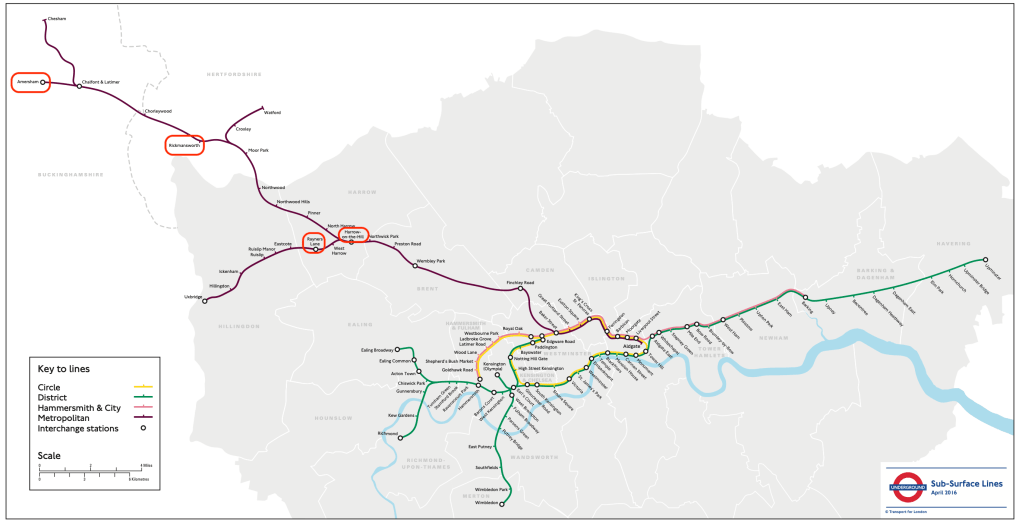
However their days are now very much numbered with CBTC almost ready for switch on in this section too so it was a delight to be able to pay a visit to both Rayners Lane and Harrow-on-the-Hill signal cabins last Thursday as part of a tour organised by the London Transport Museum Friends to see the ‘old style’ of signalling in action.

The signal cabin at Rayners Lane is situated at the western end of the London bound platform offering a bird’s eye view of the station platforms and the track towards Uxbridge including the centrally located turn-back siding. The cabin’s origins can be traced back to 1904 when a small lineside shack controlled the section of track through to Uxbridge with Rayners Lane station itself opening two years later, initially as Rayners Lane Halt. By 1910 the junction east of the station was built, originally to connect to the site of a Gas Works and the then District line, which arrived from Acton Town, later to become the Piccadilly line.
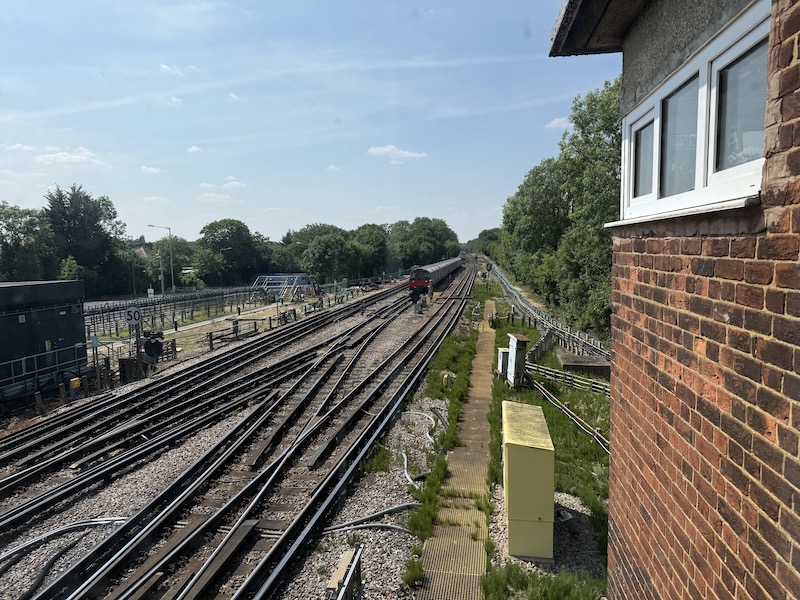
Metroland famously came along in the 1930s which saw considerable expansion including a new station and signal cabin opening in 1935 together with cabins at Ruislip and Uxbridge. Changes in recent decades have seen the Rayners Lane cabin cede control of the sidings at South Harrow to the Piccadilly line control centre based at Earls Court as well as both Ruislip and Uxbridge cabins closing in 1978 and 1985 respectively with control moving to an expanded Rayners Lane while in 1986/87 push buttons replaced the previous lever frame method of operation. Nowadays replacement parts for the forty year old console are getting harder to source as the date draws near for the transfer to CBTC.

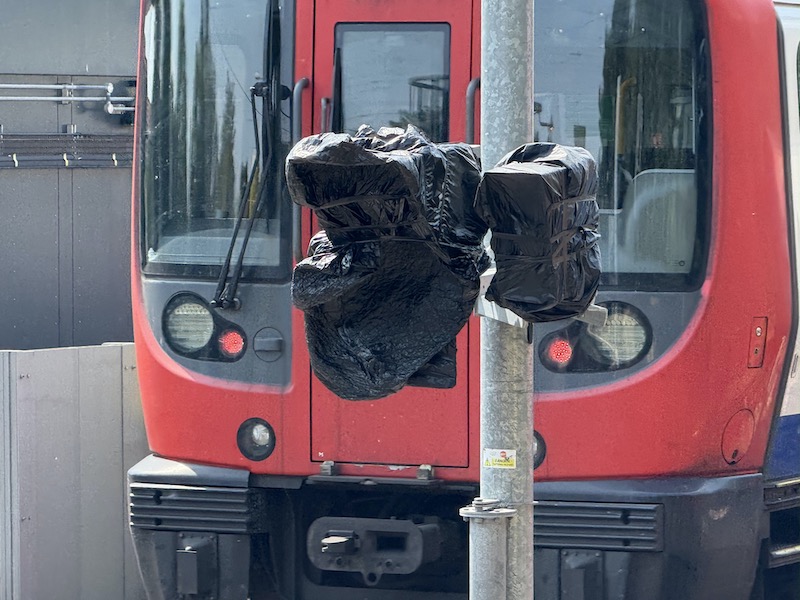
Track side displays are installed and ready for the new system but are currently covered over with black bin liners and white tape. Another tell tale sign are small yellow sensors attached to the tracks…
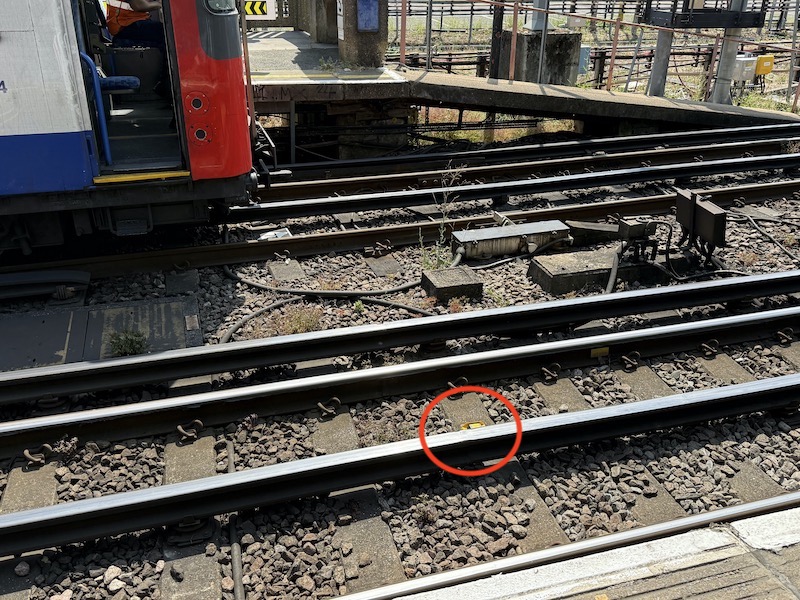
… which enable the new system to know the exact location of trains, to within six centimetres at critical locations.
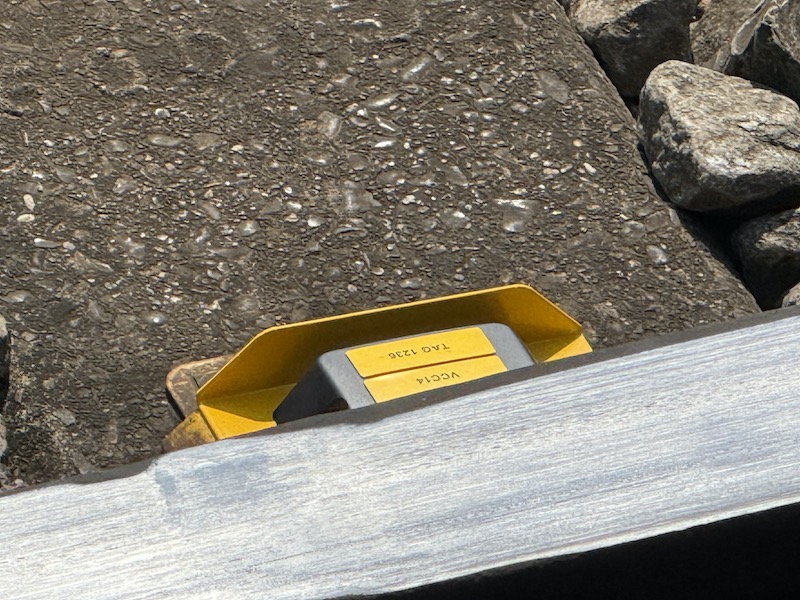
The great benefit of CBTC comes from enabling trains to travel closer to one another making frequency increases in timetables a realistic proposition compared to the conventional method of signalling.

For now, signallers at Rayners Lane rely on large traditional style wall mounted screens showing each train’s location in relation to station platforms, signals and junctions by coloured lights with buttons pressed manually on the console to clear the path or hold the train, as required, at each signal.

As you can see from the above photograph of the display, the Rayners Lane cabin controls the track from east/south of the junction between the Metropolitan and Piccadilly lines through to the terminus at Uxbridge including the centrally located turn back siding at Rayners Lane, regularly used by Piccadilly line trains, the northwestern entrance/exit to the sidings and engineering depot at Ruislip used by Central line and engineering trains and all the sidings at Uxbridge as well as the intermediate stations at Eastcote, Ruislip Manor, Ruislip and Hillingdon making for quite a workload for the signaller, especially if things don’t always go to plan.
It was fascinating to hear from manager ‘TD’ as well as watch duty signaller Trevor describe the workings of the cabin and it was obvious how much they enjoyed their work with enthusiasm and dedication as well as ensuring safety is the overriding principle behind all decisions.
After that visit it was a short ride on a Metropolitan line train down to Harrow-on-the-Hill where our small party of eight visitors found the anonymous ‘red door’ at the northern end of Platforms 3 and 4…

… through which a never ending staircase took us up high above the station platforms into the cabin.

The layout is similar to Rayners Lane with a large traditional style display on the wall, except here the reverse arrangement applies with unoccupied sections of track being lit and train locations shown by the lights turning off.

As you can see the track covered by the cabin stretches from south of Harrow-on-the-Hill through to Moor Park on the line towards Rickmansworth including North Harrow, Pinner, Northwood Hills and Northwood stations…

… and many crossovers and the junction and tracks heading towards Uxbridge. It also includes control of the tracks used principally by Chiltern Trains on the Marylebone to Aylesbury line. To the left of these boards is a display…
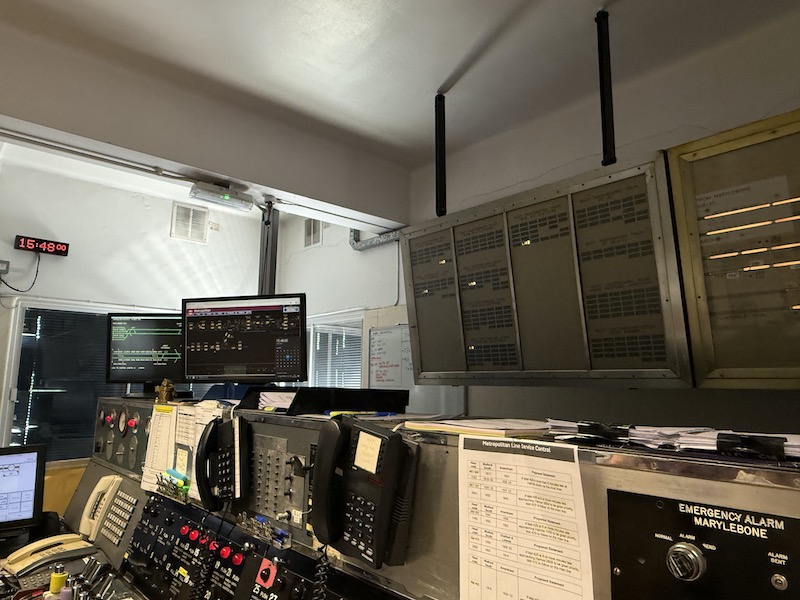
… which highlights the codes of each train approaching the section of track being controlled by the signaller.

However, the main difference to Rayners Lane is the continued use of levers rather than buttons to control the signalling as can be seen in the console in front of the displays on which there are just under 100 levers in a long line making it the largest signal cabin of its kind in the UK.
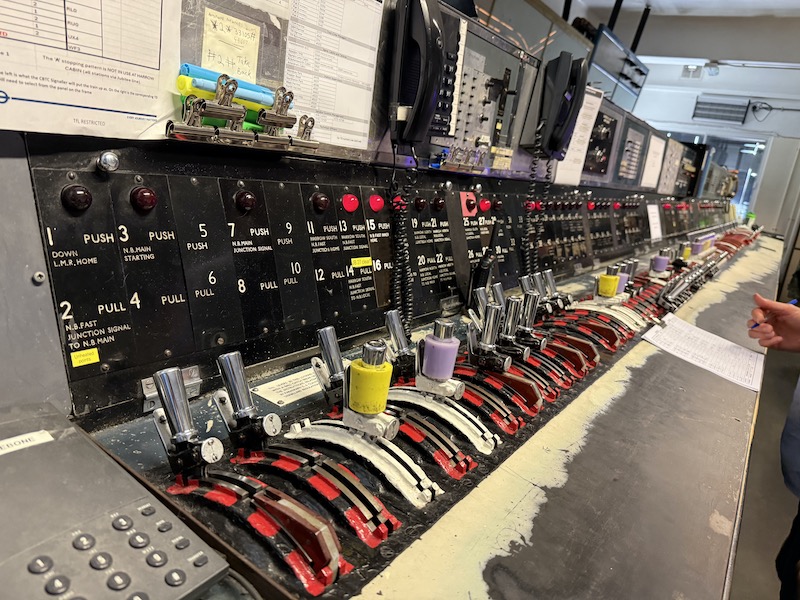
One reason for so many levers is this cabin also now does the work of what were once two further signal cabins to the south and north of Harrow-on-the-Hill. These are still in situ with their levers all working but they’re now remotely controlled by this main signal box high above Harrow-on-the-Hill station.
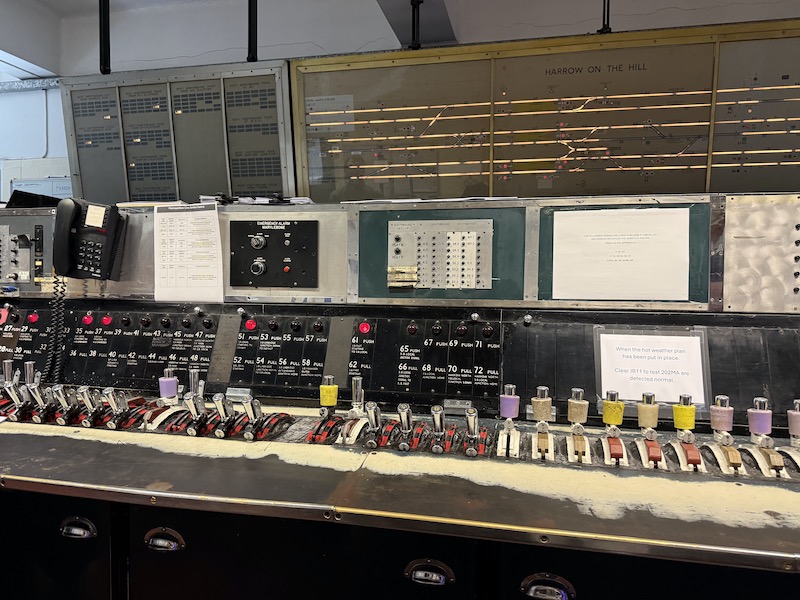
It makes for a mind-boggling array of levers and you can’t fail but admire the professionalism of the signaller on duty who just took it all in his (and then her) stride as the team swapped over for the late shift during our visit. During last week’s exceptionally hot weather special arrangements were in place to minimise risks of track damage by avoiding using the crossovers wherever possible and restricting trains to the tracks they were already on. This meant the fast peak hour Metropolitan line trains were restricted to follow the all-stations trains rather than cross over to the tracks used by Chiltern Trains.
The visit was managed for the London Transport Museum Friends by Charley who has been a signaller and is now involved in training colleagues in the skills required. Charley’s enthusiasm and passion for the job was obvious as she described the workings of the cabin to us and as a bonus concluded the visit by a look at the Relay Room on the floor below.

This houses all the electrical equipment that works the signals, points and stations displays out on the line and is part of the infrastructure which will become redundant in the upcoming months when the switch over to CBTC occurs. I got the sense the team will be sad to see all this go, they’re part of what is obviously a very friendly ‘family’ style of team working, but also a realistic recognition of the inevitability of technological progress. Charley for one, I can see, will be keen, along with the London Transport Museum, to preserve aspects of this tradition that’s coming to an end, so that it will be available for future historians and those with an interest in railways.
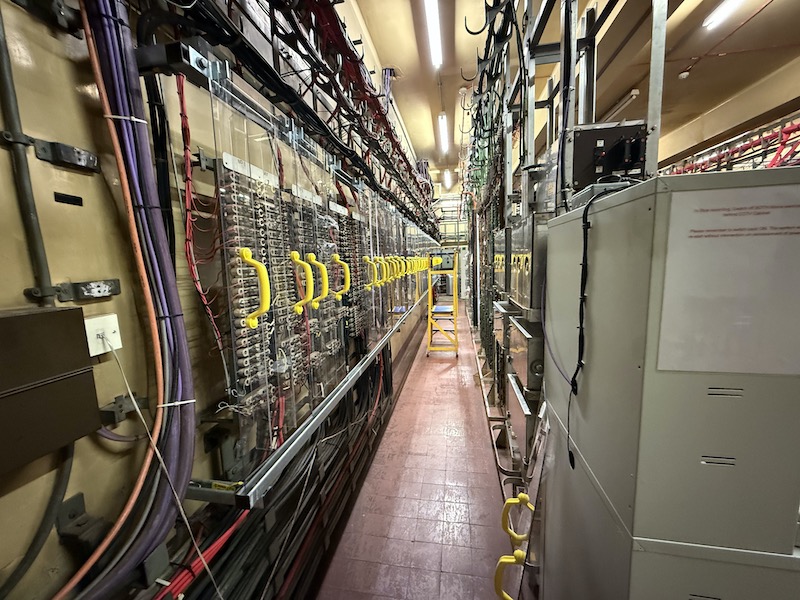
A fabulous visit and thanks to the London Transport Museum Friends and Charley for laying it on.
Roger French
Summer blogging timetable: 06:00 TThSSu


The District Railway arrived at Rayneers Lane from Acton Town, not Acton Central.
J,ohn
LikeLike
Thanks John; of course it did. I’ve no idea why I typed ‘Central’! Now corrected.
LikeLike
From Mill Hill Park…
LikeLiked by 1 person
A glorious memory prod reading this. When I was assigned to the LT Railway Staff Office in 1959, industrial relations twixt staff and management were not in the best condition. The various Sectional Council (Union) representatives for Motormen (Drivers), Guards and Station staff swanned and swaggered in and out of our office at will, few of them actually ever performing a days work doing their own job. We had to drop everything instantly and deal with whatever query “my Member” had sent them to ask/demand/complain about. The Metropolitan line of course was still operating to Aylesbury at that time and had yet to be electrified north of Rickmansworth.
But by contrast, the Signalman’s Rep, one Harry Eggleton, was straight out of the Will Hay class (a comedian for the benefit of younger readers) and a true Metropolitan Line gentleman. I believe was officially attached to the box at Chorleywood, but may have that wrong, although rarely did a shift at any box other than Sundays at premium pay rate!. But, and in true Will Hay style as in the 1930s film, grew copious amounts of vegetables in and around one of the signal boxes, and would happily come into our 55 Broadway office armed with carrots, potatoes, beans…in fact anything in season and happily distribute them amongst the three of us who actually dealt directly with the Union.
Happy memories of happy days.
Terence Uden
LikeLiked by 1 person
Pictures of the Harrow on The Hill relay room reminds me of fantastic visits to the telephone exchanges at Walton on Thames, Weybridge and Esher during Telephone Week in 1968 during my final school summer holiday. Relays that you saw had brothers in telephone exchanges especially during the period of rotary dial telephones. Traffic light controllers of that era also used relays as the pulses from the traffic detectors were of a similarity to the pulses created by a rotary telephone dial. And we must all thank Tommy Flowers for translating telephone exchange technology to the work of Alan Turing at Bletchley Park. Sections of the pictures of Colossus remind me of my happy visits to those telephone exchanges all those years ago. Walton on Thames was a fully automatic exchange; Weybridge housed the area’s GRACE (Group Routing & Charging Equipment) dealing with calls using Subscriber Trunk Dialling (STD); and Esher was where the local manned switchboard was located where they demonstrated for me the handling of 999 calls. The battery rooms at those exchanges had the very pleasant yet pungent smell of sulphuric acid. When a 999 call was received a loud bell rang and a powerful red lamp flashed. As to Underground signal box visits, my only claim to fame was on 28/07/1985, Park Junction, as part of a visit to Highgate Depot – Traffic Circular No 13 1985 refers. Alas the box was subsequently demolished. There were alterations as to Appendix 2 to the Rule Book affecting switch on and switch off times for Northern Line conductor rails. 28/07/1985 was a busy day taking in a lot of London starting for the capital by Route 218 from Hersham to Thorpe Park and then to Hounslow on a Route 116.
LikeLike
I too saw a connection between the Harrow relay room and automatic telephone exchanges, not for nothing did the term Post Office relay arise. In exchanges relays would click, noisy enough in bulk, but the real racket came from uniselectors stepping round and Strowger switches stepping up and then across. Not enough for ear defenders to be worn, but enough to interrupt conversations. I started my working life as an exchange maintenance technician, au fait with circuit diagrams of staggering complexity. Day release to get various C & G telecom certificates led onwards and upwards, but I still remember happy days at LONgford (Stretford) exchange in the 60s.
LikeLike
Too true, in the switch room of a Strowger exchange the noise was terrific. At least as a child I was used to such noise, schooled by television programmes such as “westerns” and military history (World At War). I seriously suggest that the pulse rate of a rotary telephone dial was equivalent to that of machine gun fire.
LikeLike
By 1910 the junction east of the station was built, originally to connect to the site of a Gas Works and the then District line, which arrived from Acton Central, later to become the Piccadilly line.
I think you mean Acton TOWN, although this was named Mill Hill Park at a very early stage
LikeLike
I am so envious! I would have loved to have joined that visit. Note that the lever frame at Harrow is a push-pull frame so each lever can be pushed or pulled from its central normal position according to the route being set. This dates from 1948 and incorporated remote control of the adjacent boxes from the start. The relays are vane relays, not Post Office type relays. As can be seen, these were enclosed in glass fronted containers, hence ‘fishtank’ type. One of the IRSE’s famous ‘Green Books’ sought to explain the physics of these with a wonderful amount of vector-algebra, but not sure whether anybody really understood it. By the original CBTC programme this should all have gone by 2016. To read all about ‘London Underground Signalling’ see the book of that name by Piers Connor published by Capital Transport at the end of last year. AHS
LikeLiked by 1 person
CBTC actually stands for Communications-Based Train Control, not computer-based. It’s all about the continuous track-train interaction which enables the shorter headways and/or moving block. In the early days it was often some form of inductive transmission, but radio has become the norm, particularly the huge data capabilities of 4G and 5G.
LikeLike
Many thanks for clarifying what CBTC stands for – now corrected.
LikeLike
PS: Glad to hear that Charley is still active in LU signalling circles. Always seemed very passionate about working at Harrow box.
LikeLiked by 1 person
I have happy childhood memories of Harrow on the Hill and exhilarating rides on A60 stock trains.
Pete
LikeLiked by 1 person
Thank you very much Roger, for a fascinating insight to the conventional signalling, that remains on the London Underground. Signalling, really, for me, is one of the most interesting features of Trains and Railways…if you didn’t have it – the signalling – we wouldn’t have the Trains!! I am so interested in how each train is ‘prepared’ for, ‘accepted’ and ‘passed on’…that is true for the conventional signalling right upto Present Day Level, I believe…I know its still true for places like, say, Cambridge Power Signal Box, as it has to make contact with its ‘fringes’ – boxes on the outside of the Powerbox area! I am also interested, within the ‘mix’ of signalling, how Level Crossings are catered for. Its a fascinating subject – I should think you can tell I think so!! I saw you on Geoff Marshall’s ‘You Tube’, yesterday, talking about the opening, at the end of last month, of ‘Cambridge South’. It has got to be a ‘game changer’ because many more people, from Local and National Modal Points, will be able to travel by train, to Addenbrooke’s Hospital, instead of coming by car…that must make a difference!!
Thank you.
Kind regards,
Ben Walsh,Cambridge.
LikeLiked by 2 people
Excellent article as always Roger, and some enlightening comments from your readers too. Just one from me, that yellow block between the tracks should be ‘new’ as cats would do more than ‘mew’ there.
Anthony H.
LikeLike
Many thanks, Tony. Now corrected.
LikeLike
Hi Roger,
Another excellent blog.
I attended the visit the day before and thought it was excellent. It’s amazing to see the system in operation and until you witness it you would not believe it when you have fully automated train running on other lines.
As you sat sadly a piece of history which will eventually disappear.
I thought it was interesting that the signal person at Rayners lane controlled the platform indicators at Uxbridge for next train out and platform. No automation their!!!
I have now been elected treasurer of the Routemaster Association which has its challenges. In the future it would be great if perhaps you could do an article for our quarterly magazine … of course only if that’s ok with you.
Catch up soon.
Dave
LikeLiked by 1 person
When the technology is being decommissioned and removed, is any of it being kept for museums? Or auctioned? And not just sent for scrap?
LikeLike
I used to be in charge of some District signal boxes and enjoyed my invariably tea fuelled visits. I even pulled some levers on occasion! Great people and things will inevitably change when they are all gone on the Met. The sense of ownership is very important on the Underground. Thank goodness the RMT kept privatisation at bay!
MikeC
LikeLike
The signal boxes are described as creating “quite a workload for the signaller”.
Can you share anything about the typical workload? Are they directly guiding the route of every train, requiring fairly constant attention? Or does the system operate in a relatively “default” mode for most trains, requiring intervention only in special cases?
LikeLike