
Tuesday 7th October 2025

Both TfL and Brighton & Hove Bus Company introduced a new high profile express bus route last week. It was interesting to take a ride on both to compare and contrast.
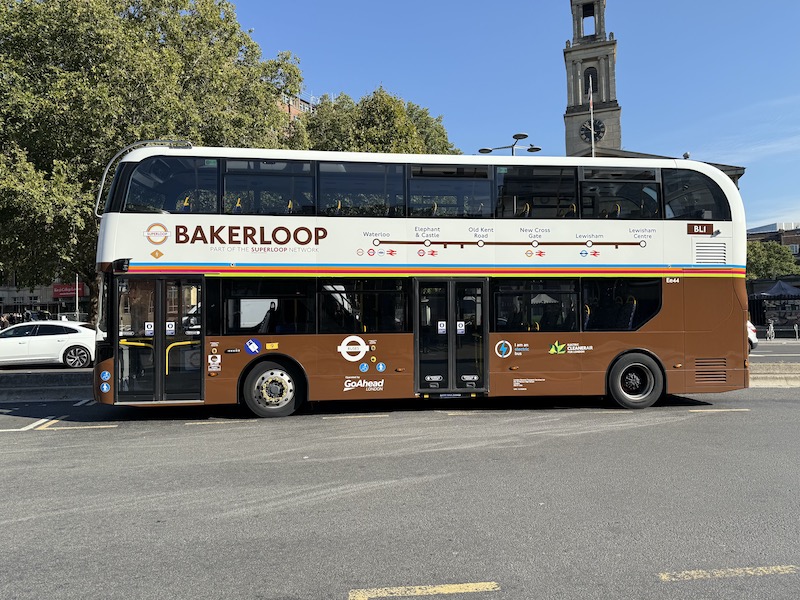
TfL’s much hyped route BL1 began on Saturday 27th September providing a quicker alternative for passengers travelling by bus between Waterloo, Elephant & Castle, Old Kent Road, New Cross and Lewisham. It’s a relatively cheap high profile way for Mayor Khan to continue highlighting the need for the Bakerloo line to be extended from its current terminus at Elephant & Castle six miles further south to Lewisham.

In 2021 the extension was estimated to cost between £5.2 billion and £8.7 billion (what’s a few billion difference between friends?) while the brand new BL1 bus route, utilising 10 double deck buses, costs just under £5 million per annum to operate, so only a factor of a 1,000 times cheaper than constructing the extension. Which makes me wonder, now the Mayor has introduced the route, won’t those who control the purse strings at the Treasury tell him there’s no longer any justification to build an extended Underground line when you’ve got an “express bus route” for a thousandth of the cost?

Go-Ahead London runs the BL1 for TfL every 12 minutes (15 minutes early and late and on Sundays) from 05:00 to 01:00 using five year old ADL Enviro400EV City buses from its base by Waterloo station.

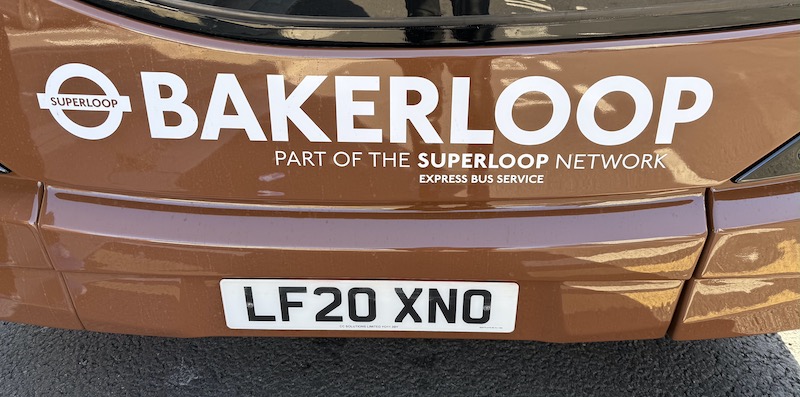
They’re smart looking buses wearing a brown version of the Superloop branding with a bespoke Bakerloop brand name emblazoned on the sides, front and rear…
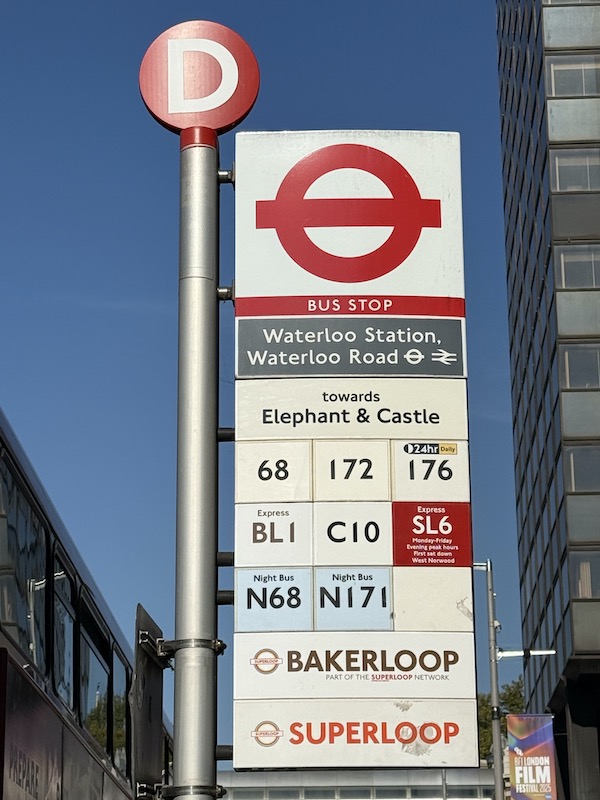
… as well as on bus stop flags along the route.
Inside, the buses sport the Bakerloo line moquette…
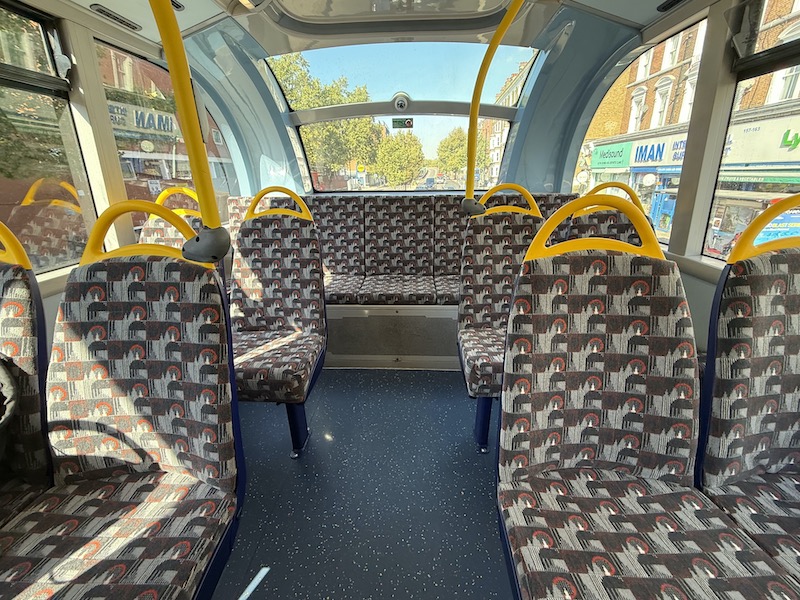
…. as can be found on the trains …

… but that aside,…
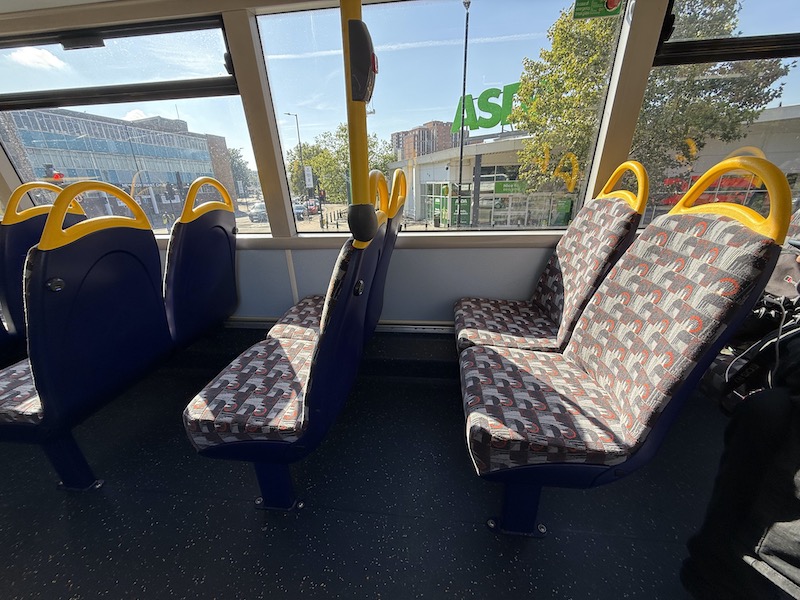
…are nothing special, although usb sockets (now becoming standard on new buses in London, at last) is a step up from what passengers enjoy when travelling on the Bakerloo line itself.
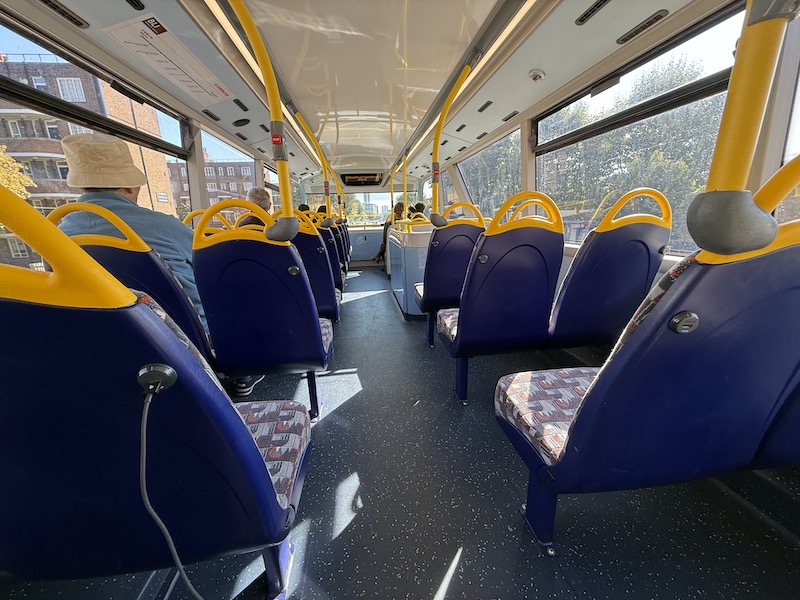
End to end journey time according to bus stop panels along the route is 26 minutes but that’s only achieved on very early and late journeys with daytime trips allocated 34 minutes and peak hour journeys timetabled to take up to 38 minutes.

However, trying the route out last Tuesday late morning and across lunch time saw buses taking much longer due to a closed bus lane…
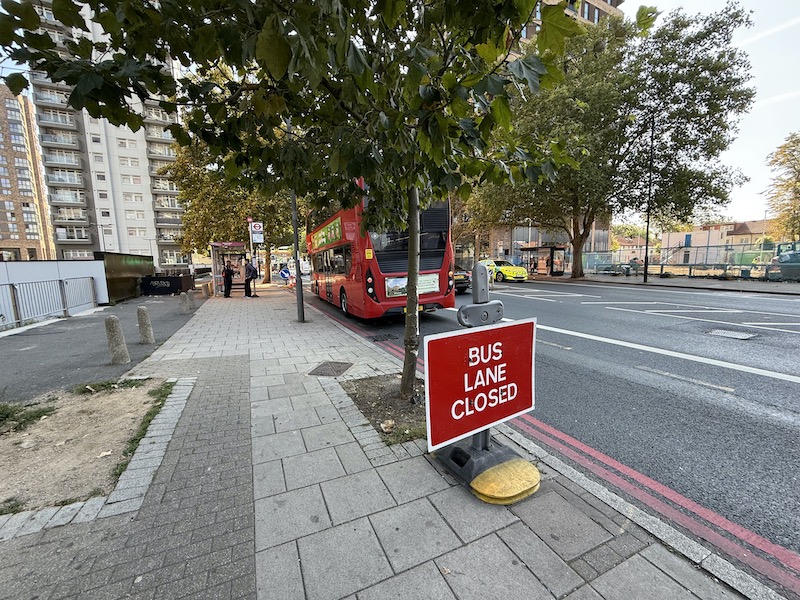
…and roadworks…
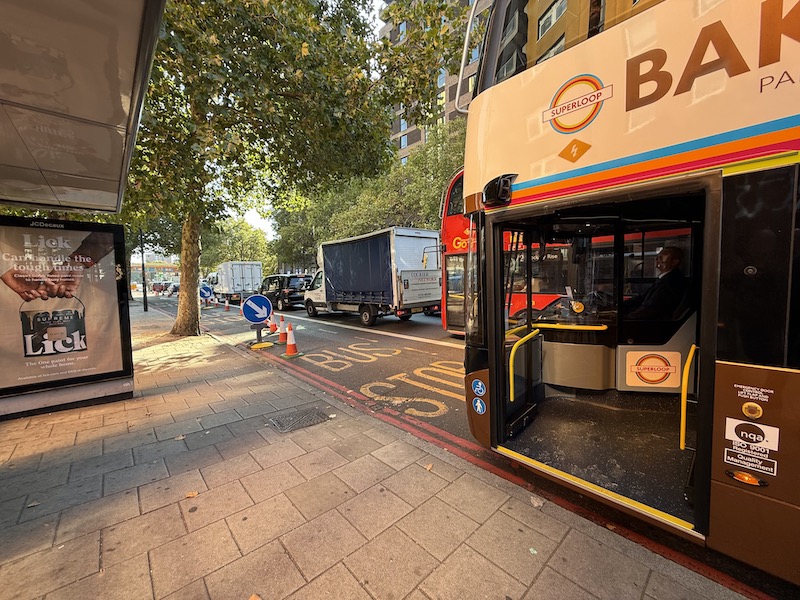
…where the Old Kent Road turns into New Cross Road causing ten minute delays.

Numbers travelling were encouraging for only the route’s second weekday with passengers obviously becoming familiar with a quicker alternative than what has previously been on offer – indeed, a journey from Waterloo to Lewisham until last weekend involved a change of bus along the way.

One benefit of the reduced number of stops along the route – as you can see from the TfL route map above, there are only five intermediate stops in between Waterloo and Lewisham – is that southbound buses take advantage of the flyover at the busy Bricklayers Arms roundabout, saving vital minutes.

Back at Waterloo the arrival of the BL1 has meant a raft of changes to the bus stop arrangements for other bus routes with brown buses taking over the prime layover point just before the South Bank roundabout.

Route 59 now observes stop E not D, while route C10 uses D not E (work that one out?). At Elephant & Castle route 415 uses M not N and K not J and in Lewisham route 436 passengers now have to use stop U as it no longer stops at S while in Old Kent Road the P12 uses ER rather than ES. Hope that’s all clear.
TfL has been plugging the new route on social media as well as taking commercial advertising space at some bus shelters to raise awareness…
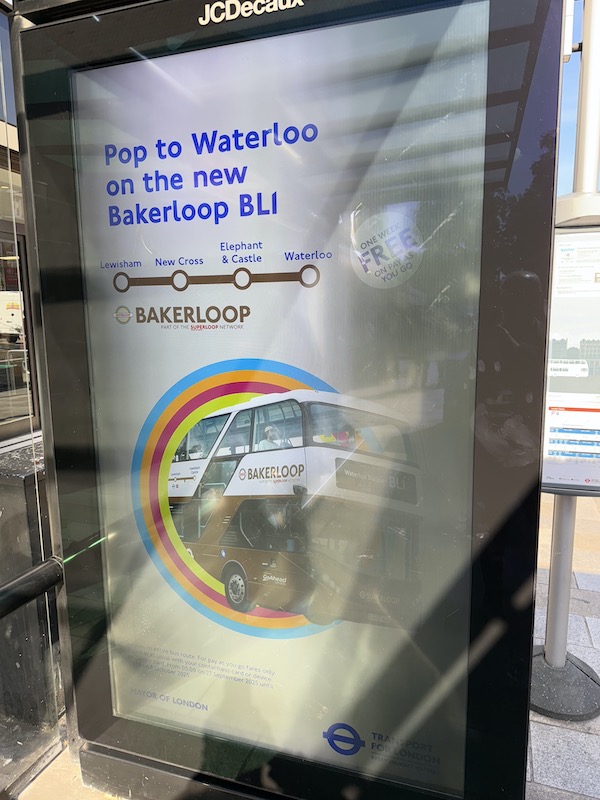
… but I was surprised and disappointed not to see any reference to the new route inside Bakerloo line trains nor at Elephant & Castle Undergound station, save for a poster by the entrance (with another also on display at Lewisham’s DLR station).

I’d have thought it would have been a good idea to add the BL1 to line diagrams both inside the trains…

… and on platforms for maximum effect…
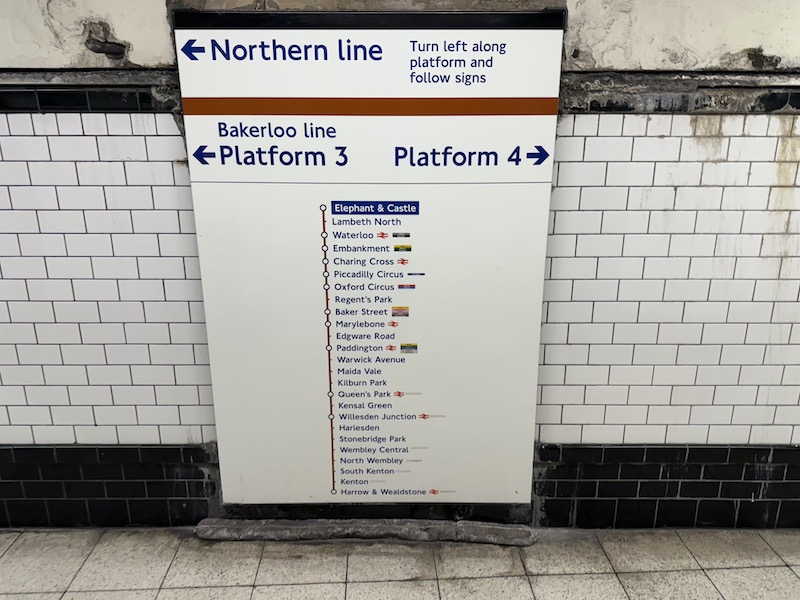
… albeit with a dotted line and explanation of the Bakerloop brand. And perhaps add a reference to it on the Way Out signs at Elephant & Castle…
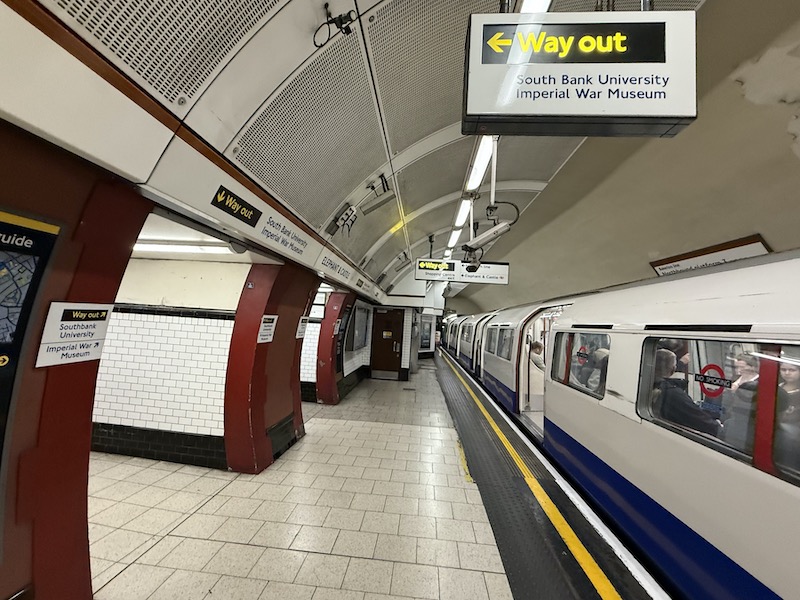
… and use the panels in the lifts for a poster or two.
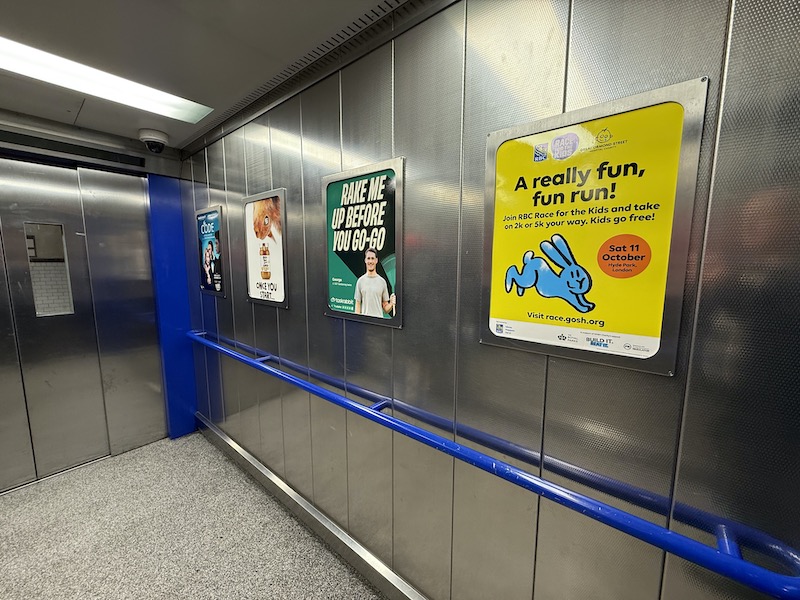
Otherwise why on earth is is called Bakerloop? Other than being a Mayoral Gimmick.

It’s not a “loop” and if you don’t closely associate it with the Bakerloo line, what’s the point?
TfL adds it’s “PART OF THE SUPERLOOP NETWORK” (and if you look closely you’ll see underneath the word SUPER (above photo) that it’s an “EXPRESS BUS SERVICE” (in about 6pt print size) but bus shelters only proclaim it’s Superloop…

… as do the driver cab doors…

… with line diagrams on the interior cove panels inside the buses referring to BL1 and Superloop but not Bakerloop…
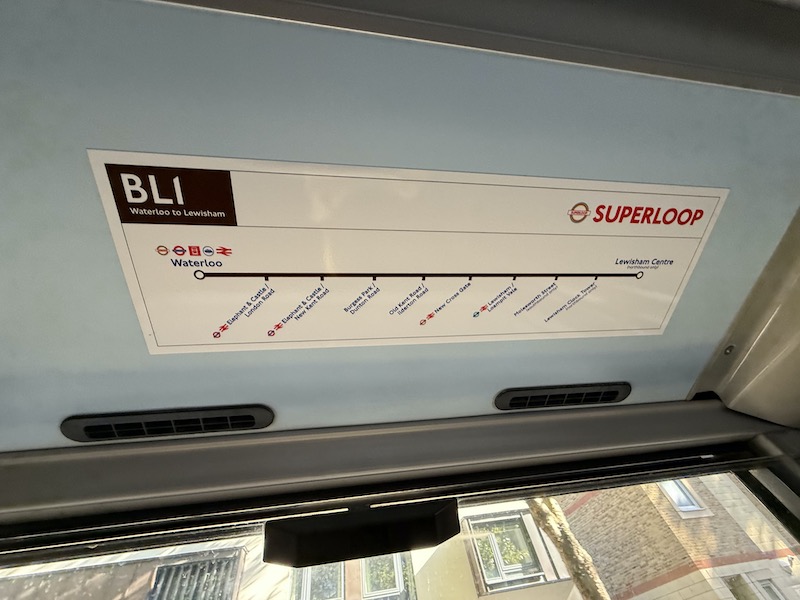
… but the Bakerloop brand adorns the bus stop flags.

The whole Superloop brand is in danger of losing its way with more new routes to be added in the coming months which will only serve to dilute the original intent which I thought was to promote a network of quicker, express bus routes encircling London’s suburbs.

It might be helpful for the marketing people at TfL to have a chat with those who really know what they’re doing in the bus industry, for example, take a trip down to the seaside and see what Brighton & Hove is up to with its latest initiative, as I did on Monday last week.
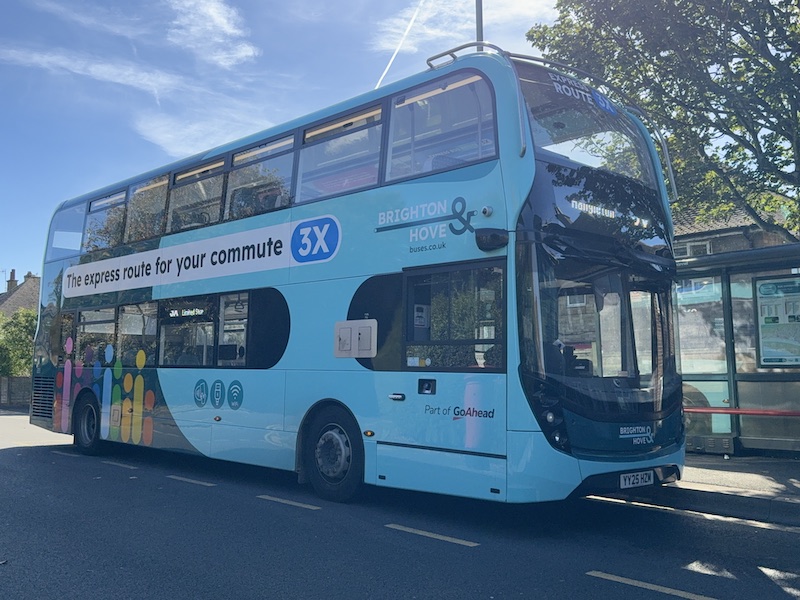
It’s another brand new cross-city express route for the company – the 3X, between Hangleton on the north west side of the city and Brighton University’s sites along the Lewes Road and terminating at its Falmer site adjacent to Brighton & Hove Albion’s football ground.

You’ll notice something different to Bakerloop just from the above images, not least major points served along the route – Hanlgeton, Hove Station, Brighton Station, Lewes Road and Falmer – are emblazoned in large print between the upper and lower decks on the sides of buses so they can easily be read which contrasts with the rather smaller print size on Bakerloop bus sides.
And then there’s a very clear route map available online…
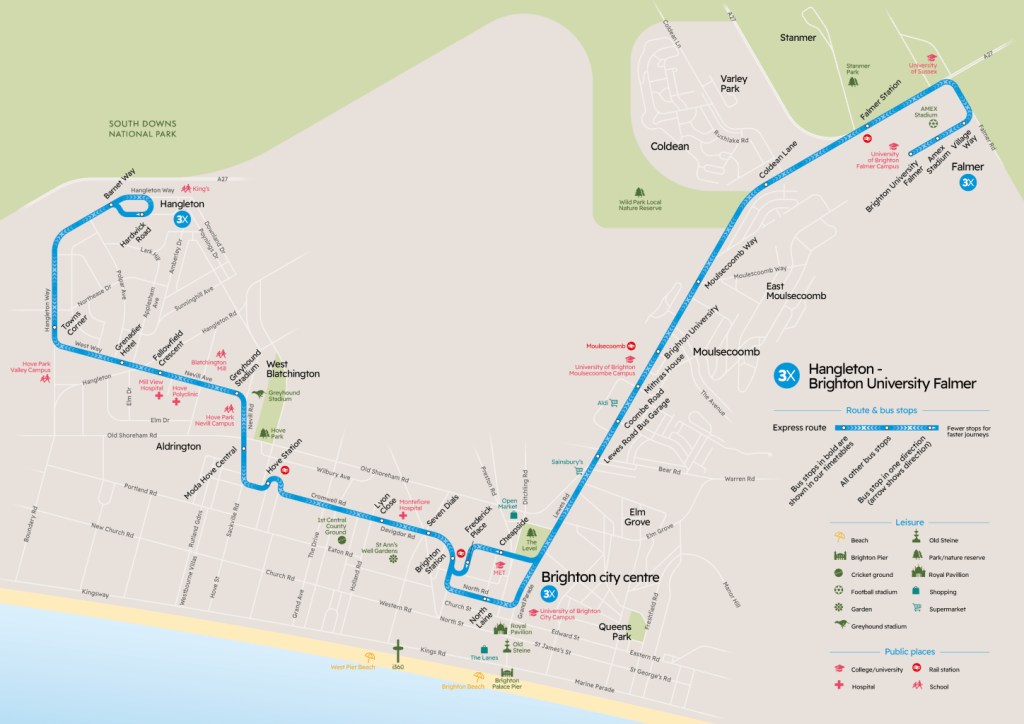
… and also in a timetable leaflet which can be picked up from buses on the route.

And, as always when I see timetable leaflets, I see passengers taking them and using them – even smartphone obsessed students.

There are no timetable leaflets for the Bakerloop BL1, nor a route map – the one I included at the top of this blog is from TfL’s consultation for the route many months ago, which is the only time TfL deem it necessary to produce some form of cartography to help passengers understand where its routes go. Once that’s done, you’re on your own without a map. Brighton & Hove also produces (and updates) a full colour network map too – something unheard of for passengers trying to work out where London’s buses go.
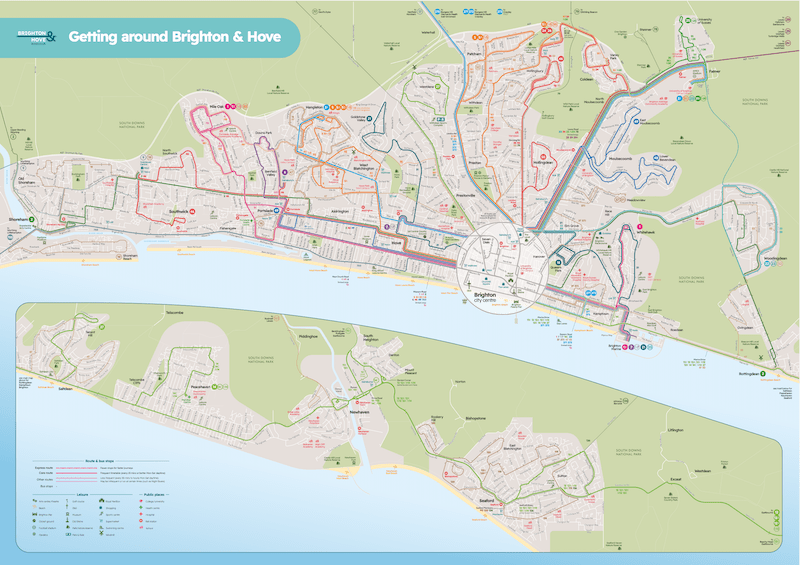
And copies are posted at bus shelters throughout the city, together with scheduled departure times for buses passing by…
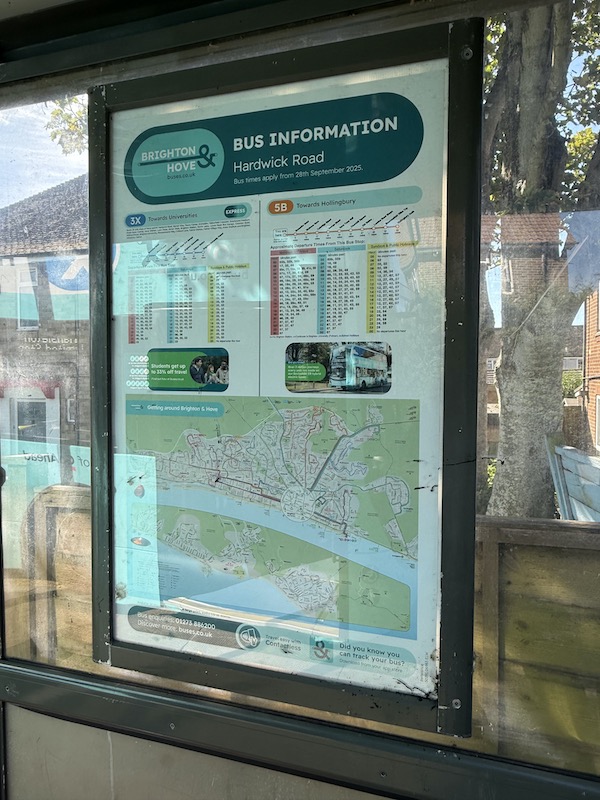
… rather than a vague “about every 11-13 minutes”. (Why not just say ‘every 12 minutes’?)

Route 3X runs every 15 minutes between 05:27 to 00:16 (half hourly on Sundays from 06:55 and 23:44) and is operated from the company’s bus garage in Lewes Road using eight brand new ADL Enviro400 MMC buses.

These buses really are very comfortable and stylish with all the latest accessibility features, making those on the Bakerloop look rather basic.

There’s also a clear diagram of the bus stops served by the 3X, albeit rather small print size…

… with none of the confusion you’ll find on the Bakerloop equivalent poster trying to explain the situation in Lewisham with one stop ‘southbound only’ and two ‘northbound only’ but on the same line diagram.

Like with Brighton & Hove’s express route 1X introduced in July 2024, bus stops served by the 3X are clearly designated with a separate pole and a 3X sign on the top.
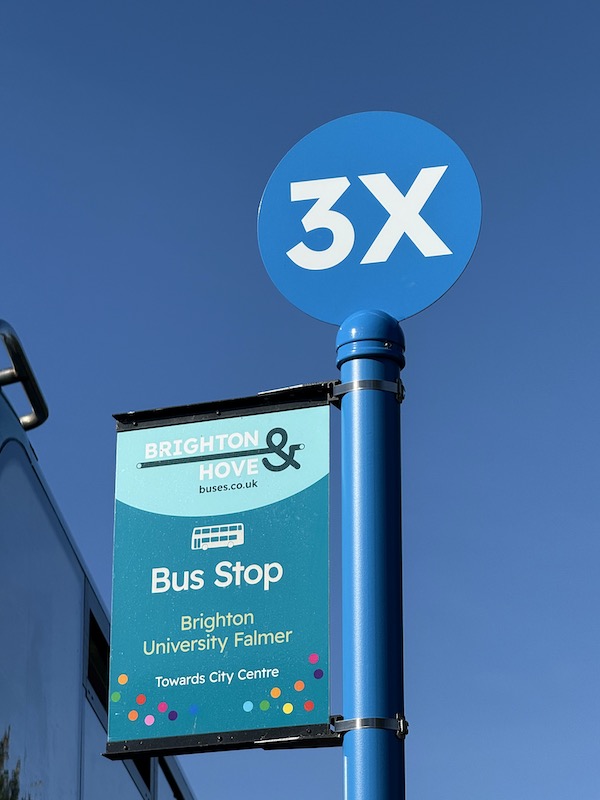
… and the promotional campaign, like Bakerloop’s, involved social media, posters on the gateline at Brighton station and banners on lamposts along Queens Road and Lewes Road in Brighton.

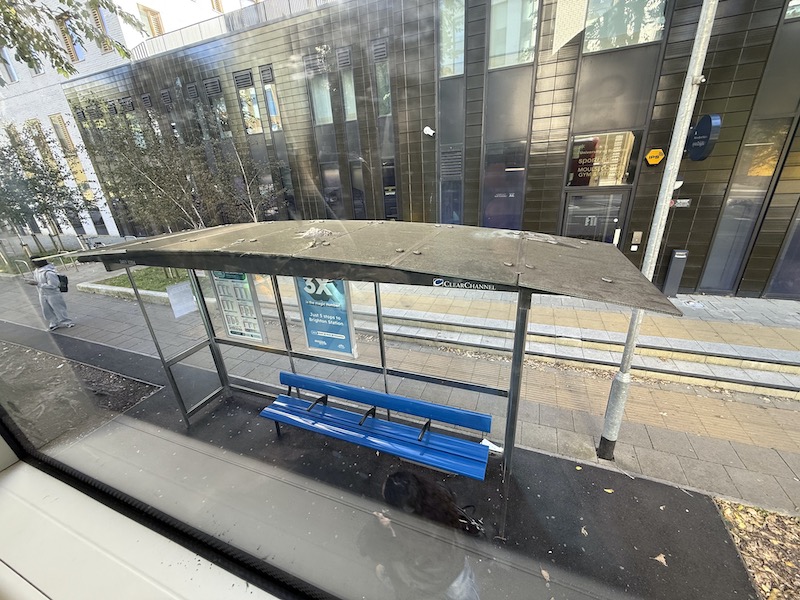
Many bus shelters also have posters promoting the express nature of the service…

… highlighting the reduced number of bus stops to major points such as Brighton and Hove stations, because the route offers greatly improved journey times from Hangleton to both stations as well as between these points and the Lewes Road and Falmer.
It was all very impressive to see and the ride I took up and down the route on its first Monday morning last week was busy with students as well as other passengers and this, before the University had fully returned for the new term. It all bodes well.
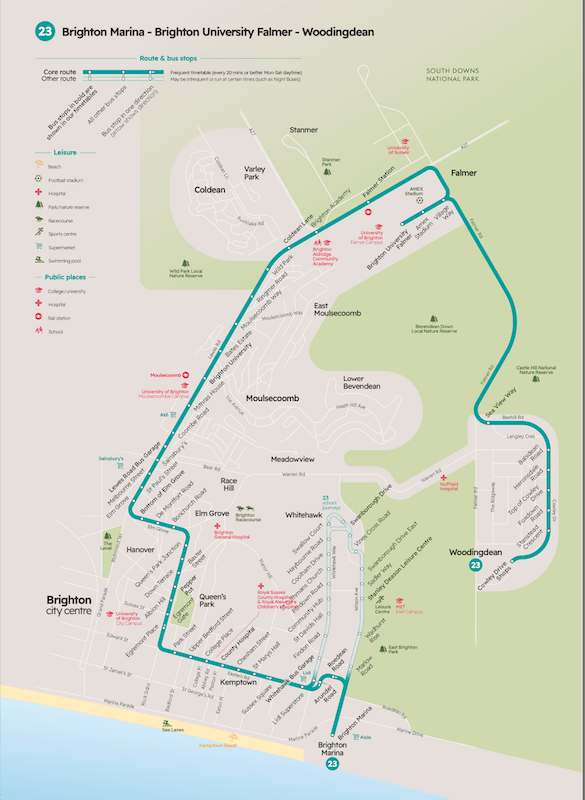
For aficionados of Brighton’s bus network, improvements introduced from 28th September also included an extension to half-hourly route 23 from Brighton University’s Falmer site over to Woodingdean…
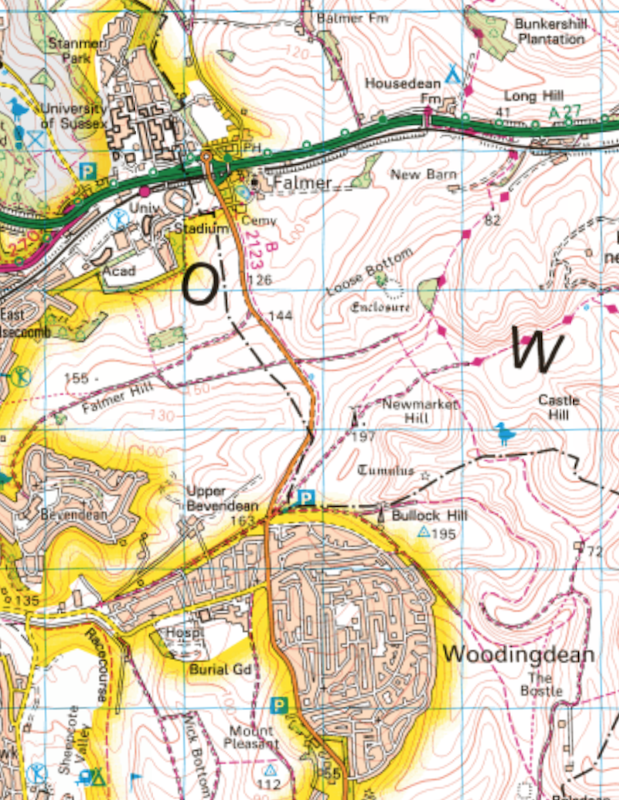
…providing a much requested link between the two locations, but previously always difficult to provide on a financially sustainable basis. It’s a lovely section of route along the B2123 across the Downs but there are no houses, shops, offices or bus stops to be served.

The need to add a bus into route 23’s cycle to improve timekeeping and help from the city’s Bus Service Improvement Plan’s funding – which has also helped kickstart the 3X – has meant this route extension is now a reality…

… giving the large residential area of Woodingdean, nestling in the Downs, …

… a convenient direct link to Falmer and Lewes Road with buses then continuing via Queens Park and the Royal Sussex County Hospital to Brighton Marina, almost back to Woodingdean.
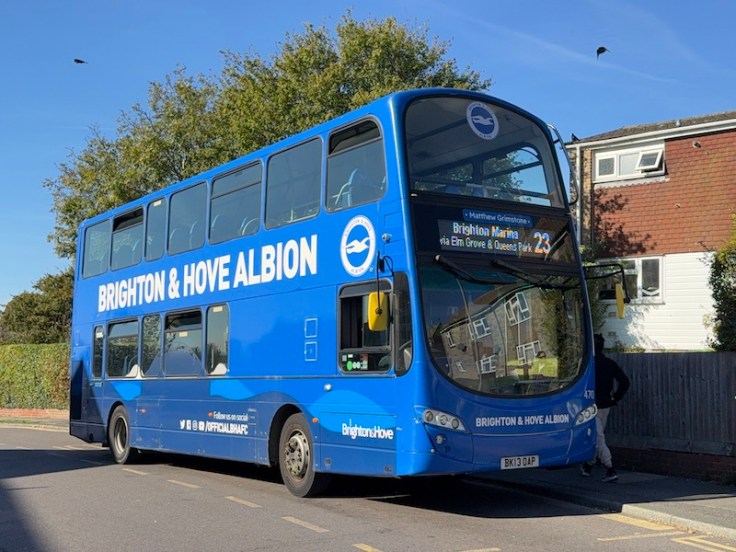
Back in my day I was always sceptical whether the demand was there for such a link, so I was pleasantly surprised to see two or three passengers make the journey in both directions when I took a ride last Monday, the first weekday of the new route. Although it will need more than that for a secure long term future.
Finally, the rather convoluted arrangement whereby route 25 served both Sussex University and Brighton University sites at Falmer has been sensibly rationalised with the 25 now serving just the former and the 3X, 5B and 23 the latter while the 25X provides a link to Sussex House at the former as well as the latter and the N25 serves both sites. All helpfully explained in map form too.

It was great to bump into Commercial Director Nick Hill and his team also travelling and experiencing the new routes last Monday – and how refreshing to see managers out and about seeing things for themselves ‘on the road’. There’s no better way.
Hopefully the team at TfL do that too.
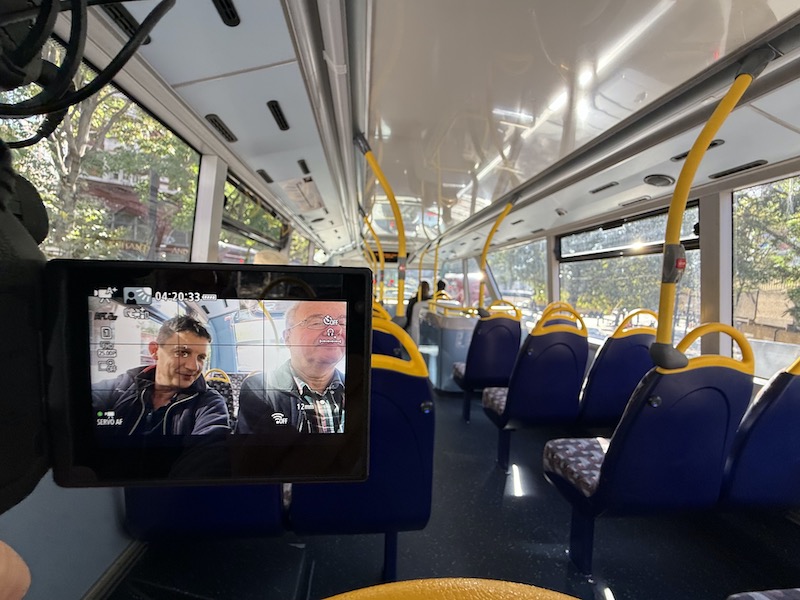
My Bakerloop journey last Tuesday was with my friend Geoff Marshall and make sure you give his video on the BL1 a watch on his excellent YouTube channel.
Roger French
Blogging timetable: 06:00 TThS
 BusAndTrainUser
I took a ride on Bakerloop last week and left thoroughly impressed. The driver of the bus I was on made public address announcements at every stop and even apologised the Superloop sign hadn’t been erected on the Elephant and Castle bus stop.
Passers by were heard to comment saying that’s the new non stop route. I even took a photo at Waterloo of people whose heads were turned by seeing the bus.
Loop isn’t the correct title for a radial route. In the 1970s Liverpools railway system was joined up by the Loop and the Link the later being a more sensible title for radial routes.
According to Google the name Superloop originated from an idea by the then Mayor of London in 2008. The one that was going to lie down in front of the diggers to prevent the third runway at Heathrow
What a beautiful irony it would have been if Bakerloop had been a bendybus with passengers boarding at all doors … bit like a train!
John Nicholas
LikeLike
In his manifesto, the Mayor elected in 2008 promised a network of orbital express buses in the suburbs.
During his eight years as London Mayor, he delivered… a frequency increase on the X26 (now SL7) between Croydon and Heathrow. That apart, his promised network of orbital express buses was nowhere to be seen.
Malc M
LikeLike
Boris didn’t tell the truth… I’m shocked!
BW2
LikeLike
BL1 about 35 minutes. Train about 20 minutes
LikeLike
The trains don’t stop at Elephant & Castle or along Old Kent Road.
Julian Walker
LikeLike
Indeed not. Inner south east London is poorly served by rail, particularly in and around Burgess Park.
There is a “hole” in the rail coverage map, with no station within 1 kilometre of parts of Camberwell, Walworth, North Peckham and Old Kent Road, surrounding Burgess Park. Densely-populated areas, but nowhere else in inner London is as far away from any access to rail services.
For end-to-end journeys between Lewisham and Waterloo, the train is a lot quicker (albeit the intervals between trains can be a bit lumpy).
Malc M
LikeLike
Wow, a whole kilometre.
Don’t mind me if I don’t burst into tears at the very thought.
LikeLike
@Anon 07:54
Yes, I know, it’s terrible, isn’t it.
Now look at the population density of that part of inner London. Then you might start to understand why lack of rail access is an issue. Or you might not.
Malc M
LikeLike
There is a beautiful paradox that Brighton and Hove buses having received many awards for accessibility initiatives, now wins an award for a limited stop route in an urban environment taking away the very essence of accessibility, the bus stop!
Commiserations to Pronto, 101 and 43 all in my top ten favourite bus routes that I make a point of riding on in my travels!
John Nicholas
LikeLike
What is “Pronto” and where do routes 101 and 43 go?
LikeLike
These routes were runners up in National Travel Awards for best bus service to Brighton 1X.
Pronto is the fast inter urban service between Nottingham, Mansfield and Chesterfield operated by Stagecoach. It runs every 10 minutes between Nottingham and Mansfield, there’s usually a bus waiting at the terminus ready to board, hence the name “Pronto”.
The 101 is Maidstone to Medway Towns operated by Arriva swiftly taking passengers direct between town centres up Bluebell Hill.
The 43 is Edinburgh to South Queensferry route operated by Lothian Country.
They are no nonsense inter urban routes which also provide local links for students and shoppers at retail parks en route with a perception your getting somewhere quickly.
I appreciate the evidence presented for the award was likely to appeal to an industry perspective rather than a customer perspective.
John Nicholas
LikeLike
Thank you for the information. My only experience of bus travel in Scotland was a disaster as Lothian Regional Transport was operating a “no change given policy” and I over-rode my stop inadvertently and needed to do a lot more walking in Edinburgh than I was planning. As to Route 101, I may have done this on 05/08/1989 using a M&D Explorer. Out on an Invictaway 980 from Victoria then from Maidstone back to London via the Medway towns and Kentish bus (Explorer accepted) services to connect with the London bus Network. Quite a long day. £2.40 for my Hersham issued ODTC and then £4.30 for the Explorer. Lots of drinks in Maidstone, sleeping on buses doing the town routes in hot weather then the long haul back to London via Bluebell Hill. As to Nottingham, Mansfield and Chesterfield: motorcycle era on L-Plated (Honda CD175) visiting cathedrals and “football towns” such as those cited on Classified Football Results late Saturday afternoons.
LikeLike
“Pronto” is what old farts like me remember as the jointly operated East Midland/Mansfield & District and Trent service 63 between Chesterfield, Mansfield and Nottingham, which the ever-trendy and number-disliking trentbarton renamed some years ago.
Only for trentbarton to pull out entirely when loadings reached the point that double-deckers were required on many journeys, trentbarton having an irrational dislike of such beasts despite them being used by their associated companies Notts & Derby and TM Travel, leaving the route to be operated entirely by Stagecoach East Midlands (Lincolnshire Road Car, not the original East Midland company!).
Pandemic loadings dropping led to schedule reductions with “pronto” branded double-deckers being transferred to Lincoln, although they seem to have vanished (or at least been repainted into standard livery) now.
LikeLike
I must admit being cynical about names replacing route numbers until I started using services in the East Midlands a decade ago.
Which bus goes to Calverton, the Calverton Connection, simple.
As I write there are 11 Pronto branded buses on the route with two generic Stagecoach liveried. One Pronto branded bus is off road, none are on wrong routes.
Isn’t open data brilliant, It also allows me to commend National Express West Midlands for the swift 35 minute journey from Birmingham to Walsall I’ve just undertaken arriving dead on time aboard the X51 a true express route.
John Nicholas
LikeLike
The new 25X doesn’t even serve Coldean Lane were many Brighton Uni. Residents live. Pretty poor planning there. I also don’t expect the 23 extension to last which probably would have been better turning into a looped service to improve reliability.
LikeLike
Yeah I hear that residence said they already have the 52 to the marina. 23 it only served half of woodingdean and residents of Warren Road would have liked been served . When I first saw the Route map I thought it should have been a circular Continuing from woodingdean cowley Dr to falmer Road, Warren Road, then either Wilson Avenue and the marina or bear Road back to Lewes Road.
LikeLike
Isn’t the word “loop” merely produced by adding a P to Bakerloo – thus indicating the connection between the train and the bus with the latter being distinctive to a normal all stops service?
LikeLike
It really is “Falmer” this time!
LikeLike
Regarding the TfL brands ‘Superloop’ and ‘Hopper’ (fares) – both, to me, seem ‘amateur’ and perhaps imposed by someone senior rather than properly thought through by marketing experts
LikeLike
Both names were imposed by City Hall and appeared in the mayor’s election manifestos.
LikeLike
Yes, I think the Hopper name predates the current mayor and was used in a bunch of election manifestos including the LibDems.
LikeLike
Urban minibuses with “Hoppa” branding were once ubiquitous throughout the land.
Peter Brown
LikeLike
When it comes to brand recognition, my observation is that very few bus brands, of which many are created, actually register at all with the public. I’d suggest that both Superloop and Hopper have done so. You may consider them ‘amateur’ but often simple is memorable and therefore best!
LikeLike
As you say the simplist unique names provide the greatest resonance.
I spoke to lady in London who came from Long Eaton, “if I said if I said Indigo would you know what I was talking about” she replied “that’s the bus to Nottingham”.
Was there a new map in One Stop Travel including the 3X?
I replied “it definitely exists because I said hi to the Roadside Infrastructure team who were putting them up in the Lewes Road”.
John Nicholas
LikeLike
Agreed, both these terms are well known and understood and have been successful as a branding exercise.
Purely anecdotal but those of my work colleagues who also use the new BL1 seem to refer to it solely as the “Bakerloop” rather than the route number! From my experience so far it’s already a busy route – well done TfL and the Mayor 🙂
LikeLike
If we’re being as nit picky about B&H as we are about TfL, someone should sense check the 23 and Falmer maps. Putting “Core Route” and “Other Route” as a legend is pretty unhelpful. Also why are hospitals shown under leisure facilities? I looked at the second map of Falmer last week and it shows the challenges of geographic maps where there are multiple different loops in an area (see also Uno 242/243 in Potters Bar).
LikeLike
Brighton and Hove have completely lost the plot with their maps. Especially the one posted at bus stops which implies a new island has emerged out of the sea in the English Channel.
All maps on buses required replacement with the introduction of route 3X.
Little thought appears to have been given to how this should be achieved as even last week I came across buses that still had the original map before the introduction of route 1X.
This led to my assumption B&H don’t have mystery customers who would be expected to notice these poor standards, which was confirmed by a representative of B&H when I asked at an event.
John Nicholas
LikeLike
I used to work with the guys who prepare the TfL timetable panels. I suspect / hope they shared my dislike of the ‘every 11-13 minutes’ nonsense but had to do it. I believe the reason is that there are a couple of journeys within the relevant time band that have 11 min intervals and a couple with 13 min intervals, but the rest having 12 min intervals, so they have to state ‘every 11-13 mins’ to avoid being inaccurate. A case of comprehensiveness trumping comprehension. I think there was a maximum ‘range’ permitted, perhaps 4 mins, allowing such unhelpful text as ‘every 7-11 minutes’ which allowed the best use of space available on the panel.
LikeLike
I think the issue with TfL and maps is that they assume everyone is an individual, planning their own travel, on a ‘from w to x on y date at z time’ basis, so suited to a journey planner, forgetting the diversity of journey planning purposes, learning styles, ways of planning, and serendipity of exploration. And there’s the cost saving of course too.
LikeLike
USB sockets on TfL buses is hardly something new. All electrics have had them since 2016 and ALL new buses have had them since late 2019.
Meanwhile GoAhead had a fleet of around 100 new buses delivered to Cornwall in 2020 with not a single USB port between them.
Steve
LikeLike
London’s and Brighton’s new buses also have faster C to C USB sockets with much improved charging times. I have noticed one operator has retrofitted these to Enviros which are some of the oldest buses in their fleet.
John Nicholas
LikeLike
Whilst I love buses as much as the next busandtrainuser reader I think it’s unfair to compare the cost of a bus service with a high capacity modern underground metro. It’s like comparing apples with light bulbs. A tube line will have a capacity of tens of thousands of people an hour whilst five buses and hour on the Bakerloop service is clearly only a few hundred.
Promoters calculate that a Bakerloo upgrade and extension would add £1.5bn GVA annually to the UK economy.
The extension would support tens of thousands of new homes in a way that a bus service never would.
LikeLike
You beat me to it!
5 x double deck buses per hour provide less capacity than just one single Bakerloo line train.
Despite being limited stop, the bus will never provide anything like comparable journey times with the Underground – if the Bakerloo line extension does ever get built (and I hope it will), it will link Old Kent Road direct to the heart of the West End in 15 minutes, with a train every few minutes. The bus will never achieve that level of connectivity.
One of the things that holds back the UK’s productivity is our lack of investment in high-quality public transport which would connect people to a wide range of jobs or training. I don’t think it is a badge of pride that the largest city anywhere in Western Europe without a tram or metro system is Leeds (it does have suburban rail, but that doesn’t provide comparable frequencies, or coverage of the inner city districts) – unless I am mistaken.
Malc M
LikeLiked by 1 person
The Treasury sticks to the neoliberal play book (small state, low tax), so doesn’t like spending money on ordinary people. They can’t see that this is actually investment and will unleash productivity gains and the desired growth. The Bakerloo Line 1972 stock is life expired, new trains are long overdue, everyone knows this. The new trains and the extension should already be under construction. As the existing fleet may not be enough to serve a longer line at current frequencies. The trains should be an add on to the Piccadily line fleet reducing the unit price, and maintain the supply chain.
Peter Brown
LikeLiked by 2 people
As the Treasury treats people transferring from car driving to being a bus passenger as a loss of fuel duty, the odds are stacked against public transport investment.
Gareth Cheeseman
LikeLike
So what will they do when most cars are EVs then? They won’t pay fuel duty either.
Aaron
LikeLike
Can’t understand why the long awaited 23-Woodingdean to Falmer is not extended down to Rottingdean thus providing connection with the Coaster/Coastal services along to Eastbourne. It would also then provide the opportunity to get to Falmer and hence to Lewes etc. without changing from the 2 to 23 in Woodingdean.
LikeLike
If they are going to have to change somewhere in any case, it might as well be in the centre of Brighton, which requires no extension or further spending.
LikeLike
Most places in Brighton you can get to by taking two buses.
LikeLike
The road across the downs used by route 23 has traffic congestion during peaks where traffic regularly dawdles and there are queues into Rottingdean.
Personal observations reveal elongated traffic jams caused by motorists expecting the delay on this road and leaving a bigger gap with the vehicle in front so that they can catch up with their phone text messages.
I’ve seen this phenomenon in other places where queues regularly occur.
The 23 I caught to Woodingdean ran empty to Queens Park to catch up time. The following bus was slightly late and on the return journey when it arrived at Falmer Station there was a sea of intending students for Queens Park after 45 minute gap in service during evening peak.
John Nicholas
LikeLike
Great to see both of these routes. I have for a long time been lamenting the lack of interest by the bus industry in express buses! I’m still awaiting interurban express bus routes where there are no (and sometimes have never been) rail options; as well as regular local routes, that is, not instead of them. Hopefully, as and when Heidi Alexander has time to address the government’s ambition to improve integration, this will start happening, though it will need a change of attitude from some bus and rail managers.
What that will achieve – and what I hope the 3X and BL1 will do – is extend the range of places where (from home) you can spend a morning, an afternoon, or an evening by public transport; the lack of this at present is, in my experience, and from talking to other people, a major reason people use cars. It would of course be better if these services could be integrated with rail – where rail exists but, again, that might need managers to talk to one another constructively
LikeLike
Hangleton to Falmer already existed with the 5B Mondays to Fridays it does take around an hour & a half where the new 3x is a limited stop that takes around 50 minutes.
LikeLike
You are correct, there was an instance where every every 9-10 minutes was shown for a route that ran every 10 minutes with the exception of a running time contraction on the last journey in the time frame.
You are actually telling people what service is in daytime, peak, evening etc. That can easily be solved by shortening the time frame of the query that produces the value.
Obviously there may be nefarious reasons for using running time contractions to make the advertised frequecy appear better than scheduled.
I love the timetable for the 192 in Manchester, every 10 minutes, the longest time you have to wait and then three turn up together!
John Nicholas
LikeLike
Not all bus service publicity at Waterloo is up to date. Ironically the spider map at the BL1 alighting point makes no reference to the service. Stop E doesn’t have a timetable for the 59 and the local map on the bus stop post still shows the old stopping arrangements. Only 7/10 TfL I’m afraid
Martin W
LikeLike
Manchester’s 192 Timetable has , certainly of GMPTE after privatisation, an aspirational indication rather than any kind of clockwork despatch, there are so many incidents arising potentially on the road or bus that the main consideration that enough capacity per hour is provided , at least at runout, and that last buses do not run early (something I have seen TfL services do)
Maybe indeed in London routes that go spoke should be Superlink. But the Bakerloop name I think came out of local people and enthusisasts as much as TfL management.
Others have mentioned the faster journey time and greater capacity a tube line will bring. Interestringly a Lewisham Tube stop could give mildly quicker – or less hassle – of getting to Canary Wharf given Oxford Circus isnt plugged into the Elizabeth Line and changing at Waterloo is not straightforward onto a crowded Jubilee.
I wonder if a kink up to Deptford area is worth doing on the Bakerloo Line extention, at least provision for potential station .
The Bakerloop consultation map differs from reality in that the run to Lewisham station was deleted meaning for going north one has to cross the road, but if you are on a train at Lewisham you will tend to stay on it for Waterloo (east) so it is really just a small annoyance if you want the Burgess Park area. The internal route diagram maybe should state Lewisham Centre Moulsworth street but really that is pretty clear from the external destination blind.
JBC Prestatyn
LikeLike
Whilst Brighton can normally certainly show TfL how to do things properly, sadly, that terrible meaningless mess of a livery somewhat dilutes any excitement.
“Superloop” is really just a catchy name which has caught on in the same way earlier generations adopted the “Green Line”, understanding it meant a superior limited stop service. So no point in changing anything now.
Terence Uden
LikeLiked by 1 person
I totally agree with your remarks concerning the recently changed B&H livery. New management often want to publicise their presence & what better way with a bus company but to change the colours. Even the fonts used are crass to my eyes. I know it’s business but clearly there was no recognition of the heritage they inherited or what their customers had come to identify with. As the yanks say ‘If it ain’t broke don’t fix it’.
LikeLike
There are now seven Brighton and Hove bus routes that operate along Lewes Road on a limited stop basis – the new service 3X has a different stopping pattern to any of the other six routes thereby further increasing the confusion for customers of which bus stops are actually served by the different limited stop routes.
LikeLike
What might be sensible is for TfL to extend some buses services beyond London
Extending say the 317 to Cheshunt Brookfield Centre would restore a direct link to Enfield and may be extending the 217 as well which would provide direct link to Wood Green
LikeLike
So glad I’m not alone on this. Personally, I would extend the 217 to Cheshunt and the 317 would go to Waltham Abbey as it did until the 90s. To replace the unreliable 251. I tried to research why the routes were cut back to Waltham Cross but it seems like a great mystery that is hard to figure out. For nearly 60 years, Cheshunt got London buses, it never made sense for that to end. All I know is Waltham Cross is very unfit for purpose as a terminus. The area’s bus network is very fragmented with inconsistent levels of service across what is basically one continuous built up area.
The whole area needs a major network review and TFL, Herts and Essex need to work together to sort the many gaps in our buses. I’m glad they expanded the 242 but I don’t want to go to Hatfield, I want direct routes to Enfield and places in Epping Forest like Chingford like Potters Bar has! The current bus provision in Cheshunt seems unfit for purpose.
It sort of makes me laugh that they are happy to spend £5 million on Bakerloop when an extension of 215 from Lea Valley Campsite to Waltham Abbey and Waltham Cross would cost £750,000 and TFL refused to do it. I created a petition a while back suggesting what needs to happen here. https://www.change.org/p/bring-back-london-buses-to-cheshunt-and-broxbourne
Someone in Waltham Abbey did a far more successful petition than mine as it got press attention and even got London Assembly support for restoring buses from Chingford to Waltham Abbey, but so far no action from Essex or TFL. People are yearning for better buses around here!
Aaron
LikeLike
@Aaron – there is a clear and simple reason why TfL “refuses” to extend its services to Waltham Abbey or Cheshunt. I’m sure this has been explained previously, in response to similar comments.
TfL is accountable to the Mayor of London, with responsibility for transport within Greater London. Neither Waltham Abbey nor Cheshunt is in Greater London. Therefore, however much you might want it to be TfL’s responsibility, and however many times you wish it were, it isn’t.
If the bus network in Cheshunt is unfit for purpose, that would be for Hertfordshire County Council to address (although its powers are limited to a degree, as deregulation gives operators the freedom to choose what, where and when to operate commercially).
If I recall correctly, the direct bus from Cheshunt to Enfield ceased when Arriva took the commercial decision to cut route 310 back to Waltham Cross. Cheshunt did for a long time have a bus link southwards through Ponders End to Edmonton and beyond. That was lost when London Country North East (predecessor to today’s Arriva operation) chose to register the Waltham Cross to Hammond Street service commercially.
As for a link from Waltham Abbey to Chingford, that would be for Essex County Council to provide. Essex did at one stage subsidise just such a link, as route 505. That it no longer does may be regrettable, but also suggests usage was too low to justify the continuing cost of subsidy.
Perhaps what is needed is for local authorities outside London to be better funded, and given greater responsibility for providing a better public transport service – including working effectively with neighbouring authorities where cross-border services are of benefit.
Malc M
LikeLike
Very well explained. Clearly a lot more needs to be addressed by local authorities bordering London in close consultation with TfL as you suggest. No doubt this will also apply to other areas of the country where franchising is being planned or introduced.
LikeLike
Thing is the status quo is not satisfactory. Traffic is a major problem in Enfield, same in Cheshunt. The poor bus service out here *Makes* traffic in London worse, so it should be TFL’s responsibility, they have an objective to reduce traffic. I argue the county boundaries are very unhelpful here and should be changed but at least TFL’s area should be made to align with London’s built up area. If local government isn’t flexible enough for these issues, it needs to be changed.
All I’m arguing for is to align Cheshunt/ Waltham Abbey local buses with Potters Bar and Loughton/ Debden which would also see the east-west routes 242 and 66 becoming London routes again, that would be far better for the wider area. I think with the government very likely to back the ‘new town’ of up to 20,000 houses in Crews Hill and Chase Park on the edge of Enfield, this messy issue will only get messier unless the cross-boundary needs of this area are sorted before a single new house goes up. Cheshunt itself has separate plans for 1000s of homes at Brookfield. Yet alone all the ribbon development being built around here.
And thanks to everyone explaining about what happened to the Hammond Street end of the route, seems like a proper British cock up to me. This is part of why people look down on buses I think, one day they are here, the next they can be taken away or made less useful all because of petty politics. What frustrates me too is we are finally seeing bus improvements, but in a direction away from where I want to go.
Aaron
LikeLike
The challenge is that this is not the only area where these issues exist. For Cheshunt, you can also have chunks of South West London, Slough or Watford.
The fact is that the issue affects you. However, there are far too few “yous” to justify a commercial service and elected officials are far more bothered about the people who vote for them than people across the boundary.
That’s life
LikeLike
Yes and that’s a very shortsighted, frankly stupid way for authorities to look at it. How about some strategic regional planning for once? Switzerland on the other hand plans things so well, transport works well even for tiny hamlets of a few hundred, let alone medium sized commuter towns and suburbs where viability wouldn’t even be a thought, the service would just be provided. Also not a good comparison from you, Watford and Slough get TFL routes, every area around London needs the same treatment. Also funny how the 107 and 292 are viable in Borehamwood despite it being 80% the size of Cheshunt.
Aaron
LikeLike
Aaron – the fact is that Slough and Watford do get some TfL buses. Much as Waltham Cross does. That they don’t extend to encompass all of those places, nor do they extend further (e.g. Maidenhead), is the point so not quite the “gotcha” that I think you thought it was.
As for Switzerland, transport is just one component of a wider debate. Do people want a high tax, high cost of living in the UK in order to pay for better healthcare, transport, education etc? Evidence of this is pretty scant
Finally, Borehamwood’s 107/292 may well have different reasons why they are more popular e.g. a major traffic objective like Barnet Hospital is a factor? Also a thought… Borehamwood is the defacto first major place over the border (like Waltham Cross is). It’s not like they’re heading further north to Radlett.
LikeLike
Waltham Cross is only convenient for TFL, it is not convenient for passengers. From a traffic objective, it makes little sense to terminate there, when 2 medium sized towns are only just up the road! Cheshunt is not comparable to Maidenhead or Radlett, it’s clearly a part of the continuous built up area. You can’t blame that it’s frustrating how TFL use their funding at times, £5 million/ year could help a lot in Outer London and the fringe areas.
Also we already are in a high tax, high cost of living situation. May as we have proper public services for the hassle.
And Borehamwood, the 292 starts in a residential estate not so different than mine, doesn’t serve the hospital either.
Aaron
LikeLike
@Aaron – no matter how much you might want it, no matter how many times you may post your wishes on here, TfL’s remit and funding is for services in (or for the benefit of) Greater London.
TfL does not have a remit, or funding, to step in and spend its money sorting out deficiencies in bus services beyond the Greater London boundary.
What this does perhaps highlight is the lack of funding for public transport in areas outside Greater London – of which Cheshunt is one.
Malc M
LikeLike
It would make sense to restore a link from Enfield to at least Cheshunt probably as far as the Brookfield Centre. Restoring a long lost link to Wood Green would also make sense it would provide a direct link to Wood Green as well as the underground
The Green Line link mainly went as a result of congestion the Red Bus links mainly went when the routes outside of London had to go out to tender
The 251 came about as a sorry saga of the tendering of the 279 Hammond St to Manor House service
The tender was eon by Eastern National but they were initially unable to operate it for a while London Country North East Operated it and they declared the Waltham Cross Mon to St service commercial
The chances of HCC and TfL agreeing to the changes above is probably close to zero
LikeLike
The Red bus routes mainly got cut back when those that run outside of London if not commercial had to go out to tender
LikeLike
Smartphone-obsessed students looking at a timetable is great, but bonus points if they didn’t put their feet on the seats!! (Maybe a wording could be put in the timetables on “bus etiquette”).
LikeLiked by 1 person
Why do TFL not just call these “radial express routes” Superlinks ?
LikeLike
Because it sounds like a brand of cigarettes?
LikeLike
High Performance Cuff Links ?
JBC Prestatyn
LikeLike
Because then you would have 2 brands to market and for the public to have to take on, which they’d no doubt confuse with one another. It’s a brand for express bus services. It’s simply being too puritan to say that only if it’s part of a loop should it be called Superloop. Besides, the ship has sailed.
LikeLike
This one is supposed to take the place of a proposed extension to the Bakerloo line if it does enough in numbers it will convince them to extend the tube line.
LikeLike
As a passenger, if you see a Bakerloop bus, then from the pavement they appear to be on route BL, but from the front offside it is clearly BL1, and from straight ahead it is not clear. Another less than perfect modern destination display.
Your photographs confirm this.
LikeLike
Before making a comment on the 23 extension, I have to say that I always feel for any of Roger’s successors – big and successful boots to fill!
Anyway, back to the subject, outside of the question of whether there is demand, I’m always cautious about the consequence of creating routes that could lead to passengers making unintended lengthy journeys. What I mean is, the risk that people at one end see bus headed for the other and take it, only to feel that the bus experience took them all round the houses and is never to be done again, without realising that there were more direct options.
I might have been tempted to make the connection by extending the 22 from Woodingdean to Falmer, or even by joining them up as a circular.
LikeLike
The ‘over the hill’ is welcome if only because it saves travelling into the City centre and changing there for a Lewes service. It provides cover for that side of the triangle. Well done Brighton & Hove for both new routes.
LikeLike
09:23 anonymous I agree
LikeLike
Well, the contrast between the ancient Bakerloo Tube trains and the “only 4-year old Bakerloop buses couldn’t be greater. The Tube interiors are now horrendous, by a combination of advanced age and vandalism in the form of graffiti inexpertly removed.
One small way that LUL could reduce the grot and publicise the Bakerloop buses would be to fill every empty advertising slot with a Bakerloop route diagram. Perhaps they think that might cost too much, as there are rather a lot of those empty slots!
Stuart S
LikeLike
A couple of further thoughts about the Bakerloop.
As far as I can tell, despite its branding, it doesn’t offer through fares to/from the Bakerloo line. Travel from, say, Piccadilly Circus to Old Kent Road using Bakerloo line and Bakerloop bus and you will be charged the tube fare plus the bus fare. Unless I have missed something – happy to be corrected if so.
During the first week of operation, I understand travel on the Bakerloop was free (you still had to touch in, but were charged £0.00). I am wondering whether that could partly explain the loadings Roger observed – were these “new” journeys, or journeys abstracted from other local buses?
Malc M
LikeLike
AI could be used to plan an optimize a bus network. It would meed good quality data to feed in and I am not surer that bus companies have that
LikeLike
Bus companies have for some 40 years various computer (and manual) tools to design basic route networks ( the maths behind it being known for some 20 years plus prior to that ) and consultants can be hired with specialist skills to carry it out when required. Although Midland Red’s Viable Network Project, driven by the impact of loss of many urban routes to WMPTE, was more about costs of individual existing routes less revenue to give council contributions sought , or general options – vehicle and driver scheduling by computer was still a bit more difficult to more than a rough first draft legal hours (union hours) compliant , along with lots of other things like garage rationalisation a lot depended, rightly, on local management to have ideas of passenger flow generators. What has been less so of recent years has been the contract work to home of places like nationalised coal mines , which had specific additional routes, nowadays indeed the newer glass plate universities and warehouse units working 12 hour shifts are newer passenger generators beyond the general work office shopping and leisure journeys.
JBC Prestatyn
LikeLike
Malc M , while some journeys for free might have occured on the first saturday I travelled , some were because the journey was a bit quicker, indeed not everyone was aware of nil cost though the driver was indicating people to just board without needing to tap in , which might affect passenger stats for that week.
In theory a faster journey should attract more passengers . but of course they would be more end to end, which we know for Tube / National Rail costs Waterloo to Lewisham is probably an overall cheaper fare via South Eastern. I didnt travel northbound but I would note that Saturday southbound journeys were Elephant – Old Kent Road Tesco as much as through to Lewisham -OK some was novelty – with a fair few families with young children out.
Did the Docklands Buses charge Bus Fares ( I assume as DLR pricing had not been worked out the Bus Fare would be applicable at the time ) or a min fare / flat fare
JBC Prestatyn
LikeLike
There is a balance between the time saved and the time spent waiting for the limited stop bus.
From Waterloo, the all-stops 172 parallels the Bakerloop as far as New Cross Gate. For short-ish journeys (e.g. to Burgess Park), if a 172 turns up and there isn’t a Bakerloop in sight, you would probably get there quicker by getting on the 172 rather than waiting for the Bakerloop.
I had a ride on the Bakerloop last Tuesday during the evening peak, heading to Waterloo. It caught up a 172 at Burgess Park. The 172 arrived at Waterloo one minute after the Bakerloop.
For longer journeys, there may be more of a time saving, but that may be offset altogether if you wait the full 12 minutes for the Bakerloop to arrive.
Malc M
LikeLike
Having always admired Brighton & Hove’s red and cream livery I was shocked when they introduced their new aqua livery. However I’ve warmed to it and can see the logic behind it (matches the taxis, and street furniture colour, plus has a seaside vibe). I particularly like the graphic blocks with curved ends, with carry over on to bus stop timetables, information displays, and leaflets. Very consistent, pleasing to the eye, looks like they care about what they’re doing.
Peter Brown
LikeLike
Potters Bar garage was an historical oddity, Logically it should have been a London Country Garage
I suspect the reason it was a Red bus garage was down to the fact that Potter Bar was originally in Middlesex and that was regarded as a part of London
LikeLike
Very impressed with the BL1 so far, I’ve used it seven or eight times and it’s been pretty reliable and very well used. I have a feeling that the daytime frequency might well need to be increased to every 10 minutes before the first year is up.
For me it will also be extremely handy early Sunday mornings as neither Southeastern trains nor the DLR operate until after 7.
LikeLike