Sunday 1st June 2025
Horray it’s June; so that means Sunday blogging is back as the BusAndTrainUser.com enhanced summer timetable kicks in for the next three months from today.

I’ve been meaning to visit Pilning railway station for years and finally got round to treating myself to that delight yesterday, so what better way to begin this summer’s blogging?
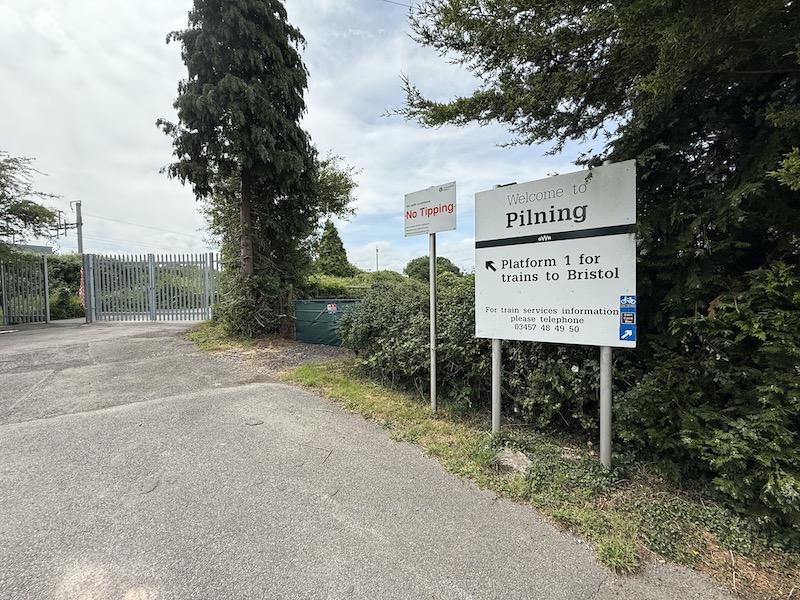
It had to be a Saturday visit as that’s the station’s claim to fame.
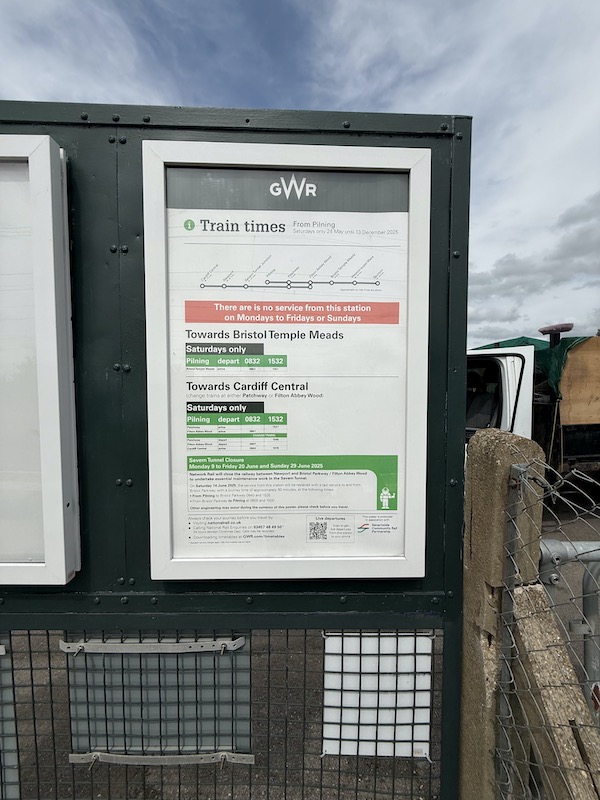
It only has two train departures a week, both on a Saturday, at 08:32 and 15:32, and both in the same direction making a return journey starting and finishing at the station extremely challenging.
The station lies about a mile from Pilning village centre along an unclassified road with no footpath. Around 1,500 people live in the village which is served by Stagecoach’s hourly route 12 between Bristol Parkway and Severn Beach using the B4064 through Pilning.

There are no scheduled buses to the station itself – the nearest bus stop on the 12 is a 15 minute walk along Station Road – which I was thinking of using but I knew just the job for getting to the station itself and that, of course, is the WESTlink DRT operated by Via with eight seater private hire vehicles.
Both Bristol Parkway and Pilning fall within the Thornbury zone so it was a straightforward process of booking a journey to get me over to Pilning station for the 15:32 departure – obviously the 08:32 was too early to reach from Sussex.

I’ll tell you about that journey another time as I don’t want to take away from the subject of this blog – Pilning’s unique status in Britain of having just two train departures a week in the same direction.

It all went wrong for poor old Pilning in 2016 when, without consultation, Network Rail removed the station’s footbridge connecting its two platforms as part of the electrification of the line to Cardiff.

The footbridge clearance was too low for the new infrastructure and Network Rail claimed it would cost between £5 million and £7 million to install a suitable replacement. So the station was left with just one useable platform and a very committed and vociferous Pilning Station Group campaigning for a better service.
The station is situated in South Gloucestershire on the main line from Paddington to Cardiff just east of the Severn Tunnel.
Severn Tunnel Junction station, in Monmouthshire, is the next station west on the Welsh side of the Tunnel, and Patchway is the next station to its east towards Bristol.
The removal of the footbridge took away access to the westbound platform which now lies dormant so trains can only stop in the eastbound direction.

Both the 08:32 and 15:32 journeys begin in Cardiff and operate via Newport and Bristol Temple Meads continuing via Weston-super-Mare to Taunton and Exeter.
There are nine other stations served along the way including Pilning. But, you’d never know, if you didn’t know, as it’s deemed a state secret by GWR.
Pilning isn’t listed between Severn Tunnel Junction and Patchway in GWR’s timetable for the line.
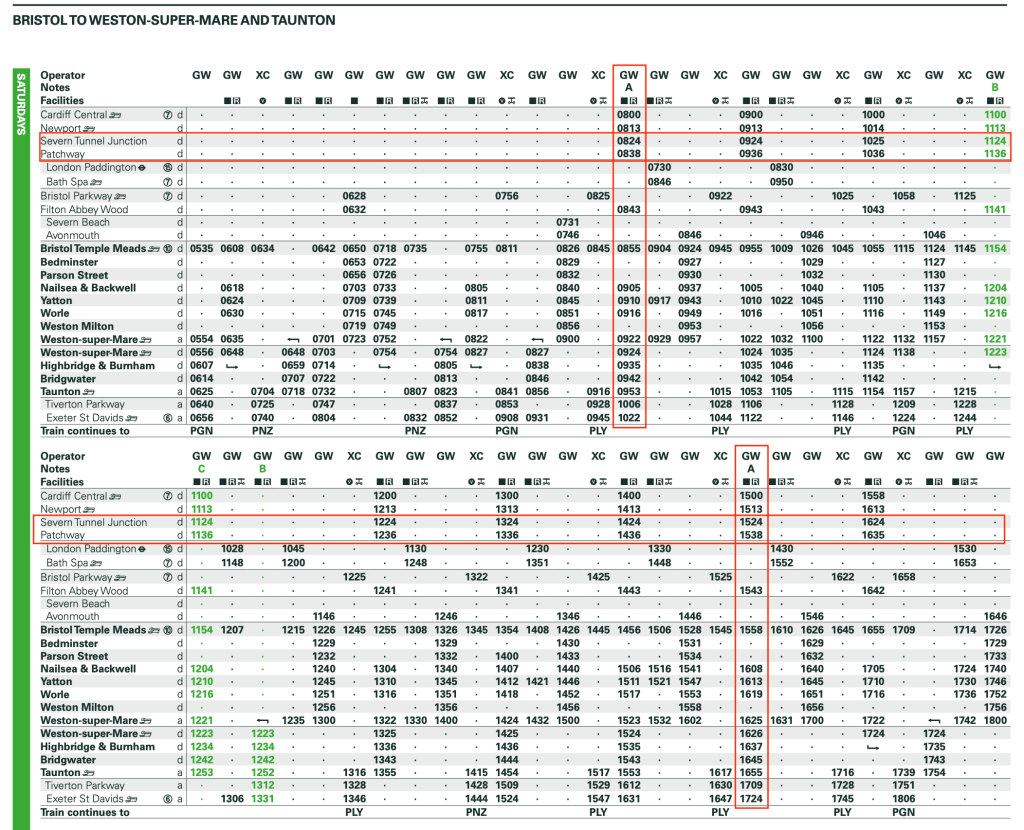
You have to be very observant to notice there’s a code letter A at the top of the columns for the 08:00 and 15:00 departures from Cardiff on Saturdays which in the ‘Notes and Symbols’ at the beginning of the timetable explains it means “Also calls at Pilning” but you have to be psychic to know what time the train calls as it’s not mentioned anywhere. You might not even know where the station is located along the route.

Back in history, the station had many more daily departures even including a Motorail, introduced in 1910, to take cars through the Severn Tunnel before the Bridge was opened.
But by 2006 the service had reduced to just two departures a day and the then new Great Western franchise, which began that year, saw a reduction to just two on Saturdays, albeit one from Cardiff to Bristol in the morning and back again from Bristol (towards Cardiff) in the afternoon.

Unsurprisingly passenger numbers have plummeted as the service has reduced and the station regularly appears in the Least Used Station league table, at one time seeing as few as 50 passengers a year in the early 2000s.
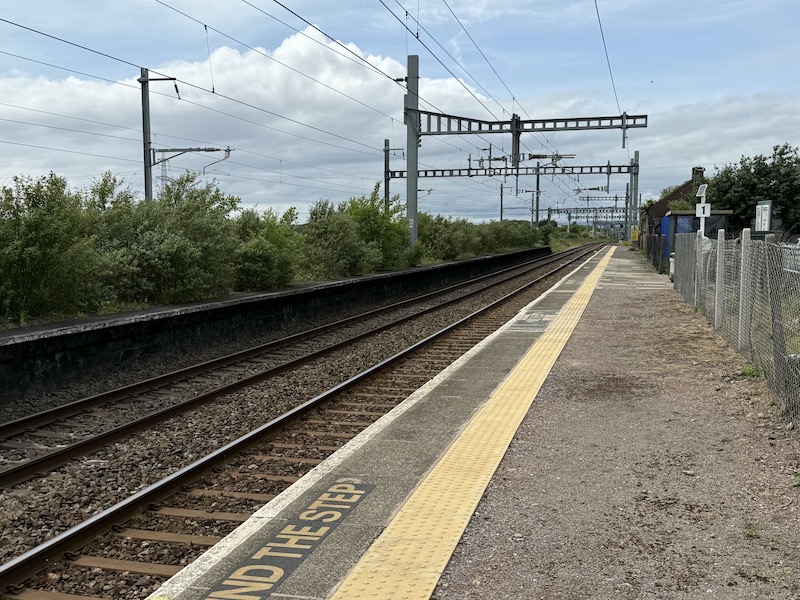
However, the Pilning Station Group has long campaigned for improvements not least when the footbridge was removed, claiming it was ‘closure by stealth’ and successfully raised the station’s profile by issuing a challenge to see how far people can get catching the morning journey to Bristol and returning on the afternoon one. Sadly with two eastbound departures that’s more tricky and all the more so as there’s now no longer parking facilities at the station.

My DRT minibus dropped me at the ramped entrance roadway to the station…

… and as I walked towards the station I soon saw what in the past had been a very active goods yard…

… was now leased to a “Waste Removal and Landscaping” business.
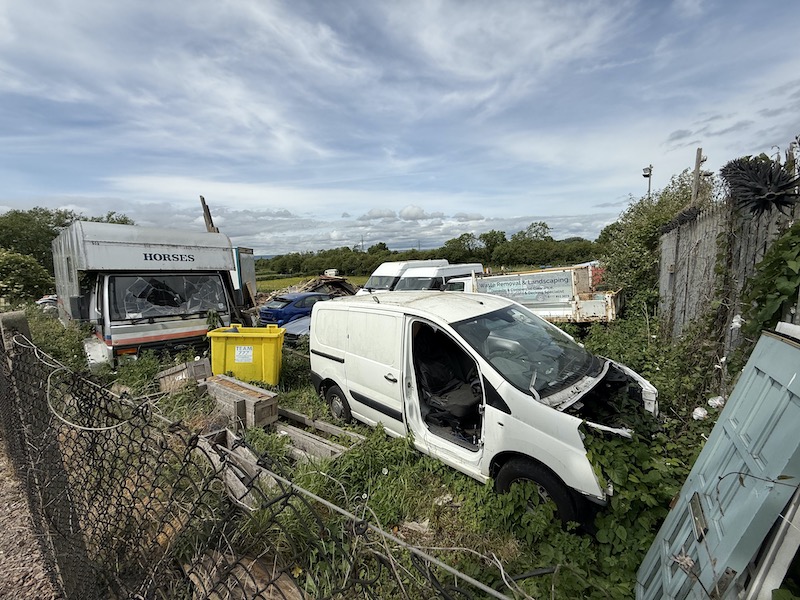
“Landscaping”!!!

That did make me smile.


I was worried at one point I might not find the actual entrance to the platform amid all the “Landscaping”…
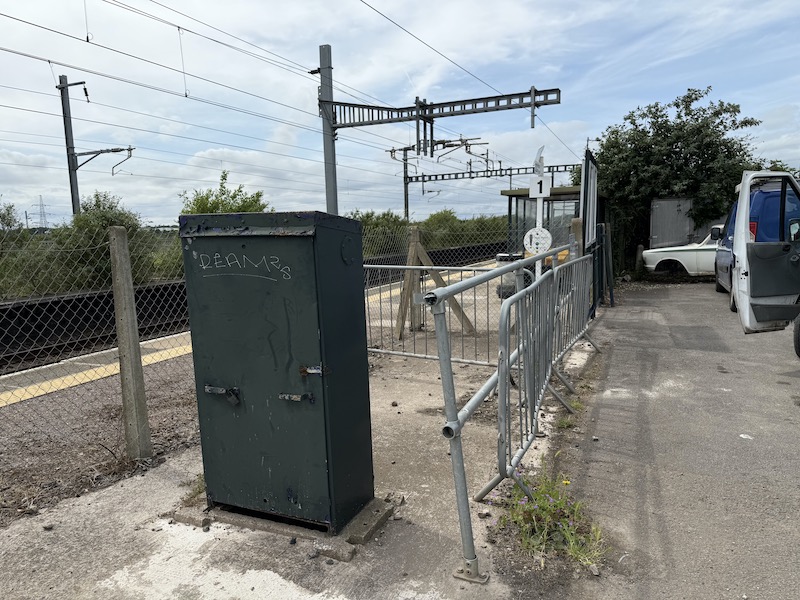
… but soon found the gate…

… next to the main entrance to the “Waste Removal ” business…

… and let myself in.

The former station building has long gone and a brick building still in situ is now used by the aforementioned business with the one solitary Pilning station sign adorning its wall overlooking the platform.
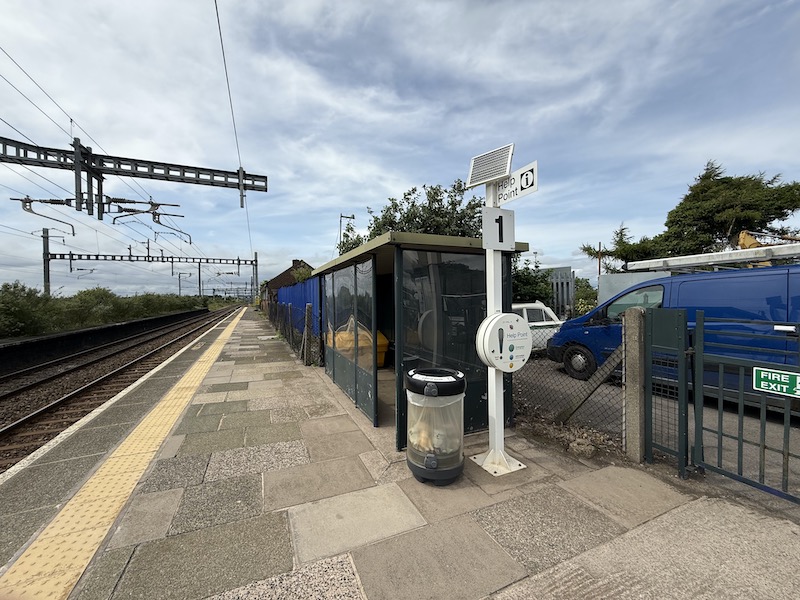
There’s also a fairly basic shelter with a grit bin…

… and a plaque in memory of Jonathan King who founded the Pilning Station Group and died at the young age of 53. Poignantly the plaque used to adorn the brick base of the now removed footbridge.

There’s also a rubbish bin and I wondered how often it’s emptied and the logistics and cost of that…

… (maybe the Waste Removal business has the contract).
There’s a double sided notice board…

…which has an Onward Travel poster…

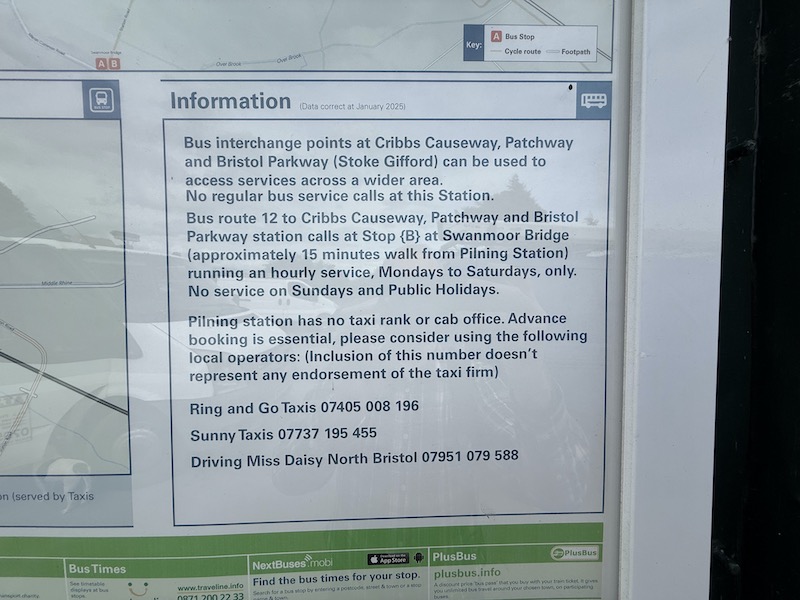
… as well as departure details including how to reach Cardiff by first heading east and then doubling back by changing at either Filton Abbey Wood (morning) or Patchway (afternoon) to a westbound train to Cardiff.

There’s a passing loop north of the main line just to the west of the station…

…and a loop line to the south of the abandoned platform which at one time was used by goods trains.

The remaining platform is 130 yards long which is just enough to cater for a five coach IET which the 15:32 departure was formed of on Saturday.
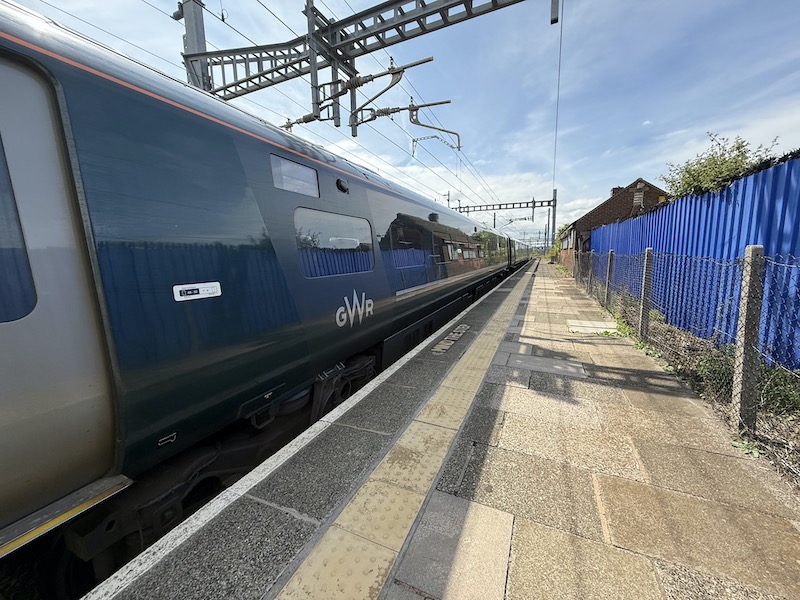
It didn’t surprise me I was the only passenger but the Office of Rail and Road recorded 330 passengers in 2023/24 which is pretty good going for just two eastbound departures a week.

If any readers are thinking of following in my footsteps and give those passenger figures for 2025/26 a boost, give June a miss as there’s no service for much of the month with a ‘replacement taxi service’ operating instead.

Britain’s railways need quirky stations like Pilning and long may it continue.
But is it really the quirkiest – or is there another oddball station more deserving of that title?

Roger French
Blogging timetable: 06:00 TThS with Summer Su extras.
 BusAndTrainUser
The “Motorail” service between Pilning and Severn Tunnel Junction was very limited and in addition to car and passenger fares being charged one could also “hire” a tarpaulin to cover one’s car but reports are such that even hiring the tarpaulin left one’s car filthy with the tunnel suffering permanent water ingress and this was in the days of steam haulage.
LikeLike
Does the pub shown on the OS map still exist? But it might be quite a wait for a lunchtime opening, I guess, if thinking about a visit by train.
LikeLike
Indeed it does – https://theploughpilning.co.uk/
LikeLike
Great story, Roger. There’s a book in here somewhere to rival “Gulliver’s Travels”.
LikeLike
“Britain’s railways need quirky stations like Pilning and long may it continue“.
It is very rare that I disagree with Roger, but on this occasion . . . I have long thought that keeping stations like Pilning open is wasteful and that the money involved (like the contract for cleaning the shelter, emptying the waste bin, maintaining the noticeboard and so on) could be better spent on a station actually performing a useful function.
In similar vein is Golf Street station (906 pax/year or 1 pax/train) just south of Carnoustie (less than one mile away). . . only three trains a day. The station is minimalist, but still has lighting, and still needs maintaining. Barry Links, another mile south of Golf Street, has the same level of train service, but has only 470 pax/year or 0.5 pax/train. The stations at Reddish South and Denton in Manchester are in the same category . . . here with only one unidirectional train each week.
In my view, if a station has less than (say) 1000 passengers a year, it should be carefully considered for closure . . . only remaining open if there are very specific social circumstances that might cause real hardship to regular users. Using Roger’s data, 330 pax/year is around 3 pax/train . . . but I note that no other passengers alighted or boarded his train, so either all morning passengers returned by some other method (or didn’t return?!).
For the avoidance of doubt, I do NOT mean that (for example) most Scotrail stations north or west of Dingwall should close . . . specific social circumstances, remember . . . but stations far from any housing or other providers of passengers should not get a “free pass” to remain open just because they are there and have been since time immemorial.
It’s like the RRB between West Ealing and Greenford . . . hugely wasteful, no prospect of ever reopening, and serves no useful function . . . simply withdraw it.
I’ll get me tin hat ready . . .
LikeLike
Closures simply aren’t going to happen. Any attempt to close a station just results in thousands of claims of hardship from people who aren’t even in the same country, let alone the actual area involved. And they’re all seemingly treated as genuine hardship, for reasons best known to our government.
There’s clearly a pot of money to waste on pointless stations, even though that money would be better spent on genuine public transport provision for the areas concerned. But then the people who claim hardship rarely use the trains concerned so would be equally unlikely to use any other form of public transport in the area.
LikeLike
I wholeheartedly agree.
Either build 1,000 houses next to it, and therefore make a case for improving the train service, or close it.
LikeLike
There is a finite amount of money to support services. We have main rail lines where passenger numbers are minimal and costs are very high. In many cases it would be sensible to close these lines and replace with a bus service which could be provided at much lower cost. This would then free up finance for investment in lines where there is demand and for reopening old lines where there is now demand
LikeLike
It would not have been difficult or very expensive to have raised the height of the footbridge
LikeLike
Pilning was progressively run down from the late 70s/80s, when it was reduced to one train each way daily Mon-Fri (at one point one of those was taken out of the timetable due to driver shortages until protestors got it reinstated). The footbridge removal in 2016 was craftily sneaked through stealthily by Network Rail as a “Minor Alteration (!)”, avoiding the need for full statutory consultation. The furore and resulting publicity raised the profile of the station considerably, and its official usage figure short up by over 1,400% (!) between 2016 and 2019. Even now its annual figures place it well clear of the Least Used Stations “Bottom 10”. More people would undoubtedly use it if it had even just a couple more trains on a Saturday (eg one at lunchtime – the Plough pub is just down the road – and an early-evening service to enable people to have a full day out), but GWR flatly refuse all requests for even the most modest improvements. Undaunted, the station’s User Group continue to fight on – for details, together with a history of the station and other interesting local info, see http://www.pilningstation.uk . Graham L.
LikeLiked by 1 person
Ironic that the coming Tunnel closure will bring to Piling an improved service of two r/t RRT journeys! And why is the DRT offer that you used not mentioned on the ‘Onward Travel’ poster, I wonder.
Robin Bence
LikeLike
Not only that, but bus 12 now also runs (every 2 hours) on Sundays…
LikeLike
I remember seeing the car ferry train, when on our way to and from Bristol. That would be in the early post war years. Also used the Beachley-Aust ferry a few times. I don’t think it got much patronage.
LikeLike
It’s an eerily similar story to that of Polesworth in Warwickshire. That station has one timetabled early morning journey a day (Monday to Saturday) northbound towards Tamworth, but no return journey. Same reason, Network Rail removed a footbridge during line upgrade works and never put it back, presumably due to ‘costs’. As a result the southbound platform is inaccessible, and Polesworth regularly features in ‘Britain’s Least Used Stations’ list.
Stu – West Midlands Bus Users
LikeLike
I used to work the trains stopping at Polesworth towards the end of last century, when the 153s used to shuttle back and forth between Coventry/Nuneaton and Stafford.
The station was barely used at any time of day; in early CT days the most regular “passenger” used to sit in the shelter recording any delays and claiming compensation vouchers which he used to pay for the few journeys he actually made, at least until he was invited for a chat with PC Plod about fraudulent claims.
That’s why the Powers That Be felt they could effectively close Polesworth station by removing the bridge (which truly was in dire need of replacement); the locals didn’t use the station and really didn’t care whether it existed or not. Any complaints come from outside campaigners, not the locals.
LikeLike
Polesworth is one of those stations which have potential to be well used, especially if it gets an hourly service. Afterall it’s a large village. Compared to the no hope of Pilning.
LikeLike
Contrast the footbridge removals at Pilning and Polesworth with Breich.
Again, Network Rail proposed closure of the station because of the cost of raising the footbridge to clear the overhead wires. This was rejected; the station was upgraded and now has a roughly hourly train service in each direction six days a week (two-hourly on Sundays).
LikeLike
All very interesting
LikeLike
Ironic that mickey mouse stations like this are kept open, yet the HOUSING communities surrounding Cottingley station in Leeds will see their station closed once the un-useable White Rose station opens. It’s NOT a replacement station as it’s too far for a lot of the houses without a lengthy walk and it’s in an isolated place with poor access from the main road, all that station is useful for is the office park! Keep Cottingley open for the never ending housing developments in Cottingley, Churwell and the western side of Beeston!
LikeLike
Is it the case that, like ‘”Parliamentary” trains, this is a “Parliamentary” station? In other words it’s just too difficult to close it completely? The issue of raising the footbridge is a convenient excuse. The £5-7 million quoted presumably has to include the cost of (and maintenance of) lifts.
V in Saltash, where the station footbridge was removed many years ago, but there’s a convenient road overbridge nearby
LikeLike
I would have thought an underpass (with long access ramps) could be constructed for far less than £5m. Low maintenance, with some care for how drainage would work.
It would be possible for new GB railways to request parliamentary time to make station closures easier (streamline the process); maybe with use of streamlined fast track closure offset by a protective measure of requiring a quality bustitution at normal local bus fares for a 10 year period: mandatory 5 round bus trips per day (7 days per week) starting at a time to suitable to arrive at 845 in nearest substantial town, and ending no sooner than (say) 1930 arrival back at station; and no major reuse of land for 50 years. A frequent bus gives the site a final chance to swim (regular bus absorbed into local council control/subsidy on its merits of ridership, or train reinstatement) or sink.
MilesT
LikeLike
If one day the footbridge was put in, do the overhead electrification masts get in the way now, as planted on the platform. Or could a short part of the platform be opened between the two masts, and the trains use selective door opening if necessary?
LikeLike
If you crossed the bridge your head would touch the OHLE and you’d get a bit of a shock! Assuming the bridge didn’t already touch the OHLE and become live at 25kV.
LikeLike
What I meant is a new footbridge that was higher than the overhead power lines. My concern, if you look at the pictures, is how the masts are planted directly in the currently disused platform.
LikeLike
I suppose it depends on your definition of ‘quirky’. David Wallace
Sent from my iPhone
>
LikeLike
I agree, David. I would nominate (amongst others) Altnabreac on the Far North Line and Berney Arms in Norfolk.
There is no public road to Altnabreac and absolutely nothing there if you alight except forestry and I would be wary of getting lost in the forest and/or missing the last train out (what if it was cancelled?).
Likewise there is no public road to Berney Arms, just a footpath to the river, which you can then follow all the way to Great Yarmouth. I have never actually done so, but would like to try that out on a sunny summer day. I wouldn’t dare do it in the opposite direction, again for fear of missing the last train back.
Whilst I would hate to see any stations closed, it is ridiculous that these quirky ones survive when there are still so many quite sizeable places that lost their station years ago.
But it’s all part of what makes being a rail enthusiast so appealing!
Brian Musgrave.
LikeLike
LikeLike
I believe Altnabreac station is currently the subject of a court case. The thread over on Rail Forums is quite the read. My nomination for quirkiest station would be Coombe Junction Halt.
‘Whilst I would hate to see any stations closed, it is ridiculous that these quirky ones survive when there are still so many quite sizeable places that lost their station years ago.’
This is particularly stark in Devon where sizeable towns like Plympton and Cullompton lost their main-line stations but the quirky stops in the middle of nowhere on the Tarka Line remain open.
Chris
LikeLike
Great blog but one error – the station does include a car park BUT because of the ‘fly tipping’ Network Rail installed a gate so you can’t actually drive to the car park. To be fair, I’m not sure you would want to park there for fear of your car being ‘landscaped’. Interestingly, the ‘fly tipping’ hasn’t reduced since the locked gates were installed…
LikeLike
Pilning station has never had mains power installed – another cost issue that hinders a case for investment to encourage an increase in the number of trains that call there. Richard K.
LikeLike
In reply to Richard K’s comment, it’s not correct to say Pilning has never had mains power installed – it used to have electric lighting but this was taken out of use many years ago when the lamp posts were deemed unsafe. There is still a mains electricity supply to the immediately- ajacent “landscaping” business. Graham L.
LikeLike
Point taken, Graham, but the fact remains that reinstating power for provision of lighting and a ticket machine etc would add to the cost of improving the station.
LikeLike
I see Sullivans Bus are up before the traffic commissioners
LikeLike
Slight error, Bristol Parkway falls in the Bristol North zone for Westlink, not the Thornbury zone.
Parkway is additionally in its own shared zone that covers both Parkway and UWE and allows travel outside of the North zone.
-Luke
LikeLike
I can’t be the only one who thinks Pilning has a lot of potential as a location. When I visited Pilning Station, I walked there after taking a train to Severn Beach (to catch the 15:32 to go to Bristol) and was struck by how close the motorway was to Pilning. Surely it could be developed into a park and ride style station? It’s got lots of space around the area and in a good location for both Bristol and South Wales, it’s easy to say ‘close it’ but we need new stations all the time, why not give an existing massively underused one a second chance? Build up the area nearby as a new town, build a slip road between the station and M4 and provide the trains and buses, so less traffic is clogging up Bristol. It’s a massively wasted site and sad it looking so desolate but also looking at old pictures of the station, it’s amazing how quickly nature takes over!
Aaron
LikeLike
Is the Plus Bus ticket valid on DRT ?
LikeLike
I doubt anyone has ever thought of that!
LikeLike
Surely the logical solution would be to relocate Pilning station to a point adjacent to one of the overbridges within the village – either the B4064 or the A403? The bridge would already exist, and the station would be near to the houses it purports to serve.
RC169
LikeLike
It will bever generate any meaningful passenger numbers. Probably more sensible to close it
LikeLike
The name ‘Pilning’ relates to the area and the station, reputedly was created initially to load cattle to transport to Smithfield. Moving the station to make access to the village that has grown up, now known as Pilning, isn’t possible as to the immediate west of the platform is the start of the downward grade into the Severn Tunnel. Yes a proposal for 1000 house(no 3000) is on the table, subject to the Local Plan and the Neighbourhood Plan, but the proximity to the massive Severnside Enterprise Area is really its potential customer. Businesses there have great difficulty in attracting employees and several companies currently run private staff buses to/from Newport. A bus shuttle to the trading estates, timed to meet trains, would be the obvious and cost effective way of developing the station, as well as providing much needed transport to local residents. Also now in the mix is a proposal to build a new stadium for Gloucestershire County Cricket adjacent.
Peter Tz.
LikeLike
Was rather surprised to see a photo of an outward ticket to Pilning given the lack of suitable trains! Guess you have to go via Severn Tunnel Junction.
Definitely a case for develop or die.
Richard Warwick
LikeLike