Tuesday 24th November 2026
Today’s blog begins with a HEALTH WARNING for the anonymous reader with an aversion to reading criticism in these blogposts, presumably preferring a blog that simply regurgitates sycophantic press releases enthusing over the latest hyped up “ground-breaking” initiative, peppered with supportive congratulatory messages from gullible stakeholders. Please look away now, for your own sanity. Why not simply log on to TfL’s Press Release webpage instead and soak up the positivity it contains in abundance? You’ll feel so much better than reading what follows.
Because today’s blog contains excoriating criticism at TfL’s continued incompetence at presenting accurate and helpful information for its bus passengers. But, as always, I like to be constructive in my critique and will use a career long experience of the bus industry to suggest how things can be improved for the future.
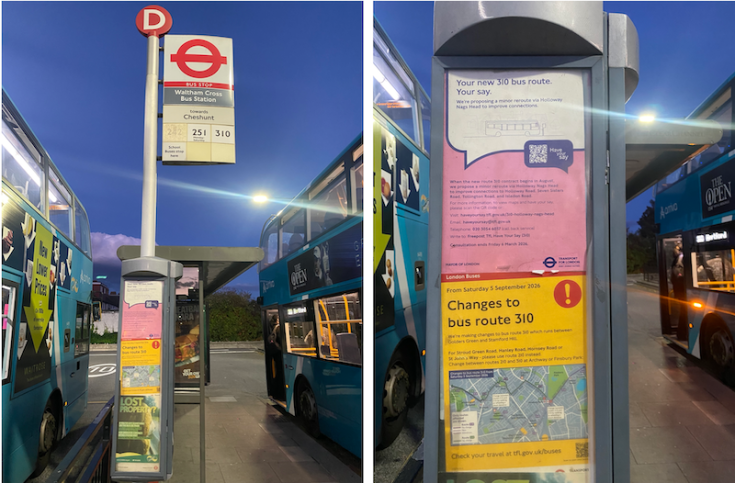
For years I (and many others) have been remarking how the quality of TfL’s information for bus passengers is woefully inadequate. A lack of any kind of network route map and inadequate displays at bus stops are two oft-quoted issues. Missing timetable displays, out of date timetables or just nothing on display at bus stops are the norm these days. I’d venture to say the majority of bus stop displays are lacking in some regard. The absolute classic of the genre was the recent display about “Changes to bus route 310” for the ‘wrong’ (non TfL) 310, in Waltham Cross, instead of the ‘correct’ 310 in Finsbury Park.
But TfL has excelled itself in its level of information provision incompetency for the unwelcome changes made to central area bus routes 19 and 38 over the weekend before last. And this time, along with Arriva, it sunk to a new nadir with incorrect electronic ‘next bus’ signs at bus stops, misleading bus destination displays as well as wrong onboard signs.
Displaying out-of-date ‘spider’ maps in bus shelters only adds to the confusion.
And to top it all last Thursday, and confirming just how completely out of touch with bus passengers TfL’s “Comms” team is, the weekly email offering “weekend travel advice”, updating passengers of all the services TfL aren’t running over the weekend, was headlined with a photograph of a smiling passenger purporting to ask a smiling bus driver for help with a bus map query (in the days when cab screens had holes through which each could hear each other)…
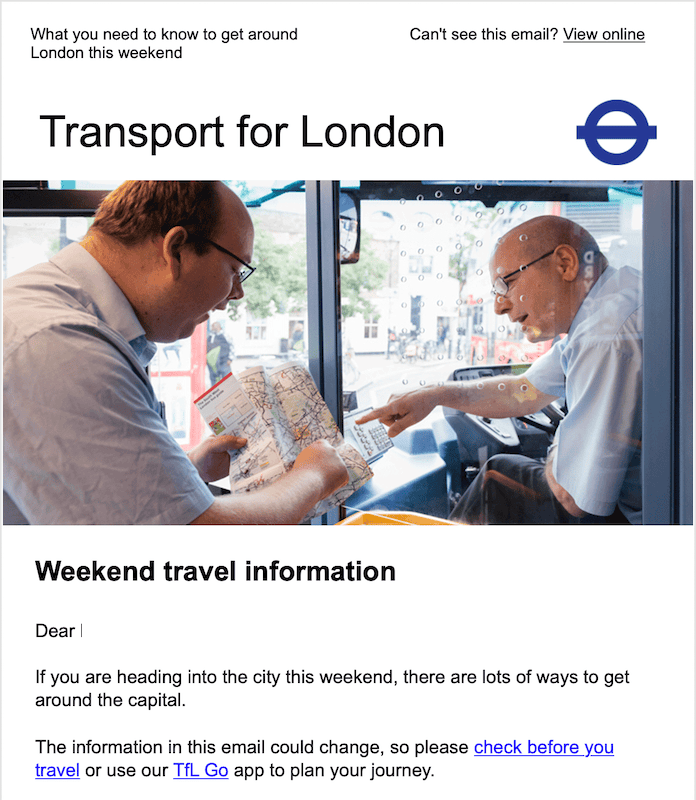
… and about which the driver is presumably saying words to the effect “I’m not surprised you’re confused mate, TfL hasn’t bothered to update that map since 2016”.
If the passenger was attempting to travel from, for example, Angel, Islington to Victoria last week, not only was that map as useless as an octogenarian American President but everything TfL deemed appropriate to display to help the hapless passenger was incorrect.
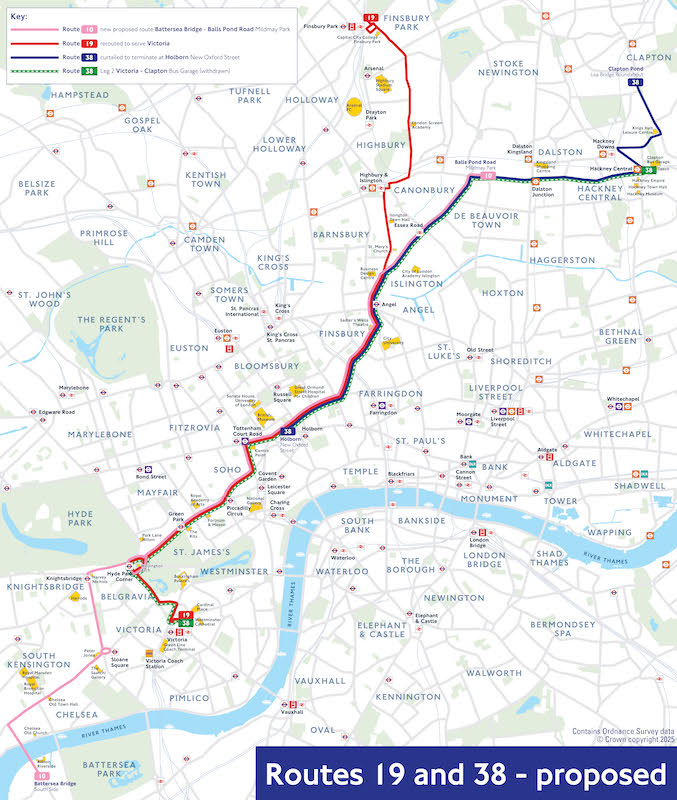
There’s no online official map to explain the changes TfL made to long standing routes 19 and 38 on Saturday 14th November. The 19 has run between Finsbury Park and Battersea Bridge since London Transport was formed in 1933 (it used to continue southwards to Tooting) as has the 38 linked Clapton Pond, Hackney and Dalston with Victoria (originally from as far north as Chingford).
You’d think changing the southern terminals of two such long established routes (as happened on 14th November) would be enacted with the greatest attention to detail so as not to cause unnecessary confusion for passengers. After all, it’s not as though the changes were rushed through, with the public consultation ending in January (having opened in November 2025) and the change date of November 2026 being announced back in July.
So how do you think passengers fared at Angel (served by both routes), as I found when I visited last Thursday morning, six days after the new regime began?
In the changes, the 19 had its route at Hyde Park Corner amended to drop down to Victoria, where it now terminates (instead of continuing via Knightsbridge and Chelsea to Battersea Bridge), thereby taking over from the 38 which was cut back to Holborn while the route to Battersea Bridge (previously the 19) is now the province of a newly resurrected route number 10 introduced to parallel most of the 19 (and some of the 38) between Newington Green and Battersea Bridge.
Without an online map to illustrate the change, passengers only have a written online description, but if you search diligently you can find a map TfL produced for the consultation (reproduced above) albeit it’s out of date as it shows the original proposal of the 10 terminating at Balls Pond Road instead of Newington Green.
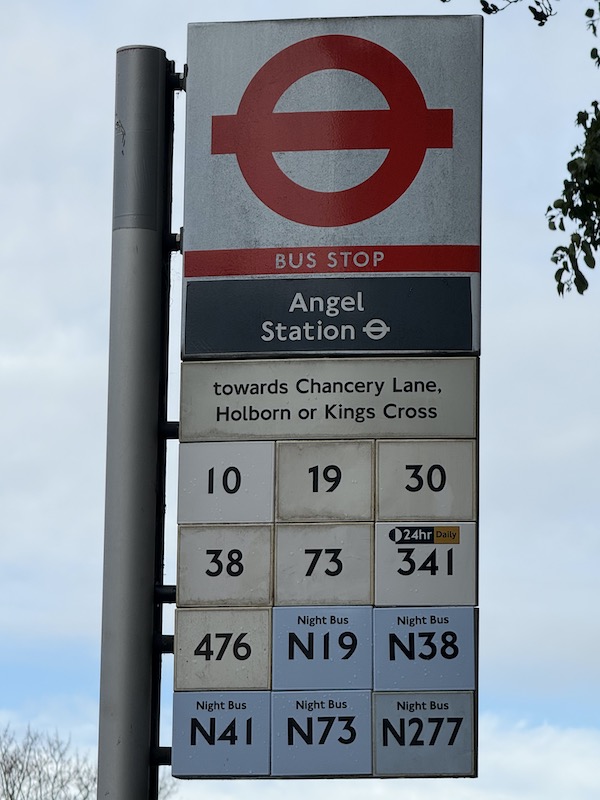
The southbound bus stop immediately outside Angel Underground station (missing its identifying letter ‘F’) has correctly had a 10 tile added alongside the 19 and 38 but that’s as far as the good news goes.
The ‘spider’ map display in the bus shelter…
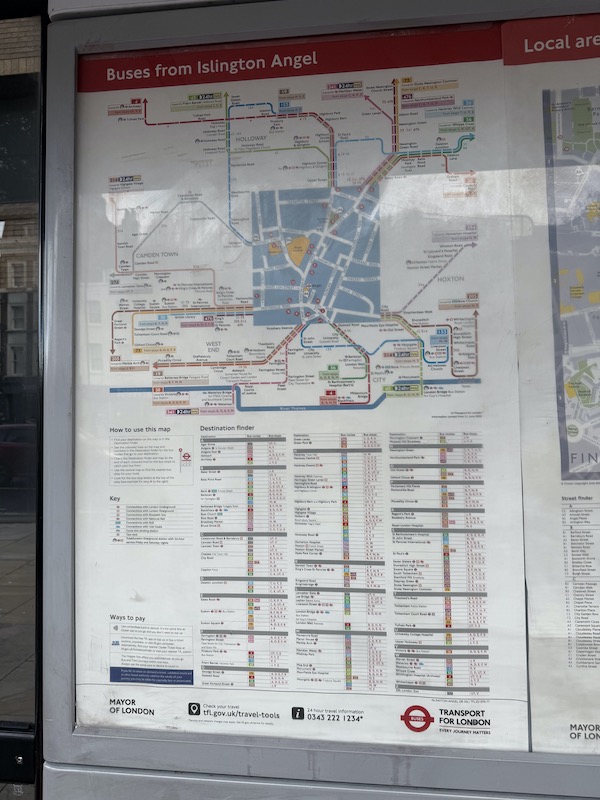
… still told you (wrongly) to take the 38 to Victoria and the 19 to Battersea Bridge and made no mention of the 10.
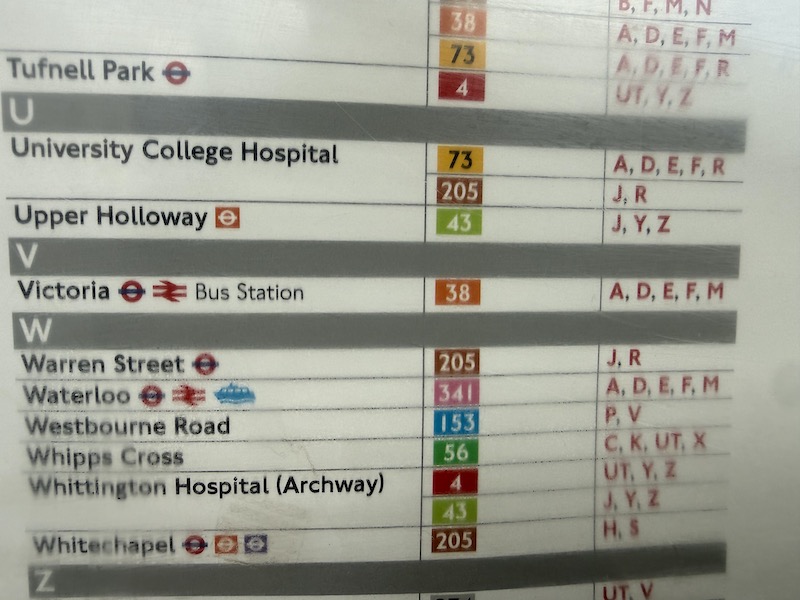
The route ‘flow diagram’ on the bus stop timetable case display panel still (wrongly) showed the 19 would take you to Battersea Bridge and the 38 to Victoria…
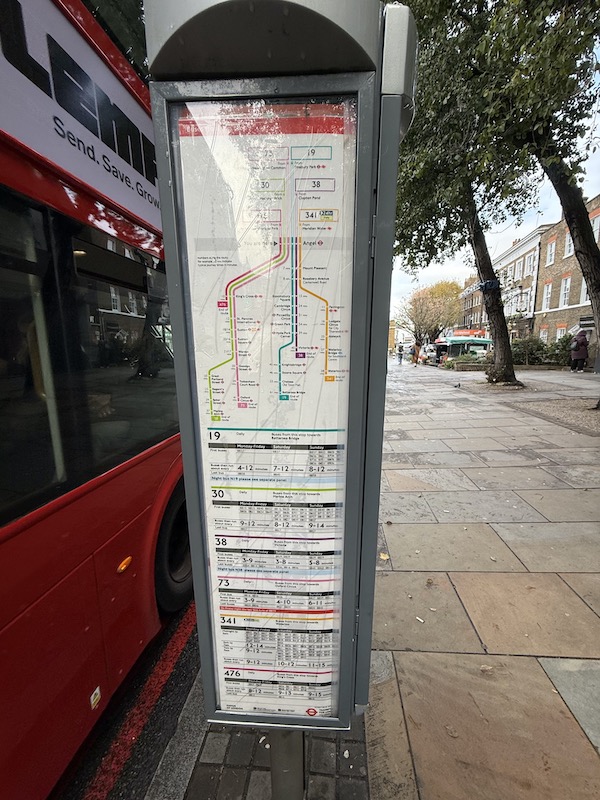
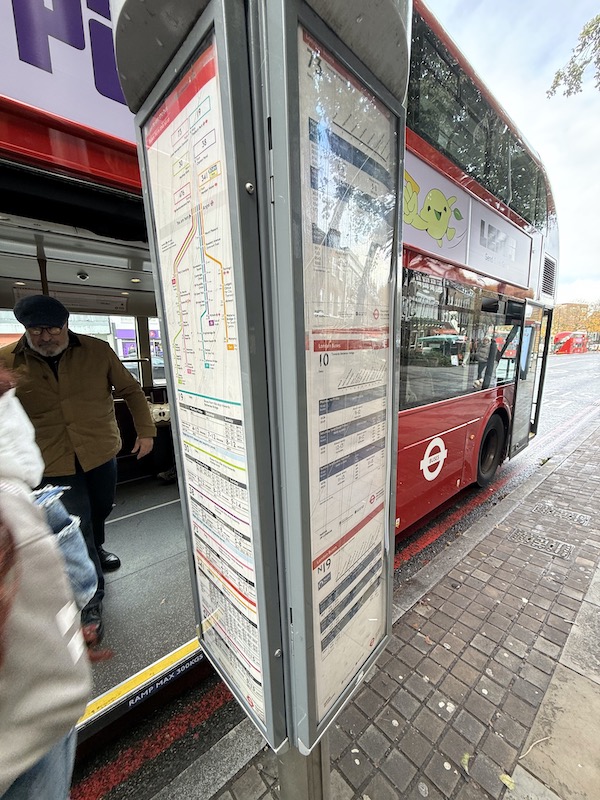
… although someone had posted a new timetable panel for route 10 (to Battersea Bridge) in the adjacent display, just to confuse things.
Bizarrely, there’s no electronic next bus display in the bus shelter at this stop, for that you have to walk a few yards further on to the next bus shelter (where the bus doesn’t stop)…
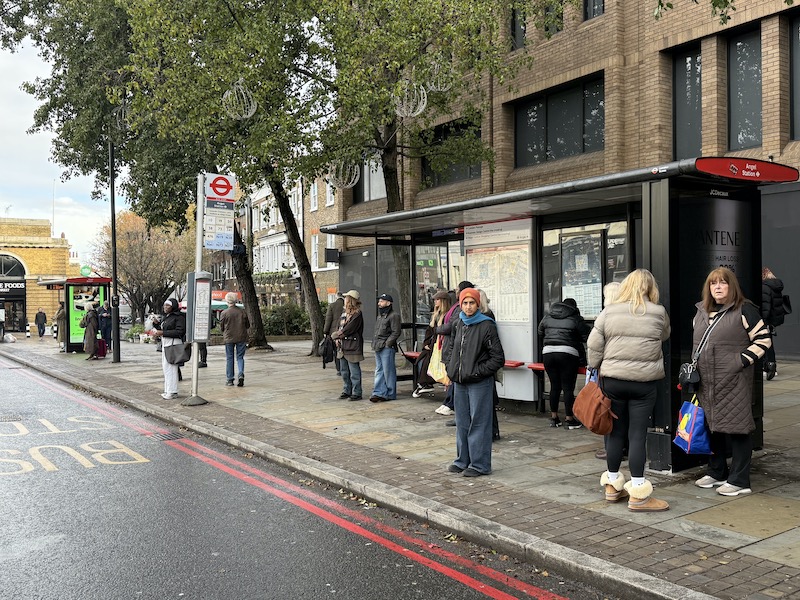
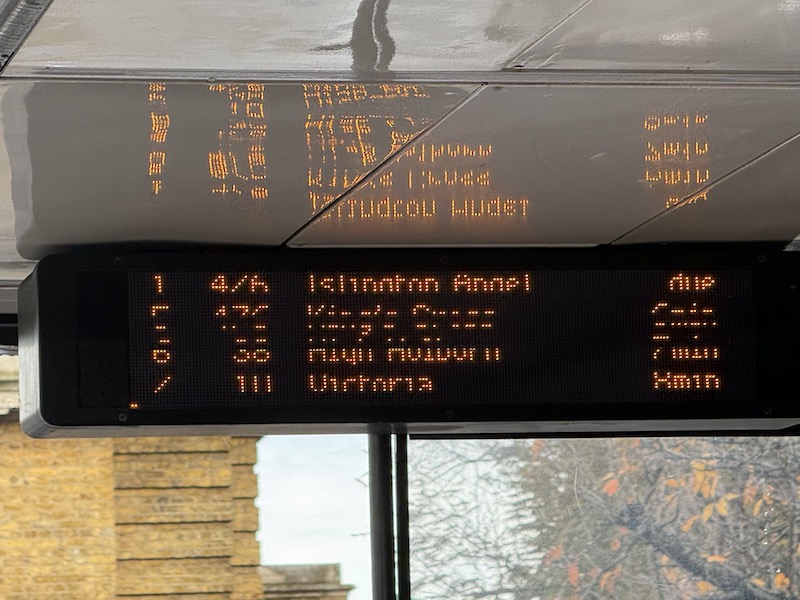
… and there you’d find the display showing new route 10 except it was (wrongly) showing it going to Victoria, not Battersea Bridge.
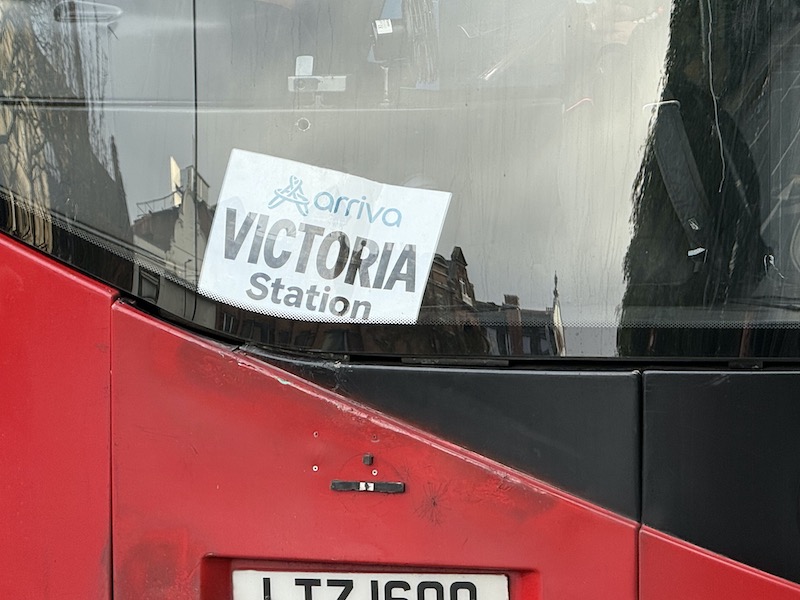
Buses on route 19 arriving at the bus stop were (wrongly) displaying Hyde Park Corner as the destination with the correct destination, Victoria, added on a printed sheet lodged at the bottom of the front windscreen.
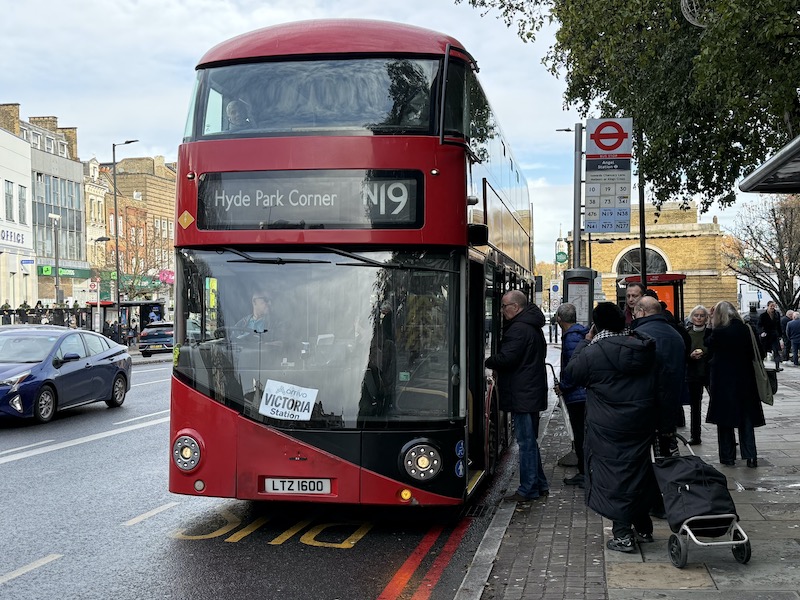
A passenger not noticing that (as I initially didn’t on the first bus to arrive) would be forgiven for thinking one of TfL’s regular route curtailments “to regulate the service” was in operation and wait for the next bus in the hope that was going to Victoria.
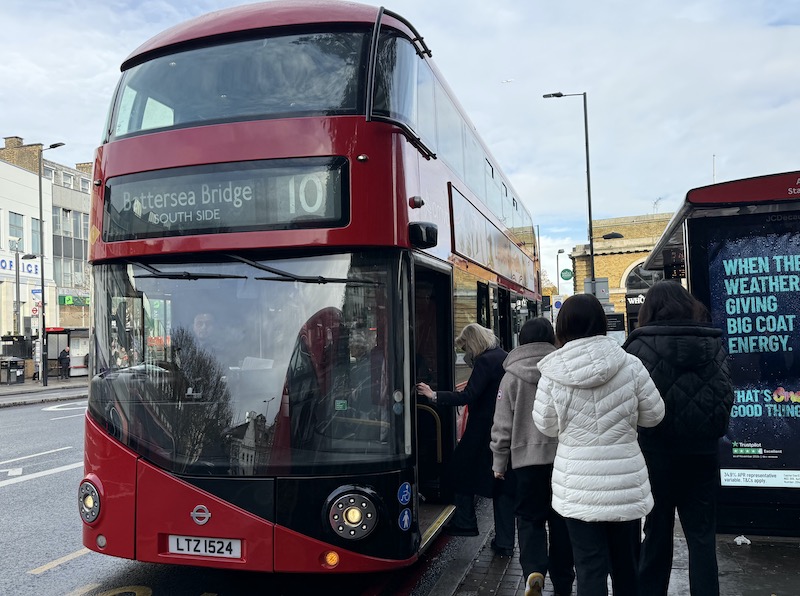
Had passengers decided to wait for a bus on the 10 to get to Victoria as advised by the electronic display in the (other) bus shelter and mistrust the ultimate destination display showing Battersea Bridge on the bus exterior – they’d be reassured they’d done the right thing as on board the internal destination displays were indeed (wrongly) advising the bus was going to Victoria.
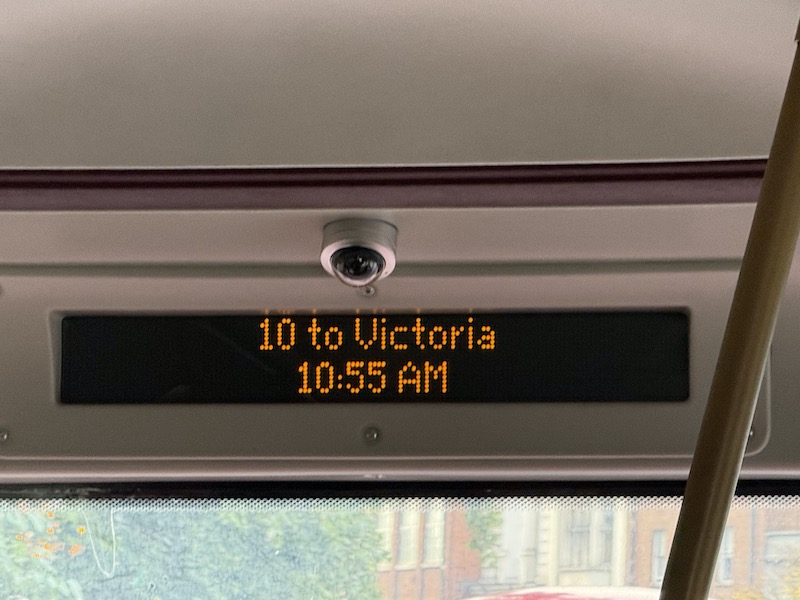
It wasn’t. It was going to Battersea Bridge as confirmed by the audio announcement. So, someone hard of hearing is misled but someone with sight difficulties is OK.
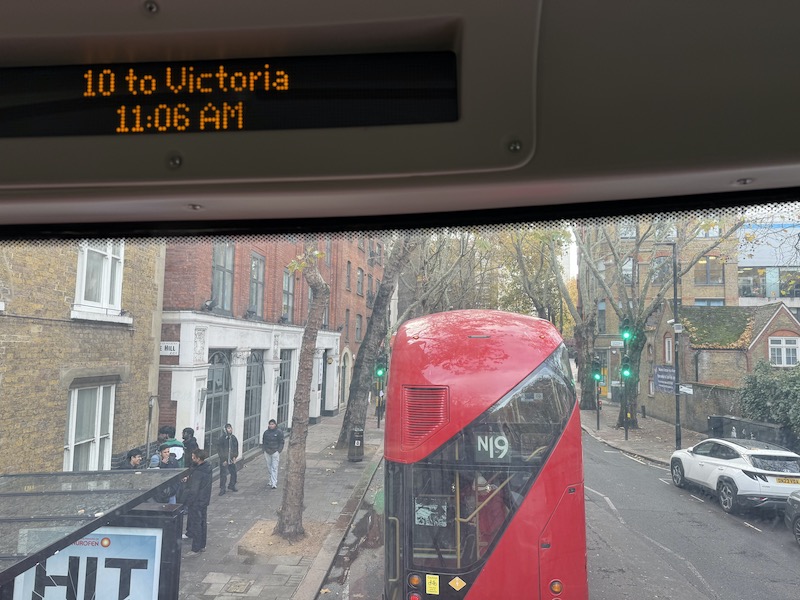
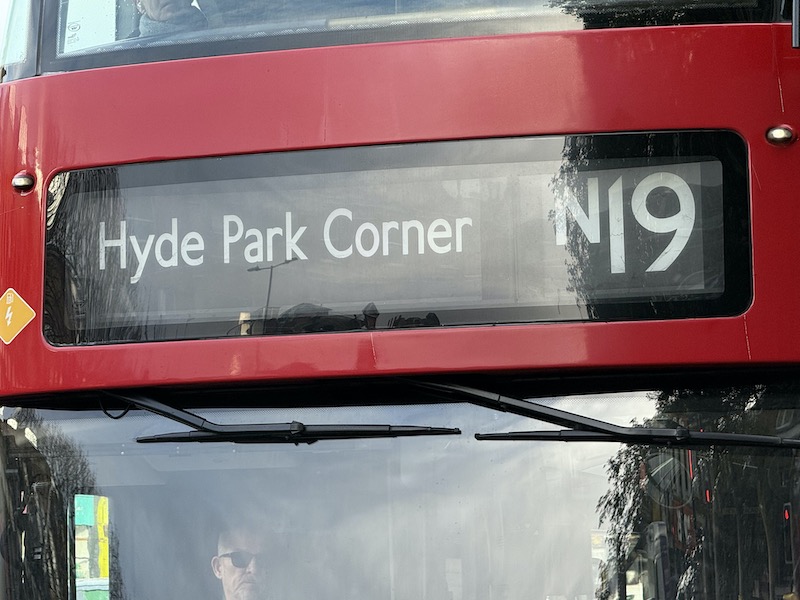
And just to complete the incompetence, buses on the 19 were displaying the route as N19 rather than 19. You could forgive this passenger boarding a bus on the 10 at Angel for being totally confused and seeking help from the driver…
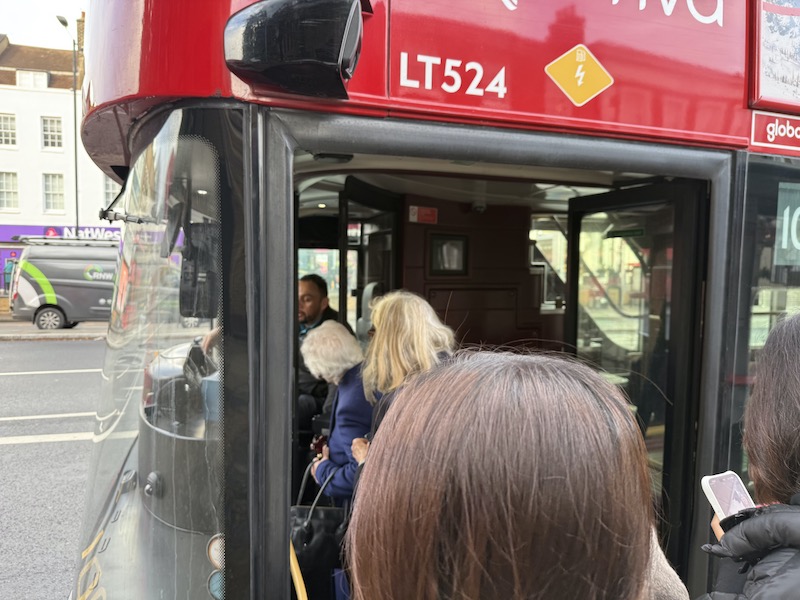
… which, of course, unlike in the photo TfL’s “Comms” people sent out in the email, necessitates the driver opening the cab door so he can hear what she’s saying, because the reality is TfL don’t want drivers to be able to hear what passengers are saying when they make a query.
Can any of the foregoing be defended? As said, it was six days after introduction. Long enough for any immediate ‘teething problems’ to be resolved. It was four months after the change date was announced. Long enough for proper plans to have been put in place. It’s simply the latest example of information blunders that points to a systemic problem at TfL.
Which brings me to my suggested solution to prevent such inadequacies in the future. Looking at TfL’s top executive team of ten Chief Officers, none come with any experience of bus operation. Commissioner Andy Lord, Chief Operating Officer Clare Mann and Chief Capital Officer Stuart Harvey all have rail/Underground experience with six of the others being specialists in Finance, Communications and Corporate Affairs, Customer & Strategy (!), Health & Safety, Administration and HR. But since the abandonment of the role of Managing Director of Surface Transport in 2022 (previous post holders: Peter Hendy, David Brown, Leon Daniels) there’s been no one at a senior level in TfL with a bus background.
Yet a tenth member of the team, Dr Will Norman, is Walking and Cycling Commissioner so why not have a Bus Commissioner or even a Managing Director for Buses once again? After all, more passengers travel by bus than any other mode and the evidence suggests since 2022 (or even further back, since Leon Daniels stepped down in 2017) the bus rot has set in and that lack of experience is evident for us all to see.
And the challenges facing bus operation in London are set to continue.
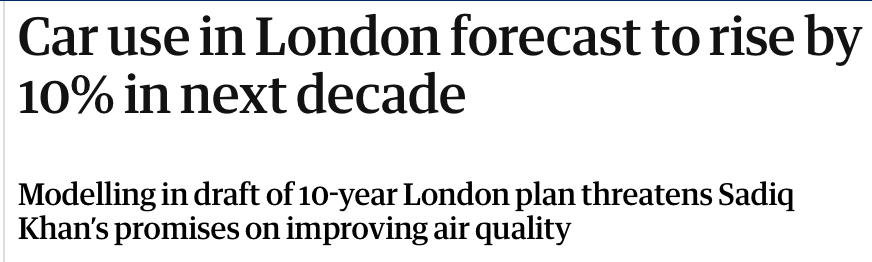
While at Angel last Thursday I read a report in The Guardian newspaper that modelling for the latest 10-year London plan in one scenario shows “car use in London will rise by 10% over the next decade with cycling and walking falling as a proportion of trips, according to an official forecast by the city’s mayoralty” … and “road congestion from a growing population would slow buses down, while packed tube services might require stations to close regularly to ease numbers.”
The main reason I was at Angel on Thursday was having seen the controversial news this busy Underground station will become exit only at weekends and bank holidays from 2nd January due to problems with its ageing escalators.
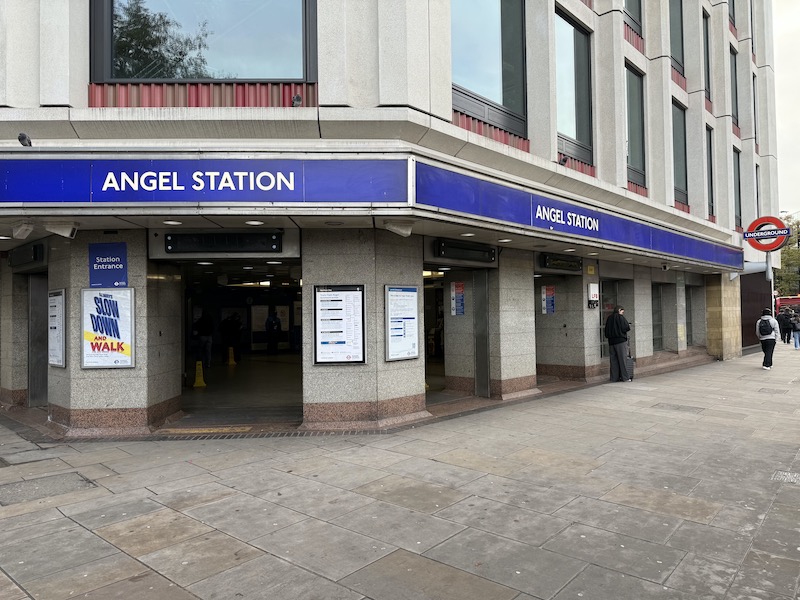
One of the station’s three long escalators has been out of action since April 2026 and after 35 years in service is overdue a replacement.
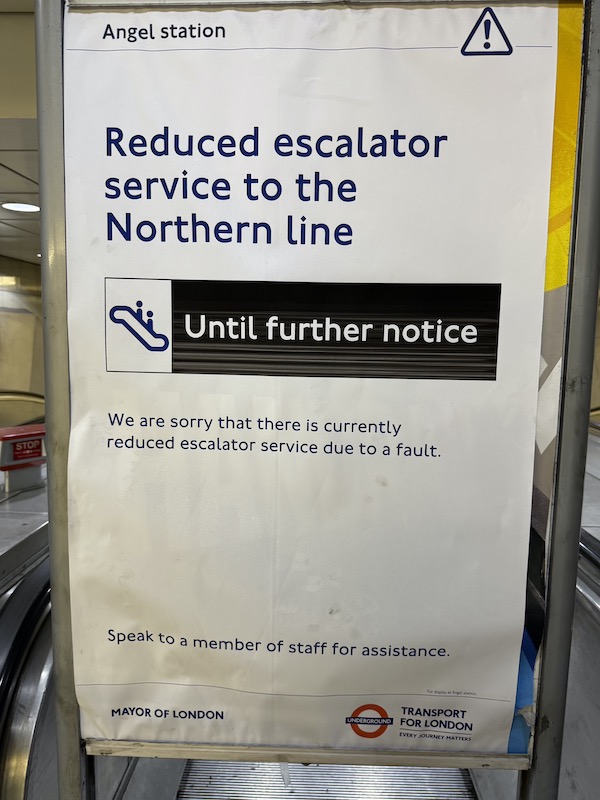
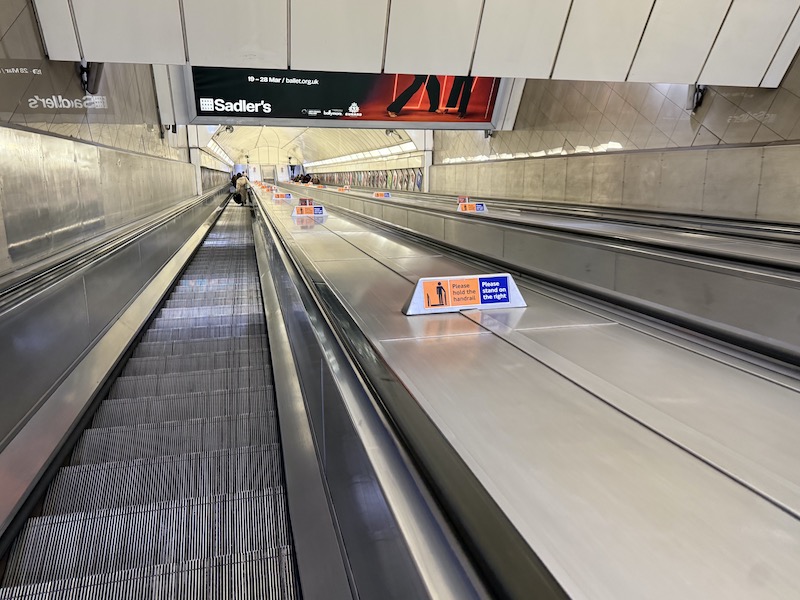
It’s now got to the stage if one of the other escalators fails, the station has to become exit only, and if both fail the station has to close as, at 60 metres, they’re the longest escalators on the Underground and are not safe to walk up and down in a static state.
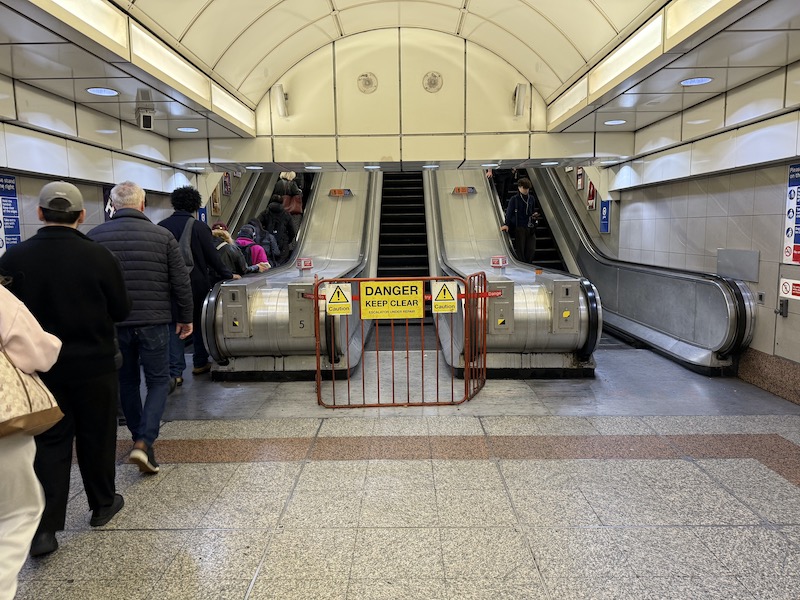
It’s proving controversial with TfL said to be weighing up the option of a complete closure of the station in any event to facilitate the much needed replacement work but …… funding for that work is still uncertain.
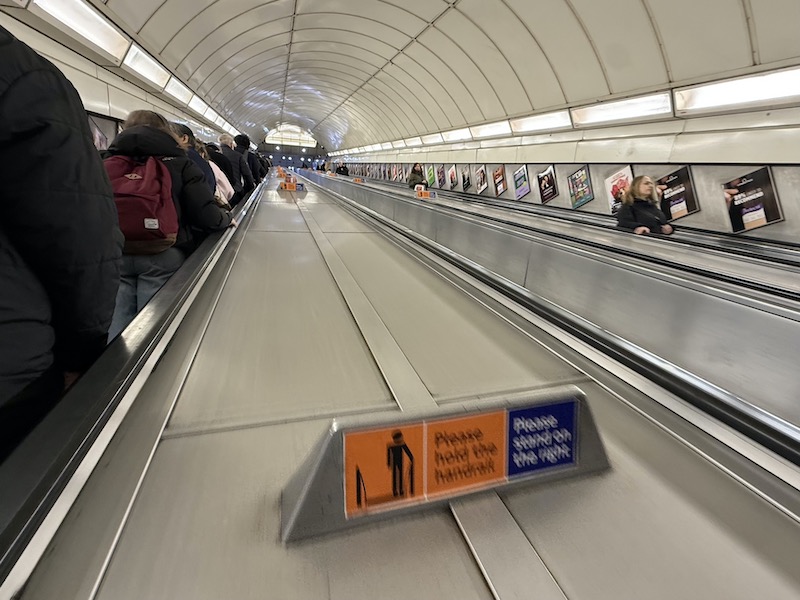
In a statement, TfL explained “the legacy of historic shortfalls in Government funding for essential TfL asset renewals has meant that TfL has not been able to invest in new escalators at the station. TfL will continue to investigate options for renewal, repair and replacement within the funding constraints it continues to experience, but in the meantime is doing everything possible to extend their working life and keep the station as operational as possible.”
Roger French
Blogging timetable: 06:00 TThS


TfL has become a political football. If the mayor did not prioritise minimal fare increases no doubt money would be available for essential capital items such as new escalators at Angel. It’s no use blaming the Government, TfL already gets a massive capital grant, they just choose to spend it badly. The continued proliferation of cycle lanes removing road space and increasing congestion is slowly killing the bus network, I for one never use buses in the central area due to slow speeds and unreliability.
The Labour Government seems to think Mayors are the fount of knowledge, what’s happened in London and becoming apparent elsewhere shows that the opposite is true.
LikeLike
OH Roger, what wise words you write. I was a manager of bus service for many years in Central London and beyond!!??
I just say the words ROUTE 11, what debate that caused!!
The Wandering Busman, retired
LikeLike