Saturday 8th August 2026
Readers may recall a blog last November featuring a grassroots campaign in Glastonbury calling for a dedicated direct bus route linking the Somerset town to and from Castle Cary railway station to alleviate the need for the convoluted alternative of changing buses in Street or an expensive taxi.
Well, the campaigners wish was granted from the beginning of this month after Somerset Council agreed to fund a six month trial as well as directly operate such a service itself, almost identical to the draft timetable that had been suggested. It’s been given route number 567.
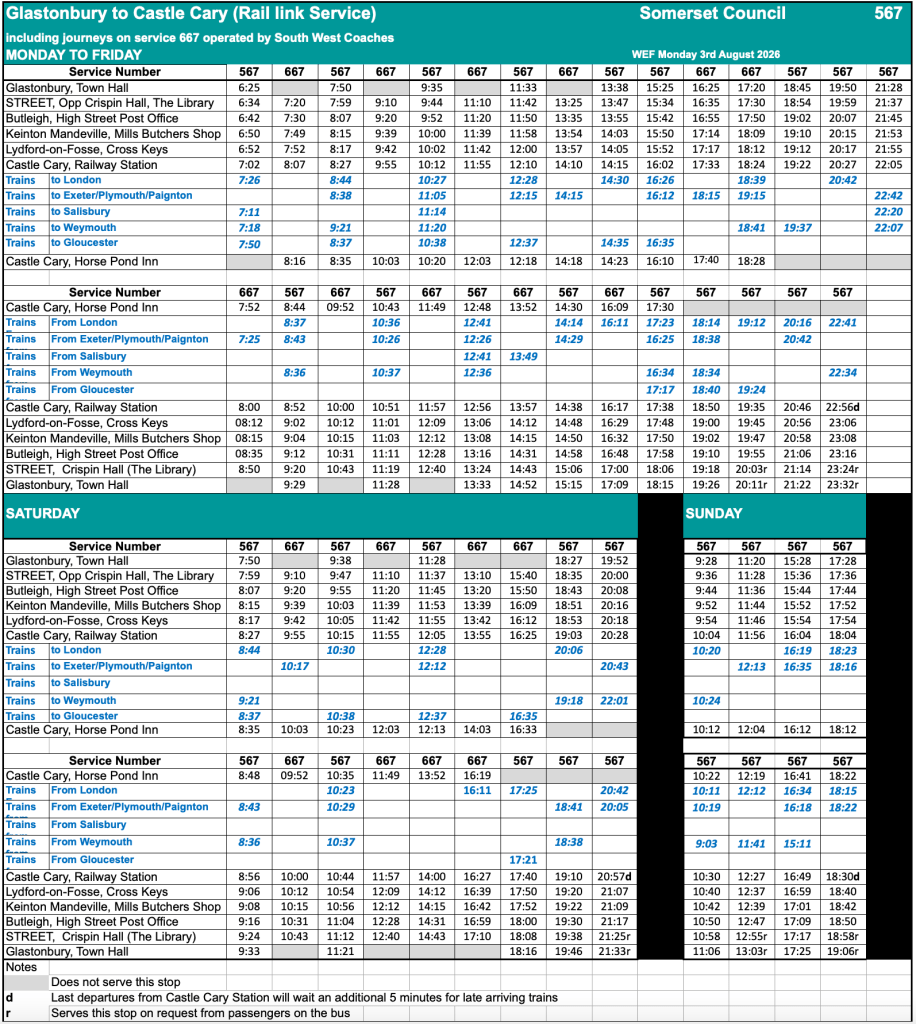
The seven days a week timetable includes nine return journeys on Mondays to Fridays, with an impressively long operational day extending from 06:25 to 23:32 with five return journeys on Saturdays and four on Sundays as can be seen in the above timetable (which also includes South West Coaches route 667 between Street and Castle Cary).
It’s a one bus operation although bizarrely two buses are needed for half an hour around 19:35 while some long gaps are included in the daytime especially on Saturdays when there’s no service 567 between 12.13 and 18:27.
As you can see, the published timetable for new route 567 commendably shows all the connections between bus arrivals and departures at the station (shown in blue print) with trains to and from London, Exeter/Plymouth/Paignton, Salisbury, Weymouth and Gloucester although not every departure serves all these destinations as we’re not dealing with a Mini Switzerland here (no £6 million funding slushing around).
However, it looks like an exemplar of bus-rail integration and I had high hopes when trying it out on Wednesday, 10 days into the new service.
Readers may also recall from last November’s blog how I attempted to try out a connection available at that time from an arriving train and one of the two long standing bus routes serving Castle Cary railway station (South West Coaches routes 1 Yeovil-Shepton Mallet and 667 Wincanton-Street) only to miss the connection due to GWR’s late running train from London Paddington to Exeter due to arrive at 12:14. Which on further investigation turned out to regularly run late, sometimes extensively.
The timetable for route 567 doesn’t provide for a connection from that 12:14 arrival, and in any event after last year’s experience I wouldn’t trust it anyway, so instead I got up nice and early and travelled over to Castle Cary on South Western Railway’s 10:36 arrival from London Waterloo and Clapham Junction (depart 07:57).
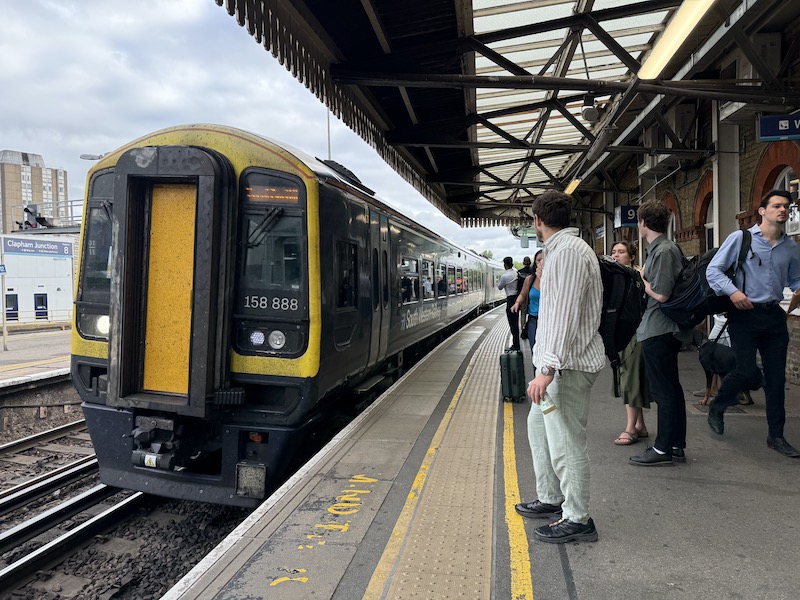
It was an odd sight to see a two coach Class 158 arriving in a busy peak hour Clapham Junction – that’s all the “everything’s-going-to-be-alright-now-it’s-Nationalised” SWR could muster for the service – but after Salisbury the numbers on board thinned out to the extent, by Frome, there were only half a dozen of us left on board.
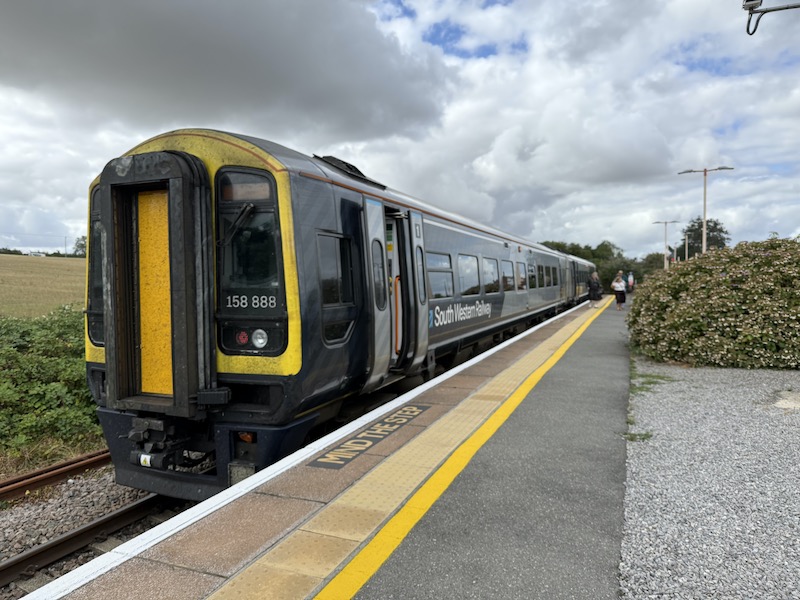
We arrived into Castle Cary six minutes late at 10:42 thanks to a late running GWR train (09:03 Paddington to Penzance) ahead of us but I wasn’t worried as the 567 wasn’t scheduled to depart until 10:51 giving a comfortable connection between the two modes.
Route 567 begins and ends its journey in Castle Cary itself which is just over a mile to the south of the station but the bus is given a generous eight minutes from there to reach the station, so not surprisingly it turned up a little early at 10:48.
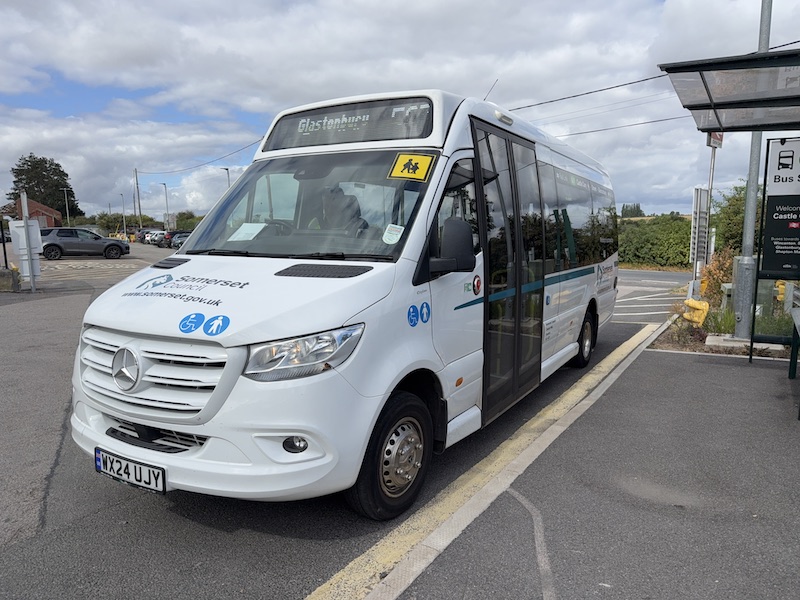
As highlighted in November, Castle Cary’s station forecourt has a conveniently sited bus stop…
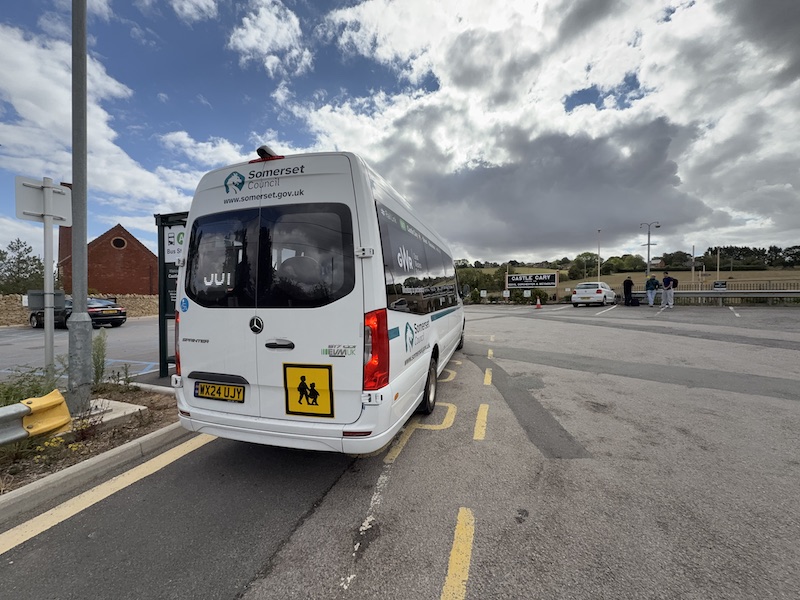
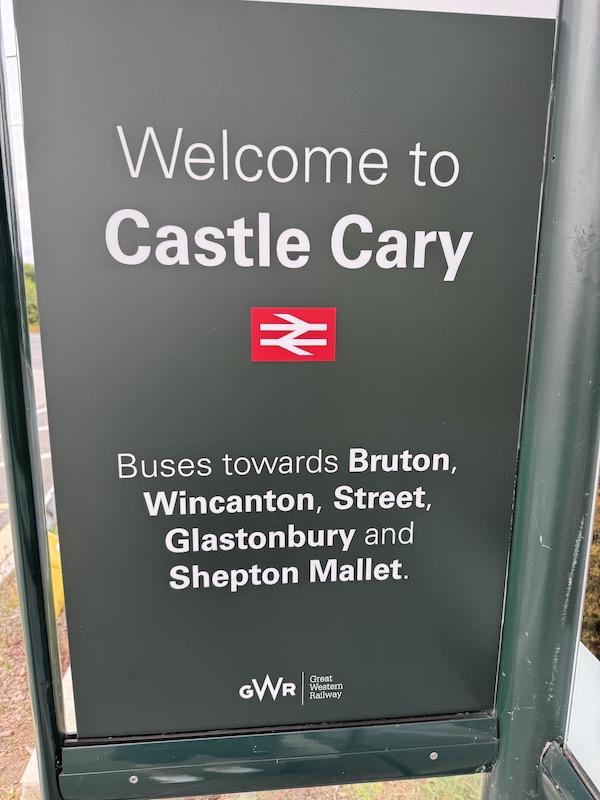
… with GWR style branding promoting bus links as well as full timetables on display and it was good to see the 567 had been added…
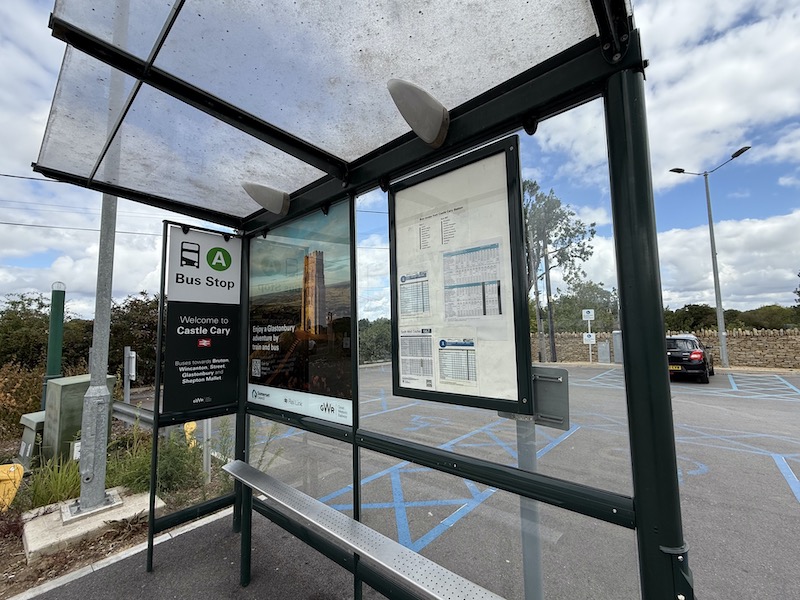
… as well as a promotion for the new route to Glastonbury and the town being added to the list of places served. Well done to GWR; it’s great to see such attention to detail.
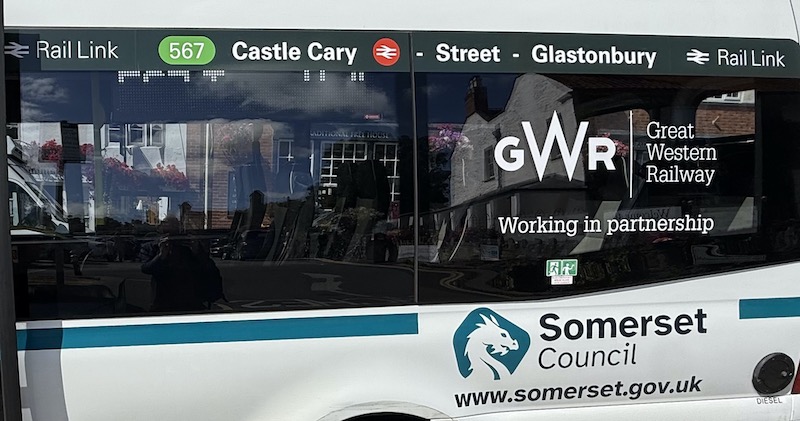
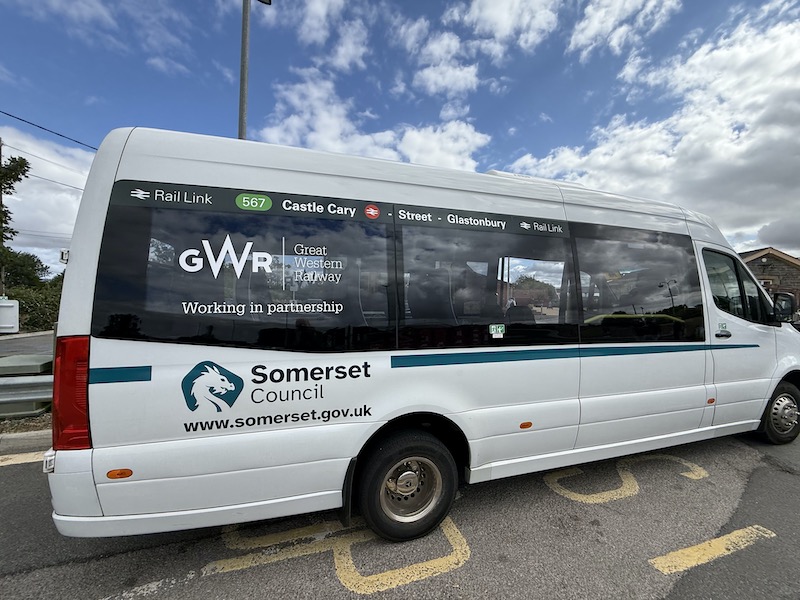
The dedicated Mercedes Sprinter also has names of the main destinations served on the route along its sides as well as GWR’s smart Rail Link branding.
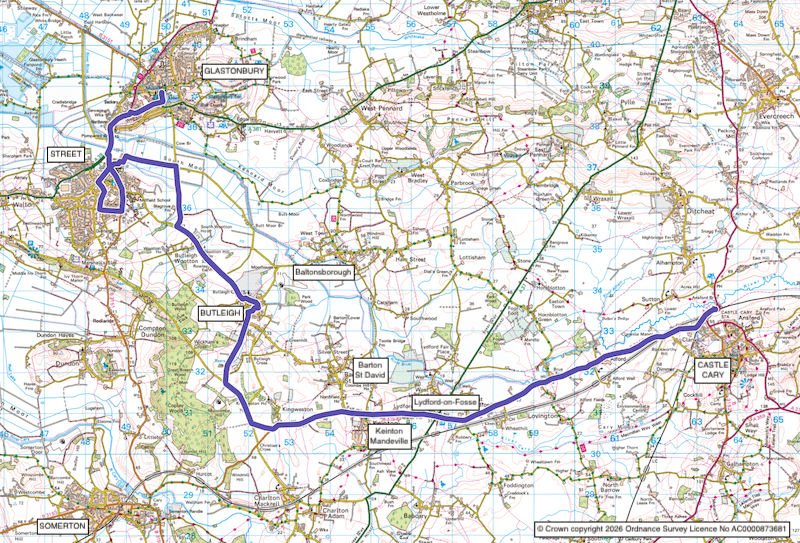
We set off – just the driver and I – on time at 10:51 towards Street and Glastonbury, the former also served by route 667 albeit by a slightly longer route (via Barton St David and Baltonsborough as shown on the map below) taking 45 minutes whereas the 567 bypasses both villages and takes 28 minutes.
Except it doesn’t. There’s a problem with the new timetable which became obvious as we headed over to Glastonbury and all the more so on the way back.
The distribution of running time is wrong. Only eight minutes is given between the village of Butleigh and Street (in both directions) whereas even with foot down driving it took 13 minutes and a more comfortable ride, as well as allowing for passengers boarding and alighting, would be 15 minutes.
The driver I travelled with said all three of the team who’ve been recruited for the new route tried practice runs before the route started last week and none could achieve less than 13 minutes even at 05:30 in the morning without any traffic about. Meet a tractor or other vehicles along the narrow roads, particularly in the village centre of Butleigh, and timekeeping will be a real problem.
Conversely nine minutes is allowed between Glastonbury and Street whereas on the way back it took us five, whereupon we had to pause for four minutes before continuing (to keep to time) only to then face the wrongly timed section of route to Butleigh and becoming six minutes late.
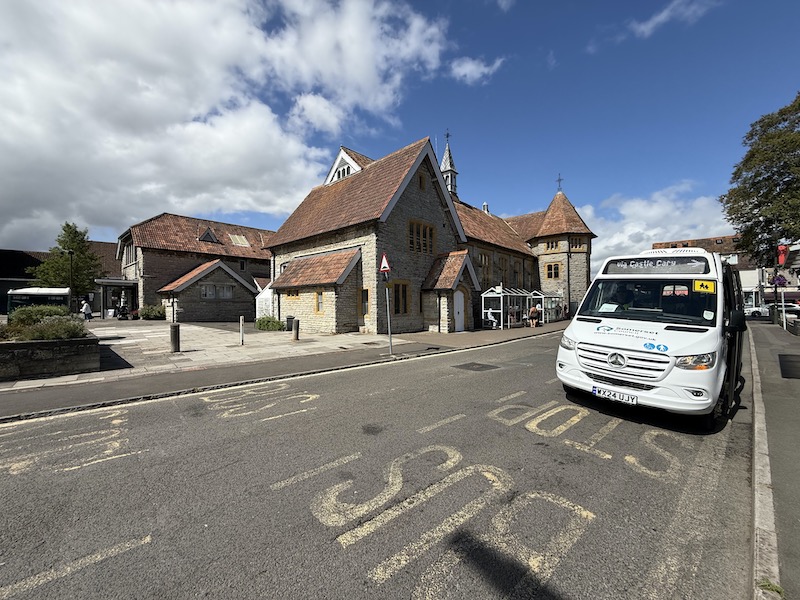
The upshot is it stresses out the driver and passengers heading back to Castle Cary aiming to make connections with trains. Granted most connection times are suitably generous but ironically the journey I travelled back on from Glastonbury is due to arrive into Castle Cary station at 12:10 whereas, despite the heroic efforts of the driver, we arrived at the station five minutes late at 12:15 – which shows in the timetable, among others, as a connection to the 12:15 GWR departure to Exeter (yes, that famous 10:36 from Paddington).
And as fate would have it that renowned train was once again running late – 23 minutes – due to “a fault on a train in front of this one”, so passengers would have made it but if all had been running correctly there’d have been no chance.
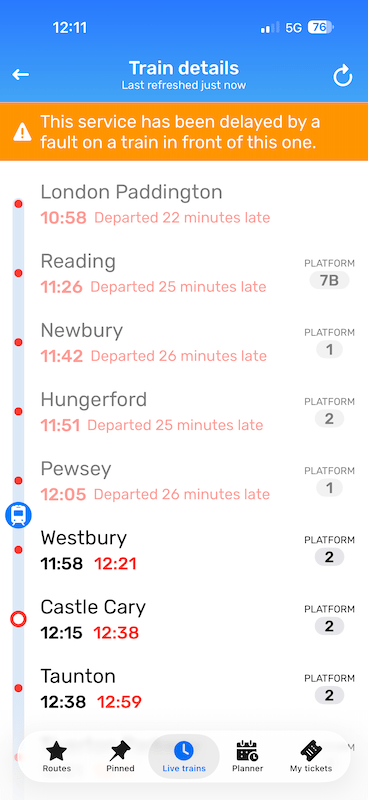
The 567 timetable needs urgently revising to ensure passengers trying it out to connect with trains in these first few weeks are not put off by the stress of a late running bus heading towards the station through no fault of the driver.
I appreciate it’s a challenge to work out a timetable to make connections with trains in both directions (from and to Glastonbury) using just one bus but to me, it’s just all too tight. I suggest the convoluted route followed by the bus in Street is simplified not least as route 667 also serves Street, eg taking the route showing in red below rather than the current route shown in blue.
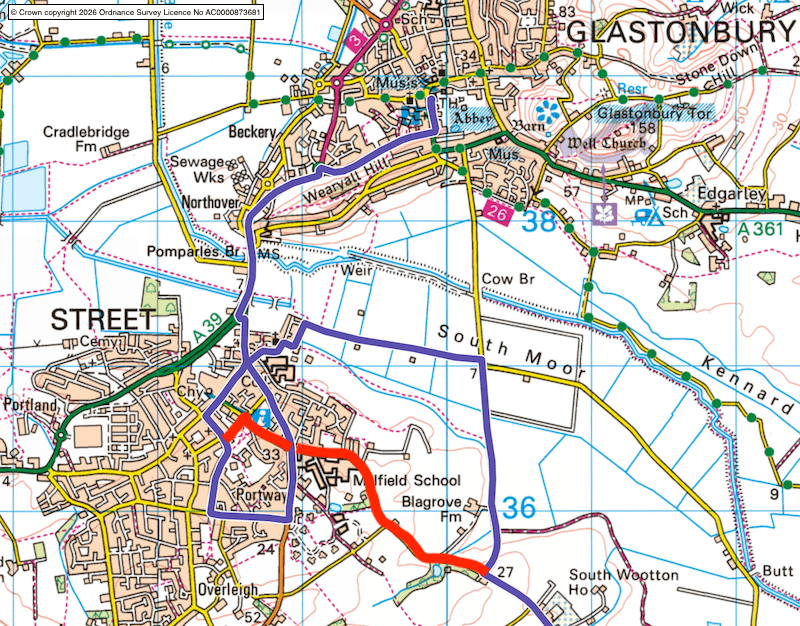
This would save enough time to maintain the current unrealistic allowance between Street and Butleigh without altering timings. As an illustration it took us seven minutes to navigate that blue loop in Street itself on Wednesday whereas only eight minutes are given in total to reach Butleigh.
Quite how this situation has arisen when I assume the timetable was compiled following ‘on the road’ trials is a mystery. Maybe if someone from Somerset Council is reading this they could take note?
No other passengers made a connection at the station but its early days and one potential passenger passing by did enquire of the driver, while we paused in Street, about the Sunday service and asked for reassurance it ran as she was planning to catch a train.
And we did carry five other passengers, albeit all could have used other routes, including on the outward journey one from Lydford-on-Fosse to Street (667); one from Street to Glastonbury (373/374/375/376); and on the return journey, two from Butleigh and one from Keinton Mandeville to Castle Cary town centre (667).
The new 567 certainly gives a better frequency on the common section of route with the 667 as can be seen from the timetable shown earlier.
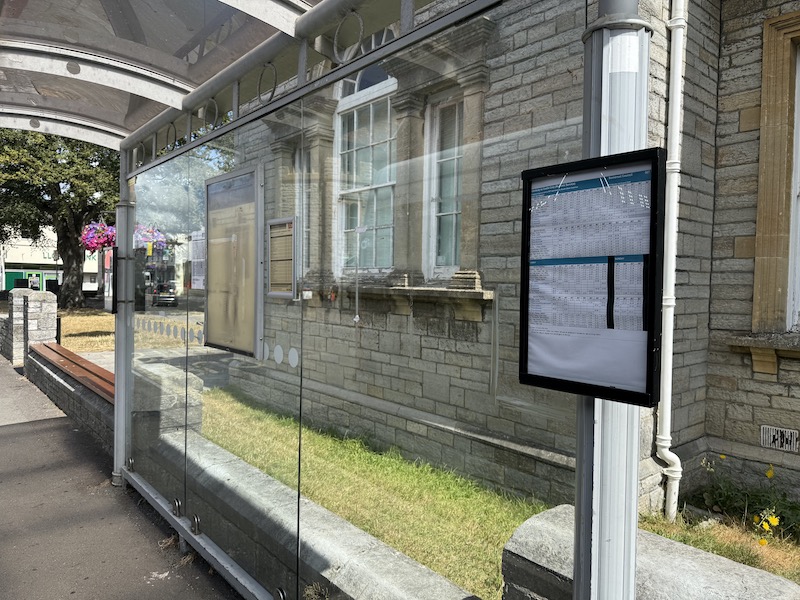
It was good to see copies of the new timetable had been posted at bus stops all along the route and a supply of an A4 printed sheet was available on board the bus…
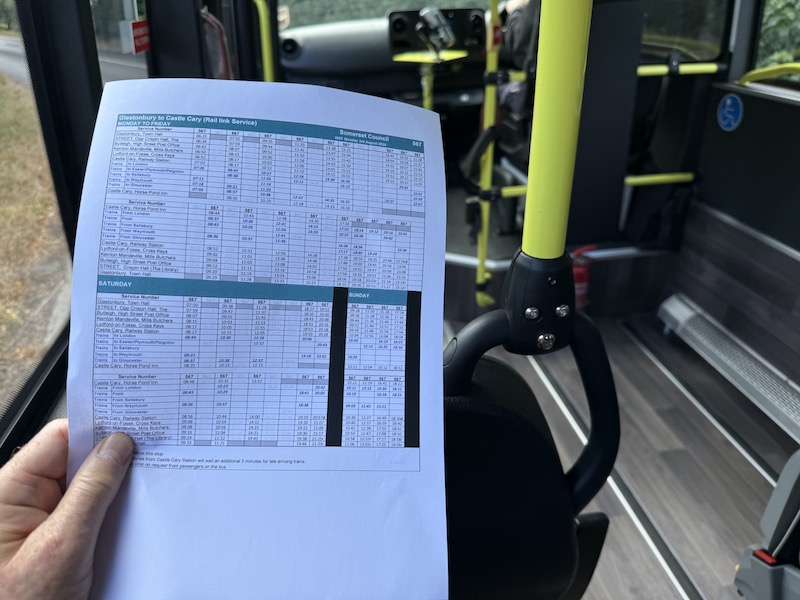
… albeit just showing the 567 rather than the combined timetable with 667 journeys.
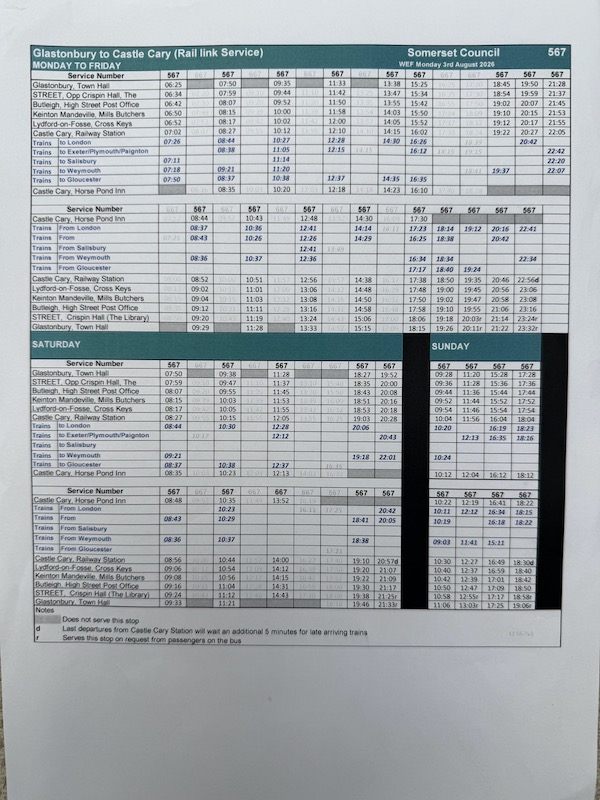
On both timetables there’s a note to say the “last departures from Castle Cary Station will wait an additional 5 minutes for late arriving trains” but when I asked the driver how he would know whether a train was running late or not, and if so how late it was, he didn’t know. It’s a shame with all the technology around these days the bus driver can’t be given access to an app that shows real time departures.
It’s also a pity, bearing in mind the overall cost of this trial route that a colourful and attractive leaflet hasn’t been produced and distributed to households along the route as key to its success is raising awareness. It’s also a shame, more effort can’t be made to tidy up the display at the bus stop in the centre of Glastonbury.
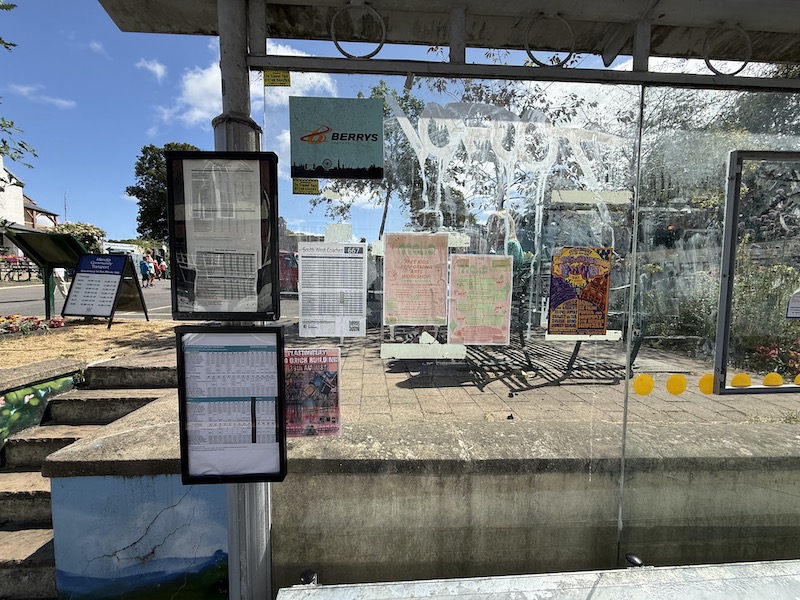
It’s a delightful town but the image of the bus to residents and the many visitors is not helped by such poor presentation.
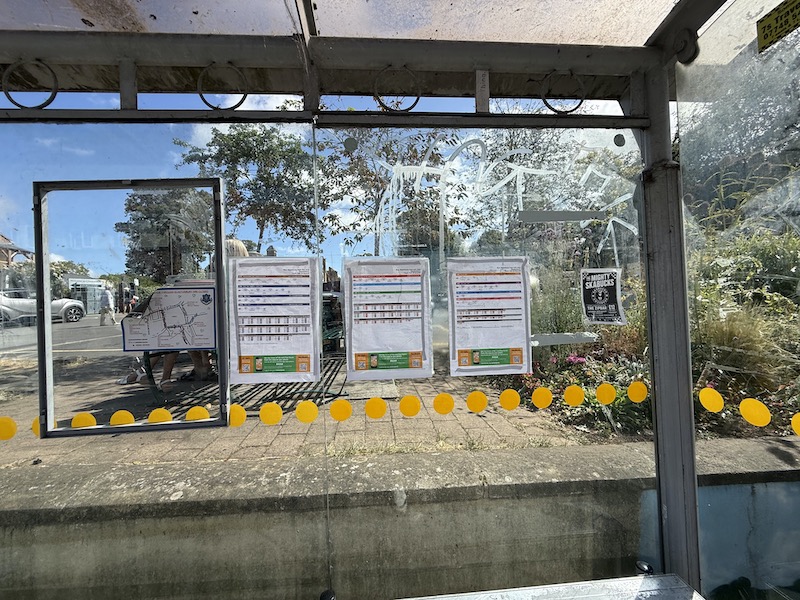
Interestingly one notice (which was peeling off in the top left corner) explained arrangements for “bus routes when roads through Glastonbury are closed”.
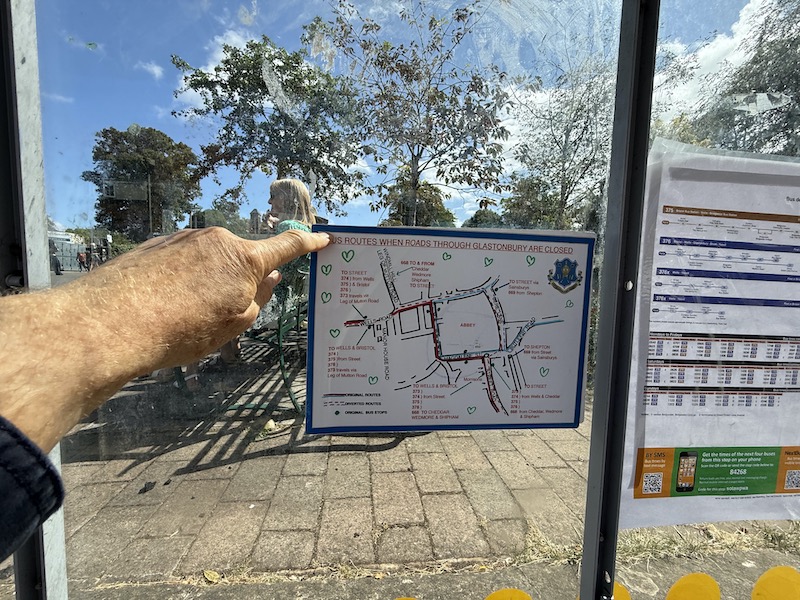
Even more reason to get those running times sorted as I can imagine at busy times of the year (not least a certain long weekend in June) the roads throughout the area can get very congested.
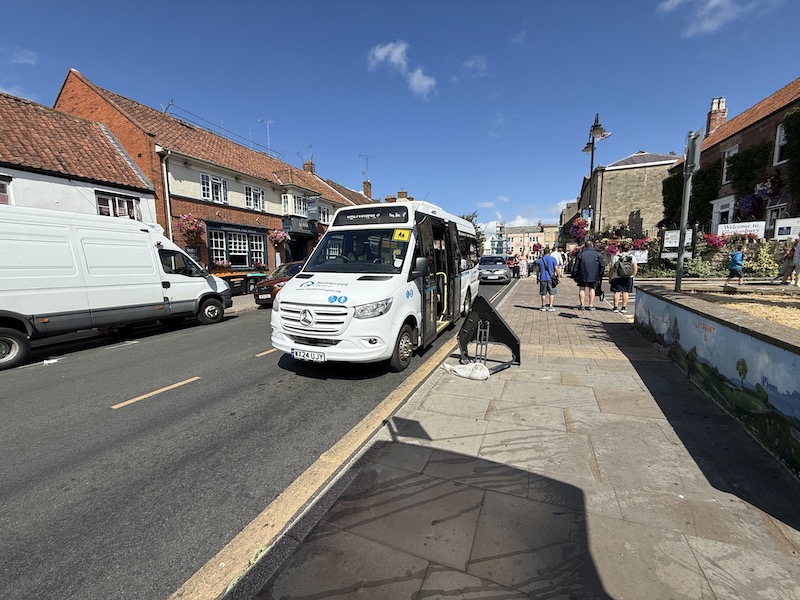
I wish the route well, but it’s going to struggle to survive, especially as Somerset Council has only committed funding for six months. As has been said many times in these blogs and in the ‘Comments’, that’s simply not long enough to test out the full potential of a new bus route.
Roger French
Summer blogging timetable: 06:00 TThSSu
 BusAndTrainUser
I have only ever visited Glastonbury by motorcycle on 28/07/1979, visiting the Abbey two days before passing my Motorcycle Driving Test at the Chertsey Centre. It was a lovely long tour taking in Andover, Warminster (for a call on a step-great aunt who worked for the Lifts & Escalators Section of LUL), Wells and a night at a hotel in Bath before driving straight home to Surrey the following day.
Glastonbury had an important claim to fame in the sporting world. Sports goods manufacturer BAILY’S of Glastonbury made a whole host of sports goods especially boxing gloves. In the 1960s all the major fights in the UK were staged using Baily’s gloves. Cooper, Ali et al. The Baily’s logo can clearly be seen from pictures of all those fights of yesteryear. Indeed, I boxed at school 1961-1965 and I wore Baily’s gloves and they are still in my possession although now too small to wear.
LikeLike
Note that the “Mini Switzerland” funding (mentioned above) in fact totals £12m – the widely publicised £6m from central government and a less well publicised £6m from the East Midlands Combined Council Authority (EMCCA) – shown on page 32 of this document.
LikeLike
This all looks poorly thought out. Why do about half of the trains from Castle Cary not have connections, the main service to the station is the GWR one from Paddington yet this lightly loaded SWR one gets a connection? And there are the impossible running times and the weird route in Street. South West Coaches 667 could also be extended to Glastonbury as there is plenty of stand time on the two bus schedule.
Why is Somerset Council so amateurish? There is BSIP money from which this is no doubt being funded. Whilst there is no £6m for mini Switzerland it might be worth paying the team who devised that to make a proper job of this before it fails miserably.
And as Roger says six months is nowhere near long enough to test the concept.
LikeLike
Mini Switzerland has £6m for revenue and £6m for capital. It’s not clear what the capital is for? Bearing in mind kick off is hoped to be spring 2027 the chance of having electric buses or improved station facilities by then is nil, so there could be grants for the extra diesel buses required. But hopefully the £6m to run it should keep it operating for a few years to test and refine the concept.
LikeLike
Judging by comments on social media buses will not wait at Castle Cary even for one minute for late running trains. Given GWR’s very poor punctuality record that totally undermines confidence in the service which unfortunately I think will be doomed to failure as a result.
Steve
LikeLike
The 567/667 timetable as shown clearly depicts the difficulties in connecting buses with trains. There are effectively FOUR services to be connected with (up/down London; up/down Weymouth). None of these operate to a standard hour. Which should be prioritised? And when that is decided, what minimum connection time should be used? 5 minutes? 10 minutes?
And what happens when services are not running on time? At a guess, 10 minutes bus >> train “should” be sufficient to allow for slight road delays and the purchase of a ticket. However, what about train >> bus connections? 10 minutes again? if the train IS on time, then passengers will huff and puff about “hanging around”, and “we should’ve used the car”.
If the train is delayed, then how long should the bus wait after scheduled departure time? The Traffic Commissioners state that the bus is deemed to be “non-operated” after 5 minutes. And if a longer delay is encountered, and the bus does wait, then what about the passengers waiting further along the route?
And how much “buggeration” time should be allowed between journeys to allow for potential delays? And how much extra resource will this cost, or how many potential extra journeys will be sacrificed to maintain a “core” timetable? And will this be attractive enough to secure the necessary patronage for the route to continue?
I’ve tried to answer these questions so very many times over the last 50 years . . . and NEVER found an answer that meets all objectives. If anyone out there can provide said answers . . . there’s a coffee on me waiting!!
LikeLiked by 1 person
With regard to buses connecting with trains & vice versa, the lack of information for the driver reminded me of a feature introduced by Go South Coast. Live information on train & ferry times is displayed on Morebus & Southern Vectis buses. Perhaps train companies could adopt the same system? However, if the bus or train gets held up, then I appreciate such information becomes academic. No magic solution greenline 727 but having smelt the coffee I’ll take the biscuit!
LikeLike
Another route for Municipally Operated Bus Services. Something growing that I dont think was forecast some years ago (as opposed to supported by). Has Somerset ever had a municipal bus before ?
JBC Prestatyn
LikeLike
This will be an ‘in house’ operation running off a Section 22 permit rather than an arms-length O Licence operator. Looking at bustimes.org Somerset Council operates 24 routes across the county.
https://bustimes.org/operators/somerset-county-council-previously-atmos
LikeLike
I agree with Green Line 747’s comments entirely, if you have a clock face hourly reliable ( a word unknown in parts of BR) then bus/rail connections in isolated areas might work.
Perhaps as part of a rail route (formerly franchise, don’t know what the GBR word for these will be – region?) the rail operator could be required to run the connecting bus service. This was tried early on in privatisation, I think Virgin ran several, one of which was X99 Milton to Keynes to Luton , messed up by Stagecoach as MK1 latterly and now rescued by Arriva of all people as X1
LikeLike
It looks as though both Stagecoach and Arriva are running a fast service between Milton Keynes and Luton, though by slightly different routes, with similar journey times and (on a Saturday morning at least) simultaneous departures.
Maybe Roger could supplement his Stagecoach trip from some time back by trying out the Arriva offering?
Ian McNeil
LikeLike
I wonder what the demand really is?
Street has a population of 13,000 and Glastonbury 9000.
The trains are only useful for long distance – the local towns served will have very limited use.
They have buses every 30 mins to Bristol even though it takes nearly 2 hours. The other direction hourly to Yeovil and hourly alternating between Bridgwater and Taunton.
Adapting the 667 with perhaps a 3rd bus (the 567 one?) with ability to wait for late trains and provide connections from Wincanton as well might be better.
#
All trains running an hourly pattern would be very helpful, but it does not cover local needs. Paignton has 2 trains a day each to Manchester and London, Axminster has the morning commuter journey run early to match Exeter College start time, etc. Axminster otherwise has the same timed hourly service 7 days a week with only first and last trains different.
LikeLike
I was a little surprised to see this added as a new route rather than by improving what was already in place. I know people like to see their own dedicated link and all that, but working to improve an existing route should be more efficient and have a greater chance of a long term existence. I guess it depends on how the contract for the 667 is set up and/or the influence of the railway operator wanting something bespoke.
Richard Warwick
LikeLike
It’s good to see that the bus has an eyeball to eyeball view of the arriving trains, but crazy that the driver doesn’t have access to Realtime Trains, or similar info on train punctuality. Without that, it’s anybody’s guess as to whether the connection will be held. Not a good way to encourage public confidence in a Rail Link bus.
Peter Murnaghan
LikeLike
The National Rail app, available to anyone, has a Live Trains feature!
LikeLike
I was going to post the same comment!
Pete
LikeLike
Can the driver leave the bus and check the platform / station entrance display/s
JBC Prestatyn
LikeLike
Back in the day it was Somervale Coaches with their ex Western Welsh Leyland Leopard that replaced the Somerset and Dorset railway,going via every former station shadowed by a Bristol Omnibus Greyhound route and Bristol Greyhound (requiring advance booking). As you might imagine passenger number were very limited as not many people actually wanted to go on that route.
LikeLike
Hope this new service is successful after the needed running time tweaks. That bus shelter in Glastonbury (a tourist hotspot) is an embarrassment. So shoddy and amateurish.
I wonder if people heading to Glastonbury Festival will overwhelm that Sprinter though if they don’t know about the dedicated shuttle buses put on for the event.
Pete
LikeLike
Anyone heading to the festival will be directed to the special shuttle buses (or just follow the crowd!)
LikeLike
The Glastonbury Festival isn’t actually at Glastonbury, but at Pilton, nowhere near where the 567 goes.
Steve
LikeLike
That 2 coach SWR train at Clapham Junction on the West of England service can be sufficient in normal times and if everything else is running smoothly.
However, SWR has been far from running smoothly recently and that applies in spades to the West of England service. I had the misfortune to catch one westbound from Clapham on a sweltering hot day, when the previous service (formed of more units) had been turned around at Basingstoke. So we had several trainloads crammed into this absurd freak of a main line train. While SWR performance remains so bad they should never field anything less than 5 coaches long out of Waterloo, as they never know how many will be actually be wanting to use it especially on the busy leg as far as Basingstoke.
Stuart S
LikeLike
Unfortunately it is the heat drying the trackbed again that is causing west of england route problems. Unlikely to solve climate change quickly but the lack of two track running is a problem that GBR should be instructed to get sorted where reasonable for the future
JBC Prestatyn
LikeLike
My understanding is that the 158/159 fleet that operates the West of England line is suffering from chronic availablity problems. A combination of them pushing towards 40 years old and First Group penny pinching on maintenance as compared to South West Trains days so I doubt it’s a case of trains sitting around spare.
Stagecoach actually had a plan to replace the trains and upgrade the line as part of one of their franchise bids in the early 2000’s. That was rejected and we’re now 20+ years on and seeing the inevitable consequences of there having been little investment in the line. SWR are starting a heavy refurbishment programme on the trains so it looks like they’ll be closer to 50 by the time they retire! (Incidentally that will be about twice the age of the loco + coaches that they replaced!)
Surfblue
LikeLike
Although not branded as a rail-link service, another new route you might like to try is Stagecoach South 8 (Yateley – Farnborough) which starts on August 30th running hourly seven days a week. Details are at https://www.stagecoachbus.com/service-updates/serviceupdatesarticle?SituationId=ID-13/07/2026-14:21:39:688
The timetable shows connections at Farnborough (Main) for Waterloo, so Stagecoach are obviously hopeful of this being a major selling point. However, I am a bit concerned at the rather tight 6′ connections towards London, particularly if you need to buy a train ticket !
LikeLiked by 1 person
Having looked at the link I note Stagecoach are offering free travel over the August bank holiday as well as every weekend throughout September. Good initiative. Hopefully this will help to stimulate regular demand for service 8.
LikeLike
The GWR of course has a long history of operating bus services to feed its railways and make money in their own right , initially on their own account then investing in mainly Tilling Group bus companies but I think had investments in BET too (any other independent or small groups ?)
Such ties at times would lead to unions on the buses being NUR rather than the TGWU or similar.
As to which train services get a direct bus connection as long as a fair proportion is covered with other departures or arrivals just having to have a longer – but its not excessive ? wait.
For the Traffic Commissioners given the last and one other later journey dont actually promise to reach Street or Glastonbury unless requested by passengers on the bus I cannot see that “late” running of those services is a consideration other than restricting legal driving hours.
JBC Prestatyn
LikeLike
Such a shame about all the issues and logistics here. These sort of initiatives should’ve been all over the country after the Beeching cuts. I understand buses replaced rail in many rural areas, but there was seemingly never any effort back then to connect the replacement buses on former branch lines with any remaining railways including mainlines. Something that truly baffles me. Seeing GWR put in some effort on the branding side, tickets and timetables should’ve been the standard all along. If done right buses really could massively extend the reach of the railway. Something that would massively improve things in a suburban town like mine too.
Aaron
LikeLike
The example to follow was Lord Ashfield’s Underground Group where the buses owned (London General inc its Country Service franchise) were operated to mainly its own tube railheads like Morden , Golders Green and so on , but also to some of the competing pre grouping and later stations like Sutton , Ilford, Ealing Broadway and Romford. I assume services to Potters Bar fell in the same idea too. One can argue that taking the LPTB area and then splitting it across the political boundaries extant at 1970 failed to ensure this meaningfully continued (assuming limitless supply of buses and ignoring revenue not covering costs by that time).
What we do have today is a common theme with the buses – In Waltham Abbey , Portsmouth / Southsea and Castle Cary is the rather well known. but less solved, problem of faster services not serving every community sometimes at the expense of reducing the slow but more connecting service frequency.
While noting the other bus services covering Glastonbury and Street it does indeed seem more sensible to fully cover both routes at all times as 667 or 567 running through route entirely differing in the intermediate places served with the 567 running time appropriately allocated properly on its intermediate calling points.
JBC Prestatyn
LikeLike
@JBC Prestatyn
That seems like the best way of doing it, especially if the rail service is frequent. Noticed this is quite common all over South Essex, where there is a frequent rail and frequent bus service. Especially Canvey Island and Basildon, not really necessary to look at the timetable when a bus is every 10 to 15 minutes and the train is a similar frequency, with the bus stopping next door. Would be ideal if all urban and suburban areas were like that.
I’m finding the 66 extension really useful because it’s 1 bus to the Central Line even though it’s a longish journey (55 minutes but in reality not much longer than reaching the local stations because of the lack of bus/ train integration), nice route too. Wishing from Cheshunt, it was possible to reach the Northern and Piccadilly Lines on just 1 bus too, would open up a large variety of destinations that way.
A real challenge highlighted in this blog is how to do it in rural areas like Somerset where at best a bus is hourly and the train is also just hourly. That requires a lot more planning and more importantly communication and coordination between companies and councils and others who until now don’t seem to like to talk to each other.
Aaron
LikeLike
Aaron – you’re talking about something that happened long before you were born and that you have no knowledge about.
Many of the rail replacement services that were instituted were poorly used (as were the trains before them) but went from peripherally located former station to former station and took much longer. That meant they were doomed to failure in that regard.
Some services did survive but more because the former rail line paralleled the road owing to geography.
BW2
LikeLike
I never said it had to be like for like. I’m saying the lack of integration since then between bus and train is what baffled me. For example you have the now frequent 90 from Maldon to Witham, a useful route, was any attempt made to make it obvious in publicity that it actually connects with trains, that combined tickets are available? Rather than here is another bus route that can change with the wind.
In some cases, the bus replacement makes more sense than the rail service ever did. Hadleigh connected to the mainline in the middle of nowhere, now the bus goes direct to Ipswich, its nearest city. My issue is they did these things separately. Anyone wanting to use the bus as a branch line to the railway that remains is left to work it out all themselves. It doesn’t work as one system. Only GWR’s efforts so far get close. I have high hopes for Mini-Switzerland too and feel that is what should’ve happened during the decades of rail closures we had in the 50s, 60s and 70s. Instead of the siloed approach we got.
Aaron
LikeLike
Aaron
The 90 timetable doesn’t and hasn’t changed with the wind.
It had a new timetable in 2017 and aside from having to have a Covid period timetable and a route diversion in 2022, it only got changed in 2023. So that’s one change in NINE years…
I know that this is before you were born but BR and the nationalised operators were never that great in promoting or establishing bus links, and certainly couldn’t agree on revenue apportionment.
BW2
LikeLike
There is going to have to be some Guiding Mind at GBR for the use of scheduled bus services provided by any other entity in potential partnership . indeed will GBR have the statutory powers to operate local or express bus services (not including rail replacement services for engineering or similar needs) ? There is talk I think of extending more north east rail at Saltburn / Lofthouse area where normal investment analysis shows express bus service would be just as beneficial , which rather questions if so why isnt such bus service (assuming no changes to road widths layouts or prorities is need ) in place now ?
JBC Prestatyn
LikeLike
The second bus on duty M-F on the 567 appears to be a follow on one from a single Somerset 667 operation from Wincanton to Castle Cary via Bruton in one direction only presumably providing an effective rail link from those areas after the other operator has ceased for the day.
JBC Prestatyn
LikeLike
I seem to recall the BR directly operated some buses (rather than just having a commercial sales agreement).
Peterborough-Wisbech-Kings lynn-swaffham-dereham-norwich is an example (maybe even back to original LNER days, pre BR) and this specific route has recently reappeared in publicity but not as directly operated; it’s in the fares data viewable on Fares website, although quite hard to actually purchase (not available online on any website it seems, and only some of the destinations available at major ticket offices like Kings cross; local GN operated ticket offices can sell these). Fakenham has also been added to publicity and fares data.
Generating a complete list of all bus destinations in the rail fares dataset (and on br fares) is surprisingly hard task, if you wanted to tick them all off, even before considering defunct examples in the southern part of the Eastern counties (shadows of which still exist in local bus timetables).
milesT
LikeLike
British Railways never ran bus services for the public. Other parts of the nationalised industry existed to do that.
Peterborough-Kings Lynn was a dedicated service run by Eastern Counties, a National Bus Company operator, using coaches painted in an approximation of BR blue and grey. The through Excel service to Norwich is the descendant of a post-1980 service branded as Eastlink.
Eastern Counties did run a number of post-Beeching rail replacement services, but like many other locations, these tried to replicate the rail route and serve closed station sites, rather than the obvious place where people actually wanted to travel to.
Written from memory, as my ECOC history has disappeared….
KCC
LikeLike
@kcc
I stand corrected, although it seems I am not the only person with the wrong impression even contemporaneously.
I was gadding about yesterday at the colne valley railway and one of the books on display for public consultation was “East Anglia by Rail” (Railway Development society) which has a write up on the Peterborough to King’s Lynn section and the write-up very much implies it is railway operated (definitely with through ticketing) with a livery as you describe.
So we may be splitting hairs in he definition, maybe the question would be who had the revenue for passengers using the bus exclusively; the bus operator or BR? If BR, then it is railway operated even if subcontracted to ECOC to provide diverted vehicle and driver (c.f. a TfL franchise today), if ECOC was taking the revenue risk then it was just BR reselling a service operated by ECOC.
MilesT
LikeLike
Logically this should be a success, as both Street and Glastonbury have strong connections with other areas (DFLs, etc.) and a slightly more green-minded ethos than most provincial towns. I suspect in reality it might not be though, despite a very commendable long operational day.
Roger’s train is normally scheduled for a 4-car 158/9 – still stupid to have at Waterloo of course, but much better than just 2. When run as planned it divides at Salisbury.
LikeLike
To add, I wonder how far GWR will be willing to go to support this? If the bus runs late to an advertised connection, will they endorse Advance tickets to a later train service?
LikeLike
Hoping for something from Roger on the provincial August free travel for u16s sometime. Seems to be getting enthusiastic use round here but no idea how it is seen by industry insiders.
LikeLike
I’ve definitely noticed more young people out and about in both Cheshunt (Brookfield) and Waltham Abbey. A good amount of them didn’t seem to know about it until getting on the bus and many seemed genuinely grateful. The 242 seemed noticeably busier with younger people seemingly seeing where it went on a sunny day! I guess for people from neighbouring London boroughs, they can finally use the buses the same way they are used to.
Aaron
LikeLike
I wish East Midlands Parkway had a rail link bus service
LikeLike