Tuesday 7th July 2026
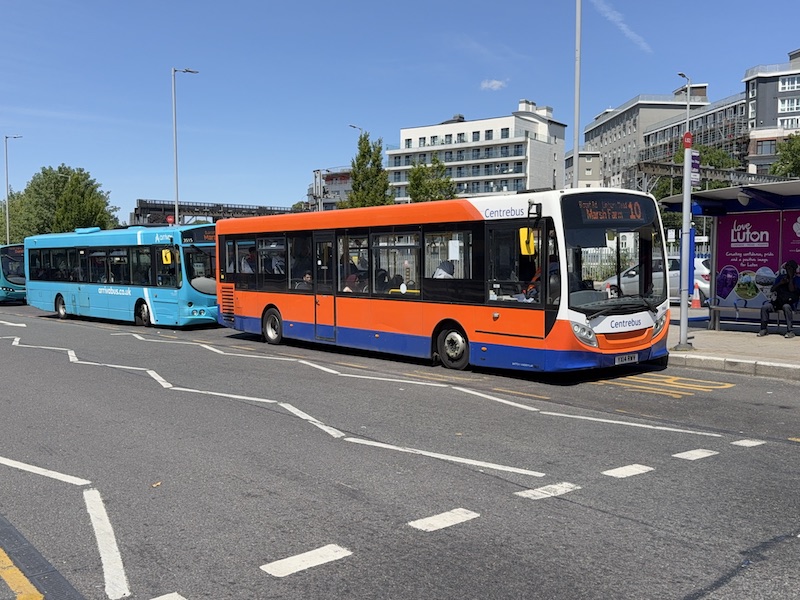
It’s yet another Tuesday tale of competition between bus companies in the Home Counties. While Thames Valley and Carousel have dampened down their skirmishes with tactical withdrawals in Berkshire, the battle for the High Wycombe and Slough to Uxbridge corridors between Carousel and First Bus continues and over in neighbouring Bedfordshire a new outbreak of hostilities has just begun.
I recently covered the battle between Red Rose and Arriva for the corridor between Aylesbury and Buckingham and a few months ago highlighted wasted duplication in Luton and Dunstable between Arriva and Grant Palmer with both companies chasing each other on the roads between the town centre and Linmere and Thorn, but yet more competition began in this area from the end of May when Arriva expanded its network to take on Centrebus starting a new head to head battle for the Marsh Farm residential area in north Luton.

As part of a significant change round of routes from 31st May, including a renumbering into single digits, Arriva changed its route previously numbered 29 which had shuttled every 20 minutes between Rumfold, Biscot and Luton town centre to now be known as route 5 with an increased frequency of every 15 minutes and an extension from Rumfold to serve the large Marsh Farm residential area.

This puts it in direct competition with Centrebus’s route 10 which runs to the estate on a more direct route every 12 minutes and has done so for decades, including by predecessor bus companies.
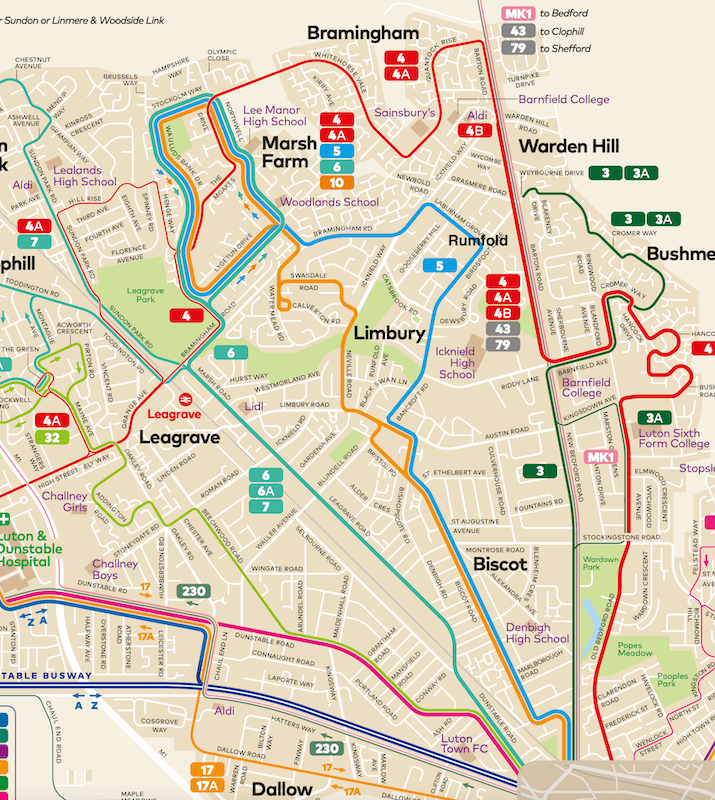
The two routes are shown on an extract from Arriva’s comprehensive network map of the conurbation (above) with its new route 5 shown in light blue (I’ve added the name Rumfold to clarify where it is) and Centrebus route 10 shown in orange via Limbury. You can see they both serve Marsh Farm with a large anti-clockwise loop along with Arriva’s route 6 (was numbered route 27 until 31st May) which also runs every 15 minutes around the estate before continuing to the town centre via Leagrave. Below is the full network map from earlier in the year showing the arrangements before the recent changes from which you can see the light blue route 29 didn’t continue over to Marsh Farm.
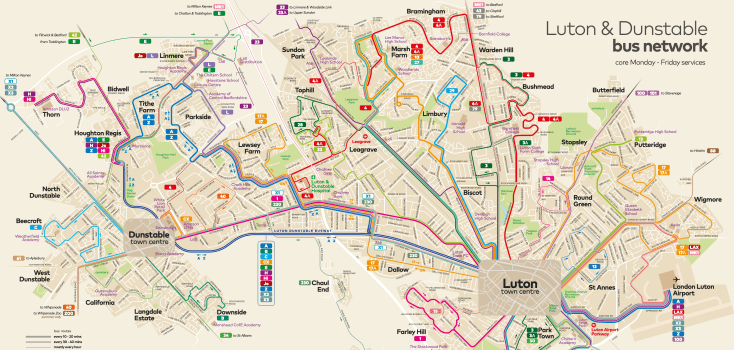
As part of its network changes Arriva are promoting buses between Marsh Farm and the town centre “every 7 minutes” (actually 7-8 minutes) by coordinating frequencies on routes 5 and 6 albeit they take different routes into town with the 5 taking 30 minutes while the 6 takes 26 minutes. Centrebus’s comparable journey on the 10 via Limbury takes 24 minutes.


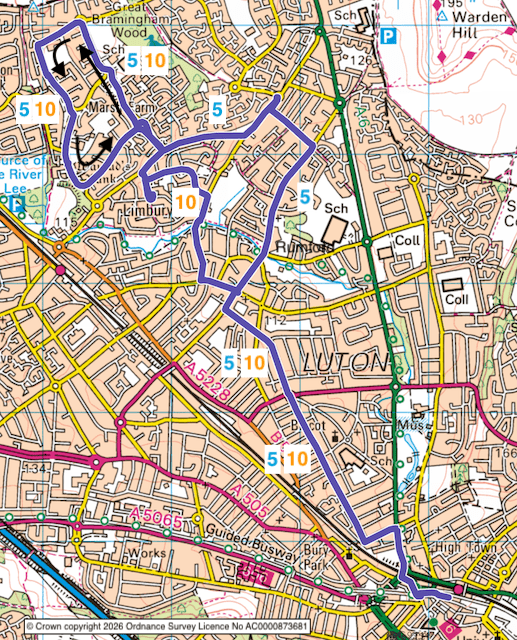
The OS map extract below shows the comparable routes of the 5 and 10 from which you can see why the 10 has a four minute time advantage due to its more direct routing through Limbury rather than Rumfold.
I took a ride on both routes on Thursday morning last week to see how the competition was going in its fifth week. Things got off to a bad start as I walked from the Interchange through to Silver Street where both routes depart alongside Luton’s big shopping centre, now branded as Frasers Plus.

A small number of passengers were waiting at the bus stop for the 5 and 10 but there was a distinct lack of buses.

The road was closed beyond the bus stops and none of us were quite sure whether buses would still be serving them before doubling back to regain the normal route.

There were no notices posted at any of the six bus stops and everyone was looking rather confused at each other and gradually drifting away, mostly to the nearby Interchange alongside the station where both routes also stop on their inbound journey at Stand 2.
Here there was more confusion with buses arriving on the 5 and 10 with passengers expecting to travel onwards to the shopping centre and drivers telling them this is as far as the bus was going with other passengers boarding for their return journey. No information was posted here either.
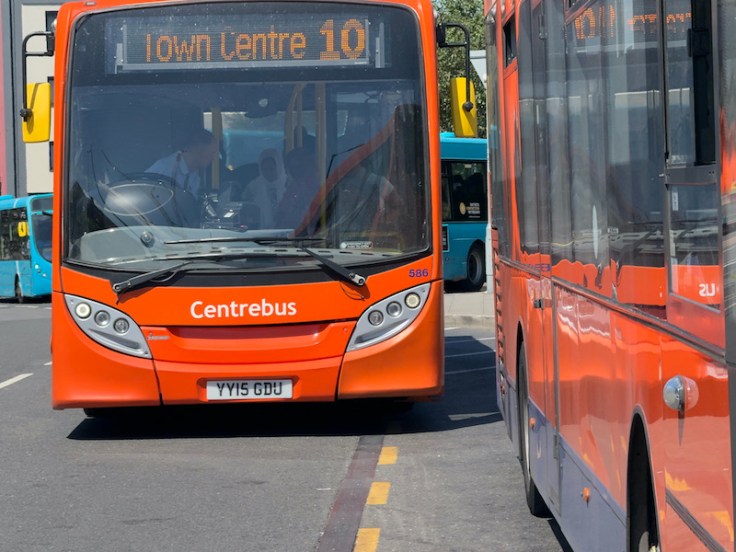
It wasn’t very encouraging.
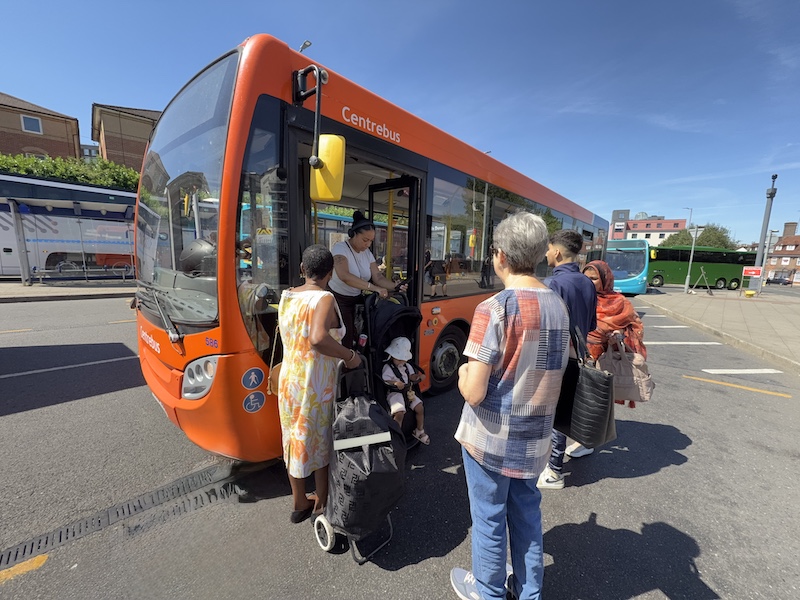
I hopped on a route 10 and we soon set off with five on board not far behind an Arriva route 5 which had departed a couple of minutes before with four passengers. As we approached the busy and congested retail and residential area of Biscot just north of the town centre, we caught the Arriva route 5 up…
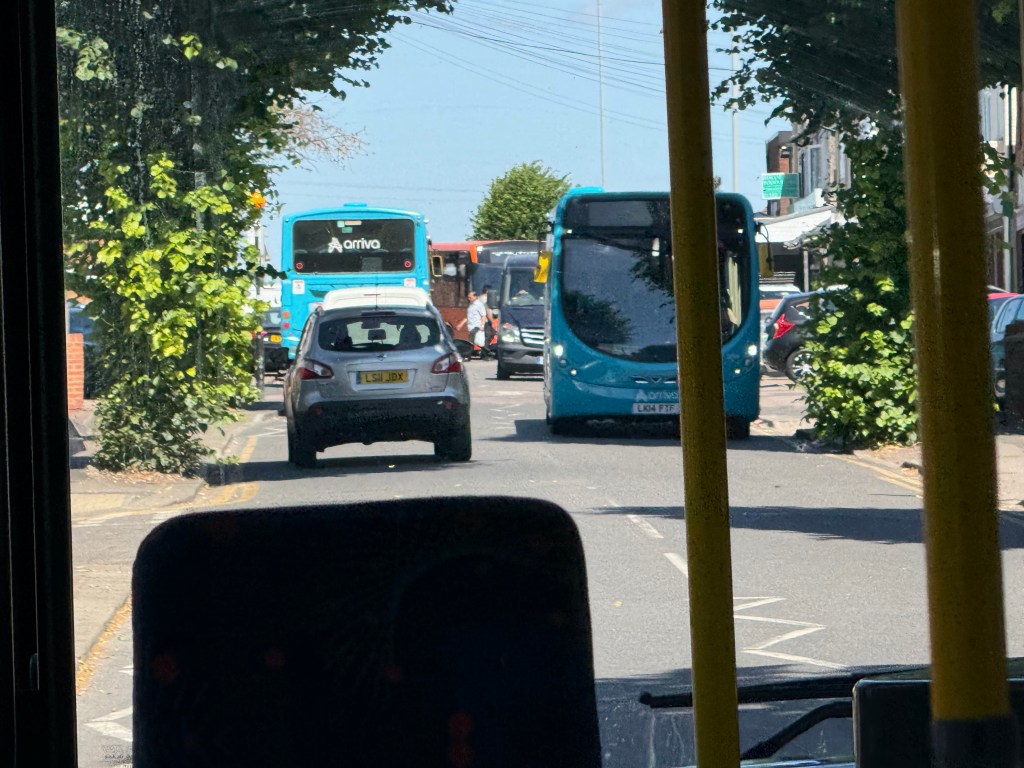
… as well as passing an inbound Arriva route 5 followed closely by a Centrebus route 10 both with high single digit numbers on board. We stayed on the tail of the 5 until it turned off to continue via Rumfold while we headed for Limbury where we paused for a couple of minutes by the area’s local retail centre…
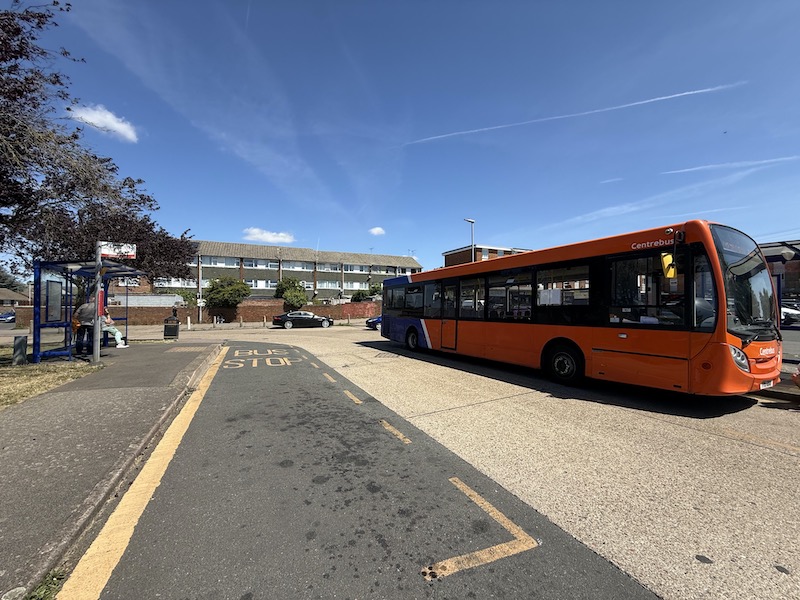
… and two buses heading into town on the 10 passed with about a dozen passengers between them.
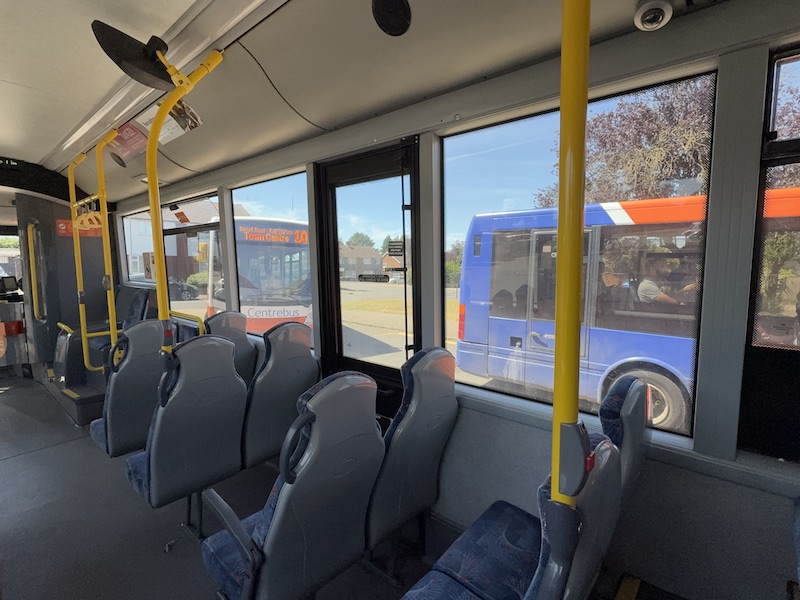
By now just one passenger remained as we set off again for Marsh Farm where the Arriva route 5 got just in front of us as we began the anti-clockwise circuit around the area.

It was interesting to see two passengers shunned the Arriva bus just in front of us at the first stop and boarded the Centrebus 10…

… as we continued to follow the 5 which was just in front.

The same thing happened at the next stop with another passenger letting Arriva go by…

… and the next stop after that with two more passengers favouring Centrebus over Arriva.

It may be because they were travelling to Limbury or perhaps perceived the 5 took a longer route (which it does) or were befuddled by the route number showing as 5, as previously the Arriva route for the town centre at these stops would have been the 27 (now the 6 via Leagrave) and not helped by the bus stops still showing the old route numbers.

Both buses seemed to be taking a pause at this stop so I took the opportunity to switch from the 10 to the 5 and see how that fared on its journey back into town.

There were two passengers already on board the Arriva bus and we continued to wait a little longer as the Centrebus bus set off and overtook on its journey back into town.

No-one boarded as we headed around the Rumfold area but once we got to the busy Biscot area we picked up 14 passengers at eight bus stops including four of those 14 alighting after making just short journeys on board giving us 12 passengers as we reached the town centre not far behind the route 10 which had set off before us from Marsh Farm and I’m sure did just as well through Biscot.

The section of route through Biscot is undoubtedly serving a well patronised area and again I noticed the bus stops were still showing the former route number 29 rather than the new 5…
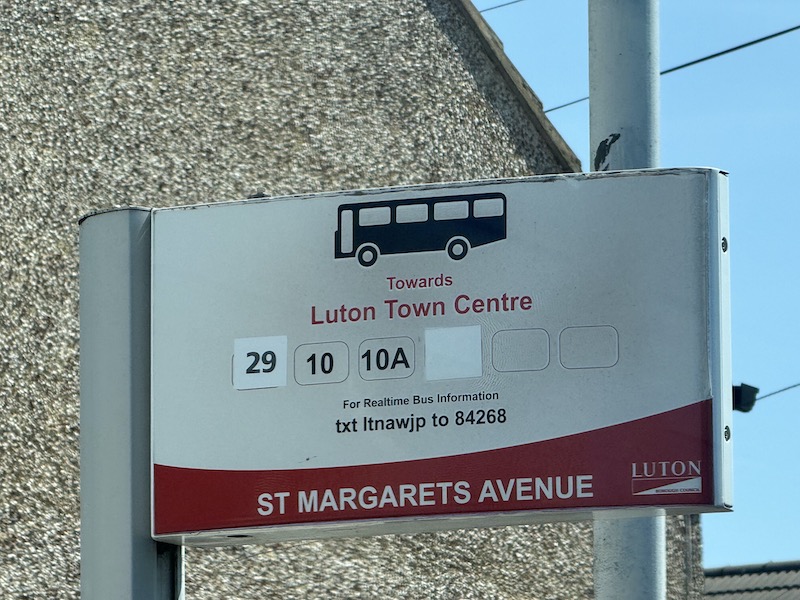

… although the new look bus stops for Luton don’t have a facility for route numbers so that will solve that problem.

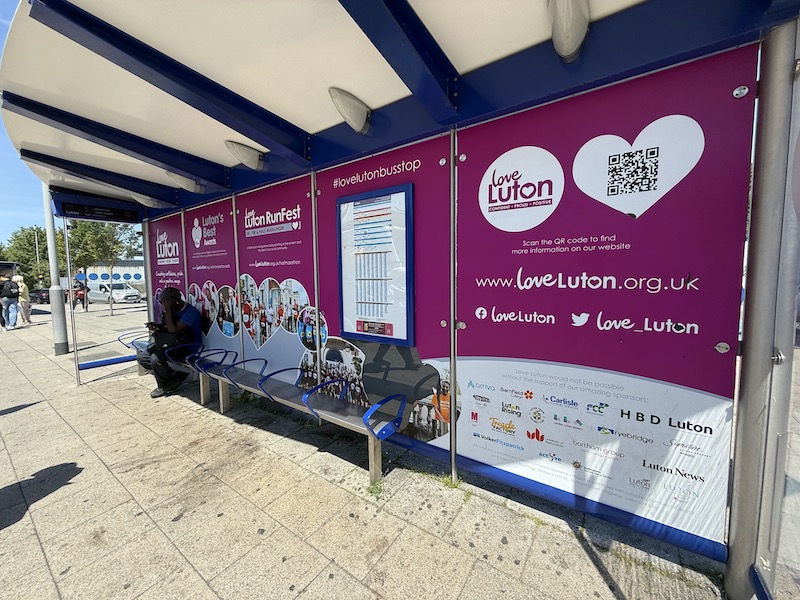
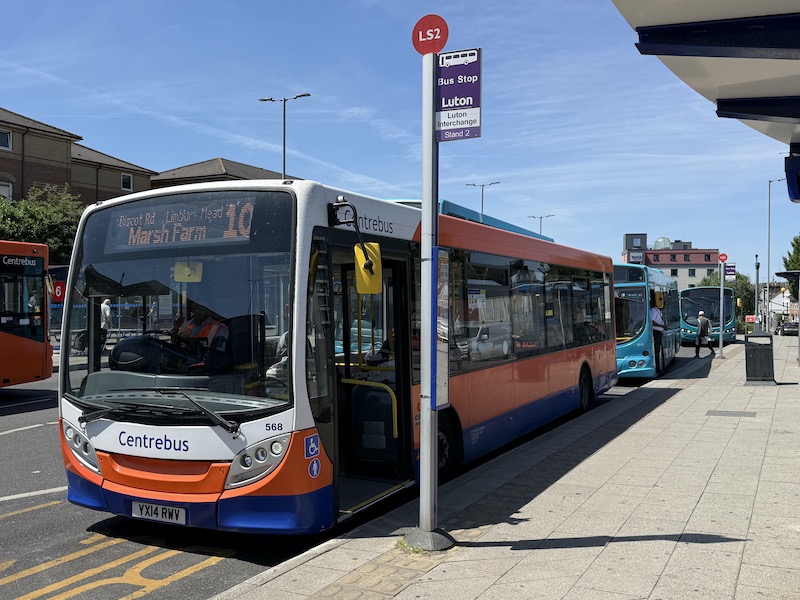
Purple seems to the favoured corporate colour for the Unitary Luton Borough Council.
It was evident Centrebus’s long standing presence in Marsh Farm has led to a loyal following and I got the impression Arriva’s additional frequency (eight buses per hour rather than the previous five) as a result of the newly extended route 5 (ex 29) wasn’t making much of an impact
While in Luton I also had a look at the Arriva/Grant Palmer clash between the companies’ routes H/H1 and Jo/L and numbers travelling didn’t look any different to what I’d found when sampling these routes back in February.
There simply aren’t enough passengers to make these competitive clashes sustainable.
Roger French
Summer blogging timetable: 06:00 TThSSu


The days of Luton Corporation buses around the town in a Caramel and Cream livery (were they mainly double deck Leyland PD2 ?) What frequencies to such residential areas applied then ? With Purple bus stop signs I would expect some kind of Harry Potter triple deck RT conversions running around.
With United Counties to the North and London Country area to the South the border town in regulated days had a good fair service and the Thameslink fast electric trains were way yet to come for the rail network as such and a much smaller airport with much larger Vauxhall Motors manufacturing in town giving plenty of route income.
Is the combined 5/6 going to generate more passengers and leave enough for the 10. Given they take different routes there might be. Having had personal experience of not getting bus stops updated at flag level in time for route changes I realise that it can be a challenge to get everything done, but surely once published in notices and proceedings ( why in these electronic information ages links to the proposed timetable be incorporated in such things from the DfT ?) someone needs to go and order the vynal stickies and a ladder , ideally getting new route up in advance by a couple of days no bad thing , removing old over a few days later ASSUMING the timetable case has been updated.
JBC Prestatyn
LikeLike
The 1930s area agreements protected Luton Corporation to an extent. The London Passenger Transport Board’s London Country buses were not allowed to carry passengers locally within the Borough of Luton – the trade-off being that their Green Line coaches had the exclusive right to the passenger traffic between Luton and London.
The Vauxhall Works was a thorn in the side of the Corporation, even if it did provide much custom. Wages were similar, but Vauxhall workers did not need to work extreme early and late turns and has evenings and weekends off. This led to staff shortages and the services were plagued by cancellations. The union short-sightedly resisted driver-only operation (although this eased in the late 1960s) which would have allowed the services to operate with fewer, but better paid, staff. Eventually the ailing undertaking was sold to the newly-formed National Bus Company, being absorbed into United Counties from 4th January 1970.
Julian Walker
LikeLiked by 1 person
Interesting – if depressing. We (the public) were sold deregulated, privatised buses on the basis hat competition would make them much more passenger-friendly; no points there, I’m afraid.
‘There simply aren’t enough passengers’ – well, there probably would be if the service quality didn’t put off anyone who had an alternative … If the service(s) operated to timetable, and passenger information at stops was accurate, and reliable, it should be possible to generate at least some new custom: every year, a crop of potential new public transport users leave school, another crop of older people give the buses a try, and others whose political instincts are Green would be glad to have a decent service to cut down on car-use. Why can the managements of these operators not see the big ‘fail’ they are making by not attracting this potential new custom?
I’ve gone on about road-works previously but, again, why are bus management so unwilling to knock at the door of a – presumably – more public transport conscious minister to try and sort out this problem which affects buses much more that cars and lorries, which can and will divert if they informed? Again, a big ‘fail’ for not even posting publicity at stops – these bus companies obviously can’t be trusted to ‘put the passenger first’ even in this most obvious situation, so councils need to be properly funded to do the publicity – by the companies that cause the road closures.
LikeLiked by 3 people
Are you able to evidence your rather sweeping statement that these services don’t operate to timetable and that there isn’t accurate passenger information at bus stops?
There clearly is publicity at the bus stops, Roger’s taken photos of it – try reading the article. Pillock.
LikeLike
It’s Runfold estate Roger👍🚌
LikeLike
Looks like Arriva are becoming a bit more aggressive – presumably to justify the investment in 800 new buses.
However, I think Centrebus will succeed on this one because of their consistency – same route and number. Arriva have just confused everyone by renumbering and changing the routes. Don’t know how many extra buses were needed to extend the 29 to Marsh Farm but cannot not see the justification and I expect they were recycled from another part of Luton.
The network map is a Luton Council one with all operators so it is good that this has been updated. Putting route numbers on bus stops is always risky as operators seem to enjoy changing them from time to time!
Richard Warwick
LikeLiked by 1 person
I must agree with Rick about the need for operators to “put passengers first”. Very few operators these days bother to provide printed timetables … it’s all on line … except for Arriva who have removed their, admittedly poorly presented, downloadable timetables from their website.
in St. Albans we have an operator on one of the city routes which has a driver who regularly runs early and is not unknown to make up his own route as well. Complaints to the operator go unanswered. They obviously have nothing but contempt for their passengers/customers. We are subsidising this incompetence through our council tax.
John
LikeLike
Perhaps a complaint should be addressed to Herts CC? They are both the contracting and the registration authority, and vehicle tracking will almost certainly show any deviation from route or timetable.
LikeLike
The one.network roadworks site shows scaffolding works in Library Road, the way the 10 should have run. There is then a second entry to show the road is closed for the duration. It’s possible that the scaffolding permit was granted on the basis of leaving the road open, but an inspection deemed it to be necessary to close the road. If that took place at short notice, there is little the bus operators can do but react to it on the day.
I’m afraid any thought that the Government may reign in utilities and others who cause roadworks to improve life for bus passengers is very much outweighed by the greater desire for more (housing) development, which is often the cause of disruption as new utility connections are put in. Plus, no-one wants to be without water/gas/electricity/phone line, which frequently require the road to be dug up for a repair.
KCC
LikeLike
Seems like yet another example of deregulation being really wasteful. There would be enough passengers if timetables were coordinated to even out the service and actually provide new links rather than lazily duplicating each other, which creates a really unbalanced network. So, 1 part of town has 2 routes basically copy each other while a neighbouring area may only get a barebones service. It’s nonsense and I hope it comes to an end in the coming years.
A bit like some of the changes coming on 26th July to the Lea Valley, where a genuinely positive change from Arriva, on closer inspection is a mixed bag. The 66 is being extended to Hammond Street via Brookfield which creates a lot of new links, it is also being coordinated with a reduced 251 so 4 buses an hour run between Cheshunt and Waltham Abbey, a positive change. But on closer inspection, they are also cutting evening journeys. 251 will end 20 minutes earlier than now while the 66 will end a whopping 2 hours 15 minutes earlier from Loughton, cutting out journeys around 9pm and 10pm! The 66 also runs very close to the hourly 242 towards Waltham Cross. So, what could’ve been 3 buses an hour to/ from Brookfield is more like 2 because of a lack of coordination. Also spotted 26 plates on the 310 already!
Also, Central Connect are making some great changes. The 13 to Epping and North Weald doubles in frequency to every half hour. Later journeys on the 25 to Harlow too. While, Travel Essex shows a small series of very short town routes in Waltham Abbey (A1/ A2/ A3), one of which runs down Sewardstone Road to Lea Valley Campsite, to connect with the 215 to Chingford and Walthamstow. A section unserved in 10 years but facing a lot of public pressure online to restore! Good news but a through route to Chingford Station would be far more useful.
Aaron
LikeLike
The additional journeys on the 25 and the new A1 service are both recipients of Hertfordshire Local Authority Bus Grant (formerly BSIP) funding.
Dan Tancock
LikeLike
Any idea on the A2 and A3 sections? Just seems silly having 3 routes that all take at most 10 minutes each when it could’ve been one jointly funded route. A lack of direct route between Waltham Cross and Chingford seems like an obvious missing link, regardless of the silly boundaries around here.
Really hopping it’s 1 bus on these A routes that change route number in Waltham Abbey but people can stay on to the Campsite, otherwise it’s a bit useless and extending the 215 would be a better solution.
Also not sure how you know what BSIP funds nowadays as Intalink doesn’t bother to tell us.
Aaron
LikeLike
It will be one bus and through Ticketing will allow passengers on the A3 to continue to/from Waltham Cross. There are ambitions to extend the A3 in future to Chingford but that would require some political support and authority funding to kickstart.
LikeLike
To Anonymous,
That is very encouraging, just a shame the way it has been registered means it will be harder for people to find out about it, as people really enthusiastic about it like me can currently find no information on it! A bit like the 84B, now 243, TFL should really be running these cross-boundary routes for there to be any long term success.
And obviously not TFL, but the northern section of what was the 505 now runs from 7am to 10pm, 6 days a week, that is the minimum a link from Waltham Cross to Chingford needs to get to. And every time I visit Chingford Mount and see a 215, I wish it ran to Waltham Cross, would make my life a lot easier!
Aaron
LikeLike
How disappointing that no one -Arriva/Centrebus/Council – seemed bothered to affix a notice on the Silver Street stops directing passengers to the station interchange. It really can’t be too difficult!
Also that 5 weeks after the changes bus stop flags still show the outdated route numbers. I had hoped that Luton Council were showing signs of improvement with bus stop information but obviously not.
Have not been to Luton Interchange lately Roger , but when leaving the railway station did you see any information as to which of the many bus stops each route uses?
On my last visit I had to inspect each stop until I found the one I wanted!
LikeLike
As KCC pointed out it appears that this closure may not have been planned and that the notice of the closure may have been very minimal and I have been led to believe that the possible diversion route (not normally served by anything but a couple of school buses early in the morning) had issues with parking preventing buses getting round smoothly (an issue when you are talking about a bus every couple of minutes and not 1 or 2 a day).
It appears, given his experience, that Roger arrived into this as it was unfolding on the day and I understand notices were placed on the stops later in the day by the operators once it was clear what was happening and the initial management of the emerging issue had been dealt with though given comments I have seen it is possible these may have been damaged/removed and may need to be reviewed/replaced.
Dwarfer
LikeLiked by 1 person
When I was last in Luton (a few months ago).there was no Summary of Departures. A real let down to what otherwise is a good interchange
LikeLike
Maybe worth noting that the Centrebus 10 reduces to half hourly on Saturdays, so Arriva have a significant frequency advantage one day a week.
LikeLike
Thanks for the info Dwarfer
LikeLike
I had expected Arriva to try to grow the market by providing the basics; reliability, good publicity and a stable service. Instead they are harking back to the on road competition of the late 80s.
Resources can be found to try to run another operator off the road, figuratively, but elsewhere there is little evidence of any attempt to improve service provision.
Gareth Cheeseman
LikeLiked by 1 person
On the whole, I would agree with your sentiments but with Arriva and Centrebus it’s a bit like watching the lowest tier of football. Neither operator has that element of focus on quality which is needed to raise the bar. The Centrebus group of companies appear to relish tendered work, contract work and stuff which has financial support, rather than putting in their own effort on purely commercial offerings. If Centrebus has been substandard when it comes to service delivery on its route 10, in whatever form, then it leaves the door ajar for someone else to come in.
LikeLike
Have you actually ridden on these routes Gareth Cheeseman? Perhaps you should sample the reliability and pick up some of the good publicity before talking utter twaddle.
I’m sure if they wanted to run another operator off the road they’d just have registered a 10A and sat 5 mins in front of Centrebus – rather than increasing their frequency between Marsh Farm and the Interchange and providing a link between Marsh Farm and Runfold that didn’t exist previously.
LikeLike
As the person who designed this network change, I thought I’d add a little context behind some of the thinking.
With tongue firmly in cheek, one thing that has always amused me about bus planning is that you can never quite win! Expand a network and it’s described as a bus war; simplify or consolidate it and it’s portrayed as the death of a thousand cuts. The reality is usually somewhere in between. Every network planner, commercial team and bus operator is ultimately trying to answer the same question: how do we make the bus attractive enough that more people choose to use it? Sometimes that means adding new links, sometimes it means simplifying what’s already there, and often it’s a combination of both.
The Leagrave changes certainly weren’t conceived as a competitive move. Anyone familiar with the Luton market will know that the multi-operator HipHop ticket is actually the cheapest day ticket available, cheaper than purchasing from any individual operator. For many customers travelling within the urban area, that means they already have complete freedom to board whichever bus arrives first. That creates a very different dynamic to the traditional “bus wars” of previous decades.
Likewise, whilst routes 5 and 10 serve slightly different markets, their scheduled journey times are remarkably similar. Between Marsh Farm and Luton Interchange there’s only around a two-minute difference in the published timetables. The redesign wasn’t about creating a faster journey; it was about creating a simpler network, strengthening connections and making better use of the resources available. The wider objective was to build a network that better reflects how people travel today.
The scheme itself actually grew from a completely different exercise: addressing the long-standing Luton–Bury Park–Leagrave corridor. Previously this was served by five buses an hour on the 27 (every 12 minutes), alongside two buses an hour on the 28 and 23/23A. Any timetable enthusiast will recognise that those frequencies don’t produce an even headway on the shared section. Too often buses would end up following one another, before leaving an extended gap behind them. It wasn’t the most effective use of vehicles, nor was it the service customers deserved.
We could quite easily have taken the operational saving and banked it. Instead, we chose to reinvest it. Back in 2024 the 29 was reduced from every 15 minutes to every 20 minutes whilst retaining the same vehicle requirement, reflecting James Freeman’s philosophy of delivering the service we could consistently operate rather than over-promising. The result was a significant improvement in punctuality, and ever since it had been an ambition to restore the higher frequency once the operational performance gave us the confidence to do so sustainably.
The redesign also reflects changing travel patterns. We retained the established links to Leagrave on route 6 for Thameslink connections and access to Bury Park, whilst using route 5 to bridge gaps in the network and provide links that we knew customers wanted for a variety of journey purposes. We also recognised the strong educational movements across the network and extended journeys to London Luton Airport during the small hours to better support shift workers.
Encouragingly, customer growth on the corridor is currently tracking ahead of our expectations in terms of supporting the additional investment in resource, whilst punctuality has consistently been in the mid-90% range. They’re only early results, but they’re certainly encouraging.
I completely agree with the comments regarding bus stop infrastructure. We continue to press the issue with the local authority and work collaboratively to improve bus stops and waiting facilities. The quality of the customer experience starts well before someone steps onto a bus.
There’s also a wider point worth making. Much of the industry’s current discussion understandably centres on franchising and what that might mean for bus networks. However, many areas, including Luton, continue to operate successfully within a deregulated environment. Arriva and Centrebus (and their predecessors) have operated alongside one another around Marsh Farm and through Biscot since the 1980s. This isn’t a new head-to-head competitive battle; it’s an established market. The objective of this scheme wasn’t to chase another operator. It was to simplify the Arriva network, strengthen connectivity, improve the overall customer proposition and attract more people to bus travel. That’s particularly important given that bus use in Luton has recovered strongly since the pandemic, presenting a genuine opportunity to grow the market rather than simply redistribute existing passengers.
The principles of good network design are timeless: keep services simple, frequent, direct and easy to understand. What changes is how people travel. As towns develop, demographics shift and travel patterns evolve, individual routes are naturally adapted over time. Eventually, however, there comes a point where optimising one route at a time no longer produces the best outcome. That’s when it’s worth stepping back, zooming out and viewing the network as a whole, considering how corridors complement each other rather than treating them as separate entities.
This change also forms part of a much wider strategy that’s been developing over several years: strengthening links between Luton’s highest-demand destinations through “forget-the-timetable” corridors. Today, Leagrave – Luton, Dunstable – London Luton Airport, the L&D Hospital – Luton and Lewsey Farm – Luton all benefit from a 7/8 minute frequency. We’ve also doubled the direct Marsh Farm – Dunstable service over the past 12 months; restoring the connection last year, and increasing it from one bus per hour to two in the last change; something customers had been requesting for many years.
Network growth inevitably takes time. Any coordinated redesign needs an opportunity to bed in and allow new travel habits to develop. We’re also entering the period of the year when passenger demand naturally softens with the summer holidays, whilst the recent spell of exceptionally hot weather has undoubtedly had an influence too. In many ways, that gives the network the opportunity to establish itself ahead of the new academic year, when travel demand increases again.
Will every aspect prove perfect? Probably not. Like any network, we’ll continue to review performance and refine it as the data develops. That’s simply good network planning. It’s encouraging to see the early operational performance and customer response heading in the right direction.
Thanks, as always, for the insight and opinion.
Matt King
LikeLiked by 2 people
Matt King destroys his own argument in his third paragraph, with the multi operator Hip Hop ticket passengers can be operator blind as it’s valid on every bus in Luton. So Marsh Farm had a coordinated 10 buses an hour by two operators , already an area where you don’t need a timetable, so why the need to up that to 13 ? Of course the only reason is to try to force Centrebus out, as Arriva have tried with Stagecoach and Grant Palmer in the area. Funny how all the improvements have been in areas where there are other operators, and not in areas where Arriva is the only operator.
The clear fact in the whole of the South midlands ( and probably nationally) is that Arriva is poorest quality national operator, and if they are to survive concentration on upping their game, as it appears they are doing in Southend with the X1, should be their priority, not starting unnecessary bus wars.
They benefit massively from local authority subsidies in Luton, the Hip Hop price is subsidised and Arriva receives the lions share of that and their evening network is also massively supported and the support was given to them without the services being put out to tender.
With the diktat from their venture capital owners that every depot has to make an 18% profit margin, so I am told, then more depots will follow High Wycombe and Aylesbury into oblivion.
LikeLike
Really helpful, comprehensive explanation from Matt King. Thank you.
LikeLiked by 3 people
Matt King suggests “many areas continue to operate successfully within a deregulated environment”. I’m sorry but that leaves everything to chance. A postcode lottery of good (not many places), basic (for people with no other choice) and the disastrous. Deregulation has been a disaster this country has lived with for far too long. Just look at Europe for how it could and should be.
LikeLike
Exactly and well said. Living in Cheshunt now, classic commuter belt, I can get a reasonably frequent bus service on 3 routes as I’m a short walk from everything luckily. But if I lived further out, whole areas have just 1 bus an hour! And the market at 1 time, decided to provide even more of a skeleton service than that! Timing buses with trains is difficult due to traffic problems. At night, only 1 bus an hour runs for a whole town of 48000! I grew up in Edmonton and later Enfield Lock, as things go, really not that far away, I don’t expect a 24/7 service out here but the network under TFL covers a wide range of destinations and almost everything is turn up and go, even at Midnight on Sunday! It really should be something to work towards. Trains run at this time here.
By contrast, what is noticeable going to Waltham Abbey now, is 2 buses come along at once, one will pick up and the other runs empty, all because they are ran by different companies who won’t coordinate their timetables! I think what really don’t help in this area is it being divided by 3 different councils with their own priorities.
Living here, it is clear to me the market simply won’t serve areas that are too inconvenient for them without public money, same with certain times of day and if that’s no good, they may as well be saying tough! I mean if no one wants to directly serve a rail station with 8 trains an hour and a couple million passengers per year and where 10000s live miles away, we know deregulation is no good. And if our taxes are funding buses, we should have control over them and a say.
Aaron
LikeLike
That purple bus stop flag design is awful. Is it telling me this is the stop for buses to Luton, or the name of the local authority?
LikeLike