Saturday 4th July 2026
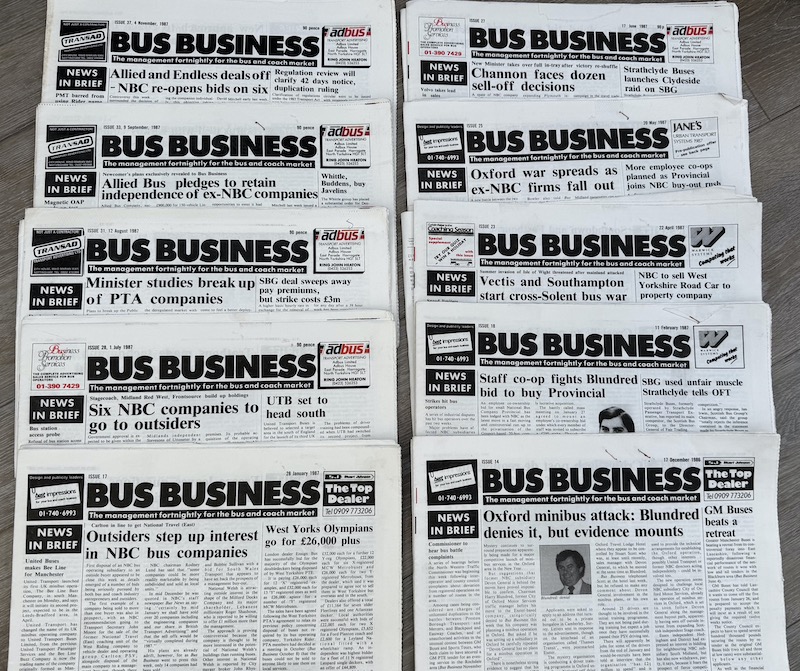
Thanks for all the positive comments following last month’s blogpost marking the publication of the first issue of Bus Business in June 1986 . Among the reactions was the following from the newspaper’s founder and managing editor Peter Stonham: “thanks for your delightful reflections on the 40th anniversary of Bus Business. You have excellent memory, an obvious great archiving capability, and a ‘news nose’ that seems strangely familiar to me ….Thanks a lot for this recognition of a significant chapter of my life, and moment of fascinating nostalgia “
Peter went on to recall “for the historical record, Bus Business was absorbed into another bus and coach travel trade publication three years later, and Local Transport Today began as another new publication in April 1989 to provide wider news, analysis, and commentary on transport policy, planning, and management, beginning another significant new transport publishing era, that still continues online.”
Let’s continue this new monthly nostalgic blogging series by highlighting snippets from the news from Bus Business editions in July 1986, three months out from Deregulation Day itself on 26th October. And just to show it wasn’t only ownership of bus companies changing hands as the privatisation programme also proceeded, there were changes in the manufacturing side of the industry with a front page report in issue 4 of Bus Business dated 30 July 1986…..
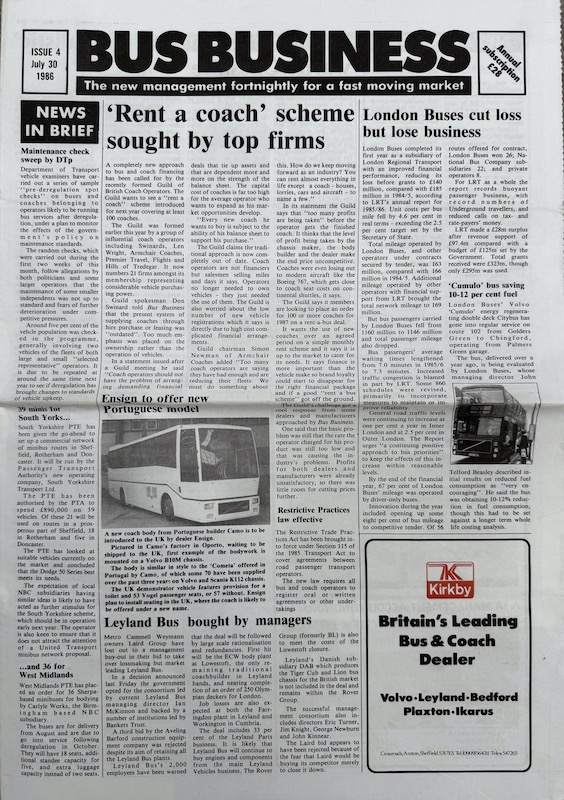
Leyland Bus bought by managers
Metro Cammell Weymann owners Laird Group have lost out to a management buy-out in their bid to take over lossmaking but market leading Leyland Bus. In a decision announced last Friday the government opted for the consortium led by current Leyland managing director Ian MacKinnon and backed by a number of institutions led by Bankers Trust.
Leyland Bus’s 2,000 employees have been warned the deal will be followed by large scale rationalisation and redundancies. First hit will be the ECW body plant at Lowestoft, the only remaining traditional coachbuilder in Leyland hands, and nearing completion of an order of 250 Olympian deckers for London. Job losses are also expected at both the Farrington plant in Leyland and Workington in Cumbria.
Tender success is 200 miles away
Chesterfield based NBC subsidiary, East Midland Motor Services have won a group of tenders called by Essex County Council for bus routes in Brentwood, some 200 miles away. The out-of-area bids are the first of their kind to emerge under the tendering provess.
Michael Holmes, EMMS general manager, told Bus Business this week that the operation in Brentwood reflected the company’s plan “to establish a small base in that neck of the woods” near the M11 motorway and expanding Stansted AIrport. But he refused to give more details of the company’s plans. The Brentwood services, using four buses, would partly use Bassetlaw staff who would otherwise be surplus, and partly local labour. Accommodation for staff would be provided for periods of a few days spent away.
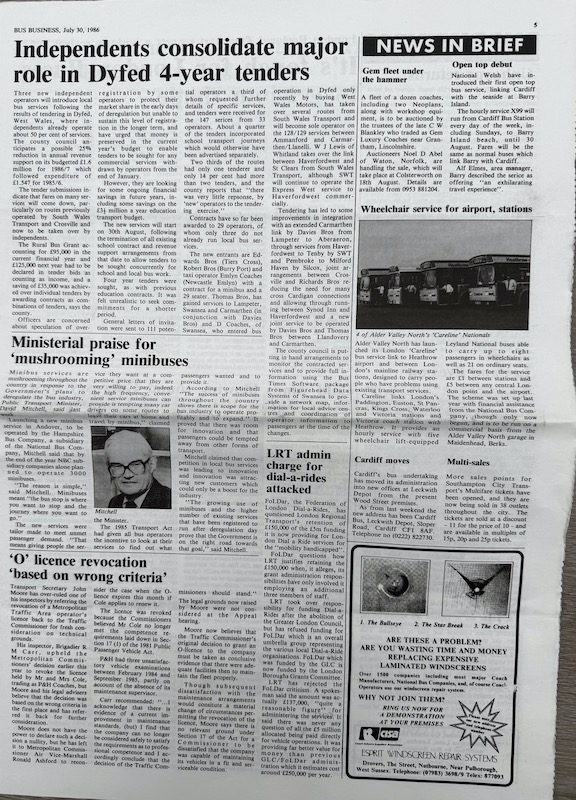
London Buses cut loss but lose business
London Buses completed its first year as a subsidiary of London Regional Transport with an improved financial performance reducing its loss before grants to £140 million, compared with £185 million in 1984/5 according to LRT’s annual report for 1985/86. Total mileage operated by London Buses, and other operators under contracts secured by tender, was 163 million, compared with 166 million in 1984/5. Additional mileage operated by other operators with financial support from LRT brought the total network mileage to 169 million.
Bus bus passengers carried by London Buses fell from 1160 million to 1146 million and total passenger mileage dropped. By the end of the financial year, 67 per cent of London Buses’ mileage was operated by driver-only buses.
Maintenance check sweep by DTp
Department of Transport vehicle examiners have carried out a series of sample “pre-deregulation spot checks” on buses and coaches belonging to operators likely to be running bus services after deregulation, under a plan to monitor the effects of the government’s policy on maintenance standards.
The random checks, which were carried out during the first two weeks of this month, follow allegations by both politicians and some larger operators that the maintenance of some smaller independents was not up to standard and fears of further deterioration under competitive pressures.
39 minis for South Yorks
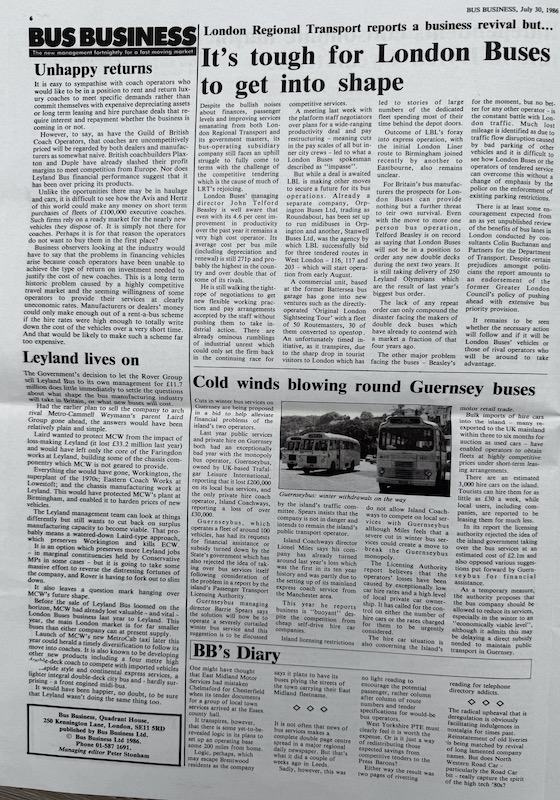
South Yorkshire PTE has been given the go-ahead to set up a commercial network of minibus routes in Sheffield, Rotherham and Doncaster. It will be run by the Passenger Transport Authority’s new operating company, South Yorkshire Transport Ltd. The PTE has been authorised by the PTA to spend £890,000 on 39 vehicles. Of these 21 will be used on routes in a prosperous part of Sheffield, 18 in Rotherham and five in Doncaster.
Panel to probe off-bus ticketing future in Manchester
A panel of bus, rail and taxi opeators is to determine the future management of Greater Manchester PTE’s off-bus multi-journey ticketing schemes. The PTE wants to retain the advantages – notably faster boarding, increased trip generation and rising revenue – of off-bus tickets after deregulation in October and will make the systems available to providers of commercially registered services.
It will have members from Greater Manchester Buses, Ribble, Rossendale Transport, West Yorkshire Transport, A Mayne and Son, Yelloway Motor Services, Finglands South Manchester Coachways and Citibus Tours as well as from British Rail and the Manchester Taxi Owners.
Taxi sharing revolution forecast
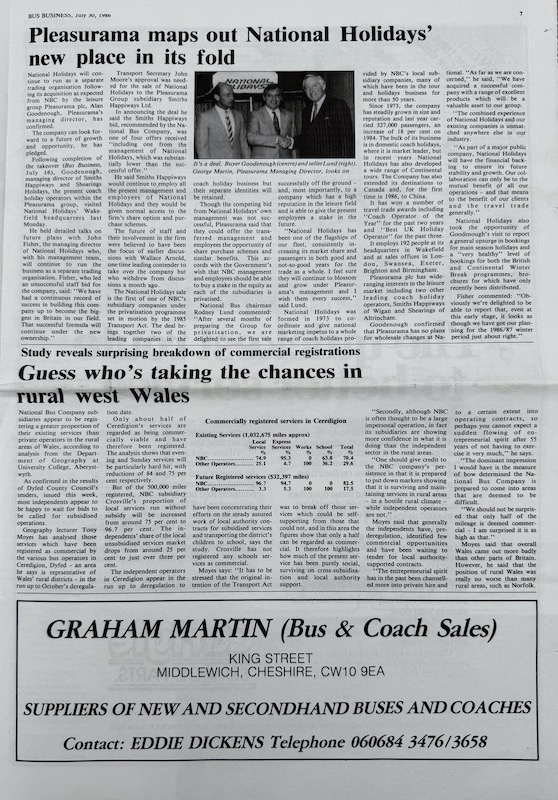
London’s taxi trade could be revolutionised when taxi sharing is introduced, David Mitchell, Minister for Public Transport, has claimed. Opening a depot in West London which provides taxi catering and refuelling facilities, Mitchell said that if the trade grasped the opportunity that taxi sharing would offer, it could bring about a considerable increase in the number of of passengers carried. “Shared taxis, because they will be cheaper, will attract new custom” he asserted.
Ministerial praise for ‘mushrooming’ minibuses
Minibus services are mushrooming throughout the country in response to Government’s plans to deregulate the bus industry, Public Transport Minister David Mitchell, said last week. Launching a new minibus service in Andover, to be operated by the Hampshire Bus Company, a subsidiary of the National Bus Company, Mitchell said that by the end of the year NBC subsidiary companies alone planned to operated 3,000 minibuses.
The new services were tailor made to meet unmet passenger demand. “That means giving people the service they want at a competitive price that they are very willing to pay, indeed the high frequency, convenient service minibuses can provide is tempting many car drivers on some routes to leave their cars at home and travel by minibus” claimed the Minister.
Vauxhall site joins coach station shortlist
A site at Vauxhall, near to the Victoria Line tube station at the southern end of Vauxhall Bridge, has been added to the shortlist of potential locations for a major new London coach terminal. The Vauxhall site joins the existing alternatives identified at Kings Cross, Paddington and White City in a report by consultants Steer Davies Gleave for London Regional Transport earlier this year.
They are all now being evaluated for potential development, including the opportunity for private enterprise involvement. The new terminal would be the main London base for coaches arriving from all over the country. It would largely replace Victrola coach station where the lease expires in 1990.
GM Buses shows its colours
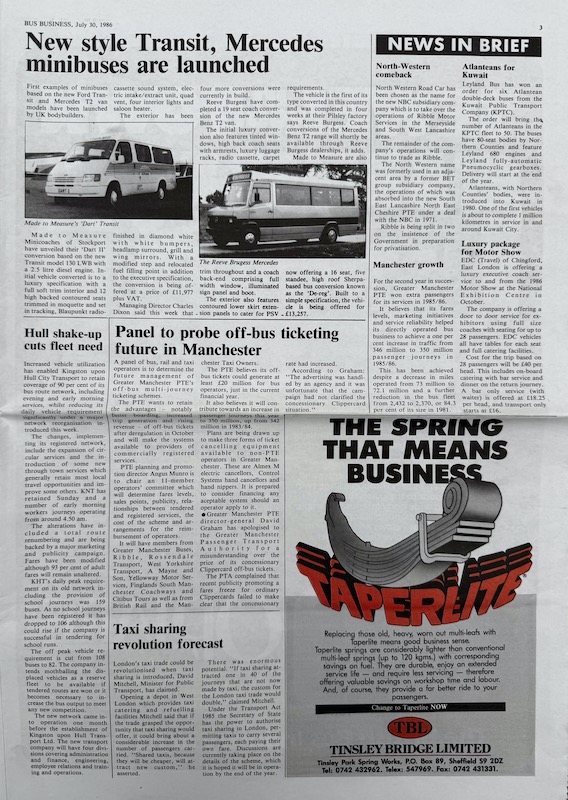
A new fleetname, basic livery and area identities have been unveiled for the new Great Manchester Buses Limited company which will trade as GM Buses. The company will replace Greater Manchester Transport as a commercial company from 26 October. The present orange and brown bus livery has been retained to save costs. But new style logos in an italic style with diagonal stripes are being used, each identifying one of the four operating subsidiaries. Local town names to be displayed above doors will follow a common style.
Wheelchair service for airport, stations
Alder Valley North has launched its London ‘Careline’ bus service link to Heathrow airport and between London’s mainline railway stations, designed to carry people who have problems using existing transport services.
Careline links London’s Paddington, Euston, St Pancras, Kings Cross, Waterloo and Victoria stations and Victoria coach station with Heathrow. It provides an hourly service with five wheelchair lift-equipped Leyland National buses able to carry up to eight passengers in wheelchairs as well as 21 on ordinary seats. The fares for the service are £1 between stations and £5 between any central London point and the airport. The scheme was set up last year with financial assistance from the National Bus Company, though only now begun, and is to be run on a commercial basis from the Alder Valley North garage in Maidenhead, Berks.
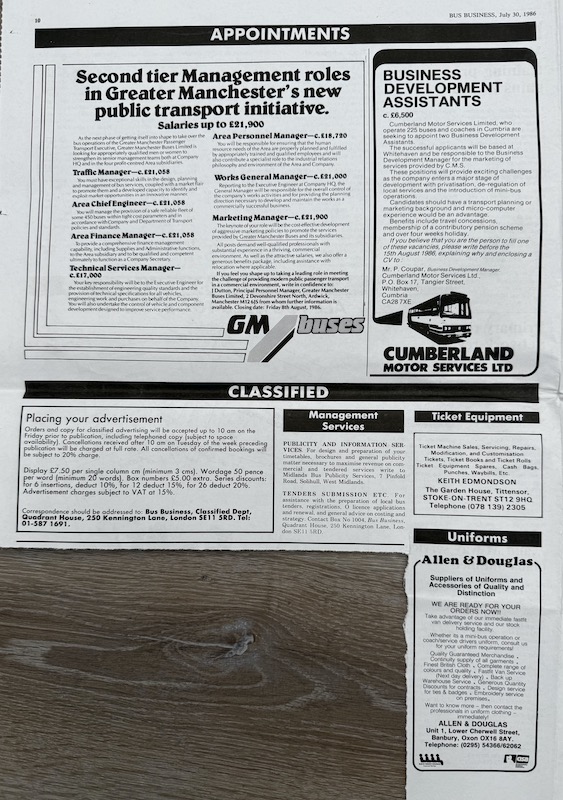
APPOINTMENTS
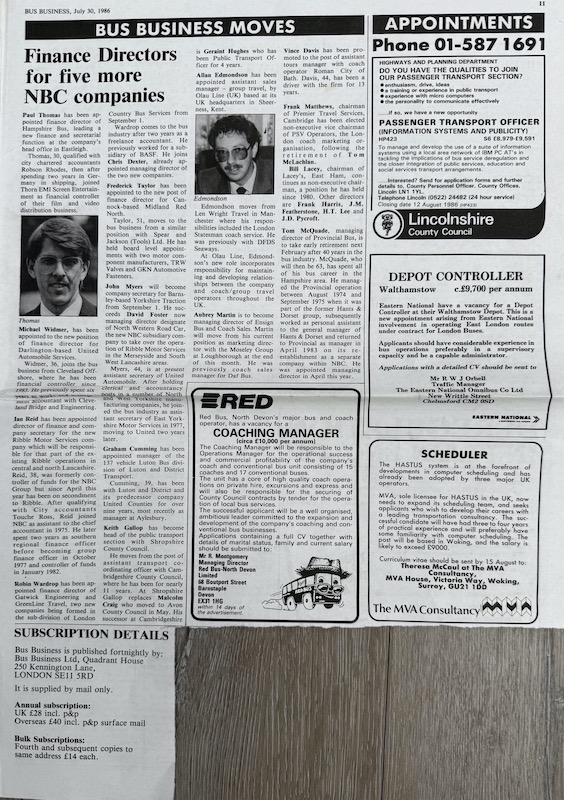
(Whoever owned the Bus Business issue I have was obviously keenly interested in the jobs market as two of the advertisements for vacancies have been cut and removed … but others still in situ include…)
Depot Controller, Walthamstow c£9,700 per annum Eastern National
Eastern National have a vacancy for a Depot Controller at their Walthamstow Depot. This is a new appointment arising from Eastern National involvement in operating East London routes under contract for London Buses.Applications should be sent to Mr R W J Orbell, Traffic Manager, Eastern National in Chelmsford.
Coaching Manager (Circa £10,000 per annum) Red Bus
Red Bus, North Devon’s major bus and coach operator has a vacancy for a Coaching Manager responsible to the Operations Manager for the operational success and commercial profitability of the company’s coaches and 17 conventional buses. Applications should be sent to Mr R Montgomery, Managing Director Red Bus-North Devon in Barnstaple.
Business Development Assistants c£6.500 Cumberland Motor Services Ltd
Cumberland Motor Services Limited who operate 225 buses and coaches in Cumbria are seeking to appoint two Business Development Assistants. The successful applicants will be based at Whitehaven and be responsible to the Business Development Manager for the marketing of services provided by CMS. Please write to Mr P Couper, Business Development Manager, Cumberland Motor Services, in Whitehaven.
Watch out for “Bus Business in August 1986” next month.
Roger French
Summer Blogging timetable: 06:00 TThSSu
 BusAndTrainUser
interesting. There is a r in Laird.
£10k for a coach manager for Red Bus! I suppose it reflected the challenge. Would have eaten the profit.
LikeLike
Thanks; Laird corrected.
LikeLike
Laird Group were MCW owners not Laid
and
Farrington Leyland
JBC Prestayn
LikeLike
Many thanks; both corrected.
LikeLike
Loved Bus Business. Excellent publication full of the latest news in what was a busy period in the bus industry
LikeLike
When it comes to archival publications, I was utterly floored at church last Sunday when a lady whose husband worked for London Transport gave me a copy of London Transport Magazine dated April 1969, an edition including four colour pages covering the Queen’s official opening of the Victoria Line to Victoria Station. With a school friend I rode the first section as soon as possible after opening: Walthamstow – Highbury. I have quite a Victoria Line “library” including five “Not for Publication” items. Track plans, track circuit details, gradients and how one would act as a train operator of the 1967 stock. She was an adventurous soul, our late Queen: one picture shows her being escorted through a tunnel to view an interlocking machine room where the code generators sat in respect of the line’s ATO. It was a fantastic catch for my collections and in 1969 LTM covered Country Bus & Green Line matters as well as Central Buses and the Underground. Sports are not left out: a picture of busmen taking on the Met Line at Acton with underground trains in the background.
LikeLiked by 1 person
I had an utterly unexpected and thoroughly unauthorised visit to one Interlocking Machine Room after drinks in north London. This was at Highbury on the southbound road. When I arrived at the platform the leading headwall door was open with technicians inside. With the confidence my drinks gave me I just sauntered in to view at first hand equipment I had only ever seen in picture form in books. As this was Highbury I saw the emergency operating levers which would have been in use during problems with the service. A senior member of the station staff who remained outside the IMR was shocked at my conduct yet after this treat my train arrived and this experience added to my enjoyment of the evening.
LikeLike
Interesting about the minibus revolution which later fizzled out. I remember the minibuses in Tonbridge, which were popular because of the higher frequency than the previous ‘big bus’ service. They were not accessible for wheelchairs – though neither were the big buses then – and I presume that, despite the lower driver wages, the venture was commercially unsuccessful. But – stepping back from the money issue – they were actually an efficient (in the normal, not the bus-industry sense) way of getting people to where they wanted to go. Again, there seems to have been no attempt to provide real integration with rail (through-ticketing, timetabling, improving interchanges, staff able to advise on both modes, joint publicity etc.) – I wonder, if rail and bus managers had actually made an effort in that direction, whether at least some of the minibus schemes would have been successful – maybe even financially?
LikeLike
There were so many of them in Tonbridge, they acquired the nickname “greenfly”
Terence Uden
LikeLike
I was working in Bath when Badgerline converted all the city services bar one to Minilink Ford Transits, i think there were 85 of them. They seemed to be buzzing about everywhere. They certainly had to work hard on Bath’s hills, lots of thrash and smoke. Good times.
Pete
LikeLike
Mention of Badgerline reminds me when they got together with Southern Vectis to compete in the Bournemouth area. Yellow Buses & their budget subsidiary White Buses saw them off along with the separate Routemaster bus operation. Ironically, Yellow Buses eventually went bust on 4th Aug’ 22 & Go South Coast (which includes Southern Vectis) took over the next day. What goes round….
LikeLike
And of course Badgerline also competed with Wilts & Dorset in my native Salisbury too with 2 batches of Ivecos and Western National’s only batch of Ford Transit VE6 buses, some of which never saw public service and retained their original colours being used as staff buses as the depot was approx 3 miles out of the city and had an ex Bristol city fleet dual door Bristol.RE used as a rest room.
All buses carried Badgerline (South) Ltd legal lettering.
They also picked up a small network of Hampshire County Council tendered services in the Fordingbridge area which reached Salisbury and Ringwood in a very limited way. These were also operated from their Salisbury base.
They had unfulfilled aspirations on wider destinations in the area which were as one driver showed me the contents of an Iveco destination blind.
Ironically, throughout this period of competition, W&D still ran their service from Salisbury to Bath & Bristol jointly with Badgerline and the latter’s drivers continued to use the staff canteen in Salisbury bus station.
Interesting times!
LikeLike
Wilts & Dorset responded by acquiring a fleet of MetroRiders for Salisbury and Badgerline withdrew quite quickly if my memory is correct.
Pete
LikeLike
I remember visiting Bath during the Ford Transit era and being surprised that many of them were running with dented front wings. My initial fears that the local traffic conditions were allayed by this being apparently down to an overly aggressive bus wash.
LikeLike
Many minibus services were actually successful!! They often were converted back to big-bus operation within several years because the additional passenger numbers required bigger buses.
As far as conversations between bus and rail managers were concerned … privatisation of buses and later trains meant that managers were busy enough trying to look after their own concerns.
It was (and still is) the case that the Competition Authorities try to maximise competition between modes, instead of recognising that the true competitor is the car!!!
Conversations were banned unless an “honest broker’ was involved … a case of “policy before common sense”!!
LikeLike
I actually attended the Andover launch with it’s massive publicity, the then transport minister and parade of Ford Transits. It made a massive difference to the area’s bus services atbthe time as these had dwindled considerably within the town area.
LikeLike
Indeed, many minibus schemes were extremely successful, both in lowering costs and the endless availability of Drivers at the time in spite of low wage rates. As greenline727 points out, many fell victims to their own success, and required larger vehicles. As nobody had a crystal ball at the time, and it was all a copycat of watching Harry Blundred’s success in Exeter, perhaps the major mistake was in using 16 seaters at the start rather than later minibus schemes of 24-26 seat capacities. It beggars belief now to recall such small vehicles being used on the ever busy 12 (Newton Abbot-Brixham) route (and some uncomfortable journeys), but Harry knew best!
A thankful reminder that efforts to close Victoria Coach station were never achieved. Nobody would ever consider removing the Waterloo rail terminus to Clapham Junction or equivalents , so why were serious proposals often considered to re-locate coach services? Thankfully it is still proudly there, and as busy as ever.
Terence Uden
LikeLike
While the Kick start was Harry Blundred some serious thought in Capital Planning of NBC by 1982/3 was about more frequent services with smaller vehicles impacting the possibility of passenger growth ( and also lower Capital Funding and Maintenance costs based on something like a 6 year service life ) privatisation started to eat into priorities of research and in say south wales the National Welsh Bustler vs the challenger operators began to get messy , but the PMT and Midland Red services as examples and the Oxford / Cheltenham ones seemed to show some strong delivery of local services in a way LTE had barely done in their Ford Transit experiments. The big bread van in London was the Gold Arrow for the 28 and 31 which I think had mixed results , do passengers mind or should buses look like a “real bus” ? A lot comes down to the cost of supply and there is a limit on driver wages that means savings if any are not as much as one might like.
Victoria Coach station was unloved as being in prime central london real estate and a congestion , particulary from the north of england to expand and cope with predicted services. But central London didnt have much alternative , overspill into the British Airways terminal building for west A4 services helped a bit and I think using Heathrow Central Bus station for a few terminators eased a little on everything into London. I guess the place is still a challenge but there seem to be fewer south coast services these days as the fast electric trains have taken much of the market away. I think Walthamstow was tried for a destination for some services once the Victoria line became feasible and nowadays Stratford is a coach hub mainly for Stansted but some other places East too.
Part of the Media pressing though was a bit of clever martketing by National Express in raising awareness of NatEx Coach services with free publicity in the press and TV
I wonder how Bus Business might report the likes of Flixbus these days
JBC Prestatyn
LikeLike
Gold Arrow minibuses on the 28 and 31 were Peter Hendy’s baby. They ran a more frequent service than the Routemasters but the buses were breadvans and not universally loved. So much so that the headline on the billboards for the Ham & High was ‘Mutiny on the Sardine Route’. The buses were soon replaced by Wright bodied Dennis Darts. I suppose the experiment was of it’s time but I was never a fan
Martin W
LikeLike
@JBC Prestatyn – in what way were the results on the 28 and 31 “mixed”?
As I understand it, replacing Routemasters with Mercedes midibuses at greatly improved frequencies resulted in significant increases in ridership (as there was now a bus along “in a few minutes” rather than intervals of 10 minutes and longer). So much so that the Mercedes had to be replaced by Dennis Darts, the midibus conversion having been a victim of its own success.
Malc M
LikeLike
Mixed in so far indeed that the minibus proved too small, and there was a general chatter that buses in London should generally be something like full sized Routemasters.
Did running such frequent numbers of vehicles increase traffic congestion – I dont think the vehicles were narrower than RMs.
One could ponder for passenger journeys what if more full size London Bus routes had been so converted.
I didnt have access to waiting time for a bus statistics to consider generalised for NBC companies impact on ridership, but other route specific studies roughly came up with halve the waiting time and passenger journeys increased by about 10percent or better. London additionally had avoided the direct impact of loss of heavy industry job cuts – even in west london where things like Heathrow provided employment even as many of the factories along the Great West Road ceased to employ in the great numbers of the past.
JBC Prestatyn
LikeLike
@JBC – I think you are missing (or ignoring) the point.
The midibuses did prove too small – because the increased frequency attracted greater numbers of passengers. I would say achieving passenger growth, to the point where demand outgrew the vehicles, was a measure of success rather than failure. How about you?
The conversion to midibus actually resulted in a small increase in overall capacity, once you take account of the improved frequencies. A standard Routemaster, as used on the 28 and 31, carried 69 passengers (64 seats + 5 standing). The Mercedes/Alexanders used on the 28 and 31 carried 43 (28 + 15).
6 x Routemasters per hour = 6 x 69 = total capacity 414
10 x Mercedes midi per hour = 10 x 43 = total capacity 430
“Did running such frequent numbers of vehicles increase traffic congestion – I dont think the vehicles were narrower than RMs.“
The RMs were 8’0″ wide – or 2.44 metres. I could be mistaken, but was under the impression van-derived midibuses were generally somewhere around 2.2m or 2.3m wide.
Malc M
LikeLike
Jobs page was the first pages read when Bus Business arrived!
LikeLiked by 1 person
When Bus Business arrived it was normally straight to the jobs pages first!
NT
LikeLiked by 1 person
40 years ago, yet to me, it only seems like half that time. Now it seems we’re about to go full circle. Such is life.
LikeLike
A valuable record of the destruction of Britain’s traditional bus services under Thatcher and the Tories.
LikeLike
The National bus company under Labour were destroying it far faster.
LikeLike
A Big Destruction came in 1972 as the acquired BET companies routes were severely cut , particulary Southdown. See previous blog comments on some specifics.
Tilling Group / National original constituents always seemed to run a more threadbare set of services even in the 1920s and 30s maybe BHD an exception as one couldnt run fewer or less frequent anyway.
The NBC was hit by Thatcher indirectly – the collapse of the coal mines and steelworks as mass employment diminished in the money making areas for the likes of PMT and Yorkshire Traction. There was also the move to car ownership increases a Basildon Man became aspirational not to use public transport of any form.
I didnt find a significant change in reduction in passengers pro-rata 1974 to 1980 on a monthly basis that could not be explained by changes in real fares upwards, car ownership, mileage operated or real incomes / car registrations . However I did not plot mileage against governing power at westminster and I only selected NBC companies that did not have a strong muncipical or PTE presence in their area.
JBC Prestatyn
LikeLike