Thursday 2nd April 2026
Another bus ‘war’ has broken out. This time in Lanarkshire.
And this one reminds me of the time Arriva began competing with Safeguard, the much respected long standing independently owned small bus company in Guildford in a David and Goliath style battle. I think Arriva thought it could knock a fatal nail in Safeguard’s profitability but in the event it didn’t end well for Arriva.
As in Guildford, this latest bus battle, which began on Sunday, was initiated by the Goliath of the pair, First Bus, aggressively duplicating JMB Travel’s, flagship bus route between Motherwell and Lanark.
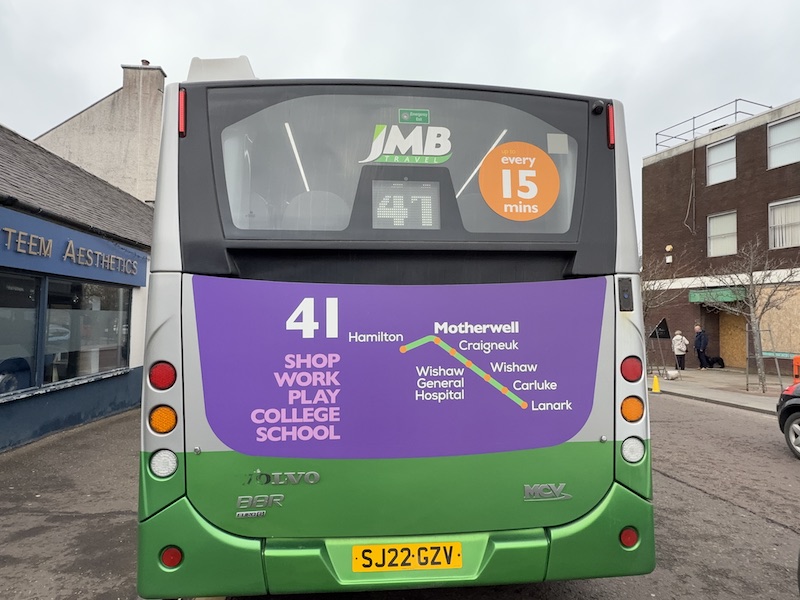
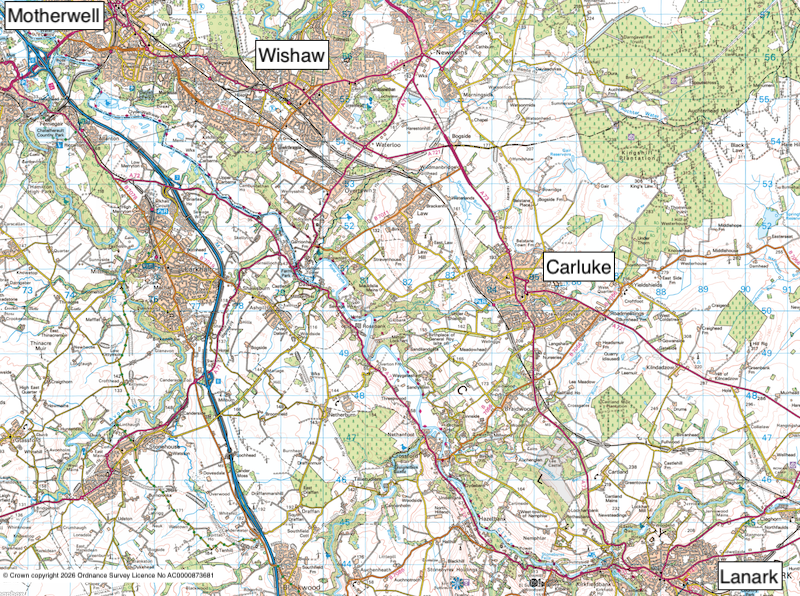
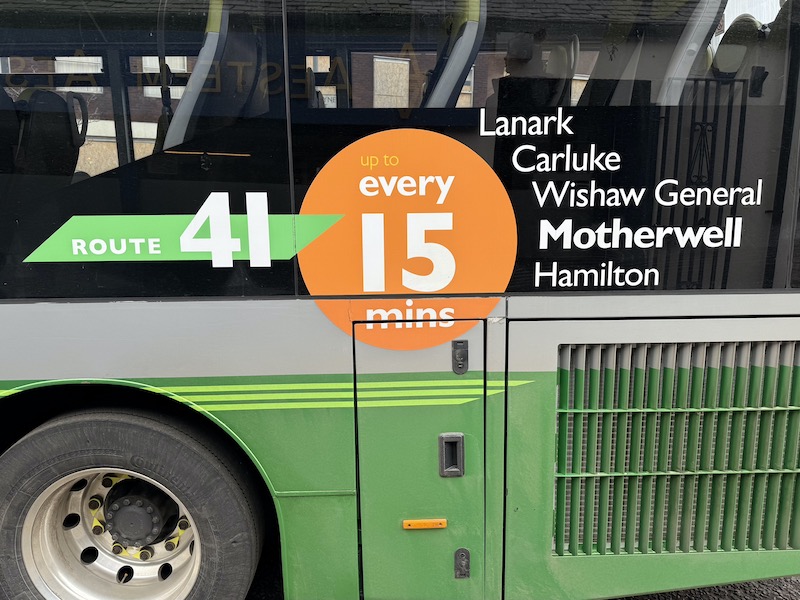
JMB has been running its route 41 every 15 minutes (Mondays to Fridays, 20 on Saturdays and hourly on Sundays) for many years. It’s a good route linking the communities of Lanark, Carluke, Bogside, Wishaw, Craigneuk and Motherwell after which buses continue to Hamilton.
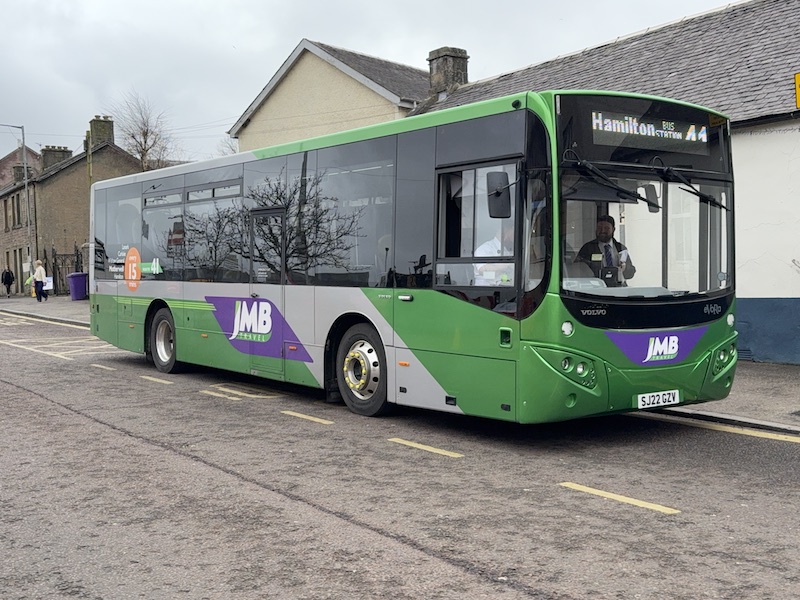
JMB run a fleet of smart modern Volvo eVoRa buses dedicated to the route.
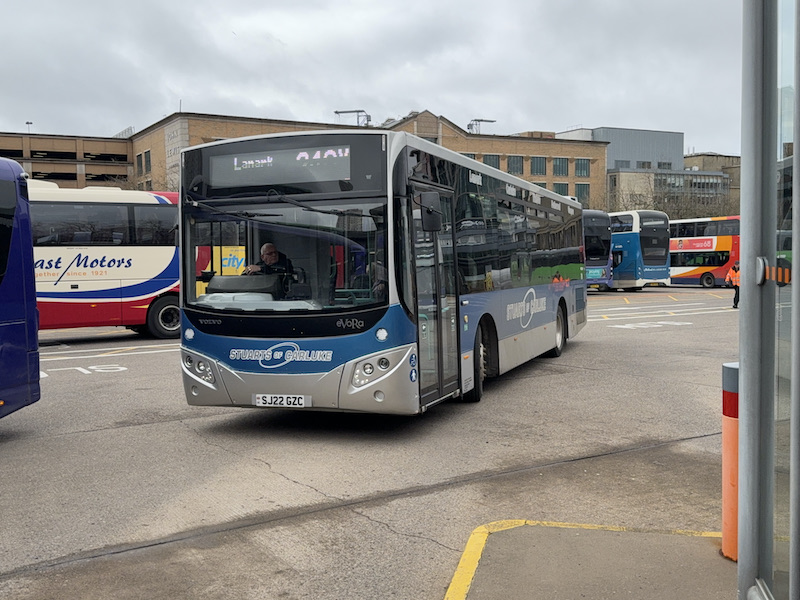
Also running on this inter-urban corridor is fellow independent, Stuart’s Coaches, with its (approximate) hourly route 240X between Lanark and Motherwell then fast to Glasgow…
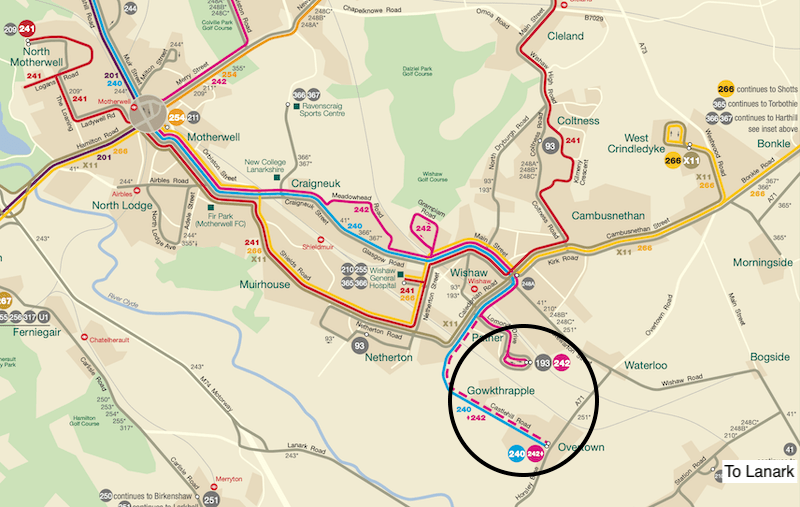
… but until Sunday, First Bus had shown no interest with its route 240 reaching only as far south as Overtown and route 242 to Pather, both located just beyond Wishaw.
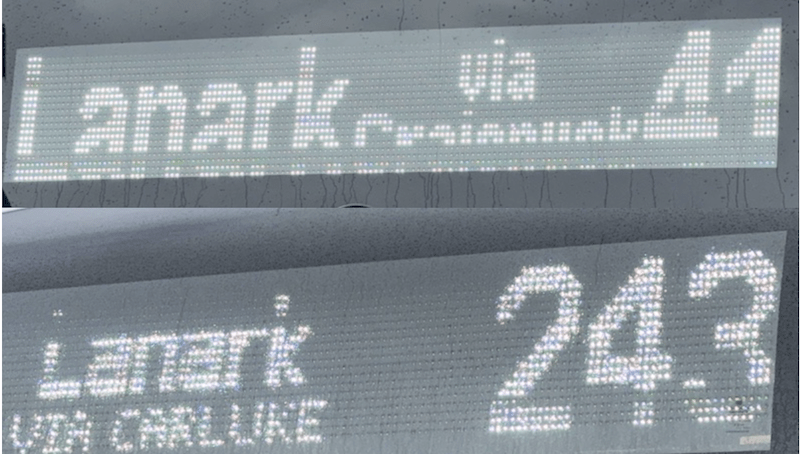
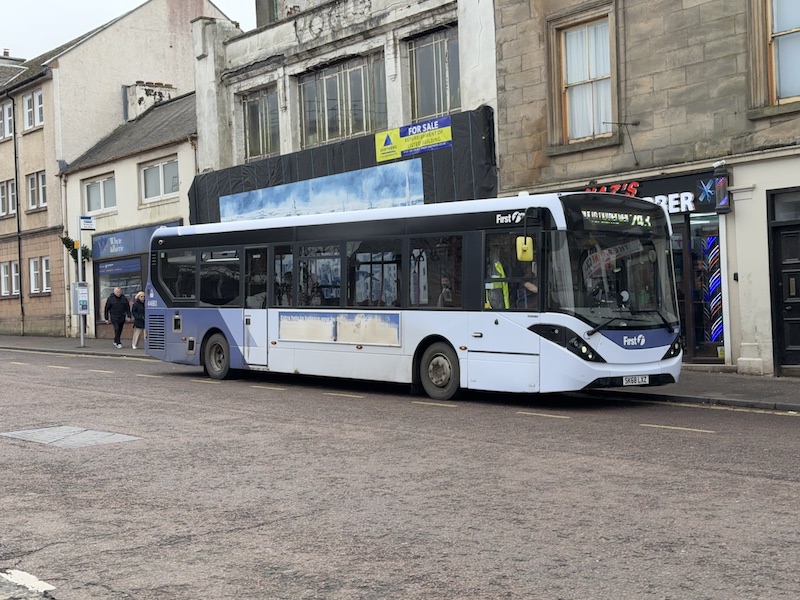
Now, First’s new bus route numbered 243 has appeared on the scene which not only mirrors JMB’s route 41 and its 15 minute frequency (20 on Saturdays and hourly Sundays) but surprise, surprise, buses are all timed to run a few minutes in front of the 41.
I thought that kind of wasteful cynical competition was for a bygone era rather than the enlightened 21st century when it’s all about sensible partnership working. More of this kind of activity and SPT leaders will have all the evidence they need to justify pressing on with their franchising plans for the region.
But, of course, First Bus managers justify what is a blatant competitive attack as something completely different with Commercial Director Graeme Macfarlane claiming “these new services will provide better connectivity, greater convenience and more options for customers travelling around Lanarkshire”.
It’s true this 243/41 skirmish is just one small part of a much larger review of First’s Lanarkshire network which includes new links and improved frequencies but it’s being disingenuous and taking us for fools by not admitting there’s only one justification for new route 243 and that’s to damage JMB Travel’s market share.
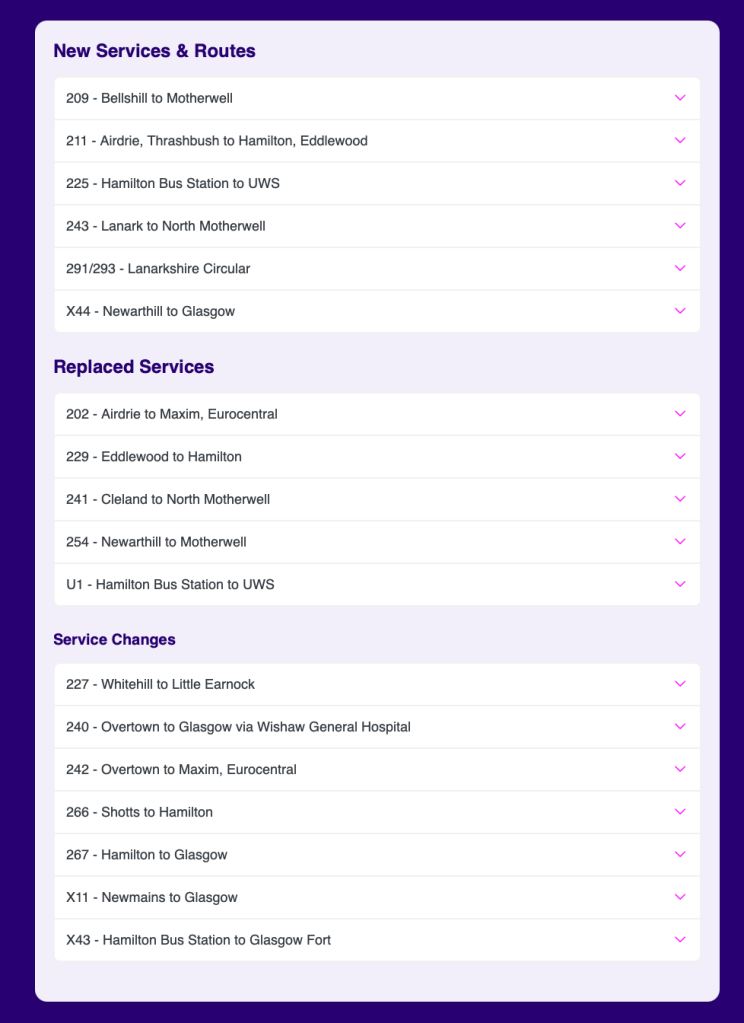
And with what aim, I wonder? Taking a ride up and down the route on Tuesday afternoon First is obviously damaging JMB’s revenue with buses creaming off passengers waiting at bus stops along the route particularly on the busy section between Motherwell and Wishaw, which is one continuous built up area, but it’s also doing its own profitability no favours.
South of Wishaw and through Carluke to Lanark the route is more rural in nature and there are slim pickings.
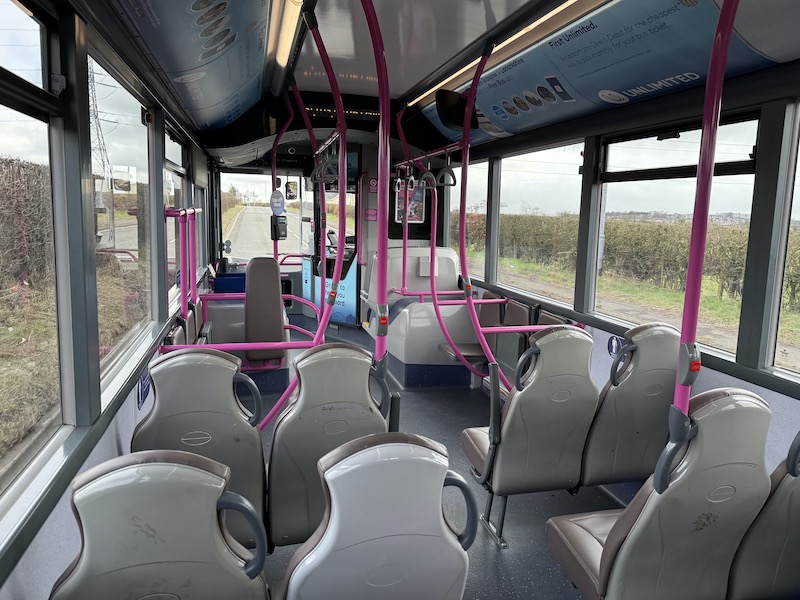
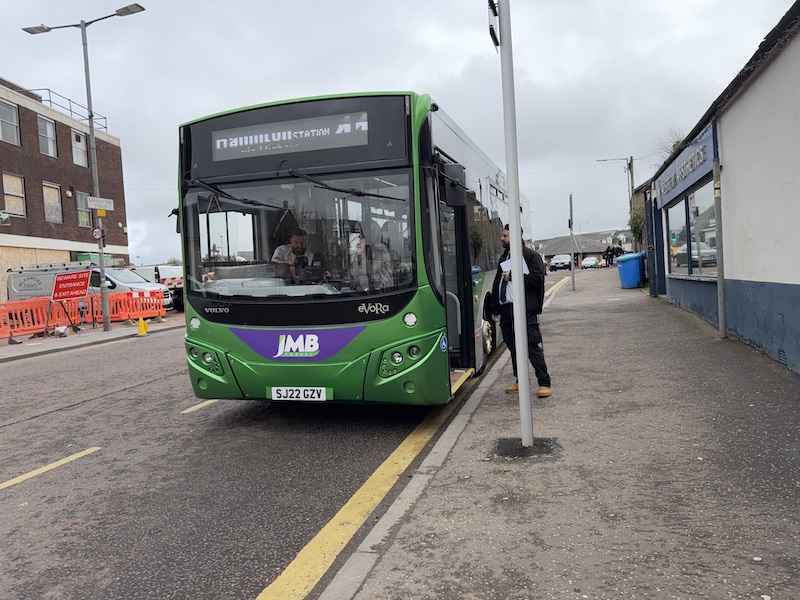
The First Bus I travelled on heading towards Lanark carried around a dozen passengers between Motherwell and Wishaw (17 minutes), just three south of Wishaw, who all travelled for a couple of stops, and then no one for 10 minutes (see photo above) and only one passenger between Carluke and Lanark (15 minutes).
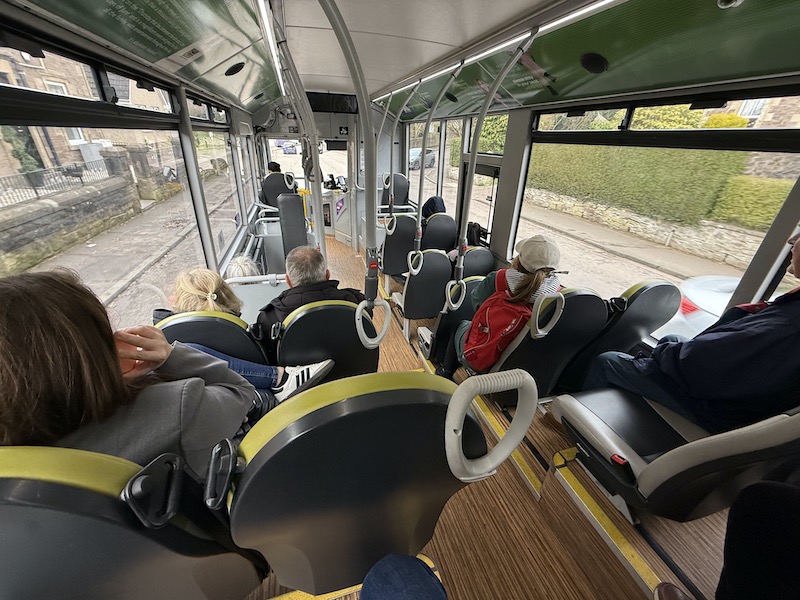
Returning on a JMB Travel 41 saw us leave Lanark with 16 on board (see photo below) thanks to some judicious layover tactics where JMB is sensibly having a bus on stand loading up for almost the full fifteen minutes whereas First Bus are almost in and out.
JMB also had a member of staff at the temporary terminal point (the bus station is being resurfaced) overseeing things and we left smartly in advance of a slightly late running 243 which overtook us heading out of Lanark with no one on compared to our 16.
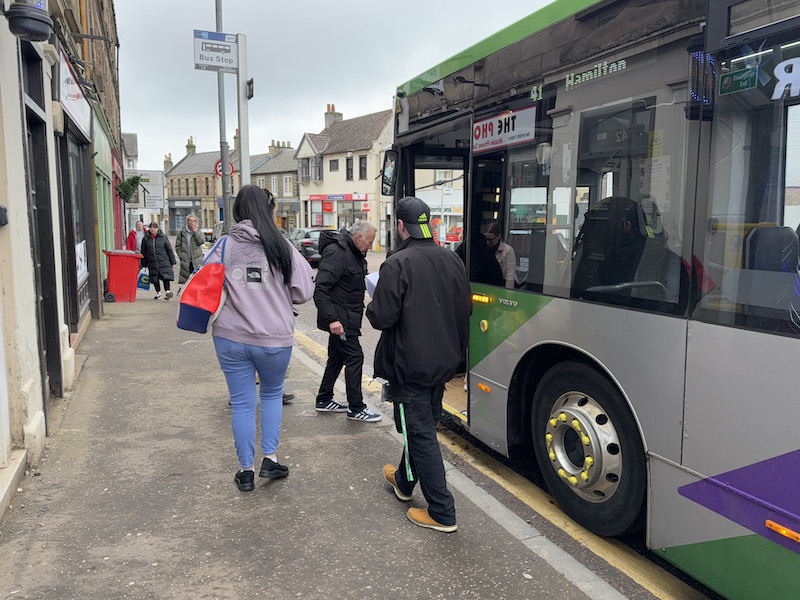
We picked up another 17 on the journey to Motherwell so not bad going considering the 243 was ahead of us.
All the other buses I passed on the route were similarly loaded and I’d say it’s the luck of the draw between Motherwell and Wishaw which bus comes first but JMB seem to have the upper hand between Wishaw, Carluke and Lanark.
Unless First Bus expects to run JMB off the road (and that’s not going to do its reputation and standing much good) I can’t see why they would want to invest considerable resources and cost – the route takes eight buses which doesn’t come cheap – with consequential damage to its profit margin by running up losses on this foolhardy venture.
I suspect somewhere in the First Glasgow team there’s frustration, and even annoyance, seeing JMB taking the initiative over the last year or so to successfully introduce two new ‘fast’ routes linking Hillhouse/Hamilton (X1) and Newarthill/Motherwell (X5) with Glasgow (as featured in previous blogs) which have both inevitably meant some minor toe treading on First’s network in the localised segments of the routes. Anyone looking objectively can see JMB has been at pains to avoid any direct head to head competition; they’ve found gaps in the market and filled them. This contrasts completely with First’s 243 blatant head to head aggression.
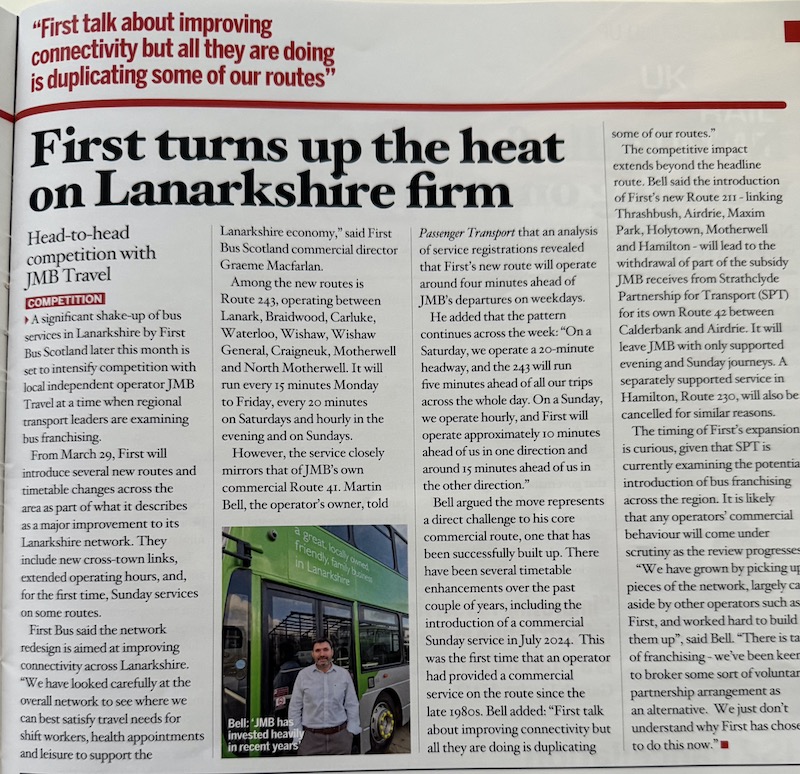
As well as the trade press, I see the Glasgow Times picked up on the story on Monday
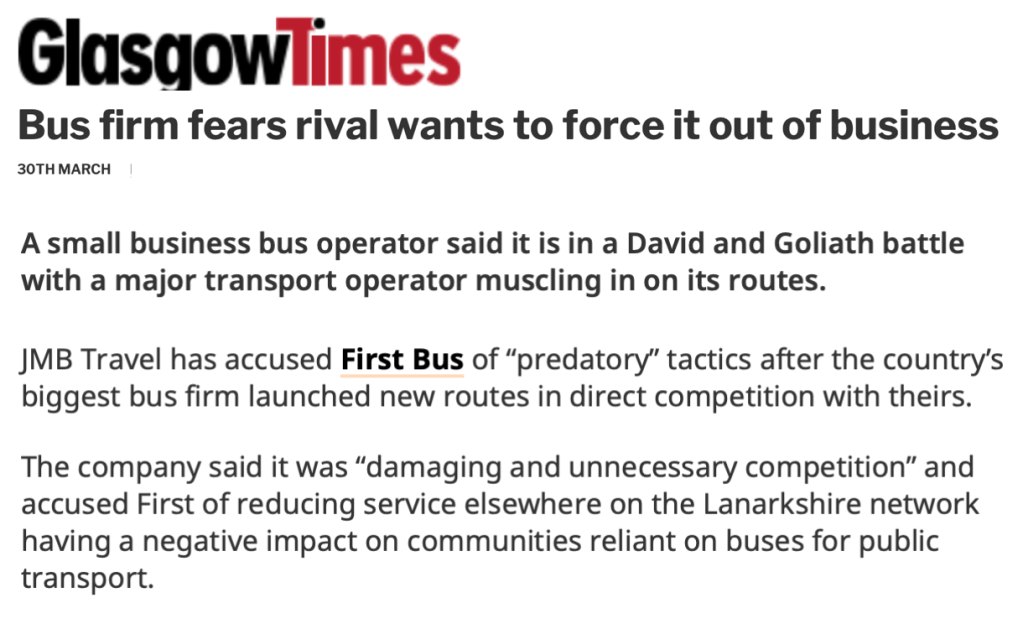
JMB’s Martin Bell is quoted as saying “we now face a David and Goliath situation – a small independent family-run business, up against a large multi national conglomerate. We cannot understand why First Bus have decided to take this unnecessary action when there are other communities across Glasgow and Lanarkshire which could have benefitted from this investment.”
It’s not just the 243/41 which is concerning Martin. Another new service introduced by First Bus on Sunday is route 211 between Motherwell and Airdrie (with extensions at both ends to Eddlewood/Hamilton and Thrashbush previously served by now withdrawn routes 202 and 229 respectively).
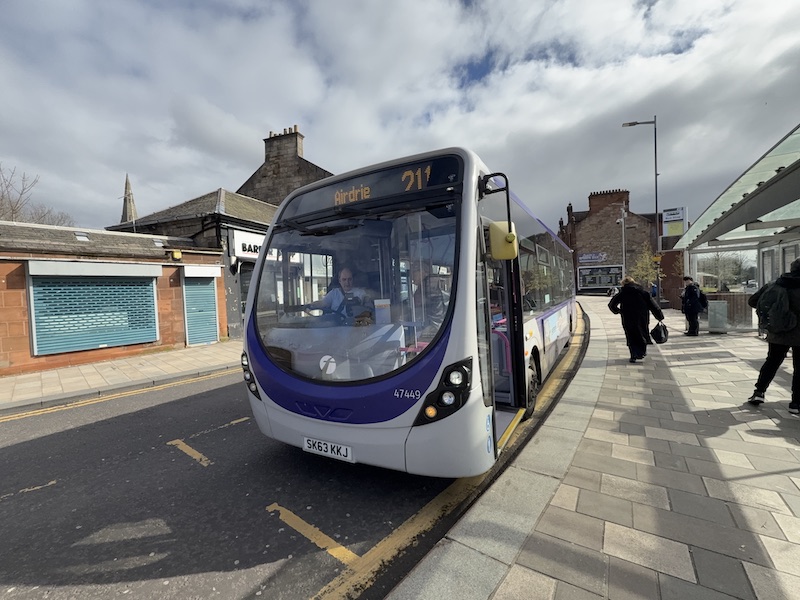
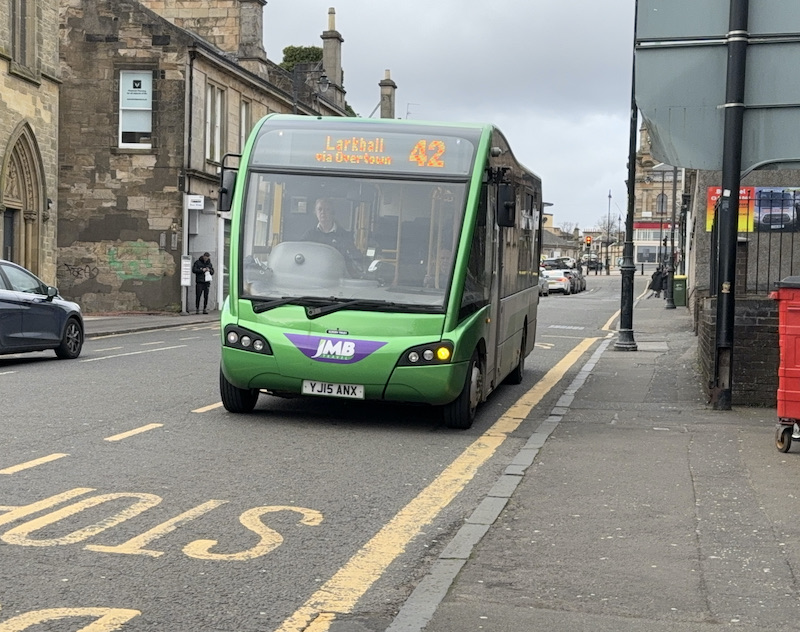
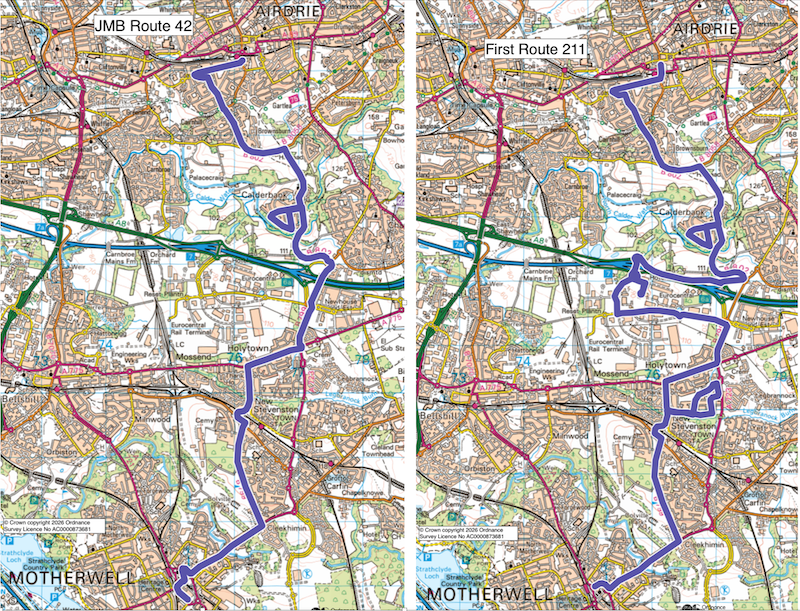
It’s true this hourly 211 provides new links but it also comes at the expense of duplicating JMB Travel’s hourly route 42 which covers much of the same ground.
Again I travelled towards Airdrie on Tuesday on a late running 211 – scheduled eight minutes ahead of the 42 on the common section (similar timings southbound too) – and managed to cream off two or three passengers no doubt expecting a 42 but southbound an almost full JMB 16-seater half emptied out between Airdrie and Calderbank with another four or five joining us in the contested section through New Stevenston into Motherwell.
I think the 42’s more direct routing will help keep loyal passengers on much of the route as First has taken the opportunity to serve Maxim Park (a business park off the M8) leading to a more indirect route.
Other changes introduced by First include a new circular route 291/293 replacing routes 241 and 254 providing a new link between Wishaw, Cottness and Parkside (241) with Newharthill and Carfin (254).
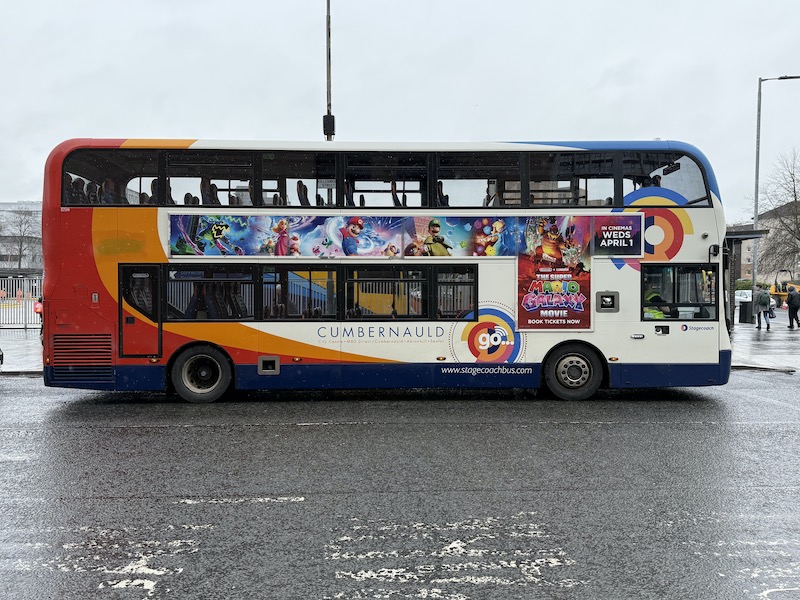
In a separate development on Sunday, First Bus also took over services X25/X25A, the main route between Cumbernauld and Glasgow which Stagecoach ran for years but gave up last weekend presumably believing it’s no longer commercial.
It’s quite a commitment for First which must have added another seven or even eight additional buses to its fleet to run the route.
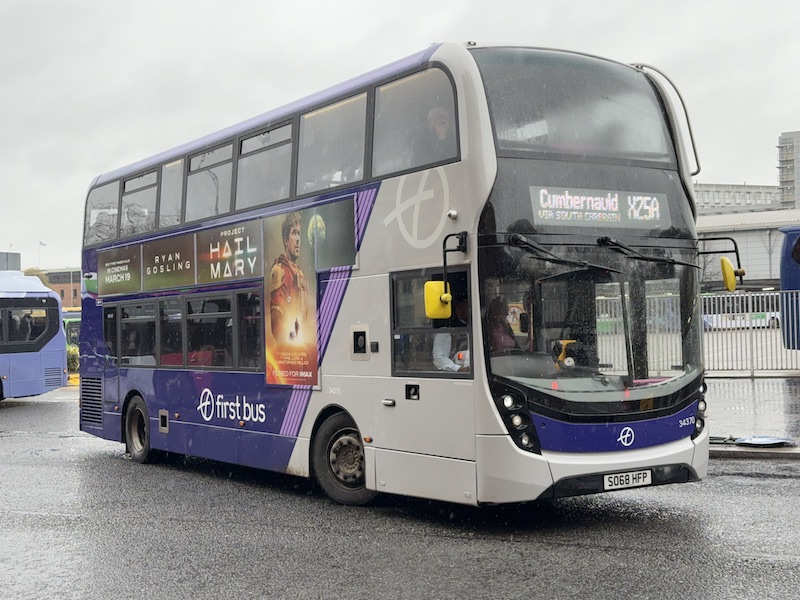
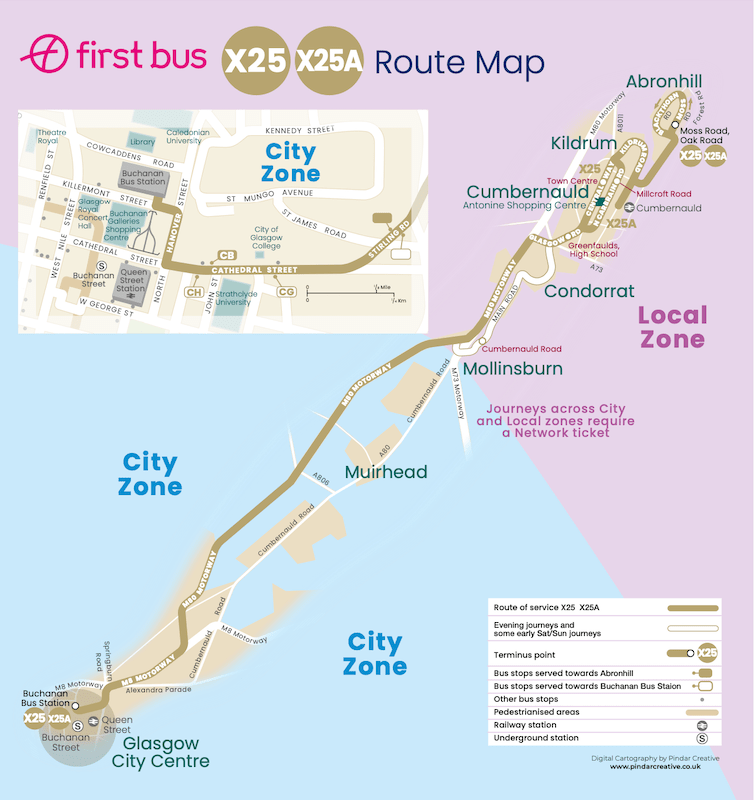
Buses run fast on the motorway between Glasgow and Cumbernauld then serving the town centre before continuing to the suburb of Abronhill.
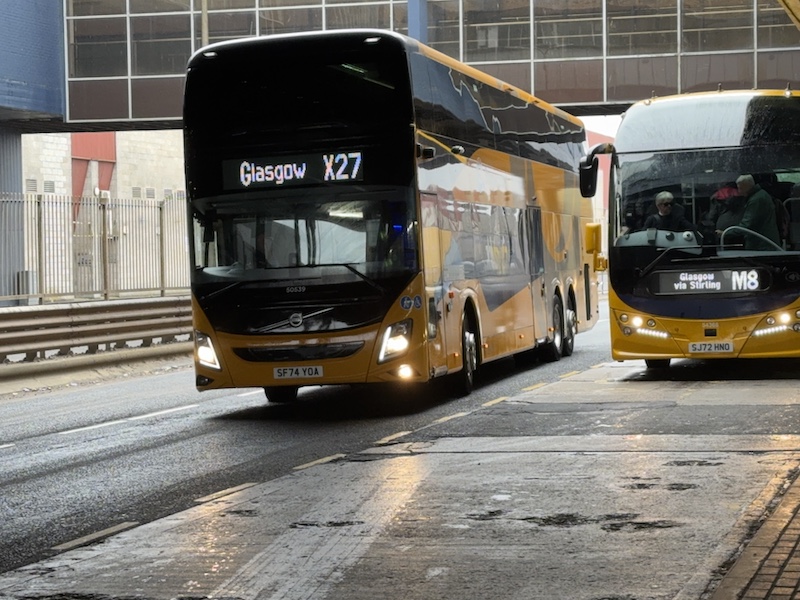
Stagecoach (as well as citylink and enber) still runs between Glasgow and Cumbernauld on its hourly X27 from Kirkcaldy, Halbeath and Dunfermline (as well as Leven in the peaks on a marathon two hours 50 minute journey).
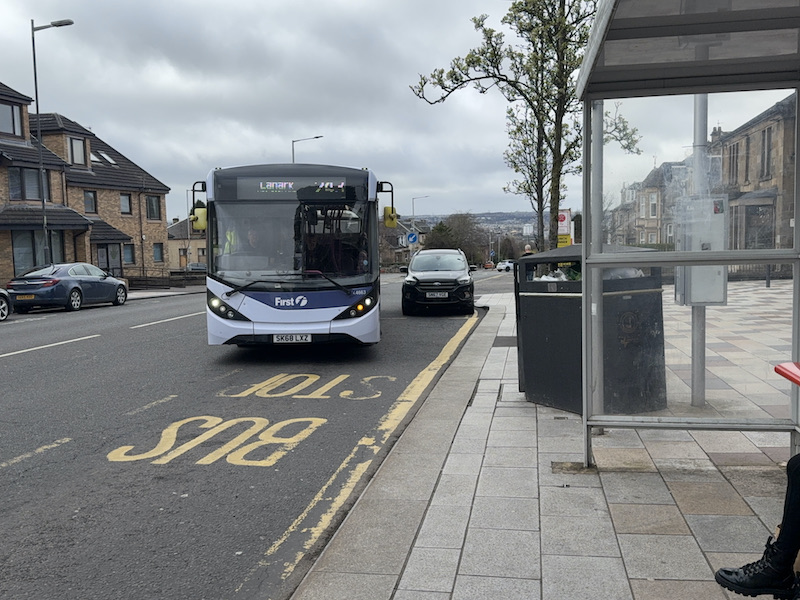
Commendably First Bus has made available route maps for all its new services online as well as explanations about the changes posted well in advance.
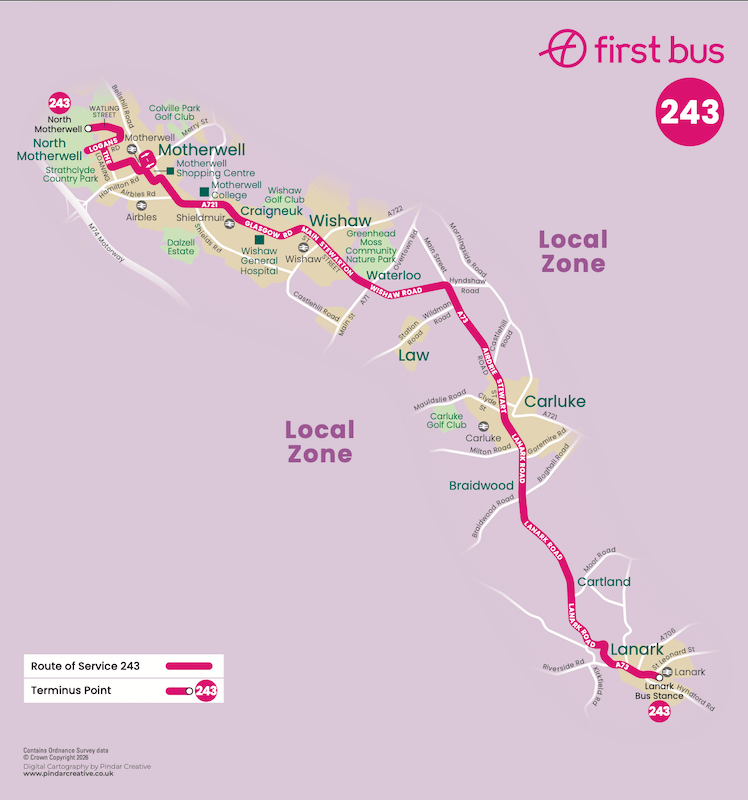
However although the network map for Lanarkshire has been updated you have to hunt for it online as the old map is still showing in the map section of the website (as below).
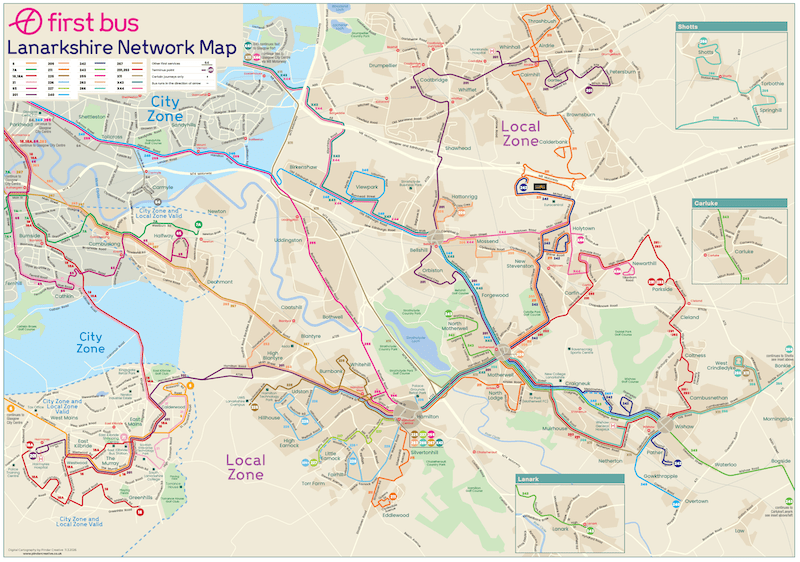
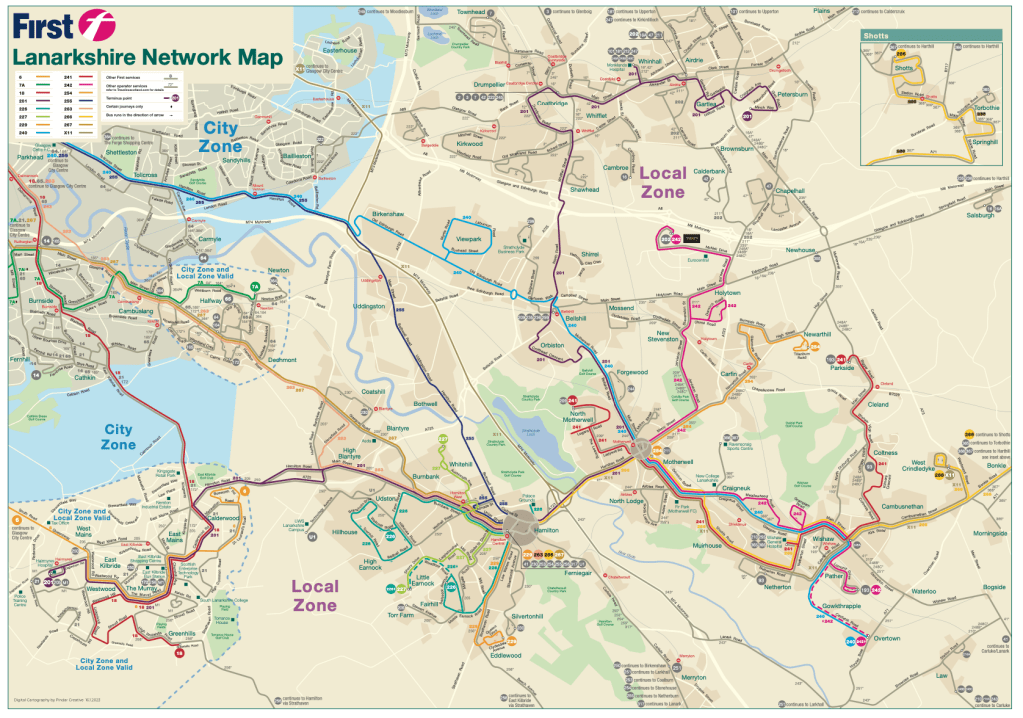
Hopefully that will be resolved soon so prospective passengers can find the new map (as above) and will be able to see the “better connectivity, greater convenience and more options”.
Roger French
Blogging timetable: 06:00 TThS
 BusAndTrainUser
It sounds as if the sooner the UK has, for public transport operators, a Swiss-style Legal Duty to Co-operate the better!
LikeLike
It would definitely be a better use of resources, especially with providing comprehensive transport in more marginal areas. This blog gives another example of how private operators just undermine each other. Also exciting times that DFT is funding the ‘mini-Switzerland’ pilot in the Peak District!
Aaron
LikeLike
Excellent news Aaron. I found this article after I read your comment.
https://www.bbc.co.uk/news/articles/cwywvrpv3xzo
Peter Brown
LikeLike
Sometimes things which sound great to grab a headline are totally impractical . They may reflect a laudable dream but which just can’t translate into reality, even if the public want it to. I would love to see this evaluated by someone with real knowledge. When I read the short article, a few thoughts crossed my mind…
I’ve yet to see an article in the mainstream media on public transport that was informed and knowledgeable.
LikeLike
I agree the mainstream media can be rubbish, the BBC got an opinion from the Reform leader of Derbyshire but not the Mayor of the East Midlands for example. Even though, it’s her who will help bring this proposal about.
The man who came up with this idea, Thomas Ableman, has a professional background in transport having worked for TFL, National Express and others, so it’s not just some armchair proposal. He has a blog himself, Freewheeling.
Clock face timetables where turn up and go is not justifiable as is the case in rural areas is essential. Even spacing on shared sections between different routes would be even better and is the point of the proposal. In Cheshunt, you can have all 3 routes towards Waltham Cross turn up at the same time then nothing at all for 15 or 20 minutes despite the local centre getting 8 buses an hour! It needs to be more predictable and integration is the point, both between different bus routes and with trains and that is also why we need services from early to late to actually attract people on to the services.
We know well in advance when rail timetables changes, more so if major changes are planned. The proposal has the railway at the heart of it, so presumably bus changes would only happen on the same days twice per year. Far easy to adjust a bus timetable than a rail timetable. And a lot better than the free for all that exists now. I believe Transport for Wales is also looking at integration in this way and where it’s been done with Trawscymru already, it seems to work well.
I don’t know if your local council has done much lately but mine is resurfacing roads, painting underpasses and just tidying up the area a bit. It actually makes a difference. This blog has highlighted again and again, neglected and dirty bus stops, lack of information etc. That is what is meant by changing perception and if a service is shown to be reliable, that also really helps. But other than enhancing services, the other main thing was to improve the places where people will change to train or another bus. I am concerned what happens if the train is cancelled or the bus is late though.
I really want this to succeed because despite living in a more urban area, this joining up of transport would transform my life. I saw the transport investment in Ireland when I went last year, connections were looser than in Switzerland, but it still worked better than England, we need to at least try in this country.
Attached is the actual report. https://drive.google.com/file/d/1aZjCSVbSwIjl73uvj0uOg1hgliUQC98_/view
Aaron
LikeLike
Thanks for the link. I’ll take a look. I agree with much of what you say, but on saying that clockface timetables are essential, for me that is unrealistic given the variability of road traffic conditions nowadays. I remember when Green Lines had the same times past each hour from the first bus to the last 40 years ago. You couldn’t hope to achieve that now. I’d also argue that in these times of people looking up the next bus of various apps before they head out, whether or not that is at the same minutes past the hour as the previous or next is not a concern.
LikeLike
@anonymous – Most of the less frequent routes in my area are mostly clockface already (just a later departure in peak hours) and it makes it much easier to remember, oh the bus is on the hour, or at 10 past etc. I use bustimes.org for tracking but I hope eventually it just won’t be needed because the buses will be reliable enough and with 1 change connect to another regional bus or short walk to the rail station. I have the TFL app for London buses but barely need it.
Where different routes meet, it would be nice if they could be more evenly spaced out, so the shared section or corridor as I call it could see something every 5 to 8 minutes, truly turn up and go with little extra resources required.
Aaron
LikeLike
Is there any evidence that non clock-facing timetables actually work?
LikeLike
There is more chance they can be achieved.
LikeLike
I’ll ask Michael Bennett this, if non clock-facing works, then why haven’t the other the large Transport Groups in the UK introduced it to their networks and the likes of Lothian and Nottingham City Transport?
LikeLike
Michael it’s a shame, isn’t it, that we’ve lost so much confidence in this country in our ability to do objectively sensible things. Deregulation was a massive con trick a triumph of ideology over common sense. You are right in that our media back in the day didn’t hold the Tory government of the 80’s and the 90’s properly to account for their destruction of integrated and cheap systems as in Sheffield and Tyne and Wear. Irreversible damage was done. I don’t hold much more hope out now but in some outlets like Modern Railways and this blog there is a high standard of truth although of course opinions differ as to the efficacy of certain policies. In my opinion there is enough evidence to suggest that we could build such world class systems in Britain if we put our mind to it. If it can be done in Switzerland, or Sweden or South Tyrol it can be done here. Why not?
MikeC
LikeLike
This probably isn’t the place to do the deregulation good vs. bad debate as it must have been done to death, but I think it’s fair to say that what preceded it wasn’t working and it’s equally fair to say that it’s no longer really working as it was intended. Good and bad in both.
I’m not convinced that going back to full public control is the answer either. London is very well coordinated but it’s costly and wasteful. Rural funding is so often misspent, as we’ve read so often in these pages. JMB wouldn’t have been able to enter a publicly controlled and run network.
I don’t pretend to know
LikeLike
In my opinion, it’s the buses that change and withdraw services with the minimum of notice. Whereas the railway will already be working on the May 2027 timetable as we speak…
And I have been on several late trains/buses in Switzerland – the answer is, they wait for a reasonable time period to ensure connections are made! Sadly I’m not sure if this will be as effective in the UK with the focus on punctuality of the train over the experience of the actual customers (under the current rules an empty train on time and 100 passengers delayed by an hour is “better” than a train 10 minutes late with everyone making the connection)
LikeLike
In 2021 the Council for the Protection of Rural England published a report which claimed that the government could deliver a world-leading bus network capable of matching Swiss standards with every village of two to three hundred people is guaranteed at least an hourly bus service from 6am to midnight, 7 days a week for about £2.7bn per year. See https://www.cpre.org.uk/wp-content/uploads/2021/03/every-village-every-hour-report.pdf
I haven’t run a slide rule over their figures (which proabloy now need at least 30% added to them) and it’s open to debate whether those hundreds of extra buses would do anything other than cart so much fresh air around.
LikeLike
My experience is in over 20 years of visiting the South Tyrol. It’s a rural area with one large town, several small ones and lots of villages and hamlets some quite isolated. It reminds me of North Yorkshire. They certainly haven’t jumped via a big bang approach to a super network. But over a 25-30 year period they have moved incrementally and consistently to constantly improve their offer through bus service improvements, a growing rail network, fare integration and provincial wide information. And they are busy and getting busier. Less and less fresh air. But until we have the confidence to do it we will never know.
MikeC
LikeLike
If an operator is trying a new route you might try it hourly or if very brave every 30 minutes, but certainly not every 15 minutes. Roger hits the nail on the head by saying that First is envious of JMB’s success. It also has completely recast its Lanarkshire network which means either before it was very badly planned or the revised network has been planned from afar and it breaks links that have existed for many years, and provides opportunities for enterprising independents.
The amateurs at First forget that with a big network change you will upset a lot of existing customers even if you think the new network might be better in the long run, but of course you will never know. 8 PVR needs about £1.5m in revenue, little chance of that.
If the changes have been planned by the same team that introduced the two new routes into Uxbridge to counter Carousel then it will not end well for First.
The X25 is different in I think that this is as a result of Stagecoach closing their Cumbernauld depot , part of their continued rationalisation process seen all over the country at the behest of their new private equity owners
LikeLike
In general you are quite right, but with regard to introducing new services:
Back in Roger’s day, Brighton & Hove introduced the no 7 route, semi orbital, but serving both Brighton and Hove stations, and the marina. It was introduced, with high quality publicity, as a minibus every six minutes, and was a brilliant success – today it has full size double deckers, and even some night buses!
It can be done …
LikeLike
When a big company like First can’t take the initiative themselves to find gaps in the market to fill, but can only steal other operators’ ideas and try to hurt them, the company is in a bad place.
LikeLike
At what point did the stated aim of a deregulated bus market become “sensible partnership working”? The bus industry was deregulated by the Thatcher government to promote competition, but whenever companies compete, everyone complains.
I agree that it’s now almost impossible for two bus companies to compete without the danger of serious financial repercussions for one or both companies concerned. Rather than pretending that profit making bus companies are going to play nice, the real solution is bus franching.
LikeLike
Competition can be positive where the current service offer is poor eg unmet demand, unreliable services, poor customer service etc. That is what deregulation aimed to solve.
The issue here and previously in Guildford is that none of these issues apply and therefore the new competitor is not improving the market. Pretty gaulling when there are plenty of opportunities where investment in and improvement of an operators current market would be justified by delivering greater passenger numbers. The problem is that that takes time whereas trying to take over someone else’s hard work seems easier and requires less imagination and skill.
LikeLiked by 1 person
“I thought that kind of wasteful cynical competition was for a bygone era rather than the enlightened 21st century when it’s all about sensible partnership working.”
busandtrainuser.com, April 2nd 2026
“…down in the Home Counties bus deregulation appears to be alive and well as it approaches its Ruby anniversary later this year.”
busandtrainuser.com, January 13th 2026
In both cases, reporting on a second operator muscling in on an existing service of another.
With the greatest of respect Roger, please be consistent. Are you enthusiastic about the on-the-road competition that deregulation enables, or are you not?
Malc M
LikeLike
Hello Malc – deregulation may be “alive and well in the Home Counties” but I’m not a fan of current developments there. Partnership and cooperation is the way forward.
LikeLike
As followers of bus operations we do seem to have an affinity to support the smaller operator (When they offer a reliable and quality operation) in preference to a larger corporate group. This may reflect on our attitudes to on road competiton.
Reported today as of 8pm 01st April 2026 Yorkshire Buses in West Yorkshire ceased operating , quoted as blaming the high cost or availability of road fuel I suspect a probable lack of marginal overall profit was already inplace and if drivers paid at min wage the increase in that today (with knock on ERS) would easily tip a loss.
For the Lanark services a bus every 7.5mins is about a London frequency and might even be sustainable . One would certainly like to see a form of coordination on Saturdays as 10 min even spaced would be great for passengers and Sunday 30min even more so. What are the last hours of operation on the two routes ?
JBC Prestatyn
LikeLike
Stagecoach is still every 30 minutes between Glasgow and Cumbernauld – the X24 to St Andrews runs on the opposite half hour to the X27.
https://tiscon-maps-stagecoachbus.s3.amazonaws.com/Timetables/East%20Scotland/EXPRESS/ESCOT_Special_X24_X27.pdf
LikeLike
Given the fares cap and other concessions this competition effectively is public funded!
LikeLike
I wasn’t aware that there was a general fare cap in Scotland. There are trials in the Highlands but not everywhere. The only public funded part will be the under 22s who now get free travel in Scotland as well as the seniors.
LikeLike
The fare cap only applies in the Highlands and Moray. It doesn’t apply in Strathclyde at all. I wish it applied in Aberdeenshire though.
Aaron
LikeLike
Hmm, what to do with those surplus ex Kernow buses 🤔
Peter Brown
LikeLike
Many of us, I suspect, will sympathise with JMB as the “David” in this situation and bemoan deregulation for enabling this. My heart is probably naturally in that place too, but then I remember that it was the same deregulation that allowed JMB to thrive.
And before we get too woeful, if JMBs offering is so much better, would you not expect the passengers to feel inclined to be loyal to them? If the passengers’ hearts can’t be relied upon, then what of their heads? Were they offered loyalty discounts or other incentives to support JMB?
Never mind the passengers – what JMB doing about this? Fighting back or playing the victim? Why did they allow another operator to run minutes ahead of them when they could have registered their own leap-frog change? What about improving the frequency on the busy section and reducing it on the less busy side? There is an element of live by the sword and die by sword about this.
LikeLike
15/07/1979. Lanark featured in one of my motorcycle tours between hotel stops at Lockerbie and Dundee. I did 160 miles that day and my dear first motorcycle, a Honda-CD175 (UGF666R) “Romeo” did me proud. It honoured itself by dealing with the Beattock summit in the way it dealt with my daily commuting between Hersham and Addlestone. I needed no crack express locomotive of either east or west main line train: dear “Romeo” did me proud that day. Lanark was painfully dull but I was able to grab a coffee as I sped north. The harsh yet august concrete of Cumbernauld impressed and humbled me as it would having enjoyed a visit to the Brunel University campus near Uxbridge. Stirling Castle was next but there was no real time to honour the Wallace Monument before pressing on to Perth for a general wander, knowing this to be one of my many overnight All Line Rail rover pauses as I hurried north or south. Off then, along the north bank of the Tay and my drive chain was rattling within its case so enjoyment of arriving in Dundee was tempered by a “mucky hands” time – tightening my drive chain. This was always messy but the little tool kit (free) tucked in a compartment near the battery did its job. All this on L-Plates so far from home. Petrol for the day £1.77 (1.5 gallons) in Stirling.
LikeLike
Funny thing is JMB has took over routes that First Bus abandoned. Also the 240 from First Bus used to go to Carluke as well many years ago so people may remember that they stopped serving that route before.
I don’t even understand why the 243 follows the exact JMB 41 route – the First 243 could have done the same North Motherwell to Lanark route but go via Netherton or Newmains instead, making a connection there – so its clear they want to just force JMB out of their own routes.
LikeLike
Its not the first time First have tried to take on JMB, (so long ago was it they were called McKindless).
First extended the 240 to Lanark, lasted less than 6 months, they then tried terminating it on Wilton Rd in Carluke, that lasted about 6 months too, and they gave up.
LikeLike
First is the most unimaginitive and amateurish of the major groups; the sooner the professionals take over the better. In my area we not only suffer the dire “AI” timetables and their horrible presentation, but search in vain for an index of places served or a route map on their childish website. And printed information? Guess.
LikeLike
I couldn’t agree more. Under Janette Bell, the local bus side of the business has regressed, with many senior roles filled by inward looking, non-industry appointments.
LikeLike
What you also need to remember as these changes are being led by an ex JMB employee, and also that all of First Glasgow’s experienced network staff have all left the company in the last 2 or 3 years.
LikeLike