Thursday 5th March 2026
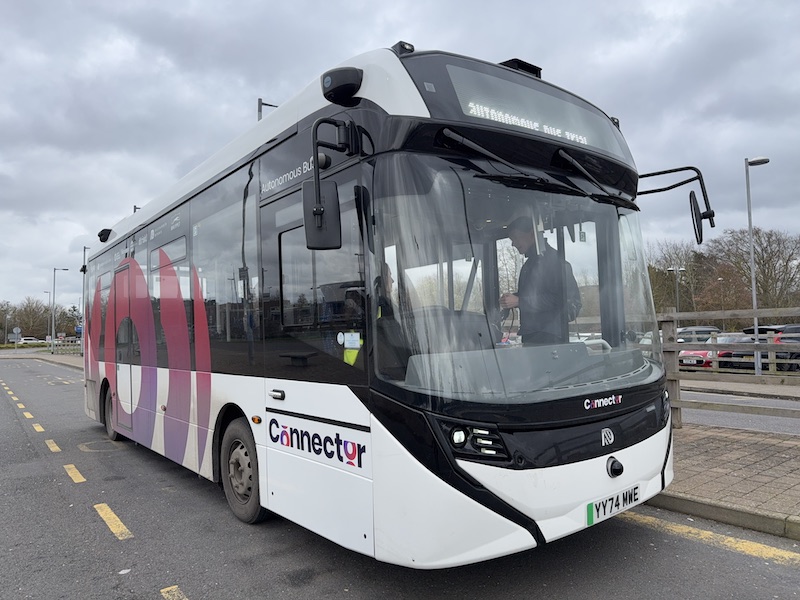
Regular readers may recall my write up of the autonomous bus trial in West Cambridge last summer as well as an abortive journey to travel on the second route introduced in south Cambridge just before Christmas when the bus was running in manual mode. It’s been a patient couple of months wait before making a return trip to Cambridge for another go at seeing this latest technology in action as it’s continued to prove temperamental but Whippet’s managing director, Ed Cameron kindly let me know things had now settled down so together with my friend Geoff Marshall, we paid another visit to Cambridge last Thursday to check out how this second route is doing.
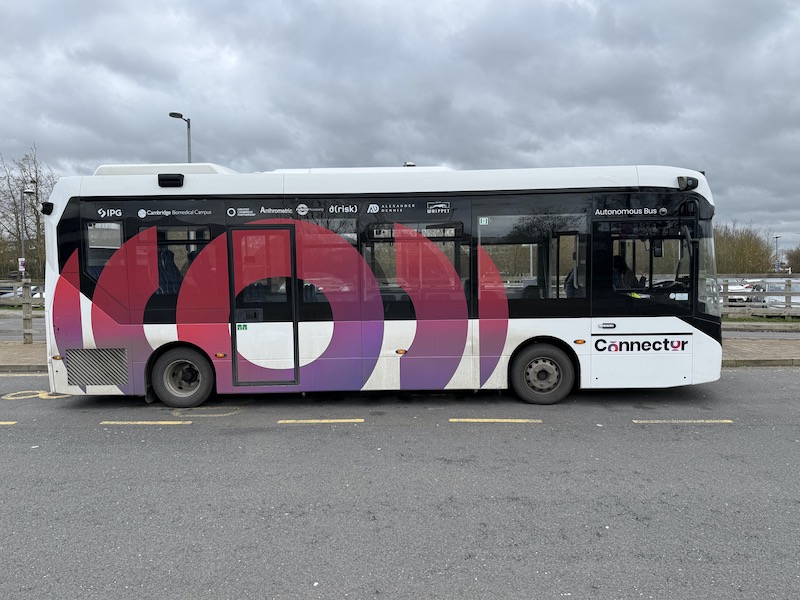
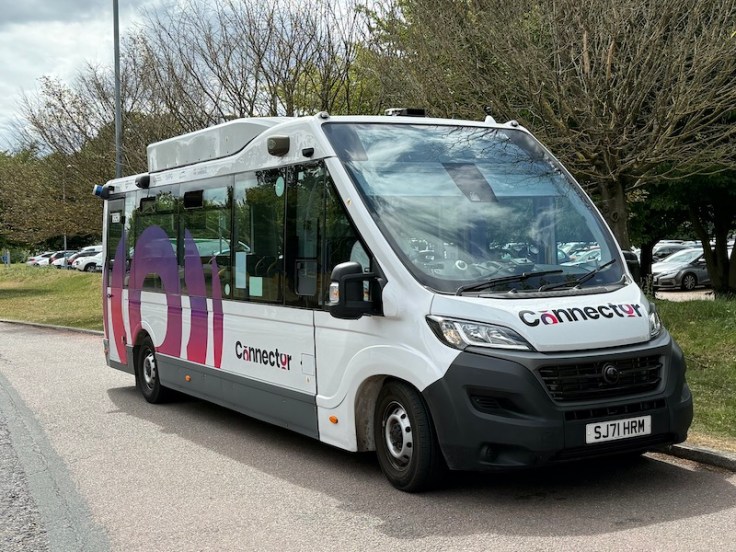
It’s operated by one of three Alexander Dennis Enviro100EV buses which have been kitted out with clever software as well as a whole welter of censors, cameras and GPS technology to enable the buses to self drive in autonomous mode on public roads as has been seen in other trials in Sunderland, Milton Keynes, Edinburgh, Harwell and Didcot over the last few years.
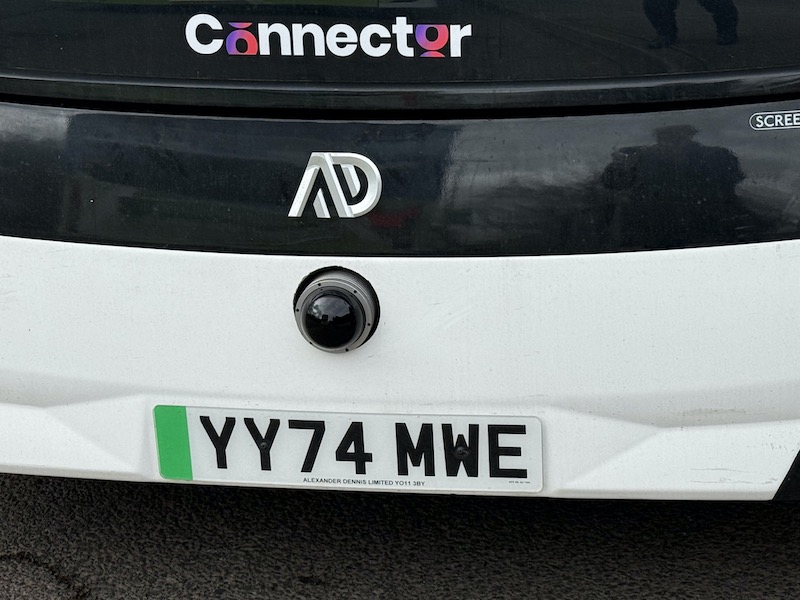
The two trials in Cambridge are being overseen by the Greater Cambridge Partnership and go under a Connector branding with funding from the Centre for Connected and Autonomous Vehicles – a joint unit of the Department for Transport and Department for Business and Trade. Fusion Processing is masterminding the technology with Whippet providing the drivers as well as looking after the three buses which have been supplied by ADL. There’s also a Mellor bodied Fiat used on the West Cambridge trial which was used on the original trial in Didcot in 2023 operated by First Bus.
This latest Connector trial route runs between the Trumpington and Babraham Road Park & Ride sites in south Cambridge via the huge Cambridge Biomedial Campus site which includes Addenbrooke’s Hospital, the Royal Papworth Hospital, AstraZenica UK’s offices as well as many other medical, pharmaceutical and scientific businesses.
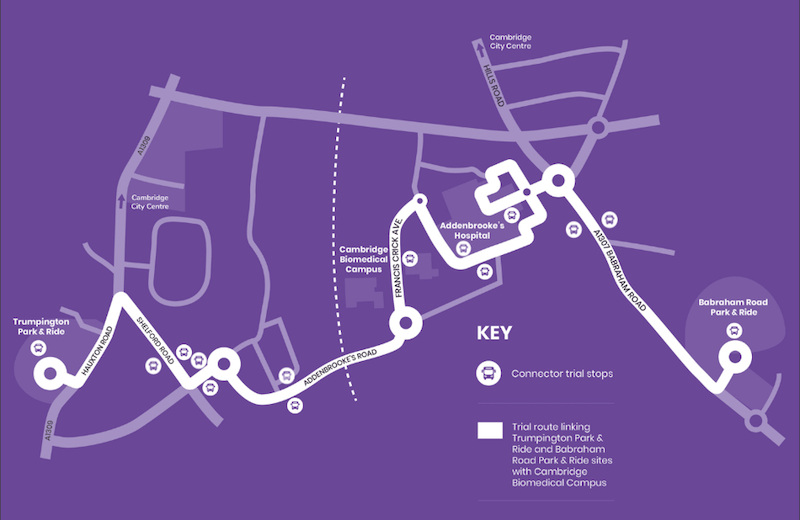
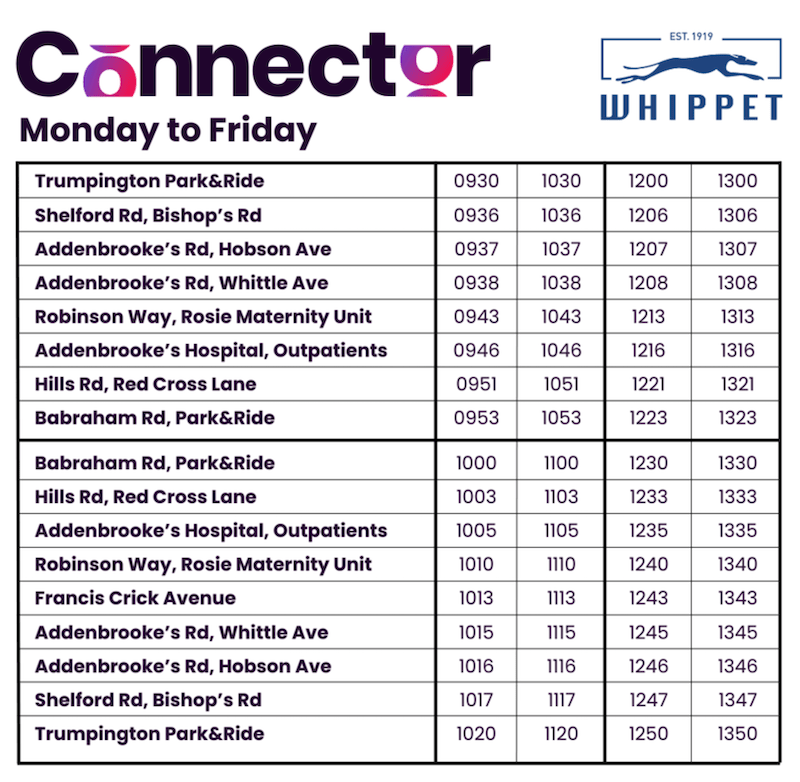
The route sees just four return journeys on Mondays to Fridays with an end to end journey time of around 20-23 minutes depending on direction.
One of four drivers who have received special training in how to handle an autonomous bus operates this on a rota as well as other standard bus driving work. But, of course, it’s a completely different driving approach needed with an autonomous bus. In essence it’s a ‘hands off’ approach but to always be ready at any time to take over the driving, either by hands going back on to the steering wheel or a foot touching the brake or accelerator. In such circumstances the autonomous mode immediately cuts out.
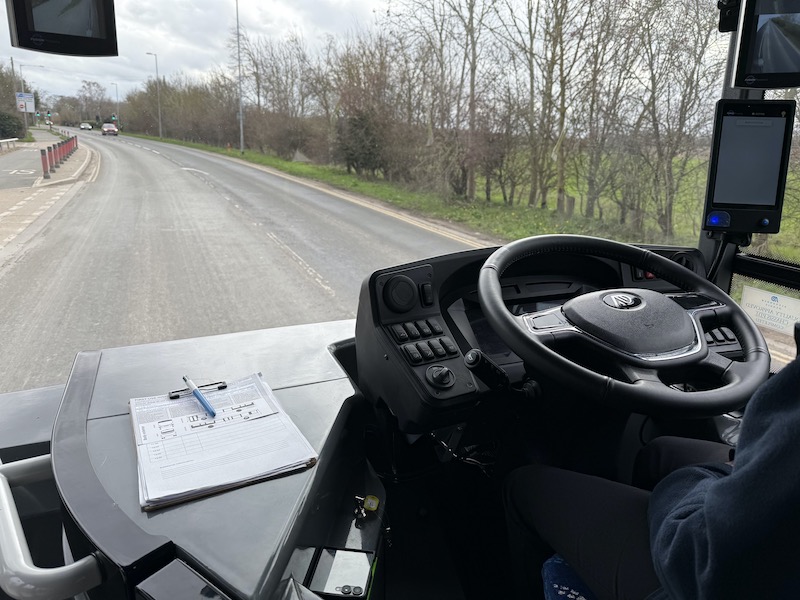
It’s quite remarkable to watch the bus drive itself along the route not only on major roads, but also through much of the complex Cambridge Biomedical Campus with its many pedestrian crossings and other potential hazards. However a short stretch of the most intricate part of the ‘twist and turn’ route through the Campus is not yet automated.
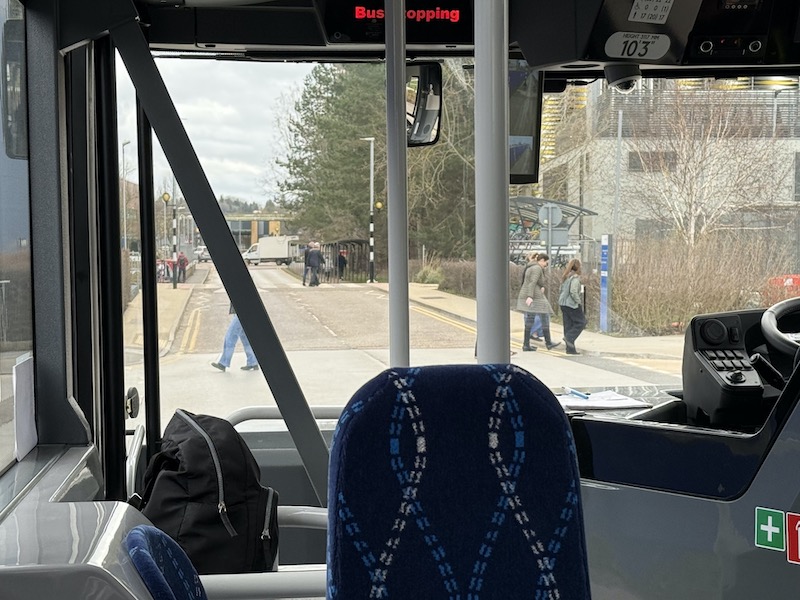
Geoff and I made a couple of round trips up and down the route to see the technology in action as well as meeting up with Ed Cameron to hear more about how this latest trial is going. On the first journey from Trumpington the technology wasn’t working but on reaching Babraham Road, our driver for the day, Sam, tried the usual trick of shutting the whole system down and booting it up again and luckily that did the business and after repositioning the bus at the Park & Ride terminal point so a connection could be made to the internet, Sam was confident we’d soon be in autonomous mode.
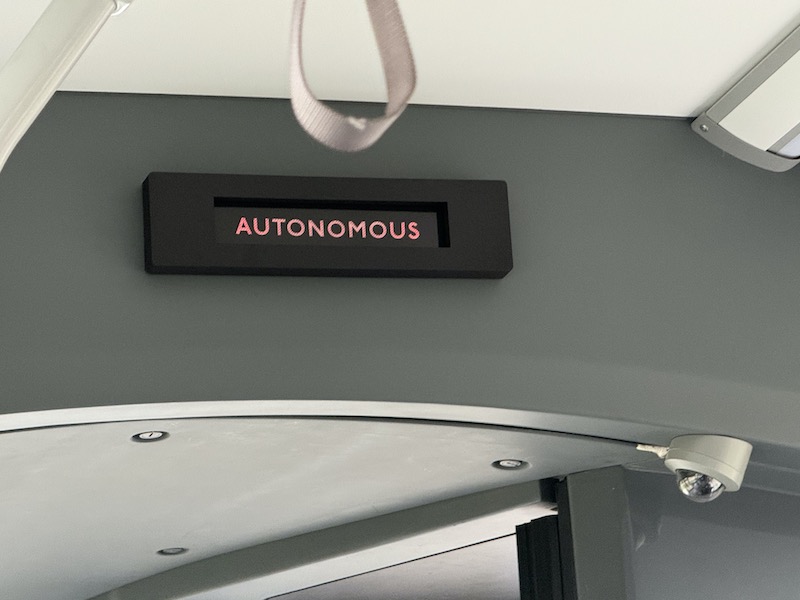
And, sure enough, she was right, for as she drove out of the site a buzzer sounded and the light came on above the bulkhead indicating to passengers on board the bus was now in autonomous mode.
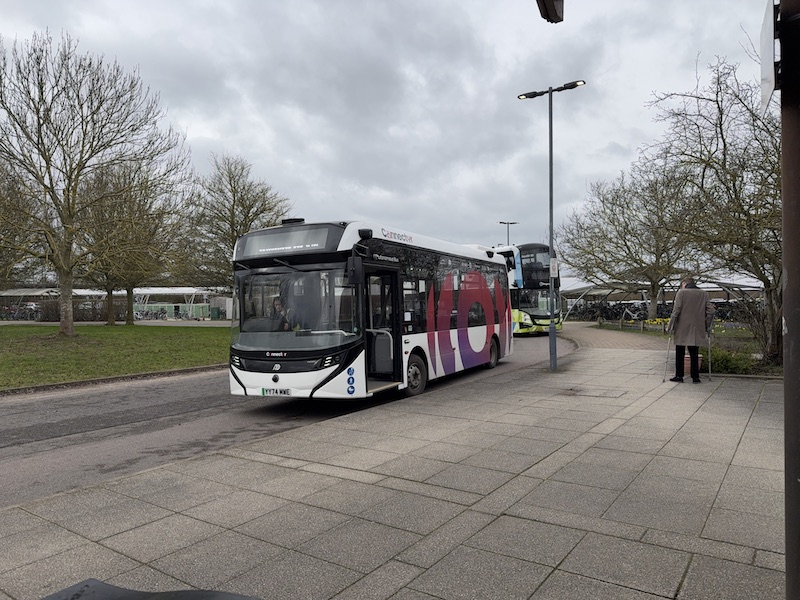
We didn’t carry any passengers on that first round trip but on the 11:00 departure from Trumpington, Sam pulled up to the departure stand, also used by Stagecoach’s guided bus route A to the Cambridge Biomedical Campus (before continuing to the city centre and St Ives), where there was a queue of eight passengers waiting to get to Addenbrooke’s so they all came aboard, intrigued at the idea of travelling on a self-driving bus.
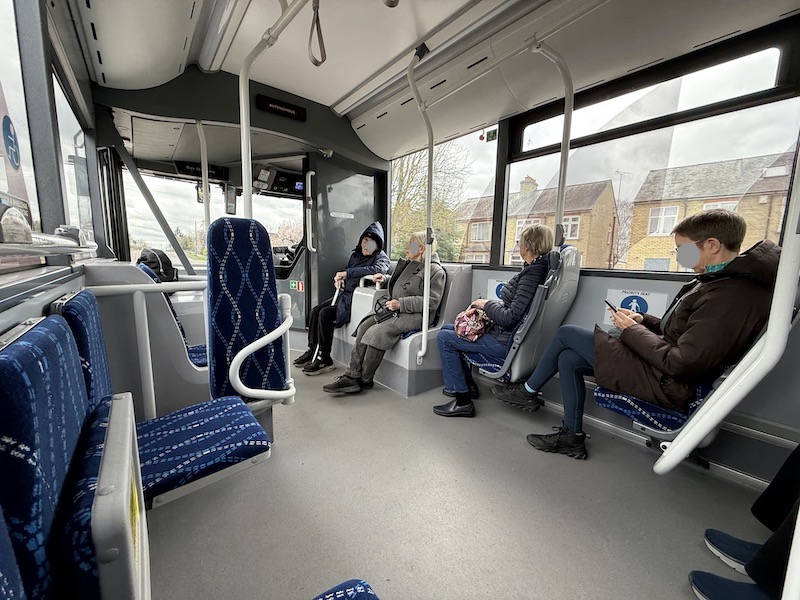
As we pulled away, Sam explained to everyone what was happening particularly as during the journey she warned there would be some instances of harsh braking where the software hasn’t quite got the measure of the road. I’d already noticed a couple of examples where road signs for roadworks were protruding out from the kerbside making the bus think it was a hazard. It also didn’t seem to like the hump before a zebra crossing on part of the route. Unlike other trials I’d travelled on, the bus wasn’t fitted with seatbelts but Sam did explain the nearside tip up seats weren’t to be used nor was standing permitted.
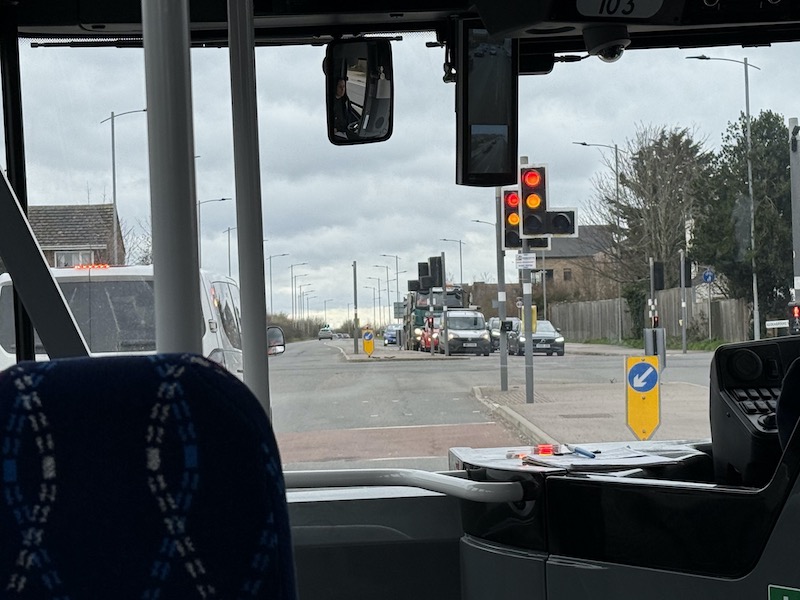
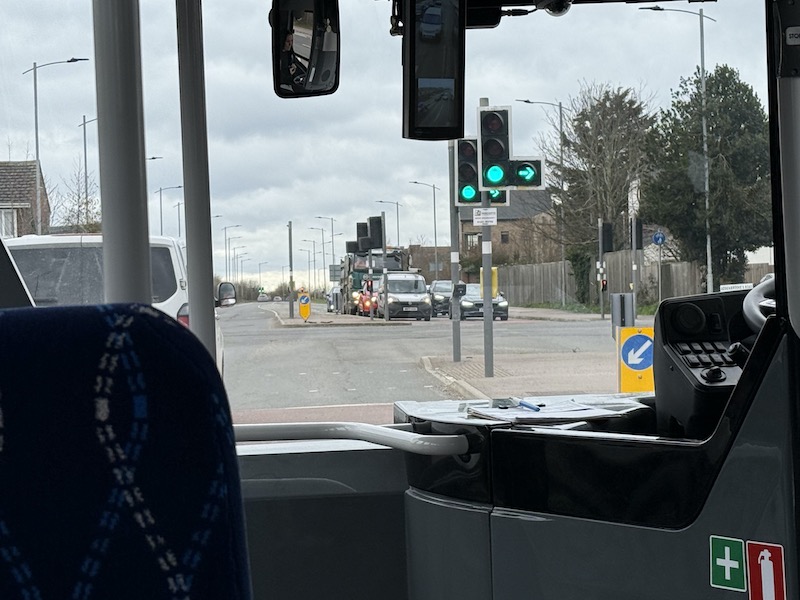
One particularly impressive aspect of the technology was it’s ability to correctly read the road and wait until a green filter light came on at a set of traffic lights where we turned right, setting off exactly as the filter came on.
It was also noticeable at roundabouts how the sensors accurately picked up traffic which was leaving at the exit from where we were joining, so could be ignored, but other traffic which was coming round in front of us to the next exit needed waiting for.
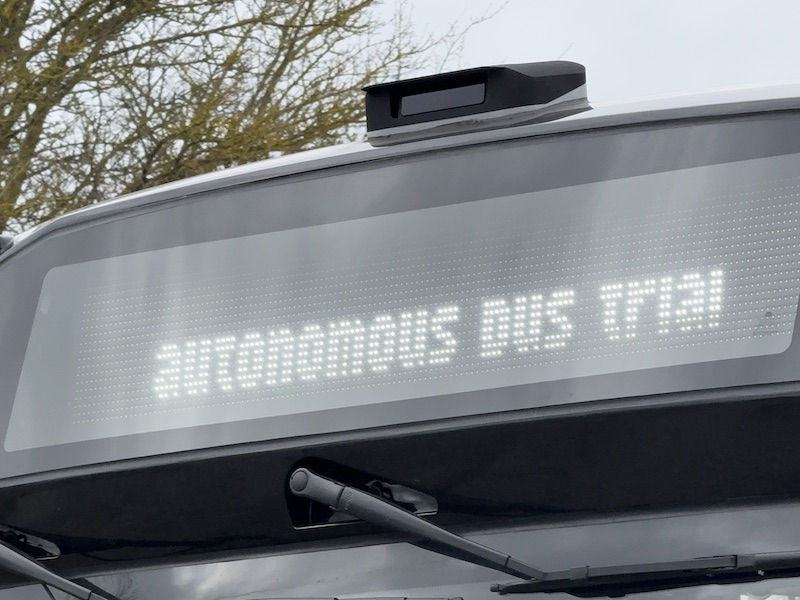
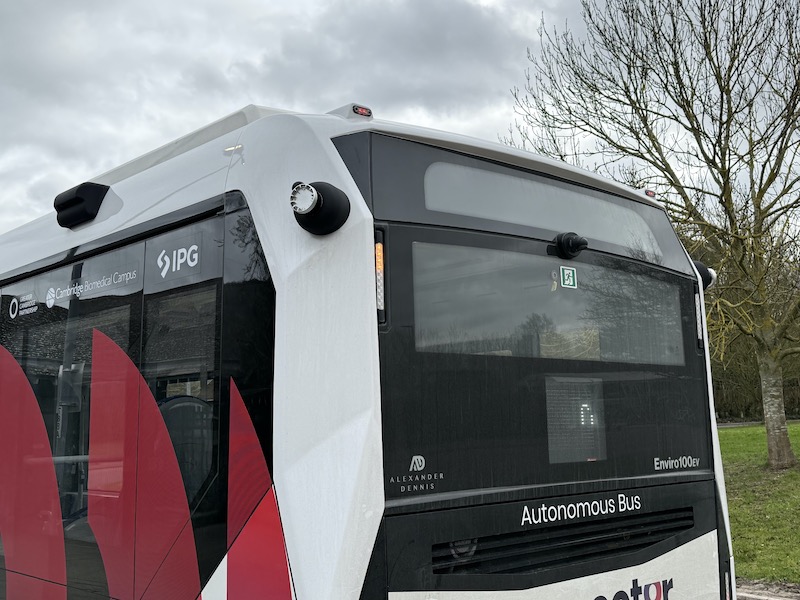
The sensors and cameras are an essential part of the technology and literally surround the bodywork of the bus to ensure every angle is covered.
Ed tells me the plan is for the Biomedical Campus route to be expanded to include two buses operating on it rather than one as well as adapting the third E100 bus to run on the West Cambridge route allowing the older Fiat bus to be stood down. This latter route has had its timetable expanded and now includes four lunch time journeys as well as five morning and six late afternoon journeys.

Ed also explained the Greater Cambridge Partnership has submitted a funding application for a further two years, which if successful will see one of the E100 buses upgraded from the current Level 3 (Conditional Driver Automation) to Level 4 (High Driving Automation) which means no driver is required as the bus is programmed to pull into the side if a problem arises. Alphabet’s Waymo subsidiary recently unveiled a Level 4 self driving taxi service in Arizona without a safety driver in the seat however under current UK legislation a driver (or “safety pilot”) has to be present. Notwithstanding this Waymo and Uber are set to launch driverless taxis in London later this year.
All this raises the question of what the future holds for autonomous vehicles. The technology is certainly impressive. Many aspects of it will undoubtedly improve safety and reduce risk since the software is designed with risk minimisation as an objective whereas humans need to make constant judgements depending on variable road conditions which can sometimes mean accidents, to say nothing of instances of buses losing their roofs driving under low bridges.
But, public transport is all about providing a service and a human presence is a crucial part of that. Even London’s “driverless” DLR has a member of staff on board for reassurance, and that uses fixed track. I can never see a time when a bus service on public roads (outside of defined and limited application such as airports and science park campuses etc) will operate without a person on board. So, when the Greater Cambridge Partnership suggests autonomous vehicles “could make public transport …. cost efficient” it implies that will be achieved through eliminating the need for a staff member on board, otherwise how is is going to save costs? I’m not sure how that sits with its other claim this has “the potential to improve passenger experience”.
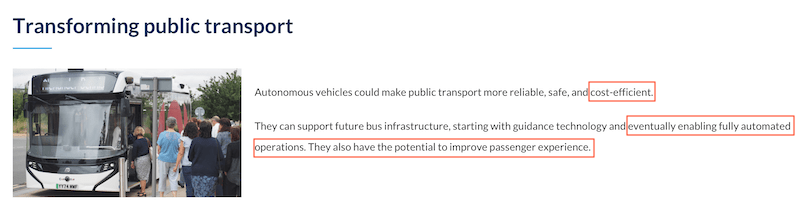
And, frankly it’s just pie in the sky to think autonomous buses will therefore “help extend out-of-hours services, make rural routes more commercially viable ….. and improve accessibility for passengers with disabilities”. What?! Come again? How will it do that. In fact it’ll be the complete opposite for those with accessibility needs. A staff member is crucial.
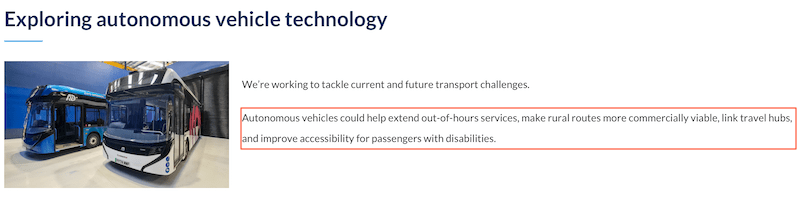
I do hope we’re not seeing the beginning of another case where Ministers and civil servants with their hands on Government funding are being sold the idea by tech companies the future for buses is automation with no staff involvement thus pouring millions of pounds into developing the technology with that objective in mind. It’ll be DRT all over again except this time we’re talking mega millions.
Indeed this afternoon, Thursday, a meeting of the Greater Cambridge Partnership Executive Board will hear plans to extend the current trial until 2028 with a bid for a further £4 million funding from Government (and “over £1 million of industrial contributions”) which if successful would see expanded testing this summer including an aspiration to include the Cambridgeshire Busway in the trial.
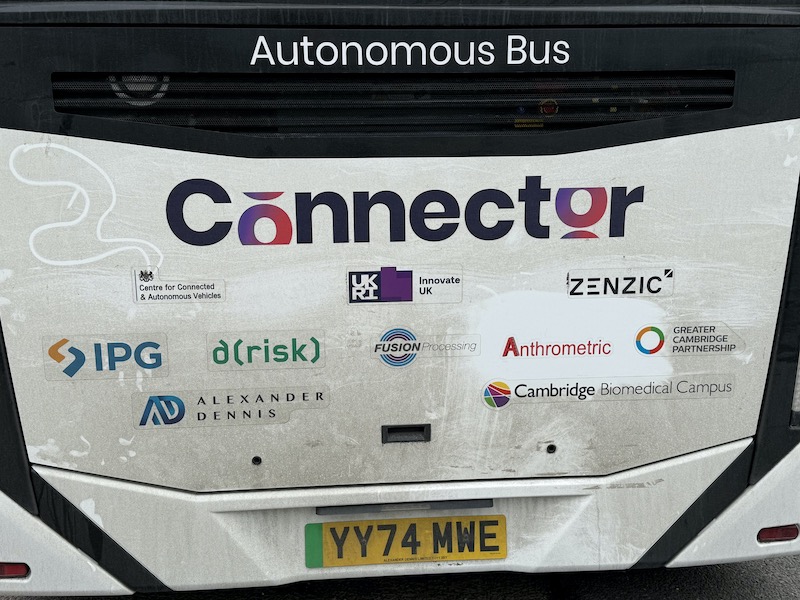
Scepticism about future staffing issues aside, it’s impressive to see the technology in action. But, always with a ‘driver’ please.
Geoff’s video is now available on his YouTube channel and, as always, is worth a watch.
Roger French
Blogging timetable: 06:00 TThS
 BusAndTrainUser
Sorry for being a pedant but I think that the word is sensor. A censor deals with films and publications. You could always have a censer but I doubt that much incense is used on an autonomous bus 🤣
LikeLiked by 1 person
Dunno maybe the on board passenger assistant needs to be qualified to use a censer if all goes wrong.
JBC Prestatyn
LikeLike
Thanks; I should have used autonomous spell check …. oh, I did!! Now manually corrected.
LikeLike
Almost – one has slipped through your fingers 🙂
LikeLike
No, it still says “censors”!
Ian McNeil
LikeLike
Needs refreshing.
LikeLike
Refreshed – you still have one “censors” and one “sensors”.
LikeLike
I like that novel approach to roundaouts. Many of the drivers on the X5 Oxford-Bedford sit and wait at roundabouts while non-conflicting traffic sails into the exit we are joining from. Maybe the robot bus could be used to train them?
LikeLike
You realise PCVs and HGVs take a lot longer to pull away at roundabouts. It’s extremely difficult now with the sheer torque on electric cars to safely get out, there’s also an increasing amount of traffic not indicating at all or correctly and of course there’s a delay in response from touching the throttle to actually pulling away. I would love to see you handle a double deck 16’2 40t articulated HGV at a busy roundabout at rush hour in London.
LikeLike
I’ve noticed that a lot of car drivers nowadays seem to have a degree of difficulty with roundabouts and treat mini-roundabouts in particular as ordinary junctions.
Given that bus drivers are car drivers before they become bus drivers, it suggests to me that perhaps there’s something to be picked up in driver training for all types of motor vehicles.
LikeLike
one problem is needing the Internet it seems which can be flaky, I understand as the earth orbit progresses GPS has to be recalibrated so the tech depends on other tech internationally working
JBC Prestatyn
LikeLike
I think the public transport idea will have to be rethought. I predict future DRT where no one owns cars but you summon a driverless electric pod to your door o, driveway or public pick up point,which takes say 4 people 2 wheelchairs as taxi style or a larger fiat style but closer to the ground ( no pesky big engine and drive train just a pick up for recharging at a town destination hub ) for more passengers. They could even operate in multiple like a road train. No steering wheel just a small computer game control paid or full remote emergency control from a ops room at the service depot.
JBC Prestatyn
LikeLike
Here’s hoping such services don’t become available. Real world experiments in the US last decade, simulating on- demand driverless taxis, prompted households to make more journeys, which meant there was more traffic on the roads than when humans had been at the wheel. More traffic slows public transport.
LikeLike
What is the difference between the model of summoning a driverless car when you want to travel and getting a taxi, which is a technology that has been around for longer than cars and hasn’t done anything to dent car use?
LikeLike
The need to pay the driver! Conventional taxi fares are wholly uncompetitive with other modes. But If you could summon a driverless taxi at a bus-type fare, it would surely do a lot to dent private car use and have a fairly catastrophic impact on public transport use.
LikeLike
I agree very much with your comments on having driver/conductor on board all buses.
However, if it meant that by not having someone on board our village would receive a clock-face service all day and in the evening (last bus currently 5:30pm) then what would I choose? A limited staffed service or a more comprehensive automated service? If I am honest, probably the latter. I don’t see any possibility in rural Derbyshire where I get my staffed bus on a clock-face through the evening service,
If automation gets me more buses, perhaps I have to suck it up?
LikeLike
Thanks for this. I absolutely agree with your comments. It is alarming that so much public money is being spent on technologies which have so far only demonstrated the uselessness of DRT and the fact that driverless buses will have drivers with special extra training. I should like to know:
1 – when wil there be similar amounts spent on projects which will desfinitely increase the attractiveness of public transport, like getting buses and trains to meet, and helping buses through roadworks – levitating, maybe or, perhaps more practically, allowing them to influence the traffic-light sequence.
2 – why I have heard nothing about the big bus companies pushing ministers about these. Maybe Whippet know something about this?
LikeLiked by 2 people
indeed for trains the fast efficient maglev systems have never had serious investment
JBC Prestatyn
LikeLike
They’ve been operating at level 4 for a few years now in San Francisco. When I was there last year we caught them a couple of times. Very impressive, and to be honest makes this trail look a bit unimpressive.
There have been loads of these trials around the country that you’ve covered, yet they don’t really seem to have achieved anything, and when competing against the likes of Waymo and Uber, to be honest not sure they ever will.
LikeLike
Insurance may be the decider here. It dictates a very large amount of what happens in public service.
I was intrigued by the comment about the bus’s ability to detect non-conflicting moves at roundabouts. Has the system got the courage to ignore all those vehicles which are still indicating right, when the car is actually turning left onto the exit?
I can see full autonomous working also used for shifting empty buses around, from depot to bus station for instance. Whether that makes economic sense is another question, as basic buses are still a value for money vehicle.
LikeLike
Who’s going to rewrite all the software needed for a diversion due to road works? Or an emergency road closure?
Plus it just takes one anti-social pest to stand in front of the bus and it won’t be going anywhere.
Sholto Thomas
LikeLiked by 2 people
summons automatic policeman , or open the front shotgun flap a la FAB1
LikeLike
Surely the same antisocial pest could stand in front of a bus with a driver and achieve the same outcome? (Depending on the driver, of course…!)
LikeLike
It is not difficult to think of at least one way in which automation might improve the passenger experience. I spent a miserable and very cold hour in Midhurst last year because no human was available to drive the bus that I had planned to catch.
Steven Salmon, Guildford
LikeLike
What happens when an autonomous bus is driving along a narrow country road, or a road made narrow by parked cars on both sides, and meets another autonomous bus? Which one, if either, will give way and reverse? Indeed, can autonomous buses safely reverse?
MotCO
LikeLiked by 1 person
Interesting that no one has come up with an answer.
LikeLike
DLR: A common misconception. The member of staff on the train checks and closes the doors and gives the right away. There HAS to be a human on the train for it to operate. The DLR cannot run without one on each train! It is not and cannot operate fully automated as there are no platform edge doors or systems to detect pax trapped in the doors in any way. Reassurance they may provide, but that’s not why they are there!
LikeLike
Even then the DLR is running in a closed environment over a relatively small distance. The whole network is maybe equivalent to a dozen or 2 roads. These ‘autonomous’ vehicles are expected to operate in much larger areas, in mixed traffic, judge pedestrian and vehicle movements and react as quickly as we do etc. I consider the costs of getting the technology to be very good, before it can be widely applied to not be worth it. Waymo and others have caused chaos in the US.
Why are we developing technology that deliberately reduces social interactions and at every turn reduces the jobs available anyway?
Also I think the DLR is a good model for restoring rail to smaller towns.
‘Autonomous’ vehicles on the other hand, just normalise a surveillance state.
Aaron
LikeLike
What an absolute waste of money & resources. Once again politicians at both national & regional level being taken in by largely U.S. technology companies. Not for nothing, why these outfits are called ‘disruptors’. I’m not arguing that change shouldn’t occur, but when it comes to operating buses resources can often be tight, so rather than waste money on automation, surely it would be better spent on providing essential services that people need, day in, day out, with a friendly driver to greet you in the process.
LikeLike
It’s the sort of thing we like to waste money and resources on in Cambridge! Having lived here for four years now I find it’s a different world here.
LikeLike
Like the Cambridge Autonomous Metro (CAM), where millions were spent trying to invent a proprietary gadgetbahn instead of just getting on with tried and tested open source technology like trams.
Peter Brown
LikeLike
Another rapid transit study for Cambridge! What do they need to know that they didn’t learn from the previous studies?
Similar to Bristol, we just have endless studies but no delivery.
Peter Brown
https://www.cambridge-news.co.uk/news/cambridge-news/people-say-trams-cambridge-would-33573831
LikeLike
Panorama on BBC1, Monday night, had a piece on AI, including a sequence about autonomous taxis in San Francisco which demonstrated a well-established project. There are, of course, more variables in bus operation but I think the technology will, in time, move us that way. Think of past changes in transport provision: where are the men with red flags?, where are the bus conductors, where are the train firemen? Things move on, and only time will tell which are successful. I do think that autonomous DRT has the potential to remove a major cost element. Whether “cost element” is a proper description of a human being is another matter.
John
LikeLike
Past progression did reduce manpower over time, however, automation is about removing the ‘face to face’ element which is so important. As for your remark about the cost element I suggest that whatever savings might be made by replacing a human driver will be more than out weighed by the higher cost of employing technicians & computer programmers operating in the background.
LikeLike
Tech bro sideshow.
Peter Brown
LikeLike
I do not know why so many are frightened of autonomous vehicles. During my motorcycle era of quite some time ago I was struck from behind on four occasions by car drivers whilst I was stationary. The first two incidents were within ten days of each other. I thus needed to abandon my case against Car Driver No 1 and proceed against Car Driver No 2 who was a motor mechanic for Moore’s of Weybridge who slammed into the back of me driving a customer’s car. Some professional driver he was! Repairs to my Honda cost about £250 but there was no personal injury aspect to this case. Car Driver No 3 struck the rear of my machine so slightly that it merely cracked the red plastic enclosure of my stop/rear lamp bulb. This woman driver promptly paid my claim for the replacement part costing £3.90. Car Driver No 4, from Windsor, struck my Kawasaki at Painshill Roundabout on the A3/A245 junction severely yet damage to my machine was insufficient to prevent me driving home. However all my arm and hand muscles were severely wrenched by the impact as I was stationary with my left hand gripping the clutch lever and my right hand gripping the front brake lever. My machine was struck from beneath me and I was tossed into the adjacent verge. I had my muscle strains recorded by my family doctor as soon as possible. Car Driver No 4’s insurance company paid out £700. I assess that £530 was the proportion for personal injury with the rest paying to repair the damage to my machine. SO, I DAMN TO HELL THOSE WHO SUGGEST THAT AUTOMATION COULD NOT DO BETTER.
LikeLike
My thoughts on this:
2. If we can’t go to no person operating, then it’s pointless developing it.
3. I’d be confident the tech could be developed, by I can’t even begin to image the misuse the vehicles would suffer. With Uber they have all your details before you get it, so there’s a natural safeguard.
LikeLiked by 1 person
Good to see Roger engaging with the team behind the initiative. Avoids him having to second guess why things have been done, as is so often the case in these blogs. More of that as it helps to inform the reader more fully.
LikeLike
I’m not sure what the question is that autonomous vehicles are supposed to answer.There are lots of excellent questions in the post itself and the comments but one that I haven’t seen come up so far is the environmental impact of AVs. I’m assuming that the use of AI will require a substantial use of electricity and water if this ever gets upscaled to any significant degree.The amount of money to bring this tech to any feasible level for making buses and trains truly driverless – assuming this is even possible – is likely to be so massive that it would be able to pay the salaries for drivers for all public transport for many, many generations. And all this to make hundreds of thousands of people jobless for no good reason. This isn’t spending to save, it is a black hole with no guaranteed success or benefits.At a time of environmental crisis, we should be focussing on tried and tested public transport rather than vapourware like this. The next step of this tech won’t be a full roll out – it will be successful pilots of small projects involving minibuses tootling around industrial estates on largely segregated routes without any staff. This will then be used by the tech-bros to argue for more funding for a major upscaling (assuming this is even possible – which can by no means be assumed) and be used by them as a weapon to oppose tried and tested public transport interventions – just like has happened in the USA.
Into the sea with it!
LikeLike
There are always solutions looking for a problem; on UK rail think the Parry People Mover, for example, or the D-train.
The difference here is that somehow the tech bros have convinced the public sector that they offer a way of reducing costs while in reality doing the opposite, and are consuming scarce funding in the process.
I assume the stars will fade from the relevant eyes in due course, but then they’ll just switch to the next big thing.
Ho hum.
LikeLike
Exactly! This is why it annoys me when people claim there is no money to socially provide conventional bus routes. The money is being squandered on things like AI and super advanced technology with no real benefit to ordinary people.
The government is carrying on the £1 billion a year for buses funding for the next 3 years, if that tripled, suddenly rural and suburban areas could get a decent all day bus service connecting every village with its nearby town or city or rail station.
Always priorities when it comes to politics.
If the future is between a ‘Mini-Switzerland’ and what driverless (not driverless) nonsense they are coming up with, I would always pick the first. We don’t need more technology, we need more connectivity.
Aaron
LikeLiked by 1 person
Part of the problem is huge amounts of untaxed venture capital wealth looking for a home. It goes to disruptive US tech bros and unleashes chaos. Think what governments could do if that wealth was taxed back and put to more productive use to fix all the damage done by decades of neoliberalism. We could fix all the decaying infrastructure, public realm, provide a nationwide integrated public transport system on the Swiss model, fix the NHS, and social care, etc, everything else where we’re told there’s no money, and society would be better off, but hey, autonomous pods!
Peter Brown
LikeLike
Well said Peter. It’s time to disrupt the disrupters!
LikeLike
Nicely summed up.
Politicians never learn. We only have to look at the mental damage U.S. technology companies have done to generations of young people thanks to variants of Social Media. Having personally seen numerous videos with incorrectly spelt AI generated subtitles & noting the negative comments on this blog about AI generated timetables, this technology is in danger of spreading illiteracy at an alarming rate.
As for self-driving buses, I trust the accountants will persuade those making the final decisions that it simply doesn’t add up financially, which ever way you look at it.
LikeLike
“autonomous” is a rather posh word to put on the internal display. I’d have gone for “Bus is self-driving”.
LikeLike
more likely using the technology will be things like self operating lawnmowers. The problem with buses is they carry humans hence the need for an on board human. Hopefully though if the technology avoids accidents then there is a net financial benefit
JBC Prestatyn
LikeLike
Most modern vehicles have factory fitted sensors that can detect people as well as other vehicles. By ensuring these are fitted all round a bus would go a long way towards avoiding accidents without going to the extreme of making a vehicle driverless. If you add up the enormous cost of a self driving bus (which includes highly paid technicians & programmers needed to keep it safe & operable), no net financial benefit is possible.
LikeLike
Are any of the sensors LIDAR?
If so you may want to check your phone camera (or any other digital cameras used) for burn in spots; something that some LIDAR sensors can do especially if you spent significant time getting a front view of the vehicle.
LikeLike