Thursday 4th December 2025
Like many towns and cities, London is plagued with roadworks often necessitating road closures and consequent diversion and disruption to bus routes.
BBC London contacted last week inviting me to take a look with them at the impact of the current closure of Delancey Street in the heart of Camden Town.
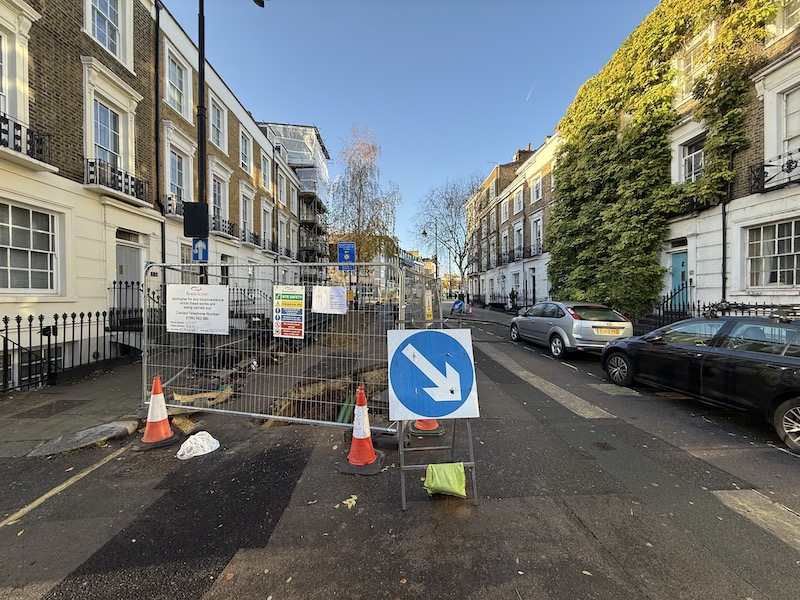
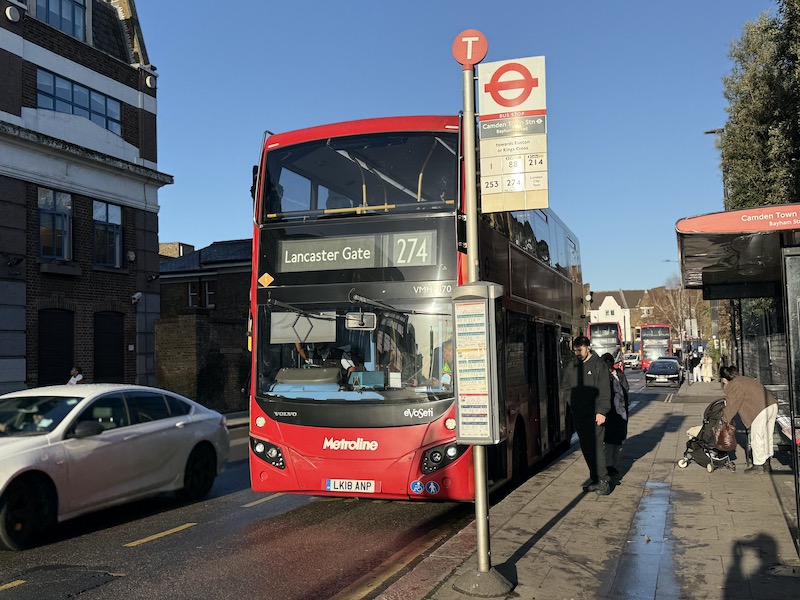
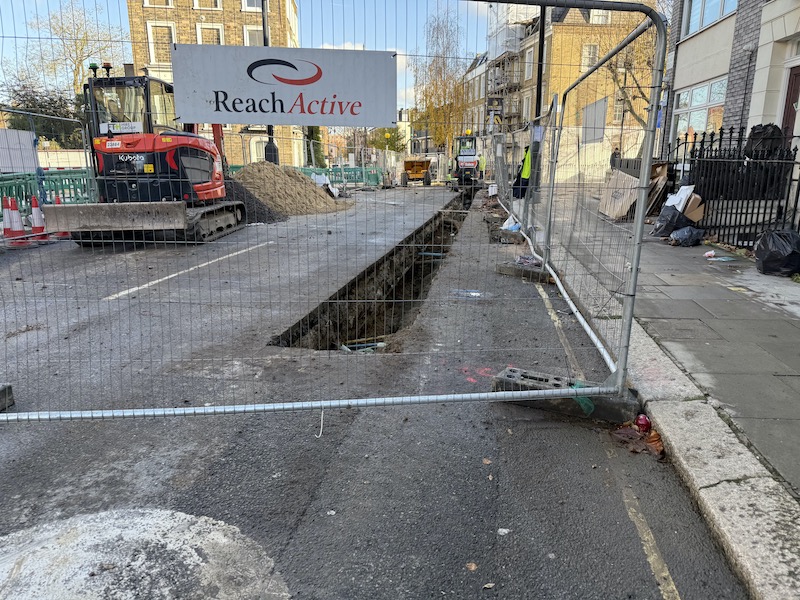
Bus routes 88 and 274 use this one way street to access the east side (88) and north side (274) of Regents Park but it closed a couple of weeks ago for electrical cable works and is not due to reopen until next Wednesday. During this period route 88 has been diverted via Hampstead Road and Euston Road instead of Albany Street to reach Great Portland Street and in so doing misses out seven bus stops with absolutely no alternative whatsoever. And no, that’s not a typo, seven bus stops on a one and a quarter mile section of route in the heart of London are no longer served.

But, that’s nothing compared to the diversion passengers are facing on route 274.
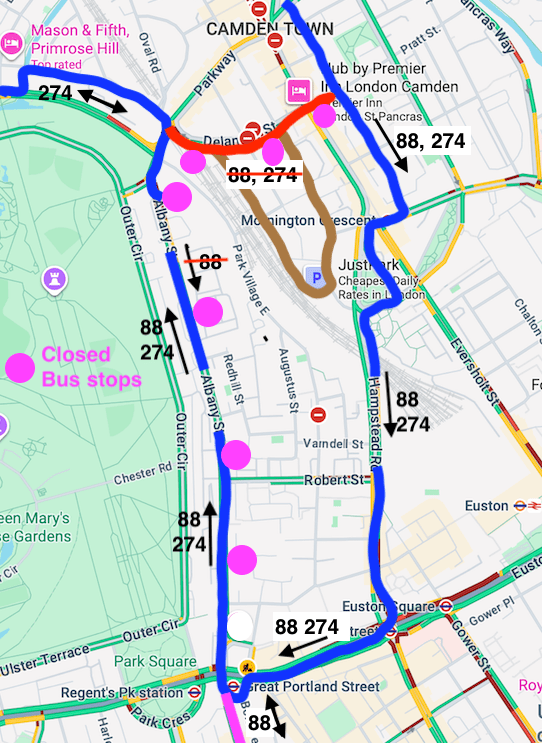
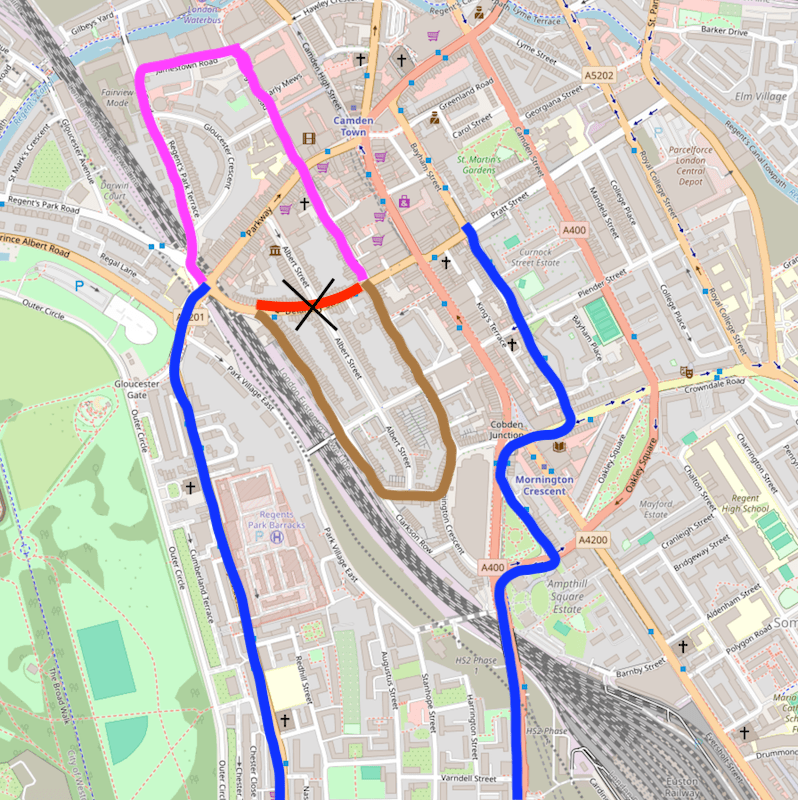
Instead of a 530 yard (490 metres) three minute short hop along Pratt Street and the closed Delancey Street, buses are having to work their way down to Euston Road via Mornington Crescent and Hampstead Road then along Euston Road to Great Portland Street Underground station where they negotiate the loop around the station and then head back north again via Albany Street – an extra distance of two and a quarter miles through roads and junctions notorious for their congestion.
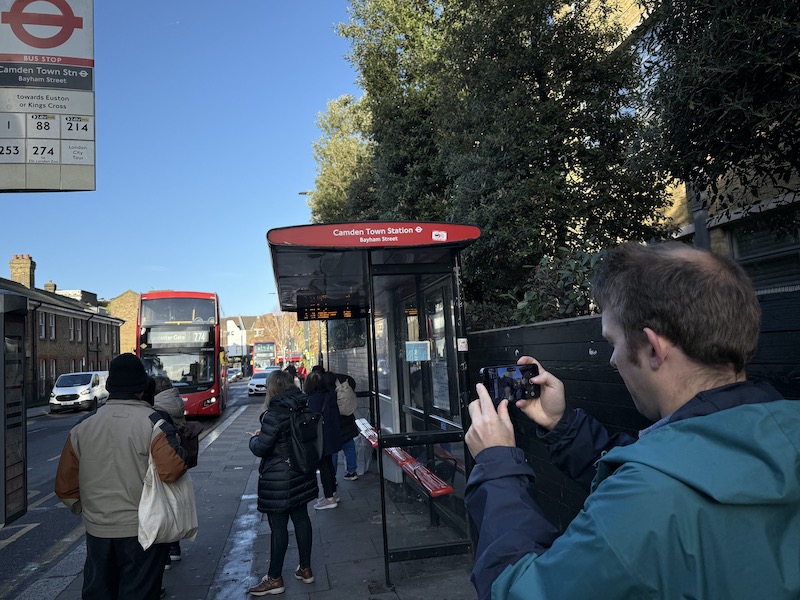
I took a ride with BBC London’s Harry Low on Tuesday morning and it took us exactly 20 minutes to get back to where we would have been three minutes later at the western end of Delancy Street (shown in red on the above map). And this was late morning, not in the snarled up peak hour traffic along Euston Road.
And, of course, the diversion itself is plagued by roadworks, not least on Hampstead Road where there have been long term temporary traffic lights controlling single lane working for traffic on this busy thoroughfare for years in connection with HS2 – not that the Government has approved it reaching Euston yet.
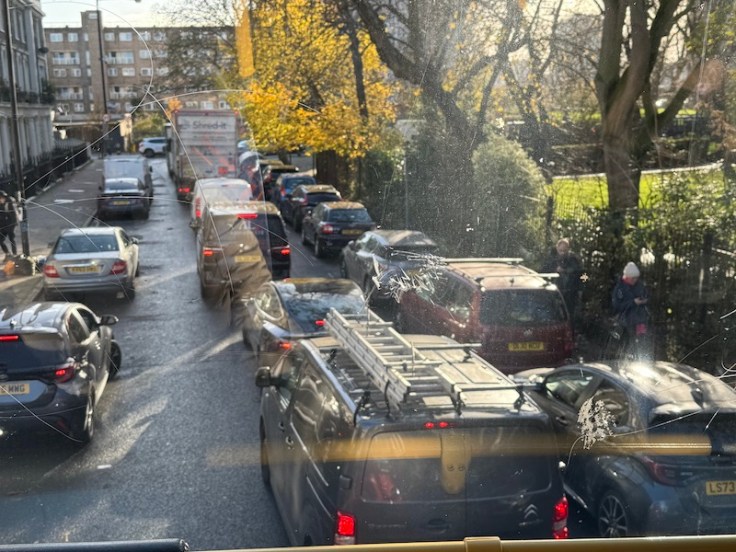
Indeed it took us nine minutes just to crawl the first leg of the diversion around Harrington Square Gardens by Mornington Crescent Underground station and wait for a gap in the traffic or the goodwill of a motorist on Lidlington Place to let us out into the queue for the temporary traffic lights in Hampstead Road.
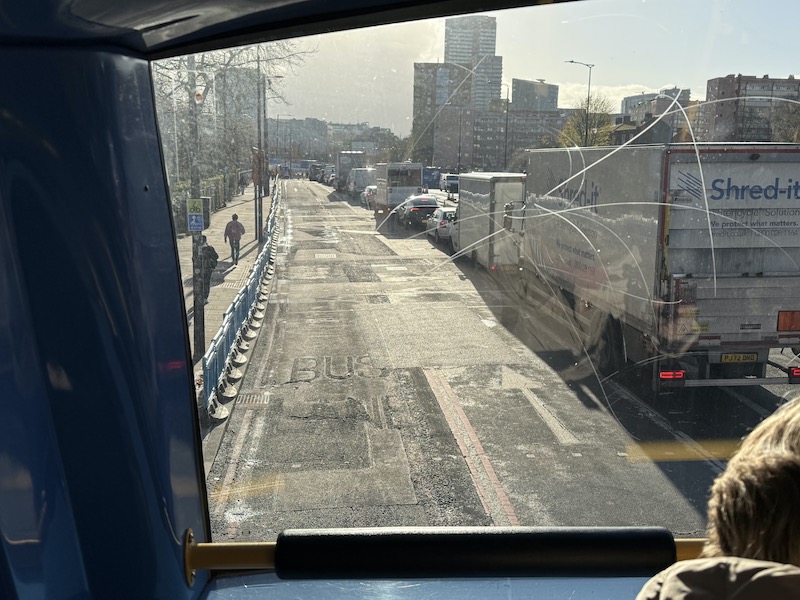
Fortunately as we turned left into Hampstead Road we had the benefit of a bus lane leading up to the lights…
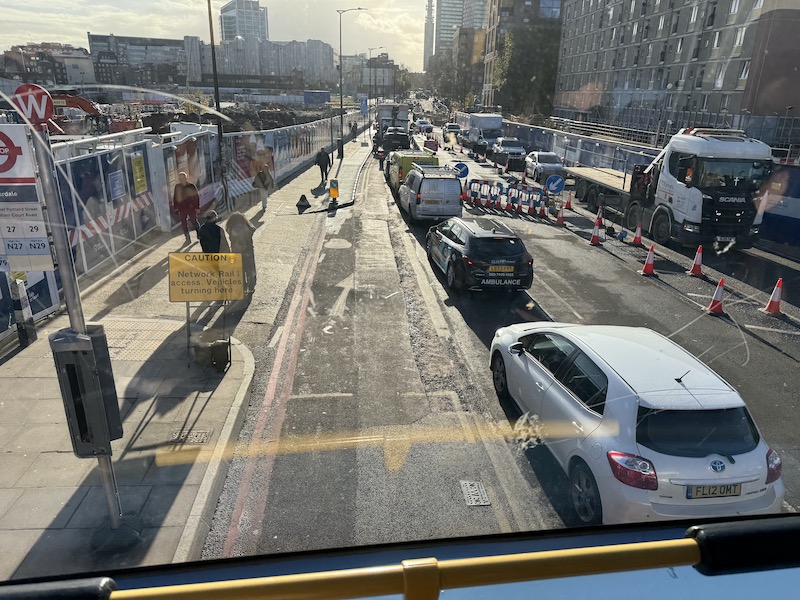
… and after negotiating that blockage we reached Warren Street Underground station where we turned right and fortunately found Euston Road wasn’t too bad at 11:30 in the morning…

… so we reached Great Portland Street after 13 minutes…

… and the only hold up heading north up Albany Street was the next set of roadworks and temporary traffic lights.

We finally regained our line of route after a 20 minute detour that would have taken three minutes had Delancy Street not been closed.
Two things struck me about this situation.
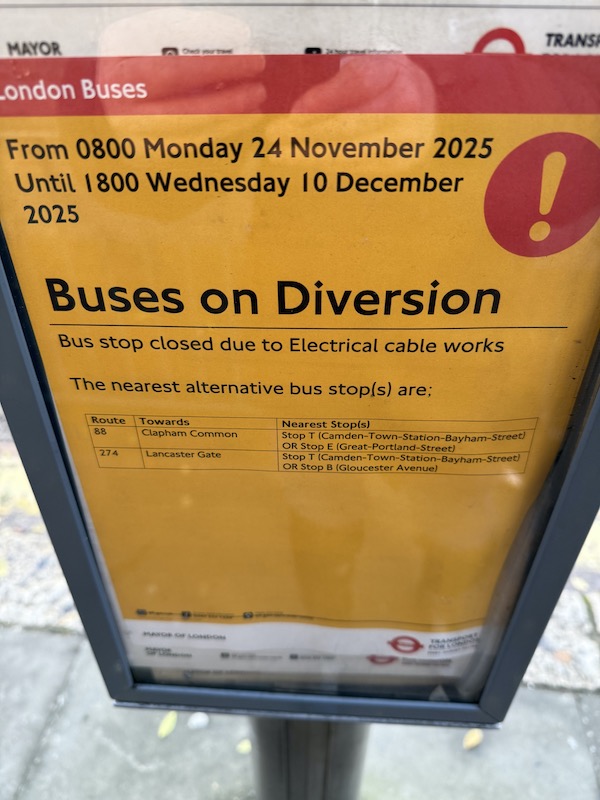
Firstly, although there was a TfL yellow notice in the timetable case advising of the diversion and where alternative stops were located none of the bus stops (three for the 274 and seven for the 88) were covered up with a yellow ‘Bus Stop Closed’ notice.
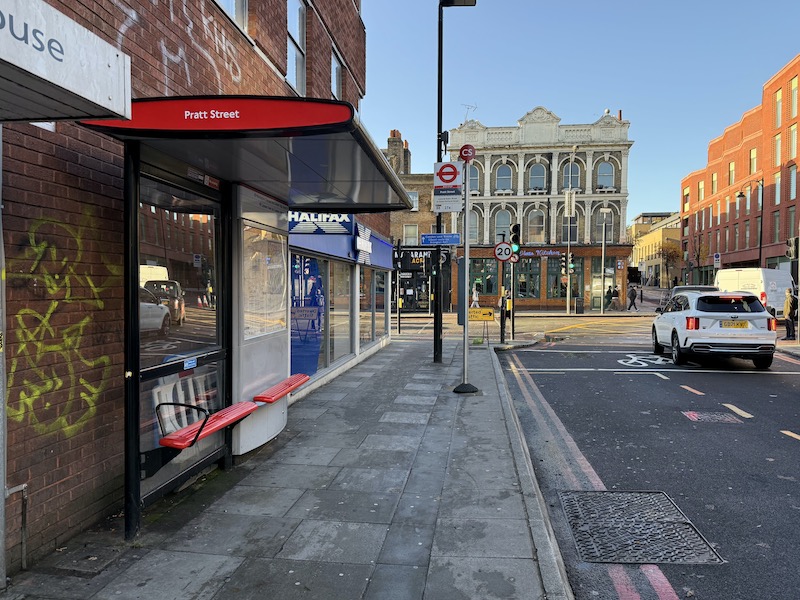
On our walk along Pratt Street, to the east of the closed Delancy Street, we found an elderly woman waiting at the closed bus stop and explained to her about the stop being closed due to the roadworks which were unseen from there. She had no idea and wondered why she’d been waiting so long. Sadly she declined to be interviewed by Harry.
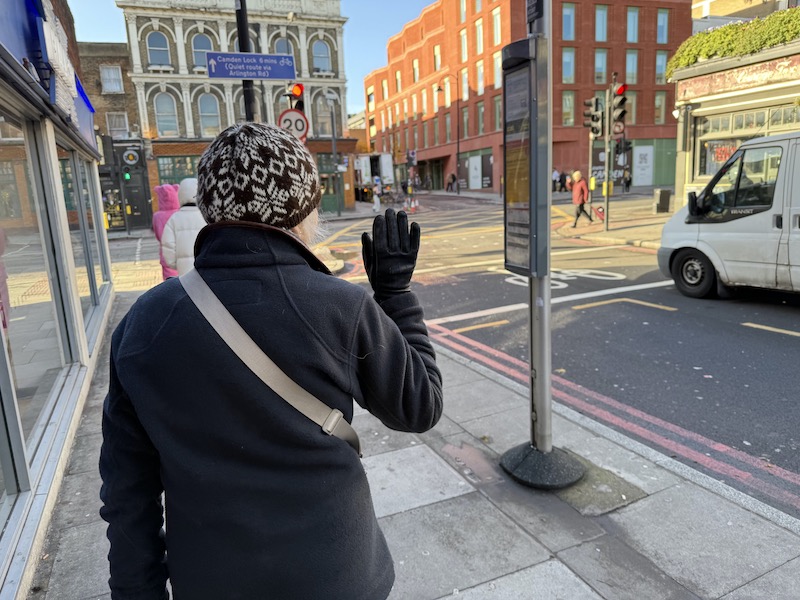
Even worse, none of the four southbound stops on Albany Street no longer served by buses on route 88 were covered up and as we passed north along the road on our diverted 274 we noticed a passenger waiting forlornly at one of these stops too. Northbound buses on the 88 continue up Albany Street as normal.

Meanwhile on board the 274 as we left Camden Town, despite the driver making an announcement “this bus is on diversion” there were two very confused tourists travelling to London Zoo checking their phones and increasingly puzzled as we headed away from that direction towards Euston Road.
Harry went to interview them for his report and we were able to reassure them the bus would eventually arrive at London Zoo.

Three other tourists who’d been sitting in the front seats on the upper deck were so baffled by the diversion they alighted at Great Portland Street.
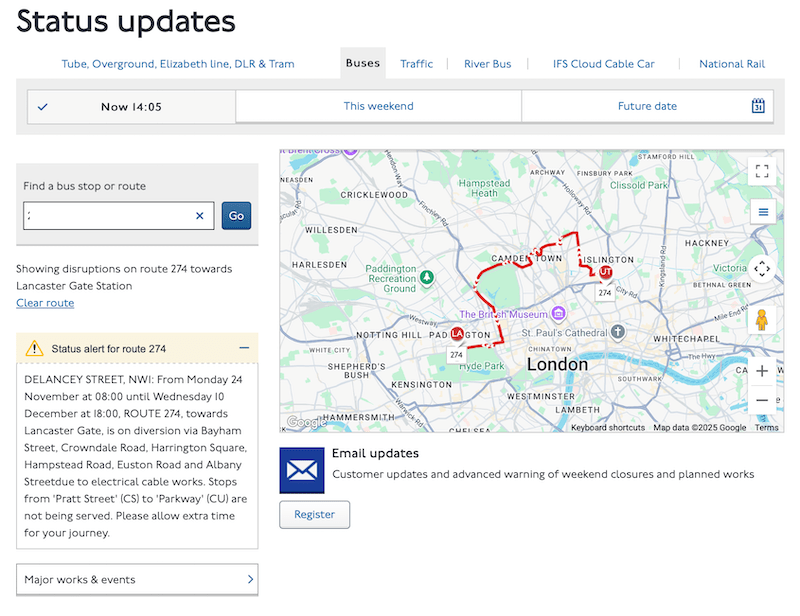
TfL has posted details about the diversion as a service alert on the 88 and 274 route information pages but what would have been helpful is large posters at each of the bus stop shelters explaining how passengers can reach the alternative bus stops – that would have made interesting reading for those wanting to catch a southbound bus in Albany Street as the answer seems to be “a long walk”.
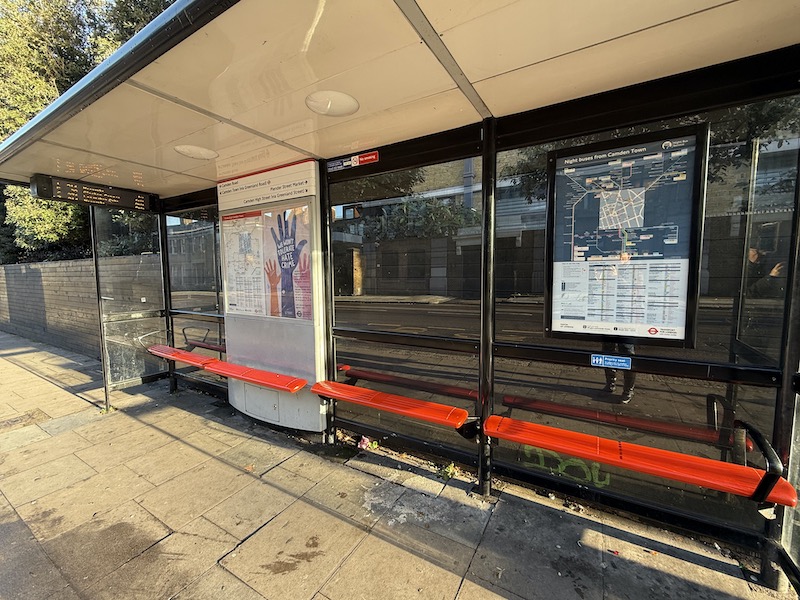
The other thing I noticed was a Diversion sign at the start of the road closure in Delancy Street with an arrow pointing right, whereas all the cars, vans and taxis were turning left.
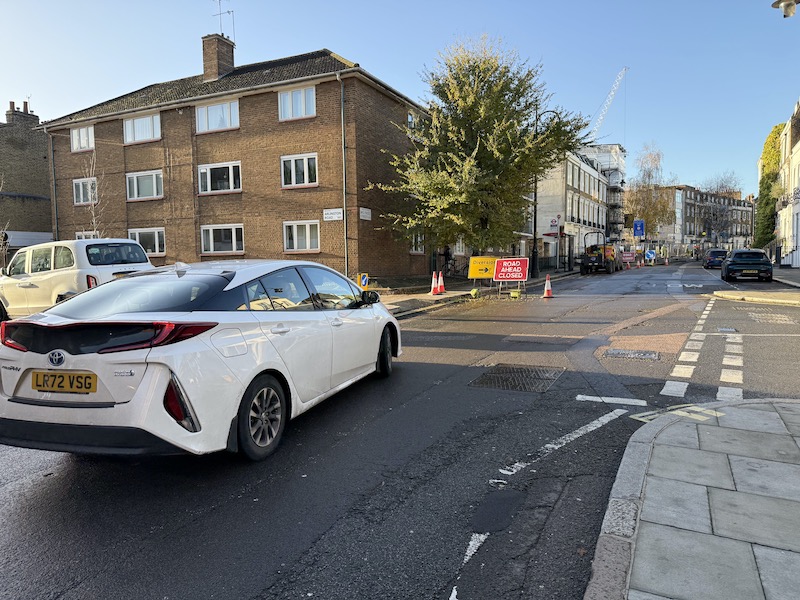
We followed them and walked what is obviously an unofficial diversion “those in the know” (and possibly Satnavs too) marked in brown on the above and below maps and wondered if it would be a suitable alternative for buses.
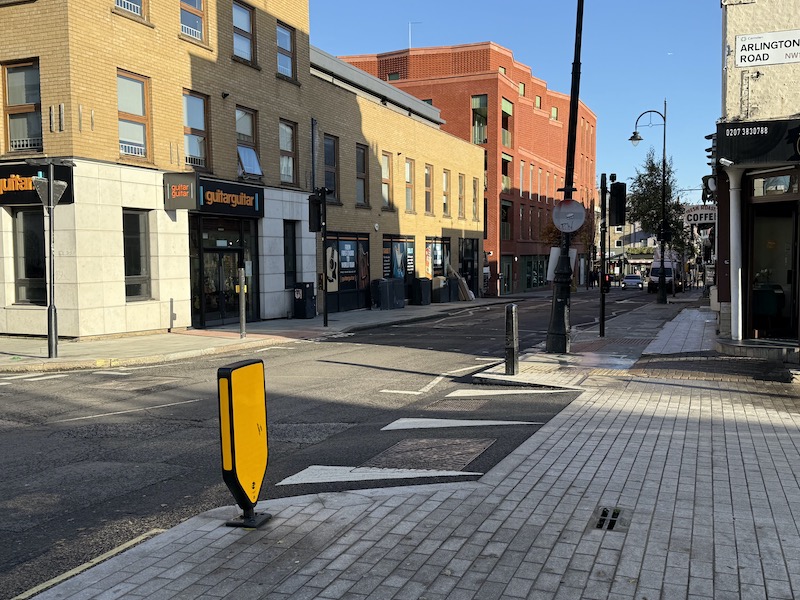
There’s no doubt the initial left turn would be tight as would a section of ‘traffic calming’ along the one of the roads, but ‘where there’s a will, there’s a way’ and with the temporary removal of a few bollards and smoothing off of a corner, buses could have certainly followed this route at much less inconvenience.

Compared to the scale of excavation works on the road itself as part of the cable installation, the aforementioned temporary fixes for the sake of helping bus passengers could easily have been accommodated if someone had insisted they be carried out.
Alternatively what looks like the official diversion turning right where the sign is pointing, and head north via Arlington Road, Jamestown Road and Oval Road (shown in purple on the map below) looks equally feasible.
It would make a change for bus passengers to be given much higher priority when it comes to mitigating the impact of such roadworks, and please, TfL, up your game on information at bus stops and don’t think a “service alert” online is all that’s needed. It’s not.
Roger French
Blogging timetable: 06:00 TThS
 BusAndTrainUser
I remember a similar situation when the Guy’s Hospital bus stop on St Thomas Street was ‘closed’ many years ago – a hopeless lack of passenger information. Unfortunately TfL are not the only culprits – many bus operators are just as bad. Just another case of not ‘Putting the Passenger First’.
One option to mitigate would be for the offending utility to be forced to pay for a doubling or trebling of the bus frequency on routes affected by the disruption they cause – might make them do the work a bit quicker.
LikeLike
Good to see that TfL’s multiple senior executives on six figure salaries are doing such a great job.
Stephen
LikeLike
MORNINGTON CRESCENT!!!! (Those who know, know). Thanks Roger, made me chuckle on a very wet dog walking morning. Steve Thomas
LikeLiked by 1 person
I’m sorry they havn”t a clue
LikeLiked by 1 person
A story now repeated throughout our once green and pleasant land. The situation made worse by the traffic levels in London of course, and the total failure by TfL to at least inform passengers “on the ground”. One has to presume that those responsible for providing such information happily assume that everyone is bristling with the latest technology and such “old hat last century” things such as a simple notice is not required.
Conversely, bus stop timetable cases around Locks Bottom (Farnborough/Orpington borders) are all happily showing diversion notices for route 61 which ceased months ago.
Terence Uden
LikeLike
Indeed.
I travelled earlier this year on the Matlock – Ashbourne route through Derbyshire’s peak district. We went on a fifteen mile diversion which took us most of the way to Derby as a result of long-term roadworks.
There was absolutely zero roadside publicity, although there was a notice on the bus and deep in the operator’s website if you went looking for it.
I think a useful mitigation would be to require the relevant utility to provide roadside publicity of the closure (and the resulting impact on the local bus services) at all bus stops on the affected routes before the work starts, liasing with the relevant bus operators to ensure such publicity is both appropriate and correct.
The extra planning work involved might just make those utilities think harder about closing roads for weeks on end.
Mind you, given how poor too many bus operators are at publicising their own services, I suspect that those operators wouldn’t know how to respond to a utility asking which services would be affected. Yes, Arriva, I’m looking at you.
LikeLike
I have some sympathy for some local authorities dealing with temporary diversions, where the number of staff can be counted in one hand, but TfL could have 1% of their staff on this and provide blanket coverage.
Gareth Cheeseman
LikeLike
For some considerable time I have noted that the monthly journal (long standing members such as myself still refer to it as “the News sheet”!), of the M&D and East Kent Bus Club, now comprises of around 50% news of service diversions caused by roadworks. And this is just Kent and a part of East Sussex.
Replicated throughout the UK as many of us intrepid travellers know, it is just as well the “Village Bush Telegraph” system remains alive and well, or there would be no passengers left!
Terence Uden
LikeLike
Transport for London (TfL) is taking bold steps to attract passengers back to public transport through innovative fares and customer rewards. The organization is considering these measures as part of its strategy to boost ridership while also expecting motorists to contribute significantly through road user charges. However, it is important to note that bus services in central and inner London may face cuts, potentially impacting passenger journeys. TfL’s draft budget for 2026/27 reveals that more than £1bn a year is expected to be paid by motorists due to London mayor Sir Sadiq Khan’s “road user charges”, such as the £18 congestion charge, Ulez, and tolls on the Blackwall and Silvertown tunnels. This is a £176m increase on TfL’s current road charging income, with £110m of the increase coming from the hike in the C-charge and the removal of the 100 per cent discount for electric vehicles from January 2, 2026.
LikeLike
There was this bloke once . . . his name was Albert W McCall. He wrote (what was then) the definitive history of London’s Green Line network. It’s long out of print, but if you see one it’s well worth a read.
And why does greenline727 bang on about A W McCall? Because he worked for London Transport in the 1950s and 1960s as a Publicity Inspector . . . he walked bus routes checking that publicity was (a) correct and (b) up to date.
Just a thought . . . should LT employ another one? Or even better . . . a team of them?
LikeLiked by 1 person
Mr McCall was indeed quite a character, and at the time of his book being published I was the Publicity Officer for the Omnibus Society, and as my London interests were with LT’s green buses rather than red, I got to know him quite well. I think he was stationed at Western House, the Central area control point for a good part of his career, and thus familiar with the entire Green Line system.
He was particularly noted for what is now politely termed, “a colourful choice of words”, and caused much laughter (not heard much these days!) when in his company.
Terence Uden
LikeLike
My goodness, what a mess! My diversion experience this week pales into insignificance! I was on a no. 8 First Bus to Windsor from Egham which was diverted via Datchet – a fact which the driver did not mention when I got on. The diversion meant that the bus did not go to Windsor at all, but went straight on to Slough. I got off as soon as i realised this and crossed the road to go back and was told by another bus driver that the roads into Windsor would not be open until 3pm (it was then around 1.30) and that the distance was walkable. Perhaps a compliment as I am 82, fortunately a walker and fit for my age. 2.5 miles and nearly an hour later I arrived at my destination- King Edward VII Hospital for the casualty eye clinic. This is normally a 15 minute bus journey with a stop very close to the hospital. The roads were closed because of preparations for the German state visit. This sort of closure happens every time there is a state visit and drivers should be instructed to ask where passengers are going when they get on when there is any sort of diversion. I have complained to First Bus but haven’t had a reply yet.
LikeLiked by 1 person
In Central London should all but essential vehicles and residents cars be banned with the road turned over to buses
In Central London there is good bus and rail services do no need for cars in general, It would significantly improve services and journey times and reduce costs
LikeLiked by 1 person
In Central London the average bus speed is little more than 6 miles an hour factor in impact of diversions and it is probably even lower
traveling by bus in Central London is now very slow and unreliable
LikeLike
With apologies to Roger for “thread drift” . . . yesterday I thought I’d have another ride on one of the Cambridgeshire Tiger routes . . . specifically the T7 from Chatteris to Wisbech via Manea.
My journey at 1140 from Chatteris arrived from Wisbech 9 minutes late, with no passengers on board. The turning manoeuvre takes 6 minutes (with a 5 minute stand time!), so we departed 10 minutes late. Despite a pretty huge diversion (avoiding Manea Station), we were back on time at Three Holes, and arrived into Wisbech 3 minutes early. There is a road closure in the area, which I believe may be moving in the next couple of weeks.
The loading was (apart from me) a nice round number . . . 0 !! I saw one bus on the diversion towards Chatteris . . . that also carried no passengers.
The timetable information at Chatteris says the bus leaves from the SE stop, but it’s actually the stop opposite!! The driver said that loadings are picking up . . . there is one regular from Chatteris who goes to college in Wisbech, and another couple from Manea . . . but the Manea couple weren’t there today.
We’ve had the discussion about value for money on this route before . . . it seems not to have improved materially. My journey was undertaken at warp speed, with the driver sticking to the crown of the road to avoid “road verge corner cracking” wherever possible, so I couldn’t see if roadside publicity had improved . . . but I suspect not.
https://busandtrainuser.com/2025/06/15/eye-of-the-cambridgeshire-tiger/ Do check out the comments as well . . .
LikeLike
Key proposals for the Holborn upgrade
Central elements of the proposals incorporate pedestrianisation, dedicated cycle lanes, and improved public spaces aimed at reducing vehicle traffic and pollution levels.
For example:
LikeLike
In the past few years, I have found two Official and one Ad-Hoc diversion enormous fun:
A2043 blocked south of A24 junction:
Westbound via A217 – Church Hill Road.
Eastbound via A24 – B279 – A217.
Southall completely closed off for religious ceremonies.
The southbound Route 120 I was aboard did a full 360 turn at the top of Lady Margaret Road, then back to White Hart R/bt – then the Hayes Bypass (A312) including the viaduct over the canal and railway, then left down Hayes Road – Western Road -Montague Waye. A section of the A312 is an interesting case. Parts of it have no pavements at all, certainly so running south from the White Hart R/bt so Motorway style pedestrian prohibitions ought to be in force, yet they are not. I have done this diversion twice and the view from the top deck of a bus crossing the canal and railway on the viaduct is superb.
The ad-hoc diversion was on an eastbound SL7 between Teddington and New Malden. Queen Elizabeth Road in Kingston was shut snarling up all the traffic with eastbound 461s entering Kingston through Thames Ditton village and the A307. The SL7 I was on reached Hampton Wick via its usual course along the B358 then did a full 360 at Hampton Wick – A308 – Hampton Court. A309 via Scilly Isles to Hook Junction. A3 to Malden Junction then a double run to serve the New Malden eastbound stop. All a fun time with me shelling out printing costs at libraries – printing off “BusTimes” maps of certain journeys including a 461-driver getting hopelessly lost in Thames Ditton. We literally went round in circles as another passenger was getting het up about missing a medical appointment.
LikeLike
Thanks for this Roger. London’s roads are suffering more and more from this kind of stuff. Piccadilly outside the Ritz seems to have been down to one lane forever impacting all westbound buses (and other traffic). This must increase PVRs, running costs and reliability.
Not sure what route northbound buses (1, SL6 etc.) are taking as a result of the Holborn fire as there is no left turn from Vernon Place to Southampton Row. The turn is probably now too tight for buses in any case.
Talking of banned turns your pink solution doesn’t quite work as traffic from Gloucester Avenue is forced left onto Parkway. Buses would need to use St Marks Square to access Albany Street. Brown solution FTW but would need removal of parking as well as the street furniture/ traffic calming you mention.
Lorenzo
LikeLike
Camden should also take a look at road layout on Pratt(?) Street to improve journey times of buses heading towards primrose hill (274 and 88?)
at the moment buses often have to wait at least a minute to get to stop; stuck behind cars waiting at the lights that haven’t moved enough to the right.
a short run of bus lane running the length of Pratt up to the bus stop might do the trick
milest
LikeLike
I know it is only a side issue in this appalling situation but, for goodness sake, why don’t we just scrap HS2? I guess there might be penalty clauses etc but it seems to me (in the north of England) utterly pointless.
John
LikeLike
The main point is that HS2 will remove services from other routes especially the WCML, which is approaching full capacity, thus making paths available for new services including freight and thereby boosting economic growth.
LikeLike
Because you’re in the north of England it is pretty much pointless.
The whole idea of HS2 is as a West Coast Main Line Diversion to take long distance Intercity trains off the “Network South East” section south of Rugby so more outer-suburban trains can run between (roughly) Milton Keynes and London.
It was never about improving connectivity for “the north”, despite the politicians’ lies.
LikeLike
it did indeed have purpose for those in the north before Rishi Sunak arbitrarily abandoned phase 2a from Lichfield to Crewe.
LikeLike
TfL have lost the plot when it comes to giving info about diversions and bus stop closures. I’ve been screwed up two days running by this in Wembley and Hackney, resulting in fruitless time-wasting waits at bus stops that aren’t being served. Graham L.
LikeLike
There is another diversion in Camden that is almost as bad, affecting routes 46 and 268 through Swiss cottage.
College crescent closed southbound; 46 takes a tour through Belize park to come back on route (towards st John’s wood) eventually via Adelaide road into the south side of the gyratory; (walking time across the legs of the diversion is 5 mins if the driver kind enough to point it out as they make the turn onto the diversion)
And 268 seems to miss out Belize park to also use Adelaide road to head towards o2 shopping centre on Finchley Road (where it terminates/starts)
Also impacted is south termination of school route 603 (which is getting a minor afternoon retiming due to local campaigning, to make it more useful for schools use, hurrah, but more to do.)
Roadworks ongoing for many months with a significant completion delay but promised to be done later this month.
This affects a common journey that personally do.
milest
LikeLike
Camden could usefully adjust the road layout on Pratt street so that the buses heading towards st John’s wood or Marylebone road can get to stop quicker, rather than getting stuck behind cars waiting at lights that haven’t moved enough to the right.
a tiny run of bus lane would do the trick and easily take 1-2 mins out of the timings.
milest
LikeLike
I don’t think MaCall “walked bus routes” checking panel T/Ts. He had a team of Publicity Fixers in service vehicle vans for that!
LikeLike
But he did walk the routes checking (inspecting) what the Publicity Fixers had done!!
LikeLike
I’m sure he did spot checks but Publicity Inspector was primarily a supervisory position. PS – how long dd it take to walk the 107 or the 727?
LikeLike
The absolute doyen of TfL Chairs was Sir Lionel Khan (cheers!). Una Stubbs eyes were agog when he managed to finish off London Buses in less than three terms…
Sveb
LikeLike
Cycle lanes have slowed London bus journeys, says transport minister
Cycle lanes have slowed some bus journeys in London, says Transport Minister Lord Hendy.
He was quizzed in the House of Lords by Conservative peer Lord Moylan, who was an aviation adviser to Boris Johnson when he was London Mayor, about the impact of cycle lane
LikeLike
Latest Bus Funding Allocations
LABG revenue allocations: 2026 to 2029 – GOV.UK
LikeLike
Good to see you on the BBC story, but the ‘Bus enthusiast’ label fails to do justice to your excellent work in highlighting some of the industry’s best and worst examples. Maybe you should have described yourself as an ‘Informed industry Watchdog’ !
Peter Murnaghan
LikeLiked by 1 person
there is a letter in this week’s Camden New Journal (series) that makes a complaint that echos this blog post.
Visible via the “e-edition” link on their website which shows a free facsimile of the paper.
milest
LikeLike
https://www.bbc.co.uk/news/videos/cdd52l8pjr9o
LikeLike
Think the issue is that none of your proposed diversions would be suitable for buses. Obviously the issue here is made particularly bad by the lack of alternatives to cross the railway tracks within a reasonable radius otherwise they’d have chosen a shorter route… but it seems like the least worst option lest the service is chopped in two and people expected to walk the missing middle section.
LikeLike
London buses can often be unbearable to use, with the time it takes to travel anywhere on them. Buses are superb for accessibility, they can just be walked on to, step free from street level. Many of the Tube and rail stations are inaccessible to those who can’t use or struggle to use steps. Such as myself. I can walk around easily, but steps are becoming impossible for me.
This is why it’s frustrating how little effort there is in London to improve journey times.
LikeLike
There is some money going to three boroughs to cut journey times but UP TO 20 percent. See IanVisits blog
JBC Prestatyn
LikeLike
There’s a diversion near me with no stop closed signs over the flag so it looks like Tfl have given up on them.
LikeLike
Meanwhile…..Superloop gets the full publicity treatment whilst regular users get virtually no info!
LikeLike
https://www.facebook.com/share/p/17Yt7gu3ii/?
Tendering-era bus stop flag presentation.
LikeLike
image is later than 1981.
LikeLike