Thursday 27th November 2025
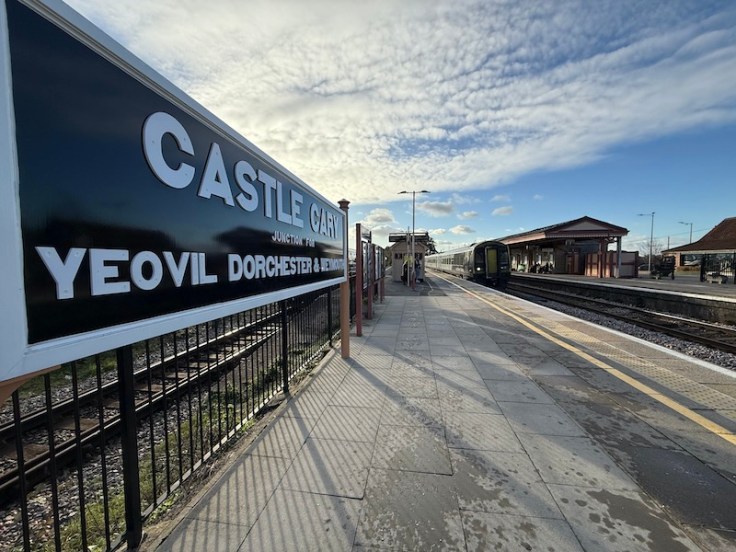
Castle Cary railway station has long been famous as the bridgehead for the annual Glastonbury Festival. Thousands of festival goers travel by GWR and SWR trains to and from this small Somerset station each June before completing their journey on a fleet of special shuttle buses laid on to move the huge crowds to Worthy Farm, near Pilton, a village six miles east of Glastonbury.
Anyone living in Glastonbury itself wanting to get to and from the station is not so well served, facing a convoluted indirect journey using a sparse network of bus routes.

However a group of community activists are currently campaigning for the introduction of a direct bus link between the town and station.
The group have set up a website called Glastonbury Trainlink to raise awareness of the campaign, enlist support and encourage donations.
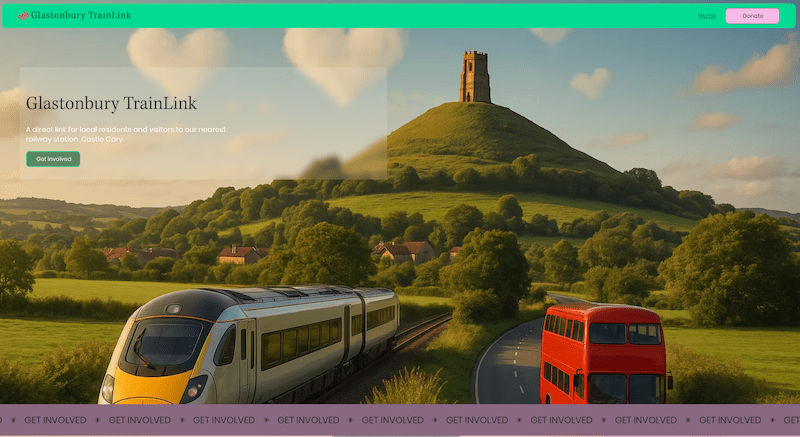
The mission is founded on “our rail network provides a low carbon option of travel, however getting access to this network is not always easy. Glastonbury has no direct public transport service to our nearest station, Castle Cary. We want to be the first town to provide a dedicated bus service that’s primary purpose is to link up with train arrivals and departures from their nearest railway station.“
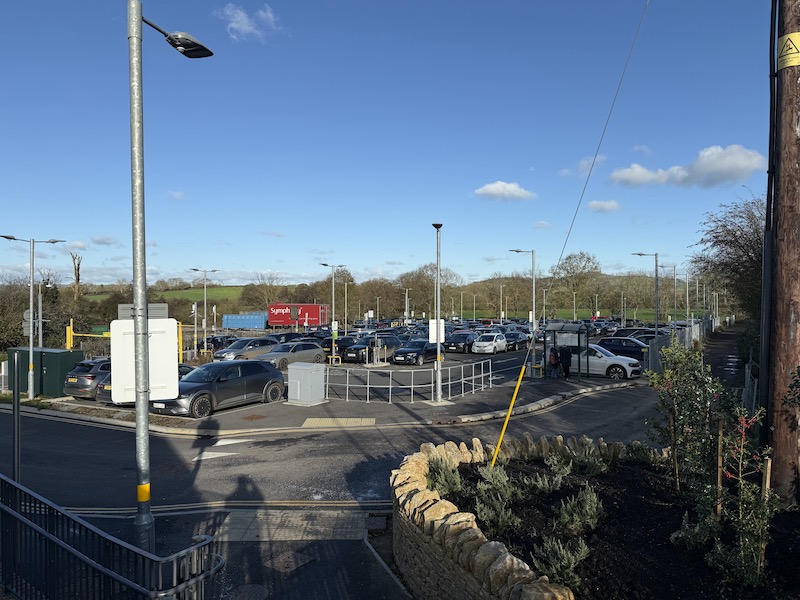
The group highlights two key outcomes the environmental benefits and providing improved access for those unable or unwilling to drive as well as highlighting Castle Cary’s recently expanded station car park is often full, demonstrating the demand is there.
Their website includes a proposed timetable with nine return journeys on weekdays across an 06:30 to 23:20 day (five return journeys on Saturdays and four on Sundays) all showing connections to and from trains at the station and including a half hour journey time to or from Glastonbury.

Having contacted local bus companies the group has been given an annual price for such a service provision of £240,000 which they explain works out at about £5,000 a week and around £45 per single trip. They also point out a taxi for one passenger can cost between £45 and £65 for the journey.
The group are seeking views on a proposed fare of between £5 and £7 to make the service financially sustainable and have set a target of raising £100,000 by February 2026 so they can commit to the service for 12 months.
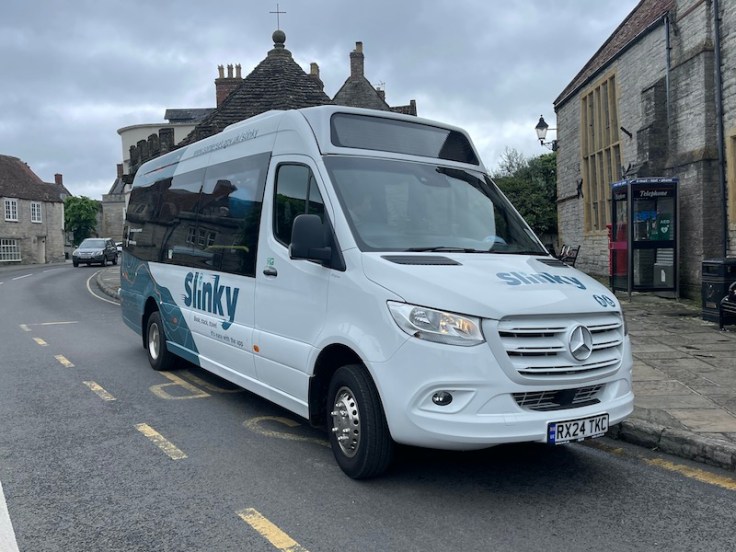
Local Parish Councils have expressed an interest in helping and I would hope Somerset Council would be stepping in with some of its Bus Service Improvement Plan funds having received almost £3 million in revenue for service initiatives in 2025/26, albeit next year’s allocation has yet to be announced. I reckon it would certainly make for a better deployment of funds than its Slinky branded DRT operation no matter what PR pronouncements of its ‘success’ may say. We all know the truth.
The Group explains “we are in discussions with the local government groups that cover the route. Glastonbury Town Council and Pilton Parish Council have already committed funds. Ashford Parish Council, which cover Castle Cary station, have also been very positive about our plan. Somerset County Council, although not currently pledging funds, are being very supportive.“

Noting that South West Coaches currently provides two bus routes serving Castle Cary station – route 1 between Yeovil and Shepton Mallet and route 667 between Wincanton and Street, both running two-hourly, I thought I’d take a ride over to Castle Cary and try and get an idea of the potential for this proposed new service.
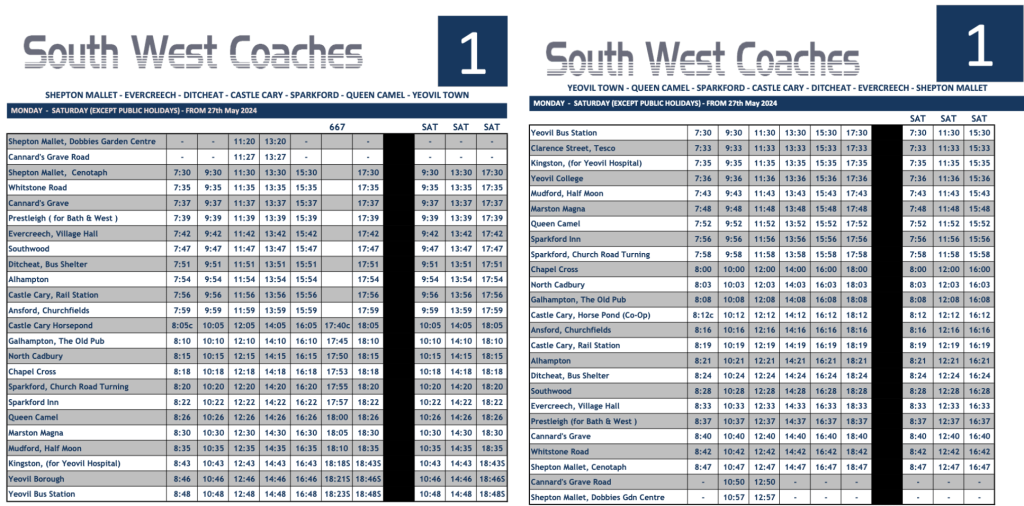
Obviously I couldn’t travel direct to Glastonbury and as I wasn’t prepared to wait until June 2027 for the Festival shuttle buses (Worthy Farm is having a fallow year in 2026) nor pay out £45+ for a taxi, I instead planned to travel on route 1 over to Shepton Mallet (north east of Glastonbury) and get a feel for the potential for Glastonbury from this existing direct facility to a nearby town.
Buses leave Castle Cary station for Shepton Mallet at 19 minutes past the even hour with a GWR train from Paddington due in at 12:14 makes for a slick connection on to the 12:19 bus which would be ideal for noting how many passengers join me on that journey and the same again on a return trip at 13:30 from Shepton Mallet back to the station for 13:57 being ideal for connection to either the 14:10 SWR to Waterloo or the 14:30 GWR to Paddington.
Looking at Google maps the bus stop looked to be very conveniently sited immediately outside the station exit so a quick walk over the footbridge would easily be possible within the five minute connection with time for some photography too. It all looked good.

However my confidence was shattered when checking recent actual train arrival times at Castle Cary showing in the two weeks prior to my intended travel date (last Thursday, 20th November) the train (10:36 from Paddington to Exeter St David’s) hadn’t arrived on time on any day during that period.
It’s lateness ranged from a minimum of five minutes to a worst experience of 37 minutes on Wednesday 19th November. Even worse, the equivalent train on Saturday 15th November (the 11:33 Paddington to Paignton calling at Castle Cary at 12:11) had been cancelled.
It didn’t look very promising but never one to duck a challenge I set off last Thursday (20th) bright and early from Hassocks buying my Super Off-Peak Return to Castle Cary with the 10:36 from Paddington being the first train that’s valid on as explained in a recent blog.
Having arrived in good time at Paddington soon after 10:00 I noticed the journey was showing ‘Cancelled’ on the departure board, but the good news was it would be starting from Reading on time at 11:01.
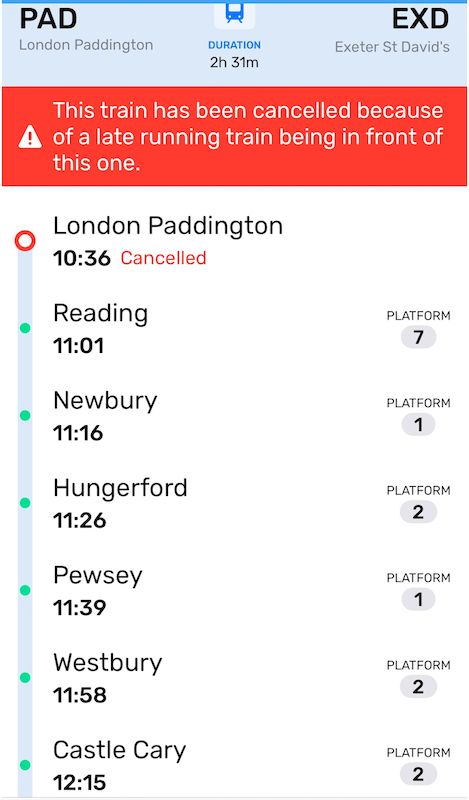
Luckily I was in time to take the Cardiff bound train from Paddington at 10:15 to Reading and waited there.
It turned out a speed restriction over defective track in Plymouth was delaying eastbound GWR trains continuing through Exeter, Newbury and Reading hence the decision to terminate the 52 minute late Paddington bound train from Plymouth in Reading at 10:54 so it could form the 11:01 back to Exeter.
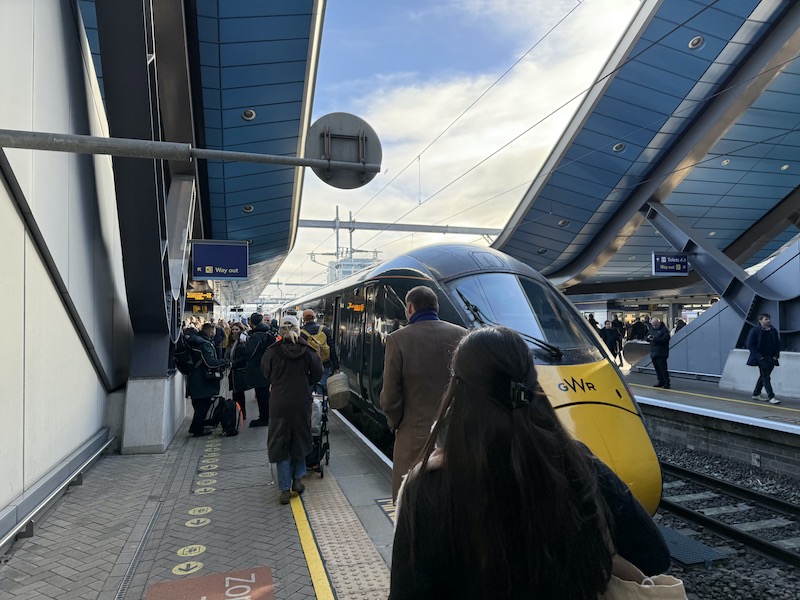
As soon as it arrived and emptied out we all climbed aboard and settled in, grateful for an empty train on which to find a seat, only to hear the Train Manager announce regretfully the driver who’d just brought the train in now needed to take a legal break of 30 minutes before departing.
So, we all amused ourselves on the train for the next half hour and I reconciled myself to accepting Shepton Mallet was off the agenda for this visit as there’d be no way of catching the 12:19 bus.
We set off from Reading at 11:32 but lost further time on the journey arriving into Castle Cary 40 minutes late at 12:54.
As I walked along the platform to the footbridge I wondered how many of the significant number of fellow passengers alighting were also Shepton Mallet bound on the 12:19 bus on route 1 and would now either need to take a taxi or face a wait of almost an hour and 25 minutes for the 14:19.
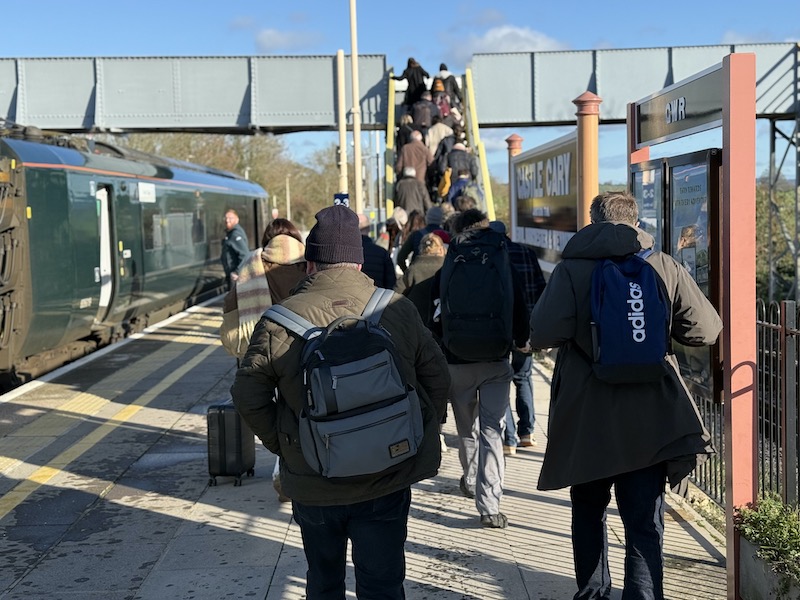
Sadly, I suspect, none of them.
Interestingly, if the proposed timetable for the Glastonbury direct bus had begun I’d have just caught it, as there’s a rather generous 41 minute connection time from the 12:14 train arrival to the 12:55 bus departure as the proposed schedule is also catering for train arrivals from Exeter (12:28) and Weymouth (12:37).
Which made me look in more detail at those proposed connections and it looks to me as though the Group are trying to do far too much and it might be better to just concentrate on connecting to and from the GWR London/Exeter trains than trying to also serve the Salisbury/Weymouth/Gloucester corridors.
Some of the waits between train/bus/train are too excessive for a half hour’s bus journey.
But, it’s an excellent initiative and great to see a community group actively getting involved to promote, organise and fund a new bus service. However, if an additional bus were to be funded it might be better deployed doubling the current two-hourly frequency on the section of route 1 between Castle Cary and Street to hourly and extend the route the four miles on to Glastonbury.
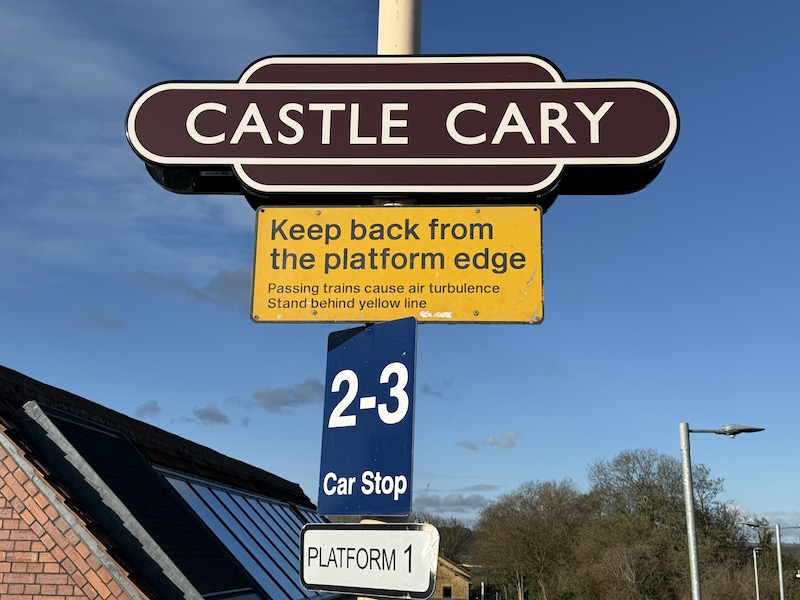
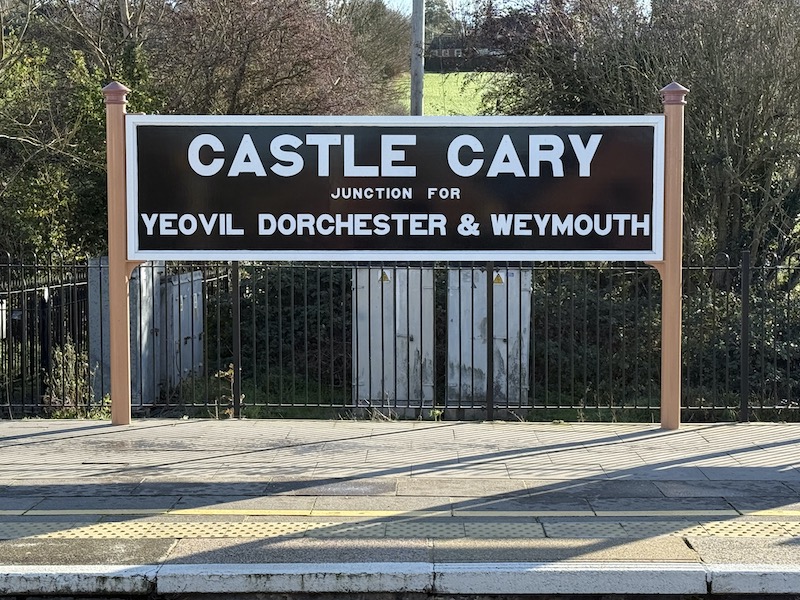
Timings could be arranged to connect with GWR trains which will fit nicely in with its policy of promoting the TrainLink brand at a number of stations across its network (eg Okehampton and Totnes). Indeed, Castle Cary station has recently benefited from a makeover and now has some wonderful heritage style signs…
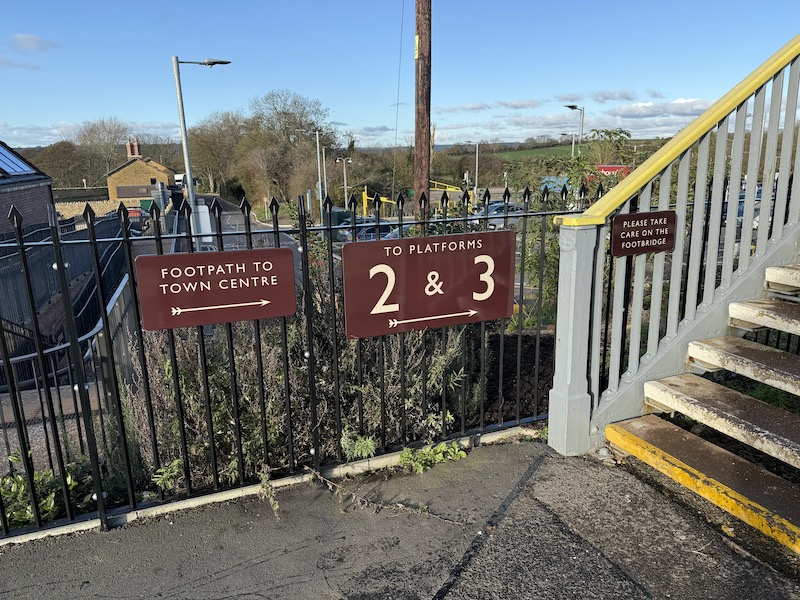
… and also a clear and very helpful bus information display as you leave the station…
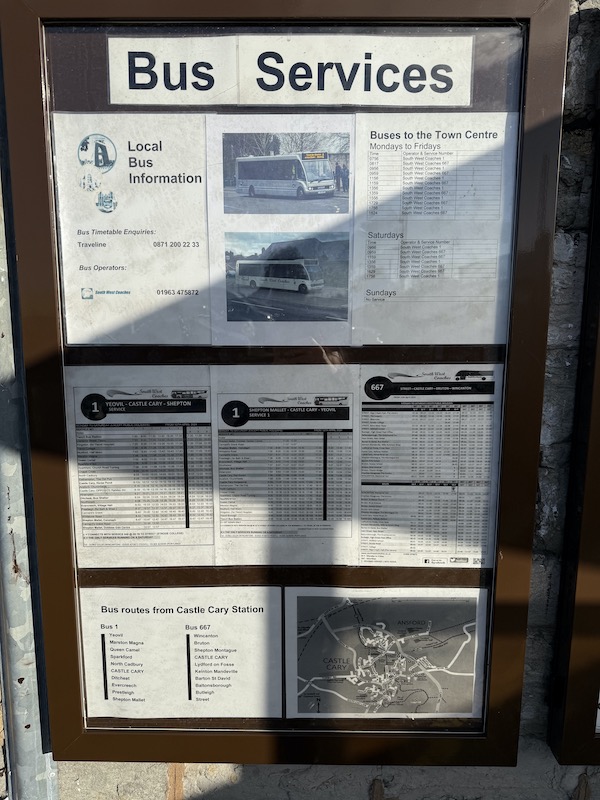
… and attractive posters in the bus shelter…
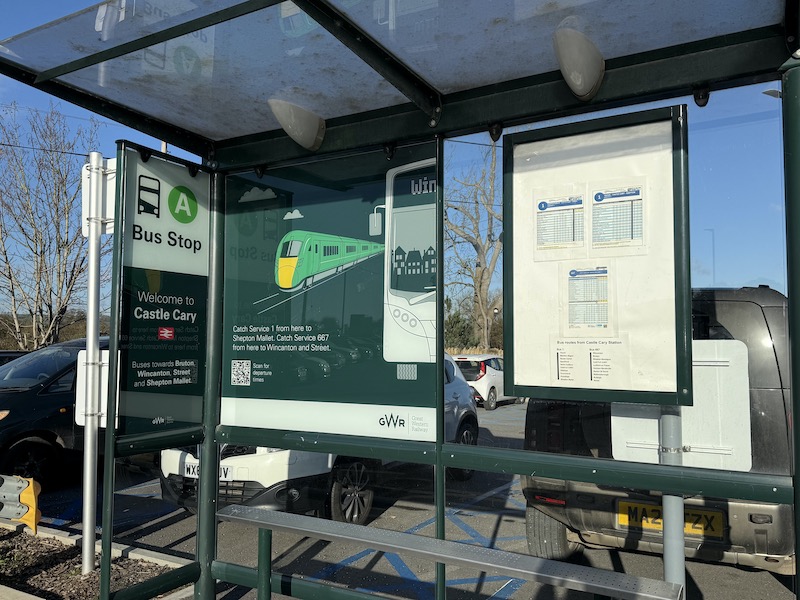
… which is less than a stone’s throw from the platform.
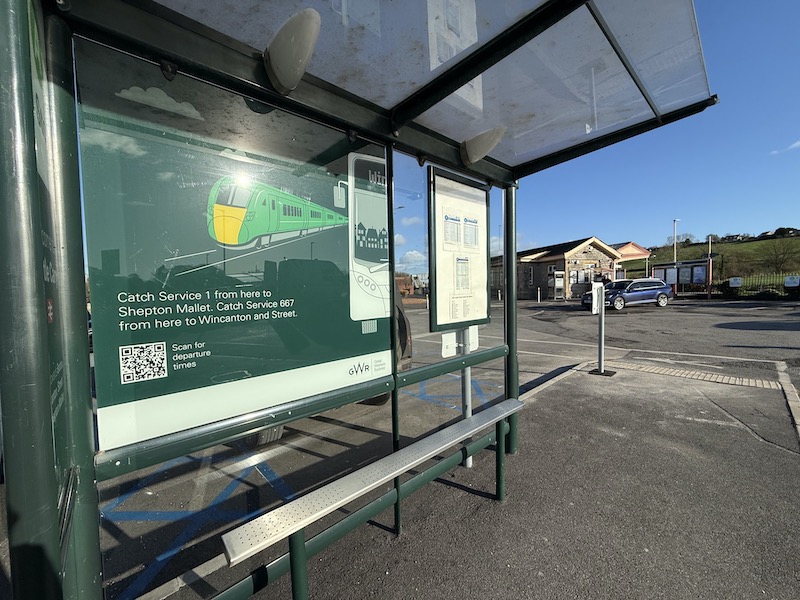
It’s all very commendable as is the wonderful conversion of a former railway building into The Creamery…
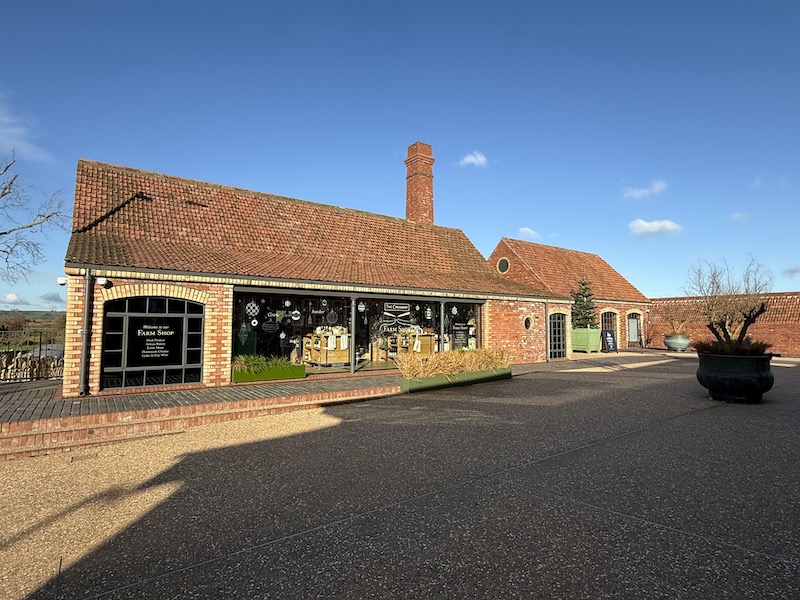
… which not only houses a farm shop (and artisan bakery) on the first floor..
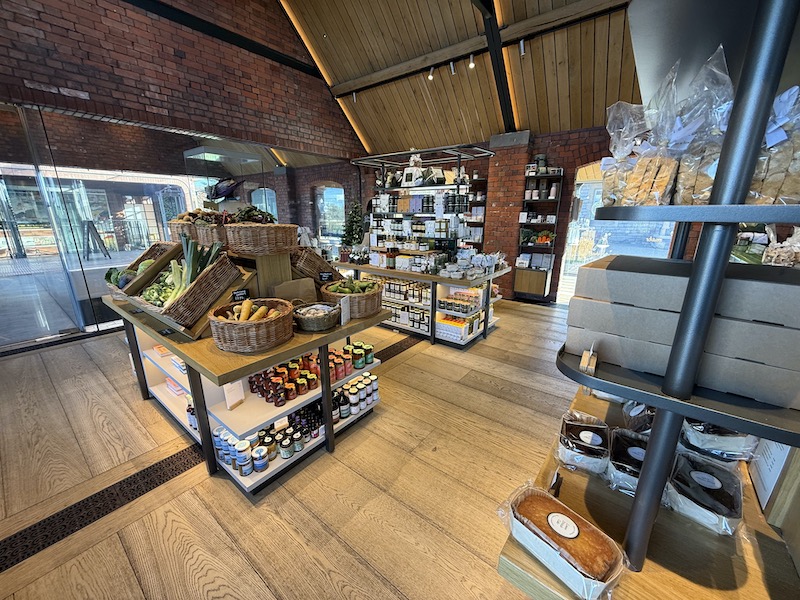
… with some rather expensive produce for sale…

… but under the shop in the basement is a full blown working creamery which you can see through the glass roof…
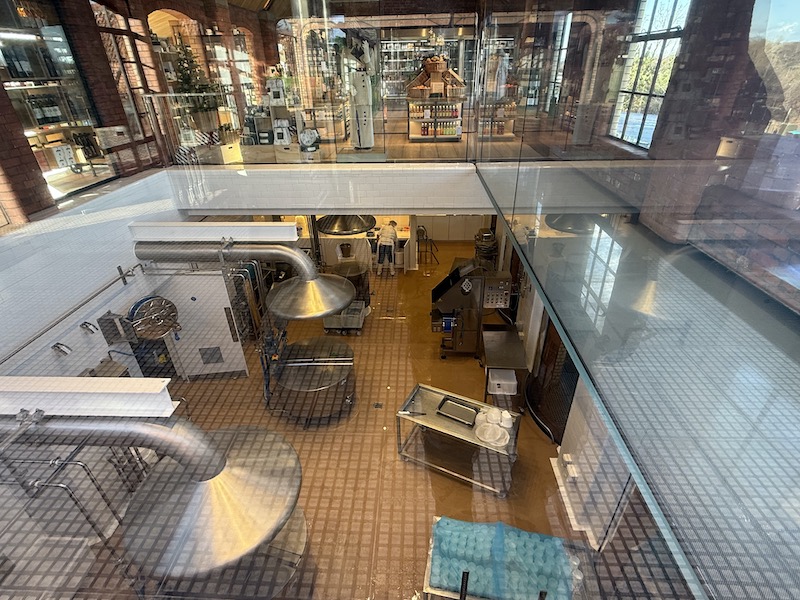
… and an adjacent café and restaurant serving fine food at appropriate prices for the genre.
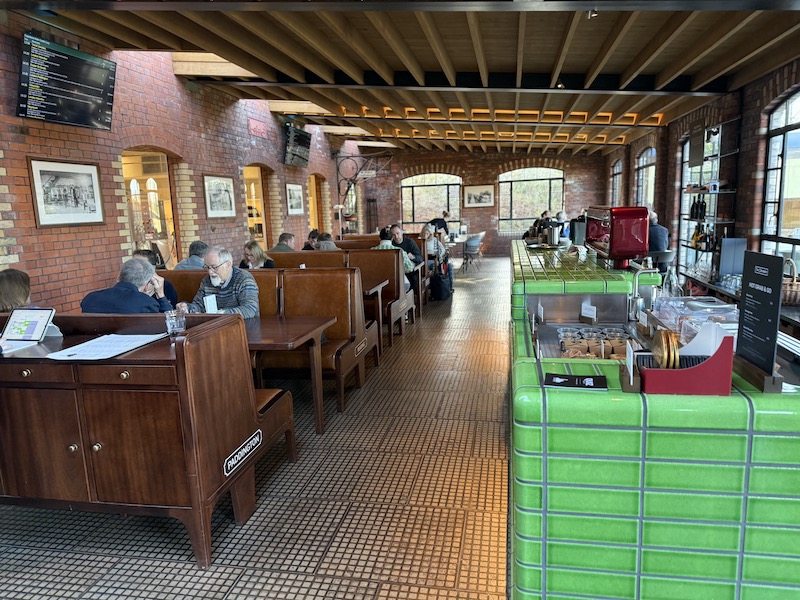
All the tables were taken last Thursday lunch time when I visited so I sat at ‘the bar’ to have my coffee which overlooked the kitchen making for a fascinating watch as I waited for the train back to London.
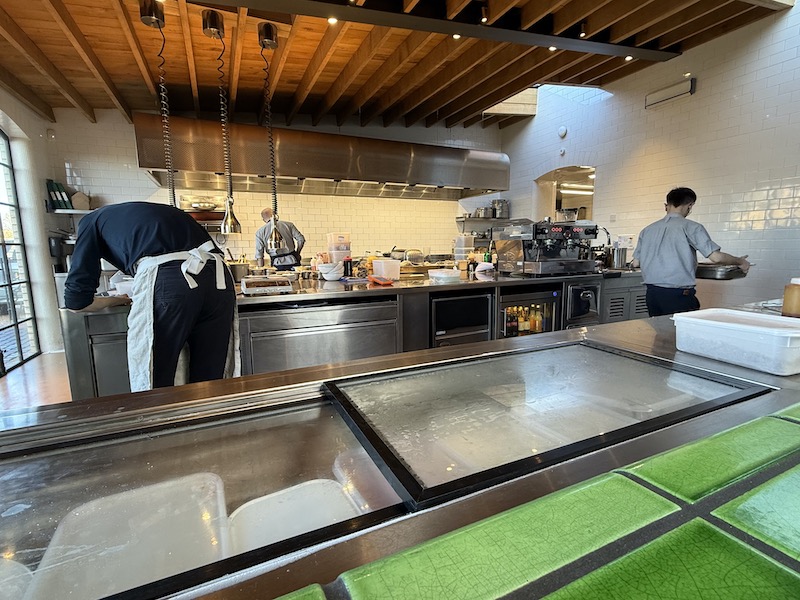
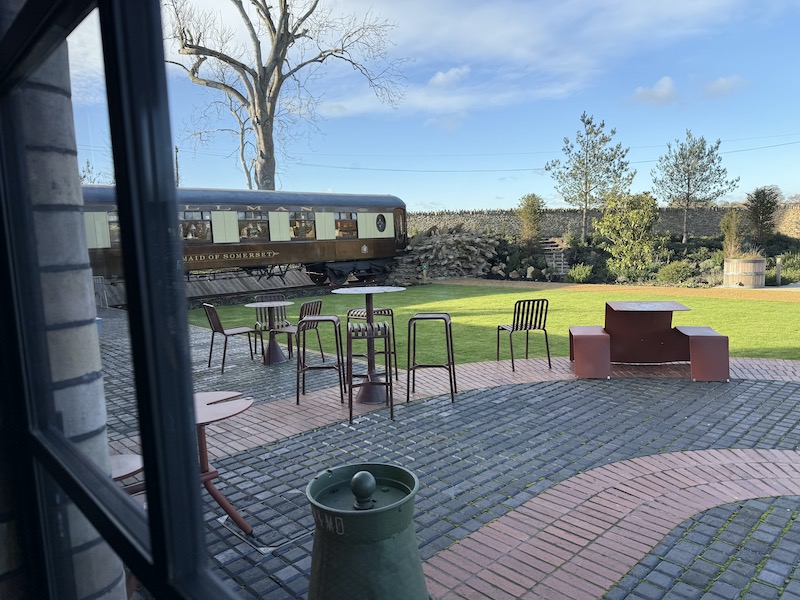
Outside The Creamery is a rather nice area to sit when the weather is less cold than it was last week…
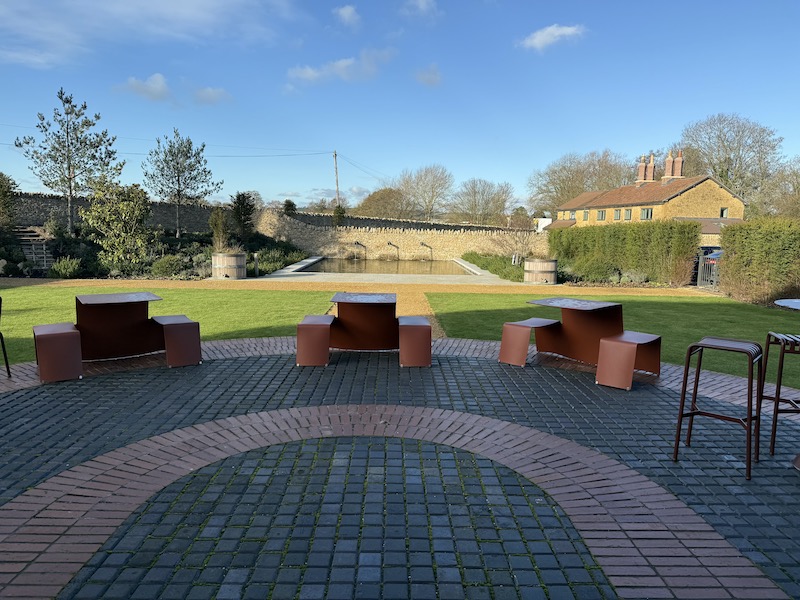
… alongside an old railway carriage.
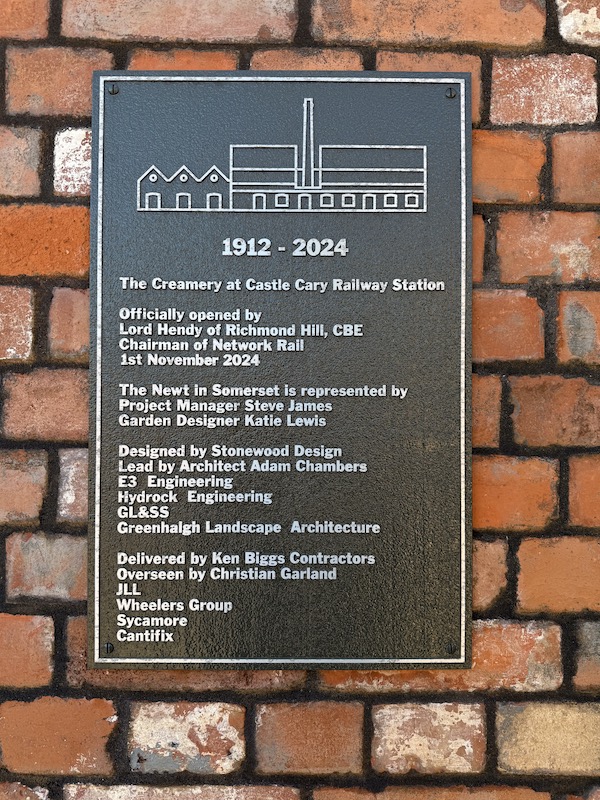
I see Lord Hendy opened the revitalised Creamery last year. It’s definitely worth a visit while you’re connecting between train and bus!
I wish the team behind the proposed Glastonbury TrainLink well and hope they can make it a success. Crucial to that will be GWR running a reliable service.
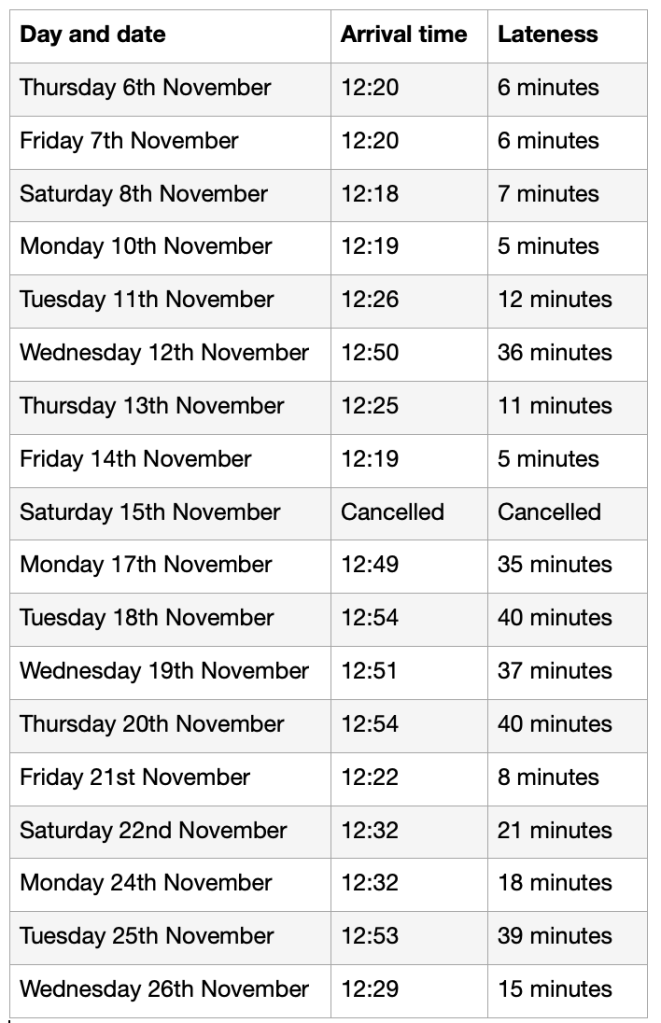
Sadly since my journey last Thursday timekeeping on the 10:36 from Paddington hasn’t improved. It arrived at 12:22 last Friday and Saturday and this week has been 18, 39 and 15 minutes late.
GWR arrivals in Castle Cary for 10:36 ex Paddington to Exeter St Davids due 12:14 (10:32 to Paignton, Saturdays, Due 12:11) over the last 18 days………
My grateful thanks to the blog reader who passed information on about Castle Cary and the Glastonbury TrainLink.
Roger French
Blogging timetable: 06:00 TThS
 BusAndTrainUser
This is something I’ve thought about a lot (mostly in terms of local town loops to railway stations in the same town, but also as a local fund raising initiative) as a ‘crayonista’ and it’s wonderful to see a group really going for it. It deserves to succeed! I agree about the excessive waits though, and yes perhaps focussing on one train flow initially would be preferable. Ideally a connection would be 5 mins but held (up to the maximum possible to allow the next trip not to be late) for late-running trains
LikeLike
No-one will be encouraged to use a rail link bus as an alternative to driving if there is all this anxiety surrounding the connection. It looks to me as though, before starting such a bus route, those involved need to cajole GWR (or Great British Railways, whatever) into getting to the bottom of the truly abysmal timekeeping issues on the railway.
LikeLike
Gladly I “did” Glastonbury during my motorcycle era, during an L-Plated trip from Hersham to Bath on 28/07/1979. As a “culture vulture” I was there for the Abbey ruins. Two days later in Chertsey I passed my motorcycle driving test, first time and took to the motorways that day visiting Basingstoke: out M3, back M4. However, I have a visceral link with Glastonbury. The “Baily’s” factory is there at The Beckary. That is where my schoolboy boxing gloves were manufactured and I still have them, but they no longer fit. Along with my LT map collection they must be some of my most long standing possessions. I boxed at school 1961-1965. In that era for major bouts in the UK “Baily’s” gloves were used including by Cooper and Ali. There is thus a bizarre historical link between me and the great fighters of that era: we used the same make of boxing glove.
LikeLike
Extending the 667 service to Glastonbury seems to be more sensible and a lot lower cost
LikeLiked by 1 person
Not sure about the heritage signing? This is a real railway (well perhaps purportedly judging by the delays). It looks nice, but it’s setting a bad precedent…
Mike Jones
LikeLike
One is intrigued to see that, according to the picture, the proposed bus service will utilise Routemasters ….
I’m also struggling to precisely identify the train type.
LikeLike
The bus in question actually resembles the prototype Leyland/Saunders Roe Lowlowder from 1954. This was the predecessor to the Leyland Atlantean that went into production in 1959, interestingly, the same year the AEC Routemaster went into production. But why feature such a vehicle in the 21st century!
I can assume who ever put the artist impression together was unable to identify something more contemporary or has a sense of humour.
LikeLike
BMMO D10
LikeLike
Roger, I’m intrigued by the 30 minutes break that the incoming driver needed at Reading.
The train from Plymouth was terminated there at 10:54 and was 52 minutes late, so it should have left there at 10:02 for Paddington arriving at say 10:27. Clearly the incoming driver could not then have been rostered for your 10:36 departure, and so a second driver was due to take that train.
I haven’t checked the GWR timetable (nor even the Elizabeth line) but it seems unilkely that the second driver couldn’t have got to Reading before 11:32, allowing your train to depart from there a bit less late. The first driver could have travelled on to Paddington and resumed his scheduled duty there.
Ian McNeil
LikeLike
and whatever that bus is, it’s not a Routemaster – if only because it has a full front.
Ian McNeil
LikeLike
BMMO D10 for the bus
JBC Prestatyn
LikeLike
Definitely not a D10. Top front windows don’t have ventilators, top of lower front are flush whereas D10 driver’s front window was angled back & driver’s side window had straight top not angled plus off side downstairs windows are unlike a either of the two D10 buses built.
LikeLike
Yes; I wondered that too. Maybe the driver was scheduled to come off at Reading on the way to Paddington and take over the Exeter train there after his/her break?
LikeLike
I suspect that owing to the general mayhem drivers’ scheduled workings had been thrown out of the window and to try to keep a service of sorts running GWR were, in non-technical language, making things up as they went along.
It’s quite likely that the second driver was still stuck at Paddington or even at Swindon or somewhere equally unexpected.
Traincrew diagrams are an arcane art at the best of times and often about as robust or sensible as the AI-created bus timetables we all love to hate.
LikeLike
Its booked a Plymouth Driver who works the 0637 from Plymouth to Reading (1002), has a legally required break and then works the 1101 from Reading to Exeter, as the Up train was very late arriving at Reading the driver couldnt work the Down train straight back without taking the break.
LikeLike
Thanks for the explanation. Presumably there are some Paddington drivers who work Exeter/Plymouth trains only between Reading and Paddington.
Ian McNeil
LikeLike
Good luck to this proposal, but if it does manage to succeed, it is only going to work if buses do make reasonable train connections. And buses not penalised for “leaving late” should they wait for a late-running train. It must be structured around the importance of specifically connecting to/from trains as much as possible, given the seemingly never-ending poor railway timekeeping for a multitude of reasons.
What a pleasant change to see well kept bus shelters actually displaying correct timetable information! As highlighted many times in this blog, the appalling state of stops and shelters in many places is shameful, and certainly gives bus travel a terrible image to non-users
Terence Uden.
LikeLike
“We want to be the first town to provide a dedicated bus service that’s primary purpose is to link up with train arrivals and departures from their nearest railway station.“
While they might be the first town to commission such a service directly, they’ve missed the boat by several decades of they want to have the first bus service timed to connect with trains!
Agreed with the suggestion that they should focus on connection with London trains – Glastonbury does already have buses to Yeovil, Bridgwater, Taunton and Bristol (albeit quite slow) so better to optimise for one set of connections. They will also need to think about how to deal with delayed trains, which definitely seems to be an issue!, if they are marketing the bus as connecting with specific trains then how long will they wait to hold a connection, especially if the next bus isn’t for a couple of hours or more?
LikeLike
Indeed! I’m fairly sure the original Great Western Railway might have something to say about that claim, having been running such things well over 100 years ago.
LikeLike
Thanks for the blog, Roger.
Ideas like this are all very well, but in reality, Glastonbury has a regular half hourly First bus service to Bristol Temple Meads, which has a much more frequent rail service to all parts than Castle Cary.
Glastonbury also has a regular (about every two hours) First bus service to Taunton, for destinations to the south-west.
I have relatives living near Glastonbury, and for all the faults of First Bus and GWR, connecting by bus with an infrequent and frankly unreliable rail service at Castle Cary is just too risky, so when I travel to Somerset, I use the Bristol route, because of the much higher frequencies.
A subsidy of £500k per annum seems an awful lot for I suspect no more than handfuls of passengers for each journey.
Nice idea, but……..
LikeLike
I agree. It strikes me as very much crayonista territory.
DRT levels of subsidy for a scheduled service that would serve as few people as DRT does, basically.
LikeLike
does the existing DRT cover the station and the town?
If so, just publicise that, maybe encourage some “flashmob” events to signal demand.
what’s annoying is when existing buses almost work (here’s looking at you Sanders, with the timtabling at Sheringham station)
milest
LikeLike
The buses [373 to 376 including 376A & 376X] are quite slow though, they take 1 hour 40 minutes Bristol-Glastonbury & 1 hour 25 minutes Glastonbury-Taunton, even Glastonbury-Bridgewater takes 1 hour 25 minutes
SM
LikeLike
Trains connecting with buses is a problem at many stations in the UK where the bus service is infrequent. My experience is of a rail to bus connection on the Celtic Travel X48 at Craven Arms in Shropshire where the bus timetable states that connections cannot be guaranteed. I thus would not trust the connection, especially to the last bus of the day. Fair enough if the train is substantially late, but in these days of apps such as real time trains one would like to think that the bus driver could find out if the train is only a few minutes late and wait accordingly. Connections to the train are less problematic because buses by and large keep good time and even if they don’t, there is usually another train within an hour.
Brian Willson
Orpington Kent and Bucknell Shropshire
LikeLike
The Creamery look very impressive, full marks to those with the imagination & money to invest & convert the original railway building & surrounding grounds. Although not exactly in a location that I would normally think about visiting, I probably would make an exception just to see & experience this particular enterprise.
LikeLiked by 1 person
A lot of GWR trains are running late at the moment as a result of some of their diesel engines being out of action. The current timetable has to be regarded as an aspiration.
LikeLike
Yes Roger Ford has been touching on this topic occassionally in Modern Railways. It’s being kept quiet, but its apparent that their are major problems with the GWR Class 800/802 fleets (as anyone who uses them regularly will know first hand).
LikeLike
I think that Ashford Parish Council should be Ansford.
LikeLike
That’s not an error by Roger; the bus promoters made that mistake on their literature.
LikeLike
There’s another issue which I don’t think has been mentioned, I apologise if I have missed it –
There have been several mentions about the timekeeping of trains. However what happens if I have an Advance ticket valid for a specific train – and the advertised bus connection fails to deliver me to the station in time? There needs to be an agreement between the train and bus operator that allows my ticket to be used on a later train. Suggesting I catch an earlier bus to be on the safe side, or buy a flexible train ticket, are not really adequate responses.
Julian Walker
LikeLike
The late running will be far more likely to occur on the railway than the bus in this area.
LikeLike
Advance tickets tend to be for long-distance routes with very expensive walk-up fares, so, even if the connection is usually fine, the cost of missing a booked train is potentially severe, and urban buses at certain times of day can be very unreliable (and I am not aware of a readily available equivalent to recenttraintimes.co.uk for buses that enables quick and easy review of historic punctuality).
NRCoT is barely adequate for train-to-train connections as matters stand — in my experience, some of the minimum connection times, especially involving city-centre terminals, are absurdly high, resulting in many sensible connections being unprotected. Some years ago, the clerk at a booking office flat-out refused to endorse my ticket for a later train after missing a connection due to a delayed train because my itinerary had allowed only 14 minutes for interchange at a station with a minimum interchange time of 15 minutes, notwithstanding the fact that the actual interchange can be done easily in 3 minutes at a run, or 5 minutes with luggage.
Another problem is that many train managers and clerks mislead customers by saying their ticket is not valid when NRCoT protection DOES apply. There have been several occasions where I have had to stand up for myself (or just proceed onto a train in defiance of an assertion by station staff that my ticket is invalid), including one case where a uniformed member of ToC staff at the platform let me on and said he would talk to the relevant people further on, but a later train manager on a connecting train with the same ToC claimed my ticket to be invalid.
If a connection is unprotected an you miss it, the Advance ticket becomes worthless if you miss the booked train, even to the point that the value cannot even be used as part payment for a new ticket (exception: if you know that you are going to miss the train by a certain deadline before it has departed its origin station, it should be possible to rebook online at short notice for a £5 admin fee, but you need an internet connection, the website needs to cooperate, and the last time I did this, I found the system would not let me rebook to a later departure on the same day… fortunately, I had future plans to travel the same route on a known future date, otherwise the ticket would have become completely worthless).
For people who do not use long-distance public transport regularly and have not educated themselves on minimum connection times, NRCoT, and ticket-specific terms & conditions, it is hardly surprising that experiences like this will deter… for a start, how about amending the default script for train managers on long-distance services to say something like “Your ticket does not seem to be valid, unless you missed your booked train due to a delay or cancellation on an earlier service?”.
LikeLike
I generally applaud new initiatives but I’d be disappointed if this achieves funding, because in my view it feels like an expensive and wrong way to meet the need (assuming there really is a need), by which I mean creating a point to point dedicated route, seemingly in isolation of the wider network.
I can’t see it succeeding. It’s been mentioned that the reliability of the train and the proposed long waits for connections are all prohibitive. I’d also say that a 30 minute bus journey to the ‘local’ station is also quite long and the proposed fare probably off-putting (the comparison needs to be with parking cost rather than taxi cost).
It was an eye-opener to read that that there is a regular service to Temple Meads, where the train connections are far more frequent, far more reliable and in some cases quicker.
It appears that extending the 667 from Street to Glastonbury, as that route seems to have excess layover time sufficient for the extension to be at very marginal cost, might be a better way to test whether Glastonbury residents really want a public transport link to Castle Cary.
LikeLike
Interesting and informative discussion. As a collector of rural cafe experiences, the Creamery alone is tempting me to visit Castle Cary. Many of those stations in the inland parts of Somerset, Dorset and Wiltshire are interesting places in themselves
LikeLike
You nneed to try the breakfast at Gillingham. It makes the route via Salisbury bearable.
LikeLike
Good morning Roger
I thought this BBC news item might be of interest to you.
https://www.bbc.co.uk/news/articles/cx2pyrr85n8o
Best wishes Robert Monroe
LikeLike
Thanks Robert. No surprise there!
LikeLike
The cafe is part of the Newt empire
LikeLike
Newt Empire? Please elaborate.
LikeLike
See Welcome to the Newt in Somerset | The Newt in Somerset.
I believe they are the sponsors for the Chelsea Flower Show.
LikeLike
The 1036 Paddington to Exeter (1034 depending on which way the base timetable wishes to play) is a chronic know poor performer, not helped that the inward stock is also a cause for concern – 0503 Penzance to London Paddington.
The inward usually runs as a 5-car to Plymouth and imeant to attach a further 5-car to become 10-car and then arrive in London and split to form 1023 to Oxford and 1036 Exeter.
The inward generally gets walloped by inherent problems coming up the Berks and Hants through Castle Cary but more often than late owing to problems at Plymouth, has come up late from Plymouth owing to the failure to attach and then causes step ups at Paddington to resource an extra unit to form either the 1023 or the 1036.
Generally practice also is that as part control measure to get a right time run back South West, if the inward service is 30 minutes plus coming into the Reading it will be cancelled between Reading and London and the 1036 from Paddington will restart right time at Reading.
A further problem is that the 1036 is a known service for heavy customer loadings as it is the first Super Off-peak South West, and yet the 1003, which is a 9-car, carries fresh air and yet the powers that be will not allow Super Off breaks to be valid on the 1003 thus allowing a spread of the loadings.
LikeLiked by 2 people
The early links with Glastonbury came about with the closure of the Somerset and Dorset Railway in the late 1960s. I was growing up in the area at the time. Somervale(http://www.countrybus.co.uk/somervale.htm) started a service that wandered around following the railway but I dont think it produced much traffic. Bristol Omnibus ran( I think ) a Bristol Greyhound service through Shepton Mallet to Bournemouth. I remember a journey to see the last few trolleybuses which ran entirely empty. I believe the buses were not covered by Bus Grant.
LikeLike
Another problem causing the regular delays on GWR services to Castle Cary is the fact that GWR do not have enough Class 800/802 units. This means that too many are short-formed 5-car units, which get overcrowded and take longer loading & unloading at station stops along the way. The train then runs later and later until final destination. Because they do not have enough trains, the trains are used to the maximum and are effectively being flogged to death, causing more breakdowns in service. If they had electrified the line beyond Newbury, they would be able to use their more reliable electric power more often.
LikeLike