Saturday 15th November 2025
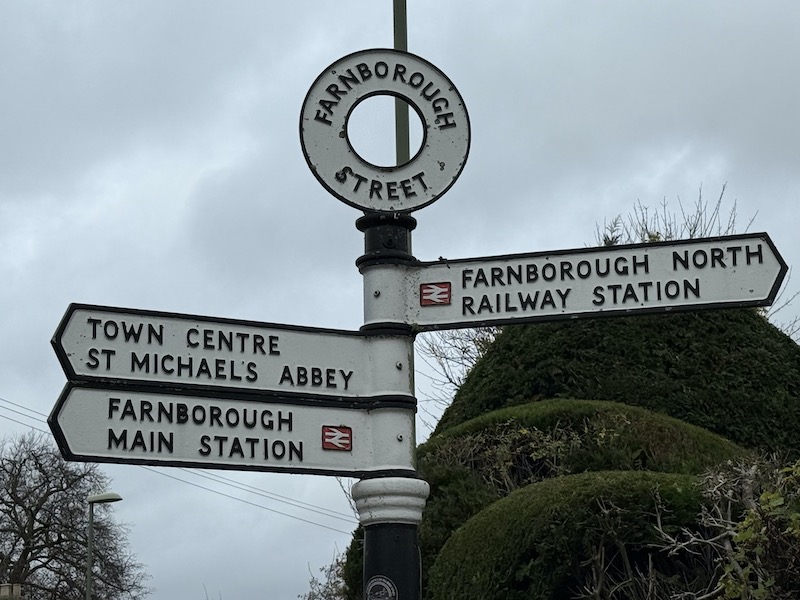
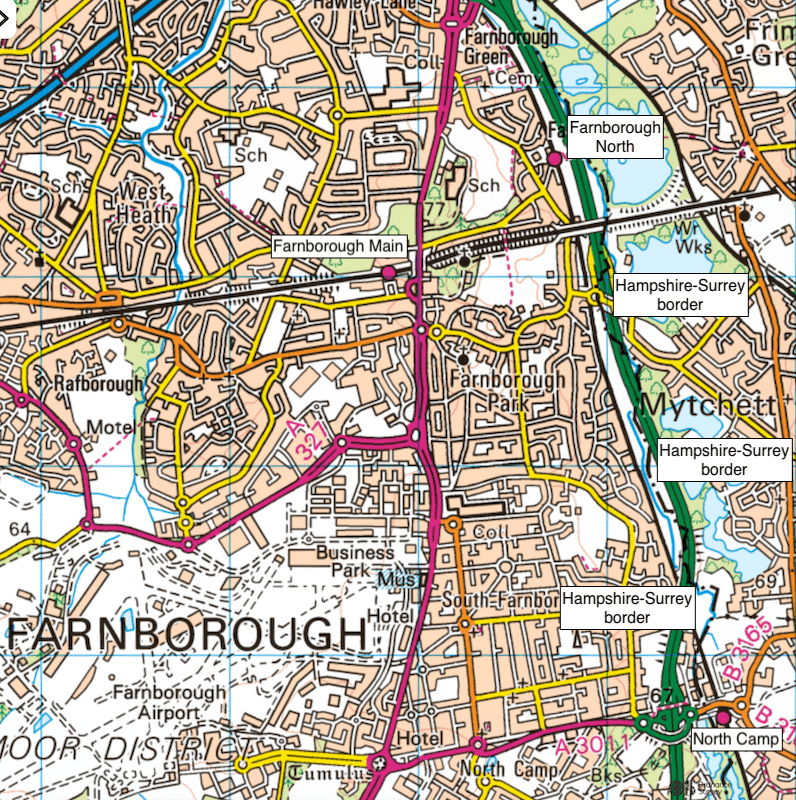
Farnborough’s another station pair I hadn’t included in my original list for this series, thinking that with North Camp close to Farnborough Main and Farnborough North, it made for a town with three stations, rather than two. But then I was contacted a few weeks ago by the wonderful Mike Knott who invited me to pay a visit to Farnborough North and see what’s been achieved through huge community involvement at that station and when he also clarified not only is North Camp not technically in Farnborough but is located over the border in Surrey, whereas Farnborough Main and Farnborough North are in Hampshire, that changed everything.
So Tuesday saw me heading over to the town of Farnborough to take a look at what turned out to be a truly fascinating station pair visit, not least the hidden secrets of Farnborough North, of which more anon.
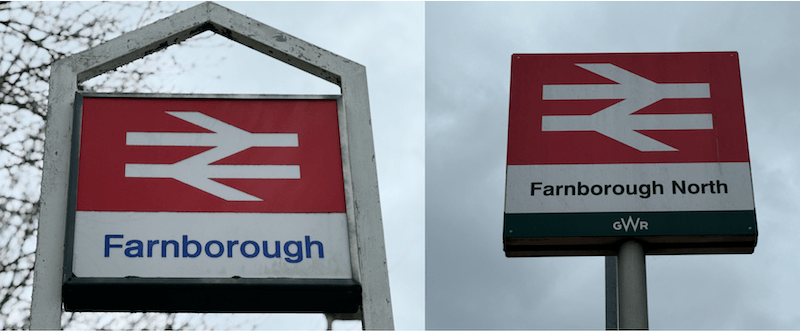
Let’s begin with a brief history with a few facts and figures. Both stations were confusingly called plain Farnborough until 1923 when the larger of the two became officially known as Farnborough (Main). It’s on the South Western Railway main line to Southampton and, as you can see, is still known simply as Farnborough on station signs as well as in timetables. It arrived on the scene first in 1838. With its direct trains to London Waterloo it saw 2,064,000 passengers in 2023/24.
Farnborough North (also renamed in 1923) opened 11 years after its namesake, in 1849, and was originally owned by the South Eastern and Chatham Railway. It sits on what we now call the North Downs Line (Reading-Guildford-Redhill-Gatwick Airport) operated by GWR and saw about a fifth of the passenger numbers at Farnborough (Main) with 446,000 in 2023/24, many of those being students.

Farnborough (Main)’s off-peak service provision is a half hourly stopping service between Basingstoke and London Waterloo as well as an hourly semi-fast Portsmouth Harbour to London Waterloo with an additional London bound journey per hour in the morning peak whereas Farnborough North has just an hourly service between Reading and Gatwick Airport increasing to two an hour in both peaks towards Gatwick and in the morning peak towards Reading.
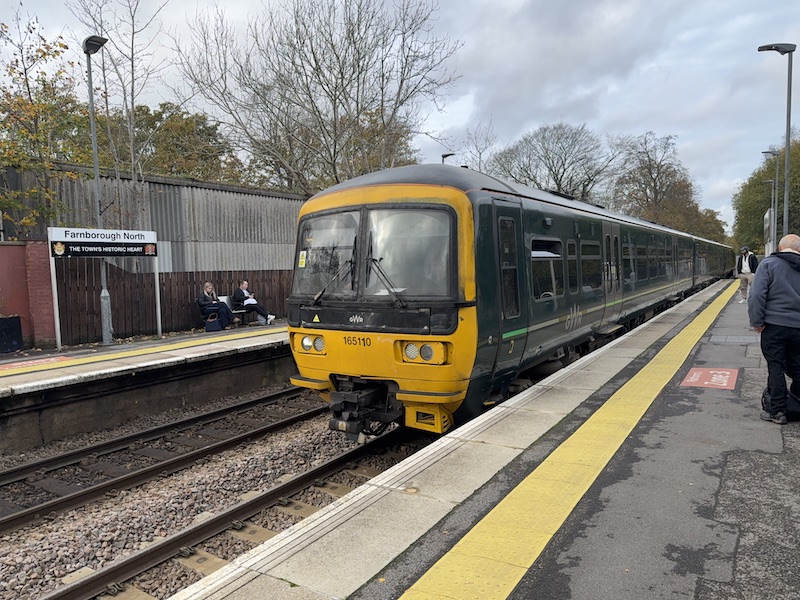
As you’d expect from the foregoing, station facilities at Farnborough (Main) are much more extensive than at Farnborough North, not least the latter being an open station with no ticket office or station buildings whereas Farnborough Main has a two-window ticket office and gateline at its entrance/exit on the southbound platform 2.

But, let’s start our tour on the London bound platform 1 where there’s an accessible toilet…
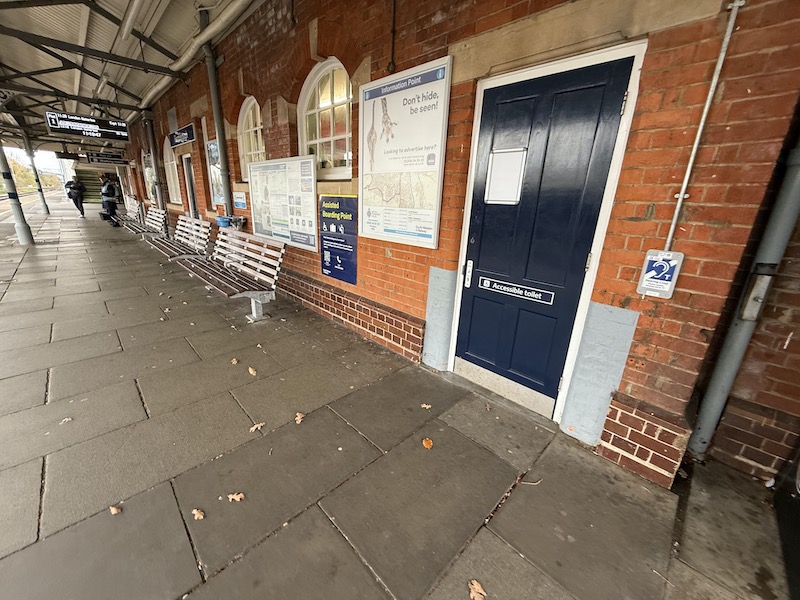
… lots of traditional style bench seats…
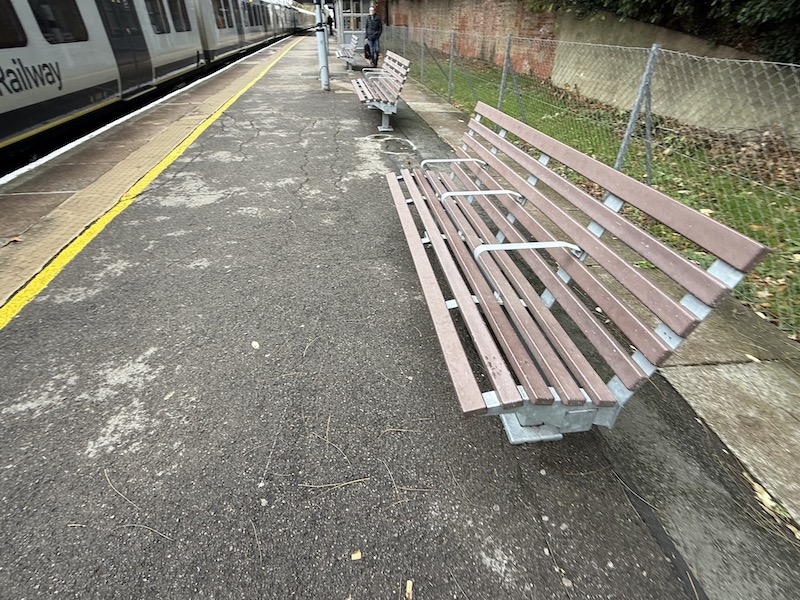
.. an old style shelter…
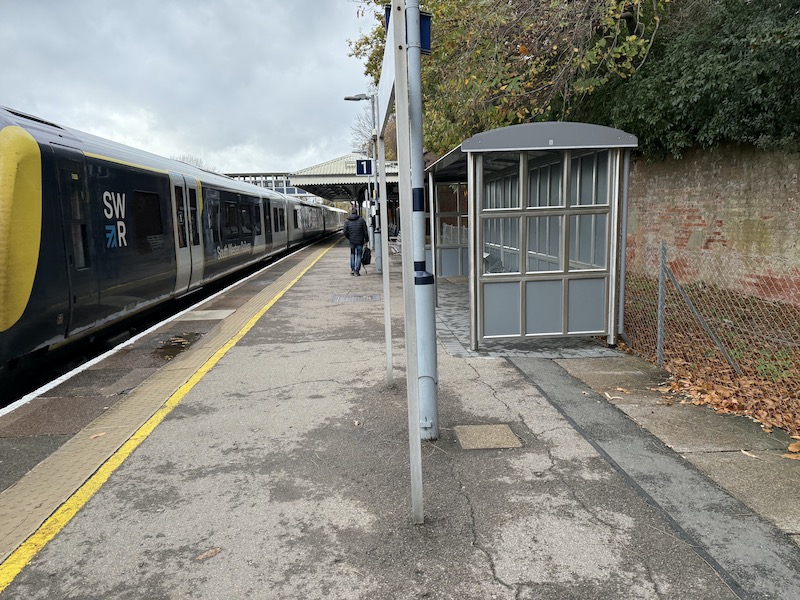
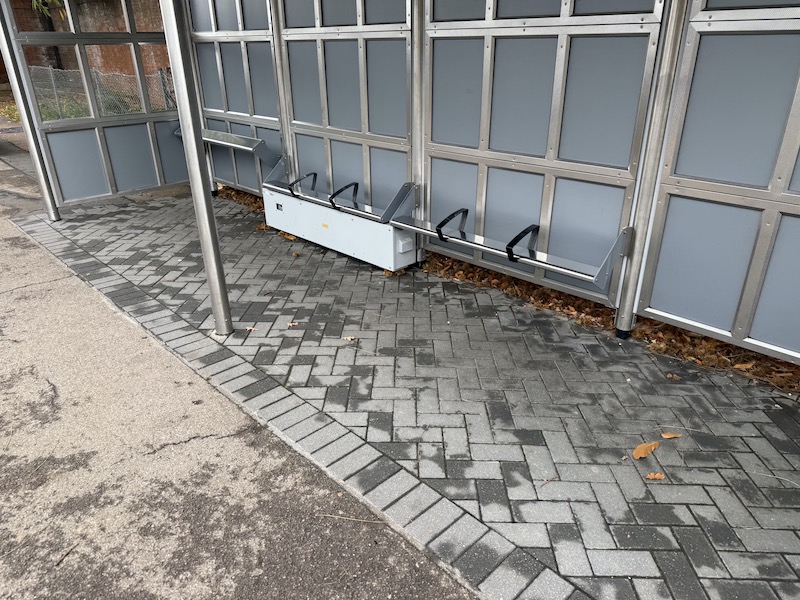
… with not so comfortable bench and perch seats…
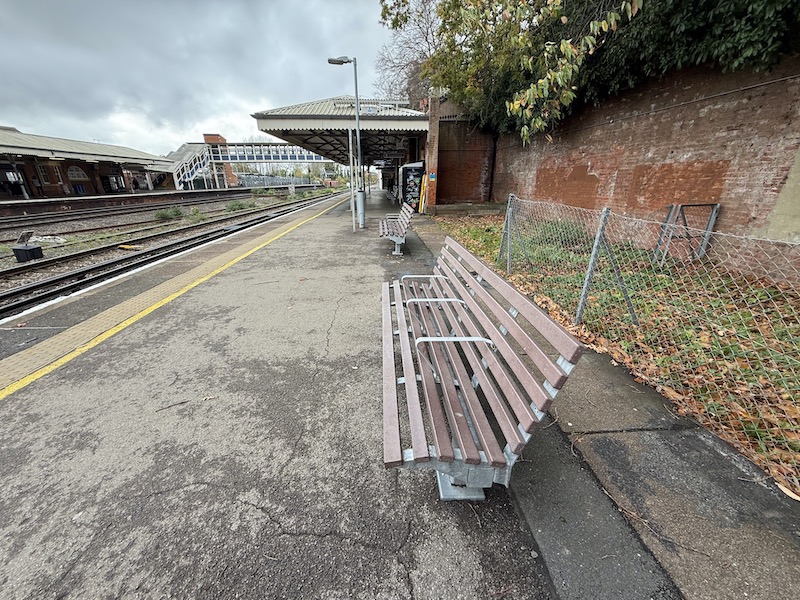
… then some more wooden bench seats…
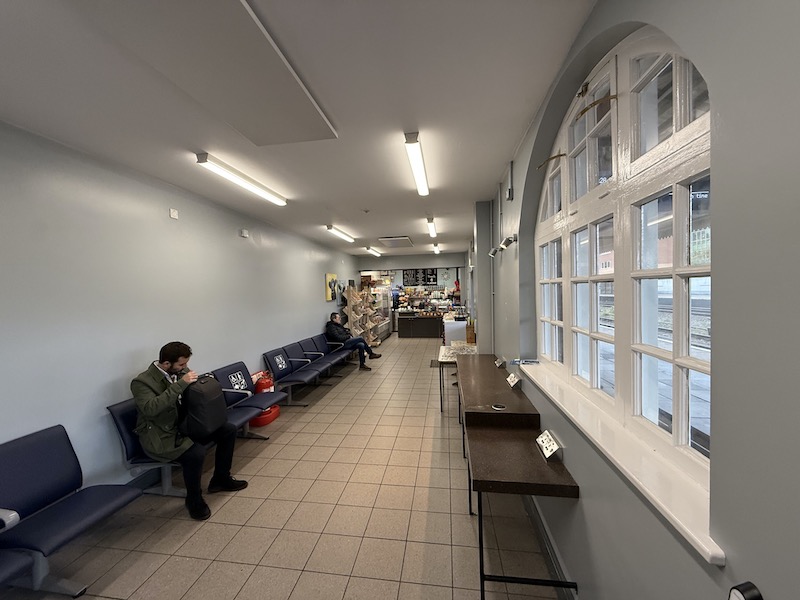
… a rather lovely waiting room with seats looking out on to the tracks and a refreshment counter at one end…
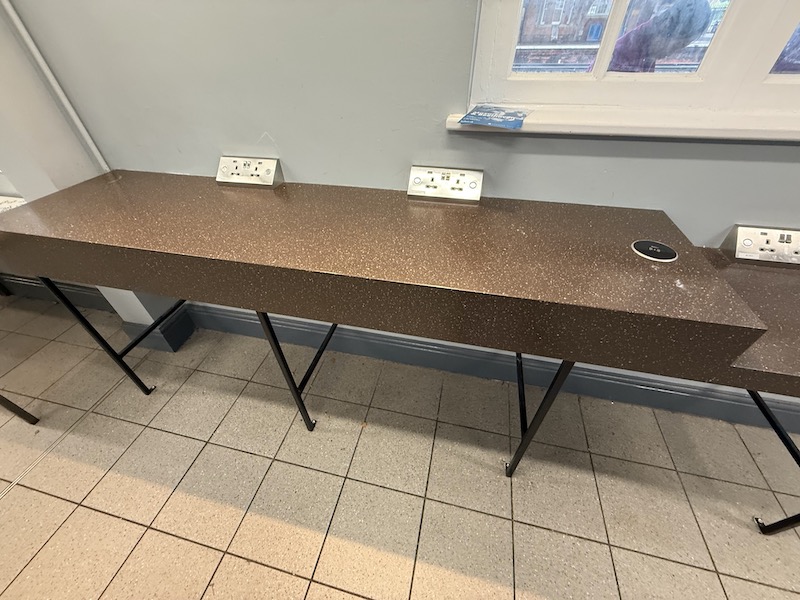
… some sockets for the all important charging of laptops, tablets and smartphones…
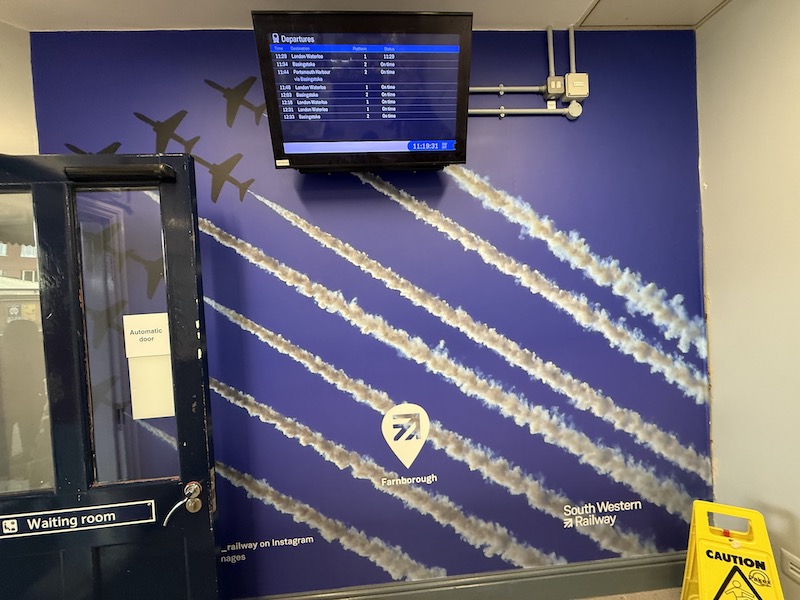
… a mural with acknowledgment to the nearby airfield where the famous air show is held…
… and, best of all, a table with Karen’s 1,000 piece jigsaw, which on Tuesday was very much ‘work in progress’.
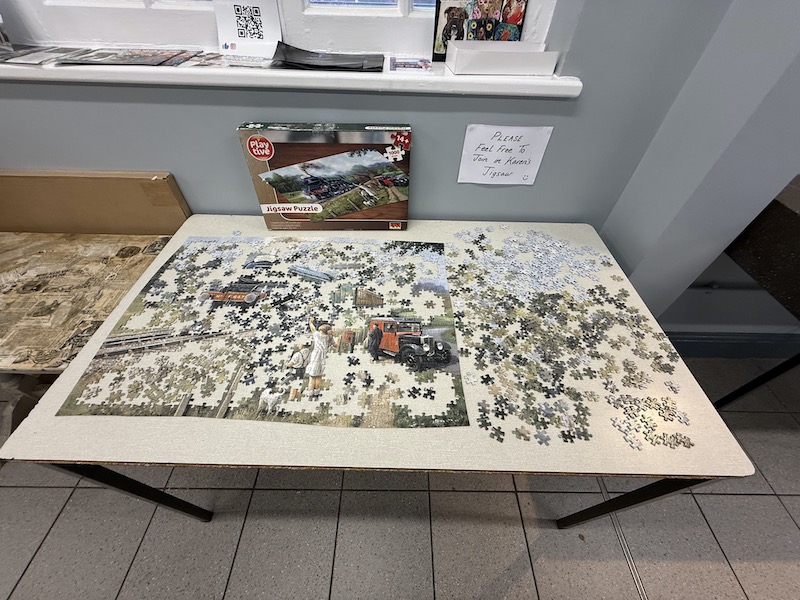
… with a request for any help to finish it off while waiting for your train.
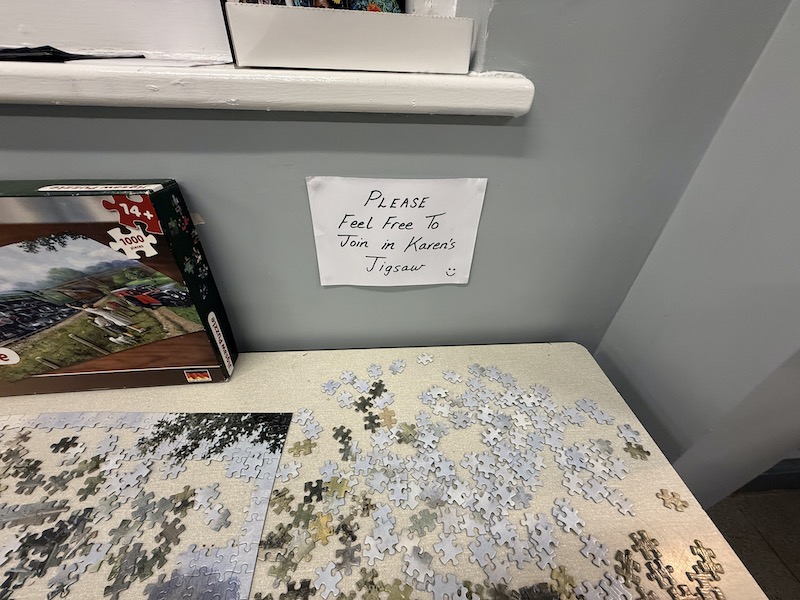
It makes a change from the usual book library.
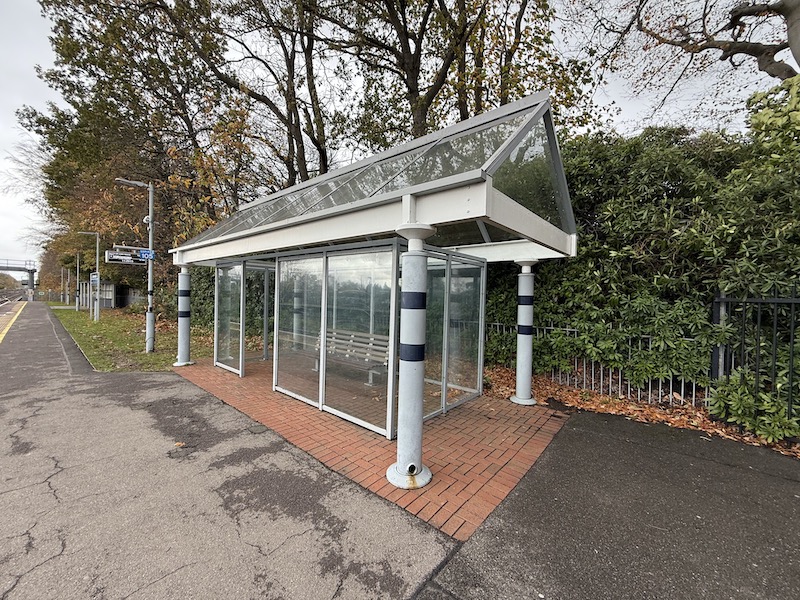
Back out on the platform there’s a rather interesting shaped shelter at the southern end of the platform…
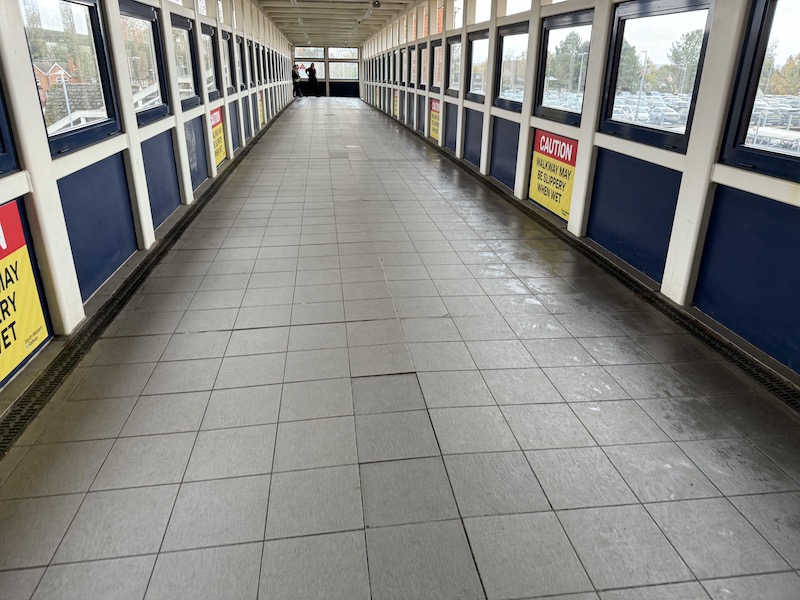
… and stairs and a lift for the substantial footbridge to cross to platform 2.
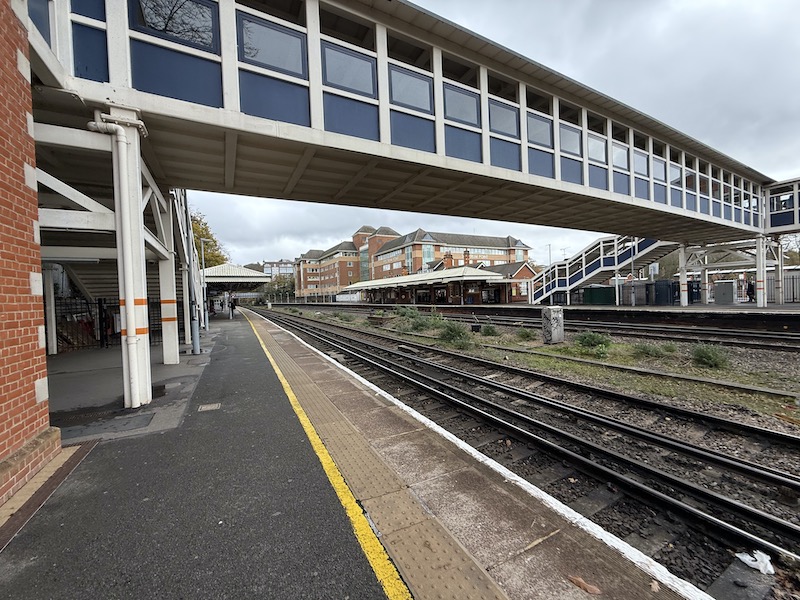
This is conveniently wide…
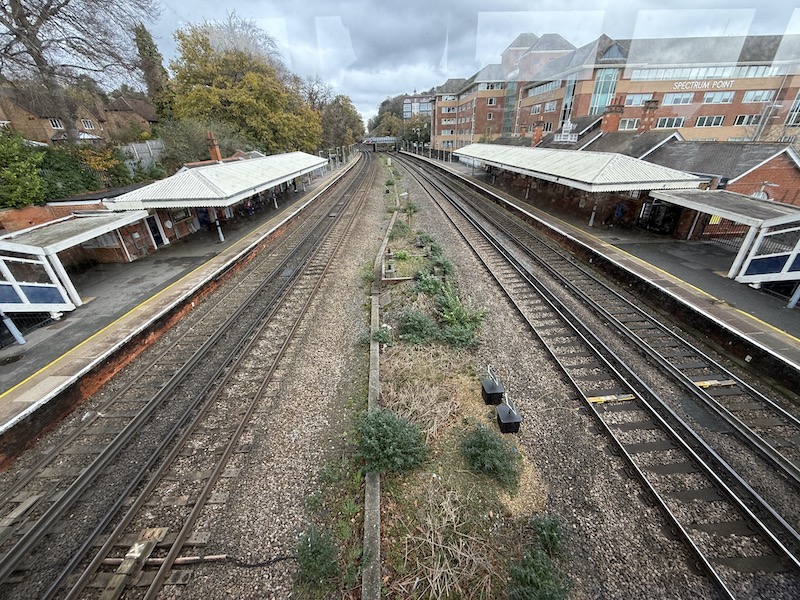
…and sits high above the tracks offering nice views below towards London…
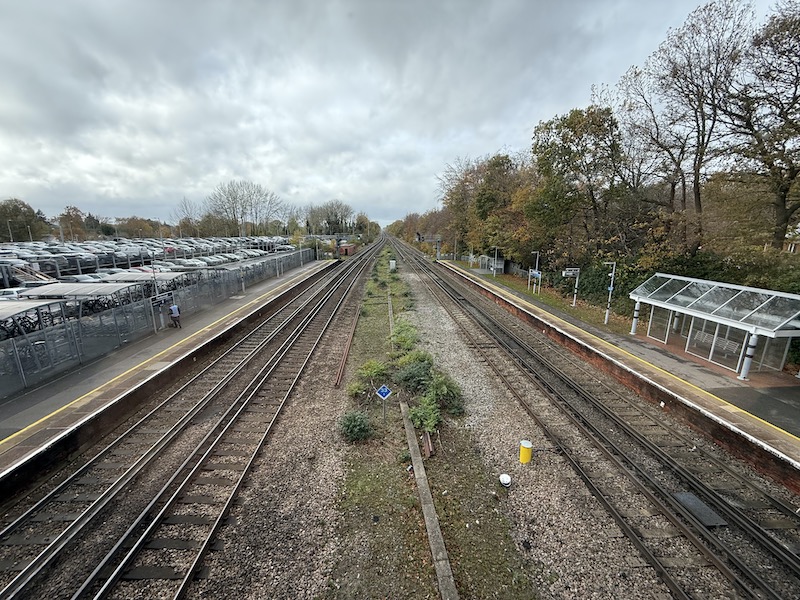
… and towards Southampton with the fast lines in the middle alongside the lines for stopping trains.
As already mentioned, Platform 2 is where the gate line can be found…
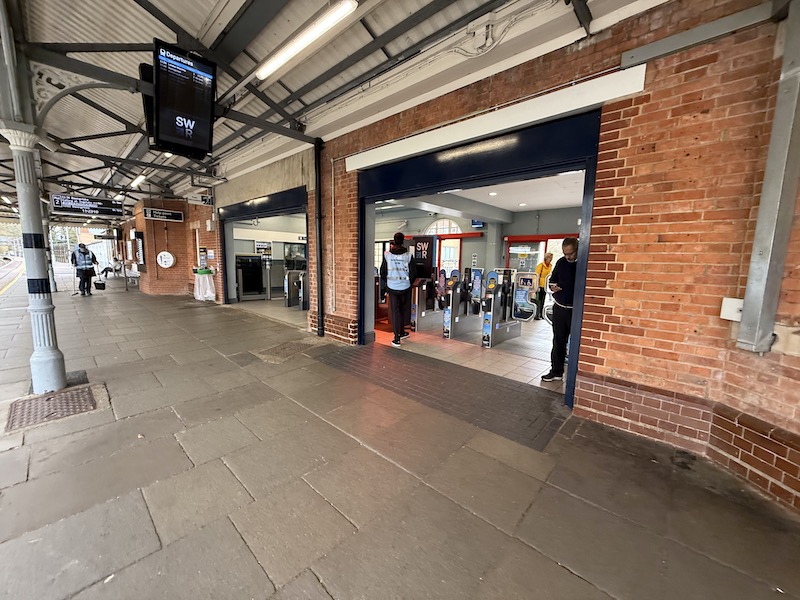
…but there are no shelters as it’s obviously felt the canopy is substantial enough to keep waiting passengers dry. There is an interesting shutter covering a window from the ticket office which looks permanently out of use.

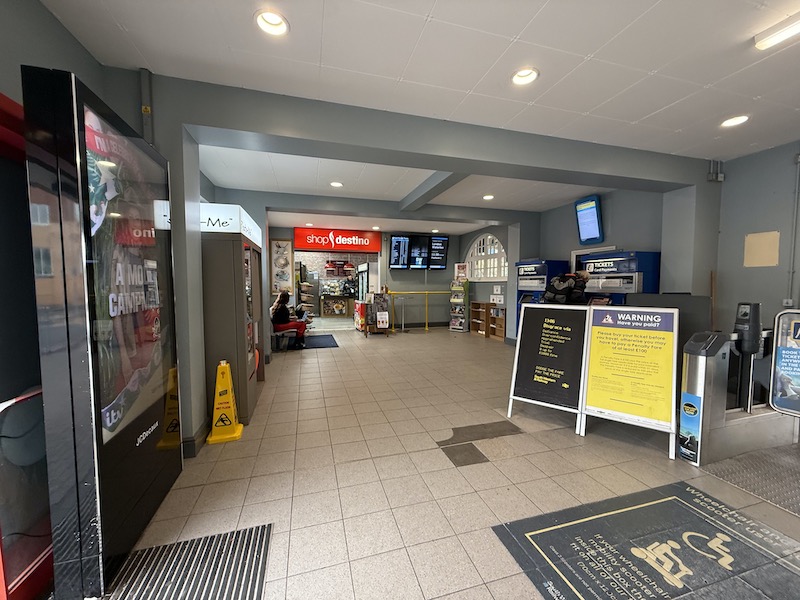
Also, as already mentioned, there’s a ticket office in the foyer and there’s also a shop and two ticket machines as well as a book library.
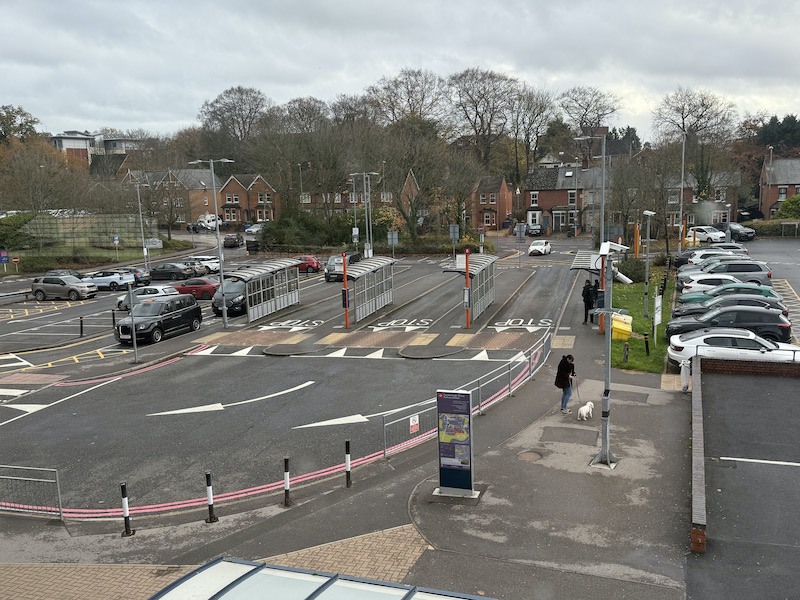
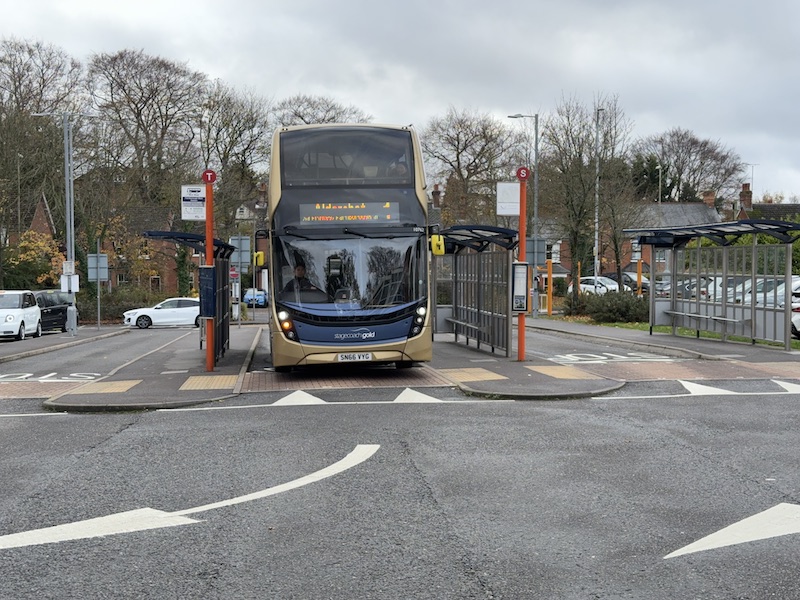
Immediately outside three bus stops see Stagecoach’s 12-minute frequency route 1 between Aldershot and Camberley…
… once marketed as a Gold branded route, as well as less frequent routes 2, 11 and 194.
There’s a large car park which, like many on this line, has had an additional deck installed…
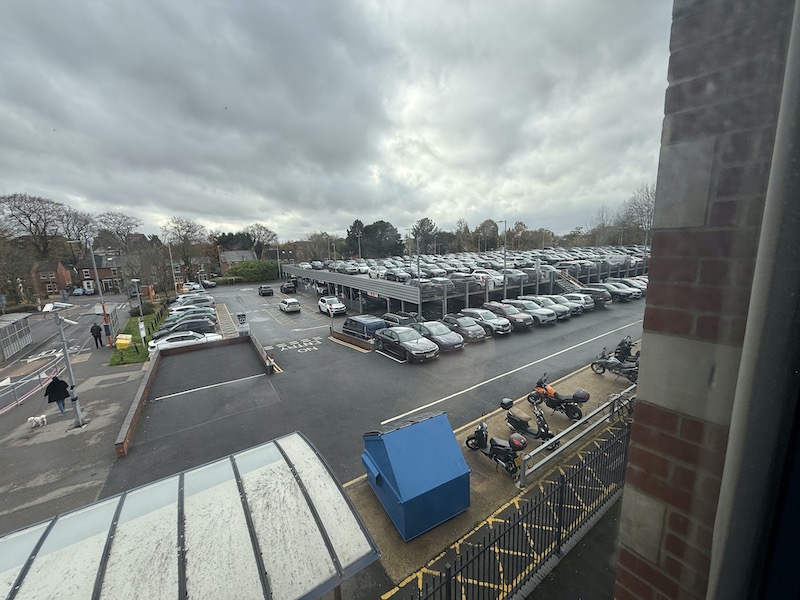
… and taxis and drop off/pick up spaces are also available.

The station is well looked after, thanks to hard working staff, one of whom, David, it was a pleasure to meet during my visit.

Let’s take the 15 minute walk over to Farnborough North which can be found at the end of Farnborough Street, in an area of the town also known as Farnborough Street. It’s at the end of what is a no through road although there is access to lakes through a gated level crossing (see the earlier map extract) which local fishermen use to drive across and have keys to unlock the gates to do so.
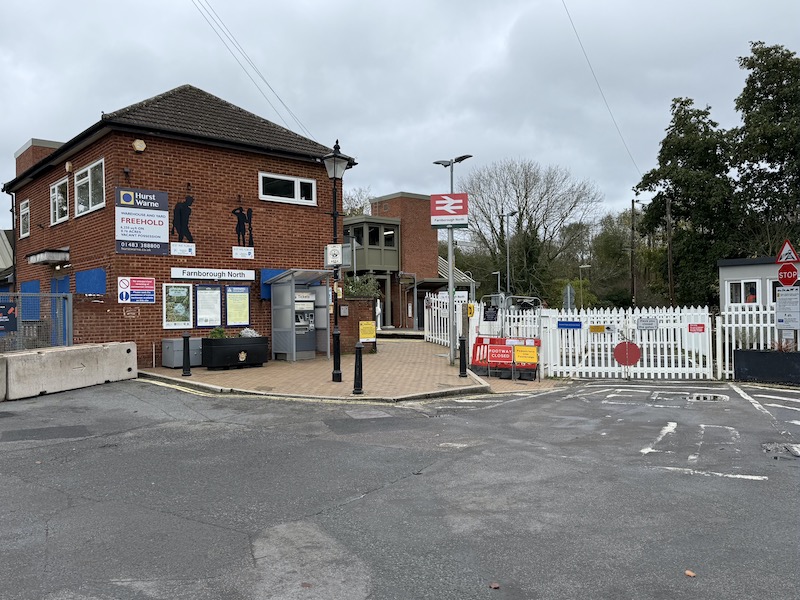
You might just be able to make out the two signs to the left of the gate which say “Footway Closed”…
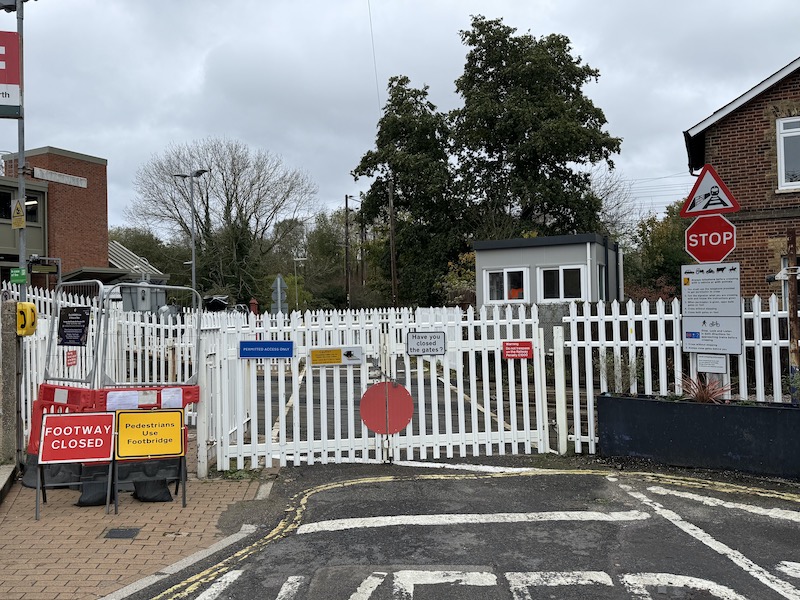
… and “Pedestrians Use Footbridge”. That’s because whereas passenger access to the eastbound (Guildford bound) platform 1 had entailed crossing the tracks at this point, earlier this year a new footbridge was installed…

… which, like at Farnborough (Main) is a very substantial piece of infrastructure…
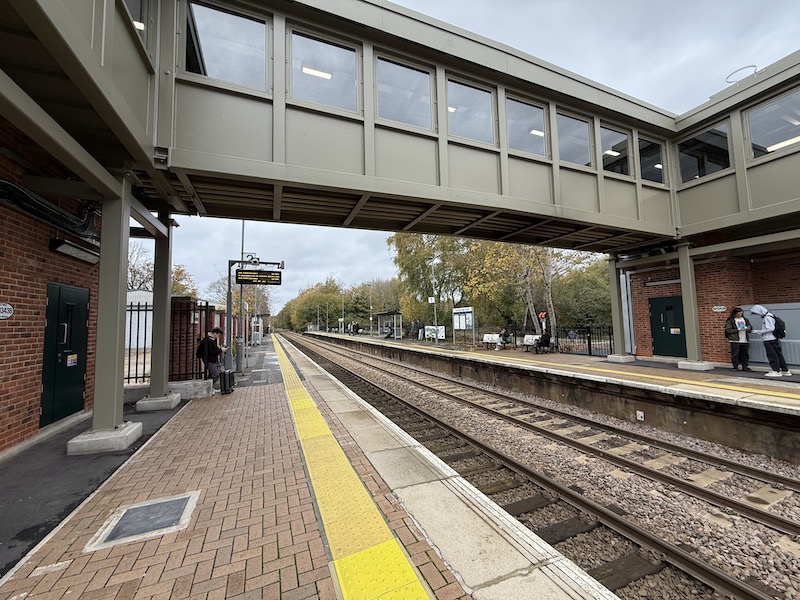
…and I understand although it’s now open for use there are some problems with the lifts so it hasn’t been officially handed over to GWR, which is the reason you might have noticed a member of staff wearing orange high-vis in the small Portacabin alongside the level crossing because until it’s officially “opened” the old arrangement of having the crossing staffed is still in place, even though there’s nothing to do.

Both platforms at Farnborough North offer a small traditional ‘bus style’ shelter and some seats but aside from a ticket machine, that’s about it for facilities.

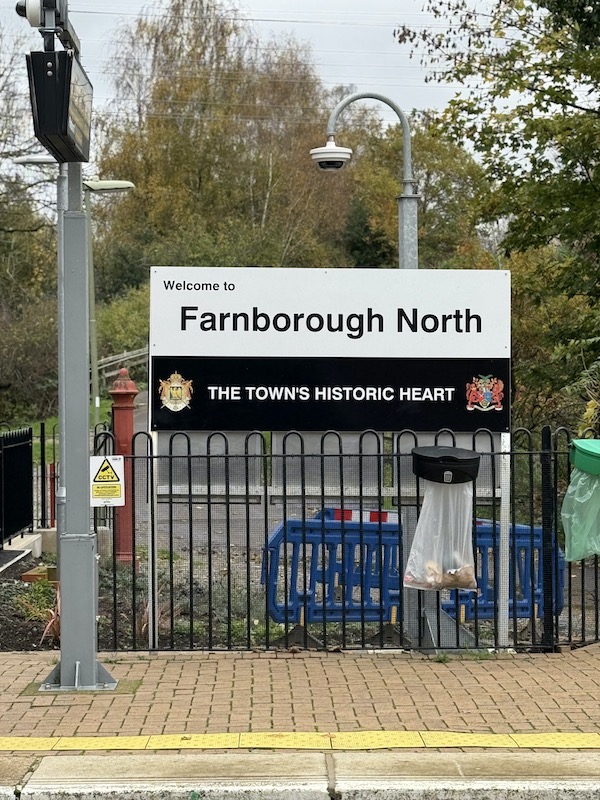
Farnborough North proudly proclaims under its station sign it’s at “The Town’s Historic Heart”...
.. which is where the aforementioned Mike Knott comes in.
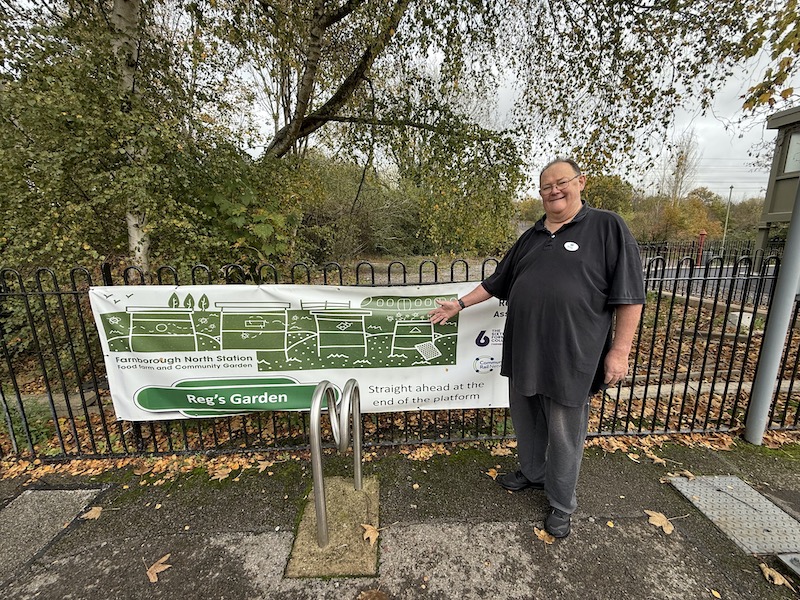
That’s Mike proudly standing in front of a banner on Platform 1 promoting Reg’s Garden. This amazing feature sits behind the Old Station Master’s House which can be found on the other side of the level crossing and Portacabin.
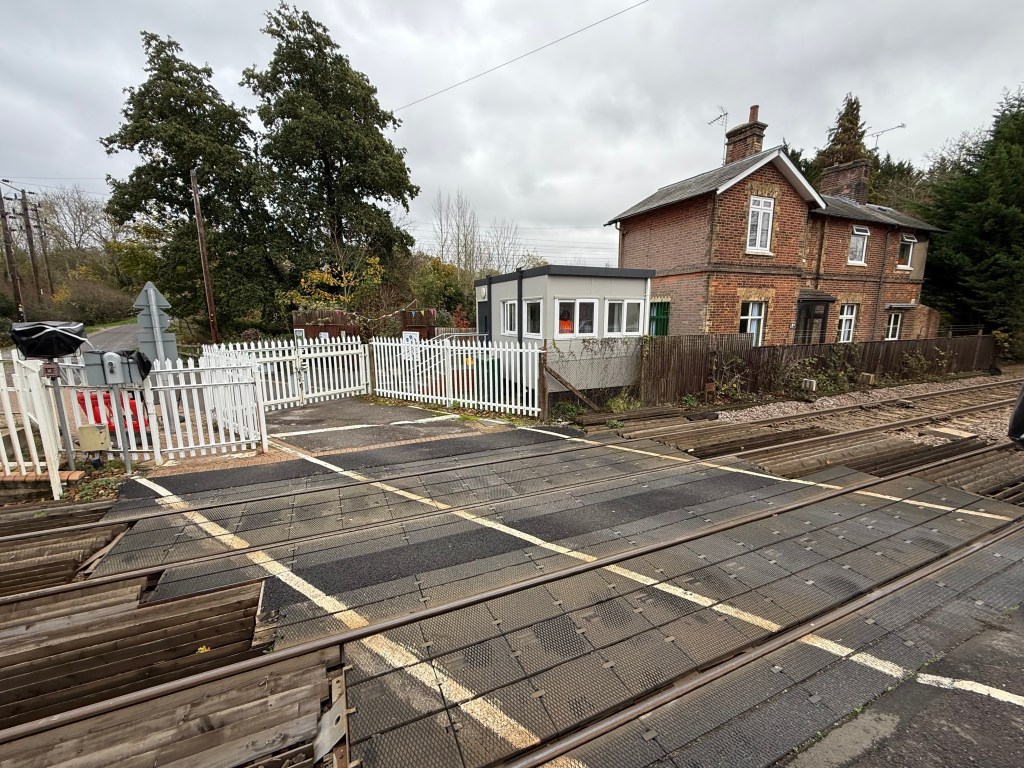
Both the house and garden are a truly amazing treasure trove of community involvement. I spent a fascinating hour visiting both the house and garden last Tuesday when Mike kindly briefed me about the background to the project and showed me around.
The “three up, three down” house, which is owned by Network Rail, has been occupied by a number of railway employees over the years, latterly Reginald Hutchings who was a career railwayman with British Rail, being an electrical engineer overseeing part of Southern Region’s Signal and Telegraph unit based in Woking. In 1986 he bought the land alongside the house from British Rail which on his death was bequeathed to his son and daughter.

Sadly the land became badly overgrown and the house also fell into disrepair through not being occupied for over a decade. However, Reg’s son and daughter kindly leased the land for 10 years to the Farnborough Street Residents Association of which Mike, who lives opposite the station, is chairman and more recently Network Rail has handed the Old Station Master’s House over for community use.
What is now known as Reg’s Garden was officially opened to the public in 2021 and Mike showed me a photograph of how it looked when they first took up the lease of the land…
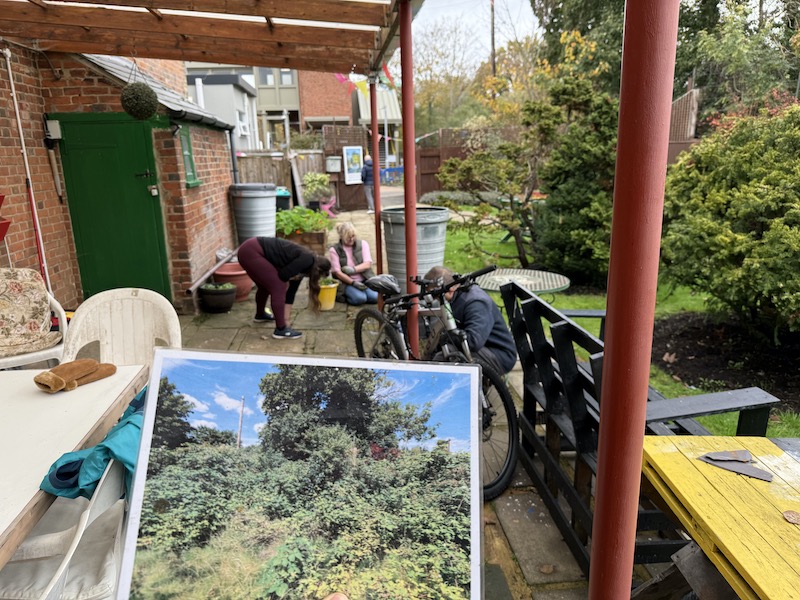
… compared to how it looks today (looking in the same direction), thanks to the hard work and determination of a whole host of dedicated community volunteers as well as employees from some of the large employers in the town (including BMW) and students from Farnborough SIxth Form College.
Mark Hopwood and the team at GWR have also been hugely supportive of this project, including some funding, and Mark along with Lord Hendy were present when the garden was officially opened.
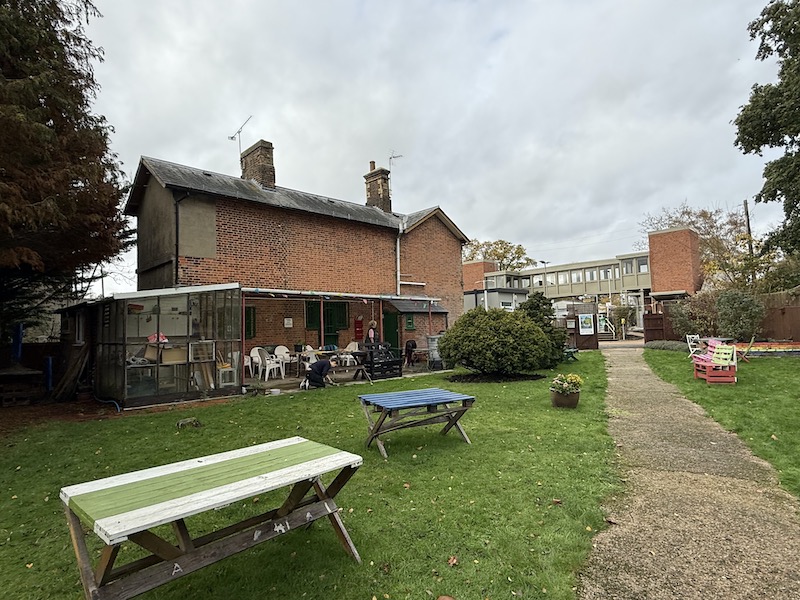
Take a look at how the garden now looks. It’s impressive.

The land is split into three main sections, a grassed area behind the house…
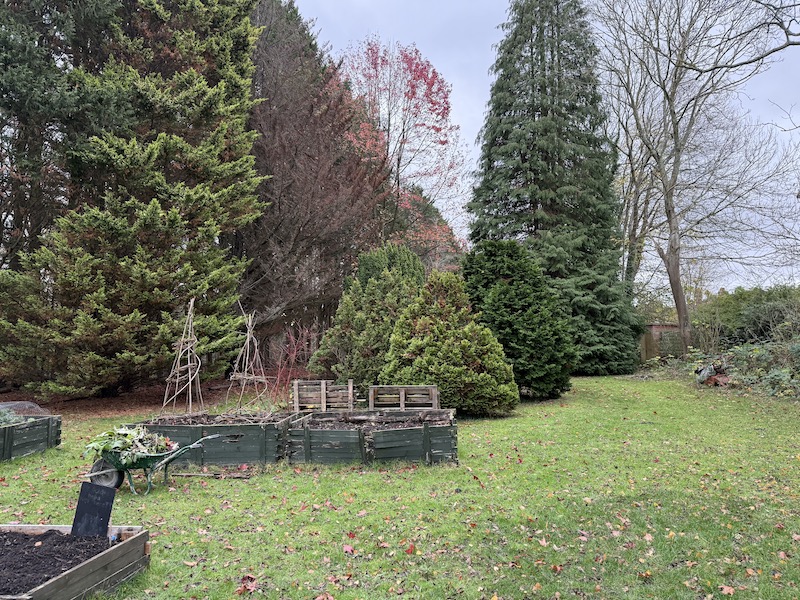
… community food farm planters…
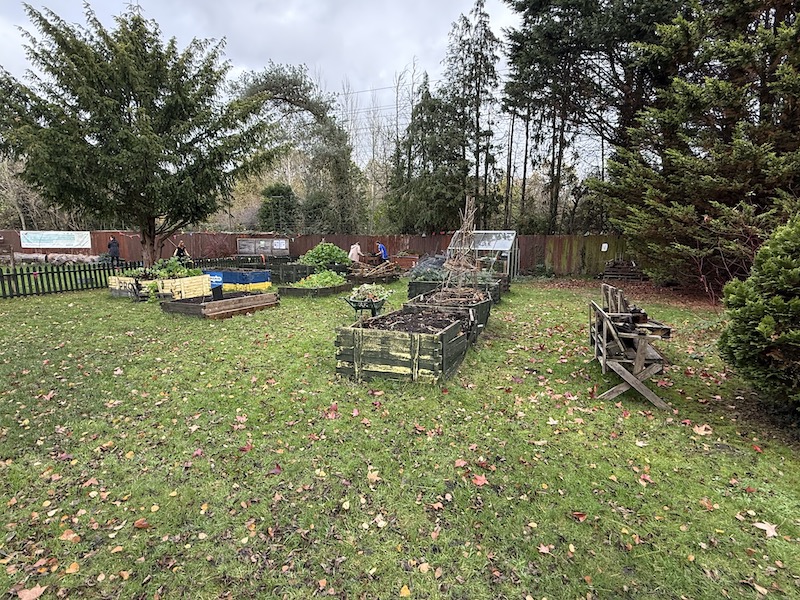
… a wildlife area with children’s play area and a number of allotments leased to local residents…
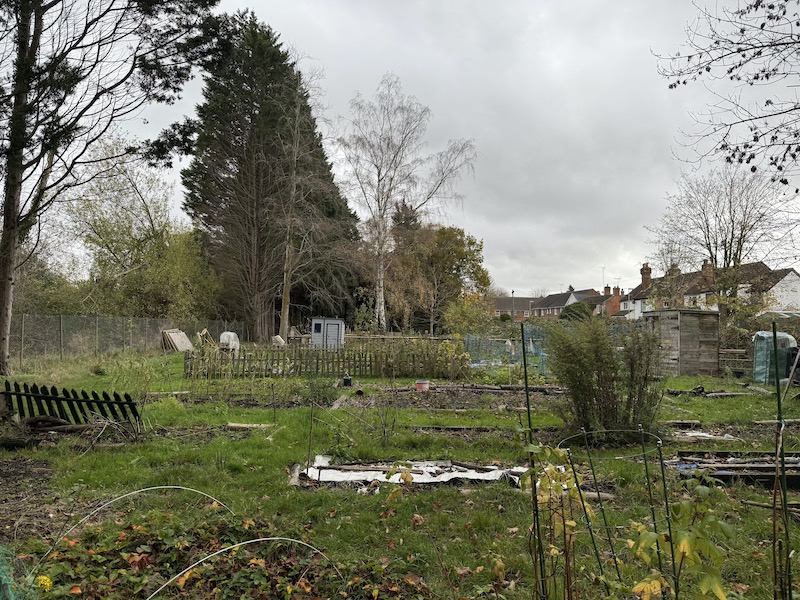
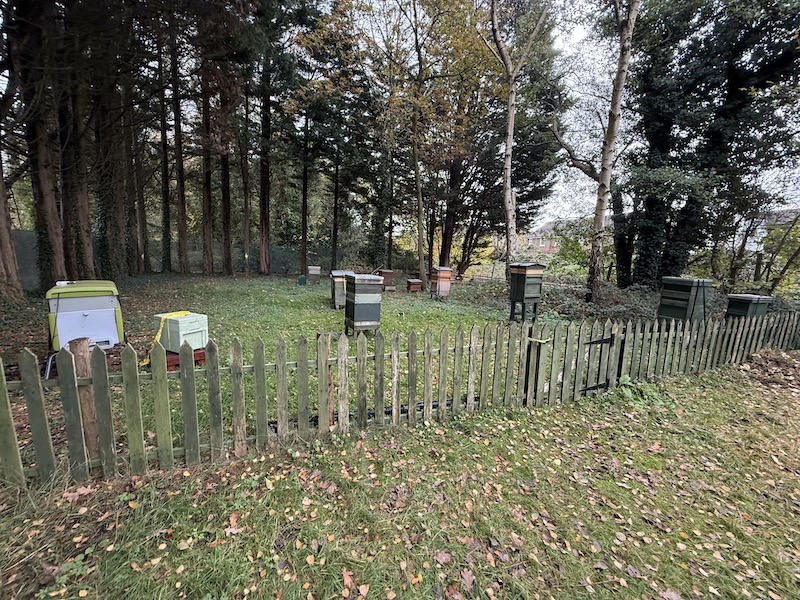
… and an area for bee hives at the far end.
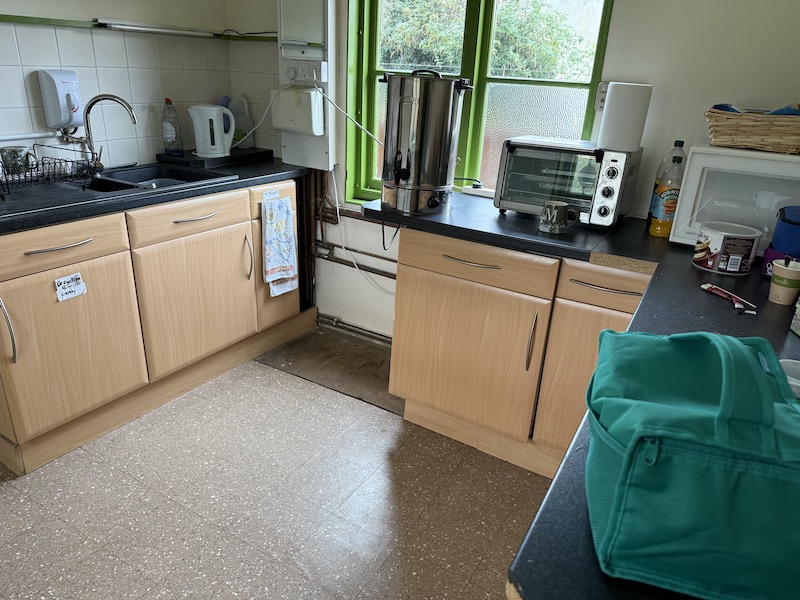
The House is in the process of being converted into a community hub. The ground floor has been decorated in the green and cream of the old Southern Railway stations with a newly installed (second hand) kitchen facility…
… a busy room where much activity takes place…

… and a third room for community meetings.
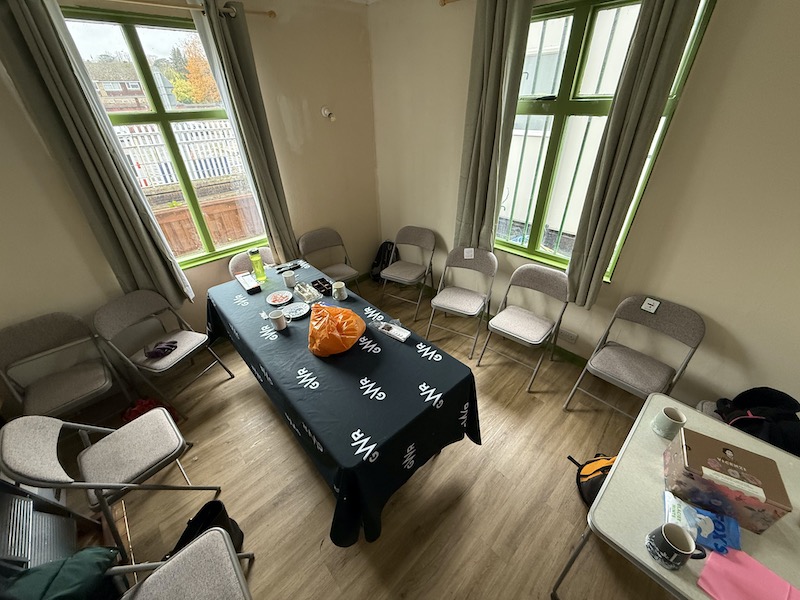
Both the rooms alongside the kitchen can be booked by local groups and on Mondays a Warm Cafė has been established…
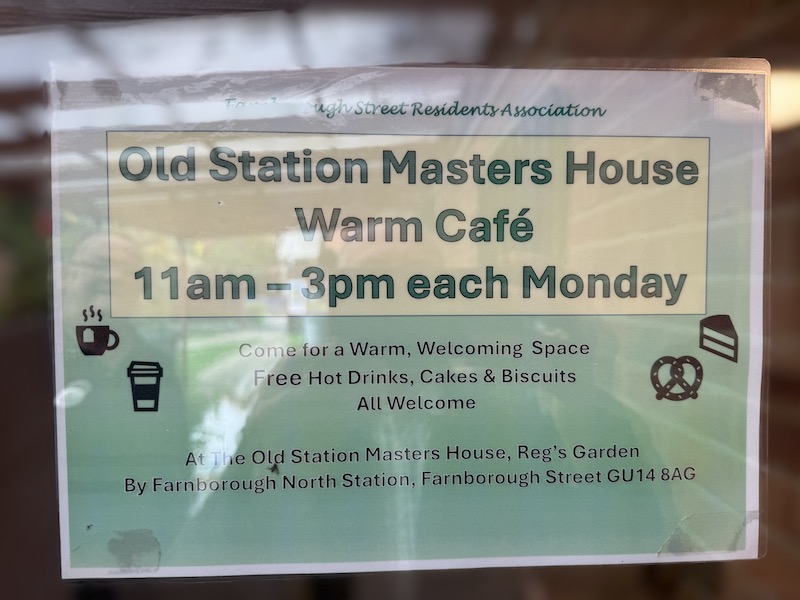
… for local people to visit and enjoy free hot drinks, light snacks “and a chat with good company in a warm and welcoming environment”. The original front door and entrance to the house…
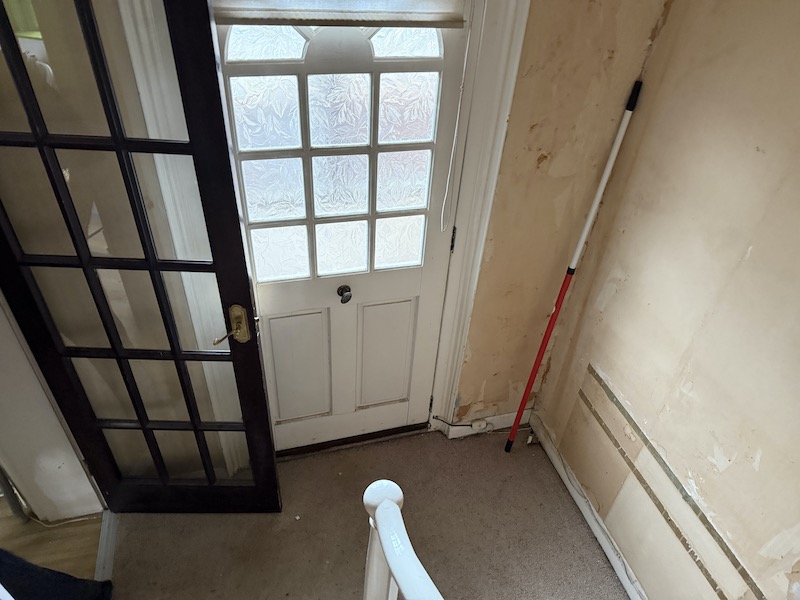
… the stairs…
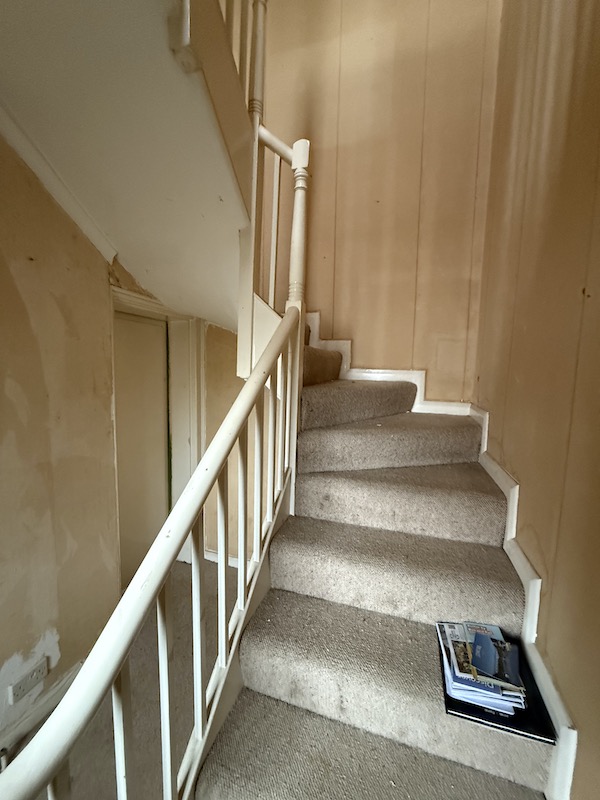
… and the three former bedrooms upstairs are in the process of being renovated and decorated…
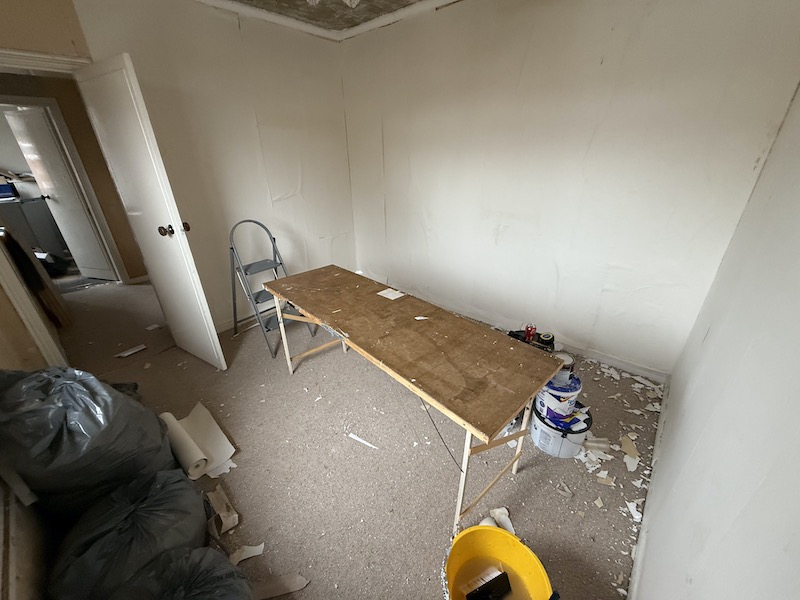
… with much work done but much still to be done. All by volunteers.
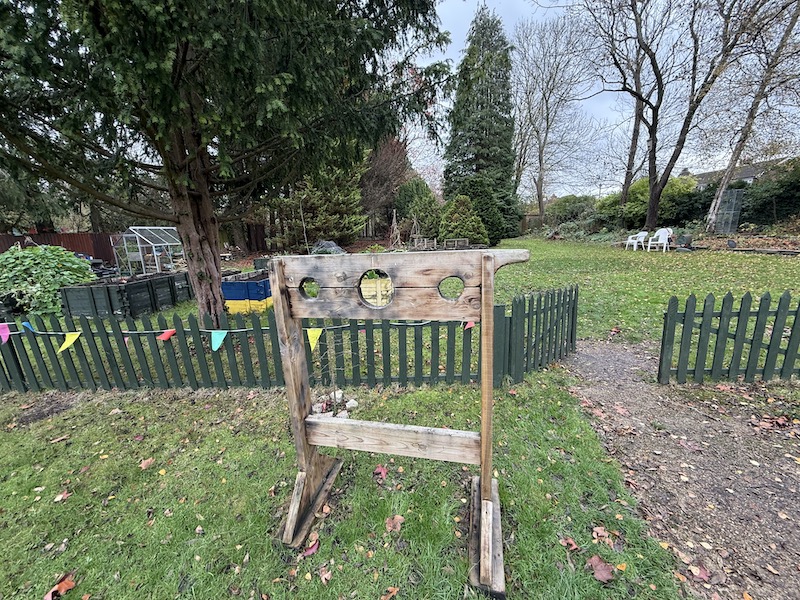
Back in the garden I was reassured the original stocks from the village are no longer used…
… and Mike explained on Sundays volunteers meet at 11am and stay until 1.30pm with horticulture activities and young people taking part in the Duke of Edinburgh Award Scheme Community section getting involved. Mike added “we also work with Community Matters Partnerships to allow companies to get involved with their Corporate Responsibility Days. Groups between 10 and 60 are the norm”. SInce July of this year 850 volunteers have been involved in the project.
Individuals can also get involved in other tasks such as planting and maintaining the many flowerbeds and helping at the Warm Cafė. A good example, Mike showed me, is a flower bed that’s recently been planted alongside Platform 1 at the station, now the footbridge work has finished, which when the plants grow and flower next summer will depict the National Rail “Double Arrow” symbol.
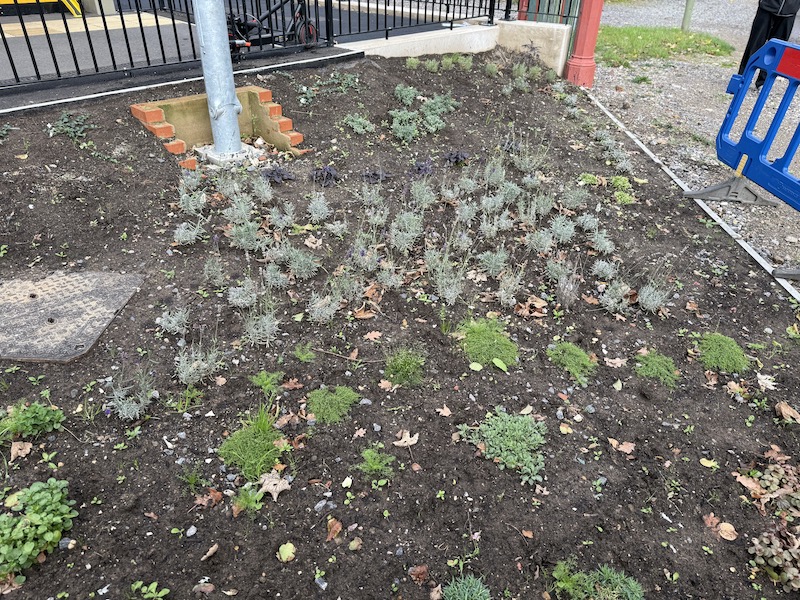
What a lovely touch.
The day I visited, a Tuesday, there’s a regular team of volunteers who work in the garden and while I was there a new nesting box was being installed…
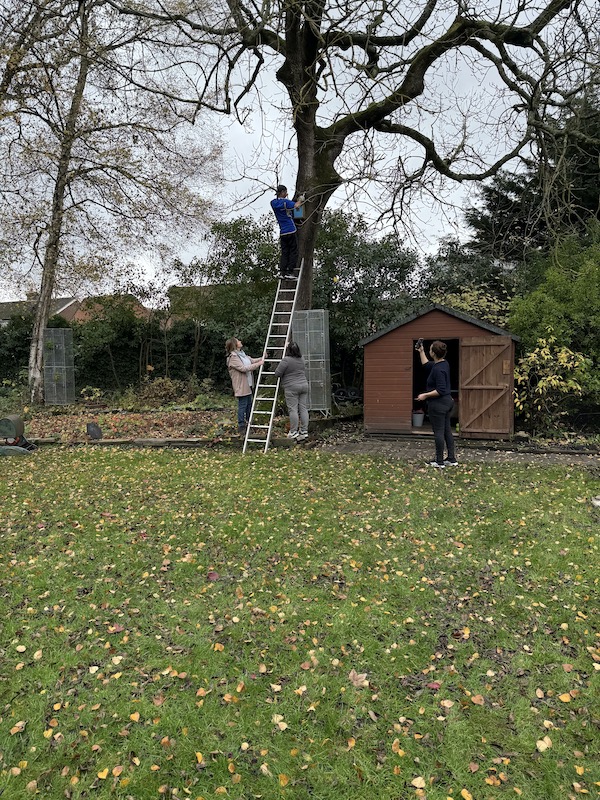
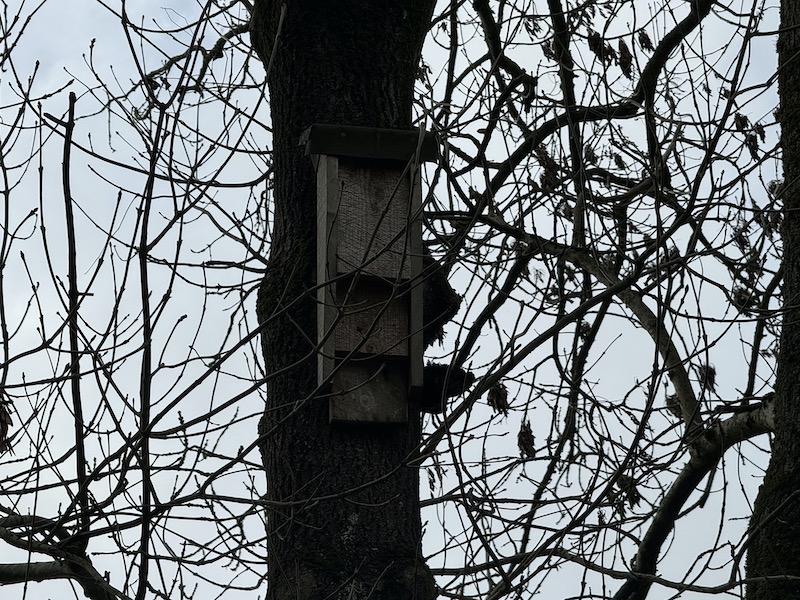
… alongside another tree containing a bat box.
Mike also showed me where a third platform used to stand alongside today’s Platform 1 which was grassed over to allow army horses being transferred to and from the barracks at Aldershot to be transported by train to where they were needed in those far off distant days in the past.

Alongside this was another siding for the exclusive use of Queen Victoria when she travelled by special train to regularly visit her friend Empress Eugenie, who was married to Napoleon III and lived in the building that’s now Farnborough Hill School.
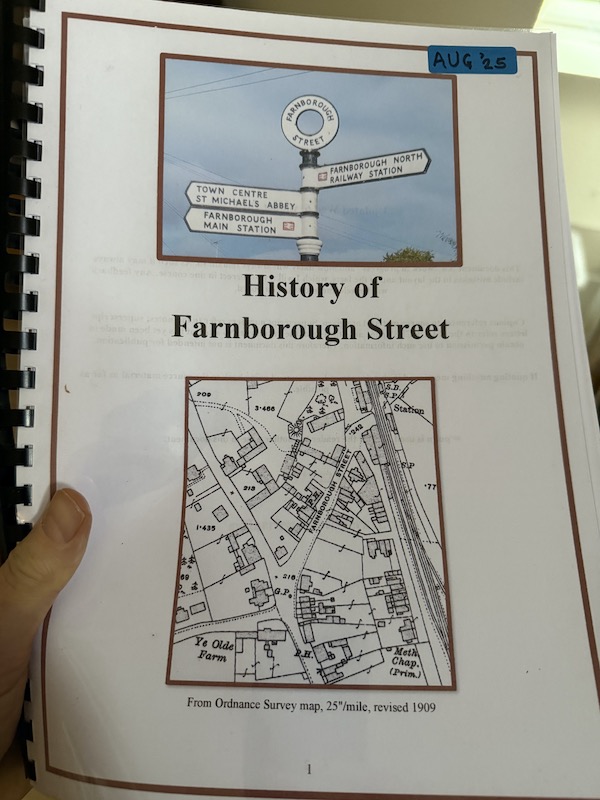
It was a fascinating visit, and Mike also kindly lent me an amazing publication put together by local historian, Mike Johnson, covering the history of Farnborough Street.
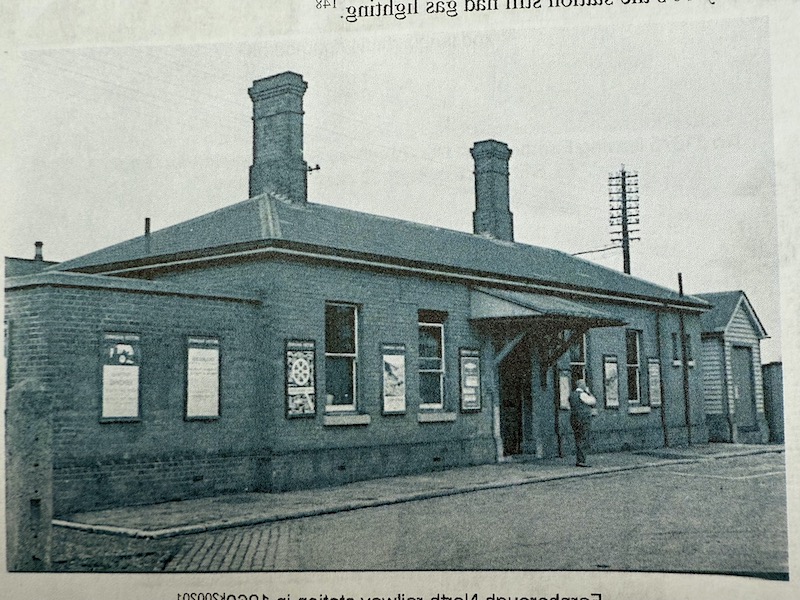
This comprehensively researched 261 page fascinating document charts the detailed history of the area from the 19th Century through to modern times and includes chapters on the station with some fantastic historic photos from which I’m including a couple here with due acknowledgment to the two Mikes.
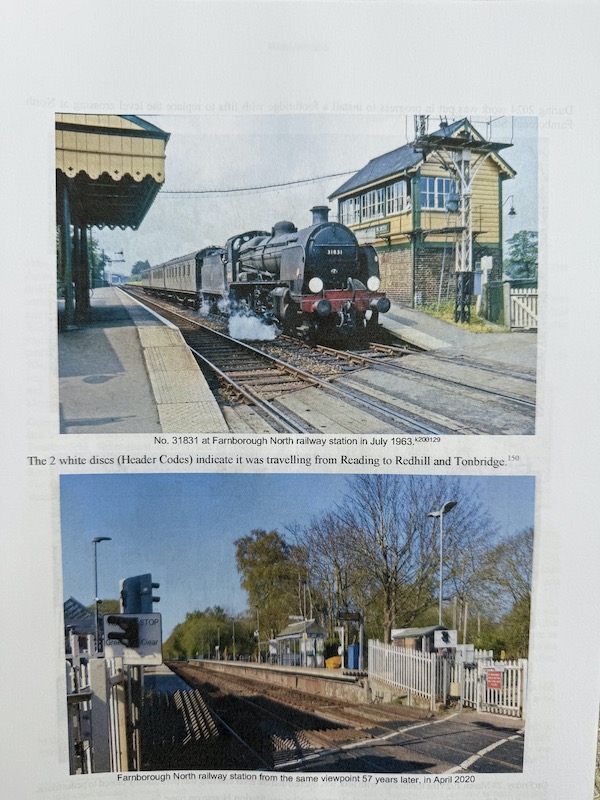
Mike Knott and his team of volunteers have been shortlisted for a rail industry award for the great work they’re all doing. In my mind, there’s no doubt they’re sure fire winners and deservedly so too.
It proved to be the most fascinating visit to a “Place with Two Stations” in this series so far and my thanks to Mike for his time last Tuesday.
Roger French
Did you catch the 22 previous blogs in this series? 1: Hertford; 2: Canterbury. 3: Wigan, 4 Dorchester, 5 Windsor, 6 Wakefield, 7 Reddish, 8 Yeovil, 9 Newark-on-Trent, 10 New Mills, 11 Tyndrum, 12 St Albans, 13 Falkirk, 14 Catford, 15 Helensburgh, 16 Gainsborough, 17 Edenbridge, 18 Bicester, 19 Worcester, 20 Epsom and Ewell, 21 Wrexham, 22 Runcorn.
Blogging timetable: 06:00 TThS
 BusAndTrainUser
The first time I used Farnborough Main was certainly memorable. I was working at Thos Cook & Son Ltd Head Office near Green Park Station at the time and one day a younger female departmental colleague was taken poorly at work. The matter was briefly in the hands of HO Personnel who chose me to escort my colleague home to Farnborough Main where her father, who ran a shop near Farnborough North station, would meet her and take her the rest of the way to her home. It was Air Show time and as I escorted my younger colleague out onto the southern forecourt of Farnborough Main station a historic Lancaster flew overhead. I fancy that the departmental timesheet was suitably endorsed with the term compassionate leave. I was probably chosen, living in Hersham – on the same line out of London Waterloo. I am also more recently familiar with Stagecoach South Route 1 and have had three car rides along the A331, across which is the UK’s most recently built aqueduct built for the Basingstoke Canal when the relief road was constructed.
LikeLike
i visited Farnborough North in the Summer to catch up with some friends at a local hostelry. My connection coming from south west London was at Wokingham and I had a good three or four minutes to make it. Unfortunately my train was late and I saw the Farnborough North train leave the platform as I arrived. The next one was an hour later. I wasn’t the only passenger inconvenienced by this and it seems quite a few others wanted to make the connection. The staff said that it happened quite frequently but that GWR wouldn’t let their trains wait to make the connection. Another example of our disconnected railway. I did take a look at Farnborough North and it is indeed an interesting station obviously cared for by the railway and the locals
Martin W
LikeLike
Punctuality on the Waterloo – Reading line is appalling despite more and more time being added in with every timetable change. Thus, combined with the revised North Downs line timetable introduced a couple of years ago connections at Wokingham cannot be relied on unless you catch the train before the one you need to.
Steve
LikeLike
Basic operating discipline on the South Western lines has collapsed since Stagecoach days. Inner suburban services are insanely slow due to delays caused by the guards needing to open the train doors, ticket checking on trains is all but non-existent except on long distance services, trains frequently skip booked stops if delayed and if anything goes wrong at Waterloo train dispatch is chaotic to the point of endangering passengers.
Incredibly things seem to have got worse since nationalisation, I can only assume because management are so focused on getting the new trains into service to avoid the Minister being embarased that they are ignoring the actual day-to-day running of the service.
LikeLike
We travel frequently from Waterloo to visit family in Raynes Park and Twickenham and welcome the faster introduction of the new trains which are a vast improvement on the ones they are replacing. I guess we have been fortunate in so far not noticing any apparent deterioration in the service since nationalisation.
LikeLike
There are daily cancellations on the Hounslow loop and across the south west suburban network. The decision to retire all the 455s in December will only make matters worse if there aren’t enough Arterios in service then. This is all about seeing to be doing something and saving money. Running a reliable service is no longer a priority in the nationalised world of SWR
Martin W
LikeLike
I have not travelled on South Western recently as the deterioration since Stagecoach left was rapid and serious. If this decline has continued since nationalisation then things must be appalling.
The introduction of the new trains should serve as a lesson in how not to introduce change and the haste to remove the old trains is symptomatic of putting everything before passengers.
The efforts of the volunteers to create a community facility must be praised.
Gareth Cheeseman
LikeLike
@Gareth Cheeseman – the withdrawal of the old trains may be dictated by maintenance and overhaul standards.
I don’t know what the regime at SWR is, but if it is based on mileage, then the old trains may now have become due for their next overhaul.
Overhauling units that are about to go for scrap – good value for money? (Although I do agree, if it causes a deterioration in service to passengers, it’s not a great position to be in. Damned if you do, damned if you don’t)
Malc M
LikeLike
in BR days guards opened the doors on Class 455 without the long delays we see today.
LikeLike
I’ve been caught at Wokingham in the same way … arriving at the train door just as they were closing, the guard shouted “stand away”.
I later learned that he was unable to re-open the doors from the rear cab … seemingly there is an interlock that prevents that.
I was lucky, in that I was heading to Guildford, so my next train was only 30 minutes behind. In future I’ll change at Ascot and Aldershot … the connections are safer there!!
LikeLike
Perhaps rail managers should be made to take an annual journey involving a tight connection with the only option being waiting an hour. I don’t think they have really thought through the consequences, especially when it means a train departs just as another train arrives. Even if no one actually misses the connection on a particular occasion – the whole incident is viewed by two trainloads of people, plus anyone waiting on any of the platforms. It’s as if the railway is hanging out a giant sign saying ‘Don’t bother to try and make a journey involving a connection – we will not be helpful’.
The net effect is that the vast majority of passengers only make ‘one-seat’ journeys – and the percentage of overall travel by train remains pitifully low.
LikeLike
In a few other places, rather than having separate stations on routes which cross, there is a single station at the crossing point with platforms for both lines. Tamworth and Retford come to mind. Maybe there’s scope for a look at how these work, especially the interchange arrangements.
Ian McNeil
LikeLike
Yes, Tamworth is interesting, When I first used it, to change from L&NW from Euston to Cross Country for Burton, I wondered where platform 3 was …
LikeLike
Against which has to be balanced is the station location then in an appropriate place for local access? The same thing has often been suggested for Canterbury, but the place where the two lines cross each other is far less conveniently sited in relation to the city centre than the current separate stations.
LikeLike
To be strictly accurate, Farnborough North was on the line opened by the South Eastern Railway. It didn’t become the SECR until 1899, after the setting up of a joint managing committee with the London, Chatham & Dover Railway.
KCC
LikeLiked by 1 person
Isn’t it strange that we sometimes never notice the most ordinary things? I had never previously noticed that the name boards at Farnborough (Main) only said “Farnborough”. Always impressed by the good bus stopping arrangements here too.
Regarding the Air Show, it was amazing how many times people travelled out to Farnborough (Kent) on 47s, only to be severely disappointed. It happened twice to me and we only worked the route (from Bromley garage) on Saturdays until 1965. And guess what, when it’s replacement in the form of the 261 took over in 1982, it happened again!
Terence Uden
LikeLiked by 1 person
Funny you mention that. When I was a young child, we would take the train to visit grandparents in Lymington.
When the train passed through Farnborough, I excitedly thought I would see an RT on route 47!
In more recent years, red London buses have run to Farnborough Air Show, with London General providing services from Central London and Heathrow Airport, as well as park & ride and local/internal shuttles.
I only worked the Farnborough services once, in 2010. Other operators were assisting with Wilts & Dorset, Brighton & Hove and Stagecoach all providing buses. My shift was an interesting one – work a morning journey from Victoria with a Volvo Olympian, break, a couple of hours on the internal shuttle with a Wilts & Dorset Citaro, another break, then take the Olympian on a late afternoon journey back to Victoria. Fun times!
Malc M
LikeLike
oops! typo spotted….Sundays, not Saturdays for 47s to Farnborough.
LikeLike
“There is an interesting shutter…” Now that is a nerdy comment!
And it is a pillory, not stocks. That’s my inner nerd at work.
Fascinating read, nevertheless.
John
LikeLike
Great to see the community-led work going on around Farnborough North. I used to one stop down the line (near North Camp) for many years and it did always feel like Farnborough North was a bit of a poor relation, only having half the service and fewer facilities. Nice to see it getting some love.
I suspect the train crews will also be a lot happier with that crossing closed to pedestrians, I understand it used to be regularly abused.
As you correctly note, North Camp station does actually sit just over the border in Surrey, technically within the village of Ash Vale, making that village technically a place with two stations. As a non-driver, living half way between the two was perfect for being able to get round a fair chunk of the country.
LikeLike
You might be interested to know that the Gold 1 service along with the 20 Aldershot to Guildford will be using 22 new Yutong DDs early in the New Year bought by Stagecoaach with Surrey CC.
Quite a snub for another local company AD who have a facility in the town and who used to a big user of their buses.
LikeLike
lichfield please. JJ
LikeLike
I know the background to the pedestrian crossing still being open at Farnborough North. The overwhelming problem is that the crossing is officially a public bridleway. Cyclists have a right to use bridleways and when the bridge and lifts were specified there was no provision for them to use them. I assume that horse riders have relinquished their rights, but cyclists have not!
Hampshire County Council has published a closure order, but there have been objections and those can only be resolved in a Public Inquiry. The bridleway is quite wide, well surfaced and well used and provides an excellent off-road route from Farnborough to Frimley Green.
LikeLike
The level crossing at Farnborough North was the site of a serious near-miss in 2022, when a group of 144 people (mostly students) were crossing the tracks. Given its heavy usage, it seems amazing that this was still the recognised way of crossing the tracks. Google gives quite a detailed description of the incident, which I have reproduced below:
A serious near-miss occurred at the Farnborough North level crossing on May 19, 2022, when a large group of pedestrians, mainly students, was struck by a train traveling at 70 mph. The incident happened because users held the gate open for each other while a train was approaching, and the level crossing attendant’s attempt to lock the gates failed. The Rail Accident Investigation Branch (RAIB)investigated the incident and found that Network Rail had not adequately managed the residual risks at the high-risk crossing, even after implementing additional safety measures.
The incident
Investigation findings and recommendations
The RAIB made recommendations to Network Rail regarding improvements to the risk assessment process for such crossings.
The RAIB found that Network Rail had not developed a sufficient plan or provided adequate training for the attendant to manage the risks at the crossing, particularly the residual risk of pedestrian behavior even with the new safety measures.
The crossing was deemed “a high-risk location” due to limited visibility, high user numbers, and a history of previous safety incidents.
A long-standing plan to replace the crossing with a footbridge had been delayed due to issues like land ownership and design requirements.
LikeLiked by 1 person
most public transport that runs once per hour is generally of little use. A half hourly all day Reading-Gatwick seems a rather useful service and would make the interchange issues less of a worry , one cannot time every interchange with another to please everyone.
The level crossing issue at Farnborough North report was too critical of the crossing keeper – what kind of training can be provided and implemented when individuals force gates open against red lights ? the report should have been sent to the institutions where the students were and the individuals sued / prosecuted for trespass.
Perhaps the bridleway could be solved either with ramps up to the footbridge or down to a deep underpass. Or maybe really are horse riders inconvenienced by taking a longer alternative route ?
JBC Prestatyn
LikeLike
I’m not sure the RAIB report was critical of the crossing attendant – indeed para. 39 states
“The crossing attendant recognised the risk of users continuing to cross while the miniature stop lights and audible alarm were indicating the approach of a train and shouted a warning from the cabin window. This, however, had no effect and the flow of crossing users continued. The crossing attendant then left the cabin and directly intervened to close the gate, which prevented users entering the crossing from the platform 1 side at about the same time that train 1V38 came into view. The actions of the crossing attendant may have prevented a serious accident.”
It appears that only 16 seconds elapsed between the stop lights showing red and the attendant closing the gate, and it’s difficult to see how he could have acted differently or more quickly. In any case lack of training would be down to Network Rail rather than the attendant, and what sort of training could be given for this scenario anyway?
Regarding the bridleway, para. 88 states that Hampshire County Council imposed a Traffic Regulation Order on it in 2012 to prohibit equestrian access, but it remains a Right of Way requiring Network Rail to maintain a route suitable for cyclists, pedestrians and mobility-impaired users.
The (surprisingly readable) RAIB report is well worth a read and can be found at
https://assets.publishing.service.gov.uk/media/6442731122ef3b000c66f6d5/R042023_230424_Farnborough_North.pdf
There’s also an interesting Network Rail presentation from 2023 on the (then) proposed footbridge at
https://www.networkrail.co.uk/wp-content/uploads/2023/01/Farnborough-North-and-Hatches-Consultation-Presentation.pdf
And finally, there’s a nice YouTube video of the new lifts and footbridge, although it does perhaps come to an end rather surprisingly !
https://www.youtube.com/watch?v=OJEpss8n0W4
LikeLike
North Camp could be called Farnborough South and seems closer to Farnborough Airport than Farnborough Main is
JBC Prestatyn
LikeLiked by 1 person
Note that the Stagecoach buses in use on the 1 still advertise a 10 min frequency, despite that having not been offered since March 2020. I realise the route is getting new Yutongs next year, but that doesn’t really excuse this misleading advertising for over five and half years now.
LikeLike
Another great episode. Thanks.
For the record, have you done Portsmouth & Southsea & Portsmouth Harbour? Or do they not count as on same line?
LikeLike
Thanks. No,I haven’t included these as there are other stations in Portsmouth and Southsea (eg Fratton).
LikeLike