
Thursday 9th October 2025

The two words “at last” have become all too familiar in a heading when it comes to blogging about new trains entering service in Britain, and these latest CAF built trains for London’s DLR network are no different.

The first of the 54 trains was unveiled to the media by Mayor Khan at the network’s Beckton depot back in February 2023 with an expected entry into service “from early 2024”. As always when it comes to new trains …. software issues, gauge clearance, test miles, compatible signal technology and the many other factors at play on the railway …. that deadline proved somewhat optimistic with subsequent expected dates rolling ever forward until finally the promised “end of September 2025” was met by car 209 managing to hit the tracks in public service on Monday 30th, last week.

Designated as B23 stock, each CAF walk-through five-car train built in its factory in Beasain, Spain is equivalent in length to three current DLR trains with a stated capacity of 792 passengers, but with only 156 seats (including 15 tip-ups), making for a lot of standing expected.

That’s why the interiors have been designed with longitudinal seating as standard on the Underground and Overground for many years, and, as you can see, a new teal colour scheme and a moquette, known as ‘Poplar’.
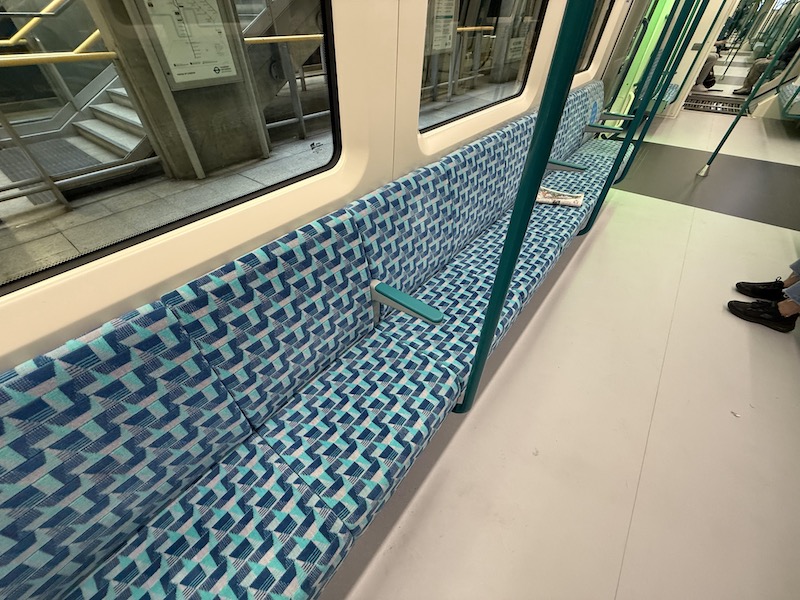
However, the popular ‘pretend to be the driver’ seats at the front and rear, offering a clear view along the tracks ahead and behind, have been retained…

…although they’d be a squash for two people and seemed further back from the control panel to me…
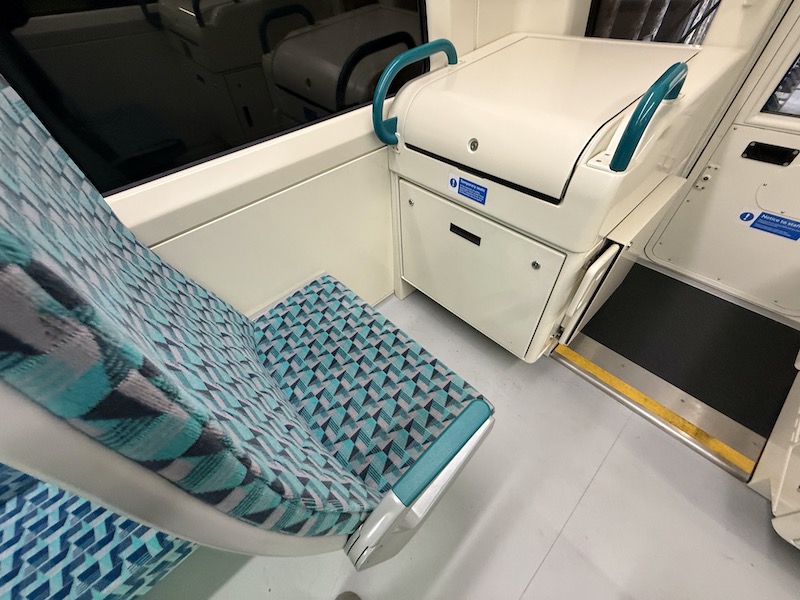
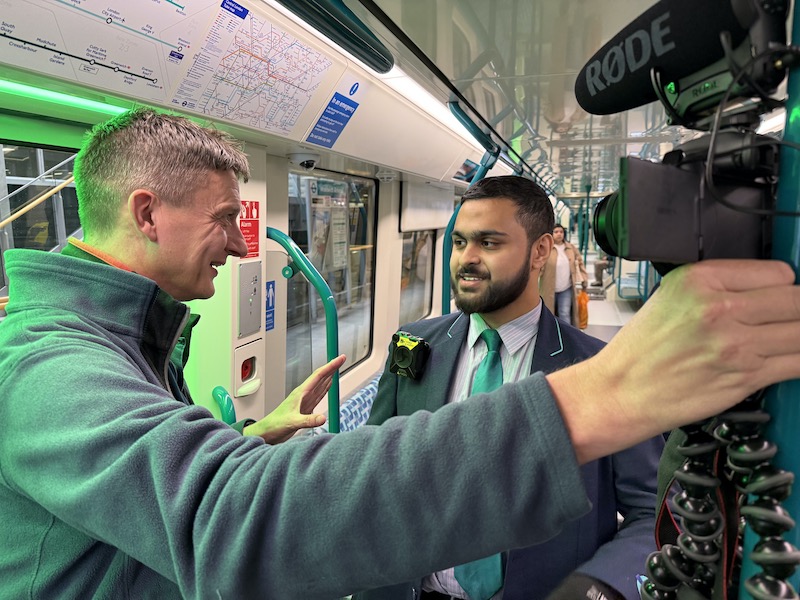
As now, these can also be commandeered by the on-board Passenger Service Assistant (PSA) to take over the driving if needed. PSAs can now walk right through the train and offer a reassuring presence to passengers and it was good to meet blog reader Arif who was very smartly attired and clearly enjoying carrying out his duties on the train’s first day in service on Tuesday last week, not least as he explained the train dispatch procedure to Geoff Marshall for his video on the new trains.
Coaches two and four in each five-car set include designated areas for wheelchair users…
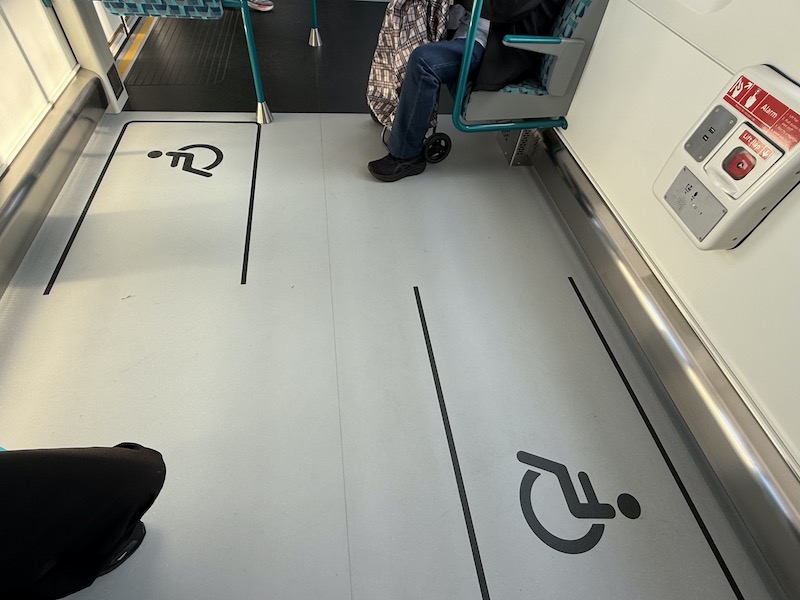
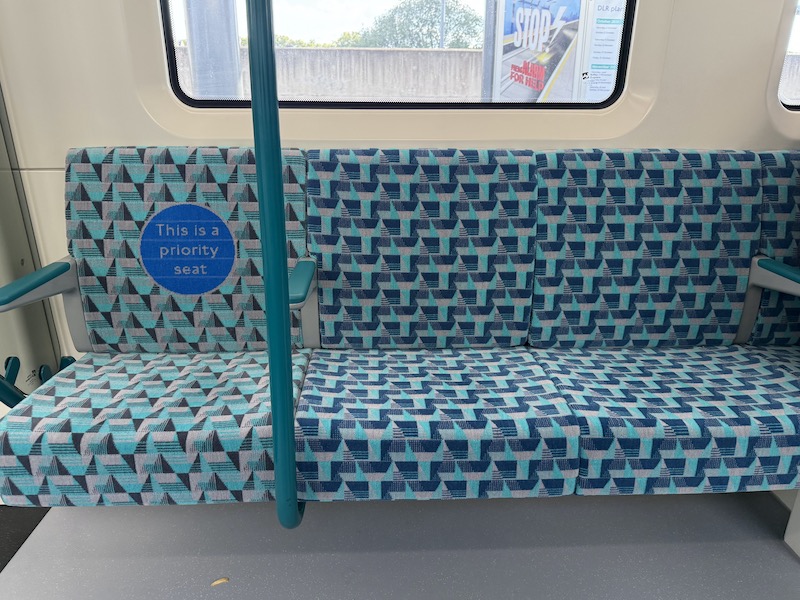
… and there are also areas for buggies and other ‘large stuff’ through the train as well as priority seats marked with a slightly different moquette design for those with accessibility needs at different points…

… including by the doors.
The doors have a bright green lighted surround which comes on as the train approaches a station (to indicate which side of the train the doors will open) and remains on while the doors are open…

… changing to a flashing red as a very loud beep sounds before they close.

The entrance/exit areas are very spacious to assist with efficient boarding and alighting…
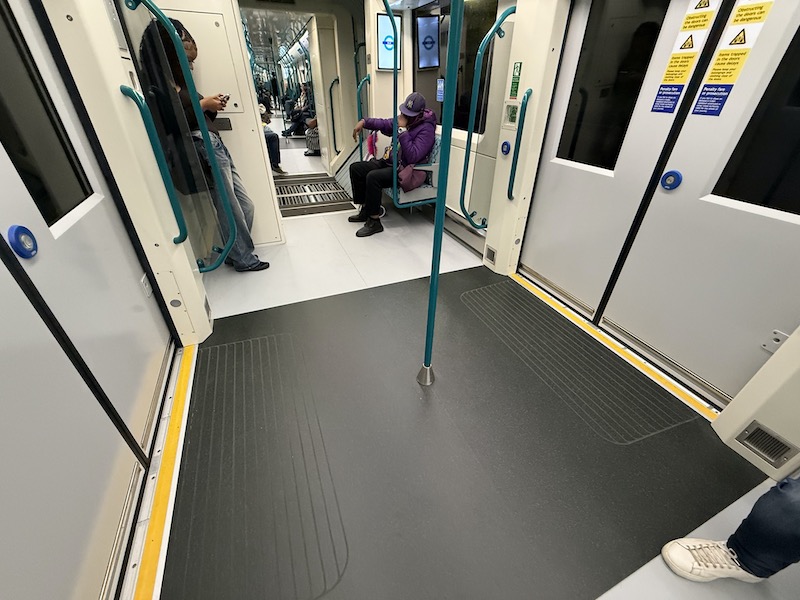
… and the ‘walk through’ area in between the coaches (which aren’t actually articulated as such)…
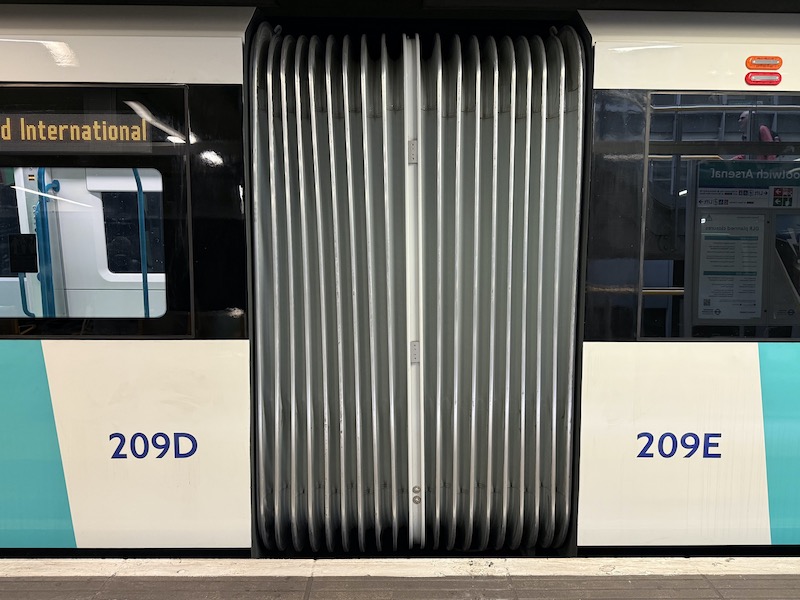
… has been designed to handle the sharp curves on the DLR.

Coaches also display upcoming stations being served and the final destination…

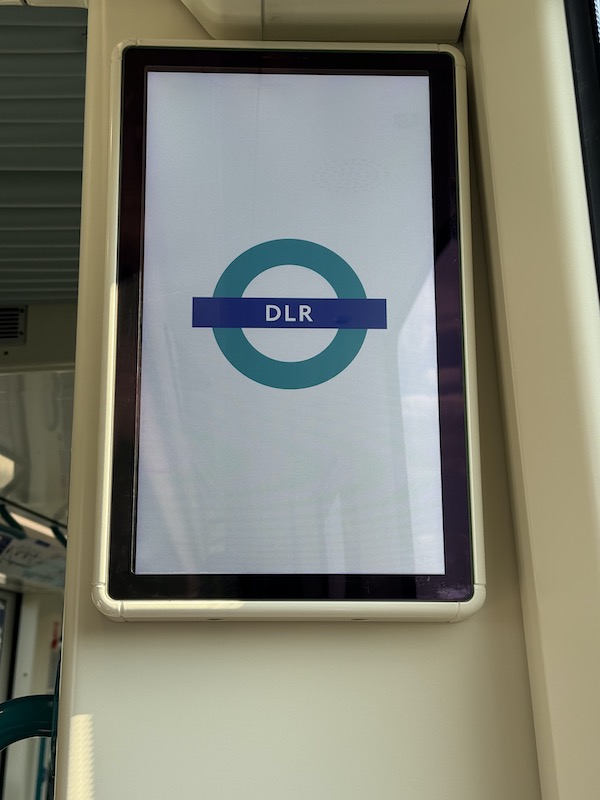
… as well as electronic screens by the doors which, when I travelled on the first day, were just showing the DLR logo, but I’m sure will be used for something more substantive. Commercial advertising, perhaps?
USB sockets and air conditioning are two further new features passengers will enjoy compared to the existing fleet as well as the general much more open, airy and unconfined feel of the trains.
These will be much welcome improvements over the existing fleet of B90, B92 and B2K trains…

… which will be withdrawn, leaving the more modern B07 trains in service alongside this new B23 stock of 54 trains. They’re costing £942 million with funding from the UK Housing Infrastructure Fund (£260 million), a National Wealth Fund Loan (£500 million) and a contribution from London City AIrport.
At the moment only 10 of the new trains have been delivered to the Beckton depot with a second one due into service this week to join 209. It’s going to take some time before all 54 are in service but when they are I’m sure the overall increase in passenger capacity for the entire DLR fleet (said to be 50%) compared to the existing cramped trains will be welcomed by passengers ……. albeit it’s down to fewer seats and more standing room.

Roger French
Blogging timetable: 06:00 TThS


The electronic screens would certainly provide the ability to scroll and show potential extensions and even bus services introduced in readiness like Bakerloop that you craved on Bakerloo line trains.
Thank you for providing the link to Geoff Marshall’s excellent informative video. Even spotted the Mayor of London taking a trip!
John Nicholas
LikeLike
“Yeah, I’d like to spend more time having to stand up on my public transport journeys” said absolutely nobody ever…
It’s more “improving things worse”, a continuing trend from TFL these days..
…if the trains are full then run a better service, don’t just turn all the trains into cattle trucks!
LikeLike
Where people are making short journeys (as they generally are on the DLR), standing for 10–15 minutes is not usually a hardship. Prioritising capacity and throughput over seating is commonplace on urban rail and bus networks around the world. Better to stand with plenty of space for everyone to move around than sit in cramped seats and it be awkward every time someone wants to get on or off because there isn’t enough circulation space.
LikeLike
@SteveInSelby – very true.
In fact, if you travel on the DLR (or London Underground, or other urban metros) you will often see people choosing to stand even when seats are available.
Unless I am mistaken, the longest end-to-end journey on the DLR takes about half an hour – but how many passengers travel end-to-end? My impression is that the vast majority are making shorter intermediate journeys.
The new fleet will provide more seating overall, as there will be more of them – 54 x full-length (each one equivalent to 3-car existing), replacing 94 x existing single-car.
Malc M
LikeLike
That reply used very little actual thinking to be fair. Like a lot of railways and subways there are many branches on the dlr. You can let’s say run an every 2 minute great service through the core section yet the trains to each branch is limited because you can only fit so many in the core. This also is why Thameslink struggles a lot with delays.
LikeLike
Probably the UK’s most expensive train
Britannic Explorer, A Belmond Train | Luxury Sleeper Train
LikeLike
A moquette, known as ‘Polar’ ?
It’s actually ‘Poplar’, named after the original DLR depot which is still used for stabling trains. The design is described as sails and is a nod to the shipping heritage of this riverside and dockland area.
Julian Walker
LikeLike
The ultimate “cattle-trucks”, and built in Spain just for good measure. The passenger accommodation may resemble the original trains of 200 years ago, with standing only for most, but who could have forseen we would need to buy such basic equipment abroad?
A pity many other transport staff don’t aspire to dress like Arif.
Terence Uden
LikeLike
Hardly basic equipment! They’re extremely specialised trains.
None of of the DLR stock, or any other light rail trains or trams have been built in the UK. We simply don’t do light rail manufacture due to the relative lack of domestic demand. It’s not worth the R&D or manufacturing facilities for such a small market.
LikeLiked by 1 person
@Terence Uden – I am really surprised to learn that the original Stockton & Darlington trains had wheelchair/buggy spaces, audio-visual announcements, USB ports, air-con, not to mention step-free access from street to train.
I learn something new every day 🙂
Malc M
LikeLiked by 1 person
A seat, rather than having to stand under someone’s armpit and trying to hang on a strap for even twenty minutes, is more important to many.
Terence Uden
LikeLike
@Terence Uden – with more space per train, and an enlarged fleet, the risk of having your face in someone’s armpit is lower.
As for seating, let’s do the maths.
Remove 94 trains with 50-55 seats. Total old seats withdrawn, around 5,000.
Introduce 54 trains with 156 seats. Total new seats introduced, more than 8,000.
Happy now?
Malc M
LikeLiked by 1 person
Typo corrected; thanks.
LikeLike
I always find it slightly amusing that when new trains are introduced we get the usual more capacity pitch, never mentioning, as you have, that it also means fewer seats.Barry Coppock
LikeLike
Are there fewer seats, though? Possibly, for a full-length train, but only marginally if so.
However, many DLR trains are currently formed of two vehicles, with a combined seating capacity of around 100-110. Replacing those with a full-length B23 will provide more seats, will it not?
Malc M
LikeLike
I’m not a great fan of longitudinal seating as it tends to make me feel queasy on long journeys. For short journeys I think it’s fine.The DLR does have some long stretches though especially the Woolwich Arsenal branch. Ideally it would have been good to get a mixture of both transverse and longitudinal seating as the Paris metro is doing. You can also admire the views out of the window (great views around the docks and London City Airport). Standardisation doesn’t always equal passenger comfort. Also why are there so few armrests? Surely there should be one between each seat or are they simply trying to cram in more people like cattle ? It would also be good to go back the the days of the two level armrests which allowed passengers to share the space without elbowing each other. Probably something that the DLR team would have explored if they hadn’t been brought into the TfL family .
Martin W
LikeLike
I‘m glad to hear that USB charging points are provided. In other late-introduced trains they tend to be missing as they were presumably constructed before USB points became commonplace – for example the Thameslink units and more recently and frustratingly the new SWR units (which do have a few USB points but by no means at every seat).
LikeLike
One important thing that looks missing from the photos is the passenger control panels!
https://londonist.com/london/transport/dlr-front-seat-control-panel
Jay
LikeLike
Full length trains does seem like the DLR is growing up. I hope a couple of examples of the older stock can enter preservation somewhere.
The end seats are like the semi pair single on some double deck buses. They are about big enough for a parent and Child
Through Journeys from Beckton (area) to Bank and Woolwich to Stratford do happen. With Elizabeth Line there may be quicker – with interchange – journeys possible.
Jubilee service passengerwise from Stratford is normally heaving beyond existing capacity , with delays / gaps in service , for a station which has leisure, residential retail and education not far away I think any study would show that there is undercapacity which needs to be sorted on what is a relatively new railway.
JBC Prestatyn.
LikeLike
I think it should be noted they are going into service on the Woolwich Arsenal to Stratford International Route, which should suit them avoiding Canary Wharf for now. I wonder if they have been tested fully on all the routes or if that will be ongoing during the introduction period or if the two different stocks will be line separated effectively
JBC Prestatyn
LikeLike
I like these new trains they look smart. Not concerned about ratio of seats to standing, it’s urban rail so expect to stand for short trips. I noticed Roger mentioned loud door closing beeps. I wish TfL could find a less harsh warning sound. The S Stock trains almost have sirens when the doors open, way too loud.
I much prefer the approach taken by Vancouver Skytrain, an automated light metros similar to the DLR, which has a nice chime like a doorbell to when the doors close.
Peter Brown
LikeLike
Like the tube, the DLR trains (and general map) do not show interchanges with the Superloop express buses! Why? – have TfL forgotten they are supposed to be an integrated network? Or is it like everywhere else (apart from a select few exceptions) – rail managers just don’t talk to bus managers …
LikeLike
On the subject of seats and trying to restrict myself to be entirely factual, according to Wikipedia, the first three generations had 70 seats per car. So it you have B23 stock replacing a former 2-car unit then you actually gain 16 seats.
Of course, if the original train was a 3-car train then there is a substantial loss of 54 seats.
If you take into account the extra trains and the longer trains, I suspect that overall the total number of seats will remain the about the same or be slightly increased. Inevitably, as the DLR gets busier, despite that, the chances of an individual getting a seat is reduced.
A more sophisticated measure is how long people are expected to stand given that people making a longer journey will probably have the opportunity to grab a seat at some point in the journey even if they can’t sit for all the journey.
Pedantic of Purley
LikeLiked by 1 person
I am not convinced the B90/B92/B2K trains do have 70 seats.
Between windscreen and leading set of doors, two pairs of double seats facing windscreen – 8 seats in total.
Between first and second set of doors, an inward-facing double, then a “club four”, then another inward facing double, on each side – 16 seats in total.
Between second set of doors and articulation, an inward-facing double on one side, a pair of tip-ups on the other – 4 in total.
That would make 28 per half, total 56 including tip-ups (OK so my estimate of 50-55 in other replies was marginally too low).
Happy to be corrected if my memory is playing tricks!
Malc M
LikeLike
After some digging for interior photos of DLR trains, I found technical drawings released by a Freedom of Information request to TfL. Numbers include tip-up seats (4 on old trains, 20 on B23).
B90/B92/B2K – 68 seats (136 double/204 triple)
B07 – 56 seats (112 double/168 triple)
B23 – 158 seats
54 B23 trains replace 94 B90/B92/B2K trains. Meaning 8532 seats replacing 6392 seats.
Current fleet – 9472 seats
B07/B23 fleet – 11612 seats
A 22.6% increase.
So per train its better than a double but worse than a triple, however overall a big increase in seats because all trains are full length which is currently not the case.
https://tfl.gov.uk/corporate/transparency/freedom-of-information/foi-request-detail?referenceId=FOI-4241-2324
Numbers don’t exactly match those in the article but the drawings could be out of date.
LikeLike
Interesting to see the technical drawings, thank you for finding those.
The drawing for the B07 looks up-to-date. Some years ago the pairs of seats facing each other in the centre of each car were replaced with longitudinal seating, and the drawing reflects this.
The B92 drawing doesn’t represent how the trains are configured now. The drawing shows a single row of seats facing the window, with a longitudinal triple seat behind on each side (10 seats between windscreen and first set of doors). The B92s now have two rows of forward facing seats in that area (8 seats in total, rather than 10).
Either side of the “club 4” (pairs of seats facing each other), the drawing shows a longitudinal triple. I will have to check next time I travel on the DLR as I could have sworn they were doubles rather than triples!
Malc M
LikeLike
…and to answer my own comment, I travelled on B90/B92/B2K stock on the DLR today. The inward-facing seats, shown as triples on the technical drawings, are doubles (and the inward-facing triples forward of the leading set of doors are forward-facing doubles). So the seating capacity of each articulated vehicle is 56 (including 4 x tip-ups) rather than the 70 claimed on Wikipedia.
Malc M
LikeLike
some commentators on here seem to think they are off for a nice day out in something like the Bluebell Railway. For heavens sake this is mass transit, A to B stuff. The cars look as if they’re lined with seats in any case, no footstalls or antimacassars I’m afraid, but as Roger points out, plenty of designated areas for buggies, wheelchairs and for those with various other needs.
LikeLike
With that mindset, why bother with seats at all
LikeLike
They deem to be moving to standing only on short commuter lines and even on the outer Met lines they have considerably reduced seating
LikeLike
The external destination indicators (small orange dot matrix) feel old fashioned and cheap.
Larger white ones (similar to what is now seen on the new buses) would have looked better and would be more visible.
Great that the internal signage is to modern specs.
MilesT
LikeLike
Let’s hope they would be more reliable than many used on London buses in recent years!
LikeLike
Perhaps the problem is the B07 stock which loses seats already in double and triple compared to its forebears. I assume the seat count is for effective multi use / wheelchair spaces being prioritised which in practice become crush load standing spaces ( mainly at present it seems ABBA musical near pudding mill lane to stratford in the evenings ) . Question is being more new trains will they allow the remaining stock to be used in triple rather than doubles to keep the frequency going ?
JBC Prestatyn
LikeLike
Given these trains were designed for the DLTR why are they taking so long to get them into service ?
LikeLike
The original DLR trains went to Essen:
Peter Brown
LikeLike
Very nice trains
LikeLike
can the withdrawn DLR stock find a use elsewhere ?
LikeLike
Isle of Wight would’ve been a good place for them after conversion to driver operation (like Essen). Could be combined with LRT operating practices, line of site driving, more passing loops, more frequent service, more stops, new routes. Its possible to operate at 15 minute intervals on a single line with more passing loops.
Peter Brown
LikeLike
I love these new DLR trains🚆. The seats are very comfortable and the outside of the train is also nice.I also drawed a picture of the New DLR trains on paper
Mason
LikeLike