
Sunday 20th April 2025
I’m back on the fortnightly wander around places with two stations today and following my visit to Wakefield a month ago, here’s another pair of stations between which trains run in public service, albeit here in Yeovil, not very many.

Timings of the limited number of trains using the single track connecting line between Yeovil Junction and Yeovil Pen Mill aren’t very convenient for regular travellers, more a clever way for South Western Railway to expand the geographic reach of its West of England line from Waterloo.
Yeovil Junction is the busier of the town’s two stations but it’s not very conveniently located, being two miles south of the town centre along a winding country road with fast traffic and no footpath. Until a county boundary tweak in 1991 the station was actually located in Dorset while the town of Yeovil itself is of course in Somerset. Yeovil Junction was opened by the London and South Western Railway in 1860 on its line from London to Exeter.
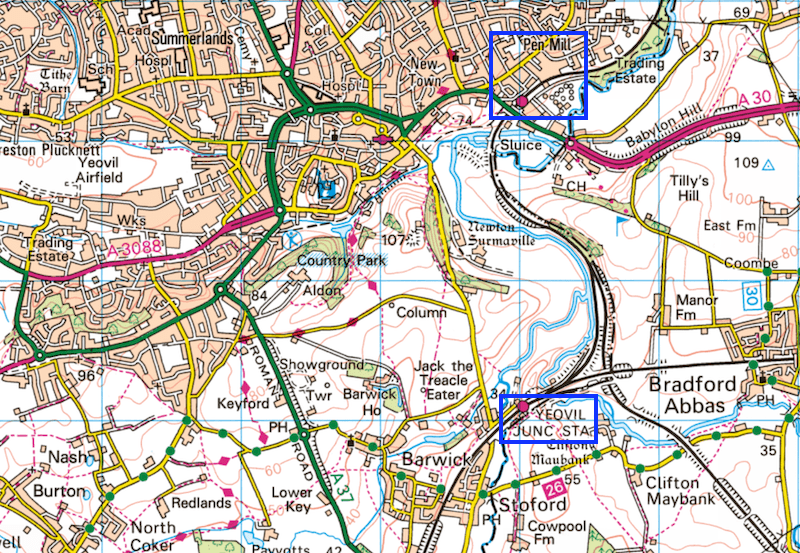
Yeovil Pen Mill, to the east of the town centre (and like in Canterbury, almost exactly due north of Junction on the same line of longitude – see above map) was opened by the Great Western Railway four years earlier in 1856 on what’s now known as the Heart of Wessex line as featured in my visit to Dorchester (located further south on the line to Weymouth) in February.
As you can see from the diagram below, taken with acknowledgment from Wikipedia, a short connection between the two stations was first introduced in 1864 with another one added in 1943. It’s used as a diversionary route for GWR trains between Exeter and Paddington and South West Trains started to regularly use it to run a few trains a day on its line from Waterloo to Salisbury continuing via Westbury, Frome and Castle Cary to reach Yeovil Pen Mill before using the connecting line to Yeovil Junction where they terminate, and vice versa in the reverse direction.

Let’s pay a visit to Yeovil Junction first. As you can see, it hasn’t got the most inspiring of station entrances.
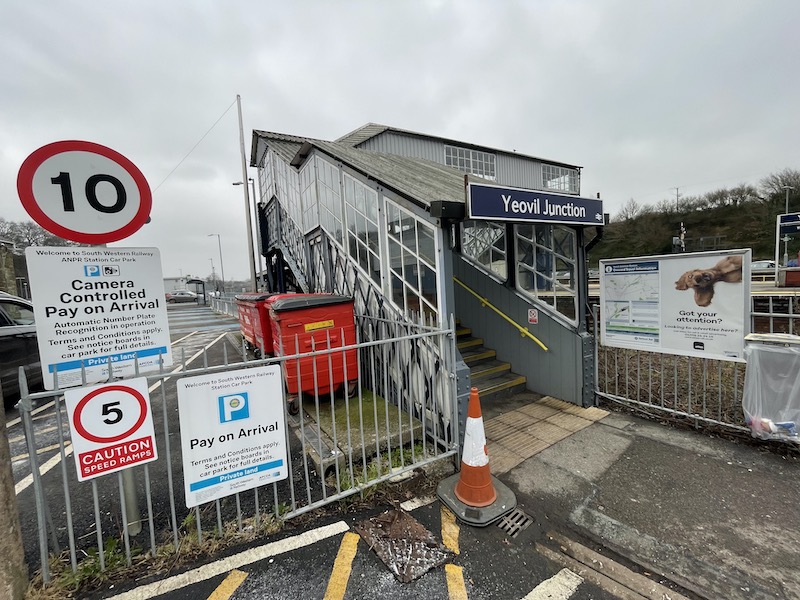
No roadside station building greets you, just a footbridge and a row of bright red commercial waste bins.

However, once on the island platform there are some rather nice historic features including this rather lovely two-faced clock…

… and a retro style map portraying some local history and welcoming you to the station.
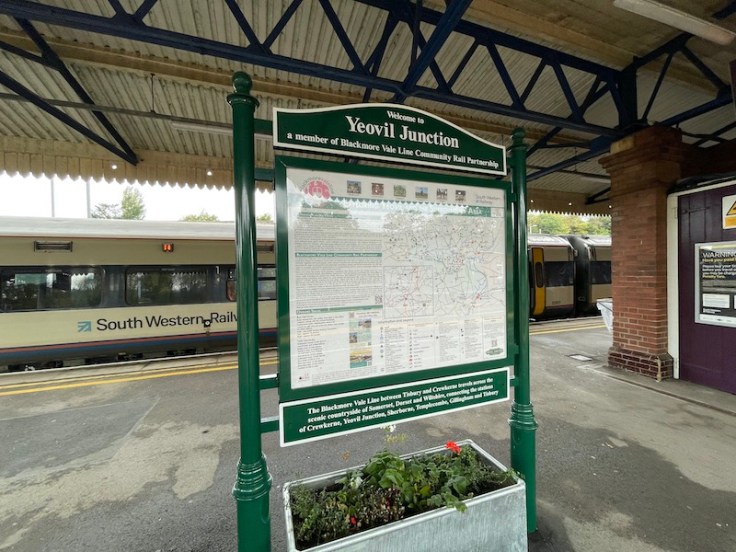
The map highlights a circuitous walking route between the two stations for those with plenty of time on their hands.

The ticket office is located next to the waiting room on the platform with a window into the waiting area…

… which has seats around its other three sides.

Elsewhere on the platform there are smart card readers…

… and a café with a seating area.

There are toilets…

… and some nice foliage planters located at various points.

A substantial area south of the live tracks …

… is given over to the Yeovil Railway Centre.
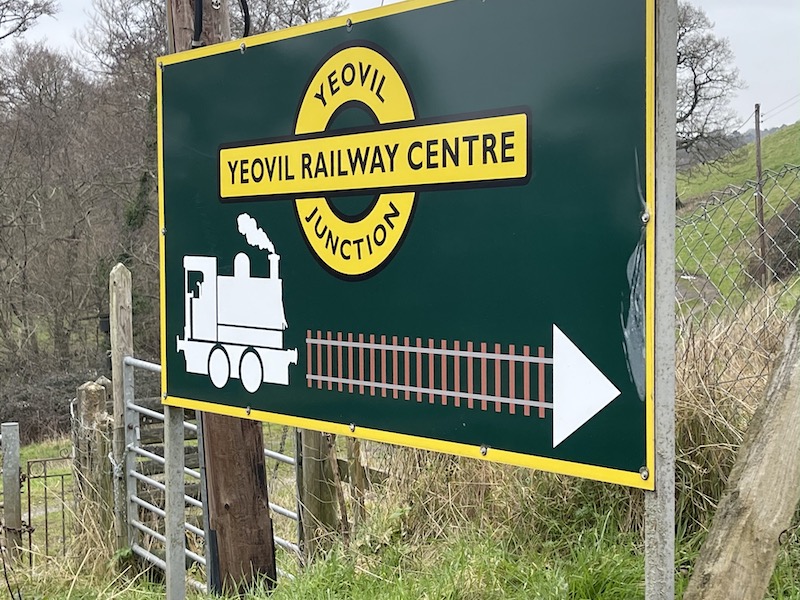
This Trust owned heritage centre (to the right in the photo below) is home to a small number of steam locomotives, one of which is owned by the Trust and offers driver experiences as well as public rides on steam running days.

More details can be found on the Centre’s website.

As well as being home to two railways stations, Yeovil is also famous for being “The Home of British Helicopters” with manufacturer Leonardo based in the south of the town.

Alighting from an arriving train at Yeovil Junction passengers leave, as they entered, via the footbridge….

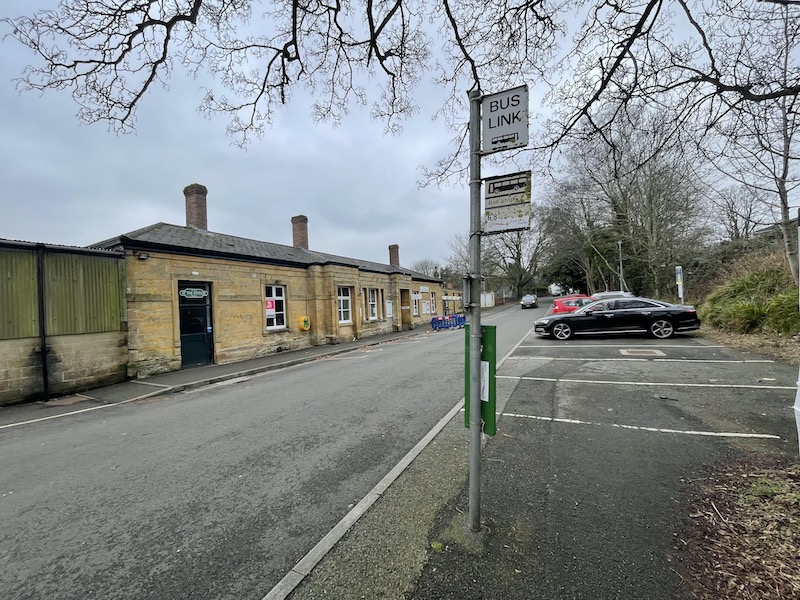
…. and the unassuming entrance, but at least there’s a reassuring sign confirming you’re heading in the right direction for a bus and taxi to take you to the town centre and Pen Mill.

Outside there are four well marked car parking spaces for those with disabilities, albeit there’s no lift access to the platform, and a bus shelter alongside a bus stop marking in the road.
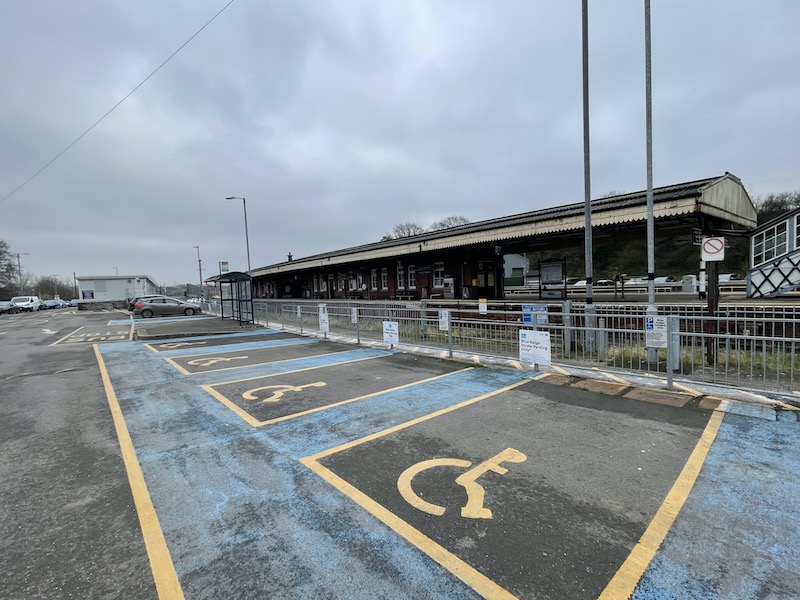
This is where local town route 68 calls by on its hourly circuit taking in Yeovil Junction station on its way to and from the community of Barwick (located to the south of the station)…

… then via the bus station in the town centre before serving a residential area to the north east of the town, continuing via the town centre, including Pen Mill station (pictured below).
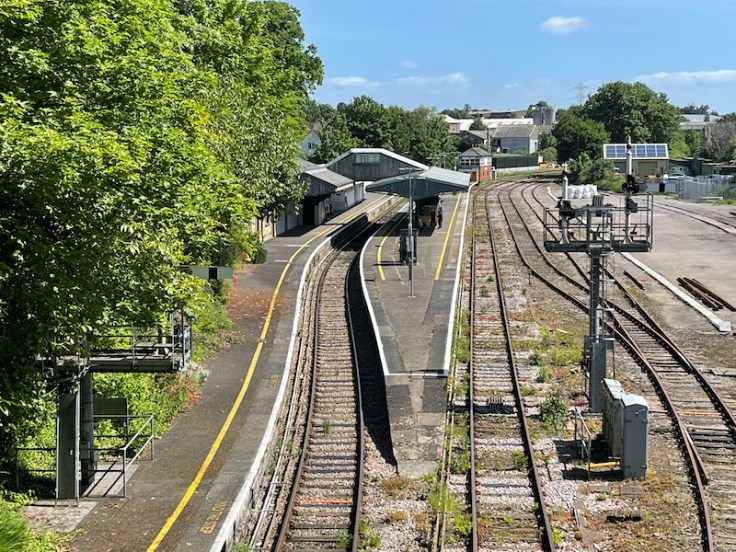
Its hourly frequency is not particularly conducive to convenient bus and train connections, but I suspect a higher frequency wouldn’t be justified by the numbers travelling.
Compared to Yeovil Junction, Yeovil Pen Mill (pictured above and below) offers a proper entrance building, albeit not one that would win any architecture awards.
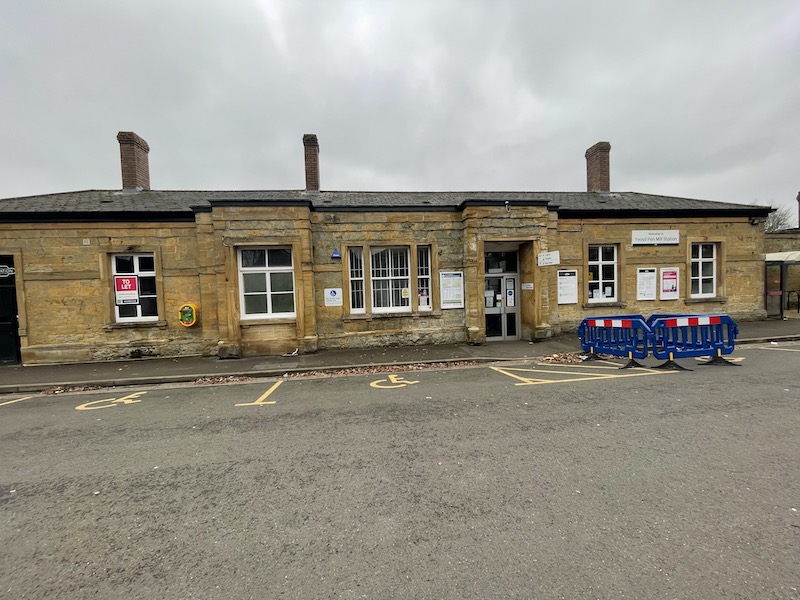
There’s a ticket office and small waiting area…

… which leads straight on to platform 1 for trains heading north towards Castle Cary and Frome as well as SWR trains heading south on the connecting line to Yeovil Junction.

The station has the same GWR operated Heart of Wessex branded two-hourly service between Weymouth and Bath, Bristol and Gloucester as described when we visited Dorchester West in February which is 34 minutes south down the line.
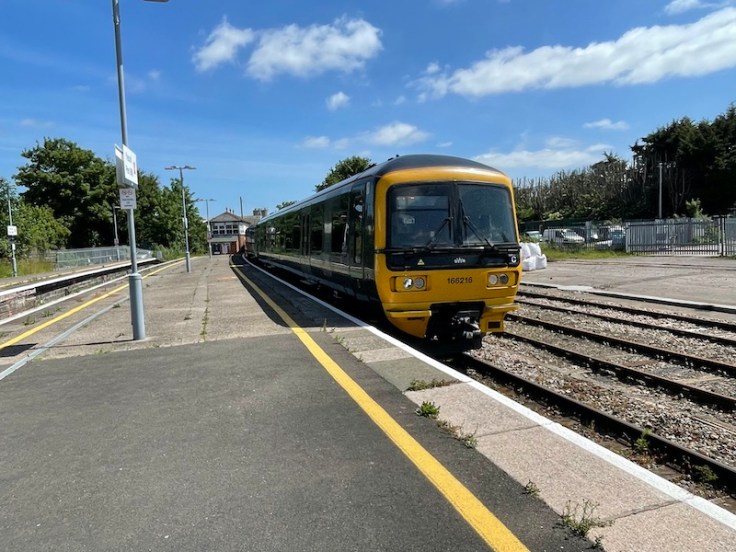
But it also sees four South Western Railway trains a day heading back via Castle Cary, Frome and Westbury to Salisbury on Mondays to Fridays oddly timed at 13:45, 14:59, 19:36 and 21:52. (One of these is shown below in platform 1 at Pen Mill). No such journeys run on Saturday with just one on Sunday at 09:53. These all come from Yeovil Junction as described earlier as well as two shuttle journeys on Mondays to Fridays.

Platform 2 faces the same tracks as platform 1 but, as far as I can see, isn’t used for boarding and alighting, whereas platform 3 on the other side of that platform is used by southbound trains to Weymouth.
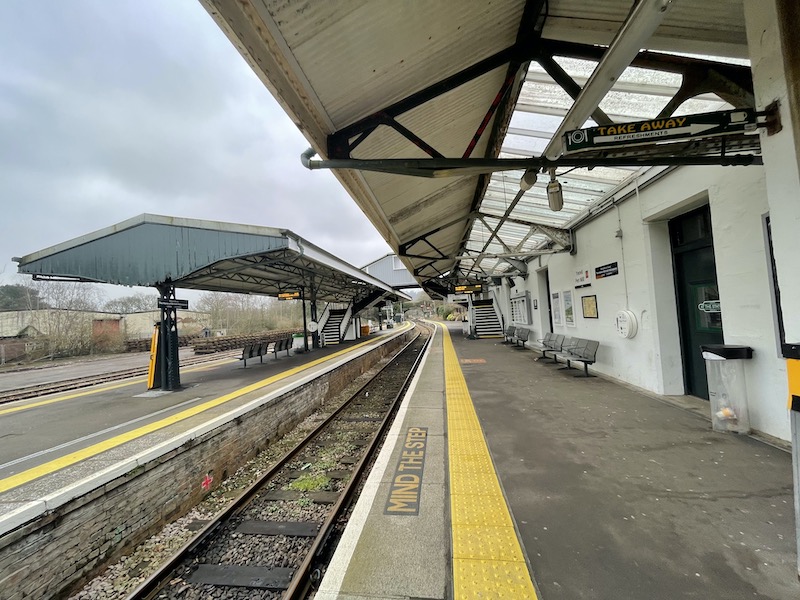
There’s a footbridge linking the station’s exit/entrance on platform 1 with platform 3 but sadly no step-free access.

There’s a lovely signal box at the northern end of the island platform…
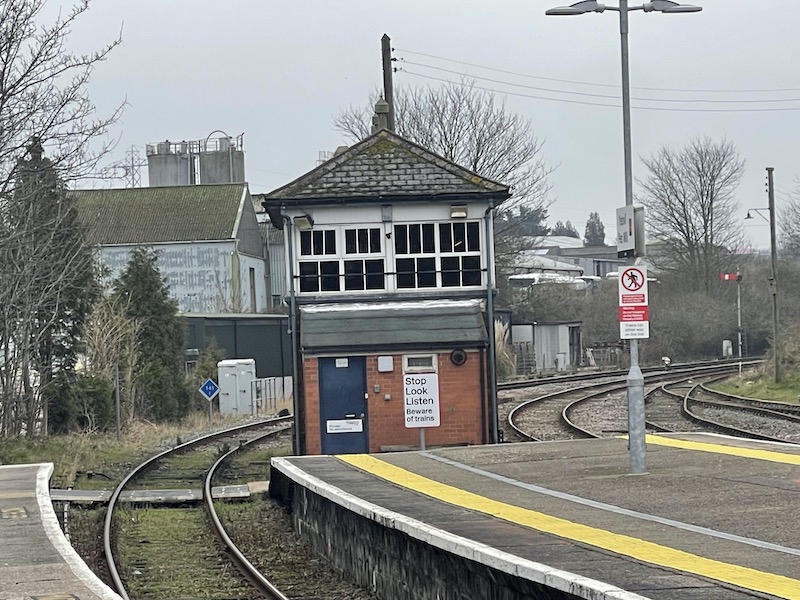
…with traditional style signals at the southern end of the platforms.

One final point on those SWR trains which operate via Castle Cary and Pen Mill. when I was in Andover recently I noticed the station departure boards show a westbound train heading to Salisbury where it splits with the front portion continuing to Exeter St Davids direct via Yeovil Junction and the rear portion to Yeovil Junction via Frome and Castle Cary has the latter section shown as terminating at Castle Cary, so sensibly Yeovil bound passengers don’t take the portion making a longer journey.
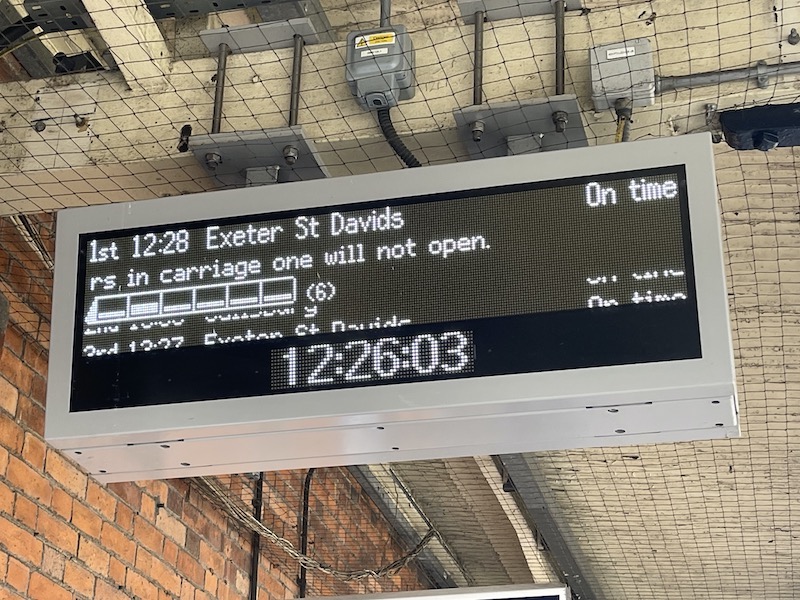

Howver those with time on their hands might enjoy the scenery on that longer journey!
All in all Yeovil enjoys a lovely pair of provincial stations which are always a pleasure to visit.
Roger French
Did you catch the seven previous blogs in this series? 1: Hertford; 2: Canterbury. 3: Wigan, 4 Dorchester, 5 Windsor, 6 Wakefield, 7 Reddish.
Blogging timetable: Bonus blogs are appearing daily over Easter and then TThS
 BusAndTrainUser
Both stations seem to be a bit short on double arrows!
LikeLike
Plenty of old semaphore signals though. Must be quite expansive to keep filling up the oil lamps
LikeLike
Do not forget Reddish in Stockport Cheshire.
Two stations North and South although South only has one train a week.
LikeLike
LikeLiked by 1 person
It’s a long time since the remaining semaphores had oil lamps. They’re electric lamps nowadays.
Unlike the stupidly bright LED signals that Network Rail loves so much, they also have the advantage that they don’t blind the drivers at night!
LikeLike
Hi Roger,A fascinating piece
LikeLiked by 1 person
The signal lamps were electrified a long time ago. The bus photographed isn’t the regular one which normally is a Mercedes-Benz Sprinter EVM Cityline run by Somerst Council. There are barrow crossings for access, YJ is unlocked on request by the station staff, at the moment staffing appears OK, YPM is a bit erratic but the signal box (originally planned to be replaced a decade plus ago) is manned 24 hrs. YJ is on the list for an accessible bridge, but probably near the bottom of the list.
LikeLiked by 1 person
I am sure you are right that a bus between Junction station and the town centre would probably not be a commercial proposition on its own. But how can rail managers be so unconcerned about what happens to their passengers once they get off the train? What happened to ‘putting the passenger/customer first (which commercial operations are supposed to do by definition, apparently)? It is hard to believe that a well designed, reliable bus-meets-train would not generate substantial amounts of extra custom, but apparently (from the statements of GWR) rail managers are not interested in having a sensible conversation with bus managers about how to share the extra revenue generated.
Crazy! I’ve just spent a happy hour on GoogleMaps journey planner finding out that for most of the day it’s quicker to travel by car between London and Yeovil; that the best rail offers include a twenty minute walk to/from Pen Mill station, or a bus from Castle Cary station; that Berrys’ coaches compare very well on time with rail; that no competitive journeys are routed via Junction station – any SW main-line journeys use bus connections to/from Sherborne, Templecombe or even Crewkerne stations!
Please, rail managers, just pick up the phone and get talking to your bus manager colleagues about really putting the passenger first.
LikeLike
Yeovil Junction generally has an hourly train service . . . xx28 from Exeter to London; xx38 from London to Exeter, The rail line can be subject to quite high delays, mainly caused by the long single line sections. Trying to timetable a bus route to serve the regular train times AND account for delays is challenging.
The existing bus timetable (Route 68) generally has buses arriving at the Junction at xx20 and departing at xx45 . . . all journeys serve Yeovil Pen Mill at xx05. I would submit that this is pretty much the best that can be achieved . . . if the trains were timetabled to pass at the Junction, then this could be improved (they’re actually scheduled to pass at Sherborne, which is in the middle of a double track section, and provides some resiliance in the event of late running). I’m honestly not sure how the bus times could be improved upon without using two buses, chasing around 10 minutes apart!!
The history of Route 68 over the last 20+ years is that all the local operators have had a go at running it . . . none could make it pay, which I suspect is why Somerset Council run it now . . . probably the lowest cost achievable.
If passengers don’t like the wait . . . there’s always a taxi!!
LikeLike
Long single track sections are the bane of the Exeter line. There’s no excuse for this it’s just penny pinching. It’s possible to provide a 15 minute interval service on a single track line with regular spaced passing places, plenty of examples in Switzerland.
The payback on reliability and a frequency enhancement to half hourly would do wonders here to grow the market. Especially as the A303 can be horrendously busy, and we are supposed to be doing climate change mitigations.
Peter Brown
LikeLike
The 68 has had its frequency reduced recently – removing a mid-afternoon service which would have connected neatly with arriving services from Waterloo.
LikeLike
A shuttle bus service that does DRT things in the gaps might be the sort of basket case that could attract funding. Luke
LikeLike
Never happened. Not in BR days, not in Big Four days, and most certainly not now. The pre-nationalisation railway carried passengers as an adjunct to freight, BR was too broke to worry about it and the post-privatisation TOCs just do the bare minimum to comply with their contracts.
Besides, ‘everyone knows’ that people drive to and from stations. Buses are for losers, remember? 😦
Phone? Nobody uses phones nowadays. It’s all done by email. But regardless, anyone who worked for/with First, Arriva or Stagecoach will know that the rail and bus elements of the groups simply don’t consider working together.
And why should it be the rail managers who have to make the running, anyway? Bus company managers have commercial freedom; rail managers don’t.
LikeLike
SWT used to publish a fine book timetable which certainly had many bus connections within it.
Why did it cease? SWR does not publish timetables at all, though they are still online in the same format so could easily be printed. Why is life made so difficult nowadays? Surely carrying a leaflet or A 5 size book on a day out is so much easier than consulting a phone all through the day?
malcolm chase
LikeLike
Printed leaflets and A5 size booklets cost money and running railways nowadays is all about (saving) money .. money … MONEY!
Observer
LikeLike
According to bustimes.org there are no buses serving Yeovil Junction at all.
LikeLike
I suspect because Somerset Council hasn’t provided the appropriate data to Bus Open Data. Traveline does have it, but maybe their data comes from elsewhere?
The single-tracking of the West of England main line was done in the 1960s; partially because Dorset CC were uninterested in saving the line . . . it was quite close to full closure! There are plans every 10 years or so to reduce the amount of single track, but they always fail, because the line just isn’t well-used enough, and the councils really aren’t fussed . . .
LikeLike
Passengers are regularly dumped at Yeovil Junction Station, when there’s issues, with late running, flooding, landslides, trespass etc. Sometimes when the station isn’t manned, although there are traincrew in the depot. Whilst control send the train back to London to get back on schedule and leave passengers to wait for the next service. It’s bleak in the winter with no facilities. The service often seems to get worse during the day.
The SC 68 service does a school run in the afternoon, which is very common in many areas of the country as Roger has highlighted in the past. SC is in state of chaos due to becoming a unitary authority and almost bankrupt, there is a Bus group fighting for better services with some success, Yeovil never appears to be a priority as far as County Hall in Taunton are concerned, there’s now the 376 hourly service to Bristol 7 days a week and as of today the 51 does provide a Sunday and Bank holiday service for the first time in a generation.
LikeLike
Interestingly, the National Rail, SWR and GWR websites all state that Junction and Plat 3 at Pen Mill are accessible by barrow crossing with assistance when the stations are staffed. Was there any sign on the ground that was the case? Mind you, NR and SWR also state there is no disabled toilet at Junction, when you have clearly photographed one, and SWR state it is not served by buses, so they clearly have little faith in the 68!
LikeLike
Those canopy ends at Pen Mill badly need a paint job! Graham L.
LikeLike
disabled toilet in middle platform but no disabled access across the bridge…. Shades of Monty Python here!
LikeLike
For an account of Yeovil’s three stations and their operation in the good old days, see page 134 of Adrian Vaughan’s elegiac Signalman’s Morning^. It’s sad to think that he’s 84 now and all of the old stagers he met, learned from and wrote so affectionately about are long gone.
^If you haven’t a copy, find one.
LikeLike
I noticed this today:
https://www.bbc.co.uk/news/articles/cj0zy5r36z5o
LikeLike
It’s quite a mixed bag of the way they advertise the Pen Mill trains at London Waterloo.
Weekdays there is the 07:50 that do terminate at Pen Mill. The 09:50 actually terminates at Yeovil Junction but is advertised as Pen Mill sensibly. Oddly enough the 11:20 which I assume that was on your photos at Andover that advertise the rear to Castle Cary, do advertise Exeter St Davids & Yeovil Junction at Waterloo.
In the evening peak, the 16:50 is advertised as Frome via Yeovil Junction which actually terminates at Westbury (much quicker changing at Salisbury)
Not mentioning Pen Mill, there is a service that splits twice (19:20), rear 3 to Salisbury, middle 3 to Yeovil Junction and front 3 to Exeter.
^CD
LikeLike
Two points:
A Henthorn Stott
LikeLiked by 1 person
Thanks for the suggested wording; now updated.
LikeLike
Will Oulton Broad’s two stations be featuring ?
LikeLike