
Saturday 22nd February 2025
Neither of Dorchester’s two railway stations are particularly busy when compared to the six stations featured so far in this fortnightly series (Hertford, Canterbury and Wigan) but Dorchester South, which arrived on the scene first, in 1847, beats its near neighbour, Dorchester West, by virtue of hosting South Western Railway’s twice-an-hour service between Weymouth (in one direction) and Poole, Bournemouth, Southampton and London Waterloo in the other.
Dorchster West, on the other hand, which opened 10 years later in 1857, sees Great Western Railway’s Heart of Wessex line link Weymouth and Yeovil, Frome, Westbury, Bath and Bristol every two hours, with most journeys continuing to (and from) Gloucester.

It doesn’t take much more than five minutes to walk between the two stations and interestingly both comprise two platforms on a section of double track with trains arriving from the east (SWR at Dorchester South) and north (GWR at Dorchester West) on single track as shown on the Ordnance Survey map extract above and in the photo below looking north from Dorchester West.

The stations present an interesting comparison between a Brunel built GWR original (West) and an ex-Network South East rebuild of an 1847 original (South).
When I visited both stations last weekend it was interesting to see the final stages of work to provide improved level access to Dorchester South station with a newly revamped ticket office about to reopen from last Tuesday (18th).

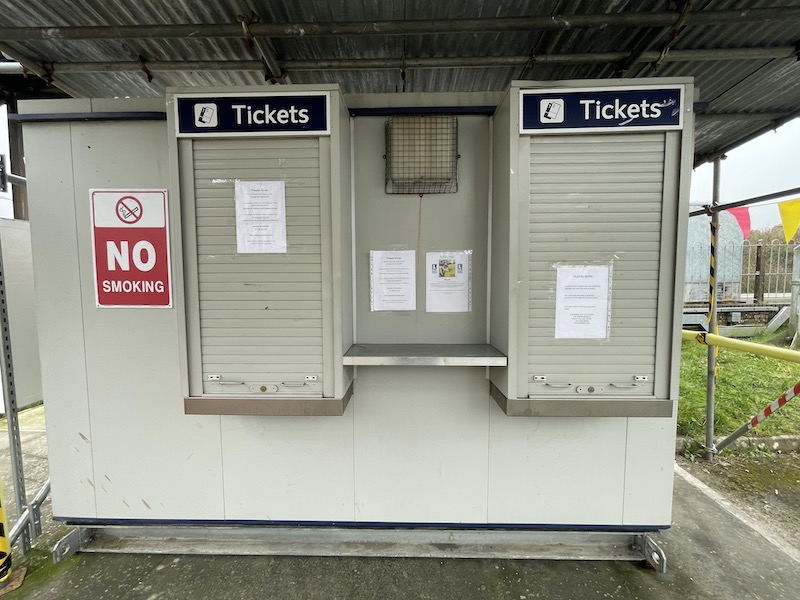
While this work had been in progress a temporary ticket office was installed alongside the London bound platform 1…

… which was closed over last weekend and on Monday, in preparation for the move into the improved facilities…
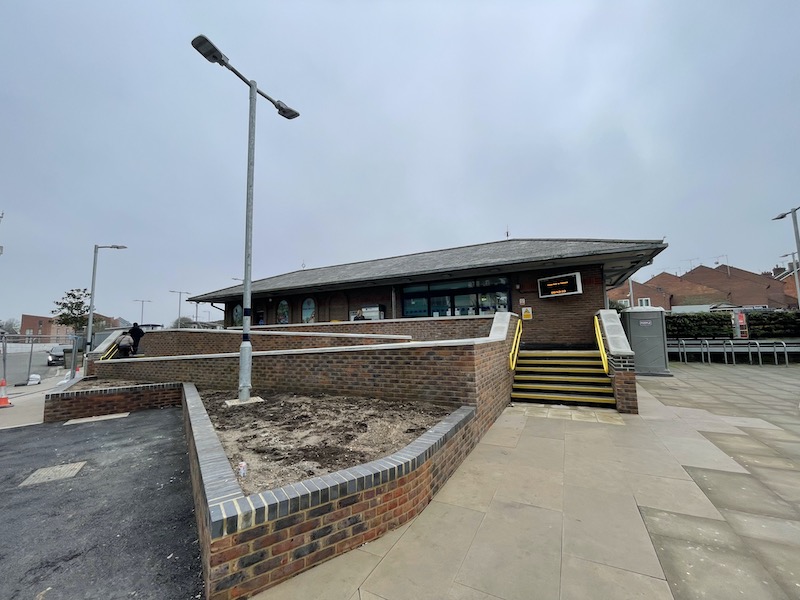
… which incorporate improved steps and a ramp leading up to the building.
However, while access to platform 1 is easy, there’s still a footbridge with no lift facilities to the Weymouth bound platform 2, although there is easy access from that platform into Cromwell Road as you can see in the photograph below by the side of the footbridge steps. At one time Weymouth bound trains would use the (London) platform 1 to set down and pick up to make for more convenient access, but this is not so easy now the frequency is two trains per hour.
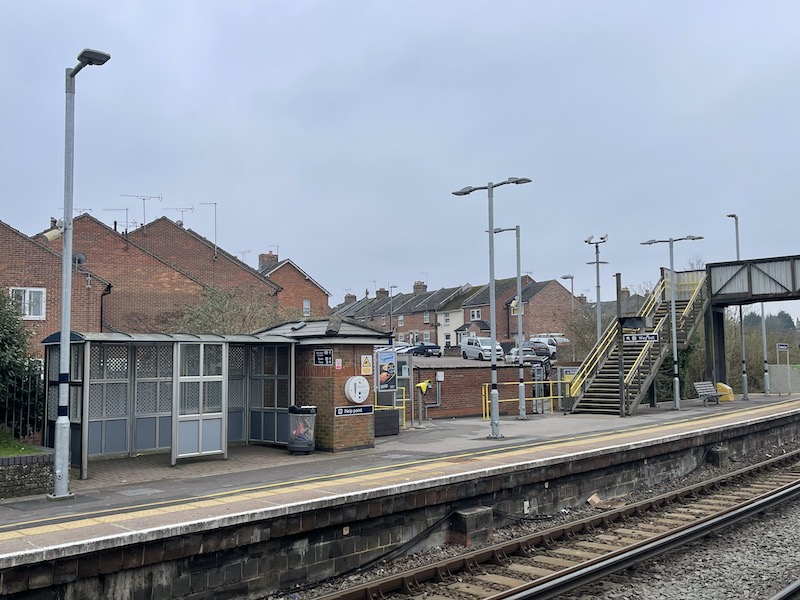
Dorchester South has been through many rebuilds in its life but when the station first opened (originally named just Dorchester) it was built to provide an intended through service to Exeter with the tracks continuing west and crossing the GWR tracks at right angles. This never happened and eventually the lines from South continued on a sharp curve left to join the GWR line to Weymouth.
Barry Doe, who knows a thing or two about Dorset, his local patch, kindly gave me the background to the rather intricate history of how trains used to access Weymouth from Dorchester South which I’d been puzzling over knowing reversing movements were involved.
Barry clarified “from the time the line was extended to join the GWR line to Weymouth it was always a double track through route as now. The only difference was there were no platforms on that track so all trains had to go into the old original ‘terminus’ first in each direction. That would have meant down trains crossing the up at the throat to access the platform. They would then have had to reverse across the throat to the down line, then reverse again to carry on to Weymouth.
“Once the down platform was built in 1878 everything was exactly as now in the down direction, with through trains calling at the down and on to Weymouth.
“However, up trains had no platform until 1970 and trains would come from Weymouth and pass the station then reverse into the old terminus to set down and pick up, then reverse again and proceed to London. There were no run-rounds and the engine remained at the London end and would have been hand signalled back into the platform.
“There was a subway to connect platforms but I think it was from 1989 (when the old terminus buildings were demolished) that it was replaced by the current bridge connecting the up and down platforms and access to the up was direct from the road as now.”
Barry also added the following snippet of curiosity: “that as part of the deal for the LSWR to lay mixed track over the 7 miles from Dorchester Junction to Weymouth (the GWR being broad gauge) the GWR insisted on laying mixed track for 7 miles east of Dorchester South. As that latter 7 miles of track literally ended in the wilds between two stations it was never used!” Fascinating.

As part of the work necessary for electrification in the late 1980s a new booking hall was built on the curved platform which is the one that’s just been refurbished. Both platforms have a smattering of wooden seats…
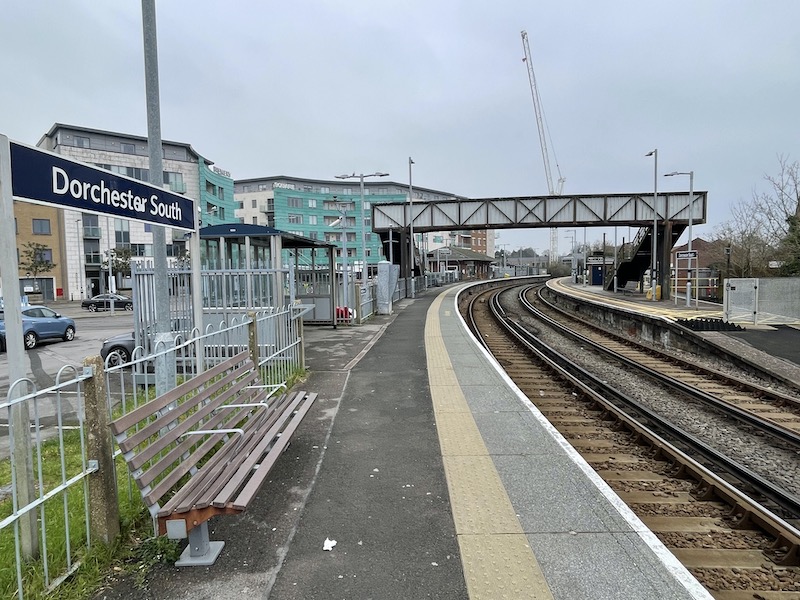
… and traditional old-style shelters with perches…

… or more wooden seats…
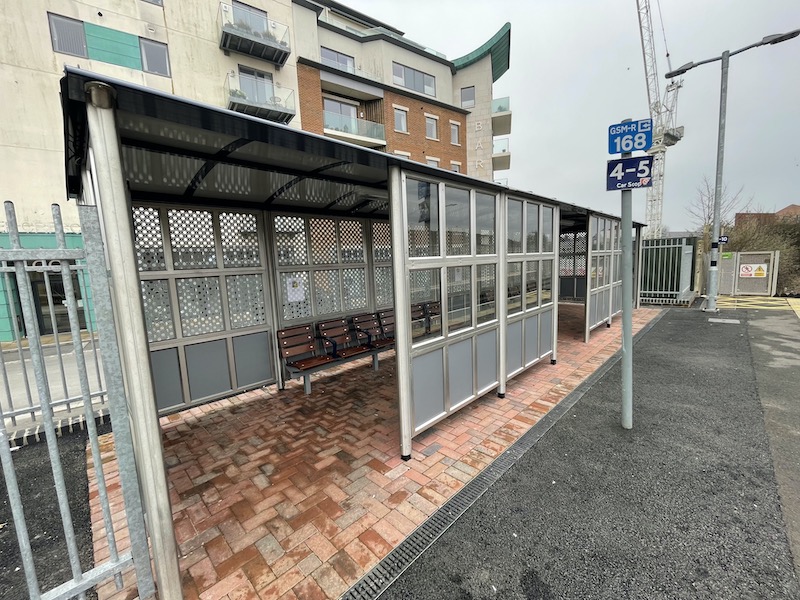
… or no seats at all. Unusually the shelters are quite long providing a good amount of under cover waiting areas on the platform but I see from the poster explaining the new accessibility arrangements, “new and improved shelters” are being provided.

Peering inside the newly revamped ticket office…

… I see there are more seats being provided as well as toilets.

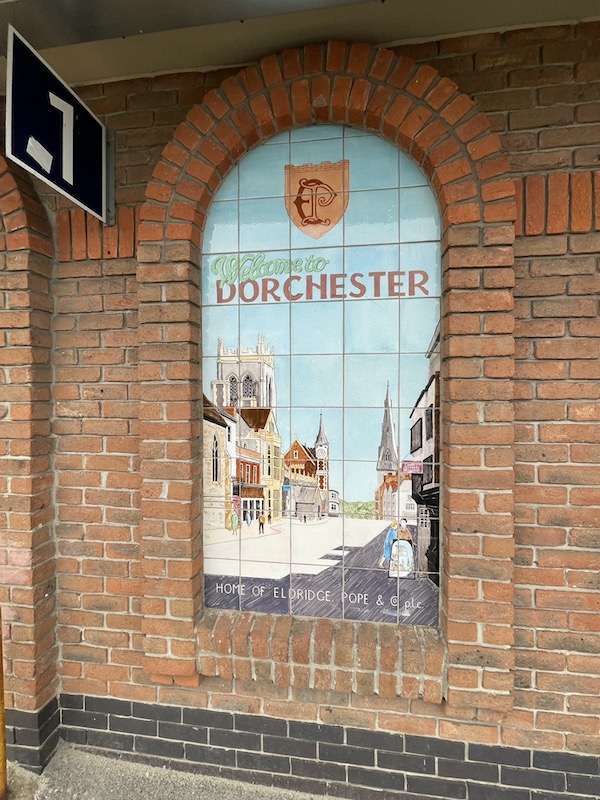
Outside the ticket office you’ll find a couple of rather nice mosaic images including one celebrating the famous Dorset born poet Thomas Hardy…

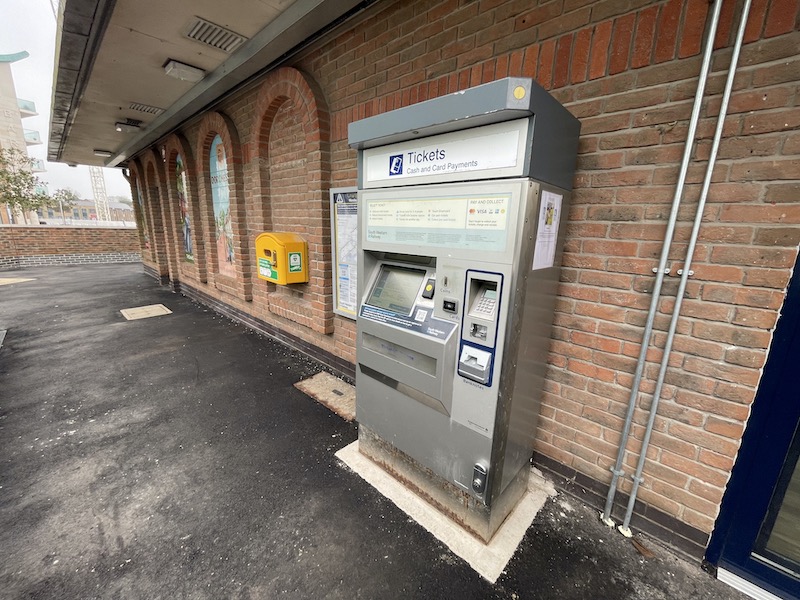
… as well as the station’s only Ticket Vending Machine.
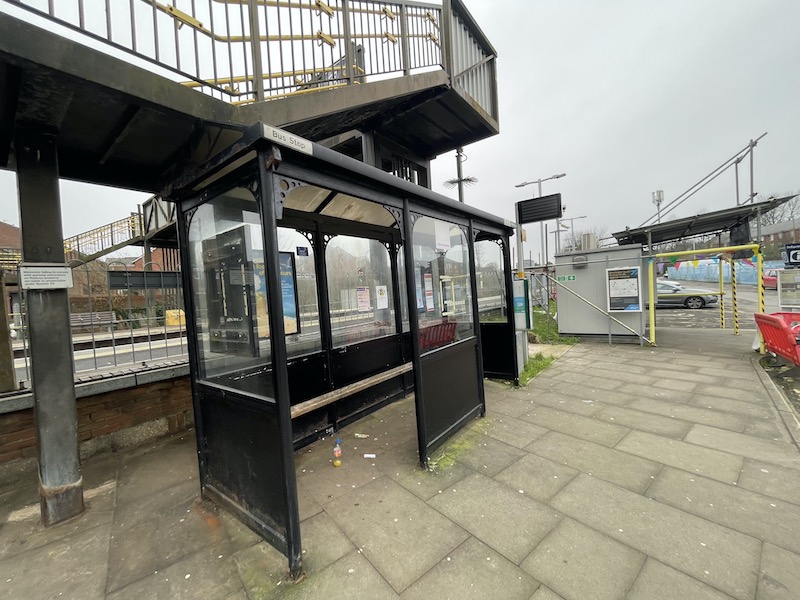
Outside the station there’s a newly arranged area for taxis, short stay parking and a bus shelter for buses on routes 6 (Poundbury circular), CR8 (Blandford-Weymouth) and Jurassic Coaster X51 (Bridport-Weymouth).
The first train to London Waterloo leaves at 06:07 (arrives 08:48) and after 08:33 the two trains an hour arrangement is for an all stations stopper at 33 minutes past the hour (taking two hours and 47 minutes to Waterloo) and a slightly quicker train at 13 minutes past the hour (taking two hours and 34 minutes). Last train to London is at 21:12 with the next three trains to Woking, Southampton and Bournemouth (being the last one at 23:22) respectively. Saturdays see a similar pattern between 05:52 and 23:22 and on Sundays there’s an hourly service between 08:00 and 23:10.
First train to Weymouth is 06:58 (Sundays 09:24) with the last train at 00:10 (Sundays 00:24) however, passengers wanting Weymouth can also use trains from Dorchester West, of course, but there’s much less choice with the two hourly frequency commencing as late as 08:10 (Sundays 10:16) and a last train at 22:55. In the other direction towards Gloucester trains run between 06:51 (Sundays 08:12) and 20:24/20:27/20:53/21:41 depending on the day of the week.

Not far down the tracks from Dorchester South in the westerly direction comes the junction with the tracks on the Heart of Wessex line with its trains serving Dorchester West, but there’s no direct connection between the two stations.

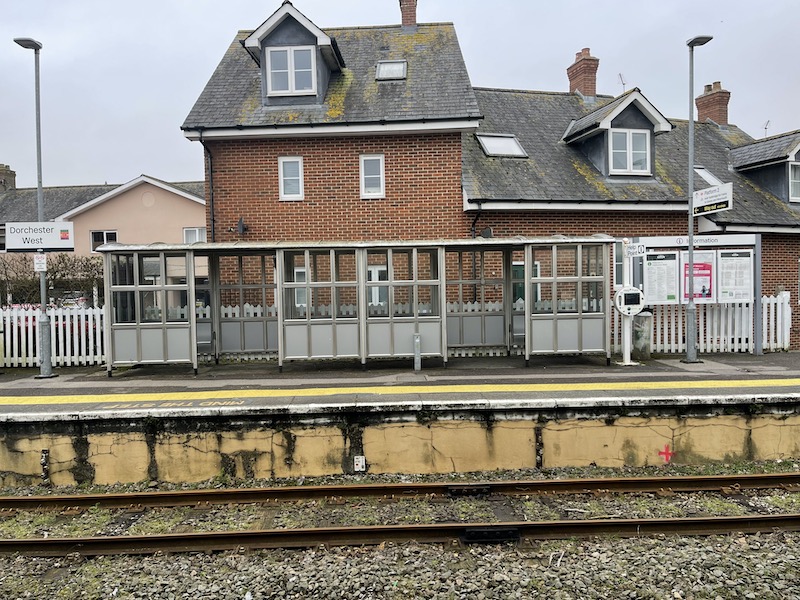
Unsurprisingly Dorchester West has far fewer facilities for passengers – there’s no ticket office, no waiting room, no ticket machine and no toilets. The former (and listed) railway building on the Weymouth bound platform 2 is now in the hands of Domino’s Pizza….
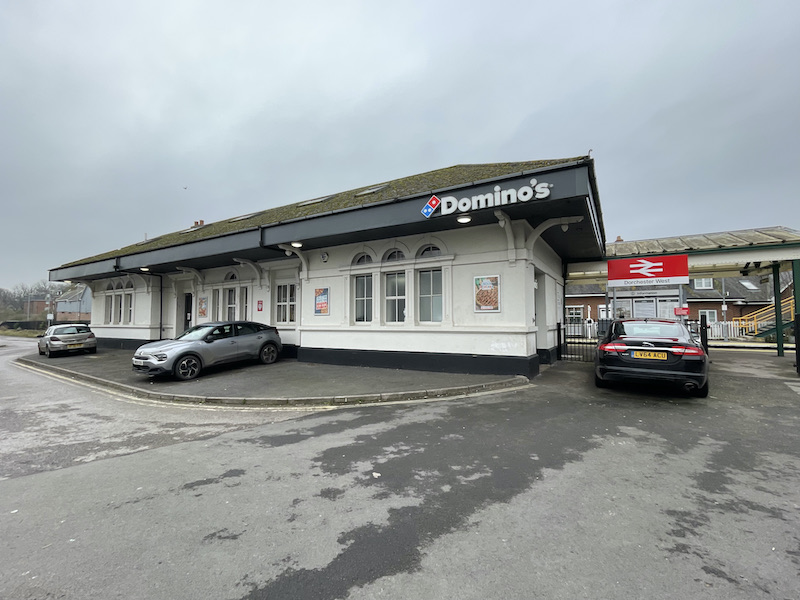
… which is handy if you want a pizza to take-away. Looking in from the platform window, there are many boxes ready to be filled with your choice of toppings too.

There’s a generous number of bike stands alongside the seats on platform 2…
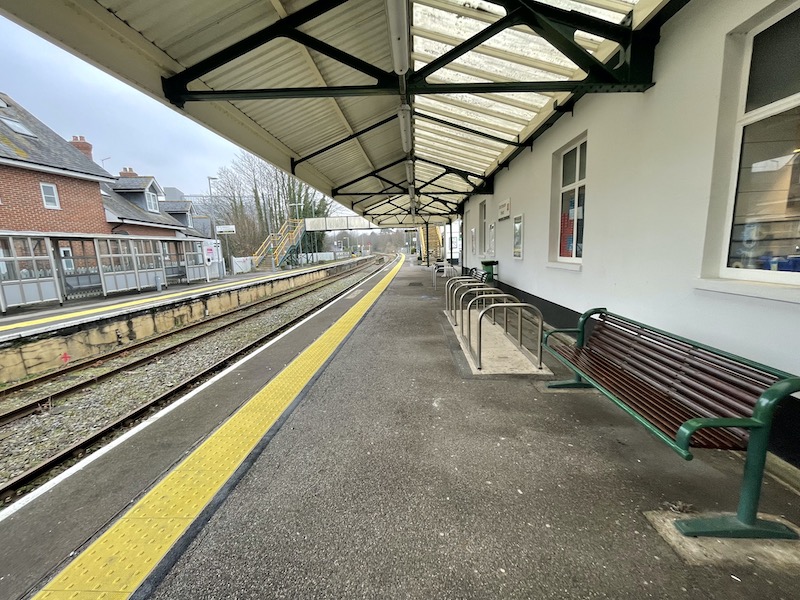
… and as you can see there’s another non-accessible footbridge between the two platforms but as well as platform 2 having level access, a new ramp was constructed a few years ago to give level access to the Gloucester bound platform 1 too.

Platform 1 has also seen a considerable amount of residential development built very close to the boundary…
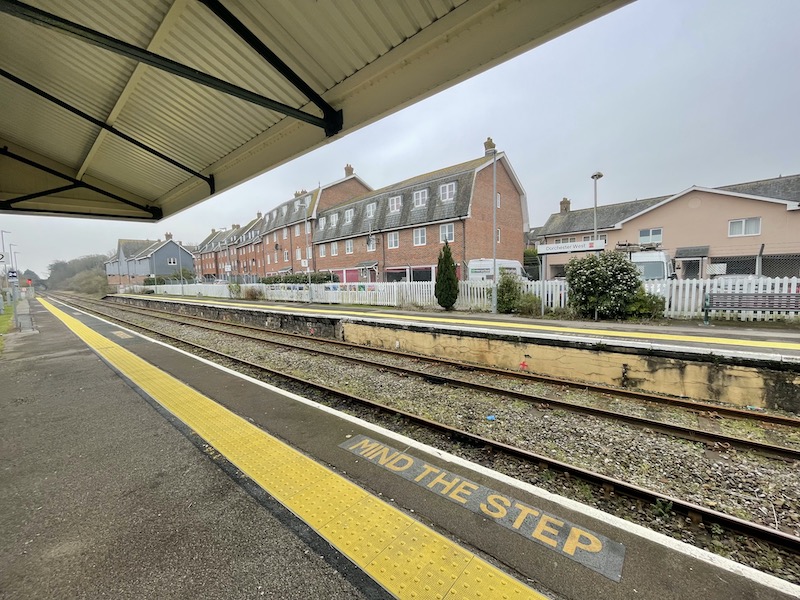
…which must make it very convenient to walk to the station for a train.

… albeit there’s no direct access to the shelter from behind.
The station has been adopted and is looked after by a volunteer group – Friends of Dorchester West Station – who keep the station clean and tidy, change the rubbish sacks and regularly weed, plant and maintain the garden areas as well as enhance customer information at the station.

And what an excellent job they do too.

As well as traditional old style bench seats on both platforms, there’s this rather nice original station name sign on platform 1.

All in all an interesting pair of stations for a lovely town.
Roger French
Did you catch the three previous blogs in this series? 1: Hertford; 2: Canterbury. 3: Wigan.
Blogging timetable: 06:00 TThS
 BusAndTrainUser
Very interesting!
Steve
LikeLike
I don’t know why Barry Doe says that trains running from Weymouth to Bournemouth ( and beyond ) needed to reverse twice to access the original ( terminus ) line at Dorchester South:-
“However, up trains had no platform until 1970 and trains would come from Weymouth and pass the station then reverse into the old terminus to set down and pick up, then reverse again and proceed to London. “
Having set down and picked up passengers at the old platform, they could then proceed forwards towards Bournemouth. Certainly, that is how I remember it from journeys to and from Weymouth in the early 1970’s ( and possibly the late ’60’s as well ), with just one reverse movement.
Nigel Frampton
LikeLike
I imagine that Barry was designating each of the 2 changes of direction as reversal.
Ian McNeil
LikeLike
Dorchester South also has an active “Friends” group supported by Purbeck CRP (although it isn’t in “Purbeck”). The new (long) waiting shelter on the Up platform replaces the old Parcels Dock, an unsightly metal structure demolished 2 years ago. The station has Access for All funding to develop a design for a step-free route between platforms but the funding to actually build something has yet to materialise.
LikeLike
That’s a replica sign at Dorchester West, although it appears to be on an original nameboard. GWR signs were made up of raised individual letters, not a “flat” printed sign as that one is (see the one at High Wycombe which I think has featured in this blog before). And this picture shows a BR Gill Sans era enamel sign in the same position:
https://blogger.googleusercontent.com/img/b/R29vZ2xl/AVvXsEhEzMhHy7vEcOCmCa56bfCX4Dsb12nmS2RMi81w1cytYuX9JSMfQ2LZuV0XpPi23rbgase8HMu2TXxpag3Lak1eVOFk9GjSSqDofQ10GABf_q5Spewck9F4kviJaMoJhKpG4k9KI6erTQE/s1600/Dorchester+West+7.8.1973+1.jpg
LikeLiked by 1 person
In the late ’50s I lived with my mother in a village about 1.5 miles from Bridport station. We occasionally visited relatives in London which required a walk to the station along a narrow, winding country lane, a train to Maiden Newton, another train to Dorchester West, a walk to Dorchester South and finally a train to Waterloo. I used to be fascinated by the reversing manoeuvre of the London-bound train. The walk to and from Bridport station would sometimes be in the dark, a scary thought today, but in those days there was little traffic.
LikeLike
Yes, this brings back memories. My grandparents lived in Bridport and the homeward journey to Coulsdon involved catching the branch train to Maiden Newton and then down to Dorchester for the walk across to South station. There we would wait until the Bulleid Pacific hauled train from Weymouth would pass the Down platform, before reversing into the Up platform to pick us up. It was a memorably unique part of our journey home.
At least our platform was straight, rather than being on the curve, but it was operationally cumbersome.
Peter Murnaghan
LikeLike
About 20 years ago the Dominoes at Dorchester West was an Indian Restaurant, and very good it was too .
One thing I feel I should mention as a southerner now living in the north west is how late trains run from London compared to up here . For example the last train to Weymouth from Waterloo , a journey over 3 hrs 30 minutes , is at 21.35 on a Saturday, and Poole a journey of 2hrs 39 minutes has a last Saturday train at 23.05 . By contrast last direct services from Euston to Liverpool and Manchester, two major cities are 20.12 and 21.01 respectively despite neither journey being over 3 hrs .
LikeLike
Yes, we are well off on the SWR main line. I have often been on business trips by rail to northern cities, and been very grateful that even with relatively late arrivals into Euston or Kings Cross, I could still get home that night, and with a reasonable frequency of services out of Waterloo too!
LikeLike
People around the South East who benefit from London-centric scheduling designed to handle the numbers around the metropolis really have no idea how poor the rest of England’s evening public transport is.
Over in Lincolnshire if you want to catch a train from Lincoln to Grimsby on a Saturday, the last one is at 18:30. Yes, half-past-six. Going the other way towards Nottingham, rock up at Lincoln station at 21:45 and you’re stuck; you’ve already missed the last one on Saturday. During the week there’s a 23:06 ‘late train’, but that’s regularly a replacement bus which has started from Cleethorpes so won’t even reach Lincoln until after midnight. I assume it gets to Nottingham around breakfast time if the driver actually serves all the small stops it’s supposed to.
It’s better than it used to be, sort of; it’s not too long ago that the last train of the day from Peterborough to Lincoln via Spalding (Mon-Sat) was at 16:25! (It’s now 23:10). After that you had to travel via Newark, usually with a change and dodgy connections, sometimes involving the walk between stations.
And buses? Forget them if you want an evening out. They go to bed by 18:00 in and around Lincolnshire, with a few (often BSIP funded) exceptions.
LikeLiked by 1 person
Just to add that there’s a brilliant short video about visiting Dorchester by train on the Purbeck CRP website here: https://purbeckcrp.org.uk/dorchester-south-railway-station/ This page also has a picture of the now-demolished Parcels Dock – must tell Steve (our CRP officer) to get it updated!!
LikeLike
Nice film, Tony.
Cheers, Peter Murnaghan
LikeLike
I was in Newark on Friday. There are two stations there. The Travelodge is almost new and The Prince Rupert is an good place to eat.
Hope that this helps.
Andrew
LikeLike
Thanks for the prompt Andrew; they’re on the list to visit sometime in the coming weeks.
LikeLike
Enjoyed the feature on Dorchester, Roger.
It reminds me of day trips to Bournemouth, Dorchester and Weymouth from Southampton in the early 1970s, when the southwesterly extent of third rail electrification was Bournemouth (actually just beyond Branksome, for access to Bournemouth TMD and stabling sidings).
The solution to through running was innovative, for the time.
The 12-car Waterloo – Weymouth trains consisted of two motorless 4TC units propelled by a powerful 4REP set at the London end, controlled from the cab in the leading 4TC unit.
At Bournemouth a Class 33 Bo-Bo awaited to haul one or both 4TC sets onward to Weymouth.
For the return journey, the Class 33 propelled the 4TC set(s) back to Bournemouth, again controlled from the cab in the leading 4TC unit, where the 4REP (or 4TC + 4REP) awaited coupling, and the Class 33 was decoupled to wait its next trip to Weymouth.
The curved up platform had only relatively recently replaced the original up terminating platform, which trackless, was still connected to the down platform by a subway, as I recall.
LikeLike
On 07/10/1974 I rode a first generation DMU from Weymouth to Dorchester West during a Southern Region Rover tour as this was permitted on the ticket so would have done Roger’s walk between the two Dorchester stations on that occasion. On 01/08/2009 I revisited Dorchester South station on a JDW train when SWT was having one of its Summer Sales with a maximum CDR fare of £10.00.
LikeLike
Dominos Pizza? I remember when there was a really good Chinese restaurant at Dorchester West. Shame.
LikeLike
The bus shelter at South hasn’t yet been designated a transport hub, then?
LikeLike
Does anyone have a list of all the locations on national railway planner where “all stations” is a search option, to use as a “ticky list” for Rogers future travels (allowing for some cases where All stations might not reference the same town or city name so may not equal 25 that Roger set for himself, unless that is how he generated the list!)
Just for fun, I looked up the comparative journey times/costs from Weymouth to Dorchester by train and also by high frequency bus (Route 10) which also does the journey.
MilesT
LikeLike