Saturday 21st September 2024

We’re now into the top three of this year’s run down, month by month, of Britain’s busiest railway stations, using the Office of Road and Rail’s statistics for the year ended March 2023. Which brings us to Waterloo.

Pre-pandemic and pre-Elizabeth line, Waterloo always proudly held the top spot, but nothing’s for ever, and it’s had to concede its previous domination to two others, as we’ll see in the next couple of month’s blogs.
Personally, it’s my least used London terminus station, as living in Sussex when needing to travel to destinations served by trains using Waterloo in south London, Surrey, Hampshire, Dorset, Wiltshire and the south west line to Exeter, I tend to either change trains at Clapham Junction or use the Coastway West line via Havant and Southampton.
However, although less familiar with all the nooks and crannies as other London termini, I’m always impressed with the splendour of the station and its sheer size not least, with the platforms previously used by Eurostar trains, the station boasts an impressive 24 platforms.
It also sits at a high level above a mysterious undercroft which I have no knowledge about other than an aspirational project announced earlier this year to create a new southern entrance for the station and turning part of it into a St Pancras style retail and dining area.

In that regard it’s interesting to see a fairly recent development in the area under the former International platforms once used for passport control etc and which now boasts a retail area called The Sidings….

… including a new Wetherspoons.

It’s early days with many of the retail units still not let, and I do wonder whether footfall will ever be enough to justify it all. I see Costa has already closed.
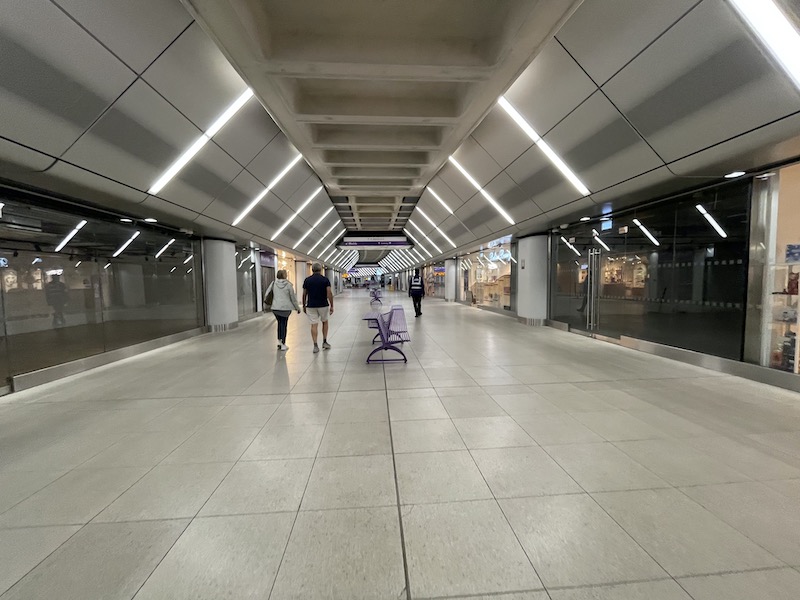
There’s a gateline and escalators up to platforms 20 to 24 at the far end…

… but most passengers use the slope and gateline from the main concourse and thus avoid ‘The Sidings’.

In any event these platforms aren’t intensively used with departures on the ‘Windsor lines’ to Windsor, Reading and Weybridge and the vast area in front of the gateline is always relatively quiet for such a busy station.

There’s even a passenger information desk sited near the gateline which must be the quietest in all the main line termini.

But let’s get back to the start and the five main entrances and exits to Waterloo of which the most famous is Victory Arch in the north west corner of the site up the main steps and numbered 5.

Running from here along the northern boundary wall of the station is Cab Road, which as its name implies is used by taxis for pick up …

… and round the corner on the east side of the building, for set down…

… and buses on terminating routes 11 and 77.

Cab Road also provides for step free access into the station using entrances/exits marked 1, 2 and 3.
The main concourse of the station with access to platforms 1 to 19 is always a hive of activity.
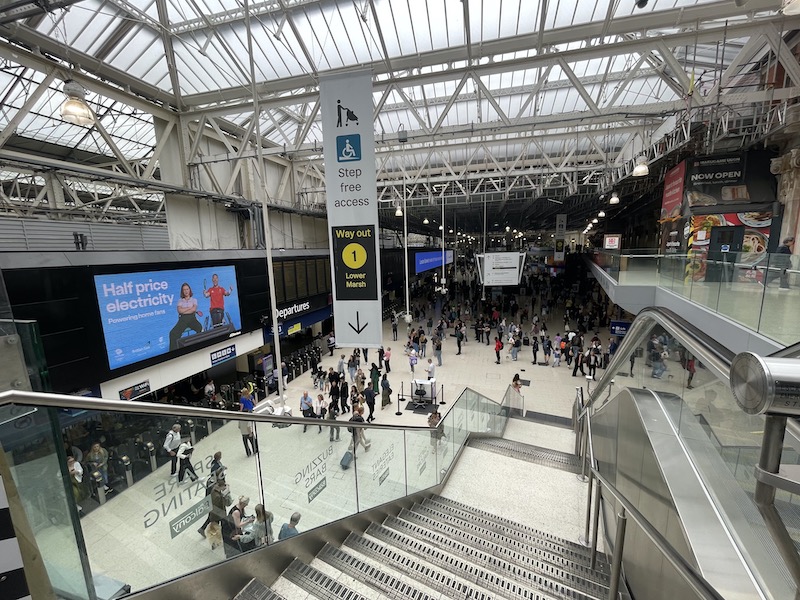
A new extended gateline has recently been installed by platform 19…

… and the trend for intrusive and glaring advertising has not escaped the area above the long gateline in front of the platforms…

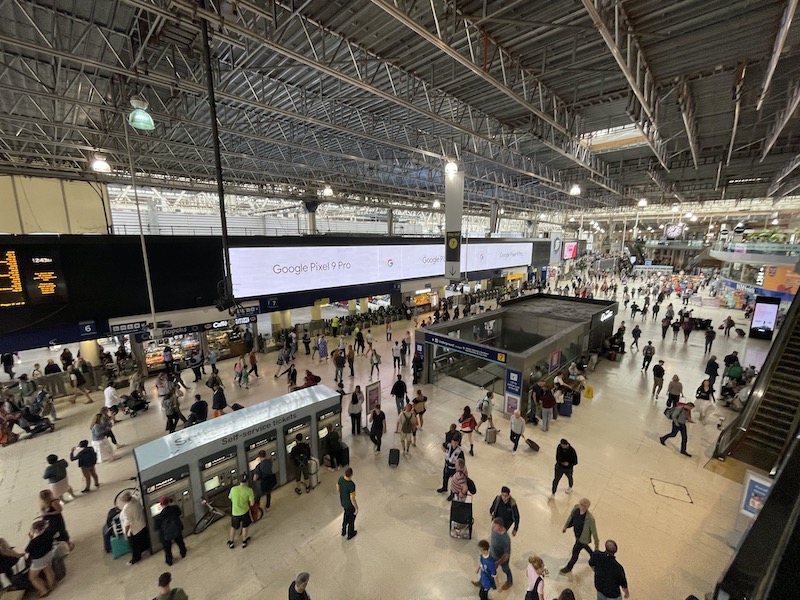
… with traditional departure boards either side of it above platforms 4 and 5 and 15 and 16…


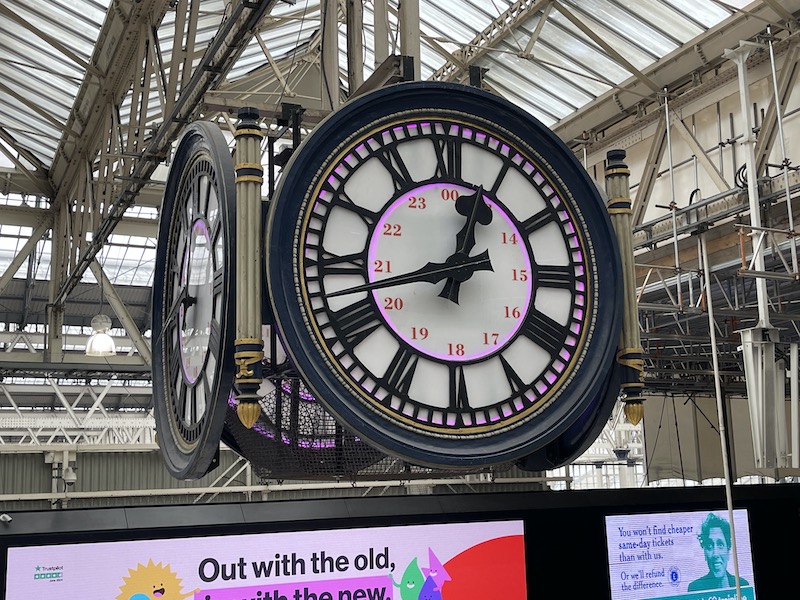
… and a new style electronic departures in the middle of the concourse under the famous clock with colour coding of when to wait and when to head to the platform.
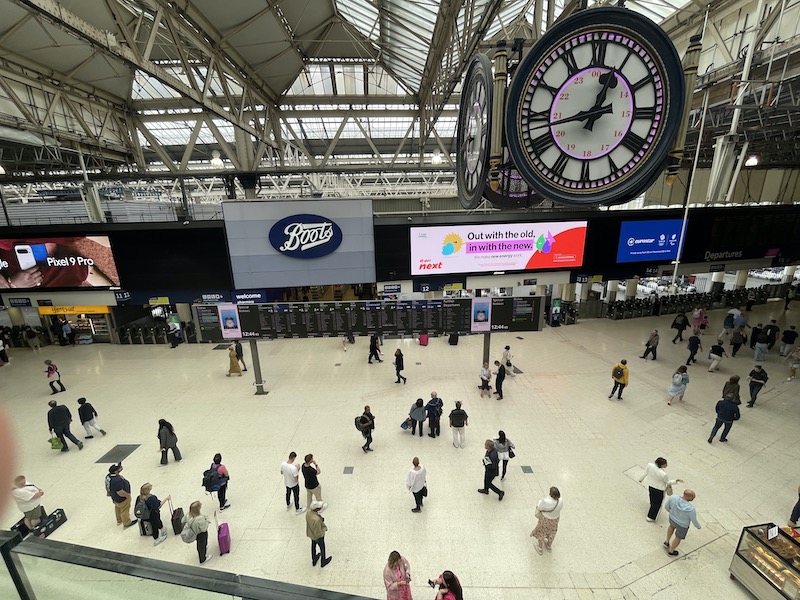

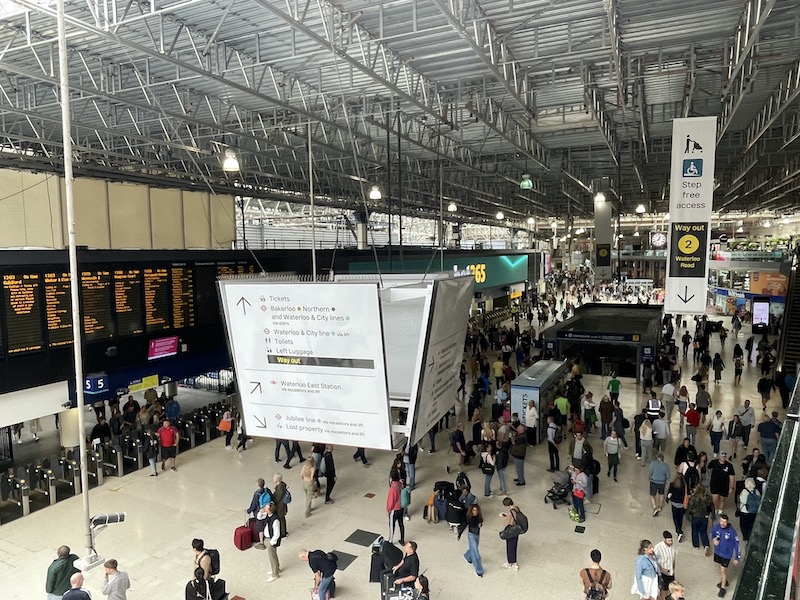
Large directional notices hanging from the ceiling are helpful.
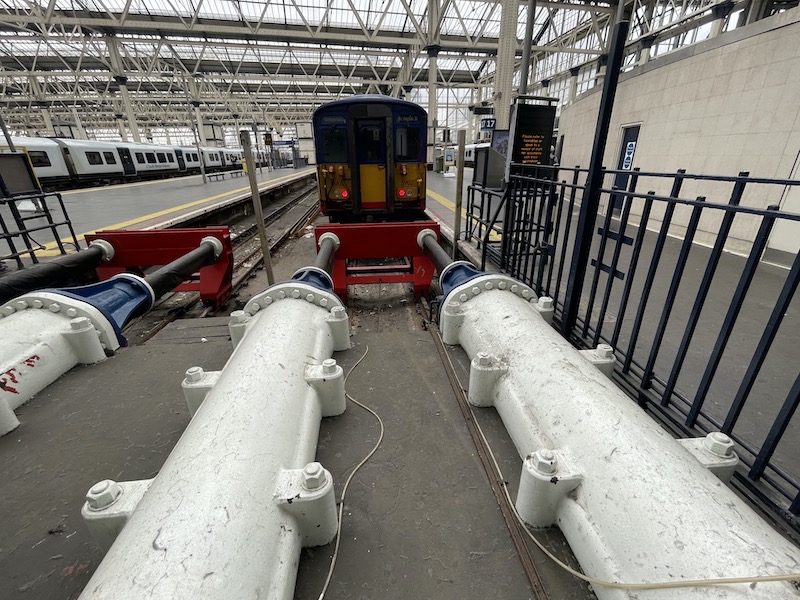
The buffers at the platform end of the tracks are the most extensive I’ve ever seen and I think I know what would come off worse – train or concourse – in the hopefully unlikely event of them ever having to prove their worth.
There are a number of access points to the four Underground lines which serve Waterloo (Bakerloo, Jubilee, Northern and Waterloo & City) including the main one alongside platform 18.
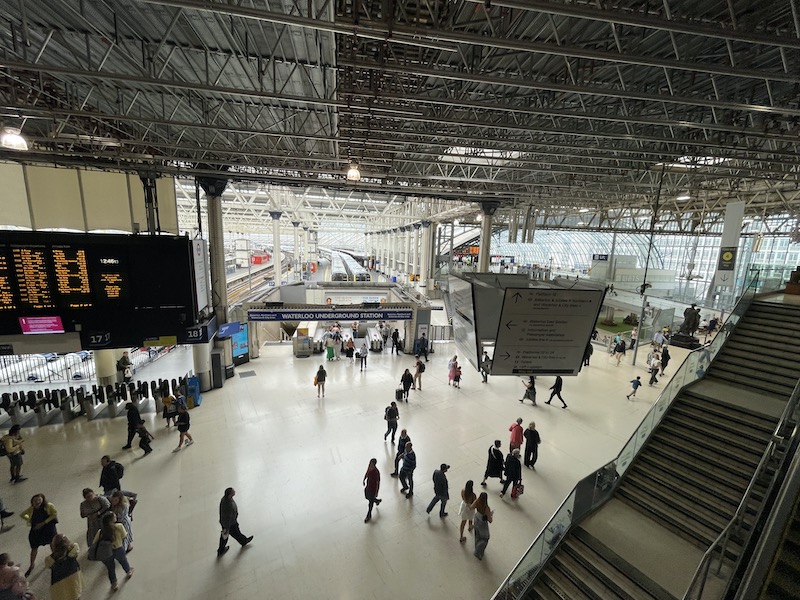
There’s an old style ticket office on the main concourse with, wait for it, 14 windows.

Those were the days eh? Obviously only three or four are used in these modern e-ticket times and there are also banks of self service ticket machines available too.

There’s also a Rail Information desk next to the gathering point for those needing assistance.

Perhaps the best thing about Waterloo are the refurbished toilets…
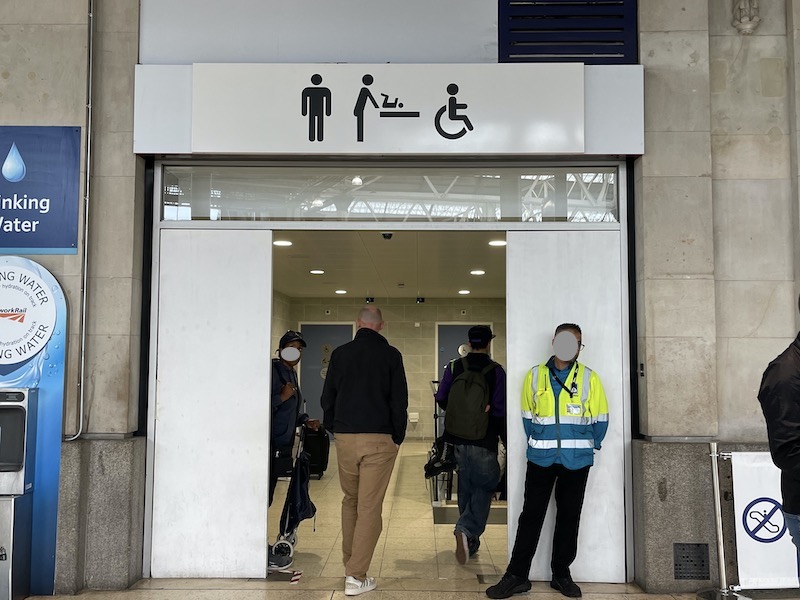
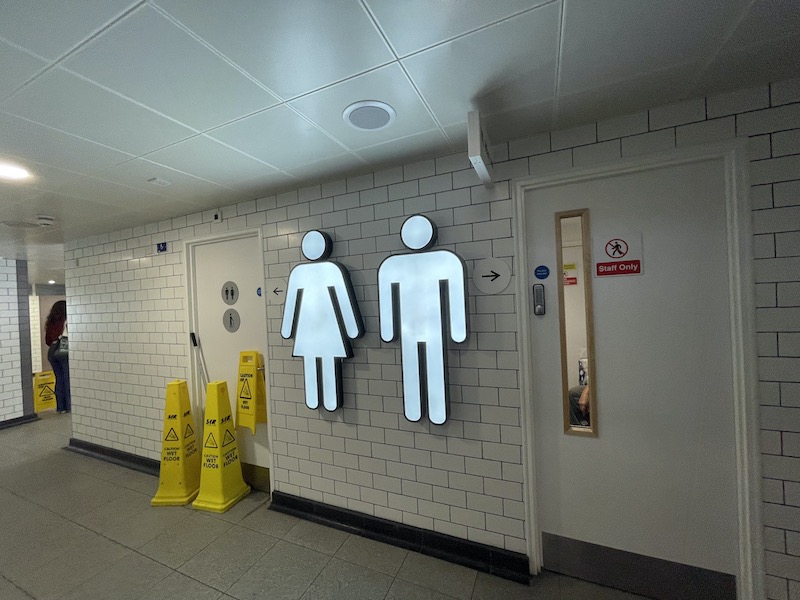
… which have not long reopened after a complete refit with all sorts of modern day requirements now provided for…

… including gender neutral options…

… urinals for those with walking sticks, and the now standard custom of communal wash basins with hand dryer under the panels between the mirrors.

I just hope the individual soap dispensers last longer than the ones at Victoria which are all now disused being replaced by a sparse provision of separate dispensers above the taps by the mirrors. There are also toilets in The Sidings.
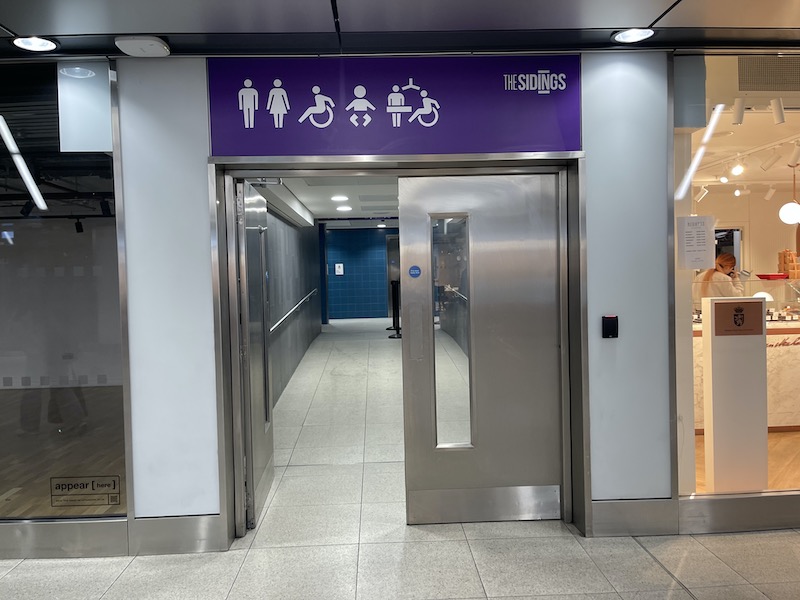
As well as the aforementioned Sidings shopping area under platforms 20-24 there are also retail units around the edge of the concourse and a balcony on an upper level accessed by escalators, stairs and lifts which also provides convenient access to and from neighbouring Waterloo East station served by Southeastern trains…

… and the Victory pub.

Back down on the concourse you’ll find a statue unveiled in June 2022 in recognition of the National Windrush Movement…
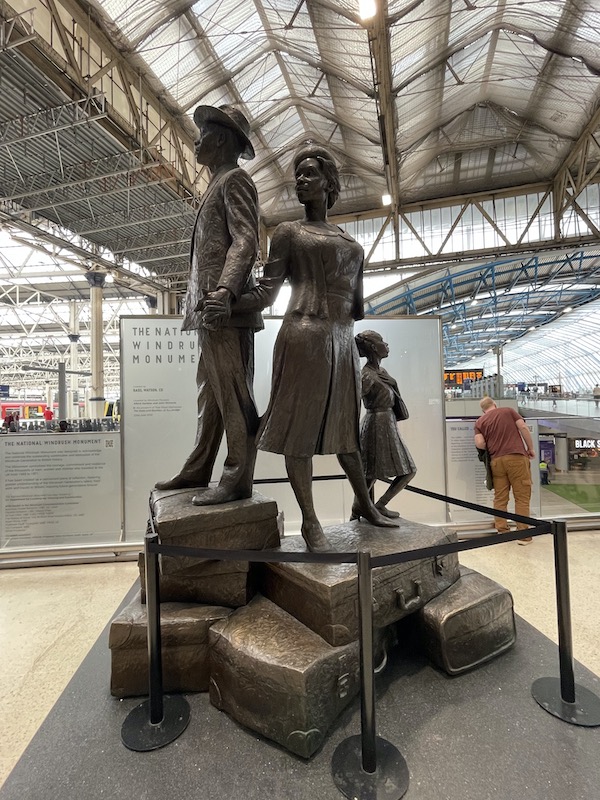
… with an explanatory board stating the “Monument symbolises the courage, commitment and resilience of the thousands of men, women and children who travelled to the UK from 1948 to 1971. It has been created as a permanent place of reflection, fostering greater understanding of the Windrush Generation’s talent, hard work and loyalty to Britain, inspiring future generations forever.”

Finally and pertinently for a review of a railway station let’s discuss train arrivals and departures as Waterloo, uniquely for a London terminal in the Office of Road and Rail’s top ten, is the only one served exclusively by a single Train Operating Company – South Western Railway.
The station’s 24 platforms can get very busy with trains serving a whole range of destinations in the “south west”. These saw an impressive 57,789,780 passenger journeys to and from the station in the year ended March 2023, which is why Waterloo is in third place.
I’ll be interested to know if I’ve managed to accurately record the complex range of destinations served from Waterloo in a typical off peak hour to close this blog….
South west London suburbs are served by two circular routes – one via Chiswick, Brentford and Hounslow returning via Richmond and Putney (half hourly in both directions) and the other via Kingston and Teddington also returning via Richmond and Putney (also half hourly in both directions) as well as a half hourly service to Surbiton and Hampton Court and another to Tolworth and Chessington South with a third to just over the border, to Shepperton in Surrey.

Also in Surrey, Weybridge is served by trains on the main line (to/from Basingstoke and Woking) as well as a half hourly service via the suburbs of Brentford, Hounslow, Chertsey and Addlestone. Woking has a half hourly ‘stopper’ and a half hourly semi-fast which continues to Basingstoke.

Windsor & Eton Riverside and Reading both receive a half hourly service via Richmond and Staines, while destinations further afield with half hourly services include Alton, Salisbury (with hourly extensions to Exeter and some other journeys continuing to Yeovil via Frome or vice versa) and Southampton, Bournemouth and Weymouth.
Portsmouth Harbour receives an hourly service via Eastleigh and a half hourly service via Guildford (with the latter also having an hourly service as far as Haslemere). Guildford also has a stopping half hourly service via Cobham and hourly via Epsom with the latter also on an hourly service continuing to Dorking.
Phew.
Watch out for a look at Britain’s second busiest railway station next month.
Roger French
Blogging timetable: 06:00 TThS.
Comments on today’s blog are welcome but please keep them relevant to the blog topic, avoid personal insults and add your name (or an identifier). Thank you.


The huge advertisement display at Waterloo is nowhere near as problematic as the Euston one because of the passenger flows. Almost all passengers enter the station either via the escalators from the Jubilee line ticket hall and Waterloo Road or from the Victory Arch and the main tube ticket hall end. In either case that means they are walking past the departures boards on either side of the big advertisement as soon as they arrive at the station.
LikeLike
The clock is still the traditional place to meet “Under the clock at Waterloo”.
Sadly there is no longer even one restaurant, as there used to be upstairs before Covid. There were two and well- used too.
The taxi rank has recently been pushed away for picking up too, resulting in an unnecessarily longer walk for those with suitcases, especially if you arrive at platform 14 as we always seem to now. {it used to be 7 or 8]
But its a fine station
malcolm chase
LikeLike
Only two typos, this time, Roger…soap dispnesersserved exclusively by a sing
LikeLike
Many thanks – both now corrected including a third “Composny” rather than “Company”.
LikeLike
I’ve used Waterloo station for years and always found it to be a welcoming place. It was sad to see the Solari board disappear some years ago now but after a number of failures with new displays (some which couldn’t be read in bright sunlight) I think NR eventually got it right. I agree about the lack of restaurants though. Not everyone wants fast food especially if you’ve got a long wait for your train due to frequent cancellations.( The performance of SWR is for another blog) It’s also a shame that there are very few outlets selling confectionery. Years ago you could buy a bar of chocolate from many of the small kiosks by the gateline. The recently opened Wetherspoons is a useful addition and seems to be doing a good trade in the early mornings. Not surprising as the price of their coffee seems to be outside the cartel of the other outlets providing similar beverages. Roger mentioned local bus connections. With all the cuts to the capital’s bus network it was sad to see the demise of the Red Arrow routes and a shame that buses no longer use the Aldwych tram subway. That cut the journey time to Holborn and with the removal of the bus lane on Waterloo Bridge (why is this not reinstated ?) it means that often it is quicker to walk. Reinstating a direct bus link to Bank would also be useful as the Waterloo & City line doesn’t run at weekends.
Martin W
LikeLike
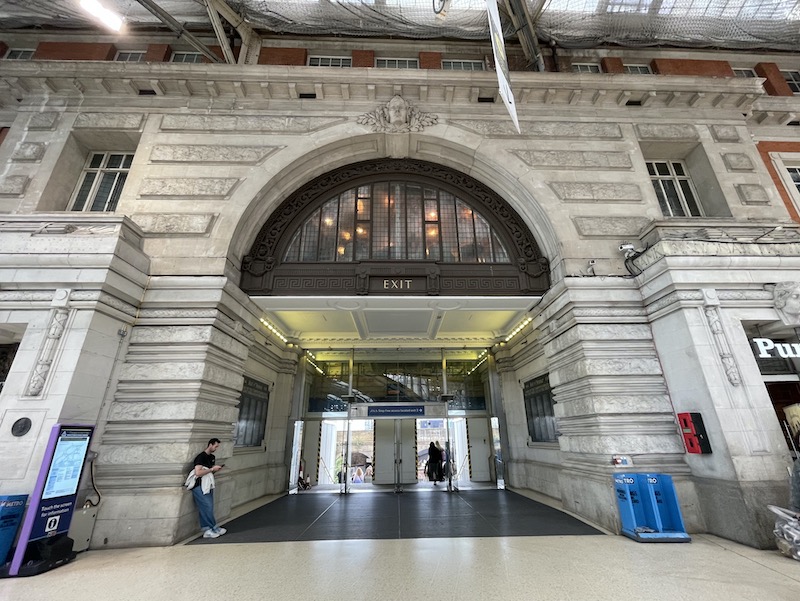
At 71 I suppose that I have only ever really known Waterloo Station for 61 of those years. Changes to the Departures Information has been the most significant feature for me. The first type I knew was an extraordinary affair and I direct readers to “Terminus” BTF, probably on YouTube or BFI Player! The current ones with LED displays are functional but I mourn the loss of the Solari system – that nervous wait for the plates to flip over hoping that it would show one’s departure train for home. Solari was not always right: plates on the Central Section’s platforms at Clapham Junction wrongly showed Upper Warrington when they should have been manufactured showing Upper Warlingham. I think I wrote to BR, but I fancy that they stuck with this error. Superb picture of the arch: first time I had an opportunity to read what was on the escutcheons on the arch itself. “Dardanelles” – Churchill’s only shame. “Mesopotamia” – was that Lawrence’s triumph? Favourite stock of yesteryear: 4-COR as I had four cab rides home to Walton on Thames one week in my early days working in London.
LikeLike
Its fun to rewatch the Bourne movie shot in the station and see how much the it’s changed. Of course if they’d had the mezzanane when that was shot it would have made the whole thing very different.
LikeLike
And the official video for the Pet Shop Boys ‘West End Girls’
Kim R
LikeLike
The Dardanelles was not “Churchill’s only shame”. Ask the people of Llanelli, who still recall him sending troops against strikers in the town during the national rail strike of 1911.
LikeLike
Until it’s demise the Solari board used to show Brentford Central which was always a welcome oddity.
Martin W
LikeLike
Oddly, Brentford was renamed Brentford Central in 1950 after the creation of a unified British Railways. Presumably this was to distinguish it from the Western Region station of the same name, even though this had closed to passengers in 1942. The Central suffix was dropped in 1980.
LikeLike
That was Hi Tech compared to Kings Cross
LikeLike
I was exploring the Sidings earlier this month and discovered that the Wetherspoon pub is the only one e without its own toilets, apart from one disabled cubicle. Fully mobile customers.ers are expected to use the communal toilets.
Also, although there is claimed to be access to the UndergroubD from the Sixings, it is not fully accessible a d involves a lo g walk under the concourse and 2 lots of stairs. Readers are recommended to use the lifts to the main concourse and run the gauntlet of the main line passengers
John Crowhurst
LikeLike
In premises where food and/or drink is sold to the public for consumption on site, there must be an adequate number of toilets and hand wash facilities for customer use.
So Wetherspoons may not technically be complying with the law
LikeLike
I used the new ‘Spoons last Wednesday. The pub toilets (for all) are badly signed but exist to the left of the bar counter.
Kim R
LikeLike
Waterloo is my London terminus, usually passing through on at least one day a week. Thank you Roger for letting me know that the toilets are finally open again! While they’ve been closed, those in the The Sidings have suffered somewhat from very heavy use. I’m sure that much of The Sidings footfall in that period has just been for displaced loo visitors.
Indeed the undercroft is both huge and mysterious. Go from the Bakerloo Line direct to the platforms via the subway and you’ll see that it’s multilevel too.
In my opinion the curved roof of the old international platforms is one of the architectural gems of the railways. Viewed in daylight from near the Windrush memorial, it looks stunning with its curves in two dimensions.
A last though about the toilets. I wish there were some at the platform 1 end of the concourse. It can be a long walk back and forth if you want the Jubilee Line after your comfort break.
LikeLike
Just adding a bit more. Waterloo is a great station but it’s badly let down by the scruffy and and disorganised “public realm” outside the Victory Arch. Huge numbers of pedestrians travel through that area but it’s a potentially dangerous and untidy mess with dozens of clashes with vehicle and cycle movements. It leads to the nations largest and busiest cultural quarter, the South Bank and can be absolutely chaotic at busy times.
LikeLiked by 1 person
Have always thought its a missed opportunity not to use the lines via International Junction to provide a route into Kent in times of planned disruption at Victoria
LikeLike
It was on one occasion (a weekend) some time after the International trains had left, but before SWR “locals” had started to use the vacant platforms. It took ages to actually get “ordinary” trains into those platforms for some obscure reason, but that is the inflexible railway we have had to get used too. May have been other times, but I only encountered it once. Seemed very odd actually going around the rusting curve to join the normal route into Kent.
Terence Uden
LikeLike
No mention in your article of the dedicated subway leading to the bus stops on Tennison Way! That’s the most convenient way to reach the buses that head north over Waterloo Bridge. Upper deck bus rides over that bridge being one of the great bus rides of England with extensive views in both directions.
LikeLike
Yes, I remember the old old departure indicator – latterly with a man with a long pole standing next to it so he could turn any slats that hadn’t quite made it into the correct position. (The old old departure board at Glasgow Central was also amazing but in a completely different way). I also once used the upstairs restaurant which, even in the early 70s, seemed to a throwback to a bygone age. And does anyone remember the awful “The Drum” griddle in the mid-70s?
LikeLike
Liked your comment about the Glasgow Central departure boards! I assume you meant the boards they literally hung behind the windows above the former ticket office. They were unique and the windows are still there in what is now a restaurant I believe, having spied them for the first time in about 20 years a few years ago on a visit.
LikeLike
Yes, those were the ones. Very labour-intensive at peak hours!
LikeLike
Platforms 20 – 24 are very intensively used when there is a big game at Twickenham!
Riding a bus that goes through the tunnel underneath the station is an experience.
LikeLike
Thanks for all the detail – I have used Waterloo a fair amount over the years, but didn’t know all of that! Interesting about the undercroft. If the powers that be ever decide to make Waterloo a through-station (as I believe the original LSWR plan was) perhaps it could actually be used for trains … I gather that the lack of capacity at Waterloo, and the need to turn all trains around there is the reason for the rathe sad half-hourly services to everywhere, with the result that if you live on a tube line you get trains every few minutes, but if you live in Chessington, or Hampton Court (for example) you get only 2 per hour.
Waterloo is a fine station if you live in a London-centric universe, but the popularity of the M25, unpleasant as it is to use, has shown that, for longer journeys around the country, many people are not attracted by the rail offer. To get from the ‘Waterloo’ southwest to East Anglia by train means using at least two underground lines, and long walks at most of the interchanges. Through stations work well in other European cities; Thameslink and the Elizabeth line have shown the way in London, but is anyone even thinking of a plan to connect all the main lines? A single central station would be too big, but perhaps a triangle of stations (West End, City, South-bank) would enable all cross-London journeys to be done with just one quick, convenient and efficient change. Just think of emptying the M25 …
LikeLike
Yes the problem is that the slow lines are at capacity all the way out the Raynes Park, so there’s no way to significantly enhance the services on the branches. Crossrail 2 remains the best technical solution since it would take over a lot of the branch line services. Some of the intermediate services like the Altons could then be moved over to the slow lines freeing up capacity on the fast lines. But the reality is that traffic on SWR has hugely fallen since the pandemic and reverting to a ten carriage railway will probably buy a lot of time before new capacity is needed.
LikeLike
Anglia Trains did try a service from (I think) Chelmsford to Basingstoke for a few years. It wasn’t a success, partly I suspect because it took such a long time to get round north London.
LikeLike
They did. It ran every 2 hours from Monday to Saturday. Used it several times from Stratford to Basingstoke which I think from memory took 2 hours just for that stretch.
LikeLike
Great article and nice pics. I like the station but my biggest gripe is the fact that the main entrance through Victory Arch doesn’t have escalators! It’s a nightmare to negotiate with luggage and yet looking at the site, I’m sure something could be done to improve matters. There is a side entrance way down Waterloo Road with escalators, but I think they need to improve accessibility at the main entrance. On my frequent trips to Portsmouth I have taken to travelling on Thameslink to East Croydon instead and changing to Southern rather than use South Western Railways from Waterloo and fighting with the stairs at Victory Arch after getting off the 381 bus. It’s good to see that they have made good use of the former Eurostar space. I did travel from Waterloo on Eurostar once.
LikeLike
The trick with big bags and wheelchairs is to carry on up the taxi road slope outside the station building and go in via the central entrance. No steps that way.
LikeLike
Given the likely rent some of those tenants will be paying for units in “the sidings”, I could see it becoming a revolving door of businesses down there….especially if the footfall shown in your photos is the norm! Handy for those of us that prefer picking somewhere a little more out of the way at a railway station, though.
-blue
LikeLike
Regarding the typical off-peak service pattern, only one of the two circular services runs now (Kingston). The half-hourly off-peak Hounslow ‘rounders’ were victims of Covid, now only running during peak hours, leaving the likes of Brentford and Hounslow to the half-hourly Weybridge services.
LikeLike
And also Mortlake and North Sheen the same. It’s little wonder that passenger numbers remain well below pre-Covid on SWR.
LikeLike
JDW got the name “Lion & Unicorn” from the 1951 Festival of Britain. It was Pavilion 18 on the official London Transport map issued in connection with the event. The late Bobby Robson of worthy report as manager of Ipswich Town FC and England had a hand in this event. His parents wanted him to have a back-up career in case football management transpired not to be his forte. Rebellious Fulham FC players forced him out after all. Robson took a quickie electrician’s course, at his parents’ behest, and his practical role in the 1951 event was to help install the wiring at the Royal Festival Hall. He fully absorbed the craftsmanship of the building trades and whilst Manager at NUFC took a role in the stadium’s refurbishment. I had the honour of getting his autograph outside the BCFC ground on a motorcycle tour of the Midlands one autumn.
LikeLike
One very useful entrance/exit that was lost a few years ago was the footbridge at the west side of the concourse that passed through Elizabeth House and over York Road, with staircases down to both sides of York Road and continuing on towards Jubilee Gardens and the South Bank. It would be good if this traffic-free link could be reinstated if the the Elizabeth House site ever gets redeveloped, as has happened across the road.
I worked for a time in the office located behind the glazed screen on the northwest side of the Victory Arch.
Steven Saunders
LikeLike
https://londonist.com/london/transport/waterloo-station-revelopment-plan
LikeLike
https://londonist.com/london/transport/waterloo-station-revelopment-plans
LikeLike
Cheapest Coffee/Tea in Waterloo:
If catching an very early train (e.g. the 0530 to Weymouth), McDonalds is the first food/drink outfit to open at 0500, not much else open on the station until a bit later.
I am glad to see Black Sheep in the Sidings, though, for a more premium Coffee/Tea option which is not so busy and has seating
The Sainsbury’s Local in the Sidings is also proving very useful.
Santander Bikes in plentiful supply in the Taxi road, but you can also pick up and drop off a Santander on the far side of Tennison Road (quicker drop off there then navigating to Taxi Road when coming over the river)
MilesT
LikeLike
I’ve used Waterloo only once, not by train but waiting for a friend to travel from Walton on Thames. I don’t remember there being more than one gents toilet, payable and with a turnstile. Wales had played at Twickenham that day, and just as I was about to go in there was a massive surge of supporters in dire need, which overwhelmed the system so the attendant unlocked everything and the horde piled in. To parody a Max Boyce song, “we were sharing urinals, boy, but it came out just the same”.
LikeLike
@malcolm chase
I would suggest that the new Wetherspoons fulfils the requirement as a restaurant, i.e. sit down plated meals. Yes it also is a pub.
MilesT
LikeLike
One feature now gone is that there used to be an Ian Allen shop just behind the station in Lower Marsh. I loved browsing the books there on just about any transport subject you could think of.
LikeLike
My first stop whenever I arrived at Waterloo, usually then followed by a few Routemaster journeys!
LikeLike
Buffer stops nowadays are generally pretty much cosmetic, with other measures used to make sure trains stop well before the end of the line. I suspect Waterloo’s only remain because they would be expensive to remove.
I wonder how long the cab road will survive, as allowing vehicles to drop off/pick up at the station entrance under cover has fallen out of favour (Leicester and Hull Paragon are examples that particularly spring to mind). Partly security-related I’m sure, but also excessive enthusiasm for pedestrianisation and large piazzas such as the one at King’s Cross that bus passengers now have to scuttle across in the rain; the one negative of that remodelling.
LikeLike
Most of the London terminuses had an arrivals taxi road and departure taxi road. Kings Cross, St Pancras, Liverpool Street, Paddington amongst others. Most have now long gone
LikeLike
The best thing about Waterloo is the song. Otherwise it’s a mess.
LikeLike