
Thursday 6th June 2024
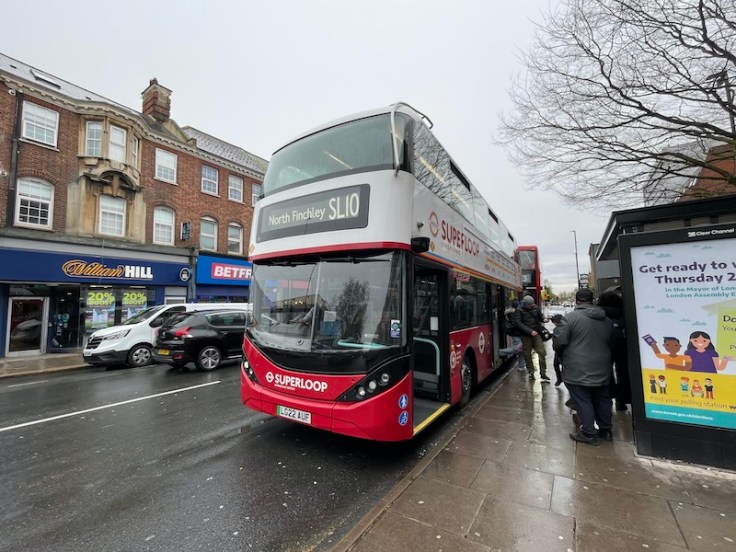
Readers will recall Tuesday’s blog saw us ending Part 1 of our round London Superloop odyssey beginning at East Croydon having only reached as far as Finchley Central rather than the planned Walthamstow Central. Thanks to light rain conditions, unimpressive aged vehicles on the SL7 to Heathrow, slow going through Northolt on the SL9 as well as a deluge of school children, an impromptu stop of 12 minutes for no reason and more slow going on the SL10 on a Friday afternoon school turning out time, it would be fair to say we’d not come away with a very positive impression of this new high profile supposed “express” bus network.
But, we had hopes there’d be a turnaround in fortunes for Part 2 as we reconvened on the Friday before the Bank Holliday weekend at the end of last month, ready for a 10:30 start at Bus Stop C at Finchley Central where we’d finished Part 1, three weeks earlier.
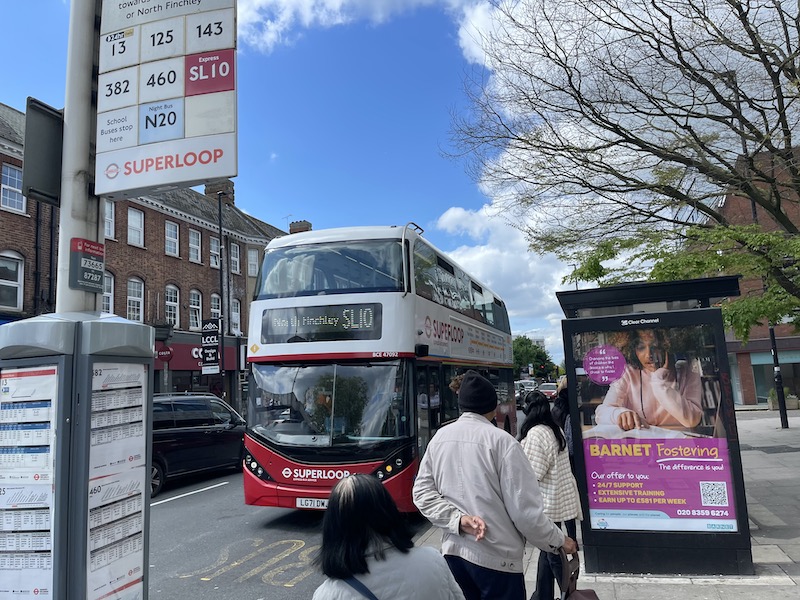
And at 10:38, the first of our five buses for the day, on route SL10, arrived from Harrow bound for North Finchley. It’s just a one stop, one mile journey which the bus is given eight minutes to complete. Suffice to say we were almost at the terminus in half that time but then waited three minutes for a couple of changes in the traffic lights to reach the final bus stop alongside the gloomy bus station in North Finchley.
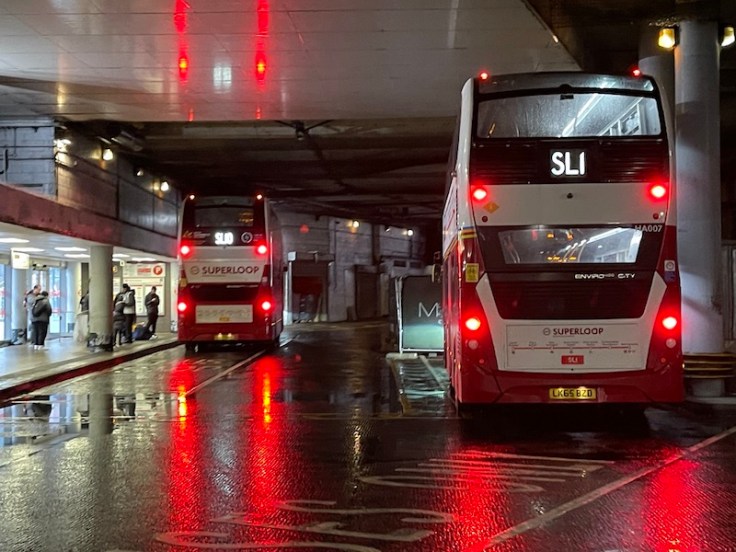
Six passengers, together with the six of us, all alighted to let the driver take the bus off to the nearby layover area at the end of Woodhouse Road.
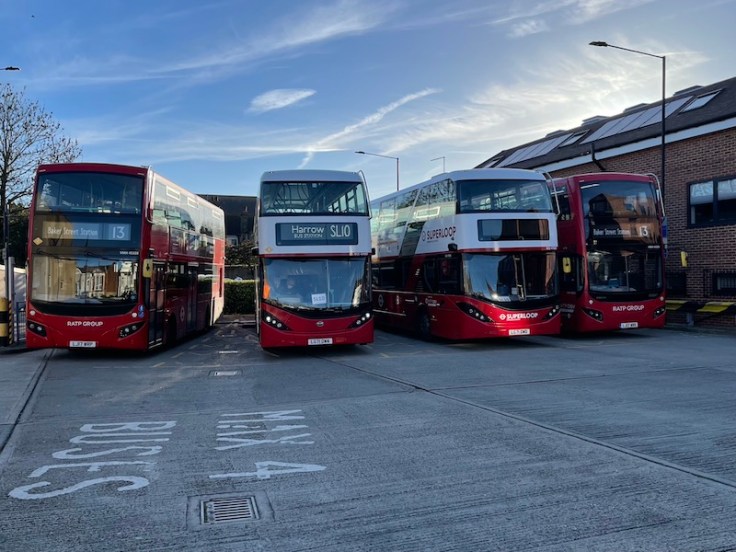
After a seven minute wait our second bus of the day, on route SL1, came out of the bus station gloom to pick up half a dozen passengers at the same stop we’d alighted from the SL10.
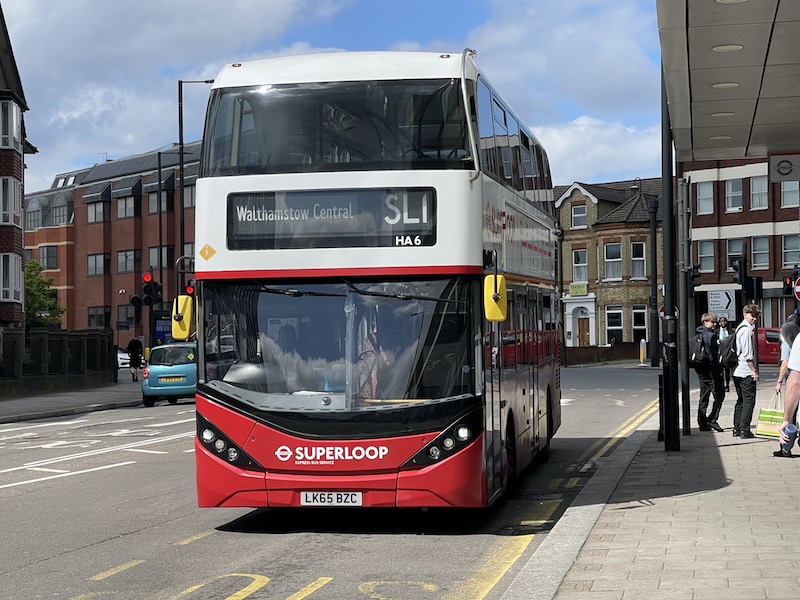
No passengers, other than ourselves, made the connection between the two routes – which was the case throughout our round London journey, indicating TfL have got the termini about right.
As we headed along Woodhouse Road and Friern Barnet Road towards Friern Barnet, New Southgate and Arnos Grove, we picked up around six more passengers at each of the three bus stops making for a very respectable on board total.
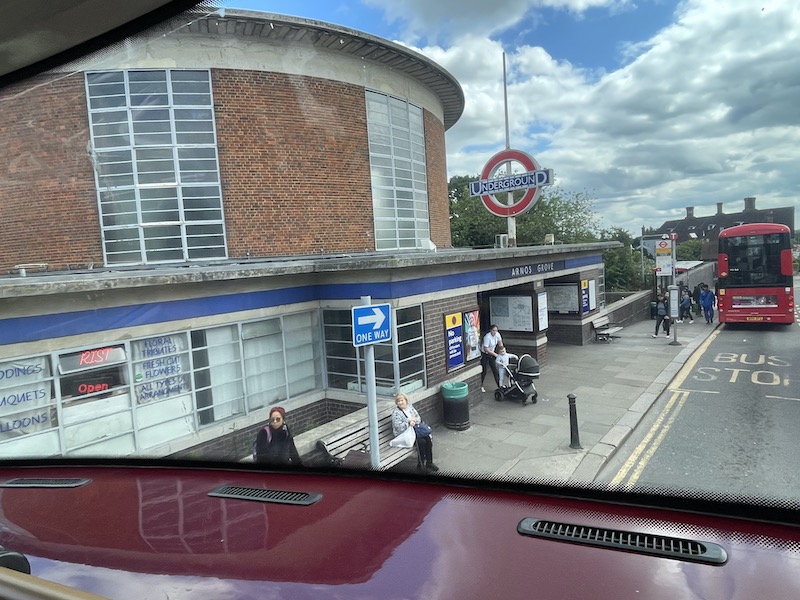
At Arnos Grove we began paralleling route 34 which covers the same ground as the SL1 all the way to Walthamstow. Arriva operate both routes 34 and SL1 from its bus garage in Palmers Green conveniently adjacent to the North Circular Road and roughly mid way along the routes and where I’d cut my teeth as a London bus conductor 52 years ago.
The SL1 operates every 12 minutes taking 11 buses for the nine mile end-to-end journey while the 34 has a slightly longer 12 mile route (commencing at Barnet Church) and takes 18 buses for its 10 minute frequency.
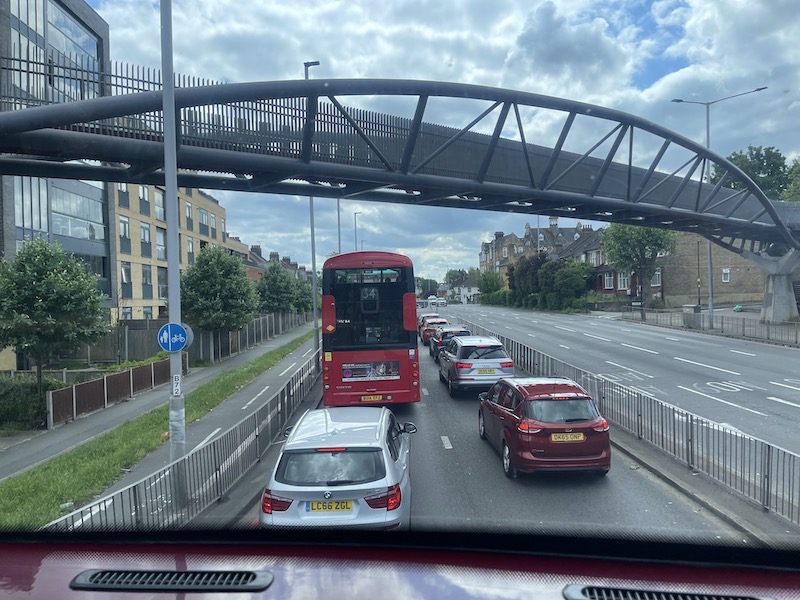
It came as no surprise that as soon as we hit the Bowes Road traffic lights just south of Arnos Grove, where we join the A406 North Circular Road, the traffic was at a crawl on the two lane section towards Palmers Green. It took us seven minutes to complete that distance of three quarters of a mile which is the time allowance given in the schedule, so slow going is nothing untoward here.
There are only seven intermediate bus stops between Arnos Grove and Walthamstow Central on the SL1 and, provided the A 406 North Circular Road is behaving itself, you do fair zip along giving the impression of being an “express” service. The buses are smart Enviro400 City buses which belie their age of nine years.
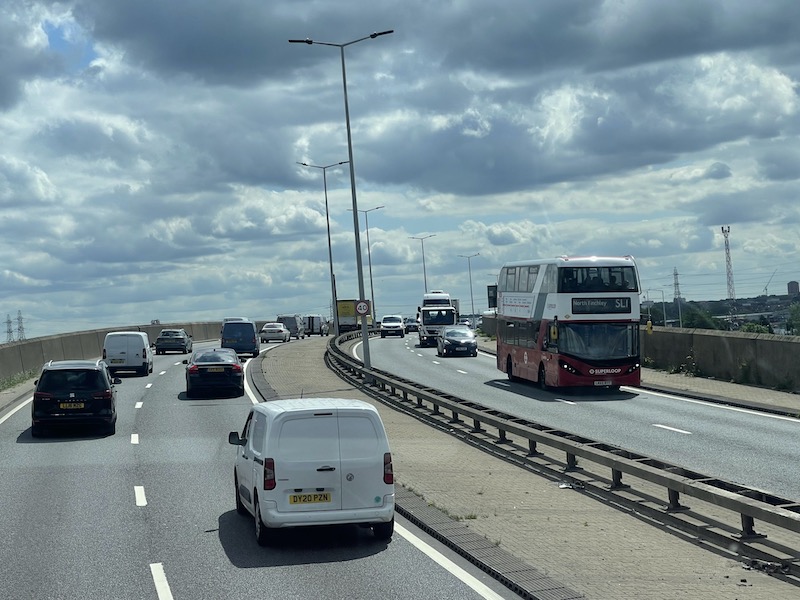
Quite a few passengers both alighted and boarded at Edmonton Angel but there were few takers at Walthamstow Crooked Billet and Bell Corner. We arrived into Walthamstow Central bus station at 11:30 having taken just 38 minutes which was 16 minutes less than the 54 minutes scheduled, and thank goodness we weren’t “held to regulate the service” for that time indicating the benefit of running on headway when traffic is moving well, rather than worse case scenario scheduled times.
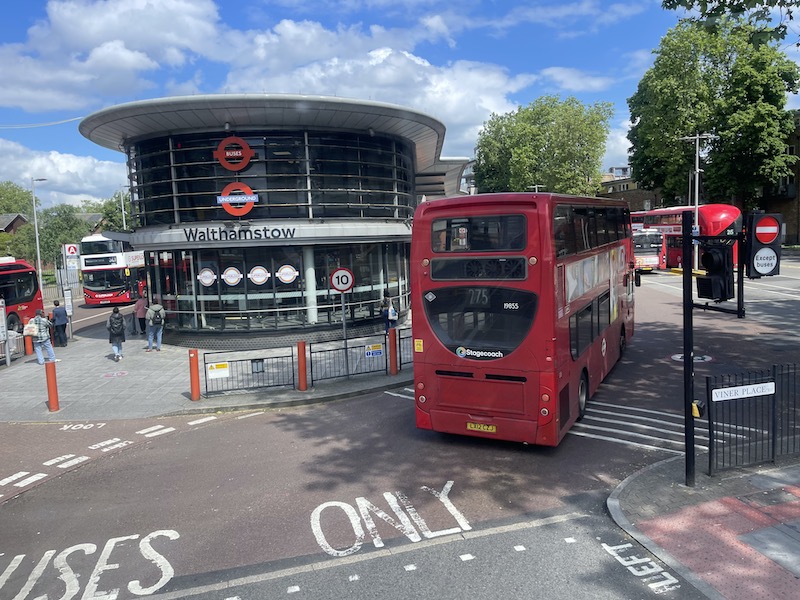
Had we ploughed on to Walthmastow as originally planned in Part 1, I suspect the journey would have taken at least double that time, such is the vagary of the North Circular.
After an eight minute pause in Walthamstow it was on to our third bus of the day – route SL2 to take us through Gants Hill, Ilford and Barking to North Woolwich.
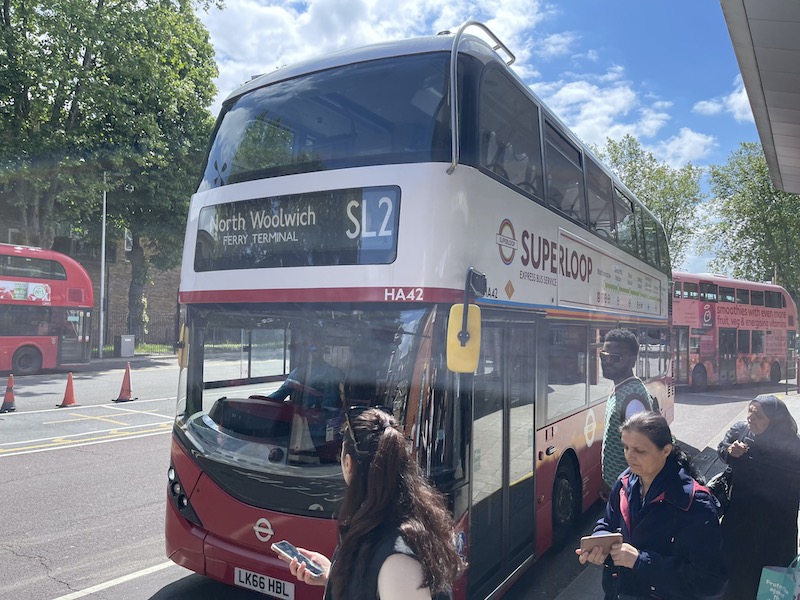
This is another Arriva operated route but from its base in Barking. It also runs every 12 minutes and uses 16 similar Enviro400 City buses as those used on the SL1. Whereas parallel routes 183 and 34 had their frequencies cut when parallel routes SL10 and SL1 were introduced, no routes were amended when the SL2 began earlier this year in March.
Walthamstow to Gants Hill is covered by route 123 (from Bell Corner rather than the Market and Central Station bus stops in Walthamstow) with more routes joining the busy corridor from Gants Hill to Ilford, while between Ilford and Barking there’s the EL1 and 169, so the SL2 acts as a duplicate with the added benefit of providing a limited stop journey.
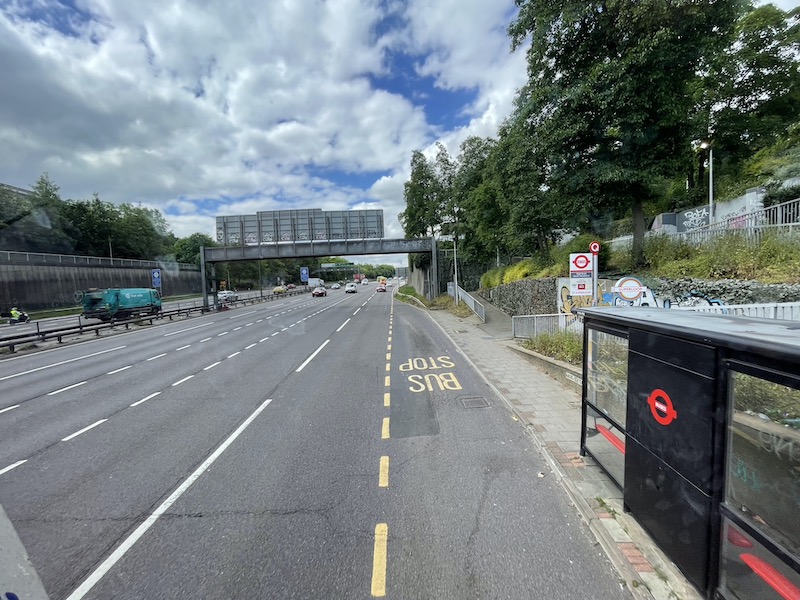
We did brisk trade at the eight stops between Walthamstow and Barking Station albeit by-passing what is probably London’s bleakest bus stop to wait at – alongside eleven lanes of traffic on the North Circular Road just before the M11 junction.
A good number of passengers were on both decks on that section but after Barking we emptied out rather than gained new passengers and the last section to North Woolwich is much less busy. It does make one wonder whether, other than for the sake of reaching the River Thames, whether it makes any sense to run the SL2 further south than Barking.
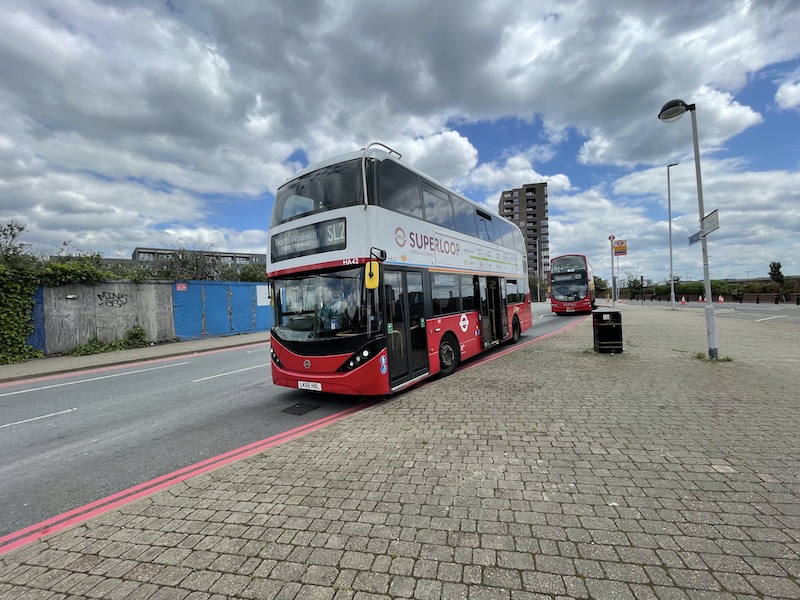
At the North Woolwich Ferry terminus, which we reached at 12:33, 55 minutes after leaving Walthamstow, there were just three other passengers alighting with us, although ironically one of those was also travelling south of the River, as of course were we.
TfL hasn’t rebranded the Woolwich Free Ferry as Superloop yet but it’s either that or the foot tunnel as the options for continuing our round London journey. We had a democratic vote and always wanting to be ‘customer orientated’ decided the three who opted for the Ferry take that…
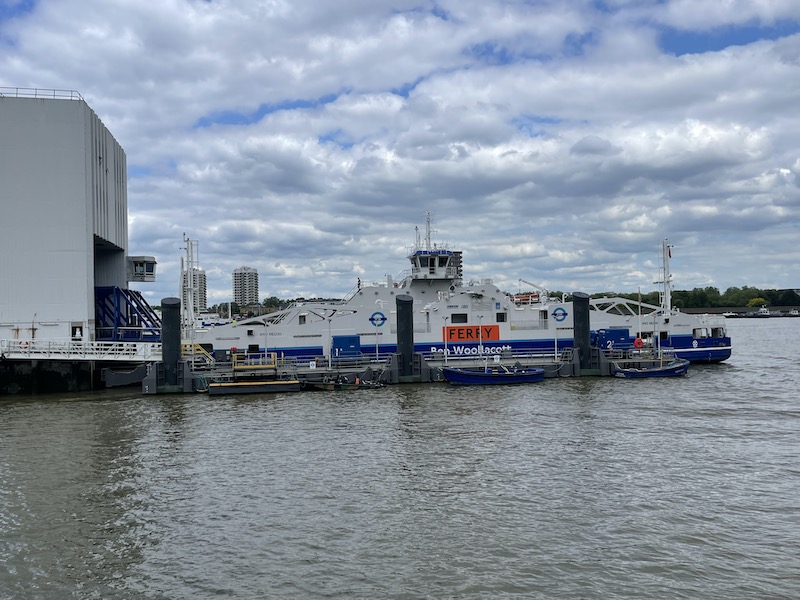
… and the three opting for the foot tunnel do that. I’d done the ferry a couple of times but only the foot tunnel once so chose the latter.
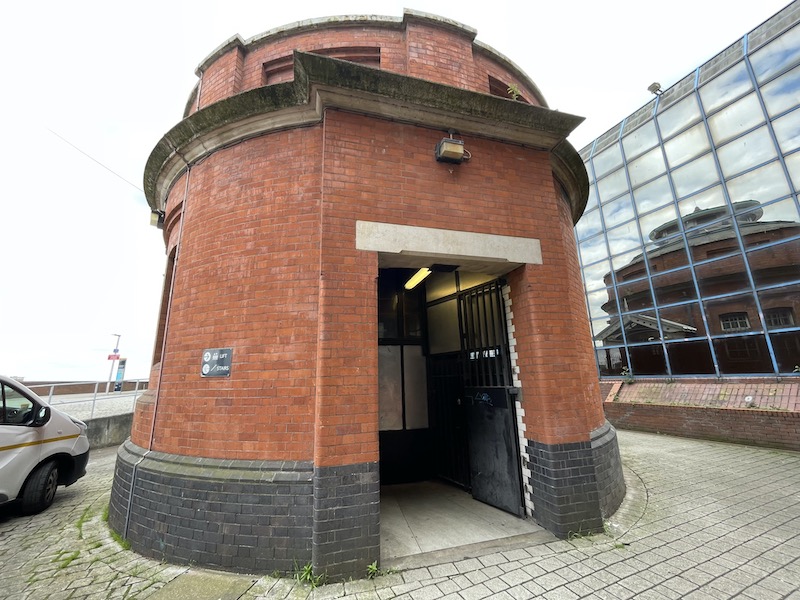
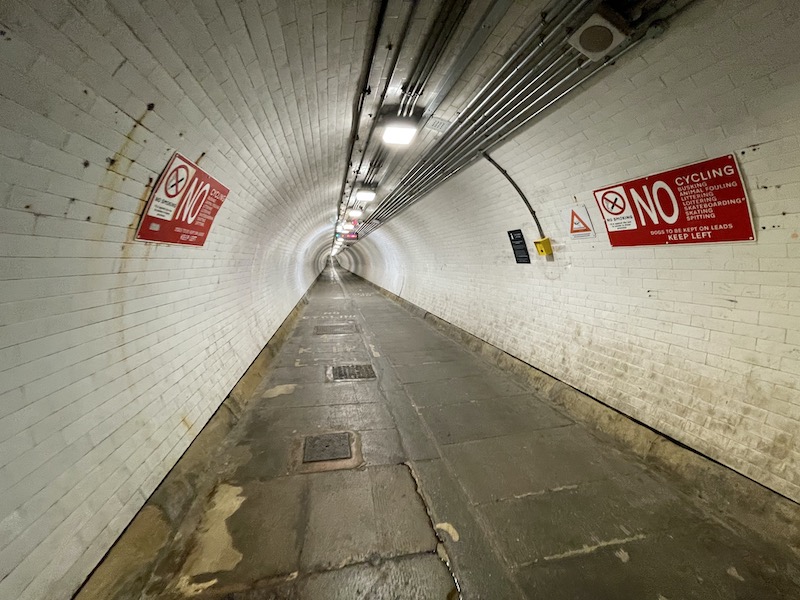
The lift at the North Woolwich end didn’t look in a very healthy state…
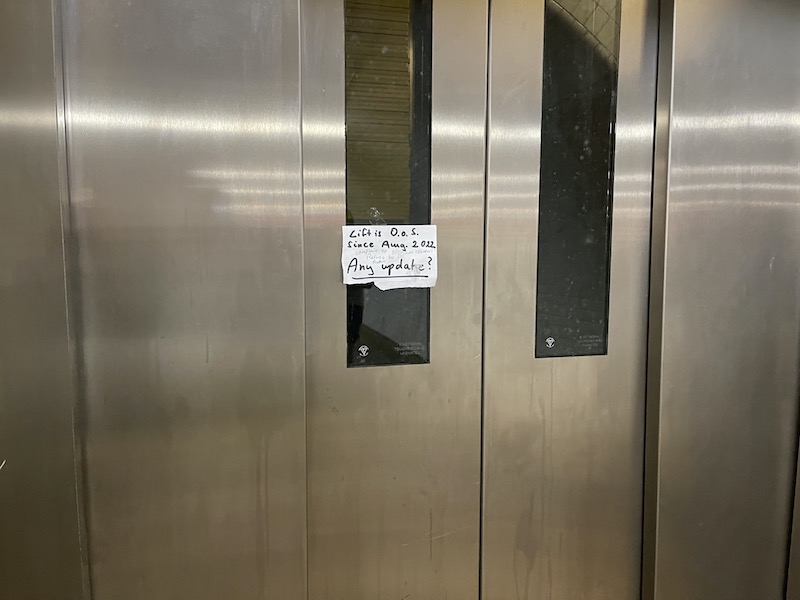
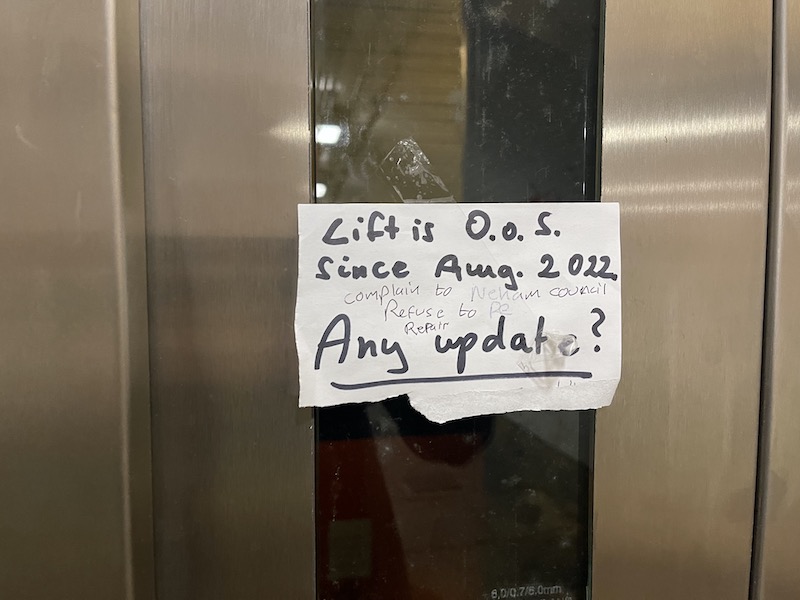
… but thankfully the one at the Woolwich end was, thus avoiding the long climb up the steps.
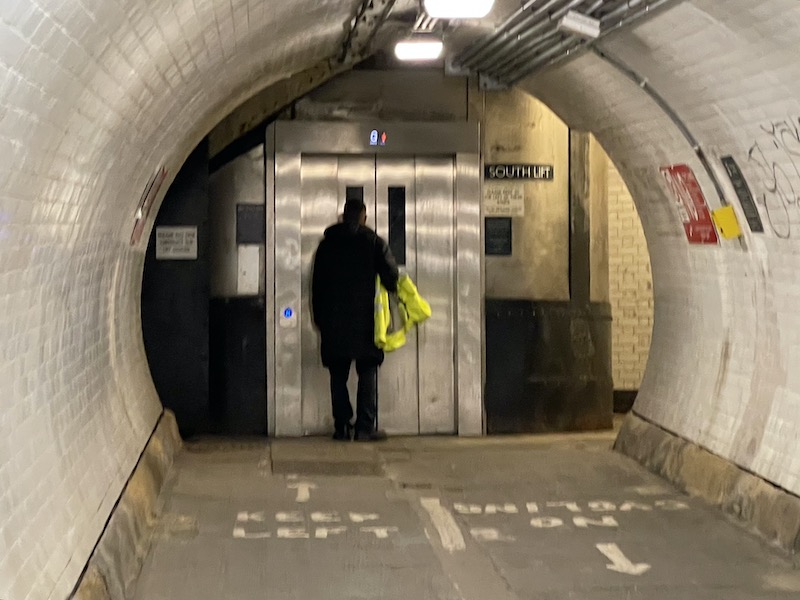
It took ten minutes. Colleagues on the Ferry took about half an hour having just missed Ben Woollacott so having to catch Dame Vera Lynne instead.

After that it was a short walk into Woolwich town centre, a spot of lunch and then a ride on the frequent and very busy route 472 the short distance to Thamesmead to reconnect with the Superloop network and take a ride on route SL3 down to Bromley North.
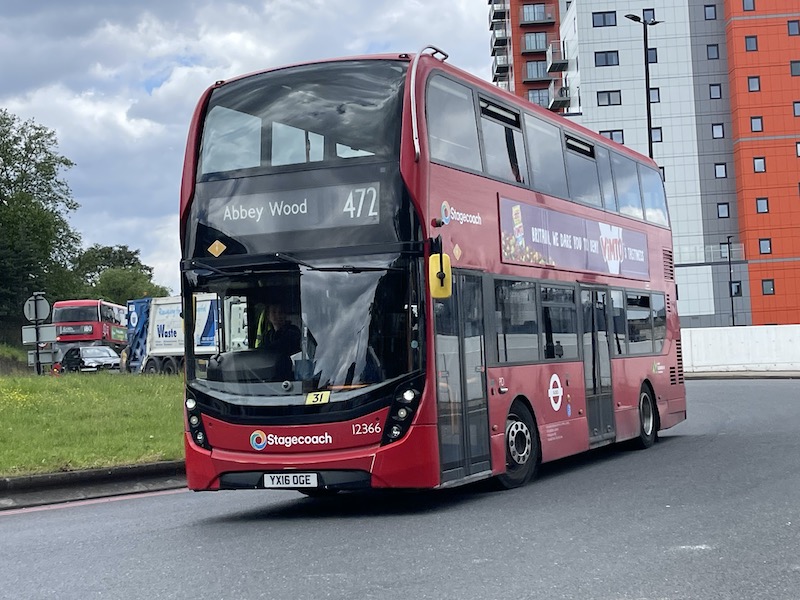
Thamesmead is the huge residential area built in the mid 1960s south of the Thames without a rail connection thus making bus routes to nearby Abbey Wood, especially now its on the Elizabeth line, as well as to Plumstead and Woolwich all the more important. But the SL3 starts at what’s referred to as Thamesmead town centre (which isn’t anything to crow about) but then only stops at Carlyle Road before reaching Abbey Wood station so doesn’t serve the area where most people live.
We only carried around eight passengers from the Thamesmead terminus, four of whom travelled to the Wetherspoons situated right by the bus stop in Bexleyheath (Lion Road).
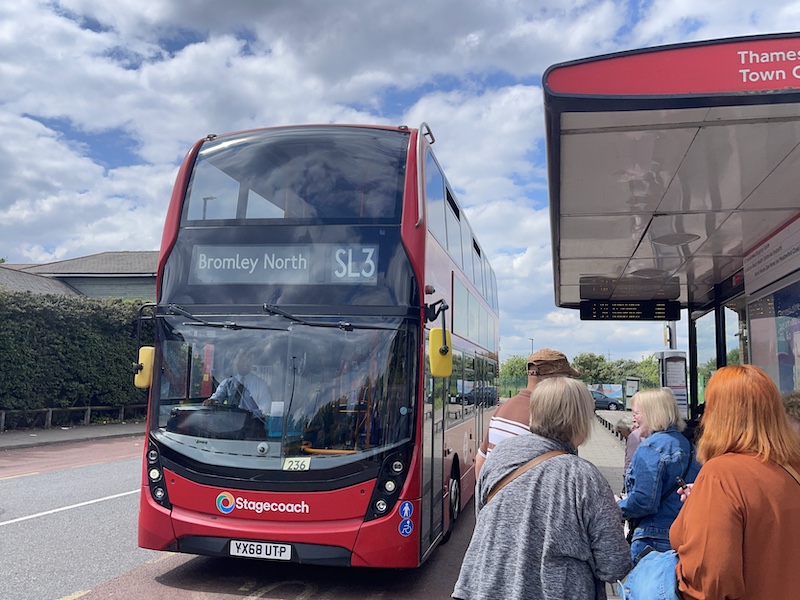
Route SL3 began in February and although is operated by Stagecoach with 15 ‘New Routemasters’ from its Bromley bus garage the bus operating our journey was an ADL Enviro400 MMC.
Interestingly Stagecoach has recently retained the contract to operate the route with a new tender from January 2025 with 15 new electric double deck buses.
We left Thamesmead at 14:26 for the hour’s journey and 23 mile run to Bromley via Bexleyheath, Sidcup and Chislehurst and were expecting to become busy with school children during the journey.
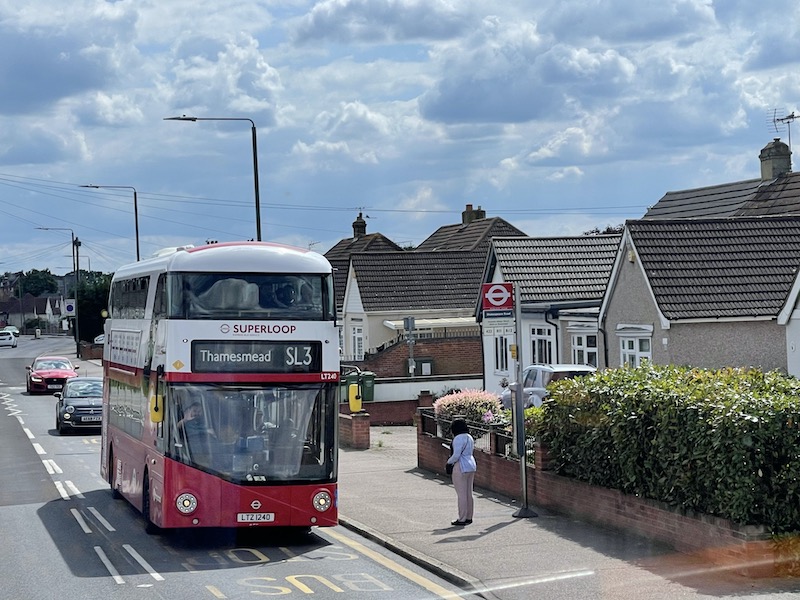
In the event it wasn’t that busy a trip as we only picked up a few keen-to-get-out-of-school-and-get-home students in Sidcup as we spotted large numbers heading towards the bus stop but too late for our departure.
But traffic delays in the Chislehurst area caused us to lose time and we arrived into Bromley North at 15:35 having taken 69 minutes for the journey.
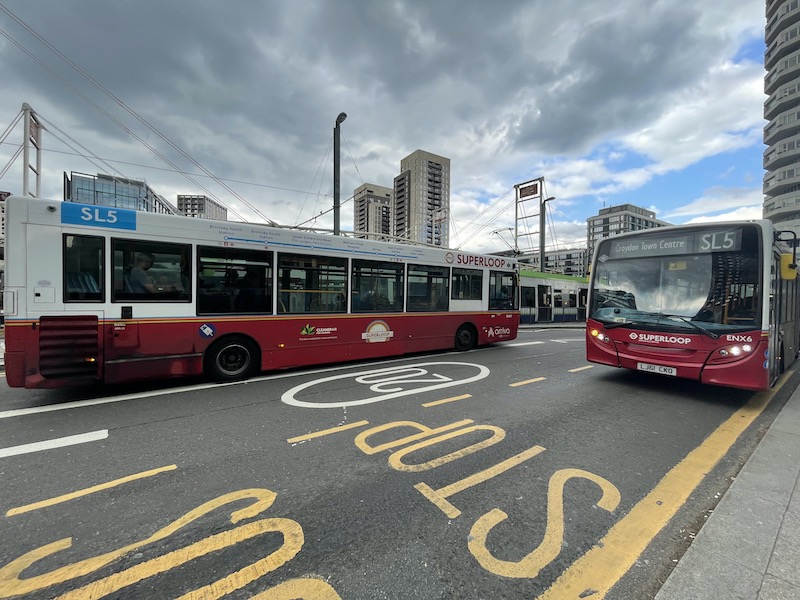
Our final bus to complete the circuit, route SL5, is the shortest Superloop route at just seven miles from Bromley North to East Croydon. It’s also the only route operated by single decks – 10 Enviro200s from Arriva’s Croydon bus garage. And it’s the most uncomfortable too with seats that make your bum hurt within about five minutes of sitting. 12 year old uncomfortable buses seem an odd choice for what’s supposed to be a high profile brand.
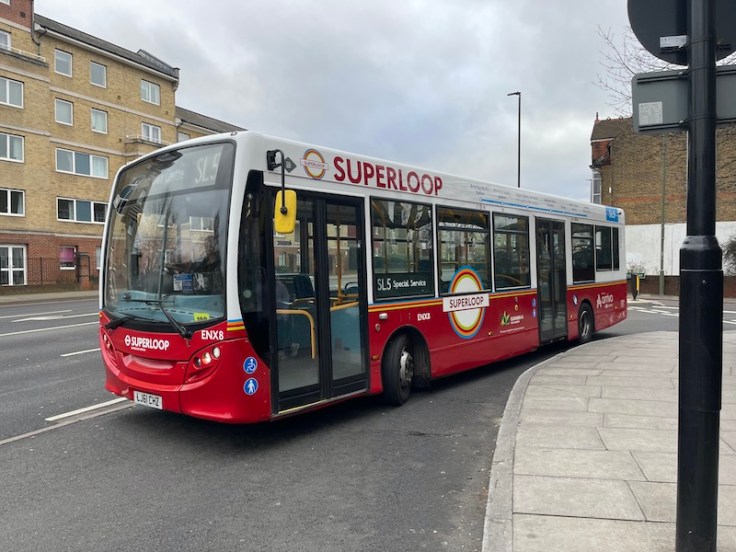
The journey was a busy one too with 29 passengers boarding at the three bus stops observed by the SL5 in Bromley with twos and threes alighting at the five stops before reaching Shirley – and ones and twos boarding – from where it’s a non stop run to East Croydon.
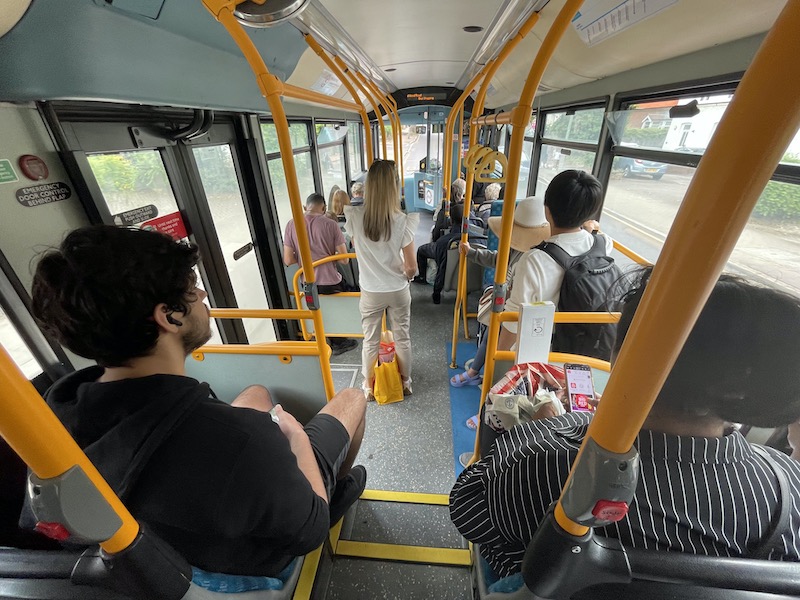
Except we stopped and started many times as we queued for nine minutes to get through temporary traffic lights in the Shirley area meaning having left Bromley North at 15:52 we didn’t arrive at East Croydon until 16:36 making for a 44 minute journey time, 16 minutes more than the schedule which coincidentally is a delay of similar proportions we experienced at the end of Part 1 on the SL10.
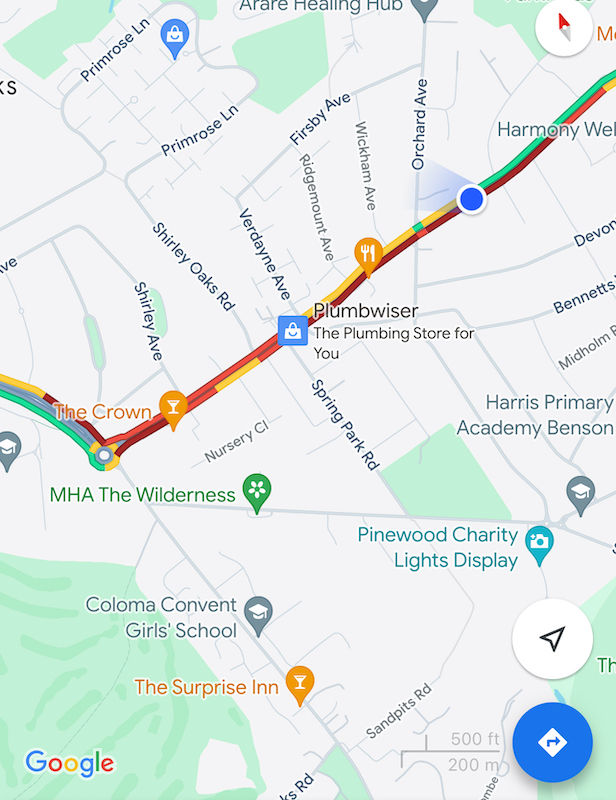
As the bus continued beyond East Croydon to the terminus in nearby Park Street we were left to reflect on our two days worth of Superloop travels.
It had taken us seven hours and 36 minutes of actual on bus time to travel the 85 miles that make up the orbital part of Superloop which, if we add on another six minutes for the short sections of route in Croydon we missed out (West Croydon bus station to East Croydon on the SL7 and East Croydon to Park Street on the SL5), makes for an average speed of exactly 11 mph.
That isn’t “express” by any stretch of the imagination. It’s only around double what a serious jogger would achieve (admittedly not for an 85 mile continuous stretch though) but you get the point.
For passengers used to TfL’s buses seemingly taking for ever to complete a journey with frequent stops, slow crawls to “regulate the service” and delays caused by traffic and roadworks, any improvement by being on a bus which skips a few stops is appreciated as an improvement.
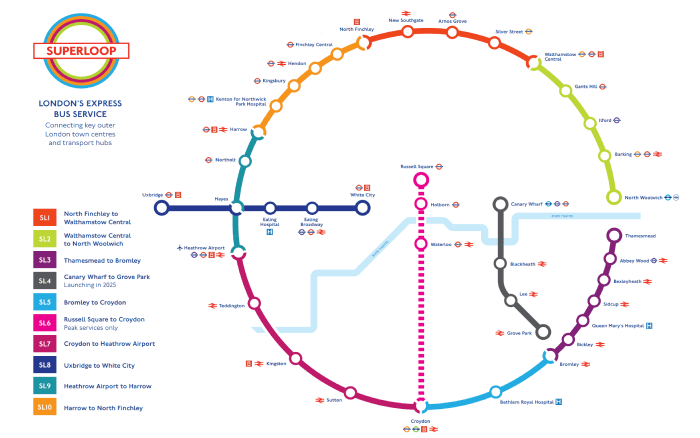
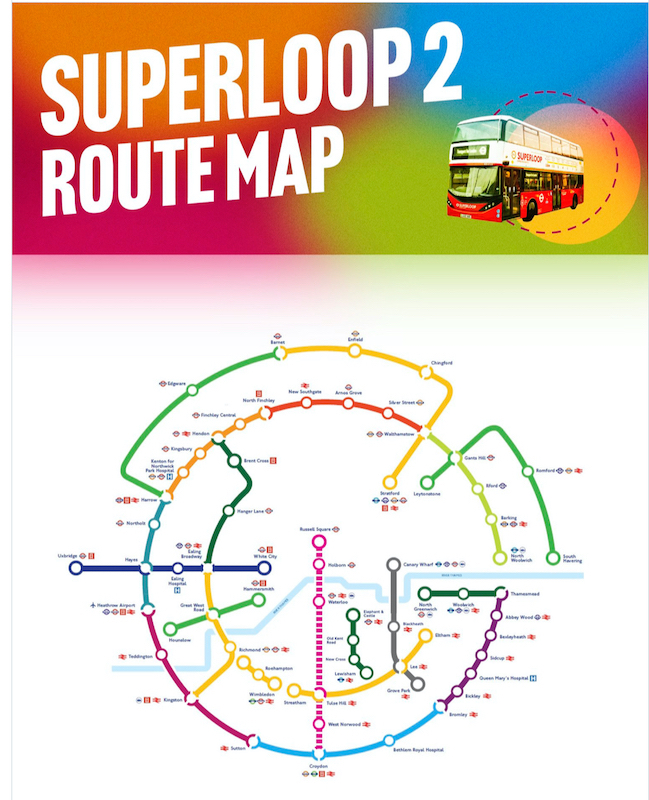
What does the Superloop brand represent? It’s a confusing message, not helped by there being two radial routes (and one more planned) which don’t fit into the orbital network around London implied by the word “loop” in Superloop.
The livery makes the buses stand out from the rest of the fleet’s plain red but the application of the destinations served on the external sides is amateurish with names pasted across the advert frames which are no longer used.
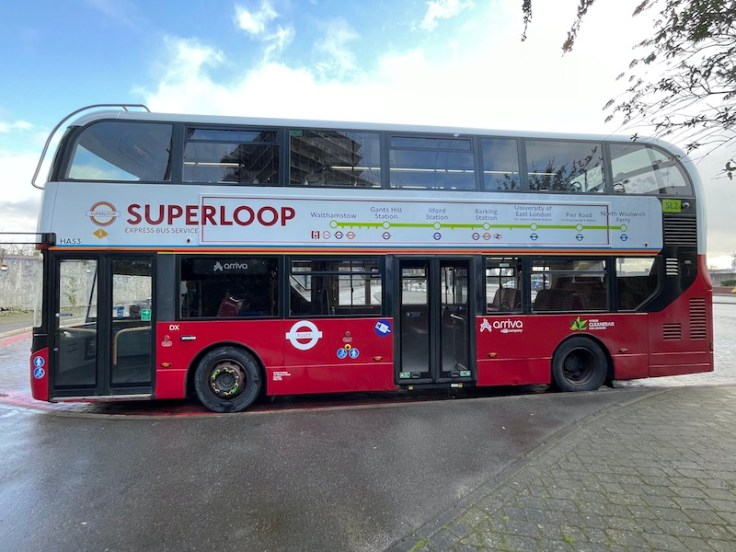
Anyone with an eye to professional presentation would have removed the frames or designed the spacing to avoid such a clash. It demonstrates a lack of thinking.
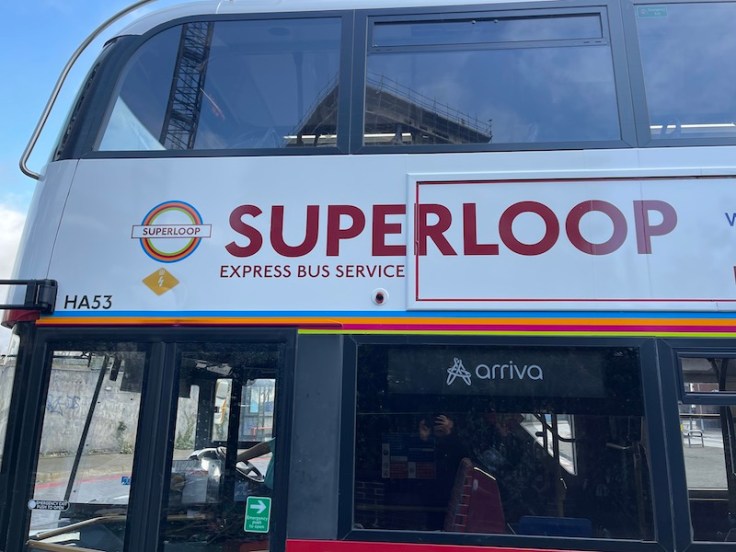
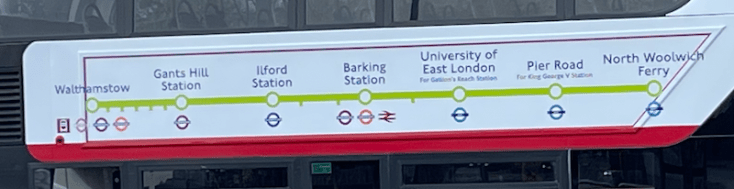
The colour coding of the 10 routes fails to make an impact and could usefully have been carried forward to the stickers on the bus stop plates or even the livery itself – replacing some of the red perhaps?

Inside the buses there’s a few posters on each deck depicting the stops served but otherwise there’s no branding carried forward to the interiors.
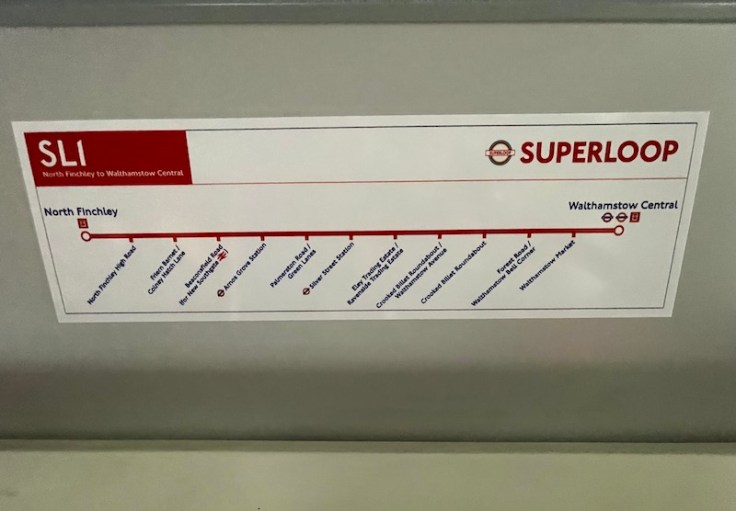
When you compare TfL’s application of the Overground brand to that of Superloop, it does come across as a rough and ready approach lacking the professionalism of the former.
The oldest vehicles used on routes SL5 and SL7 detract from the image but this should be resolved when both routes currently out for tender with new contracts beginning in April 2025 when hopefully new buses will be specified.
With Mayor Khan’s extensive plans to expand the Superloop network as announced during his recent re-election campaign, some of these matters do need addressing, else the brand will offer further confusion of what it represents other than an alternative pot pourri of bus routes that run limited stop and use buses with a variety of interiors offering different standards of comfort from the awful to the acceptable and ages of vehicles.
Roger French
Blogging timetable: 0600 TThS except next week is another Bonus Blog Week with a daily posting describing developments in both bus and rail from around the country which I’m out and about exploring this week using a 7-Day All Line Rail Rover.
Comments on today’s blog are welcome but please keep them relevant to the blog topic, avoid personal insults and add your name (or an identifier). Thank you.


The SL2 serves the University of East London campus at Gallions Reach, which may explain why it goes to North Woolwich. The couple of trips I’ve done around lunchtime carried a number of people to that stop.
Bernie
LikeLike
Showing my age perhaps, but I would have thought the red lower deck and white upper deck livery denoted dual purpose vehicles, whose more comfortable seats would have been welcome on such a marathon trip.
Gareth Cheeseman
LikeLiked by 1 person
I’d commented on a previous article that memories of my local Hants & Dorset dual purpose Bristol VRs came to mind. Of course, other NBC subsidiaries were available!
LikeLike
I did the southern half, Kingston to Thamesmead and back, one Sunday afternoon after church in East Molesey and the roads were so quiet one would have though that full Covid-19 rules had come back into force that day. No hassle at all. I did the northern half, Kingston to North Woolwich on a very quiet Wednesday getting back to Kingston directly across South London. Both were very tame excursions again with no stress at all. Even getting across South London that school Wednesday afternoon on non loop routes was all rather tame. Connections for both trips were so smooth that it was as though my trips had been coordinated by TFL and the police using a sophisticated radio system!
LikeLike
I use the SL7 regularly, and used the old X26 and 726 previously when they ran the route from Croydon to Heathrow. I get the impression that your journey on the SL7 was an unusually lightly loaded one. The SL7 I caught from Kingston To Croydon last Saturday was 75% full most of the way. I regularly see the SL7 with decent loads on a Sunday afternoon.
With regard to the age of the buses and the allegedly amateurish branding, genuine passsengers like me really don’t care if the bus is elderly or the route advertising is a bit naff. We care that the bus turns up, is punctual, is clean, and completes the journey. We all accept that london traffic can be an absolute nightmare beyond TFLs control. I do agree that the SL5 needs bigger buses, perhaps like the ones used on H37 from Hounslow to Richmond.
With regard to non-radial routes being given superloop numbers I expect the 607 was renumbered SL8 as it was the only “non-school” route in the”6″ series. It is my local bus, and again those of us who use it regularly really don’t care what number it is given as long as it turns up and takes us where we want to go. Ordainary passengers are a lot less interested in route branding and advertising than bus professionals and enthusiasts imagine.
LikeLiked by 1 person
| Ordinary passengers are a lot less interested in route branding
| and advertising than bus professionals and enthusiasts imagine.
This.
I wish the “Hey! Look at our amazing new brands!” brigade could have this beaten into them with a big stick.
You’re never going to get the addicts out of their cars with a bit of snazzy branding and self-promotion about how great you are when the industry consistently fails at this bit:
| We care that the bus turns up, is punctual, is clean, and completes the journey.
I’ve travelled on services provided by all the award-winning and self-proclaimed “really good” companies around the country and frankly there’s nothing all that special about any of them other than their abilities at marketing and self-promotion.
All of them at one time or another have failed on the things listed above when I’ve been travelling with them, and all the snazzy advertising in the world and pretty interiors doesn’t help a jot when the bus doesn’t turn up at all or breaks down and the passengers are dumped roadside or the journey gets cancelled halfway because there’s no relieving driver.
I could go on, but I’d rather remember the nice trips I’ve made on non-branded, non-advertised routes – rural trips where the driver has stopped so I can take a photo at a really photogenic spot, for example. Sitting upstairs on a double-decker admiring the scenery over the tops of hedges. Trips where the driver has helped someone off with their shopping and taken it to their gate (admittedly next to the bus stop, but it’s still nice of them). And so on.
A. Nony Mouse
LikeLiked by 1 person
You have express some of Jarret Walker’s “7 requirements of Public Transit” (There is an article on Wikipeda about Mr. Walker which has a summary)
His view is you have to consider all 7, not one/some in isolation, to achieve modal shift
The “7 requirements” deserves to be better known by transport professionals and enthusiasts alike.
MilesT
LikeLiked by 1 person
Why must we always sink to the bottom of aspirations? Obviously, passengers expect the bus to turn up, first and foremost. But time and time again we get the usual “I don’t care if it’s a box on wheels as long as it turns up” brigade. Every other industry demonstrates the power of branding.
The Superloop branding application is clearly not ‘allegedly’ amateurish, it is amateurish. Sticking vinyls that don’t fit straight over advert frames is a basic failing.
TfL spend millions on design – look at the forthcoming Overground re-brand for example. There’s whole departments dedicated to design. Pouring over options to make it as easy to travel round the network as possible. Agonising over shades of colours to be used. Coming up with bespoke moquettes for each individual tube line.
But when it comes to buses, and they just slap anything on, we’re supposed to just accept it because nobody ‘cares’? Well TfL obviously did to an extent for Superloop, otherwise why are they branded in the first place. They’ve just done a slapdash job of it and we shouldn’t pooh pooh its being called out.
LikeLiked by 2 people
“Every other industry demonstrates the power of branding” but some in the bus industry seem to think that “branding” alone will solve all their problems.
It won’t. The bus does need to turn up, run to time, be clean etc etc. Branding is only part of it.
In this instance, Superloop was implemented with commendable speed. Inevitably, given the mix of bus types, there wasn’t time to design vinyls to suit each type.
Agreed, it does demonstrate the present TfL regime’s approach that the bus is the poor relation of London’s transport network.
Observer
LikeLiked by 1 person
| But time and time again we get the usual “I don’t care if it’s a box
| on wheels as long as it turns up” brigade.
That’s because those of us who rely on public transport to travel have learned that it’s all we can realistically aspire for. All too often the snazzy brands and razzmatazz just serve to emphasise how amateurish so many bus companies are about the essential bit of getting that box on wheels to turn up.
Marketing is important, indeed essential for growing a business, but it does not and should never replace the basic job of that business. Unfortunately too many bus companies who emphasise their branding prefer to ignore that part.
| Every other industry demonstrates the power of branding.
But they do so to sell a solid product. The bus industry too often chooses to brand instead of providing that solid product.
A. Nony Mouse
LikeLiked by 1 person
It depends on who your target “audience” is. If you are only interested in addressing and informing the existing customer base, then the (correct and informative) route number and destination display are probably adequate. That group already knows how to identify a bus, and recognise if it is the one that they want – or not. But if the operator wants to attract new customers, then a distinctive image, that stands out as being noticeably different, is obviously a very useful marketing tool. In that case, inconsistent and messy application of the design sends the wrong message to potential customers, and really should be avoided like the plague from the word “go”.
Nigel Frampton
LikeLike
I rarely give credit to TfL as it is painfully clear that those in command have little clue about the practicalities and the flexibility required to operate an efficient bus service for the benefit of the public. Their only concern is adherence to contract specification and the jumble of numbers, figures and percentages as a result. A situation now fast becoming the normal in Manchester too I note.
But, and in spite of being introduced thirty years later than they should have been, considering the almost lightning speed by normal TfL standards with which they were introduced (nothing to do the Council Elections I am sure…), the results are pretty impressive. Of course Greater London traffic hampers the whole operation, and much varies from day to day, but considering what had to be done in gathering vehicles, new liveries and Driver recruitment, I would say it has been a job well done.
The sorting out of some of the finer points, vehicles, liveries etc. can surely come later once services are established and possibly subject to changes in the light of operational experience. And as other Commentators have noted, the loadings on particularly the SL7 are very impressive at all times of the day. The public also choose to travel on the uncomfortable (and clapped out!) single-deck SL5 rather than comfortable electric double-deckers on the 119, merely because the journey time is perceived as faster. The time difference is almost negligible, but they rightly enjoy the reduction in stops.
Let us hope Limited stop services can be introduced along more corridors, and not just in Greater London.
Terence Uden
LikeLiked by 1 person
As Bernie stated above, it serves the university, which had finished teaching by the time you used the service, as a now former student from the outer boroughs (Havering) SL2 has been a lifesaver for me when going to the university, saving me on average an hour each way
LikeLike
With average London bus speeds of around 9mph Superloop’s 11mph represents about a 20% improvement, so not bad in that context. As with so many things, it depends on how one defines success…
Mike Best
LikeLike
SL2 serving North Woolwich not only helps serve the uni nearby as stated above but will also come into its own when new housing blocks are completed. It’s also handy for those on the south of the river as you highlight, and that will become an increasing benefit as again more residential blocks rise south of the river. The foot tunnel is pretty speedy but that lift needs fixing.
The same concept of Superloop buses before in place before new housing also applies in Thamesmead.
LikeLike
Imagine if this were a network of speedy tram routes that operated around the outer borough’s of London to form a loop, THAT’S something I’d like to see…
LikeLike
Imagine if the Superloop routes were not trams, but bus routes with extensive bus lanes and other priority measures. Thus giving the speed and reliability of a tram, but added flexibility. That really would be good! Sadly it would take a very brave politician (and sadly Mayor Khan isn’t one) to take road space away from car drivers…….
LikeLike
The only way you will ever get politicians willing to risk the ire of the media and the motoring public by introducing serious amounts of bus priority in London is if they don’t have to answer to the voters. That means it will only happen if we end up under a dictatorship, which Gods forfend.
The only other way it will happen is if fossil fuels become so ridiculously expensive that it prices driving a car out of the reach of the ordinary person.
For that to happen probably means the Middle East “dispute” has gone nuclear, and in that even we’ll all have far bigger things to worry about.
A. Nony Mouse
LikeLike
At present the Super loop buses give very poor value for money. They are not much faster than normal bus routes and most duplicate existing routes and have not improved passenger numbers by much. On any cost benefit analysis’s they have failed
Replace them with trams? I think not trams are very expensive and inflexible and add to congestion
The big problem is lack of road space. Who should get priority for the scarce road space
One way of improving things is much tighter restrictions on on road parking but politically that’s not going to happen. Getting rid of most cycle lanes would also help but again politically it will not happen
LikeLike
We’re doomed then as apparently nothing can be done!
Peter Brown
LikeLike
In the short term . . . no, nothing can be done. Superloop may not be ideal, but it is better than nothing. Look at this way . . . if Superloop proves to be beneficial to passengers, and numbers grow, then the concept is valid, and can be improved or expanded.
Even increasing bus lanes is contentious . . . pressure groups will scream about reducing mobility for car drivers, or removing prorities for cyclists, or trimming trees. Trying to build tram lines will take for ever, as we’ve seen on ALL tram networks in the UK . . . but if Superloop starts the process off, then maybe that’s the best we can hope for in the short term.
LikeLike
I hope you’re right greenline, baby steps, build patronage, justification for more priority etc. I can see that Superloop has been created quickly with existing resources, so credit for that is due.
Politicians do need to listen to public transport advocates, educate themselves about trends in Europe regarding cycling, 15 minute cities, car reduction, innovative bus priorities, and how together this brings an improved quality of life. Then they need to LEAD in persuading the public.
Transport is the largest emitter of carbon now, SUVs have wiped out the benefits of cleaner engines, and are simply ridiculous in urban areas. We can’t just continue bumbling along in the stereotypical British amateurish way and hope everyone will be soon be driving electric cars (they won’t) so we don’t need to do anything now.
Peter Brown
LikeLike
. On any cost benefit analysis’s they have failed ?
When was this done. Would be interesting to see a additional cost analysis compared to prior service and overall general patronage – marginal cost to marginal passenger ideally.
What did (is?) seem to be a problem are folk not sure they are part of the london bus network and can oyster be used?
LikeLike
Superloop near doubles the resource on a route but has not doubled the passenger numbers nor has it reduced congestion or speeded up jouneys which tends to indicate they are not delivering value for money
LikeLike
Believe you and me, I’m no supporter of TfL . . . but Superloop needs to be given time. We’re barely 6 months into the network . . . some routes barely 3 months since starting. In my career, and where increases in passenger numbers on new routes can be clearly identified, I would say that 6 months is an absolute minimum before examining whether numbers have grown (or fallen).
In London, where parallel routes muddy the data considerably, I’d argue for 12 months to elapse before looking at passenger numbers on Superloop routes.
Expecting immediate results is never good. Passengers change their behaviours slowly . . . if their existing journey meets their expectations, they’ll be slow to change.
LikeLiked by 1 person
| Expecting immediate results is never good.
The only time results are immediate is when they’re negative.
To take an example from my own career: 30 years ago the Birmingham CrossCity line was closed for electrification, with replacement buses provided for months. Patronage very rapidly nose-dived as the regular users found alternative means of making their journeys, be that car, local bus or in some cases driving to different railheads.
| Passengers change their behaviours slowly
…and they’re extremely risk-averse.
They’re very slow to adopt new behaviours if they don’t trust that the new provision will last. So, if someone says “Hey, we’re going to run these new express buses but we’ll review them after six months” then the passengers are unlikely to have confidence in it being worthwhile changing their regular travel patterns. If the funding is available, I’d say the minimum time to allow a service to bed in and attract regular custom is three years.
To return to the Birmingham CrossCity line, by privatisation there was serious discussion within the railway* as to whether the daytime 15-minute headway with peak extras could be justified as the passengers just hadn’t returned.
Today the headway is every 10 minutes and the trains are busy all day, but from the viewpoint of 1995/96 that really wasn’t at all a likely thing. It took a decade or more for the passengers to return in great numbers.
* Richard Jones could probably tell us if the PTE were as concerned around five years after the XCity electrification blockades as Central TOU/TOC were.
A. Nony Mouse
LikeLike
The biggest negative for passenger numbers on Tfl buses over the past 7/8 years has been the reduced speed, mainly caused by the removal of road space to appease the minority cycle lobby. Far more people have been lost from bus services than would ever cycle. So anything that reduces journey time and increases passengers is a good thing.
I agree with .p Greenline 727, it takes at least 12 months before any meaningful data is available to further amend services. Never alter a bus route unless you have to
LikeLike
have a bad experience on SL9
herbaria to harrow
landed at terminal 5 at 4.45 collected bags 5.15pm
not good direction how to go to central bus station
took free train to terminal 2 again poor sign posting to reach central bus station arrived at 5.50pm
did not get on the Sl9 till 6.45 no sl9 came in between
theoretically missed four buses in between
the stop has no information on delays and website is also poor.boarded the bus not enough spaces to store suitcases
one would expect buses to and from Heathrow to have ad quite and convenient spaces for suitcases instead of having to lift/swing heavy cases in limited space . So stored in push chair area. Driver not happy and not extremely rude. Got out of his cab and shouted to store the bag in the rackwhere there were already bags?
reached harrow bus station at 7.50
if going to Heathrow to catch a flight,
would advise not to use this service as poor timing inadequate information and no space for bags
LikeLike
I don’t work for TfL or a bus company, but whenever I travel on London buses everyone seems downright rude to me.
| in the rack where there were already bags?
Was the rack actually full?
One thing I’ve noticed when I travel is that people nowadays are unwilling to move bags in racks to create space, so you end up with racks that are “full” when they only have a few small bags in although those bags could have been moved to put a suitcase in then the small bag alongside or on top.
I’ve also notice that people don’t consider others when putting cases into racks, so someone will plonk their case in lying on its back (largest side) rather than on its side so other cases can be put alongside; people will put cases into racks handle first so the wheels stick out into the aisle, where other people will catch them, rather than putting the case in wheels first (which makes them easier to take out).
A. Nony Mouse
LikeLike
I wonder how many of the anonymouses (anonymi?) complaining about the buses to and from Heathrow are under the misapprehension that complaining here – or on any random site online – will reach TfL?
Y’know, like the people who put detailed complaints in reviews on Google Maps yet seriously believe that company X will read and react…
Anonymous A. Nony Mouse
LikeLike
SL9
We were so excited to use the super loop end to end to get home after a business trip on the 7th June. We waited for the 1808, nothing arrived, then the 1817,again no information and no arrival, and then finally we spotted the 1832 which the driver went to take break before departing at 1840. It took the best part of an hour From Heathrow to Harrow which was expected, however other than the delays, this bus is not equipped for passengers travelling with luggage – it really seems it is a commuter bus.
Overall very disappointed with the service, the lack of information on delays and the complete lack of space for travellers with luggage.
LikeLike
I have to agree that the facilities at Heathrow Central bus station are very poor and inadequate and should be a lot better. I doubt that things will improve though
LikeLike
London’s slowing bus speeds are a big problem. Superloop or express buses generally are a part attempt to answer this but only part. Speed limits on major bus roads could be raised to 30 again. Bus lanes and other priority measures must take preference over cars and bikes. And measures must be taken to reduce private car traffic. It’s not easy but the rewards are great.
Mike C
LikeLike