
Tuesday 4th June 2024
The small gang of intrepid (mostly retired) busmen who do occasional bizarre London based bus trips has been at it again. Way back before Superloop was even a glint in a Mayoral eye, in June 2016, some of the team circumnavigated the extreme outer edge of the Capital’s bus network using TfL buses (as well as Ensignbus X80). It took 14 and a half hours to complete the epic ride from East Croydon and back again ….
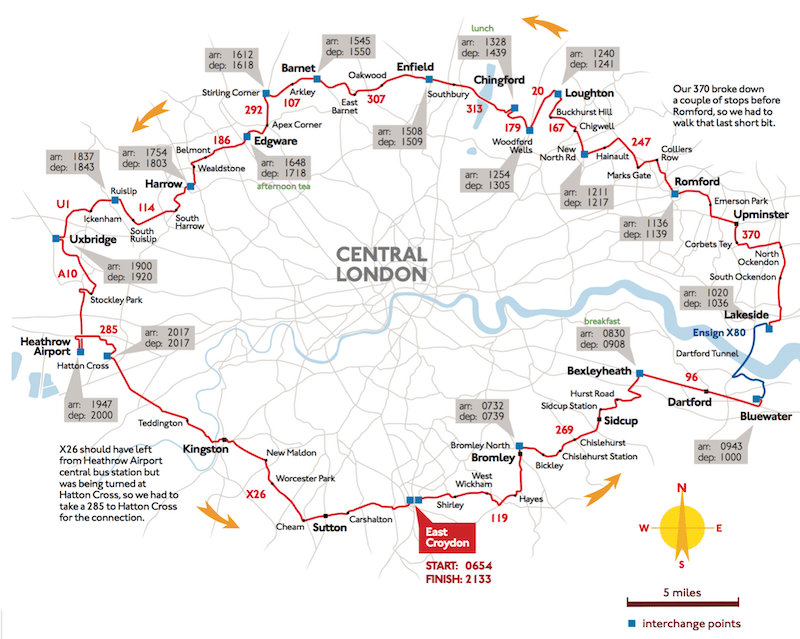
… then in 2021 you may recall we took a more leisurely four days to do a similar circumnavigation but this time “over the border” using former London Transport green/London Country bus routes to belatedly celebrate that company’s 50th anniversary as described in a four-part blog series that year.
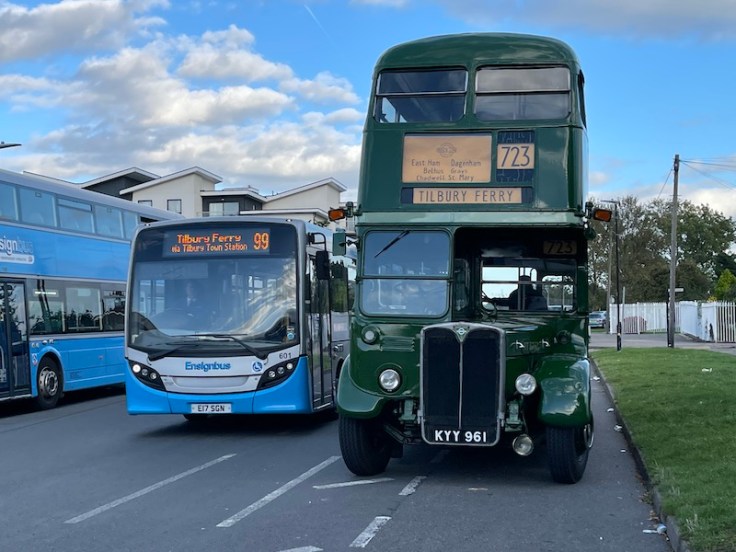
We’ve also recreated former Green Line routes, former trolleybus networks and even crossed every London bridge by bus in strict geographic, west to east, order. So, for our first escapade in 2024 it was self evident we’d be back on the round London tour kick, but this time using the Mayor’s new Superloop “express bus” network to see how the network is faring after the celebratory introductory hype has worn off.
With memories of that 14 and a half hour arduous trek still lingering we decided to spread the 2024 Superloop version into a two-day affair allowing time for a nice leisurely pace with an off-peak start time and a decent lunch stop.
And so it was we gathered at 10:30 outside East Croydon station for the first foray and an intention to travel clockwise and reach Walthamstow Central by around 16:30 having enjoyed four of the seven SL numbered routes.
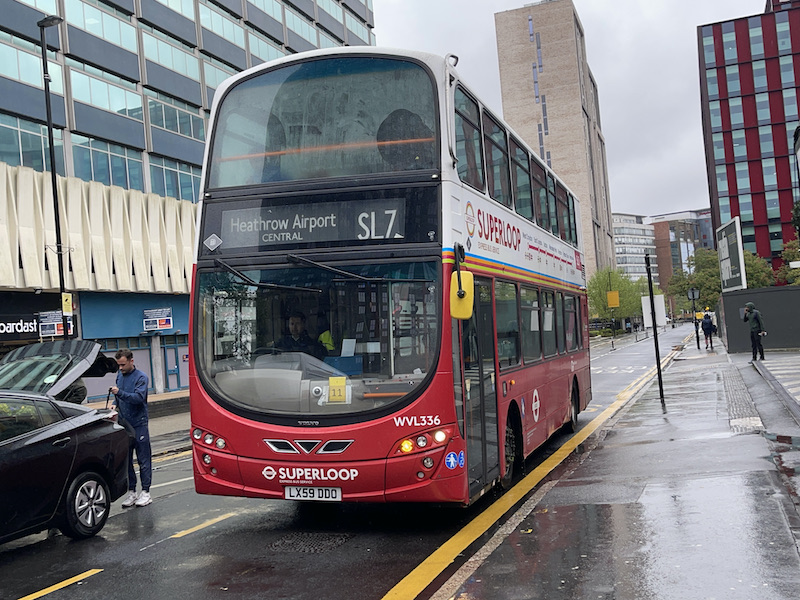
Our first bus on route SL7 taking us all the way to Heathrow Airport was a 14 year old Volvo B9TL with a Wright Eclipse Gemini body operated by Go-Ahead London’s Metrobus arm from its bus garage in Beddington, Croydon. It’s not exactly in its first flush of youth, as they say, having served its time with sister company Blue Triangle on the East London Transit branded routes EL1 and EL2.
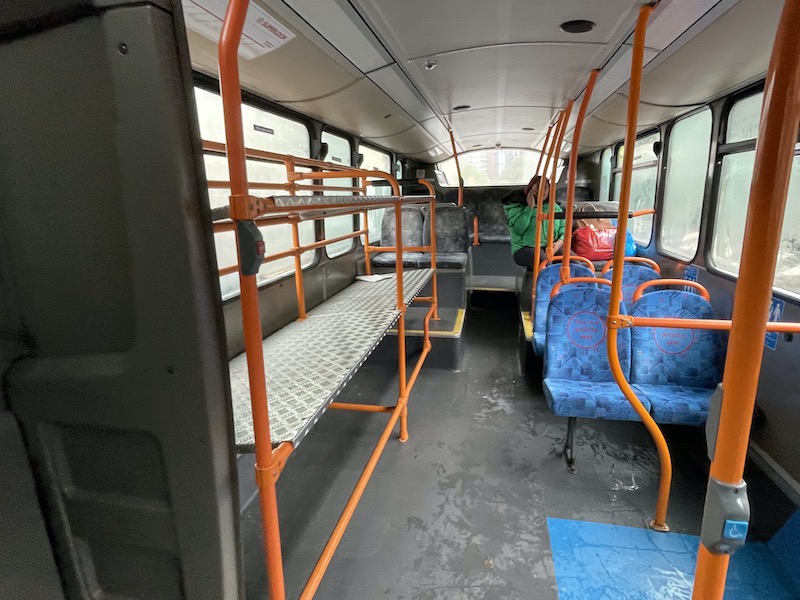
A large luggage rack has been added behind the stairs on the lower deck and the centre doors have been removed but on the upper deck there’s a protruding panel in the floor above where the mechanism for the doors used to be.
This makes for an uncomfortable two-level floor for passengers sitting in the rows above the former doors.
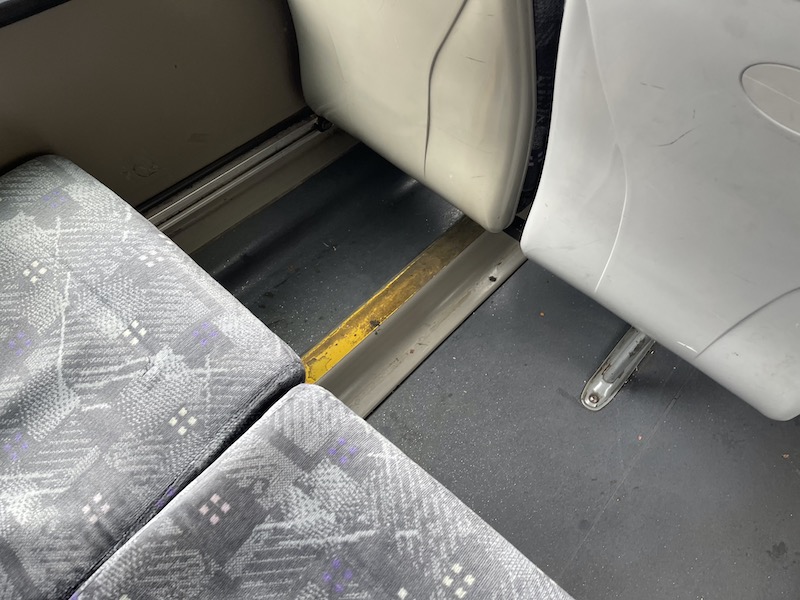
The ambiance of the interior is dated and poor. It certainly doesn’t convey a “Super” image befitting the branding of what is promoted as a high profile network of express routes.
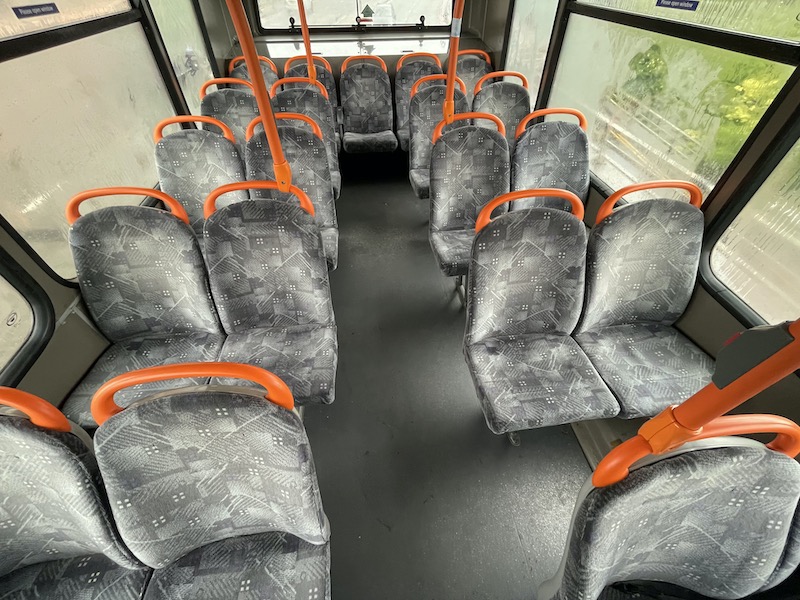
Light rain fell for much of the journey inevitably meaning all the windows soon steamed up making it impossible to see where we’d been or where we were. It doesn’t make for a very pleasant atmosphere for a journey scheduled to take an hour and 47 minutes via Sutton, New Malden, Kingston and Teddington.
Route SL7 begins at West Croydon bus station but we boarded the bus four minutes into its journey in Dingwall Road, alongside East Croydon railway station and with memories of a former bus garage in the road which at one time was part of Southdown and before that National Travel South East and we tried hard to remember which company preceded that…….(update… Ray has reminded me it was Timpson’s which in turn had taken over Bourne and Balmer in 1953 … thanks to the person commenting too.)
About eight or so passengers and the seven of us headed off towards Sutton where a few alighted and more joined us, as was the way at most of the eight intermediate stops between West Croydon and Kingston where there was a significant exodus and minor replenishment of passengers (at both the station and Wood Street stops) with more joining at Teddington for the one lengthy stop ride all the way to Hatton Cross.
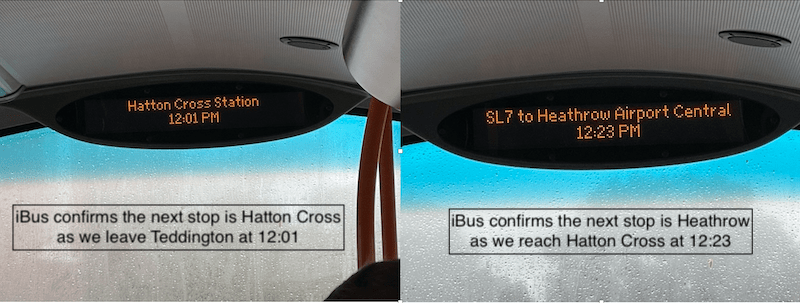
Indeed, the 22 minute journey from Teddington to Hatton Cross is the longest gap between bus stops on the TfL bus network but the idea we would travel “express” is soon punctured by the 20 mph speed limit for much of the way which the driver assiduously observed.
The final fling to Heathrow after reaching Hatton Cross is an eight minute trek around the airport perimeter and after diving into the tunnels under the runways at 12:31 we reached the Central bus station at 12:32, three minutes behind schedule.
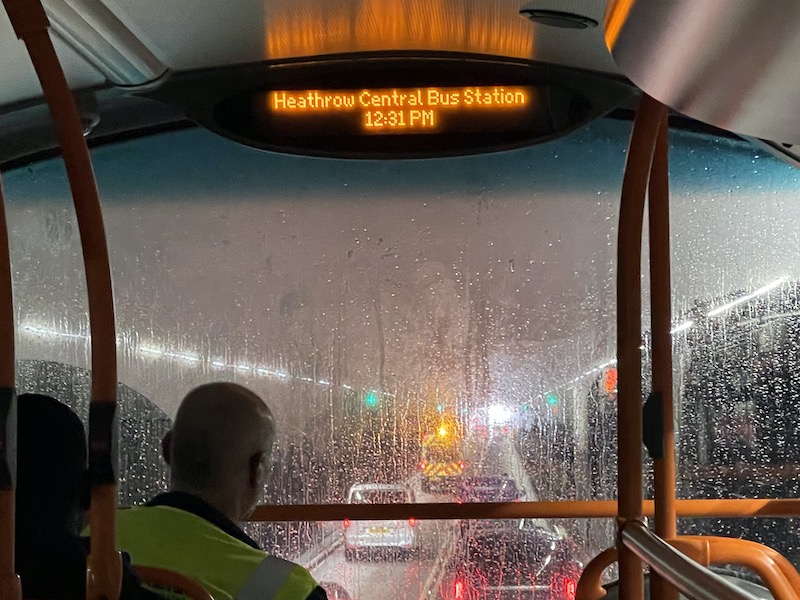
The SL7 (formerly known as the X26, and before that the 726) is a lengthy 24 miles and had a doubling in frequency to every 15 minutes in August 2023 with 20 buses now needed to run the service. It was interesting to peer through the misted up windows and note buses we passed heading towards West Croydon every seven and a half minutes all having about a dozen passengers on board.
We also noted not all buses have had their centre exits removed and where not, the lower deck luggage rack was not quite so extensive.
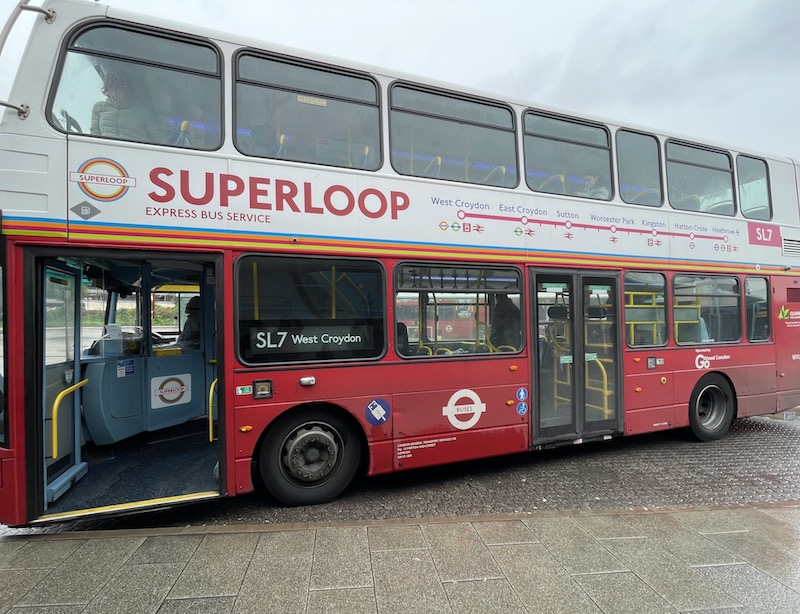
After a quick toilet stop we were on our way again on the next segment, on our second bus, heading north to Harrow on route SL9, the renumbered X140.
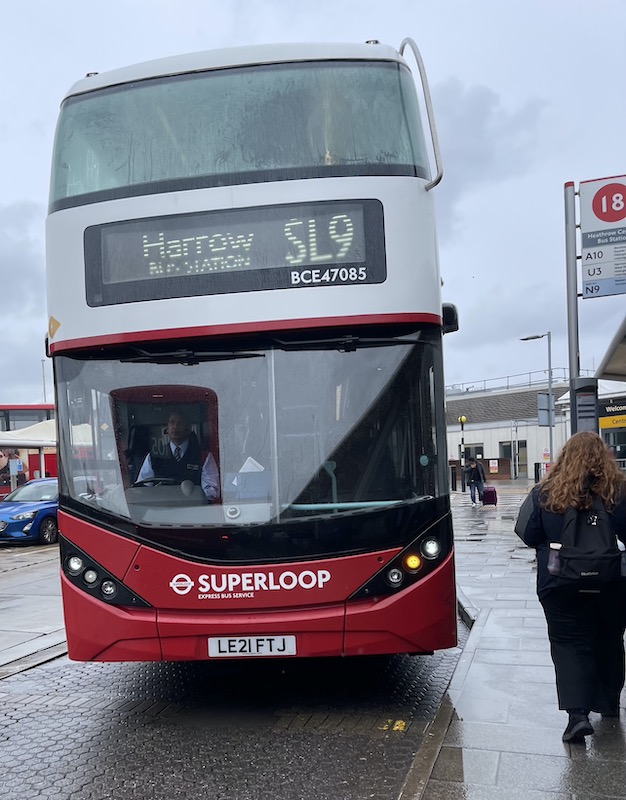
This was a London Sovereign BYD/ADL Enviro400EV City from the RATP Dev bus garage in Harrow and being only three years old, gave a much better impression to passengers.
It’s a 10 mile, 52 minute, journey with 13 buses needed for the 12 minute frequency. We left Heathrow at 12:56 with about a dozen passengers and picked up high single digit numbers at the first stops in Harlington as well as in Hayes (the railway station and town centre) where the all stopper 140 route joined us.
The phenomenon of passengers ringing the bell to be dropped off at one of the non observed stops, which always seemed to be prevalent on the X140, has continued on the SL9 and was noticeable as we passed through Yeading and on to Northolt, as was the traffic queuing along the A312 which slowed our progress, even being overtaken at one bus stop by a bus on route 140.
We arrived into Harrow bus station at 13:51 having taken 55 minutes and seen a good number of passengers – anecdotally SL9 buses looked busier than 140 buses. There are 21 of the latter running every eight minutes and, as already explained, 13 of the former every 12 minutes.
It was now time for a late lunch break before we began the second half which would take us on to North Finchley on the SL10 and then across to Walthamstow on the SL1.
Except it didn’t quite work out that way.
The bus on route SL10 arrived ready to depart just as we arrived back into Harrow’s bus station at 14:56 and we headed off with ten on board, a couple of minutes later.
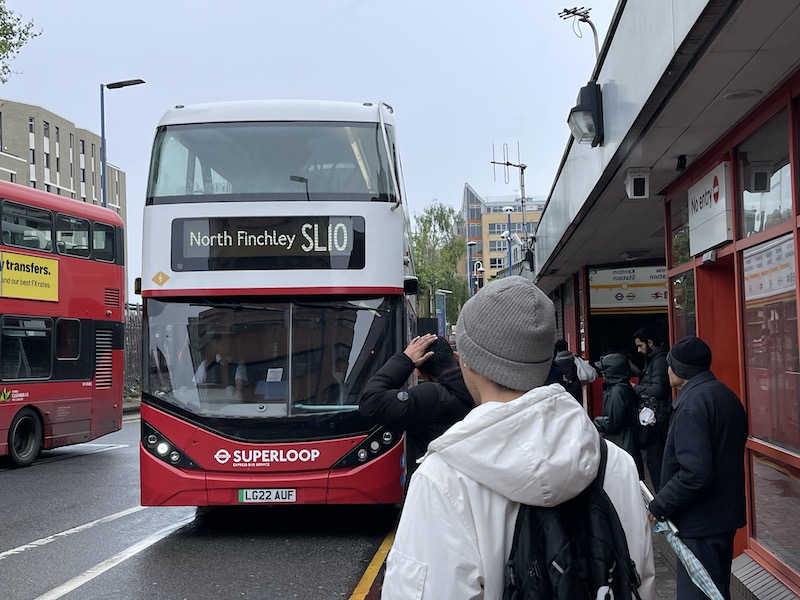
It was a two year old London Sovereign BYD/ADL EnviroEV from the same RATP Dev Harrow bus garage as the SL9.
Like the SL9, route SL10 runs every 12 minutes with end to end journey times for the nine miles to North Finchley taking generally just under the hour. Our bus, one of 13 needed for the route, was given a scheduled time of 59 minutes reflecting the fact we’d be travelling through school turning out time and its consequential impact on passenger numbers and traffic levels on the road.
And sure enough at only the second stop after leaving Harrow bus station we arrived at Kenton Road/Kenton Lane six minutes later where a large number of students were waiting to board.
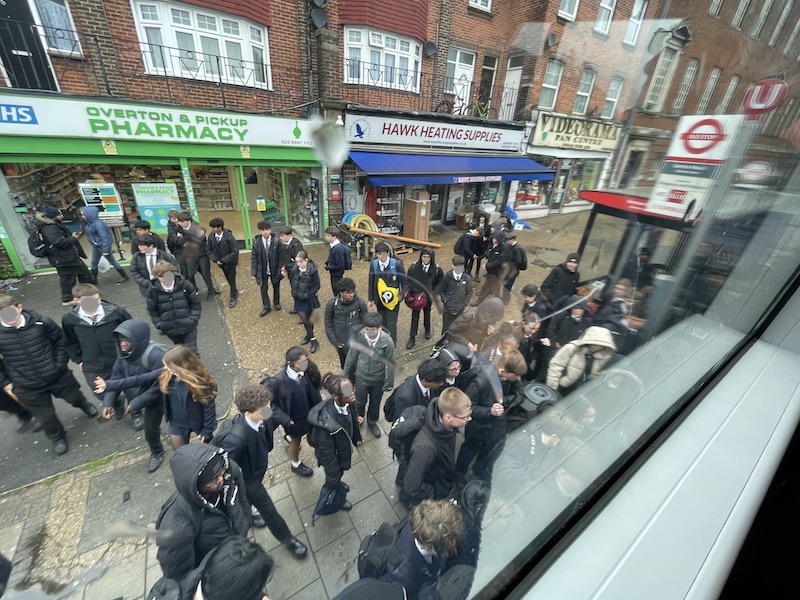
They piled on the bus through both doors – front and centre – and it didn’t take long for the upper deck to become full with three or four students standing and others standing on the stairs.

Many were left behind at the bus stop which we all had time to observe as the driver stayed at the bus stop for 12 minutes with no explanation of why we’d not moved. There was speculation it might be a mechanical issue, or possibly because there were standees on the upper deck. But there was no communication.
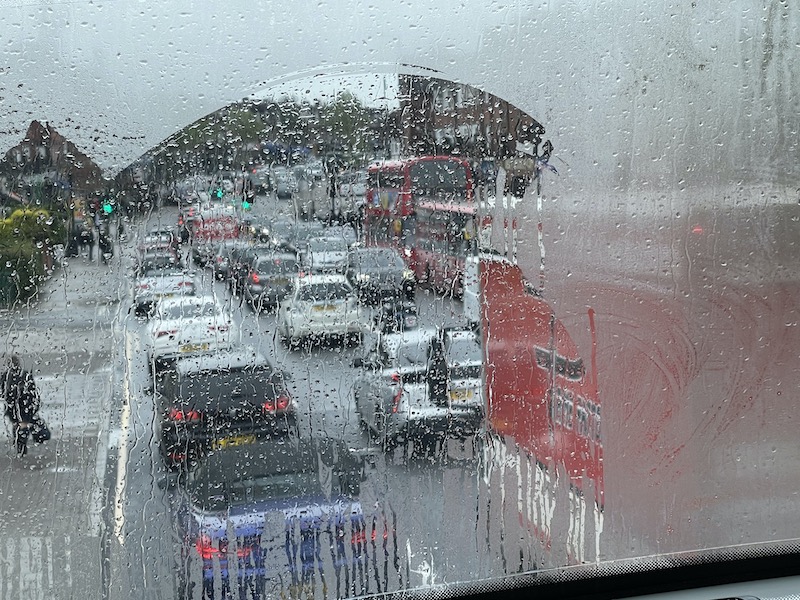
When we finally did pull away, the traffic ahead, seen through the misted up windows, and for the rest of the journey, can only be described as ‘slow going’. By the time we’d reached Hendon we were almost 30 minutes behind schedule.
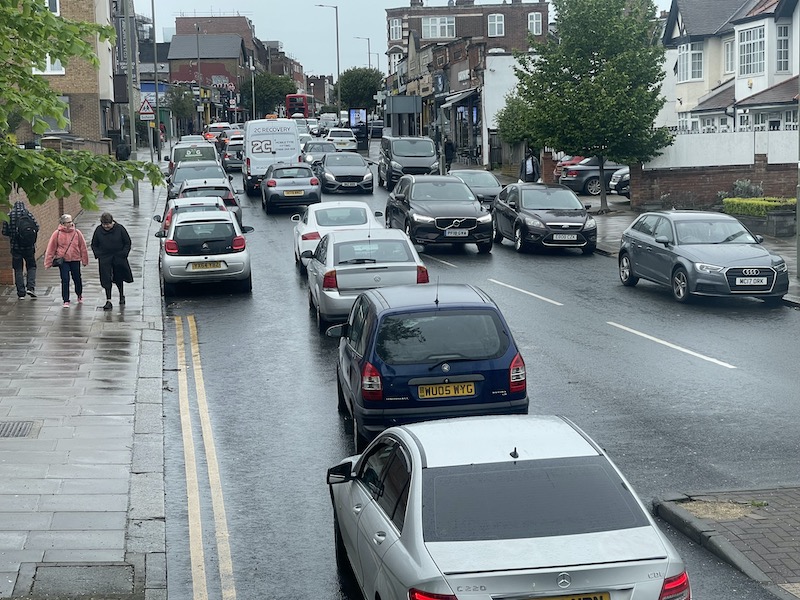
It was an excellent demonstration of a lack of bus priority measures killing off any semblance of the bus route being regarded as “express”. And the onboard overcrowded conditions made the journey uncomfortable and uninviting. “Super”, this certainly wasn’t.
The SL10 parallels the 183 for much of its journey and when the former was introduced the frequency of the latter was reduced from every 7.5 minutes to every 10 minutes with a reduction in requirement from 25 buses to 19.
We’d been scheduled to pass Finchley Central on route to North Finchley at 15:47; 50 minutes after leaving Harrow. We finally arrived there at 16:14 – 27 minutes late on what should have been a 50 minute journey – just over half as much again than it should have taken.
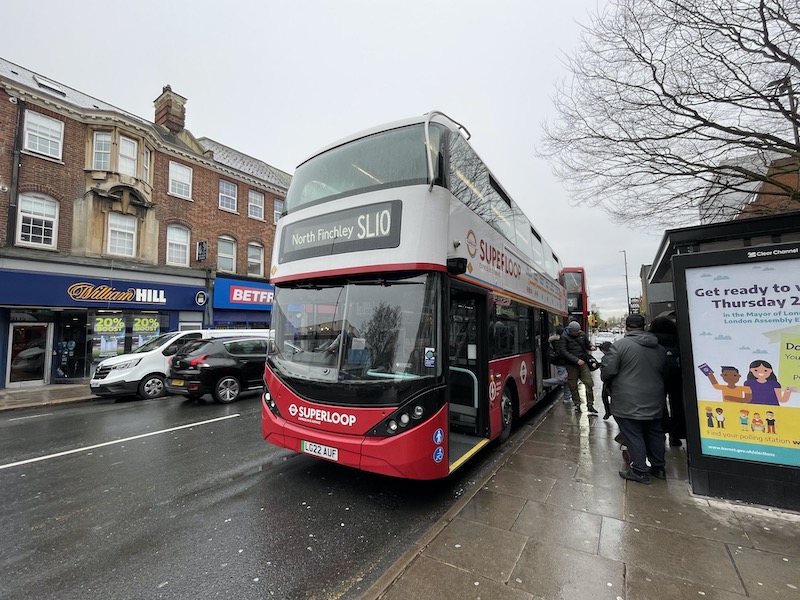
While we were slowly crawling through Kenton and Hendon, I’d been keeping an eye on the state of the North Circular Road, particularly east of Arnos Grove and through the Palmers Green bottleneck. Ominously Google maps was showing a thick red line indicating more congestion and inevitable delays on our next route, the SL1 from North Finchley to Walthamstow.
We decided to curtail our Superloop Part 1 foray at Finchley Central rather than face more frustrating delays through Friern Barnet, Palmers Green and Edmonton with an anticipated arrival in Walthamstow at least an hour later than the original plan.
Looking on the bright side, restarting Part 2 of our round trip back at Finchley Central, and changing buses in North Finchley soon after, should mean enjoying a mid morning clear run round to Walthamstow on the North Circular. Well, you can but hope.
Find out if our revised expectations were met in Part 2, or whether we needed a Part 3 to complete the journey round to East Croydon, in Thursday’s blog.
Roger French
Blogging timetable: 06:00 TThS except next week is another Bonus Blog Week with a daily posting describing developments in both bus and rail from around the country which I’m out and about exploring this week with a 7-Day All Line Rail Rover.
Comments on today’s blog are welcome but please keep them relevant to the blog topic, avoid personal insults and add your name (or an identifier). Thank you.


Great review – but sadly I’m not surprised about the delays on the SL10. I’ve been on the SL10 between Hendon station and Finchley Central a few times and it’s always been heavy traffic and ended up running late. Barnet borough in general has very little in the way of bus priority measures (or cycle priority measures for that matter). I’m hopeful that might change given the council is ‘under new management’, but we’ll have to wait and see.
More generally, it does make you wonder how viable the Superloop is as a method of getting between the outer London suburbs. It’s probably acceptable for ‘short hop’ journeys like, say, Finchley to Kenton, but given how so many of the routes get stuck in traffic or 20mph zones I don’t think many people would use it to travel right round to places like Heathrow. I guess the problems are partly because London’s orbital road network is not always well developed, especially in south London where the South Circular can be very slow. That said, the SL1 seems to suffer from some of the worst delays and that’s using the North Circular – a dual carriageway trunk road.
Nick, Lancaster
LikeLiked by 2 people
The East London Transit routes are EL1 and EL2
Andy V
LikeLiked by 1 person
Of course; many thanks Andy. Updated.
LikeLike
That garage in Dingwall Rd was, I think, Timpson’s, before that Bourne and Balmer, then Wallace Arnold – though with the latter operator I may be confusing it with their travel agency in Park Lane, near the Seeboard building, which was my usual place to buy Red Rovers. (For some reason, unlike Green Rovers, Red Rovers couldn’t be bought from the conductor).
LikeLiked by 1 person
Many thanks.
LikeLike
I used to buy Red Rovers at LT garages – notably S, GM, FW and AV, but possibly others too that I’ve forgotten about.
Ian McNeil
LikeLike
Was the Dingwall Road coach station in East Croydon previously owned by Bourne & Balmer (later Timpsons) ?
Peter Murnaghan
LikeLiked by 1 person
Spot on Peter; now updated.
LikeLike
I used the SL7 in early May from Heathrow to Sutton on a real practical journey! That was as a medical courier travelling to the Royal Marsden. Our experience of travelling from Heathrow to Sutton over the years suggests that the X26/SL7 has always been a worthwhile radial bus route, with less hassle than any train journey via central London. My memory is that my bus was rather more modern than Roger’s!
LikeLike
Thanks for this review – let us hope that the future holds more bus lanes (maybe even on the North Circular?) and parking restrictions, plus finance to provide more (and better) buses for the greater traffic flows which all those should generate!
Part of the Superloop package which I’d like to hear about is the off-bus publicity. Three examples: is it as easy to find your way at interchanges as it is on the Underground? – do the network maps at Underground stations show the SL as well as the OG as a means of avoiding central London? – do the line diagrams on tube trains show SL interchanges, as they show interchanges with other tube, OG and main-line rail etc.?
LikeLike
Ironic how SL7 has now come full circle, in the 90s when it was 726 Dartford-Heathrow, the route was always up for withdrawal but often got stay of execution, it was cut to operate Bromley-Heathrow with late evening & early morning journeys withdrawn.
726 was then renumbered to X26 & further cut to become West Croydon-Heathrow, but given a frequency boost from hourly to 2 buses an hour, & recently renumbered to SL7 & increased to 4 buses an hour
I do have a timetable when the 726 was Gravesend-Windsor, their was a 725 Gravesend-Windsor but think that went via Staines, the 726 via Heathrow & Slough
SM
LikeLike
Whilst the Volvo vehicles at present used on the SL7 (former X26) are a little dated by now, they do give a comfortable ride. Along with the former 607, the SL7 is of course a long established service and extremely popular, as was the former Green Line 725/6. Evenings and Sunday mornings the running time, in spite of the ridiculous 20mph restrictions (which are fine for residential side roads but NOT for limited stop inter-urban bus services) is little more than one hour from East Croydon to Hatton Cross. If ever there was an example of how buses should be given top priority to do the work they are best suited to do, the SL7 is it. But presumably, the brigade who damaged ULEZ cameras, will similarly oppose further bus lanes should their “freedoms” be curtailed.
The experience with school children simply flooding onto the SL10 is now becoming far too normal on London bus services. In fact the Zip card system, introduced deliberately to stop free riding and other abuses, including vandalism, which occurred after children’s fares were abolished, now appears to be entirely optional. Youths of any age merely walk onto buses once more as if the Zip system no longer exists, and TfL appear to do absolutely nothing. Complaint to TfL is, as always, useless and thus a whole new generation now abuse the system and Greater London Council tax payers foot the bill.
Terence Uden
LikeLike
It’s not just London where “authority” is apparently unwilling to do anything about kids and youths travelling without tickets.
I was in Greater Manchester over the weekend and the serried ranks of Metrolink inspectors in their yellow hi-viz jackets hanging around Victoria and jumping trams to Queen’s Road were noticeably ignoring kids and youths even when groups of youths jumped off the trams on seeing the yellow HVs shouting about needing to get off because of not having tickets.
The only time I saw youths being instructed to go and buy tickets was on Sunday when Tram-Replacement Buses were in operation and the CMAC contractors were taking things seriously at least at a couple of the stops.
It was quite clear from listening to locals that Metrolink ticket inspections rarely happen anywhere other than around their Queen’s Road base, so if there’s no interest in enforcing payment and there’s rampant evasion (posters on Metrolink stations quote 86 *thousand* penalty fares issued last year, which given the lack of ticket checks says a lot), why not drop the pretence of charging and just make the service free at the point of use?
A. Nony Mouse
LikeLike
That won’t happen as rather than a £7-8m gap in revenue, you’ll have a £70-80m gap to fund
LikeLike
Except it’s not a £7-8 million gap, because if they’re raising 7-8 million doing checks on on one small section of route then you can absolutely infer that they’re losing a similar proportion across the rest of the system.
My assessment from riding the system and just listening to people talking and watching their behaviour is that the fraud rate is potentially in the region of 20-25%, which is horrendous by the standards of any public transport system. The UK railway is generally understood to have a fraudulent travel level of 4%, by comparison.
TfGM are employing inspection teams which are ineffective, they’re paying for ticket machines, supplies and maintenance, and those are costs which wouldn’t be needed if tickets weren’t required.
However, this is the UK rather than Luxembourg and the idea of providing a public service which is free at the point of use is anathema, so it would never happen.
A. Nony Mouse
LikeLike
Noted in the small print seen recently, I gather TfL wish to cut the SL7 back to Sutton, extending the single-deck SL5 from Croydon to Sutton in it’s place. Hopefully, should this retrograde move happen, they will have sorted the so-called tree problem in Park Langley (double deckers happily work in leafier places within the Borough Of Bromley) by then and double-decked the SL5.
Terence Uden
LikeLike
The SL5 should overlap with the SL7. Possibly even by a different route to sutton or one or other being more express and missing out different stops ?
JBC Prestatyn
LikeLike
Well I don’t suppose that they can do anything about the light rain.Let’s face it rain is the new norm and we’ve hardly seen a single dry day in 11 months and if it remains so until July it’ll have been 12 months of rain everyday.Of course it’s not just depressing it’s damaging railway embarrassments and the like.
LikeLike
Presumably “railway embarrassments” should actually be “railway embankments”!
RC169
LikeLike
Roger, I share your frustration at the late running of the Superloops but at least you didn’t have to be unceremoniously made to leave the service before reaching your destination! This has happened to me twice recently. Once on a SL3 from Bromley to Thamesmead which terminated at Abbey Wood and again on a SL9 from Harrow to Heathrow where we were invited to leave the bus at Hayes (The Grapes). Another frustration I found was on a SL6. A fine non-stop run from Holborn to West Norwood was then spoilt by stopping at every single bus stop from there to West Croydon. To Summarise. Superloop. Good idea. Smart Livery. Stupid name. And Express it certainly is not.
LikeLike
Superloop won’t achieve its full potential without a radical increase in bus lanes. One question I have is why are bus lanes always the kerb lane? Move the bus lane to the outer lane and no one will park in it, simples. This is why trams run in the middle of the road. There are ways to achieve level boarding with this scenario.
On the topic of falling bus speeds snd congestion they are having a conversation about this in Edinburgh:
https://www.scotsman.com/news/transport/push-to-extend-edinburgh-bus-lane-hours-amid-warning-vehicles-will-slow-to-walking-pace-as-times-soar-4652511
Peter Brown
LikeLike
If buses are meant to keep to time you have a good idea. If they are to carry passengers as well there is a slight flaw. You would need a pelican crossing at every stop. Motorists won’t let you cross unless one is there.
LikeLike
Indeed – and this is the case at a lot of tram stops in Germany. The disadvantage for the passengers is that the tram stops are generally significantly more widely-spaced than bus stops. So the vehicle moves faster, but the passengers often have further to walk to and from their actual starting point or destination.
Nigel Frampton
LikeLike
Andrew, I would think zebra crossings would suffice in most cases, although yes, busy stops would need light controlled crossings.
I would envisage this arrangement be for new BRT services for starters. Wider stop spacings, and articulated tram style buses similar to the Glider in Belfast. A new mode for swifter, medium distance travel. Stops for such a service would have wider catchment areas as people will walk further if the transport is perceived as faster.
Peter Brown
LikeLike
A lot of extra resource goes into these Super Loop buses but they yield very little benefit. They save little if any time and carry only modest numbers of passengers and largely duplicate existing routes
LikeLike
Many former bus lanes in Kingston area have been removed to allow space for new cycle lanes as required by TfL.
Michael Hill
LikeLike