Thursday 9th May 2024
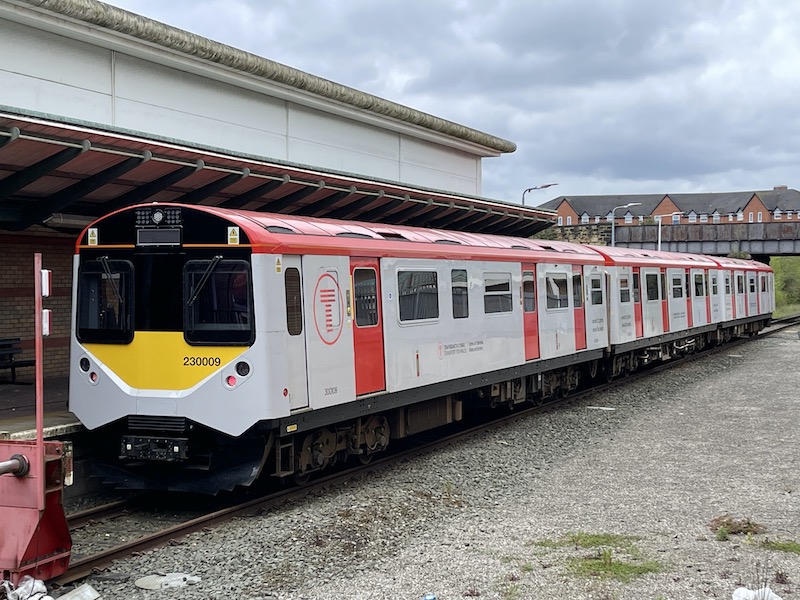
Rail companies which bought into the Vivarail idea of refurbished London Underground D78 stock becoming diesel/battery Class 230 and electric Class 484 trains in their new guise haven’t had a lot of luck with their purchases.
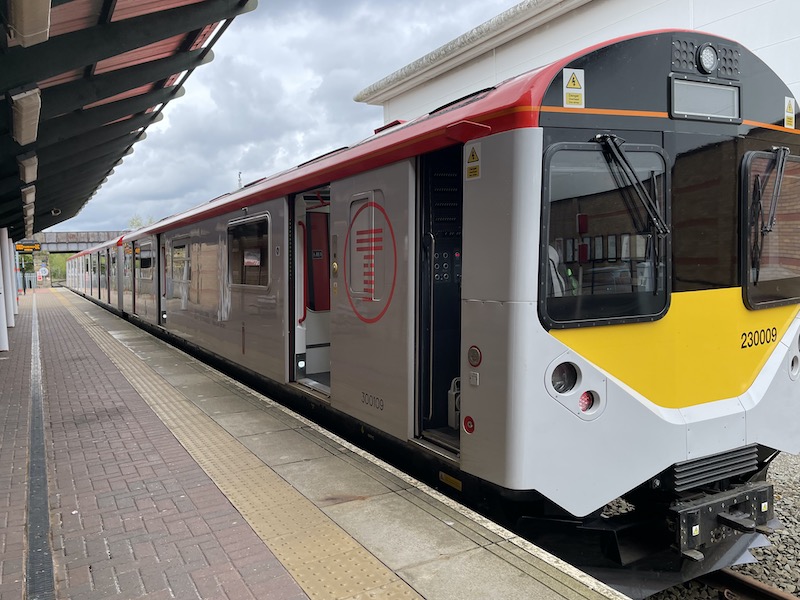
The idea sounded good when first mooted by the late Adrian Shooter who founded Vivarail to undertake the conversion and refurbishment work, but if the proof of the pudding is in performance on the tracks, it’s not been particularly inspiring,
It’s not been helped by Vivarail entering administration in November 2022. This resulted in London Northwestern Railway (LNWR) immediately withdrawing its three Class 230 trains, introduced in April 2019 on the Marston Vale line between Bedford and Bletchley from service as Vivarail staff had been maintaining them.

Passengers on the line had to use replacement buses for most of last year until Class 150 units could be sourced and drivers trained.
Island Line took five sets of the third rail electric powered Class 484 trains, introducing them in November 2021. South Western Railway (SWR) optimistically still declares on its website “with five trains in service, there’s also greater flexibility to run longer trains at busier times, such as during the summer.”
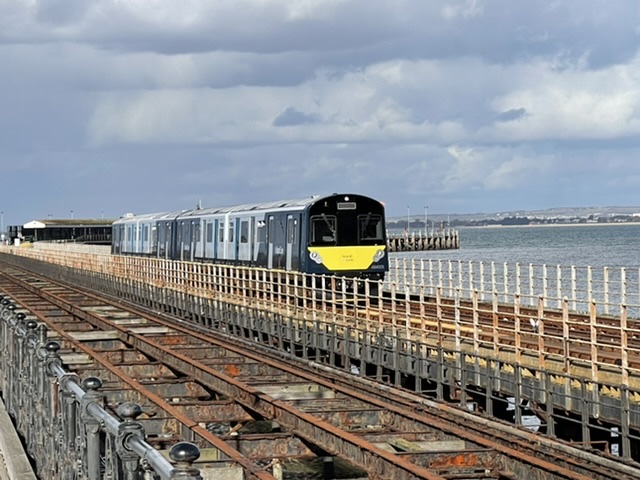
Except since the end of February this year SWR has slashed the Island Line timetable by half running just an hourly service with only one of the five train sets in service due to what is thought to be “excessive wheel wear” although SWR have only confirmed the trains require more maintenance than anticipated. So much for the £26 million refurbishment of the line in 2021.
Then there’s Transport for Wales’ (TfW) five sets of Class 230s which were supposed to herald a much improved service on the Borderlands line between Bidston and Wrexham Central with a promised doubling in frequency from hourly to half-hourly.
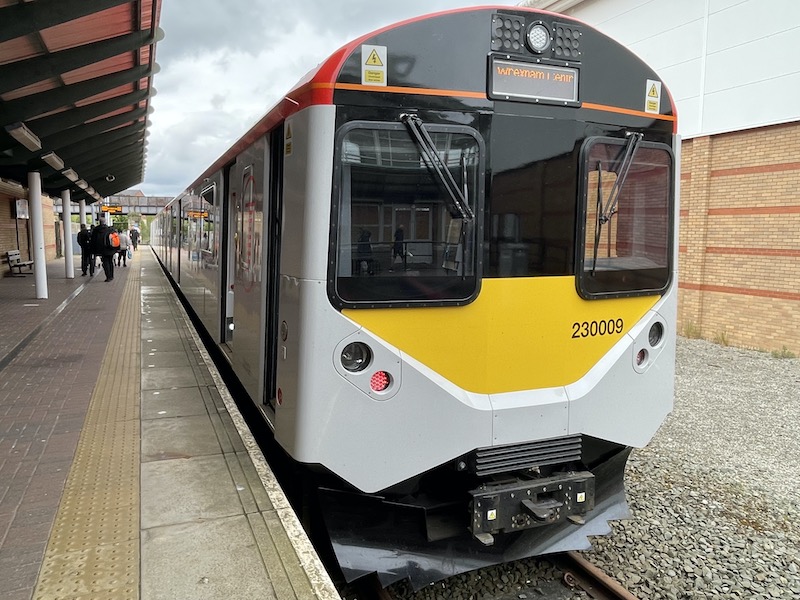
One set entered service in May 2023 but was immediately beset with problems not even managing to complete its first day in service before breaking down. Sadly that unreliability has continued such that TfW now only schedules one unit out of the three trains needed to run the current service, and even that is taken out of service at lunch time with another of the five units taking its place for the rest of the day.
The other two diagrams are run by TfW’s new Class 197 units.
Not only that but the Class 230 trains couldn’t maintain the tight hour’s turnaround for an end to end journey making the hourly frequency hopelessly unreliable. At one time, an analysis of a 12 week period showed at Hawarden station, halfway way along the line, only 9% of trains arrived on time.

To mitigate this problems TfW added additional journey time as well as an increase in turnaround times at the termini deploying extra Class 197 units to make for three diagrams to run the timetable rather than the previous two and introduced an awkward 45 minute frequency with the promised half-hourly service now kicked firmly into the long grass.
Then finally there’s GWR who have bought up all the remaining Class 230 units from Vivarail’s Administrators as well as taking on that company’s staff and other infrastructure, spare parts and intellectual property and the three redundant units from LNWR. It plans to run a pilot scheme involving a fast charge battery powered Class 230 on the West Ealing to Greenford branch later this year once proving trials, which are already well underway have proved successful.

The track record of these units in service at LNWR, SWR and TfW doesn’t bode well for the GWR trial but the company has been very bullish and positive about the upcoming introduction, claiming tests are going great guns and there’s already even talk about how such units could be deployed on GWR’s other branch lines in the Thames Valley and the West Country.
I blogged about the Class 230 debut on the Marston Vale line in March 2019 as well as the introduction of Class 484s on the Island line in November 2021 and had been wanting to give the TfW units a ride since their launch a year ago. However, their unreliability had always eluded me.
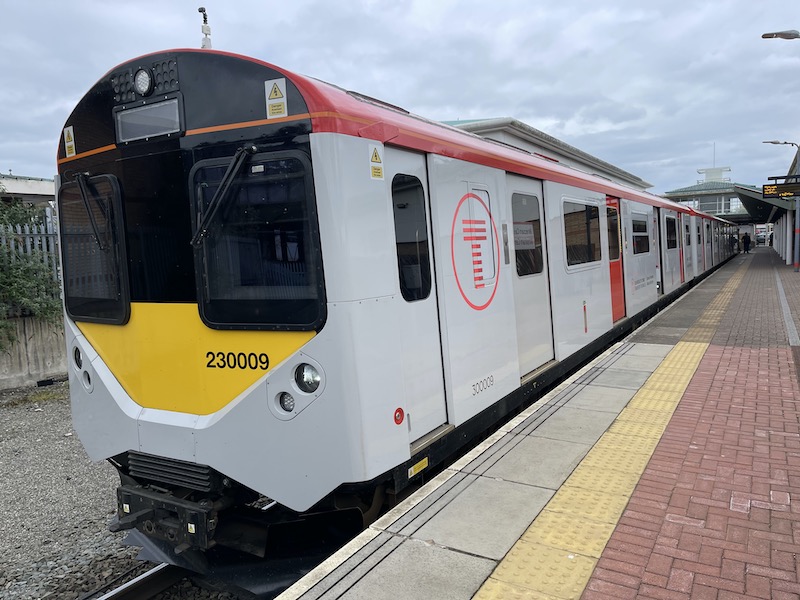
On one occasion I was on my way from Hassocks up to Wrexham one morning having seen a unit was out in service only to find as I reached Crewe it had broken down. On another occasion I was already in north Wales and planned to connect with a unit in service as it passed through Shotton, when again it broke down before I reached it.
However, a recent let down trying out Cheshire West’s allegedly highly successful iTravel branded Demand Responsive Transport bus service (which I’ll be blogging about later this month) left me at a loose end in the area so I made my way over to Wrexham, seeing that the afternoon Class 230 unit was actually running in service, and at last enjoyed a much anticipated ride.

The unit comprises three carriages. As when in its previous District line Underground train days, there are four fairly wide single leaf doors in each carriage…
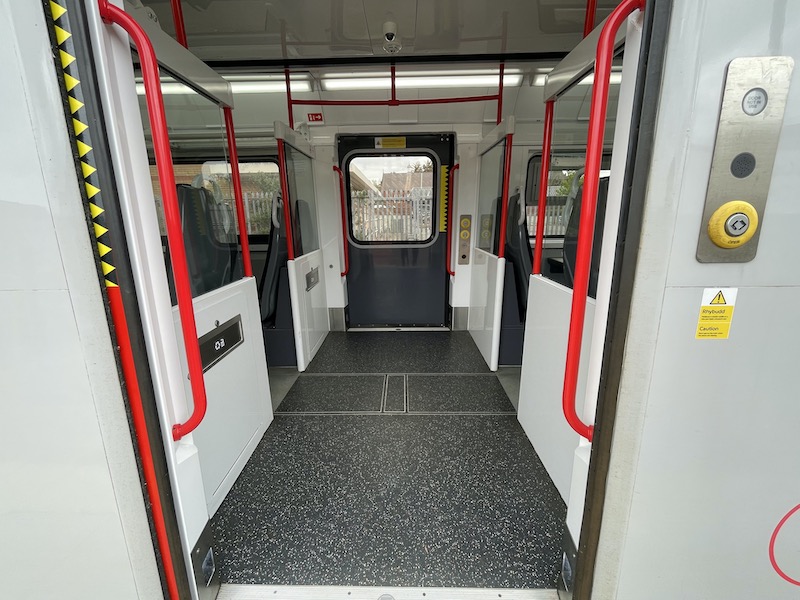
… although one end carriage has the door closest to the driver’s cab blocked off for staff use only…
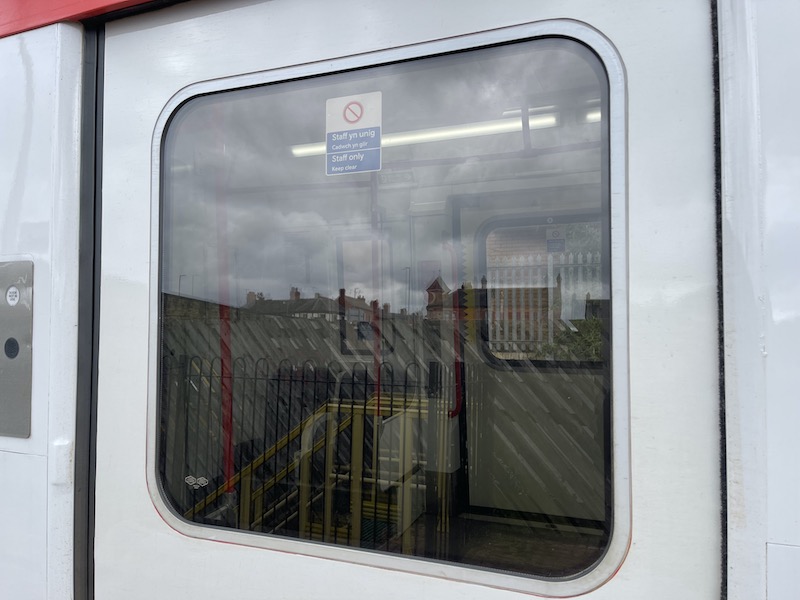
… and at the other end of the train the accessible toilet is situated where the third door would have been…
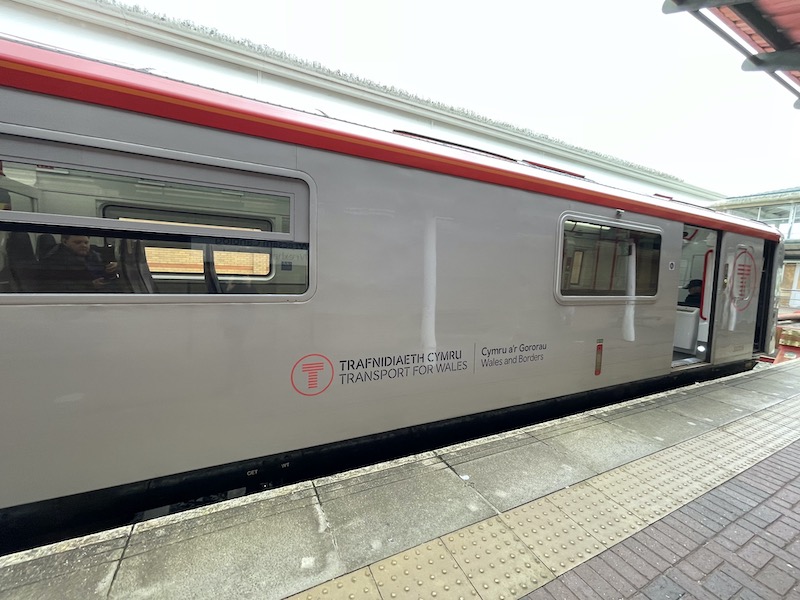
… meaning that carriage also has three external doors available, rather than four.
Each end section of each carriage has a short row of longitudinal seats (two in the ends with driver cabs…
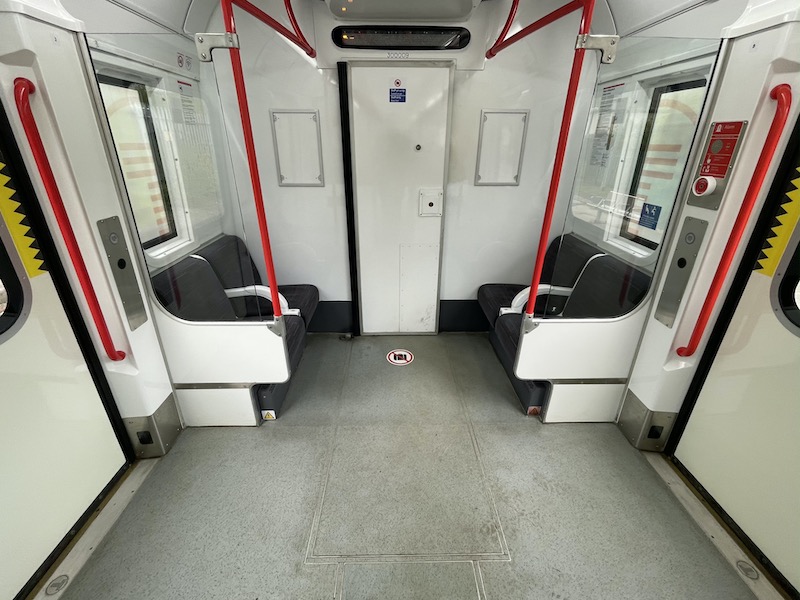
… and four where there isn’t a cab)…
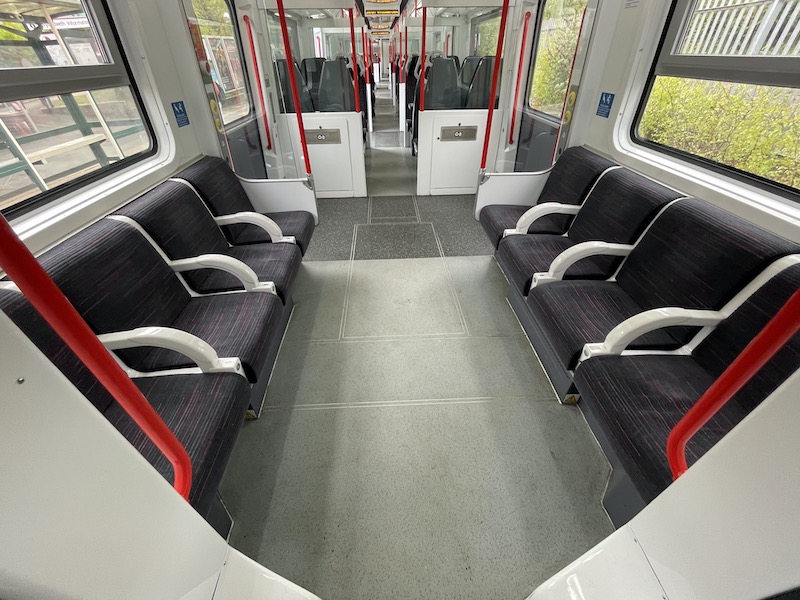
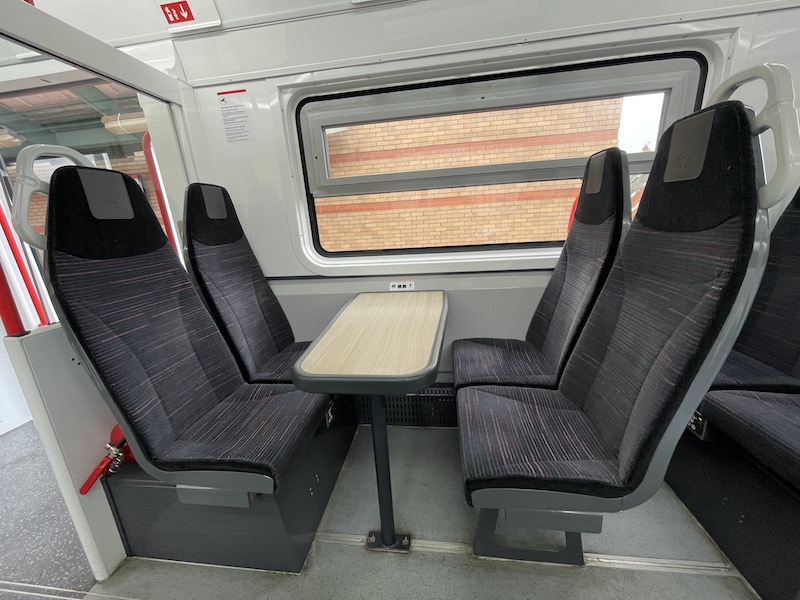
… with the middle sections between the two doors laid out with a set of four seats and a table and a double seat on either side of the gangway.
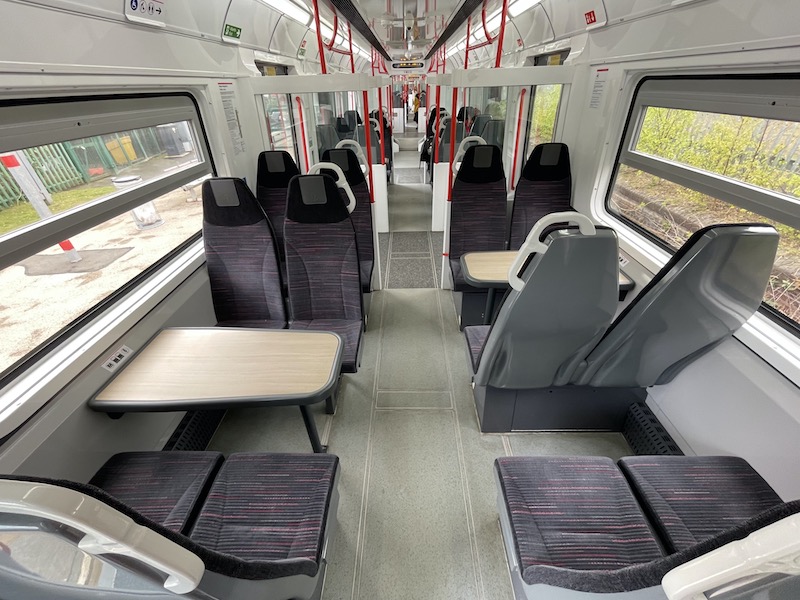
The seat pitches aren’t particularly generous, even those set aside for passengers with mobility issues…
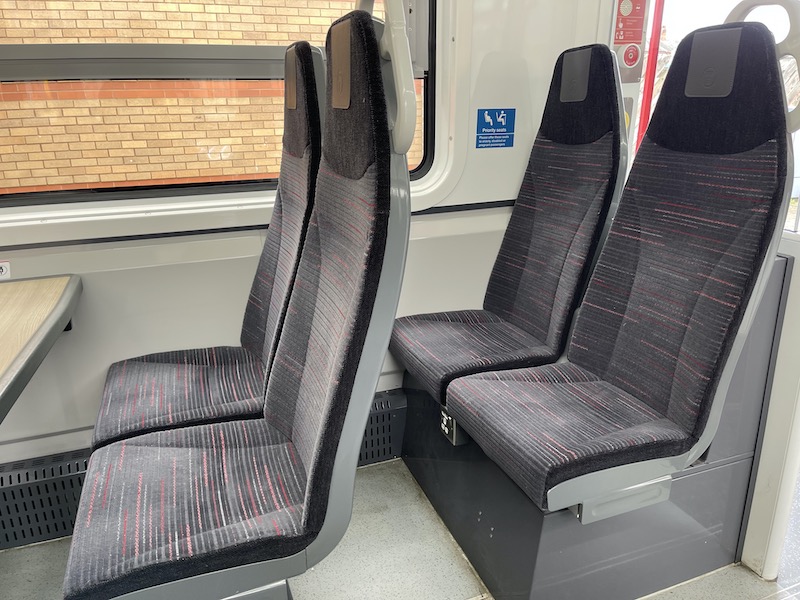
… and there’s not a lot of space for legs under the table if passengers are sitting opposite each other.
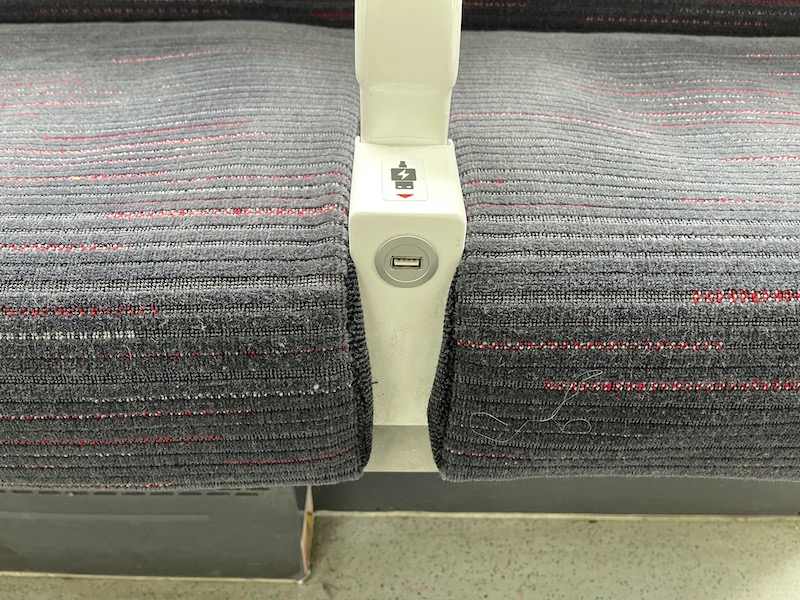
There are usb sockets between the longitudinal seats…
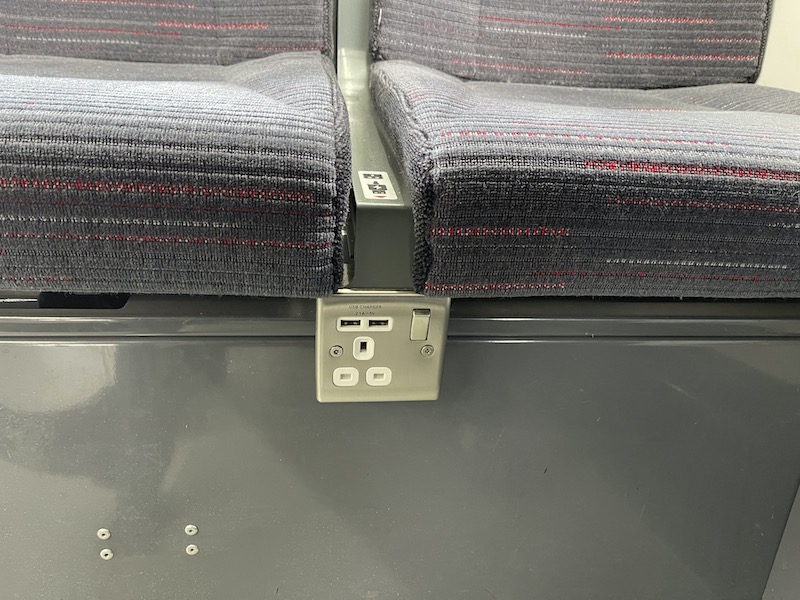
… as well as three pin plug sockets under the table and airline style seats.
The carriages give an airy feel and are quite solid to travel in confirming Adrian’s original thinking that the body shells had a lot of life in them yet.

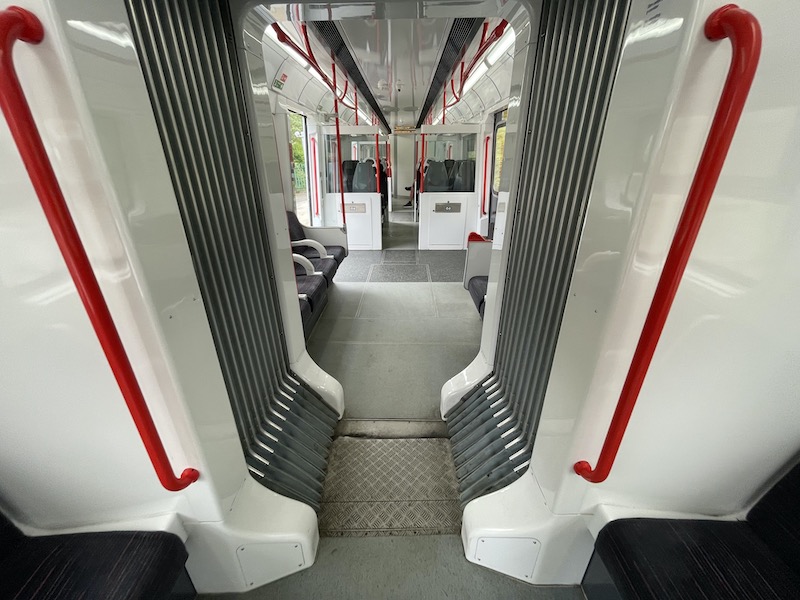
The three carriages have been converted to walk through…
… and the accessible toilet has an area for a wheelchair immediately alongside.
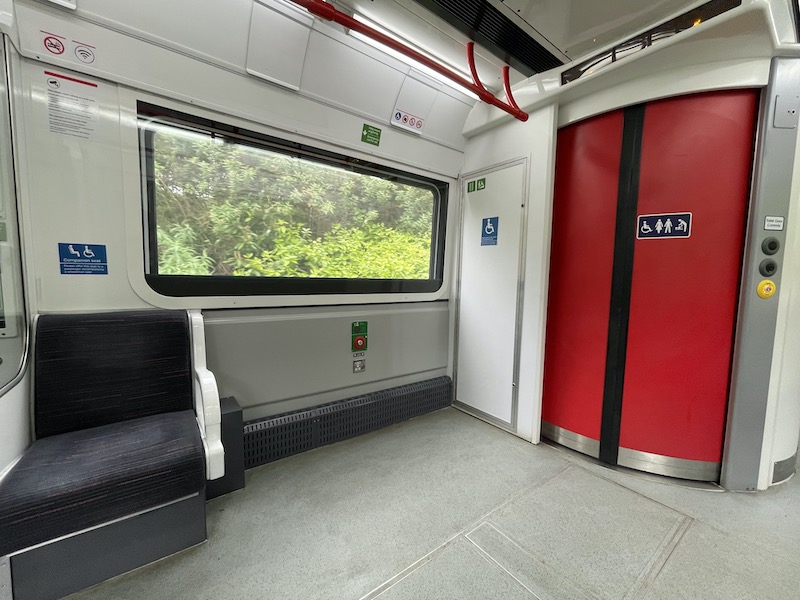
… with a short row of tip up seats opposite.
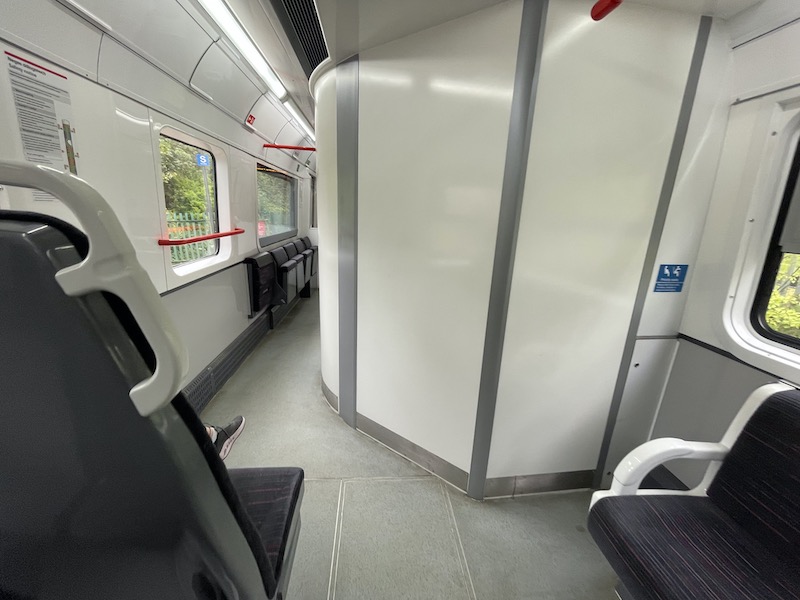
The middle carriage has tip up seats in one section to allow for prams and bicycles.
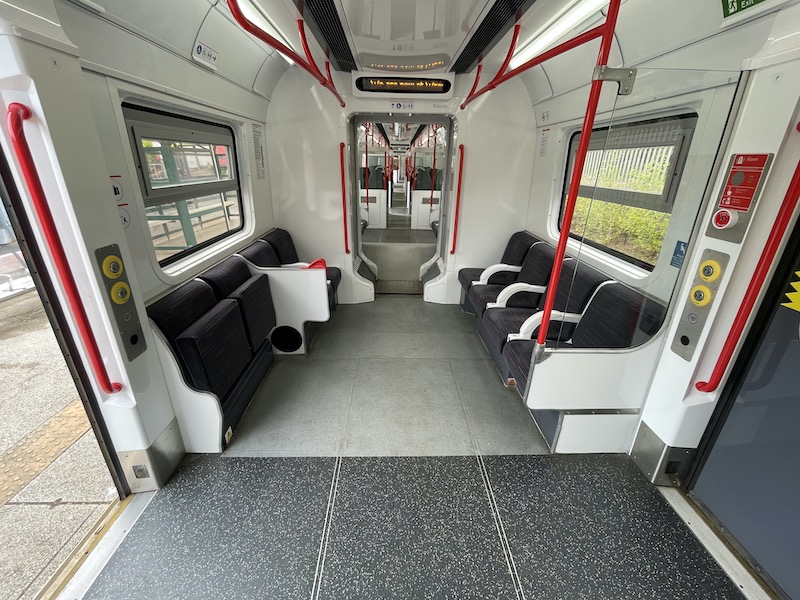
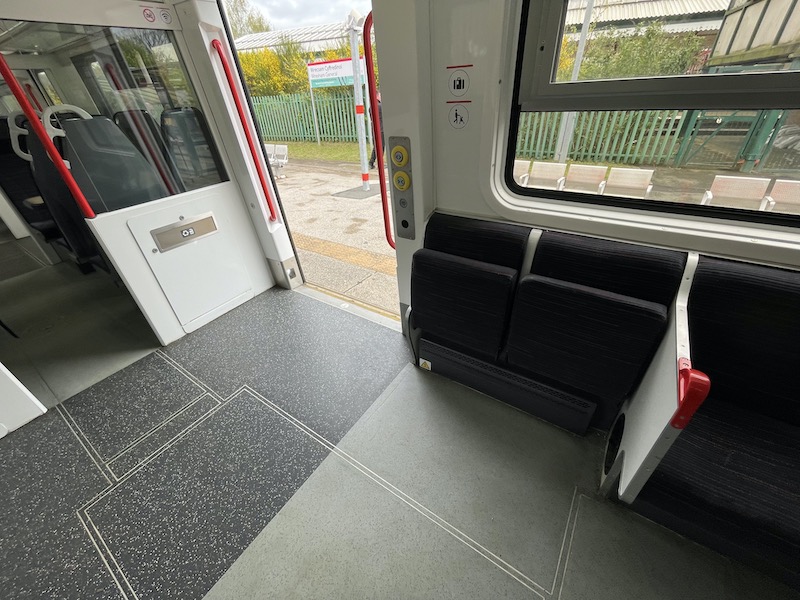
There are litter bins by the doors.
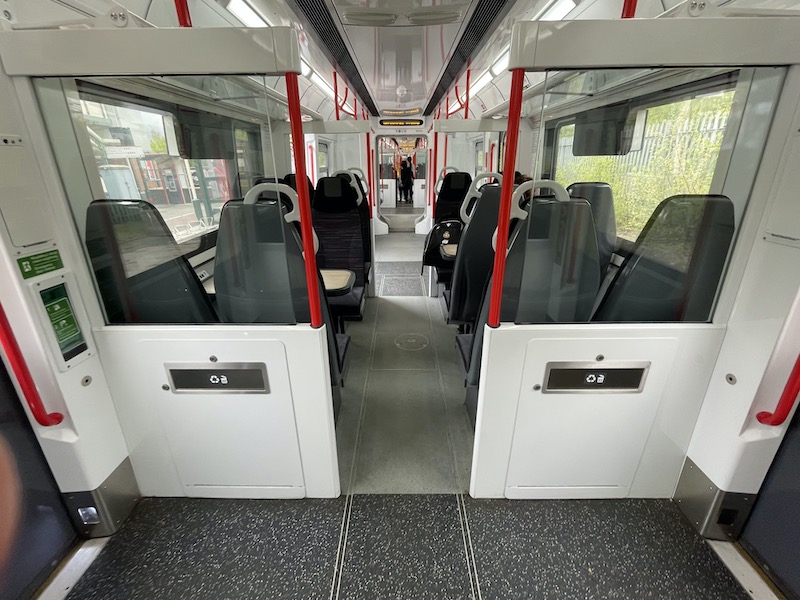
For their age, not far off fifty years, the trains give a good impression and a comfortable ride. But, the most important thing with any train is its reliability and for that, experience over the last few years must leave a rather large question mark over whether Class 230 trains do have a future.
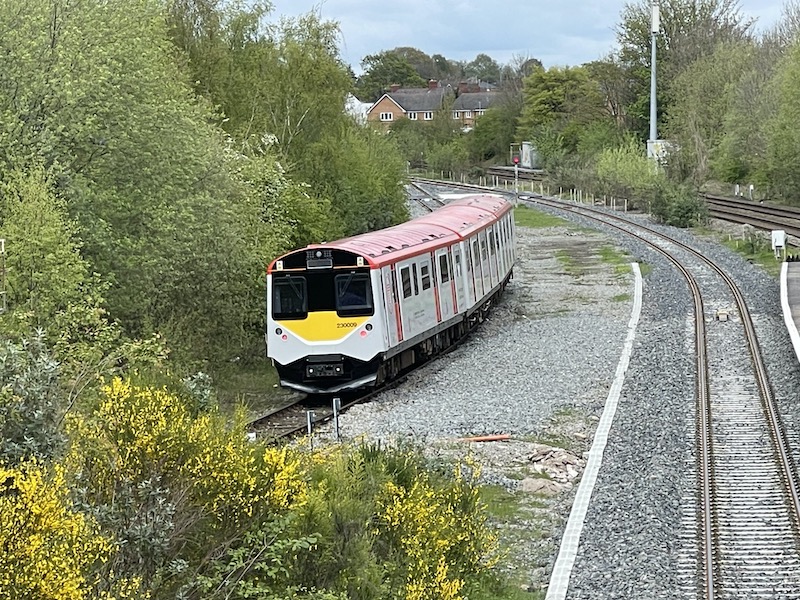
Roger French
Blogging timetable: 06:00 TThS
Comments on today’s blog are welcome but please keep them relevant to the blog topic, avoid personal insults and add your name (or an identifier). Thank you.


I would say it was a bad idea, The first of the D stock were introduced in 1976 and the District line operates about 18 hours a day 7 days a week so these train were EOL and no amount of refurbishment was going to change that. I suspect a lot of money has been wasted and these trains will be withdrawn before long
LikeLike
No it did not enter service in 1976. It’s called D78, because that was when it was anticipated to enter service, but never achieved that (ditto the 1973 stock).
In point of practice, they entered service between 1980 and 1983, so every unit is still nearer 40 years old than 50. The very heavy overhauls given to them by TfL was close to creating a brand new train; Adrian was very offended if you described them as old trains.
LikeLiked by 1 person
Of course “Adrian” was very offended if you described them as old trains, they were his baby. He wasn’t exactly objective.
It’s noticeable that the one organisation which didn’t go anywhere near the 230s was his old company.
Stagecoach Rail went to look at them as instructed by the DfT and their senior fleet bod’s reaction, I’m told by someone who was there, was “Over my dead body”.
Put bluntly, the 230s were forced on the industry by Adrian Shooter’s chums at the DfT, aided and abetted by HM Treasury who saw only cost savings. The TOCs didn’t (and don’t) want them, and it’s easy to tell which companies had the easily pressured senior people.
They’re just yet another example of a long history of lemons dating back to the Modernisation Programme and before.
A Train Driver
LikeLiked by 1 person
This reminds me of the Leyland National Greenways that Drawlane/British Bus/East Lancs converted from original Leyland Nationals. They were always unreliable.
This was always a bonkers project,along with the class 769 conversions, especially these days when items such as electrical equipment become obsolete much more quickly. Coupled with the Island Line refurbishment which, as Roger has previously said should have been converted to a Busway, typifies the railways continual ability to waste money.
Over the 20 years since part privatisation before Covid the railways managed to double the number of passengers, but subsidy also increased. How this could occur in an industry where a lot of costs are fixed shows how much inefficiency crept in. To be further compounded under the next Labour Government when the remaining TOC’s will be jettisoned.
LikeLiked by 1 person
I think that what is more pertinent is whether “re-purposing” ANY 30-40-50 year old trains is sensible?
We’ve seen the GWR Class 769 conversions fail to make it into service at all. We’ve seen the various Northern conversions suffer from reliability issues, and be withdrawn early.
I’m no engineer, but has the underlying problem been that attempting to update elderly trains to modern standards is simply not do-able?
All worthy attempts, but however good the basic structures might be, they’re still old. Even the 72 stock is creaking now … despite heroic efforts by Bakerloo engineers.
Time-expired is time-expired ….
LikeLiked by 1 person
Thanks – and congratulations for managing actually to ride on one of these rarely appearing trains!
Perhaps not all the comments about ‘life-expired’ trains are relevant – it often seems to have been the new equipment which has failed. It does make you realise why schemes like the Elizabeth line take so much trouble and time on tests before letting the public ride on their new trains.
I wonder if there is a future for the 230s running on heritage lines, many of which have had ambitions to run general public services. They are used to dealing with one-off items of rolling-stock rather than whole classes, and possibly ‘amateur’ engineers, doing it for the love of working with machinery, would have a better track-record (oh, dear, an unintended pun): like actors, the amateurs do as much as they can, the professionals as little as they can, maybe. At any rate, there would usually be a steam or classic diesel loco to come to the rescue … and there’s an off-chance a unit would enter the Railway Series books – ‘Cecil the Class 230’, anyone?
LikeLike
On heritage lines they only get light usage and also maintenance costs are less of an issue as the Labour is free
LikeLike
Those heritage lines which wanted cheap ‘modern’ DMUs were given Pacers not very long ago.
Rumour has it that at least some are already trying to get rid of them.
LikeLike
Like everything to do with Vivarail the idea of running the 230’s on Westcountry branch lines sounds good in theory. However, I do wonder how many lines they would actually be practical for.
St Ives – very tight turnarounds with not much time for charging
Looe – can they cope with the gradient and curve into Liskeard
Falmouth, Newquay and Exmouth – all potentially perfect if it wasn’t for the fact that journeys from the branches are (or soon will be) extended onto other routes which probably make the overall journey time too long
Gunnislake – could be suitable if they are compatible with running on short stretches of the main line
Okehampton and Barnstaple – are the journey times too long?
Unless I’ve forgotten something obvious that only really leaves the Severn Beach line.
Chris
LikeLiked by 2 people
if you wind the clock back, the original issue was that there was a shortage of DMUs, and with electric trains the way forward, there was no economic case to procure new DMUs. Step forward Adrian Shooter with his plans to convert recently heavily overhauled class D78s to DMU at lower cost than new trains. The theory was good, the execution less so. The problems with the converted DMUs included overheating, but in theory there shouldn’t have been an issue with them in EMU mode, except the track profile on the Isle of Wight has caused problems (nothing to do with the actual trains). Plugging them into batteries rather than 3rd and 4th rail therefore should be less problematic, and could be a low-cost solution for the smaller branch lines.
MotCO
LikeLike
with the benefit of hindsight, it seems the Island line should be redeveloped using modern light rail/tram technology–overhead power with the last section through the tunnel and onto the pier being battery powered.
Sadly that’s probably cost-prohibitive–complete retrackage and overheads and vehicles although it would make it easier to put in passing loops for increased service, and potentially extend the service as a tram off the main line of the route where relevant, maybe even into or close to Newport
I fear the only other viable long term option for Island line is to turn it into heritage railway, getting the IoW Steam railway to take it on, with heritage DMU or heritage EMU (or keeping the converted D78’s until they can get cascaded heritage Bakerloo units). With a electric or cable hauled peoplemover or land train or lightweight shuttlebus to get foot ferry passengers off the Ryde pier to a bus interchange so that the “heritage” services don’t need to run as intensively. At some point I wonder if the hovercraft will also cease triggering a review of ferry services anyway. (and I know the IoW is really struggling with ferry connections at the moment generally, but still not quite making the economic case for a fixed link to largely replace the ferries)
MilesT
LikeLiked by 1 person
I suppose this project always looked something like a solution looking for a problem. It seems disappointing that a bit of entrepreneurial thinking has come so awry.
apart from the comments above which I tend to agree with, I again question why so much modern rolling stock is so uncomfortable, and with completely insufficient leg room etc. It is for instance far more comfortable to travel on a National Express coach than on many trains especially the execrable Thameslink stock!
LikeLike
“especially the execrable Thameslink stock”
If you think the Thameslink stick is bad, don’t ever try travelling on any Northern 156. The seat pitch is atrocious and appears to have been copied from the yellow Merseyrail Pacers which were apparently intended to be used only by kids aged under 10 the seats were so close together.
The East Midlands 156s (which have unfortunately now also gone to Northern) had a much better seat pitch.
A. Nony Mouse
LikeLike
I have not found Northern class 156 seat pitch to be a problem on Carlisle-Newcastle.
And last week, the ScotRail class 156 Carlisle Dumfries Kilmarnock Glasgow was ok. (Note – deliberate choice of different route for a change)
LikeLike
Seat pitches are, like everything about seating, intensely personal.
It’s good that you have no issues with the seat pitch on Northern’s 156s. My knees made it very clear they weren’t happy when I was making my way round the Cumbrian Coast a couple of weeks ago.
A. Nony Mouse
LikeLike
I do wonder how the unit that was sent over to Pennsylvania is doing?!
LikeLike
Trapped passengers smashed Tube windows to escape as staff failed to respond to fire alert, report finds
the Rail Accident Investigation Branch (RAIB), which compiled the report, warned that the incident “had the potential to have more serious consequences”, especially as Clapham Common Tube station “has a narrow island platform which increases the risk of passengers falling onto the track”, which could see travellers “being exposed to conductor rails and trains approaching on the adjacent southbound line”.
Those caught in the incident failed to “receive suitable information or see any effective action from London Underground staff”, with the report stating that staff present were “not provided with the procedures or training needed to effectively identify and manage incidents where passenger behaviour can rapidly escalate”.
LikeLike
The whole incident lasted less than 5 minutes, if I remember correctly. That’s from the train stopping to everyone panicking and ending up running all over the station.
There’s a whole load of things to look at here, starting from “Why did a whole trainload of people panic?”, going through “Why did people smash windows instead of using the Emergency Door Releases to unlock the doors and easily leave the train?” to “How the heck is one driver and one member of station staff supposed to reassure and control a trainload of panicking people?”
Unfortunately those and other questions get shuffled into the ‘too difficult to answer cheaply or easily’ box, so we end up with the usual ‘but the paper procedures weren’t effective’ guff.
At some point the world needs to stop pretending we can control everything with bits of paper, and also stop pretending that behaving like a herd of sheep is anything other than an evolutionary dead end.
A. Train Driver
LikeLiked by 1 person
TFL failed as the report shows, If you were sealed v up in as smoker filled carriage and TfL staff did nothing you would panic. There is NO passenger emergency door unlock that’s why windows were smashed
LikeLiked by 1 person
@Anon 10:00
I wasn’t aware that there are no emergency releases, although I’m aware from other incidents that passengers will ignore them when they’re panicking.
As for the others, we’re talking an entire trainload of people panicking, not just those in the affected vehicle, and an entire trainload of people – and lots of internet commentators – apparently expecting TfL staff to magically appear instantly like Mr Benn’s shopkeeper.
There’s a lot in there about how our society reacts to problems which needs serious consideration, and certainly deserves a far better response than a simplistic, dismissive “TfL failed” or “Of course people panicked”.
Not that I would have any understanding of passenger behaviour or incident response problems, of course. I’m just a train driver, after all; an anonymous blog commentator would clearly know far more than I.
A. Train Driver
LikeLiked by 1 person
The behaviour of passengers, and the similar incident on the Central Line, shows the “child people” mentality so prevalent in society these days!
LikeLiked by 1 person
Four minutes in a crowded Tube carriage filling with smoke and with no means of escape is a very long time. I’d certainly be terrified: how do I know that there isn’t going to be a sudden eruption of flame incinerating everyone in the carriage. Not childish behaviour at all, especially as we’re underground rather than outdoors.
Andrew Kleissner,
LikeLiked by 1 person
A quick note about Roger’s earlier blog on the Eynsham Park and Ride. Someone did suggest Roger invests in a drone…. no need as Auto Shenanigans youtube channel has also decided to do a feature The £51 MILLION Park & Ride That You Can’t Use – Eynsham, West Oxfordshire – Waste Of Money? (youtube.com) and it does come with some lovely overhead shots.
BW2
LikeLiked by 1 person
If a fraction of the money that is wasted on the railways and diverted to improving local buses, I’m sure that would be worthwhile.
LikeLike
The £300 million wasted on not sending anyone to Rwanda would be a good bung towards public transport improvements, but that’s pocket money to be forgotten about.
The money that has already been spent and wasted on HS2 because a bunch of politicians kept u-turning would have done a lot more than just improved local buses, but that’s also just been treated as pocket money to be forgotten about.
Oh, and how many billions did the Truss and Kwarteng farce wipe out of our economy? All of that could have been used for public services.
If you live in a Tory constituency, maybe you could ask them to justify some of it when they come knocking on your door before the general election, but don’t expect them to give you any real answers.
LikeLike
To think Labour had 13 years to reverse many of Thatcher’s/Major’s privatisations…
Kim R
LikeLiked by 1 person
What relevance does that have to the money that has been wasted by the Tories over the past 14 years?
Labour were held responsible by the electorate in the general election which saw them lose power; you have to be particularly sad or desperate to still try the “but Labour” deflection after so many years of them being in opposition.
LikeLiked by 1 person
Apologies again – didn’t mean to be anonymous in that last post!
LikeLike
In the name of ‘innovation’, anything goes. RC
LikeLike
I’m really disappointed about these trains. I would’ve thought that converting electric units with existing proven traction motors into diesel-electric should’ve been quite simple, so it must’ve been the diesel engines at fault. The bodies were aluminium, very robust and were well cared for by LU. Perhaps there’s still hope if another diesel engine model can be sourced. I’m not a fan of battery electric traction for trains, it just seems like a cop out from doing actual electrification. Same goes for hydrogen.
Peter Brown
LikeLiked by 2 people
Let’s just see if the Greenford Line approach works. This may prove to be much more reliable than the diesel propulsion version, and possibly the track is in a much better condition than the Isle-of-Wight line. There is just a chance this could be a relatively cheap way to reopen some lines, lowering the cost of requisitioning trains. A recharging third rail strip at Cowley might be a cheap way to get the Oxford-Cowley line reopened for instance.
LikeLiked by 1 person
The concept of the 230s was probably sound, but I recall in the early days of service on the Marston Vale line, the diesel engines (4 Ford Duratorq 3.2 TDCi’s) had many failures. Was there a more reliable engine that could have been used such as BMW’s B57 3.0 diesel?
LikeLike
My anger over this is aimed at Transport for Wales rather than Vivarail. Untried trains were seen as a cheap solution for a cross border service allowing new trains to head for South Wales.
When the reliability issues surfaced, on day one of operation, services were cancelled regularly and passengers have drifted away. Timings have been a struggle on the line with the public timetable showing the train arriving at Wrexham Central one minute after it is due to depart on the return journey. Replacement bus services struggle as their route is a lot longer.
Timekeeping has improved as train crew have gained experience of the units, which have different braking and accelerating characteristics to diesel trains and the doors have their own foibles. The lunchtime unit swap was introduced as a result of pollen clogging the radiator but stayed in place through the winter
The experiment of using solid old units as a testbed for hybrid trains has failed in this instance and the question is how long will TfW keep throwing money into units on a line where passengers have all but given up.
Gareth Cheeseman
LikeLiked by 1 person
Should we actually Muse that many Short Branch Lines which do not have a freight service requirement would be better off converted to (guided) bus services, where speeds up to 60mph could be achieved , this may be a better way to re-open some routes.
JBC Prestatyn
LikeLike
Has research ever been done asking passengers on the St Ives – Cambridge Busway route if, on reflection, they would rather it have been a reopened railway line.
LikeLike
The St Ives route has one factor making it more suitable for busway conversion than reinstating rails, which is that buses can serve a considerable area of the town that would have been poorly served by a railway station … so it might depend whether you’re asking people who live in St Ives or Northstowe! I very much doubt that people who use existing trains would be happy with them being replaced by buses, even if the trackbed was converted to a busway (which would not be cheap!)
LikeLike
If it’s currently a “short branch line” then it doesn’t need reopening, and closing it for conversion would not go down well (to put it politely).
If it’s currently in need of reopening then the Cambridge busway saga will make people think twice about a guided busway rather than a railway.
Busways have been discounted by most reopening campaigns, and they must have good reason for doing so.
A. Nony Mouse
LikeLike
The Greater Anglia bimode trains were designed for possible conversion to battery operation. How much feasability testing of it has been done I do not know
LikeLike
If you mean the Stadtler UK-FLIRTs then I think Stadtler has already been trialing BEV or mixed mode elsewhere in the world. But would need to report testing for the UK version.
MilesT
LikeLike
What a pity there isn’t a single organisation that could have carried out trial operations to identify the problems and resolve them, if possible. Instead we have had four separate train operators doing their own thing and getting nowhere.
Also, it is a pity that the promotors will probably never reveal the real costs of this rolling stock compared with a follow-on order for proven new trains already being introduced elsewhere.
On the other hand, the experience with the Class 701 on South Western Railway doesn’t give much confidence either.
Steven Saunders
LikeLike
The single organisation is called the Department for Transport, which decided that multiple Train Companies would be required to have the things.
Much of what is wrong with today’s railway can be laid at the feet of the Department for Transport, and if Great British Railways ever happens that won’t change; GBR will just add another layer of plausible deniability between HM Government and the paying customers.
A. Nony Mouse
LikeLike
I think it’s acknowledged that both the Cambridge and Luton Busways have been very successful and encouraged a lot of new public transport passengers. Both are operated without any subsidy. In Cambridge passengers would have been dumped at the Railway Station nowhere near the City Centre, and I’m sure the rail service would have been loss making. In Luton and Cambridge areas well away from the Busway have enjoyed much faster services into both Centres, something that would have been impossible with a rail line. The Dunstable- Luton frequency is now about every 5 mins, and with a 24 hour service, again none of this would have happened with a rail service.
LikeLiked by 1 person
Both are heavily subsidised
LikeLike
Bidston Wrexham needs to be integrated into Merseyrail and around the Liverpool with more class 777 and 3rd rail to Wrexham – yes, I know the powers that be have stated no more 3rd rail for safety reasons.
LikeLike
If you read Roger Ford’s erudite columns, it seems that while the ORR refuse to allow “new” third rail, they consistently refuse to explain _why_ they refuse it.
LikeLike
Dear Roger
Thank you for the interesting blogs that you continue to write.
I thought you might be interested in the latest adjustment to the Island Line timetable which is described in the link below.
https://www.islandecho.co.uk/new-island-line-timetable-to-see-just-1-train-every-40-minutes/
Presumably SWR considers connections better with this timetable as the current connection time with the hourly service at Ryde Pier Head (approx 7 mins) is not recognised in journey planners, which consequently show connections of approx 67 minutes. The “Minimum Connection Time” at Ryde Pier Head has been adjusted (more than once I think) and now stands at 10 mins.
Alice Through the Looking Glass springs to mind!
Best wishes Robert
Robert Monroe
LikeLiked by 1 person
Many thanks Robert. I was going to say unbelievable, but sadly it is believable!
LikeLike