Saturday 27th April 2024

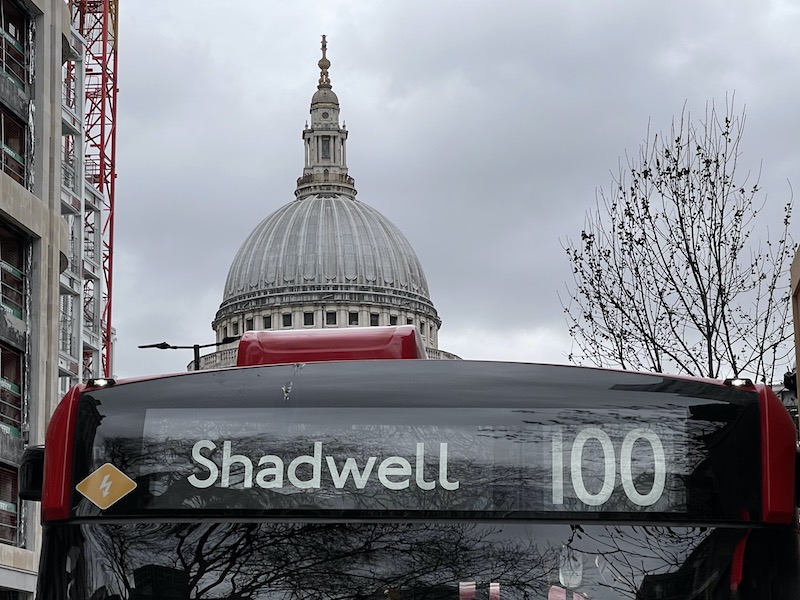
We’re now a third of the way through this fortnightly series featuring all of Britain’s bus routes numbered 100 and having been to Stevenage, Crawley, Lincoln, Glasgow, Campbeltown, Guildford and Manchester I thought it was time to head to London and take a ride on TfL’s route 100.
It’s odd to think the iconic number 100 has never really been exploited to denote a high profile bus route in London. Between 1934 and 1972 it was used for possibly London Transport’s quirkiest bus route running multiple duplicated journeys on what was quaintly referred to as “an irregular timetable” to coincide with shift change times at Beckton Gas Works, ferrying employees between that isolated site in East London and Barking – a journey time of around 8-10 minutes.

Buses for the route were sourced from route 15 and, exceptionally for London in those days, crews changed the number blinds themselves when swapping between routes.
After that route was withdrawn in 1972 the number was used for a few summer seasons to denote a sightseeing route aimed at tourists commencing from Horse Guards Avenue operated for London Transport with the much loved heritage vehicle ST922 owned by Prince Marshall’s Obsolete Fleet as depicted in the photograph below taken in 1973 by Barry Le Jeune.

After that foray the number 100, as we know it today (more or less), reappeared in June 1989 denoting a new route to serve the Wapping area of Docklands as it was transforming from the infamous former docks to an area for homes and businesses. This new 100 linked Shadwell and Wapping with Aldgate and Liverpool Street, as well as passing by Fenchurch Street in the eastbound direction.
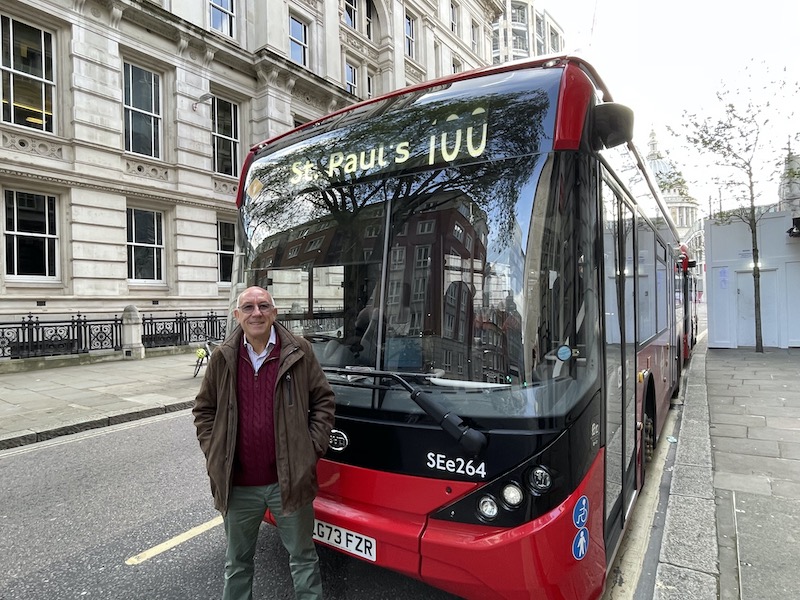
I was joined on a trip up and down the route yesterday morning by a famous regular user of the service, Leon Daniels, TfL’s Managing Director Surface Transport until his retirement in 2017. Leon has a unique insight into the route’s characteristics both from his extensive professional interest and knowledge but also because it’s his friendly local bus route.

Back in 1989 when the route began Leon well remembers the challenges in operating buses through what was at that time an extensive redevelopment site and kindly shared this photo he took in the early days of the route with a Metrorider unable to proceed in Wapping due to builders blocking the road.

Interesting to see the destination blind stating ‘WAPPING Shadwell Station’ and the branding for the fledgling route.
Leon recalls intervening personally on one occasion by calling into the local police station in Wapping to get the police to take action only to be told by the Constable on duty he belonged to the River Police so wouldn’t want to get involved in a road traffic issue!
In 1998 the route was modified in the Aldgate area so it no longer served Fenchurch Street while a more substantial route extension beyond Liverpool Street to Elephant & Castle was introduced the following year in 1999. Leon recalls the downside of this was buses getting stuck at both ends of the route in peak time bottlenecks leading to significant unreliability.
Apart from a minor rerouting to serve Queen Victoria Street instead of Ludgate Circus in 2015, that incarnation lasted until 2017 when the route was cut back to Barbican and two years later, in 2019, gained a short extension to a more suitable stand space with the current western terminus in King Edward Street just north of St Paul’s Underground station.

The route is operated from Go-Ahead London’s Camberwell bus garage with nine electric Enviro200 MMC EV buses on a daytime 12 minute frequency timetable and every 15 minutes in evenings and all day on Sundays.
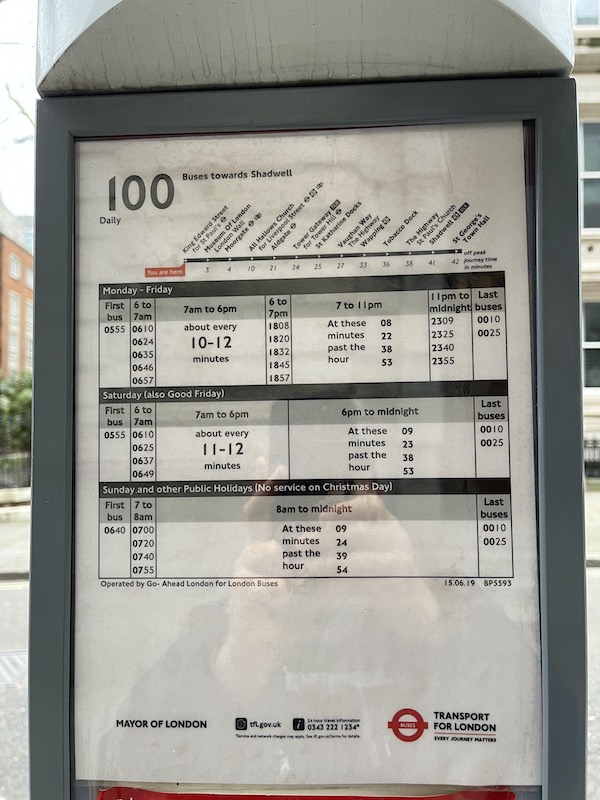
The electric buses used are from two batches. Some dating from 2019 and others more recently from last year.

It’s interesting to compare and contrast and spot the improvements now incorporated into recent deliveries of these and other new buses in London.

But you’ll notice how both batches come with a Leon Daniels sitting on the rear seat.


Today’s TfL route 100 is only three miles in length from St Paul’s to Shadwell with a scheduled journey time ranging from around 30-45 minutes depending on the time of day. That gives an average speed of 4mph in peak times; an average London jogging commuter could certainly attain a similar journey time and a cyclist could easily beat the bus. But that’s “London style buses” (the envy of many Combined Authority elected Mayors) for you.
I’ve taken a couple of rides on the route recently – one a few weeks ago and another yesterday morning with Leon. The first was an afternoon journey from St Paul’s (at 13:57) to Shadwell when I thought I’d avoid the worst of the frustrations of traffic congestion and sure enough proved lucky in my timing choice and direction of travel.
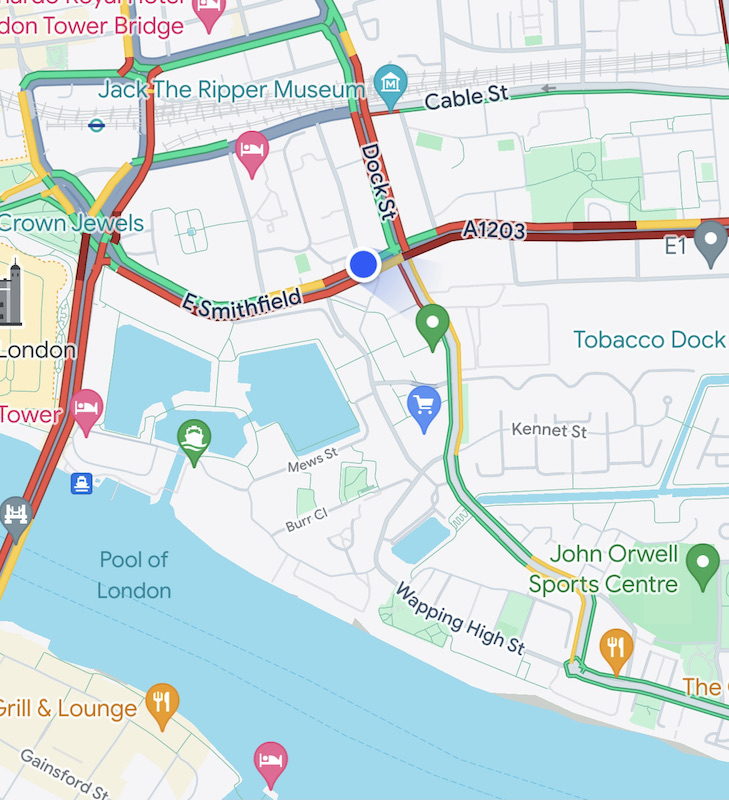
Having clocked the long queues of traffic from the east approaching Tower Bridge on the A1203 (see above map), I decided to abandon the idea of making a return journey on that occasion. Life is too short.
The first half of the journey turned out to be quite busy with 15 passengers boarding between St Paul’s, London Wall and Aldgate. Five of these were a group of office workers from London Wall travelling just three stops to St Botolph Street for a late lunch, two alighted at All Hallows Church, and one at Aldgate but six travelling beyond Tower Gateway alighting at The Highway and another to Wapping. After The Highway another six boarded as we continued our journey through Wapping and on to Shadwell. All told 21 passengers travelled and we arrived into Shadwell at 14:26, eight minutes earlier than the scheduled time of 14:34.
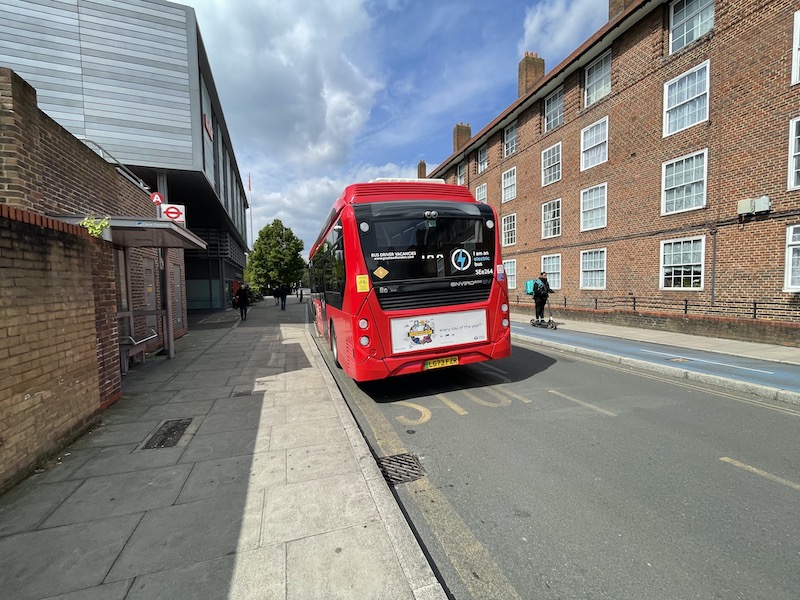
On yesterday morning’s outing we left St Paul’s at 11:25 with one passenger boarding at the King Edward Street terminus stop who travelled to Wapping station. Three more joined at Moorgate, one of whom alighted at St Botolph Street, Aldgate with two more coming on board at Aldgate station and another one at Tower Hill. At Highway three alighted and two boarded giving five on board (aside from us) who all alighted at Wapping station from where we continued empty towards Shadwell, including waiting time for two minutes at the health centre and finally picking just two more up for a one bus stop ride to the terminus which we reached at 11:59 – 34 minutes after leaving St Paul’s having carried 11 passenger in total.
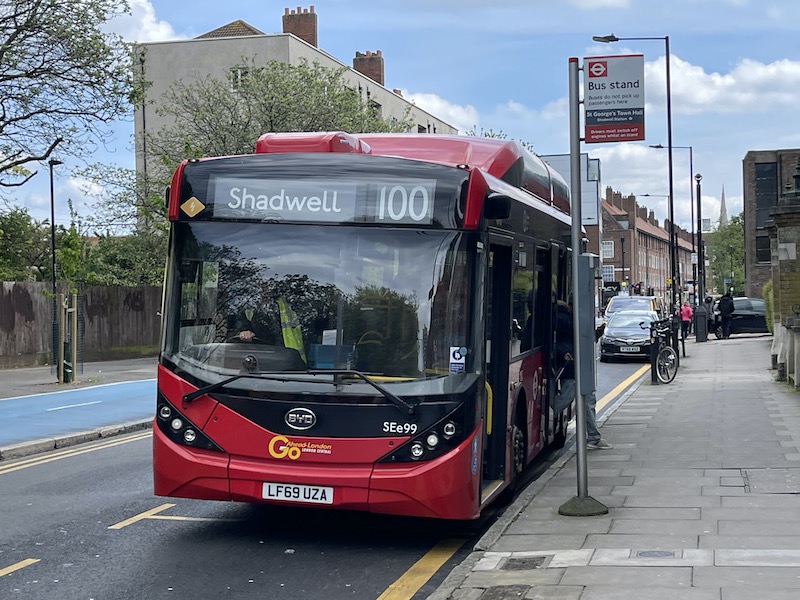
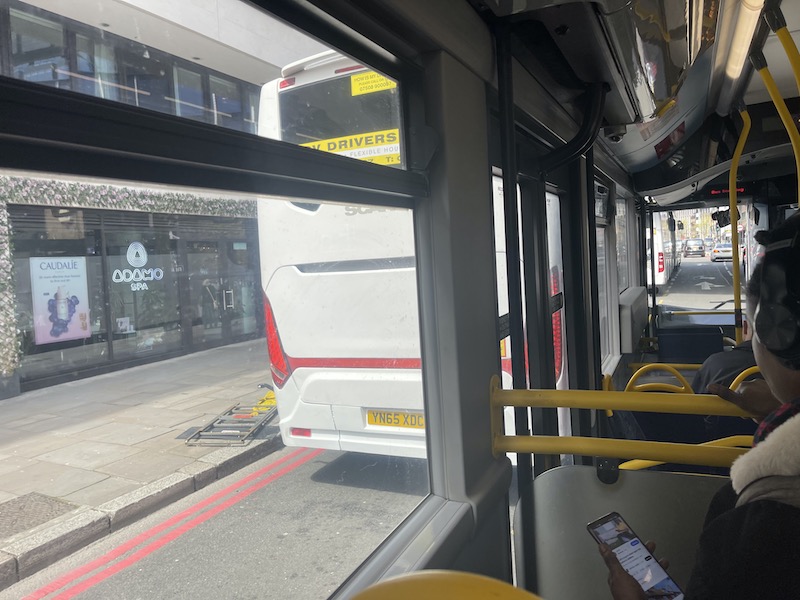
After a break in Shadwell we returned on the 12:26 departure which coincidentally also carried 11 passengers, with most boarding in the Wapping area. One passenger alighted at Tower Gateway where the driver kindly let her alight from the front door which he’d positioned where there was a gap between parked tourist coaches blocking the bus stop under the railway bridge.

Leon pointed out a simple solution to this regular occurrence was to swap the bus stop designations around so the stop for scheduled buses comes before, rather than after, the area set aside for tourist coaches to stand as well as meaning it would be closer to both Tower Hill and Tower Gateway stations for passengers – about where the photo below is taken rather than further along the road, where the photo above was taken.
One of the unique aspects of TfL’s route 100 which sets it apart from the other 25 similarly numbered bus routes in Britain (as well as all other TfL bus routes bar the D3), is that it operates over genuine cobbled streets as it passes through Wapping…

… including a section of road where it’s too narrow for vehicles to pass each other – not something you see elsewhere in central London, or, apart from the Spaniards Inn on Hampstead Heath, any where else in London.
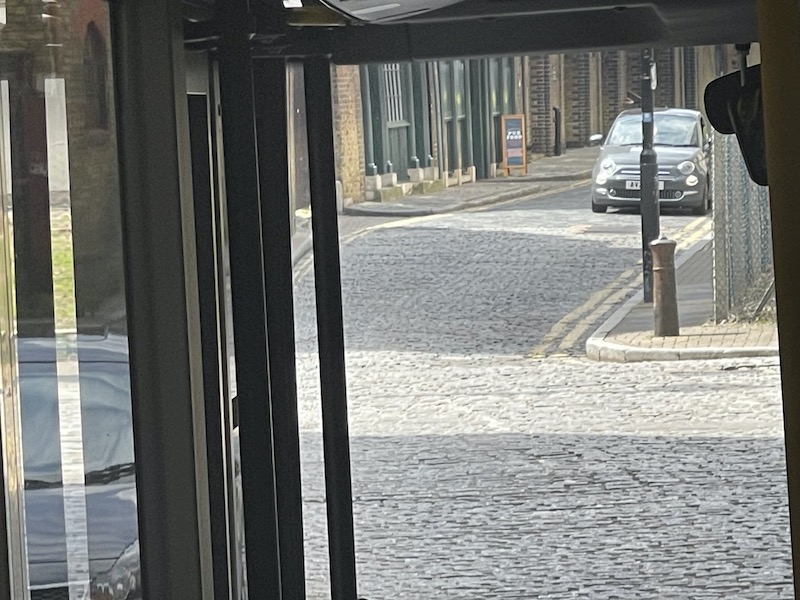
If you know where to look (Leon did) you can also spot one of the rare sitings of a TfL ‘Tail Stop’ also located in Wapping.

As you can see it’s not the busiest of route 100s. Those in Stevenage/Hitchin; Crawley/Redhill; Lincoln/Scunthorpe and Manchester/Warrington as featured in previous blogs in this series easily surpass the numbers travelling between Shadwell, Wapping, Aldgate and St Paul’s. There’s also no doubt it has the most sedate journey speed and layover allowance at termini of the routes featured with the London characteristic of two buses on stand time at each end.


That means at any one time (during the daytime) four of the nine buses on route 100 are standing idle with just five actually wheel turning, which is an interesting thought to conclude on as well as adding my grateful thanks to Leon Daniels for all the background information he kindly provided and accompanying me on my exploration and kindly hosting a lovely lunch afterwards – well, it’s hard work all this bus riding you know.
You can hear more from Leon on his Lunch with Leon podcasts which have now reached No 89 with all the back catalogue available on Leon’s website including No 53 with yours truly when we also “lunched” in January 2022.
Another plus from sharing bus rides with Leon is the fantastic collection of nostalgic photographs he has stored on his smartphone including this amazing atmospheric one below, from the mid to late 1960s during the period when London Transport’s ‘trial’ Atlantean XAs ran on route 67 in a pre Wapping redevelopment, pre Wapping station becoming East London Line and Overground and certainly pre route 100 era.
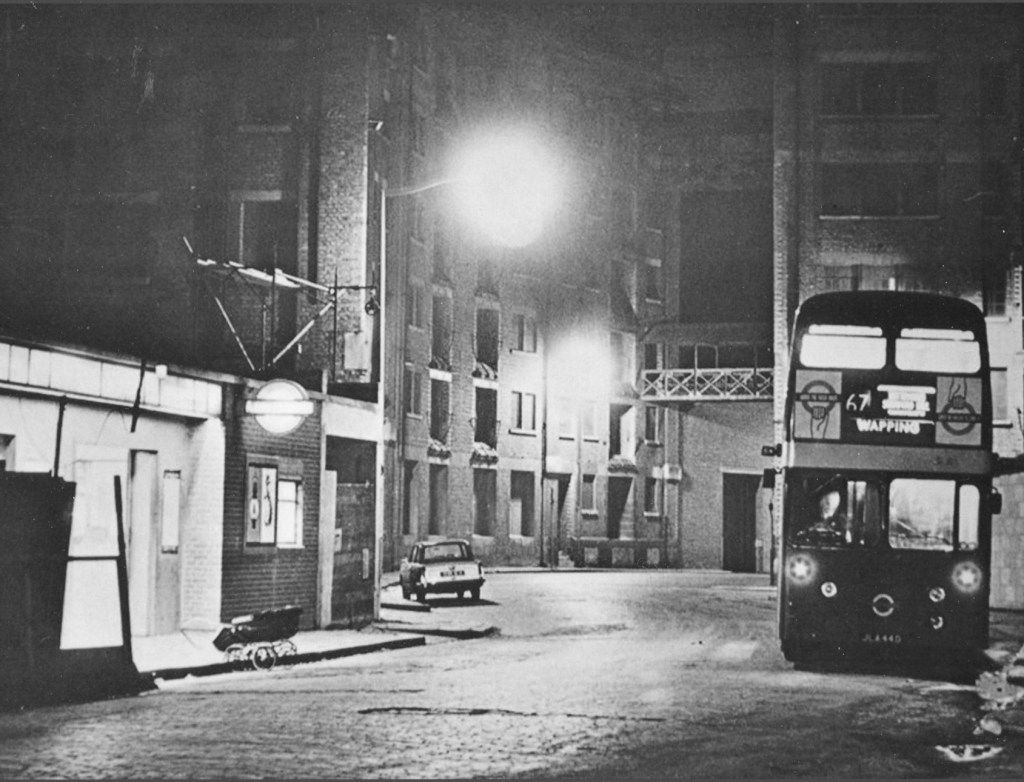
Gorgeous.
Roger French
Did you catch the first eight ‘Every route 100’ blogs? Here’s 1 of 26 (Stevenage-Hitchin) 2 of 26 (Crawley-Redhill), 3 of 26 (Lincoln-Scunthorpe), 4 of 26 (Glasgow-Riverside Museum), 5 of 26 (Campbeltown local), 6 of 26 (Guildford’s Onslow Park & Ride), 7 of 26 (Warrington-Manchester), 8 of 26 (Chatham-St Mary’s Island).
Blogging timetable: 06:00 TThS.
Comments on today’s blog are welcome but please keep them relevant to the blog topic, avoid personal insults and add your name (or an identifier). Thank you.
 BusAndTrainUser
Back in the 1960s I worked in the Minories for a couple of years, often (as a junior clerk) making deliveries around the city area. The 100 might have been useful, but – then as now – traffic meant that it was usually quicker to walk, and that area is full of interest. Thanks for bringing back the memories of cobbled streets
LikeLike
I can only feel sorry for the drivers . . . all that stand time, and a slow overall journey time . . . it must be incredibly frustrating.
Whilst I can see the need for the route around Wapping . . . I do wonder why the route needs to run beyond Aldgate (or maybe Liverpool Street) . . . the westward section seems to duplicate other routes, and with the “hopper” ticket would make changing simple.
One of those TfL routes that perhaps needs a rethink, one that would save money and inconvenience few passengers . . .
LikeLike
Routes like the 100 – a ludicrously inefficient use of public resources – is what frightens me the most about the rush to return to public sector control that is just on the horizon.
LikeLike
Hear! Hear! Whilst Wapping itself may need a bus service as quite a hike to any others, to tie up nine buses, which must require at least twenty duties seven days a week becomes eye-wateringly expensive. The annual wage bill alone tops £1,000,000, before anything else…..Perhaps ideal for DRT hahaha!
Of course, as history always tells us, when the next round of austerity befalls us and profligate Councils run out of money, the first sweeping cuts are usually aimed at bus services.
I do hope the Council tax payers in many other places are preparing for this!
Terence Uden
LikeLike
I’d love to know the stories behind the (abandoned?) pram in the road an8d the lonely parked Triumph Herald in the very atmospheric 67 photo!
LikeLike
This just about sums up the current Tfl, taxpayer subsidised inefficiency and incompetence
LikeLiked by 1 person
two buses on stand is not everywhere, but often it is for “driver protection” – the route terminating at Lavender Fields. Mitcham and a couple of the estates in Barking come to mind. I cannot recall what buses serve London Wall – it seems fewer than in some past years, and maybe different routes would carry more passengers. There is much congestion basically on the road system at the north end of Tower Bridge. Perhaps the route should be transferred to Uber and become a DRT for people going from Wapping to the Shadwell health centre.
In Minibus days we called this the Wapping Hopper
In a time I dont really want to remember how far back I dont remember much public transport around Wapping, but the older mansion block housing was being transferred to Barratt for refurbishment or demolition and rebuild. In the meantime City of London Polytechnic were using it for Student Accommodation, having learning centres at Aldgate, Moorgate , Tower Hill and Whitechapel I think we had to walk basically in. While the accommodation had been acquired , there appears no one told the utility companies for the roads or blocks of flats as I cannot remember the communal or street lights being on. At about the same time News International came with their print works which remained as impenetrable as the docks had earlier, but was one of the destinations of Harry Blundreds Docklands Minibus competing service (which apart from contracts essentially failed due to the lack of joint ticketing /capitalcard acceptances with other LT services).
A problem in any bit of London is do you walk, because the bus for about any two bus stops is not always quicker, or wait it out sitting on a bus because you have already walked or worked for part of the day anyway and are just too knackered to get any further , then the frequency of buses is appreciated.
When St Katherines Dock closed commercially as part of the redevelopment the GLC insisted on Council House development and there are good number of mid 1970s flats still owned by TH council there of which many folk work in the city or east end , those I know though do choose to ride by bike to work, routes exist that avoid the busy traffic junctions which helps for that but the 100 and other buses would give alternatives.
Being in London last week Mayor/Candidate Khan announced ideas for SuperLoop2, this week it was taking on certain London rail services – indicated was the Moorgate-Hertford Service and the SouthEastern Dartford Loops ( unsure if Hayes is included ), I dont think that London operation of them will necessarily bring any significant service level improvements, and it seems tied to increasing local to stations housing development of up to 130,000 dwellings (I assume that is additional and not including plans for others already – which rather makes why Beam Park station is still at some kind of odd consulting stage when there is new flats ready to go)
JBC Prestatyn
LikeLike
There are other places in London which are too narrow for buses to pass (or, at least, there were).
On Mitcham Common, used by route 118, bus stop flags carried a notice to drivers to check the road ahead before proceeding. These were installed when the route converted to OPO – the Metrobuses were a couple of inches wider than the Routemasters they replaced.
When I occasionally drove route 464, some years ago, the duty card included an instruction not to proceed beyond Biggin Hill Airport northbound, or Biggin Hill Valley southbound, until the other 464 had passed in the opposite direction. (The section south of Biggin Hill Valley crosses into Surrey, but the section north of Biggin Hill Airport is entirely within Greater London)
Malc M
LikeLike
I find the publicly available bus schedules information on the TfL website of great interest to see how efficient or otherwise the bus workings are
https://tfl.gov.uk/corporate/publications-and-reports/bus-schedules?Query=100
LikeLike
Two buses on stand together at each end might appear wasteful. A quick check of route 100’s time schedule on TfL’s website reveals it isn’t scheduled.
At St Paul’s, during the midday period, buses do get a generous layover, around 18-20 minutes. At Shadwell, scheduled layover is 8-10 minutes, on a 12-minute headway, so two buses on stand together at Shadwell is not scheduled.
This may suggest some resilience has been built in by the operator, to enable a reliable service to be maintained in unpredictable traffic conditions. Or, as the buses are electric, are the generous layovers provided to manage the mileage between charging?
During the morning peak, layovers are less generous – about 8-10 minutes at each end, so two buses would not be scheduled to share the stand, either at Shadwell or St Paul’s
Malc M
LikeLike
Other capitals treat their 100s differently. The Berlin version links most of the key sights in the central area, although sadly now articulated bus rather than a double decker.
KCC
LikeLike
I enjoyed the article thank you. However I do not think it correctly demonstrated the use or usefullness of the service and this, I think, “gave rise to some of the comments.
It is a very useful route that also gives links to other sections of the transport network. The current route gives vital access to St Bart’s hospital for patients and staff from Wapping and Shadwell. It also gives a link to the city for city workers. It links to the Central line, the Overground, the District and Circle and the Docklands Light railway.
I use the 100 bus almost every day and although, like all routes, there are quiet times it is frequently full and at peak times there is often no bus waiting at either terminus. It used to be a 5 minute service but has been reduced to 12 minutes. This is understandable owing to the need to cut costs but any further cuts to the frequency would certainly reduce its usefullness.
Buses are vital in an area like Wapping and Shadwell as they make transport accessible for the disabled and for those for whom a taxi is unrealistic
Paula
LikeLiked by 1 person
I was living in Wapping when the route launched in ’89. With a bus stop just a few yards from my house, it was much quicker to use the 100 to get to/from the city, rather than use Wapping station.
The MCW Metroriders didn’t last long, being replaced by Renault midibuses. These were awful – their suspension struggled with the cobbled streets, engine soundproofing was poor and the bodies (IIRC Reeve Burgess?) started rattling within a year of entering service. On warm summer days, the walk to/from the station became infinitely more attractive than a “Renault ride”.
Thankfully, new Metroriders replaced the Renaults after a few years and were still in use when I relocated to Swindon.
Thank you for this update on the route and that amazingly atmospheric photo of an Atlantean outside Wapping station.
LikeLike
One unusual feature of the 100 is that Go-Ahead operate it from a garage on the other side of the river – as they do with the 11 and the 214. That can’t help the costs of the routes.
Ian McNeil
LikeLike
Camberwell isn’t that far from the route. It’s around 20 min dead running home to /from either end.
Steve
LikeLike
Thanks Steve. And of course the 11 does now cross the river, which I’d forgotten! Though that’s quite recent – as is the transfer of the 91 from Stockwell to Northumberland Park.
Ian McNeil
LikeLike
I’d like to see some of the armchair experts here compile a schedule for the 100 that is both reliable and saves resource over the current schedules.
Steve
LikeLike
Armchair experts always know best, Steve – especially when generalising from isolated examples can be used to support their particular view of the world! (I’ve never been guilty of that, of course…)
LikeLike
I believe the roads in Wapping are paved with Setts rather than Cobbles. Cobbles are rounded stones as found on a beach while setts are stones cut into rectangular pieces so they can be laid closer together to provide a smoother surface. I understand there are still about 50 roads made of setts in Central London, the only other one used by buses that comes to mind is the Hampstead, South End Green stand where the pick up stop on the 24 is on the setts. There are still a few roads paved with wooden setts which are quieter and were often used outside churches.
A good website is http://www.wheremywheelsgo,co.uk which incldes a cycle tour route over all 51 streets with setts.
Alan JS
LikeLike
I think you’re correct, Alan, but there’s a typo in that URL – the comma before co should be a full stop.
LikeLike
Setts or cobbles, I’m not sure, but this is not the only 100 that runs over them – Compass Bus 100 bangs and clatters over them in Horsham (West Sussex)!
LikeLiked by 1 person
A fascinating review Roger. Anonymous at 11.03 commented: “I find the publicly available bus schedules information on the TfL website of great interest to see how efficient or otherwise the bus workings are.” and linked to the TfL bus schedules.
https://tfl.gov.uk/corporate/publications-and-reports/bus-schedules?Query=100
Having gone off down that rabbit hole I was intrigued to discover that the timetables, after 23:59, continue as 24:xx and even on to 25:xx. The rabbit hole guided me to a night bus timetable, the N15, where we find references to 31:xx, ie 07:00.
Stuart Render
LikeLike
As a former scheduler, I can confirm this is a necessary part of preparing crew schedules that run across midnight. A driver signing on at (say) 2330 might sign off at 3130 – or 0730. Time can’t run backwards on computers! The duty boards are adjusted during the printing process to show the “correct” time.
LikeLike