Thursday 7th December 2023
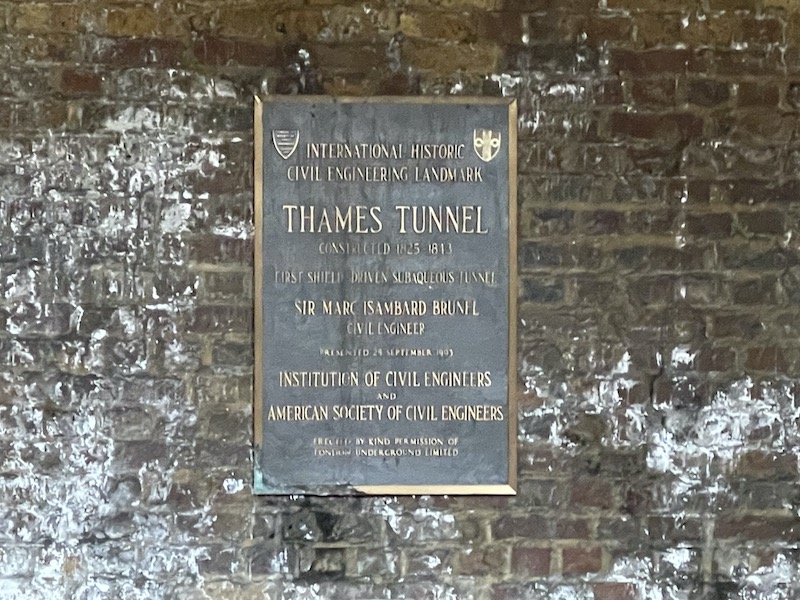
By the 1820s the River Thames at Rotherhithe was so congested it had become the M25 of its day. The nearest river crossing for merchants and citizens was London Bridge but that was over two miles away as well as being busy and expensive to use.
It’s said the river was so chocablock with boats and ships, pedestrians could cross by hopping from one boat to another until reaching the other side. But obviously that wasn’t a sustainable solution to meet the growing demand for cross river movement and linking the expanding docks on each side of the river.
So plans were drawn up for the very first tunnel to be built under a river.
Initial attempts between 1805 and 1809 had failed due to the difficult ground conditions but a decade later along came Marc Brunel who had patented his tunnelling shield and in 1823 produced a plan for a tunnel between Rotherhithe and Wapping with construction beginning in 1825. However within a short time Marc fell ill due to the sewage laden water conditions giving off methane gas where work was taking place leading to his retirement and 19 year old son, Isambard Kingdom Brunel, taking over.
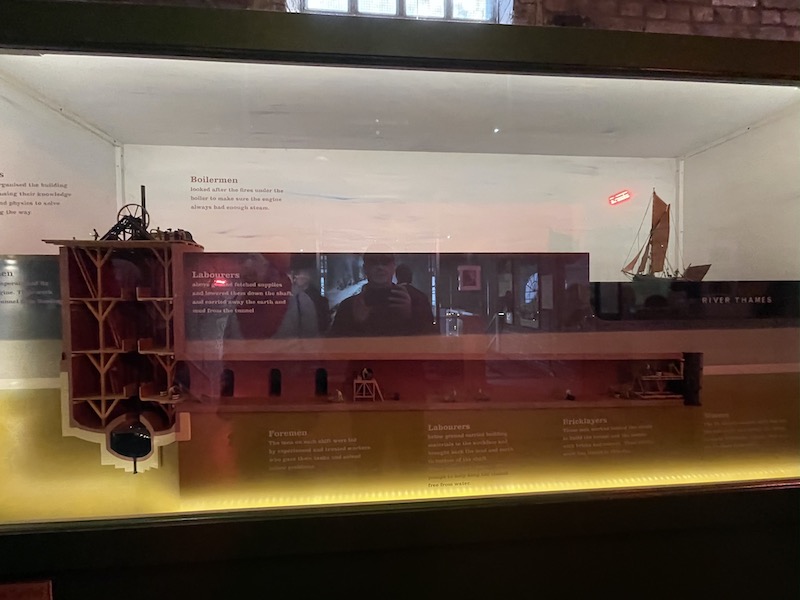
It was a gruelling process coping with flooding and other challenges as well as a drain on finances making it the HS2 of its time. But rather than cancelling its northern leg, steps were taken to raise funds including allowing visitors to pay a shilling and climb down the shaft to observe the workmen at work on the construction with the foul smells, noise and danger thrown in for free. Homeless people were able to pay a penny and sleep in the tunnel overnight.
After 18 years of arduous construction the tunnel finally opened to the public in March 1843 and was an immediate success becoming a hugely popular way to cross the river with 50,000 visitors on its opening day and a million in the first ten weeks.

Fast forward exactly 180 years and Brunel’s tunnel, now used as a key part of the London Overground, was opened to the public to explore during a Hidden London weekend special at the end of last month and proved equally popular. Thanks to engineering work on the tracks in the Shoreditch area the busy line between Wapping and Rotherhithe which usually sees London Overground trains running every few minutes was closed to trains on 25th and 26th November.

Thanks to meticulous planning and I’d imagine no end of risk assessments and Health & Safety concerns, the Hidden London team worked with London Overground to offer a unique opportunity for the public to walk through the tunnel as they’d done 180 years ago. Guided tours left Rotherhithe every 20 minutes throughout the weekend and my good friend Ray Stenning and I had been lucky enough to secure tickets for the very first ‘departure’ at 10:00 on the Saturday.
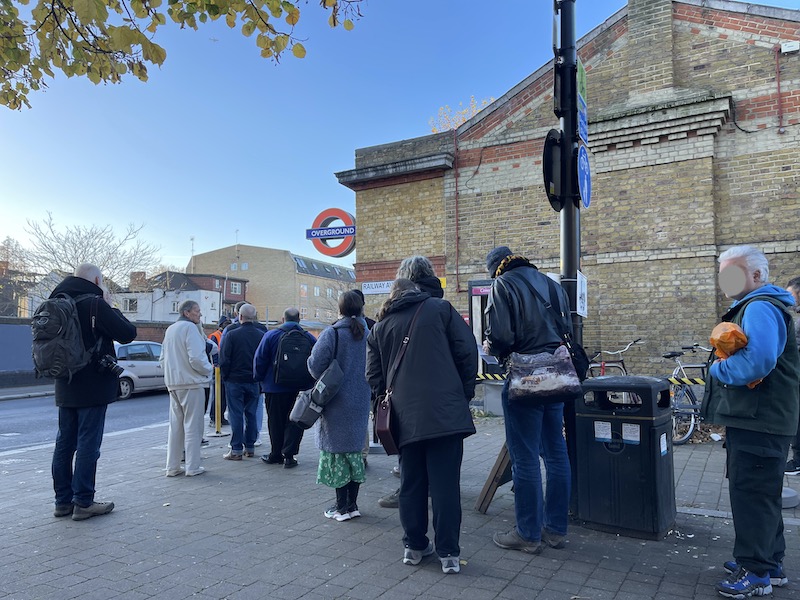
After a brief introduction and words of welcome from London Overground staff, 20 of us were in the capable hands of Hidden London guides Aaron and Paul who did a magnificent job during the following hour taking us along the tracks through to Wapping and then back again while imparting their extensive knowledge of the history of the tunnels at strategic points along the way.

Arrangements had been made to install ‘piers’ on the tracks at both Rotherhithe and Wapping to enable visitors to access the tracks safely and begin the tour.

Although it’s one tunnel there’s a dividing wall creating two ‘bores’ which have gaps at frequent intervals.
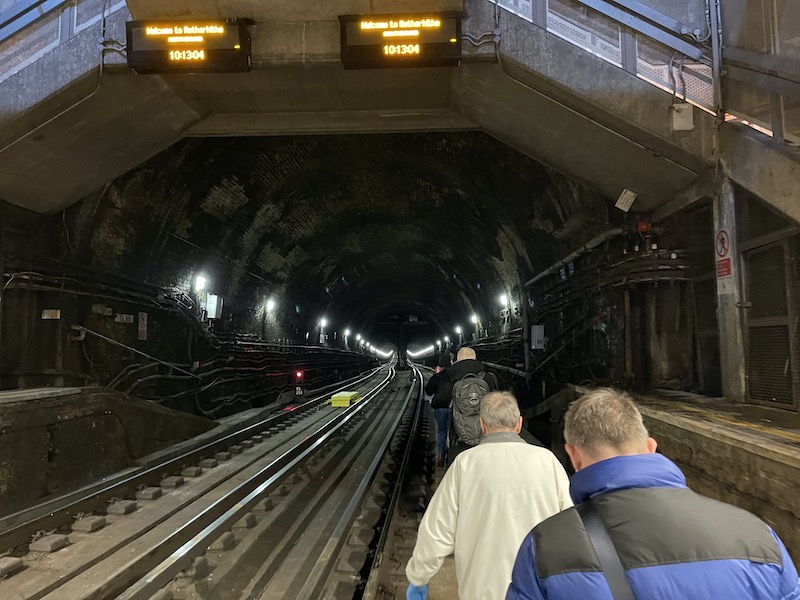
But first we had to cross over to the northbound bore which was closely supervised to ensure no one tripped over.

In the early years of the tunnel the gaps between the ‘bores’ were filled with up to 60 stalls selling various products and services in the Capital’s first underground shopping arcade.

Despite its delays, setbacks and disasters, the Thames Tunnel became one of the sights of London, as it had during construction. Foreign governments sent experts to learn from this “eighth wonder of the world”, seen as a triumph of British engineering. At its height of popularity about two million people were paying a penny to pass through each year.

But while the tunnel had ultimately proved to be a triumph of civil engineering, in echoes of today’s HS2 experience, it was not a financial success. It had cost £454,000 to dig and another £180,000 to fit out, far in excess of initial cost estimates.

Furthermore, after the initial popularity waned the tunnel’s reputation became more sordid with prostitutes and other more unsavoury characters known as ‘tunnel thieves’ frequenting the arches and in 1865 the owners sold the tunnel to the East London Railway Company for £800,000 to allow steam-powered trains to carry passengers under the river. Trains ran north to Shoreditch including a loop to Liverpool Street and Whitechapel.
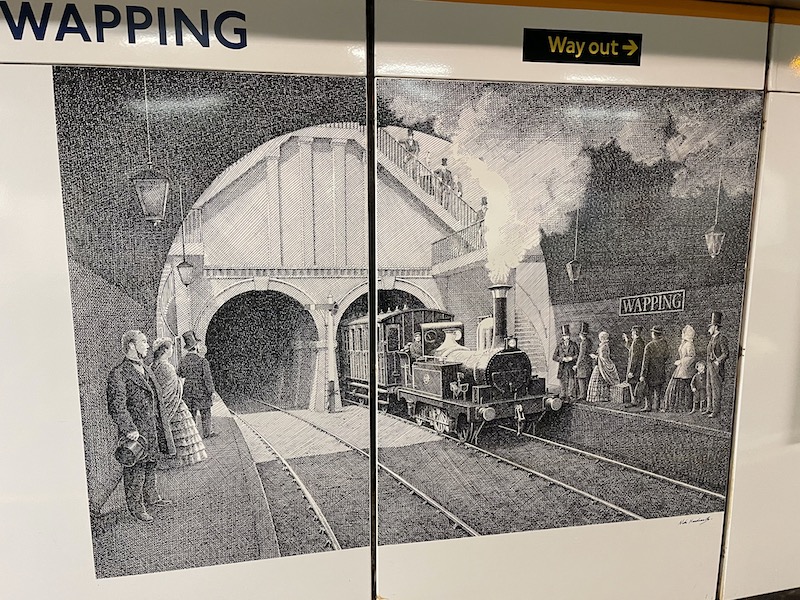
The tunnel’s disused construction shaft to the north of the river was repurposed to become Wapping station which is why even today access to and from the platforms is the most restricted on the network.
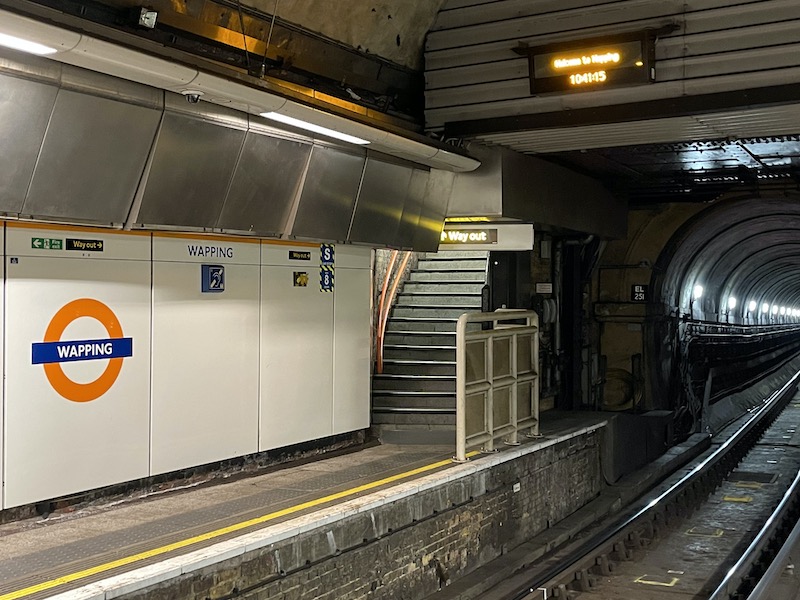
The line was electrified in 1913 and became part of the London Transport Passenger Board’s assets when established in 1933 becoming part of the Metropolitan line. In 1995 the line was closed as part of plans to provide a link to the new Jubilee line at Canada Water and the opportunity was taken to perform much needed maintenance including “shotcreting” the tunnel’s walls and roof to prevent leaks.
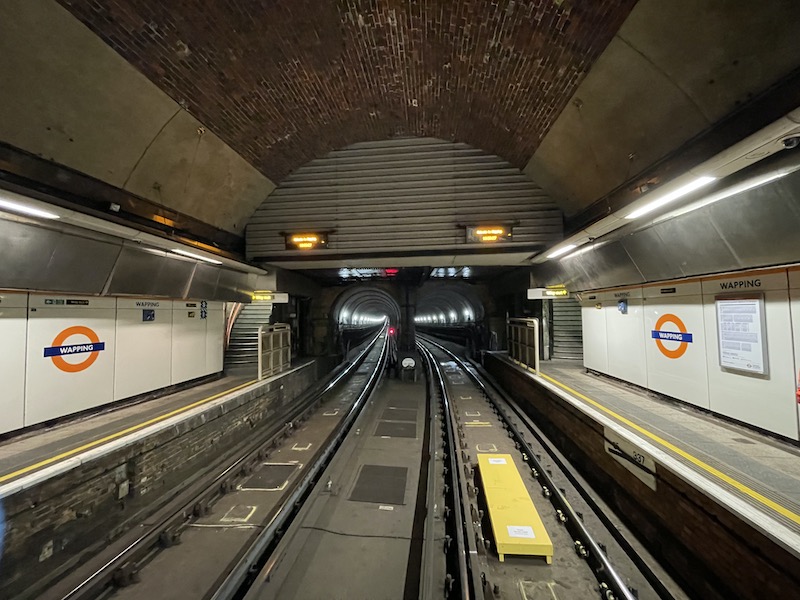
However this was not without controversy with architectural interests seeking and gaining Grade II listing for the tunnel at the eleventh hour resulting in a more sympathetic plan for treatment including a short section at one end being left untreated to retain the tunnel’s original appearance.

The tunnel reopened in 1998 but closed again in 2007 to permit track-laying and resignalling for the East London line extension and become part of the London Overground with main line trains once again running through the tunnel after it reopened in 2010.
It was a truly fascinating visit and although far from cheap at £75 a ticket, indeed some observed the cost was bordering on extortion, it was obvious costly preparatory work had been necessary with extensive staff numbers involved over the weekend to facilitate this unique visitor experience.

To complete the visit Ray and I also went along to the nearby Brunel Museum just north of Rotherhithe station. Located in the original shaft from where construction of the tunnel began, as well as exhibits and story boards…

… it has a viewing area at the bottom of the shaft to watch an informative video about the tunnel and proved to be a great way to end the visit.

180 years ago Brunel’s vision for the Thames Tunnel almost certainly didn’t envisage thousands of passengers travelling through it on an intensive network of frequent main line trains; which makes you wonder what the situation will be in another 180 years in the year 2203.
Thanks to those at TfL, London Overground and Hidden London who made this visit possible.
Roger French
Blogging timetable: 06:00 TThS.
Comments are welcome but please keep them relevant to the blog topic, avoid personal insults and add your name (or an identifier). Thank you.


Fascinating …. I wish I’d known about the tour!!
£75 seems a lot, but for something unique like this …. probably worth it.
One tiny correction … it’s Marc, not Mark.
LikeLike
Thanks; corrected.
LikeLike
Would have liked to have done this, but couldn’t justify that sort of money for what is in the end an hour down a tunnel.
LikeLike
I’m
LikeLike
What a fabulous idea by the organisers. This is truly a rare ‘cop’. Well done you and Ray for going along and thanks Roger for your write-up and pictures.
Peter Murnaghan
LikeLiked by 1 person
It always seemed quite incongruous that this small line, albeit with such an amazing history, was deemed to be part of the Metropolitan Line. In my early career working in the Railway Staff office of London Transport, former Met line staff (most top positions were held by them) really did consider all other lines, and indeed, London Transport itself, as inferior to the life they had once known. To have had this line, in what was regarded then as a less than savoury part of London, certainly in contrast to the leafy glades of Hertfordshire and Buckinghamshire, was almost too much to bear! I think they pretended it to be part of the District line instead.
I recall the line was totally staffed from the small depot at New Cross, but to stop the Motormen and Guards going mad with repetition (a rounder from either New Cross or New Cross Gate took barely 30-35 minutes), there was a roster line every six or eight weeks where they worked a middle turn on the Hammersmith and City, thus getting to exotic Barking.
Terence Uden
LikeLiked by 1 person
Well that’s the first time I have seen Barking described as “exotic”!
Nigel Turner
LikeLike
A fascinating and very interesting blog. I don’t know how you manage to provide so many fine reports And travel as well.
Gerald
LikeLiked by 1 person
Whilst you’ve said “the line … became part of the London Transport Passenger Board’s assets when established in 1933″, I seem to recall reading that the ELL rail infrastructure stayed part of SR then BR until around the 1950s (albeit under some sort of joint management committee).
I dug out my 1987 copy of H.P. White’s ‘A Regional History of the Railways of Great Britain, Volume 3: Greater London”. In it (page 102) he appears to confirm this by saying: “The [East London] line had a complex history of ownership and management but was finally vested in London Transport after nationalisation.” So after 1948.
I know I’ve got a book somewhere that gives the exact arrangements and final transfer date, but I can’t put my hand at it at the moment!
Rob
LikeLike
That’s interesting; thanks Rob.
LikeLike
Many stations on the District line remained under BR control for many years even though no BR trains serves the stations
LikeLike
I was responsible for getting the line reopened in March 1998. A great privilege. The northern bit to Shoreditch, which was a lovely looking village like station, wasn’t ready until September 1998. I walked the tunnel many times before reopening. I only came in board in 1997 and it was full on pressure in the run up. Engineering issues, health and safety, drivers duties, station staff rosters. And water, water everywhere and of course line critical pumping kit. But we made the designated date, exactly three years on from the line closure. It was a lovely little railway but I’m pleased the tunnel has finally fulfilled its potential as a vital transport link from a wide area of south London to Shoreditch, Dalston and Highbury. Incidentally until the last day of 1999 the Brunel carried the easternmost rail tunnel under the Thames. Only twenty years later there are so many more on the Jubilee, DLR, Elizabeth Line and of course HS1.
MikeC
LikeLiked by 1 person
I used to live at Surrey Quays and have enjoyed the fascinating (but tiny, as the shaft wasn’t accessible then) Brunel Museum. I also went on a tour through the tunnel, I think just before it reopened as London Overground – I can’t remember if I paid at all for it!
Stephen (the other one)
LikeLiked by 1 person
I’ve been on all the Hidden London tours that go into tube stations (including the new Baker Street) one but somehow I missed this, which I’m annoyed about. I would love to go, but glad you got the opportunity to go on it and share it with us. I will have to keep a close eye to see if they run that tour again but given it requires a track closure it will probably be a while.
LikeLike
You could have walked through the nextdoor Rotherhithe Tunnel for free!I, however, wouldn’t recommend it as unlike the Woolwich and Greenwich Tunnels the pedestrian shares it with a relentless stream of cars.
LikeLike
Anyone thinking about walking through the Rotherhithe Tunnel might want to read this account first – https://www.ianvisits.co.uk/articles/walking-through-a-tunnel-under-the-thames-part-1-11764/
Mark L
LikeLike
Yes I’ve done it and it’s not at all pleasant!
LikeLike
One way or another the Metropolitan Railway had been involved in the financing and operation of the acquisition of the tunnel for rail purposes although it was not until 3 March 1884 that Metropolitan (and Metropolitan District Services ) lines were constructed to completion with services commencing 1st October 1884 from St Marys to New Cross and New Cross Gate respectively with extension on 6 October Hammersmith via Edgware Road to New Cross and New Cross Gate. The East London Railway via Edgware Road services then ceased 1905 for Metropolitan Districts services when it was electrified and 1906 for the Metropolitan ( LBSCR and GER Services continued and SER services restarted 3Dec1906. When the line was electrified in 1913 the Metropolitan Railway provided the electric passenger stock to the services to New Cross/New Cross Gate initially from South Kensington then the terminus was changed to Hammersmith (Hammersmith and City Line) . After grouping it appears the LNER got the freight services, with the Met the passenger ones. ( the Metropolitan being nearly unique in surviving the grouping of most British rail services ) So the route had greater association with the Metropolitan before the vesting of the operational electric Passenger Services in the Metropolitan Line with the 1933 establishment of the LTPB.
LikeLike
On 15/09/1990 I rode through the Tunnel in unusual circumstances. I was on a Metropolitan Line “Special” from New Cross Gate to Liverpool Street and King’s Cross(St Pancras) laid on for the supporters of Ipswich Town FC who had played at Millwall FC that day. “A Stock”, Train Number 076 and we went over the St Mary’s Curve. Doors remained closed between New Cross Gate and Liverpool Street. Football supporters who hade been watching other London games looked on nonplussed as this train remained stationery waiting for signals at Aldgate East with those doors remaining closed. Ipswich Town FC supporters are noble, precious people and London Underground did all in their power to get them back to Liverpool Street or King’s Cross safely. LUL excellence very much beyond the call of duty. It was humbling to experience this journey but the train did not need any tractors to assist it over the St Mary’s Curve.
LikeLike
Fifty years ago I was a regular commuter on East London line. I was intrigued by a notice at the southern entrance that provided guidance for goods trains. At that time I was unaware it had been used by goods trains. Now the question has been answered.
LikeLike
New Glasgow Subway fleet enters passenger service for the first time in 43 years
Following their final testing by train manufacturer Stadler, SPT decided to enter the first of the new trains into the system for their maiden passenger trip.
They will also be introducing platform screen doors (PSDs) to station platforms. These will be ‘half height’ to preserve as much space and openness within the stations as possible while still maintaining passenger safety and security. Once these key milestones have been reached, we can them look to introduce Unattended Train Operation (UTO) or ‘driverless’ trains to the system.
LikeLike