Sunday 25th October 2026
To mark tomorrow’s 40th Anniversary of bus deregulation here’s an article I wrote earlier this year for the Omnibus Magazine (the bi-monthly magazine of the Omnibus Society) explaining why deregulation worked so well in Brighton and Hove as well as a number of other British towns and cities. It perhaps also explains why deregulation manifestly didn’t work in other places most of which are now first in the queue for implementing the now available alternative of politically led and publicly controlled ‘franchising’, thanks to previously unheard of generous funding from Government.
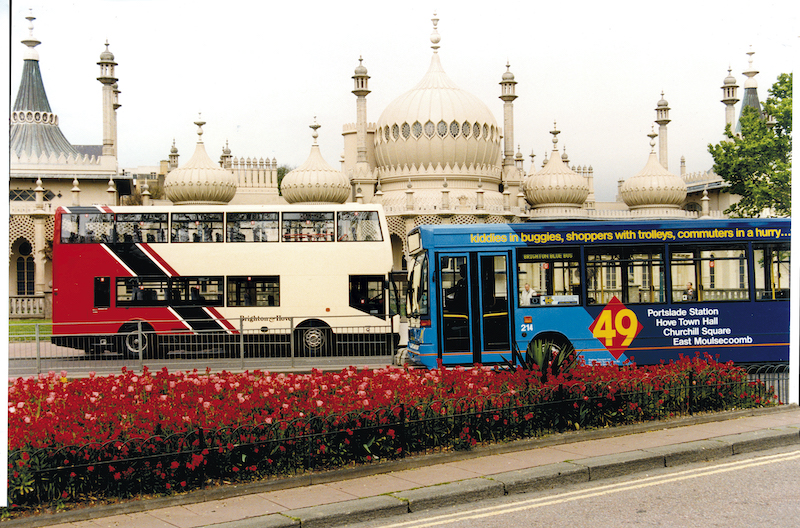
Bus deregulation is a bit like Brexit. It has divided opinions in a very binary way. You either believed sweeping away 50 years of regulation released pent up innovation and potential for growth or subscribe to the idea such freedoms heralded an unwelcome era of privatised ‘bus bandits’ making unjustified profits with little interest in the needs of passengers. Opinions became ever more entrenched as the decades have passed with the famous generalised comparison usually cited of consistent growth in regulated London from the early 2000s alongside year after year of mileage cuts and withdrawn services across Britain outside of the Capital.
Of course, as always, the truth lies somewhere in between those two extreme characterisations and the choice between regulation and deregulation is not binary at all. As has been seen in many exemplar areas, where local authorities and motivated managers, at locally based and locally controlled bus companies, work together towards a common objective of growth, then you can achieve a virtuous circle of consistent investment in bus improvements and increasing numbers of passengers.
It’s easy to forget, and indeed many involved in the industry today are too young to have had direct experience of regulation, just how stifling the pre 1986 regime was for those wanting to provide the best possible service for passengers with potential for growth. Some changes of emphasis were made in the 1980 Act but there was little incentive to improve frequencies or try out new bus routes as incumbent operators as well as British Rail and other bodies had a statutory right to object, as they usually did, and the onus was on the licence applicant to prove the desired improvement would not have a detrimental impact through any abstraction from existing services.
In today’s contactless, ‘tap and cap’ digital ticketing world, complete with political inspired fare capping by the Prime Minister, it seems impossible to think that in those pre deregulated days every change to every individual fare and ticket price had to be applied for and justified in a bureaucratic Traffic Court hearing in front of a Traffic Commissioner.
The loss of passengers in the 1960s and especially the 1970s and early 1980s became unsustainable. As a new fresh faced entrant into the industry in the early 1970s I recall thinking if the annual decline in passengers continued unabated during a career I hoped would span the next 40 or so years then it was touch and go whether there’d be any passengers left by the time I retired.
Something had to be done. The old regulated regime may have worked in the 1930s and through to the early 1960s but growth in car ownership as well as changing retail, leisure and social habits meant it was no longer appropriate for the 1980s. Directors at the National Bus Company had recognised this with its subsidiaries embarking on the Market Analysis Project in the early 1980s to identify viable networks which local authorities could supplement with additional financial support to fund extra services. This was enacted alongside reorganisations of the companies whereby mergers of the 1970s to create larger subsidiaries to save overheads were reversed and instead new smaller units led by enthusiastic locally based managers in tune with the local market began trading.
Midland Red, Western National, Bristol Omnibus, Hants & Dorset, East Kent/Maidstone & District were just some of the companies split up as well as Southdown where I’d been appointed Assistant Traffic Manager in 1982. By 1985, when we recreated an autonomous Brighton & Hove operation within Southdown, it had become obvious the Conservative Government’s intention was not only to deregulate the industry but privatise the state owned companies in small units to encourage competition, so it was decided to formally split Southdown into two operating and one engineering company, one of which was the Brighton & Hove Bus and Coach Company which I had the privilege to lead initially as General Manager.
Those early years were an exciting time to be involved in the industry. Establishing a ‘new’ bus company (it was actually a resurrection of the dormant Brighton, Hove & District company which had merged into Southdown on NBC’s formation) was a tremendous opportunity to bring in a new approach to providing great customer service as well as enhance staff relations while the upcoming need to register a commercial bus network to commence on Deregulation Day on 26th October 1986 (the date is etched in my memory) enabled us to look afresh at which bus routes had the potential to grow and those which were never going to be financial winners.
In the regulated world, frequencies of the former routes would be consistently cut to release resources to keep less remunerative routes afloat. The old principle of cross subsidy between routes was alive and well but it had the impact of making the best routes, with the most potential, increasingly unattractive and the routes with no potential struggled on. No wonder passenger numbers fell every year. The new approach saw us reverse this trend and improve frequencies of those routes with potential and let the local authorities take on the financial liability of the poorly used routes by inviting tenders for their continued operation.
Looking back now it’s testament to the skills of my colleagues who oversaw network development, that those routes we registered as the first commercial network in 1986 are still the ones that are successfully growing forty years later with frequency uplifts and regular intakes of new buses ensuring a high profile operation to attract more and more passengers.
We’d had the benefit in Brighton and Hove of working alongside the municipally owned company, Brighton Borough Transport, in a coordinated urban network under the Brighton Area Transport Services Agreement (BATS) for many years so once deregulation came along, it was no surprise that as managers who knew and trusted each other, we both tended to stick to operating the routes we knew well rather than start wasteful competition between us, which I’m sure the competition authorities would have liked to have seen.
However that didn’t mean we didn’t experience competition in the area with new operators attempting to gain market share from time to time including one particular onslaught along the coast road between Newhaven and Brighton which after various iterations and ownership changes even led to competitive cross city routes for a time. But these interlopers had their work cut out simply because of the market share we’d built up with an emphasis on encouraging passengers to buy what we used to call ‘off-bus’ tickets. This became all the more pertinent when the Go-Ahead Group (which had purchased Brighton & Hove from the management buy-out team in 1993) also purchased Brighton Buses (as Brighton Borough Transport had become through its own employee buy-out) in 1997 and merged it with Brighton & Hove to form one all encompassing bus company for the conurbation.
That same year East Sussex County Council was reorganised along with Brighton Borough and Hove Borough Councils to form a new Unitary Authority for Brighton & Hove which quickly established its desire to encourage residents and visitors to the area to use public transport with active restraint on car use through substantial parking charges and rigorously enforced on-street parking management and control which, when effective, can be just as good as a congestion charge.
With Go-Ahead’s philosophy of backing its locally based managers and leaving them to get on with the job of developing the local market for buses we soon saw consistent growth in passenger numbers as frequencies of those same core routes improved alongside annual investment in new buses, attractive ticket deals (including in the early 2000s a simple to understand flat £1 fare in the city) with high profile and locally based marketing campaigns as the council introduced a network of bus lanes and priority measures and jointly funded, with the bus company, a real time information system, which being first in the field, revolutionised the way passengers travelled.
By the early 2000s the network was 95% commercial with a consequent significant reduction in public funding compared to the early 1980s, yet passengers enjoyed a more intensive and attractive level of service including night bus routes.
None of the foregoing would have been possible under the old regulated regime.
The idea the so called prized regulated regime in London would consistently see reductions in passenger numbers year on year (as it has for over a decade) alongside (Covid pandemic aside) consistent growth in passengers in areas such as Brighton & Hove seems to be unthinkable to critics of deregulation. Yet that is the situation, and what a difference looking back to those worrying days when I joined the industry in the 1970s to realise that far from there being no passengers left, by the time I retired in 2013 we had successfully doubled the number of passengers since the mid 1990s giving the city the highest bus use per capita outside of London.
And it’s thanks to deregulation.
Roger French
PS Apologies to email subscribers and online viewers earlier on Saturday morning for all the typing errors in yesterday’s blog – somehow the first draft slipped through into publication without any proofreading. My thanks to all who let me know of errors they’d spotted especially my good friend Tony who spotted 24 of the 30 typos. The favourite was Rubble Motor Services along with Midland Fred North! Hopefully today’s blog is error free after being proofread – twice.
Blogging timetable: 06:00 TThS


Today I’m setting off for the Wirral confident of the bus services on offer thanks to the internet and excellent timetables and maps made by Merseytravel, using cross river services that were a child of deregulation.
There is one ticket that is available for all bus services and also an option that includes trains. The fares are good value for money and every bus stop has a timetable, with all routes changing on the same date.
Passengers vast majority of buses will be catching new buses, not just those on profitable to the same high standard in the same livery giving the area an identity with a visible leader in Steve Rotherham “running the buses”.
The “seat turnover” as I’ve heard it called may have doubled on Brighton’s buses but like many towns and cities across the country it has been blighted by changes to bus stops in the City Centre that make catching and interchanging between buses harder and a less present experience.
There is no widely advertised ticket valid on all services in Brighton and Bus Times that underpinned confidence in using the network is now history.
Ultimately the vision and influence of local leadership in an area is the key factor for a positive future for buses in an area as has been shown in Manchester and Merseyside recently.
I’m sure the average passenger like me just wants a service that is safe, reliable and convenient.
John Nicholas
LikeLike
There may have been some successes due to deregulation, as indeed there have been with rail privatisation, but there needs to be a far more integrated approach overall. Regulation should primarily be aimed at introducing consistency and cooperation, or in other words, integration.
Competition is so often counter productive. Yes, the best do indeed succeed, but all too often the less good are allowed simply to wither and die. So, for example, you might have a pretty decent bus service into town, but there may be no convenient connections to ongoing rail services, which might in themselves be unreliable in any case. And guess what, you have the privilege of having to use separate apps and buy separate tickets for each leg of the journey to boot.
Wonderful! I’m sure this does a lot to attract more people out of their cars and onto public transport, just look all over the UK (not just Brighton, or anywhere else within 50 miles or so of London) and see how many journeys are being made by bus/train/tram compared to how many by private vehicle.
I’m not suggesting we in any way go back to the “good” old days of bus regulation and BR, but we need to pay much closer attention to emulating superbly run systems such as Switzerland and The Netherlands. Why keep reinventing the wheel when other countries have already shown the way, and have been doing so for several decades already?
LikeLiked by 1 person
Re yesterday’s typos. Your posts are usually so well proof-read, it has almost become a sport to spot the rare ones which do slip through!
MOtCO
LikeLiked by 1 person
Thanks Roger, and sorry to point out a typo: “the famous generalised comparison usually sited” should be “… cited”.
LikeLiked by 1 person
Many thanks.
LikeLike
Wonder if B&H would have been so successful if the local council was ambivalent towards or anti-public transport.
Steve
LikeLiked by 1 person
As you say, some areas still struggle with the current setup. I can use 2 services in particular in Swindon. Swindon to Oxford 466 was a 2 hourly wander around the villages taking just under 2 hours, now we have S6 from Stagecoach every 20 minutes running right up to midnight. Similarly Swindon to Devizes 71 is even more extreme. 2 trips Monday to Saturday, taking a different route each day, is now every 30 minutes. Obviously there are routes which are still a bit of aa challenge, but overall Stagecoach have made buses work on lengthy rural routes
LikeLike
The Swindon to Devizes service (now the 49)
LikeLike
Sorry. Log in issues!
As I was saying, the Swindon to Devizes service (49) has been a particular success and this was kickstarted many years ago by funding from what was then Wiltshire County Council. It was operated by Thamesdown Transport for several years after deregulation before passing to Stagecoach.
LikeLike
It’s unbelievable that it happened so long ago. I must commend all in Kent, both in the local authorities ( where I was involved) and the operators, who worked in good harmony through all the measures to determine self supporting and financially supported services.
LikeLike
If I remember rightly, according to the redoubtable Basil Williams, owner of the legendary independent Hants & Sussex / Southern Motorways, it was the invention of television that had a crippling affect on rural bus services. People no longer went out in the evenings for their entertainment.
Things were never so simple !
Peter Murnaghan
LikeLike
Tomorrow too is the first day of Oxford Street in London general pedestrianisation, I understand in advance the last day of bus operations was on Friday 23rd October and that it is hoped to run a couple of routemaster private hires down there with RM848 about noon and a Briget’s Tea Bus Routemaster using the road for the last time today.
Brighton’s tacit agreement not to compete bordered on anti-competitive illegality under how the legislation had been drafted.
JBC Prestatyn
LikeLike
London Country in the 1970s – one map, one all-day ticket, and 4 (later 5) timetable books. Look at the area now…
LikeLike
Excluding the ups and downs of Green Line, London Country lost some of its outer London Routes that presumably were profitable , those like the 403 into Croydon and the 406 into Kingston. As I have noted before it seemed odd looking back that the histoJBCric division of Red Buses at Loughton and Potters Bar should have been transferred to London Country on its formation as garages outside of the LTE area, I feel this would have led to a better network and hopefully a better spread of buses out of London Transport. The Westlink carve out of London Buses mentioned yesterday at Stanwell Moor likewise really took away something that might have been better under London Country but the Bedfont area was always a bit odd under LTE with the four routes of Golden Miller providing effective local services which changed as Heathrow Airport and the M25 expanded over localities and local roads. likewise Roundabout/Orpington network covered routes LTE were reluctant to cover with Orpington and District and others filling in holes in the LT map on a sporadic basis. Go Ahead Metrobus indeed may have its LT contracts but the company roots lie in those Orpington and ex Tillingborne routes providing at the right time bases for expansion over a West Surrey chunk of London Country.
JBC Prestatyn
LikeLike
Franchising may be star-sprinkled magic to many eyes, but those eyes will soon water when the costs come home to roost, as Manchester are now discovering. Articles by respected people such as David Leeder and Julian Peddle in the November “Buses” magazine should be read by some of those ardent Politicians who somehow think it will solve all. There are a host of problems, which began with Covid and worsened by fuel prices, national insurance rises and a never-ending stream of regulations made by Civil Servants who never have need to step on a bus, that have sent the cost of operation sky-high. Thus in most cases, the industry needs financial support that was never required to such a level, playing right into the hands of the pro-Regulators.
I don’t have a crystal ball, but it will be interesting to see just how some minds, and certainly support, may change in five years time.
Terence Uden
LikeLike
Brighton’s record post deregulation is impressive and just shows how partnership working achieved these results. It’s a pity that London didn’t benefit from limited deregulation with the private sector allowed to run additional services much in the same way as open access can on the railway. The only time London operators were allowed to use their initiative was in the short period when net cost contracts were in operation or when there was a will from the companies to provide them. (Enthusiastic managers like the late Ron Brewer and the late Robin Young come to mind.)Since then patronage has declined whilst costs have gone up. Inner London bus services are now seeing managed decline as further evidenced by the Oxford Street closure this weekend. Who wants to catch a Night Bus from Marble Arch ?
Martin W
LikeLike
In my home town of Gosport initially privatisation saw competition and widespread use of small van derived buses ( which were far from ideal) , but since First Bus took over the town bus services have been slashed with lots of well established routes withdrawn or curtailed to daytime only services . First only seem interested in the profitable busway services .
On a separate note, I too have reservations about the politically driven consensus that mayor controlled franchises are the way forward, and certainly in the West Midlands I have to ask if it’s really sensible to make the National Express operation financially unviable, then spend £30m to supposedly save thousands of NX jobs , plus it seems take £78m of pension liability into the public realm .
Gary from Winsford
LikeLike
One does wonder if the WMCA was planning to buy the NX Bus operations from Mobico, then there would be no need for franchising, just keep the company as its own ‘municipal’ operator.
As things stand, WMCA have spent £24m to buy a company and then essentially wind it down over the next three years as new franchise contracts get awarded to other operators.
Stu (WMBU)
LikeLike
I seriously question the need for franchising in the West Midlands after the buyout. NXWM basically ran everything in the core areas, if anywhere needs improvements up there it’s the outer and fringe neighbouring areas, places like Cannock or Redditch or Kidderminster where buses are not great.
Franchising in the West Midlands would just fragment things now I would’ve thought.
Aaron
LikeLike
WMCA/TfWM (Transport for West Midlands) will be ‘inheriting’ a pretty comprehensive bus network. The talk from them is about ‘stability’ and ‘maintaining the network’, which basically means that not much will change, and it will be a few more years down the line before any major route changes occur.
What franchising is not going to immediately solve here is the issue of bus service reliability and punctuality, not while there are still so many traffic congestion pinch points caused by never-ending roadworks programmes that are badly co-ordinated and continually over-run.
That’s what is ultimately going to disappoint bus users, especially as they’ve been ‘sold a dream’ that taking back control of buses will magically make them run on time.
LikeLike
It would be the same problem down here in the places next to London, there’s too many cars and most roads are 1 lane in each direction! Very few alternative routes for traffic to go. Uncoordinated roadworks are a constant problem.
Aaron
LikeLike
The effects of regulation in 1931 and then deregulation in 1986 obviously varied from place to place but as an example of how regulation stifled progress I give you the following example-
H.C. Chambers & Son of Bures in Suffolk issued a timetable on September 29th 1930 “and until further notice”. On a Saturday there were three through journeys from Colchester to Bury St. Edmunds, leaving at 9am, 1245 and 4pm. On November 17th 1985 Mr. Chambers’ grandson issued a timetable for that same route. There were now four through journeys on a Saturday, leaving at 0900, 1245, 1430 and 1600.
On April 24th 1995, Mr. Chambers’ great grandsons issued a timetable for that route. On a Saturday, there were now eight through journeys leaving Colchester at 0915 and then at 15 minutes past each hour. The service continued at a similar level until the business was sold to Go-Ahead in 2012.
One can’t help feeling that there was a lot of unmet travel desires during the regulated era.
LikeLike
But the growth in housing along the Bury route in the Sudbury and Haverhill areas has stimulated demand that may not have been there in the regulated era.
LikeLike
The growth of all these towns in recent times, especially Haverhill is mind-blowing. Closer to London, it kind of nuts how big towns like Great Dunmow and Bishop’s Stortford are now and still growing, with future growth coming in Harlow, Cheshunt and most towns all around the green belt too, but little in the way of joined up regional planning. Some of these places like we saw recently with the Crawley post conductive to generating bus use and far too many just not and instead creating more traffic.
Bury St Edmunds may even need a 2nd rail station the way its growing!
Aaron
LikeLike
“local authorities and motivated managers…. work together towards a common objective of growth”.
That, in a nutshell, sums up what needs to be done. Many places, sadly, have a combination of operators who aren’t willing to invest and promote and local authorities unwilling or unable (ballot-box pressure) to challenge the private motorist.
But congratulations to those who have made deregulation work for the benefit of many.
John
LikeLiked by 1 person
Basically Arriva in the Lea Valley for so many years, now it faces companies like Central Connect, it’s suddenly motivated and steadily expanded timetables on its local routes as well as new vehicles have appeared in the past year. Not really fair on us who live here who should have had steady and consistent investment and improvements in our bus services.
Aaron
LikeLike
Having been with Brighton and Hove Bus & Coach Company from almost the beginning, in December 1986, I got used to continuing joint operations including the 729 to Tunbridge Wells (with Southdown and Maidstone and District) and 700 to Portsmouth with Southdown, along with day return tickets being accepted on Brighton Corporation, I couldn’t believe the difference when I moved to Leicester City Bus in 1996. No one from City Bus would talk to Midland Fox, and meanwhile Barton and Kinch had been attacking core services dating back for many decades. An interesting article, thanks.
Paul from Leicester
LikeLike
Is my memory correct that the Blue Buses of Brighton Corporation expanded north into the Falmer area which gave a enlarged area for Go Ahead to pay for compared to the original BATS operating area and routes ? I cannot recall if this network was at the expense of , or as Stagecoach withdrew from some ex Southdown routes ?
JBC Prestatyn
LikeLike
Brighton Corporation purchased a business called Lewes Coaches, and won quite a lot of tenders in East Sussex. They didn’t really compete with other commercial services.
LikeLike
As places like Leicester, Portsmouth and Brighton have shown buses cannot be run in isolation from local authorities. Success or not of deregulation has been determined by whether you have the right mix of attitudes. It also helps if the economy is going forwards, like in London and Brighton, or backwards as it was like where I live in Mansfield. Pit and factory closures in the mid 1980s killed the town and the local operators have struggled as the footfall in the town has declined, the busiest routes now are to Nottingham.
Deregulation went through a number of distinct phases. In the first decade the local managers got the freedom to revitalise the local networks. Unfortunately there were downsizings which gave fuel to competition as former employees took on their old employers – in Sheffield for example.
Then came the introduction of the disability discrimination act and the need for low floor buses. Capital was needed for this and so the companies grouped together into the four or fives names we know. This change also put up barriers to new entrants and had a major effect on minibus networks.
Then came the changes to the concessionary fares which involved new ticket machines – to record passes – and a major reduction in revenue. As the reimbursement was largely based on average adult fares we saw inflation busting fare increases with consequent loss of patronage.
After the economic crash of 2008 we saw major reductions in local authority budgets. The supporting tendered bus network saw major cuts and reductions in the reimbursement for concessions which are not guaranteed at any particular level.
When set against all of these happenings it is a surprise that the levels of bus services have remained as they have. Once the costs of franchising are realised and when patronage doesn’t grow as expected what will come next?
Richard Warwick
LikeLike
Franchising will be with us for a long time as there is a lot of political capital riding on it.
Mayors love it as it looks pretty and shows they are appearing to do something, similar to opening new Bus Stations where they are not really required. But the UTG already says they need more money on top of the £2 billion that franchising will cost. The truth is slowly seeping out in Manchester, lots of yellow buses have not improved reliability, passenger numbers have hardly moved despite the £2 fare, and costs mount.
LikeLike
The problem with deregulation is that it provided a country of haves and have nots and not just between urban and rural, what I noticed with the areas most successful under deregulation (Bournemouth or Brighton) or even with a good enough reasonably usable service (Plymouth or Norfolk) is the councils and private bus companies tend to match the travel to work areas and travel patterns quite well.
In parts of the countries where councils or transport policies/ areas are fragmented we are left with inferior services, especially off peak, because the travel patterns are disrupted (Balkanised). I’m known for complaining about the buses in Cheshunt and Waltham Abbey on here because it’s obvious both traditionally have very strong ties to London and still do as overflow commuter towns, travel patterns consistently flow into London rather than the rest of Hertfordshire or Essex. The fragmented nature of the area means buses are not able to take advantage of that flow into London, resulting in higher traffic as Waltham Cross as a terminus doesn’t have that draw at all, it’s just a small place on the way. Deregulated and regulated over an area too small like TFL just don’t mix. I think the thinking in the 80s never imagined anything but the car but we’re at the other end of that now. It didn’t and couldn’t see the consequences.
Deregulation didn’t work across Hertfordshire more widely for similar reasons especially as it lacks a central city to build something out of, travel patterns are far more complicated, so many companies came and went and the instability of this policy pushed more into cars to the point, a coordinated network is essential to the future prosperity of the place and the push to franchise in the most rural parts of the county is an interesting one.
Fragmentation is a common problem in all the places looking at and implementing franchising I think. Fragmentation of networks, higher fares, no coordination with other modes, especially trains all limit the prosperity and opportunity of places. Deregulation also struggled in congested cities like Bristol where the private company is artificially separate from road policies.
It’s noticeable deregulation worked mainly in the smaller cities or counties with a town everywhere else orientates around.
I think where I agree is it went from one extreme to another, from a straightjacket to the Wild West. It shouldn’t have been forced on everywhere outside London in my view, only places that wanted it, it should’ve been treated as an experiment rather than a free for all. In this new era, they are getting that right, letting areas who want franchising the choice (probably some will go municipal as funds allow), whereas others make the decision of an enhanced partnership which worked in Brighton and surrounding areas. We can see that in cities and towns across the East Midlands.
I think my gripe comes from that inequality and inability to strategically fix the wider social and economic problems coming from this policy, link buses with housing, jobs, leisure, other transport etc. Join it all up, transport is not abstract nor separate to everything else in life. The first thing I think of when leaving the flat is transport, that can open or close my world entirely.
In the places deregulation worked, it really worked, in the places it didn’t work, it really didn’t work.
Aaron
LikeLike
I recall there were experimental deregulated areas before D-Day, Hereford and Worcester being one , I cannot recall exactly what the results where and it was more a rexalation of the regulations rather than a total re-write.
Youtube reminds me that October 29th marks the 40th anniversary of the practical completion of the M25 motorway , which in itself changed travel and driving patterns , that today another cross Thames tunnel and motorway connections thereto proves that a circle of tarmac (or concrete in some places) was not enough to satisfy the lorry and car users. Oddly not a lot of the M25 itself was ever exploited by regular bus or coach journeys , perhaps because one can never know if even between two junctions a trip can take 20min or 2 hours
JBC Prestatyn
LikeLike
Hereford was a mess. A small market town with a fairly stable network became a mini-Glasgow, to the delight of Nicholas Ridley but to the despair of the poor sods who actually had to use the buses.
It’s never recovered.
LikeLike
Thanks very much, Roger. As always interesting and informative. But please ignore the pedants who draw attention to the minor typos of spilling ! 😀 , where the error is obvious. You must spend hours writing these blogs and yet some people have nothing better to do than point out the obvious. To them I say, nobody is perfect, even Roger. Accept this and don’t expect him to correct minor errors – he has better things to do. You have incredible patience with these folk, Roger.
Best Wishes
Paul Kirby
LikeLiked by 1 person
We dont enjoy doing it , but Rogers end of year blog points out customer facing typos and grammer errors so we expect a high standard from a professional
JBC Prestatyn
LikeLike
Lots here by commenters on “one ticket for all” flexibility.
When the two-pound scheme comes in, January 2027, can we please also have a “one ticket” then too? How feasible would it be to introduce a ticket for, say, £6.50, on any bus for a day across England.
This would likely lead many to explore bus networks beyond their home area. Then, when the £2 scheme ends, they might still continue being adventurous in the networks they use. Everyone wins.
(CH, Oxford)
LikeLike
I agree with Paul Kirby, the continual correction of typos is becoming very boring, as he says this is a valuable and informative blog and the constructive comments are very interesting, but those pointing out minor spelling errors are not.
LikeLike
Interesting blog Roger – if only everywhere were like Brighton we wouldn’t need to change things. Definitely the private sector at its very best.
Worth noting that franchising is a long way from the regulation of old. I know there are some who would like to go further, but for me the private sector does the provision of buses/drivers best, but not always deciding where/when to run them. That’s a huge difference between the 1980s regulation and franchising today.
On the post from Terrance above, it is worth noting that while I agree that David Leeder and Julian Peddle are always worth hearing, along with the politicians they too have their own bias.
With regard to Manchester it’s interesting that since franchising we have the fastest growing bus usage in the UK. Possibly at a high cost – but the truth seems to be that we don’t yet know how much and whether the other promised benefits are worth seeking.
So, Terrance I’m interested to hear your view as to what should have happened in the Manchester region. Bus usage could have remained in decline other than on a few key routes where private operators could make money. Would that have been the right answer?
Sad for the country if we have to accept decline where the commercial operators have less vision than in Brighton. Better get off the bus and back into my car!
LikeLike
I think there are two failures with the original desires at deregulation which still shape the bus networks of today. Firstly, there was no appreciation of ‘economies of scale’. It was frankly ludicrous for politicians such as the late Nicholas Ridley at the time to envisage minibuses running round forever without the stronger competing companies buying their competitors out. This indeed happened – sometimes within months – and eventually led to the creation of local monopolies, often still sticking to traditional operational areas once all the fuss has died down.
Secondly, whilst deregulation reduced Local Authority expenditure overnight, the pressures councils are faced with these days couldn’t really be foreseen (for example, social care and SEND transport to name but two). There are some councils (such as Cumbria) which infamously chose not to fund local buses at all whilst others appreciated their importance. The legacy of all this is that in too many places the commercial network packs up at 19.00 with nothing running until 06.00 the following morning. In short, buses run a commercial network and not one with wider social benefits.
Dan Tancock
LikeLike
I slightly forget John Hibbs arguements on the efficient size of a bus network or route operation, and had difficulties looking at the normal marginal cost of supply to asses what should be Economies of Scale. Indeed Roger’s record and analysis suggests that the large Southdown was less flexible for Brighton than a locally owned and managed operation with close up down links from drivers and engineers to top management team.
I would note even London shuts down frequencies after 7or8 pm , and frankly standing for 20mins outside the tube that arrives every 5mins for the onward bus is a real pain in the wet and windy nights
JBC Prestatyn
LikeLike
This. Proponents of partnership arrangements such as that achieved in Brighton and Hove choose to forget that the political intention behind deregulation was unfettered competition with no partnership whatsoever.
LikeLike
Historians love to pose counterfactuals – so what would have happened without deregulation? I would suggest that the bus system would have declined at a greater rate. In his sales talk for the GM Franchising Scheme, Andy Burnham talked of reversing 40 years of decline, but he was careful to say nothing about what was happening before then, leaving people who did not know that the bus services was in a good state. But in fact figures included by GM in the documents for the consultation exercise showed that the rate of decline for the ten years before 1986, the GMPTE years, was greater than that after 1986. If rate of decline had continued at GMPTE levels then by 2019 there would have been only half the number of passengers than there actually were. Andy Burnham also frequently trotted out the statement about patronage in London increasing whereas figures in the consultation documents showed that patronage was in decline by that date – I guess he did not read these documents. He and the new mayor following him have been claiming to have reversed 40 years of decline but it has been fortuitous for them to have taken over the system while still recovering from COVID. If they do achieve 30% increase over 2023 by 2030, they will still be only about 3% above pre-COVID.
At last months Bee Network Committee it was reported that “Since the introduction of bus franchising, Bee Network bus patronage has seen overall growth and ridership continues to increase, although the rate of growth is beginning to decelerate. Growth has been driven primarily by increasing numbers of concessionary pass users. It is expected that upcoming enhancements to the network and the introduction of free travel for 11-15 year olds will promote future patronage growth.” and on patronage that “The rolling 12mth figure (Aug 25 – Jul 26) is 3.1% higher compared with 12mths previously. The rolling 12mth figure is 1.1% higher compared with the 2025/2026 annual figure.” As conceded elsewhere increase in travel by concessionary pass users and 11-15 year olds does not increase revenue, and that will be the problem.
On another point – I do not see how services like the X43 ‘Witchway’ Manchester to Burnley could have developed as they have under the franchising system. It is indeed an open question as to whether such services can survive under franchising.
AHS
LikeLike
GMPTE, why the loss of passengers over that 10 years. Increase in private car usage , development of out of town shopping areas , structural changes in industrial employment in many of the area towns , Turner and Newall, bits of avro and other engineering in the south, the decline of Gorton and Ashton as places. Real Terms fare increases probably dont help either and how reliable was the services of GMPTE even then.
The big Manchester sucess seemed to be Magicbus along the student university corridor, but Stagecoach also invested in the Ashton and Stockport/Hazel Grove routes with those getting a regular supply of new vehicles.
But look to the future , IF a more reliable is switch concessionary pass holders from cars in a small way that is good , revenue may not go up as such but costs of operation could fall with less delays. Likewise kids might gain a habit of travelling by bus as first choice for getting around , but the way Manchester is currently structured the main areas for general leisure shopping and work are connected by the tram network which is due to expand with buses getting a role of filling the gaps – which they can do well.
JBC Prestatyn
LikeLike
It didn’t develop under deregulation either. It’s a long-standing Ribble service dating well back into regulated days, and it’s worth remembering that today’s Manchester – Burnley service is rather shorter than its Manchester – Skipton origins.
None of Transdev’s long standing headline services are inventions of theirs; they’re all inherited from predecessor operators, mostly dating back to the 1950s or even earlier.
Some thankfully have better frequencies than back then, but that’s the extent of their route innovation. Where Transdev shine is in vehicle spec, but even those are only for their headline routes.
LikeLike