Thursday 15th October 2026
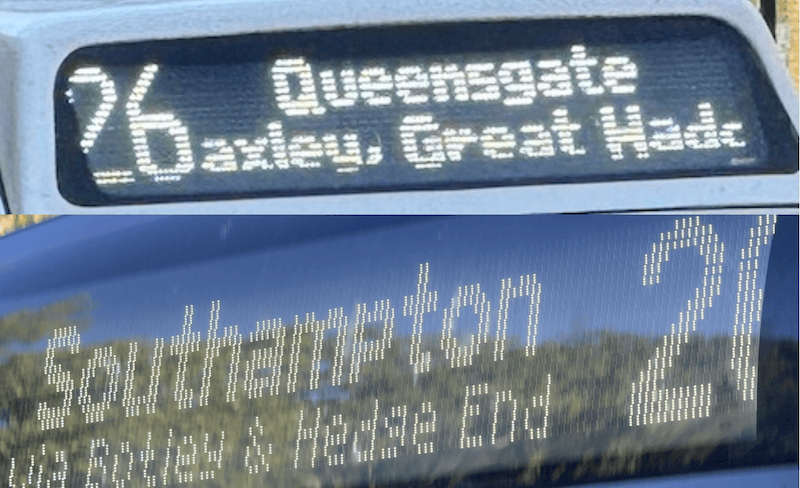
Continuing the exploration of the many new bus routes introduced around the country this year, saw me recently visit Peterborough and Southampton, as both cities have coincidentally just added a route numbered 26 to their local networks.
And in both cases part of the route serves new residential developments so I’m guessing Developer Section 106 funding, as well as Local Authority Bus Grants, has helped kick start the services.
Update; As per one of the comments …. the route is a purely commercial venture by Central Connect. Stagecoach have introduced a new half hourly route 7 between the new development and Serpentine Green utilising one bus and where it connects to its its route 6 into the city centre. It’s this route that has Section 106 funding.
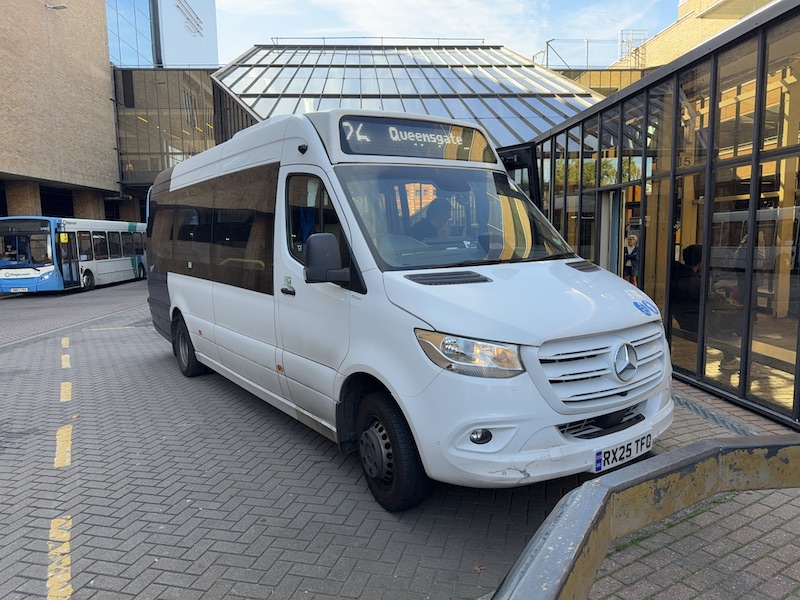
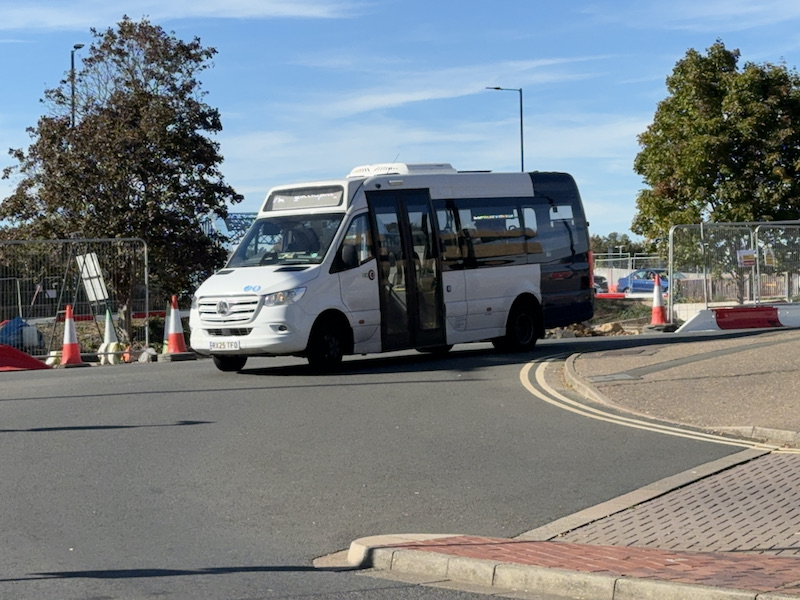
Peterborough’s route 26 began almost four months ago, at the end of June. Operated by Central Connect it comprises a circular route serving the Thorpe Meadows/Thorpe Road area to the west of the city centre as well as Old Fletton and Farcet to the east before continuing on a loop of the southern half of the city, including the Serpentine Green shopping centre and Yaxley where the new residential development is located at Lodge Way, known as Lakewood Meadows to the west of Yaxley. Indeed, it’s so new the Ordnance Survey map hasn’t quite caught up with showing the development already built.
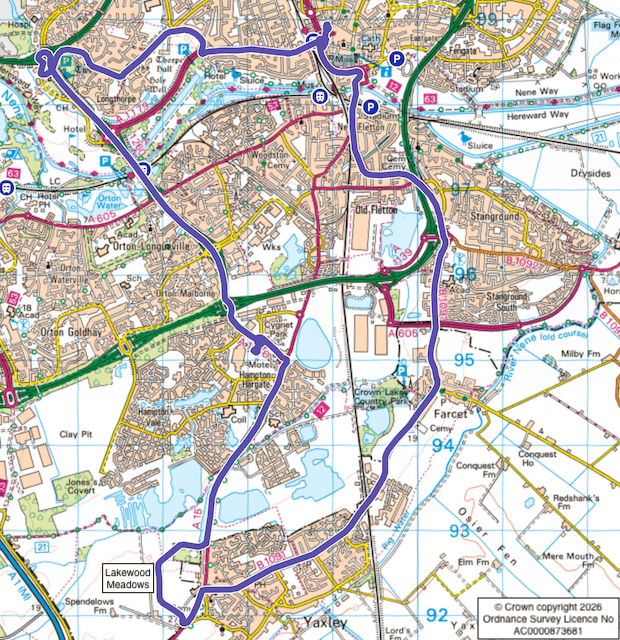
Both clockwise and anti-clockwise journeys (numbered 26A) each run hourly on Mondays to Fridays from around 06:00 to 20:00. Conveniently it takes 50 minutes to do a full circuit so operationally the route requires two buses. Oddly, on Saturdays buses only operate on the western side of the circuit reaching as far as Yaxley, Station Farm before turning back, and in what looks like strangely inefficient scheduling, the bus appears to sit at Yaxley for 45 minutes in each hour, although I suppose it might nip off to Central Connect’s premises. There’s no Sunday service.
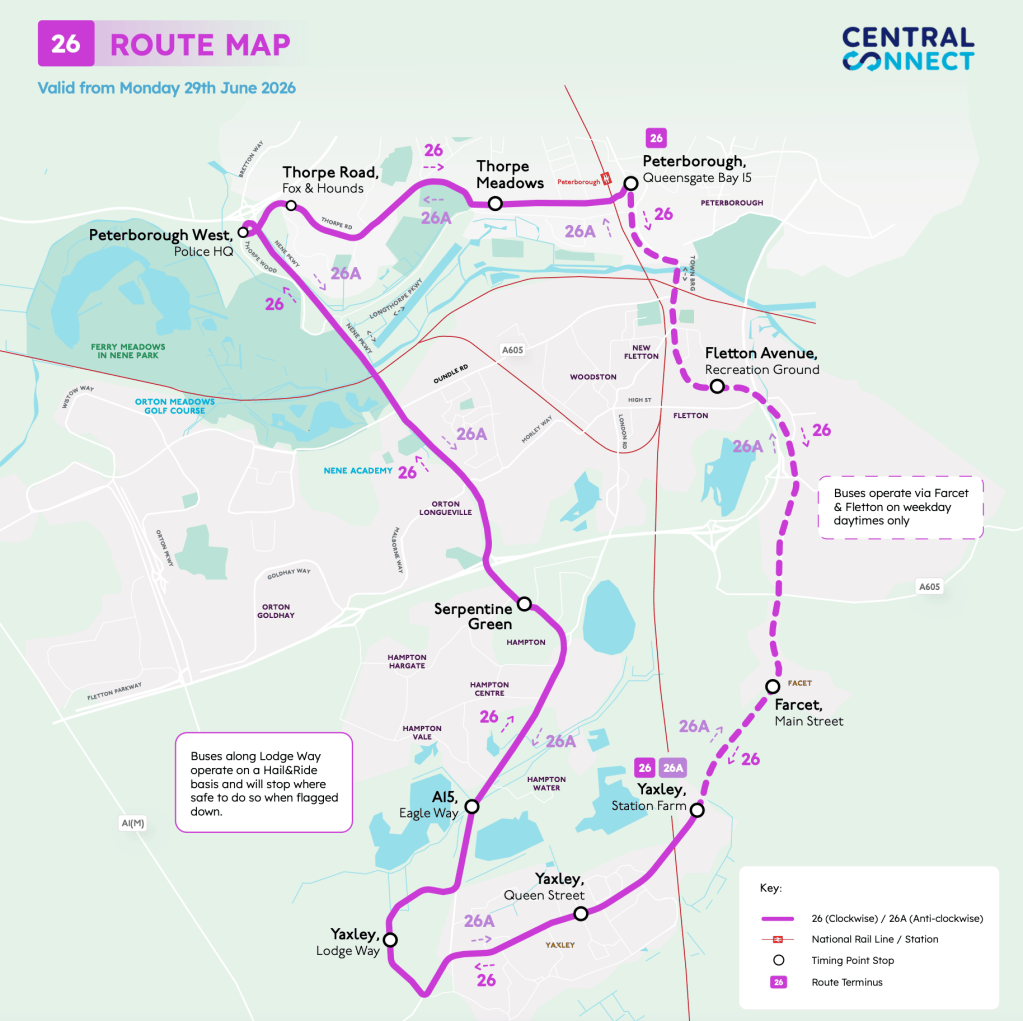
I know from previous trials, politicians and officials at the Combined Authority have a thing about circular routes in Peterborough as I found when trying out route 29 back in 2023 which was famed for being one of the Authority’s most expensively subsidised services while over in Cambridge they love their route T2 linking three of the city’s Park & Ride sites on an arc pattern.
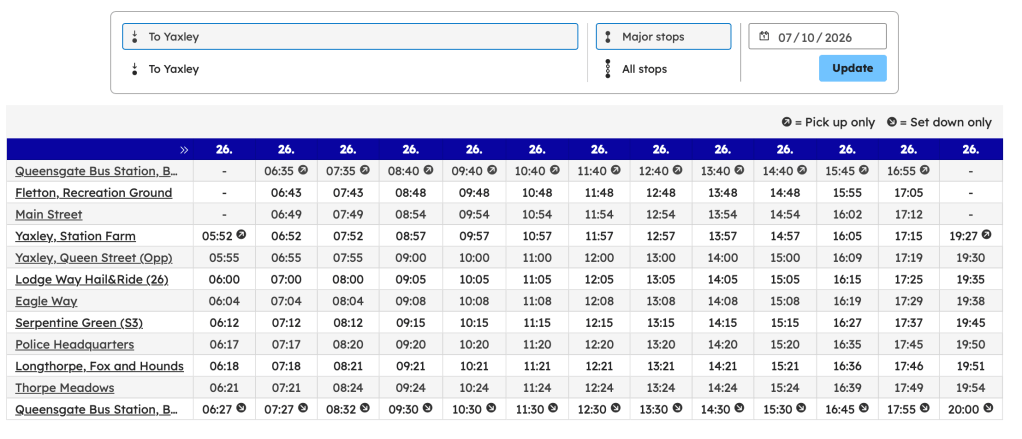
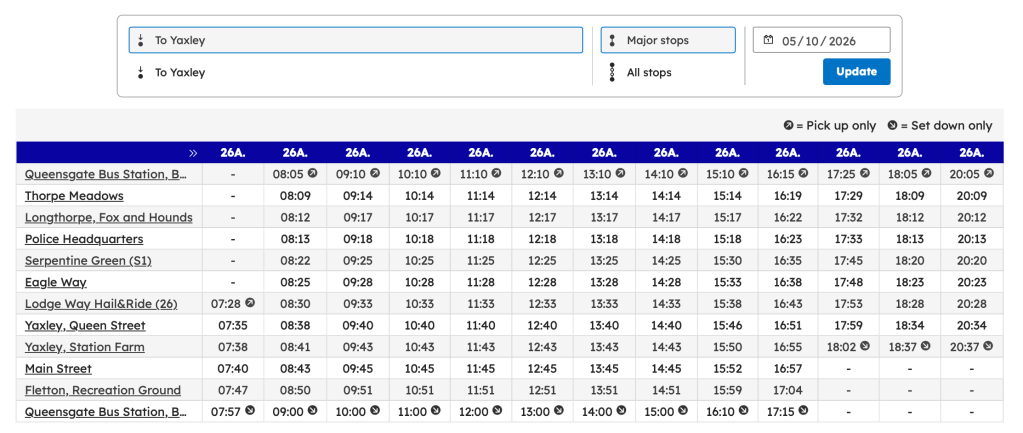
Unlike route 29, new route 26/26A does at least serve the city centre but that also means for much of its route there are alternative long established routes provided by Stagecoach. For example the Thorpe Meadows area is served by Stagecoach’s route 2 every 20 minutes, the Serpentine Green retail centre (and adjacent Hampton residential area) by route 6 every 20 minutes and Yaxley, Farcet and Old Fletton (on the eastern arc) by route 5 every 30 minutes. But, of course, these routes don’t connect the areas together without changing buses in the city centre which is why politicians love the idea of a circular route . The 26/26A links Thorpe Meadows with Serpentine Green and also Yaxley. As always with such routes, are there enough passengers wanting to make such a journey to justify the route?
I took a ride round the route on Monday of last week catching the 10:10 departure from the city’s Queensgate bus station – not one of the country’s most glamorous and attractive places from which to catch a bus, being functionally basic in facilities. At least the escalators up and down to the adjacent shopping centre were working this time. So often they’re broken.
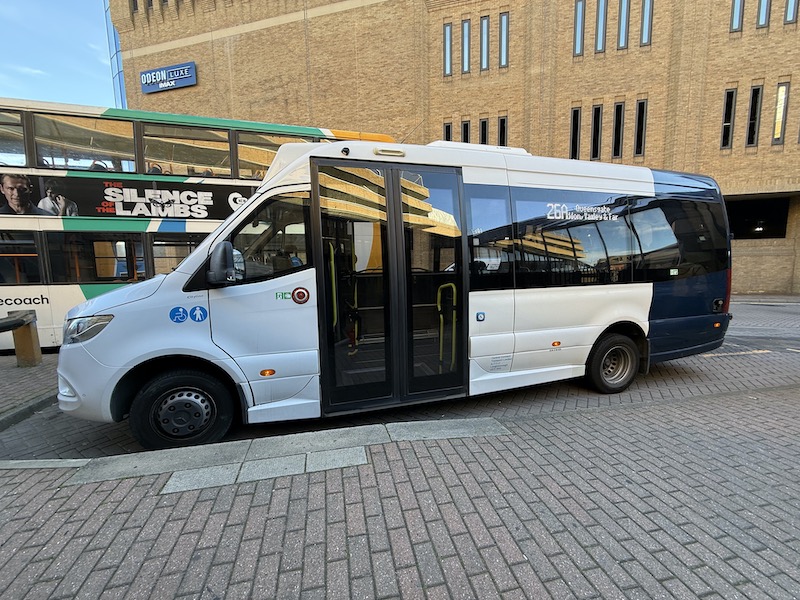
The bus was already on the stand enjoying its 10 minutes layover and we left on time with no-one else coming on board, perhaps not surprising for a journey heading out of the city centre at that time. But, sadly that remained the position for the entire 50 minutes journey back to the bus station again on the inward journey, albeit we followed and then overtook a Stagecoach bus on the aforementioned half hourly route 5 from Yaxley.
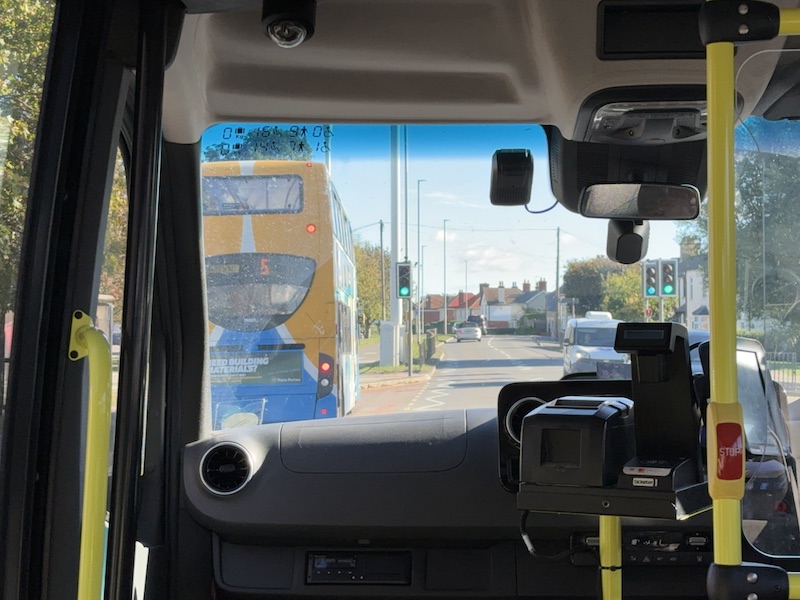
Furthermore, once we’d overtaken it people waiting at bus stops along the route let us go by in favour of waiting for the 5. We also passed the bus operating the clockwise 26 on the circuit (twice) which had no-one on the first time (heading into the city near Thorpe Road) and one on the second time (heading out of the city near Farcet).
Back in Peterborough I watched the 26A bus depart on its next journey at 11:10 with three passengers on board, which was better, as did the next departure at 11:40 on the 26, although the bus only arrived with one passenger at 11:30 meaning across all the journeys I observed the average was two passengers.
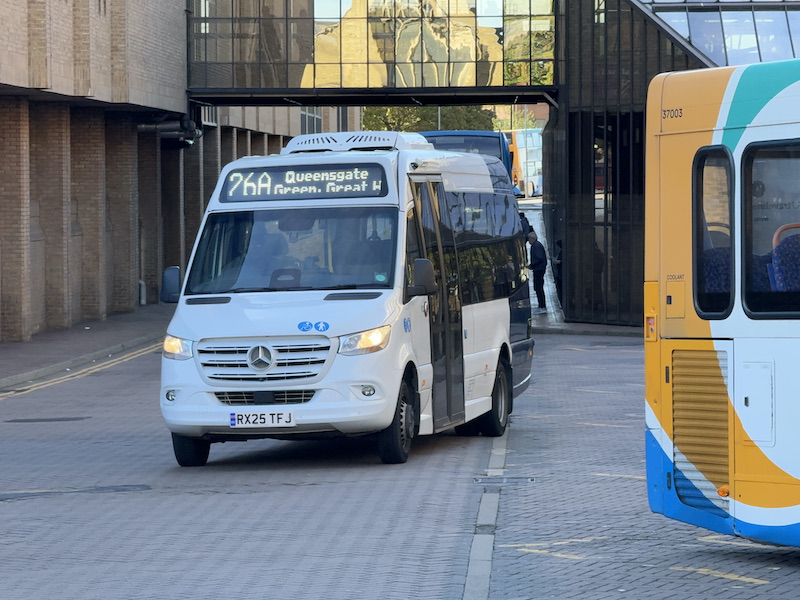
Not very encouraging after three and a half months although the driver told me it does get busy at peak times and particularly with school children using the route.
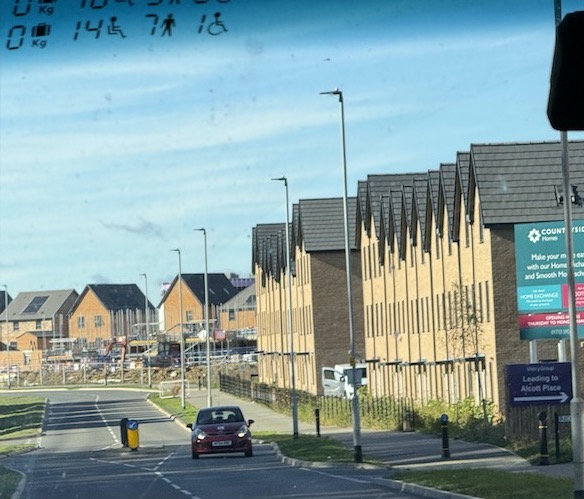
But, of course, it’s good that the bus is available for residents as they move into their new houses as the residential development continues to expand although no passengers materialised on the journey I made.
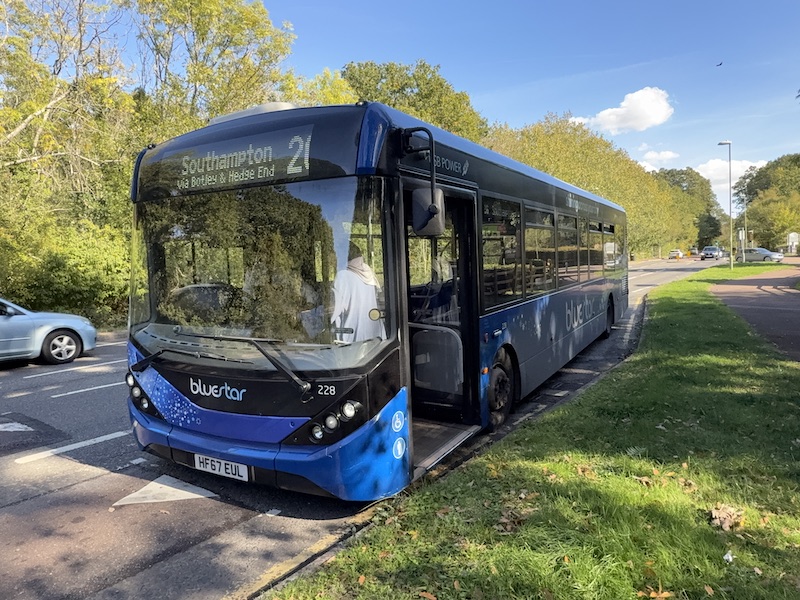
Over in Southampton, the Bluestar operated route 26 is a more recent addition to the city’s bus network, commencing at the end of August, so when I travelled on the Friday before last it was coming to the end of its fifth week.
Like Peterborough, this 26 is operated with two buses providing an hourly frequency but with a more extensive day from around 06:00 to 23:00 as well as a Sunday service albeit only every two hours.
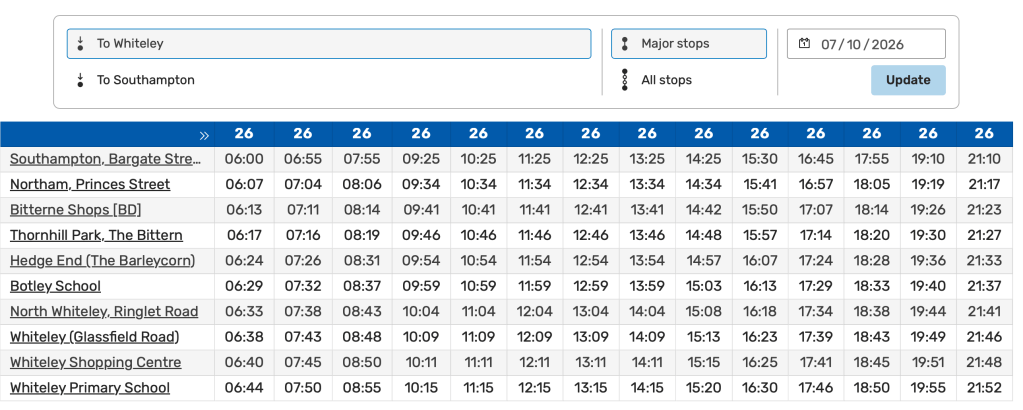
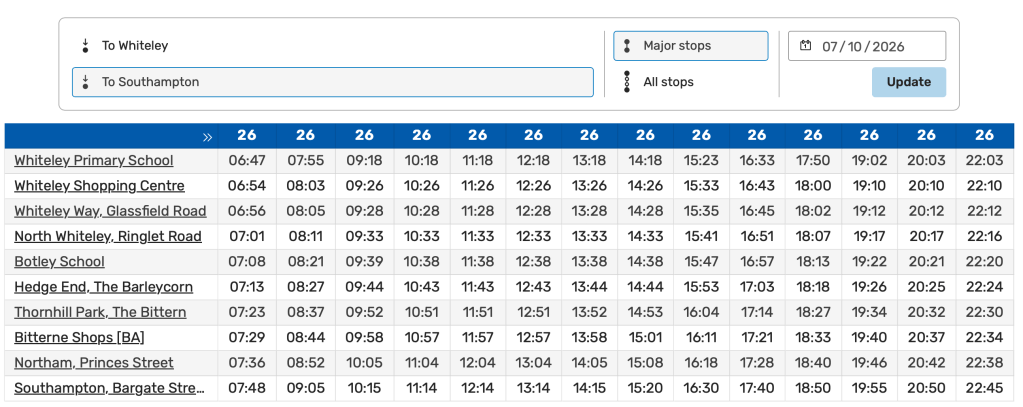
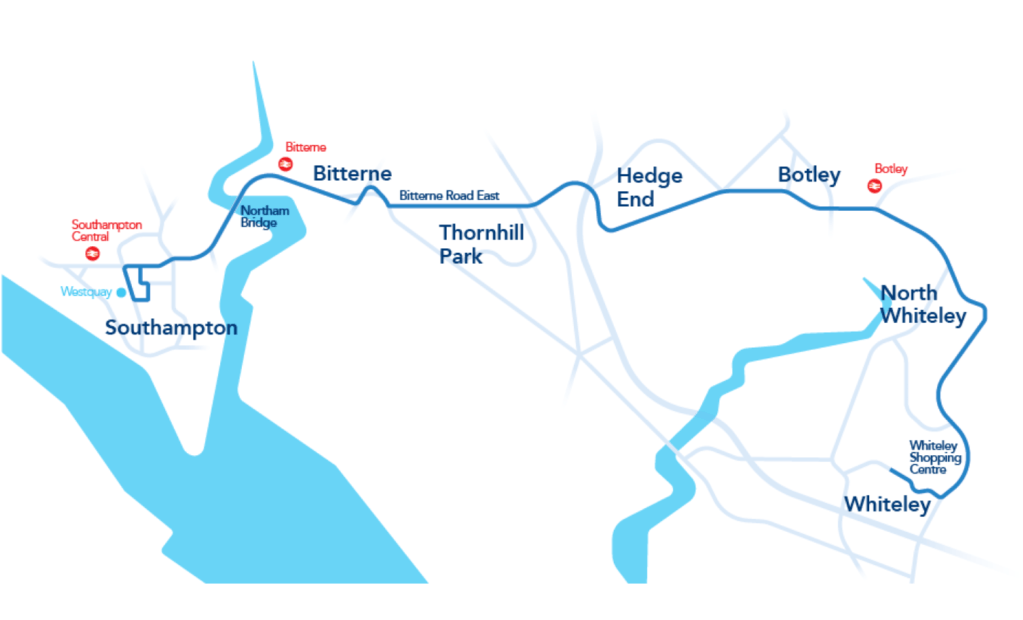
End to end journey time is 50 minutes outbound and 56 minutes inbound with the route from Southampton taking in Bitterne, Hedge End and Botley before continuing to Whiteley and from where it provides a new direct link to and from Southampton.
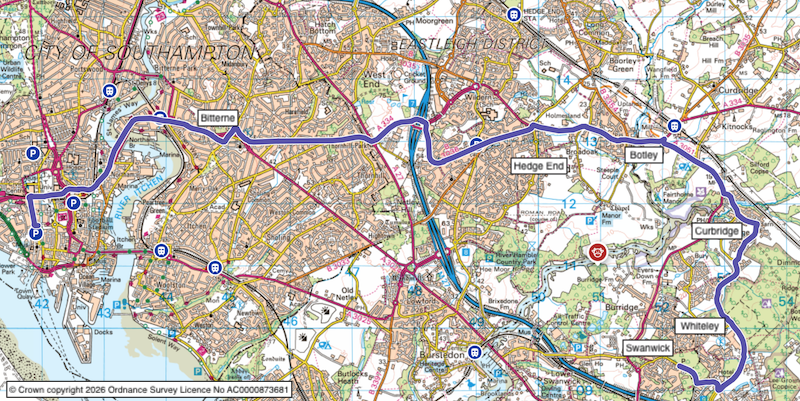
The area seeing considerable house building is to the north of Whiteley called Whiteley Meadows…
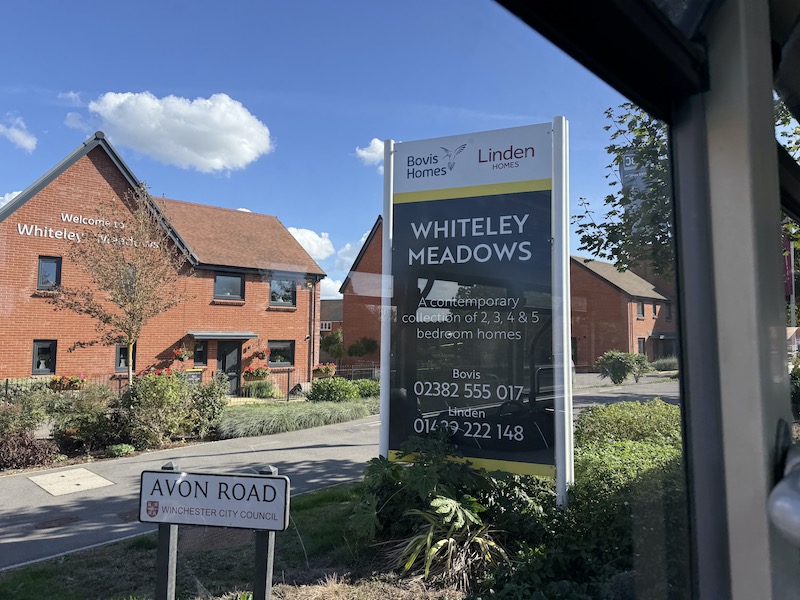
… near Curbridge and where again, development is so new Ordnance Survey haven’t yet caught up.
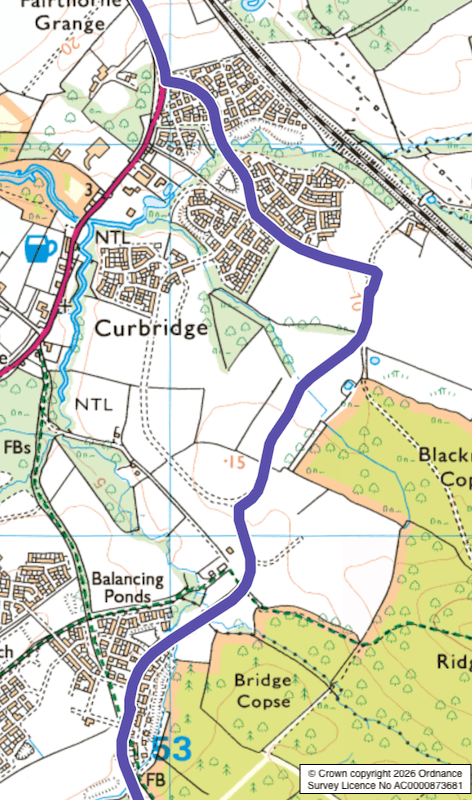
South of the new development, closer to Whiteley itself, there’s a large shopping centre including a large Tesco which was proving popular with passengers when I travelled.
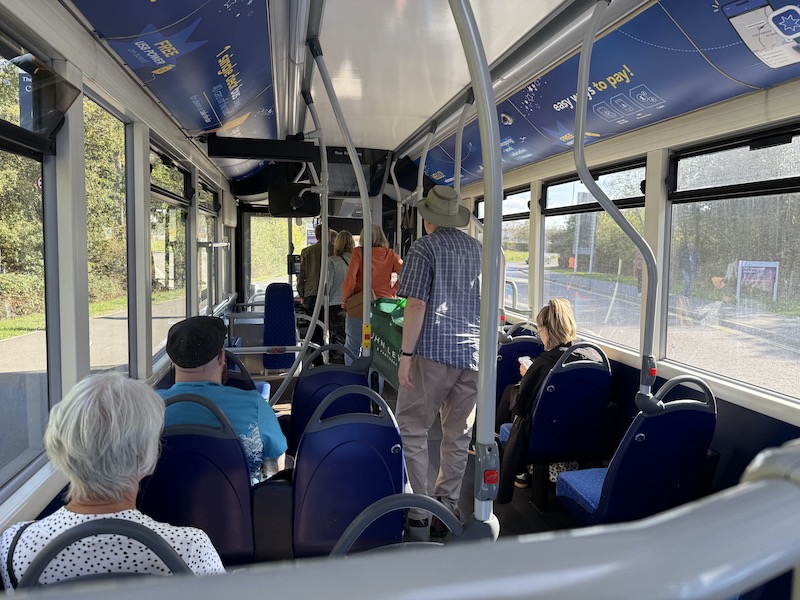
The western half of the route into and out of Southampton runs parallel with city route 3 which also runs to an hourly frequency giving a convenient doubling of the frequency along Bitterne Road East (between Bitterne and Hedge End) which I’m sure will be welcome and generate extra passengers.
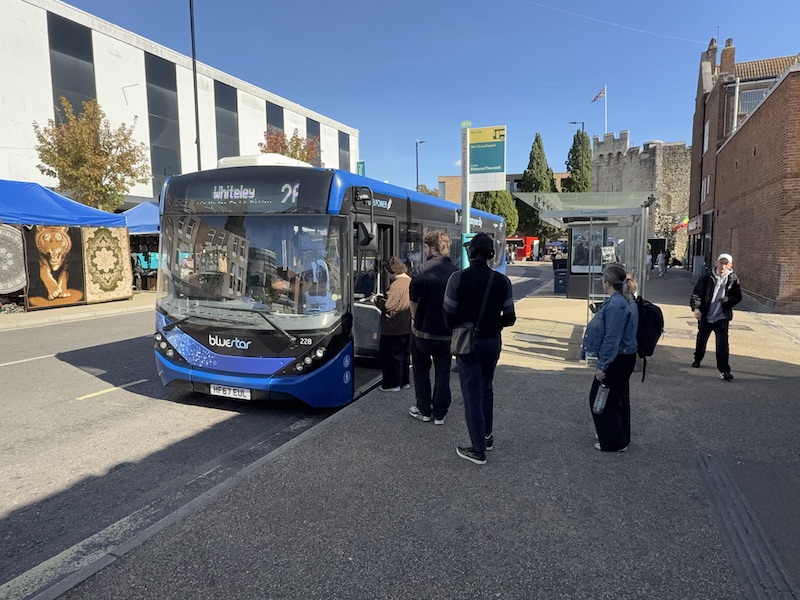
Indeed I was impressed to see 21 passengers travel on the journey I caught which was the 13:25 from Southampton over to Whiteley including four who travelled all the way from the city centre to the main stop in Whiteley.
That must be an encouraging start for both Bluestar and Hampshire County Council which has put in the funding for the route.
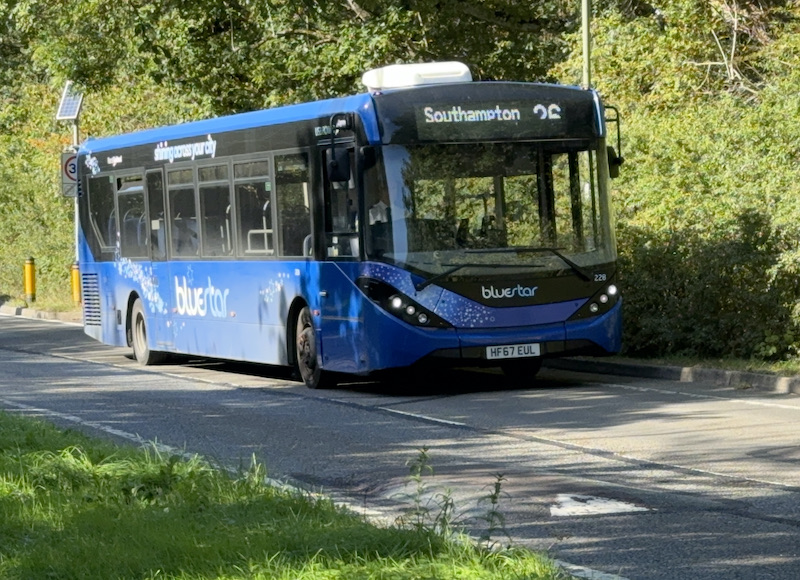
It’s so encouraging to be writing blog after blog about new bus routes during the course of this year, and makes a welcome change from the days of bus route cuts after bus route cuts. I just hope the public funding can continue but in this case, the Southampton route 26 has all the makings of a commercial proposition in due course. I’m not so sure about the Peterborough one.
Roger French
Blogging timetable: 06:00 TThS


Another good thing about the Southampton service 26 is that passengers from Botley now have faster journeys to Southampton (approx 35 minutes instead of 50 minutes). This is because the 26 takes a direct route through the centre of Hedge End, and doesn’t do the loops that service 3 does.
Steve
LikeLike
There seems to be planning chat that s106 payments are a unwanted restriction on building more housing.
At present so far as I can see in these kind of development areas the slowness of planning start to house completion does not really seem to be affected by the s106 amount. Also once occupied additional council tax does get generated giving some councils a bit to spend on bus routes.
Peterborough does not seem to be thought out that well IF the idea is to reduce car dependency with the not very useful post 1800 times and nothing on Sundays though I not the other bus routes passing near some of the developments.
Southampton seems much better planned, one would have expected a local route covering Botley side of things only but taking opportunity to double frequency to Southampton gives that extra trip opportunities with the much later service too , 20 to 25 passengers per trip could well be fairly constant across the operating day , and it looks like a bus too.
JBC Prestatyn
LikeLike
JBC appears to be missing the point.
There’s no daytime demand for the Peterborough service; putting on evening and Sunday services will simply be a waste of money.
Section 106 payments are there for a range of initiatives that reduce the impact on local facilities so that might be a new primary school, a doctors surgery, leisure facilities, pedestrian/cycle and road links. Bus services are a relatively minor part of it. However, the idea that these residents are now a revenue stream for the local council that they can spend on bus services is a misnomer – they’ll be busy using those funds for education, waste and recycling, adult care, SEND provision.
BW2
LikeLike
I have never said that council tax or s106 funds are exclusively for subsidising general public transport , but such funding , where directed and seen as needed is under present planning chat potentially being (for s106) being eliminated – something which politically may not come to pass but excluding what local or mayoral authorities may do to change provision of public transport to increase employment or social opportunities. I note the Peterborough route has been launched as commercial for its present timetable , I have suggested a small later operation may not be , but might be socially desirable. Let us see , CC are open to responding how passenger demand appears to change in the future so its present pattern is not set in stone
JBC Prestatyn
LikeLike
I didn’t suggest that you had said s.106 funding was exclusively for bus services. I did query the idea that it would somehow turbocharge the early occupancy of developments and that council tax thereby generated could be used on bus services – the council tax will be swallowed by the other things I mentioned.
Yes, you suggested an evening service might be desirable but given how parlous the ridership was that Roger witnessed (an average of two passengers per journey), it would be difficult to see how an evening service would be anything other very poorly patronised.
BW2
LikeLike
Thanks for this review – as you say, it’s good to see new bus routes appearing. I agree about the prospects of each. Hourly circular routes are probably not the best use of scarce (we are told) public funds. Orbital travel around towns is neglected by commercial operators. Car drivers do make lots of orbital trips, but they can’t easily be condensed into a few fixed bus-routes – presumably why DRT was such an attractive idea. But the market is there, and I don’t think orbital travel should be neglected; the lack of it is one reason for the ‘only 15% of travel is by public transport’ statistic.
One solution would be better frequencies or matched timings on the radial routes. As in most towns, Peterborough has a tangle of frequencies – one even every 10 minutes, but most hourly or half-hourly and a select few every 20 minutes. Now I know most bus-men’s brains are hard-wired that every route must have its own frequency; but that does not give a network which is attractive for ‘anywhere to anywhere’ journeys, usually involving changes . Better for passengers would be either a consistent – say half-hourly frequency, with all buses timed to meet at Queensgate, for quick and easy changes.
Probably not very practical – the bus station may not be big enough! An alternative would be to make all the main radial routes, say, eight-per-hour (my estimate of the minimum to start attracting substantially better custom), which would give passengers excellent flexibility, and might mean no orbital services were needed.
But good, high-frequency, orbital bus routes can, and have been, introduced. Bus 7 in Brighton & Hove was started, with excellent publicity, using minibuses every six minutes; it was popular, has lasted, and now uses double-deckers! Would that work in Peterborough? – quite possibly, if all the radial routes were frequent enough to provide worry-free connections, and Stagecoach was prepared to drop its insistence that ‘every route must cover its costs and contribute to overheads & CEO’s bonus’ and calculate rather the increase in revenue for the whole network which a new route, timing or frequency generates. Probably unlikely!
LikeLike
It’s perhaps not the case that bus company managers don’t recognise that orbital journeys take place. The fact is that often, there isn’t the critical mass of journeys to a number of complimentary traffic objectives to create a sustainable service.
Also, the fact is that some routes have different frequencies because they are simply busier. Take your suggestion – the 1 in Peterborough has a decker every 10 mins whilst the 4 has a single decker every 30 mins. Make that a uniform 20 mins… one will overload and the other may have a minor increase in patronage.
That’s not to say that Stagecoach in Peterborough are in anything other than a seemingly terminal decline. However, that’s more to do with a lack of investment for the last 10 years and a loss of the marketing and entrepreneurial side culture of Brian Souter than anything else. Routes should contribute to overheads or, at the very least, pay their own way. Don’t do that and you end up with a 1970s situation where a load of loss makers become a financial and operational millstone.
BW2
LikeLike
No each route shouldn’t have to ‘pay their own way’, that’s how we ended up with the uncoordinated mess we have now! Leave it to the profit motive and even strategic routes can become abandoned. Each route should form a key part of a well designed and well thought out network, both city and regional. Areas of high demand would see coordinated routes form natural corridors. I do agree not all routes should be high frequency though and definitely not the same frequency, but if its going to be less than every 15 to 20 minutes, make it actually time with trains and other lower frequency buses!
Lower frequency, even hourly can still be useful if connections are in mind when the timetable is designed. There’s too much siloed thinking within transport still.
One thing I will give credit for Arriva here in the Lea Valley is they actually coordinated the timetables of the 66, 251 and 310 on the shared section between Waltham Cross and Cheshunt so there’s an even spacing of buses across the day, it gives a lot more confidence to use it (less bunching and less waiting), just we still need more evening journeys too.
Aaron
LikeLike
We tried that in the 1970s, Aaron. Huge amounts of uneconomic services that soaked up money and dragged the whole industry down. It’s what led to the National Bus Co MAP schemes and ultimately to the 1985 Transport Act.
LikeLike
The Market Analysis Project became needed as computing became easier to look at costs , farebox revenue and thus a viable subsidy to services at different options of provision , Sometimes it found increasing capacity – reversing the trend to single deck services – was needed for school peaks.
What had also happened was the collapse of fundamental demand particularly in industrial and mining areas a work closures occured ( and ex workers were signed off as long term sick ).
JBC Prestatyn
LikeLike
MAP was proceeded by VNP (Viable Network Project) which was a direct result of Midland Red losing boatloads of money as they no longer had the bedrock of the Birmingham and Black Country routes to subsidise them. That is demonstrable fact.
The fact was that many NBC subsidiaries had been massively loss making for several years; Southern Vectis lost £163k in 1982 (the equivalent of nearly £600k in today’s money) and that was one of the better ones. Firms like Hants and Dorset and Alder Valley were financial basket cases.
The financial realities (that I’m sure Roger will attest to) meant that they were increasingly placing a burden on the more financially strong NBC firms and routes.
MAP was largely concentrated on the southern firms and was around 1979-82 – running in tandem with the deindustrialisation of Thatcherism, not a product of it.
BW2
LikeLike
What I’ve noticed when looking at how municipal operators manage any cuts to routes versus private operators is municipal will look at everything together at the same time, they won’t just willingly cut an area off with no alternatives (an actual last resort), private would just cut the loss making service in isolation until it barely exists which only leads to a wider spiral of decline!
And its too easy to say there’s no demand or this or that but does the route with low demand in question even make sense for any potential users? I say about this as I’ve wanted a bus along Sewardstone Road for years, we have one now but there is a problem, it doesn’t go to Chingford Station or Chingford Mount, actual locations, it terminates at a campsite in the middle of nowhere to connect with the 215, but with no guarantees of actually connecting, different fares, only runs a handful of times a day etc. In short, no good. It being difficult to use and very limited, no wonder usage is low.
Another point, what no one says about the NBC is maybe it was too big and too remote, London Country was ideal for London and surrounding areas but the regional company equivalent elsewhere wouldn’t have been ideal everywhere. Again getting the boundaries right is key. And the MAP schemes prove my point, they didn’t look at things in isolation, they actually looked at the network as a whole. It’s a political choice to subsidise or not.
But we can’t blame people for not using poorly thought out services.
I think the potential coordination from Mini-Switzerland would do a lot of good for increasing bus ridership.
Aaron
LikeLike
Thinking about the Creation of London Country it does seem that history of LGOC , minor politics and union agreements missed the potentially more logical transfer of Potters Bar and Loughton bus garages from LT to LCBS. This might have changed how the present day dead running Metroline and similar arrangements have happened and may have given a more efficient network depending on how much local authorities boundaries are treated like Berlin walls.
JBC Prestatyn
LikeLike
Aaron – that is not true. For every Nottingham and Reading (that are rightly lauded), there is an Ipswich or Newport which are less than stellar. Bus company managers spend a lot of time trying to ensure that they don’t merely abandon areas.
MAP schemes looked at specific areas, that much is true, but they still led to the wholesale removal of entire routes.
As ever, we have these statements about routes that have low passenger volumes… if only they went to x place, or served y station, or had evening and Sunday services. This “build it and they will come” stuff is often stated and then when it is provided (as we’ve seen with some of the BSIP schemes), we discover that “they” haven’t come. Of course, that’s then put down to a lack of publicity, or that there’s no integrated ticketing when the reality is much more prosaic… there isn’t the underlying need or market.
LikeLike
Its really good to see this new route which at last gives a link from Whiteley to Botley and Southampton. Living in the area I am sure it will do well and gives Bluestar a foothold in the area. I knew something was up as I saw Bluestar buses route learning before the service started.
LikeLike
Enthusiasm for (appropriate) circular routes is not confined to politicians and public transport officers.
When the much-respected Michelle Hargreaves established the (then) new senior team at Stagecoach East she pondered aloud on why the heck we didn’t have a circular route in Cambridge. Not that the (semi-) circular Tiger route would have likely met with her approval.
LikeLike
Hi Roger,
Great read as always.
I can offer some clarification to the Central Connect service in
Peterborough as I put a couple of media questions to the company when
the service was announced.
The following reply may be useful,
The Peterborough South Orbital Service (26/26A) is fully commercial, and
we do not receive any external funding.
Regarding the Saturday timetable, it is the Fletton to Farcet section
that is omitted; Yaxley is still served throughout the day. The reduced
provision on Saturdays is intended to best match available resources
with expected demand, as well as to reflect the increased running times
around the Serpentine on Saturday afternoons.
If the route performs well and there is sufficient demand from the
omitted section, we are open to considering adding it to the Saturday
schedule in the future.
Further to the reply above Stagecoach launched a service from Great
Haddon to Serpentine Green at the end of August (Route 7). It does
receive Section 106 funding and provides connections at Serpentine Green
into the service 6 to the City Centre. Using a one bus PVR to operate
the service 7 shuttle allows a 30 minute frequency.
The confusion on the Central Connect service regards CPCA funding has
come about because the CPCA is (but It seems the current position should
be ‘was’) considering a Peterborough Orbital service. The Central
Connect service is best described as Peterborough South Orbital.
Hope this helps. There have been several reports that the 26/26A is
subsidised or Section 106 funded, which is not the case.
Regards,
Steve
LikeLiked by 1 person
Many thanks Steve – have added this updated information to the text in the blog.
LikeLike
Roger – another fairly recent new route you may wish to try out is Chaserider 151 between Stone and Rugeley, which began on 1st September and runs generally hourly on M-S. It is apparently running on a 12-month trial basis.
It recreates part of First PMT 151, an RBG-funded service which ran 3 jnys M-S between 1999 and 2002.
Nigel McBride
LikeLike
If you want to see a near circular route operated by Stagecoach have a look at route 4 in Basingstoke. It’s been running on an hourly daytime frequency for many years. From the town centre it first goes west and then north and finally east, serving the main hospital for the town and finishes further east than where it started, at a shopping centre with a large Tesco. A worthwhile route providing links between traffic objectives without the need to change buses in the town centre.
LikeLike
The Southampton to Whiteley 26 is ‘technically’ a new route but until about 2017/8 there used to be a 26 from Southampton to Fareham (or in parts of the route), via most of the new 26 route from Southampton up to Botley & then through Burridge on the way to Fareham. Burridge being not a stone’s throw away from Whiteley. At one time Bluestar forerunner Solentblueline actually ran the old 26 with Provincial (who went to First bus). Even Hampshire county council were involved then as route on contract! For the last 10 yrs or so before HCC pulled the contract on the 26 the service it ran from Hedge End to Fareham only.
When North Whiteley was being developed, agreement was made between Hampshire cc, Whiteley Town council, developers & Winchester city council (N. Whiteley being Winchester controlled) regarding bus provision. However due to many circumstances including Covid this didn’t really happen. It has taken much effort by Whiteley Town Council with some local bus expert help to push for the new 26 to start the ball rolling. It seems to be a success!
LikeLike
Before the 26 started, for years the ONLY bus serving all of Whiteley (a town with a modern shopping centre & a cinema & a business park) was the Hampshire county council contracted 28\28A run by First bus Mon to Sat daytime only ~roughly hourly ~ to Fareham. You couldn’t go Whiteley nor from the new build North Whiteley to Botley which was less than a mile away!
LikeLike
North Whiteley including Whiteley meadows is an ongoing development that will bring about 3000 new homes (apx 40% affordable) & a secondary school & more primary schools to Whiteley. Effectively doubling the size of the town. Old or original Whiteley started life late 1980s with the shopping centre originally being a Designer outlet with an added Tesco, built around 1997/8. The shopping centre was effectively knocked down (except Tesco) & rebuilt to what it is today about mid 20tens.
The area predominantly being under Winchester city council control. However, Whiteley is a quirky town and part of it actually falls under Fareham borough council control. Where the 26 terminates at the Whiteley Primary school is in the FBC controlled area.
Originally Whiteley only had one (proper) way in/out from the junction 9 roundabout off the M27. In 2007 a bus only road was built allowing access from another direction. However, due to many protests over traffic jams, infrequent buses (2 hourly & none in eve or Sun) & motorway junction roadworks the bus only rd was opened to all traffic a few years later.
LikeLike
I could suggest three reasons people in Peterborough are letting the new service go past and waiting for the established one:-
Hopefully the service will start to be successful, but I have my doubts. We are a country which, outside the biggest urban areas, are wedded to (possibly even addicted to) our cars. Until government decides to apply the Big Stick rather than the current carrot-and -threat-of-stick approach, that simply won’t change.
LikeLike
It’s not that I can’t count, the list thing didn’t work the way I expected!
Ho hum…
LikeLike
The service is quite popular admittedly people still don’t know about it but are learning and finding out we are quicker and more reliable then other companies in the same area. The route is being looked at at being upgraded to e200 midi MMCs with the 25/24/23s getting full lengths E200mmcs
LikeLike
Whilst the first reason might have some justification, about half the passengers have a concessionary pass of some description. As the reluctance to get on a minibus might be more to do with the fact that a random white minibus might not be immediately identifiable as a local bus?
The big stick may seem appealing to public transport advocates. However, there are many more car drivers and they are much more important to politicians; that is the political reality.
BW2
LikeLike
Looking at Peterborough clearly there is a Rail need to think about attempting to provide either more local lines or adding to the all stations kind of service of a Peterborough North and Peterborough South if development is to continue in the same way as is being done at Cambridge , along with thought of connecting Peterborough by rail Westwards to Kettering and Northampton as a more north East West Rail route.
JBC Prestatyn
LikeLike
Was good seeing you when I passed you on the 24s glad you enjoyed the morning in Peterborough
LikeLiked by 1 person
It was great to see you too and thanks for the wave.
LikeLiked by 1 person
Another route 26 commences operation in Paignton on Monday 2nd November but it isn’t really a ‘new’ route – Stagecoach route 60 to Preston Down (Sandringham Gardens) is being transferred to Torbay Buses and being renumbered 26 from the same date. Service is also restored to Occombe Farm which has reopened as a visitor attraction.
Paignton already has local routes 22, 23, 24 and 25 and recently-introduced route 27 (which also serves Preston Down) so the renumbering does fit a sequence.
Julian Walker
LikeLike
167 from Walderslade to Hempstead Valley started back in April. Was wondering if you could do a review of that at some point
Tw
LikeLike
Thanks for the suggestion.
LikeLike
Aaron – that is not true. For every Nottingham and Reading (that are rightly lauded), there is an Ipswich or Newport which are less than stellar. Bus company managers spend a lot of time trying to ensure that they don’t merely abandon areas.
MAP schemes looked at specific areas, that much is true, but they still led to the wholesale removal of entire routes.
As ever, we have these statements about routes that have low passenger volumes… if only they went to x place, or served y station, or had evening and Sunday services. This “build it and they will come” stuff is often stated and then when it is provided (as we’ve seen with some of the BSIP schemes), we discover that “they” haven’t come. Of course, that’s then put down to a lack of publicity, or that there’s no integrated ticketing when the reality is much more prosaic… there isn’t the underlying need or market.
LikeLike
Off topic – busway news from Cambridgeshire, some good, some not so.
https://www.bbc.co.uk/news/articles/cm9qz0v3292jo
Pete
LikeLike
Very pleased to finally see better bus connections to North Whiteley. I spent many years as a consultant working on bus strategy for the development and whilst things have not panned out as expected, it’s great to finally see something significant happen!
LikeLike