Saturday 26th September 2026
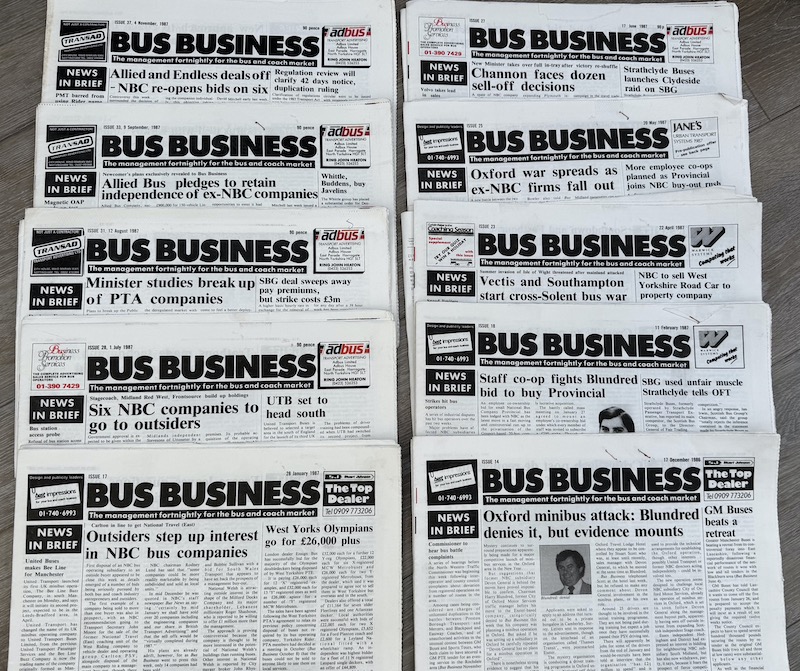
With D-Day (bus Deregulation Day) now just a month away, the 24th September 1986 edition of the fortnightly newspaper Bus Business contained more news of NBC’s privatisation process as well as the unstoppable march of minibuses. Thanks to the Bus Archive, let’s take a look at some of the main stories featured in that issue to gain a flavour of what life was like running buses exactly 40 years ago including the front page headline story…
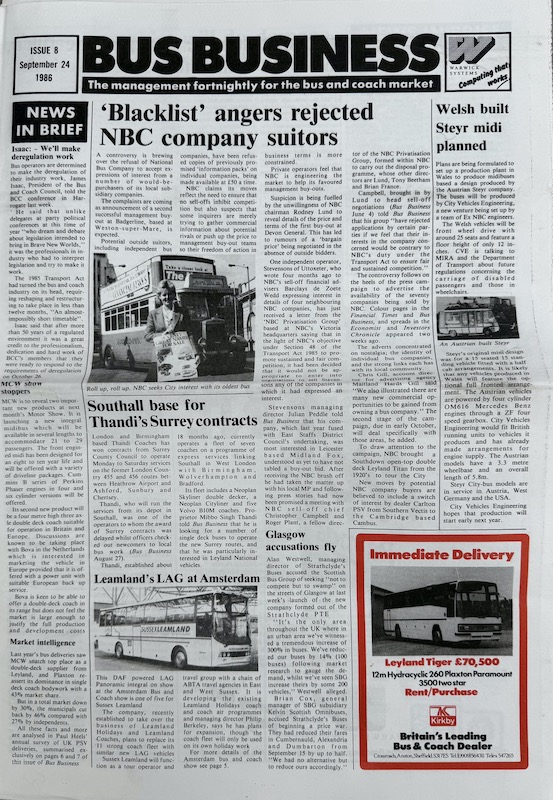
‘Blacklist’ angers rejected NBC company suitors
A controversy is brewing over the refusal of National Bus Company to accept expressions of interest from a number of would-be purchasers of its local subsidiary companies. The complaints are coming as an announcement of a second successful management buy-out at Badgerline, based at Weston-super-Mare, is expected.
Potential outside suitors, including independent bus companies, have been refused copies of previously promised ‘information packs’ on individual companies, being made available at £50 a time. NBC claims its moves reflect the need to ensure that no sell-offs inhibit competition but also suspects that some inquirers are merely trying to gather commercial information about potential rivals or push up the price to management buy-out teams so their freedom of action in business terms is more constrained.
Private operators feel that NBC is engineering the market to help its favoured management buy-outs. Suspicion is being fuelled by the unwillingness of NBC chairman Rodney Lund to reveal details of the price and terms of the first buy-out at Devon General. This has led to rumours of a ‘bargain price’ being negotiated in the absence of outside bidders.
One independent operator, Stevensons of Uttoxeter, who wrote four months ago to NBC’s sell-off financial advisors Barclays de Zoete Wedd expressing interest in details of four neighbouring NBC companies has just received a letter from the ‘NBC Privatisation Group’ based at NBC’s Victoria headquarters saying that in the light of NBC’s objective under Section 48 of the Transport Act to promote sustained and fair competition, it had been decided that it would not be appropriate to enter into negotiations to sell Stevensons any of the companies in which it had expressed an interest.
Stevensons managing director Julian Peddle told Bus Business that his company which last year fused with East Staffs District Council’s undertaking, was interested in Leicester based Midland Fox, understood as yet to have not tabled a buy-out bid. After receiving the NBC brush off he had taken the matter up with his local MP and following press stories had now been promised a meeting with NBC sell-off chief Christopher Campbell and Roger Plant, a fellow director of the NBC Privatisation Group formed within NBC to carry out the disposal programme whose other directors are Tony Beetham and Brian France.
The controversy follows on the heels of the press campaign to advertise the availability of the seventy companies being sold by NBC. Colour pages in the Financial Times and Bus Business and spreads in the Economist and Investors Chronicle appeared two weeks ago.
Glasgow accusations fly
Alan Westwell, managing director of Strathclyde’s Buses accused the Scottish Bus Group of seeking “not to compete but to swamp” on the streets of Glasgow at last week’s launch of the new company formed out of Strathclyde PTE. “It’s the only area throughout the UK where in an urban area we’re witnessing a tremendous increase of 300% in buses. We’ve reduced our buses by 14% (100 buses) following the market research to gauge the demand, whilst we’ve seen SBG increase theirs by some 200 vehicles” Westwell alleged.
Brian Cox, general manager of SBG subsidiary Kelvin Scottish Omnibuses, accused Stratchclyde’s Buses of beginning a price war. They had reduced their fares in Cumbernauld, Alexandria and Dumbarton from September 15 by up to half. “We had no alternative but to reduce ours accordingly.”
Southall base for Thandi’s Surrey Contracts
London and Birmingham based Thandi Coaches has won contracts from Surrey County Council to operate Monday to Saturday services on the former London Country 455 and 456 routes between Heathrow Airport and Ashford, Sunbury and Chertsey. Thandi, who will run the services from its depot in Southall was one of the operators to whom the award of Surrey contracts was delayed whilst officers checked out newcomers to local bus work.
Thandi, established about 18 months ago, currently operates a fleet of seven coaches on a programme of express services linking Southall in West London with Birmingham, Wolverhampton and Bradford. Its fleet includes a Neoplan Skyliner double decker, a Neoplan Cityliner and five Volvo B10M coaches. Proprietor Mibbo Singh Thandi told Bus Business that he is looking for a number of single deck buses to operate the new Surrey routes, and that he was particularly interested in Leyland National vehicles.
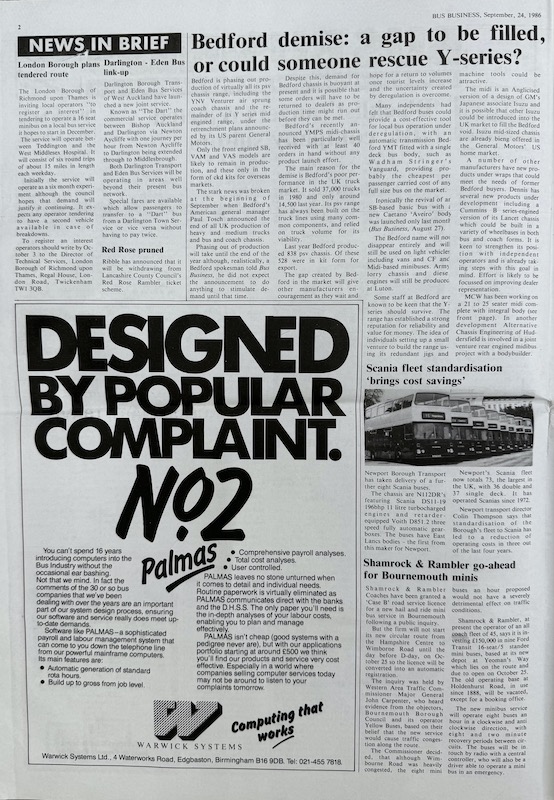
WestYorks announces minibus ‘war plans’ with UTI
West Yorkshire Passenger Transport Authority’s new bus operating company has announced its first moves in what it describes as preparations “for an all-out war against rival companies” following deregulation.
In anticipation of United Transport International’s plans to introduce about 250 minibuses to the streets of Leeds the company is advancing its plans for its own minibus services to pre-empt the UTI proposals. As a result West Yorkshire’s first regular local minis services will start on D-Day.
UTI says its plans are not yet finalised, though a manager for its proposed Leeds operation has just been signed up. West Yorks, who rejected a deal with UTI, say full agreement has been reached with Transport and General Workers Union officials on rates of pay and conditions. It hopes to have signed up 130 drivers by October 26.
The new services will involve the withdrawal of double deck buses from parts of the present 6 and 42 routes (city centre-Halton Moor and Old Darnley-city centre-Gipson-Seacroft) all currently operating at 15 minute intervals, and replacing them with 16-seat minibuses which will operate every three to four minutes. Double decks will continue to operate the number 6 route between the city centre and Pudsey, while minibuses will operate the Old Farnley-Gipton section of the number 42 route.
Shamrock & Rambler go-ahead for Bournemouth minis
Shamrock & Rambler Coaches have been granted a ‘Case B’ road service licence for a new hail and ride mini bus service in Bournemouth following a public enquiry. But the firm will not start its new circular route from the Hampshire Centre to Wimborne Road until the day before D-day, on October 25 so the licence will be converted into an automatic registration.
Shamrock & Rambler, at present the operator of an all coach fleet of 45, says it is investing £150,000 in nine Ford Transit 16-seat/5 standee mini buses, based at its new depot at Yeoman’s Way which lies on the route and due to open on October 25. The old operating base at Holdenhurst Road, in use since 1888, will be vacated except for the booking office.
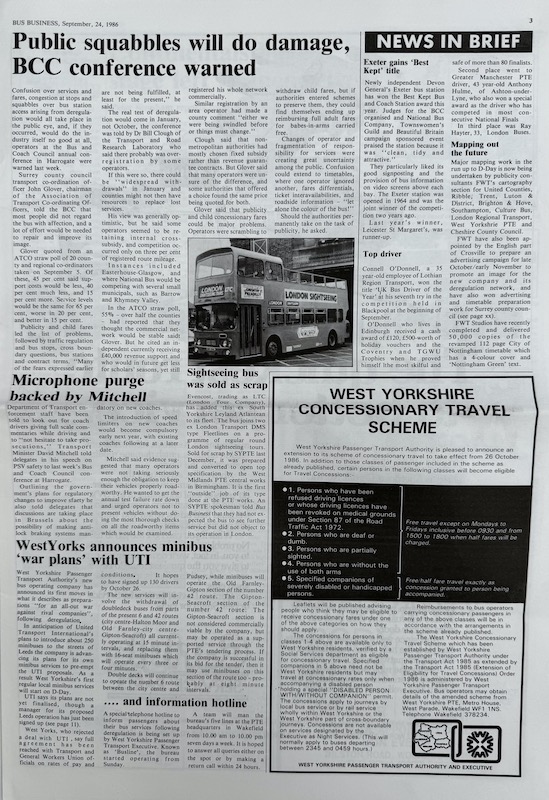
Public quibbles will do damage, BCC conference warned
Confusion over services and fares, congestion at stops and squabbles over bus station access arising from deregulation would all take place in the public eye, and, if they occurred, would do the industry itself no good at all, operators at the Bus and Coach Council annual conference in Harrogate were warned last week.
Surrey county council transport coordination officer John Glover, chairman of the Association of Transport Coordinating Officers, told the BCC that most people did not regard the bus with affection,, and a lot of effort would be needed to repair and improve its image.
Glover quoted from an ATCO straw poll of 20 county and regional coordinators taken on September 5. Of these 45 per cent said support costs would be less, 40 per cent much less, and 15 per cent more. Service levels would be the same for 65 per cent, worse in 20 per cent and better in 15 per cent.
Publicity and child fares led the list of problems, followed but traffic regulation and bus stops, cross boundary questions, bus stations and contract terms. “Many of the fears expressed earlier are not being fulfilled, at least for the present” he said.
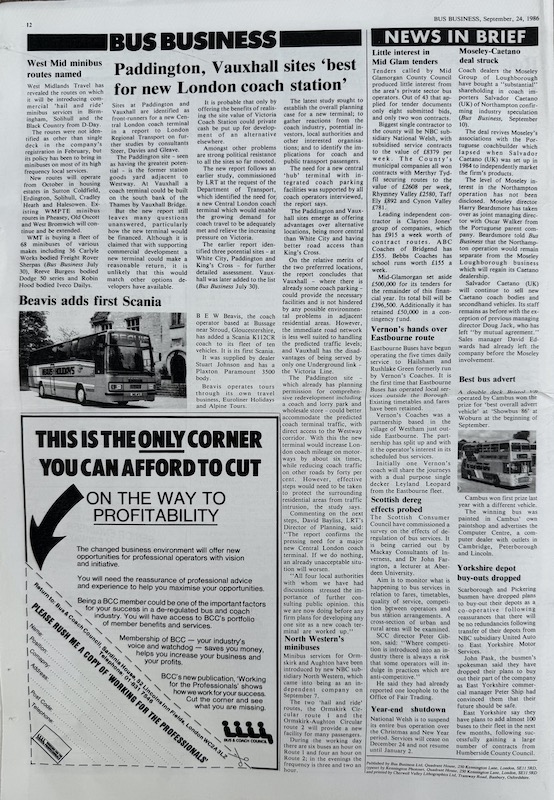
Paddington, Vauxhall sites ‘best for new London coach station’
Sites at Paddington and Vauxhall are identified as front-runners for a new Central London coach terminal in a report to London Regional Transport on further studies by consultants Steer, Davies and Gleave.
The Paddington site – seen as having the greatest potential – is the former station goods yard adjacent to Westway. At Vauxhall a coach terminal could be built on the south bank of the Thames by Vauxhall Bridge. But the new report still leaves many questions unanswered, particularly how the new terminal would be financed. Although it is claimed that with supporting commercial development a new terminal could make a reasonable return, it is unlikely that this would match other options developers have available.
It is probably that only by offering the benefits of realising the site value of Victoria Coach Station could private cash be put up for development of an alternative elsewhere.
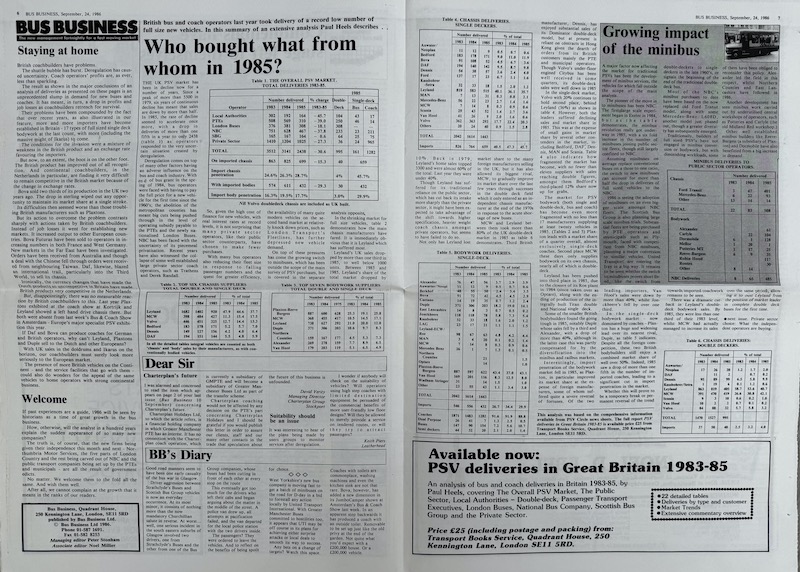
Yorkshire depot buy-outs dropped
Scarborough and Pickering busmen have dropped plans to buy-out their depots as a co-operatrive following reassurances that there will be no redundancies following transfer of their depots from NBC subsidiary United Auto to East Yorkshire Motor Services.
John Park, the busmen’s spokesman said they have dropped their plans to buy out their part of the company as East Yorkshire commercial manager Peter Shipp had convinced them that their future should be safe. East Yorkshire say they have plans to add almost 100 buses to their fleet in the next few months, following successfully gaining a large number of contracts from Humberside County Council.
Bus Business Moves
Robson to manage Leeds minibuses
Malcolm Robson has been appointed managing director (Yorkshire) of United Passenger Transport Services. He is expected to run the Leeds minibus company being set up by the United Transport International subsidiary to run an intensive local minibus network. Robson moves from being manager of 68 vehicle (including 31 minibuses) City of Gloucester Buses part of NBC subsidiary Cheltenham and Gloucester Omnibus Co who he joined two years ago from Alder Valley.
Bill Hiron
Bill Hiron has been appointed manager of City of Gloucester Buses in succession to Robson. Hiron has been with Cheltenham and Gloucester since September last year after completing a four year degree course in Transport Management and Planning at Loughborough University.
Steve Salmon
Steven Salmon has been appointed assistant to Cranleigh, Surrey, based Tillingbourne Bus Group managing director Barry King. A former National Bus Company senior management trainee, attached to Bristol Omnibus from 1981 to 1983, Salmon moves to Tillingbourne from the Education Department of Surrey County Council.
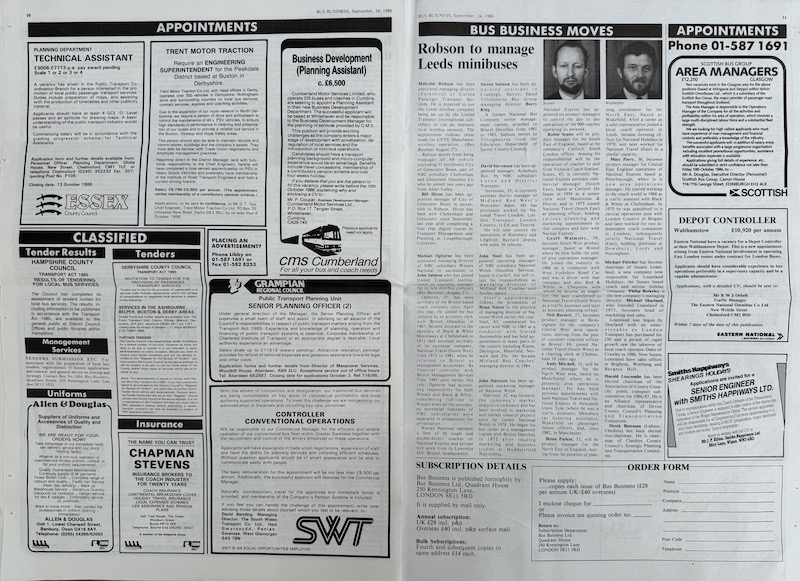
Appointments
Depot Controller Walthamstow £10,920 per annum
Eastern National has a vacancy for a Depot Controller at their Walthamstow depot. This is a new appointment arising from Eastern National involvement in operating East London routes under contract for London Buses. Applicants should have considerable experience in bus operations preferably in a supervisory capacity and be a capable administrator.
Application with a detailed CV, should be sent to: Mr R W J Orbell, Traffic Manager, The Eastern National Omnibus Co Led, New Writtle Street, Chelmsford CM2 0SD.
Business Development (Planing Assistant) c£6,500
Cumberland Motor Services Limited, who operate 225 buses and coaches in Cumbria, are seeking to appoint a Planning Assistant in their new Business Development Department. The successful applicant will be based at Whitehaven and be responsible to the Business Development Manager for the planning of services provided by C.M.S..
The position will provide exciting challenges as the company enters a major stage of development with privatisation, deregulation of local services and the introduction of mini-bus operations. Candidates should have a transit planning background and micro-computer experience would be an advantage.
Please write before 10th October 1986 enclosing a CV to: Mr P Coupar, Buisiness Development Manager, Cumberland Motor Services Ltd, PO Box 17, Tangier Street, Whitehaven, Cumbria CA28 7XE
More from Bus Business next month including a Deregulation 40 Year Anniversary blog special.
Roger French
Blogging timetable: 06:00 TThS


Interesting to see that some of those eager young bus managers are still in the industry. Indeed, one one them runs my local bus services!
Nigel Turner
LikeLike
Thanks for another fascinating insight into what was going on in the world of UK buses in the early privatisation years. I had not heard of the ‘blacklist’ which seems to have been an attempt to get as much local competition as possible. Interesting that the Treasury permitted this if it actually reduced the amount of ££ the government got from selling off the NBC subsidiaries …
Also interesting that Nobody seems to have even thought about the idea of co-operating with the railways to attract the bigger market for travel which the private car had demonstrated. Perhaps it was intransigent attitudes from rail managers, who had by then demonstrated that they were going to run their trains as ancillary services for car-drivers – but I’ve never heard from any bus manager that they were rebuffed in an attempt to provide better integration. In retrospect it was one of the big failures of the 70s Labour government that, at a time when most of the buses and trains were in public ownership, they didn’t complete the job by getting the two modes properly co-ordinated. I can remember the abysmal Transport Secretary Bill Rodgers being interviewed by Brian Redhead on the radio. Asked ‘When are you going to make the buses and trains meet’, Rodgers replied ‘I never said anything about integrating public transport’ and proceeded to go on about something he called ‘balanced transport’ – which we never heard of ever again.
Rick Townend
LikeLike
Yes, at the time I recall reading about a woman who hadn’t left her village for 20 years as there was no Bus service, until one was implemented under the act, I wish I could remember where it was, I think it was one high on a hill in the Pennines, or around there.
LikeLike
We tend to look at the journal as being for bus management planning and keeping the wheels rolling and the money coming in but there is a lot then, and now, dependent on the Local Authorities – either as providers or contractors for school or specialist transport or as planning for the non commercial gaps that appeared as services were no longer registered by anyone. The adverts for the likes of Grampian region being an example – SBG were not in the privatisation pipeline at this time.
I am not sure what information in a sales pack for Midland Red companies could be gleaned by Stephensons of Uttoxeter that Julian Peddle couldnt make a pretty good guess at – depot locations and fleet strength were well known and back of envelope PVR scheduling would give rough idea of costings.
I never understood why govt went both for Private Sell off of Companies , AND deregulation – for most companies prior the “Goodwill” element of value was the road service licence, remove that and all you had was the vehicles (effectively rented from the bank) and the depot land value.
JBC Prestatyn
LikeLike
If I remember correctly, Shamrock & Rambler’s minibus operation in Bournemouth was called “Charlie’s Cars”.
Pete
LikeLike
http://www.countrybus.com/charlies.htm
LikeLike
That was an interesting read, thank you! For me minibuses were the most exciting innovation that deregulation brought. Shame it all fizzled out. My personal experience came from working in Bath as Badgerline converted all bar one city routes to Minilink branded Transits. They were buzzing about everywhere, always one in sight.
Pete
LikeLike
TfL to create set up its own bus company “Buses for London” and operate service 6 Willesden to Victoria” out of Park Royal Garage.
https://www.bbc.co.uk/news/articles/ck5yewqved9go?at_medium=RSS&at_campaign=rss
Also I read that the West Midlands Mayor has bought NatEX West Midlands and that it “will not bid for franchised routes”. This seems a vague statement. Are they saying that franchising will only cover other operators’ services?
Pete
LikeLike
No, they’re saying that NXWM is basically going to close down in due course as routes are transferred to the franchise operators.
Seems a strange way of doing things to me, but I’m sure they know what they’re doing.
LikeLike
Presumably transferring NXWM buses to successful franchise bidders but retaining ownership? This seems stupid to me, if I suddenly had a new municipal I would concentrate on running it for the public good, and franchising the supported services.
Pete
LikeLike
I think they got it cheaper because of the plan to franchise, there does seem to be a discount on the purchase price in the light of upcoming franchising. Under how franchising has been implemented operators are not compensated for the loss of their business, councils just buy specific assets they wish to take on. As such NatEx had a loss making operation (& there is a legal question around running a loss making business with the knowledge of business loss meaning returning to profitability is unlikely) where the best assets would be bought at a reasonable price but stuck carrying some elderly assets to be sold and having to carry the cost of disposing of them.
NXWM was only an issue as franchising means it has little value as an ongoing concern for sale to another business and with franchising approaching any investment to turn around the business would be lost with all the benefits passing to TfWM.
It is suggested in a number of announcements I have seen that there is a clause in the sale that if TfWM don’t franchise they have to pay extra to Mobico (to reflect the real value of the business as a long-term going concern not just the value of its assets). This deal means TfWM remove the transition risks of short-term cutbacks by the incumbent trying to balance the short-term books, ensure they secure all the assets they need upfront and can manage the transition more seemlessly than where work is passing between previous commercial operator and future contractor whilst Mobico remove all ongoing liabilities from assets left out by TfWM and aren’t accruing losses in a business with limited future ability to recover.
Dwarfer
LikeLike
Regarding TfLs announcement that they intend to run buses themselves reminds me of a certain LPTB taking over the entire transport system in London back in July 1933. The wheel has, once again, turned full circle! PB
LikeLike
@JBC … those of us in the industry in 1986 could never understand the rationale of deregulation and privatisation at the same time.
Deregulation, whereby your income suddenly became somewhat unknown, made privatisation difficult, as estimating the value of your company was largely unknown.
This, of course, is why so many privatised operators struggled and failed in short order. It was felt that deregulation, with privatisation about 5 years later, would’ve raised more money for Government … but Thatcher and Ridley wanted it done and dusted quickly.
LikeLike
Or Perhaps the other way round. State owned (or local authority owned) bus companies in a deregulated situation would face either stiff private competition – as indeed happened in places like Darlington , Preston, Or an accusation that the rates or the state was subsidising unfair competition. Messy as it was maybe the Thatcher/Ridley way was the best of a bad muddle.
I am sure the main savings came from slightly lower wages and definately lower pension obligations as well as a risk spread reduction from trade union power. something that the Mayor Khan’s idea of public owned bus operator in London will suffer from, though often the Franchise model is held up to be the economically best way (competition for the market rather than competition in the market) London has not done spectacularly well with the loss of Sullivan , Mitcham Belle and Harris Bus (arguable Maidstone Boro Line too) with varying degrees of suppliers loosing out financially which they would have been unlikely to have done to a full state backed enterprise.
JBC Prestatyn
LikeLike
Given that London accounts for around half of all bus journeys is England the number of failures has actually been quite low – your list should probably include London Easylink – although there has also been a significant amount of consolidation over the years.
LikeLike
I wasnt sure about Atlas Bus , less of a failure more a takeover target. Blundred’s Docklands Minibus killed off by the still generally regulated LRT area of services and lack of acceptance of LRT day and season tickets though the contract work for some of the Canary Wharf office staff and similar kept it going enough for Go Ahead to use it to infiltrate the Stagecoach/East London area franchise area. I dont think there are any routes on its ticket now though all having been allocated to the Blue Triangle operation instead , I assume Go Ahead are rationalising
JBC Prestatyn.
LikeLike
@JBC – I am a bit puzzled by your comment about London not doing particularly well.
Yes, there is a list of small operators who didn’t succeed, and not always for the same reason (the demise of London Easylink was a particularly colourful story, with the boss ending up in jail if I remember correctly). There were notable successes too, with operators such as Metrobus, Ensignbus and Grey-Green showing London Buses a thing or two about how to run a more reliable service, and at less cost.
Service reliability improved markedly – because if the buses didn’t run, the operator didn’t get paid. Lost mileage in the early 1980s, before tendering, was often around 15% overall. By the mid-to-late 1990s, with all the network operated under contract, it was down to (I think) 1-2%.
Malc M
LikeLike
I dont have the lost mileage reasons particularly. in part I suspect reliability increased as route lengths were split loosing decent through connections to and in central london. And I didnt mention Limeborne – which toward the end of their Contract were barely sending out any buses on the 156 a route at its outer end having exclusive roads and making any kind of dependency on getting to work completely disappear.
I am a little fast and loose with the exact definitions here between Franchise and Contract ( having worked in commercial franchising for eight years I am used to writing contracts for franchisees of exclusive local areas not in the bus industry ). as this is a blog area rather than what I might write for a scholarly doctorate.
LikeLike
@anon 28/9 20:07 – from the London Transport annual report for 1980:
Lost mileage due to traffic congestion: 2.5%
Lost mileage due to staff not available: 8.5%
Lost mileage due to vehicles not available: 1.6%
Lost mileage due to breakdowns: 2.2%
Malc M
LikeLike
There are no “franchise areas” in London. Any operator on TfL’s approved list is able to submit a bid to run any route. Clearly factors such as having suitable garage space will influence the outcome of that process. As for Docklands Buses, all of Go-Ahead’s London operations have been on the London General O-licence for over a decade.
LikeLike
For those of us employed in administrative roles (I was in what was then called “Traffic” in NBC), these were thoroughly depressing times. We never knew from one week to the next whether we had any future in the industry. My own employer spent a lot of time and money giving us training in network design, as well as putting us through obtaining “Certificates of Competence”.
But all that was wasted. Although I was taken on by one of the new set-ups, the managers there weren’t interested. They themselves designed the post deregulation commercial network on a fag packet over lunch. It wasn’t until the mid-1990’s that things began to get back on an even keel. I often wonder why I stuck with the buses.
LikeLike
Malc M. Based upon your various comments concerning the success of the current London buses business model under TfL, what is your opinion concerning the recent announced proposal by Mayor Khan to eventually bring all the operations back under public ownership? PB
LikeLike
Labour Party Conference today caught a bit not previously trailed for railways in England (Britain?) Potential to bring ownership of passenger rolling stock into public ownership and funding supposedly to save money. I am not sure if this is good economic practice or simple Labour Party dogma.
LikeLike
@PB – I will be very interested to see how the incentive to deliver the service will be upheld.
TfL’s predecessor set up an in-house operation in the late 1990s, I vaguely recall one or two senior people in the organisation claiming with some hubris that they would “show those private operators how to run a bus service”. I don’t think East Thames Buses set that example.
Will it be different this time around? We can but wait and see.
Malc M
LikeLike
To continue the Stevensons story, I was indeed granted an audience with Christopher Campbell and his team at their offices above Victoria Coach Station. There I was presented with a map, produced by Midland Fox, to demonstrate the extent of the competition between Stevensons and MF network. I pointed out that the overlap in Burton on Trent was as a result of Midland Fox extending their services to cover areas served previously by East Staffs District Council, now taken over by Stevensons, and in other areas the routes shown were in fact school contracts or summer only Saturday holiday express services.
The look on the NBC Executives faces said it all, they had been duped.
Subsequently Midland Fox was purchased from National Bus by a consortium of Stevensons and Midland Fox management, with Stevensons acquiring Swadlincote and Lichfield depots.
Julian Peddle
LikeLiked by 1 person
Great ending to the story; many thanks Julian.
LikeLike
And it’s told in fascinating detail in “Stevensons of Uttoxeter – Celebrating the 90th Anniversary” written by Eric Wain and published by Venture in 2016. Well worth a read and includes a full fleetlist and photo of a very youthful Julian amongst it’s many illustrations!
LikeLike
And covered in the latest edition of The Omnibus Society’s Omnibus Magazine!
Tom Lynn
LikeLike
I certainly remember the Thandi services in Surrey but never rode them as this was my motorcycle era. In that post Deregulation era, there were real horrors: Route 216 replaced on Sundays by LCBS SCC Contract Route 511 all the way to Thorpe Park; and routes through Hersham on Sundays (518 & 537) every TWO HOURS. The latter a real horror but for the fact that I was a motorcyclist at that time and drove to referee football matches on both weekend days.
LikeLike
At deregulation the 216 was a commercial service. It didn’t become part of the London Buses’ network again until June 2002. This came about as London United was planning to withdraw the service. Initially a short term contract was awarded to Tellings Golden Miller but it passed to London United a year later. As for Thandhi, its stewardship of the 555/6 is still etched in the minds of bus users in north west Surrey!
LikeLike
I had no idea that my appointment at Tillingbourne was covered in Bus Business, so it was a big surprise to read it. Steven Salmon–Sent with GMX Mail app40 years of Bus Business â September 1986
LikeLiked by 1 person