Tuesday 1st September 2026
Yes; it’s another one.
There’s an increasing contrast when it comes to bus provision in certain areas of Britain. The next round of franchised bus routes is about to be rolled out from next weekend in Liverpool City Region with more to follow in the former Metropolitan conurbations in the coming months and years, while down in the Home Counties we seem to be witnessing one minor competitive skirmish after another and not even over prime bus operating territory. Perhaps those operators involved are trying to rekindle the spirit of deregulation as its 40th anniversary fast approaches. My advice – forget it.
This time it’s Harlow under the competitive spotlight. The town’s bus network has suffered considerable turmoil over the years with a myriad of operators coming and going (including some of dubious quality), but in recent years stability and a better quality of service returned not least following the sale of Central Connect to Vectare (later renamed Transport Made Simple) and of course throughout the decades Arriva has plodded on notwithstanding numerous management restructurings and more recent ownership changes but the company does boast occupying one of the two surviving former London Transport Country Bus garages in the town, perhaps confirming a degree of durability whatever is thrown at it in this part of the world.
Things changed again at the end of July when a raft of service alterations were introduced partly in association with new tender awards from Essex County Council impacting Central Connect as well as Stephensons. As part of these, (and as I found over in Aylesbury with the ‘Red Group’ in June), it’s Arriva that’s the target with Central Connect introducing blatant like for like competition on part of Harlow’s town network.
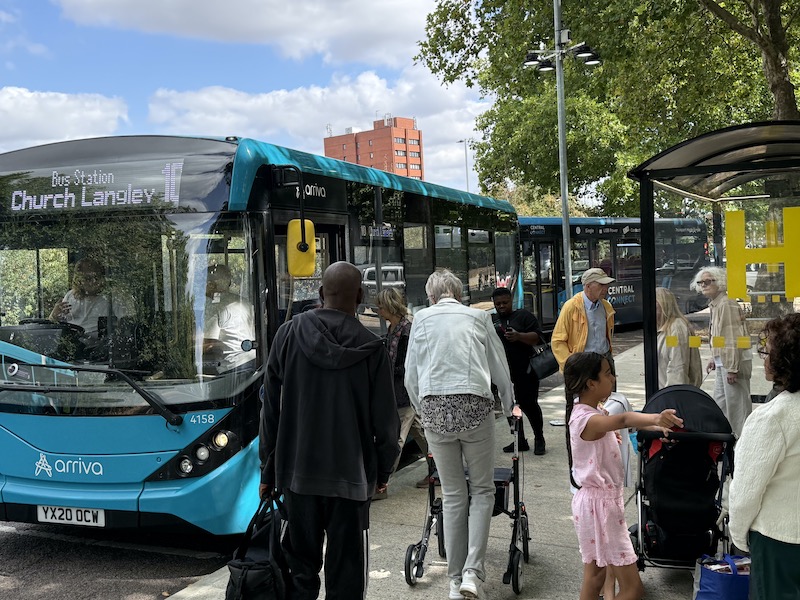
In particular the Church Langley residential area is now seeing a venerable bus battle that would delight the late Nicholas Ridley MP and his colleague original architects of deregulation 40 years ago.
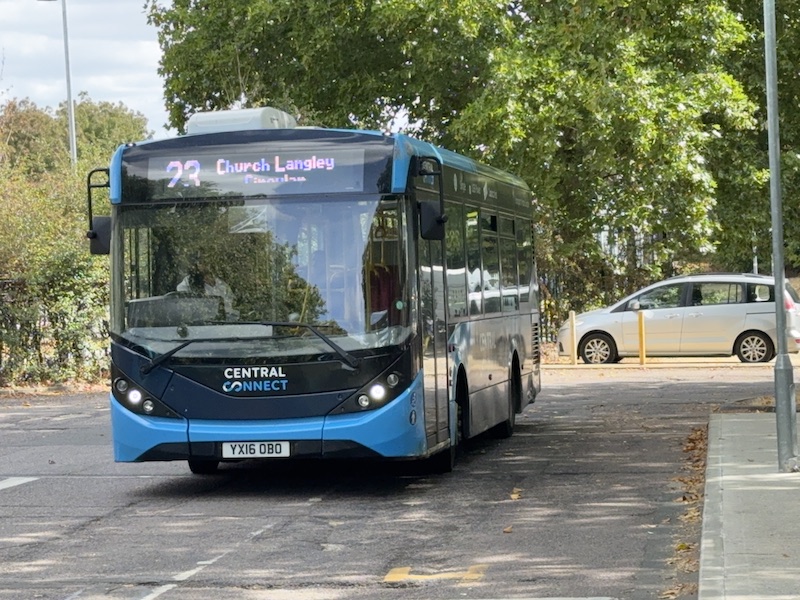
Church Langley is served by one of those Arriva routes (numbered 10) which has a reduced timetable during school holidays as well as on Saturdays – buses running every 30 minutes instead of a school term 20 minute frequency. So guess what? This summer holiday just ended has seen Central Connect step in with a replica service (numbered 23) running every 15 minutes during the daytime giving residents an unprecedented frequency increase to enjoy, especially now schools are returning meaning we’re up to seven buses an hour. Central Connect had been running route 23 as an evening and Sunday tendered service but now that’s been expanded on a commercial basis to an all day affair against Arriva. Additionally both Arriva’s 10 and Central Connect’s 23 include extended journeys to and from Harlow Town railway station at peak times.
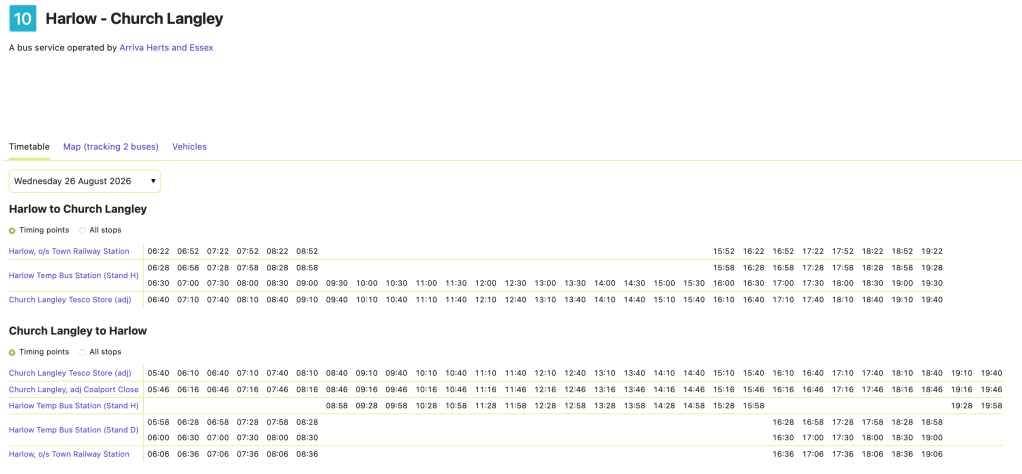
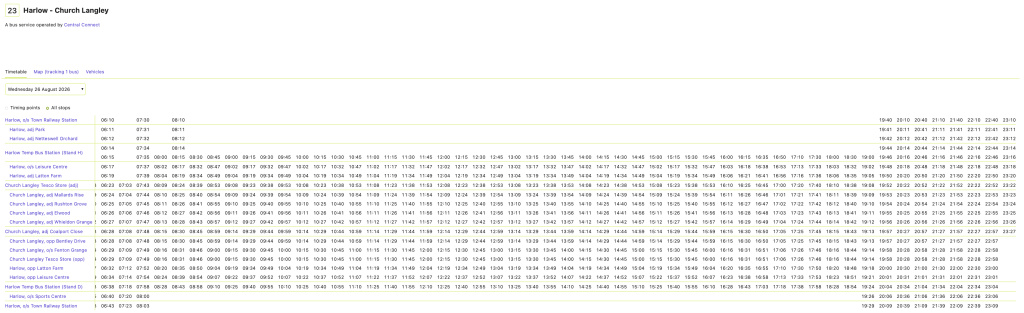
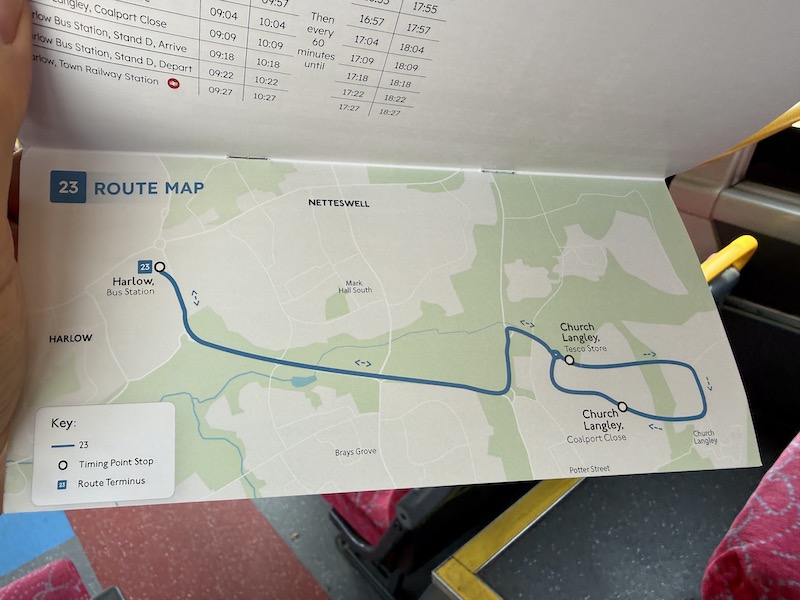
Central Connect buses rake a slightly shorter route into and out of the bus station (see map below) while in Church Langley itself both routes follow a one way circuit to best serve the housing area. A bus station and back to bus station full clockwise circuit can be completed in 25 minutes.
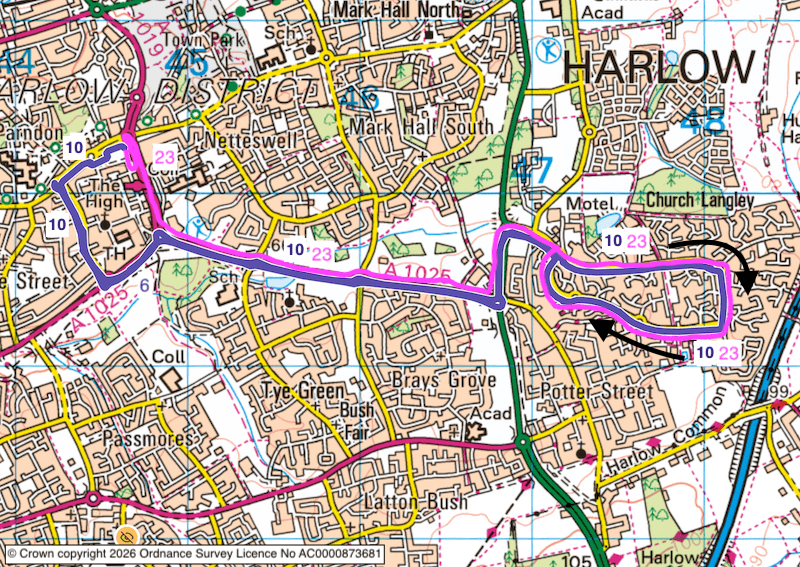
Central Connect has therefore dedicated two buses to its 15 minute frequency while Arriva interworks the service with other local routes after each trip although it could be operated with just one bus.
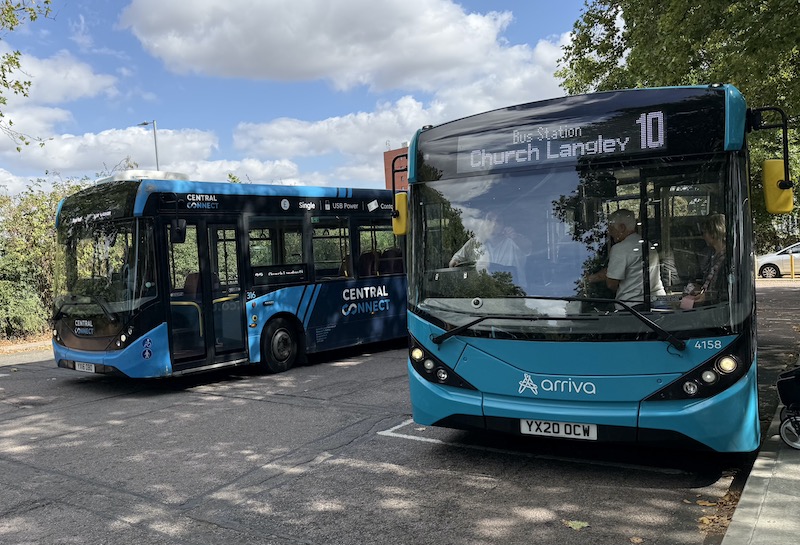
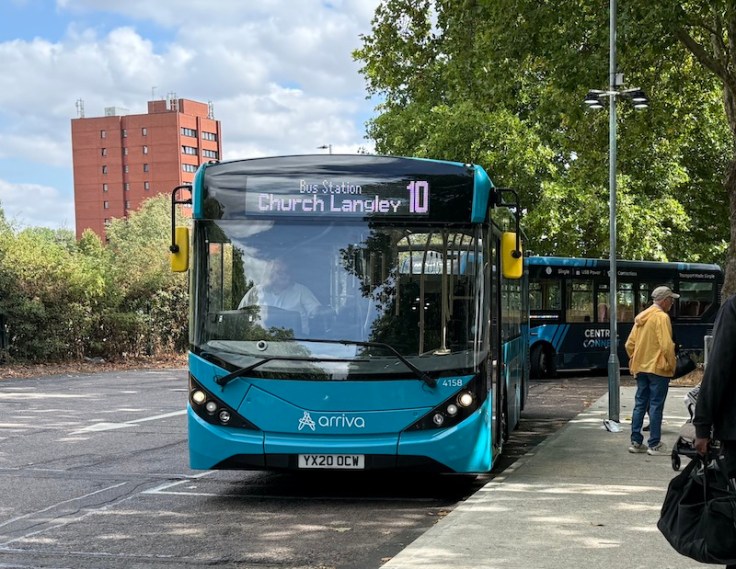
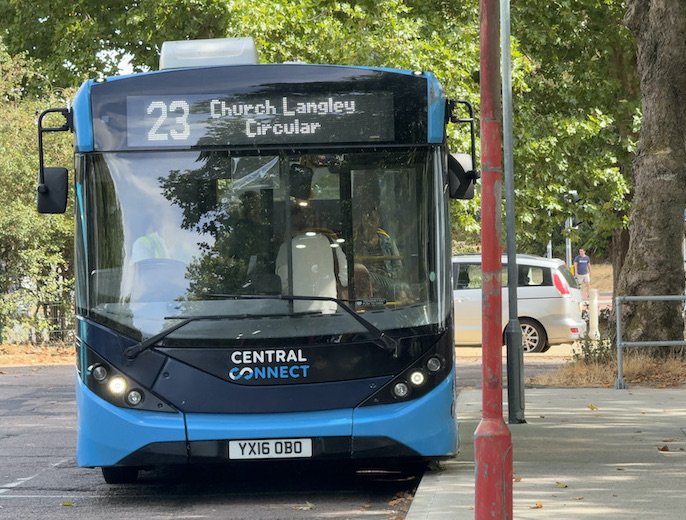
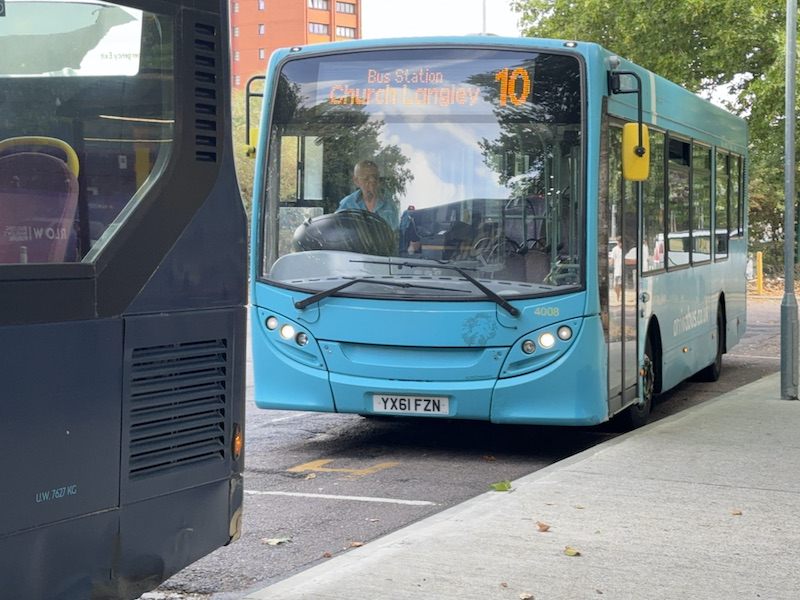
I spent a bit of time travelling around the route on both Arriva and Central Connect’s buses on Monday last week and it was a classic case of whichever bus came first passengers jumped aboard with one journey from the bus station (above photo) seeing Arriva first on the stop and Central Connect going round it with no-one on and another journey (below photo) seeing Central Connect arrive first and Arriva pull up behind with no takers.
The only person I saw hold back to wait for an Arriva bus running immediately behind a Central Connect bus was coming back into town from Church Langley where I’m guessing the gentleman wanted to alight at the Water Gardens. This shopping area is served only by Arriva’s route 10 as shown on the above map.
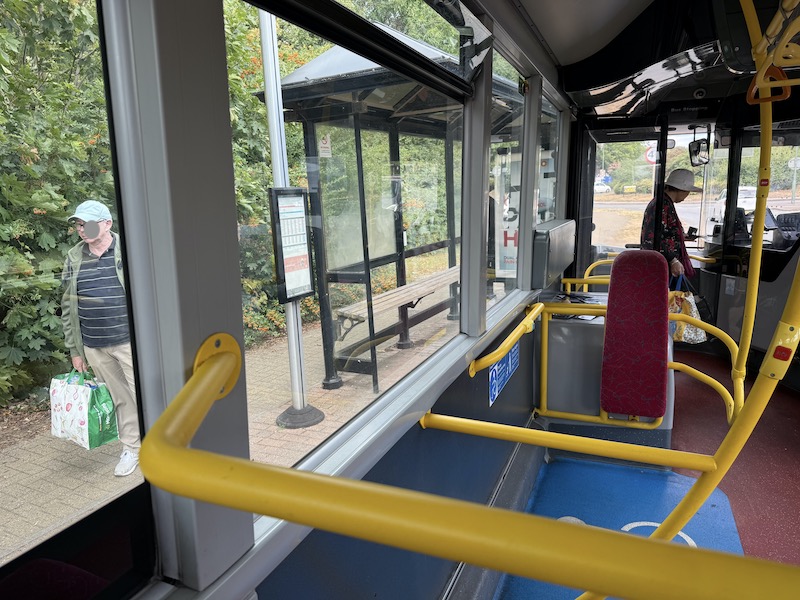
I’m a bit surprised Central Connect hasn’t followed the same route in the town centre as an Arriva journey heading out of town picked up three passengers there giving us nine in total – the most I saw on a journey.
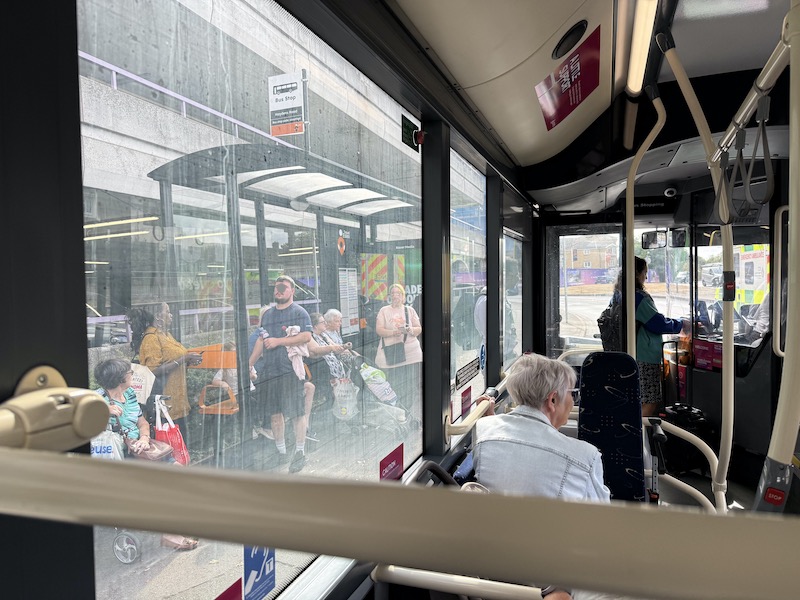
Indeed, numbers travelling late morning were mostly in the low single figures on both operators’ buses. Not enough for viability in my judgement.
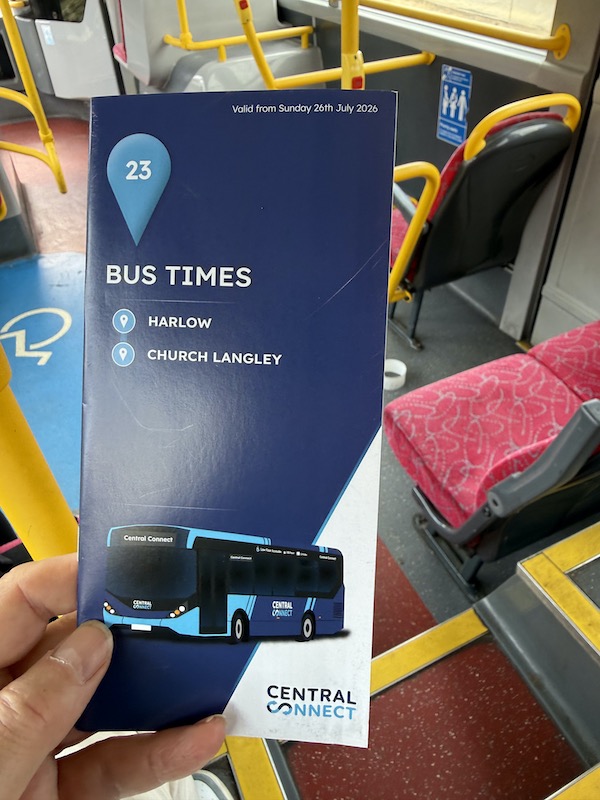
I was pleased to see Central Connect had a printed timetable leaflet available to pick up on one of the two buses on the route when I travelled, although they were spewed all over the luggage rack over the nearside front wheel as there was no leaflet holder. But I did notice a young teenager alighting pick one up and called back to her mate still on the bus to do the same when she alighted – not something you associate with the younger generation.
I also had a look at the residential area of Little Parndon which is even closer to the town centre and involves another clockwise route arrangement that’s also being contested like for like (of sorts).
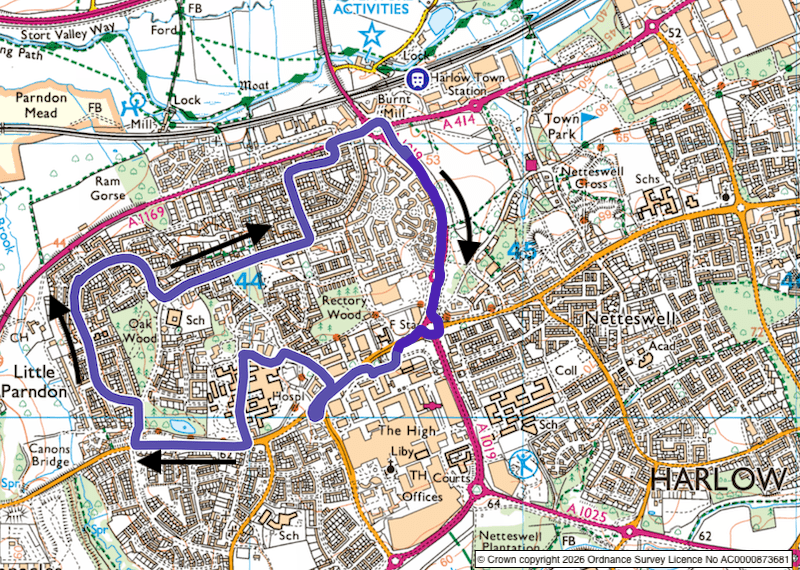
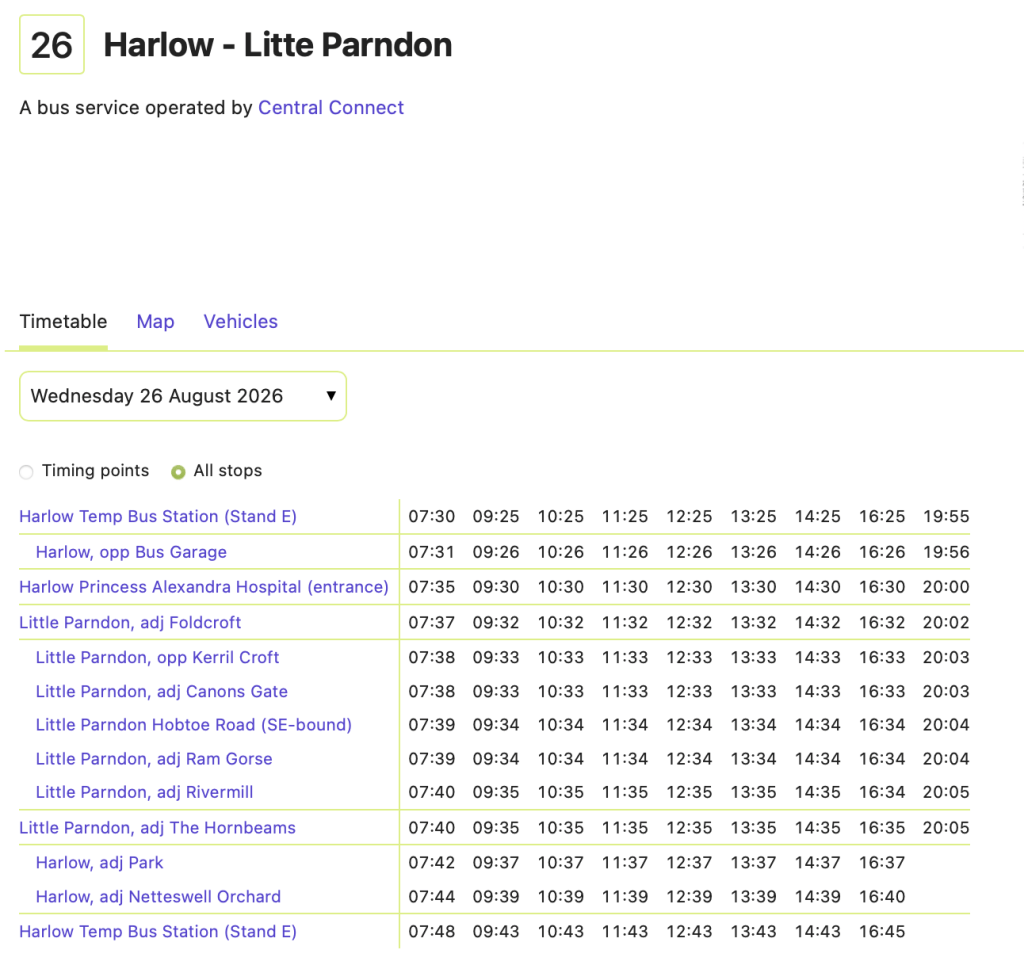
But here Arriva is definitely the minor operator running just five circuits during the off-peak as an hourly route 6 which takes 17 minutes to do a full circuit…
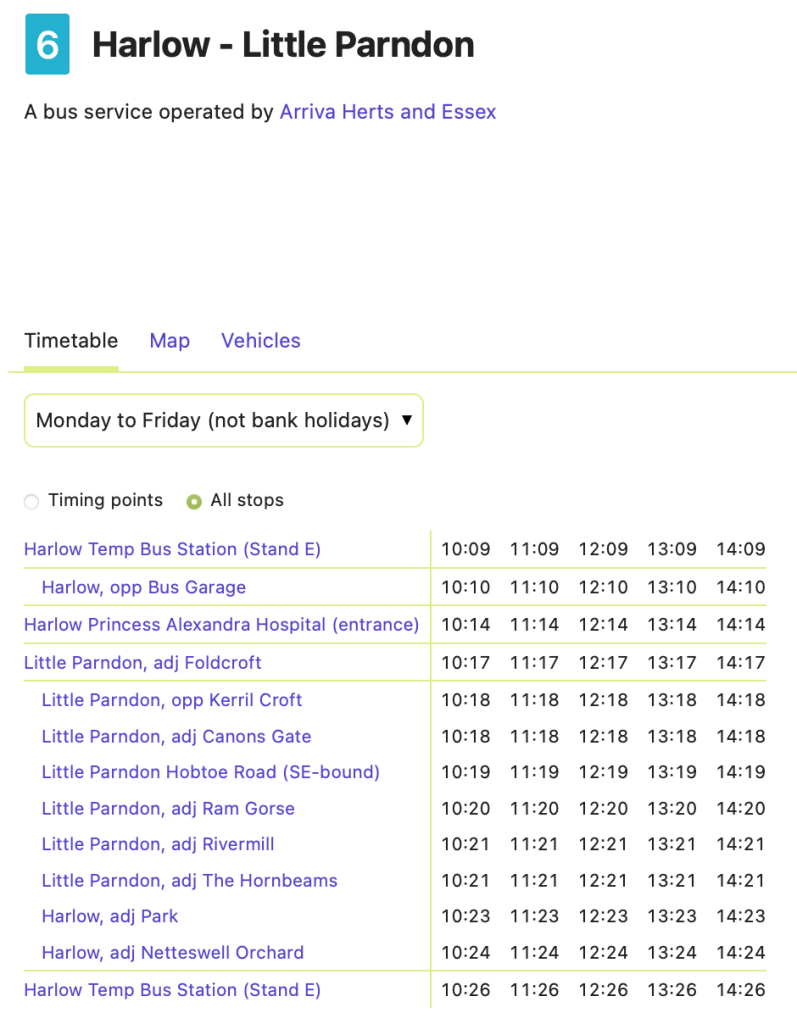
… with Central Connect’s equivalent route 26 also running hourly but over a longer period of the day with eight journeys as well as an evening journey. During the off-peak journeys are spaced 16 minutes apart between the two routes with buses on the 6 leaving the bus station at 09 minutes past the hour followed by the 26 at 25 minutes past the hour.
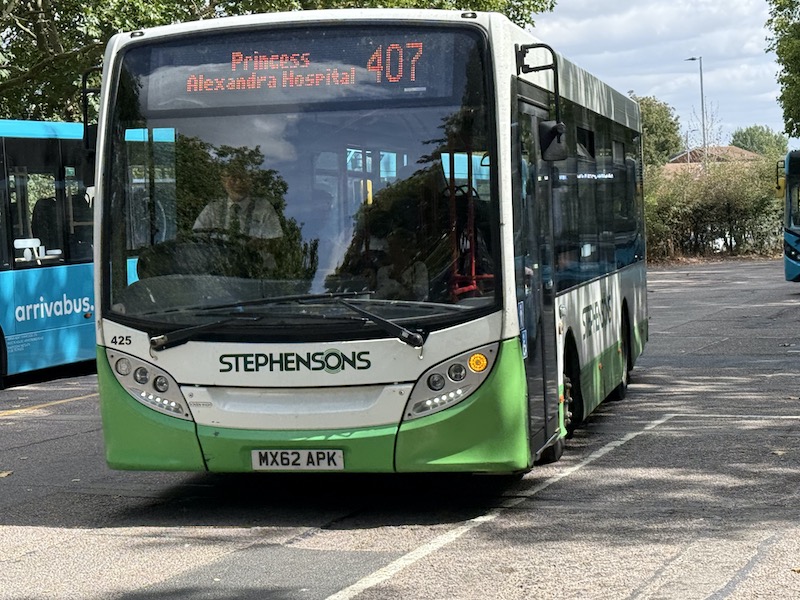
The town’s Princess Alexandra Hospital is on the circuit close to the town centre which is also served by Stephenson’s recently won tender (from Central Connect) hourly route 407/417 which runs across to Old Harlow…
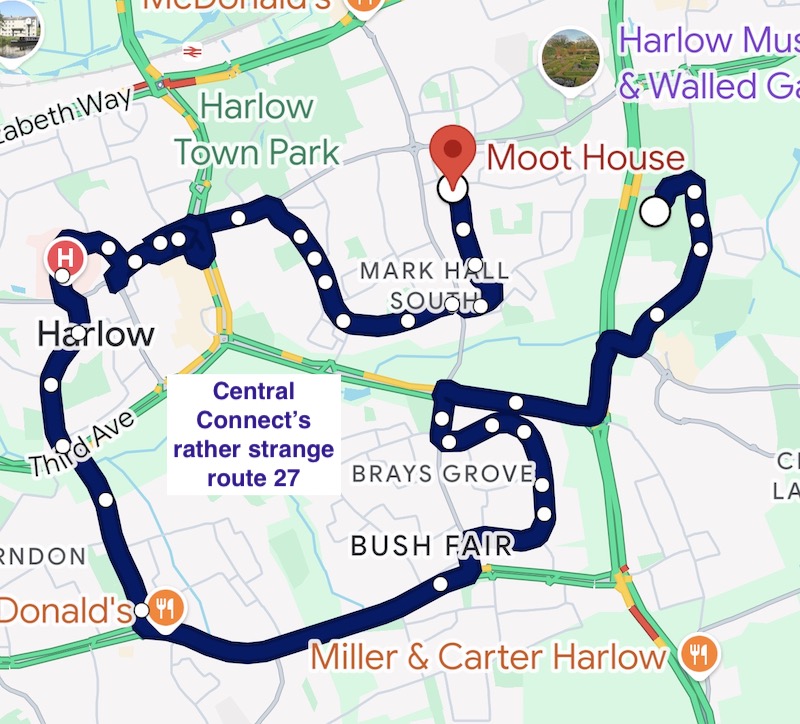
… and a rather odd route operated by Central Connect – route 27 – which performs quite a complex circuit of the town on a 90 minute frequency.
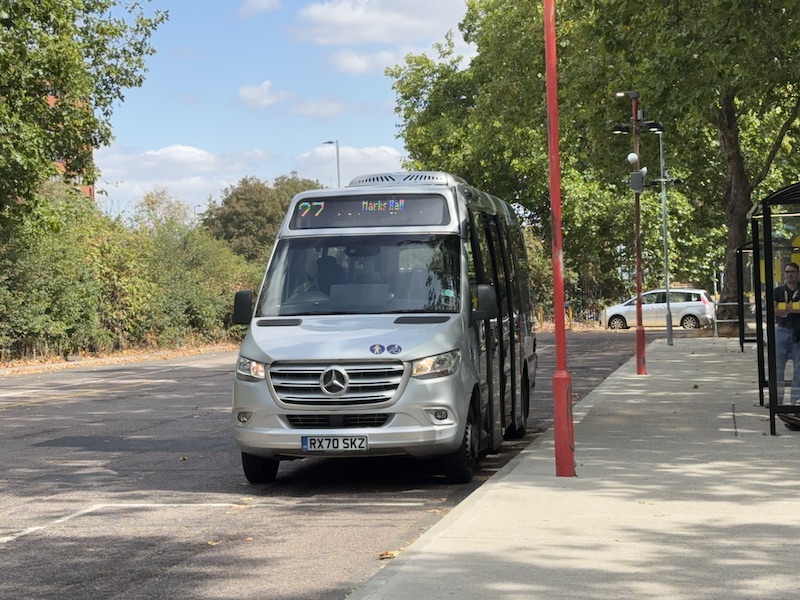
I travelled on both the 6, 26 and part of the 27 to see how many passengers were benefitting from these initiatives and sadly it was the same old story with two passengers on the 26, five on the 6 and none on the 27.
Another thing I noticed was the coincidental similarity of the moquette used by Arriva on its E200 buses…
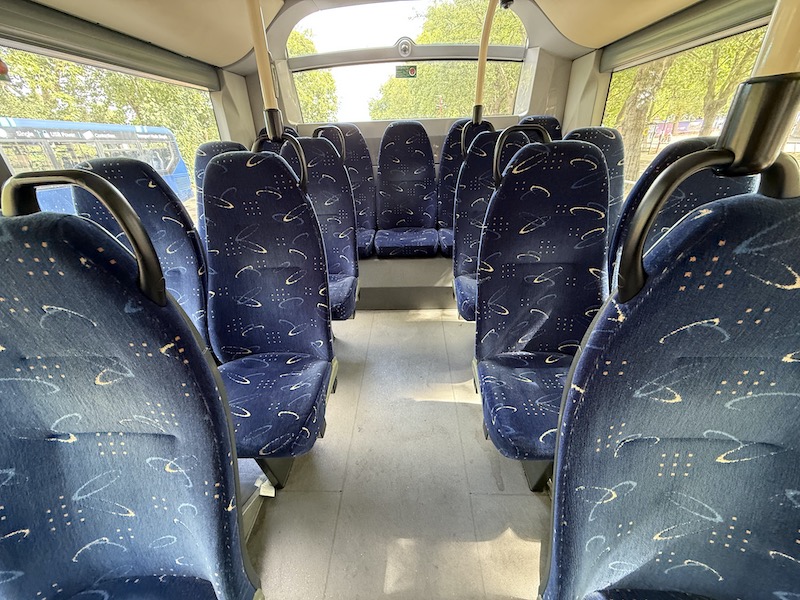
… and that used by Central Connect on its E200 buses. I forgot at one point which operator I was travelling with! I suspect many passengers “not in the know” might also mistake the similar coloured liveries and maybe don’t even realise there are two competing companies.
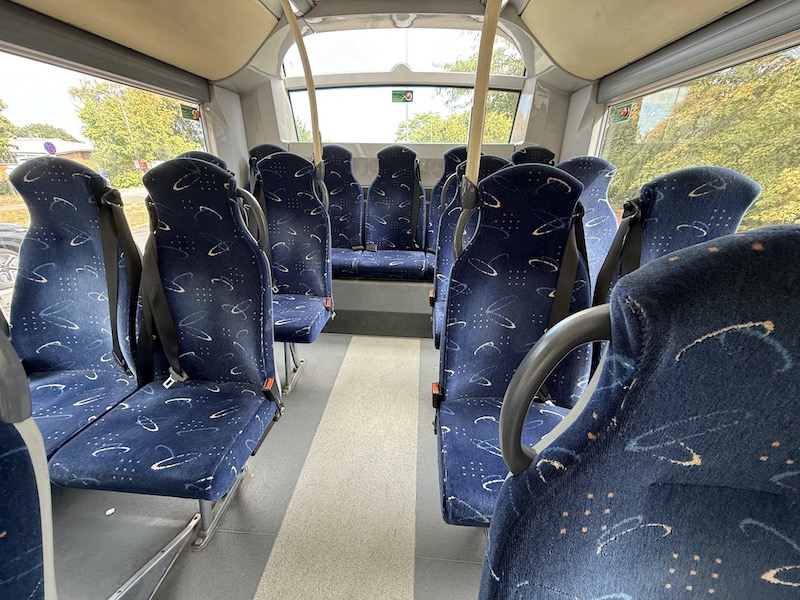
One often hears how the withdrawal of bus routes leaves passengers stranded. Here it’s the opposite problem. A lack of passengers leaving buses underwhelmed.
Roger French
My thanks to blog reader Michael for passing on the background information about this situation in Harlow.
Blogging timetable: 06:00 TThS
 BusAndTrainUser
And these are not the best routes in Harlow, all secondary routes. There is also the Arriva/Central Connect skirmish in Waltham Cross/Abbey. With a new CEO I don’t see Arriva walking away from areas as they have done in the past . Central Connect are racking up a lot of unremunerative mileage, and the pointless continuation of the Park and Ride service in Chelmsford continues I understand.
LikeLike
Oh dear, Arriva has another battle on in Harlow area with this time a good operator. Central Connect. I’m sure the Arriva senior manages for the area will sigh. Watch this space will Central Connect spread it’s wings to serve Stansted Aiport. Only time will tell!!??
The Wandering Busman, retired.
LikeLike
There is a third ex London Transport bus Garage still in use … Swanley Junction, now used by GoBus. This predates LT, as it was built by East Surrey in (I think) 1922 to replace various outstations locally.
It’s going to be interesting to see how many of these competitive “spats” survive … that in Maidenhead seems to have settled down with both operators sticking to their own territories; as has the 477 in Dartford; although the 458 in Slough seems to roll on.
Those in Waltham Abbey and (now) Harlow are probably too new to tell.
LikeLike
Swanley opened in 1925 although, unlike Northfleet and Harlow, it hasn’t been continuously operational.
LikeLike
At least in Little Parndon Central Connect has attempted to run close to 30 mins before/after Arriva allowing some kind of balanced potential journeys
I assume the 27 is a contract (does it pass the Hospital?)
For Church Langley sorry Arriva have only themselves to look at for not showing it some love, not running evenings has allowed a tender from a local authority to be in place and Central Connect might just have noticed that loadings were enough to consider the full day as commercial , as to if increasing service in school holidays (and ohh look kids go free and the govt pays a bit for that whats not to like) may mean its drivers dont get a summer break well never mind they can have a holiday another time. I wonder if the really hot summer though put off some of the expected travelling numbers I didnt see a big drop in London but personally avoided tube for thameslink a bit cooler where possible and buses were empty enough daytimes not to get too sticky in and the evening theatre clearing buses seemed as full as normal.
Harlow was perhaps the most wrongly built of the first generation new towns , in part as the coordination of plans on local and national scale were not worked together. The residential , travel conection , and work places all really being arranged too difficult to get to efficiently and we can see in Church Langley really a residential area just a little too few in residences to get buses a decent load for the service provided.
Maybe Central Connect needs a Harlow network map in its route leaflets too.
JBC Prestatyn
LikeLike
Harlow Town route map in a leaflet is with the printers and arriving imminently!
The 27 was ECC designed and originally ran every 60 minutes but was just too under-timed. It now runs every 70 not every 90 as listed to try and make it reliable but ideally needs a route redesign to better serve gaps in the market. An approach has been made to the funding body but no progress as of yet.
LikeLike
@JBC – Church Langley appears to be a more recent development. I believe much of Harlow was developed in the 1950s and 1960s (doubtlessly with some kind of “masterplan” as it was a designated New Town).
Church Langley seems to have appeared in the early 1990s as an “add-on”. I wouldn’t be surprised if that wasn’t in the masterplan of the 1950s, but I am just guessing and am open to correction.
Malc M
LikeLike
I like the Stephensons livery with the main white carrying the operator logo name and lower skirts with the wheels in the complimentary green of a shade that feels like a mix of friendly lime and mint. When they went to an employee share ownership business I felt that there would soon be a sell out to a larger group and a tax free (or lower) cash in but instead they have grown through some careful pricing of tender contracts , some commercial and some where needed withdrawal of services to keep the business aspects sustainable.
Only problem we are left with in Essex is a patchwork of operators and maybe not quite a integrated network as a whole between or within the towns of the county.
One wonders what changes the rest of the year will bring , and what planning is needed for a Burnham £2 adult fare for 2027
JBC Prestatyn
LikeLike
Central Connect originally won a lot of the evening Harlow tendered work from Arriva. They won the evening / Sundays 8 but numbered it 23. Seemingly their ticketing software does not allow for duplicate route numbers in their operating areas!
I also believe First Essex have also sublet their Harlow tender win on the 4 to Central Connect to operate on behalf of First.
Unrelated to Harlow but Central Connect have also now got a fairly public spat with ECC regarding the 907 school bus in Colchester. This may need a Roger verifies!
https://www.gazette-news.co.uk/news/26504528.central-connect-buses-boss-slams-essex-county-council/
LikeLike
The evening/Sunday version of Arriva town route 8 is the 28 (not 23).
LikeLike
Thers may be a typo with regard to the Stephenson’s route. The text says 417, but the blind says 407!
MotCO
LikeLike
The 407 and 417 are part of the same contract, the 417 is a variation used at certain times of day so you can treat them as one in the same.
LikeLike
Thanks – clarified to include both numbers now.
LikeLike
How do we persuade more folk to use the buses and the same also even then enjoy walking plus buses or trains, to get about on ?!?
The empty seats photos again.!
A ‘try it and see’, for xx months special offers approach ?
I have no car and nothing but feet buses, trains, metros etc, to get around on and at 64 it helps keep me fit too.
And I am very! content so. Though I don’t have needs some might.
But as ever the media rule us too much and give a negative view and so much so that the mass of my circle known folk, truly have such an untrue negative view . They do.
My brother has had to stop driving for a while and I moved him to buy an over 60s Railcard.
He has taken up rail travel keenly now and as others are, surprised by, when they try it, -& even now when it’s got it’s challenges indeed and late trains and cancellations are rather more -, just how good and often very enjoyable it is. He is won over for the trains at least straight off. Bringing all the benefits it does over the all sorts of having to drive a car A to B , and environmental ones also at all.
Thanks! Roger for the Blog.
The argument for competition comes in when a service provider is running often late, poor, rude drivers say , and threadbare timetable..but !??? .
Is local Govt intervention the ‘answer’ or not . ? Do we know the answer from worldwide examples now, and is the answer that sometimes yes but sometimes competition works and the passengers don’t mind as long as the route is served. ?
Or do we really ‘all’ like , want in our public transport realm of life, a calm orderly, public service, way to it. And this alone should be what we get.
Are we now at a stage in the years that both in this country with overseas too we can see what works and what should be, and so then now it can be happening wider and certain ways given national guidance or overrule.
“Look come on , there is multiple experiences, of and mass data that shows that ….” as you have said Roger on the On Demand and yet another Mayor, ignoramus way, whose scene is not public transport one thinks, seeks to use the way still.
And also what are the multiple factors which keep usage down of the buses.
I could suggest these :
No options for lower fares in terms of short journeys for a £1 say. We had this in Bristol for a while and they called it the 3 stop hop. I thought it was very good. But folk were abusing it and buying a £1 ticket and then staying on, I think.
[– What research has been done to see why folk don’t use the buses and are these real ones or ones that if they gave it a trial period they would realise are false ! . Check out Google Scholar we can do to try and see and get leads into what has been done and is being .]
As a train and bus traveller I question when folk say train travel is expensive as to just how expensive bus travel is per mile travelled !? .
And as for saving money in a city like Newcastle here it is so confusing to know what to go for of a day , and they don’t ever give good savings on season tickets on buses it seems either . A week or 4 days or 2 weeks or a month with real savings. Unlike say the Railway Rover tickets for an area for £xx when on holiday. But as for routine journeys , spending so much at outset to save £xx is never appealing to me.
Roger you ought to have a day in Newcastle and see if you can work out which tickets to go for with the 3 main competing bus companies all with different fare structures. One with return tickets one with tap on tap off and etc etc..Then one has the Metro which for such a most well used service the fares seem oddly high. Is the Mayor pocketing money from it to help other causes needs ?!? Or do they price it higher to dissuade and from them getting too packed !?? I don’t know. And then one has good reliable on time, widely so one finds, and well used local Northern trains. – An all services or modes , day ticket for £7.50 is an option too.
Anyway so fares How many folk think buses are too expensive and so don’t use them ? And if they are, ???, then what for the way ahead . Or do folk need to be helped to see the value of the fare s ? I think they are expensive for the market they are trying to serve.
Price cheaper but then one needs to get the uptake AND advertise and intro offers enough to work such .
no. 2 drivers driving too fast especially on country roads in icy or wet conditions repeatedly so in the winter timed, — and then there are also very few buses still with seat belts. Odd!, as it is since in coaches it became mandatory decades back.
The Express double deckers, X24 to Sunderland was it I saw yesterday, roar along this dual carriageway here at Wardley, in the outside lane etc, and sadly one thinks young drivers like the power they have in their hands now, and rather too much so at times. As is the way with us in our youth years. This can be quite off putting for the older and weaker . How much one wonders Research needed? We maybe all should get into the habit of reporting to the bus company if we believe any driver has been driving just too fast out in the country …or in town as here with the powerful new smooth Voltra buses give a lovely smooth ride but the driver has the power to put his foot down and zip on and up too close behind cars, as we all know is not the safe proper way to drive .
It’s always great to be on a bus and there is a lifelong older bus driver as known in Bristol, or wherever, but he steady way, pulls away and all calm orderly, and one knows he has been doing this a lifetime and yet he keeps on driving in the same calm no fuss way. He’s seen it all before . And when he gets out into an open stretch of dual carriageway it’s again nothing speedy and taking no silly pressure to catch up with having got late , for unavoidable reasons or whatever . Again just steady steady.
No. 3 Waiting at bus stops with lacking bus shelters and seats, the crazy nonsense indeed as to how many all around the country by now have been put up with the protection not towards the prevailing wind rain side.
No. 3a Lacking timetables too at them. How much do all these factors reduce the general sum use of buses .
Maybe time for some new national and local research on the: Why?s
No. 4 Then there is the timetable itself and e.g. how often places don’t these days have services into the evenings so going out of a day and not having option to get back after 5pm or so.
Why so widely no services on a Sunday for countless routes too? How much do people find this off putting and it reduces wider uptake?
No. 5 Lack of connectivity with train service arrivals . Or for departures too to a degree. GWR have been seeking to address this in quite a developing way, it seems. Working with bus companies to make this matter better.
Anyway…thoughts and how can we change the too many empty seats, bus photos of yours taken Roger, etc …, in the times ahead .!..?? Thanks, David .
LikeLike
That’s a mighty list! – I go for the lack of connectivity with trains – and also with other buses. It takes very little time on Google Maps etc. to find journeys for which there is no practical (and sometimes no possible) public transport option, and sometimes the journey is possible but the return impossible due to lack of connections.
Talking to bus and train managers has revealed that they talk very little to one another. Even within the rail world, the idea of holding a connection is frowned on – ” It would inconvenience all the other passengers”; but by not holding the connection, all those other passengers, plus anyone on the platforms, are treated to a public demonstration that ‘we are not going to help you if you choose to take the risk of making a journey involving changing trains”.
Bus managers appear to be focused on evaluating each individual route by its ticket sales, rather than by its contribution to the whole local bus network (let alone that of other bus – or rail – companies. “It would be awfully difficult to do that …” And hence the percentage of travel milage by bus and train remains at about 15% of the total, which gives a good excuse for some transport journalists to argue for no public money to be spent on them, as very few people use them.
Hopefully Andy Burnham and Heidi Alexander can push for the better integration which Labour promised when they got elected.
Rick Townend
LikeLike
You’re clearly an optimist Rick. Unfortunately the record over the past 50 years shows that both the regulated & deregulated approaches never achieved this. I don’t personally think this government will be in power long enough to deliver any meaningful change and therefore, it is more likely we will all be back at square one on this question. PB
LikeLike
pre Covid, the Arriva 10 continued to and from Hertford to give journeys additional to the 724. Maybe central connect might want to look at that for their 10 as, despite much timetable amending, timekeeping on the 724 remains uncertain and there are 70 or even 80 min gaps in the timetable.
LikeLike
Don’t forget that the 725 duplicates the 724 all the way from Welwyn to Heathrow, giving an almost half-hourly service.
I do remember when there were competing services between Harlow and Hertford that they did quite well.
LikeLike
Central Connect have done a very creditable job for improving the former Trustybus/Galleon operation but you do wonder what they are doing with these rather distracting bits of competition. I can’t see Arriva backing down with Mr Gilbert in situ. With so much to do in sorting out their Go Ahead East Anglia purchase, they’d be better off working on that than wasting time and money on these sort of confrontations.
One little thing about Roger’s moquette observation. As part of the updating of the Arriva fleet, they are making judicious purchases of secondhand vehicles and a number of e200mmcs have arrived having been leased to other operators. Those dealer spec vehicles are now in Arriva colours but not refurbished and clearly, some of the older Central Connect vehicles were similarly purchased from dealer stock too.
BW2
LikeLike
Obligatory typo watch: “Vectare (later remained Transport Made Simple)”?
LikeLike
Obligatory ‘many thanks, now corrected’.
LikeLike
I live where there there are different routes to the same place at the same time but different bus stops & there on two different roads. And you have to make a decision on which one to go to and if one is late or not showing up you’ve missed the other one.
LikeLike
Church Langley is an attractive up-market area of Harlow where there is a high level of car (s) ownership and when a predeccessor tried their luck against Arriva several years ago they gave up after a few months. Central Connect is tying up newish buses on this and the futile Chelmsford Park and Ride competitive service when the run-down Konnectbus fleet is crying out for newer buses which makes no economic sense at all.
LikeLike
Church Langley is a bit more upmarket than much of Harlow but is (or was) still good bus territory. The 10 started at a x15 frequency in the late 90s. There was competition for quite some years (SM’s T15 and later T10). There was also a time when Arriva ran a 10 and 20 service via different routes which combined to give 6bph.
The reduced service on the 10, especially in the evenings and on Sundays, plus only running to the Station in the peaks in the last couple of years (after a period when there was no through service) have all taken their toll.
LikeLike
I vaguely recall being told that there was a restrictive covenant on the land at the ex-LT/LCBS Harlow garage, preventing it from being used for any other purpose. If that is true it would make the site effectively worthless, and may explain its continued survival.
I could be mistaken, though.
Malc M
LikeLike
I very much remember the effect deregulation had when introduced back in 1986. Overnight, my then home town of Darlington went from having a well ordered council run service, to a chaotic one run by various operators. Buses would regularly leapfrog each other, if close together. Or, if not, then the preceding service would usually be well loaded, whereas the following one practically empty.
Clearly an example where competition creates inefficiency and in stark contrast to the narrative that it is more efficient than a standardised public service offering.
Now, it seems from your blog that the lessons of the past have not always been well learned. No wonder the general public often find privatised bus services bewildering and confusing, which is hardly a great incentive to use them.
LikeLike
Was pre deregulation any better though, i remember many companies barred from picking up local passengers in Towns/City’s across the UK if there was another Municipal/PTE operator in that area, like Ribble were prevented from carrying local passengers in Southport, along with a few other Towns/City’s in Lancashire, & it wasn’t only Ribble that were affected by this either.
SM
LikeLike
Quite right. Bournemouth Corporation had protection clauses under an act of parliament that in effect meant that Hants & Dorset were not able to pick up local passengers within its operating area. For many years H&D buses operating into the BCT area carried a white board at the front stating ‘Not on service for Bournemouth Corporation passengers’.
The 1985 Transport Act effectively abolished this archaic protection.
LikeLike
Remind me, what happened to Bournemouth Corporation?
Malc M
LikeLike
Under the 1985 Transport Act most municipals operating buses were obliged to form arms length companies. Bournemouth Transport Ltd was formed to take over the erstwhile BCT operations and traded thereafter as Yellow Buses. In 2005 Bournemouth Council sold 90% of the business to Transdev retaining a 10% shareholding. In 2011 RATP acquired the business following the swap of various assets between itself and Transdev leading to the Bournemouth council 10% share also being acquired.
Following accumulated losses RATP then sold the business to the management in 2019. Then COVID hit & the newly independent business struggled thereafter, leading to its collapse into administration during July 2022 & closure shortly after, on 4th August 2022. PB
LikeLike
The restrictions on picking up passengers cut both ways. It was an agreement, not legislation per se (although it arguably stemmed from the registration requirements of the 1930 Act) and Bournemouth Corporation was not allowed to operate in Poole. When the contraflow bus lane on Kings Road in Reading opened it was initially restricted to Reading Corporation services.
LikeLike
My experience pre deregulation is extremely limited and mainly confined to my then home town of Darlington. I remember this being quite a well run operation, but this isn’t necessarily representative of the wider picture.
What I can categorically say is that the UK deregulated system is extremely disintegrated and this does not serve the interests of passengers well. I am not in any way suggesting we should go back to how it was before, either deregulation for buses or privatisation for rail.
What we need is a proper integrated system and should be looking at successful operations abroad for our inspiration. And we don’t have to look too far. The Netherlands has some superb public transport, and Switzerland has the best most integrated public transport in the World.
LikeLike
Cardiff Bus does still have a few Short Hop (now called Local) fares – although on my local route you can travel for 16 stops! I have no idea if they are abused or not, however an easy solution to that would be to only have them available with Tap On, Tap Off (phone and contactless).
LikeLike
Clarification of Vectare, TMS, Central Connect …
Vectare started with School Bus management software in 2016 and got into bus operation in 2018. They bought Galleon Travel’s bus operation around Harlow in 2023 along with Simmonds and Flagfinders, etc. Transport Made Simple was formed in June 2024 as a holding company. Then followed a complex reorganisation in several steps. The end was Vectare with the bus software was sold to Faria Education. Transport Made Simple is the group umbrella for Central Connect as the bus operator, Simmonds and Flagfinders as coach companies and Lyon Tyres. Dominic Kalantary largely moved with Vectare, but is a TMS director and owner, where as Peter Nathanail is with TMS running buses and coaches. Peter and Dominic are both 29!
LikeLike
I thought it might be interesting to look at how the bus service to Little Parndon has waxed and waned over the years.
LCBS timetables from the mid/late 1970s show route 805 providing a generally half-hourly service during the daytimes, serving Little Parndon as a loop. As the service ran in both directions, Little Parndon was served by 4 buses per hour (albeit 10/20 minutes apart, rather than departing at even 15-minute intervals). Peak hours were more ragged and less frequent, mostly with route 806 rather than 805, and the evening and Sunday service was one bus per hour running out-and-back to Little Parndon rather than running as a loop.
A 1981 timetable shows Little Parndon served by T5 running half-hourly Mon-Sat daytimes, supplemented by an hourly T9, with the T5 providing an hourly evening and Sunday service. Peak hours still a bit ragged, provided mostly by route T16. By 1983, the T5 has been improved to every 20 minutes daytime, the peak hour service (still quite ragged) is now provided by the T5, but the T9 has gone. Two years later the T5 is unchanged but has been joined by routes T7A/T7C providing three Mon-Fri daytime journeys in each direction at two-hour intervals.
Then deregulation happens. The October 1986 timetable published by Essex County Council shows London Country North East running the T5 to Little Parndon commercially, but daytime frequency cut to half-hourly. No evening or Sunday service is shown in the timetable. This appears to be an omission, as LOTS sources indicate the evening and Sunday services being tendered by Essex as two separate contracts, both awarded to other operators. The T7A/T7C have been renumbered T7/T8 and increased to hourly in each direction, as a tendered service now operated by Sampsons.
Competition in Harlow then heats up, with the arrival of the Buzz Co-operative using minibuses to challenge LCNE. By 1989, Buzz Co-op’s B7 provides a bus every 50 minutes to Little Parndon, Mon-Sat from around 09:00 to 15:30 only. LCNE’s successor, County Bus, maintains a half-hourly daytime service but this is now provided by the extending the 502/503 (Loughton/Hammond Street <> Harlow) from the bus station through Little Parndon then terminating at the bus garage. The T7/T8 continue to provide their hourly Mon-Fri daytime service. Tendered evening and Sunday services to Little Parndon are still hourly, the Mon-Sat evening service retains the T5 number while the Sunday service is now the T1.
By the mid 1990s, Little Parndon still gets two buses per hour Mon-Sat daytimes but they are no longer evenly-spaced as it is two separate hourly services (807 and 815, both County Bus). Notably, nothing serves Little Parndon before 08:20. Hourly evening and Sunday services are provided by 859 and 851 respectively. There are also 1-2 daytime journeys on Mon-Sat provided by a wheelchair-accessible service E44 (Waltham Cross <> Harlow).
Fast forward to today and if I have got this correct, Little Parndon now gets:
M-F, both peaks: Stephensons’ 14 with varying intervals between 20 and 40 minutes, one of the 40-minute gaps is plugged by an a.m. peak journey on Central Connect 26, there are also a couple of Stephensons 417 journeys.
M-F daytimes: Central Connect’s 26 hourly, supplemented between 10:00 and 14:00 by Arriva’s 6, but the two services aren’t evenly-spaced. Then, after the 6 has packed up, the 26 has a two-hour gap in the mid-afternoon.
Sat daytimes: Central Connect’s 26 doesn’t run. Daytime service limited to one journey just before 08:30 on Stephensons’ 417, then Arriva’s 6 between around 10:00 and 15:00. Nothing then until after 17:30, when the evening service kicks in…
M-S evenings: Stephensons’ 417, hourly, plus one isolated journey on Central Connect 26
Sun daytimes: Central Connect 26, every two hours between 09:45 and 17:45
Sun evenings: nothing (previously, Sunday services did run into the evening)
Generally the service frequency now is quite a lot worse than any of the previous “snapshots”, although a morning peak service has been restored.
Malc M
LikeLiked by 1 person
Many thanks for your research and fascinating results.
LikeLike
As a potential answer to the reader’s query above, how do we get more people to try buses? My vote would be a country-wide day pass introduced when the £2 scheme starts in January 2027. Cost £7. Nice and simple – every operator.
This has been achieved in Oxfordshire (“MyBus” ticket), and turned out to be selling something like three to four times more day tickets than originally planned.
Oh, and where “skirmishes” do happen, tickets valid on any bus are always helpful. Just board the first one that turns up. Your average punter doesn’t care if the bus is owned by John Smith or Fred Blogs. They just want to return home with the minimum possible wait at the bus stop.
(CH, Oxford)
LikeLike
At least Central Connect’s passengers can just look at a timetable and turn up for the bus, rather than having to look up term dates first. With many schools going back midweek after the Summer hols, does the first half of the week count as term time or not? Or worry if the local school has an inset day so the kids are off, then which timetable will the bus run to? The Arriva timetable adds a complication to travel and would turn me to the car or the alternative operator with the simple timetable.
LikeLike
I understand Harlow bus depot is owned by Alan Stevenson AJS. AJS were the original owners of County Bus I think, mentioned above. Arriva hold the lease.
In general Arriva’s stewardship of buses in Hertfordshire and Essex has been abysmal.
Watford, Hertfordshire’s largest urban area has no bus depot and services are run from Hemel Hempstead, services in Stevenage continue to be reduced, the area has these ridiculous different off peak services between schooldays and school holidays which confuses passengers, and Colchester is clearly at end of Iife stage.
Let’s hope the new MD introduces positive upgrades to services, and not just new buses or responses to competition. Having lost two depots in Merseyside and now Cleckheaton to franchising the operation is contracting, shire county areas might be their only salvation.
LikeLike
It’s Alan Stephenson who created AJS following a successful buy out of East Yorkshire from the NBC. Although he built up (with others) a sizeable bus operating empire during the heady days of privatisation, he subsequently sold off the operating companies but shrewdly held on to the ownership of lots of property, generating no doubt, a nice steady income stream.
LikeLike
Harlow was one of my first long distance ENCTS projects after I got my pass.
Living near Hersham Station I needed to walk to Halfway Green for a 555 to LHR T4 (0915). I crossed to LHR T123 by Underground (1040). Then 724 to Harlow (1115). Drinks at the Harlow JDW. Then a Route 8 around Old Harlow (1540) followed by a Route 6 around Little Parndon (1610) using the same vehicle which had appropriate Crosslinks. McDonald’s snack back at Harlow. 724 back to LHR T123 (1726), then Route 555 back to Walton on Thames (2046) where I had another drink at “The Regent” (alas no longer a JDW but Stonegate), then a walk home of around half an hour. With the long journey back to LHR I needed to be a modest drinker in Harlow. Sunset that day took place whilst I was on the Route 6 going round Little Parndon (1617). The previous day I used my free travel to watch football at Charterhouse School and as an Hon Member of the Old Carthusians FC I had a free meal after the game! I left Hersham at 0831 and got home around 2013. No drinks on the way out yet the Surbiton JDW on my way home.
LikeLike
Given your regular references to both JDW pubs & your home town, Tim Martin should employ you in his Marketing Dept & Elmbridge should appoint you as their Hersham ambassador!
LikeLike