Thursday 20th August 2026
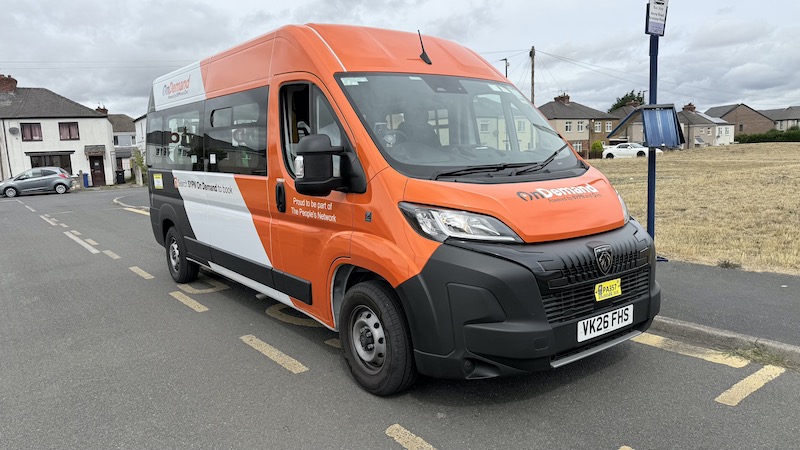
As more areas give up on their dalliance with DRT (Norfolk County Council’s the latest to revert to fixed routes with its Flexibus scheme coming to an end in Swafham at the end of the month) it’s interesting to see South Yorkshire Mayoral Combined Authority and its self styled People’s Network (SYPN) begin its own 12 month “pilot” (this one costing £800,000) with Mayor Coppard explaining the aim is to “test this new approach supporting our ambition for a fairer, inclusive and more accessible South Yorkshire.”
It’s a shame he doesn’t just give his Mayoral colleague on Teesside a call where the Combined Authority’s TeesFlex DRT bit the dust earlier this year after six years of trying, or talk to those in Norfolk as Coach Services (the new operator of the fixed routes replacing Flexibus) tells passengers from 1st September “getting around Swaffham and the surrounding local villages just got easier. Say goodbye to booking apps and pre-scheduling—these new fixed-route services mean you can just check the timetable and head to your nearest stop!”
He could also have a look at my DRT Chronology webpage and read about some of the areas who’ve enthusiastically launched DRT “pilots” and “trials” to great fanfares of publicity only to quietly withdraw them a few years later having lost a fortune … eg Bristol (Slide and First and Last Mile) Sittingbourne (Click), Liverpool (Click), London – Various (Chariot), Ealing (Slide), Sutton (GoSutton), Upper Skelmorlie/Weymss Bay (Connect and Go), Oxford (PickMeUp), Speke (Click), West Midlands (West Midlands OnDemand), Lubbesthorpe (Click then NovusFlex), Watford (Click), Bedale (YorBus), Inverurie (ready2go), Leeds (Flexibus), Berwickshire (pingo), Aylesham (Stagecoach Connect), Lichfield (LinkUp) … to name a few that come to mind.
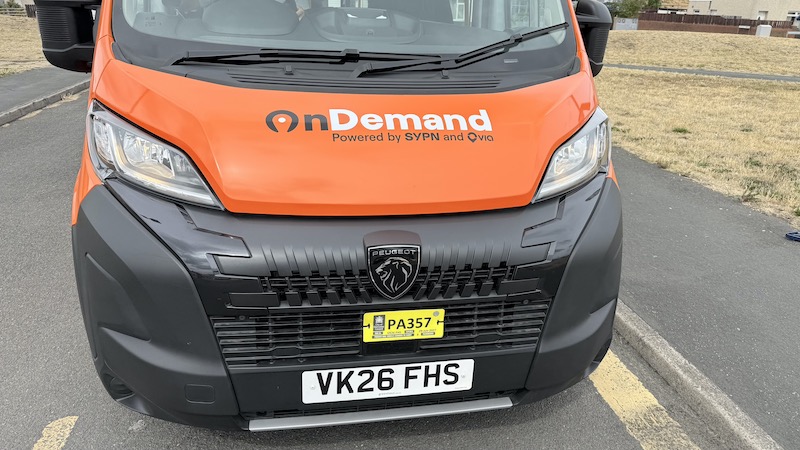
The People’s Network’s £800,000 has come from the Authority’s “Transport Innovation Fund (TIF) which is supporting innovative transport projects in each of South Yorkshire’s four local authority areas.”
Software for OnDemand (as it’s branded) is from the Via stable and includes the usual App as well as facilitating bookings by phone through a contact centre (between 08:30 and 14:30 on Mondays to Fridays).
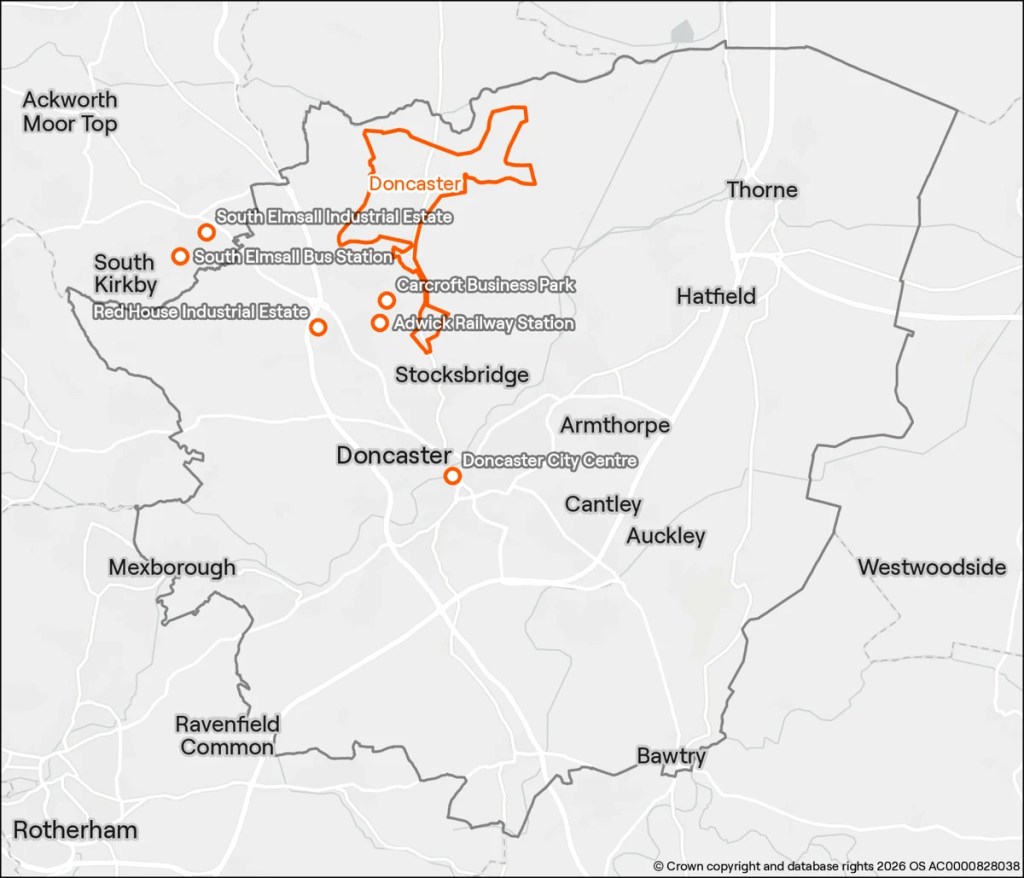
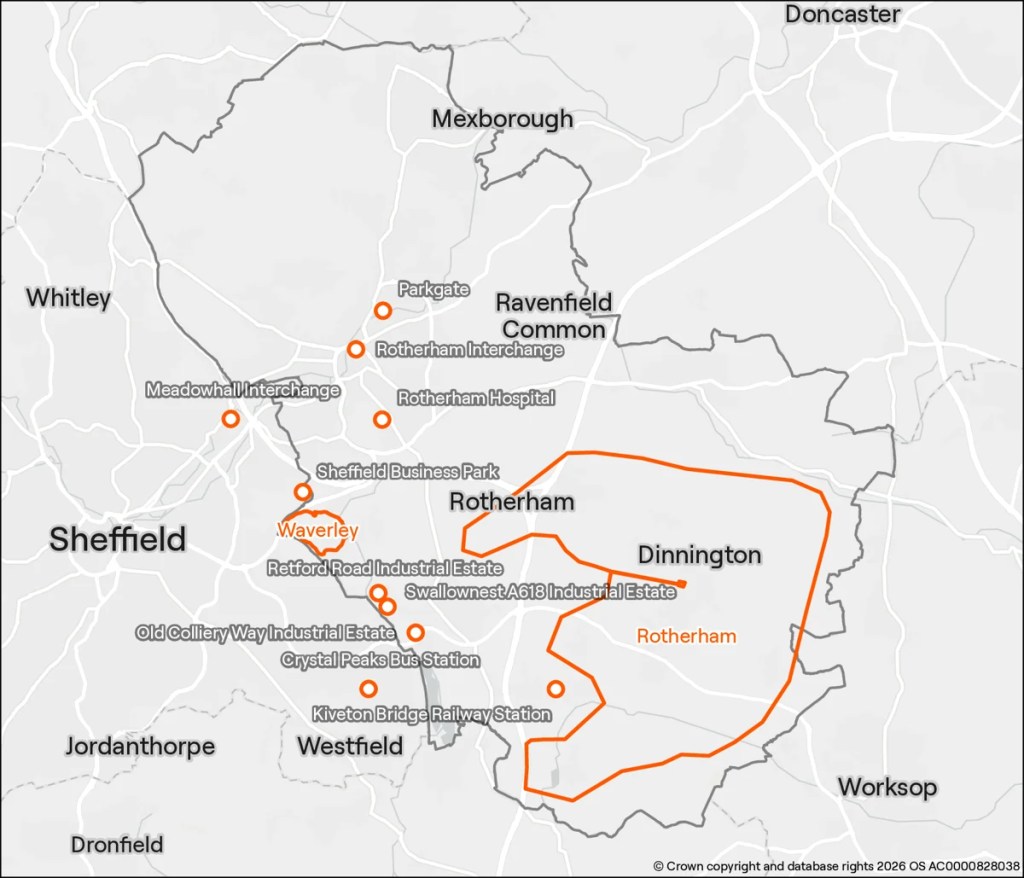
There are two distinct operating areas – one in Doncaster centred on Askern and one in Rotherham based on Dinnington. Each zone is reported to have four vehicles allocated to it, which strikes me as good value for £800,000. It’s operated by Via under Private Hire licensing arrangements.
Travel can be booked within each zone or from within a zone to various Hubs including South Emsall and Adwick railway station from the former with Meadowhall, Crystal Peaks and Rotherham Hospital among the Hubs served by the latter.
Hours of operation are 05:00 (first pick-up) to 18:00 (last drop off) on Mondays to Saturdays with no service on Sundays. Boookings can be made up to seven days in advance with a cut off an hour before pick-up time. The first two journeys are free and after that there’s a £3 fare and £1 for those under 19 with a ‘Zoom’ pass. Concessionary travel is available for ENCTS passholders.
SYPN OnDemand began on 3rd August so in its third week I popped up to Askern on Tuesday to give the Doncaster zone a try. It was straightforward to book a short journey from Askern’s Station Road to a nearby residential area – Sherwood Avenue. It was only scheduled for a three minute ride although the destination was shown as Anna Road/Airstone Road rather than Sherwood Avenue when the booking was confirmed and the pick up at High Street/Station Road although this was later updated to a bus stop just round the corner in Selby Road.
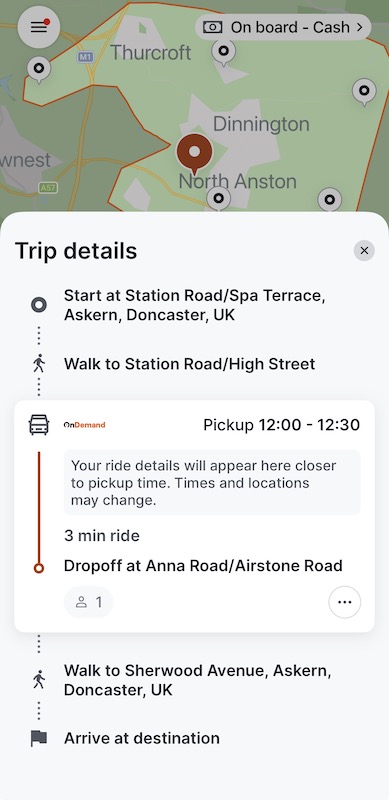
I was given a pick up time slot of between 12:00 and 12:30 and made sure I arrived in good time by catching a bus on First’s route 362 which links Doncaster with Askern every half an hour.
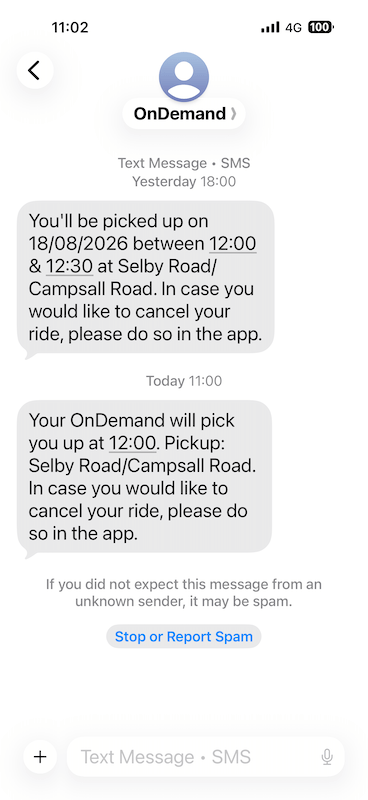
The usual text reminders came at 18:00 on Monday evening and 11:00 on Tuesday with the latter confirming the pick up time as 12:00, conveniently at the beginning of the half hour window I’d been given.
Half an hour before pick up the minibus was showing on the map in the App and ironically was coming from Doncaster where I’d also just come from.
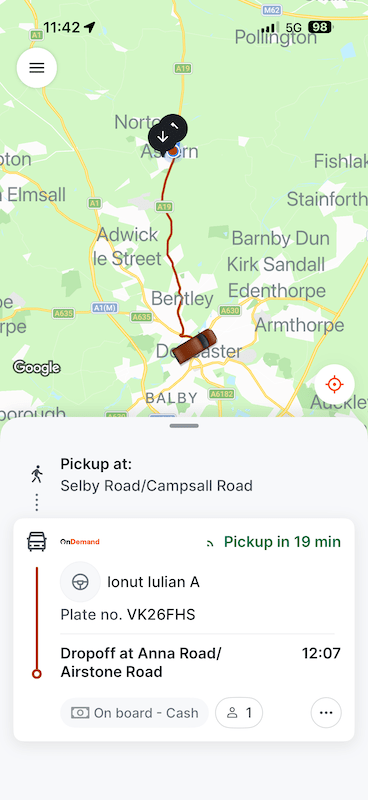
It arrived exactly on time at 12:00 and encouragingly had a passenger already on board. She was travelling from Doncaster back home to Norton, a village north west of Askern devoid of scheduled buses for four years (she told me) so was overjoyed at this new service and had already made a number of journeys and found booking the rides easy.
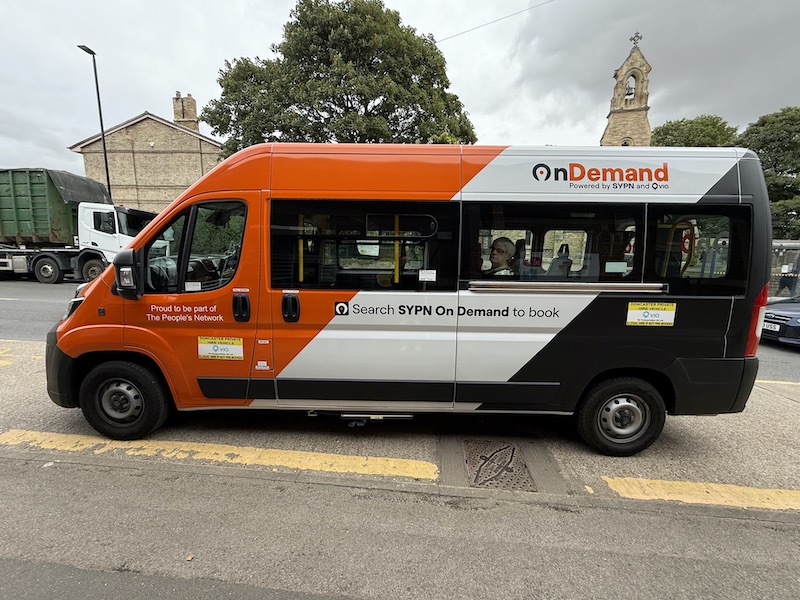
I apologised for making her journey a little circuitous around the western side of Askern where the driver dropped me off before continuing on to Norton but she was just enjoying the ride.

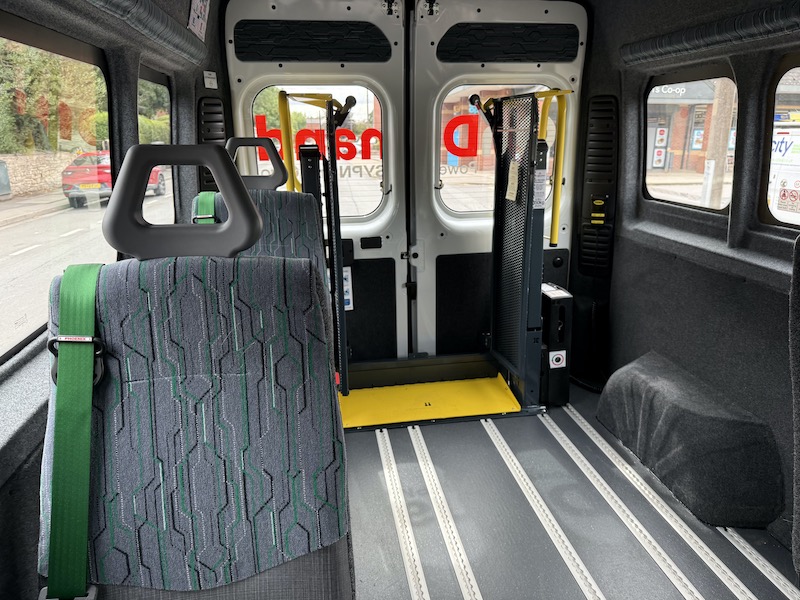
Interestingly the Peugeot minibus was set up with just four seats for able bodied passengers and the rest of the space for wheelchairs accessed through the rear tail lift. The side door was manually operated and as always rather heavy to open and slide closed.
Via’s software prevents journeys being booked where conventional scheduled bus routes are available – for example, Askern to Doncaster, but Norton to Doncaster is possible as there’s no fixed bus route.
I’m sure this new service will be appreciated by passengers who’ve been devoid of a bus service, but as always with DRT, its success depends on being not too busy (that passengers find it hard to book a ride when they want it) and not too slack (that it makes no financial sense and loses a fortune). Excessive unproductive dead running between journeys has been another challenging factor in many schemes.
As is often the case with DRT schemes thee’s no detailed map clearly showing the boundaries of the zones in which journeys can be booked – I’ve extracted the online maps and included them earlier in this blog and the inly other source is the App itself which is fiddly to use on a smartphone to see the boundaries.
I’m not familiar with the area served by the Rotherham zone but I’d have thought, certainly with the Doncaster zone centred on Askern, if four buses are being expended on the “pilot” some useful timetabled conventionally operated routes could have been introduced instead – as has been found on Teesside and rural Norfolk – to better effect.
12 months on and £800,000 later Mayor Coppard might come to realise this.
Roger French
Summer blogging timetable: 06:00 TThSSu


In fairness the London area ones suffered from slightly not good app and software and were hit by pandemic before the results and trial variations could be completed. I wonder if DRT is better if jointly run by adjoining authorities – this might solve some of our awkward London and Surrey and London/Herts/Essex problems noted by self and others in the past on this blogs.
IF this DRT shows up some regular demand routes – and its nature is that it wont direct compete with existing fixed bus routes – that might be good as the Norton-Doncaster example shows a regular 8 journeys a day to town centre or the slightly out of town northern shopping and leisure area might be of value – perhaps down to the southern employment zone too. Vehicle livery is good too eye-catching and more like a proper bus than some fixed route offerings
JBC Prestatyn
LikeLike
Either fixed or DRT, it requires London and the Home Counties working together much more than now. I would hope you would get both, so extend some of TFL’s services to the likes of Cheshunt Brookfield, Waltham Abbey, maybe even Epping to provide an alternative when the Central Line struggles, which seems to be a lot beyond Loughton nowadays. Transfer a route like the 242 or 66 for circular routes. As Crews Hill gets built out, a route between Enfield, Cuffley and Cheshunt will be needed. DRT would make sense connecting tiny places like High Beech to stations like Loughton and Chingford. Regional gaps like Debden or Epping to Romford require fixed routes too in my view. Plenty of villages between NE London with its Central and Elizabeth Lines and the likes of Harlow and Chelmsford where DRT could make a lot of sense too. All of this requires a regional approach and a bit of flexibility.
I think the problem with DRT in nearly all cases is it seems so daunting to use if not a local and too often not there when local people need it. It seems impossible to visit somewhere and then decide on the spot to use the service available unlike even a 2 hourly bus. Compared to a taxi who can be phoned anywhere at almost any time and you’ll usually wait no more than 20 minutes, very often get one there and then. Makes me wonder if the authorities should just own a taxi firm instead and encourage shared taxis that charge regular bus fares in places or times with lower demand and the driver being paid by the council instead of having separate DRT schemes.
Aaron
LikeLike
I think you my have a point about DRT being too daunting to use, especially for some of the older demographic. Downloading an app and being able to interpret the messages, and that’s without the shortcomings of inexact timings for connections, supposed times where they are too busy to offer a journey etc. I often wonder if just making it dial-a-ride would make the world of difference? How much would it cost to employ a controller, just like the old days of minicab offices, compared to the costs of the app development and maintenance.
LikeLike
Definitely not great for older people vs even the weekly shopper bus that used to exist everywhere, which this blog has highlighted so well as social spaces on wheels. My experience of riding the 969 the other year was similar to that which surprised me for London.
I’d say DRT is daunting to visitors or anyone unfamiliar with an area too. Narrows where you can go to strict and confusing council boundaries (something that should never impact transport as I always refer to in my posts), a complete lottery if the app will even let you book, let alone when you need it etc. which risks people getting stranded. It massively overcomplicates what should be simple. I was tempted to try Hertslynx after a visit to Royston recently but opted for the limited 18 service instead due to the certainty of the fixed timetable and its connection at Buntingford with the 331 for Ware and further afield. Regardless of who we are, we need the certainty the service will even turn up broadly when we need it. Part of why some prefer trams over buses I think.
Your suggestion would definitely be better at both ends, cheaper for the council and simpler for anyone who needs it.
Aaron
LikeLike
I wonder if anyone has asked the National Infrastructure and Service Transformation Authority to report on DRT schemes such as this one? – might be a good idea: at least it would get NISTA bogged down and stop it issuing damaging pseudo reports like the one which has delayed the Leeds trams into an increasingly misty future ….
LikeLike
National Infrastructure and Service Transformation Authority
What a title !
I dread to think how many staff it employs and how much they get paid
Martin W
LikeLike
Maybe the National Audit Office might be a better bet? Their reports do seem to be objective and can be hard-hitting.
MotCO
LikeLike
SwaffHam, please!
LikeLike
Thank you.
LikeLike
and Lubbesthorpe please.
I like the comment “and found booking the rides easy.”
they are only easy if the service is underused. If it’s popular then it’s almost impossible to get the booking you wanted…
LikeLike
Thanks. Corrected.
Easy booking …. it’s why I only travel in the first few weeks when awareness is low.
LikeLike
the tautological “revert back” is back!
LikeLike
Thanks. Now reverted back to revert.
LikeLike
A disappointing blog post. So easy to criticise. At least the South Yorkshire team is trying something new. The benefit of reading this blog is to get a better understanding of services and new initiatives around the country. That’s the positive. The negative is that we have to read what is almost contact criticism. But that’s bloggers for you. Place your bets on a nice, positive post next time.
LikeLike
The South Yorks team is not trying something new, it’s a tried and tested way of losing money – see the list of failed schemes at the top of this blog post. Nobody, apart from the author, seems to keep track of when these things start and fail. A successful DRT scheme I suggest is the exception not the norm.
LikeLiked by 1 person
But isn’t running socially necessary bus services also a tried and tested way of losing money? Of course they all cost money. But you don’t like DRT, maybe because you don’t need to rely on it to get to essential services. Perhaps look through the lens of those who can’t get to medical appointments or work by conventional scheduled bus services. Accept that the minority costs more.
LikeLike
Why do you think that this one will succeed when at least 18 others have ceased? How many successful DRT schemes are there, and how many are cheaper (overall cost and cost per passenger) than either what was previously provided, or the cost of an equivalent taxi ride? In theory DRT sounds like a good idea, but in practice, they are expensive, zoning doesn’t allow you to go where you want to go (eg I can’t use my local scheme to take me to the nearest hospital), they are not always available, and a fixed route is xheaper, not least because you don’t need the backroom support.
MotCO
LikeLike
The thing is DRT has its odds stacked against it, so many do fail. The 1 positive when they do end is we see fixed routes come back. The latest being in Swaffham, Norfolk. Seen fixed routes be restored all over the country in recent years after the DRT experiment ended.
Maybe a fixed route between Doncaster and Norton is one of the things that should come out of this.
Aaron
LikeLike
Wouldn’t be a very good blog if Roger just wrote what he thought people wanted to hear, rather than facts based on experience. In fact, if it was just written to please operators or authorities, then it would just be yet another magazine and would probably lose most of its readers.
LikeLike
Postbuses instead!
Although perhaps they would be parcelbuses and operated as a side business by EVRI or InPost gig couriers or similar.
Perhaps it would be cheaper to concentrate on blocking factors to that sort of service and subsidise by offering cheap leases on suitable vehicles (supporting accessible travel and parcels)
a recent trip to the zero2 bus museum reminded me of postbuses (and their relatively recent demise) as they have a good display there at present
MilesT
LikeLike
I guess that the self styled Peoples Network is trying this as an experiment before they sort out what they want to franchise. If the DfT is prepared to pay then why not?
The zone near Dinnington serves a rather affluent area and will make a reasonable comparison with the Doncaster zone which serves a former mining district.
The bus to Norton used to be a route between Doncaster and Pontefract once operated by the former independent operator South Yorkshire which existed before SYPTE. The villages in the Dinnington zone were served by East Midland after it took over a local independent.
You would have thought previous experience of DRT schemes would be shared to avoid mistakes. However, ideas for transport that work in one area can rarely be repeated elsewhere, you don’t know until you try.
Richard Warwick
LikeLike
A managers job at South Yorkshire was advertised some years ago, I did think about applying but wasnt certain If I could commit my long term future to the area , maybe I should have done as it was one of the better (and surviving) independents probably missed by SYPTE because it went out of the county but a question was should it expand or concentrate – Delaine like – on providing a quality service on its main routes , I dont think Stagecoach or First would have challenged and if as the Norton area left at present unserved shows they didnt think of filling in in the later years.
JBC Prestatyn
LikeLike
I like the parcel bus idea (Anonymous at 10:29). The driver could throw you at the front door – occasionally the correct one. Or stuff you in a collection locker for the family to pick you up later.
John
LikeLiked by 2 people
Intriguing that the system allows a booking from Doncaster to Norton, when there are 2 buses an hour (one on First 361 via Carcroft, one on First 362 via Askern, as an extension of the journey you made!) – unless the other passenger was travelling from somewhere other than the city centre, or to somewhere far enough out from the centre of the village that the system counted it as out of range of the bus stop.
Looking at the map, it’s difficult to tell but there really doesn’t seem to be much that isn’t already covered by regular buses, although it could be that it’s more aimed at filling in orbital links and connections to industrial estates and local railway stations.
LikeLike
The system does show the fixed alternative routes if they are near the times of travel you are requesting but allows a 5am booking as no bus at that time and presumably at other times you wish to (attempt) travel +- 30min
JBC Prestatyn
LikeLike
To me this is just another example of Mayors with far too much money to spend wanting to make some kind of headline to remind the voters they actually exist.
With the demise of CT4N everything from EMCA starts with ‘The Mayor is working hard……Actually the Mayor won’t have the first clue about what’s going on but they are desperate for headlines.
At least in Manchester they just got on with franchising which is difficult enough, and left messing with the network until the new regime had bedded in.
LikeLike
Does anybody know if the DfT is actually keeping a register of all the DRT schemes they’ve funded and some Key Performance Indicators, and an overall Red Amber Green (RAG) indicator for each one. If I was on the Transport Select Committee I would ask for this.
Pete
LikeLike
The funding used for DRT by LTA’s is a drop jn the ocean in terms of funding through BSIP and LATG etc for “developing” bus services. The better question would be to assess how successful the total funding has been.
LikeLike
https://www.cheshirewestandchester.gov.uk/residents/transport-and-roads/public-transport/itravel-connecting-people-and-places
Cheshire West and Chester Council have recently expanded their itravel DRT service. This is one of the more successful examples of DRT. Maybe worth a visit Roger, or an update if you’ve tried it already.
LikeLike
Service hours
Monday to Saturday:
First pick-up: 5:00am
Last drop-off: 6:00pm
Which is not exactly great for evenings out or late office workers,
On the plus side I see there is a flyer poster covering Dinnington and quite a bit of open meetings at the end of july that publicised the service. The FAQs suggest five persons can book a journey together (one sits by the driver or could be a wheelchair user I guess)
JBC Prestatyn
LikeLike
I wonder how Cheshire West define success? In the last report I saw about half the passengers recorded were non entitled school children who had organised to use the DRT bus every day. The fact that they have expanded the area suggests it was underused as most are and expanding it is a way to get more passengers, which is sensible if you still want to waste a lot of money carrying very few but more passengers than with the previous smaller area.
LikeLike
Success factors are in at least three publications , one being Padam report aiming for 5users per vehicle hour and no more than £5 per passenger subsidy assuming average fare of £2.50 per passenger. I can see no restriction on age of travelling or group bookings indeed integrating to school travel is mentioned in other reports . The service encourages people to book to main bus stops for onward further travel.
The council’s delivery plan for 2025/2026 also had a number of fixed service increases enhancements and protections with BSIP but I cannot see plans for 2026 2027 or reporting back on use of the later evening and frequency increased routes (nice to see them trying some of my ideas hopefully the public make use of them)
the expansion of the areas for DRT was planned in Local Bus Grant (2025/2026) revenue funding , additional to which generally for bus operators were a number of capital capacity building , carbon resiliance capability better ticketing and Passenger information systems and so on, planed for 2025 2026 but i suspect delivered post April 2026. I have not seen any local transport plan or other funding for 2026 2027 for Cheshire West ( which seems to be a council working well with neighbours such as Cheshire East ).
JBC Prestatyn
LikeLike
Norton doesn’t warrant a scheduled service otherwise a company would have continued to provide one, so this DRT scheme fits the bill nicely. The thing is though, why do you have to book on the internet/app? Can’t you just phone someone, far easier and far safer with your personal data.
LikeLike
Still very much ‘alive and well’! Though curiously it is only ‘available to everyone’ in the Coventry area, while in the rest of the West Midlands it is what was previously known as “Ring And Ride”
https://www.tfwm.org.uk/plan-your-journey/ways-to-travel/buses-in-the-west-midlands/on-demand-buses-in-the-west-midlands
Stu
LikeLike
As others have noted, Norton gets 2 buses an hour to Doncaster (361 & 362), one via Askern and Instoneville and one via Carcroft and Skellow. This seems pretty good for a village of less than 2000 people. The longest walk from the bus stop appears to be 0.7 miles, and it appears that is the journey apparently ‘not covered’. These are commercially operated and form the core of an 10 minute Bentley – Doncaster service which is also very good. This DRT scheme puts these services massively in danger and you can see first throwing in the towel, the authority realising how terrible value DRT is and massive areas have no, or a much worse bus service. Seems pretty disgraceful, and frankly dangerous.
LikeLike