Tuesday 18th August 2026
READER ALERT (+ high pitch screeching sound from smartphone/tablet/computer).…….
The following contains opinions. So those one or two readers who often comment they reckon this blog should only contain factual and well researched content, please look away now and come back on Thursday.
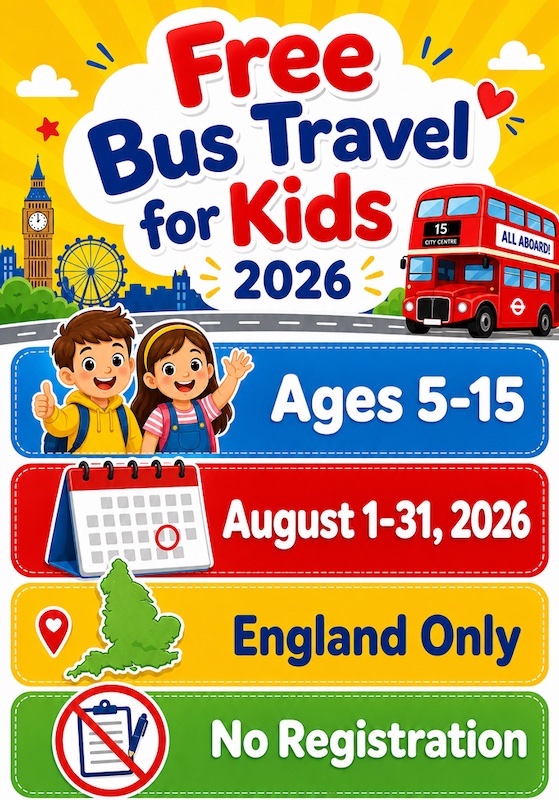
One reader recently commented they’d be interested to read my take on this month’s free travel concession in England for young people under 16 years of age.
So here it is, along with thoughts on the upcoming reduction in England’s fare cap from £3 back to £2 from January 2027.
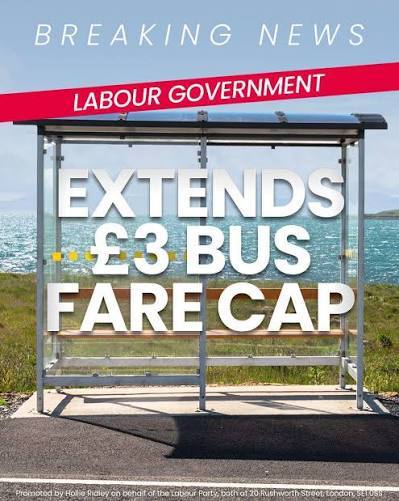
I’m all for using price as a way to encourage passengers. It’s the modus operandi of the retail world and transport should be no different.
The airlines have done it for years – RyanAir’s whole business model is about price as are high end quality retailers such as Harrods and Saint Laurent.
One of the best decisions I ever made ‘back in the day’ (26 years ago!) was introducing the £1 flat fare across Brighton and Hove because overnight everyone (a) knew what the fare was, and a simple price proposition at that, and (b) it made price the headline feature about travelling by bus in the city. It became a talking point. Even those who faced a 25% price increase (the 80p fare was no more) seemed to welcome the simplicity and those previously paying £1.30 were overjoyed. In those days it was a one coin slick payment and captured the imagination.
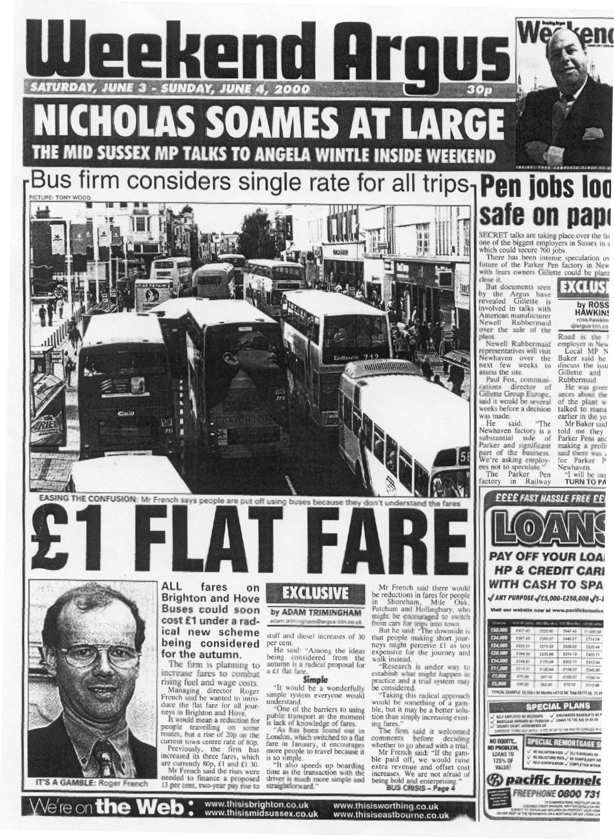
Such was the growth in passenger journeys generated by this commercial price initiative, we were able to keep the fare frozen for two and a half years but had always planned an exit strategy. This involved using price differentials to encourage day ticket purchases over single transactions, ie moving to a £1.20 flat fare and £2.40 for a day ticket, later changing to £1.30 and £2.50, thereby giving even better value and encouraging a greater commitment from passengers. That same principle also applied to encouraging weekly ticket purchases.
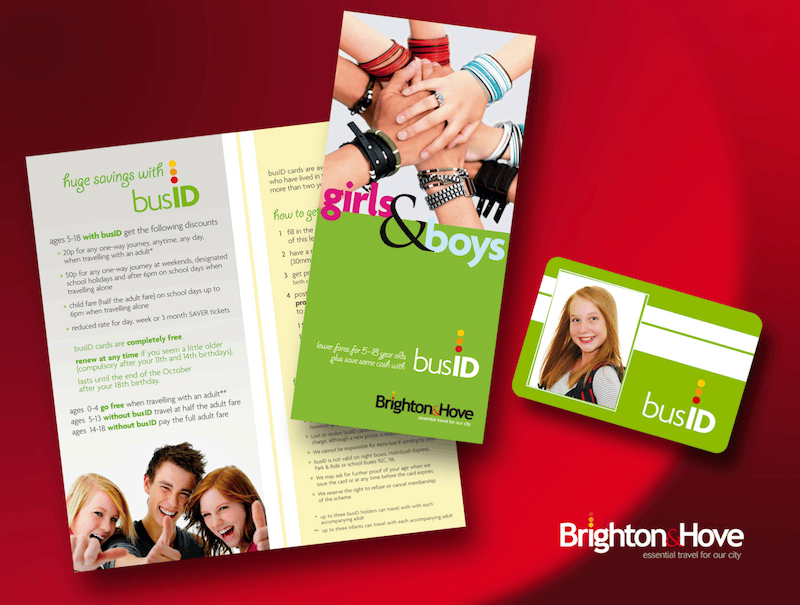
Another hugely successful price initiative was Brighton & Hove’s BusID scheme for young people. This included various fare promotions available to those with a freely obtainable BusID card and included a flat fare outside of school journey times (evenings, weekends and holidays) of 20p and later 50p, as well as an extended BudID+ scheme for 17 and 18 year olds linked to a transition arrangement with reduced priced tickets once card holders became 19 that gradually increased to full adult pricing, thus easing the transition.
All the foregoing is a world away from offering publicly funded free travel. If something is free, there’s no longer a transaction element. It absolves a business from considering the pertinence of price in the ‘marketing mix’ of price, place, product and promotion. Instead it comes down to another ‘p’ – politics.
In some cases it can undermine the value of a product. I have to declare a personal interest that for nearly seven years now I’ve been enjoying free concessionary travel in England and as a regular bus traveller I greatly value the privilege but when I travel in Wales and Scotland and pay my fare I value those bus services even more especially when I know I’m using a great value ticket, the price of which has been determined by the bus company – it makes me feel good about that company and my interaction with it.
It’s why I reckon highly regarded bus companies such as Lynx, Delaine, and White Bus are having no truck with either the free fare for children during August nor the £2-then-£3-then-£2-then-who-knows-what-price-cap, but instead prefer to maintain control over their relationship with passengers through price.
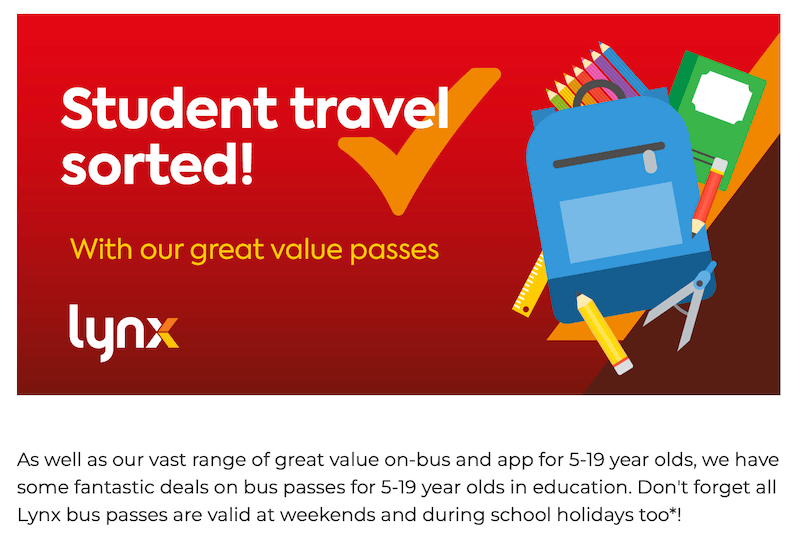
And it’s also no doubt because outside of franchised areas, any Government or local authority inspired price intervention means a business becoming dependent on public funding often involving complex formulas designed to limit the exposure of the authority and transfer some risk to the business without any commensurate influence or control.
Once you’ve committed yourself to free travel, the use of price as a promotional tool is no longer available. This may sound counterintuitive but think about another sphere of purchasing in retail where customers have a perception of how much a product costs – eg milk. If it was instead made completely free to purchase (thanks to a Government policy), consumption of milk would inevitably increase to begin with but it would soon reach a limit by how much milk people wanted in their diet and indeed use might well tale off as people become bored with it and want alternatives – cf. the fall off in concessionary travel for seniors since Covid.
It’s no longer open to retailers to use price as a means of promoting the purchase of milk as price has gone out of the product mix window. The retailers are now dependent on whatever subsidy reimbursement the authorities deem appropriate to pay and as we’ve seen with concessionary travel for seniors this can be insufficient and even put bus route viability at risk.
Now I know politicians and others understandably see free and reduced rate travel arrangements as a social investment as well as meeting environmental and welfare objectives and helping with “the cost of living crisis”.
But I don’t see any undue suffering of passengers who travel with those successful independent bus companies which have opted out of the current schemes quoted earlier. Indeed those companies demonstrate long standing commitments to the areas they serve with regular investment in improvements including their fleets and price offers. They’re not in the business of ‘ripping off’ their passengers with unreasonably priced tickets.
Ultimately if people are struggling financially to afford a realistic ticket price based on the cost of service provision then it might be better to review welfare payments made to such people rather than offer free or significantly reduced rate travel to everyone on a blanket basis. Is the latter really a good use of limited public funding with its poor targeting?
The most extreme case is the current £2 cap in the Scottish Highlands and Islands where, as I’ve reported, journeys in excess of 100 miles for £2 are being funded by taxpayers when many passengers on board, including myself, are well able to afford a commercial fare and are enjoying a tourist visit on holiday. It will be the ultimate irony if Highland Council proceed with their plan for a tax on overnight stays in Inverness while funding those same visitors to travel at a ridiculously low fare to John O’Groats.
There are similar examples in England famously including Leeds to Scarborough where passengers have seen a commercial fare in excess of £10 reduce to £2 then increase to £3 and soon to reduce again to £2.
This all smacks of bus fares being used for headlines and purely political ends. It doesn’t make sense to me that the maximum price of bus travel in England is now dependent on whether the Labour Party decides to change its leader and, therefore, the Prime Minister.
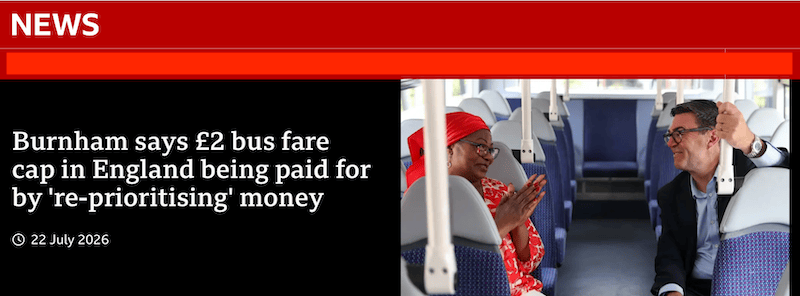
What if there’s another change of personality, will we be back to paying £3? Or even £4? Bus fares now seem to be Prime Minister dependent.
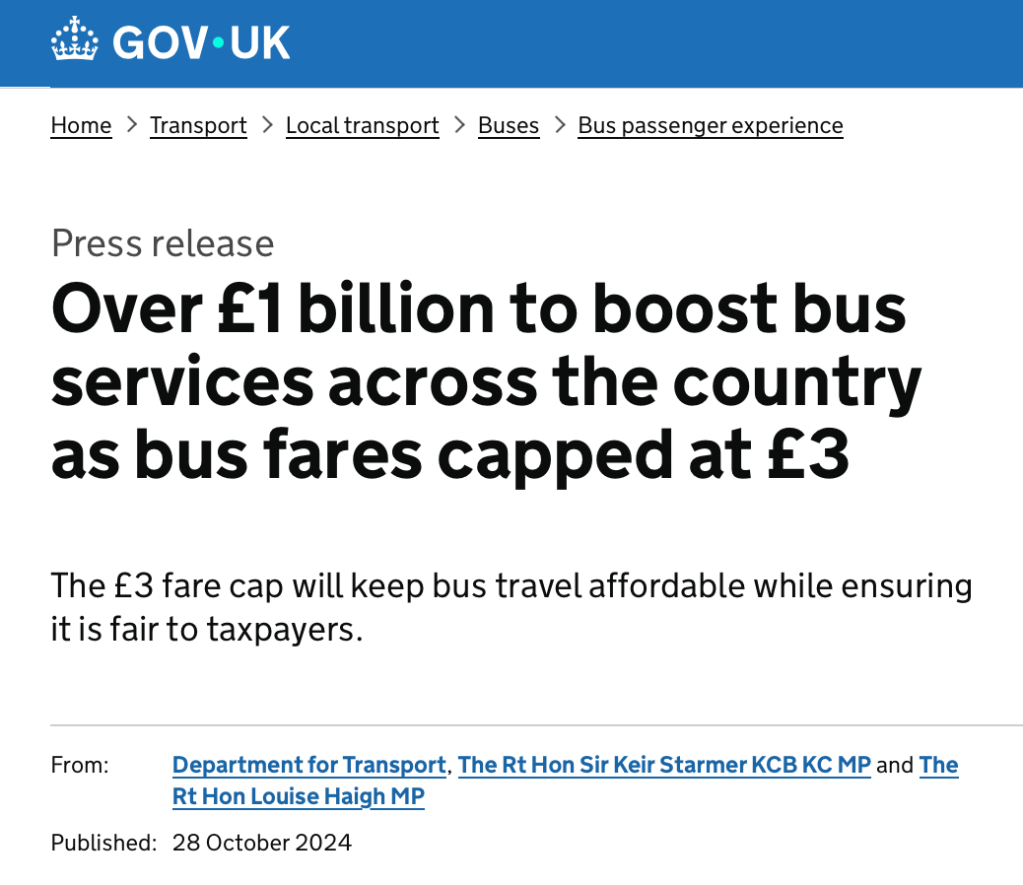
The DfT press release heralding “a third off fares” in July…
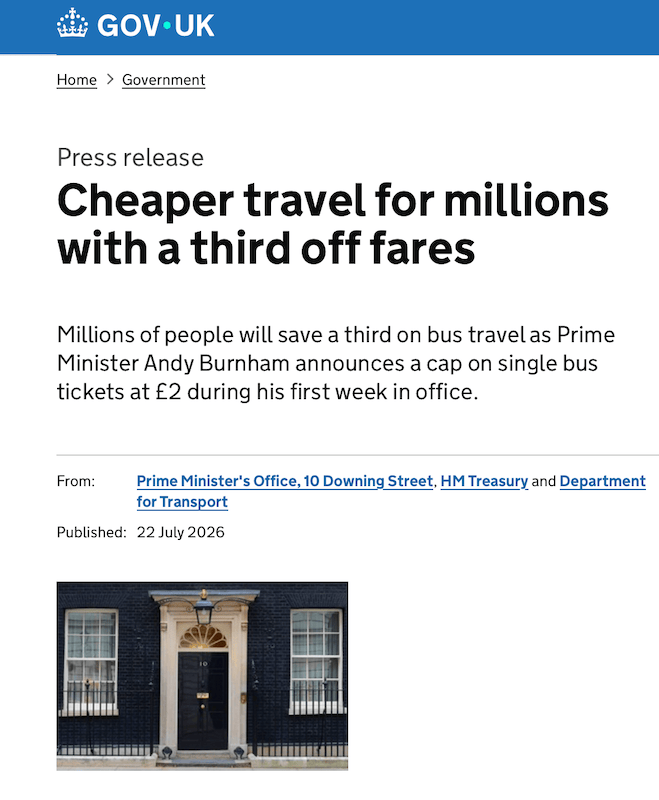
… made for an interesting contrast to the one 21 months earlier explaining why a 50% increase in fares had become necessary. Except it omitted to mention the 50% figure. I wonder why?
As was found in South Yorkshire back in the mid 1980s when that authority’s financially unsustainable policy of an eight year fares freeze finally ended, the subsequent substantial increase in fares that became necessary as the real world finally caught up with those in charge meant passenger numbers dramatically reduced mainly because people had completely lost touch with what a bus fare needed to be for sustained investment and service provision.
The same happened, albeit to a less extent, when the £2 fare increased to £3. And will happen again, that’s for sure.
History has shown the best way for Government/local authorities to use public funding to support bus travel is by investing in infrastructure – for example …. bus priority measures, bus lanes, smart traffic lights, excellent waiting areas and facilities, comprehensive information provision, Park & Ride operations, proper enforcement of parking and traffic offences, control of roadworks and interruptions to traffic flow – all of which will enable the cost of bus provision to reduce with greater productivity and better reliability giving greater confidence to passengers – together with improvements to service provision as has been happening through many Bus Service Improvement Plans.
Far better to spend public money on improving the service than offering gimmicky unsustainable price caps with no obvious exit strategy.
Roger French
Summer blogging timetable: 06:00 TThSSu
 BusAndTrainUser
Sage advice on all fronts! Sadly, the quick policital
headline is now what governs the UK!
LikeLiked by 1 person
Welfare payments are means tested (mostly, thanks to austerity) – often people are left out of these payments when they might really need them (abusive relationships, borderline on the thresholds, etc) when a fair way would to be fund a universal bus fare cap through general taxation.
Whilst there are some good indie companies out there, there should be consistency for people as bus fares are extortionate with young people (who are mostly in full time education) paying over the nose for a subpar product (like £800 for a college bus pass just for some once a day closed route). Of course, some nice indie may market this problem away by driving passenger growth to then be able to cut costs – but it ain’t guaranteed. And people need some degree of stability across the country, with this fare cap going some way in that direction (though not to a large enough extent – it should be £1!).
Carry on sharing your opinion regardless Roger.
LikeLiked by 2 people
I’ve always thought that a price reduction of say 50% would have been a better way to discount bus fares, and remember the original purpose of the £2 fare was to help out struggling people after the strictures of Covid.
A 50% cut would’ve maintained the relationship with existing fares, making any “exit strategy” easier all round.
Also remember that Boris and Burnham were “Metro” mayors, where bus fares were effectively capped already on the “pile it high, sell it cheap” principle … if your bus is already well used, then lower fares are easier to justify. Out in the sticks, that principle doesn’t apply.
I’m 6 years retired now, so I don’t know how the reimbursement of the current flat fare works, but if it is the same as the Covid reimbursement was, then it is no wonder that several companies want nothing to do with it … excessively bureaucratic is a polite way to describe it. All well and good for big companies, who probably had the data easily available, but the smaller firms would’ve needed to employ someone just to undertake this.
And finally … I bet that even the big companies are longing for franchisation / nationalisation … oh to just run bus services with no political interference and no financial risk. Just get your tender price right, and sleep at night once again!!!
LikeLiked by 2 people
Totally agree with Roger’s comments here, the bus industry is being used as yet another extension of social services and passengers now have completely lost touch with the real cost of bus travel, no doubt when they go by rail reality dawns.
And the £2 fare is purely politics, it would be far better to subsidise weekly/monthly tickets as those are the tickets used by low paid workers without cars , because it’s regular passengers the industry needs to get out of their cars.
However cheap buses are people won’t use them more unless the journey time becomes closer to a similar car journey and that’s where bus lanes are vital but politicians are still very reluctant to introduce them. Roger’s recent blog in Manchester showed a road with significant traffic congestion inward in the morning peak, wide enough for an inbound bus lane , where two useless cycle lanes had been marked out to satisfy a small vocal minority of politicians. It would be far more beneficial to have a bus lane, which might actually reduce the number of cars.
We all know the the UK is heading for a fiscal meltdown in the not too distant future, defence spending must rise and the limits of taxation are being reached. What then of the £2 fare and passenger numbers?
As an aside I was totally against the free child offer with no age verification. On a recent journey I travelled on there were 18 free children, 4 of whom were obviously over 15.
However the scheme has been wildly successful with for us a 300% increase in journeys.
It would be nice to think that this will convert some of these youngsters to bus travel but I’m not holding out too much hope.
LikeLike
I’ve heard some older passengers complaining about the £2/£3 fares cap because “it doesn’t help me” while showing total ingratitude for the fact they are given free travel as a benefit and not as some kind of intrinsic law of nature (or even something that they paid towards throughout their working life, given it was only introduced 20 years ago).
I can understand why the government are doing this in order to make headlines, and why the flat fares cap on all services should be a bigger boost to travel than a more complex system with graduated fares depending on how far you travel, even if that would be fairer than paying the same to travel from Leeds to Scarborough as to the end of the street. But it definitely runs the risk of “benefit fatigue” where the psychological impact of the cap lessens over time – even while the actual impact of the cap increases, if fares remain frozen! – while the exit strategy gets harder every year as the gap between capped and commercial fares widens. I worry that capped fares will stifle improvements, as operators will be restricted on how much they can grow their income by offering more frequent services or a higher quality product.
I would have preferred to see the money going into stronger welfare payments for those who need the financial support (including widening the scope of them), more funding for BSOG or fuel duty rebates to allow bus operators to increase commercial services and reduce commercial fares, and more investment into infrastructure to improve bus priority and the passenger experience. But that wouldn’t generate the same headlines!
LikeLiked by 1 person
The fares freeze in South Yorkshire didn’t end because it was “financially unsustainable”, it was due to a political decision by a Tory government as part of its deregulation policies, which prevented fares subsidies by local authorities.
Perhaps you could take a trip to Luxembourg and report back on that country’s universal free bus and train system? That would make interesting reading.
LikeLiked by 2 people
isn’t Luxembourg smaller than London?
LikeLiked by 1 person
Significantly smaller – according to Wikipedia, the population of Luxembourg is 693,916. Greater London has a population of 9.1 million, so more than ten times that of Luxembourg!
RC169
LikeLike
So Luxembourg about the same population as Cardiff and a couple of the adjoining valleys area which is probably a better comparison.
JBC Prestatyn
LikeLike
But not smaller than Sheffield.
LikeLike
The best decisions are made when (a) a variety of opinions are expressed and (b) there is appropriate supporting data. Keep up the good work!! RC
LikeLike
Well said Roger!
Government intervention in fares is a public policy decision, and an easy option for politicians.
Concessionary fares need to be properly funded, or they have unintended consequences which can be damaging to passengers and operators.
Fare caps are exactly the same.
Governments always claim they struggle for revenue funding but less so when they are looking for capital.
Why then can they not tackle the real issue, which requires capital, and address road space allocation to give buses priority over other vehicles, to create consistency of journey times and make the whole proposition much more attractive and compelling for passengers?
This is what would make the real difference, regardless of the regulatory or ownership model, but politicians are generally not (to date) brave enough to upset the car lobby.
And not just on urban roads, motorways and trunk roads need attention too if we are to maximise what can be achieved for the public, the economy and the climate through bus and coach services.
Even in Manchester, this has been the major failing of the much lauded Bee Network, and just look at what has been happening to bus speeds in London over the years.
Forget political gimmicks.
Congestion and bus running speeds need sorted!
So well said Roger!
RA.
LikeLiked by 1 person
Schools in Leicester have always had some of the earliest holidays in England. They return next week on Monday 24th and some school bus operators run services which effectively operate as relief to the local stage operators First and Arriva who will be carrying children free for the first week. Meanwhile the school buses will have to charge half the capped fare at £1.50. There’s concerns that for the first week the children will opt to travel free, possibly arriving at school late, rather than catch their dedicated school services paying £3 per day. As no money is available from the government pot for dedicated school services this is a worrying week for the local private operators., Paul from Leicester
LikeLiked by 1 person
The evidence base supporting this level of expenditure is very weak. The ScotRail off peak abolition and the various TfL initiatives have all failed to pay their way, and it’s almost impossible to disentangle whether the original £2 freeze worked given it coincided with the post Covid recovery and the absence of a control group. Even if assume that the purpose is to reduce the cost of living and improve access to education / employment a measure which offers the greatest savings to leisure travellers is very poorly designed.
LikeLike
As an aside, but sort of still relevant, I got on a public bus in Switzerland yesterday where the fare was £30. Each. To go 45 minutes up a valley.
Needless to say we got off again! There’s a sensible middle ground here somewhere…
LikeLike
And yet I paid just over £50 for a one day Swiss travelcard valid on all public transport in Switzerland from 00.01 on the day until 5.00 the following morning. This very August.
LikeLike
If the UK had a proper pro public transport policy and £2 fares were part of that to encourage the shift, but one does not exist and we are putting more and more levers into the hands of politicians who are becoming less and less competent over time and more and more interested in grandstanding. Another Burnham bus giveaway announced this morning.
LikeLike
Thanks Roger for a balanced summary I agree with. However, I am not an industry participant so would welcome some clarifications.
On “Bee” networks and similar, are the service providers subsidised or paid a fixed amount with the authority keeping revenue. I would imagine the latter makes a capped fare easier and a capped fair might incentivise the use of “Bee” type networks.What happens where a rural commercial service that can not afford to operate a capped fare of £2 runs into a town/city and competes for the last few miles with capped fare operators? Presumably they lose any revenue for the last few miles and become uncompetitive. Or can they cap to a boundary?
Ultimately, as you say, what is needed is investment in priority schemes etc etc which are seen as a “war on cars” and are a vote loser.
LikeLike
What happened with the Mayor’s Fares in West Yorkshire (which were capped before it was cool) was that cross-border buses charged the capped fare for journeys entirely within West Yorkshire and commercial fares on the rest of the route. I don’t know exactly how the funding worked, but I assume they were compensated in the same way that local operators within the region were … it shouldn’t be difficult when they’ll know how many journeys were made where the cap applied.
LikeLiked by 1 person
all this talk of bus priority… is there another industry that expects a government subsidy (funding for bus priority) to enable private companies to generate more profit?
LikeLike
Yes, the Green energy lobby.
LikeLike
Gas is also effectively subsidised and protected in electricity generation. A little known fact not often mentioned in discussion about green energy subsidy – but your point is correct.
LikeLike
Dale Vince talks about the gas link all the time. He wants it gone.
LikeLike
Farming
Steel Making
LikeLike
Airlines which don’t pay tax on fuel.
LikeLiked by 1 person
The entire road haulage industry, since they in no way cover the costs of the roads they use.
LikeLiked by 1 person
Dear Roger,
How I see it – ‘Rightly or Wrongly’ – is that Public Transport, Buses and Trains, should be a PUBLIC service….meaning that they are affordable to EVERYONE, therefore you ‘encourage’ them to use ‘the bus in the high street’, the ‘train to the town’ – EVERYONE should use them, because they contibute to to making a safer and more healthier environment!
Kind regards,
Ben Walsh.
LikeLiked by 1 person
Its all very well capping fares at x amount, but if the operators are being unfairly reimbursed for the capped fates, then it is surely detrimental to the bus business being used by whatever political party as a political football.
LikeLike
👍
LikeLike
As always Roger, a really interesting read. And something that’s very close to my heart given that our retail pricing strategy sits within my remit.
I agree – These fare caps appear largely politically driven (rather than commercially driven), but from my point of view, it’s given us a really good opportunity to test the theory that so many subscribe to: The one that says that flat, cheap, bus fares will drive growth and reverse the national trend of declining bus usage that many (although not all) areas of the country have seen.
My own personal view is that these fare offers are unsustainable in the long term without an ongoing funding plan or exit strategy. Yes, the £2 cap did align with a time of growth for us – somewhere around 5% across our whole network (That is, if you can fully detach the £2 cap from the Covid pandemic recovery which was still happening at the time it first came into play) – But that’s nowhere near enough to make it commercially viable in the long term. And whilst we saw some significant growth in long distance journeys, the vast majority of our passengers – around 90% – only travel within our urban areas (for those in the know, our citySAVER or Metrorider zones). And we really didn’t see much growth on those journeys at all. Most of the growth was on our interurban routes, which is great for passenger numbers on these essential services, but doesn’t do much for commercial viability on routes which tend to cost operators a lot to run, without regular bus stops en route with high concentrations of passengers wanting to board.
But when the national fare cap went from £2 to £3, we actually saw a slight drop in adult fare-paying journeys. Which I can only assume is because the market was so shocked by a 50% increase in price, they didn’t want to tolerate it. Which to me, sort of defeats the point of pouring millions of pounds of tax-payer funds into a fares scheme which can’t be sustained in the long term. And irrespective of what operating model buses are being run under (franchised or deregulated), the costs largely remain the same. Fuel costs the same, depot overheads are the same, staff wages are the same, and vehicle procurement costs are the same – As a result, I still need a bit of convincing that this heavily subsidised fare cap is the right thing for buses and bus users as a whole.
So I tend to align with you on this. Simple fares help drive growth, but unrealistic cheap (or free) fares do not. If there’s money to be spent, I would personally prefer it to go towards infrastructure projects such as bus lanes, bus priority and properly joined up real time information systems. That would help us to improve the robustness of our timetables and the ability to rapidly disseminate information during times of disruption – Which makes travelling by bus as reliable and as quick, if not quicker, than travelling in a private motor car. If we can tackle that, we can overcome the culture which has been built over many decades that the car is king.
LikeLiked by 1 person
Many thanks for these interesting thoughts, Luke.
LikeLike
The reluctance to gain significant extra passengers when fares come down I noted in working at NBC in the 80s including previous literature. With selected fares reductions AND good marketing of it in an area there would be an uplift but generally not enough to exceed total previous revenue. when fares went up in real terms ( and cash terms ) there was a reduction in numbers travelling or people making fewer journeys.
In Oxford the numbers travelling depended on if it was raining in the morning or not and was less fares sensitive.
JBC Prestatyn
LikeLike
JBC,
This was also noticeable to me as a passenger in Birmingham back then.
Weather has a definite impact on passenger usage, not only on tourist services such as seaside open-toppers.
LikeLike
An interesting debate and as Roger notes price is a key element of the marketing mix which is often now augmented by a customer service factor.
If we had younger people responding to the discussion, the dialogue might be very different. Paying £6 a trip for a lacklustre offering is not very appealing to a potential future market segment. The 232 Daffodil Line, a rural hourly service between three market towns in Glos/Herefordshire, has always had a max fare of £2. In a survey undertaken a couple of years ago the level of use by those who had access to a car on the day of travel was approx 40%. Thus, the use of price has helped to effect modal shift so sorely needed in traffic congested small towns.
Talk of gimmickry is too simplistic. The debate needs to be fuelled by research into the world of the passenger and how such schemes might change attitudes, patronage and maintenance of a passenger transport network.
LikeLiked by 1 person
Did I detect than local schemes of the past always seemed to be cheapening the service on offer ? Maybe it was me but Harrow Buses and Bexleybus acquiring sometimes secondhand buses in somewhat tescorised liveries didnt speak of quality , even Ipswich vehicles and boroline Maidstone 188s and similar just didnt seem right. Yet in Bornemouth both the Corporation’s Yellow Buses – even the old ones, and Hants and Dorset (red) and later Wilts and Dorset red and black liveries seemed more quality. Today Manchester’s Beeline doesnt quite cut the Mustard to me , maybe just adding a relief band of the old municipal colours might help ?
PS – I think that Inspired project for a First Kernow fleet was really impressive particulary the between decks route brand panels.
JBC Prestatyn
LikeLike
Bournemouth. Hants & Dorset were Green & Cream up to the early NBC days. It changed over to Red & White thereafter as a sop to the original Wilts & Dorset that had been absorbed by H&D in 1972. The new Wilts & Dorset company came about in 1983 adopting the previous H&D poppy red & white albeit with black lining. Bournemouth Corporation buses were primrose yellow with maroon bands lined out in green until the transition to the Yellow Buses branding, first with brown fleet names then blue. The lighter shade of yellow was subsequently introduced & remained so until the company sadly went into liquidation in August 2022.
I agree that the Manchester Beeline yellow livery is somewhat bland when compared with say, the new Merseyside yellow, black & grey colours. Then, like so many things in life, it’s all a matter of personal taste.
LikeLike
Did any H and D get NBC Green before merger ? Did the shade of Green change when NBC took over in 1969? Wilts and Dorset original red was darker than the Poppy Red but to me the colour contrast in Bournemouth between the Yellow fleets and the NBC Red was very much a set of complimentary colours of town services and country area services that worked when seen together . I had a photo – sold years ago and never reprinted of a Green Bristol LD something at The Square bus station would that have been an end of a long Western National service from somewhere like Dorchester ? (I dont think it was a Bristol from Bath)
JBC Prestatyn
LikeLike
Good questions JBC. H&D. Shade of Green didn’t change after NBC took over but the gold underlined fleet name changed to cream in NBC style prior to Poppy Red being steadily introduced from 1972 onwards. There were a number of vehicles in NBC green during the 1970s. Six convertible Bristol VRs were swapped with Southern Vectis, forty two Bristol LHs were acquired from Bristol Omnibus and a number of Bristol REs were transferred from Provincial (under H&D management) in 1980. There were probably one or two others in NBC green that were transferred in.
I don’t personally recall either Southern or latterly, Western National operating Lodekkas in from Weymouth, they were usually single deckers such as Bristol MWs or REs, however, I dare say the odd SN/WN double decker would’ve strayed onto the route as H&D certainly operated Lodekkas & VRs in that direction.
As you say, these colour variations mixed with Bournemouth’s yellow livery, certainly brightened up the town. Halcyon days!
LikeLike
A further comment as my email brings news of Mobico selling their WM bus business for £24m https://www.mobicogroup.com/media/news-releases/2026/proposed-sale-of-uk-bus-to-the-west-midlands-combined-authority/ Ultimately £24m is the same as the cost of revamping Dudley Interchange, compares to the £650m of the Dudley metro extension and the £400m one year incremental cost of a England-wide £2 cap. Put simply there is no money in bus operations and they are squeezed via creeping state control via caps and local authority control.
“The Transaction significantly de-risks the Group from the potential to lose market share in the forthcoming franchising process, crystallises value for its assets today broadly in line with book value, whilst providing a clean transfer of the Group’s operations, employees, cost base and other liabilities.
The Transaction provides WMCA with full control of the network, assets and operations of the business, significantly de-risking and facilitating the path to franchising in the area.”
Sorry if off topic a bit
LikeLike
Not off topic at all John. Thank you for the update as this announcement clearly puts the running of West Midlands buses back into British ownership. It’ll be interesting to see how the WMCA develop their franchising model from 2027 onwards & what livery is adopted.
LikeLike
This is not off-topic at all.
Mobico is selling off their bus operations to the WMCA because, like with BET Plc’s sale of their bus operations in 1967, they have been consistently threatened with “regulation” and what effectively amounts to theft of their property with no reimbursement (nationalisation) [threats from parasitic politicians], and so they’ve just sold out to the state before any real damage can be done to them.
West Midlands tax payers are soon to be on the hook for over £100m worth of liabilities, and a network of bus services which is largely unprofitable, being propped up by a small network of highly profitable bus services. This could have all been avoided if National Express had just ignored demands for the implementation of a “Fares Freeze”, the electrification of bus depots and services, and the numerous other government policies which led to the majority of their bus network being unprofitable or break-even.
No doubt that now that the NXWM company has been sold to the WMCA, their plans for bus franchising will be scrapped, seemingly as politicians now control the entire bus network.
LikeLike
Nice fantasy, but the reality is that Mobico’s bus operations have been slowly becoming less profitable for decades from the highs of the early 90s when West Midlands Travel Ltd was hugely profitable.
WMT staff have been saying for a long time that National Express Group (as it then was) was looking to get out of WMT (t/a NXWM), in fact since well before the sale of the Dundee operations.
It was only a matter of time before Mobico exited UK bus operation regardless of the regulatory regime, and it’s looking more and more likely that the UK coach operations will follow in due course.
My take is that, just as Badgerline Group’s “merger” with the Grampian Group was in reality a takeover by the Scottish company, National Express Group’s “merger” with Alsa Group was in reality a takeover by the Spanish company and the combined group has been looking for an exit from the UK market ever since.
LikeLiked by 1 person
I totally agree with your analysis. Mobico’s debt mountain of £1.5 billion no doubt contributed too.
Let’s hope that the WMCA, in the fullness of time, provides bus users with the services & reliability that they deserve.
LikeLiked by 1 person
If you want to reduce fares, why not offer financial incentives to bus operators so that they can reduce their costs and cut fares appropriately. Thus, increase the BSOG or whatever it is called these days. Offer free installation of EV charging points. Offer heavy discounts on British built EVs – that would help employment in Scarborough, Falkirk and NI etc and reduce the flood of cheap Chinese products.
This would have the benefit of reducing pollution, offering a better product to passengers (quieter journeys), and improving employment rates.
MotCO
LikeLiked by 1 person
There have been such incentives , I think mentioned in blogs earlier or their comments enabling at risk routes being able to be continued with new buses
JBC Prestatyn
LikeLike
Re free fares for childten. I’ve often wondered if, having given children free bus journeys, they get used to not paying, and don’t see why they should pay when they reach the age limit and thus evade fares. Does free child fares lead to adult fare evasion?
MotCO
LikeLiked by 1 person
Probably . Kids for a Quid would have been a better promotion, perhaps with a seven day ticket go anywhere for £5 on smart card with a 16-20 card avalible for £10 on app only ?
JBC Prestatyn
LikeLike
the same happened in London in the 1970s when the child fare was generally 3p. When we reached 16 we continued to pay the child fare for as long as we could get away with it!
LikeLike
Ahh , but short stage fares were 2p. there were various ways to turn a 3p journey into a 2p one , some involved walking , others the use of the AFC machine
Were not the fares later A and AA in the non financial tickets that came later?
JBC Prestatyn
LikeLike
Long live opinions on this blog!
I agree on some of Roger’s points, not least paying a fare provides a sense of value. I guess this why Cambus in the 90s placed ’20p where sold’ on their network maps even if most were given away – it showed that someone, somewhere would be paying for it and less likely to be consigned to the bin after the initial read.
If I recall my A-level Economics lessons correctly, bus travel is seen as an ‘inferior good’, I.e one whose consumption doesn’t rise with an increase in the earnings of an individual user. This is a problem and leads to a perception of poor value for money of bus travel. There are thousands out there who happily spend £20 on a couple of coffees and cakes at a high street coffee chain but baulk at paying £5 for a bus trip into town.
I’m also not convinced that bus companies always get it right with their pricing strategies. Stagecoach had a policy (albeit 20 odd years ago) of having very cheap multi-journey tickets which were clearly subsidised by very expensive day single and return tickets. Great for regular users, not so much for the occasional traveller who come away with the impression everyone pays this fare everyday.
A fare cap not only has obvious benefits for its users, but given some operators have stated a reduction in patronage when the fare cap increased to £3, perhaps £2 is the optimal price?
Dan Tancock.
LikeLiked by 2 people
Dan , indeed sort of , the aspiration to use a car rather than bus was part of the economic problem. However other parts of the marketing mix of promotions and an upgrading of vehicle presentation , livery and newness can overcome the time and price reluctance to decide on making bus journeys.
I am sure in places like Epsom there is scope to revamp the Bus offering to more places under a decent network brand that should reduce the more constant use of car journeys in preference as the present offering is too few journeys and none of them advertised as integrated network fares.
JBC Prestatyn
LikeLike
20p was an incentive for newsagents etc to stock them, they just kept the 20ps as revenue for the shelf space they took up
JBC Prestatyn
LikeLike
I like the READER ALERT announcement Roger. Although my wife and I both have 4/5G compatible phones, neither of us received the government signal, I’m pleased to say. Why? Because like many others, we’re fed up with the creeping nanny state telling everyone what they should or shouldn’t do. Whatever happened to personal responsibility?
Similarly, when it comes to bus fares. Until the state actually own & run bus services then the matter of fares should either be the responsibility of the bus companies themselves (as demonstrated by Roger’s experience with Brighton & Hove) or the recently set up franchising authorities, not politicians (even though they encouraged the latter).
Buses have become a convenient political football while deflecting people’s attention away from the really important issues facing the country that government is still not addressing. As for the many calls for more subsidies or handouts, just remember the country already has a debt pile of nearly £3 trillion and counting.
LikeLiked by 1 person
Franchising authorities are political. Groups such as We Own It have made the point that they are ‘democratically accountable’, as there is the opportunity to vote councillors out of office.
LikeLiked by 1 person
Quite right, I should’ve worded those particular comments differently.
LikeLike
The irony is that ‘Capitalism’ is democratic by default, meaning their entire points are moot.
In the same way that people will complain about a supermarket “scamming” customers with high food prices, there is simply nothing stopping you from setting up your own company to compete, well for buses there wasn’t (outside London) until the passing of the Bus Services Act 2017, and the subsequent launch of bus franchising in places like Lancashire (Manchester, Bee Network).
LikeLike
Thoughtful argument and I do agree with it, if there is money to spend then spending it on infrastructure is a good thing to do. It can’t be the only thing though. I was talking to a relative in County Durham about whether the fare reduction would cause him to shift from car to bus from work and he said no. His reason was simple, the last bus from near his work to near his home was at 5:30 pm and he could never guarantee that he would be able to leave his office in time to make it. The local operator won’t add any later journeys because they don’t believe that they would be profitable. So diverting some resources from capping fares to supporting later journeys would be the only way to encourage my relative to use the bus for work.
David Potts
LikeLike
Thanks David for pointing out my continued going on about later journeys 1800 1830 1900 1945 2030 2200 2315 as useful departure times from many places Roger has featured. Problem in England is darker and colder evenings (after this heatwave I am sure there will be two cold snaps going into 2027)
These times also apply to TfL where some routes manage not to run after times when council meetings are still going on or for London frequencies dive to 20mins or less which is a real pain see interchanging around Crystal Palace as examples the semi trunk route 157 on 3bph is ridiculous.
JBC Prestatyn
LikeLike
@JBC Prestatyn
On TFL and 20 minute frequencies, that is when they need to follow the exact timetable. Missed the 217 a couple times at Turnpike Lane late at night and had to wait the full 20 minutes to the next one as it decided to leave minutes early. Not good enough! Had similar difficulties in Slough on the 81 last night and decided to get a train instead. All because they don’t seem to go when advertised.
Aaron
LikeLike
There are a lot of drivers and controllers that take advantage of the Contract of -1 or 2 mins early running departures , this should never be allowed if departing from a bus station or first stop on a route same with train early departures (yes close doors 30sec before departure but not more than that then leave platform before WTT) On bus ones though you will find that having got too far ahead of schedule the route IS controlled back with the bus marching time at some stop to the annoyance of passengers on board who just want to get to their destination )
JBC Prestatyn
LikeLike
This is my issue as well, although thankfully not as early as 5:30pm, more 7 to 8pm, which is still too early! After that just 1 bus an hour for a town of 48000 until 10:40pm. Basically unusable. We get 8 trains an hour with the last train leaving London just before Midnight, the contrast is massive!
Until austerity, we had a handful of buses every hour until 11:30pm. We need these sort of services restored otherwise a £2 cap and now the removal of time restrictions on disabled bus passes (never an issue in Herts) are a bit meaningless. The 2010s saw so many bus cuts and despite some improvements in recent years, still a long way to go to getting an actually usable service across the whole day. Late evening, night and weekend bus journeys still leave a lot to be desired. As does the lack of local integration with rail services.
Aaron
LikeLike
I don’t very often disagree with Roger but I believe the £2 fare cap is a good move. As a passenger I don’t care whether it is a commercial initiative or a Government incentive. If it gets more people on buses it must be a benefit to the industry. Of course it should be combined with other improvements, eg bus priority and reliability and London shows that bus usage can go into decline with cheap fares when buses become slower.
Rail travel has always been subsidised and the fuel tax for cars has been frozen providing an effective subsidy. The sums involved for bus fare subsidies are tiny in comparison and I’m glad the Government is taking an interest in buses.
LikeLiked by 1 person
Not sure I agree with “it must be a benefit to the industry” … it’s only a benefit to the industry if it’s properly funded by the government. If it is then great, let’s fill our boots and make the most of the opportunity to grow ridership and attract people out of their cars. But if the funding is insufficient then that leaves the industry to pick up the shortfall, which is likely to least to cuts to services and standards, and in the best case scenario a stagnation with no growth or improvement on the cards.
LikeLike
The main advantage is not the fare but the simplicity of knowing the cost in advance. This was something that was beginning to be addressed in apps and was the number one question from potential users. It also helps with speeding up boarding times.
The issue with the cap has been no exit strategy or one to gradually increase the cap to bring it nearer to commercial levels. The other problem is with reimbursement for operators, as with the ENCT scheme, means that with capped revenues and rising costs it is no wonder that operators are more favourable towards franchising which relieves them of revenue risk.
Both London and Sheffield used deliberately low fares to encourage bus use to avoid spending millions on urban motorways. This is fine with high passenger numbers but is not sustainable elsewhere.
Unfortunately, in a pro car country like the UK it is extremely unlikely that we will see any change in policy anytime soon!
Richard Warwick
LikeLiked by 1 person
White Bus are part of the Oyster Match deal that SCC and TFL have done. on their cross border services where TFL routes run. White Bus & Falcon match the fare on the K3 between Kingston & Esher of £1,75. Same happens on FBs 461 between Kingston & West Molesey, and Metrobus’s 420 between Sutton & Banstead M&S.
LikeLike
Oyster match was originally a commercial initiative by Abellio Surrey that lives on, in part, on some of the routes now run by White Bus and Falcon. It doesn’t have any input from Surrey CC or TfL but was designed to try and get potential passengers who might have let an Abellio bus go past to board it in preference to the cheaper parallel TfL service. Of course it was never perfect (there was no fare capping, for example) but it was better than nothing. Its scope has narrowed over the years – whilst Hallmark offered an Oyster match on the 555 between Heathrow and Sunbury Cross (until it joined the £2 fare cap scheme) White Bus does not so passengers on this corridor now pay significantly more than before.
LikeLike
As the person who left the previous comment about u16 fares, thank you for your response Roger.
LikeLike
I think the fare cap reduction back to £2 is quick political fix as part of an effort to actually ease the cost of living pending the next budget.
Going forward I agree with those who say infrastructure investment should be prioritised. This would speed up buses, reduce operating costs and raise productivity as buses become more efficient. Perhaps as more franchising and enhanced partnerships convening the relationship between infrastructure and operating costs will be more apparent to politicians?
Politicians also need to be honest with the public about the climate emergency. The World is currently burning, next winter it will probably be drowning. All because humans are chucking filth into the atmosphere.
Therefore we cannot expect to our daily lives to stay unchanged. This means less driving, more walking, cycling, e-scooters, and buses, combined with sensible planning policies to reduce the need to travel in the first place. So yes, “15 minute cities” are what we need. Everyday essentials available locally plus safe walking, cycling routes and buses to access town centres, hospitals, education, jobs etc.
Policies like this also improve wellbeing and quality of life as people actually see each other locally (as opposed to jumping in their car and driving away) and experience a sense of place, trust increases, communities are created.
The bus industry stands to gain from such a change in way of life. Jobs in the car industry can be transferred to UK bus manufacturing. Towns and cities would become much more pleasant as car dominated infrastructure is replaced over time as we no longer use cars to the same extent as now. Imagine all that surface parking in town centres waiting for more productive use.
Pete
LikeLike
Whereas I personally agree with your sentiments & solutions to present transportation problems, we don’t live in a bubble. All the major industrialised nations need to follow in order that we can, together, address the damage being done to our planet. Sadly, there doesn’t seem to be any commitment from these nations to take the future of the world’s children or their children into account.
This situation tends to put everything else into perspective.
LikeLike
Sounds like communism. No thanks.
LikeLike
Off Street Surface Parking tends to be temporary in nature and does actually give some light and airspace to localities which I think is needed – building on every square inch is not good, that said a while back in Doncaster a big box set of retail stores near the racecourse with its parking was demolished being replaced with landscaping and some good sized family housing units as retail was being encourage back into (the close by) town centre.
JBC Prestatyn
LikeLike
Perhaps we should turn to , and look for Roger’s expert advice on, the extension nationwide in England to free travel for disabled persons. I would hope that places like hospitals would continue to provide appointments outside of peak hours though , simply as many disabled travellers – and those with an approved escort / assistance animal are going to take up substantial space which might be a challenge at peak hours. That the scheme is not due to start to 1st April 2027 actually shows that network planning , adjustments or enhancements to bus times and running schedules and the design primarily of lower deck saloons is going to be needed along with how this fits in with DRT and other flexible route provision along with a real return to operators at something more than marginal cost of capacity. Manchester’s single entrance double deckers can take two wheelchairs, London’s dual doors cannot ( oddly the single deck things that are used on the 470 and K5 in London actually can carry two wheelchairs which is handy for some folk ).
As an attempt to increase economic growth by improving the participation of disabled in the economy that Political P has to be commended.
JBC Prestatyn
LikeLike
The front destination display on the apparent Routemaster promoting the Kids scheme is interesting I dont think such has ever appeared on a London Buses bus with the exception of the Dennis Loline? experimental bed for a new bus chassis that ran on the 27 from V in the late 1970s.
Overall the kids scheme is confusing as the DfT web information was not comprehensive and AI queries have actually managed to summarise fairly well from major operator sites. Some appeared to put restrictions on children travelling without an adult at certain ages , others wanted various proof, others demanded that a ticket must be acquired per conditions of carriage – this would be issued at nil fare which would help with statistics. Arriva’s website I think is good suggesting standards of behavour and encouraging other safe travel to interesting places in an easy to understand english. Stagecoach was a bit more stilted in it and both websites were pretty good at stating which routes were not participating including for one a couple of DRT services which I assume were local authoritity contracts rather than commercial so that is a bit of a query
JBC Prestatyn
LikeLike
The experimental bus that ran on LT Route 27 in the late 1970s was a Daimler CVG6LX/30 with a Roe body. The purpose of running this in London was to test the combination of Gardner 6LXB engine & Voith gearbox as part of Dennis’s development of the Dominator.
LikeLike
I’m interested in how much the operator is at risk from this. Unless the increase in passengers offsets the reduction in fare revenue we may well see reductions in mileage operated. I realise this may be commercially sensitive but do you have any understanding of the actual amounts reimbursed. For example the single fare on Metrobus routes between Burgess Hill and Brighton is £4.60. Do have any idea how much Metrobus will be reimbursed for each journey now charged at £2 ?
LikeLike
No one knows. You send lots of data to the DfT and get offered a lump sum back.
Funding is cash limited, so if more people travel than the DfT has budgeted for, operators don’t get any more money, even though they are supposed to be “no better not worse off”.
LikeLike
If more people travel than expected then it shouldn’t be a problem, because the operators’ shortfall will be lower – it’s if ridership is lower than expected that things start to get tricky.
LikeLike
Whenever a business takes government money then ultimately it concedes control over its own destiny. But the lure of subsidy is very hard to refuse!
I would be interested in the percentage of typical bus company revenue that directly comes from the amounts that passengers pay as fares versus the various government payments. My guess is that the latter are well over 50% and maybe even two thirds.
This also means that franchising or even nationalisation is just a logical extension. If the public purse is funding the service then the corollary is that government calls the shots and determines the level of provision. Why allow competition between operators when it is all funded primarily by public funds anyway?
I remember well the pre 1986 era. It was not the nirvana that many people want to think it was. Nor has the post 1986 era been a nirvana either, although I do think that privatisation may have saved the industry at the time. But it might have outlived its usefulness now. Increasingly, the direction of travel is towards more government control of the industry, whatever we might say here. Buses will follow the railways.
A thought provoking piece,
Stephen Easton
LikeLike
Anon @ 2.34pm … the principle is that operators should be “no better or worse off”. So, if the fare should be £4.60 and actually is £2.00, then the company “should” receive £2.60.
However, something called a “generation factor” is applied, which for arcane reasons (back to 1986) is around 70% … this assumes that 30% of passengers would not have travelled if the full fare was charged. That £2.60 is discounted at 70%, so the actual reimbursement would be around £1.80. Assuming that no extra resources (extra trips or buses) were scheduled, companies generally accepted this as being fair.
However, in many cases, because of LTA financial restrictions, that 30% discount is closer to 50% now (sometimes even greater). That nominal £2.60 reimbursement now becomes £1.30 … that is a BIG discount on the £4.60 expected!!!!
Add into that the cost of claiming the money is why smaller operators reckon it isn’t worth taking part in the scheme (and it is still voluntary at the moment).
Sorry this is so long, but it’s worth spelling it out. Hopefully my maths is about right … if not, perhaps a current industry insider would be good enough to explain further??
LikeLiked by 1 person
Of course, that £1.30 should be added to the £2.00 cash fare received, so the operator would receive £3.30 instead of £4.60 … still a pretty big discount!! Apologies for the confusion … but this has been the simple explanation!!
LikeLike
greenline727 – thanks for explaining. If my maths are right you need to get a 40% increase in volume just to stand still. I can see why not everyone wants to be involved.
LikeLike
I have written on this topic in my BUSES Magazine column, and I have similar views to Roger.
It is interesting to compare policy in the 1970s in South Yorkshire and Oxfordshire. SY policy was centred around fare subsidies, and did not survive the contraction of local government budgets. Oxford pursued a ‘Balanced Transport Policy’ of traffic restraint, bus priority and park and ride. 50 years on, bus use is much healthier in Oxford, than SY. These traffic policies were an actual “investment” that generated recurring advantage for bus passengers terms of faster journeys and lower operating costs, and hence fares.
The SY low fares were abandoned when the money ran out – meaning when HM Treasury cut off the supply of grants to the relevant local authorities. The ‘deregulation’ of local bus services was part of a wider policy to reduce spending, and repair the public finances.
This variance between the cities is not solely a product of bus policy variance, but also reflects the much stronger employment and retail situation in Oxfordshire, and higher GDP per capita.
It is also not clear why a policy of ‘devolution’ should involve the PM setting bus fares in local areas.
My overall concern is what happens when these subsidies collide with the UK’s deteriorating public spending situation – this is essentially what happened in the 1976-1986 period. The situation in 2026 is arguably worse, with higher taxes, public spending and debt.
David Leeder
LikeLike
SYPTE probably the fares were too low. but you are comparing a single city with an area of effectively four cities three towns and a substantial semi rural area around and between them. Oxfords main internal corridors – Wheatly/Headingly and the Kidlington Route could be enhanced and controlled it was more difficult from Abingdon and the South and the independent rurals of Charlon on Otmoor and similar needed to benfit from the bus priority – which they did , it always seemed difficult to get much out of the Witney corridor and perhaps with generally higher incomes there was less response to a lower fares policy if one had been pursued. The big employer at cowley obviously had an impact.
In South Yorkshire I am not sure but I presume Yorkshire Traction had a lot of contracts direct with the National Coal Board which either gave miners to from work a low or free fare – that was the case in South Wales but as the collieries closed the income dried up and the specific routes and shift time services ceased this probably had a bigger impact rather than the more shopper aimed services – though even getting decent services Rotherham to Doncaster or Sheffield Doncaster wasnt easy at some times of day on the routings one might like – lower fares meant interchanging was not too expensive and places like Goldthorpe to Barnsley I doubt the locals could barely afford even cheap fares
JBC Prestatyn
LikeLike
It is misleading to claim that the end of the cheap, subsidised fares in South Yorkshire was caused by the money running out.
South Yorkshire PTE pursued a policy of cheap fares, paid for through subsidy from ratepayers. This did not fit with the ideology of the Thatcher government of the time, which was to privatise and deregulate, and to shrink the state. The metropolitan county councils (of which South Yorkshire was one) were abolished, as was the Greater London Council. The role of the PTEs was reduced, with bus deregulation leaving it to operators to decide what they wanted to operate, at what fares, but without subsidy.
So, the reason for cheap fares being abolished was ideological, imposed by central government whether South Yorkshire wanted it or not!
Malc M
LikeLiked by 1 person
Absolutely right. South Yorkshire pr-1986 saw high bus use including substantial custom by car owners; and low traffic congestion. While the policy perhaps went too far in allowing no fare increases during a period of high inflation, its basic model of cheap subsidised public transport which offered a viable alternative to the car was still the right way to go and matches what is normal in Europe. The contrast between Sheffield and Rotherham, and Nuremberg and Furth which have similar populations, is almost painful. The German cities have an integrated system (including the S-Bahn and U-Bahn) with reasonable fares and correspondingly high use- while South Yorkshire has seen two thirds of its passengers vanish since 1986.
One point that hasn’t been mentioned in this chat is the fact that UK fares have roared ahead of inflation. Take Hereford as an example. My 1965 Mildand Red fare book shows a maximum city to suburb fare of 11d- equal to 65p today. £2 isn’t such a bargain compared to that,and is still at the level where a family or group might get a taxi instead. A First weekly in Sheffield is currently £21- the £2 cap will give a small saving on this for 5 days a week travel- about a quarter of a day’s gross pay for someone on minimum wage or a tidy sum for say a mother accompanying her kids to school.
LikeLiked by 1 person
As has been pointed out already, South Yorkshire’s cheap fares were not abandoned for financial reasons. The 1985 Transport Act made them illegal.
LikeLike
SY’s long term policy was actually to freeze fares until the cost of collection outweighed the revenue collected, at which point they would simply have made buses free to use.
The withdrawal was not, as others have already commented, down to contracting budgets but rather due to the fallout of the London Transport ‘Fares Fair’ saga in which the courts effectively declared taxpayer funded fares subsidies illegal.
‘Fares Fair’ was of course when the wealthy Conservative-run London boroughs objected to subsidising fares for the poorer Labour-run London boroughs as a way of getting at the hated (by them) GLC and especially at Ken Livingstone. Strangely they were quite happy for funds from the poorer boroughs to be shared Londonwide by GLC (thus benefiting the richer boroughs).
LikeLike
@A Nony Mouse – to add further context to this.
The Greater London Council (GLC) held elections in 1981. Labour won, taking control from the Conservatives. Labour’s manifesto included a policy to reduce bus and tube fares, which was duly introduced in October 1981 (as you mention, it was marketed as “Fares Fair”).
Bromley Council took the GLC to court over this policy, arguing that Bromley’s ratepayers were subsidising travellers on London Underground services, but did not themselves benefit as Bromley had no Underground service.
I understand the GLC had wanted to subsidise fares on suburban rail services run by British Rail, which would have benefitted the people of Bromley (and many other areas particularly south of the Thames), but the government threatened to take an equivalent amount off their grant to BR for any funding provided by the GLC, thus countering any attempt to reduce suburban rail fares.
The court case was considered in relation to the Transport (London) Act 1969. Bromley won on appeal. The appeal judges interpreted the law requiring London Transport to have due regard for “economy” as meaning it had to break even.
As the court case was around the Transport (London) Act, it didn’t directly affect the PTEs. However, wider political forces were at play. All of the metropolitan counties were now controlled by Labour (the Conservatives had taken control of Greater Manchester, Merseyside, West Midlands and West Yorkshire in 1977, according to Wikipedia, but lost all four in 1981). The Thatcher government set about abolishing the metropolitan county councils as well as the GLC, with all seven authorities passing into history in 1986. The PTEs became PTAs but as anon (comment before yours) has stated, the 1985 Transport Act stripped them of their ability to provide subsidised, co-ordinated bus networks.
Malc M
LikeLike
Free travel for students at Kingston University shall end at the end of this month. Falcon takes over on 01/09/2026 with a flat fare of £1.10 although a transfer arrangement will be permitted between the two University routes. As a member of the public, I have used KU facilities for many years, certainly from 1994, inter site buses, the three libraries and I have sourced an enormous amount of scrap paper for use at home which was dumped in litter bins next to the library photocopy machines. I even left a motorcycle at Penrhyn Road once and used the shuttle bus to reach the Kingston Hill campus as my research progressed. I loved it if my visit was soon after a photocopier technician had called as in the litter bin would be a substantial quantity of copier “test sheets” for me to take home. One visit to the Brooklands College library, by motorcycle, had an equivalent bounty from a bin next to the library photocopier! Why pay for stationery when some can be had for free? A vast quantity of A4 sheets got from the Accounts Department of the LSE after a short visit kept me going for at least a year when I used to print at home a long time ago.
LikeLike
Since the introduction of the two or three pound fare my bus use per year has gone from low double digits to three figures. I live in rural Derbyshire. If I paid full fare it would be much cheaper to drive, and now I have an EV an order of magnitude cheaper – acknowledging the fact that I have bought the thing, but this is not the Netherlands, I was always going to need it.
The fare cap has also encouraged me to take multi-day bus adventures around England including a 26 service trip that cost me about £80. I spent my money in the places I passed through and the towns I stayed in. I would not have driven that. It was a joy to sit top-deck-front-row and let a professional do the driving. Had it been full fare I a) wouldn’t have known the cost going in and b) wouldn’t have done it.
My best mate has, thanks to the cap, and it has to be said me showing him bustimes.org and live bus tracking, basically doubled his life time bus use in one year. He’s 62.
A good way to pay for it would be for all the moaning comfortable codgers on here to give up their triple-lock pension rises and allow some of the country’s money to pass to the young people who need cheap bus fares to get from their rented flats to their zero-hours jobs, only wishing they had the terms of service and pensions of those on here complaining about generations younger than them getting something at a reasonable and predictable cost for once.
The entitlement displayed here is breath taking. I grew up in Sheffield in the 70s and 80s, and the bus service was unsurpassed. I long for those days again.
LikeLiked by 2 people
Thanks Roger and associated commenters for the insight on the fare caps and also the maths! I didn’t realise it was so complex…
This may be a slightly controversial opinion, but everyone should pay something. There shouldn’t be blanket free travel, a concession should be offered (say half price, as was back then, for children/disabled/elderly etc) and that would at least get some farebox revenue, and remind people that there is a cost to everything.
To whoever said (and I paraphrase) does free travel as a child encourage fare dodging as an adult, I think for the majority it’s a no – people realise you have to pay your way when you become an adult at 18 in the eyes of the law.
One thing I never did agree on was charging adult fares at 16 – you can’t do any adult things in that no-mans land, such as voting, legally buying alcohol/tobacco or obtaining personal lending. Yes, there’s all sort of concession cards to get to cut the fare, but why should this be something you have to apply for?
I also do not agree with the fact that operators can opt out or cherry pick out of the capped bus fares, it does not project the right image to encourage people to get out their cars and to become regular riders.
Go for the simple approach and make it easy to use, it’s why Londoners don’t mind riding the bus – the fare structure is uniform across the network, you have certainty of what you will be charged.
It’s also efficient – tap in and ride, no having to ask the driver for a ticket and faff, nor remember to tap out. Observe any London bus boarding vs out in the provinces.
LikeLiked by 1 person
At one time adult fares kicked in at age 14. I think historically this was the school leaving age with many 15 year olds (including my mum) working 5 days a week in her case in a department store and later a factory in WW2. Her dad benifited from the Early Morning Workmens fares on Tram and Tube travelling before 7am
JBC Prestatyn
LikeLike
My time as a Revenue Protection Inspector leaves me rolling my eyes at the sheer naïveté of this comment.
16 is the age at which you can (still) do the one adult thing which matters: start full-time work and therefore start earning money.
Traditionally that age was 14 and adult fares started then, as JBC notes.
Across Europe adult fares generally start at age 12, albeit there are usually scholars passes and the like which reduce fares through to the mid-20s – but those are all things which have to be applied for, which you object to.
LikeLike
regardless of your views of the £2/£3 fare, the change from £2 to £3 and back to £2 does create useful government funded price elasticity data sets for future decisions on fares (how much does £1 affect passenger numbers, especially if the data can be timestamped into hourly buckets).
My personal view on Fares policy: under 19 and over 60 have access to a weekly cap of no more than £10 per week (with under 19 allowed free rides from 0600 to 1900 in term time). And return fares to be linked to local car park charges for a 3 hour stay to put the out of pocket “mission” spend to be the same for single person car use.
MilesT
LikeLike
From my perspective as an occasional bus user, the important fact is not what the cap is, but knowing I’m not going to be ripped off.
In Wales where there is no cap, I have been charged £6 for a 30 minute journey in the Valleys. And try finding what single fares are on the Adventure Travel website – they are seemingly not there.
So knowing that it will not be more than £2 or £3 (or even £4) helps with confidence when planning a trip by bus
LikeLike
So, lobby Mark Hooper MS.
LikeLike
Indeed Fares should be registered with the Traffic Commissioner and be displayed on the vehicle and on publicly inspectable fare tables. Obviously these days fares can be changed without prior notice but the requirement to carry should be in place
Andy Burnhams fare idea is politically interesting pressure in Wales where Labour lost its majority
JBC Prestatyn
LikeLike
I think there is still a requirement for fares to be available on board for inspection, though can’t trace the legislation governing it. But no-one follows the unusual route-bound policy of London Transport by displaying them in a poster frame, instead they are all available within the electronic ticket machine.
LikeLike
I believe there still is, but I suspect anyone actually trying to inspect those fares would struggle. I doubt most companies produce printed faretables any more, and it’s rather difficult for a passenger to view the screen of a driver’s ticket machine.
The open data revolution means that fares for most routes are available on the bus times website, albeit hidden and not in a particularly user-friendly format: you have to add /fares to the end of the URL for the timetable page – for example, the fares for Arriva Midland’s Leicester – Rugby X84 can be found at https://bustimes.org/services/x84-lutterworth-to-rugby/fares.
LikeLike
I think the cap has been fantastic. In the years prior to covid some operators had stretched fares to rip-off levels, which left a really sour taste and discouraged discretionary journeys. I’ve made so many more of these since the cap, it’s been transformational in terms of how much I use the bus now – if the cap disappeared, so would a lot of my travel. I avoid White Bus like the plague, since they insist on ripping people off. I also note how almost no one suggests asking pensioners to pay to get ‘value from paying’!
Thinking about it following the government announcement, I do wonder if there should be a differential rate by journey length. For example, £2 for within a town or city, and £3 for interurban. Imo this would be fair, reasonable, and not too difficult to understand.
That all said, Roger I do like that you shared your opinions with us… and it’s nice there’s still one place left in the country where we can respectfully disagree with each other!
LikeLiked by 2 people
Stagecoach in Basingstoke does do £2 in town and £3 in the surrounding country.
Which is a bit unfair as short journey in country costs more than in town (I regularly do a one way 5 min 5 stop journey between Hook and North Farnborough on the 13 and pay £3, prepandemic it was £2.60, same distance and time in town is £2)
contactless payment has also increased casual riders (no fiddling with coins or apps needed).
MilesT
LikeLike
Yes! I remember paying £9.80 in 2022 for two of us from Bognor Regis to the Oyster Catcher at Climping, a distance of 5 mile. Presumably with one more person a taxi would have been cheaper (and quicker).
LikeLike
It’s all very well giving free and reduced price travel. But if the product is fundamentally rubbish (which for most part it is), then government may as well flush the money down the toilet.
LikeLike
bustimes is mentioned several times, as often.
I had originally thought that this marvellous resource was run by a bus enthusiast from his/her spare bedroom – can anyone enlighten me/us?
LikeLike
Hence my detail comment regarding proper resourcing for the disabled proposals. For the kids promotion and adult change overall bus services they are aimed at -to from work do actually exist.
LikeLike
Is the £2 fare sensible?. There is no evidence that it has lead to increased usage and buses have to be paid for by either fares or tax increases
LikeLike
I thought the DfT said there was? Or are operators just being dishonest when they say patronage dropped when the £3 cap was introduced?
LikeLike
Is keeping lots of country lanes and small roads open sensible? There’s no evidence that they lead to increased usage and they have to be paid for by taxation.
We can put a price on everything if you wish, but I’m sure you wouldn’t be happy when you were impacted by the results.
LikeLike
Perhaps enough has been said on this issue, but two points which might be added:
1. I believe the Isle of Man also tried out the £2 but concluded that it had caused no significant increase in usage. In England with estimates of perhaps 5% increase, the increase in usage by ‘anonymous at 7:43pm’ and friends must be very unusual.
2. The new Mayor of Greater Manchester, Bev Craig, should take a look at what is happening back in her home city of Belfast, where following a fares freeze Translink has run out of money and is talking about service cuts. When I visited last year fares within the Belfast Metro area worked out broadly similar to the GM fares but inter-urban and rural are much higher – I paid £26.10 return from Belfast to Enniskillen, which given the distance is perhaps not unreasonable.
AHS
LikeLike
Sadly, White Bus don’t appear the respected operator they once were locally, with them being seemingly unable to keep up with their expansion resulting in daily lists of cancellations. They’ve recently seemingly tried to concentrate these on the 11, a route they’re handing back to the council after just a year since winning the contract, and will cease operating in a week and a half but as yet still haven’t announced this on their website to inform passengers.
LikeLike
Interesting, as ever, to read your opinions and engage with them, thank you Roger!
Government fare promotions
I sigh when I see that the promotion uses a picture of a bus which was removed from mainstream service more than two decades years ago – and that was in the capital. How long is it since half-cab, rear entrance buses were running in everyday service anywhere else in the country?
Those highly-regarded independents choosing not to participate but maintaining control over their relationship with passengers raises a couple of interesting points. Those passengers generally don’t have the choice of going to another operator. They may, however, have the choice of whether to jump in the car (or use another means), or whether to make the journey at all. One interesting exception to this appears to be in Kent, where Kent Country are participating in the £3 fare cap but Go-Bus are not (flat fare of £3.70 on all daytime services, according to their website). The two operators compete between Dartford and Swanley. It appears that Go-Bus are participating in the free child fares promotion – no mention of it on their own website, but they are listed on Kent County Council’s site.
“It doesn’t make sense to me that the maximum price of bus travel in England is now dependent on whether the Labour Party decides to change its leader and, therefore, the Prime Minister.”
The £2 fare cap was introduced, supposedly as a temporary measure, by the previous Conservative government. A cynic might think they left it in place to the end of their term in office, knowing that they were going to lose the General Election, so that the incoming government would either have to find the funds to maintain it or take the blame for increasing/abolishing it.
“I don’t see any undue suffering of passengers who travel with those successful independent bus companies which have opted out of the current schemes quoted earlier.”
I’m hesitant to “play the man, not the ball”, however I’m guessing you enjoy a comfortable pension, as well as an ENCTS pass, travelling by bus because you choose to rather than because you absolutely need to. Not everyone is in that position. For people who are struggling to make ends meet, with high costs of housing, in precarious employment, the cost of bus travel may be significant.
South Yorkshire
As per my comment in response to David Leeder, the end of cheap fares in South Yorkshire was not becuase it was unsustainable, but came about as a result of government-imposed policy which prevented the elected politicians of South Yorkshire from continuing to provide a highly-subsidised, cheap-to-use transport system.
I first visited Sheffield in late 1983. It was a Saturday. I took a ride on a bus from the city centre out into the southern suburbs and back. Two things struck me. The buses were very busy, and the amount of car traffic was remarkably light. That suggests to me that the cheap fares policy was popular, and effective at maintaining a high level of bus use coupled with lower use of cars (with social benefits – e.g. less congestion, less pollution).
Subsidy v investment
I don’t disagree that spending the money once, to provide ongoing benefits such as bus priority, attractive waiting facilities, better real-time information, is a good thing. However, it shouldn’t be an “either/or”. Keeping fares down also provides wider benefits to the economy, not least in enabling people to be able to afford to travel to jobs, training/education, shopping, leisure…
Malc M
LikeLiked by 1 person
Buses haven’t been in the news so much in years.
Positive improvements that benefit bus users have become a regular feature of the news.
Have buses really turned the corner from the days of a Prime Minister who cited bus users over a certain age were failures.
Buses have the potential to be a societal opportunity, my perception is that many readers of this blog have been conditioned to see buses as purely a revenue generation opportunity.
I was a regular Brighton bus user at the time of the introduction of the £1 flat fare which covered the then CitySaver area bounded by Shoreham, Lewes and Newhaven. “There and Backs” £1 return fares for short journeys in deprived areas recognised the societal needs of those estates.
This opportunity came as a result of Brighton Blue buses being merged into the operation to form a monopoly of similar scale to National Express West Midlands.
Personal experiences in the West Midlands led me writing a letter “Send Roger French to Coventry” to Buses magazine when NX blatantly abused their dominant position by fare rises and service cuts (e.g. giving up tendering for unprofitable routes, widened headways, introduction of limited stop services and removal of bus stops) as revenue generation opportunities.
These methods will sound very familiar to current Brighton bus users.
The online Bank of England UK inflation calculator of goods and services states that £1 in 2000 is equal to £1.96 in 2026.
Two pounds for Brighton city area single fares seems just right.
The equivalent day ticket would nowadays be £ 4.91.
I’m on the bus in Manchester, Merseyside, Paris and even back on the bus in the West Midlands because of the simplicity of their fare offerings at reasonable prices giving unlimited access to all services even night services.
The most media savy Prime Minister of recent times stated “Perception is reality”.
Brighton’s buses are perceived as expensive. They are!
John Nicholas
LikeLike
But John, it’s a lot more complicated than that.
The inflation rate that BoE publish is a catch all summary of the average across the country, taking in to consideration a number of prices across different sectors. But everyone’s “Personal” inflation will be different based on which of those goods they rely on and which they don’t. If they rely on goods and services which are increasing faster than the rate of inflation, then they are exposed to increases in costs that are above average.
The biggest cost factor that has spiralled in the world of buses is the movement and flow of traffic on roadspaces. Taking our route 7 for example, we’ve had to increase PVR significantly in the time I’ve worked for the company, just to keep the headway/frequency the same. Mainly because it’s taking longer for a bus to to get from A to B and back to A again. But passenger numbers have not kept pace with the increase in costs in order for us to balance the incoming revenue with the outgoing expenses. That is a bigger influence on costs of bus operators than the headline rate of inflation, and fares have had to keep pace with that.
Luke.
LikeLike
Since you didn’t state it, are you referring to TfL Route 7?
LikeLike
Good point! But no, the Brighton & Hove route 7 which is where I work. I suspect similar challenges exist in London though.
LikeLike
We have here two apparently conflicting explanations for the demise of the cheap fares scheme in South Yorkshire. Either because it was unsustainable or because of Government imposed-policy. I would suggest that these are not conflicting explanations, but are simply two sides of the same coin. Government policy arose because the situation was seen, rightly or wrongly, as unsustainable. My recollection is that the burden of the scheme fell increasingly on the ratepayers, who presumably were unable to vote it down.
AHS
LikeLike
Cheap fares were a Labour policy, opposed by the Tories. Labour were consistently returned with big majorities, both to SY County Council and to the four metro districts throughout the cheap fares era. It was only ‘unsustainable’ if one believed that large subsidies to keep quality public transport were a bad idea.
LikeLike
But, the money has come from somewhere! Its all to do with trade-offs.
AHS
LikeLike
Absolutely!
Several of the Met councils increased business rates (because businesses can’t vote, unlike householders) so much that it helped increase local unemployment as businesses became unviable.
And for those championing South Yorkshire, the demise of Sheffield city centre was triggered by the granting of permission for Meadowhall. No matter what the ownership or control of buses has been in the interim, passenger numbers were always going to be a shadow of the levels of the 1980s. Rotherham has repeated the same mistake with Parkgate; Doncaster to a lesser extent with Lakeside Village.
SY
LikeLike
@AHS – I disagree that low fares being “unsustainable” and the political choices made (or imposed) by the Thatcher government are two sides of the same coin.
Look to the continent and it seems to me that in most European conurbations, public transport is seen as a beneficial thing and is subsidised.
Malc M
LikeLike
Minor typo – tail off not tale off in the text.
I’m not going to get caught in the pro/con argument on fare capping or free travel, as enough has been said above, but will comment on facts v opinion. This is a personal blog and the author can, within the bounds of defamation, legal restriction and decency, say what he likes. If we disagree, he gives us space to say so within the same bounds. There are those elsewhere not prepared to accept an unfavourable response, so Roger should be applauded for his liberal approach. I assume that he could, if wished, simply delete anything not approved of. Nothing to do with the current topic, but I don’t share his reverence for a certain graphic/livery designer who can apparently do no wrong, much preferring classic schemes of old like the (if only) timeless blue and cream of Ashton under Lyne corporation. I don’t expect that this opinion to be censored out of existence.
LikeLike
Ashton’s blue and cream livery wasn’t that timeless. It was blue, white and red until 1954, so that makes 15 years….
LikeLike
Ray Stenning clearly hasn’t left a Best Impression with you, yet why the side swipe? Whether you agree or not, Ray & his team have certainly brightened up & created many liveries over the years along with well thought out marketing support material for businesses that clearly appreciate their creative abilities.
LikeLike
May I echo the numerous comments above – I really appreciate hearing the opinions of someone who knows the bus industry well both from the inside, and as a regular user!
I also echo the comment that low fares are not much use if the buses (or buses+trains) don’t offer the travel possibility that you need. Andy Burnham’s best course will be to pursue the government’s stated policy of improving the integration of buses and trains, and the industry managers can help by taking a positive attitude to this at starting to talk to one another about this issues involved. Compete, by all means – but the main competitor is the service offered by the private car!
Rick Townend
LikeLiked by 1 person
Hi Roger – now what I would like to see is something extra when the two pound scheme comes in. Basically a day ticket for use on any bus, cost, say, £7.
Simple, effective, and would encourage journeys on to new networks, which passengers might repeat in the future when the cap is removed.
There’s still four months until the £2 scheme comes in. This “add on” I’m sure could be negotiated in that time.
Good suggestion? (CH, Oxford)
LikeLike
In the Dft’s guidance for EP’s all Local Authorities must have an all operator ticket and a proper public transport website by April 2027. Funding will be withdrawn if these requirements are not met.
LikeLike
To write on a personal note I have someone in my family who has a disability and struggles to find regular work in same location. They want to work but often do 2 days a week in one place and 1 day in another, on low pay. They don’t claim benefits and are not eligible for a bus pass from the local authority. They don’t drive.
The £2 fare for them has been a god send, they wouldn’t care if the bus was 5 minutes quicker because of bus priority, but this bus fare ias a short term measure has helped them with their quality of life.
I find it odd for all commentators on here, many who are better off people in society, and who using a free over 60s bus pass and rail cards, one could argue not needed, commenting on what is best for less fortunate in society.
LikeLike
Roger did a book review about South Yorkshire PTE’s bus operating days:
https://busandtrainuser.com/2024/03/14/book-review-in-shades-of-brown-cream/
Pete
LikeLike