Tuesday 28th July 2026
A whole raft of route changes in south Essex began yesterday. Many tendered routes changed hands with Stephensons gaining work from both Central Connect and First Bus at the same time as those companies introduced interesting initiatives on London’s fringes including a long restored cross boundary route and a brand new one.
I took a look at both new routes yesterday to try and get the measure of them and their potential for success.
First up is Central Connect’s route A3 which provides a restored link along the short bus-less section of road between Waltham Abbey, Sewardstone and the Lee Valley Camp Site, the latter being the northern terminus of TfL bus route 215.
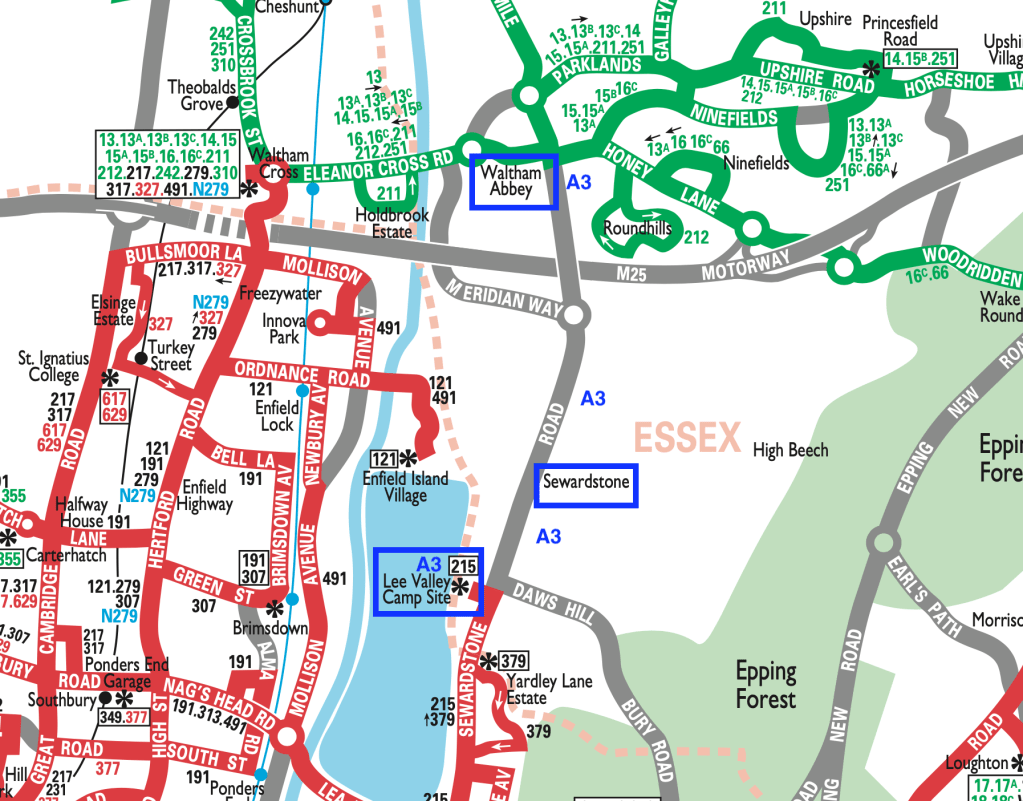
The timetable comprises seven off-peak hourly return journeys between 08:50 and 15:08 with an eight minute journey time and two minutes layover at the Lee Valley Camp Site.

In practice journeys originate in Waltham Cross because west of Waltham Abbey, Central Connect has introduced another new route – the A1 – from Waltham Cross to Waltham Abbey via South Holdbrook giving a better service for the houses and businesses in this small area.
However, when buses get back from Lee Valley Camp Site after an out and back A3 instead of reverting to an A1 and return to Waltham Cross, they continue from Waltham Abbey on a third new route – the A2 – to serve Roundhills on a quick 14 minute rounder, then once back in Waltham Abbey and after that, buses operate the return journey to Waltham Cross as an A1.
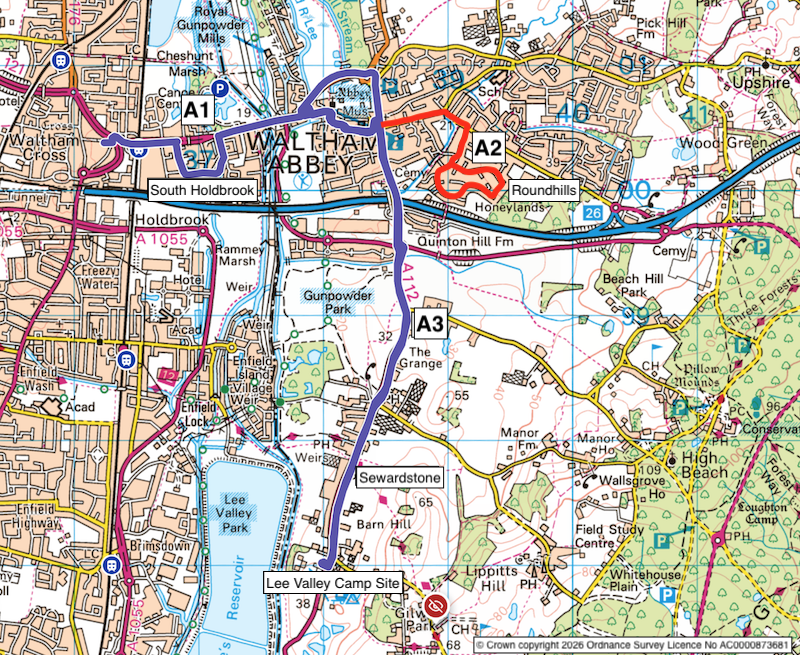
It’s an A1-A3-A3-A2-A1 interworking arrangement for one off-peak bus. So, quite an efficient way of providing these new connections.
As well as providing a bus service for Sewardstone for the first time for many years (I still hanker for the ‘good old days’ when London Transport ran the delightful 242 from Chingford to Waltham Abbey/Cross, Cuffley, Potters Bar and South Mimms and before that route 205 ran from Chingford to Hammond Street/Flamstead End) this new route A3 also provides a ‘connection’ with TfL’s route 215 which terminates from the south at the Camp Site, just north of the Greater London boundary, before returning to Walthamstow.
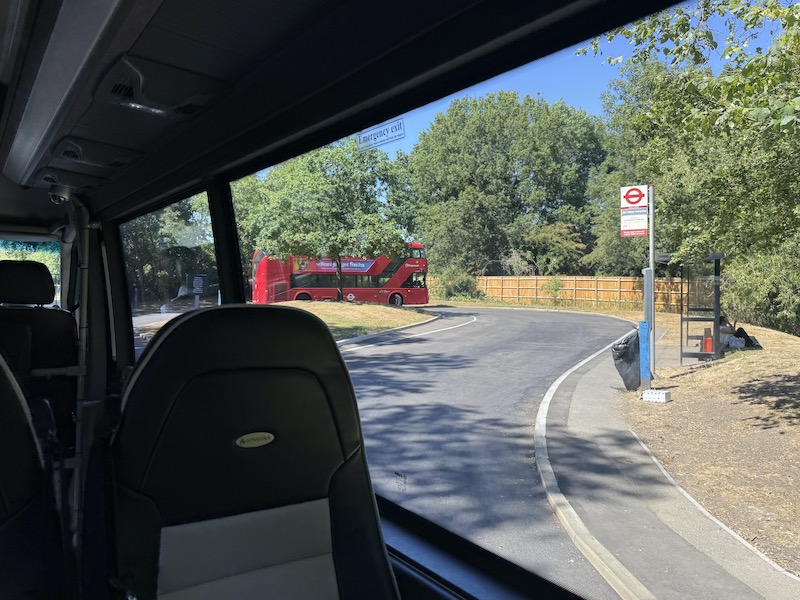
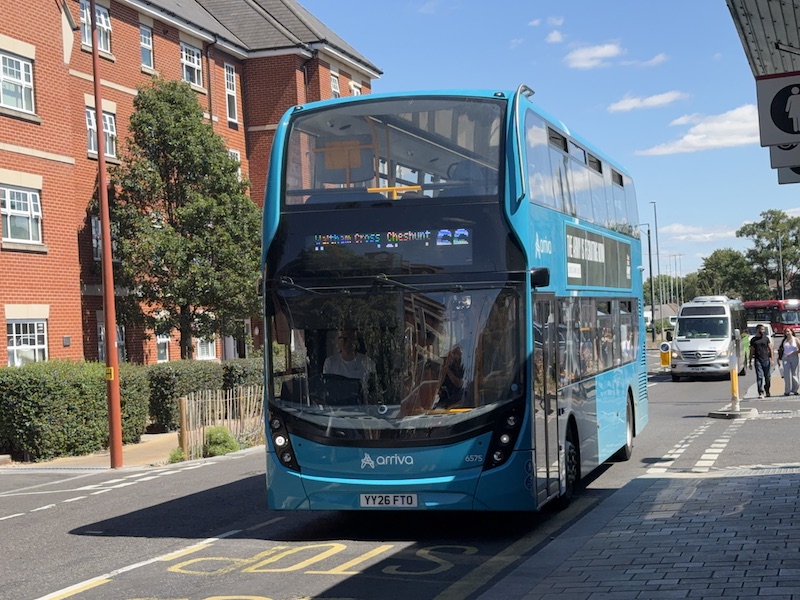
The new A1 also adds to the number of buses now connecting Waltham Abbey and Waltham Cross where other changes this week have seen Arriva extend its route 66 (Loughton/Debden circular to Waltham Abbey and Waltham Cross) to join the 251 on to Cheshunt and Hammond Street providing a new 15 minute coordinated frequency between Waltham Abbey, Waltham Cross and Hammond Street.
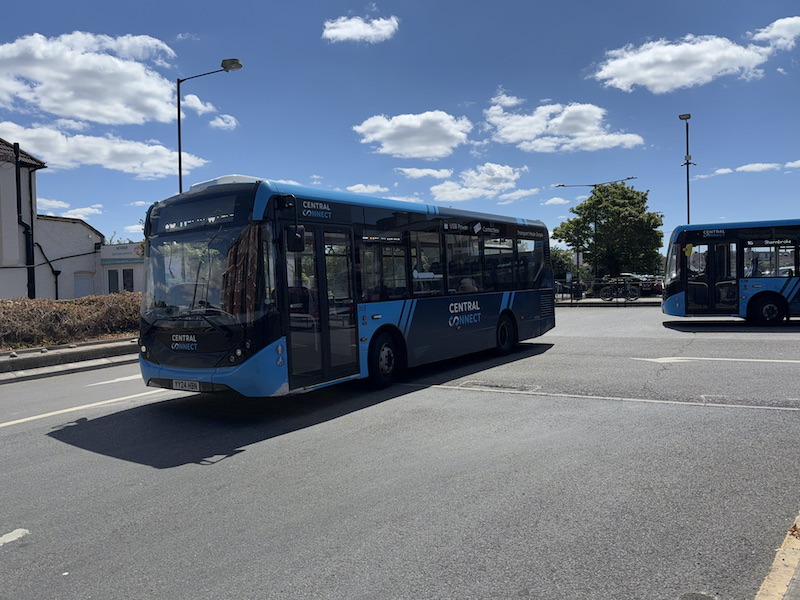
Meanwhile Central Connect has also increased the frequency of its route 13 (Waltham Cross, Waltham Abbey to Epping and North Weald) from hourly to half hourly.
All this gives the Waltham Abbey-Waltham Cross link one of the best frequencies it’s had in a long time and I’m sure passengers will appreciate this.
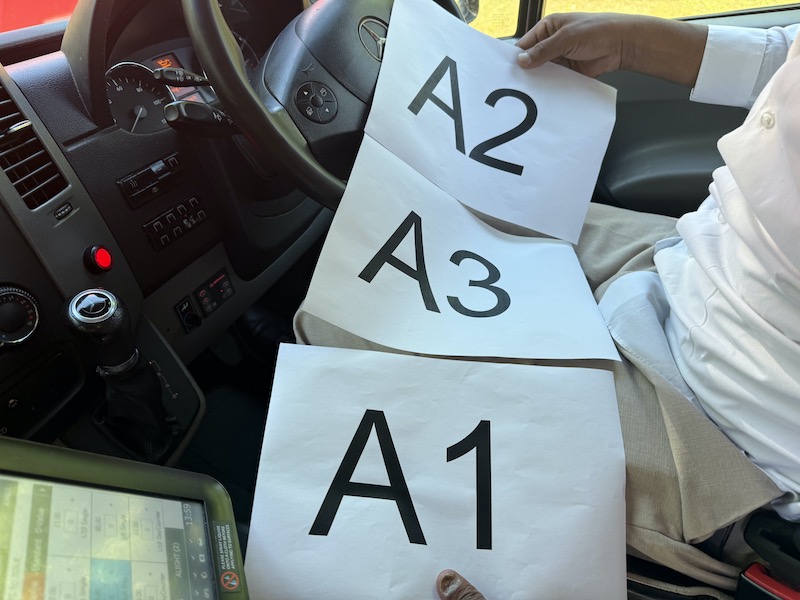
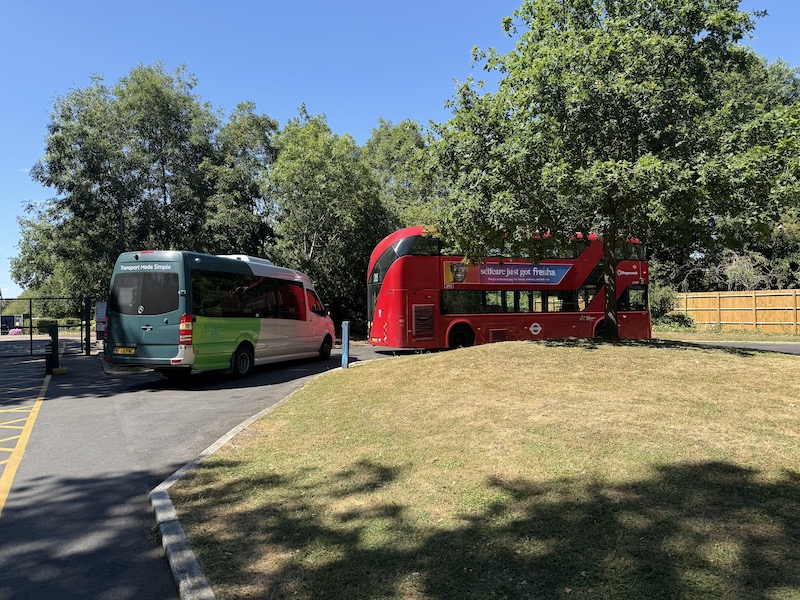
However, the A1, A2 and A3 combo does appear rather confusing especially when in these early days of the new arrangements there’s no roadside information or publicity at bus stops so passengers were naturally completely baffled and perplexed as to what route this minibus – with no working destination blind – was on and weren’t any the wiser when the driver said he was an A1.
But it wasn’t only passengers who were confused yesterday afternoon when I set about doing the full A1-A3-A2 experience. Drivers were also befuddled, as I’ll explain.
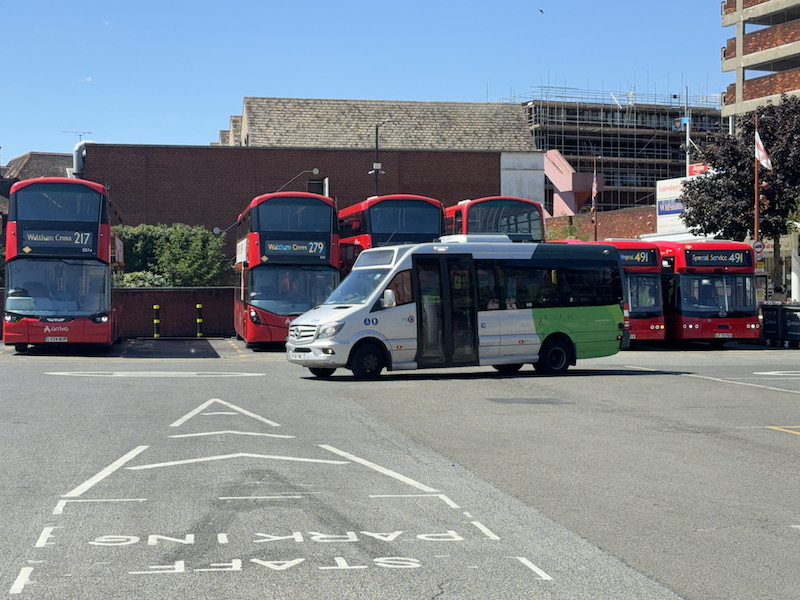
I caught the 1340 A1 from Waltham Cross bus station operated by a Mercedes Sprinter still bearing the livery of the old Novus DRT scheme in Leicestershire, albeit minus the brand name. Amazingly we carried another passenger but only to Waltham Abbey, a journey for which he could have caught one of the many other routes.
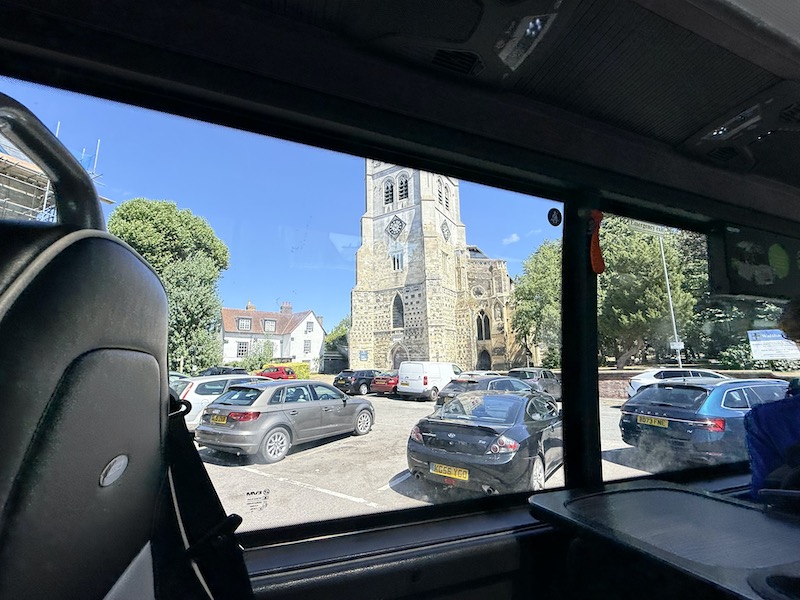
In Waltham Abbey we turned seamlessly into an A3 and headed down to the Lee Valley Camp Site.
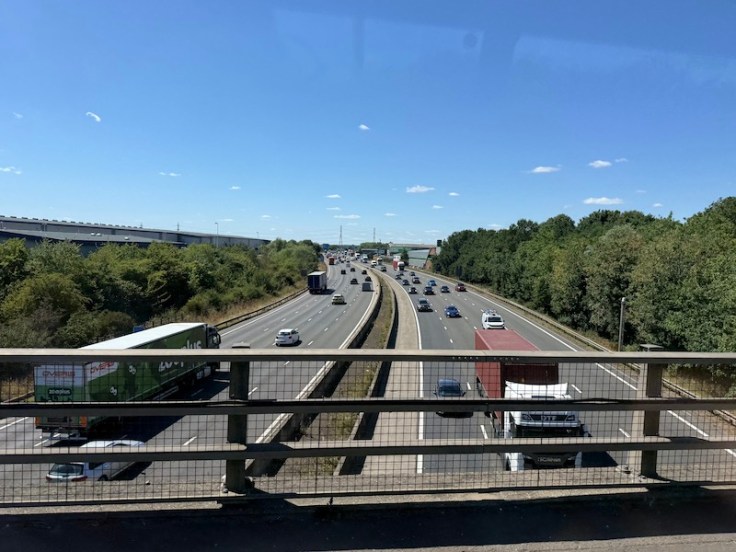
Never mind a lack of information at bus stops – once we’d crossed over the M25 there didn’t seem to be any bus stops so I’m not sure how the lucky residents of Sewardstone with their restored bus service will know where and how to catch it. Maybe it’s hail and ride but nothing indicated it is.
Arriving into the bus turning area at the front of the Camp Site on time at 13:58 our progress was blocked by a 215 on layover although luckily the bus was also due away at 14:00 as well as ourselves.
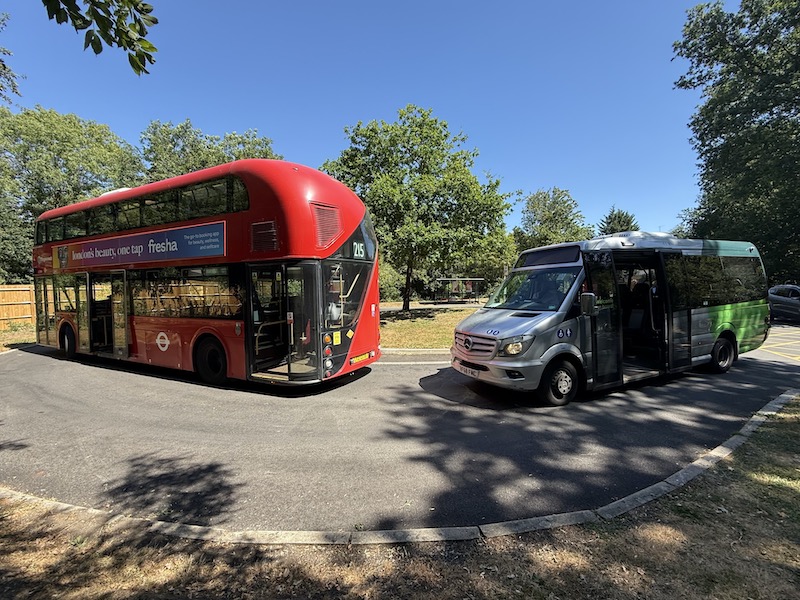
Obviously there was no information about the A3 at the bus stop here…
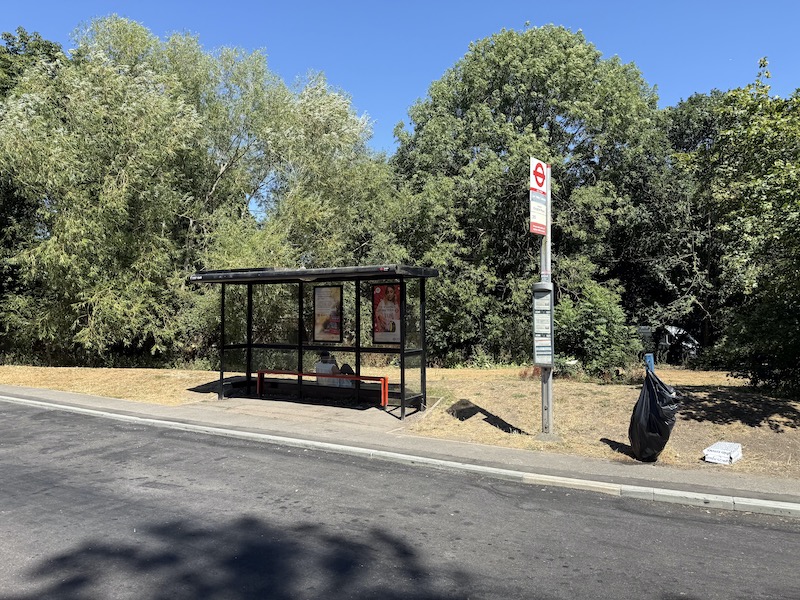
…. as there hadn’t been in Waltham Cross bus station where out of date details are on display for non TfL routes from some time ago.
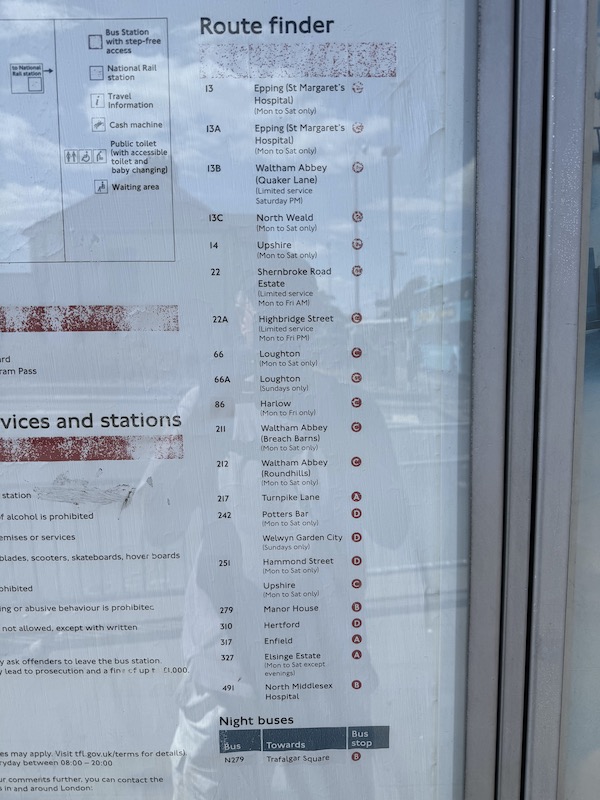
From the Camp Site it was back to Waltham Abbey from where we were due to turn into an A2 for the 14 minute run around the Roundhills residential area.
But that’s where total confusion and misunderstanding contrived to work against it. At the Quaker Lane bus stop in Waltham Abbey driver Omar who’d taken me to Lee Valley and back was a bit surprised by being taken off by new driver Andrew who’d arrived for the shift change in a company car.
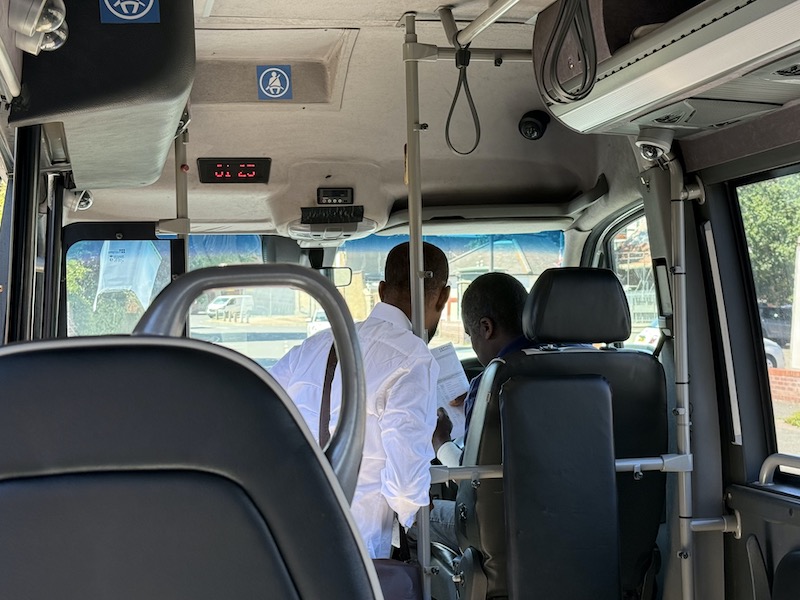
Andrew insisted he would next be driving an A1 (as per his duty sheet) whereas Omar and I advised him the next journey was an A2. Omar said he hadn’t been to Roundhills. Andrew said he thought there was a road closure there.
To cut a long story of ten minutes confusion between the two men short, Omar went off in the car and Andrew set off (on what I thought was an A2) but just did a circuit of the Waltham Abbey ring road and back to Quaker Lane. He then waited time until 14:24 and headed back to Waltham Cross as an A1.
I then twigged what had happened – he’d arrived for his handover 14 minutes too early and not realised we hadn’t done the A2 yet. Omar thought Andrew was doing him a favour by letting him get off the bus early.
The only solace from the confusion was I doubt anyone was waiting in Roundhills. No one caught the A3 and only one passenger had travelled on the A1 as already described with none boarding as we headed back to Waltham Cross.
With the split of routes making an A1 to A3 followed by an A3 followed by an A2 and back and then the A1, I can see why three separate route identifiers have been used, but, it’s a recipe for confusion as evidenced by yesterday’s experience albeit it could be put down to Day One teething issues and a lack of clear information and publicity.
However, even when people get used to the pattern of interworking (that’s passengers and drivers) it still means residents of Roundhills although enjoying a direct bus into Waltham Cross, coming home they have to go via Lea Valley Camp Site, or hop off the bus for 20 minutes and wait for it come back from there in Waltham Abbey. Similarly Sewardstone residents wanting Waltham Cross go via Roundhills on the outward journey but not on the return. And I suspect most people living in South Holdbrook, and who can, will find it quicker to walk.
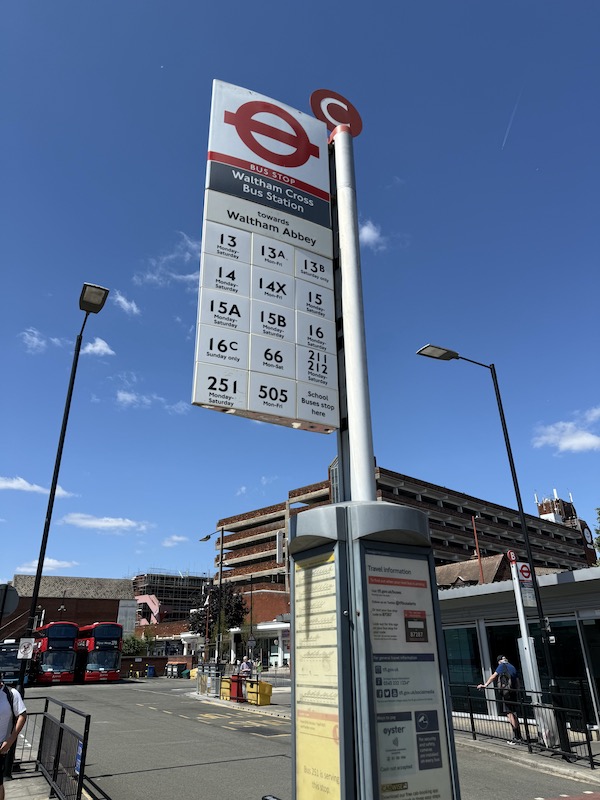
Maybe it will settle down. But, I have my doubts on this one. Furthermore, both South Holdbrook and Roundhills are served by Epping Forest Community Transport’s routes 211 and 212 respectively, albeit both offering just four off-peak journeys, so it’ll be interesting to see if these routes continue, and if so, I’m guessing regulars may stay loyal.
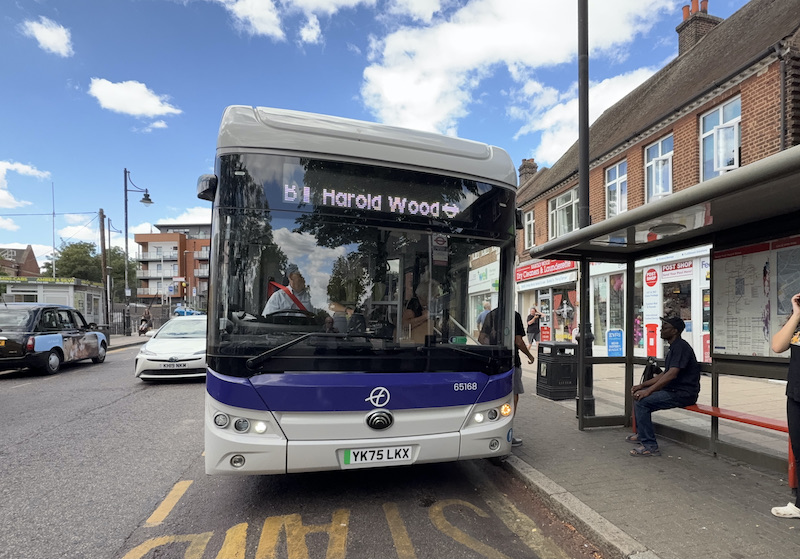
This week’s second new route, which actually does extend fully into London territory, is First’s route B1 which until last weekend was one of a number of local routes in Basildon but has now taken on a new role as a fast link from that town and its western suburbs to Harold Wood thereby providing onward connections via the Elizabeth Line to Romford, central London, Heathrow and Reading.
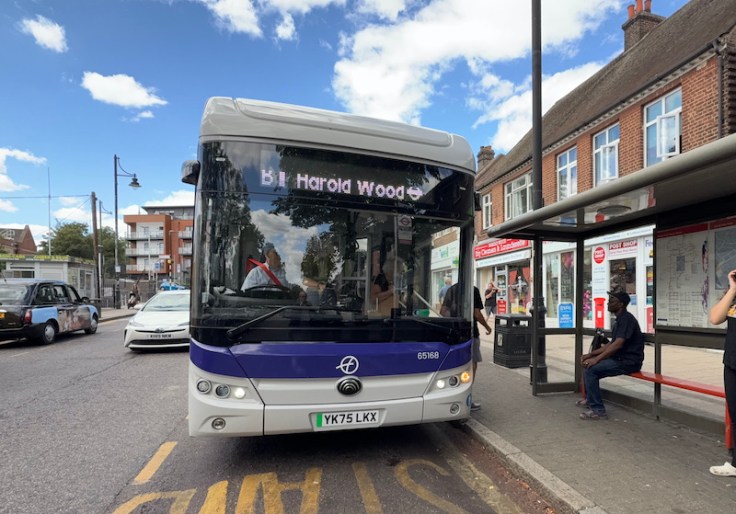
Route B1 had run every 12 minutes between Basildon’s bus station and Laindon and Southfields west of the town centre as shown on the red route on the old map below…
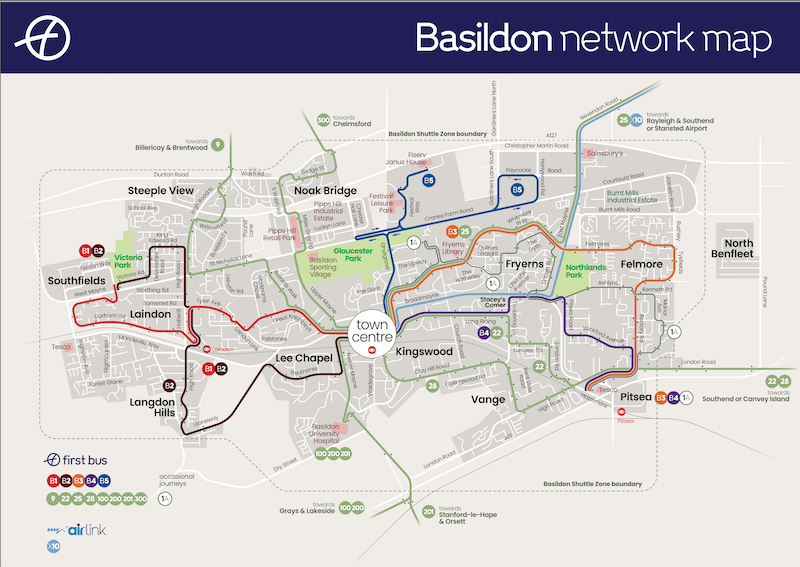
… now annotated with the additional loop in Southfields before heading off to Harold Wood.
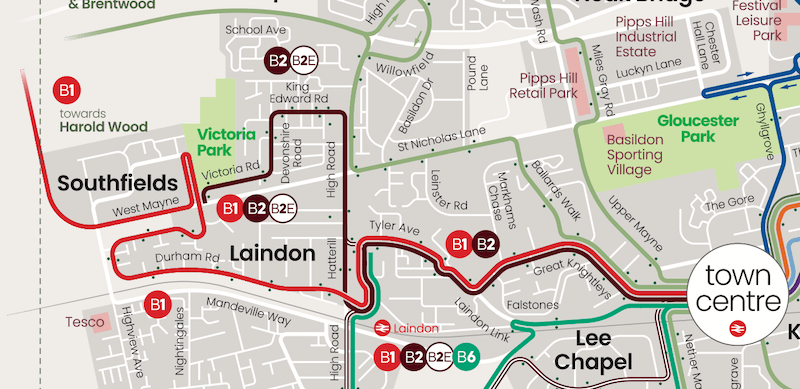
Now, as part of other changes, involving other B numbered routes (including a change to the B2 route) the frequency has reduced to every 20 minutes but with buses extended westwards to Harold Wood taking 15 minutes journey time from Laindon.
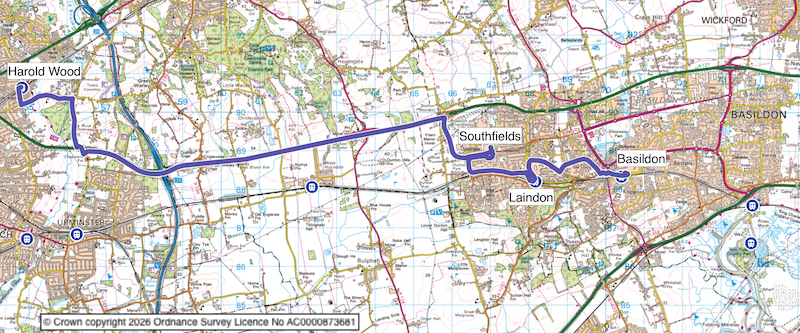
Buses run non-stop once they leave the Essex town utilising the A127 and then a couple of minor roads on the west side of the M25 (used by TfL route 346) to reach Harold Wood station.
I caught the 11:00 departure from Basildon’s bus station yesterday morning and wasn’t surprised to still find the old Essex County Council departure list and out-of-date First Bus network map on display at the stand.
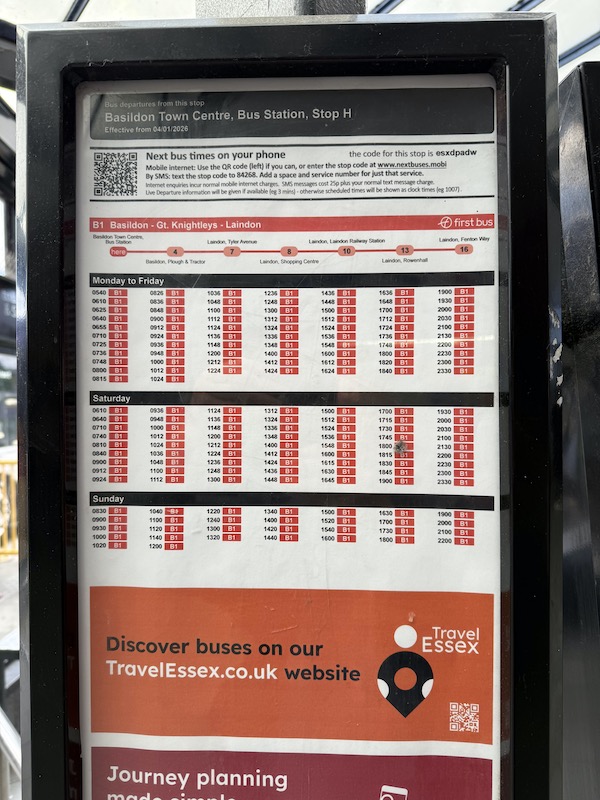
If only local authorities and many bus companies would put as much effort into fixing these fundamental ‘attention to detail’ flaws as they do in sending out hyped up news releases about how these new initiatives are so wonderful.
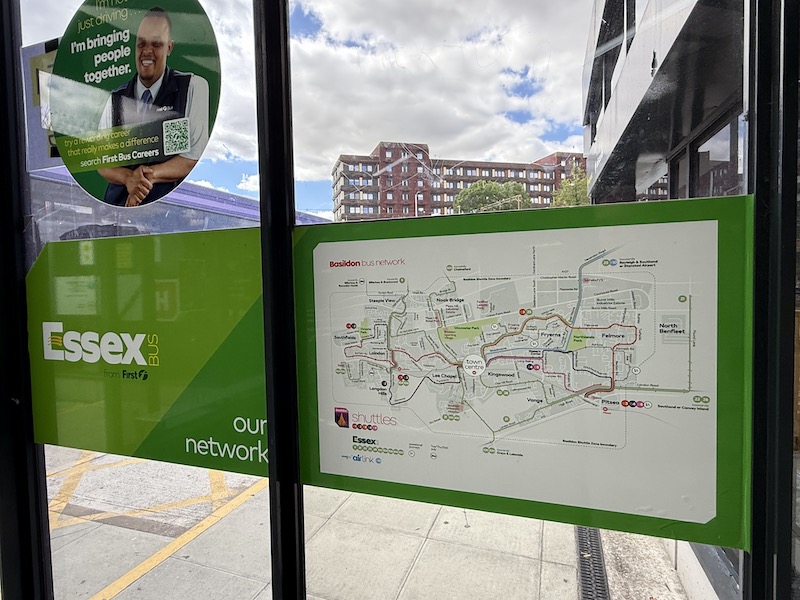
No other retail-customer interface is so woeful when launching a new product.
A dozen passengers boarded in the bus station with three more joining as we wended our way through Laindon and Southfields dropping all but four off- with that number staying on board to take advantage of the new fast link to Harold Wood.
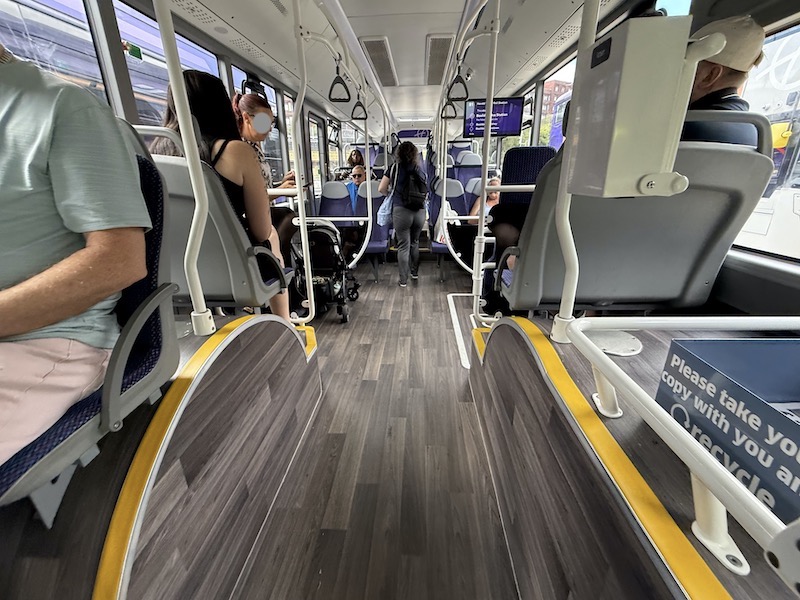
That was quite an impressive number for a first weekday morning of the new facility and hopefully bodes well for the future. The driver told me three passengers had travelled the other way on an earlier journey which was also good to hear. And we arrived on time alongside Harold Wood Station.
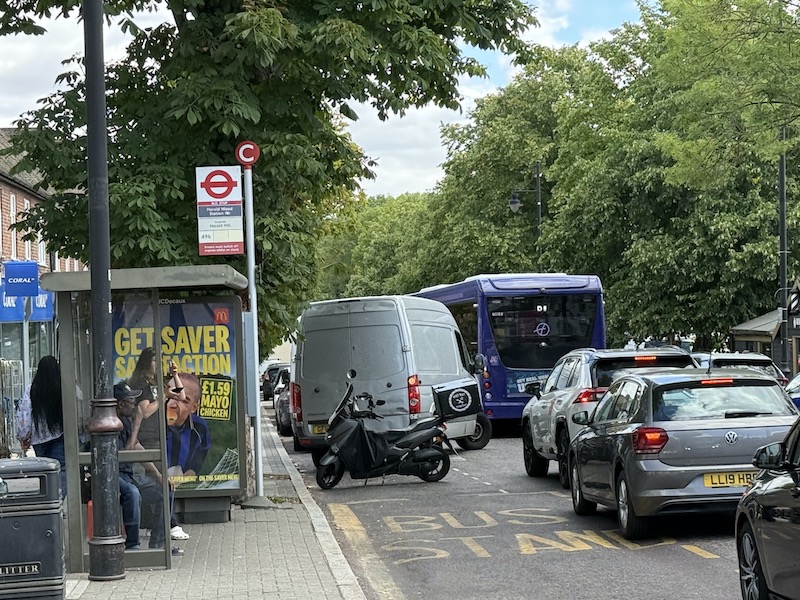
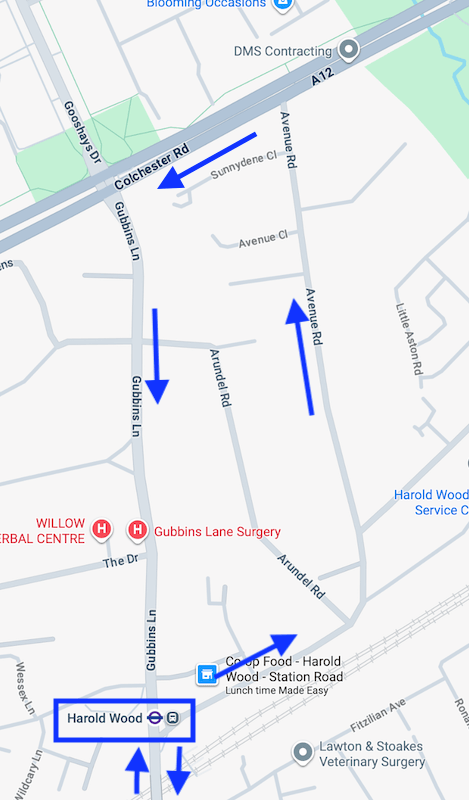
Unfortunately there’s no room for the bus to take its seven minute layover in the lay-by by the station itself so it has to continue along Station Road and Avenue Road to the A12 to retrace its route back via Gubbins Lane making for quite a circuit, and I’d imagine easily eating up the stand time on those congested roads.
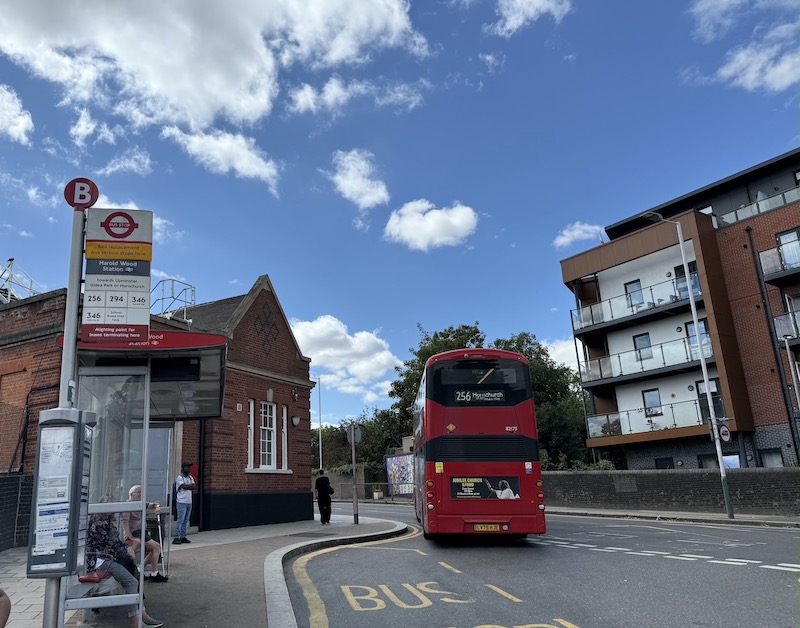
The bus does eventually return to the lay-by by the station entrance/exit to begin its Basildon bound journey, although you’d never know it from the bus stop plate or the timetable cases below which obviously hadn’t been updated.
I can see a market developing for this useful link especially once word spreads about its existence. However, a driver who was acting as a route learning mentor on board was telling me a bad accident on the nearby section of the M25 earlier yesterday morning closed all but one lane in each direction causing long delays on all surrounding roads throwing the fledging service into meltdown.
Sadly this is not an uncommon feature of the M25, and the A127 also has a reputation for delays too, but such eventualities shouldn’t stop useful initiatives like the B3. I’m glad it hasn’t.
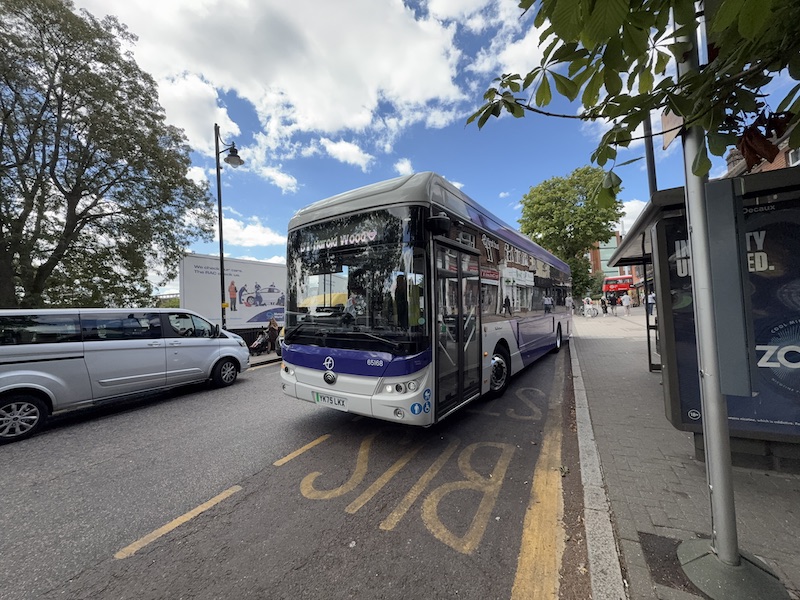
I wish it well and will watch the take up with interest wondering if there are other such applications of fast links from outside London to the Elizabeth Line.
Roger French
Summer blogging timetable: 06:00 TThSSu


Who has the contract from Essex County Council to update the timetables at bus stops?
LikeLike
Ironically, First!
But I think there is a few weeks leeway in getting all the timetable boards updated and one of the reasons why the Essex bus partnership mandates service changes on certain chosen dates.
LikeLike
I don’t think First have the contract anymore.
LikeLike
I fear this lack of detail, publicity, Bus stops, Driver unfamiliarity etc, concerning the A1-A3, something not uncommon with Central Connect, will cause Sewardstone to be left bus less for another decade. I would have thought a fully restored route, Waltham Cross-Chingford (forget the A1 and A2) would have been far more useful and few are going to risk missing northbound connections off 215s from the camping site. Although one can hardly blame Operators from avoiding TfL territory and the inevitable bureaucracy, this link really does plug a very useful gap once more.
The B1 stands a very good chance of success, as seemingly, anything to do with the Elizabeth Line seems to bear fruit. The seats are awful, but the air conditioning great!
Terence Uden
LikeLike
Roger, any theories as to why, despite all your best efforts (and its being in the realm of the bleedin’ obvious) the bus industry so often gets point-of-sale advertising wrong? It’s pretty basic practice for any retail operation – and service changes are part of business as usual (albeit a complex part), are they not?
And is there perhaps one too many A3s in “your “A1-A3-A3-A2-A1”?
LikeLike
No – there must be an A2 missing!
RC169
LikeLike
I think the A1 us a circular.
LikeLike
Correction: A2
LikeLike
To appease paper aficionados, maybe those pieces of paper the Central Connect driver is holding with the route numbers on should correspond in size with the paper size displayed on them!!
LikeLiked by 1 person
indiajthves
I am sure it does / or there are
JBC Prestatyn
LikeLike
Indiajthves?
Gobbledygook!
LikeLike
Just Extend the 215 to Waltham Abbey ?
JBC Prestatyn
LikeLike
Exactly would be the best solution in the long run. As Roger said, London Transport covered the area just fine for decades.
Aaron
LikeLike
@Aaron – London Transport did indeed provide the link between Waltham Cross/Waltham Abbey and Chingford for many decades. However, it doubtlessly only did so with funding from Hertfordshire and Essex County Councils.
During the 1970s and early 1980s, a number of the County Councils were less than happy at the high level of subsidy being demanded by LT. A number of cross-boundary services were reduced or withdrawn, with “red” buses no longer reaching destinations such as Lower Kingswood, Weybridge, Chertsey, Egham, St Albans, Theydon Bois or Brentwood. In most cases they were replaced by London Country whose costs were lower.
The changes in 1986 resulted from legislation which required county councils to put subsidised bus services out to tender. London Buses held onto the 242, as a Hertfordshire contract shortened to terminate at Waltham Abbey, but lost everything in the Loughton area (both Essex and LRT tendered). Had that change in legislation not happened, there is absolutely guarantee that Essex County Council would have continued to hand over money to London Transport for another 40 years to continue running the 242 through to Chingford – particularly as London Country’s 503 was providing an alternative service over that corridor.
Malc M
LikeLike
@Malc M
So how come Loughton and Debden continued to be served by London buses?
I think this is why it bothers me so much as some areas outside London continue to benefit from this integration, but many lost out and some right on the border with London itself, like here in the Lea Valley.
Potters Bar up the road continues to have this absurd mish mash of franchised routes and fully private running alongside at a noticeably lower level of service. Seems odd there is apparently demand for buses every 20 minutes to both Enfield and Southgate from there but not to Barnet, which remains hourly. It don’t add up.
Aaron
LikeLike
@Aaron – I’m pretty sure you have raised this question before, and had it answered before.
As I understand it, when routes such as the 20 and 167 were tendered, the contract was let by London Regional Transport (TfL’s predecessor) as the “lead”, but with Essex being involved as well.
The other point determining whether TfL supports a cross-border routes is where the majority of passenger travel. If that majority is within Greater London, TfL take the lead. That does result in a few oddities, such as TfL buses reaching places such as Dorking
In the case of the link from Potters Bar to Barnet, it may have lost out due to its more recent history of having been provided by a commercial service, outside the TfL network. Inconsistent, maybe, but that’s how these things happen. Maybe the situation might have been different today if Hertfordshire had left the 84 alone in 1986, instead of rerouteing it through Potters Bar.
Malc M
LikeLike
“A3 also provides a ‘connection’ with TfL’s route 215” – very tight in one direction (as you found) and 18 minutes to wait in the other!
LikeLike
There’s a typo in the penultimate sentence “indiajthves like the B3” should be “initiatives like the B1”
LikeLike
Thanks; now corrected.
LikeLike
For too long , generally , advertising and marketing for Bus Services has been 2 dimensional – the local paper , a map , and timetable, a route diagram inside and outside on the bus livery maybe. Coach tours at say Hastings were three dimensional – chalk boards, a laid up coach with enquiry staff selling the destinations an hour or a week in advance
Some thought therefore needs to be consider for the “First Week” bus service operations, ideally pre launch too. While changing timetables and posters is difficult at stops where old services are still in operation for new services poles and cases up in advance with “Effective From”…Date (and even think about the no fare service for a week in advance too) timetable.
In fairness Essex website DID have the new timetables to choose from about 10 days in advance of the July change date along with a list of what they were (not always easy to read (comprehend) but it was there)
The A1 A2 A3 seems overly complicated , including using those numbers , I assume ticket machines in a Central Connect zone of operation cannot cope with having two route ones etc in it as explained in a previous blog. The light green livery of the Sprinter at least looks London Countryesque.
I would have done just two routes -Waltham Cross Waltham Abbey Campsite as A1, Campsite Waltham Abbey (via the Meridian Way industrial estate) Roundhills. this loses an element of Waltham Cross Roundhills direct potential but is there revenue from that ?)
There are still areas on the map that look as if there are villages to be connected like Lippits HIll High Beech and Wood Green if the community transport folk wish to take a few more service areas into consideration.
Perhaps Roger’s next Verify project should be West Lancashire where the DRT ./ Dial A Ride has been part converted to a fixed route with change of vehicles , that are now less accessible to disabled users and also have restricted days when folk cannot get to hospital appointments and similar ( I dont know if NHS in the area run their own appointment transport – this is the situation in London where specifically Dial A Ride WONT take you to an appointment – mostly on the grounds of if time missed Dial a Ride dont want to be responsible – they will take visitors to hospitals though)
JBC Prestatyn
LikeLike
yesterday two young female barged on a london bus in south west london proclaiming (to a driver encased in his perspex fully screened cab) that its under 16 free travel thanks to Mr Burnham (and no showing of London Zip Card). They disputed my observation that it was still July and the England scheme didnt start till August – but I suppose the information must be out somewhere – is it viral on kids social media? I thought it unwise to also query that at least one appeared a tad over the age limit ( which again for London RESIDENTS a Zip card actually gives free travel up to age 18 ) I mentally queried as to if this pair were from outside London or had perhaps lost Zip card priviledgs or were taking the opportunity not to bother carrying one ( sometimes having ones journeys tracked is not a good idea which no fare or cash fare avoids – not that we can pay cash in london )
JBC Prestatyn
LikeLike
Pause before you hit the send button JBC. Under-capitalisations (Yesterday, London) two young females not female, the information must be out there somewhere etc. Your enthusiasm sometimes gets the better of you!
LikeLike
By the greatest coincidence we were in Waltham Abbey yesterday wanting to get to the Premier Inn at Sewardstone! Having searched for a bus service and not finding one, we walked.! Then we read your blog this morning! If only we had known before, we might have been on the bus with you! Just so sad there is no publicity, bus stops, timetables etc for it. Doomed to fail again.
David Ball
LikeLike
That’s a shame David. It just shows the value of good publicity and information.
LikeLike
Staying there soon myself but as will be a weekend, this bus is sadly still no good.
Aaron
LikeLike
I previously came to the conclusion that too many bus companies seemed to believe that their services were only for those people who already knew about them. The A1 A2 A3 fiasco only goes to show that they also believe that even regular customers are assumed to invoke magical powers to make themselves aware of new services
LikeLike
I don’t know if it counts as a fast link in the way you mean, but there is now a daily “commuter coach” from Stroud and Cirencester to West Drayton (I think) to connect with the Elizabeth Line, and give an alternative to the very expensive ticket prices on GWR’s line via Kemble and Stroud.
LikeLike
Yes it does operate to and from West Drayton. The service is experimental and will operate three days a week from September, Barnes of Swindon provides the coach. Look up GoStroud to find out more.
Julian Walker
LikeLike
I would have thought depending on timings that running it into Heathrow might pick up some international travellers enough for a daily service 2 journeys per day
JBC Prestatyn
LikeLike
Crazy to me that the 215 can’t be extended to Waltham Abbey it’s literally up the road and would make much more sense than the middle of nowhere 🤷🏾♂️ , Also worth noting a strange one a new ECC/BSIP funded later journey on the 397 which runs as 397A operated by CC , Strange we have ECC operating London routes now
LikeLike
The 215 is a TFL route, that will only be extended if TFL want it extending, as that part of the route is out of the TFL area
SM
LikeLike
I sense Aaron & Malc M will be expressing their respective views soon!
LikeLike
Yeah another nauseating essay by Aaron at the ready demanding buses here there & everywhere even though he contributes nothing for them.
LikeLike
That is rather harse to Aaron. I think if you look at the basic structure of the ideas he has put forward over the last year of blog comments and actually map them to the recent couple of months changes to Herts and Essex bus services there are apparent improvements that have actually come about. Clearly reading the changes of business and residential developments and prodding from the likes of Govt Local Govt and Love Your Bus kind of support is getting both some commercial changes and supported services and the overall additional gist of the TfL Boundary issue is constant source of inefficiency if one does a full origination destination plot by population . I should note that Uno have managed to be cutting a few services by about September , one wonders what problems with lack of revenue paying passengers they have found.
JBC Prestatyn
LikeLike
“I sense Aaron & Malc M will be expressing their respective views soon!”
How could I not rise to that bait?
I don’t doubt the 215 could be extended “literally up the road” to Waltham Abbey. However, one of the following conditions would need to be met:
I’m guessing none of these conditions is met, otherwise the 215 would already be running to Waltham Abbey.
Extending the 215 would incur cost. The 215 currently has a peak vehicle requirement (PVR) of 5 buses, running every 20 minutes between Walthamstow and Lee Valley Campsite. Extending the route (even if only part of the service) to Waltham Abbey could not be done within the current PVR of 5 buses. It would need at least one additional vehicle.
Let me do some “back of a fag packet” calculations. The current tender for route 215 is published on TfL’s website: Bus tender results – Transport for London. Contract price is a little over £1.5million a year – or £300,000 per bus per year. So, around £835 per day per bus. Would adding one more bus onto the 215 to extend it to Waltham Abbey generate an additional £835 per day in revenue? Possibly not.
Like Roger, I can remember the 242 running to Chingford. It was cut back to Waltham Abbey 40 years ago, a very limited replacement being provided by an Essex County Council tendered route 252, just a couple of journeys in the peaks operated (if I recall correctly) with a Freight Rover Sherpa. Otherwise, the link south of Waltham Abbey through Sewardstone was left to London Country’s 503. The 503 was commercial, but was also cut back to Waltham Abbey in 1988. Its replacement through Sewardstone was an Essex County Council tendered route 505, operated hourly with Metroriders.
Malc M
LikeLike
£835 extra revenue per day is about 20 extra passengers per journey which I think is not impossible – 10 from the campsite area and 10 through riders from Walthamstow ?
JBC Prestatyn
LikeLike
The 242 didn’t carry 20 passengers per journey from Chingford 40 years ago. Most of those it did carry alighted at Yardley Lane and so are well served. I can’t see how it would carry that number now.
LikeLike
@JBC – your optimism is quite something.
If 20 passengers per journey (all day, every day) is realistic, it begs the question why did the previous service over that section (route 505) fizzle out?
Malc M
LikeLike
Trustybus were running the 505 (every two hours) from Harlow to Chingford, but the Monday-Friday service was withdrawn January 2017, the Saturday, an ECC contract, remaining. In April 2021 this Saturday only link was withdrawn as a victim of ULEZ. Absurdly, the bus waiting time up the road in Waltham Abbey for some 30-40 minutes leaving Sewardstone busless until now. I suspect more fuss would have been made had we not all been reeling from Covid.
Terence Uden
LikeLike
Thereby making some arguement that a bus service every two hours unless specifically hitting commuter peak or useful shopping journeys is not exactly helpful compared to something if not turn up and go then at least half hourly. Indeed the A3 passenger that went the short part of the route shows folk basically take the first bus to come along ( we know there are exceptions with fares , route or trusted operator that can apply ) and if they get used to more buses then that can help. I simply note that Stewardstone is not a minor hamlet of population and with the industrial area and aim of increasing job opportunities and economic growth ( I think Burnham is still sticking with that ) then priming funding for increased bus services has to have that as part of the evaluation justification.
If the 505 failed unnoticed by TfL due to covid +ULEZ then surely the playing field is uneven given other authorities are solving capitol investment these days by financing electric vehicles to cover routes marginal in there on bus revenue payback. If Waltham Abbey had been in TfL greater london area then I am sure the route would still be running or replaced in part by extension of other routes.
JBC Prestatyn
LikeLike
(For some reason, my response to Terence posted itself further down the thread.
@Terence Uden – it might be fashionable or convenient to blame London’s clean air standards. However, if the A3 can turn at Lee Valley Campsite, what would have prevented the 505 from using that as a terminus, thus maintaining a (Saturday-only) service through Sewardstone, and meeting TfL’s 215 for onward connections?
Malc M
LikeLike
Regarding your last comment about the 505 going to “meet the 215 at Lea Valley Campsite”, the service turned at the Yardley Lane Estate at the time, inside your hallowed TfL territory .
The ULEZ comment was not my “fashionable” phrase, but the reason given by the operator at the time.
Terence Uden
LikeLike
@Terence Uden – I really should have checked my facts, shouldn’t I?
“In April 2021 this Saturday only link was withdrawn as a victim of ULEZ.”
“Regarding your last comment about the 505 going to “meet the 215 at Lea Valley Campsite”, the service turned at the Yardley Lane Estate at the time”
The 215 was extended all year round to Lee Valley Campsite on 4th March 2017.
“The ULEZ comment was not my “fashionable” phrase, but the reason given by the operator at the time.”
That may be. And yet, other operators continued (and continue) to run bus services over the border into Greater London, ULEZ notwithstanding. That suggests to me that neither the operator nor Essex County Council thought it worth bothering with getting a vehicle which could meet London’s clean air requirements – alternatively they could still have chosen to connect with the 215 at Lee Valley Campsite had they wished to, but thought that wasn’t worth bothering with either. ULEZ (Ultra Low Emission Zone) appears to have been a convenient excuse where they could shift the blame onto someone else for their own decision.
Malc M
LikeLike
Arguably, the Yardley Lane Estate could be served without needing to meet ULEZ standards or obtain a London Service Permit. The northbound TfL stop is either in Essex, or is directly on the border, depending on how accurate the map is. It has a London code, but that doesn’t prove anything.
LikeLike
Just seen the A3 this morning – it was a ‘proper’ single-decker Central Connect bus.
David Ball
LikeLike
My thoughts on service change publicity. Its not enough to update your website. You need to attract attention. Every operator and every LTA should have active social media to post updates to. Plus, they should also know about local community Facebook pages are, e.g. “Shout Out [inset town name]”, and post updates there with links back to own socials and website.
Pete
LikeLike
Echoing some of the above comments: I rode the A3 this morning and the new 19 Epping-Abridge-Ongar route yesterday. Both restore long-lost links and potentially provide very valuable connections, but nobody joined me on either.
Now whilst I love these secret buses, which only ‘we’ know about, it makes no sense to stick a bit of paper with a cryptic A3 in the windscreen and show no info on the electronic blinds (surely programmable), and even less sense to have zero information at stops and locally.
I do hope both succeed and survive, but I can’t promise to keep them going single-handed. Really need to let the travelling public in on the secret!
Jomidav
LikeLiked by 1 person
Come on chaps … day one and all that!! Never heard of a “soft launch” before? Better to iron out some bugs (as with the driver changeover confusion) when there are few passengers around to upset.
Having said all that … some early publicity at bus stops wouldn’t have come amiss … possibly some judicious posting on bus shelters whilst waiting for the Essex CC contractor to do a proper job.
That B1 extension looks interesting … I can get from London to Sarfend with a Travelcard to Harold Wood and two free buses with my Senile bus pass … may be slow, but worth a try!!!
LikeLike
Yes, I agree. In my experience, the public are equally critical if publicity is posted in advance – it has happened! – and they miss their bus because they, not unreasonably, think that the timetable posted reflects what is operating that day. Of course, the start date is shown but is often overlooked but it doesn’t really help that many timetable changes happen on a Sunday when publicity operatives may not work over weekends.
Whilst there is always the temptation to get the ‘first day commemorative ticket’ (done it myself!), I think some allowance needs to be made for the inevitable teething troubles. Maybe a revisit, say a month after a given route has started would highlight any structural issues with publicity provision as well as providing a bit more of an insight into the demand for the routes?
Dan Tancock
LikeLike
I thought the idea of a mainly Sunday change was to allow overtime updating stops ready for Monday
JBC Prestatyn
LikeLike
It wouldn’t make sense for Central Connect to put up temporary timetables. The parent company of Central Connect (TMS) is the timtable contractor for ECC. Why put up timetables when your parent company is about to do so?
LikeLike
No, I cannot agree that driver schedules cannot be clear as to which Vehicle they take over and which operation duty times they are to run from day one. Schedules form the basis of wage payments and route costs and matched income tickets sold passes accepted. I did state perhaps a week before free services could be tried as part of marketing – that is your soft launch but the agreed well in advance date everything should be in place – with perhaps an exception of alternative fuelled vehicles that need infrastructure in place which doesnt always happen on time.
I suspect Stephensons/NIBS changes in Essex were all correctly resourced and run (roadworks and normal breakdowns excepted) from day one (well July 26th) indeed an award I might grudgingly have to consider giving to First Essex too.
JBC Prestatyn
LikeLike
I saw A3 mentioned, and immediately assumed the Airbus services were being reintroduced. Showing my age, I guess.
I wonder why Central Connect chose the A suffix? It doesn’t seem to have any relevance to the local area.
LikeLike
While it implies Airport I thought it must be Abbey
JBC Prestatyn
LikeLike
“LONDON TRANSPORT CONECTIONS, 1945 – 1985” details many cross-boundary services provided by bus services other than London Transport – especially those coming in from Essex. Travelcard in 1983 brought me great fun, Eastern National services and buses included in the ticket along with London Country still a powerful force in the area from Grays Garage. Well into the early Travelcard era Eastern National was penetrating as far west as Walthamstow and Ilford, with their Routes 2 & 400 also featuring in my Main Diaries from those years.
LikeLike
Launching bus routes with no ppublicity (except perhaps on line) seems to be normal in some areas. Route X48 (llandrindod to Craven Arms) still has no roadside information in Shropshire after nearly 2 years, despite Shropshire Council having been told twice. TFL have no interest in posting timetables for non TFL services. Took over two years to post out of date timetables for go bus route 3 Orpington to Sevenoaks, with TFL blaming gobus and vice versa.
Brian Willson, Orpington
LikeLike
TFL have problems on missing timetables , wrong spider maps ( and plenty of places with no maps where they would be helpful ) perhaps a facebook group of shame needs to be created
JBC Prestatyn
LikeLike
The ECC contract for posting roadside timetables across the whole county is Central Connect – it was awarded a few months ago. Doesn’t bode well really………
LikeLike
It partly depends on how ECC specified the contract. Resource-led or demand -led?
On the subject of which, the DfT is advocating for Enhanced Partnerships to have no more than 2 service change dates per year. No-one has considered how long it would take to change roadside publicity in a large county such as Essex if this was implemented, or alternatively the cost of extra resources to achieve the changes over a shorter timescale.
KCC
LikeLike
I was working in East Horndon yesterday and noticed the B1 (and 351) heading along the Southend Arterial Road. Checking later I discovered there are no bus stops anywhere nearby, which is hardly handy!
LikeLike
But is there actually anywhere on the Southend Arterial Road where buses could actually stop ? I suspect that any bus stop on the A127 itself would be ruled out on safety grounds.
To serve East Horndon, one option might be for buses to come off the A127 at the A128 junction, double-run about 1km to the first roundabout and then stop at the Halfway House stop on the approach to the junction before rejoining the A127. Would this be worth it for the extra traffic to/from East Horndon ? It would probably add 7 to 10 mins to the round-trip journey time and be extremely annoying for other passengers, especially if no-one got on or off.
LikeLike
Although the U.K. went metric in 1970, distance measurements remained in miles & continue to this day, as I’m sure you’ll be aware if you’re a driver.
LikeLike
Apologies – I used OpenStreetMap to estimate the distance and took the 1km straight from that. Using Google Maps shows distances in miles and suggests about 0.6mi double-run for e/b buses or 0.4 for w/b.
Nigel McBride
LikeLike
Nigel, we’re all being challenged by technology now & in particular, AI. As for the metric system, the U.K. was always half in & half out. No need to apologise, an honest mistake. Kind regards, PB.
LikeLike
funny enough theres a article on BBC Essex Facebook page as on the A130 by Rayleigh there were two roadworks road signs and for some reason they are in km 😂
LikeLike
Essex County Council doesn’t have a contractor for posting roadside timetables for the simple reason that they don’t have any roadside timetables, only lists of departures which are useless if you would like to know about what return service there might be before you travel.
I can’t comment about the current ECC contractor but it was extremely random when First Essex were responsible for posting the lists..
LikeLike
Essex based this format on market research several years ago. It showed that in general, people found a departure list format far easier to understand than a traditional timetable. I’m not sure the inability to see return times is a huge downside- in many cases where full timetables are displayed, not only do many people find them incomprehensible, but the display is only for services in the direction served from that stop!
LikeLike
Anyone know why the campsite is called Lee Valley when the river is the Lea?
Strikes me that the best way around the A123 situation would be to run it as a triangle:
A1: Waltham Cross – Abbey – Campsite
A2: Campsite – Abbey – Roundhills
A3: Roundhills – Abbey – Waltham Cross
Then at least the drivers, and everyone else, might know which leg they are on.
LikeLike
The Lee/Lea spealing is long standing difference that no one I know can explain. Might be Essex vs Hertfordshire interpretations of old
JBC Prestatyn
LikeLiked by 1 person
Upstream of Hertford it’s mostly Lea; Hertford downstream is either, save for the navigable channel which is specifically Lee Navigation.
The river source is somewhere in Leagrave.
LikeLike
Problem could be the A1 Waltham Cross Waltham Abbey specifically is designed by Hertfordshire County Council Bus Improvement Plan funded by Hertfordshire Bus Improvement Plan Funding
The Other two seem to be commercial initative I do note the routes seem to finish a bit early and only run M-F. I think there is scope to run the routes to 1800 and do Saturdays too.
JBC Prestatyn
LikeLike
Whilst Hertfordshire CC provide Local Authority Bus Grant (LABG) funding (BSIP is no more, officially) to the A1, this is on a de-minimis basis and the timetable is devised by the operator.
The reason for the funding is that the A1 vastly improves the number of buses to the Holdbrook Estate in Waltham Cross. Previously buses to Holdbrook were in the hands of a very limited community transport-type operation after being served for many years by an extension of the old C3 route operated by Trustline/Trustybus and Centrebus. It is.one of the most deprived areas of the county.
incidentally, LABG is also funding additional journeys on Central Connect’s 25 service between Harlow and Cheshunt Brookfield Centre.
Dan Tancock
LikeLiked by 1 person
According to the Uno website the X10 reduction is due to fewer students living in Luton next year. The 602 shorts apparently didn’t pay their way and literally no one on this blog expected the half hourly Potters Bar to Hatfield service to be viable. The rest is minor tinkering.
LikeLike
Hello! I had the pleasure of riding the new B1 yesterday. I logged into Facebook and saw a post in a local Havering group about First Bus launching a new 20-minute service between Harold Wood and Basildon. At first, I thought it was a joke!
Since it was day one of operation, I just had to give it a go. I left my home in Gidea Park at 15:30, arriving in time for the 15:44 departure. It left a few minutes late at 15:48 but arrived at the original terminus over in Laindon 2 minutes early. This was where the support manager got off. He had spent the journey talking to two bus bashing oap’s, explaining that First has high hopes for the new route and detailing local changes around Canvey. He even admitted that their updates and publicity could be better. Indeed, I found no information at Harold Wood—no timetable and nothing on the bus stop flag. Also disappointing how basic the flags are around Basildon. Perfect advertisement space for the new service.
About half a dozen people boarded at Fenton Way. From there, through Laindon and into Basildon, the bus got surprisingly busy. I returned home on the 16:48, and again, the bus was well-loaded. Because the destination blind now reads “Harold Wood,” lots of passengers were making enquiries before boarding and chatting positively about the changes. I even overheard one passenger suggesting it would be a more convenient way to travel toward Heathrow.
We arrived on time at Fenton Way, with just one passenger left travelling over to Harold Wood, and we picked up the same route guide who was very good explaining the route to the driver who seemed unfamiliar with the route ahead.
Progress on the A127 was exactly as you’d expect—fairly heavy traffic moving at about 35/40mph—so we still arrived at Harold Wood about 4 minutes late.
Potential problems I see is the turnaround time at Harold wood. It’s not ideal having to turn around via the Colchester road as the stop at Harold wood is completely inadequate for even a minute’s layover. However I’d doubt given the chaos Gallows Corner is causing, a layover will never happen! Traffic was unbelievably quiet around Harold Wood at the time. So I believe it’ll be a challenge after the school holidays.
I got back home at 17:50. Considering I caught an Elizabeth line train and walked ten minutes from Gidea Park, I’m 10/10 impressed with the new service. I’ve never travelled with First before, usually TFL, Stagecoach East Mids/East Sussex, B&H & NCT. Brand new electric vehicle too! I sincerely wish them all the best and hope it succeeds!
Pe251lz
LikeLike
Here in my part of the world (the outer western suburbs of Brisbane) my local routes were upgraded and extended last November. Timetables were available online (one support person seemed surprised that I had one on the first day) but in many previously-unserved places there were no physical stops. However, at the most likely places, posters stating ‘temporary bus stop’ and showing a QR code link to the timetables were attached to lamp posts and, in case, a tree. I have to say that all of the drivers I encountered, many of whom were new to the job or, at least, the area, seemed to know where they were going.
LikeLike
Good idea?
https://www.ianvisits.co.uk/articles/tfl-expands-routemaster-ding-ding-trial-after-promising-safety-results-91486/
Pete
LikeLike
If it works I will accept it , but maybe not how it is being talked about. Few passengers will recall the two bells (three if full) clear to drive away signal from a Trained and Licenced bus conductor who was in charge of the passenger (and commercial revenue arising from them) conditions to a long-standing (was it the Met Police in horse bus days ?) giving a starting signal to the driver. Often accompanied with a shout of “hold very tight please” to the nominally five to eight lower saloon standees , in practice up to 20 persons standing if they were small, and almost certainly upstairs folk were still making their way to seats.
Outside of London as the FLF / Loline and Leyland/AEC variants with forward entrance jack knife or sliding doors became common the driver gained the responsibility for closing doors and moving off (I think for Green Line the conductor still had to close the rear doors which I assume continued in RMC days and I cannot recall what LT did on the batch of RCLs moved to the 149 route nor the NS routes the BEA class were applied to)
I cannot recall how conductors worked with drivers on the Q and RF types , I suspect no starting signal was given and by 1970 the MB / SM family of single decks and OMO RFs were well in much of the fleet along with DMS and similar again once DM pay conductor ones were tried I have a feeling the conductors role became to be a companion for the driver – (the numbers I traveled on were few) Again how was the FRM XA/XF types run according to rule book for starting signals if any to driver?
I recall notice on RT / RMs that PASSENGERS MUST NO GIVE STARTING SIGNAL or something to that effect.
Outside of London what were the last rear loading buses without platform doors in operation , I suspect Hants and Dorset Bristol LDs were the last with manual doors ?
JBC Prestatyn
LikeLike
@JBC – the RCLs put to work on route 149 had their doors removed.
Malc M
LikeLike
Absolutely correct Malc. They also had the luggage racks removed, standard RM/RML seats & the twin headlights replaced with singles. They looked particularly smart when they were first out-shopped from Aldenham. Another memory evoked, thank you.
LikeLike
Interesting comments JBC, you’re obviously old enough to remember the days of conductors on LT buses. I personally recall when conductors were taking fares upstairs & if the bus had pulled up while they were at the front, often looked down the other end where the mirror was positioned & if the platform was clear, would stamp on the floor for the driver to proceed.
I’m not sure if H&D had the last Lodekka LDs with manually operated doors but I do remember the conductresses were just as adept as their male colleagues when closing them! Thanks for evoking the memories, even if that wasn’t your original intention.
LikeLike
I was not going to bring to such non regulation compliance activity to a public forum. I should have mentioned though the Buzzer from the upper deck operated push indicating to driver that the conductor was upstairs and thus checking the platform using the staircase mirror and care moving off should be taken. There is a question of why the under stairs push was painted black (or black / brown bakelight) rather than the white of the public ones , was it meant to be hidden from the public ? it seemed to be on the same bell circuit – was it a 12v or 24v circuit ?
JBC Prestatyn
LikeLike
I agree, given that few will remember two bells perhaps just an automated announcement to say “please hold tight” would suffice.
Pete
LikeLike
Logical. Sometimes people over think solutions.
LikeLike
Quite a lot of ADL buses have a “ding ding” or “ding dong” ring when you press the bell once to stop – which is then repeated for the driver giving a total of four bells which my conductor training tells me was “emergency stop”!
(I was trained on Midlands rings: 1 stop, 2 go, 3 full, 4 or more emergency stop; I’m aware other parts of the country did it slightly differently.)
So using two bells as a warning will be even more meaningless!
LikeLike
@Terence Uden – it might be fashionable or convenient to blame London’s clean air standards. However, if the A3 can turn at Lee Valley Campsite, what would have prevented the 505 from using that as a terminus, thus maintaining a (Saturday-only) service through Sewardstone, and meeting TfL’s 215 for onward connections?
Malc M
LikeLike
What a contrast! Both providing useful connections, only one providing a service that actually makes sense and sadly it is not ‘Transport Made Simple’. If the B1 timetable is accurate, I can see that saving a lot of money for commuters in Basildon and Laindon. The A1/A3 provides none of that, it needs to run to Chingford Station at a minimum!
Before I comment on the blog, all I can is I ruffled someone’s feathers clearly and thank you JBC Prestatyn and Malc M for pushing back. What people need to remember is I grew up in London with an extensive bus service, now I live just outside this system in Cheshunt, it is a daily frustration and admittedly I go out less than I want to because of it. That is very isolating.
All I want is a joint up transport system and I will not stop going on about it until I get it where I live. Not everyone wants to or can drive! From travelling about, it feels like Lea Valley has put up with one of the worst bus services in the country for far too long. Arriva’s changes are for the most part, a very positive step forward as the 310 is also coordinated with the 251 and 66, making for an even daytime service in the area. The 66 extension is very useful for me. We just need them to run those services regularly at later than 7pm/ 8pm. A real shame as our trains are fantastic, just the station is awkwardly located.
I went on the A1/A3 on Monday, but went an hour earlier than Roger. I have long wanted a service along Sewardstone Road as I have relatives in Chingford and this way would save a lot of time visiting them and was initially very excited for this until I realised it ends far too early to come back on it. You’d have to leave Chingford Mount at just 2:30pm to catch the last A1/A3! Then came the actual experience, which was really disappointing. I won’t fault the driver for being late on the 1st day, but an old mini-bus with no stop buttons turned up. Very cramped and hot. Not showing on tracking. And then it reached the campsite, the 215 driver obviously wasn’t expecting another bus was it, so the A1/A3 had to reverse to even get out! I was 1 of 3 on this bus and 1 went back to the Abbey on it, which is too low passenger wise, but what do we expect, Bustimes and Google Maps weren’t updated in time, bus stops not updated and they do exist along Sewardstone Road but they are slowing being reclaimed by nature! None of this has success written on it. In fact we need to start treating buses as an essential expense for a functional country and run them properly, treating it like a fragmented ‘lifeline’ will mean anyone with a choice will never use it.
I agree with everything Roger has said and I found it very confusing too, this route needs a single number, not 3. Given Waltham Cross to Sewardstone took just 17 minutes on this bus, I really don’t understand why it can’t be added on to 1 of the several short routes in either Waltham Cross or Chingford. 215 is barely an half hour route, 317 is similar. While 379 is 12 minutes end to end! 1 of London’s shortest. It shouldn’t be rocket science or climbing over the Berlin Wall here! The solution is right there and shows serious problems with our authorities if they can’t do this properly.
There has been a campaign in Waltham Abbey to restore London buses here for a couple years now, they are very keen to keep fighting until at least the 215 or 379 is extended to at least Waltham Abbey. 2900 signed petition, support from London Assembly, the 2 MPs in the area and a number of councillors from all parties. It shouldn’t have to be a fight but it will be. All Essex has to do is subsidise an extension, the government has given them funding, so just do it.
Aaron
LikeLike
@Aaron – Cheshunt to Chingford is easily do-able by bus.
Get yourself down to Waltham Cross, then wait up to 8 minutes for a TfL 279.
For Chingford, change at Ponders End for a TfL 313, every 20 minutes.
For Chingford Mount, stay on the 279 to Angel Corner then change onto a TfL 444, every 12 minutes.
Might not be as quick as a bus through Sewardstone but, unless/until Essex County Council decides it wants to fund a service for you (and others), you do have options.
Malc M
LikeLike
Also @malc_m, you have pointed out the issue with the extension of TfL routes. It is going to be expensive to have a red decker trundling along on a section of route that can be accommodated with a Sprinter.
Also, I think @aaron is being a little disingenuous… both routes aren’t barely half an hour headways. They’re every 20 mins and we know that TfL don’t do part workings so you’d be expecting a red decker 3 times an hour at an exorbitant cost. That’s why those routes won’t be extended!
BW2
LikeLike
Looking at the change.org petition and other information… I wonder who set up that petition??? Perhaps a little bit more information
Just can’t see it happening.
LikeLike
I should have been more specific, the 215 and 317 have end to end journey times typically around half an hour. I was saying about journey times not frequencies.
Also in a limited number of cases, TFL do have part workings. One is the 166 – West Croydon to Banstead, one of these per hour from morning to evening goes on to Epsom Hospital. An ideal solution for a 215 extension to Waltham Cross on a trial basis.
Aaron
LikeLike
True about the 166 but very much the exception. Still, it doesn’t really justify even one lumbering red double decker to extend to Waltham Cross on a route where a Sprinter would provide sufficient capacity.
LikeLike
Yes the exception but doesn’t mean it has to be. It may even benefit TFL to be flexible on this so long as its communicated properly while massively improving connections for fringe areas. Would also mean avoiding extreme decisions like diverting the 149 away from Edmonton Green to Wood Green which really makes no sense and could really backfire on them.
Also we can’t judge what vehicle would be needed until a direct route is established. Given it’s a timetable no good for commuting at all either. Design a route for low ridership and that will happen, build for future demand however and it performs better than anyone ever expected.
And I love a quiet double decker, been amazing on the 242 in the past year. Also 66 don’t really need them outside peak times but still great to have, just to see Epping Forest from high up!
Aaron
LikeLike
I’d already said that 166 was an exception and even if we extended that to the 215, it was still a significant extension in requiring an extra vehicle at £300k p.a. Given that there hasn’t been a service, and there’s few houses along there, it’s frankly unlikely to be that popular even with a Tatfield level of service and TfL have more important considerations.
Whilst you may like a quiet decker, that’s a luxury TfL can ill afford.
LikeLike
@anonymous
Even a 464 level of service would be better than what we get on Sewardstone Road now. Proper single decker. Early to late 7 days a week. Hourly at quieter times, otherwise half hourly. That would suit the area fine given the hotel and pubs in the area. It really shows central planning of buses would be better in more rural areas.
Oh wait, there’s a suitable service in the area that could be extended. 379! Done!
If any organisation of TFL’s size can’t afford to spend £300000 on a fringe route, it’s broken. We really should be demanding better from these organisations.
Aaron
LikeLike
@Aaron – you don’t get it, do you?
TfL has no remit to squander £300,000 (or any sum) outside the Greater London boundary.
This has been pointed out to you time and time again.
Malc M
LikeLike
@Aaron:
An ideal solution for a 215 extension to Waltham Cross on a trial basis.
That may be. But please refer to one of my earlier posts. It cannot be done without adding another bus into the cycle. That introduces additional cost.
I can’t see it paying for itself through fare revenue. Historic use of that corridor was so low that the previous service (505) died a slow death.
Nor can I see a case for TfL funding it as it is beyond the Greater London boundary, and the benefit to Greater London would not be enough to justify the funding required.
So, unless Essex shares your optimism and commits to funding, I can’t see it happening. Repeatedly banging on about it on here isn’t going to change that.
Have you thought of attempting to set up a local bus users’ group for the Cheshunt, Waltham Cross and Waltham Abbey area, to lobby operators and the respective local authorities for improvements to your local bus links?
Malc M
LikeLike
@Malc M
The 279 is a very slow route and waiting on Southbury Road is not a pleasant experience. Always opt for a 217 or 317 instead if going that way. Also no one goes on the A406 unless they really have to, I don’t mind using the 444 to/ from Silver Street Station at night but day time because of the traffic, hell no! Weirdly SL1 is better as it doesn’t come off at the bottleneck that is Cooks Ferry! I grew up near there so know how horrible this section can be.
In the daytime to avoid all the traffic, I’ve used a 491 to Enfield Island Village and walked to the 215, a much more pleasant experience but no good for anyone from Waltham Abbey. Also coming from Cheshunt now, daytime buses are reasonable enough but at night, there’s only an hourly 310 which is no good.
What puzzles me is the trains apart from Stansted Express are guaranteed to stop to Cheshunt but the London buses stop short in Waltham Cross, just seems so misaligned.
Aaron
LikeLike
It’s funny that you mention the absence of stop buttons. I rode on Central Connect 210 last week. Is is a 68 plate Mercedes Sprinter and that appeared not to have stop buttons. However they were actually in the overhead individual light controls but were in black like the surrounds so very hard to see. They had clearly been like this from new which surprised me as I thought that they had to be in a contrasting colour.
LikeLike
With the A1/A2/A3, it makes no sense to me that it can’t just have one route number.
The general public would assume they can’t stay on the bus, unless it’s made clear they can. And Google Maps will not recognise the route, therefore putting off irregular passengers.
LikeLike
This particular blog has been better than watching Wimbledon. I make that a straight-sets win to Malc M. But keep going Aaron. Look up the song ‘High Hopes’ by Frank Sinatra. It’ll resonate.
LikeLiked by 1 person
Just fed up with living with inferior services and how much that limits life, glad that is so entertaining!
And given the government, councils and public authorities like TFL literally can’t go bankrupt, I have no concern over if they have debt or not, always was a political excuse to cut things. They exist to provide the public with the services THAT WE NEED.
Aaron
LikeLike
I’m sorry Aaron but that’s just industrial scale codswallop. Public authorities and bodies may can be insolvent and they can be unable to pay their debts in full. They have to budget and spend their money responsibly.
Also, they exist to provide the public with the services they need? Very true but in this case, it would be difficult to argue that it is a need but rather another one of your wants.
£300k to send a lumbering red double decker along some sparsely populated roads in an area outside of TfL’s remit seems a poor way for them to spend money when they’re short of cash anyway.
LikeLike
A public authority is not a household! We can argue about this forever but the best way of serving that section is by London buses doing it, because of the integration and location. Having a campsite in the middle of nowhere act as a terminus for 2 buses, both being short routes makes no sense. It really needs to be town to town and extending a route to Waltham Cross is the most sensible place to send the bus.
The campsite is already ‘over the border’ but its not where people live or want to go. If these authorities did place based policies that would be obvious.
Aaron
LikeLike
It’s not a household but being economically illiterate isn’t a justification either.
LikeLike