Saturday 11th July 2026
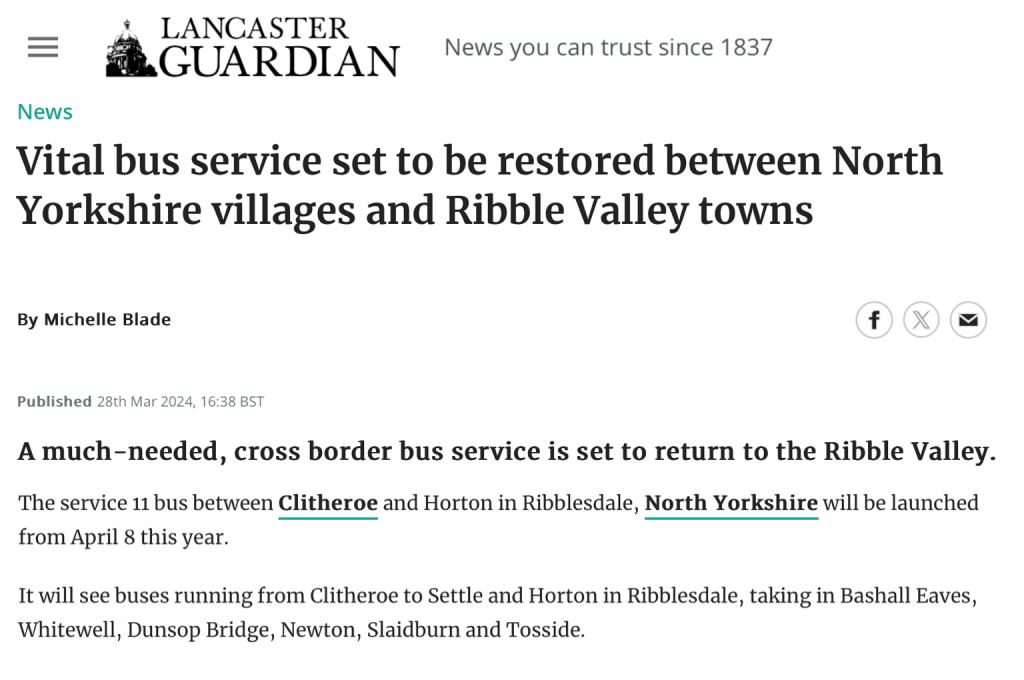
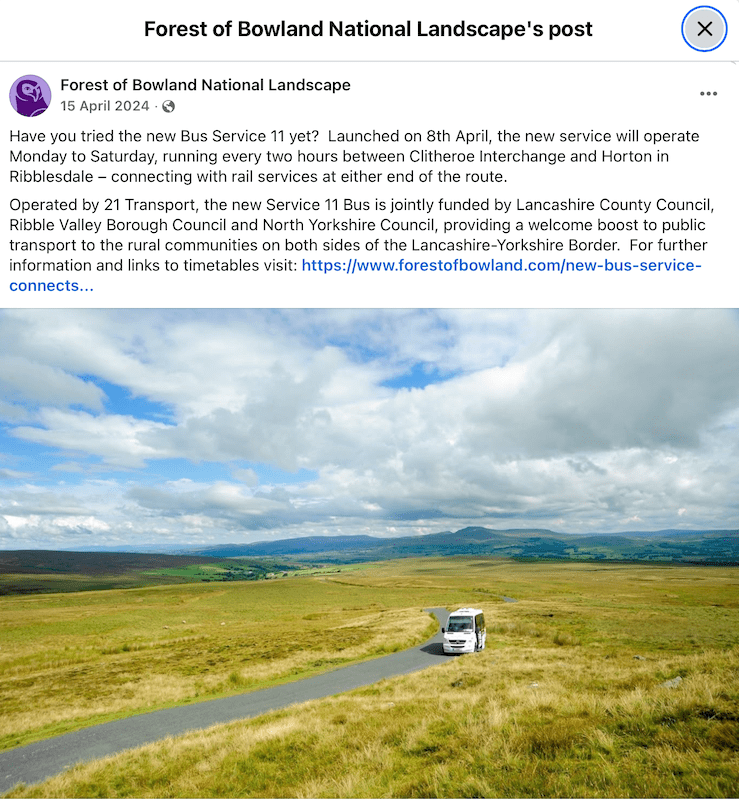
Back in April 2024 there was much joy at the return of a “vital” bus service linking North Yorkshire villages with the Ribble Valley and Clitheroe over in neighbouring Lancashire.
The Lancashire Guardian at the time reported how “The move follows discussions with local residents, with Lancashire County Council joining forces with Ribble Valley Borough Council and North Yorkshire Council, which has commissioned the service from 21 Transport Ltd.”
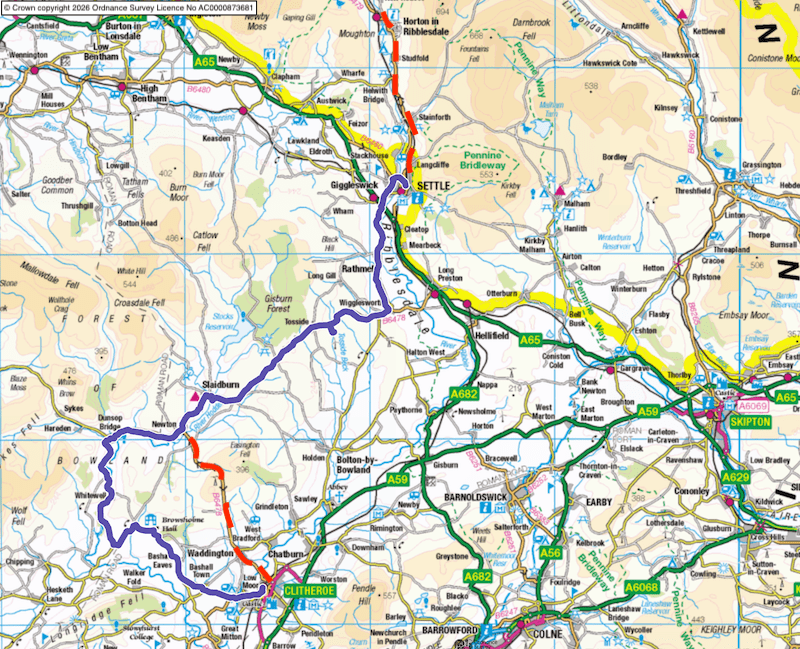
Lancashire County Council even produced a lovely timetable leaflet containing a route map showing how route 11 restores links between Horton in Ribblesdale and Settle before continuing via Rathmell, Wigglesworth and Tosside in North Yorkshire then over the border into Lancashire via Slaidburn, Newton, Dunsop Bridge, Whitewell and Bashall Eaves to Clitheroe.
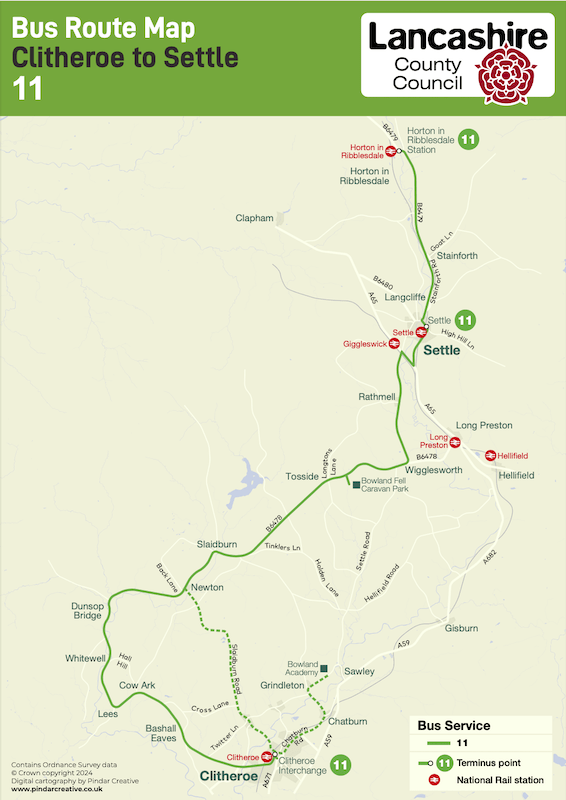
Two minibuses provide a two-hourly frequency on the service with a morning and afternoon journey extended to and from Bowland Academy near Clitheroe on schooldays. Southbound buses commence their journey in Horton in Ribblesdale then pause for 47 minutes in Setttle before continuing on to Clitheroe effectively meaning it’s two separate routes carrying the same route number 11.
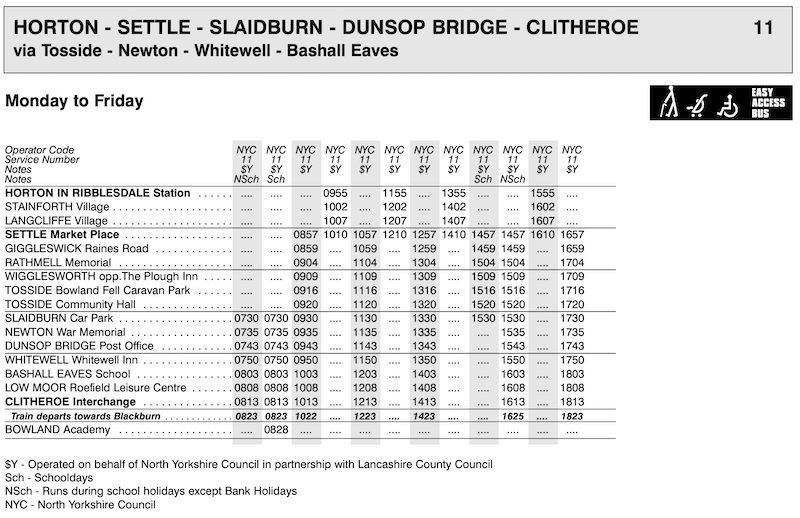
Although, as can be seen from the northbound timetable below, journeys to Horton in Ribblesdale continue uninterrupted, save for a three minute pause through Settle.
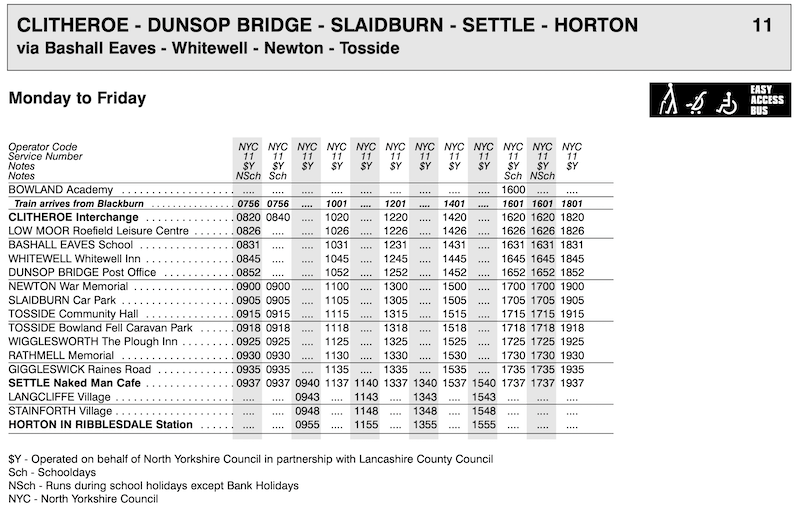
The above reflects the fact until its withdrawal in 2013 the route was in fact two separate services – a route 10 funded by Lancashire County Council between Clitheroe and Settle and a route 11 funded by North Yorkshire County Council between Settle and Horton in Ribblesdale.
The future of the two routes came to a head in October that year when a report to Lancashire County Council’s Highways and Transport Committee noted “the contract to operate these services has become unsustainable, significantly failing the County Council’s current financial guideline where at least 40% of the cost of running the service must be met through fares income, including concessionary reimbursement.”
The report continued “the cost of continuing operation of these services is an annual net subsidy of £265,000 based on an estimated revenue of £25,000 and 22,000 passenger trips per annum, returning a revenue to cost ratio of 8.6%. North Yorkshire County Council currently contributes an agreed £39,000 per annum to the cost of providing the services which results in a net annual cost to the County Council of £226,000 for the service. This contribution will cease from 28th September 2013.”
As a result of this the Cabinet Member for Highways and Transport was asked to “introduce a revised route and timetable to operate between Slaidburn and Clitheroe on an off-peak Monday to Friday basis and reduce the annual net subsidy by an estimated £165,000” while over in North Yorkshire the report noted “North Yorkshire County Council have indicated their intention to look at alternative ways to provide public transport in their area and are currently considering utilising alternative subsidised services they operate to maintain the link between Settle and Horton-in-Ribblesdale.”
Fast forward over a decade and, as already highlighted the 10 and 11 were both back together again from 2024 on a two hourly ‘through service’ with financial support from both County Councils, and furthermore, a lot of positivity about the future from local communities.
I’d also seen glowing reports in the national media (The Guardian newspaper) about the scenic nature of this route so added it to my ‘to do’ list some time ago and was pleased to finally get round to taking a ride on Tuesday, always intrigued to see how such “vital”‘ services are doing, not least in this case, it being well over two years since being resurrected, presumably with Bus Service Improvement Plan (and now Local Authority Bus Grant) funding, otherwise one might be forgiven for wondering what’s changed since 2013 and it then being “unsustainable”?
I was on a two-day wander around the Lake District with my brother at the beginning of this past week and on our way back south we originally planned to ‘do’ the full route of the 11 from Horton in Ribblesdale over to Clitheroe including the break in Settle, but annoyingly the southbound train we planned to catch from Carlisle – to also enjoy part of the wonderful Settle-Carlisle rail line – arrives into Horton in Ribblesdale at 09:54 with the bus on route 11 departing at 09:55. Not very Mini-Switzerland.
So, we stayed on the train, which parallels the route taken by the 11, offering similar scenic delights, and alighted in Settle giving us an enjoyable 55 minutes until the bus departed there at 10:57.
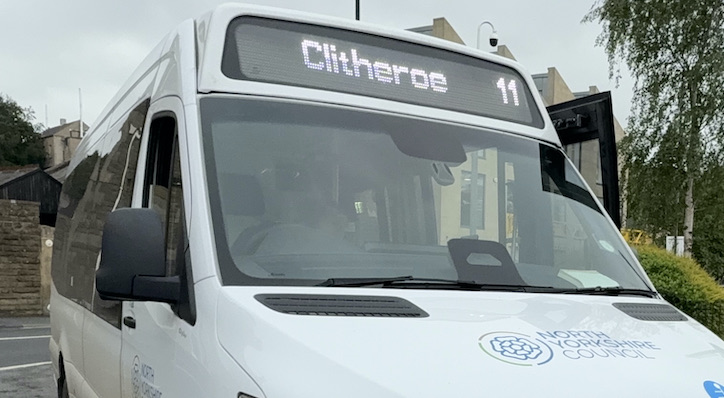
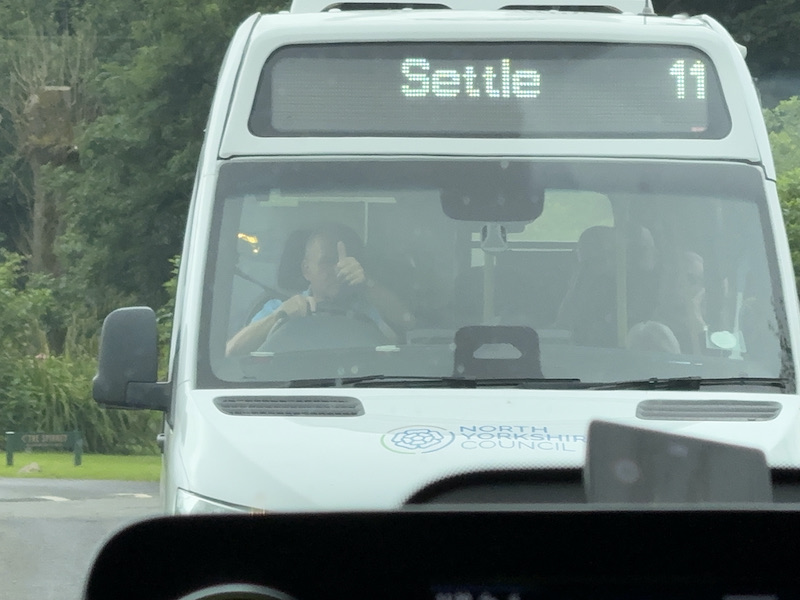
Although ’21 Transport’ was awarded the initial contract to run the resurrected route 11 in April 2024, operation passed to North Yorkshire’s in-house bus operating arm in September 2024 so it was a very recent delivered (’75 plate) North Yorkshire Council owned Mercedes Sprinter which arrived into Settle’s Market Place at exactly 10:57 bound for Clitheroe.
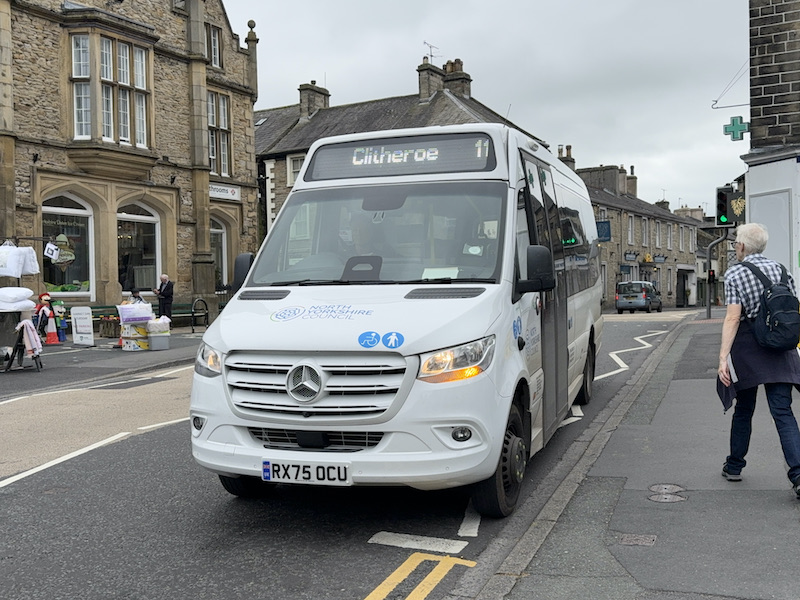
My brother is not yet of an age to benefit from a concessionary bus pass so was ready with his bankcard to pay his £3 capped fare for the journey to Clitheroe only to be told by the driver it’s cash only. Luckily I always carry a few coins on my travels (you never know when a toilet visit is needed and only accessible through a coin operated turnstile – parts of mid Wales, Greater Manchester, Derby bus station – I’m looking at you) but sadly I could only muster up £2.85, however the driver kindly accept this as payment and issued a ticket.
I’m surprised North Yorkshire Council still hasn’t got round to accepting contactless payments on the significant number of bus routes operated by its own buses. They must be one of the very few (the only?) such bus operator to be so far behind the times in such matters.
After we settled into our seats a third passenger boarded who just travelled a few stops home with his shopping and on we proceeded towards Clitheroe on a 76 minute adventure through the delightfully scenic Ribblesdale and Bowland.
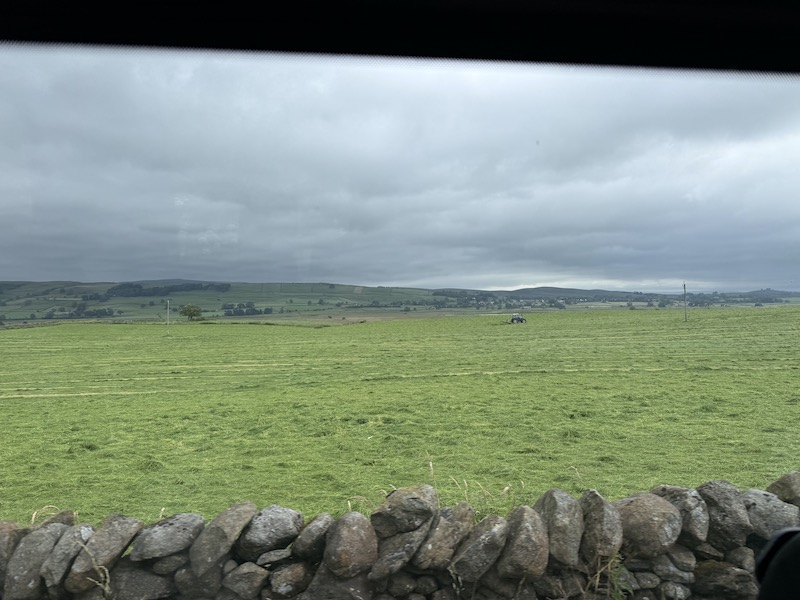
It wasn’t long before the rural nature of the route became evident as can be better seen on this Ordnance Survey map extract below.
There were no takers as we passed through Rathmell and I was beginning to wonder whether this “vital” service would prove to be rather sparsely frequented by passengers when we arrived into the next village called Wigglesworth…
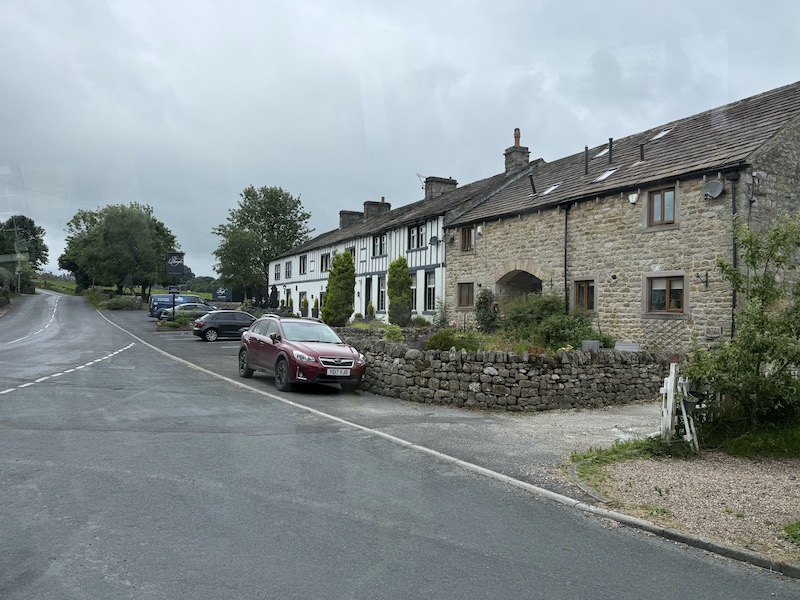
… where two passengers were waiting wanting to travel all the way to Clitheroe.
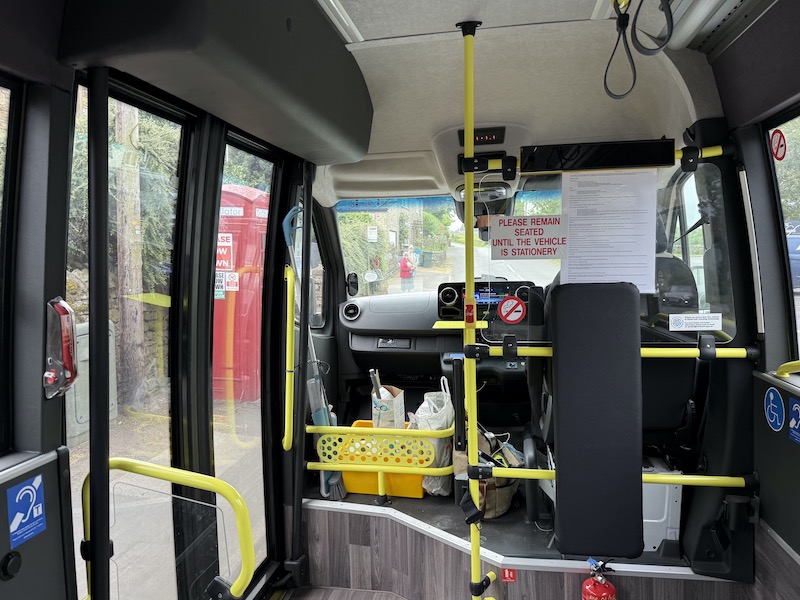
They were caravaners on a four week tour of England and had parked their caravan on a site in the village and having seen the bus go by on another journey, made enquiries and decided to take a ride and enjoy a couple of hours in Clitheroe.
It wasn’t long after that when we turned off the road to enter the Bowland Fell Holiday Park to serve this major landmark for hundreds of static caravans…
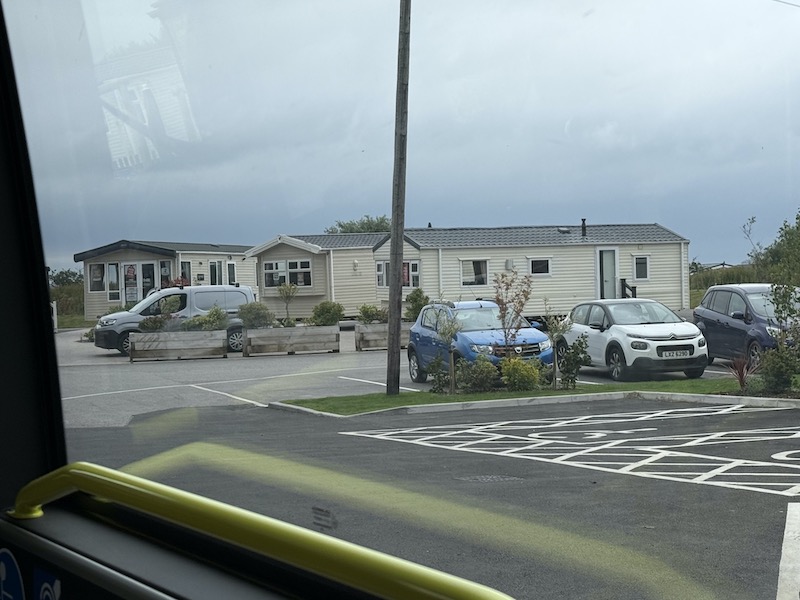
… and as we drove up the half mile access road to the main reception area we passed the second bus on the service heading towards Settle…
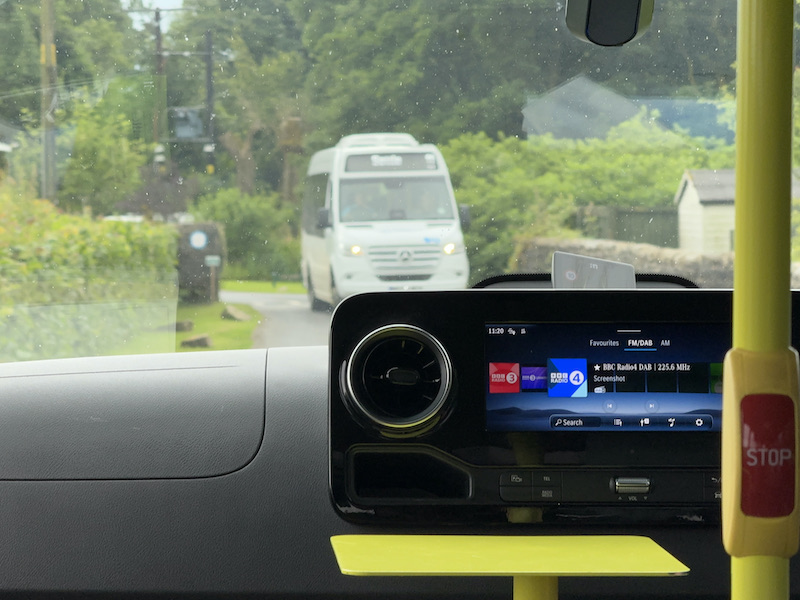
… which had nine passengers on board.
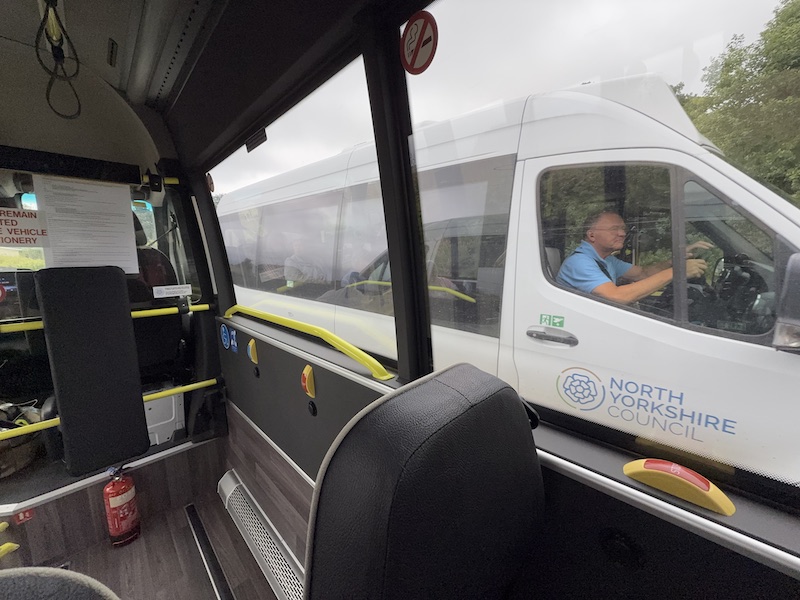
… but there was only one passenger waiting to board us who also travelled through to Clitheroe.
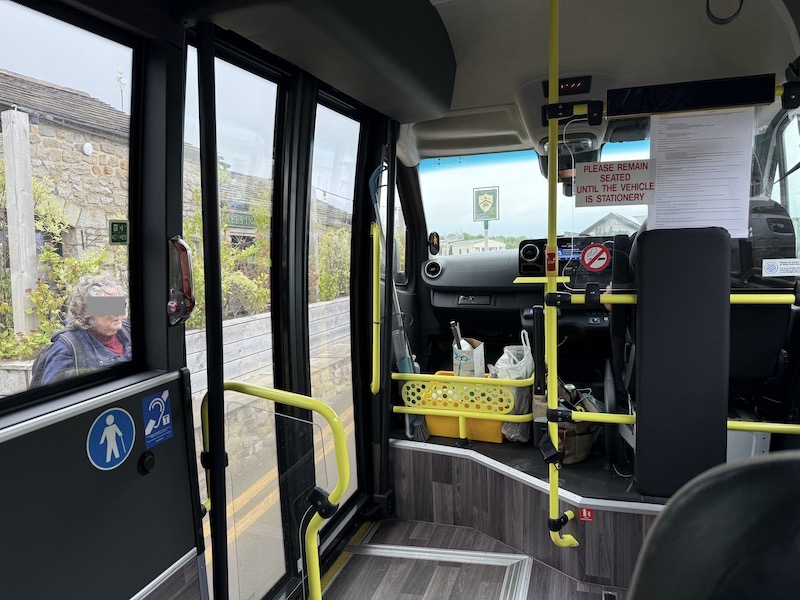
After that it was back on the road enjoying more fabulous scenery…
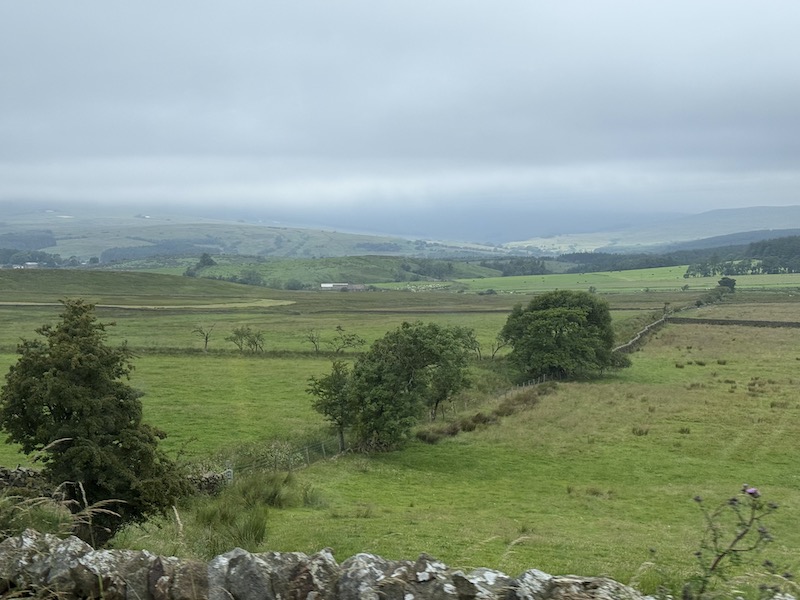
… until we reached Slaidburn where two teenagers boarded, one going to Clitheroe and another to a horse riding activity in Whitewell. Slaidburn, like many of the villages we passed through looked particularly attractive…
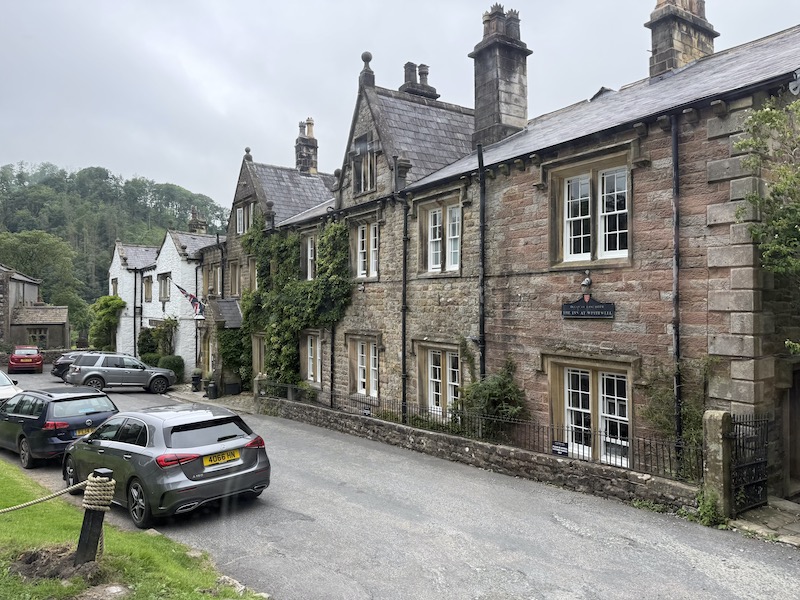
… and then it was on to Whitewell, another fabulous looking village where our horse rider alighted and another teenage passenger boarded.
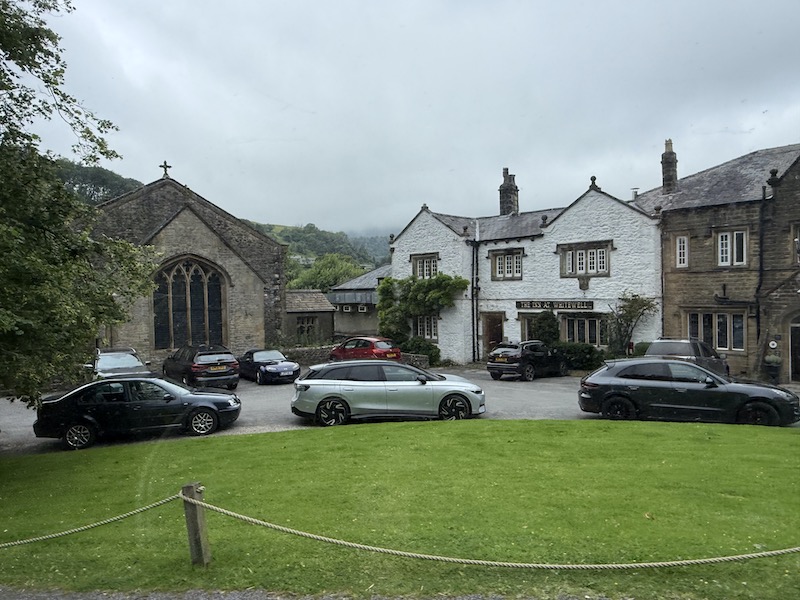
More scenery followed…
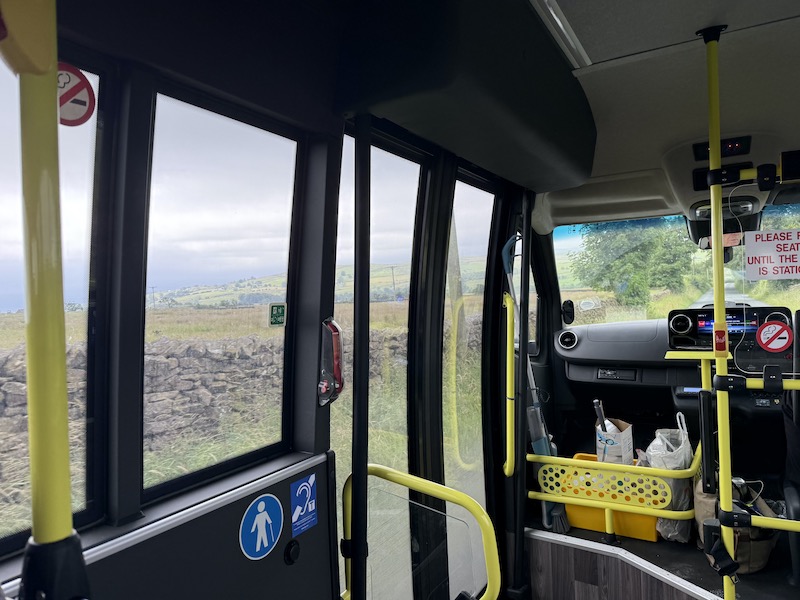
… but after 76 minutes on this superbly delightful journey we were arriving into Clitheroe where the bus terminates at the ‘Interchange’ – ie a bus stop right next to the railway station.
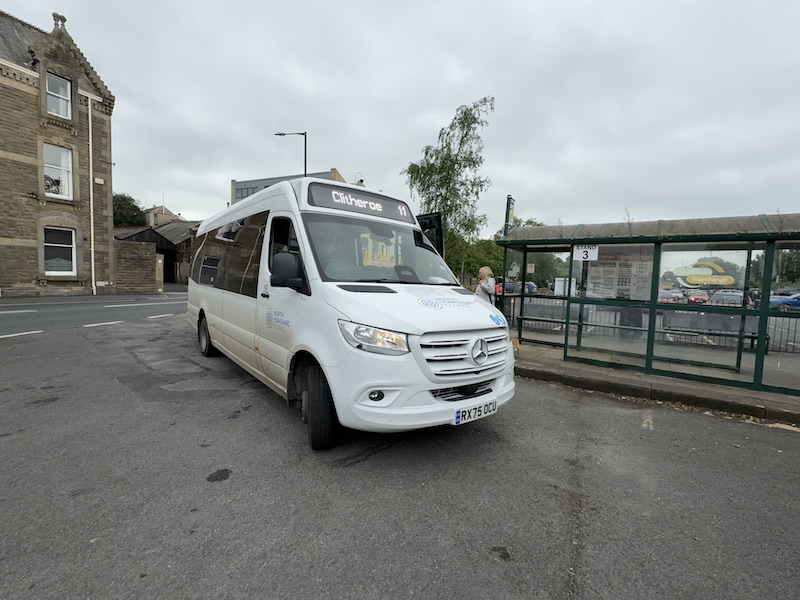
If you get a chance, add route 11 to your ‘to do’ list. You won’t regret it. It’s “vital” and quite well supported for a deep rural service.
Just one final observation – it’s such a shame North Yorkshire Council choose to block the forward view for passengers sitting in the offside double seats by sticking up notices immediately behind the driver…
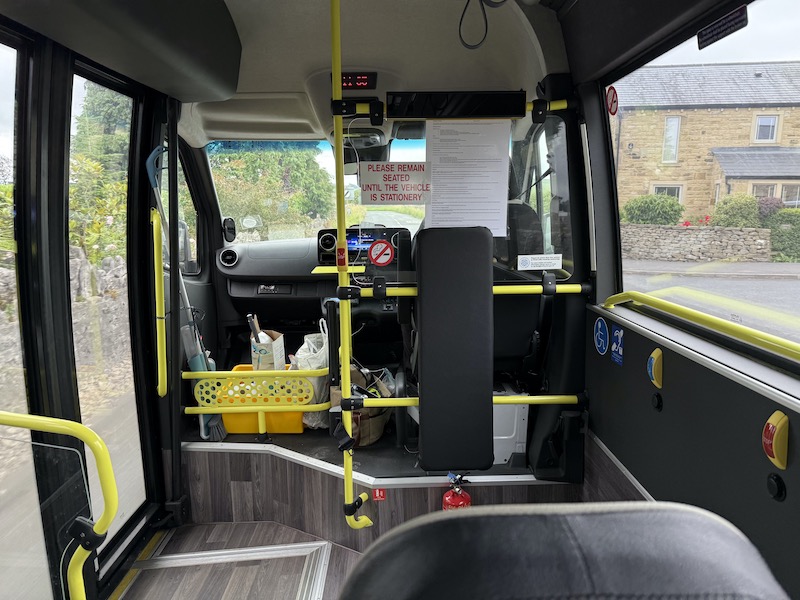
… not least as the big notice contained so much information in such a small print size it was impossible to read it but on very close examination as I left the bus I realised it was the Conditions of Carriage,

Doh!
Roger French
Summer blogging timetable: 06:00 TThSSu
 BusAndTrainUser
Simonds Service changes from 19th July
Simonds network changes from Sunday 19th July – Central Connect
LikeLike
Did the vehicle ever turn in to writing materials? How were you able to leave your seats?
LikeLike
I noticed that too. There should be free pens issued as you alight 😀
Pete
LikeLike
Apart from in this blog, the route is included in the excellent 2026 Dales Bus timetable booklet for this year, which is how I first heard about it. Friends of Dales Bus do a great job of distributing the booklet throughout local railway stations, libraries etc so hopefully this will all contribute to ridership numbers increasing. Definite shame about the cash only though!
LikeLike
The Forest of Bowland was included in the Yorkshire Traffic Commissioner’s area despite being in Lancashire. Thus, under the old licencing regime, drivers & conductors living there would get “BB” badges, rather than the more logical North Western “CC” badges applying to the rest of Lancashire. I drew the traffic commissioners’ area boundaries on a Bartholomew map around 1974 when there were substantial local government changes. Surrey was split between the Metropolitan and South Eastern commissioners’ areas: Guildford folk got “N” badges, those in Godalming “KK” badges. In my Go As You Please ticket era (1972-1977) I spotted all the English commissioners’ badges worn by London Transport bus drivers as I roamed the Capital at will. What was the Metropolitan Commissioner’s office at Bromyard Avenue in Acton still stands but is probably residential now.
LikeLike
I found your comments concerning the old licensing system interesting. My late father-in-Law was a conductor for Hants & Dorset based at their Lymington depot. He was aware of my interest in buses & kindly gave me his badge, which is KK17399. The South Eastern Commissioners’ clearly covered a very large area.
I remember Bromyard Avenue in Acton as an interesting short turning point for Trolleybuses on the 607 & later for the replacement 207 from the Uxbridge direction.
LikeLike
This was because, prior to 1974, almost the whole of Bowland was in the West Riding (of Yorkshire). The boundary was the River Ribble, so that, apart from the last mile, the whole of this route was in Yorkshire
LikeLike
Conditions of Carriage? – I should have thought it was more important for passengers to read those before they decide to get on the bus. Maybe a reason to put up bus stops all the way along the route, with shelters big enough to display large print versions of the notice – but not, please, obscuring the view of on-coming buses!
LikeLike
Thank you for mentioning this bus service. I use it often, to travel to and from Clitheroe – Settle. It has become very useful (vital, even) to some regular passengers.
Frequently, on a Tuesday, the buses are running at capacity – it’s Market Day in Settle that day. On one occasion I boarded with two others on Edisford Road (a couple of stops out of Clitheroe) and we occupied the last three vacant seats. No standing passengers are allowed which meant that we wereunable to pick up a number of waiting passengers at Slaidburn and Rathmell. The driver was most apologetic. The buses used then were typical ‘welfare’ type vehicles which have now been replaced by more suitable (and comfortable) vehicles. Without exception the drivers are fantastic, demonstrating excellent customer focus.
As a footnote, on that day when the bus was full I decided to return to Clitheroe by train, then the 280 service (Stagecoach, Skipton – Preston) just in case I was unable to board.
However, long may this service continue – and isn’t it great thattwo local authorities have worked together on this.
John Hale, Clitheroe
LikeLike
John, there is another bus company based in Clitheroe which I think consideration of appointing additional contract to could solve the market day capacity problem.
Starting by taking the NSCH service and running it on SCH serving the addtional villages at the 0820 commencement time , then turning back at settle about immediately (20min layover) and this then would give the hourly service throughout the day that others have though useful to emulate Switzerland).
The SDO service on the NYM could become regular serving the other locations
JBC Prestatyn
LikeLike
I doubt that even in Switzerland the 11 bus would connect with trains at Horton in Ribblesdale. More likely, the existence of the train to Settle would mean there would be no parallel bus.
Of course, in Settle buses would start from outside the railway station having connected with the regular interval trains on the Settle & Carlisle and at Clitheroe they would connect with the similar regular interval trains to Manchester.
it just shows what a long way we have to go.
Jim
Lancaster
LikeLiked by 1 person
From what I can tell of looking into the Swiss public transport system, I’d say you’re right but they’d probably either run services to various villages in a radius around both Settle and Horton in Ribblesdale or longer more regional connections to serve villages on route, whether that would be a scheduled route or even DRT, which does exist in Switzerland, but more to compliment fixed routes than anything.
Remember, they run hourly buses from early to late, 7 days a week even to villages of just 300 people, sometimes smaller. So a route like the 11 would be hourly from early to late every day, time with trains at both ends and even have buses from sparsely populated areas feed into it.
And I agree definitely a long way to go, even if we emulated Ireland’s integration between bus, coach and train, that would be a big improvement.
Aaron
LikeLike
As somebody who knows this area fairly well, I do not see how a route like this could ever support an hourly service 7 days a week, early to late. Not sure how they do in it Switzerland but I suspect that if you look into it the geography of the Forest of Bowland is nothing like anything in Switzerland. The Hope Valley has been chosen for the mini-Switzerland experiment because it most resembles the situation you find in Switzerland, even so I suspect that one conclusion from this will be that England is not Switzerland. Some aspects of the scheme seem very ambitious and perhaps that is a good way to start. Either way it will give RF a nice day out in the Peak District checking how it works.
AHS
LikeLike
In Switzerland a regular hourly service wouldn’t need to be “supported” by patronage alone. It is accepted that all communities of a certain size will have a certain level of service. No doubt this requires a large amount of what we would call “subsidy”, but Switzerland is a rich country.
LikeLike
Making comparisons with the way many European countries operate buses overlooks culture & attitudes. In many ways they tend to be more disciplined in their approach to such matters & as you suggest, accept social responsibility for the provision of public transport. There is not a chance that the U.K. could replicate what Switzerland achieves because we lack so many of their attributes.
LikeLike
Swiss transport does normally follow the hourly pattern but there are exceptions. I was at St Croix in the Jura earlier this year. The trains and the connecting bus route ran half hourly during the week at morning, lunchtime and evening peak with an hourly train off peak and at weekends. The connecting bus during the week was DRT in the morning, but then 90 to 120 min off peak in the afternoon then finished around 20.00 and around 30 minutes earlier at the weekend.
LikeLike
I forget what the rules were on Conditions of Carriage in regulation days , they used to be in companies timetable books and could be requested to be viewed from the conductor, I think they had to be carried , but not mandatorarily displayed, on the vehicle and tickets had to be issued subject to conditions of carriage (like BR a passenger was deemed to have read and agreed to them at ticket purchase). Adding to municipal operator numbers should be good, obviously a timetable revision to better connect with some trains might be worth checking . Omitting one set of villages on a morning schoolday only service must make residents wanting to plan their lives on regular journeys must be frustrating. Unless there are other bus services to villiages I think a later (at least in Summer) departure to Horton in Ribblesdale I think could be appreciated for shoppers and workers.
Settle has a small cultural (late evening pub and theatre scene) has anyone looked a M-S demand responsive use of a vehicle on line of route for a 1800hs-2230 operation?
Of course the big missing transport is a Settle – Clitheroe add on to the Clitheroe Blackburn line . difficult to see if passenger numbers cover the costs but I think there would be a regular patronage.
JBC Prestatyn
LikeLike
Am obvious place for T&C is o the compainmes web sites but they are rarely there most companies treat the T&C’s as almost classified information
LikeLike
Northern have been running a Saturday only service – Rochdale via Manchester Victoria to Ribblehead for over 2 years now, when I used it, it appeared to be well used from the larger towns on route. Also just noticed their page lists buses in the area including the 11 bus and notes its limited capacity due to being a minibus!
Central Connect seem to use the same buses on the Sunday 242 and 16C near me as well as the HL1, only takes the bus to carry 8 to 10 people and they feel cramped, nippy little things though! Minibuses make sense in some situations, but if they are ever close to full, regular buses make more sense. Can’t be leaving people behind on low frequency routes like another commenter here has suggested!
https://www.northernrailway.co.uk/tickets/yorkshire-dales-explorer
Aaron
LikeLike
If a larger bus was used, then Northern could advertise it directly as part of their Manchester – Ribblehead service. Basically if Monday-to-Friday, the bus is the missing link. Go on a Saturday, and it’s train all the way….. (CH, Oxford)
LikeLike
Cash only buses.
I was very surprised that on the one Swiss Post bus route that I used in Switzerland last month (Visp to Saas- Fee) was cash only and no cards. As I was on an Interail pass (not a Swiss Pass) and only had a couple of days in Switzerland I hadn’t researched this beforehand and downloaded the app.
It meant 30 mins wasted till I got both cash and the app sorted. I presume this is the same throughout the country?
LikeLike
Most Swiss passengers would have paid online or be using the FAIRTIQ app that calculates and pays your fare automatically by tracking your journey. As you will have noticed, it’s not a Swiss bus driver’s job to check that you have a ticket although they will sell you one if you need one.
LikeLike
It is interesting to note your comment is so far behind the times in not accepting contactless card payments. Most of the UK is in any case way behind the times in generally not offering advance paid tickets, which have been widespread in many European countries for many years or even decades.
I know that this would potentially encourage more fare evasion, and force the employment of revenue protection officers, but it would speed up bus services and make them more reliable. The improved reliability and convenience might just attract more passengers, especially if this became the norm throughout the country.
If anyone disagrees with this, I would simply urge them to take a few trips abroad to witness this “revolutionary” concept in action, then perhaps you would become a convert like me.
LikeLike
”I know this would potentially encourage fare evasion” is an understatement and the reason it should not be expanded. You would need an army of revenue inspectors to deal with it and I’d suggest that would cost far more than it ever recovers. The fact is that since contactless became the norm, and with capping capabilities, other off-bus solutions are outmoded.
LikeLike
Roger doesn’t mention the delights of Clitheroe, which like Ludlow are many and various. I think that if it and Skipton were coastal as well they would be perfect. A nod to nominative synchronicity – the village of Wigglesworth en route is a close match to an Australian pro at Clitheroe cricket club for several years in the 80s/90s, Ian Wrigglesworth, who set a league record for the number of runs in a season.
LikeLike
The timetable is very odd, why do Northbound buses have 3 minute layover at Settle, but buses Southbound have a 47 minute wait, buses Southbound should have a 3 minute layover as well, & have the extended layover at Clitheroe?
SM
LikeLike
On the 47 min gap southbound. On the 11 alone I dont see it as a problem other than for frustrated through passengers , but effectivel persons going further south are more likely to consider a train to the main destinations. I dont know if the vehicle and driver do another local Settle route in the time gap that could be possible.
Essentially the bit north of Settle is a local service that has been tagged onto the 99 which otherwise has its main attraction Northbound of Settle only, hence why I suggested a useful fifth evening journey north and back from Settle could help a few potential passengers.
For Clitheroe as a destination indeed coming into the interchange means most passengers face a substantial climb up the hill to the high street and library for example , and further still up to the Castle.
When the Aldi? was built out on the road toward Whalley maybe provision should have been made there for bus turning. There has been quite a bit of new residential development to the south of Clitheroe but I think that is covered by other services , but the McDonalds on the roundabout has some employement area , Clitheroe also manages to have a decent sized tesco – but still needs a bit of a walk uphill to it. Maybe if time permits an extension to cover a bit more of the town area might be better for those coming in from the north.
JBC Prestatyn
LikeLike
The ‘other operators’ section of the 1976 Ribble Southern Area timetable is instructive as to the situation over this route 50 years ago in ‘the good old days’:
Clitheroe-Slaidburn operated by Leedham’s Garage, 3 journeys M-S, 4 on Tuesday.
Tosside-Settle operated by Pennine Motors 2 journeys, Tuesdays only.
Settle-Horton operated by D. Whaites & Son, MWThF 3 journeys (pm only), Tuesdays 6 journeys, Saturdays 7 journeys, Sundays 1 journey (a seemingly useless service, 1330 from Settle returning at 1400 from Horton).
Note no service between Slaidburn and Tosside.
AHS
LikeLike
Card readers on buses rely on mobile reception, so if there is no signal, then it is difficult/impossible to take payment by card (whilst contactless payments can be processed ‘offline’ initially, the risk of the payment bouncing when it is taken is non-trivial, and not all cards will support an ‘offline’ transaction all of the time). I once encountered this situation in an urban area and (along with two other passengers who boarded at the same stop) got a free ride (the driver did not even ask whether I had cash). If the route served by a bus is known to have substantial lacunae in mobile reception, going ‘cash-only’ may actually be the most prudent option to protect revenue and ensure fairness, provided that the situation is advertised prominently.
LikeLike