Thursday 4th June 2026
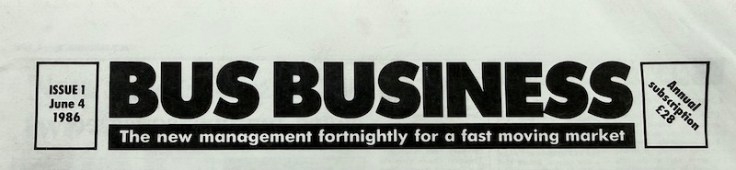
Not only does 2026 mark the 40th anniversary of bus deregulation (introduced on 26th October 1986) but this very day 40 years ago, 4th June 1986, saw the birth of Bus Business – a “fortnightly management newspaper for the bus industry, its observers and suppliers”.
The all new Issue 1 was widely distributed on a complimentary basis to encourage new readers to take out an annual subscription for £28 and there’s no doubt huge numbers responded positively to this much welcome initiative.
Produced by the long standing veteran of transport publications, managing editor Peter Stonham, the newspaper was a complete break from the previous tradition of weekly or monthly colour magazine feature style reporting.
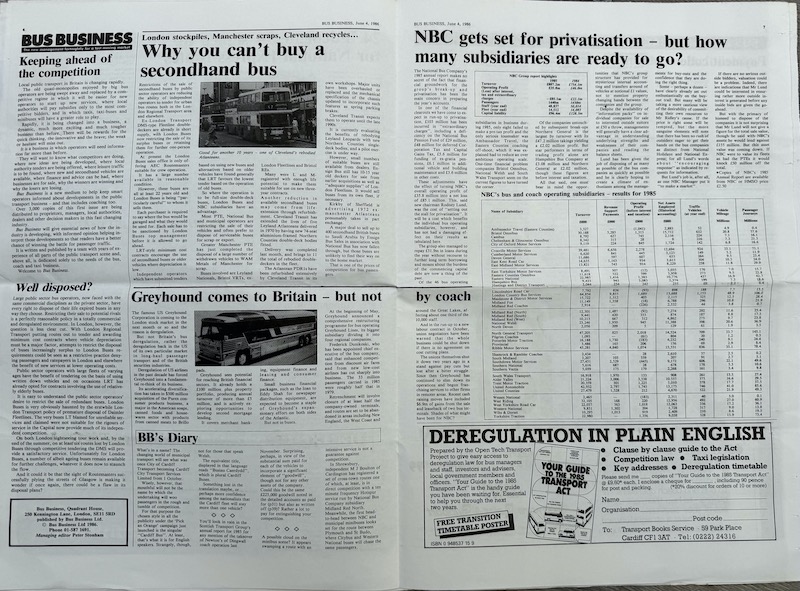
Here was a black and white newspaper style publication containing all the fast paced news impacting the industry during that frenzied period in the late 1980s, and particularly 1986, with not only the uncertainties of deregulation and which company was competing with which company but also the privatisation process was just beginning leading to fevered speculation and rumours about who was putting a bid in for whom.
In today’s world dominated by social media, online forums, the Internet and smartphones it’s easy to forget in those far off days four decades ago there was no such thing as ‘Breaking News’ and you only found out what was happening by word of mouth on a landline telephone or at a meeting or wait for a magazine which might or might not have the latest information about industry developments.
Bus Business changed all that. It was the right medium at the right time, quickly establishing itself as the credible news resource for the industry.
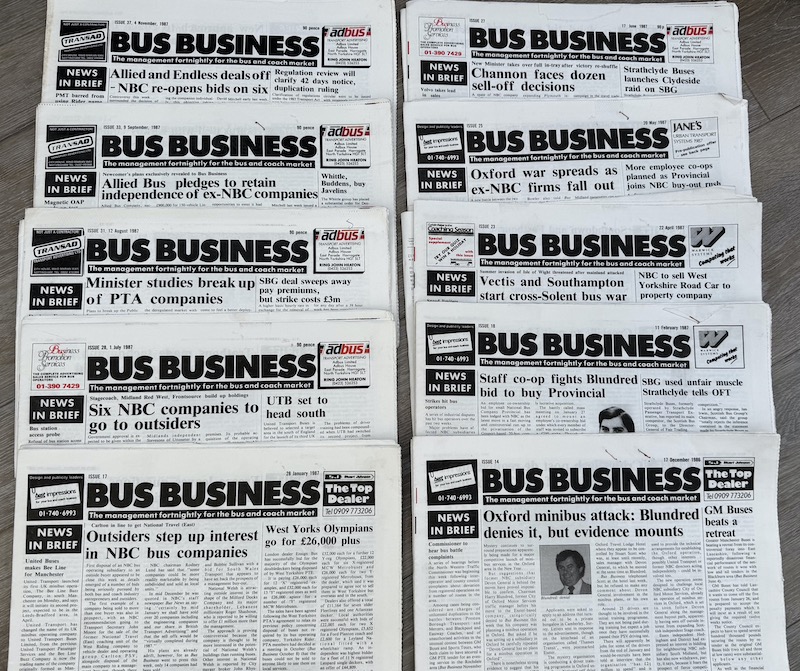
Thanks to the Bus Archive and Omnibus Society and much appreciated help from Julian Peddle, I’m delighted to let blog readers know original spare copies of Bus Business produced during the immediate post deregulation period have been unearthed so we can relive those exciting times 40 years on.
Starting today a new monthly series will feature all the highlights and developments happening exactly 40 years ago in that ‘all change’ second half of 1986 and into 1987 so those around at the time can relive the memories of those revolutionary times while those born in the intervening years can enjoy a taste of what life was like as the industry adapted to a radical new regime – including all the innovative and good things that happened as well as all the bad and shameful practices that went on.
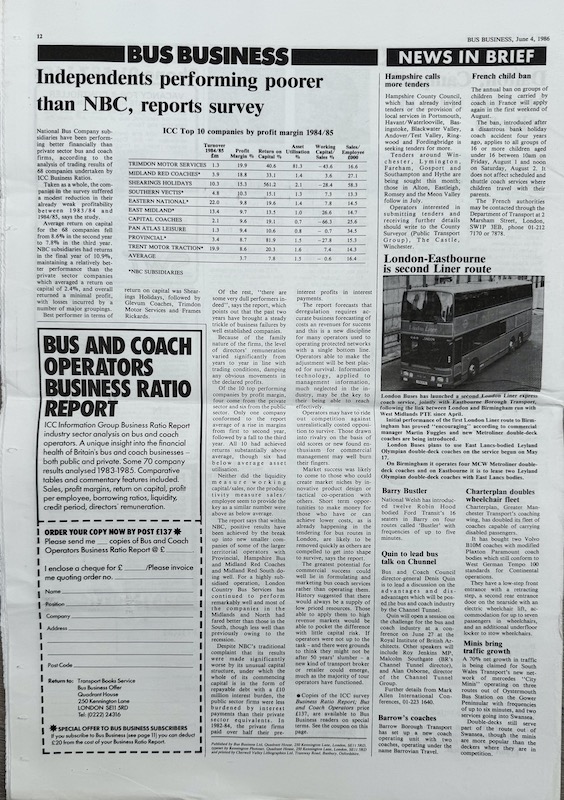
It’s interesting to reflect back in the late 1980s it was all about the impact of competition on networks and who was going to be running what bus routes while fast forward 40 years to the late 2020s ….. it’s all about the impact of competition (for franchised) networks and who is going to be running what bus routes. And in those days there was always news about the latest sale of a bus company whereas now it’s who has bought the latest coach company up for sale. In those early deregulated days there was often news of new branding being launched to make passengers aware of the new regime whereas these days there’s often news of new branding being launched to make passengers aware of the new regime. Plus ça change?
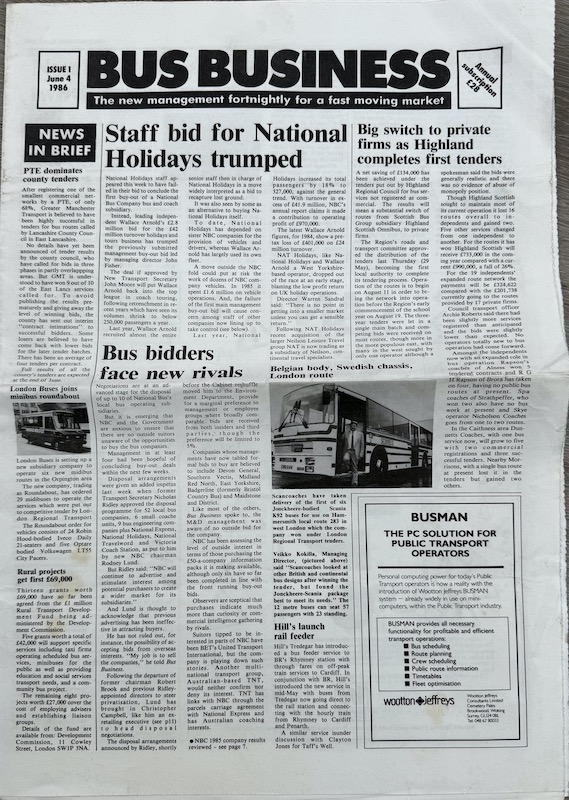
As a foretaste of what’s coming in this series in the months ahead, here are the highlights from that first issue of Bus Business which landed on managers’ desks 40 years ago on this very day.
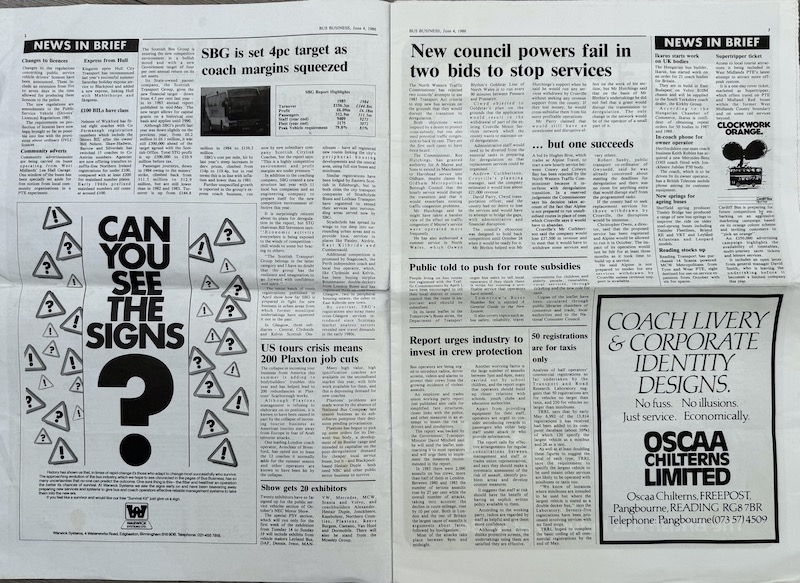
The front page main news story carried news of the National Bus Company’s fledgling privatisation process and in particular the sale of National Holidays.
Staff bid for National Holidays trumped
National Holidays staff appeared this week to have failed in their bid to conclude the first buy-out of a a National Bus Company bus and coach subsidiary. Instead leading independent Wallace Arnold’s £2.8 million bid for the £42 million turnover holidays and tours business has trumped management buy-out bid led by managing director John Fisher.
The news story goes on to report “last year, Wallace Arnold recruited almost the entire senior staff then in charge of National Holidays in a move widely interpreted as a bid to recapture lost ground. It was also seen by some as an alternative to buying National Holidays itself.”
Bus Bidders face new rivals
Negotiations are at an advanced stage for the disposal of up to 10 of National Bus’s local bus operating subsidiaries. But it is emerging that NBC and the Government are anxious to ensure that there are no outside suitors unaware of the opportunities to buy the bus companies,.
Management in at least four had been hopeful of concluding buy-out deals within the next few weeks. Disposal arrangements were given an added impetus last week when former Transport Secretary Nicholas Ridley approved the disposal programme for 52 local bus companies, six small coach units, nine bus engineering companies plus National Express, National Holidays, National Travelworld and Victoria Coach Station, as put to him by new NBC chairman Rodney Lund.
Companies whose management have now tabled formal bids to buy are believed to include Devon General, Southern Vectis, Midland Red North, East Yorkshire, Badgerline (formally Bristol Country Bus) and Maidstone and District.
London Buses joins minibus roundabout
London Buses is setting up a new subsidiary company to operate six new midibus routes in the Orpington area. The new company, trading as Roundabout, has ordered 29 midibuses to operate the services which were put out to competitive tender by London Regional Transport. The Roundabout oder for vehicles consists of 24 Robin Hood-bodied Iveco Daily 21-seaters and five Optare bodied Volkswagen LT55 City Pacers.
PTE dominates County tenders
After registering one of the mallest commercial networks by a PTE, of only 68%, Greater Manchester Transport is believed to have been successful in tenders for bus routes called by Lancaashire County Council in East Lancashire.
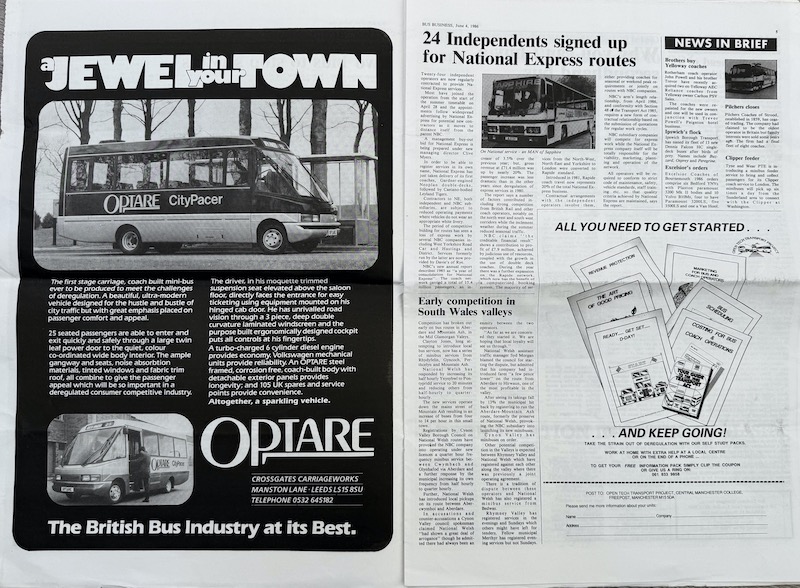
Early competition in South Wales Valleys
Competition has broken out early on bus routes in Aberdare and Mountain Ash in the Mid Glamorgan Valleys. Clayton Jones long attempting to introduce local bus services, now has a series of minibus services from Rhydyfelin, Gyncoch, Perthcelyn and Mountain Ash. National Welsh has responded by increasing its half hourly Ynysybwl to Pontyrpidd service to 20 minutes and reduing others from half-hourly to quarter-hourly.
Clipper feeder
Tyne & Wear is introducing a minibus feeder service to bring and collect passengers for its Clipper Coach service to London. The minibuses will pick up six times a day from the Sunderland area to connect with the Clipper at Washington.
Why you can’t buy a secondhand bus
Restrictions on the sale of secondhand buses by public sector operators are reducing the ability of independent operators to tender for urban bus routes both in the London Regional Transport area and elsewhere. Ex-London Transport DMS-type Fleetline double deckers are already in short supply, with London Buses now restricting the sale of its surplus buses or retaining them for further one-person operation.
London – Eastbourne is second Liner route
London Buses has launched a second London Liner express coach service jointly with Eastbourne Borough Transport, following the link between London and Birmingham run with West Midlands PTE since April.
Minis bring traffic growth
A 70% net growth in traffic is being claimed for South Wales Transport’s new network of Mercedes ‘City Minis’ operating on three routes out of Oystermouth bus station on the Gower Peninsular with frequencies of up to six minutes, and two services going into Swansea.
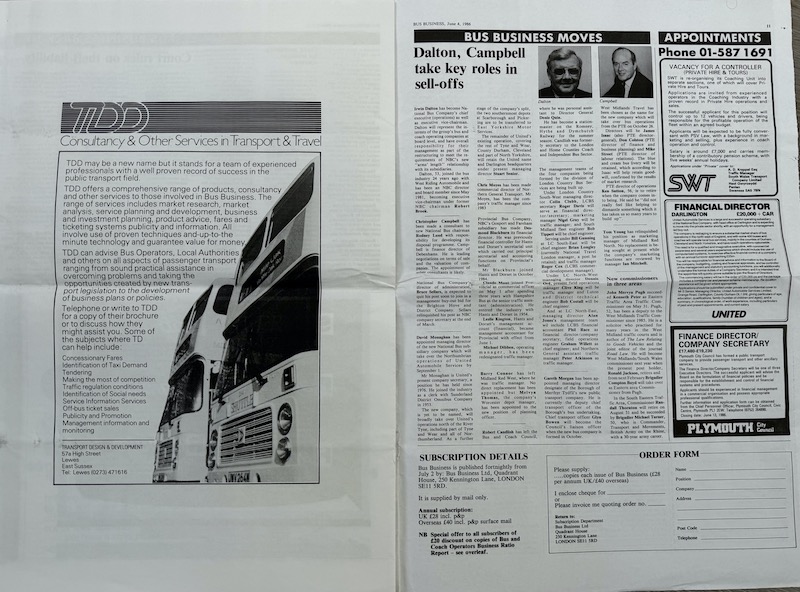
More nostalgia from 40 years ago in the coming months.
Roger French
Revised blogging timetable: As it’s June, the BusAndTrainUser enhanced blogging timetable returns for the 2026 summer season from this weekend: 06:00 TThSSu.


Bus Business was an essential read in those heady days of deregulation! Look forward to your look back in coming blogs . . .
LikeLiked by 2 people
This is a brilliant idea; one of the main reasons ‘youngsters’ (compared to me) repeat previously made mistakes / don’t learn from the past is they don’t know about it. I’ll be reading avidly, not for entertainment but to learn new things. Thank you as always. RC
LikeLiked by 1 person
Found two of my jobs through adverts in Bus Business. But regret more throwing them out, at a time when I thought I didn’t have enough space to either need or want to retain them.
MoK
LikeLike
One problem I found with trade journals was I spent more time reading them than I did actually working , when at work.
JBC Prestatyn
LikeLike
GoAhead have gained a few routes in Kent
As part of upcoming contract changes, the 308 and full 416/417 services will transfer to a new operator GO Ahead
from 29th June 2026
The 408 will go to Go Bus on the 15th June 26
LikeLike
One article on the front page of the first edition you did not enlarge upon was the purchase by Scancoaches(?) of 5 Scania buses with Jonckheere bus bodywork to work route 283 under contract to London Regional Transport. They had an unusual automatic gear operation, had black on white blinds, had high entrance steps, and could not spell Schepherds Bush. I don’t think anyone else operated them from new in the UK.
MotCO
LikeLike
Yes, it was Scancoaches – albeit using the fleetname “Scanbus”. Interesting that they managed to spell Bloemfontein Road correctly!
RC169
LikeLiked by 2 people
I must be getting old as these headlines I remember as if they were last week!
I never saw this publication whilst I was working so will be very interested to follow this series. Life was very interesting at this time and you were always wondering what would happen next.
My understanding was that Lancs CC saved quite a lot at deregulation and put out extra tenders. The wiser councils put the savings to one side ready for the inevitable further cuts when full deregulation came in February 1987.
The headline regarding Allied Bus is interesting. I always remind David Martin about this when I see him. I was at East Midland at the time and Allied was the initial bidder until the links between Allied and Drawlane became apparent.
Richard Warwick
LikeLike
A brilliant series Roger and yes Richard, it really does only seem like yesterday.
Sometime very early in the 2000’s, I went into the taxi office that was in Pool Valley in Brighton as they had some Southdown EFE models for sale. I bought a couple and the late-teens girl who served me said she didn’t remember Southdown, but they always seemed to be popular.
I felt old then. Fast forward another 20 years……!
Despite the dominance of the big groups now, so much of geographical significance within the industry was formed back then by who bought who and who competed with who.
How different things would have been if companies were bought by other bidders and/or competitive battles went the other way.
Badgerline’s attack on Wilts & Dorset after their bid for the company was unsuccessful and Harry Blundred’s plan for Basingstoke Transit are just 2 examples.
And if Wilts & Dorset’s management buyout led by Hugh Malone was unsuccesful and the alternative bid led by his collegue Alan Rolls in conjunction with Southern Vectis won instead, then Wilts & Dorset, Southern Vectis and Bluestar would have been linked almost 20 years before it eventually actually happened under Go Ahead.
I do take some small comfort by the fact that my local buses still carry legal lettering that says “Midland Red South Ltd” however!
LikeLiked by 1 person
I still missing all the companies which have disappeared in the last 40 years li.keg Ribble,Cumberland,United Eastern Scottish,West Yorkshire OK etc.Was it really necessary for the big groups to destroy years of heritage and service tho Their localities. Bus services are too important to leave to market to forces with constant changes and times etc.I hope franchising really works to improve the local bus services
LikeLike
I don’t miss Eastern Scottish. The employees were great but the Scottish Bus Group operations often left much to be desired. Not much experience of United but Northumbria is a company I do miss. Arriva look so boring.
LikeLike
I agree with you concerning Northumbria. I started working for Egger (based in Hexham) in 1986 & recall the striking livery of Northumbria’s buses plying between Newcastle & Carlisle & their innovative service 602 that linked Hexham with the Metrocentre in Gateshead. I was surprised following the renaming of the Cowie group to Arriva in 1997 & then again, when the subsequent bland Blue & Stone livery replaced the striking grey, red livery & white of Northumbria.
LikeLike
Changing operators is not the only change, 40 years ago there was real investigative reporting and serious articles, whereas today most of the magazines are just a rehash of the intensely boring press releases operators and manufacturers issue, even Passenger Transport’s articles are mainly written by consultants as a pseudo advert for their organisation,and the whole magazine can easily be read in 10 minutes.
Bus Business used to be delivered on a Thursday, and it was pointless trying to ring any senior bus Manager before 1100 as they would want to ensure they had read BB cover to cover to not miss anything. And in those days the post actually arrived reliably 6 days a week before 0900
LikeLiked by 2 people
I was completely unaware of “Bus Business” but did chance upon transport related publications at crucial times. In early 1972 I bought my “usual” copy of London Transport Magazine, in that edition was news that the foreign passport requirement for the purchase of Go As You Please tickets was being lifted in March. This information was crucial for my future travel needs yet got no publicity elsewhere at the time. Having watched the Inter Garage Football Cup Final in 1989 I was very pleased to come across a copy of LT News with a brief match report to add to my files. I had a half day off work the kick-off being at 1700. I bought a Travelcard from my local Surrey station; the game was at Park Langley in Beckenham; Ash Grove’s team came in a RML (ex LCBS) and the Alperton team in a M which had the lower deck decorated with green and yellow paper chains, the team’s kit colours; Ash Grove won and the first leg of my homeward trip was on the AG RML with the winning team and the cup inside as I rode alone in solitary splendour upstairs. Two buses from AG to Waterloo and I just made my last train home.
As to the Roundabout scheme: Travelcards and Bus Passes became available on Green Line route 706 between Bromley and Green Street Green. The following year Travelcards were extended to almost the whole Green Line network inside Greater London.
LikeLike
LikeLike
Thank you for posting this link. Having taken a look at the website the business is certainly innovative in its approach. I was particularly impressed with the Routemaster converted for Nyetimber sparkling wines. It just goes to show how an interest in one hobby can be linked to another. Cheers!
LikeLike