Thursday 21st May 2026
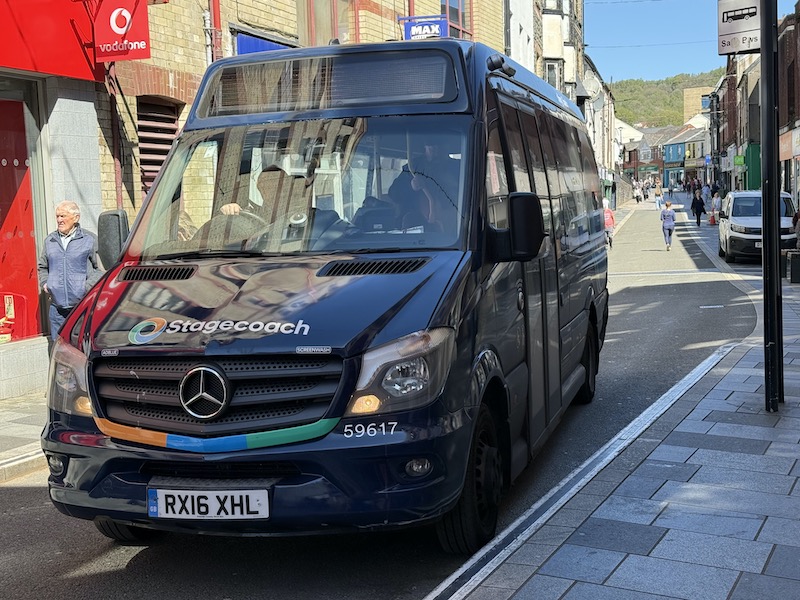
This one will be over in a flash. I thought route 99 in Thurrock was a short route involving just 13 wheel turning minutes to complete a circuit (coupled with 17 minutes layover time across three locations on the route to make for a half hourly frequency), but as a reader pointed out at the time, this latest route 99 being featured today holds the prize for the shortest journey of all 25 bus routes numbered 99, as well as being the only bus route numbered 99 in Wales.
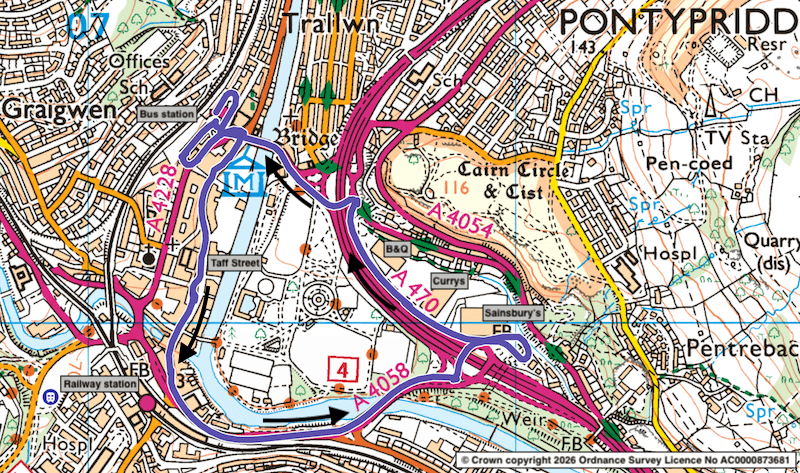
It’s Pontypridd’s Town Circular, operated by Stagecoach, with a 12 minute journey time for a complete anti-clockwise circuit of the route with three minutes layover in Pontypridd bus station making for a 15 minute frequency.
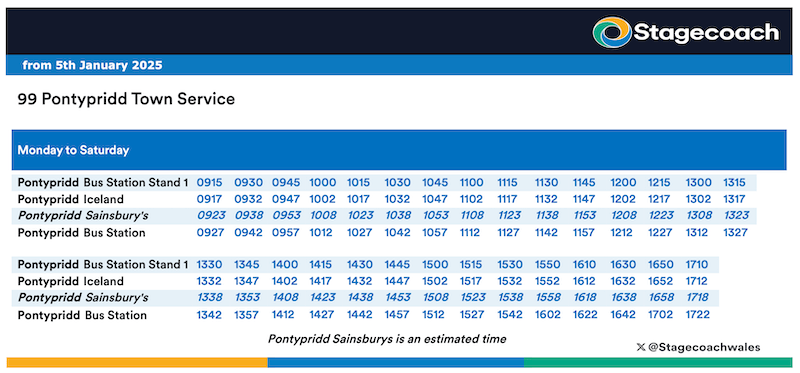
As you can see, the bus is on the road from 09:15 to 17:22 with a half hour break at lunch time and a widened 20 minute frequency during the late afternoon to keep the bus running to time with busier roads.
But my recent experience when travelling on the route the other week indicated the daytime timetable was also very tight with no margin for delay. A couple of slow boarders …. meeting all traffic lights on red on the circuit …. more traffic than usual …. and the bus soon loses time. Indeed, on the journey I made (11:30 from the bus station), we set off exactly on time, but it took two minutes to get through the traffic lights at the exit to the bus station…
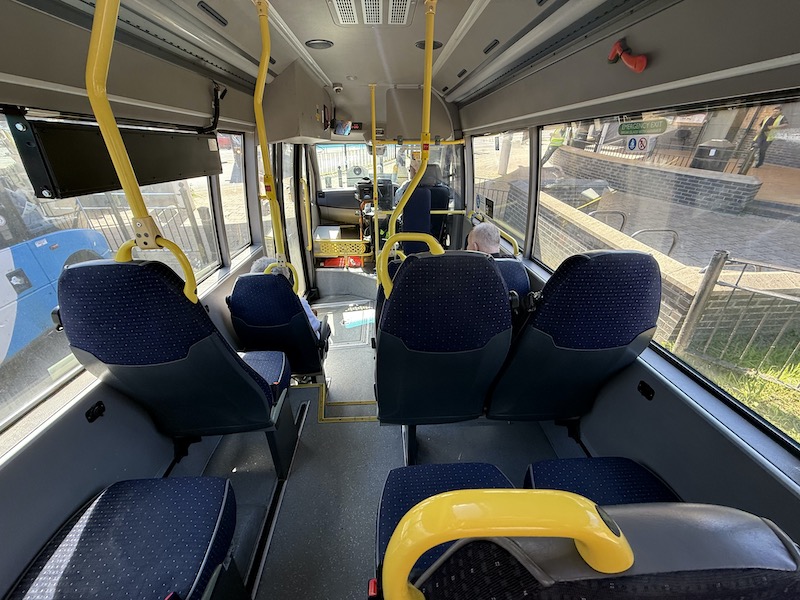
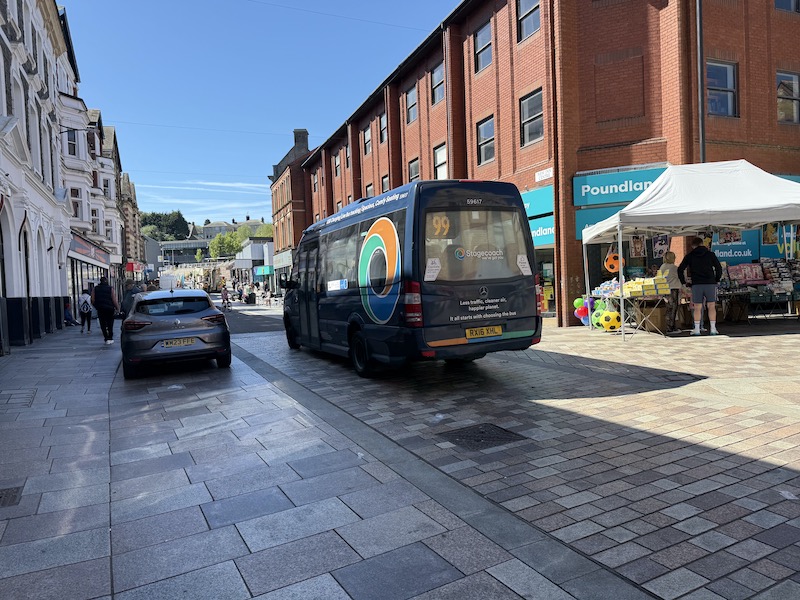
… one passenger had stayed on the bus from the previous circuit and two had boarded in the bus station. After negotiating the bus station exit we avoided the main Gelliwastad Road used by all other bus routes that by-passes the town’s main shopping street and instead spent another minute or so waiting to turn right into that otherwise pedestrianised street called Taff Street where there are three stops specifically for the 99 along its length; the third being outside M&S and seemed to be the busiest.
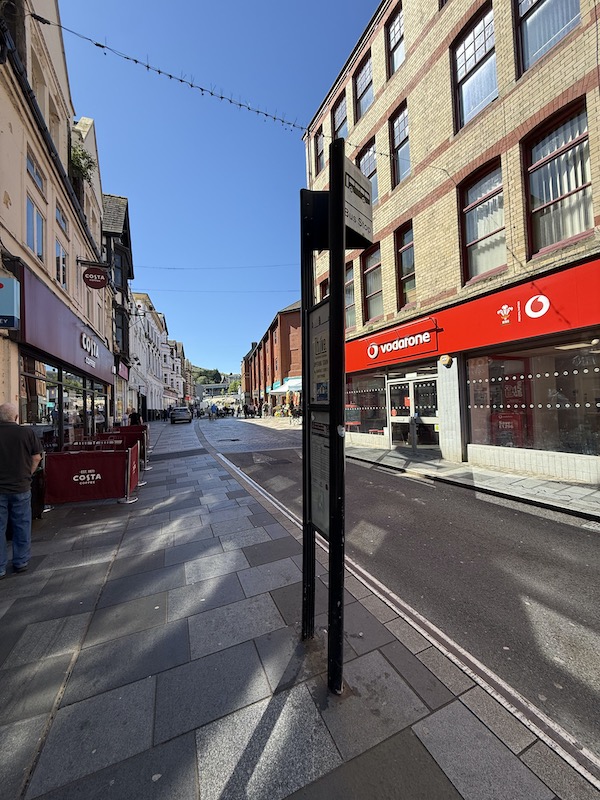
One passenger boarded at the first stop and travelled to the third stop (for M&S), the passenger from the previous circuit also alighted at M&S and the one from the bus station alighted at the second stop. At M&S three boarded to travel back round to the bus station.
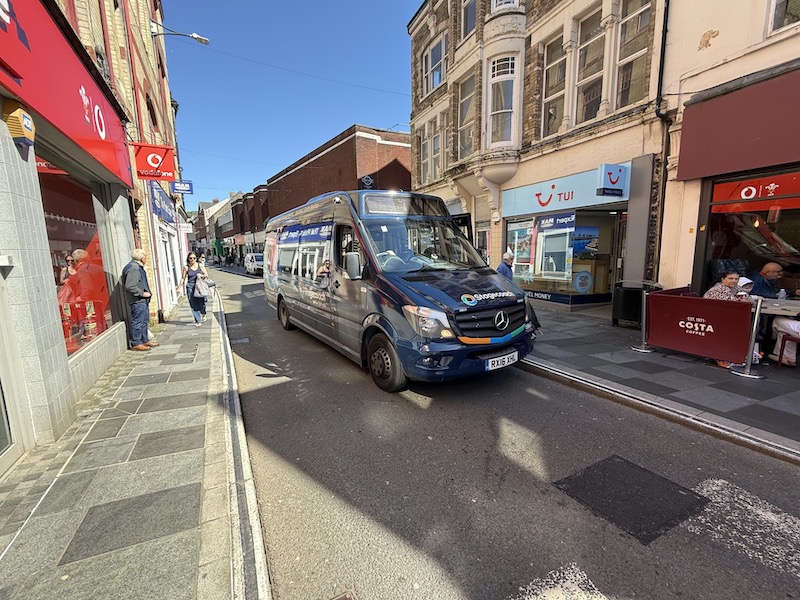
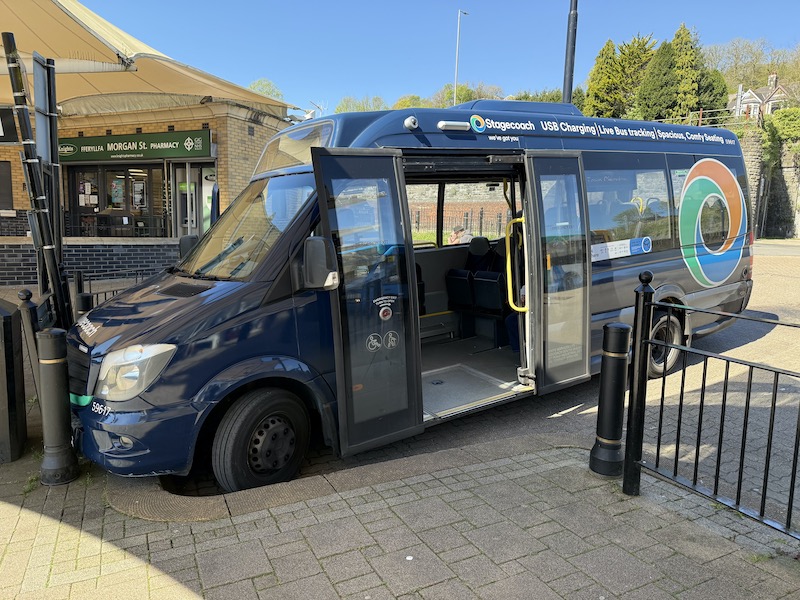
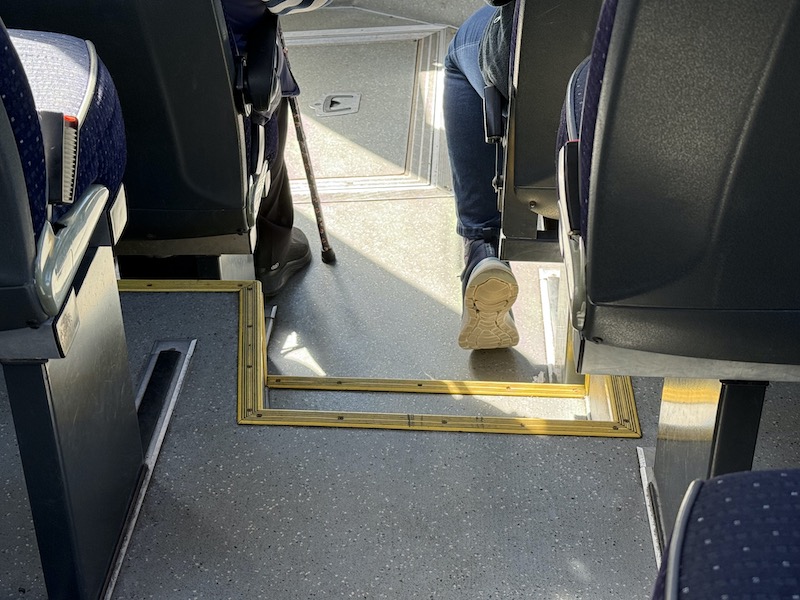
It took a little time at each stop, as passengers were reluctant to pass into the main seating area of the Mercedes Sprinter minibus, allocated to the service on the day I travelled, preferring instead to sit in the accessible area which necessitated a slight rearrangement of shopping bags and trolleys each time.
Furthermore, we only travelled along Taff Street at a snail’s pace as pedestrians have priority.
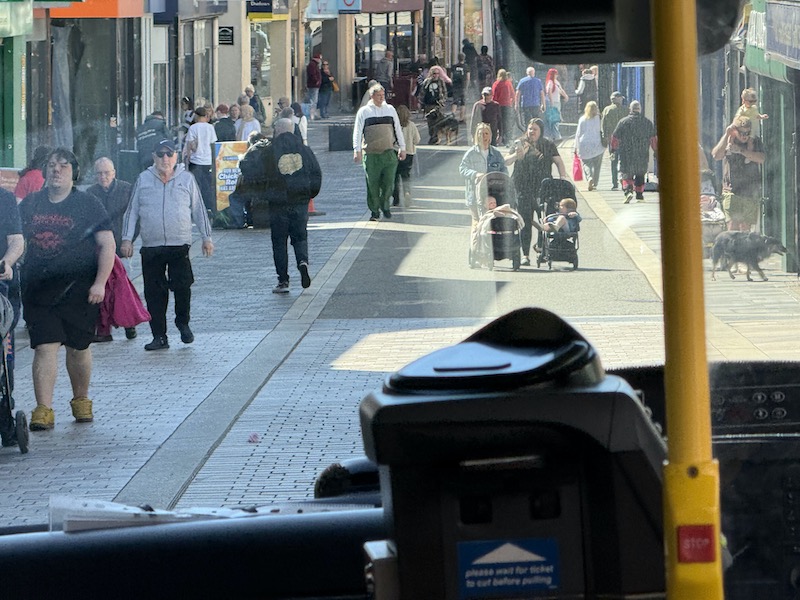
After that it was more traffic lights then out on to the main dual carriageway called Broadway past the railway station (for which there is no convenient stop for the 99 entailing a 330 yards walk to the M&S stop) and headed over to a large Sainsbury’s, Currys and B&Q on the other side of the River Taff with the former and latter both served by a bus stop and where we picked one and two passengers up respectively.
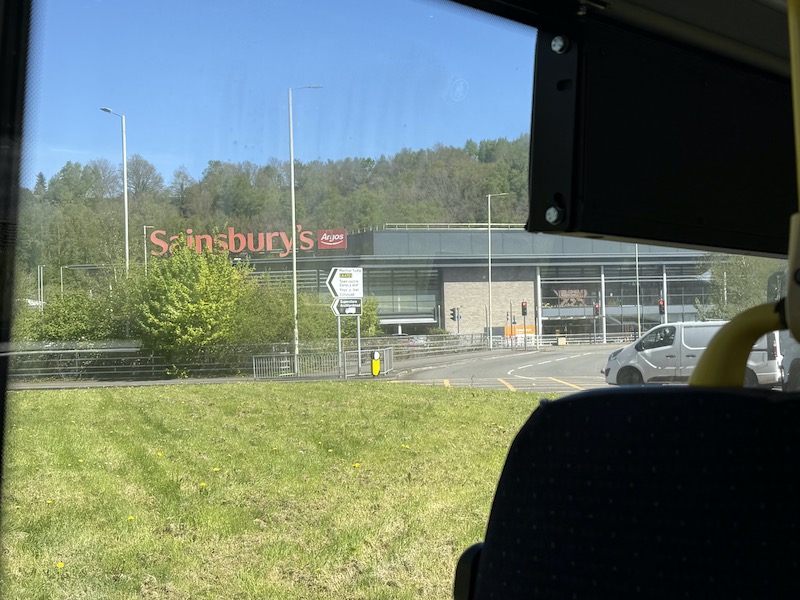
It’s then through a busy roundabout (where there is some bus priority) and back to the bus station where we arrived at 11:46 having taken 16 minutes instead of the scheduled 12. All five passengers alighted and four more boarded and I stayed on to have another ride down Taff Street where we picked one up at the first stop, two alighted at the second stop with four boarding then I alighted at M&S where one boarded, but by then it was 11:53 which the timetable shows as an “estimated time” at Sainsbury’s and there’d be no way the bus would get back to the bus station for the 12:00 journey to depart on time.
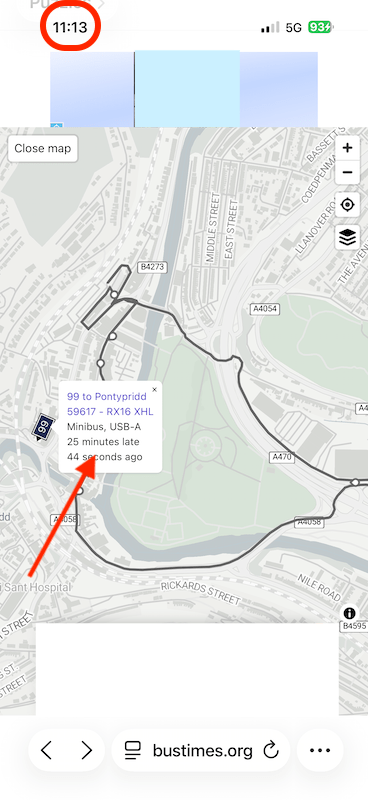
It looked like a popular town circular bus carrying high single figures on each journey, especially late morning, but it also looked like the time allowance was very optimistic. Indeed I’d been monitoring earlier journeys on bustimes.org on my way to Pontypridd the morning I travelled and noted at 11:13 the cumulative lateness had got to 25 minutes and spotted the bus skipping two journeys using Gelliwastad Road to get back on time.
I’ve subsequently taken a look at the vehicle tracking on other random days and it does seem to be a regular occurrence. For example just the the other day, an Enviro200 was on the service and at 11:46 the bus was running 20 minutes late (effectively having missed a journey out)…
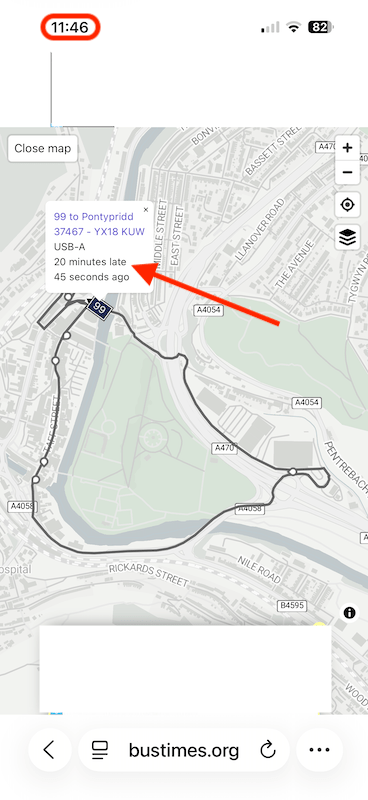
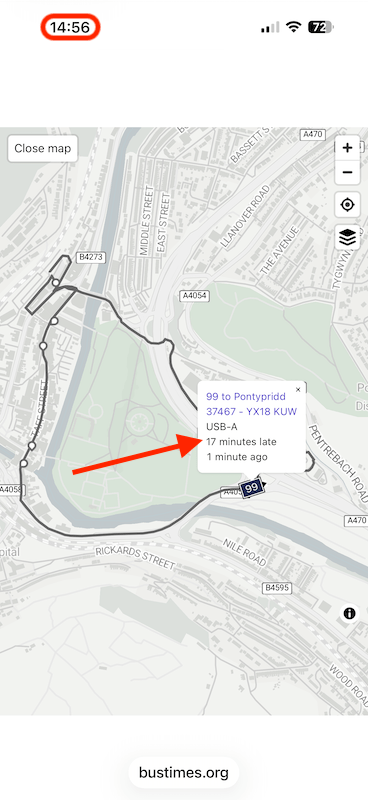
,,, and subsequently got back on time by missing another journey, yet at 14:56 it was 17 minutes down again.
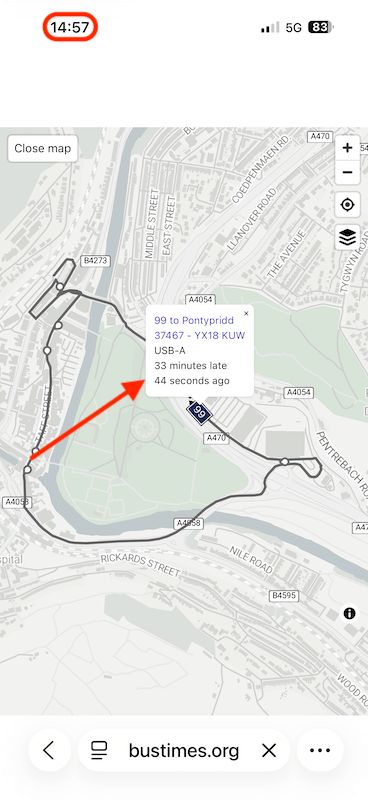
At about the same time on another random day it was runing 33 minutes late, meaning effectively two consecutive journeys had been cancelled.
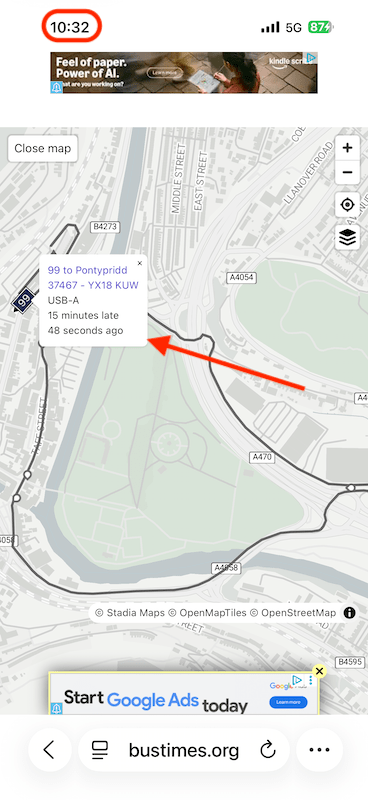
And on another day even by 10:32 it was running 15 minutes lare…
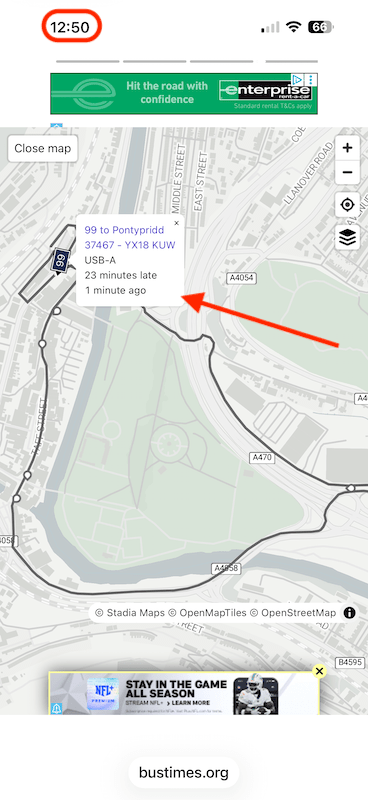
… and another day I looked at 12:50 and it was 23 minutes late.
It would seem either best to downgrade the entire service to every 20 minutes or build in another scheduled break, of say 15 minutes, around 11:00. That way passengers waiting for the bus at the five stops around the route would have greater certainty it’s coming at the scheduled time and the timetable departures listed at each bus stop…
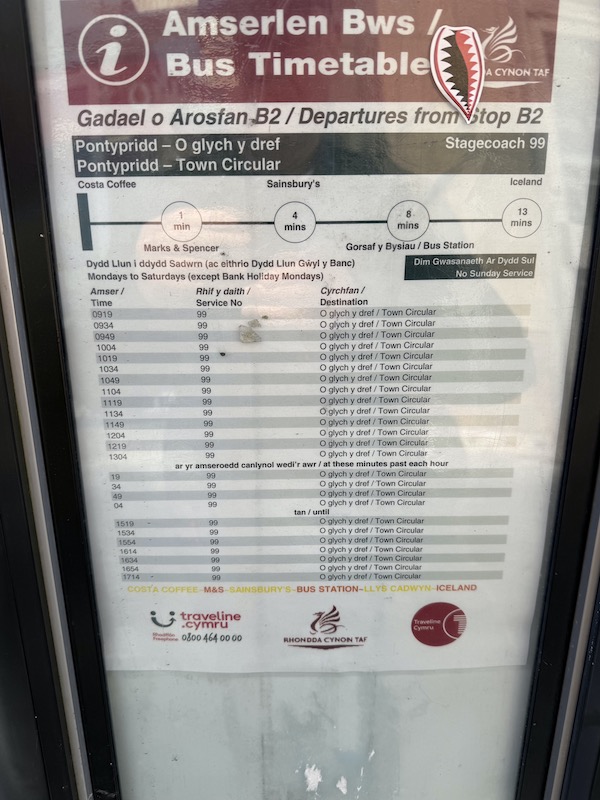
… and in the bus staton…
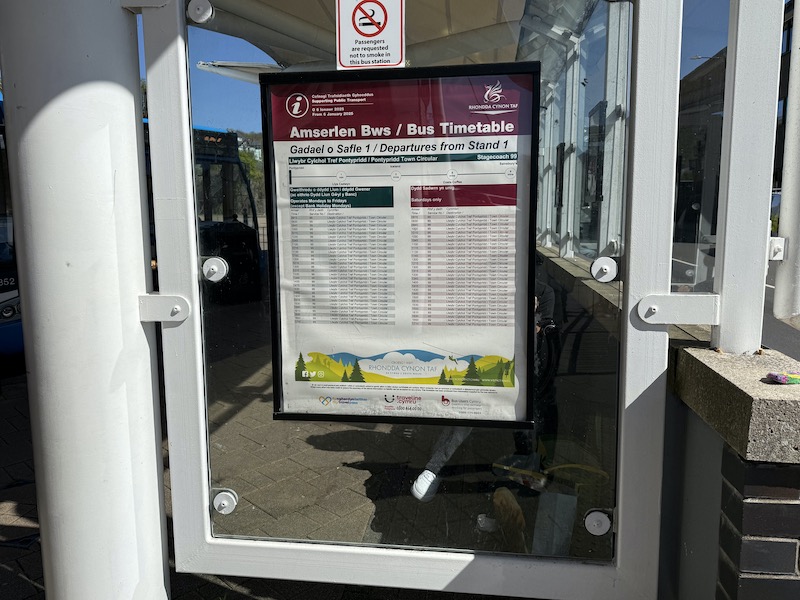
… can be relied on.
It may only be a short route, mileage wise, but it’s obviously greatly valued by those using it to get across the town centre either side of the river as well as between the bus station and the shops. It just needs its timings sorted.
Roger French
Did you catch the previous eight blogs in this series? 1 Eastbourne-Hastings, 2 Petworth-Chichester, 3 Woolwich-Bexleyheath, 4 Tilbury Town-Tilbury Ferry Terminal, 5 Chippenham-Swindon, 6 Ubley-Chew Valley, 7 Exmouth-Brixington-Exmouth, 8 Taunton-Chard.
Blogging timetable: 06:00 TThS
 BusAndTrainUser
It’s a shame that the 99 goes right past the railway station (on the other side of the road) without a stop in the vicinity. I’m no expert, but I would have thought it would be possible to have a stop just before the lights on High St (at about no. 9, say) close to the crossing leading to the station.
And with such abysmal timekeeping, I’d have thought a 20-minute frequency all day would be an improvement for all.
LikeLiked by 1 person
New bus stops were installed on Sardis Road, opposite the main entrance to the station which is served by many other bus routes from the bus station. There’s a pedestrian crossing at the adjacent traffic lights.
LikeLike
Pontypridd was a hotbed of industrial activity during WWII. It had a remarkably short trolleybus route, yet the intensity of service required vehicles from the networks at Portsmouth and Kingston upon Hull to soldier on along with the town’s own vehicles to keep the town’s passengers moving. With the current Motorway network, I would consider it an arduous and demanding job towing trolleybuses from either Portsmouth or Kingston upon Hull to Pontypridd, let alone doing it in war time using the ordinary A road network. Solid tow bar rather than chains between diesel tender and trolleybus with half shafts removed to protect the traction motors from undue wear and tear during the tows. Towing trolleybuses on level ground I am sure was quite a tricky business but the demanding gradients of the South Wales valleys would add extra stress for the operation for the man at the wheels of the trolleybuses. Pontypridd is featured in a BFI Player video entitled “EVERY VALLEY” made by BTF. I have recently bought an out of print A-Z Street Atlas of South Wales, quite a charity shop coup, showing Pontypridd in detail, but Page 88 is the most poignant showing ABERFAN and its cemetery and Memorial Garden. I remember Cliff Michelmore’s outside broadcast from this village as though it was yesterday especially as I was still at school myself in 1966. I theorise that Portsmouth and Kingston upon Hull could spare trolleybuses as they are coastal cities with wartime movements’ restrictions in place with local public transport partially stood down.
As to the local Walton on Thames “shuttle”: Route 564 can get delayed quite considerably if temporary traffic lights are blighting the area.
LikeLike
Pontypridd could have a book , bus wise, written about it just for the period 1969 to 1989. As mentioned factory closures and decline / elimination of the coal mining industry changed many things, but maybe the proximity to Cardiff with good rail services helped the town more than the likes of Merthyr or Ebbw Vale . Oddly when I lived in Wales for a short time I never explored the town – maybe I was put off by the hills – but the buses were running the last of the Pontypridd UDC AEC Regents being close to the last builds of half cabs in the UK but changed from the masterful deep dark blue and cream relief to a 1970s palette of mid blue and white with municipal bold white letraset typeface fleetname from the Taff-Ely council depot clinging to the hill (mountain?) to the east of the town. The railway station platforms seemed some of the longest for the size of town I can think of with impressive cannopies to shelter from the rain – which didnt seem as heavy or predominant as the taff got formed further up the valleys to the north. Rhondda had been fully merged into the National Welsh megalith of operations for overall management and the apparent sinecure of NBC regional directorships that seemed (correctly or not) to me of ways Nationalised Entities were to reward political friendships rather than professional experience. Deregulation brought (mini)bus wars to the streets (was it Clayton Jones ?) and the main outcome of such being the financial collapse of the privatised (but probably undercapitialised) National Welsh that had tried to take over everything and failed as Cardiff finally acquired its much wanted services to Penarth and less to Barry, and Stagecoach in two chunks got the Eastern Valleys effectively ex Red and White and then Rhondda Depot to create the relatively stable bus network of today. Will Politics again interfere and bring a new Welsh State Owned Bus Operator along ?
I dont recall Pontypridd UDC having any joint bus operations – Is that correct, as most of the connecting to other Welsh Towns or Cardiff appear to be by the GWR financed Western Welsh and Rhonnda entities ? ( did Bebb get into Pontypridd on one small route to ? )
I have just noticed the Stagecoach livery on the Sprinter is very Pontypridd UDC shade of blue.
JBC Prestatyn
LikeLike
1980s Minibus competition was indeed started by the infamous Clayton Jones who seemed to have a strangle hold on the town’s bus routes until his sale to Veolia in the 2000s (presumably other companies believed it would be a waste of effort to compete against a cowboy operator). His company, Shamrock commenced operating service 1, the predecessor to the 99, introduced following the opening of an improved bus station and diversion of all other routes away from Taff Street.
Clayton returned to bus operations after an agreement not to compete with Veolia expired and St David’s Travel was born, competing on town routes with taxibuses from the old precinct at the eastern end of Taff Street. At the same time, Clayton’s son Kevyn had started operating in the area under the Humphreys and New Adventure Travel companies who eventually became the successor to the town routes. Kevyn sold out to ComfortDelgro who renamed the company Adventure Travel. Clayton had one last roll of the dice post COVID by launching Street Buses, which used Mercedes Sprinters on town routes from the Bus Station and Precinct. This operation didn’t last longer than a year however.
LikeLike
Children aged five to 15 will travel for free on participating local buses in England in August
Dont know what Wales is doing. London already has free ZipCard travel but hopefully this UK govt proposal will either mean (no need to show zip card?) visitors to london too will travel free. This builds on a West of England (mayor/authority) trial inc Christmas/Easter Holidays,
I wonder if there are going to be a lot of 16 17 18 19 year olds passing themselves off as 15
Are our English bus services going to have capacity to cope with increased numbers (As this should encourage families to travel)
JBC Prestatyn
LikeLike
How will this be funded? Are bus companies just expected to take ‘the hit’, since there will be a cost in the form of lost revenue from fares previously paid by the 5-15year olds.
If there is no need to tap in, how will numbers be monitored if there is financial compensation? Also how will it be identified if it was a ‘success’ (whatever the ‘success’ criteria are) if numbers are not collected?
Lastly, will it mean bus drivers will become unpaid nannies, looking after ferral kids during the summer holidays?
MotCO
LikeLike
My understanding is the goverenment ie taxpayers are funding it
LikeLike
Wales brought in £1 bus fares (£3 all day) for 5-15s in November last year. This was after an anomaly whereby 16-21s were able to travel for £1 from September (a scheme pushed as part of the Budget settlement by the LibDems) but younger children still had to pay “proper” child fares. I doubt if this will get changed in the short term, but who knows? We have a new administration in charge!
LikeLike
it’s interesting to see they’ve “expanded” the route but kept the frequency. Originally it turned right out of the high street and back to the bus station serving the stops at the rail station.
LikeLike
Maybe the route should be split as 99 99S with alternate journeys via Rail Station , then over to Sainsburys. This would mean Sainsburys only gets half hourly service but if problems of reliablity exist maybe that is better ?
JBC Prestatyn
LikeLike
I wonder if the continuous driving period on this route is deliberately restricted. I don’t think I would like to drive it for 5 hours 24 minutes!
LikeLike
I think that this route would be better running every 20 minutes so that it is a bit more consistent. I expect any driver changeovers will affect reliability as there is little time given for this and it is not possible to change the vehicle because passengers are crossing the bus station.
When I was younger I used a National Wanderbus ticket (£2.97) to travel from home, in Nottingham, to the Rhonda valley. I stayed in a youth hostel and used local rover tickets to explore the National Welsh routes. I used a further Wanderbus ticket to get home.
Richard Warwick
LikeLiked by 1 person
Are there any other buses in the UK that go down pedestrian roads & do thay have stops?
LikeLike
A few buses in Oxford go along Queen Street but there are no bus stops.
LikeLike
A lovely blog, with some great comments already!
Perhaps TfW have plans for a better arrangement at the railway station. To cut the Gordian knot, the best option for passengers would be a new exit direct from the station footbridge across to the M&S bus-stop – this would cut the walk to 100m, and could serve the Sardis Road stops on the way. Lots of stations nationwide could do with additional exits. I expect the excuse for why they have not been built will be staff costs – but the additional revenue will be ignored, as will the chance to break out of the ‘only 15% of travel is by bus/train’ trap.
A commenter has pointed out that trolleybuses were a staple some years ago – maybe time for a come-back? – they would be really good on the hills. Another thinking-out-of-the-box idea: has a danglebahn over the Taff ever been considered? – maybe a day-out in Wuppertal for the council members …
Trams seem to work well in pedestrian streets – perhaps owing to their bells/gongs, and maybe partly as the rails are fixed and obvious, so it’s easier for people to get out of the way. Maybe the minibuses could have some new sound generated, and a ‘track’ for them could be laid out in the street?
Finally, if it’s popular and, as it regularly loses time and doesnt stop at the railway station, there is presumably suppressed demand, surely it’s better to put two buses on, running every ten minutes’, or three for every 7-8 minutes – a real turn-up and go frequency.
LikeLike
I seem to remember that there was a Pontypridd to Caerphilly route jointly worked by both municipal operators.
Interesting that one of the stops is still called “M and S”. The shop closed years ago and has been demolished.
LikeLike
The Pontypridd to Caerphilly joint service started operation in January 1932 and continued to operate until 1st April 1974 when the municipal operators ceased to exist due to local government re-organisation.
LikeLike