Tuesday 19th May 2026
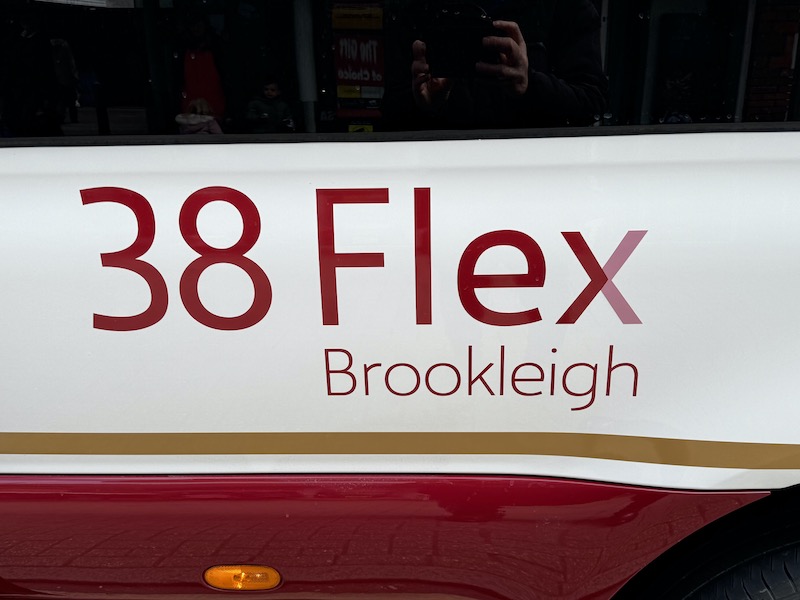
Yet another new bus route took to the road last week, and this time it’s on my home turf being in Mid Sussex’s ever expanding town of Burgess Hill. New route 38 is operated by Compass Travel serving part of the major new development of Brookleigh to the north of the town.
What makes this bus route unusual is its combination of having a fixed timetable and route during the morning and afternoon peak periods but during the rest of the day, as well as all day on Sundays, it runs to a flexible arrangement in response to demand.
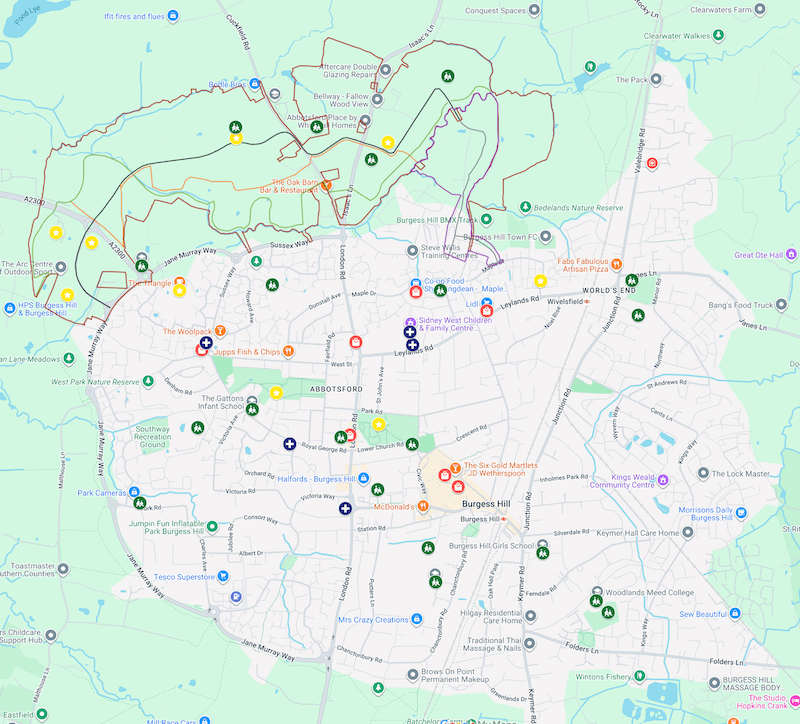
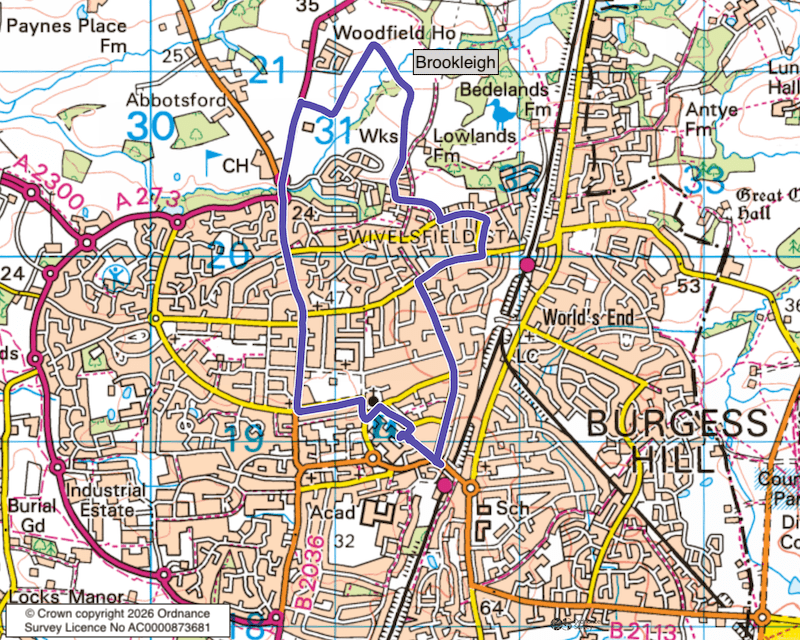
The Brookleigh development was formerly known as the Northern Arc (mainly because it’s shape is an arc to the north of the town – as shown on the map below) and includes plans for 3,500 new homes as well as three new schools, sports and recreational facilities, neighbourhood and community centres and medical facilities.
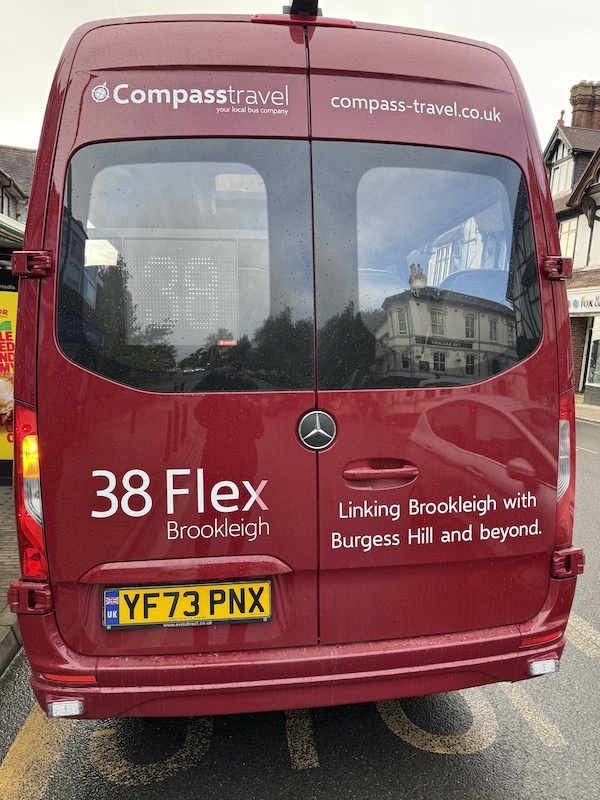
This major scheme is being delivered by Homes England which has aquired the land and making it available to developer partners as they join the project. It’s Homes England that has funded route 38 and contracted Compass Travel to operate it with a Mercedes Sprinter 16 seater branded especially for the service.
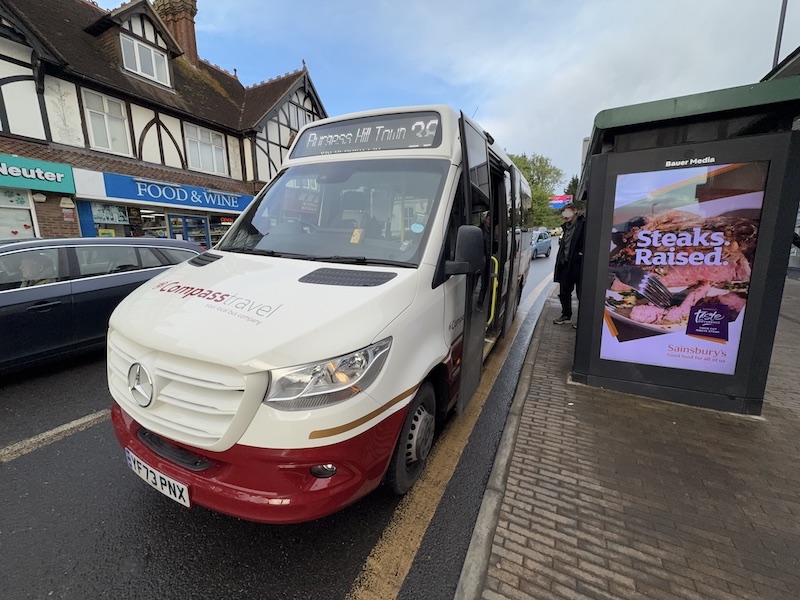
The route started last Monday and during the week I saw the bus laying over by Burgess Hill railway station and asked the driver how it was going. This was around 18:50 on Thursday and he admitted it had been very quiet with only five passengers travelling that day. Interestingly looking in the bus shelter I found no reference to the route in the rather shabby large timetable case so perhaps people are unaware of it.
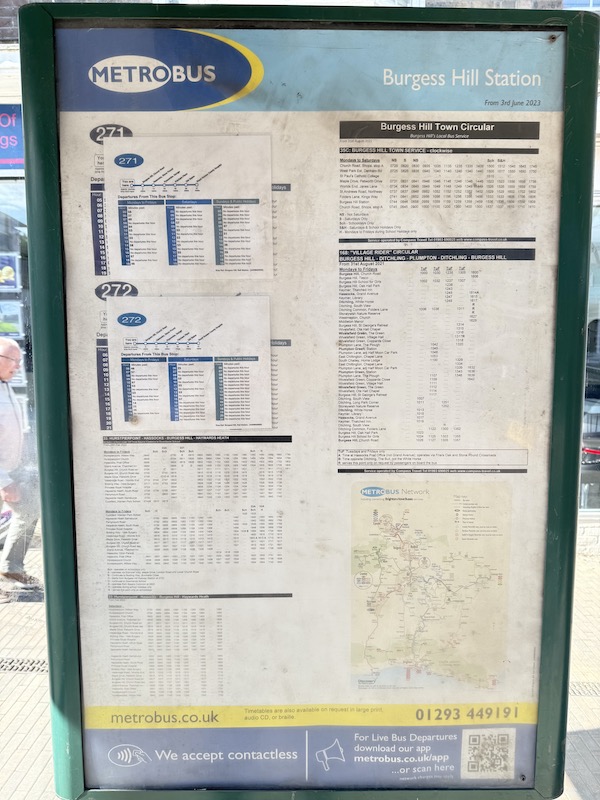
Still, it’s early days and the problem, as always with these things, is residents who have already moved in to new homes that have been completed will have established their travel arrangements prior to the new bus route starting while those yet to move in, as more new homes are built obviously aren’t yet passengers, so it’s not surprising the bus carries very few people in its early days. At least it’s now up and running.
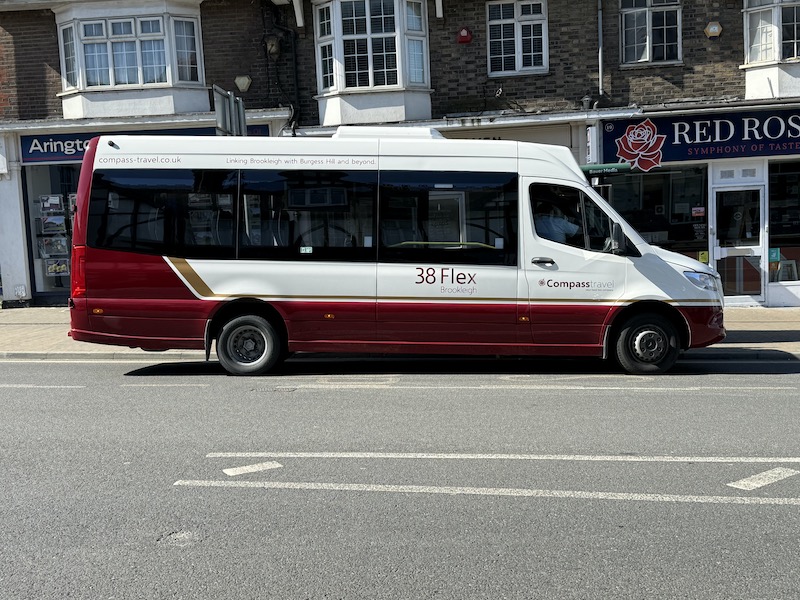
Adding to the dilemma in this case is the route’s flexible arrangement during the five hours between 10:12 and 15:00 on Mondays to Saturdays and all day Sundays (06:50 to 19:12) when, without custom, the bus sits in Burgess Hill town centre not being seen by any potential passengers living in the new development. You save the cost of the mileage of all those wasted trips carrying fresh air but you don’t raise awareness the bus exists in a way you would if it trundled around the development every half hour.
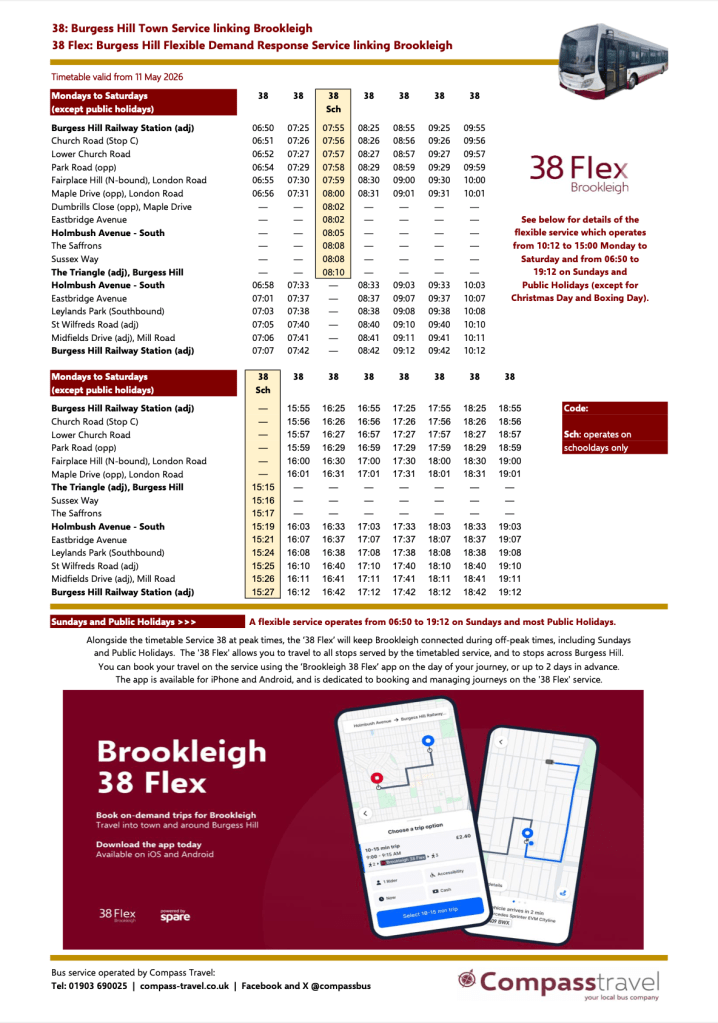
As you can see, on Mondays to Saturdays, aside from a school journey to The Triangle, the bus shuttles up and down from the development at Holmes Avenue in Brookleigh to the railway station every half hour from 06:50 to 10:12 and from 15:15 to 19:12.
Acually, the scheduled route is a one-way clockwise circuit heading towards Brookleigh from the town centre via the London Road, B2036/A273, then threading its way through the new development (not yet marked on the OS map below) before almost reaching Wivelsfield railway station and then returning into town through Mill Road.
I took a ride on the last scheduled round trip of the morning at 09:55 from the railway station on Saturday and also used the app to book a ride later in the morning from the station to Brookleigh as well as a follow on ride from there to the large Tesco on the south west side of the town.
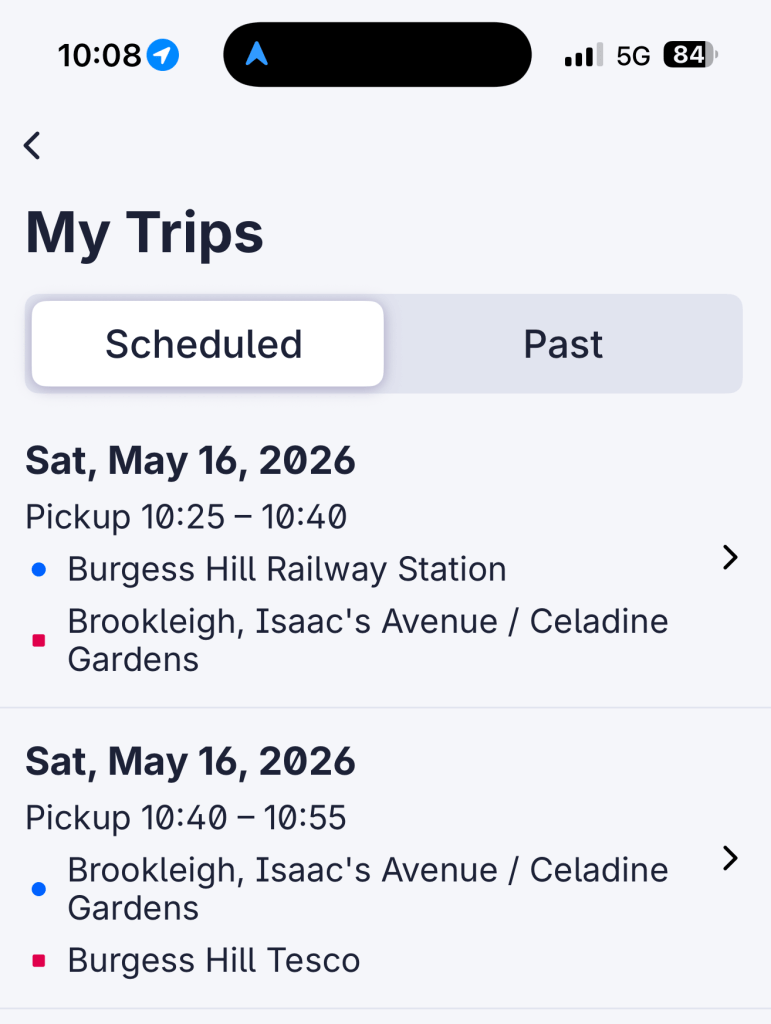
The app is from a tech company called Spare, “our solutions empower transit agencies to overcome complex challenges and deliver transformative results for riders”, but despite that, it was fairly easy to work out how to book a journey but I’m very surprised there’s no facility for potential passengers to book by phone with using the app seemingly the only way to travel off-peak. I think this will impact take up of the new service. Although the Brookleigh website shows a map (see below) seemingly suggesting the flexible booking area covers the whole town, I’m assuming one end of the journey must be within the new development as the app wouldn’t let me book a journey back from Tesco to the town centre when I tried.
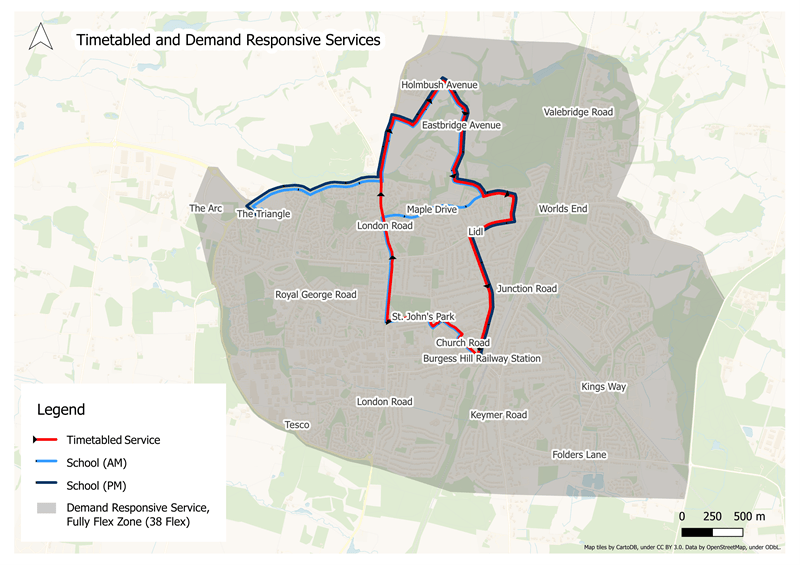
As always with these “flex” arrangements, it was easy for me to book a couple of journeys exactly when I wanted to travel (“demand responsive” at its best) as no one else knows about it yet, but as soon as they do in any meaningful numbers there’ll be a fight on to “demand” the bus when I want it rather than my neighbour and it simply doesn’t work, as I’ve been explaining ad nauseam in these blogs.
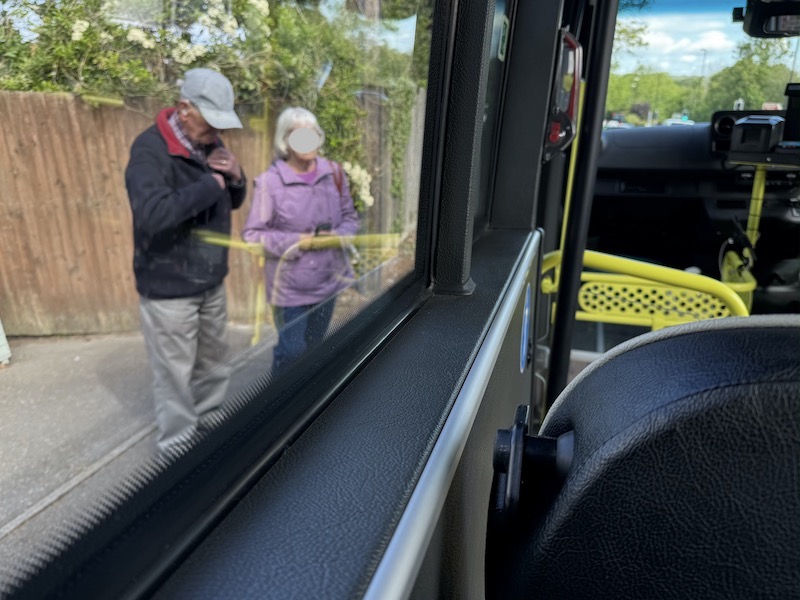
On the 09:55 journey we actually picked up two passengers on the circuit, albeit they boarded as we headed north on the B2036 London Road (in a long established part of the town) and travelled around the route and back into town, so not from the new development, and I think they were just trying the service out.
I asked the driver if he’d received my bookings for the two later journeys but he explained he was only the relief driver to give the main driver a break while he did three rounders (this being the third). He’d driven over from Compass Travel’s base in Worthing (by car) and after the three rounders was driving (by car again) over to Steyning to do the rest of his duty on route 100.
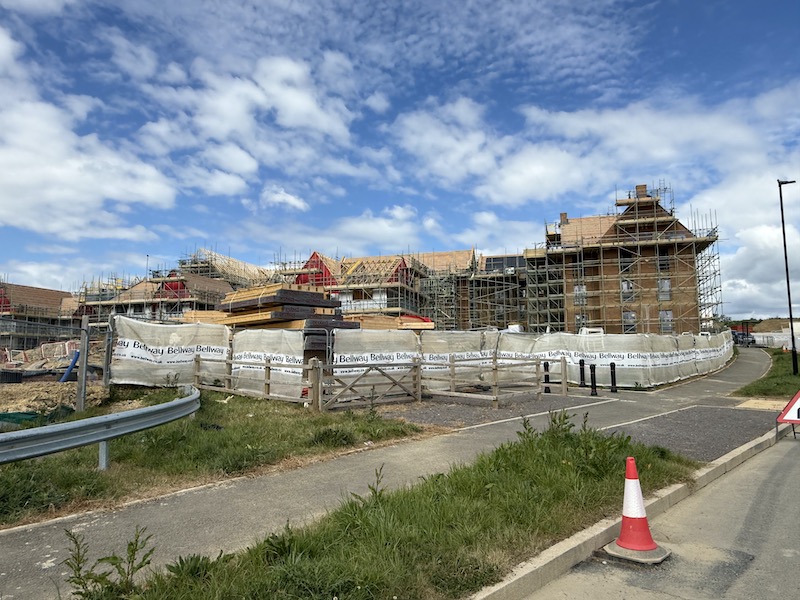
As we toured around Brookleigh it was interesting to see the scale of development and the number of homes already occupied.
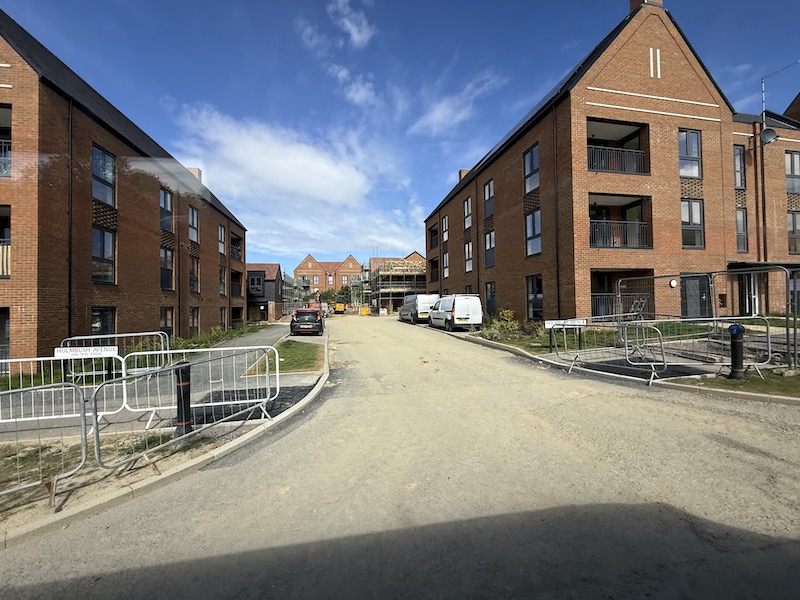
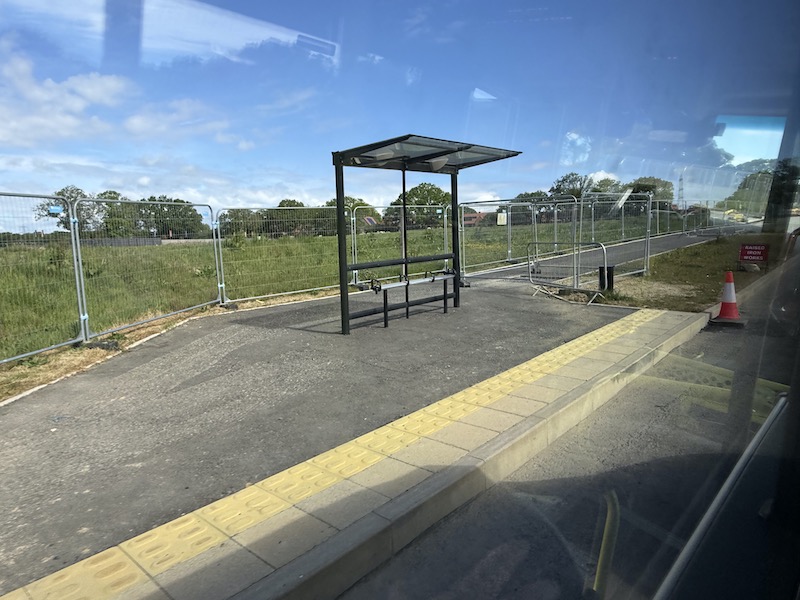
I noticed three bus stops and shelters have been installed, oddly in pairs on both sides of the road whereas the bus only goes one way, with one pair containing a timetable…
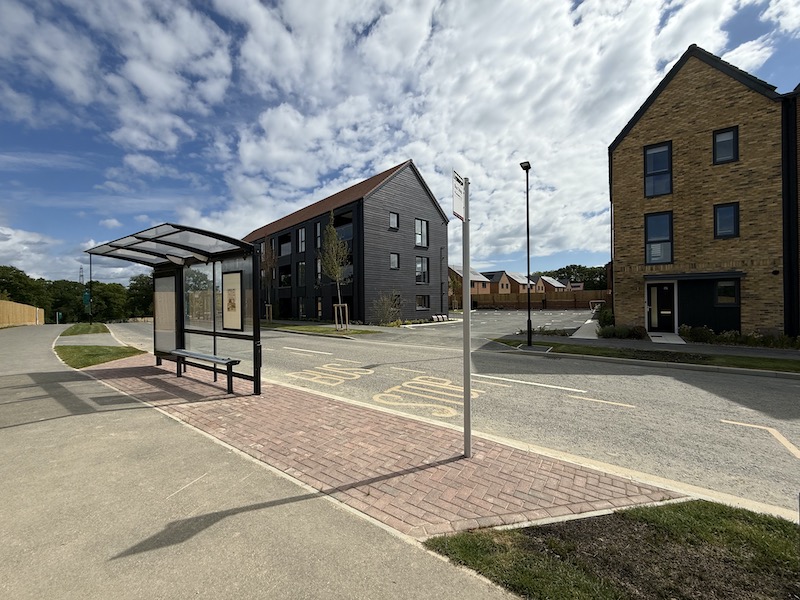
… and another minus both timetable and bus stop pole, so may not yet be in use, although there were people living close by…
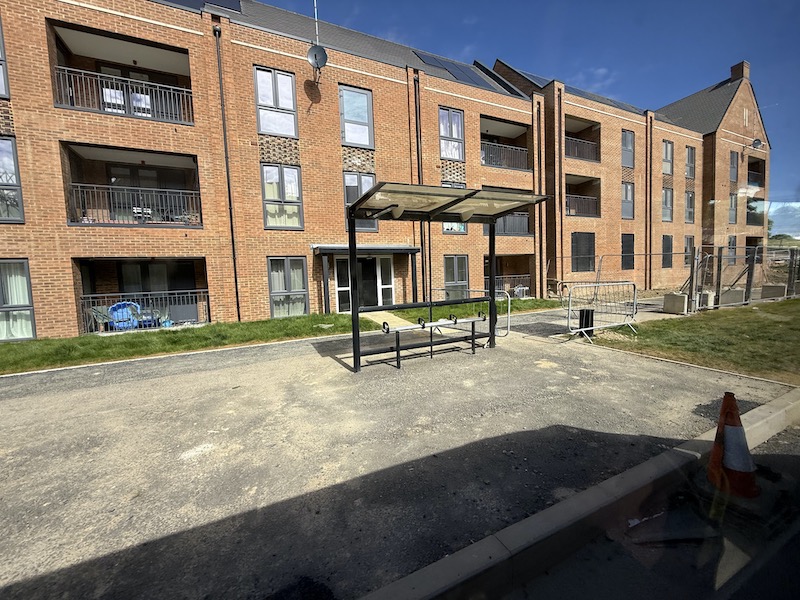
… while the third was surrounded by barriers with no development yet near it.
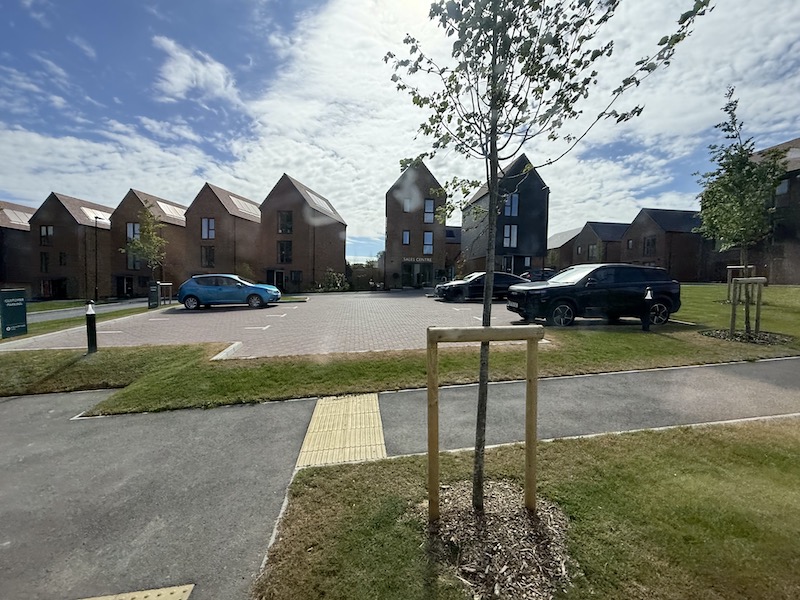
Not surprisingly there were quite a number of cars and other vehicles and I noticed there were many parking spaces for residents.
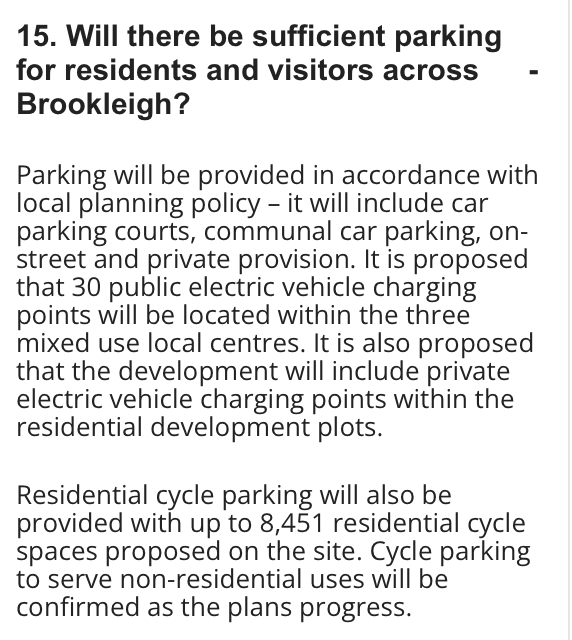
The Brookleigh website explains…
Having done a circuit of the new development and knowing the drivers would be changing over back in Burgess Hill I decided to cancel my “flexible” journey bookings as I’d seen enough and didn’t want to waste the fuel by doing an unnecessary trip so after arriving back into the town centre at 10:12 I left the bus and the drivers to change over and presumably the new driver having enjoyed her break would just sit there until someone did book a journey, or it was time to do the next scheduled journey in almost six hours time at 15:55.
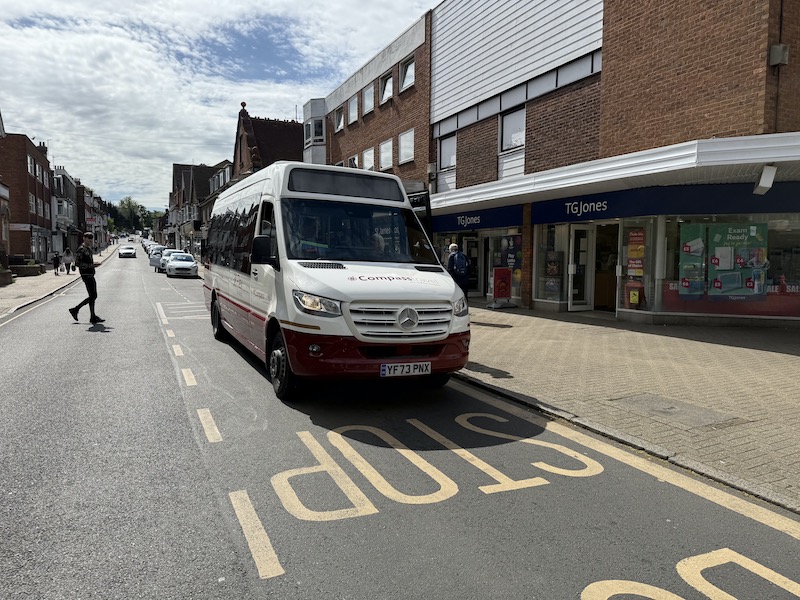
It’s certainly an interesting addition to the Burgess Hill bus scene. Thanks to Homes England.
Roger French
Blogging timetable: 06:00 TThS


The Wandering Busman talking. How Burgess, Keymer,Hassocks and Hawards Heath has grown in the 43 years I’ve known Mid-Sussex. I hope the new service is a success. Compass seems to be growing as company as well.
LikeLike
The towns are Burgess Hill & Haywards Heath.
LikeLike
How utterly soul less Brookleigh looks. Bus shelters without a bus stop totem, “glass and steel” housing with presumably NO vacant retail units as part of the estate. So depressing, the way every residential development gets more and more dependent on the car.
LikeLike
Sort of Similar – travelled (in error) on the 315 london bus service Tooting Bec – Springfield Hospital (Now Springfield Village ) yesterday. Route lurches a bit up Trinity Road then off along a Tooting side street (cars parked both sides and little place to stop – with one person alighting , so the route that was does have some use rather than replicating the G1 along Nightingale Lane), then a fair bit of covering of the outer bit of the villiage development with no hail and ride or bus stops apparent apart from the final one , which finishes at part of the medical centre (so useful for staff) and largish care home- so useful for staff and visitor. The site does have a couple of shops and I think a community centre with more housebuilding going on being marketed at the present time (as London Square ?)
JBC Prestatyn
LikeLike
With Planning Policies supposedly covering 15 min cities and active travel one would expect a lot more cycling provision – which would eat into this kind of local service by design. Leaving that aside one has to repeat Roger’s noting of a lack of clear roadside publicity , and the days of local papers I assume are effectively long gone to do things like wrap around adverts for bus launches and the like. Indeed should bus routes be launched in the same way as new station openings with goody bags and Vloggers commenting and filming for YT ?
That said I find the public timetable as printed confusing to read. Community Area names in front of some road names might be useful (It would help to bring Brookfield for example as a community place) and I would put the 38 SDO as a separate 38S Service and place a full 38 daily service in the time slot with at NSD if appropriate, arrival at Railway Station 0822. ( indeed just opening up the “middle” of the printed timetable for timing points of The Saffrons and Sussex Way ) and running every day at that time with a fixed 1500 departure from The Railway Station could be better (do people live at The Saffrons ?)
This might undermine the flexness of things – indeed somehow the bus MUST be at The Triangle for 1515 so that means the “1500” ceasing of DRT itself flexible as that has to be some kind of departure to a place the bus can hurry back from.
I thought the idea of Planning (permission) was to have some idea of where generated travel patterns might occur. In the good old days of building houses (and roads) the likes of Wimpey would use rather old double deck buses as staff transport though these days most specialist trades arrive on site by car or van.
I also note to the SW there is an industrial area – I assume Brookfield residents might do something like , work there ?
Is there logic in running Clockwise round the present loop – is Wivelsfield station the better one for morning commutes (more services ?) Indeed Burgess Hill seems to suffer with the main spine road being some distance from the rail station (and the ring road serving industry even worse) .
I suppose the DRT segment Could be replaced as fixed (unless there are odd demands for Settlement to Church and Burial ground on an irregular basis) Hourly Service running counter clockwise to the south and Tescos ?
JBC Prestatyn
LikeLike
Counter clockwise? I didn’t realise you were American, JBC.
LikeLike
my gramma didnt like my aunty
JBC Prestatyn
LikeLike
Check your spelling, punctuation & grammar before posting JBC. Your enthusiasm often gets the better of you!
LikeLike
Great to see a forward thinking initiative with a flexible service to allow patronage to build and understand demand. Always difficult with new developments and much harder now with different work patterns. 3,500 new homes will take 15 years to build out I expect and would imagine there will be quite the bus strategy to cater for demand. This will only be the start. Although, while those bus shelters may look pretty, they don’t offer much protection from the elements unfortunately. Style over function?
LikeLike
Generally if you know a bus will be around in a rough five min timeframe the shelters are sufficient. Big problems in London on the cyclesuperhighways , the shelters are were the stops were, now they are 20 to 30 metres away from the bus stop flag (some drivers observe the shelters but you cannot guarantee it. Indeed is there any penalty in law for a bus setting down or picking up other than at a bus stop ( was old met police act then (but never in law ? traffic commissioners )
JBC Prestatyn
LikeLike
I wonder if incoming Residents are even informed of the existence of a bus service? Highly doubtful. The Driver taking over for the DRT stint would need a break too, and thus another Worthing rounder by car required, if not two, unless the third Driver works to the last journey without dying from boredom before? The one thing we can be sure of, is that when the development is finally completed, the Burgess Hill road system will have 7000 extra cars to cope with!
Whilst the DRT element is as pointless as ever, I suppose, if loadings really are so poor at present, at least precious fuel is being saved.
Terence Uden
LikeLike
I like that the Brookleigh website illustrates it’s bus section with a picture of a 18m 3-door articulated bus – they must *REALLY* be expecting a heavy demand.
David Potts
LikeLike
Good to see a positive initiative, although not sure what this blogger actually wants. If it’s too popular during the DRT period he says it won’t work, and if it’s not busy then he suggests it’s a failure. The team behind this can be applauded for doing something.
LikeLike
I quite agree. DRT gets an almost universal bad rep on this channel which is a shame. As you say what do all these experts want. And how representative are these views of the travelling public who actually pay their own bus and rail fares.
Well done the developer and the local council.
LikeLike
The DfT commissioned evaluation report into its Rural Mobility Fund noted (a) most DRT schemes carry between 1 and 2 (with some up to 3) passengers per hour; (b) for every 100 miles with a passenger on board the bus travels 77 miles with no passengers on board and (c) unfulfilled bookings as a ratio of fulfilled bookings for most schemes show more passengers unable to book than able to book.
Against those findings I guess it depends on your definition of what ‘success’ looks like.
See … https://busandtrainuser.com/2026/01/22/the-results-are-in-for-the-rural-mobility-fund/#more-86368
LikeLike
Indeed. Success may be about improving social and geographic accessibility and offering a bus service to many of those that are isolated. The areas that the big buses might not serve. Everyone has different opinions of success as you note, and we can have these opinions. Sometimes it’s good to recognise that we are all different. Keep up the great work and continue to broaden the mind is what I say. Best wishes.
LikeLike
Exactly. In practically all DRT schemes, there is nothing that could not be provided by local taxi firms, and at a fraction of the cost. Obviously reimbursed appropriately by the local authority.
Accessible taxis are now the normal, and there would be no need to buy new vehicles. Instant phone bookings (voice or text) instead of complicated apps which many older people find difficult to use.
LikeLiked by 1 person
Modern houses remind me of Pete Seeger’s rendition of ‘Little Boxes’. Most look like they’re made from ‘ticky tacky’!
As for the Compass service described, it needs to be re-thought & marketed strongly in order to have any chance of becoming established. Start by ditching the DRT element & advertising it on social media. Surely there are plenty of people living in the area served by service 38 Flex that would use it if only they were made aware of this service through the media channels modern society uses.
LikeLike
The bus shelters in the new development need large posters advertisung the service, preferably outward facing to motorists as they drive past.
Peter Brown
LikeLike
Burgess Hill is a bit of a planning disaster area to be honest. The “Town Centre” seems to be dying on its feet with the shopping centre mostly boarded up for “re-development”. Meanwhile, the big Tesco’s and the Leisure Centre (“The Triangle”) are right out on the ring road and are not served by bus from the areas where people live. Both have huge and full car parks, and both get the hourly 100 but this merely wanders along the ring road before zooming off on it’s tour of rural West Sussex. There is an efficient one-bus Town Service (the 35) which seems to do well, but in the long term it is surely to be hoped that buses to Brookleigh and other development in the “northern arc” will get integrated with this route to somehow serve the whole town in a better way.
Anthony Holden
LikeLiked by 1 person
Well said!
LikeLike
The local newspaper, “Mid Sussex Times”, mentioned the new bus service on its front page last week with a fuller article on page 9, which looked like a press release. However, I saw no posts about it on the Compass Travel X account even though there had been several regarding its former 261 route being absorbed in the new Metrobus 500.
Steven Saunders, Burgess Hill.
LikeLiked by 1 person
yeah I check their website regularly and didn’t know about it until now
LikeLike
I find out about this bus route here despite checking the website regularly.
Compass travel is one of my local bus operators and I check the website regular and there was no mention of this new bus route on the front of their page unless you go to timetables and scroll down to 38.
LikeLike
I live on a long road with multiple bus stops and there is one bus route that only serves one of the stops on the road. For some years now the Estate tenant housing association does their own bus leaflet but always missed out that one bus until they were formed by someone by email. Which was listed in their newsletter.
LikeLike
One 16-seat minibus to serve 3500 residents … good job hardly anyone uses it, then. Has anyone done any credible research about the service frequency which really triggers meaningful modal transfer on to buses and trains? My own feeling is minimum ‘every 7-8 minutes’ – but the evidence is there in general – the DLR, trams, the frequent bus services e.g. in Brighton, the Elizabeth line … the whole London Underground network for heaven’s sake!
I don’t know who set the timetable for the 38 (which doesn’t seem to be mentioned either on bustimes or Google-Maps) but it’s about the least useful for rail connections. Burgess Hill has a variety of half-hourly services, to Brighton, Littlehampton, Gatwick, Victoria, and Bedford (via London Bridge) – all of which cluster in a 15-minute interval: the 38 leaves just before, and arrives just after all of them! Wivelsfield station – for trains to Lewes and Eastbourne – is a five minute walk from the Leylands Park stop, but again the buses just miss in both directions. Please, Heidi Alexander, make the bus and train operators, and the people who set up routes like the 38, check about connections!
LikeLiked by 1 person
I totally agree with your comments concerning co-ordination with train services.Alas, this tends to be prevalent in many parts of the country where bus & train operators seem not to acknowledge one another, yet alone work together for their customer’s onward journeys.
LikeLiked by 2 people
Well said! Surely the baseline for planning the bus timetable should be to focus on meeting that 15 minute cluster of train arrivals. The timetable and route should be designed such that the bus is back at the station for the next set of train arrivals.
Peter Brown
LikeLike
The Flex part from all I can find is only bookable on a phone app. It can not be done from a computer web browser nor during office hours by phone.
LikeLike