Thursday 16th April 2026
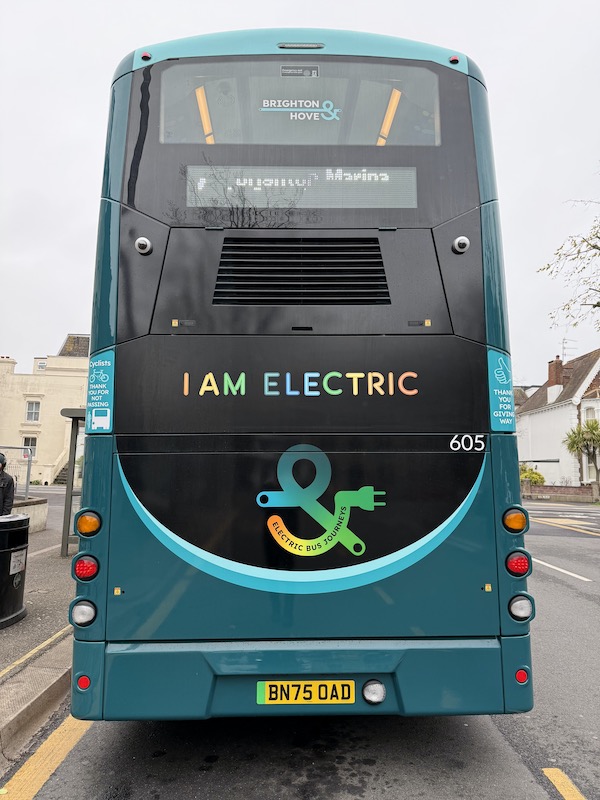
…. Brighton & Hove Bus Company has begun operating “a brand new fleet of 16 Wrightbus Electroliner Generation 2, zero-emission, state-of-the-art, electric buses delivering a best-in-class range of 275 miles from each 442kWh battery pack” …. on its busy cross-city route 7 between Brighton Marina and central Hove.
Which all sounds good, and, even better, the Company kindly invited me to the official launch of these new buses on Monday afternoon…
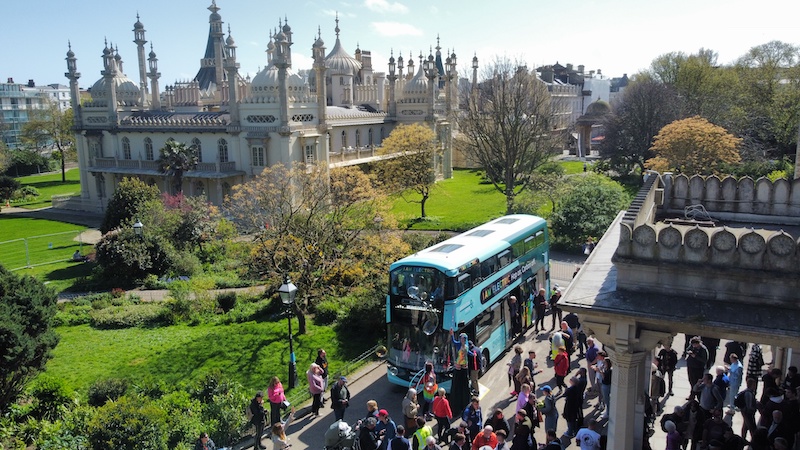
… which was a great opportunity to meet up with a whole bunch of lovely people I haven’t seen since retiring 13 years ago and reminding me just how much Brighton & Hove’s buses are embedded into the community and city life.
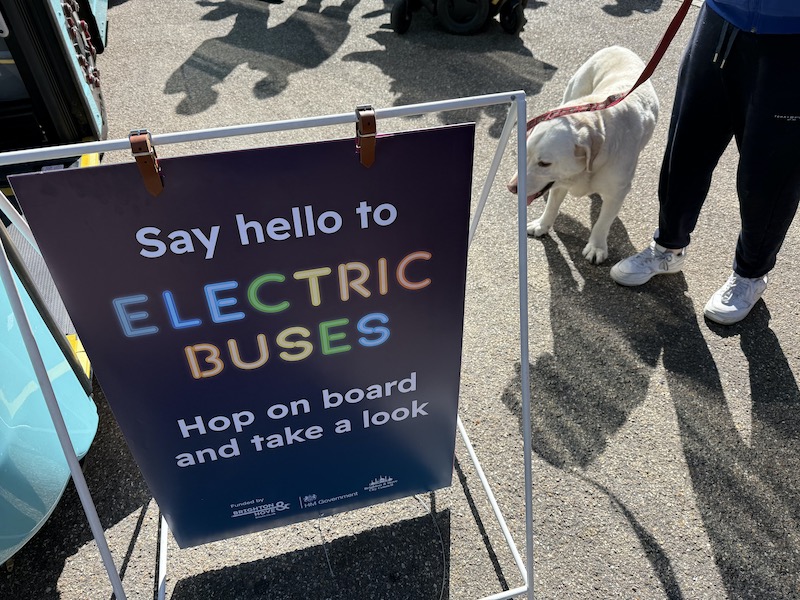
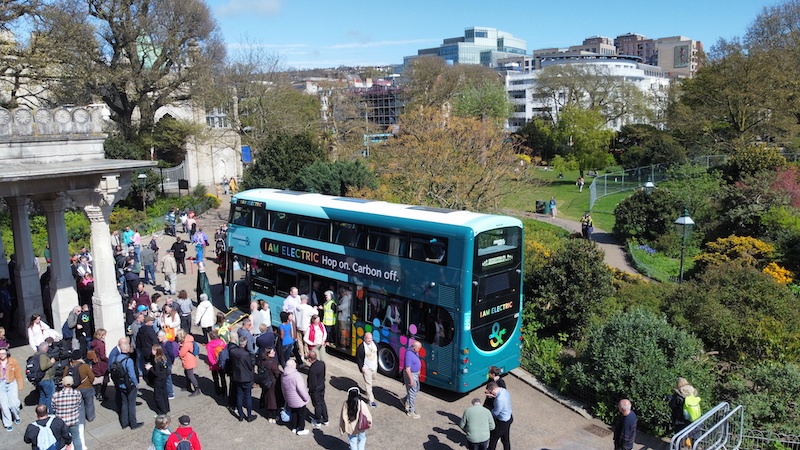
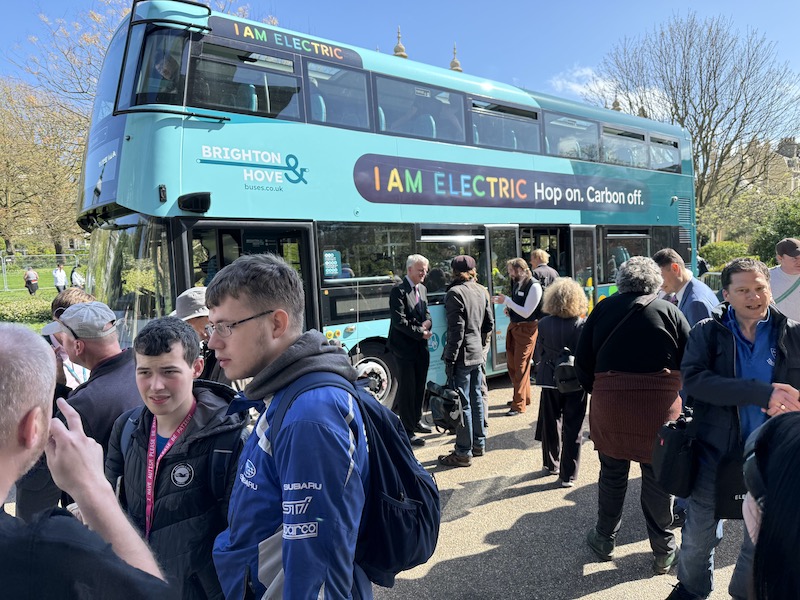
This wasn’t one of those high profile razzamatazz launches with pyrotechnics and lasers and a suspense building unveiling of a whole fleet of vehicles brought along to some huge sports stadium which must cost a fortune to lay on; no, this was a meet up in the iconic surrounds of the Royal Pavilion and Brighton Museum and Art Gallery with just one example of the new fleet on display for everyone to take a look at as they chatted with friends and colleagues in Monday afternoon’s glorious Spring sunshine.
There were a few speeches inside the Museum itself in a formal part of the proceedings and it was interesting to hear both Rupert Cox (the company’s Interim Managing Director) and Councillor Trevor Muten (Cabinet Member for Transport & City Infrastructure) talk about the importance of partnership working which has, of course, been key to Brighton & Hove’s success at consistently growing passenger numbers over so many years giving the city the highest bus use per head of population outside London.
The 16 buses have seen the bus company invest £7 million with a £2.9 million contribution from the DfT’s ZEBRA 2 fund and £600,000 from Brighton & Hove City Council.
Characteristically for Brighton & Hove Buses, the other speeches were not from representatives of the vehicle manufacturer or electric infrastructure supplier as often happens at these launch events, but instead they were from key people in the city and wider community including the Chamber of Commerce and the Alzheimer’s Society, on behalf of a whole range of local groups interested in accessibility (including Guide Dogs for the Blind and RNID), together with contributions enthusiastically delivered by local primary school children as well as from the Deputy Lord Lieutenant, all listened to by a wide range of people from local community groups.
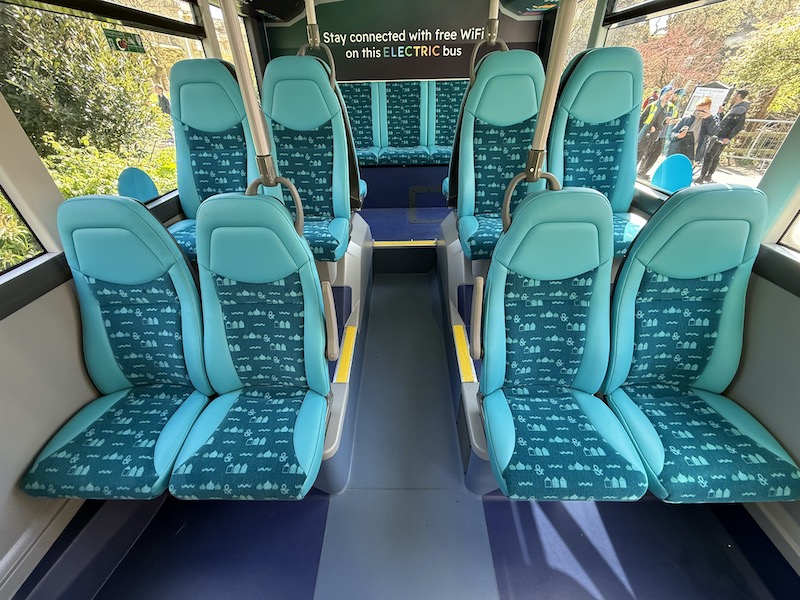
It was very encouraging to hear so many people heap praise on the positive and engaging approach the Brighton & Hove team take to community involvement not least ensuring these new buses continue to raise standards of accessibility. For example, by involving local people such as Dr Bert Williams MBE along with Shirley, who is living with dementia, in the design of the interiors, small but crucial elements of the layout and colour scheme can be incorporated to be sure it is dementia friendly.
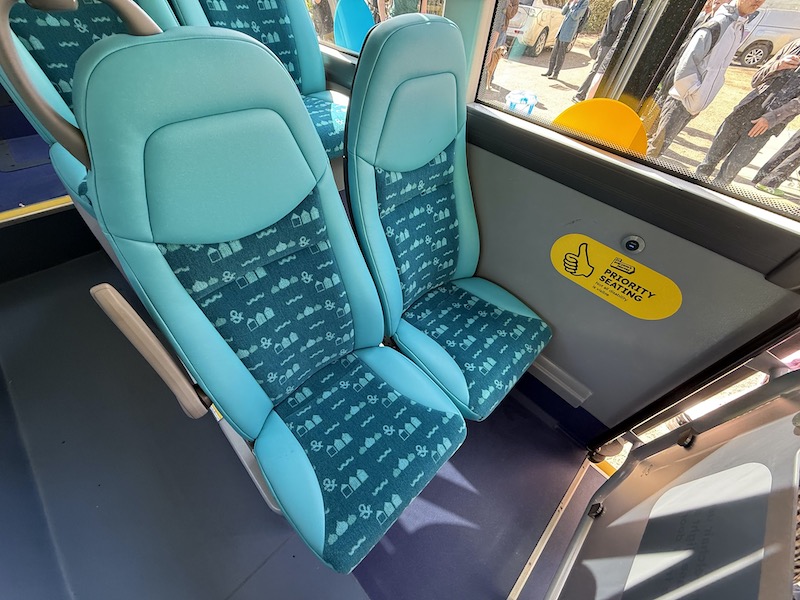
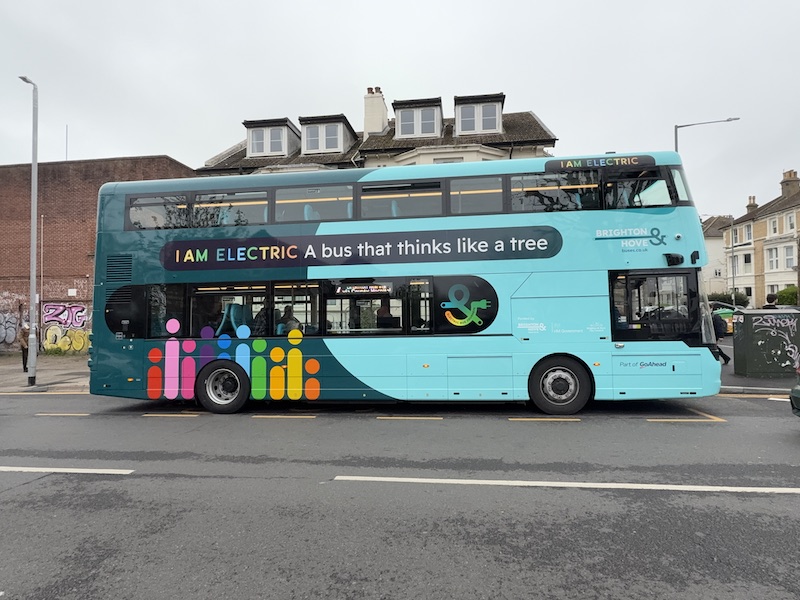
And it looks great too.
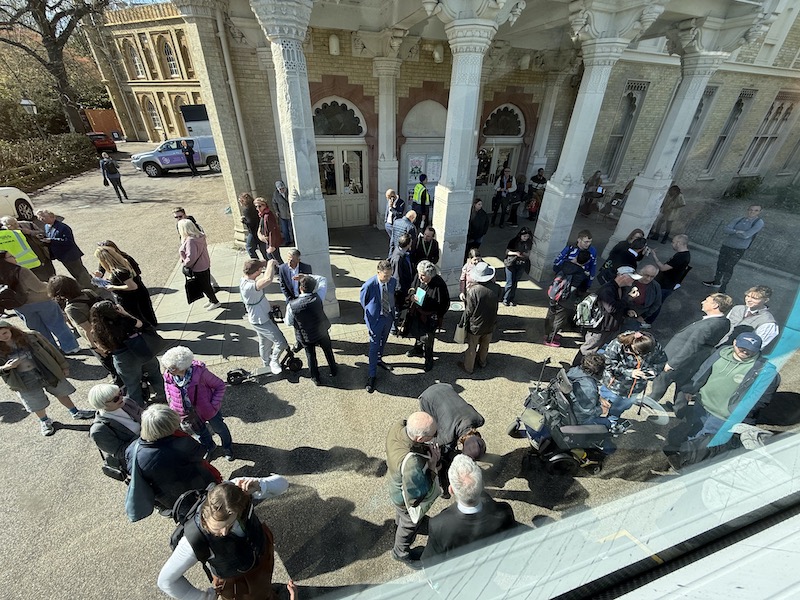
Outside in the Royal Pavilion grounds a crowd of local people as well as bus enthusiasts gathered to look over one of the buses and it was lovely to meet so many people clearly enjoying the opportunity to meet up and talk about the importance of buses and how they love the Company.
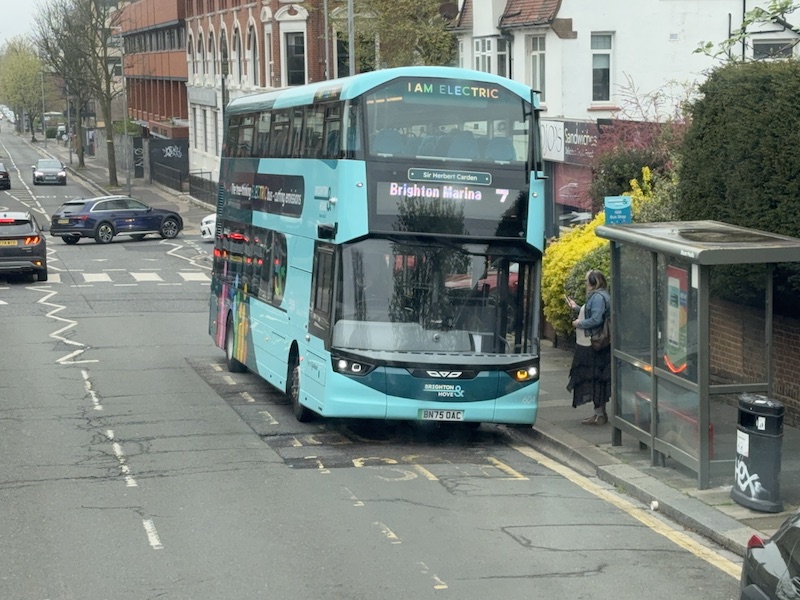
Brighton & Hove are gradually introducing the new fleet on to route 7 and I took the opportunity to take a ride on one in service yesterday afternoon to see how they were performing on the city’s busy streets.
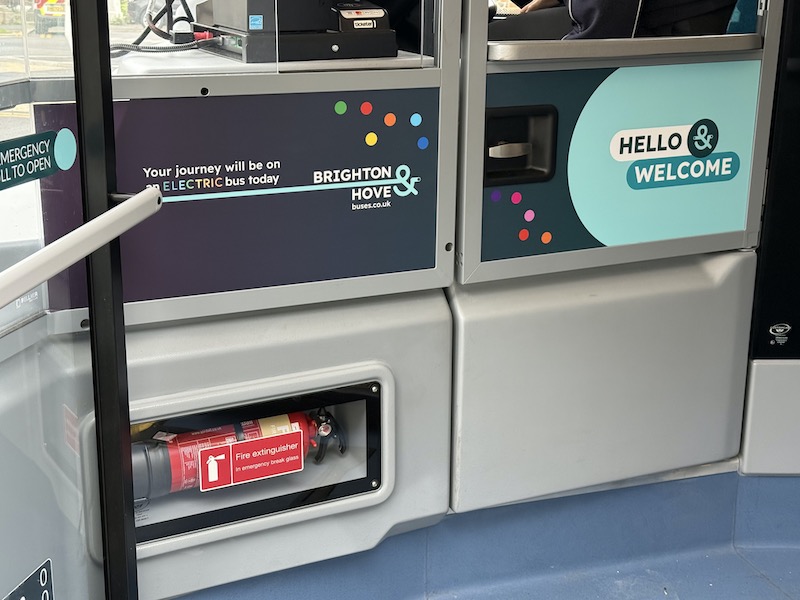
First impressions as you board are of a simple welcome without a plethora of notices…
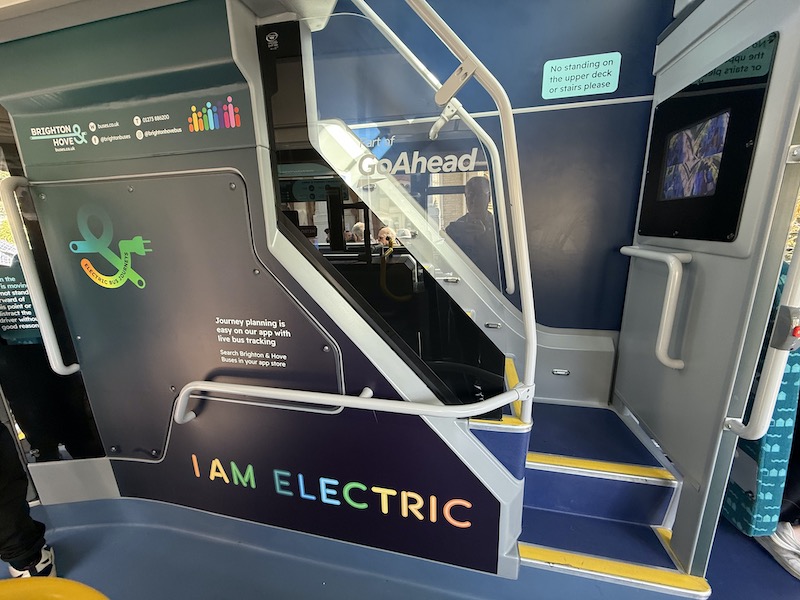
…taking you past the stairs to the double wheelchair area with three tip up seats either side …
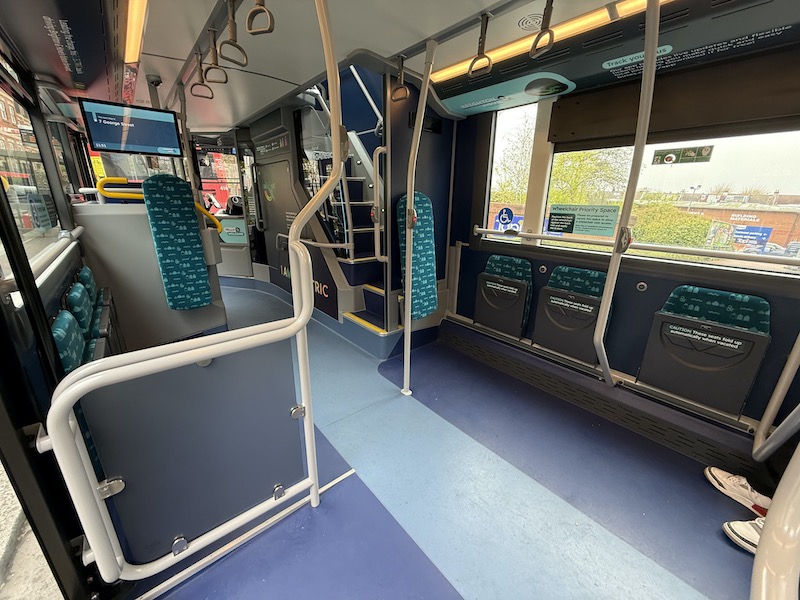
… followed by a double seat either side, accessed without a step, then another double seat either side with a step, and then the rear four with two rear facing pairs. So not many step free ‘proper seats’ but that’s the compromise with having a dual door bus, which the team feel is necessary for a city route like the 7.
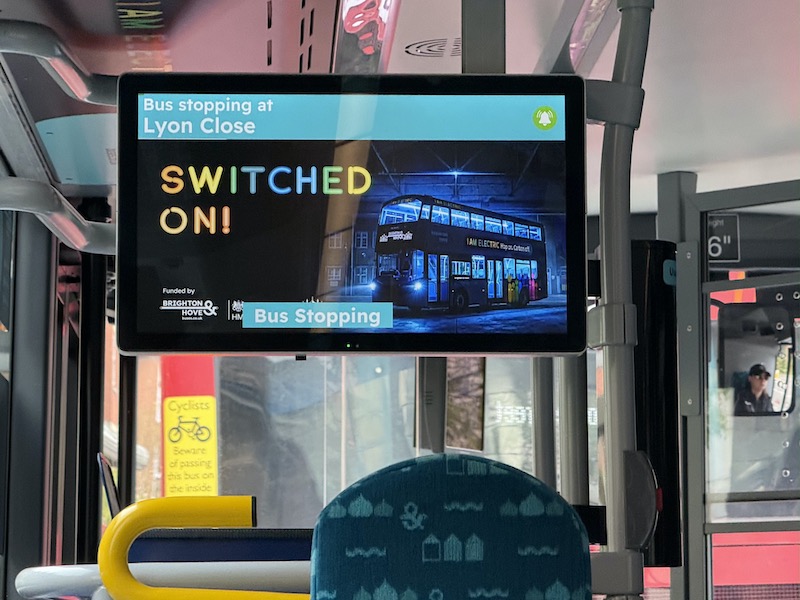
The ‘next stop’ monitor screen on the lower deck…
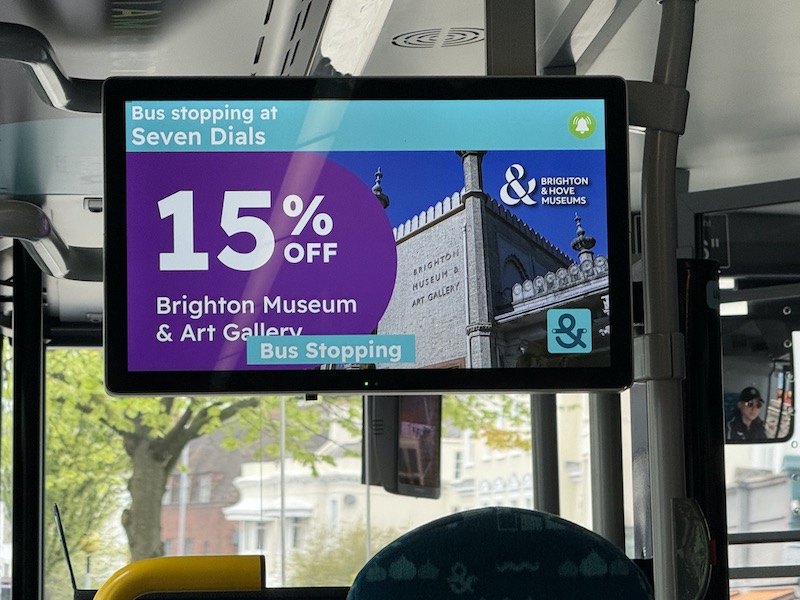
… and at the front on the upper deck…
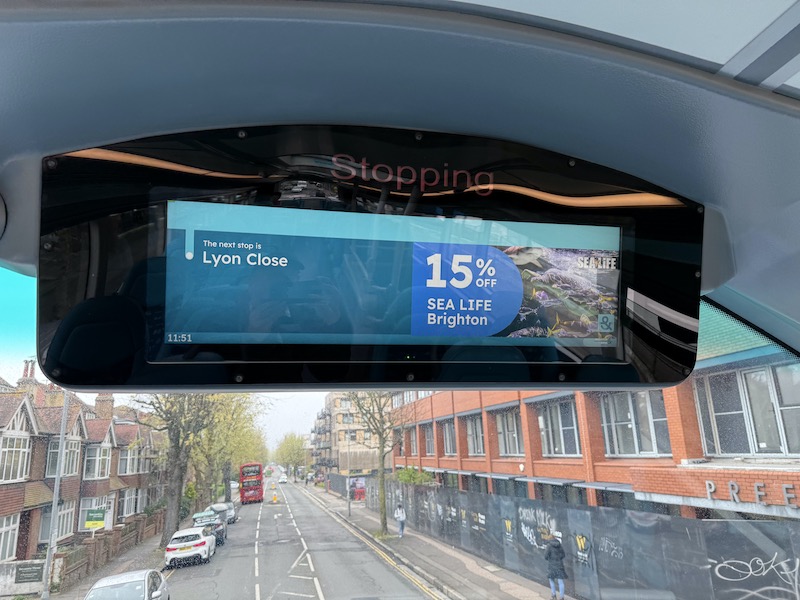
… display bright colourful clear promotional messages on a scrolling basis during the journey and I must say how impressive it is to actually be able to read these (so many bus companies use too small a print size or just don’t use them) and see the great offers available which the company has impressively arranged with local businesses and attractions.
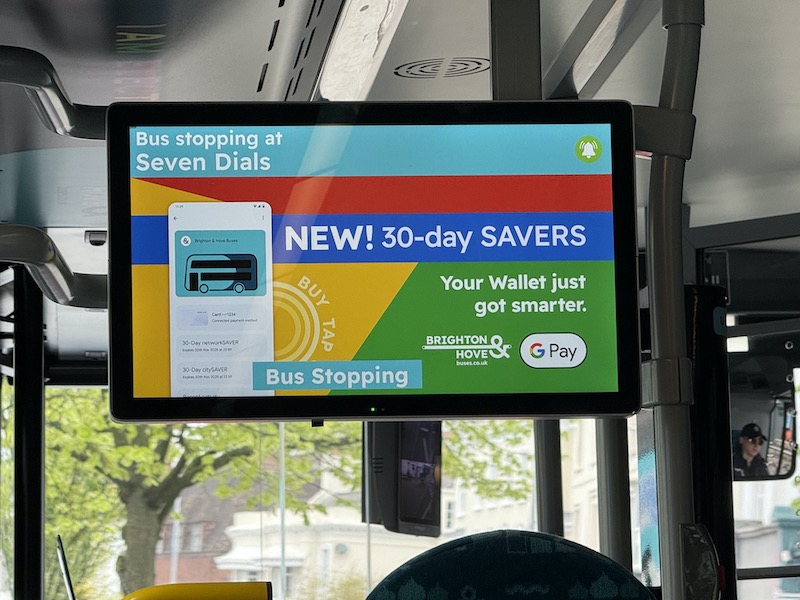
Other messages promote the company’s own products including its new tie up with FlixBus.
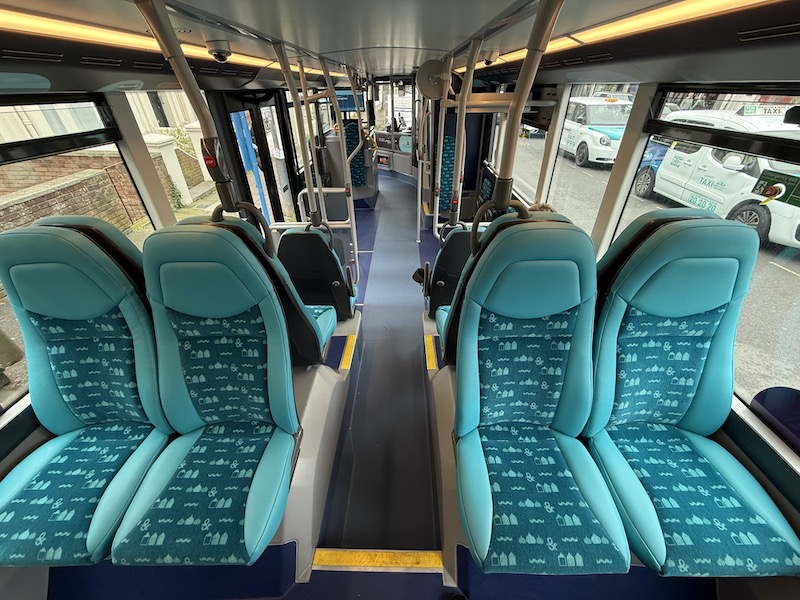
On the upper deck there’s one table at the rear offside but otherwise many more of the very comfortable seats in pairs…
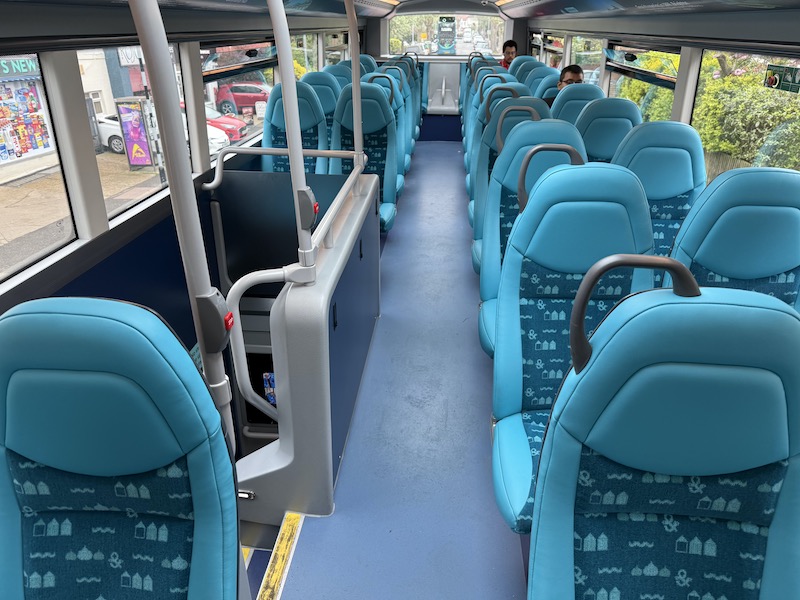
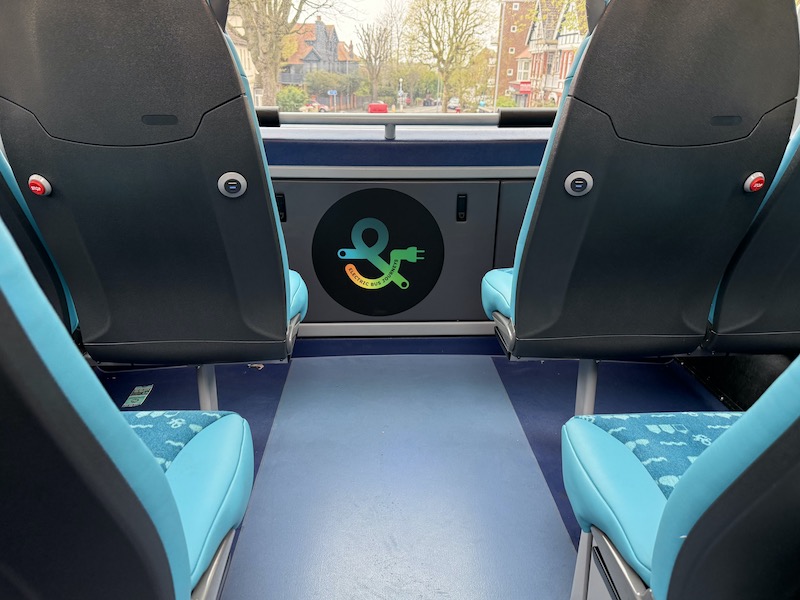
… with usb sockets and bell pushes on the seat backs.
It’s a sensible and practical layout for a busy cross city route such as the 7.
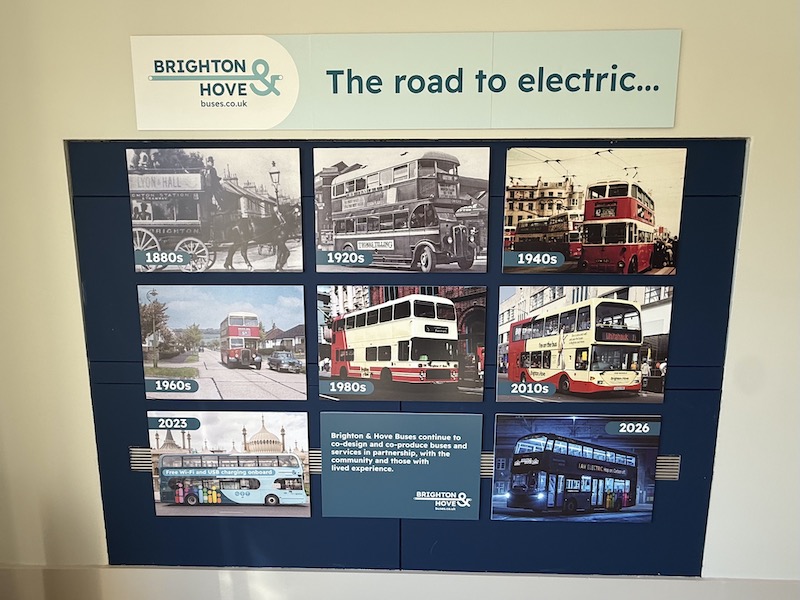
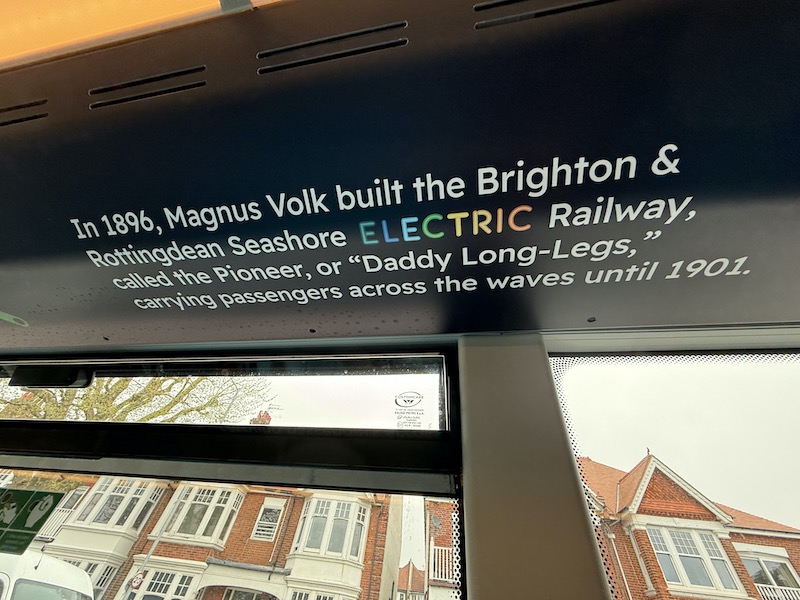
I’m sure Magnus would have approved.
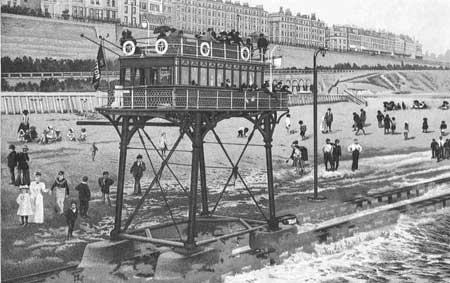
Accessibility has come a long way in 130 years.
And, even better, 29 more buses are on order thanks to further ZEBRA 2 funding from DfT and partnership funding from Brighton & Hove City Council and West Sussex County Council.
Roger French
Blogging timetable: 06:00 TThS
 BusAndTrainUser
it is good to see a focused bus company keen on promoting bus use. In southern Hertfordshire only uno seems to make good use of upcoming stops being displayed and announced. Limited information, sometimes incorrect, is slowly being introduced by some other operators.
John C.
LikeLike
Interesting as I am certain that one of the reasons why North Somerset Coaches ceased operating is that there was to be a next stop requirement, in the Bristol area, and their vehicles had not got them. That was about a decade ago. Don’t know if it was brought in as I moved away. They do seem to work on many Sanders vehicles – the dominant operator where I now live – but there isn’t 100% installation.
Useless trivia – North Somerset had two ex B&H vehicles, one of which was named Magnus Voke.
LikeLike
I don’t get it with Uno, next stop announcements are definitely on the 610 and 614 but still not hearing them on the 242 and 243 at all. They are clearly the same fairly new buses on all routes. By contrast, always hear next stop announcements on Arriva’s routes now as well as the 907 to Stevenage. Central Connect don’t seem to have bothered at all.
Found it very useful the other day going to a part of Norwich I’ve never been to before, as First have rolled it out there too.
Aaron
LikeLike
As a passenger, I prefer not to be assailed with invasive advertising, whatever the product.
Other operators use those large screens to display useful information, such as the next few stops in addition to the legal requirement to show the next one.
LikeLike
Indeed, the screens should only show next stop not invasive advertising, next stop screens on buses on the Bee Network are worse for this.
SM
LikeLike
The 7 has certainly come along way since it started, and these Electoroliners are an excellent choice and a great step forward…..just a pity about the livery, which probably wouldn’t look too bad if the “totem pole” splodges were removed. Please God they don’t mess about anymore with sister Metrobus which started to go down the same route in Crawley at one time.
Why are tip-up seats quite OK for everywhere else in the UK, including TfL trains, but resolutely banned as “unsafe” on TfL contracted buses?
Terence Uden
LikeLiked by 1 person
The adverts seem local , things like the fares tickets are useful but not needed in a place like London for example where one simple fare rules these days. Video ads are destracting but here the advert seems actually tied into the next stop ( here you can do this ).
One thing some buses now have is the screens on the cove panels for people sitting in wheelchairs that are backwards facing.
I assume the 7 is a reasonably short cross city service with most passengers going only a few stops and not too many through passengers.
I hope the drivers have been well trained , the acceleration and stopping power of electric vehicles (how do they compare with Trolleybuses which always seemed swift but not harsh) easily throwing standing (and seated) passengers about.
I doubt the tip up seats will be used that much
Brighton Marina could be a good place for charge top up facilities.
While the range is impressive could this actually mean weight of vehicles could be dropped with fewer batteries for a bit less but useful range ? particulary with charging at each end layover if possible ? Maybe the range is built in if longer routes are considered for future operation
LikeLike
Roger might be interested to know Metrobus are making changes to a couple of routes in May, including, a new 500 Eastbourne-Gatwick via via Willingdon, Hailsham, East Hoathly, Halland, Uckfield, Maresfield, Forest Row, East Grinstead, Copthorne and Manor Royal Business District, this will replace the 54 between Eastbourne & Uckfield
https://www.metrobus.co.uk/May
SM
LikeLiked by 1 person
I seem to remember Southdown East & Mid Sussex tried something like this immediately after de-regulation in 1986…
Anthony Holden
LikeLike
Hi Roger, I’ve been following your blog for some time now and interesting to see the info on the latest electric vehicles. I don’t get into the city much these days as the years are beginning to catch up, I’m 81 this year! One thing, it’s sad to see that the prominent red fleet livery has changed.
Many fond and happy memories of my time with the company.
Kindest regards, Den (Dennis Mackey)
PS I still have my dedicated and signed copy of your book from my retirement day. DM.
LikeLiked by 1 person
Great to hear from you Dennis; hope you’re keeping well.
LikeLike
The Blue livery gives a touch of feel of the onetime Brighton Corporation buses, maybe appropriate given the (necessary) public investment and local authority partnership
JBC Prestatyn
LikeLike
I couldn’t disagree with you more. Brighton Corporation buses were originally red & cream like those of the Tilling owned Brighton, Hove & District. The corporation did adopt blue (but not the current B&H shade) until the operation was eventually sold to B&H. As for the current livery & logos these are not comparable to the previous classy Best Impressions applications. To my eyes the logos, particularly the ampersand, look amateurish by comparison.
All your good work overturned Roger.
LikeLike
Fancy both you and the Deputy Lord Lieutenant being at the same event!
LikeLiked by 1 person
It was a colleague Deputy Lieutenant who spoke!
LikeLiked by 1 person
B&H route 7 has been one of my favourites, ever since it started up with minibuses every six minutes – real turn-up-and go. For many years it has been big buses, and is now two-door electrics – and night buses! It ticks so many boxes – the route calls at both main stations, plus the clock-tower, the marina and the county hospital – and an easy walk to the county cricket ground. I use it on most of my visits – the only place it doesn’t serve is Palmeira Square (for Audrey’s chocolate shop in Holland Road) – but plenty of other routes go there!
It’s a model for a semi-orbital route which other towns should copy, and proves that there may be latent demand which you’ll never know about until you try!
LikeLiked by 2 people
So simple but so essential – to have next-stop displays in a readable font!
An essential feature for any bus operation wanting grow bus use. Why are so many apparently not interested in next-stop information?
For dedicated car users, buses are a complete mystery – routes, fares, frequency, payment systems, stop locations. Any scrap of useful formation will reduce the fear!
One feature of the Brighton display I would question is interrupting that next stop information with full screen ads. There’s nothing more irritating, or even scary, than having the vital information suddenly obscured before you’ve had time to focus on it properly. If it has to be there, use split screens!
Stuart S
LikeLiked by 1 person
Thanks for this comment, Stuart, which I’ve shared with the Cambridge Area Bus Users Executive Committee. The paucity of information – at-stop, on-board, anywhere – frustrates us immensely.
LikeLike
What’s with this “Hop on Board” that we see so often? It would be amusing in Australia, but here it sounds like a serious Passenger Incident waiting to happen. “Come Aboard” is so much more friendly and professional.
I blame Hoppa buses and and Hopper fares and similarly meaningless inventions.
Ian McNeil
LikeLike
I’ve already sampled the Electroliners over on the Isle of Wight (courtesy of Southern Vectis) & found them to be superb vehicles to travel on. The only negative (I overheard from a fellow passenger) was the effect these vehicles were likely to have on the road surfaces given their extra weight.
LikeLike
An odd bit of corporate PR, Roger. A shame that Brighton and Hove chose to forget the efforts of the Brighton, Hove & Preston United Omnibus Company, who operated a fleet of battery electric buses there 118 years ago. They became the world’s biggest electric bus operators at one point, of course, and only switched to petrol when the manufacturer folded and the spares ran out. This still gave them a service life of nearly twice that of a contemporary petrol bus. It’s almost as if B&H didn’t want to acknowledge that their admirable use of these lovely new buses isn’t quite as ground breaking as they would like it to be?
LikeLike
There must surely be an opportunity to advertise the superb Brighton bus network in London. As some sort of joint activity with Thameslink / Southern? Basic question. If I went to Victoria right now and fancied a day wandering around Brighton by bus, what rover ticket should I buy when I get off the train? Not lots of “it depends, different zones” etc – just something really simple, and ideally multi-operator (CH, Oxford).
LikeLiked by 1 person
If you are arriving by train the simple one is just to add a Plusbus to your train ticket. Multi-operator and generally speaking always cheaper than buying the equivalent on-bus ticket.
Dwarfer
LikeLike
Hi “Dwarfer”. Many thanks. And you know, this is where the publicity is poor. I just assumed a Brighton with PlusBus meant I could only stay within the Brighton city limits (as you might expect from the name). Turns out a PlusBus to Brighton, and you can use any bus all the way towards Seaford or Shoreham. I’m a regular bus and train user, and didn’t know that – so how is someone trying this for the first time meant to know?
Thanks. Here for others if interested. £5 add-on
https://www.plusbus.info/brighton
I just wish we could do better telling people about what is available, and in particular, if arriving new to an area. (CH, Oxford)
PS – What is interesting, an annual season PlusBus is £555 for Brighton. I bet there are some circumstances where buying a train season between two adjacent stations is worth if, even if never used, to be able to buy such an annual bus ticket?
LikeLike
You say it’s hard to find the info, then show the easily accessible source of the info…
As an example when booking online it comes up as an option, explains what it is, one click to add, another click to go to the PlusBus website and find out where it’s valid. It’s not like it isn’t there!
LikeLike
Hi Causton – I can certainly see why you say that, but it is always that initial hurdle that affects those less familiar with things. So once you have the correct search term, it does indeed become easier to find info.
But again, imagine someone in London fancies a trip to the coast, and a short train ride. You get to Victoria. “PlusBus” is described as a local add-on, so you might think that’s not the ticket for you when you get to Brighton, because you might want to use buses hop on, hop off, along the coastline.
Someone says “Discovery Ticket” which is great, if you know a person who understands bus tickets. Yet, put that in google, first hit right now goes to Kent County Council, which then points to the South Downs National Park website. That site lists bus companies taking part and counties. But there is no map – so at the edges, you need to know where county boundaries are. That could be annoying if you instead caught the train to Lymington – where is the Dorset boundary, that I shouldn’t cross, if I ventured westwards?
It simply shouldn’t be this difficult. We need to be thinking of car drivers, who fancy a change – how do they get this information?
Easiest of all would be something like the Discovery ticket, it operates nationally, and it comes with top-notch publicity. One ticket, valid everywhere, no worries about geographical boundaries. I can get the train where I want, and use any bus upon arrival.
Even if in some instances, on a day trip, buying single/small zone tickets might have worked out cheaper in the end, I’d maybe pay the extra amount for the simplicity. That means less time using screens trying to find the best ticket, and more time instead enjoying the train ride and looking out the window! Which would be worth the couple of quid lost because I didn’t buy precisely the cheapest tickets or zones. Time “offline” is a real treat at times, rather than scrabbling around across multiple websites.
Keep it simple, keep it relevant, keep it well publicised. We need to be thinking about people who wouldn’t normally use the bus, who can find ticketing to be easy, and then they discover the fancy new buses on the B&H route 7!
Apologies for the long post. (CH, Oxford).
LikeLike
Exactly and well said @CH, Oxford.
In part, I think this is why bus ridership is so much higher in London and why franchising in Manchester is successful in increasing ridership. Same with council run buses in places like Reading and Edinburgh. Easy to identify the brand, consistent, easy to find information, simple fares etc. In these areas, you buy a single knowing after a couple rides, your fares will be capped regardless of routes. It’s simple, it works.
Outside these areas, like in Sussex but outside Brighton and Hove, the regional tickets exist but are not actively advertised, the tickets available overlap and are byzantine. It’s too easy to end up paying more than you should have to. When Arriva or First for example only show their own routes (typical in much of the country), it only gives half the picture, giving a false impression of where buses go to.
Train tickets are also complex but at least with rangers and rovers, it’s in black and white where you can go, as maps are easy to find. Such tickets on bus should be as simple. Unsurprisingly, since getting a disabled bus pass, I’ve taken far more of an interest in buses outside London. Nothing is simpler than free on all regular stopping buses! At that point, who runs them matters a lot less and it matters far more whether it takes me where I want to go.
Aaron
LikeLike
An annual rail season from Aldrington to Hove (the cheapest journey I can find to/from/within the zone) costs £484.00. Plusbus add on at £555 gives a combined £1039.00.
B&H doesn’t sell a comparable annual product, but 4 consecutive 90-day CitySaver tickets would cost £1081.20 in total. The area of validity is a bit more restrictive than Plusbus, though. 4 90-day NetworkSaver tickets – wider area but without Stagecoach acceptance would cost £1213.60 in total, so a bit of a saving there.
If you were after the Gold Card perks too then I’d think it was well worth doing!
LikeLike
It’s called a PlusBus.
Or the £10 Discovery that covers a massive area. Simple! 😁
LikeLike
Very nice new buses, and proper city buses with exit doors to boot.
I really like the Brighton & Hove new livery (after the initial shock at introduction as the red/cream was lovely). I particularly like how they use the ampersand in the fleetname and other graphics.
Peter Brown
LikeLike
A driver once told me they do really appreciate passengers saying “thank you” when they leave. Two doors is great for busy services, but I wonder if drivers miss the compliment when rostered on a two-door service!
LikeLiked by 1 person
I have heard passengers still calling out thanks on using exit doors, so I think it can continue.
Regarding Brighton & Hove, I’ve just read the May edition of Buses editorial describing that the city council wishes to pursue bus franchising!
Peter Brown
LikeLike
If it ain’t broke don’t fix it! Just another local politician jumping on the bandwagon.
LikeLike
Just two small comments to make on this piece Roger, there is indeed a table on the upper-deck of these new buses, it is at the back on the offside, giving a set of four facing. I think that these are a welcoming feature of B&H buses and look to be popular with families and groups of students. Talking of welcoming ‘kit’ on these buses, someone here thought that the six tip-up seats would not be used much. I would counter that by saying that when I take a short trip on the local B&H buses and therefore travel downstairs, the tip-ups are in constant use. They are welcomed by people with buggies, who sit alongside their child, and by elderly people with shopping trolleys and also by people travelling just a few stops. A ‘plus’ feature is that these seats are in the flat part of the lower deck and thus easier to reach. Many thanks for this write-up of the event on Monday, it was good to meet up again. Best regards, Chris Warren.
LikeLike
Many thanks Chris – have updated the blog to correct the point about the table.
Thanks again.
LikeLike
With all this mostly private sector investment it seems absolutely logical for the local authority to consider franchising the network!
LikeLike
Places like Brighton where it’s one company basically running everything anyway (seemingly everywhere Go Ahead runs buses), would make much more sense to nationalise/ municipalise it instead. Franchising would actually make the services worse in this case and have hardly any benefits compared to the areas where buses are fragmented. Franchising would benefit Hertfordshire but not Cornwall and Plymouth for example, because of this.
Aaron
LikeLike
A contradiction in terms or were you being sarcastic?
LikeLike
£7million total spend of which £3.5m came from the public purse I believe I read in the article. No wonder bus companies are investing in electric when they receive such attractive funding opportunities. Buses look excellent and really pleased to see the efforts being made with passenger accessibility including dementia. Brilliant initiative.
LikeLike
suggest you read the article again. It’s a £10.5m total spend – £7m of Go Ahead money and £3.5m of grants etc.
LikeLike
That’s not what the article says. Maybe deliberately ambiguous. Perhaps Roger might advise. Are these new buses £650K each? Really.
LikeLike
B&H press release stated £10.5m total. Excellent. Still a significant public contribution. I think that was the initial point.
LikeLike
And an even larger contribution from the operator. The reality is to get operators to move to electric, the upfront costs are substantial so the DfT need to help bridge the gap. The £3.5m is to support both the infrastructure works and the vehicles themselves.
LikeLike
The article says B&H invested £7 million – that was the Go Ahead spend.
The article continues to say there is “a £2.9 million contribution from the DfT’s ZEBRA 2 fund and £600,000 from Brighton & Hove City Council.”
That makes £10.5m which is what the official press release said so not ambiguous at all
LikeLike
There is zero sense in franchising, let alone nationalising, Brighton’s buses.
LikeLike
A bus that “thinks like a tree”
Interesting image. Something to do with sustainability, I suppose.
Perhaps they intending that it branch out on to as many roots as possible?
SS.
LikeLike
I became aware of the “Daddy Long Legs” in 1964 when I bought a booklet celebrating the Volk’s Railway (1883-1964). I am old enough to remember the Volk’s drivers using the overhead control knob to drive the cars. That booklet has survived numerous refilings within my system and during a house move in late 2007. Its “twin” survivor is a gorgeous 1965 booklet advertising the BR train ferry services between both Harwich and Zeebrugge & Dover and Dunkerque. It has a map offering the delights to freight exporters and an export timescale from say London to Rome in five days. Pictures show car flats bearing left hand drive Morris 1100s being loaded on to a train ferry at Harwich and a double deck Kartic showing MG sports cars for export too. On a motorcycle excursion staying in Colchester one weekend, I saw a train ferry at its berth in Harwich one Sunday morning yet failed to note its name. Between Harwich and Clacton on Sea, as an off-duty football referee I just had to stop off for a while at a place called Weeley to watch part of a youth game. I had been playing hooky from Surrey football on that occasion. It had been quite a weekend, hands so cold and barely able to sign credit card vouchers for fuel bought. At least I had been at football (Crystal Palace FC) on the Saturday afternoon before my trip to Essex for the weekend. Woolwich Ferry then out on the A12 at night.
LikeLike
Noted elsewhere is that the running cost of the Manchester Beeline bus network is roughly double the cost of the previous network, which is virtually unchanged from pre franchising. On top of this is at least £169m of capital spend on depots and vehicles, and in the operating budget there does not appear to be any allowance for the depreciation and thus replacement of those assets when the time comes. In more Manchester news tram frequencies have been reduced as a result of a new pay deal for drivers as the new arrangements require an extra 60-80 drivers, at an annual cost of circa £3.5m per annum.
And who pays for this? The taxpayer, and they call this success. And every other Metro Mayor ( plus Brighton and Hove ?) thinks this is a good idea. Total national cost at least £ half a billion
LikeLike
It’s better than what existed before. Think the taxpayer benefits from less people driving, socially, environmentally and in health, it benefits from better public transport and so do businesses. Public transport creates opportunity and wealth. I as a taxpayer want taxes to go towards mutually beneficial things and not more wars, unlike some well paid drivers and a handful of quiet buses, war is an actual waste. In the long run, municipal bus companies would be better than franchising.
Aaron
LikeLike
It would be interesting to do a poll of bus enthusiasts to find out their favourite modern EV double decker (Electroliner, Volvo, BYD, or whatever else).
personally based on my local experience in North central London, the BYD wins out (in the winter at least) for comfortable seats (especially upstairs) and smooth quiet ride.
that said, it’s also worth comparing the number of level access seats downstairs in various deployments, as this seems to be decreasing with recent EV bus rollouts in London.
milesT
LikeLike
It’s interesting that you didn’t mention Alexander Dennis. I’ve only personally travelled on the Wrightbus Electroliner & must say it is a superb piece of British engineering albeit with some Chinese technology included. My personal issue is that BYD & Yutong, as good as their vehicles are, receive two subsidies. One from their own government & the second from UK taxpayers courtesy of ZEBRA funding. This combination has led to an uneven commercial playing field that has already relegated AD to third position in terms of 2025 UK bus sales. All this from a UK government that purports to support British industry.
LikeLike