Thursday 9th April 2026
New bus routes for new housing developments come in various shapes and sizes but one being held up as an exemplar is route HL1 in Hoddesdon in Hertfordshire.
This month marks its first anniversary and noting a recent gushingly favourable news report in the trade press I decided to take a look on the ground and do a quick BusAndTrainUser Verify.
Hertfordshire County Council has used Section 106 Developer funding to contract Central Connect to provide a bespoke bus route linking the self styled ‘High Leigh Garden Village’ with Hoddesdon’s retail centre around its famous Clock Tower as well as nearby Broxbourne railway station.
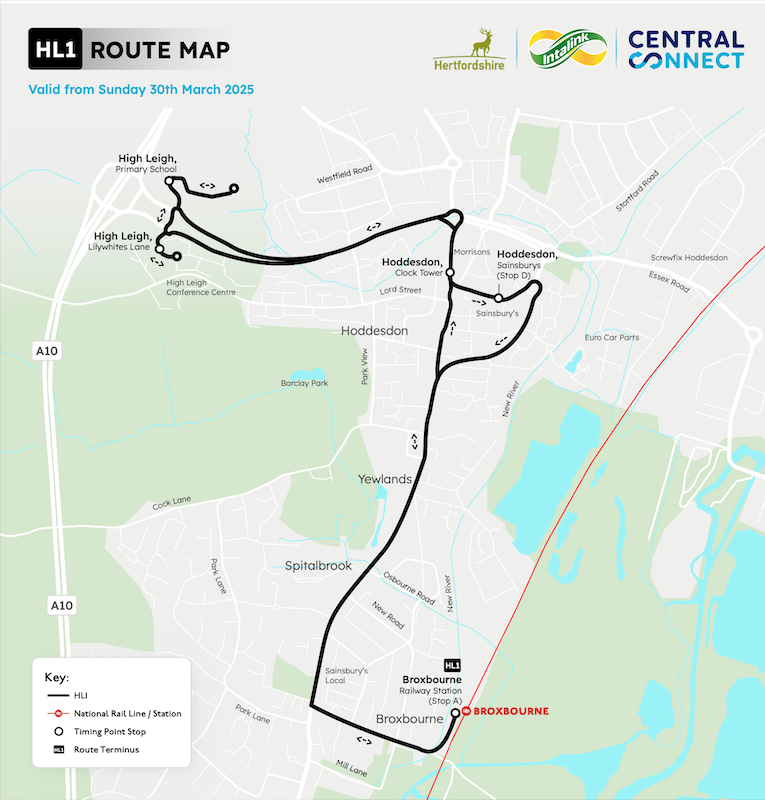
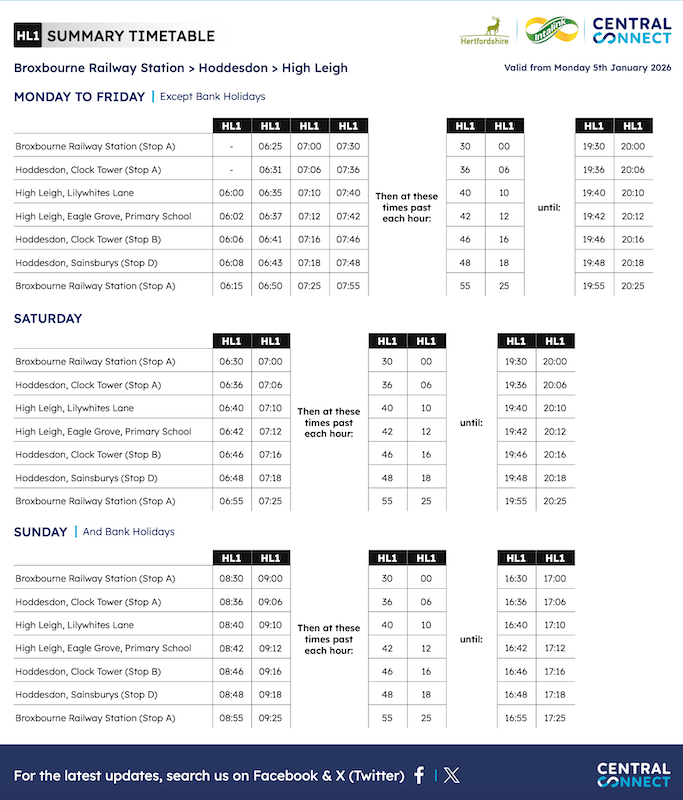
It takes 25 minutes to complete a round trip from Broxbourne station to High Leigh (a distance of 1.4 miles) and back again so with five minutes layover a one bus shuttle type service gives a half hourly frequency.
The timetable’s span of day is from 06:00 to 20:30 on Mondays to Fridays with an 06:30 start on Saturdays and a reduced 08:30 to 17:30 operation on Sundays.
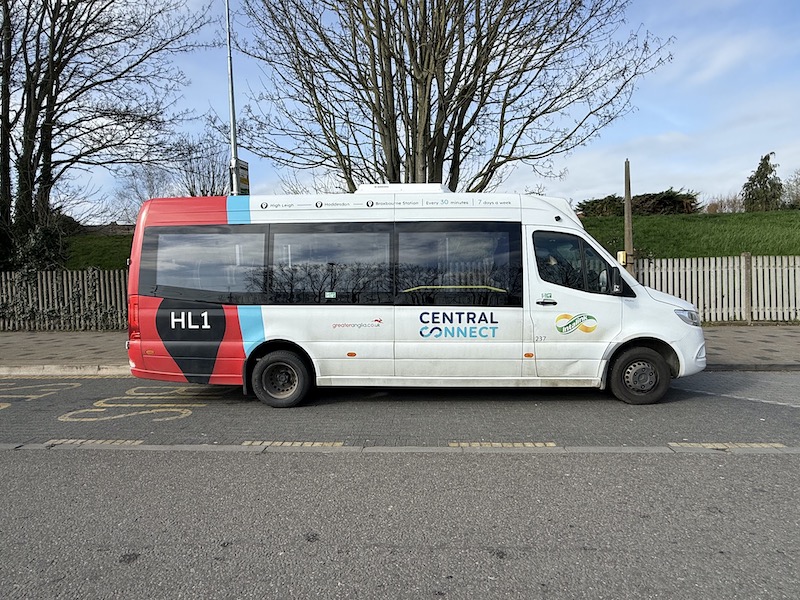
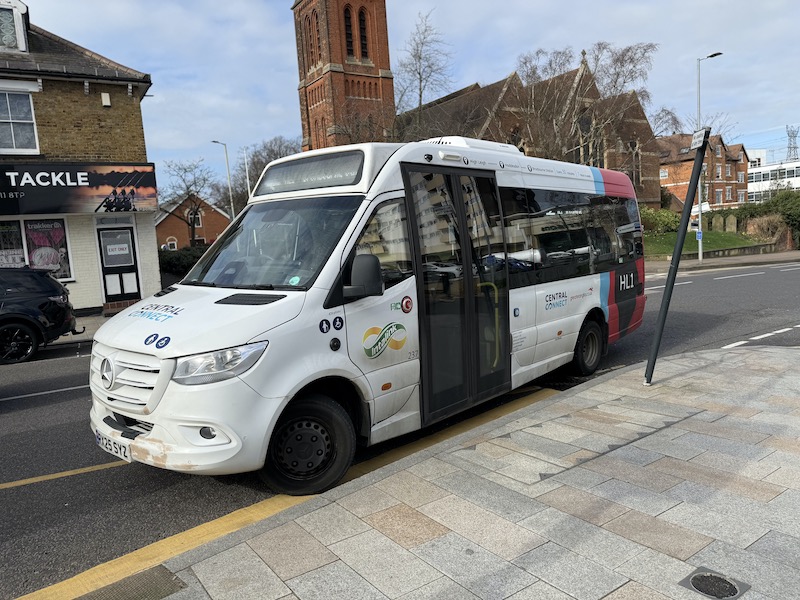
A new Mercedes Sprinter in bespoke branding was acquired for the route last year.
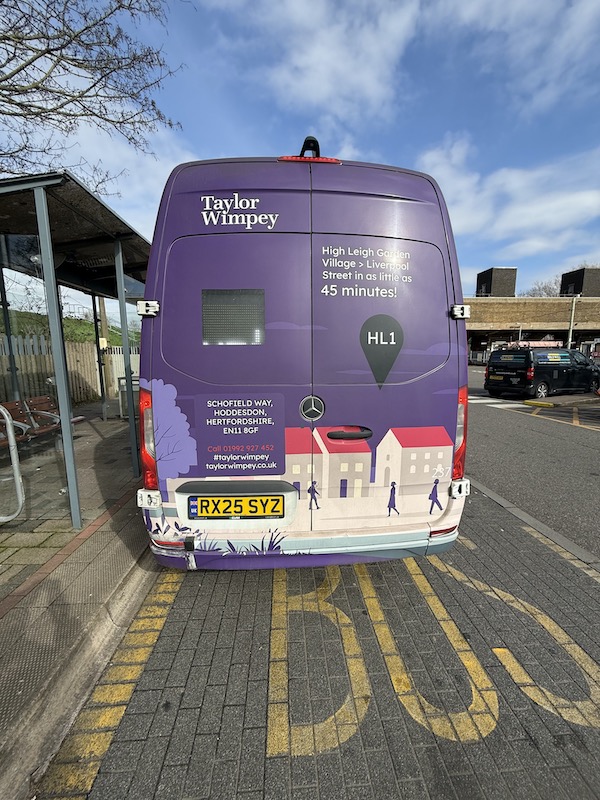
On my ride around it was noticeable how High Leigh Garden Village is still very much in development with Taylor Wimpey promoting new releases of houses but there’s also another development by Bellway on the opposite (south) side of the A10 dual carriageway link road.
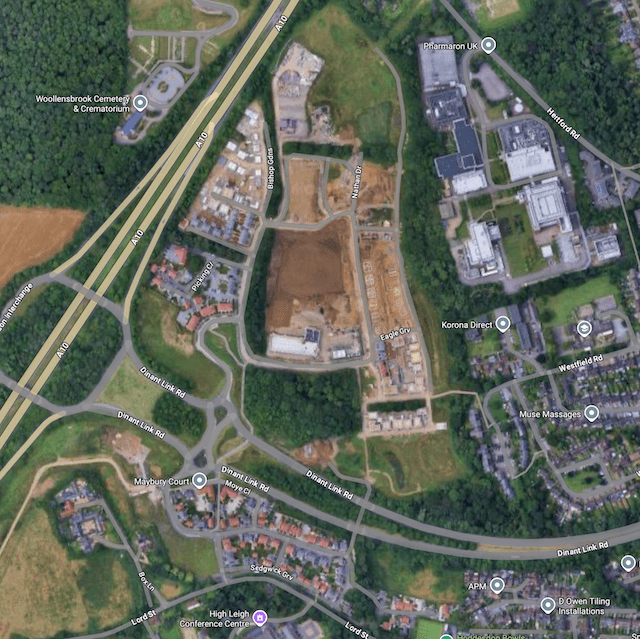
The bus followed a route into each of these two new developments and then did a reverse turn into a side road and retraced its tracks back to the main road. it wasn’t clear whether both developments are regarded as part of the one ‘Garden Village’ and if so I reckon it’ll be a challenge to create one community with them being separated by a busy dual carriageway.
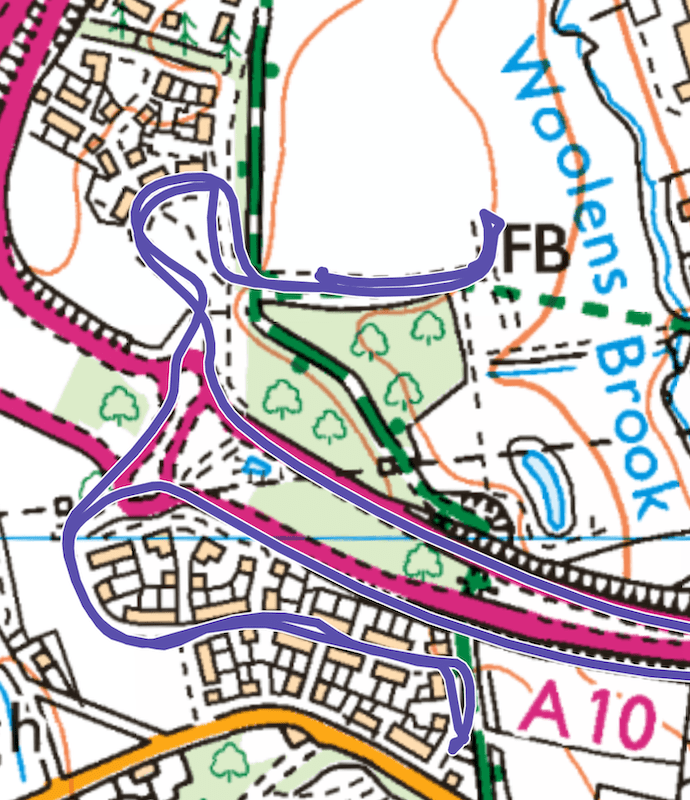
© Crown copyright 2026 Ordnance Survey Licence No AC0000873681
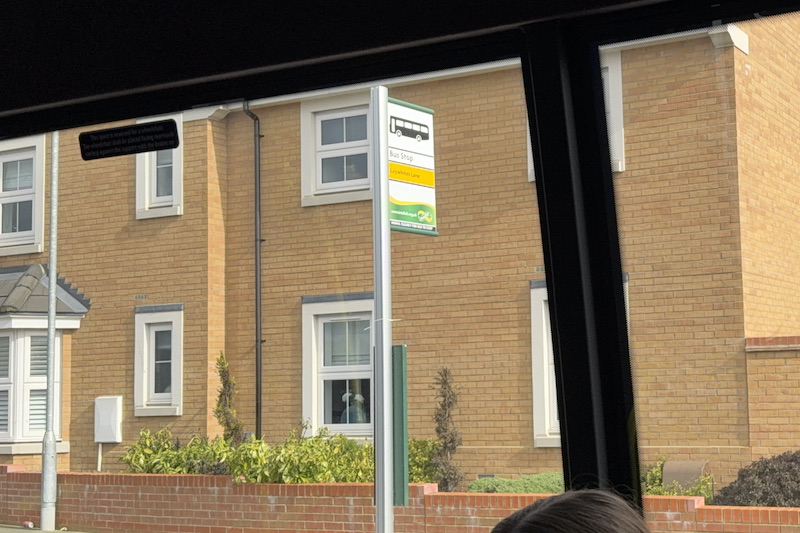
I noticed just one fixed bus stop on the southern development…
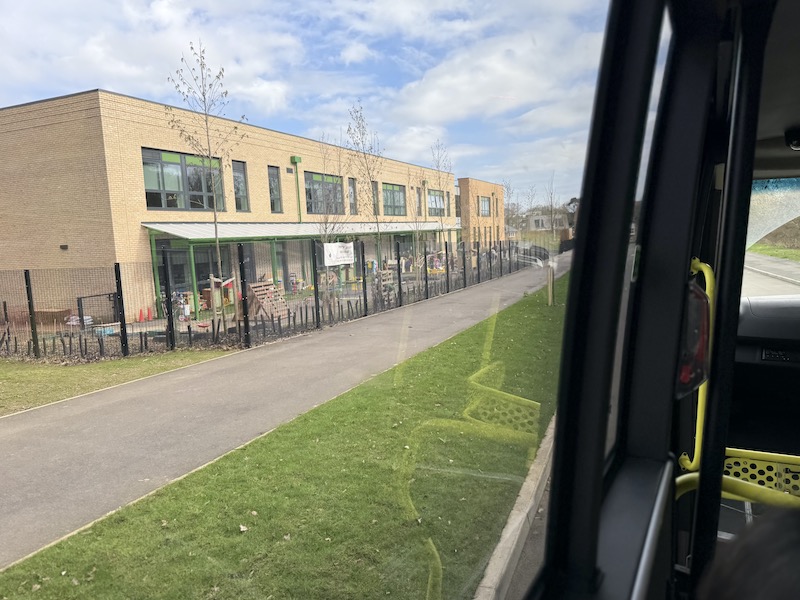
… and a couple on the northern development which also already has a substantial primary school built and open.
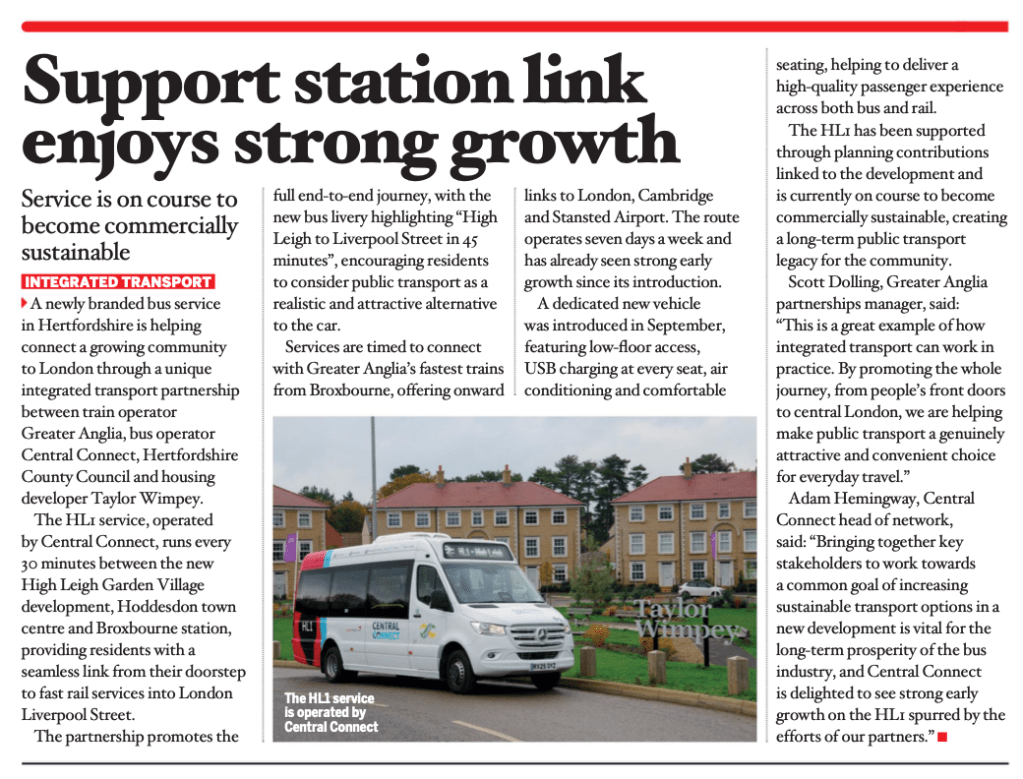
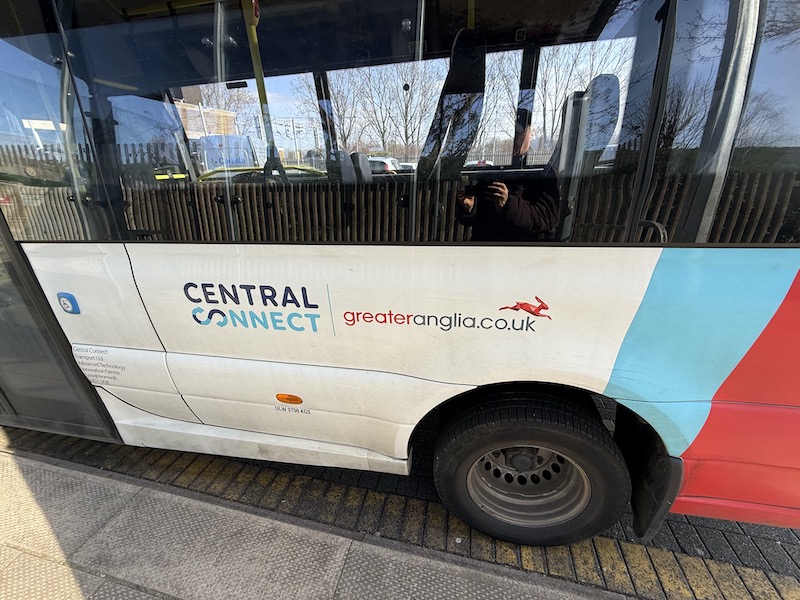
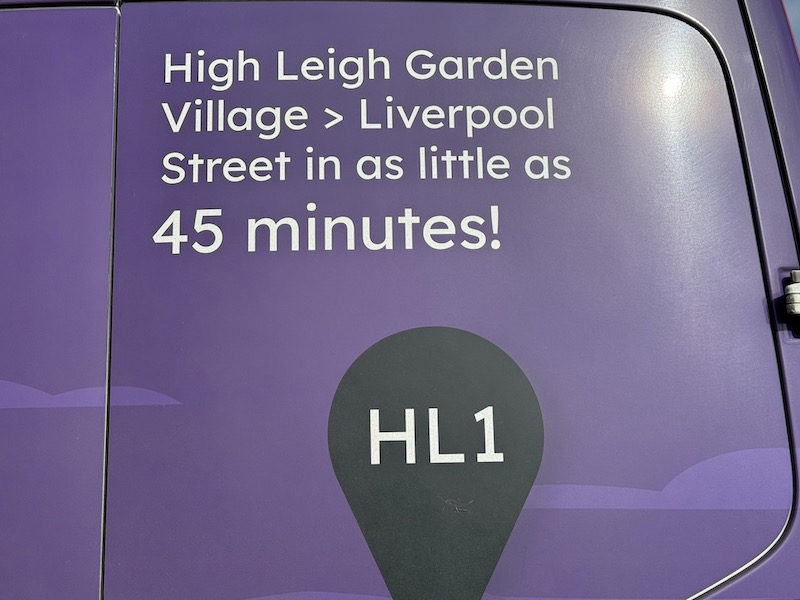
The reason the route is being hailed as an exemplar is it reportedly provides “seamless connections” between bus and rail at Broxbourne station. Good connections to and from fast trains to Liverpool Street and promotion of an overall end to end journey time to London from the ‘Garden Vilkage’ of 45 minutes are highlighted and I noticed Greater Anglia has its logo on the side of the bus so maybe they (ie DfTO) are also supporting the route.
The terminal point is conveniently close to the ticket office and entrance/exit to the station building…
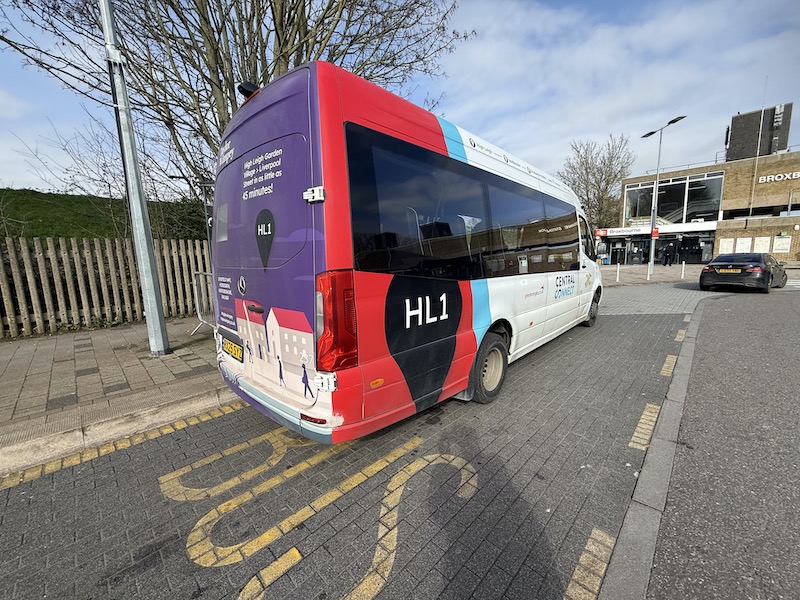
… and there’s a Hertfordshire style listing of bus departures on display in the bus shelter but I didn’t notice anything in the station building.
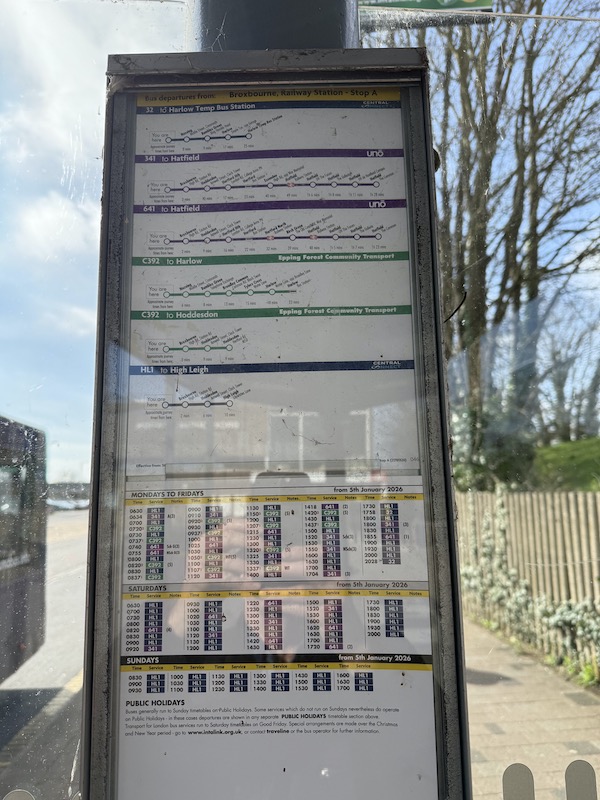
Fast trains arrive from Liverpool Street at 20/50 with southbound journeys departing at 14/44. The former is handy for the 00/30 HL1 departures giving, for example, a northbound itinerary leaving Liverpool Street at 10:54, arriving Broxbourne 11:20, leaving Broxbourne 11:30 on the HL1 and arriving High Leigh at 11:40-11:42 making for an overall journey time of 46 minutes so pretty much as claimed. However in the southbound direction it takes longer as the connection at the station is more generous with a bus leaving High Leigh at 11:42, arriving in Broxbourne at 11:55 and the next fast train not until 12:14 arriving into Liverpool Street at 12:42 making for an hour’s overall journey – so not quite the 45 minutes as claimed.
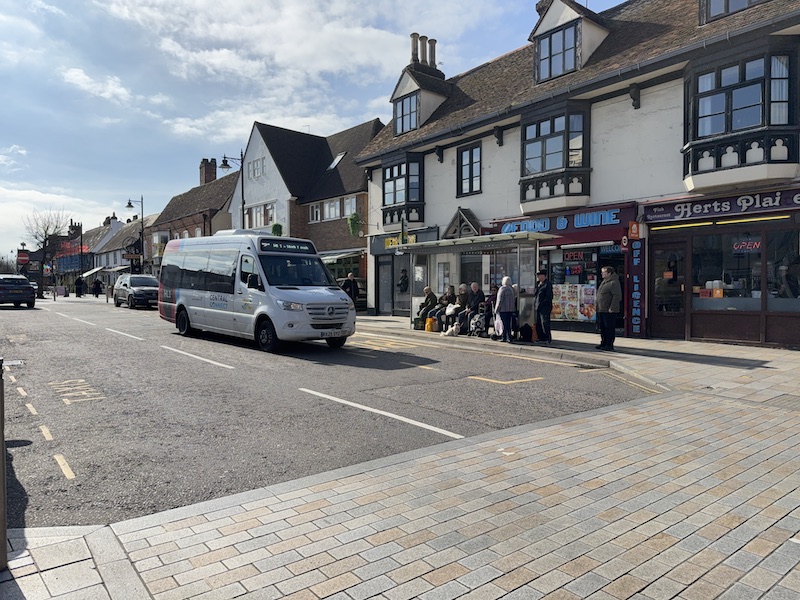
I travelled on that quoted 11:30 from Broxbourne station and although a passenger alighted as the bus arrived and went into the station, it was just me on departure but at the Clock Tower in the centre if Hoddesdon at 11:36 a woman and child boarded with shopping as did another woman.
No one got on or off during our quick ‘up and down’ of the Bellway southern development but when we got to the Primary School on the Taylor Wimpey northern development the woman asked the driver if he would wait while she dashed in to the school to pick her young son up – which I was impressed to see he did. He could have carried on and dropped the other passengers (woman and child) off where he did the reverse turn up the road as by then mum would have been back with offspring, but we waited anyway and within a couple of minutes she was back.
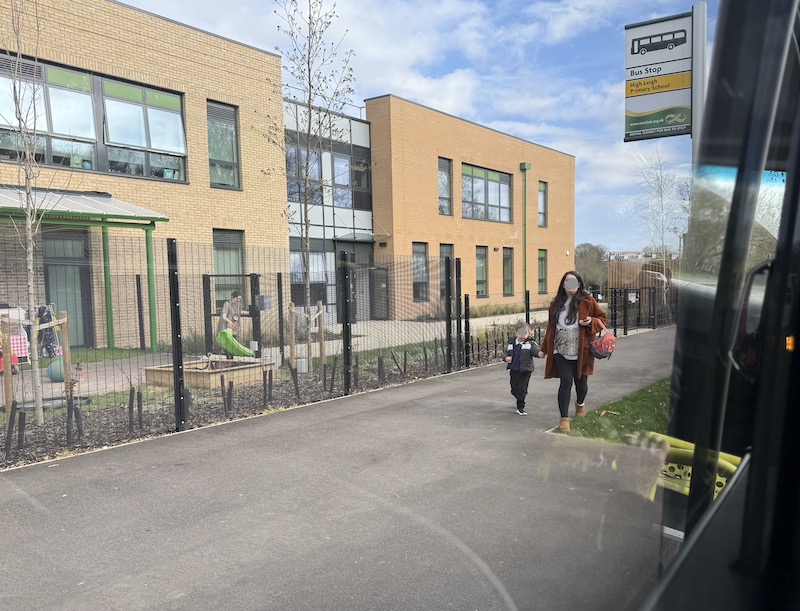
Mum and child got off back at the Clock Tower at 11:46 and no one else joined for the run back to the station for 11:55.
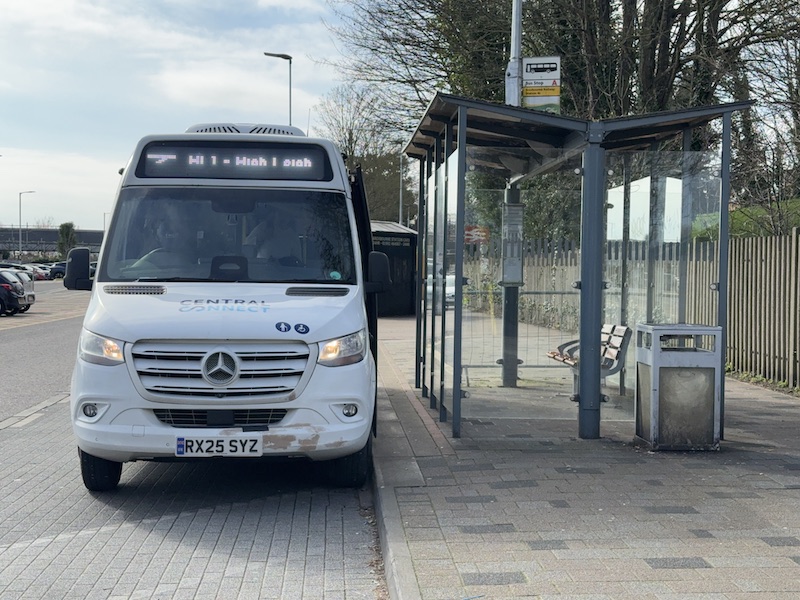
And then the whole cycle began again at 12:00.
Having only sampled one return journey I can’t comment on the “strong growth” claim, but, as always when you’re carrying two or three passengers per journey, you only need one more to be able to claim “strong growth” of the order of 25% or even up to 50%. One very positive I took away was how simple the offer is for new residents moving in to understand. An easy to remember half hourly bus shuttling up and down on a fixed route and fixed timetable deserves to succeed, albeit I’m not sure the eventual catchment area will be strong enough to make it commercially viable.
Roger French
Blogging timetable: 06:00 TThS
 BusAndTrainUser
Certainly a route with those times that I and a couple of my friends would have found useful in the days when we had evening toyfairs and an annual model railway show at one of the schools in the area , getting from Broxbourne Station to Hoddesdon town centre was a pain , the through buses to Harlow did run but times seemed unclear and really needed planning. The school changed to an academy and ran a lot more after school clubs so it wasnt possible to continue toyfairs, maybe we should investigate what space the Primary might have.
JBC Prestatyn
LikeLike
It is in my view unlikely that the route will carry many passengers to and from the station. A more sensible route would be to run it through to the Brookfield Centre that though would mean it could not serve the Station. There are proposals though for a new station at Turnford near the college which such a route could serve
The current Brookfield Centre is to be massively expanded so is likely to become a key destination
LikeLike
I dont think the shopkeepers of Hoddesdon would be very pleased with that.
Maybe the Brookfield Centre would be a better southern destination of the Central Connect Route mentioned on comments . It doesnt look well connected for a route from Cheshunt (Waltham Cross) to get to it and continue north but maybe it is possible, the problem is there is a main road parralle and buses cannot do both roads but need to serve both of them then you get too many buses on the common further sections.
Of Course if Brookfield Centre (s106 again) want to contribute to a bus service then no reason a 2nd bus could not be added to the route with double run to station. I assume this would add 10mins to journey time which with two buses would give a nice 20min frequency rather than half hourly.
JBC Prestatyn
LikeLike
Interesting! – I think the main block is the public perception (correct in general) that bus and train operators are only very loosely committed to making bus-rail integration work. No publicity inside the station; a timetable which only connects well in one direction; probably no through-ticketing; probably the station staff (if they exist) will only have the advice for passengers ‘details are at the bus-stop’ – happily that is true in this case – and probably will have no authority to hold the train for a minute if the bus is a little delayed, or the bus if the train is delayed. Luckily the long connection to the southbound trains means that, even if the bus is seriously delayed arriving at the station, one can fairly certainly rely on the connection.
Unfortunately, years of tradition mean that, in most places, the unspoken message given out by train and bus companies is still ‘Don’t bother to try and make a journey involving a change, as we won’t help you’. And so the percentage of travel by public transport remains low!
As for commercial sustainability, I’m sure you are right, considering the bus operation on its own. What might be achieved by a properly integrated, properly publicised operation, and taking into account extra rail revenue generated, we will never know until the rail and bus managers start talking to one another constructively.
LikeLiked by 1 person
There’s an interesting proposal for the Peak District in Derbyshire which has just been given the go-ahead – for a ‘Mini Switzerland’ where buses will be deliberately timed and co-ordinated around Northern Rail’s hourly stopping service along the Hope Valley line between Manchester and Sheffield. Crucially, both the management of Stagecoach Yorkshire and Northern Rail, as well as the East Midlands Combined County Authority, are fully on board. The Department for Transport and Government Ministers, in what is one of the most pro-public transport Governments in a long time, are also taking interest.
The argument is that the services are already being supported, so a modest extra investment has the potential to increase both the revenue, as well as meeting social objectives such as reducing traffic in the Peak District, improving access to the countryside for city dwellers (many of whom do not have access to a car) and improving local mobility.
The scheme is intended to act as a model, demonstrating what can be achieved by rolling out such schemes in other rural areas in the UK. On a smaller scale, Devon County Council and Great Western Railway have already shown what can be achieved with modest additional spending on bus routes to improve connections with train services at Barnstaple and Totnes.
Julian Walker
LikeLike
Looks like the Combined Authorities are managing to break the log jam of some cross (older) border services and bring rail into the if not funding then influence. I dont really see big increases in passenger numbers in the specific areas, maybe more weekend leisure , will be interesting to see results which I think would take a couple of years to draw meaningful conclusions
JBC Prestatyn
LikeLike
Broxbourne Station was one of several rebuilds on the line out of Liverpool Street when the service was electrified in the 1960s. Bishop’s Stortford and Harlow Town stations were also rebuilds, all done by the BR Eastern Region Architects’ Department. I was able to explore Broxbourne and Harlow Town stations in 2003 when Zone 6 was extended to Harlow Town during the major Central Line closure. I needed to dally at Broxbourne Station on one occasion in the Waiting Room and I noticed something quite homely about the heating. You see I was born in a semi in Park Road Kingston upon Thames in August 1953 and with me being mother’s second born the family moved to a small detached house in Burhill Road, Hersham the following year. Father had a local builder almost double the size of the original building also insisting that central heating was installed as best as could be done at the time, heated by a coke burning boiler. There were no white slimline radiators then, father’s new house had crude cast iron radiators fitted as they were the only available ones at the time – identical to the ones I found at Broxbourne Station. Father was an obsessive gardener and bought the house as much for the garden as the building. It was a vast garden and at one time Father paid a professional gardener to come each Thursday to do the donkeywork. The fruit and vegetables that were produced would honour the kitchen of any grand house in the country.
As to Hazzard’s latest video about London Transport in WWII and its brochure London Transport Carried On!, this was republished in hardback as London Transport At War in 1978, so there is a greater chance of getting the reprint from the second-hand market rather than the original.
LikeLike
I have two copies of London Transport at War one the first edition and one a later reprint – I dont know if it was revised. If I can find them I might re read the bit about London Buses converting to fire engine apparatus which I dont recall happening unless it was fairly good chassis using time expired or damaged bodies would the work have been done at Chiswick ? The book extract shown covered more that LT staff ( like railway company staff ) undertook fire watching and reaction duties. A couple of family members worked in Hartlepool at the railway owned docks / ship builders doing that ( they made some ships I think for railway ferries ) Did such staff get civil defence or similar medals awarded after the end of hostilities ?
JBC Prestatyn
LikeLike
A positive initiative and one to be welcomed. Roger uses the word ‘maybe’ to query whether Greater Anglia offers financial support. Bloggers do tend to do this; supposition rather than finding the answer before committing finger to keyboard. Hopefully an update will follow. But as I say, a positive initiative that’s good to hear about.
LikeLike
Greater Anglia are calling this an “integrated transport partnership”, and as far as my 5 minutes of research goes, that’s all I found.
LikeLike
Maintain the bus stop and put the timetable up and contribute to publicity leaflets ? Should adverts for connection buses be on train advert panels and on the PIS screens on route indicators and before station stops?
JBC Prestatyn
LikeLike
Central Connect have picked up the new HCC route 33 which will run between Hoddesdon and Bishops Stortford
LikeLike
How long before it is converted to a dreaded DRT?
MotCO
LikeLike
I don’t know what the final population of the area is expected to be but the catchment area looks too small to be able to sustain this route. It is typical of these tick box routes put on to satisfy the planning permission.
Ideally it would be integrated into the local network to provide more connectivity but this then makes connectivity with the trains more complicated. The end result is lots of bespoke services none of which survive.
Richard Warwick
LikeLike