Saturday 21st February 2026
This year’s third exploration of Britain’s 25 bus routes numbered 99 finds us in south east London on a journey between Woolwich and Bexleyheath.
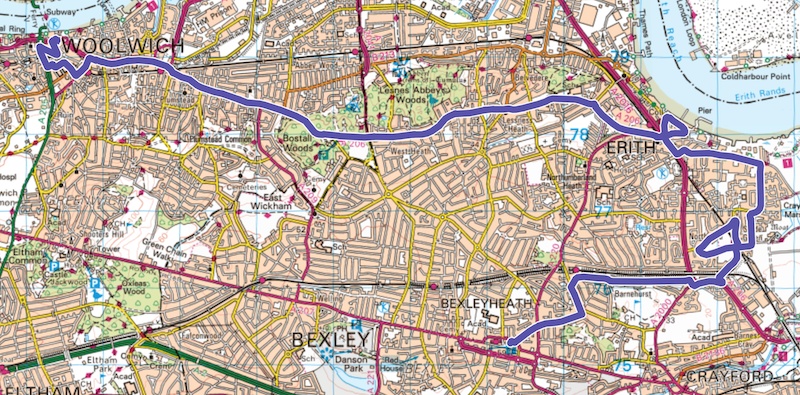
Buses on route 99 were plying the roads between Woolwich and Erith even before London Transport was formed in 1933 being a key part of the network linking these important communities. The route was extended beyond Erith to Slade Green railway station in 1979, but cut back to Erith six years later in 1985 only to be extended again in 2009 but this time beyond Slade Green back towards Bexleyheath which it’s continued to do ever since and provides a rather unusual trajectory forming a ‘U shape’ at the eastern end of the route.
© Crown copyright 2026 Ordnance Survey Licence No AC0000873681
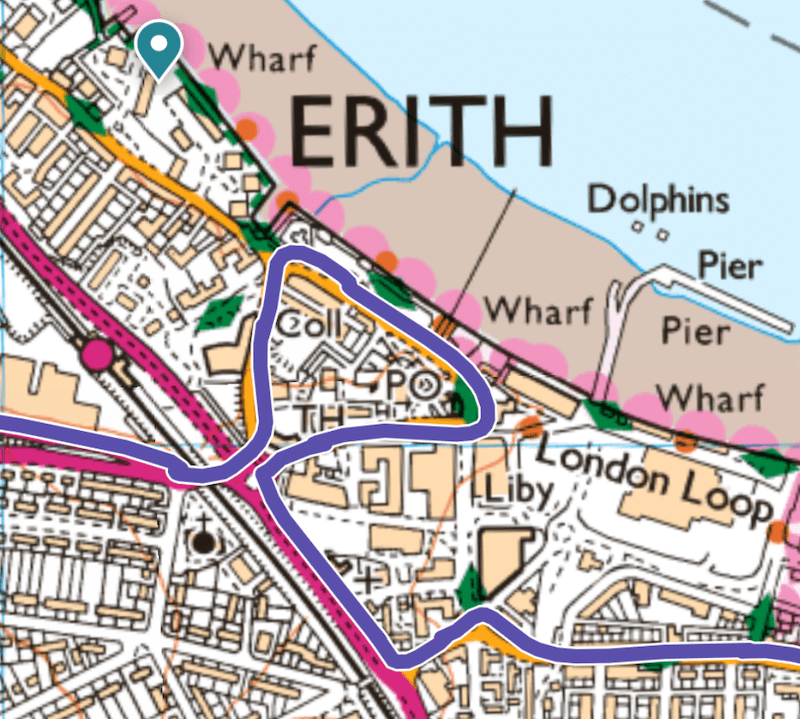
Not surprisingly, as I found on my sample journey, the bus emptied out when we arrived from Woolwich in Erith town centre, only for a fresh intake of passengers as we headed south to Slade Green including the loop around to serve either side of the station before heading westwards to Bexleyheath.
But, let’s begin at the western end of the route at the terminus in Woolwich, which as you can see is in the shadows of the towns relatively recently built tower blocks of flats in the High Street, albeit the retail offer at that location is not what one might expect from a traditional High Street.
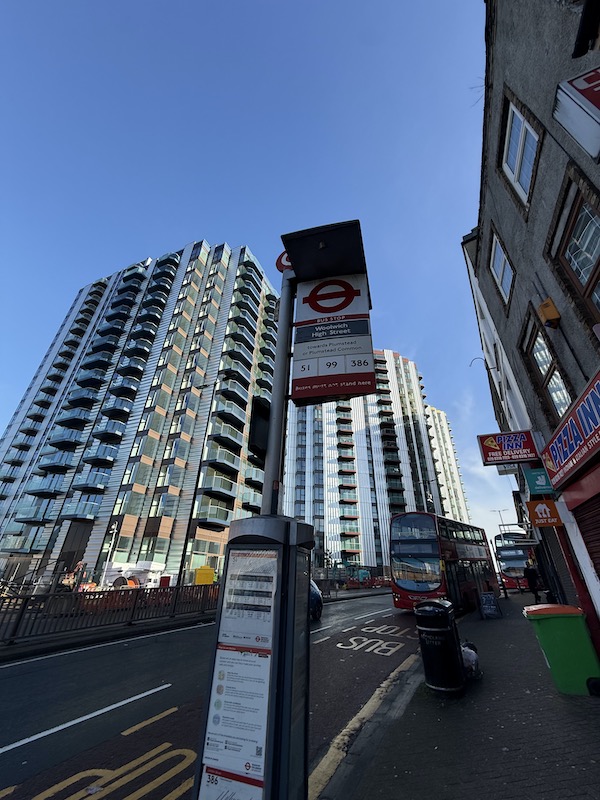
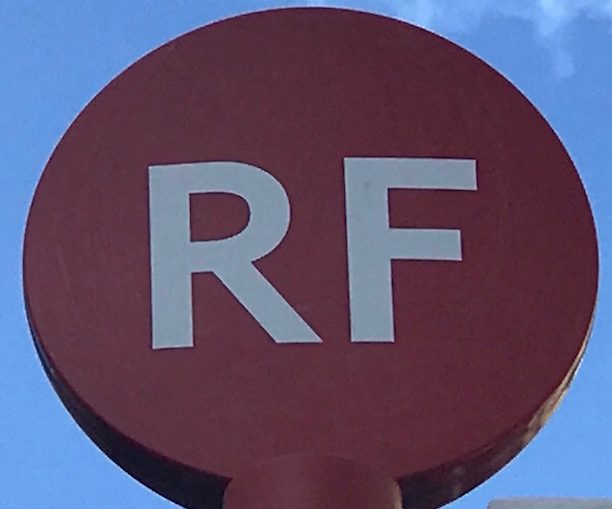
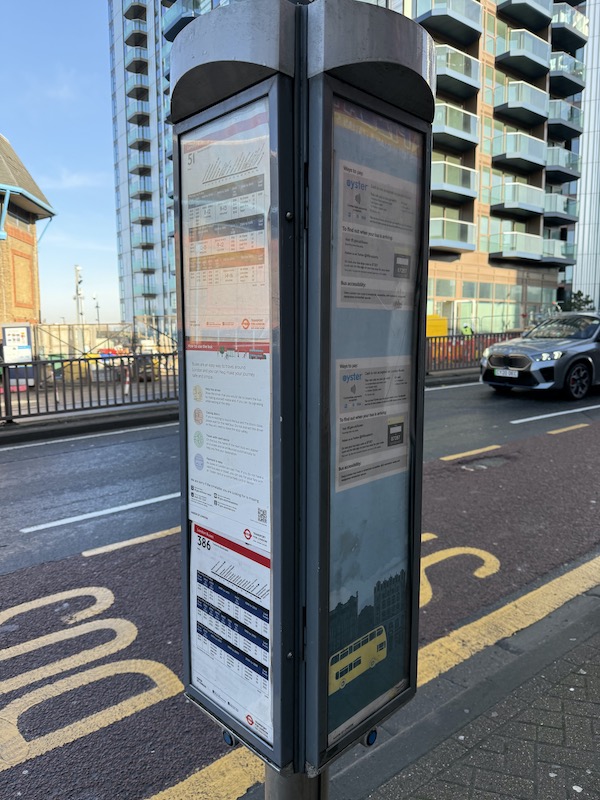
As indicated by the bus stop flag photographed above, route 99 shares the first bus stop with two other High Street terminating routes – the 51 and 386. Suffice to say while timetables outlining departures were in place for those two routes, for my route 99, there was nothing. Even though, as you can see (below) there is plenty of room, such is the demise of decent information standards from TfL these days.
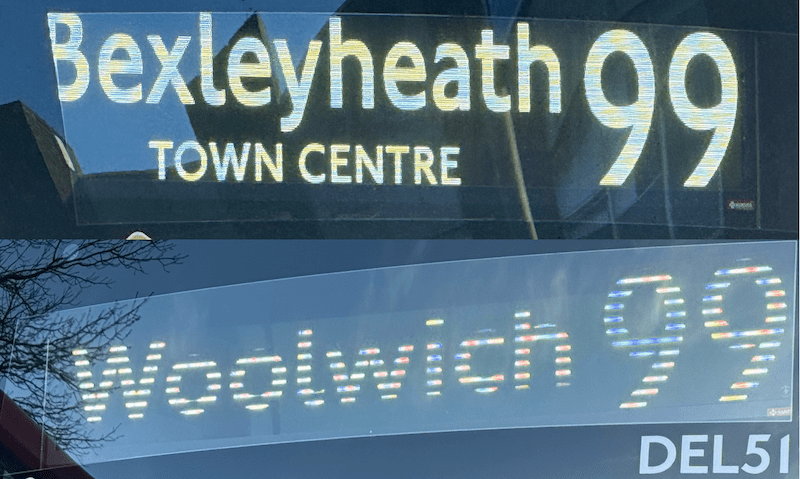
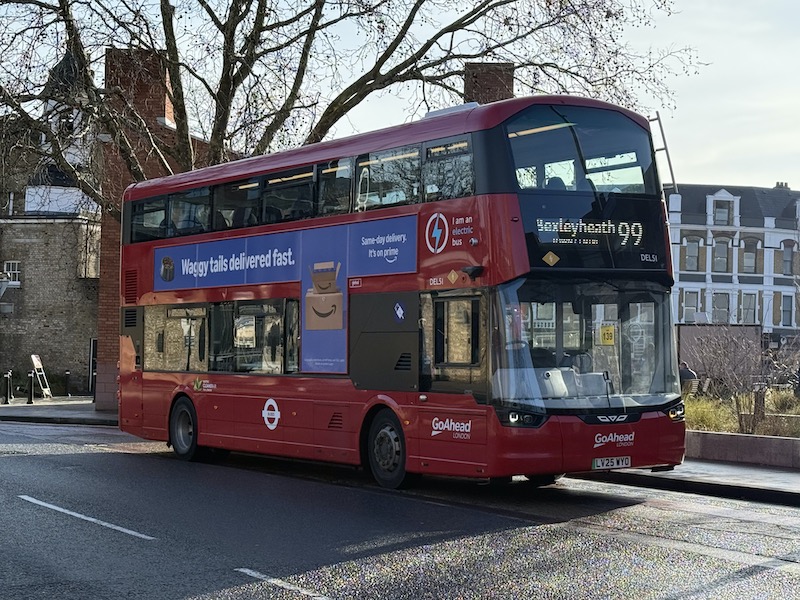
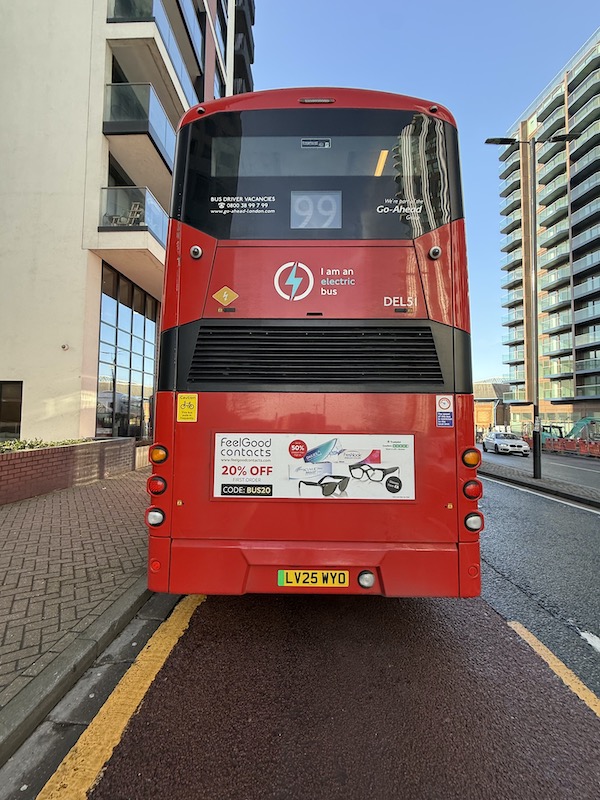
Buses on the three routes take advantage of a short bus stand layby just east of the bus stop and I patiently waited for the smart new Go-Ahead London Wright StreetDeck Electroliner with 99 Bexleyheath screened up to power up and glide the few yards down to the bus stop and pick me up.
But the omens were not looking good. The bus was due away at 11:36 but I could see the driver having intense discussions on his mobile phone and every so often wandering to the back of the bus to look at the nearside tyre. Buses on route 51 came and went on their long trek south to Orpington, even a bus on the 20 minutely route 386 headed off to Blackheath, but still the 99 was showing no sign of life.
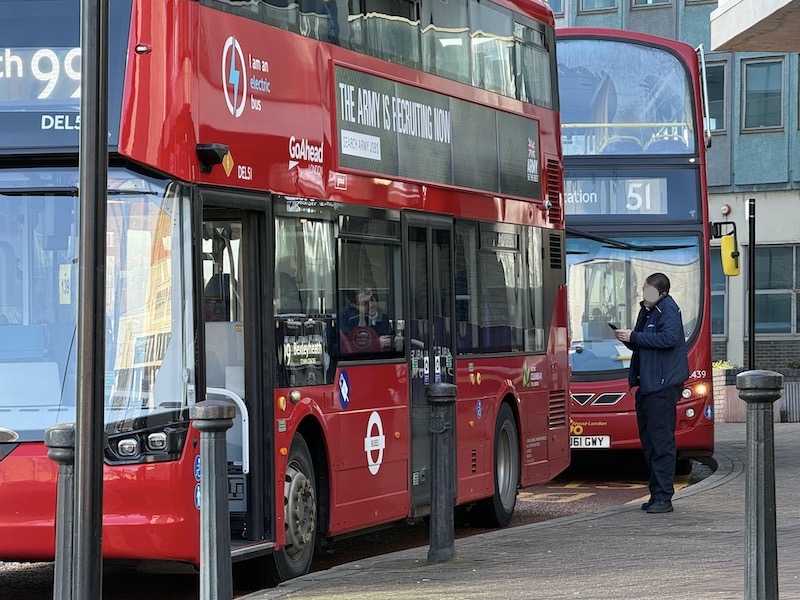
Every so often I’d wander up to see what the driver was up to and whether the next bus had arrived. It was particularly frustrating as I’d just missed the previous departure at 11:23 and the time was now 11:49 when the next bus after the 11:36 should have been leaving – the frequency being a clunky every 13 minutes at this time of the day.
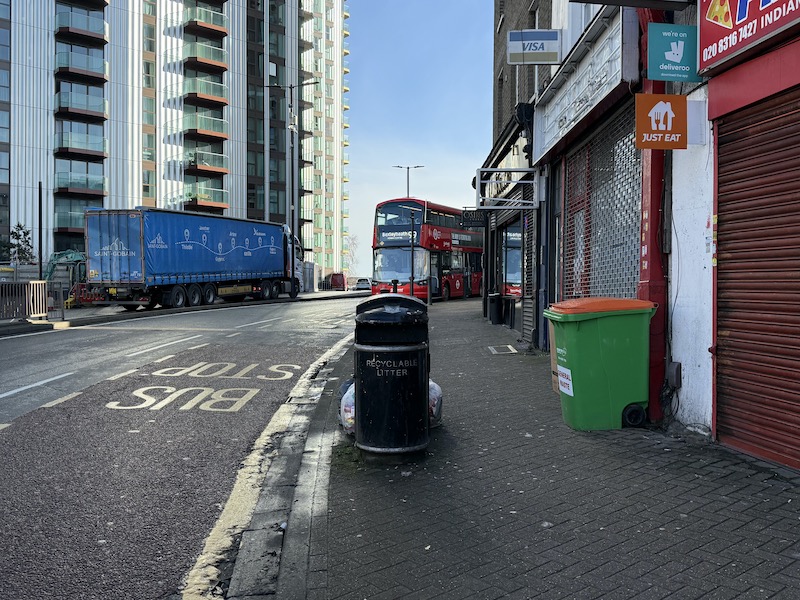
Finally, at 11:51 with mobile phone call completed, the driver jumped in the cab, and came on down to the bus stop where it was still just myself waiting to board. I asked if there’d been a problem and he explained he’d had concerns about the rear nearside tyre but had received reassurance from the depot it was safe to proceed.
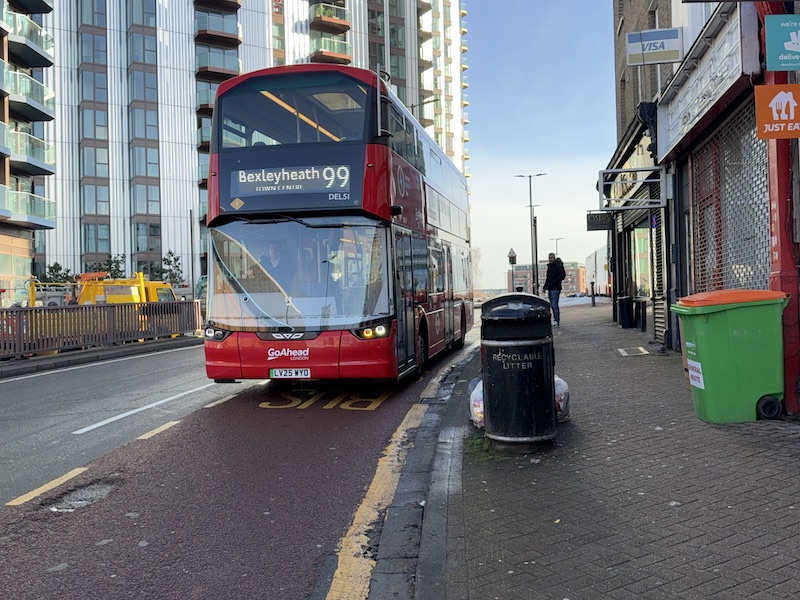
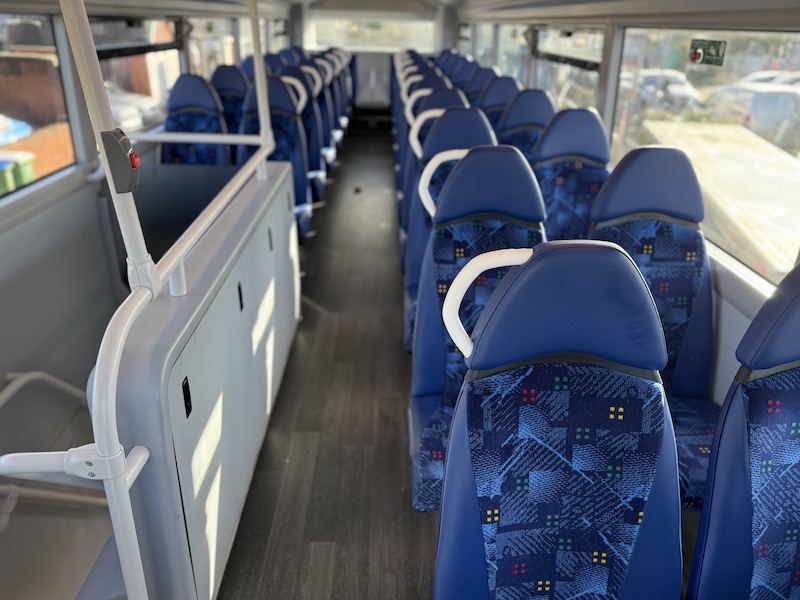
Route 99 is operated out of Go-Ahead’s long standing former London Transport bus garage in Bexleyheath and has 14 buses allocated to provide the route length of 10 miles with a 13 minute frequency (15 minutes at the weekends). The Electroliner buses are a recent introduction to the service and have higher backed seats as is becoming standard in London these days…
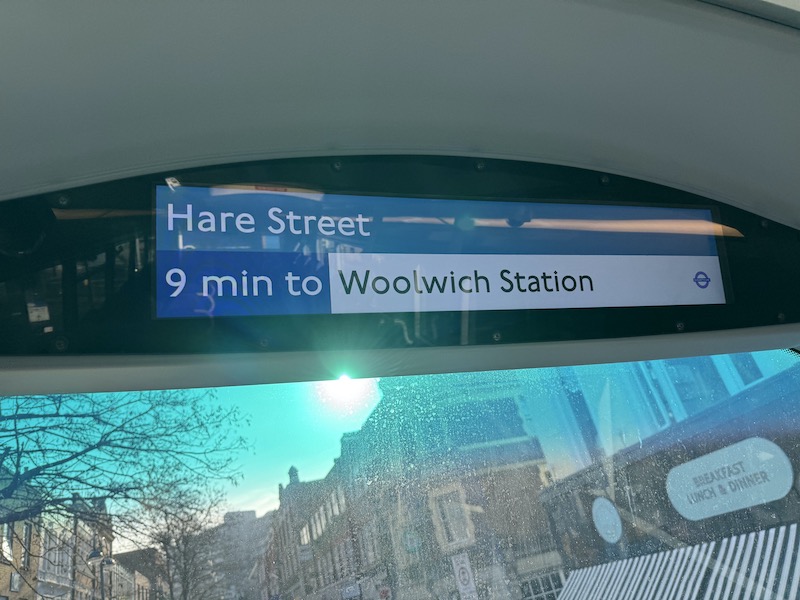
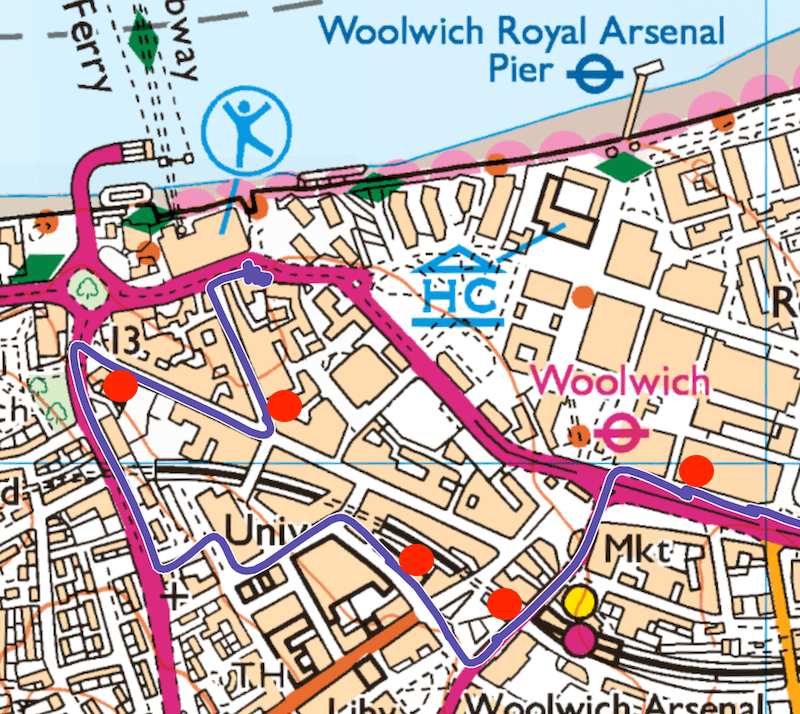
… and much improved information displays including predictive journey times, which as you can see a convoluted routing around Woolwich town centre gives a nine minute journey time to reach one of the town’s many stations (this one called simply Woolwich being on the Elizabeth line). It would take less than that to walk it along High Street.
Woolwich station is the fifth stop after leaving the High Street terminus, and not surprisingly by the time we reached there we’d picked up 32 passengers – with one boarding at the first stop in Hare Street, nine at the third stop in Thomas Street and 22 boarding at the fourth stop opposite Woolwich Arsenal Southeastern and DLR stations and six more at Woolwich station itself.
© Crown copyright 2026 Ordnance Survey Licence No AC0000873681
I must admit I’d expected it to be even busier seeing as how we were 15 minutes late and there’d been a 28 minute gap in the service.
There are many other bus routes which head eastwards from Woolwich towards neighbouring Plumstead. I counted 10 besides the 99 and passengers enjoy a bus a minute (62 buses per hour).
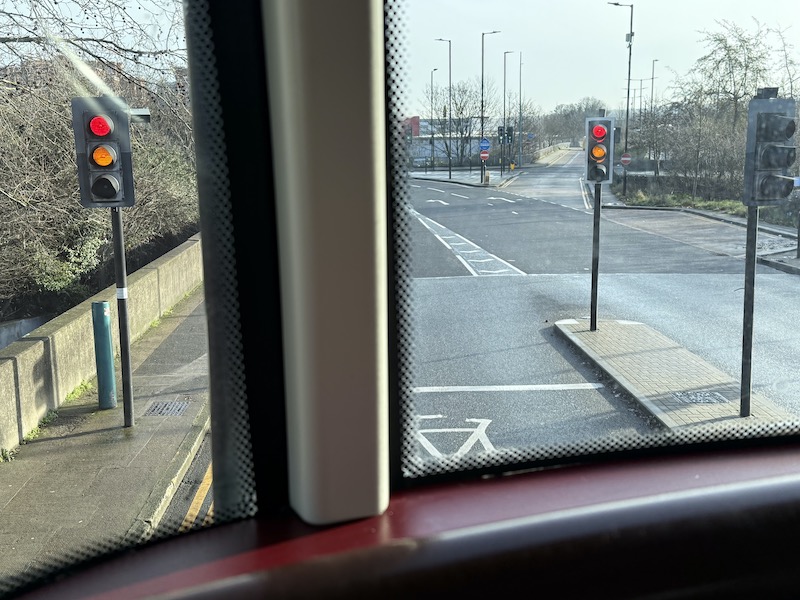
At the bus stop for Plumstead bus garage there’s a short stretch of bus only road with traffic lights enabling buses heading due east to cut across the two lanes of traffic and through another ‘bus only’ slip road as can be seen in the above photo, but frustratingly, as the bus enters the latter, the traffic signals that had been on green, turn to red as can be seen in the below photo, and the bus has to wait for turning traffic to pass across. Which all seemed a bit counter productive for bus priority.
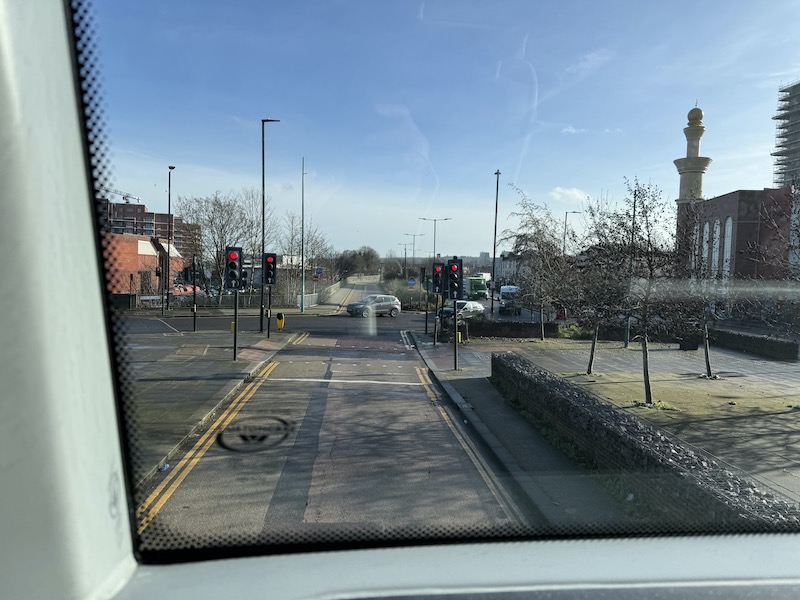
We then continued east along High Street which leads into Bostall Hill, in the photo below…
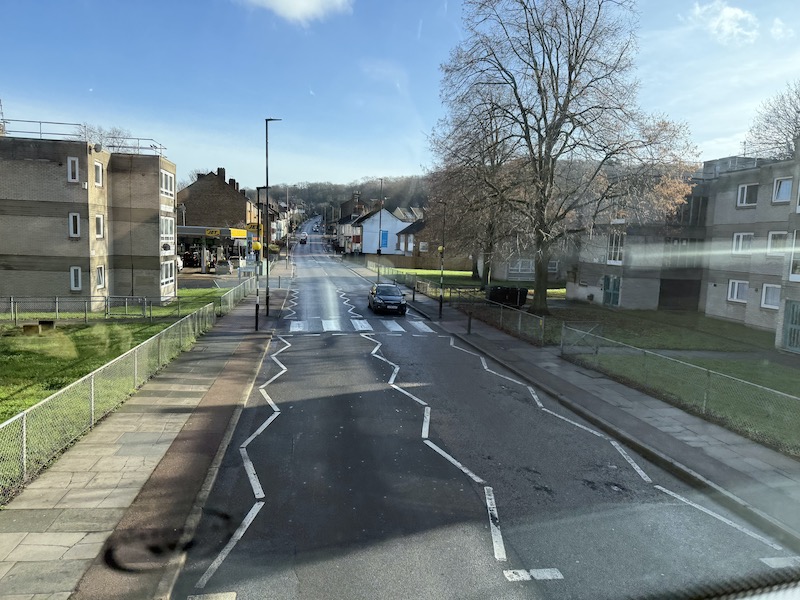
… which is the first section of route where the 99 is all alone
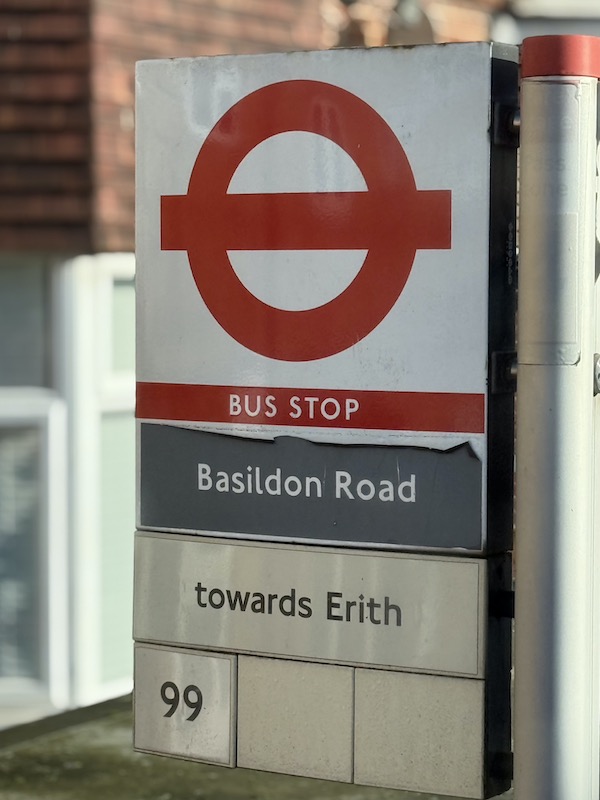
… and continues into a more green area approaching Upper Belvedere…
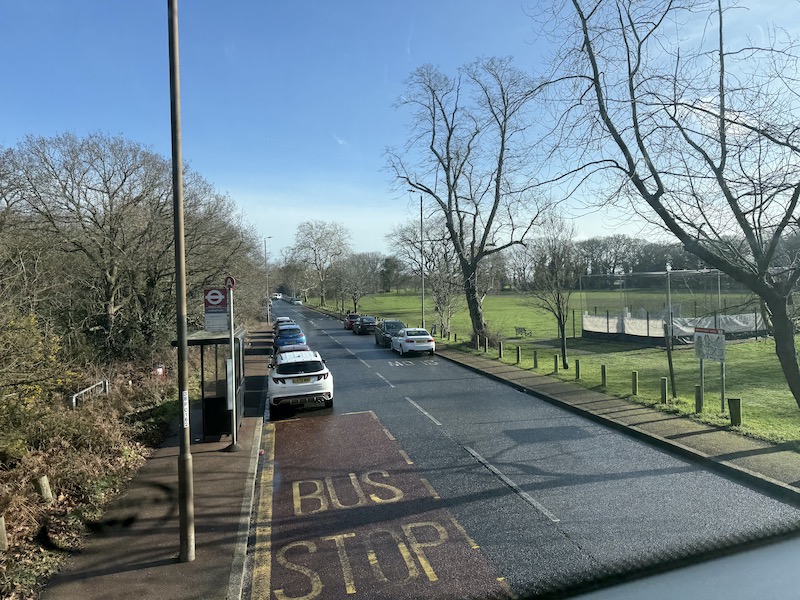
… where for a brief distance we’re joined by route 469 as well as route 401 which crosses our path on its way from Bexleyheath to Thamesmead. No-one from here would catch a 99 to Bexleyheath since the 401 would take you directly there in 10 minutes whereas our route via Erith and Slade Green will take 36 minutes.
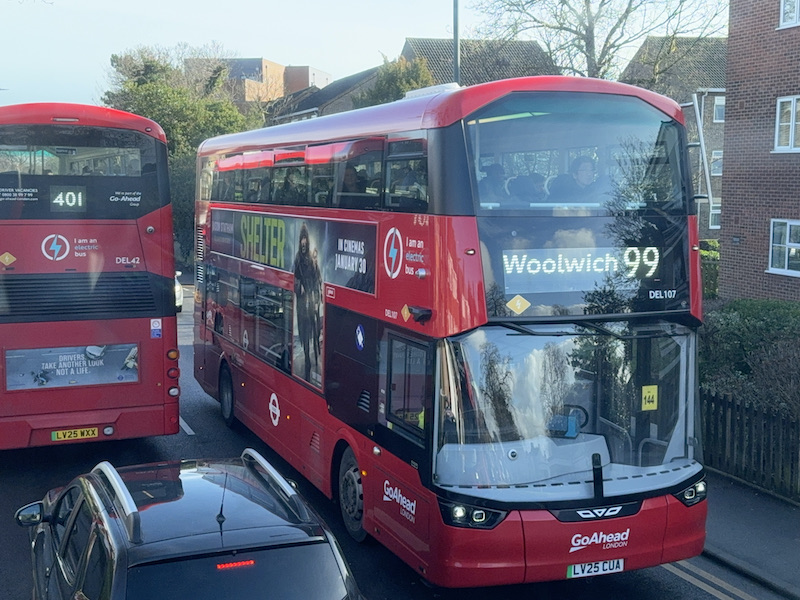
But we’re popular with Erith bound passengers as we continue our easterly trajectory as we’re back on our own again along Erith Road…
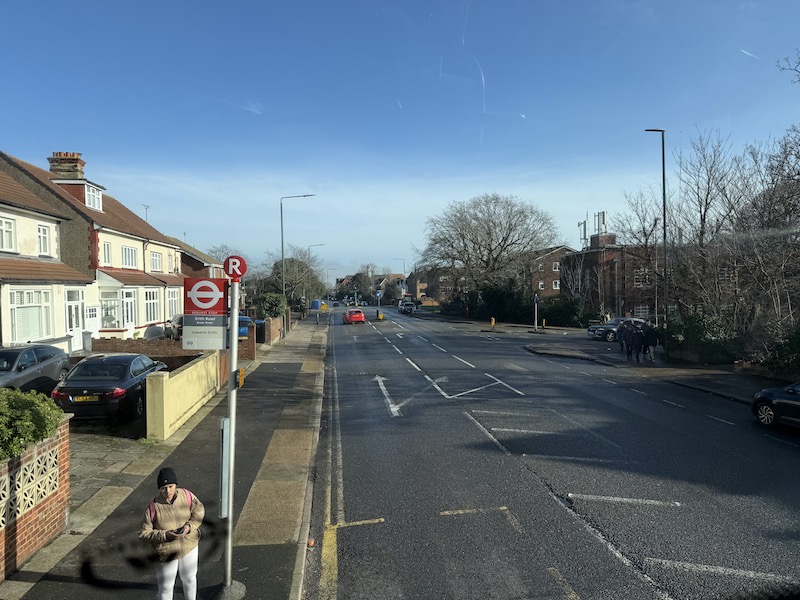
… and Fraser Road where buses on route 180 join in the fun to serve a new housing development to the west of Erith town centre and we cross over the railway and after a circuit of Erith’s town centre itself…
© Crown copyright 2026 Ordnance Survey Licence No AC0000873681
… we arrive at the main bus stop…
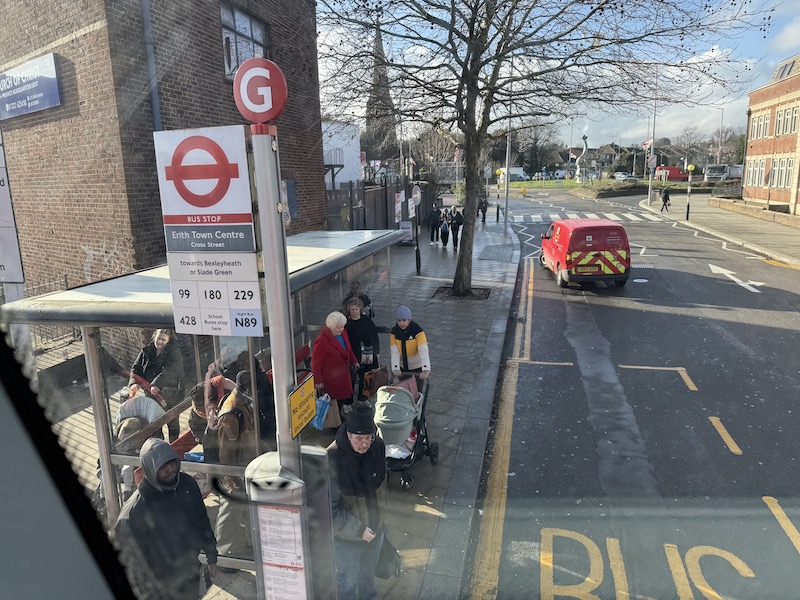
… where everyone except me alights and eight new passengers join. It’s now 12:31 and we’ve clawed back four minutes being now only 11 minutes behind time after our delayed start.
Since Woolwich we’ve picked up 23 more passengers at 11 bus stops and the many buses we’ve passed towards Woolwich have carried around a dozen or so passengers.
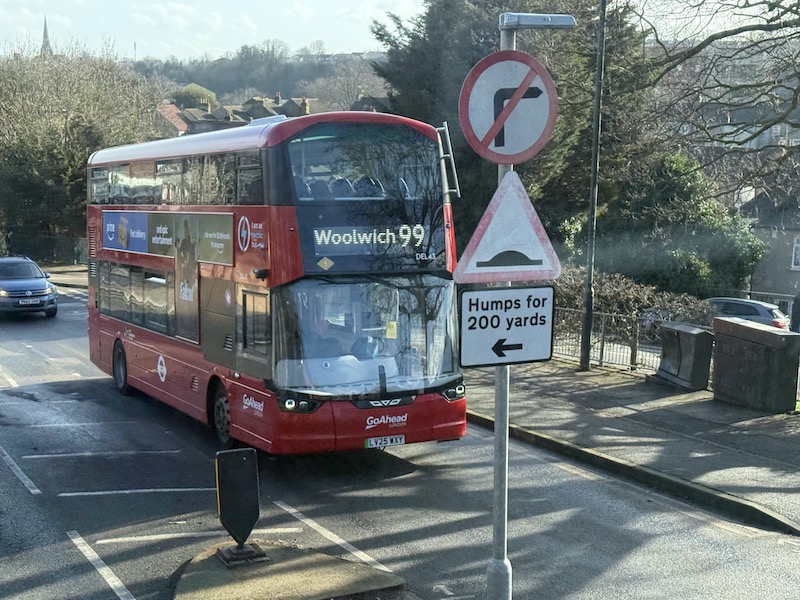
We’re now heading towards Slade Green and there’s a distinct change in the ambiance as lampposts are all adorned with flags…
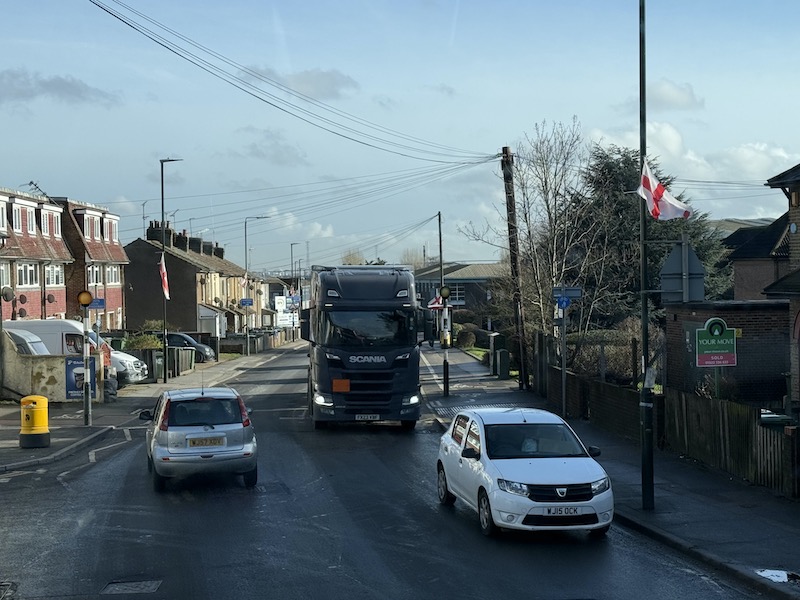
… and on street parking makes for a challenging drive along narrow residential roads…
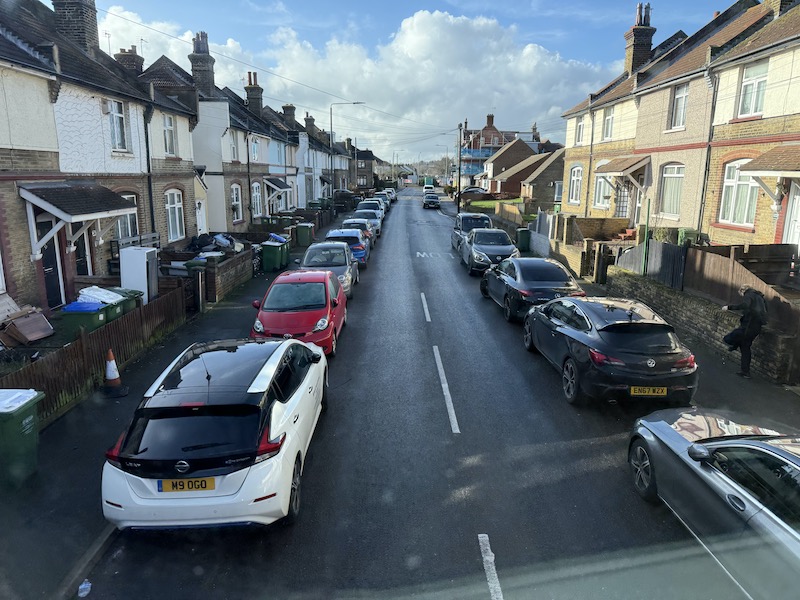
… until we reach the eastern entrance to the station before heading over the railway…
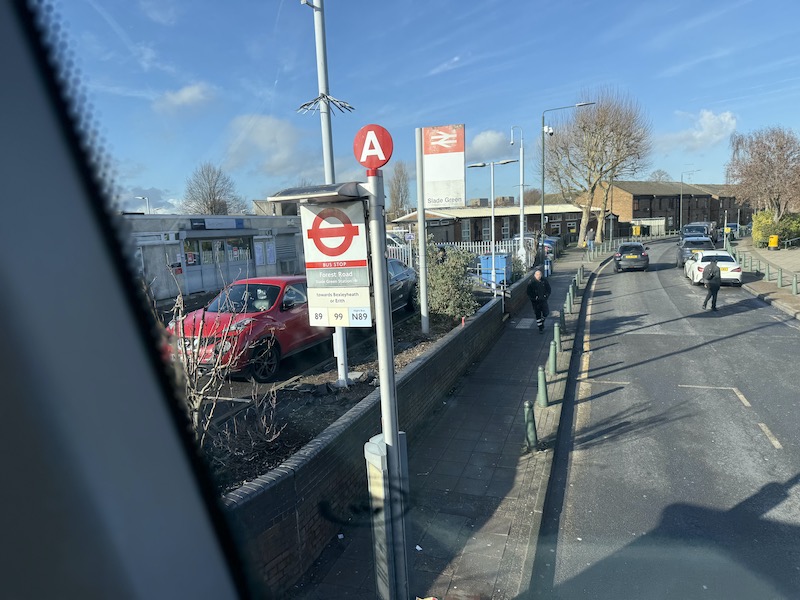
… through a rather tricky narrow corner…
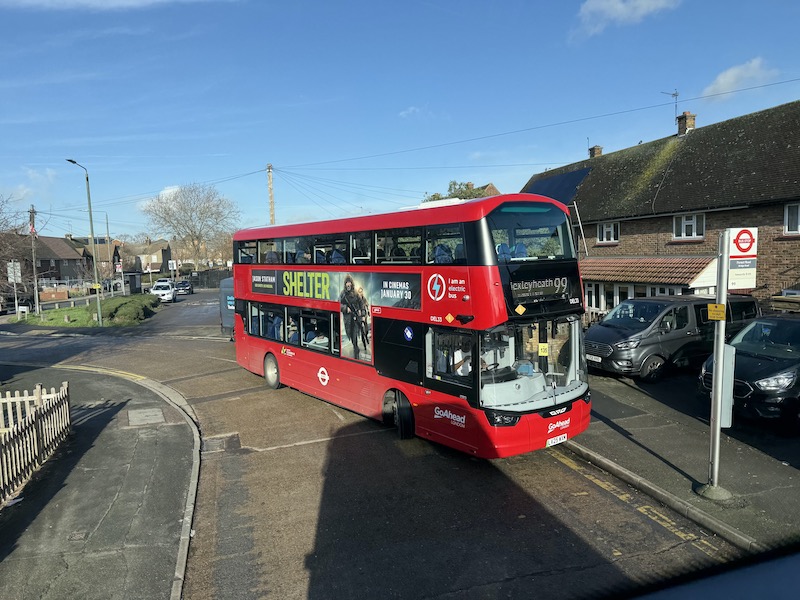
… which involved mounting the kerb, so good job our rear tyre was pronounced fit for the road…
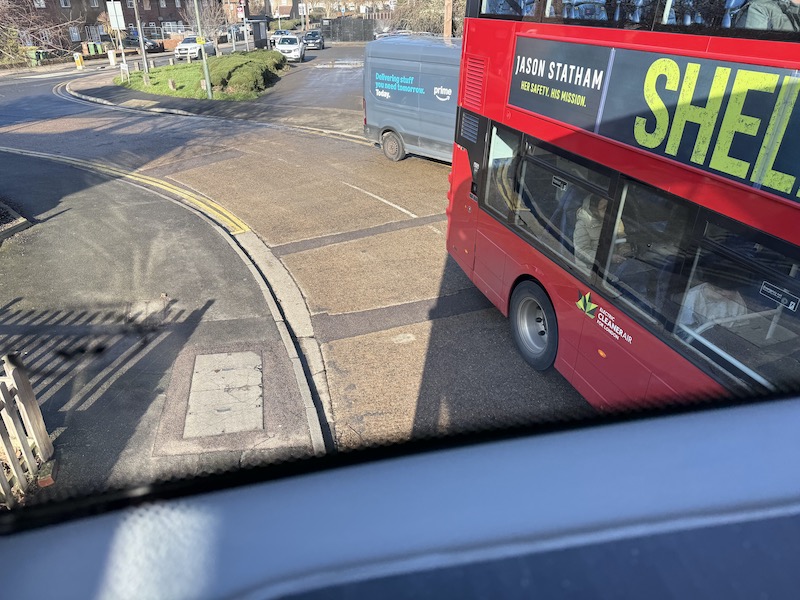
…before reaching the western entrance to the station on the other side of the tracks, three minutes later.
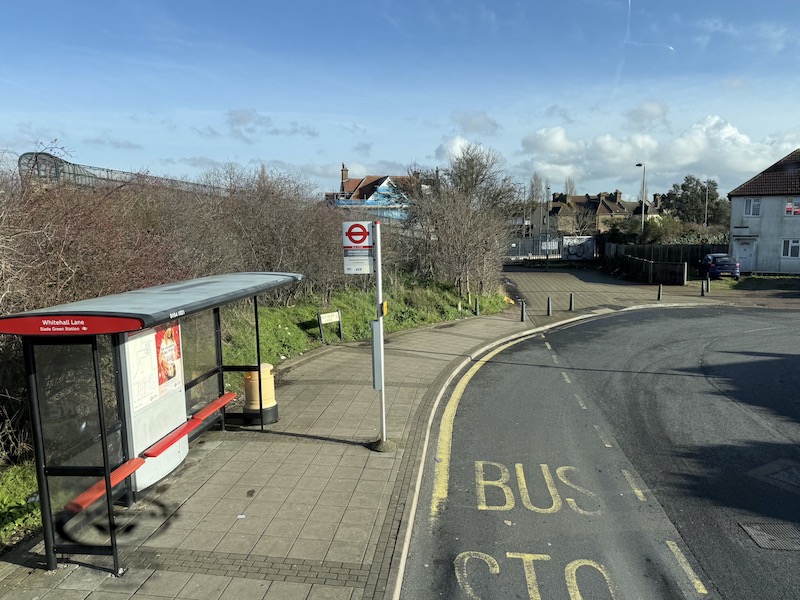
It makes for another interesting squiggle of a route.
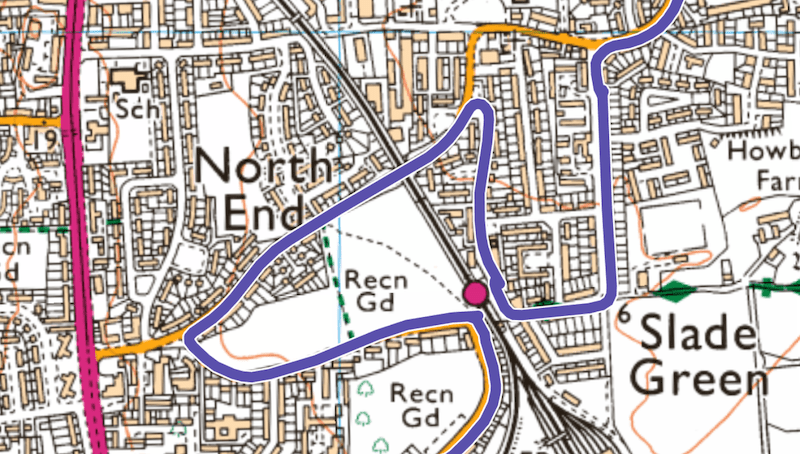
© Crown copyright 2026 Ordnance Survey Licence No AC0000873681
After that came more challenging driving along roads with width restricting on street parking as we’re briefly joined by buses on route 428…
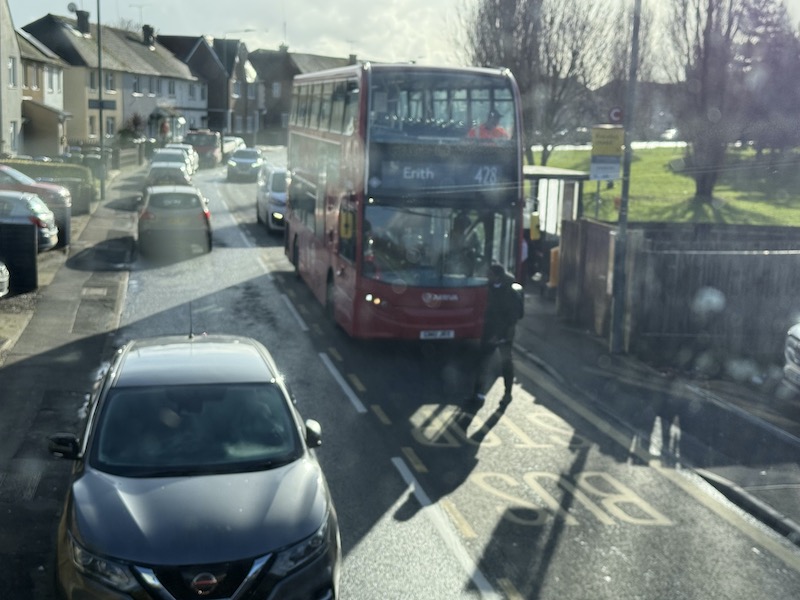
… before, heading west and we’re in the home straight literally – along Northall Road towards Bexleyheath.
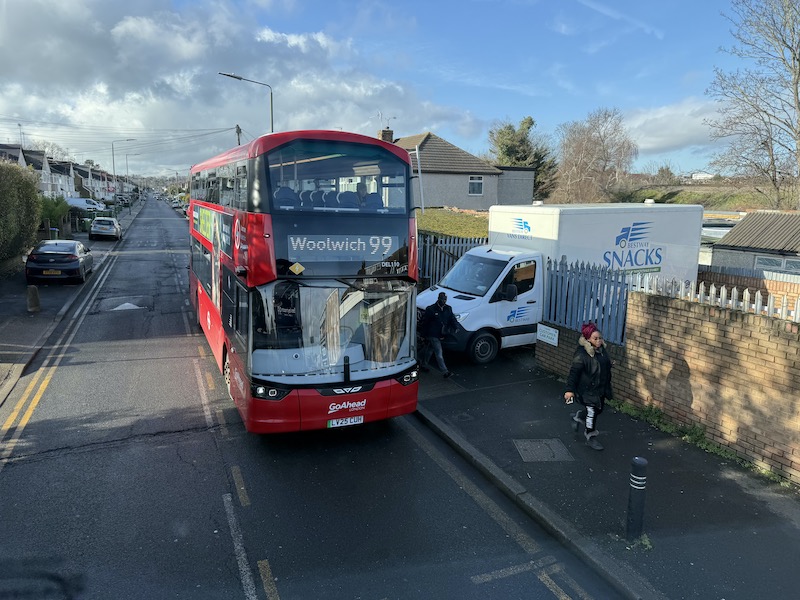
And it’s not long before the setting down point for terminating buses in Bexleyheath town centre comes into view and the 13 passengers who’ve joined us since Erith alight, as do I.
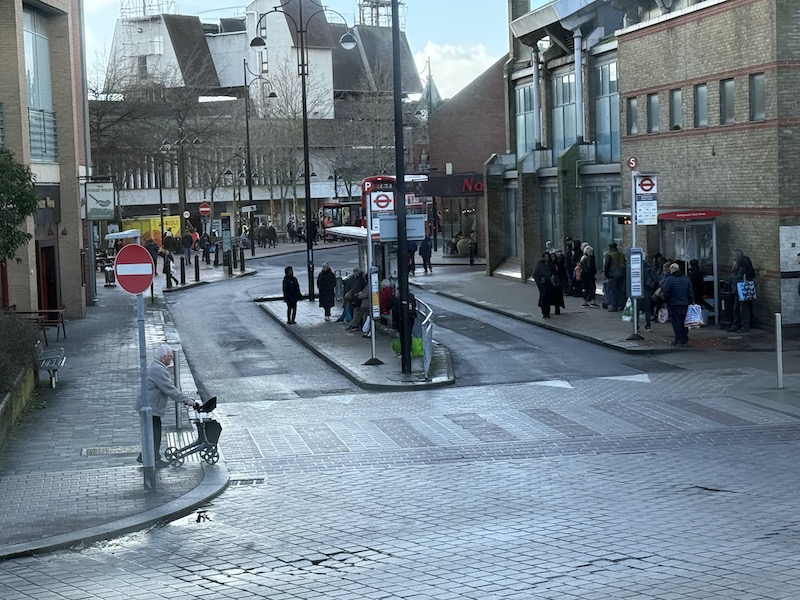
It’s now 12:58, and taken us 67 minutes to complete the 10 mile journey making for an average speed of 9 mph. We were due to arrive at 12:49 and take 73 minutes meaning, despite carrying a double load, we managed to claw back six minutes of lateness having carried 83 passengers in total.
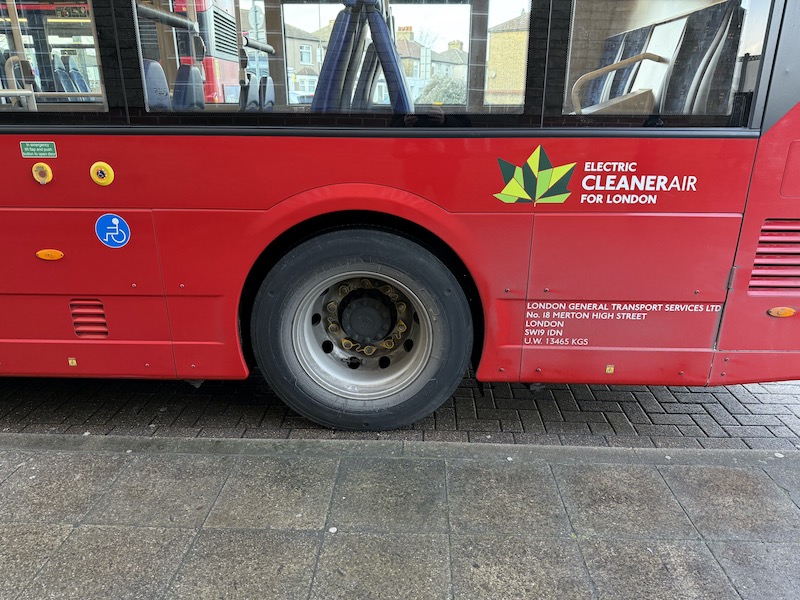
To greet us at the terminal point was a high-viz wearing member of the engineering team who presumably wanted to just take a look at the worrying tyre for himself, although I have to say, I didn’t spot anything obviously wrong either.
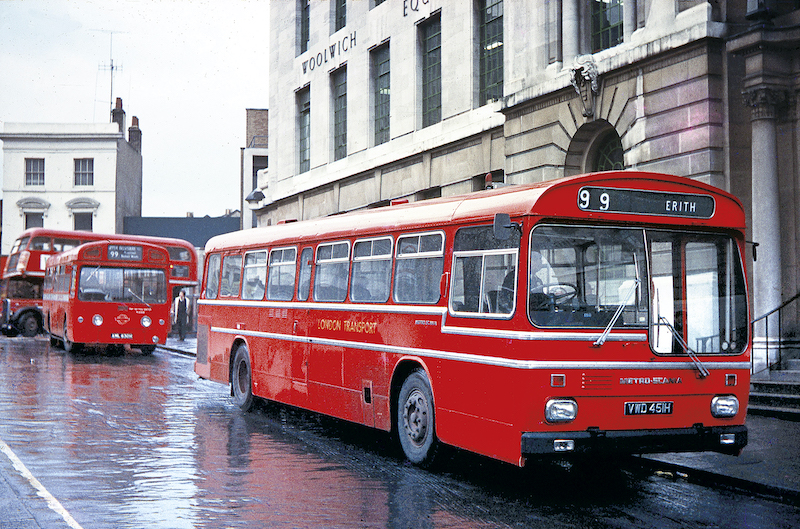
And that’s London’s route 99. But finally, for nostalgia, here’s a photo of one of the more unusual vehicle types, a single deck Metro Scania prototype, that operated for a trial on the service in April 1970 reproduced here with many thanks to Martin Curtis.
Roger French
Did you catch the previous blog in this series? 1 of 25 Eastbourne-Hastings, 2 of 25 Petworth-Chichester.
Blogging timetable: 06:00 TThS
 BusAndTrainUser
I guess the time clawback was due to it being half term. Buses on many routes mid peaks have been dawdling at stops and a slow trundle betwixt them. However in some south west London areas Thames Water seem determined to bring out the single file traffic lights making for delay and curtailment which is very noticeable once the schools return. Not London Buses fault for the latter but I don’t know why some routes don’t have a holiday schedule with speeded up running times of about 4 to five mins faster per 10 route miles.
JBC Prestatyn
LikeLike
Many routes do indeed have school holiday schedules with reduced running times, but it only works if the reduction doesn’t result in stand capacities being exceeded. You often need to achieve a sufficient running time reduction to enable a bus to be saved in order for it to work.
LikeLike
murky dephs blog of course the main correspondent of South East London happenings .Woolwich once dominated by the Arsenal for the army with stables horses field artillery and ballistics testing as an employer giving rise to the cooperative society that dominated the effective high street ( i think the main shopping street was Powis Street ) and built many of the nearby housing. Now an area transitioning to the modern mansion block of work from home laptop living
LikeLike
The 99 number is 110 years old this year having first started in 1916 operated by Athol Street (Poplar) garage no doubt for the benefit of munition workers at Woolwich Arsenal operating between Poplar and Crayford. LGOC opened a garage at Crayford in 1917 for the service. Suspended in 1919 it was reintroduced in 1920 operated by Plumstead (AM) with Crayford reopening in 1921. The service was extended to Dartford in 1924 but in 1925 it was split to operate with double decks from Woolwich to Erith from AM and single decks between Erith and Dartford from Crayford. Crayford garage was transferred to East Surrey in 1931 along with single deck section of the 99. My late mother recalled using the 99 from Bostall Hill to Woolwich to attend the Woolwich Polytechnic next to Earl of Chatham terminus. I can confirm that the main shopping street was Powis Street and the Royal Arsenal Cooperative Society (RACS) was a major landowner in the area.
LikeLike
Your comments on the lack of bus-stop information are depressing – when TfL have a free (unless someone drives into the stop and pushes it over) advertising location.
I know there are places in England for which a bus every 13 minutes would be a remote dream, but I don’t think that is going to attract many car drivers (and reduce the on-street parking, general congestion and bad air-quality). The badly set-up bus-priority doesn’t help either. For me, the minimum frequency for turn-up-and-go is 8-per-hour: I think most people are prepared to wait 7 minutes if they turn up and just miss a bus/train. People would also be much more ready to undertake journeys involving a change – having to wait 13 minutes for the first bus and then another 13 minutes for the second bus is a real put-off. And before I get the shouts of ‘but it will all cost too much’, this would enable some duplication to be cut out. 60 buses an hour is not necessary – even though I expect it is much more likely to be 6 buses every 10 minutes!
Looking forward to your next ‘route 99’
LikeLike
The average wait time is 50% of the service frequency, so for a service that runs every 12 minutes the AWT is 6 minutes.
LikeLiked by 1 person
As a colleague once asked of those propagating such a figure, what’s the cut off point? There isn’t one, he was told, and then asked whether they really believed people would be waiting 3.5 days for some of our once-a-week routes.
LikeLike
When I used to catch the 227 between Chislehurst and Bickley station (a good few years ago now), I always worked on the presumption that the likely wait was twice the advertised headway. I rarely managed better.
LikeLike
I did consider if 99 needed increase of service but it seems there are only a few bits where the route is unique to its roads or prime destination at any one point. I think 13 mins works out a 4 and a large bit of buses per hour , 12 min would make it 5 which in practice is probably the real service pattern with no one really seeing a bus go by then going back to stop 13mins later fir the next one. 13 min allows fir a bit of late running g to a 15min gap which is acceptable on this route.. I cannot see much trip generation occurring here with an uplift to 10min or 8min frequency with some of the links covered by a not very accessible rail network where investment in disabled access and increase train frequency may be batter
JBC Prestatyn
LikeLike
This blog takes my mind back to 1985 when Capitalcard was launched and I was able to explore the southeastern quarter of London easily for the first time living in Hersham. The One Day version was not introduced until the following year so I took several seven-day holidays from my work at Runnymede Council’s Treasurer’s Department to “do” this southeastern quarter of London using 7-day Capitalcard tickets. Sidcup had a Bus Garage and in 1988 the whole area became “blue” with Bexleybus hitting the road. This was a mix of great fun and incompetence. Minibuses having fleet number applied with black spirit marker, Routes 422 and 492 quickly being hived off to Boroline Maidstone – third hand London “LS” vehicles some sporting the Eastbourne livery traversing roads a long way from the salty sea; third hand “DMS” returning south from Glasgow. Driving for Bexleybus was for a short time an Honorary position – payroll grievously out of its depth with drivers being unpaid for long periods of time. To “prove” a Route I would need to deliberately break my journey and on Route 99 I did this at The Eardley Arms in the days long before my frequenting the estate chaired by Sir Tim Martin. My current laptop has its Pictures folder stuffed with gems from that era – Ipswich and Kingston upon Hull vehicles prominent and the early London tenders won by Kentish Bus. I needed to “double log” Kentish Bus rides – the KB&C Fleet Number and the vehicle’s original LCSE Fleet Number. Having logged rides on Falcon Buses by registration number since they took over from Abellio Surrey, I see that Falcon is introducing Fleet Numbers for the first time. Capitalcard days = Courage managed houses and Hoffmeister lager; now I sup at JDWs and it is BudLight.
As to Hazzard’s latest video mentioning Baker Street Station. He correctly states that the wartime Special Operations Executive was based nearby but not why it was there. London Transport had its Rifle Club shooting range within the bowels of the station, so where better to train agents in firearms use than here in the heart of London.
LikeLike
TfL could save a great deal of money if non- schoolday schedules were introduced across it’s bus network. There is nothing more frustrating as a bus passenger than being ‘regulated’ by remote official in a control room miles away from the route. Unfortunately the way the London bus tendering regime is run encourages this type of activity as operator bonuses are paid on evenness of gaps.The system needs a root and branch reform. The operators aren’t calling for it as it’s not in their financial interest. London Travel watch doesn’t have any teeth and London’s Assembly Members rarely ask the right questions. So it’s business as usual for TfL and no proper scrutiny. We need regime change but this would need a miracle for this to happen. Where London previously led others now lead. London’s bus network is now in terminal decline.
Martin W
LikeLiked by 1 person
Certainly agree with the sentiment, but with varying school holiday times, even under the same local authority, it can be quite difficult to implement. You also have rostering problems if vehicles are saved, but agree that the whole regime in London needs an overhaul. The only interest ALL parties (Operators and certainly TfL) have are “contract compliance”, passengers featuring some way down a long list of priorities. Substantial savings could be made by “tweaking” many schedules to avoid excessive layover times early morning and late night, and of course the idiocy of insisting all buses MUST travel end to end!
Even Mayor Burnham has stopped short on that one!
On a slightly brighter note, and I certainly restrict my journeys on TfL to an absolute minimum, I have noticed that Controllers appear to allow buses to run early during school holidays if ‘bustimes.org’ is accurate, although this can still mean needless slow running. And lest we forget, many services travel along 20mph restricted roads which is also a disincentive to prospective passengers.
Terence Uden
LikeLiked by 1 person
terrance I think you mean all buses are planned to run end to end. Curtailment in practice does occur and I think a couple of short school extras are in the schedules but is rare
JBC Prestatyn
LikeLike
@Martin W – “London’s bus network is now in terminal decline”? Oh come off it!
In the year 2024/25 (April 2024 to March 2025), London’s buses carried more than 1.8 billion passengers. While that may be quite a bit lower than the peak in 2013/14, it is nevertheless more than were being carried in any year through the 1970s, 1980s or 1990s. Passenger numbers fell below 1.8 billion in 1969, the next year that more than 1.8 billion were carried was 2004/05. The low point was in 1982, with 1.04 billion carried.
Miles operated tells a not dissimilar story. In 2024/25, London’s buses operated 283 million miles. That is higher than in any year between 1968 and 2002/03 inclusive. The low point was 1983, with 164 million miles operated.
So, last year, London’s buses carried 75% more passengers, and operated 73% more miles, than in the low points in the 1980s. Over the same period of time, across the rest of England, bus miles operated have fallen by 19%, while passengers carried have fallen by 49%.
@Terence Uden – it is untrue to claim TfL’s only interest is in contract compliance, or that passengers’ interests are “some way down the list”.
Take a look at the Scorecard in TfL’s Annual Report and Statement of Accounts 2024/25 – it is on page 14. The Scorecard shows the key performance metrics against which TfL’s performance is measured. You will note a target for customer journey time on buses.
If my understanding is correct, this includes the time spent waiting for a bus as well as the time spent on board, worked out as an overall average. With that measure, TfL has an incentive to reduce waiting time and/or on-board journey time.
Malc M
LikeLike
the big changes to passenger numbers beyond an expanded network as development in East London particularly has occurred is the free zip fares for kids making bus a chooseable option rather than walk, and oyster where a one or two stop bus on a season ticket or daily price cap is at nil marginal cost to passenger and also nil marginal revenue to LT
JBC Prestatyn
LikeLike
If TfL put Passengers before “contract compliance”, why do we have to suffer the ridiculous situation of buses “waiting time” just one stop and sometimes within sight of their terminus?
Once a bus has passed its last timing point, as is normal outside hallowed TfL land, it matters not and to the Passengers advantage to arrive early.
Terence Uden
LikeLike
@Terence Uden – what you describe sounds like a decision on service regulation by the operators, rather than any instruction from TfL.
What you describe does remind me of the “good old days” of London Transport, when a bus might wait several minutes one stop short of a terminus or a crew change point, or dawdle excessively on approach, so that the driver would not get clocked by an inspector for running early.
Malc M
LikeLike
Yes……complying with the strictures of the TfL contract to avoid penalties!
Terence Uden
LikeLike
@Terence Uden – I don’t believe there is any truth in what you claim.
That said, if you can show me the clause in the contracts that TfL will penalise operators if they don’t hold buses at the penultimate stop, I will happily stand corrected.
Over to you…
Malc M
LikeLike
Or so that they would reach the crew change point 8 minutes late not 7 minutes late and then get a ‘docket’ for overtime (overtime was rounded up or down to the nearest quarter hour, so no bus ever arrived 7 (or 22) minutes late at the change-over point…)
In the days before GPS, there was usually somewhere a bus could hide for a few minutes (the south side of the Catford one way system was a favourite, out of sight of the Rushey Green inspector…)
Catford Cat
LikeLike
The houses on the east side of the railway at Slade Green are Railway Workers’ houses, built for staff at the then-new Slade Green Depot which opened in 1899 to house steam locomotives – it was converted for electric traction in 1926. The houses were remarkable for having electric lighting, which was unheard of in working-class housing at the time.
Julian Walker
LikeLiked by 1 person
To be strictly accurate, it was Slades Green when it opened, the second s disappearing in 1953.
LikeLike
The picture of the MS reminded me that the 99 was one of a handful (122, 122A and 291, later 192 being the others) that gained MDs when they first escaped from the PM/NX stronghold where they ousted everything else at the old Plumstead (AM) garage. I heard that the garage liked them and had the impression that they looked after them and ran them well and properly. Pity the ‘reward’ was that the garage closed. I never had the same impression about PD.
LikeLiked by 1 person
Nice comments Michael, particularly concerning the staff’s experience with the Metropolitan.
Although I never personally travelled on one I recall seeing the MD class in service when travelling regularly in SE London during 1978/9.
I always thought the metal trim around the waistline looked crude & of course when the M class appeared, MCW saw fit to leave this off. I also remember driving past the old Plumstead garage which always struck me as being somewhat antiquated in appearance when compared with other bus garages in SE London.
LikeLiked by 1 person
The closure of the old Plumstead (AM) garage was a result of the development of Thamesmead, a town of around 40,000 residents being built on reclaimed marshland. Thamesmead would need new bus services to be introduced, and the existing garages at Plumstead and Abbey Wood lacked the capacity which would be needed. Hence the new garage being built at Plumstead (PD), now operated by Stagecoach.
From my own observations, I got the impression that the MD-class Metropolitans seemed better looked-after at Plumstead than they had been at Peckham or New Cross.
Malc M
LikeLike
TfL is under financial pressure with Bus, Undergrounds and DLR having fewer passengers
LikeLike
TfL under financial pressure – I should say so. Bus network patronage fell again by 1.5% (now to 2013 figures) and is being propped up by the tube which actually increased patronage by 3%
LikeLike
I would like to see specific route data. In bits of central London walking is quicker , zone2 is strangled by road narrowing and cycles.
JBC Prestatyn
LikeLike
@JBC Prestatyn – route specific data is available on TfL’s website: Buses performance data – Transport for London. If you download the “Bus service usage…” file you will find, for each route, the number of passengers carried and kms operated for each year going back as far as 2010.
Malc M
LikeLike
I know you’re only quoting recorded data but I don’t understand why these reports refer to Km rather than miles. The U.K. went metric in 1970 yet Km was never adopted & is still not officially recognised when referring to distances travelled by road or rail. Hence why to this day, all road signage & vehicle speed readings are shown in mileage terms. An anomaly of course, but remember, there was a backlash to these changes in the late 1960s when certain politicians were preparing the ground for our entry into Europe (using the term ‘Common Market’ as a disguise). Thankfully, we also managed to hold on to the pint, literally. Cheers! 🍻
LikeLike
Tube passenger numbers are still well down although there has been some post covid recovery
LikeLike
Can we even compare 2019 tube ridership with today’s tube ridership fairly?
In 2019, I used the tube because I had no other option, now I mainly pick the Elizabeth Line and with it, the Overground and DLR as it’s more convenient for the journeys I take. Elizabeth Line even when it’s packed is much more pleasant to ride than the tube, because of the space in trains and in stations. Quieter and cooler too.
If anything, you’d expect at least the Central and Jubilee Lines to see lower ridership because of the extra capacity offered by the Elizabeth Line.
Aaron
LikeLike
I would like to see statistics but both tube lines are bearing up well for passenger numbers with central line peak eastbound being full at stratford where Leyton and beyond passengers try to fit on tubes . I suspect there may be a small drop in passengers on h and c padd to liv Street
JBC Prestatyn
LikeLike
The 99 extension from Erith to Bexleyheath replaced the 469 which had previously covered the route.
I think I have a Bexleybus uniform tie that was donated to a charity shop in Woolwich during the time I was volunteering in the shop. As we joked about the tartan pattern seats, the assistant manager gave me the tie as a memento.
You chose a good day to travel as during the week both 99 & 180 were diverted away from Fraser Road up to Christchurch Erith but the railway bridge.
LikeLike
Tartan patterned seats on Bexleybus DMS vehicles would reflect their earlier use in Glasgow. Glasgow altered the London style destination displays, but when they got to Bexleyheath Garage, the Glasgow style destination style was retained.
LikeLike
Thank you Malc M for standing up for London’s buses. Since I started using them every day since 1978 they have massively improved in terms of frequency, reach of routes, reliability and night service. Of course there are frustrations. Bus speeds are definitely an issue and the powers that be must do more about that. But my local rail feeder but route here in north London makes it possible to live comfortably without a car which should be the goal of all urban transport authorities and local government.
LikeLike
I agree overall but cross-boundary routes continue to be a real frustration for me. I think South London generally has decent cross-boundary bus links from both TFL and Non-TFL, whereas North London continues to be very hit and miss. Especially in the Lea Valley, a long standing route like the 242 or 66 (formerly 250) should never have been cut off from the wider London bus network. I think Superloop has got a lot more right than wrong, but ensuring all neighbouring areas get a consistent level of bus service from Outer London is essential. The Crews Hill development will have to address this for places near Enfield to be a success.
And strongly agree with the last point, but in London’s case, that should extend to the commuter towns too. Otherwise, traffic will always be an issue.
I generally don’t get all the doomsayers on London buses but then I see the subsidy as no issue and all the concessions as a good thing. If they can get to a more nuanced policy on speed limits, I think they’ll be fine. That and sorting out the housing crisis which clearly dampens demand for London’s public transport.
Aaron
LikeLike
“I generally don’t get all the doomsayers on London buses but then I see the subsidy as no issue and all the concessions as a good thing. If they can get to a more nuanced policy on speed limits, I think they’ll be fine. That and sorting out the housing crisis which clearly dampens demand for London’s public transport.“
The problem is that it is increasingly unsustainable. All the positives that were created in the 2000s are now being reversed. Bus patronage increased in Great Britain by 1%… despite London falling by 1%. Since the high point in 2013/4 when 2.38bn journeys were recorded, passenger figures have fallen down to 2.19bn before Covid and are now 1.84bn – a figure last seen in 2006
London’s fall in patronage was despite c.£1.1bn in subsidy…a figure that has increased from £659m in 2016/7. Interest rates on existing loans have to be renegotiated in 2026 and at higher rates than they were originally secured.
So the doomsayers are being so because they can see that a system where farebox revenue is being massively outstripped by costs. There’s a bus network where road speeds have fallen massively so increasing PVR (increasing cost) or leading to resource cuts (meaning services are less attractive). We can see that the direction of travel is grim but some people are so ideologically blinded/economically illiterate that they refuse to acknowledge the financial realities.
To put it simply – fewer buses, fewer passengers, insufficient farebox revenue higher costs means increased siphoning of tube funds…and anyone who’s been on the tube recently can see standards are slipping.
BW2
LikeLike
I see a lot of structural issues with TFL and issues with policies being too inflexible, tunnelvision etc. Stuff like 20mph should be during business hours only for example, I’ve been on enough late and night buses stuck at 20 with no one else on the road, it is very silly.
I think the current tendering system is deeply fragmentary, causing a lot of waste like dead mileage and I don’t see how that can last. We’ll know for sure when other authorities with franchising arrangements who own their garages instead, perform any better or not. The future even in regions with enhanced partnerships is far more public intervention, in London that means less and less private operators and involvement over time in my view.
Routes with overlapping sections rather than fixed A to B makes sense to come back. Then lower demand areas could gain services.
Also that subsidy level needs to broken down, as the context matters more than the headline figure.
We need to be more like other countries where our cities and regions can raise and keep more of their funds too.
I think my issue with the general negativity around TFL is that these people seem to see buses in isolation, but they are part of a wider transport system and other issues in our lives and the economy, where we can afford to live, lack of public services and infrastructure etc. The lack of an overarching regional strategy and body (bigger than London). Tons of different issues that will affect buses and anything else.
Aaron
LikeLike
Aaron – did you actually read what was said?
The fundamental issue is that subsidy has almost doubled in less than 10 years yet bus patronage has fallen by almost 25% in that time. You can only go so long in treating the tube as a cash cow before the amount being extracted from there to prop up the bus network begins to adversely affect the tube.
Even TfL’s own reports indicate that total ridership across modes appears to have plateaued despite being lower than in 2019. Bus speeds have fallen and whilst you may suggest dynamic road speeds, the fact is that you are still going to have them during the day (0600 to 2000) and that’s directly impacting the peak vehicle requirement.
Talking about the tendering system, pan South East authorities are a) just an excuse for you to return to your usual tropes and b) are completely irrelevant in why some of us can see why the direction of travel and are pessimistic about the current and the future.
More local tax raising is pointless until the fundamental issues are addressed.
BW2
LikeLike
Because not a lot can change until we start treating London and the South East as one effective region. If policies don’t align with its true functional area, of course it will be expensive and wasteful. Our region is very fragmented and messy!
And with bus speeds, it seems to be a political leaning who blames bikes or cars. I would restrict the cars a lot more myself.
Aaron
LikeLike
Clearly Aaron, you didn’t read what I wrote. I didn’t mention cycling – I just cited that road speeds for London buses have got slower, which is an indisputable fact. Also indisputable is the impact on bus patronage and network costs.
A SE transport authority doesn’t solve any of the problems affecting London’s declining bus patronage…and THAT is a fact too.
BW2
LikeLike
It seems that Route 99 is currently running to a revised timetable due to the cycling works in Woolwich. It previously had a non-schoolday timetable in operation but this appears to have been suspended. I wonder if this is a case of the operator getting mitigation from TfL when the additional running time isn’t really needed. More profit for operators at the expense of running a passenger service ?
LikeLike
Thank you to Roger and several of the commenters for the review and recollections of one of my local routes growing up in the 1960s and 70s. It was a few pence cheaper for the family to travel from Upper Belvedere to Woolwich on the 99 instead of the 122A, even though the latter stopped nearer to our house!
Another feature of those times was the short workings form Woolwich that terminated at the Eardley arms in Upper Belvedere, which gave the sight of red Central and green Country buses (route 401/486) on the stand together, possibly one of the innermost places where this happened? I’m sure I travelled on the Metro Scania prototype during its trial operation.
Steven Saunders
LikeLiked by 1 person
TfL fares increases
The cost of a trip to Heathrow on the Elizabeth Line appears to be extortionate at £15.50
LikeLike
20mph seems reasonable for safety sake and should mean fewer bus incidents occurring as drivers have time to check their surroundings. However it can mean higher costs so more subsidy or passengers to pay more for a slower journey
JBC Prestatyn
LikeLike
I couldn’t disagree with you more JBC. We had 30mph speed limits in most urban areas in the U.K. for decades which were deemed safe in relation to the types of vehicles mainly using the roads during that time. What the so called ‘safety brigade’ have not taken into account is that during the last two decades vehicle braking systems have improved immeasurably leading in most cases to shorter braking distances. I accept that 20mph speed limits should apply in certain places such as around schools & hospitals but otherwise, 30mph is more sensible & furthermore, would increase the possibility of better bus frequencies in the process.
LikeLiked by 1 person
TfL is obsessed with making the whole of London 20mph. Totally bonkers. Agree fine to have these in residential backstreets and around schools etc but not on dual carriageways. Modern buses are programmed to travel at 17mph due to calibration issues which makes journey times even slower. Absolute madness
LikeLike
More precisely, the fact that apparently the ISA speed limiters are configured in km/h and work with 5km/h increments which doesn’t convert very well to 20mph. So as a slight retort to the comment further up about miles and pints and the single market, this is perhaps a good example as to why joining (or rather, staying in) the club would have been helpful. Presumably no ISA manufacturer finds it worth it to configure an mp/h product just for the UK market.
LikeLike
while it still might not convert i fell 25mph speed limit is more sensible in urban areas
JBC Prestatyn
LikeLiked by 1 person