Saturday 14th February 2026
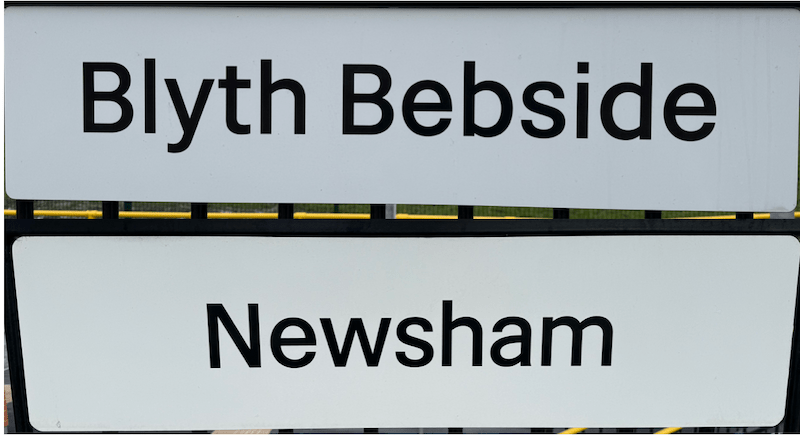
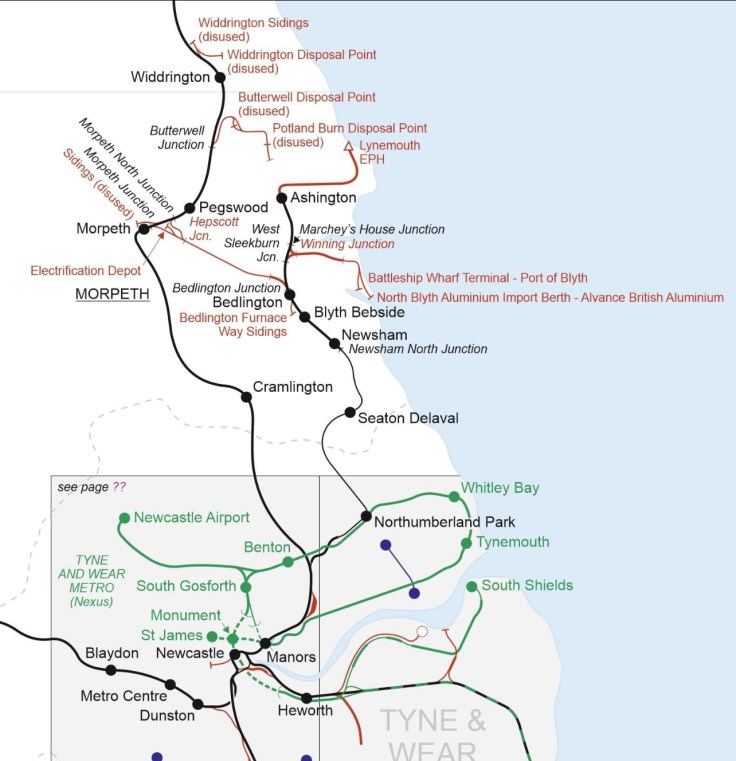
Britain’s next new railway station, Northumberland Park, is opening next Sunday (22nd) on the recently restored Northumberland line but it was only at the end of last month I got round to visiting last year’s two newbies on the line, Blyth Bebside and Newsham.
They opened in March and October 2025 respectively bringing even more passengers to this already busy line despite it being not much more than a year since reopening in December 2024.
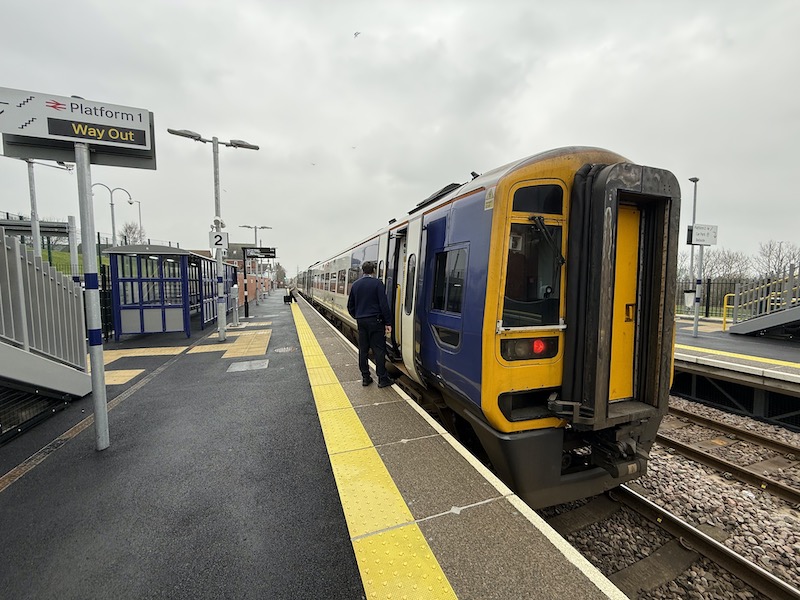
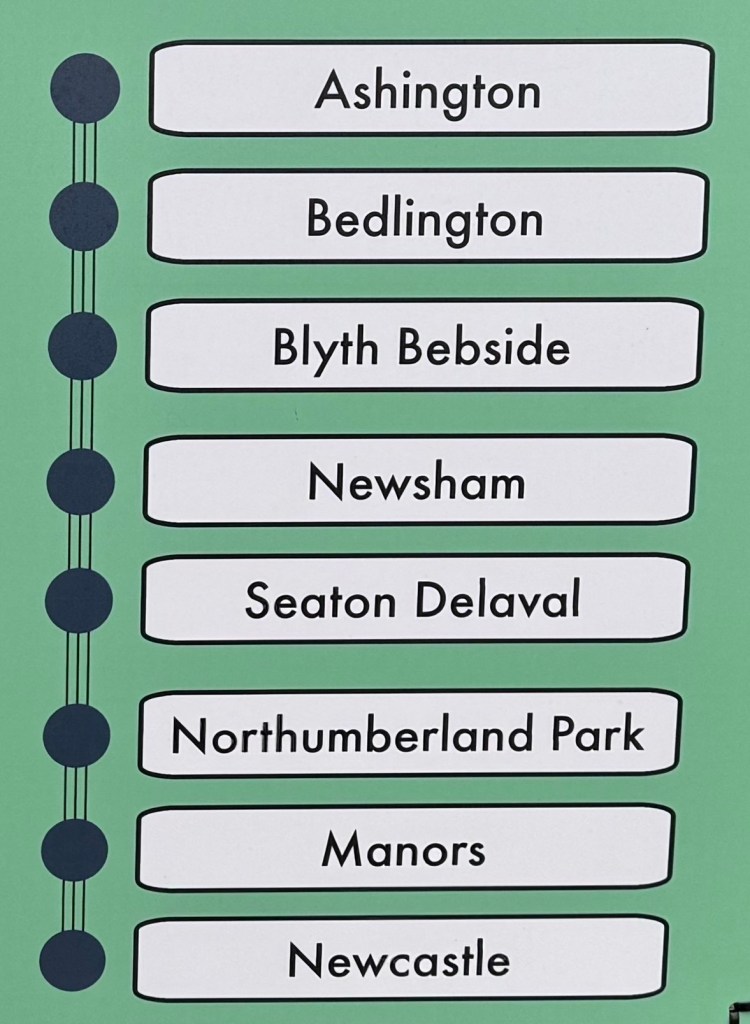
The popular line sees a half hourly service operated by three of Northern’s Class 158 trains linking Ashington with Manors and Newcastle via the above mentioned stations together with Seaton Delaval, which was completed and ready for the line’s reopening.
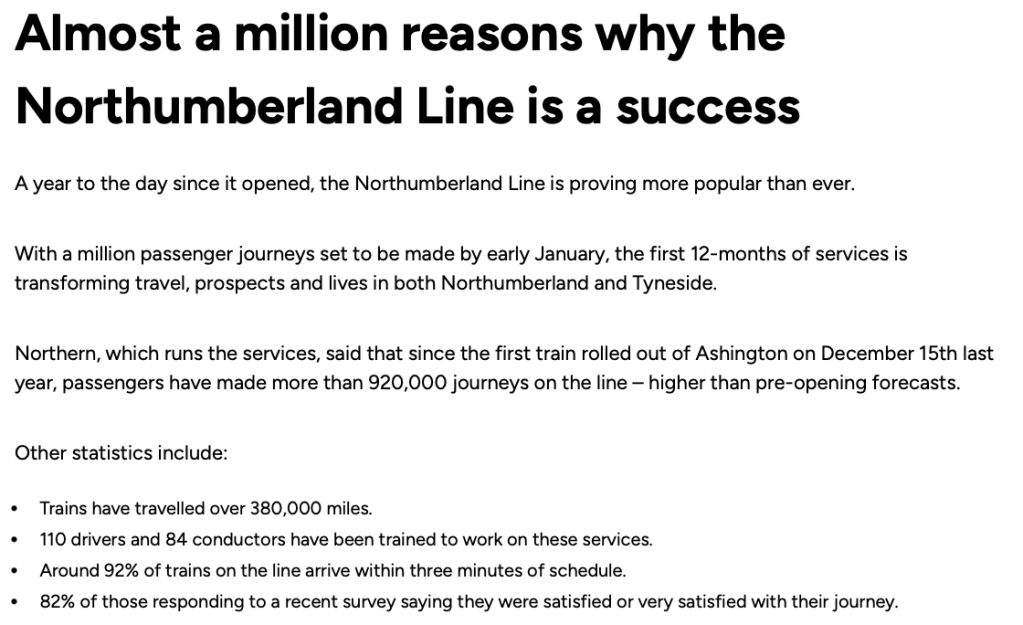
Media reports regularly record how busy the line has already become with Northern doing its best to double capacity using four coach trains on extra popular days for events etc.
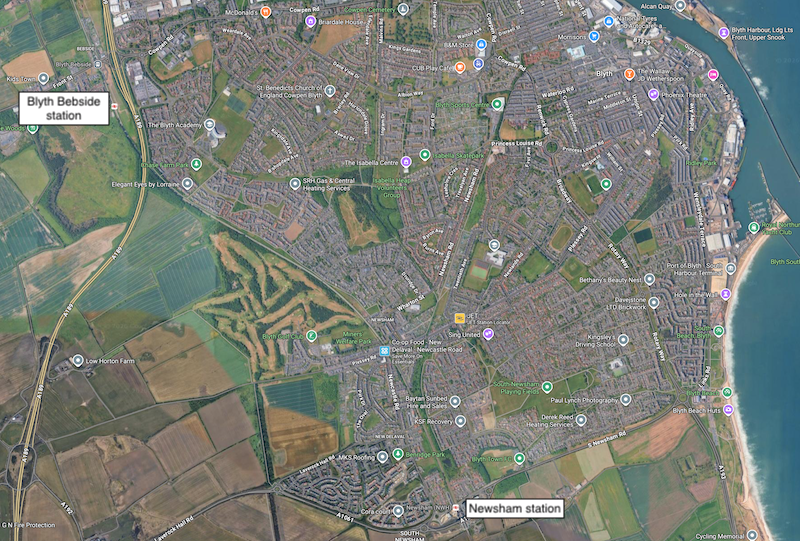
You only have to take a quick glance at the Google satellite image of the two new stations to realise just how many people are now connected into the railway network.
I travelled on a Saturday lunch time at the end of last month and found Newcastle bound trains packed with passengers heading into the city for an afternoon’s shopping and evening’s leisure. Passengers were a good mix of families, young people, loud people, people already having a drink or two on the journey down, as well as retired people seeking a quiet journey such as myself.
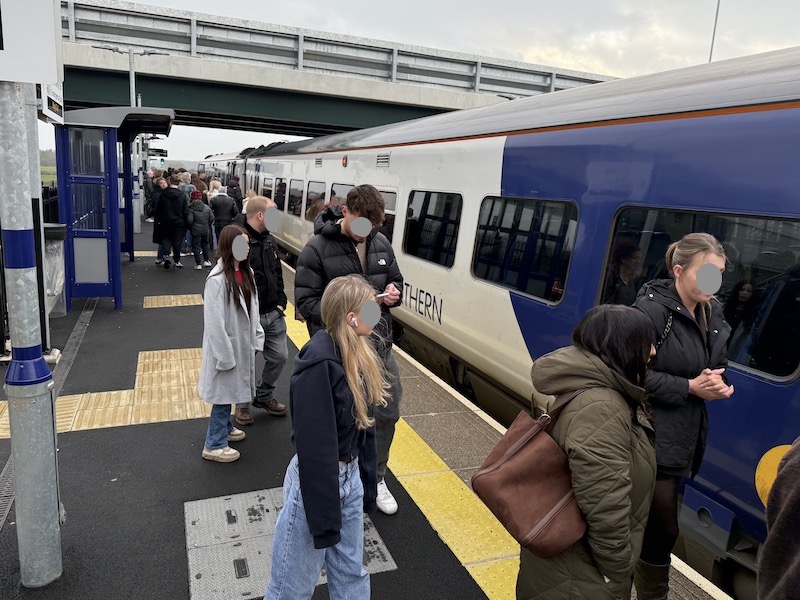
At least 40-50 people were waiting for late morning and lunch time southbound trains at both Newsham and Blyth Bebside when I visited with trains arriving already well loaded from Ashington. It was impressive to see. I suspect Arriva has noticed a drop off in passengers using its bus network in the area and hopefully many also used to drive into the city and now park their car in the car parks at both stations.
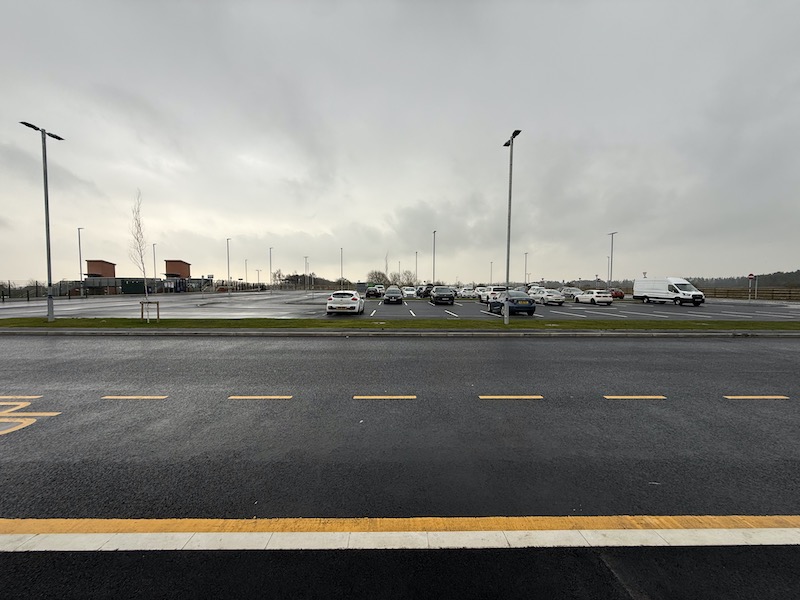
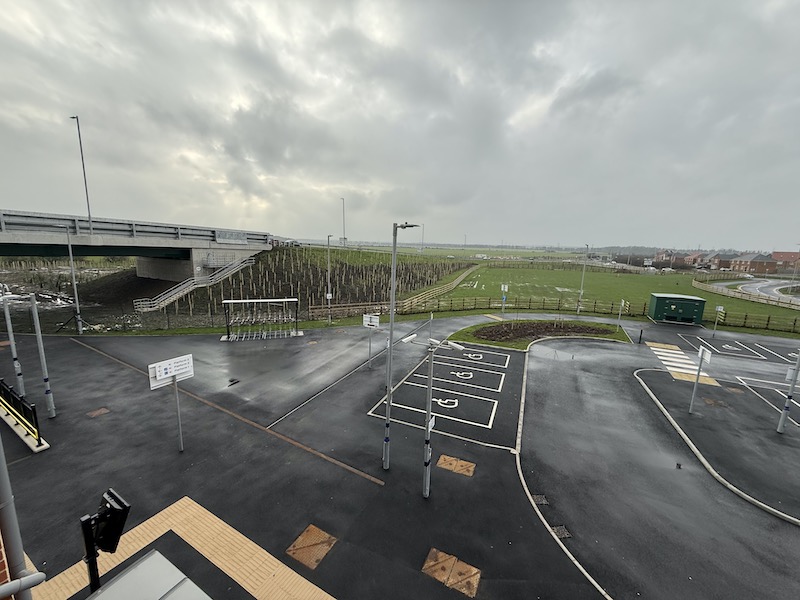
Newsham seemed to be the busier of the two stations with car parks at both fairly well used, as seen at Newsham photographed below…
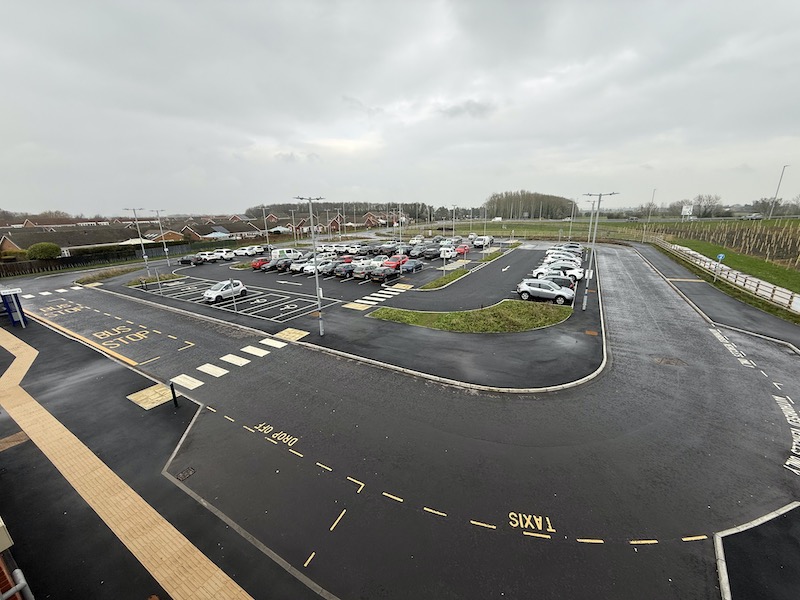
… and Blyth Bebside less busy.
Both stations have been constructed to a modular design with footbridge and lifts…
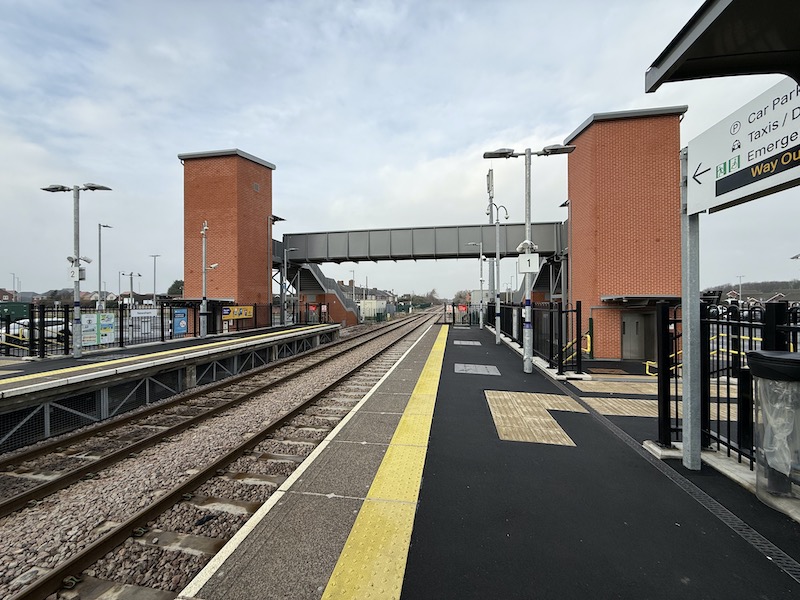
… a couple of shelters…
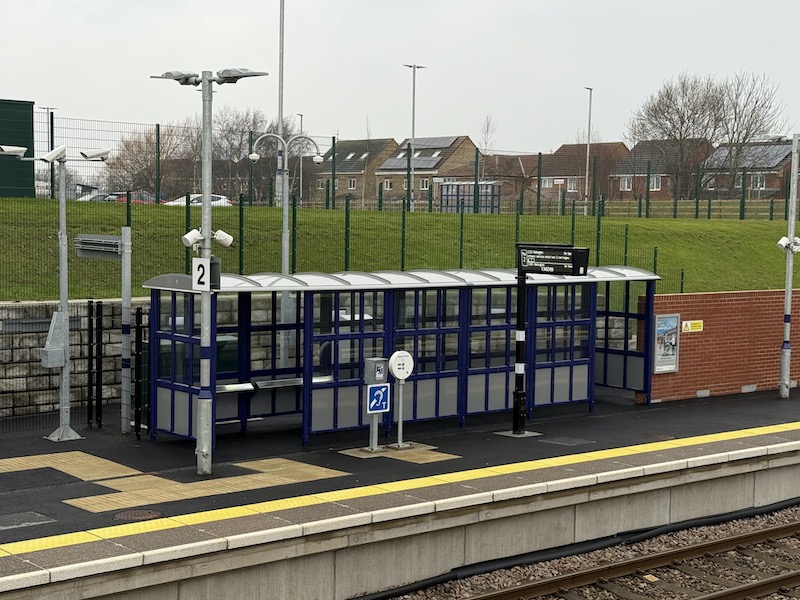
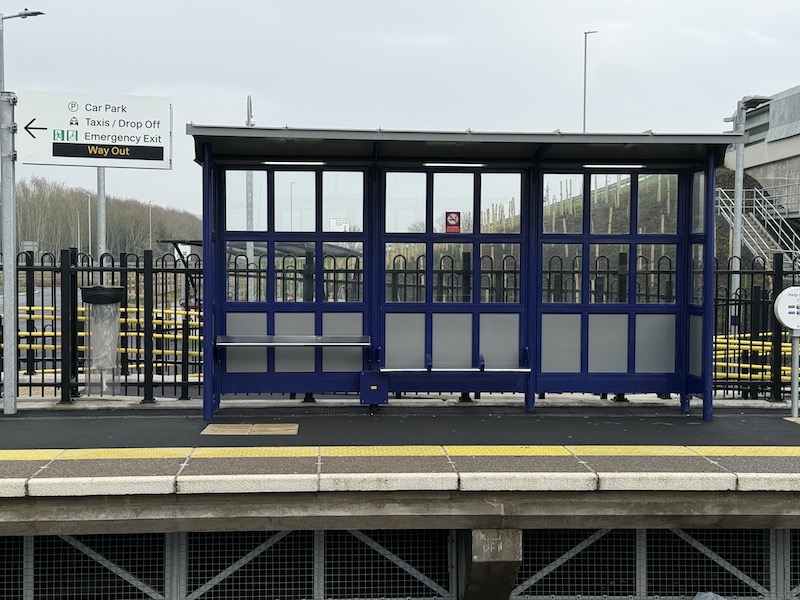
… and standard seats in two places on each platform…
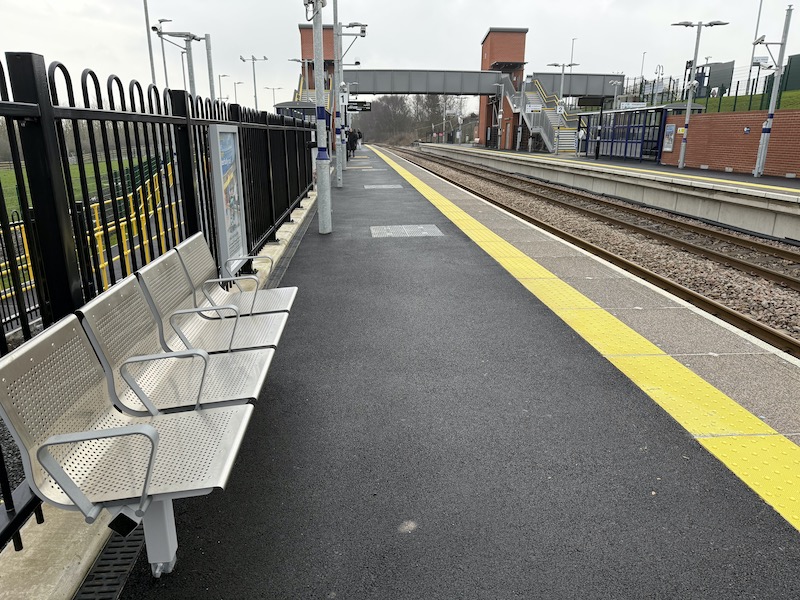
… as can be seen at Blyth Bebside…
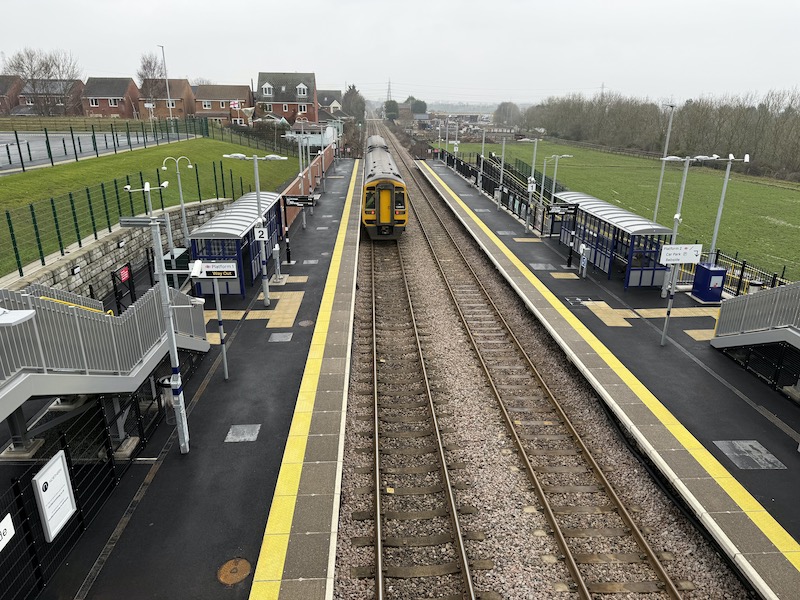
… and Newsham (below) with its open front shelters compared to the enclosed variety at Blyth Bebside (above).
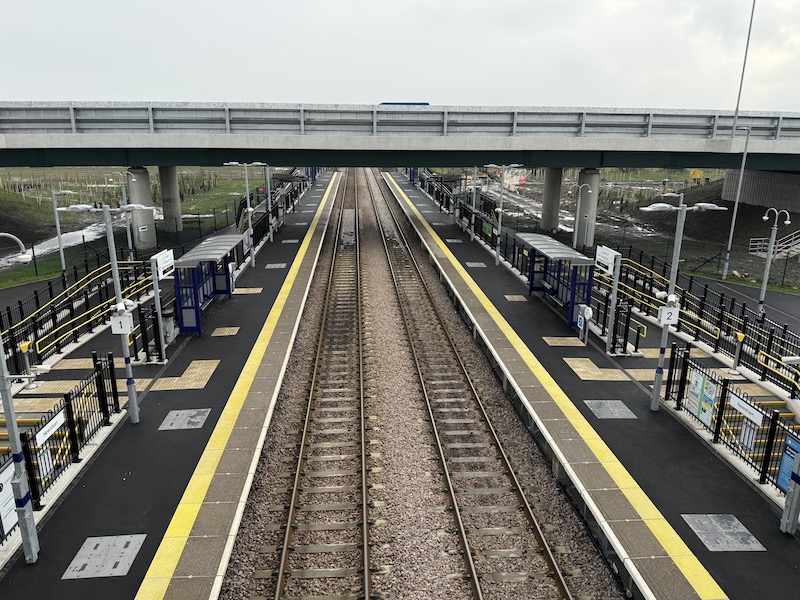
As you can also see in the above photograph, Newsham’s platforms are dominated by the A1061 flyover making for a rather noisy wait as traffic passes overhead.
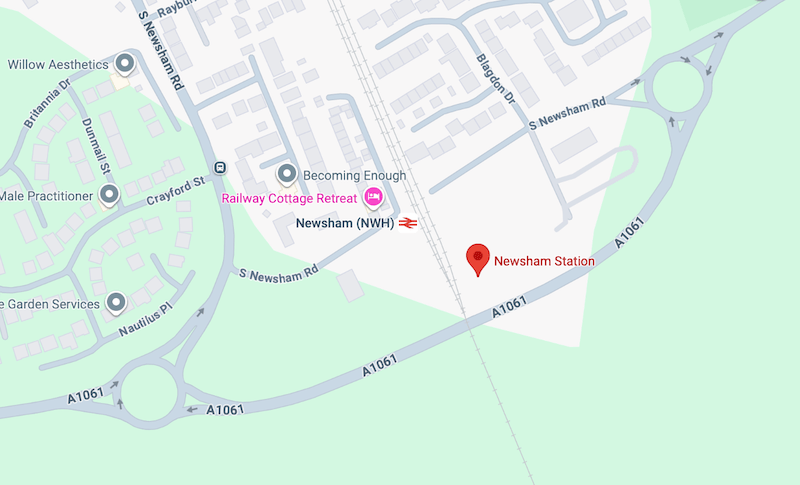
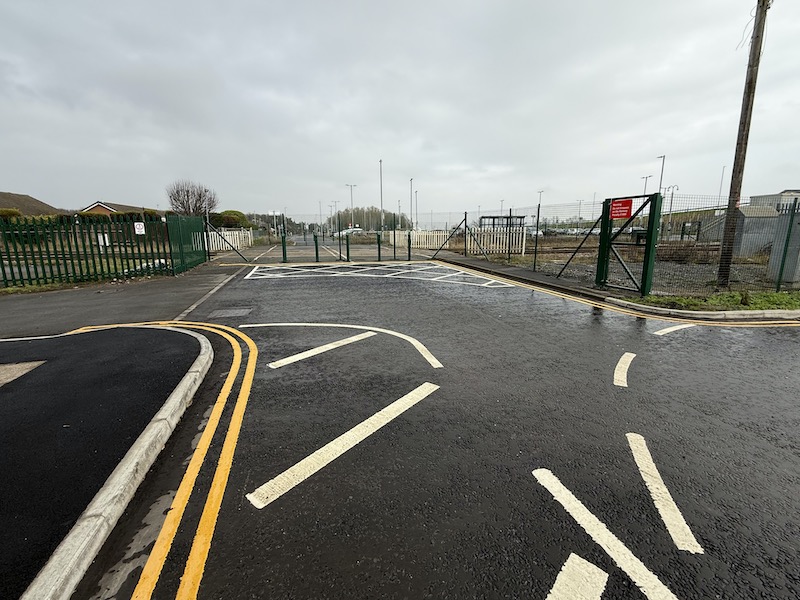
This was built as part of the station’s reopening when the former level crossing on South Newsham Road was closed as can be seen in the Google map extract above and the photograph below.
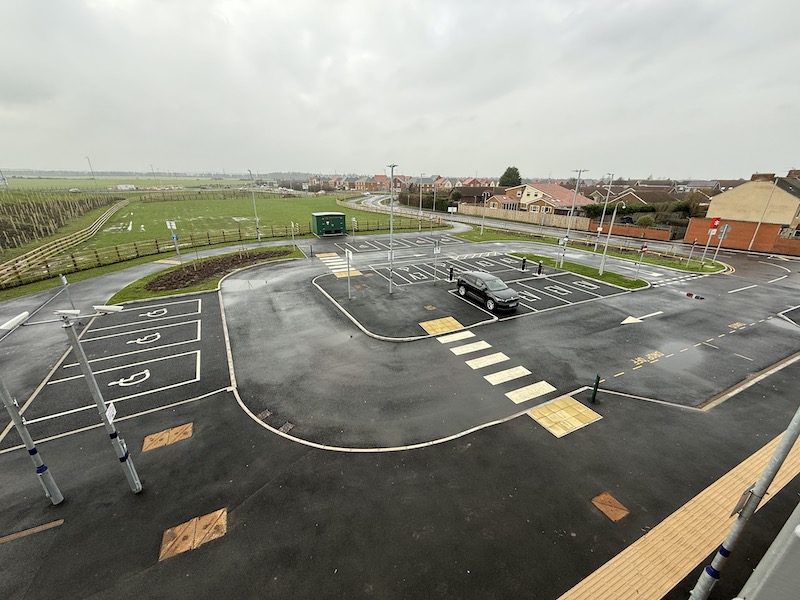
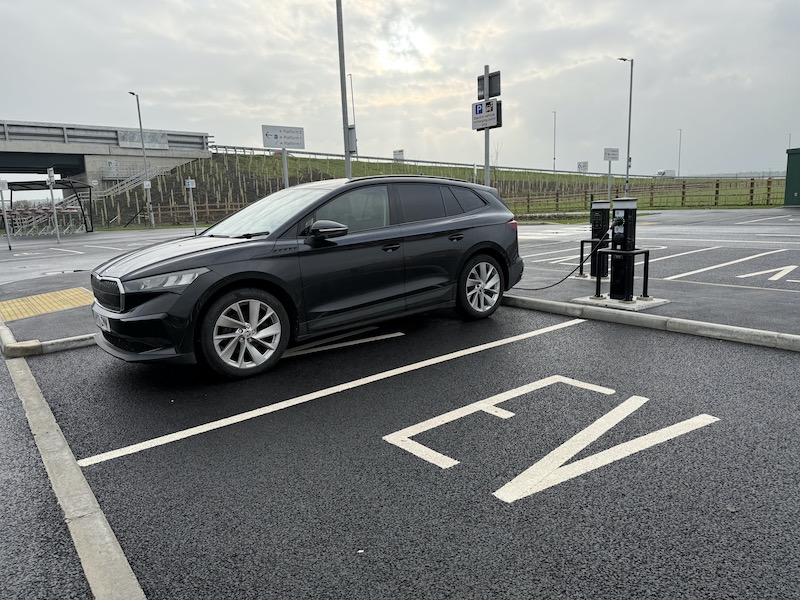
Newsham’s car park is alongside the southbound platform but there’s also a small car park with spaces for blue badge holders and electric charging points which wasn’t so busy.
I often wonder about those spaces and how inefficient it is to have a car plugged in all day while a commuter heads off into the nearby major town or city.
There’s also a cycle rack here as well as on the southbound side.
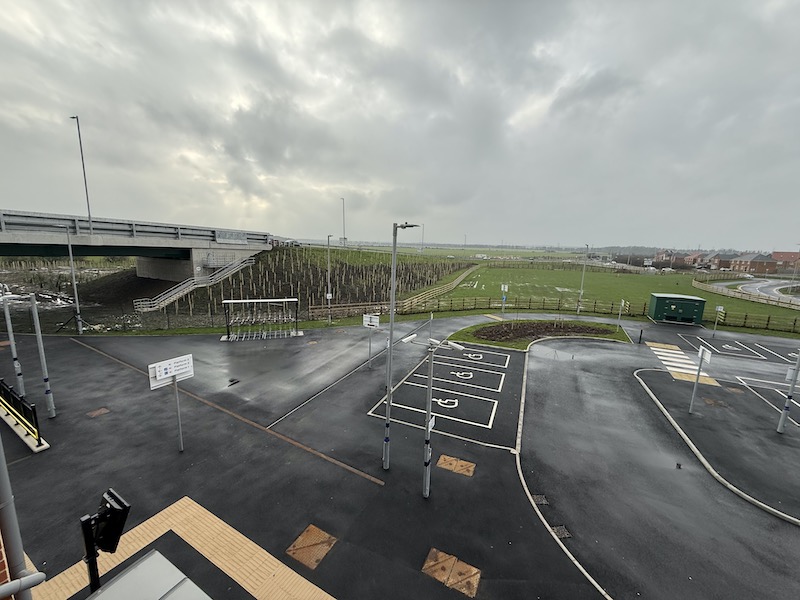
Back at Blyth Bebside vehicle access is only to the car park alongside the northbound platform with the southbound platform having footpath access on a rather meandering trajectory from the neighbouring residential and commercial areas and was proving quite popular during my visit. More so, than the car park.
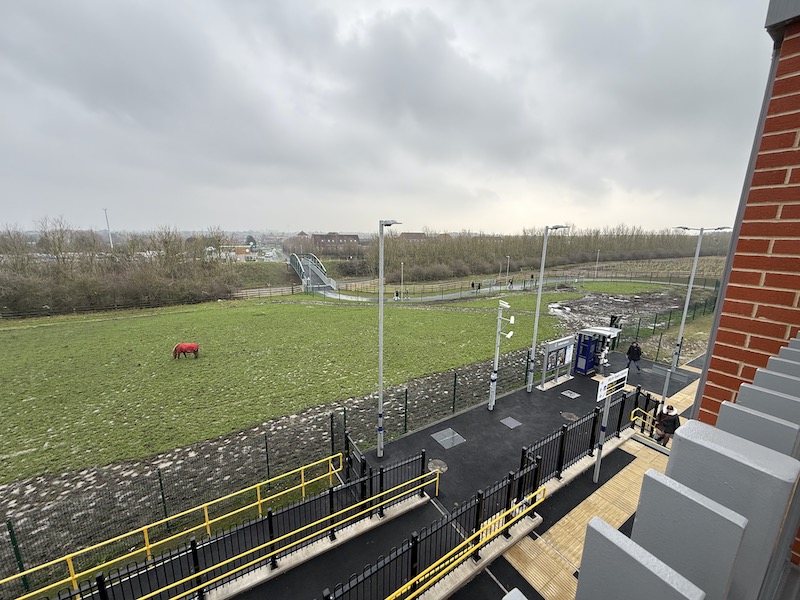
I noticed spaces for taxis had been marked out alongside the exit from the northbound platform in Blyth Bebside’s car park…
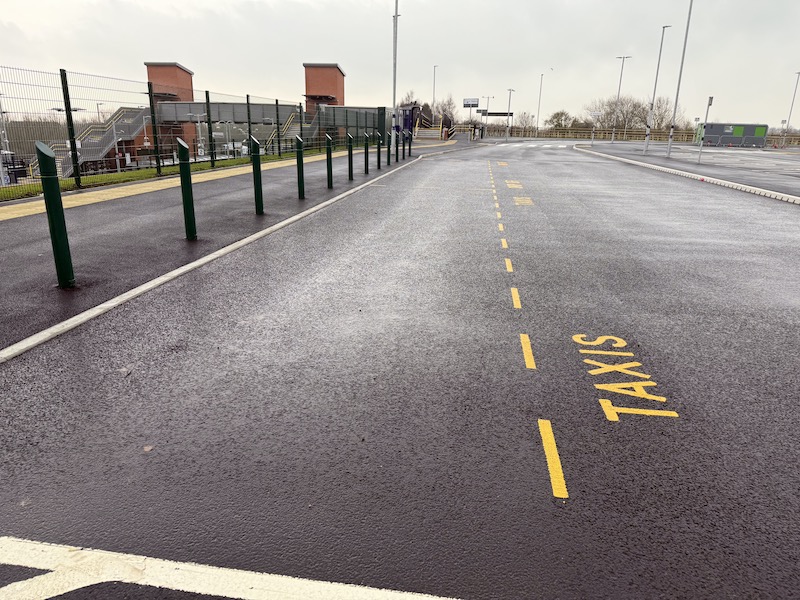
… which frustratingly were much closer than the bus shelter had been positioned.
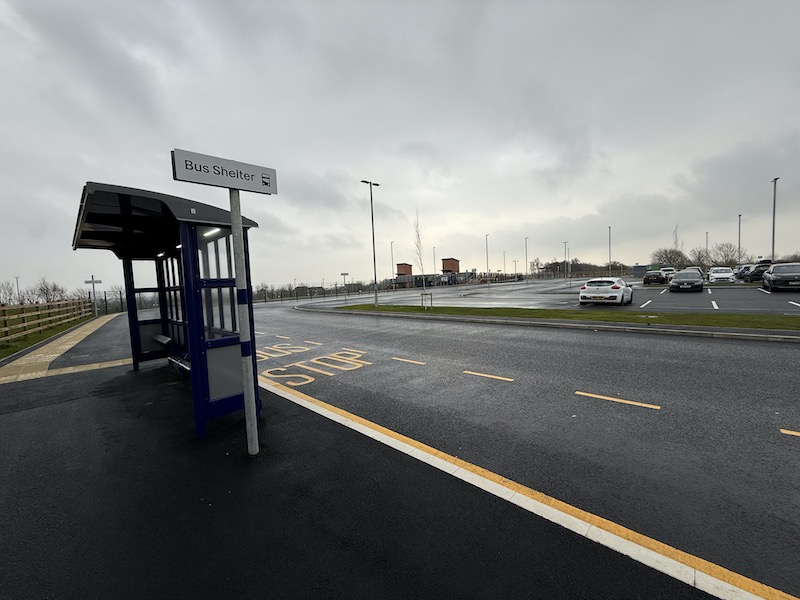
Although the bus shelter (thank goodness a sign confirmed it was a “bus shelter”) won’t be seeing any buses any time soon and presumably is just for rail replacement buses.
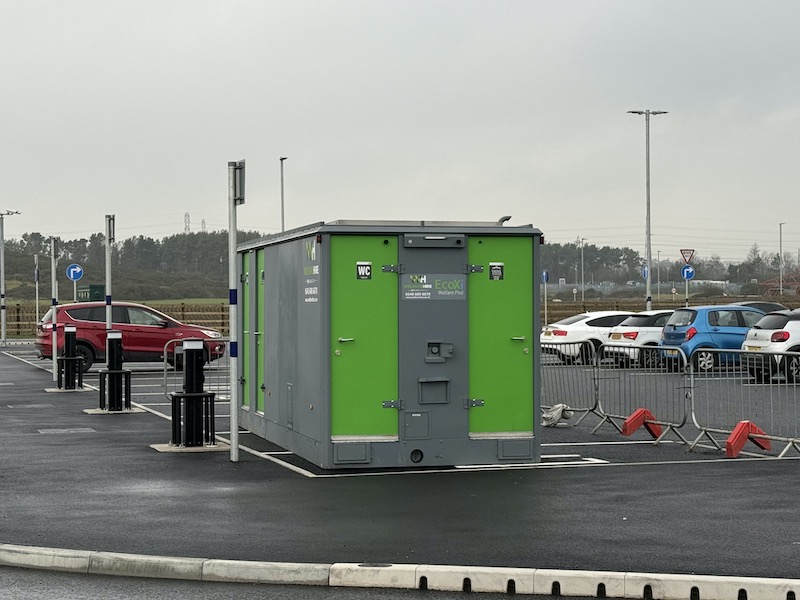
Also in the car park was what I thought was a temporary style cabin making a loud humming noise which I assumed was a generator of some kind and it was only when I got home and uploaded the photographs I took for this blog I noticed it said WC on one of the doors, so maybe it was a toilet – which would be an odd additional facility to a station of this kind.
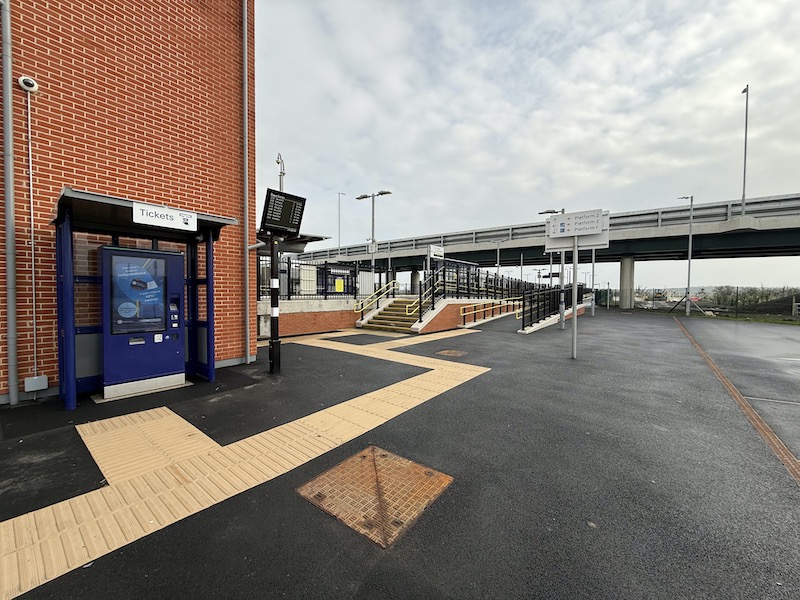
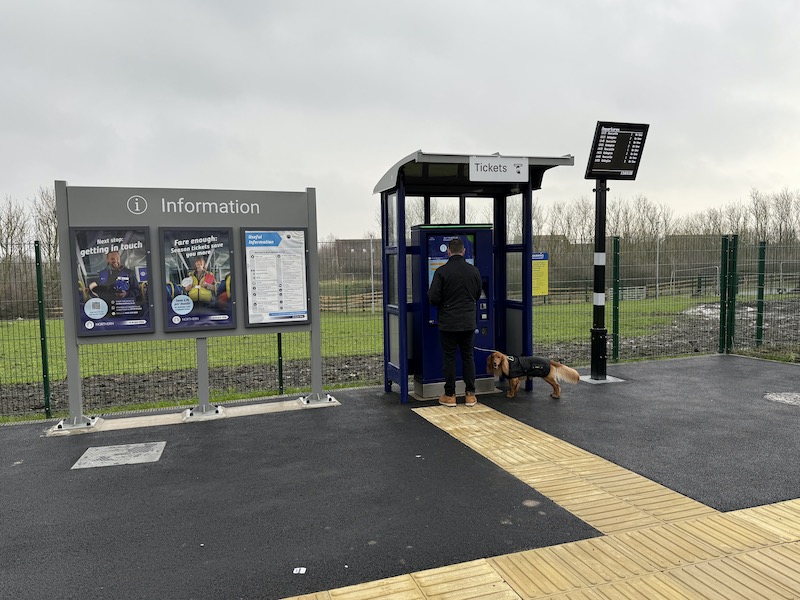
Both stations have ticket machines by both platforms and the usual electronic displays showing departures.
… as well as good accessible ramps as well as steps where needed.
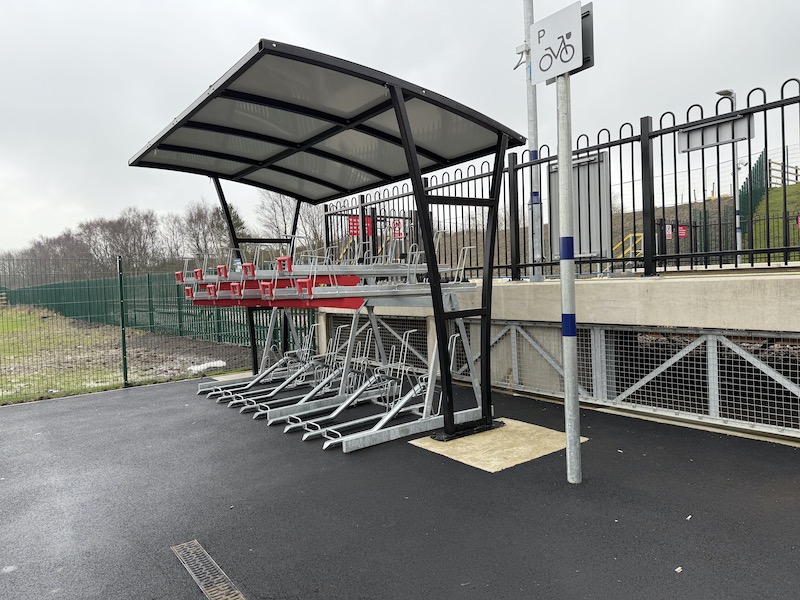
And there’s good provision for cycle storage.
After Northumberland Park opens on Sunday, the final new station, Bedlington, is due to open later in the Spring while the Northumberland line’s millionth passenger is also expected to buy a ticket in the near future which will no doubt be celebrated with the usual PR coverage.
After that, five more stations will be opening in the West Midlands in the coming months. Manufacturers of modular shelters and seats have been busy. And, not forgetting Cambridge South will open too, although passing through it last week indicated there was still much ‘finishing off’ work to complete.
Roger French
Blogging timetable: 06:00 TThS
 BusAndTrainUser
Final station (Bedlington) opens 29th March.
LikeLike
Class 158s are quite unsuitable for this line which carries many families with buggies. 150s with a few seats removed near the door bulkheads would be more practical. The £5.20 maximum return fare is almost anti-competitive against the commercial bus services. Compare with Gloucester-Cheltenham £6.40 for 9 minutes.
Sholto Thomas
LikeLike
If anything that shows GWR are a rip off in most of their network. Bristol to Bath by train is also a rip off for a short journey. West of Exeter, trains are very cheap.
Buses and trains should not be seen as competing, they compliment each other. I use the bus for 1 or 2 reasons, to get to a rail station or the nearest couple town centres. Buses are better for shorter journeys while trains are better for medium and long journeys. It makes much more sense to see buses as branches to the railway.
Thankfully as more and more areas franchise the buses (hopefully including the North East where an integrated network with the Tyne and Wear Metro makes a ton of sense), this false notion of competition between bus and train will disappear.
Aaron
LikeLiked by 1 person
It is a false notion that there is bus and train competition, and sadly Aaron is one of many who thinks it exists. What happens is that when a train or tram line is reintroduced, it decimates local bus services. Seen it in North Manchester where the Metrolink saw services to Rochdale and Oldham reduced markedly. Bathgate to Edinburgh routes disappeared totally, Ebbw Vale services reduced, Galashiels to Edinburgh buses halved, and so on.
Now a simple soul might think…. that’s fine because as long as people are getting on public transport, that’s fine.
Well, the example of Okehampton to Exeter illustrates the issue. The trains have been a great success for the people of Okehampton. However, what it did was upset the delicate ecosystem of local bus services. By removing the single biggest transport generator, it meant that the parallel bus service that serves all the villages suddenly was no longer viable. There are fewer journeys and instead of the commercial Stagecoach service, it’s now a tendered service. That’s an extreme case, granted – most of the time, you just see intermediate villages and stops see their frequent service reduced markedly.
Roger is very experienced and he’s seen this happen too many times. Hence his comments – once Bedlington station opens, then you can see the X21 being scaled back so great news for Ashington residents travelling to Newcastle but less good for places like Nedderton or Stakeford. It’s perhaps only because the Blyth to Newcastle services have Cramlington (and the local traffic from Newsham to Blyth town centre) that they have remained relatively unscathed.
LikeLike
You appear to contradict yourself. I said buses and trains DON’T compete. They compliment each other. Obviously nowhere should lose their public transport but this is where leaving it to the market to run proper bus services fails. Most private bus companies have no real idea of a wider network.
It is bogus to suggest we should not build new railways or trams for towns that need them just because a nearby village won’t be served by it at all or buses under a commercial setting. The thing is public transport needs to be funded properly and consistently over the long term and it needs to be well advertised and integrated into new developments. Are you saying somewhere like Haverhill should not get a railway because under a privatised bus system, villages like Linton might lose their buses? Seems a bit ridiculous to me.
If the North East authority controlled the buses, they would feed into the new stations via changes to existing routes on day 1 of the station opening. That’s integrated public transport.
Aaron
LikeLike
Now Aaron – you said that they shouldn’t be seen as competing with each other. My argument is that they don’t anyway.
Your view is that they should merely be seen as branches feeding into the train? Your view was also that buses are better for local services. This suggests that you feel there shouldn’t be any long distance services from Ashington or Blyth to Newcastle as you feel that buses should only be used for local services?
What I’m saying is that there is the law of unintended consequences. Okehampton, as I said, was an extreme example but don’t think that there aren’t going to be changes to services in SE Northumberland and that these long distance services perform some very important roles which will be reduced. Whether its publicly or privately owned, the financial impact of revenue abstraction will still be the same.
As for the statements about consistent funding and policy approach from government, I think we all agree on those sentiments.
LikeLike
Buses should be branches into the railway yes, but in densely populated areas, there would still be a need for a dense bus network connecting various towns and villages. Most regions would still have decent overlapping bus coverage and frequency for anyone wanting to go solely by bus. I’d say with how NE England is built up, buses are still essential across the full region, as even with the Ashington line a lot of people live away from it. These new stations appear to mostly be on the very edge of the towns (a big problem in my town in SE England too). I don’t see why the villages you mention before would suddenly lose their buses, maybe lose a direct bus to Newcastle but not necessarily. But this is why buses and trains need to be integrated both with tickets and timetables and both be accessible too. Also, why a network view should be taken.
There is a place for long distance bus routes, I’d say in any county with a bunch of towns around, they are really needed. But not the be all and end all. It needs to be both as buses are a lot more flexible with where they can serve, effectively covering gaps in the rail network.
A lot of it comes down to development I think.
Also Bathgate has 2 direct buses and a train to Edinburgh.
Aaron
LikeLike
As I said, there will be changes. Those villages may not lose their services but they may see a 20 min service reduced to hourly, lose their direct service, etc. Or as Okehampton showed, a commercial service has to be replaced with a tendered service.
Bathgate is a good case in point. It has ONE direct service – the other is a Livingston to Edinburgh service that then runs through to Bathgate. The services were once plentiful and served intermediate places like Broxburn – now it’s a shadow of what it was. Once the critical mass of passengers were lost to the rail line, there’s not enough to sustain the same level of bus service so those places get a much reduced frequency. Happened with Borders Railway too. That’s what happens.
There are countless examples across the UK. Not saying that we shouldn’t have new stations or reopened lines but Roger alluding to how things may change is based on lots of examples where it has happened.
LikeLike
@anon 15/2 22:30 – looking at Broxburn, it appears to have a half-hourly X18 running from early morning until late at night, passing through on its way between Bathgate and Edinburgh. Broxburn has a population of around 15,000.
Let me compare Broxburn with another town of very similar size, Verwood in Dorset, which is 10 miles from its nearest rail station. Verwood is served only by Morebus X6, running hourly to Poole and Ringwood, or every two hours onwards to Bournemouth. The service packs up at around 19:00.
For a town of its size, has Broxburn really suffered so badly from the reopening of the Bathgate line?
Malc M
LikeLike
Well Malc M… Broxburn had a depot until 1978, and Bathgate a depot until the 1990s. Don’t think Verwood ever had such a service that would justify that sort of presence.
Notwithstanding that Broxburn and Verwood have markedly different socio-economic makeup
LikeLike
@anon, 17/2 12:22 – so, the reopening of the Bathgate rail line in 1986 resulted in the closure of Broxburn’s bus depot eight years earlier?
Malc M
LikeLike
Agree in principle with what you say. However should point out that Lothian Country operates a half-hourly bus service between Edinburgh and Bathgate.
LikeLike
I’m with Aaron on this. Which is why this project really needs to happen as demonstrator. We know it works because there’s a nation where their whole public transport system is based on integration and network effects. Sure those who like their one seat bus rides will shout loudly, but I suspect they will be outnumbered by new passengers attracted to an anywhere to anywhere else via connections model.
https://www.bbc.co.uk/news/articles/cvgd2d7eddlo
Peter Brown
LikeLike
I saw this ‘mini-Switzerland’ proposal mentioned a while back, really good to see it going forward. Could work really well as a model, not just for rural areas but also suburban areas that straddle multiple authorities or counties, like in the South East.
I really think the only way to achieve proper modal shift is by combining buses and trains, this shift in focus would also surely lead to more efforts to make rail travel a lot more accessible too as well as decent measures for bus priority.
The Peak District seems like a great place to test this out. As if it is successful there, it will very likely be successful everywhere else in the country.
Aaron
LikeLike
I wonder how about 5million gbp thus far compares to the operating costs?
if capacity is going to be a problem can platforms accommodate five or six car units?
is it timetablewise practical to run shorts to from Newsham at intermediate times if newcastle has space restraints more than 30 mins might be a problem . Alternatively when the interchange to metro is in place using that as a south terminal might help
I suspect Bedlington might be busy once open but maybe folk are those driving yo the car parks already
Is there a payment needed for parking ?
JBC Prestatyn
LikeLike
Platforms have been built for 4-car trains, I don’t think any stations can accommodate longer trains than that and it’s unlikely that we would need more than two 4-car trains per hour in the foreseeable future. I can’t imagine that many people would be interested in catching a short to Northumberland Park and then changing for the metro to Newcastle city centre – some will do, sure, especially if there are metro stations more convenient for their destination than the mainline station – but nowhere near enough to justify running additional reasons only for them. It will be interesting to see whether the numbers interchanging with the metro do increase over time.
There may be merit in adding parking charges in due course, but it’s probably a good idea to at least start it free to encourage people to use the train and get them used to it.
LikeLike
if passenger numbers exceed forecast despite a reasonable bus service to the main destination then surely the reopening of other closed routes particularly where track exists has to be brought forward. In economic terms unless such projects compete for scarce resources thus bidding up factor input prices there should be no rationing of investment funds.
JBC Prestatyn
LikeLike
We need to be careful about saying that numbers are exceeding expectations. What we’ve seen with a few new lines recently is that the expected numbers were for a steady increase from zero to a stable level over ~5 years … and then what has happened is that the numbers have shot up in the first couple of years and then stabilised at about the expected level, just reaching that level much quicker.
A couple of factors can be behind this – on the positive side, better publicity and social media spread the word and excitement about the new service quicker than used to be the case – on the negative side, the lines are often late opening so people have already started to make changes to their lives in anticipation of it opening.
Either way, the important thing is to wait and see what the passenger numbers are looking like after 5 years and how that compares with the predictions, rather than jumping to conclusions about long-term numbers based only off the graph being steeper in the first couple of years.
LikeLike
Another station dominated by a road viaduct is Huntingdon, dominated by what used to be the truckers’ paradise A14, but the viaduct now carries the A1307. Videos on YouTube by Jon Jefferson (AKA Auto Shenanigans) refer.
LikeLike
The viaduct at Huntingdon was demolished some years ago when the road network was changed. These days there’s just an ordinary bridge carrying a local road at the north end of the station.
LikeLike
A 110 Drivers but only 84 guards. How does that work
Why a 110 drivers for a low frequency service? Most trains are operated by companies other than Northern
LikeLike
110 drivers and 84 guards were “trained” to work on the line …. better than training too few and then cancelling trains due to staff shortage!!!
Guards work different shifts to drivers … drivers take trains to/from sidings /depots etc, guards start/finish at stations, so you need more drivers!!!
LikeLike
depends on shift patterns
I guess guards can work a 10 hour day drivers 8. Drivers will sign on at depot and do train checks then proceed to station to pick up guard from the train crew office
JBC Prestatyn
LikeLike
I suspect Arriva will be secretly pleased, as providing them with the excuse to remove yet more double-deckers and shove their passengers into over-crowded single-deckers, always their preferred modus operandi if possible.
Terence Uden
LikeLike
Such a great shame it wasn’t electrified from the word go. Those 4-car, ‘Renatus’ class 321s would’ve been ideal for this line.
LikeLiked by 3 people
I wonder if this line would have been better as part of the Metro.
Perhaps Arriva would be better off refocusing their network to connect with the trains and thus keeping more passengers by extending each station’s catchment area, rather than using up resources providing direct service to Newcastle.
Peter Brown
LikeLiked by 1 person
Regarding the “temporary style cabin”, I looked it up and the ECOXi is a “mobile welfare unit”:
https://www.kellinggroup.com/welfare-hire/welfare-product/ecoxi/
I assume that was provided for site workers to use during the station’s construction, so I’m not sure why it would still be there, as presumably the station would have toilet facilities that passengers can use?
LikeLike
I think there is still finishing off sand snagging to be done and poss area used by staff also working on the other stations
JBC Prestatyn
LikeLike
Just such a shame that reopening wasn’t progressed when first (to my knowledge) mooted in the 1990s. We could have been seeing the benefits for the last 20+ years…
LikeLike
The new stations are rather ugly, the car parks are probably too big (Has no attempt been made at integrating the rail line into the existing bus network? And why are the parking spaces so wide?), but at least the reopened line looks to be well used – hopefully more closed-to-passengers railway lines can be reopened over the next following years (unlikely).
LikeLiked by 1 person
better a too large car park.. many station areas expecting an uplift in residential units nearby . But yes a new nicer design for facilities a variety of cladding bricks and tiles are available these days along with potential space for commercial units though noted trains are note quiet but one can get used to them if working in an office
JBC Prestatyn
LikeLike
Here in south Birmingham, with our new stations on the soon-to-be-opened Camp Hill line, we have quite the opposite – none of the three new stations have any car parking! There will of course be cycle lock-up facilities, and ‘drop-off/pick-up’ spaces for taxis and cars, with the expectation from Transport for West Midlands (TfWM) being that most passengers will ‘walk or cycle’ in order to get the train.
Granted, the stations at Moseley and Kings Heath are well-served by frequent buses, while Pineapple Road is less so. Residents did express concerns that rail users would take up valuable parking space on local roads, so it remains to be seen whether those concerns will be justified or not. Anyone with a car who drives to get a train into Birmingham is likely already going to Kings Norton or Yardley Wood, where there is plentiful parking available.
LikeLike
indeed the line has been designed to serve inner city communities with some of the stations being for a destination as much as a origination point. Relatively close to the other stations mentioned they are like many zone 3 and inner tube stations. Again there will be an impact on local buses but I think its the unlocking of growth that is the main driver for West Midlands locations
JBC Prestatyn
LikeLike
Agree about the aesthetics – I swear with pretty much any new station, you could take a photo in black and white and it wouldn’t look any different. But a big car park is probably essential given that residential areas have developed well away from the railway line, and better to have wide spaces that can comfortably accommodate today’s oversized cars than to have people squeezing in and not getting between them lines as so often happens.
Probably difficult to get a lot of enthusiasm from Arriva to integrate the bus network with the railway given that the railway will be poaching a large number of their passengers!
LikeLike
I think Arriva could take their to be lost longer distance passengers to and from the stations and thus retain some revenue. Shorter routes would not require so many buses as the current trunk route, and a half hourly frequency to tie into the trains would enable non car users access to the trains. The trunk route into Newcastle could reduce in frequency (which it will probably do anyway) to serve the shorter intermediate journeys.
Also we should be building dense mixed use development alongside new stations, not acres of parking to create more demand.
Peter Brown
LikeLike
And the fare may well be the same, given the £3 fare cap. Although overall income may be less with less reimbursement from the fare cap scheme, but countered by at least half the mileage needed for a through route into Newcastle.
LikeLike
I did mention on previous blogs of the route that the impact on buses needs to be looked at a year after the full line reopening. If the trains effectively offer 200 seats every half hour for 4 main stations an a double decker 65 seats every 15 mins or 260 an hour some will travel full length as their stop at home is closer than the rail station giving little time difference. And yes the rail fares will have to become more realistic in due course
JBC Prestatyn
LikeLike
I wonder what the justification for the low train return fare is, which undercuts the bus fare, and of course any losses just disappear in the massive subsidy that Northern receives. If passengers have been lost from Arriva’s network, leading to reduced revenue this could lead to a substantial reduction in services in the area as I would guess that the interurban services from Northumberland into Newcastle would have been the most profitable parts of the network
LikeLike
The big problem with rail is the cost. They also make huge losses. Buses tend to run at at least breakeven
LikeLike
Rail does have higher fixed costs than bus. But then, rail may provide greater economic benefits, through plugging places such as Ashington and Blyth into the national rail network and also providing much quicker journey times into Newcastle, making it less time-consuming for travel into the city for work or leisure.
Buses may appear to break even, but there is financial support through BSOG (outside London, that is – I don’t think the capital receives any BSOG funding); financial support for the England £3 fare cap; financial support for services which are not provided commercially; financial support for procuring zero-emission vehicles. And, of course, the local authorities pick up the bill for maintaining the roads including bus priority measures. They may (or may not) also pick up the costs of maintaining bus stops and shelters.
Malc M
LikeLike
are most journeys essentially local or has the presence of rail network generated new trips beyond Newcastle or facilitated folk from beyond to visit friends in blythe etc to a greater extent?
JBC Prestatyn
LikeLike