Thursday 12th February 2026
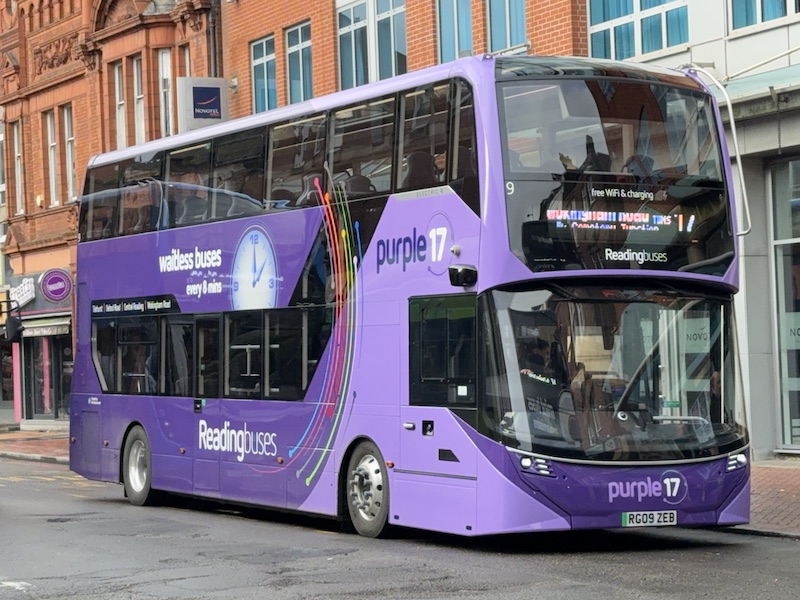
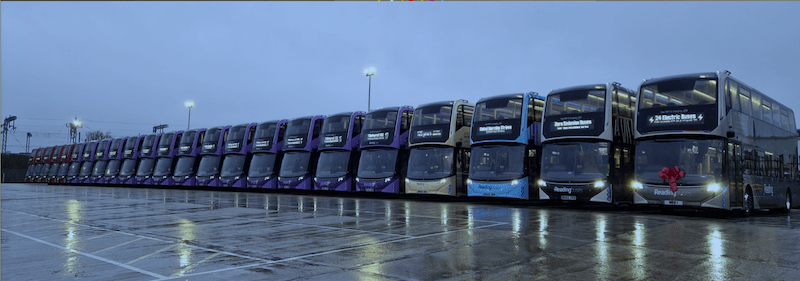
There was a time when gas powered buses seemed to be the future at Reading Buses but last Friday the company made a power switch and began operating a smart new fleet of 24 ADL Enviro400EV battery electric buses. The first in the fleet, they’ve reportedly cost about £14 million with more spent on new charging infrastructure in the bus depot. A DfT grant of £4.7 million was received with a further £1.3 million towards eight more buses on order for a summer delivery.
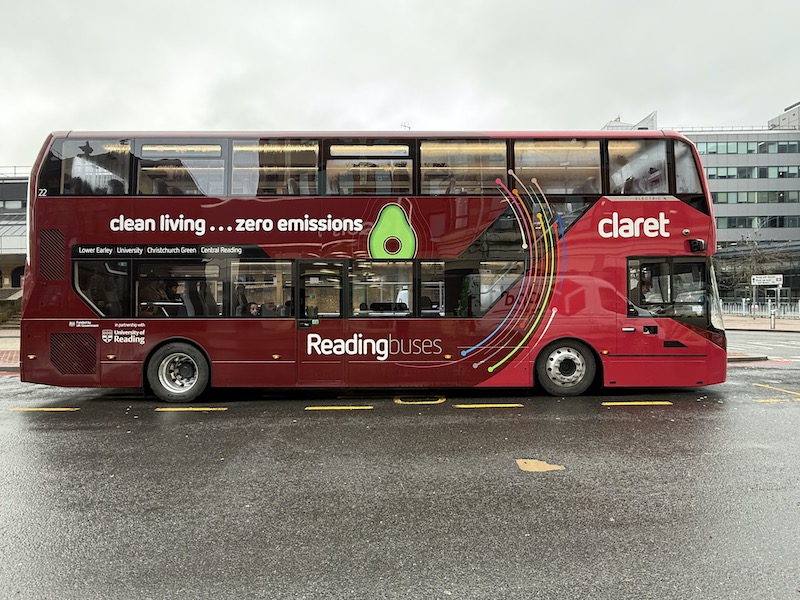
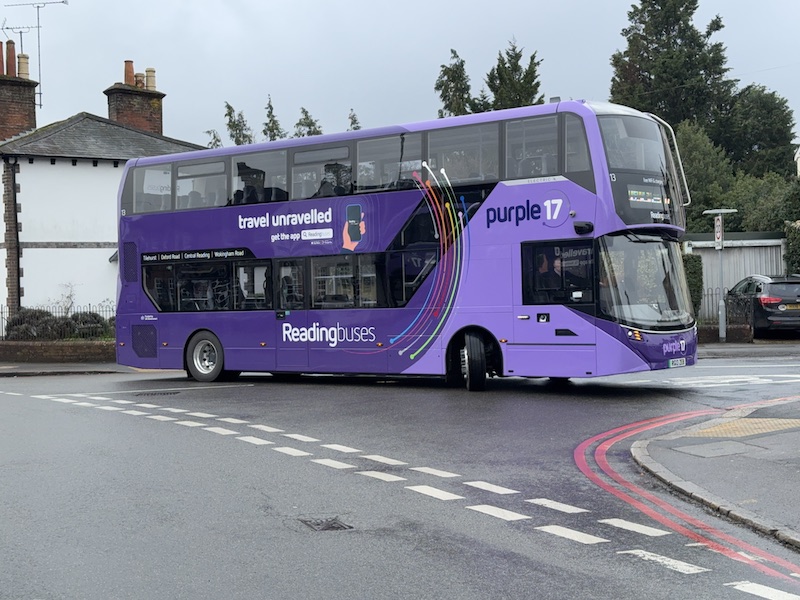
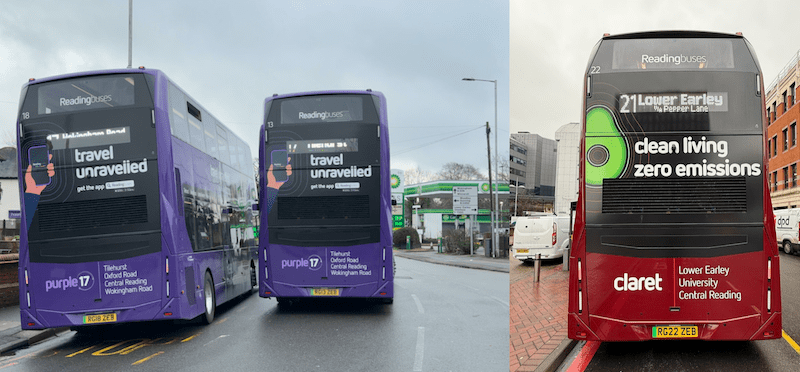
These first 24 smart new buses are operating on Reading’s busy long standing purple branded cross town route 17 between Tilehurst and Wokingham Road, Three Tuns and claret branded route 21 serving the University campus at Whiteknights and Lower Earley.
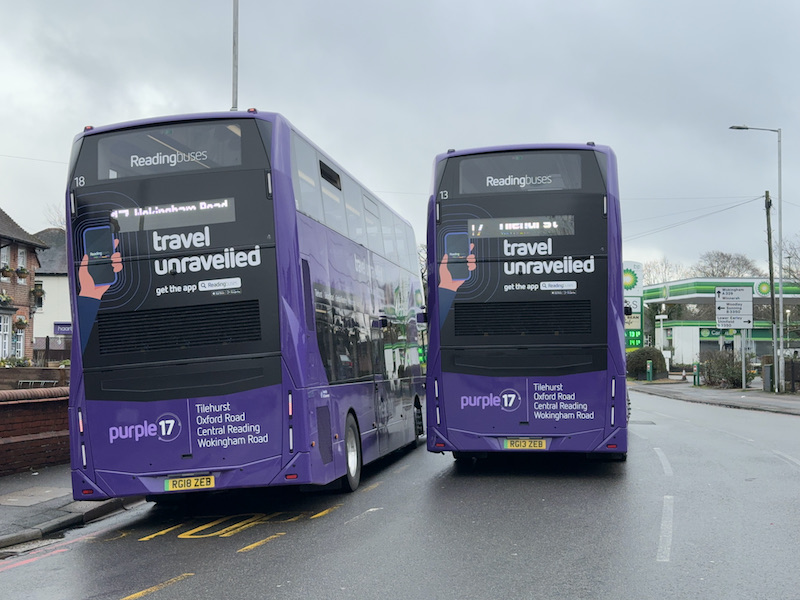
It’s always impressive to see an overnight whole route upgrade and never more so than when the new fleet wears an eye catching livery with high profile branding. You can’t fail to notice the step up such upgrades portray on the street, even on a dull and damp February morning.
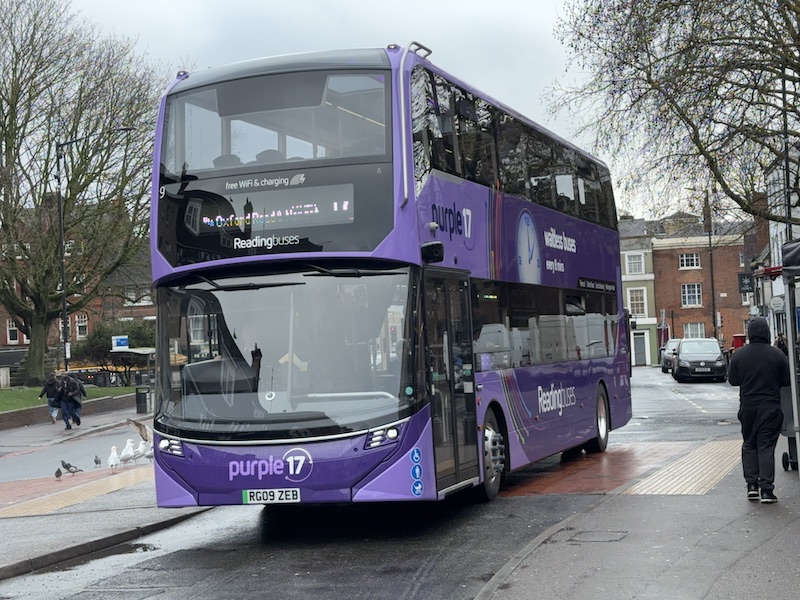
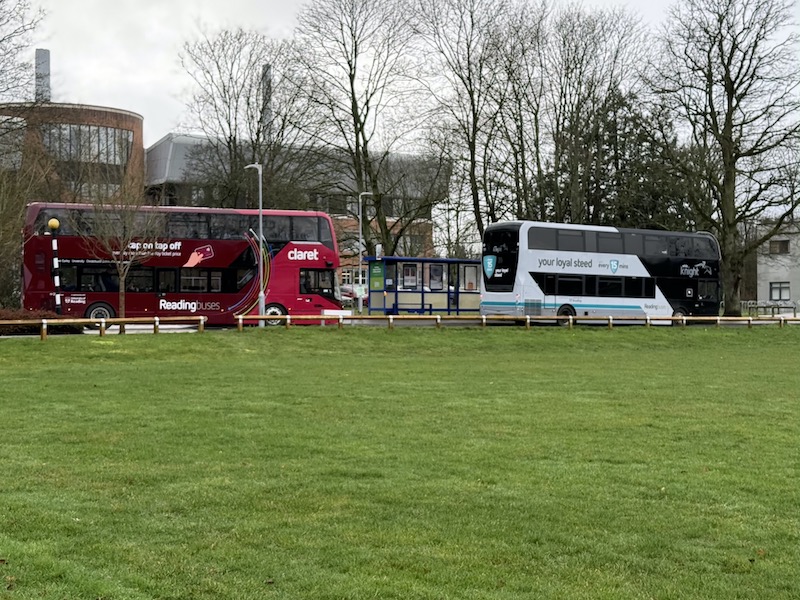
They certainly stand out on the University of Reading’s campus.
An official launch took place for the cameras and stakeholders last Thursday afternoon with the full fleet rolled out into service en masse from first thing on Friday morning.
When taking a ride on both routes that morning I was initially fooled by seeing dated registration plates on the buses…
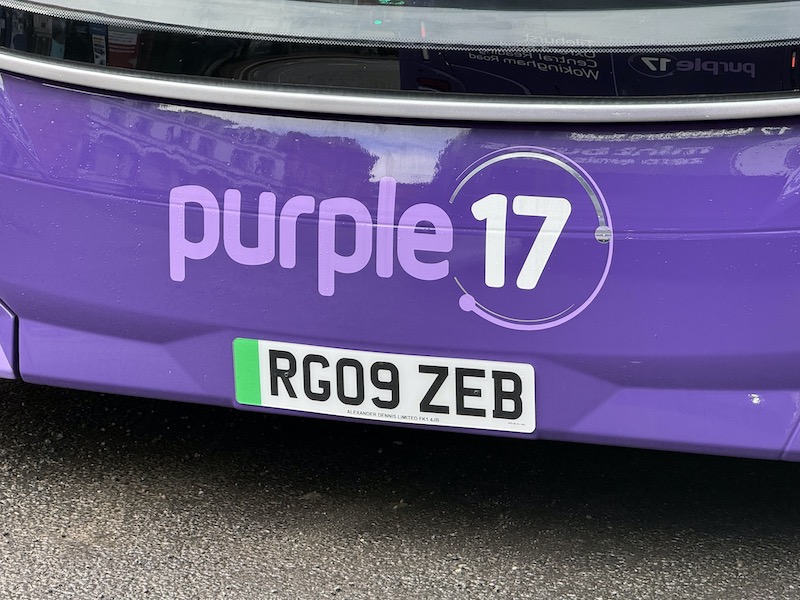
… thinking they were old buses and there must have been a last minute problem preventing introduction of the new fleet but then the penny dropped … they all have RGxxZEB cherished registration plates to indicate the tie up between Reading Buses and Zenobe.
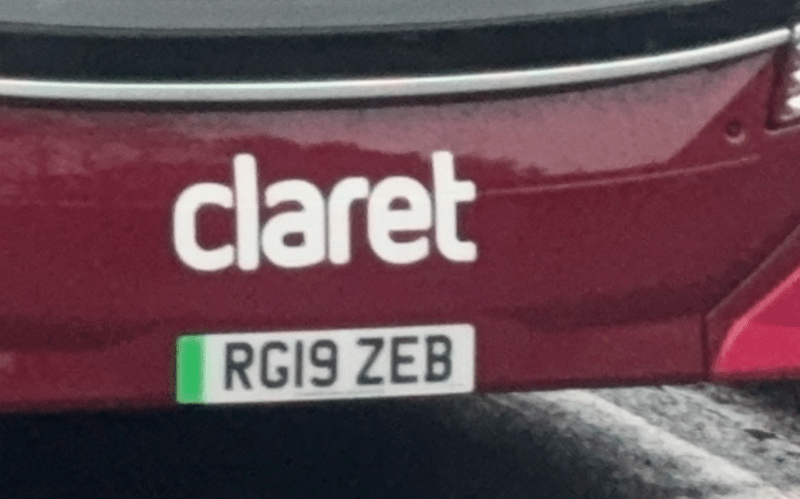
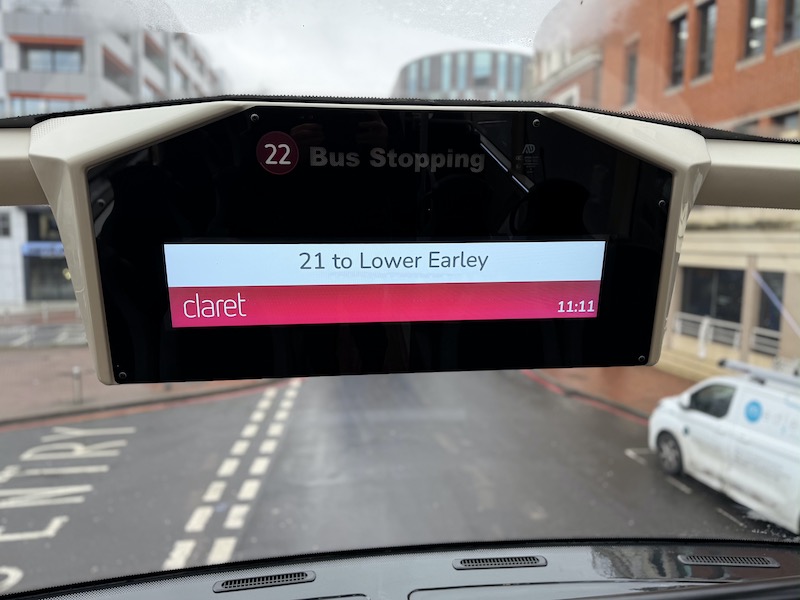
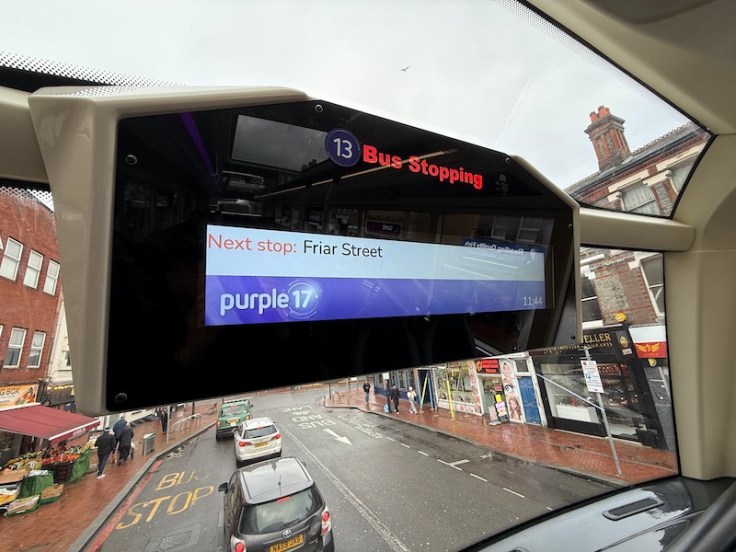
The number is also the bus fleet number which I realised when jumping on a bus outside the station on route 21 which was showing a number 22 as well as a 21 on the front upper deck next stop display, which made me do a double take before twigging.
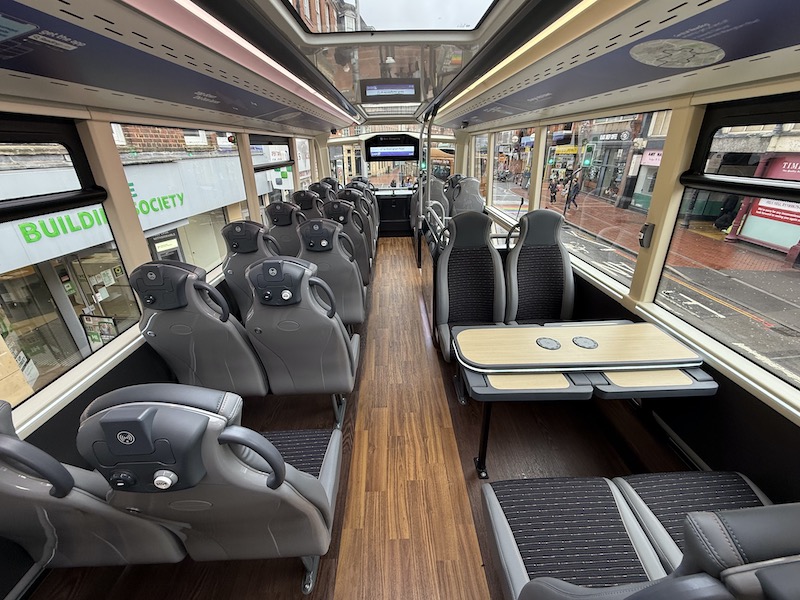
Once I’d got my aging brain around those unusual features I was able to enjoy the comfort and ambiance these new buses provide. A lot of thought has obviously gone into the interior specification with mood strip lighting around the side panels…
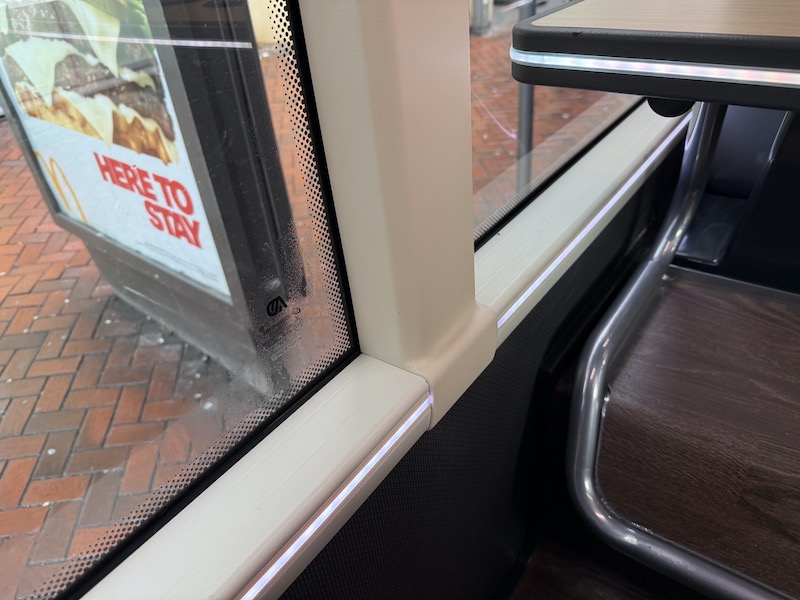
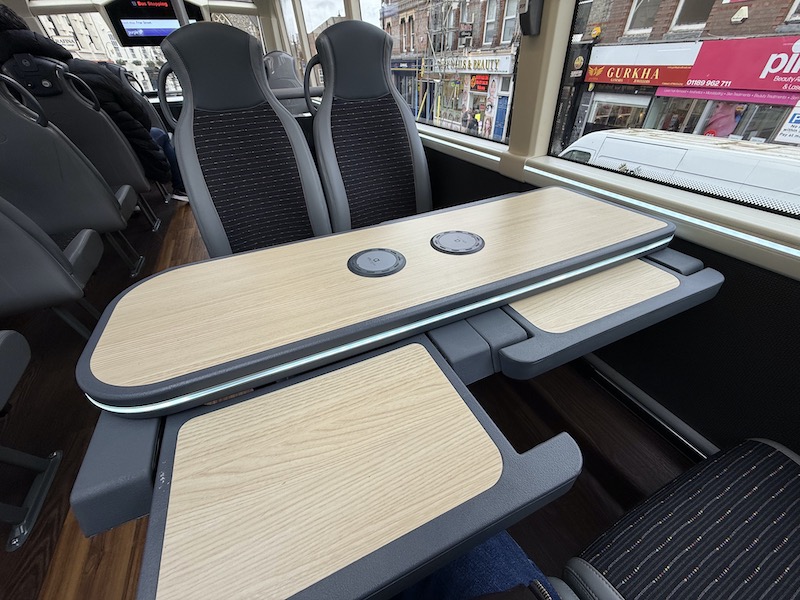
… and the tables.
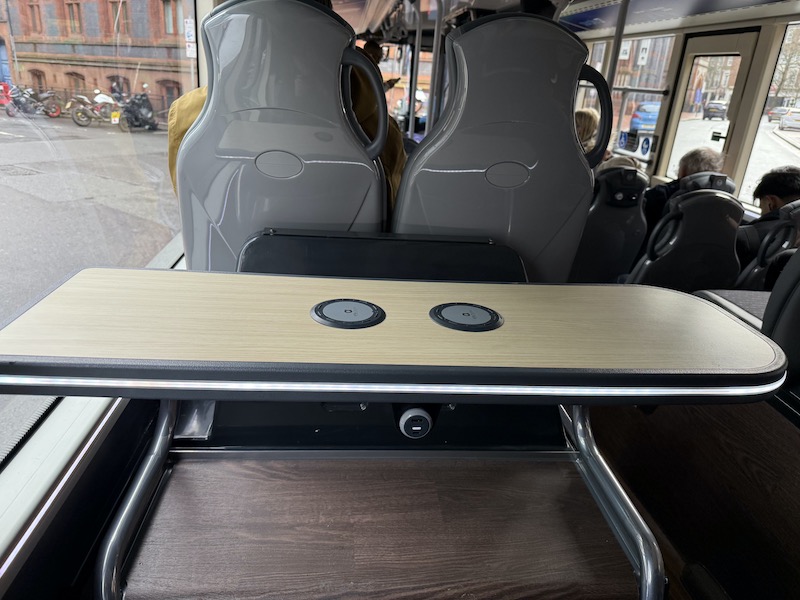
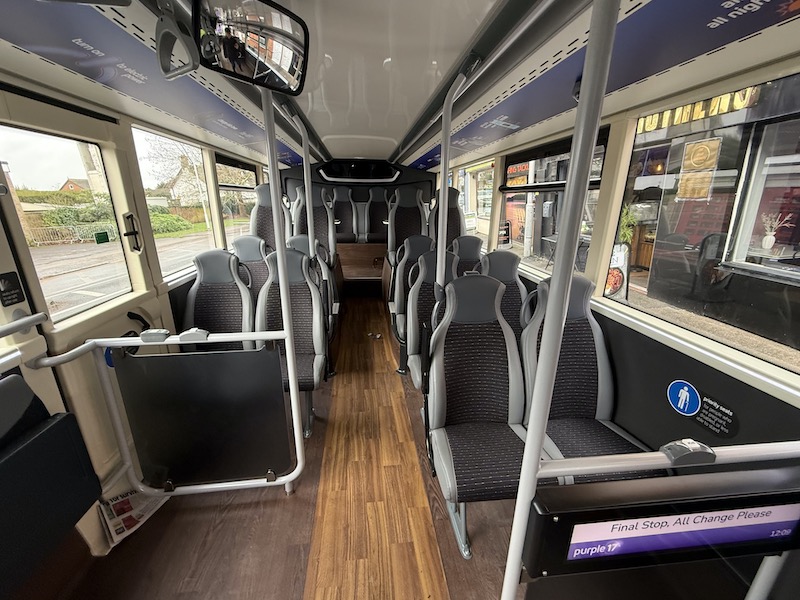
As you can see, at the rear of the lower deck there are two bench style tables incorporating a foot rest as well as two wireless charging panels on each.
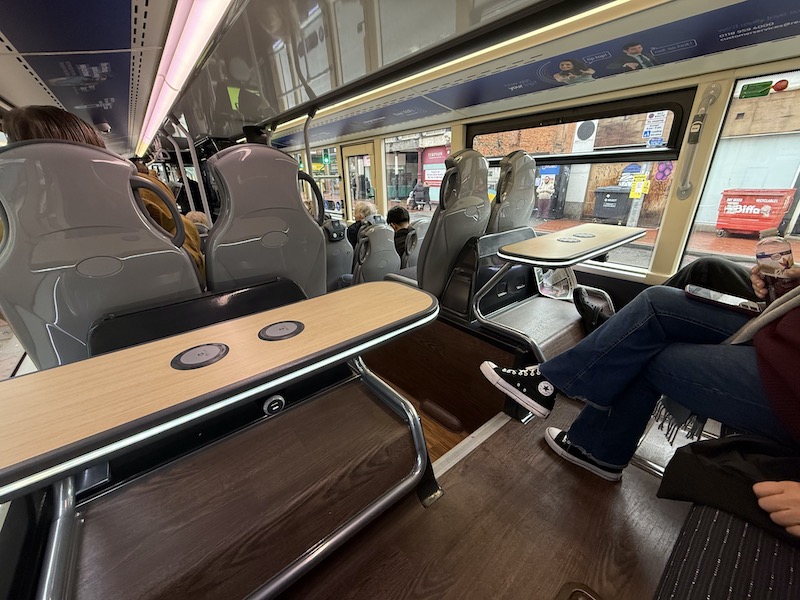
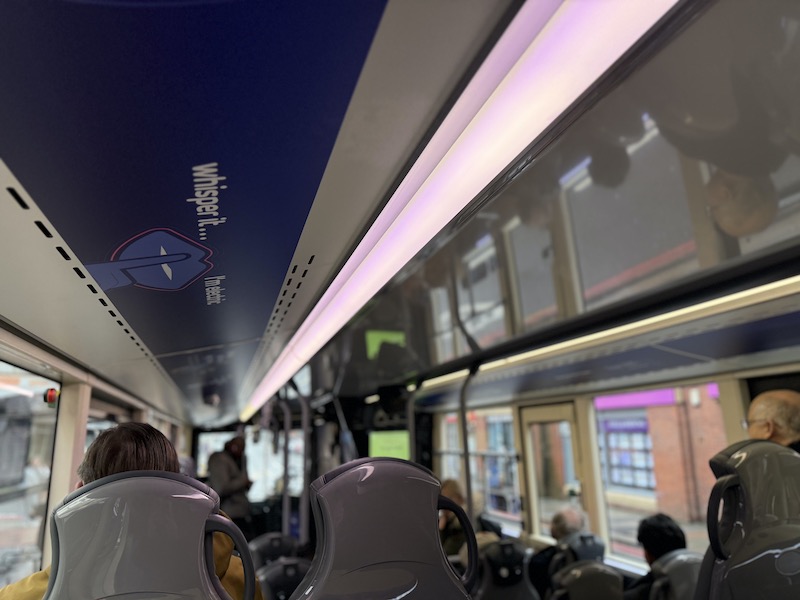
There’s also mood strip lighting in the roof panels which are branded for the colour of the route while the bus is travelling…
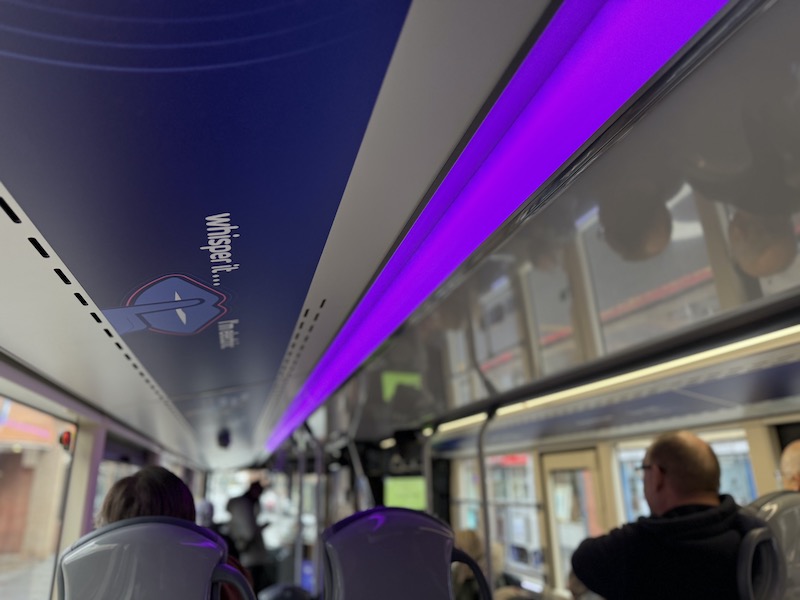
… and then change to white when the doors open at a bus stop, which is nice.
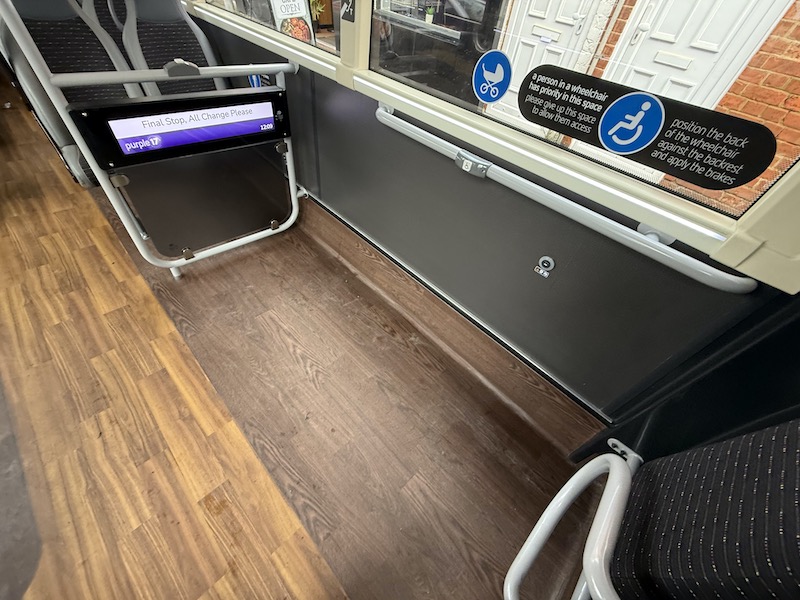
There’s two wheelchair spaces (one each side), which is good to see…
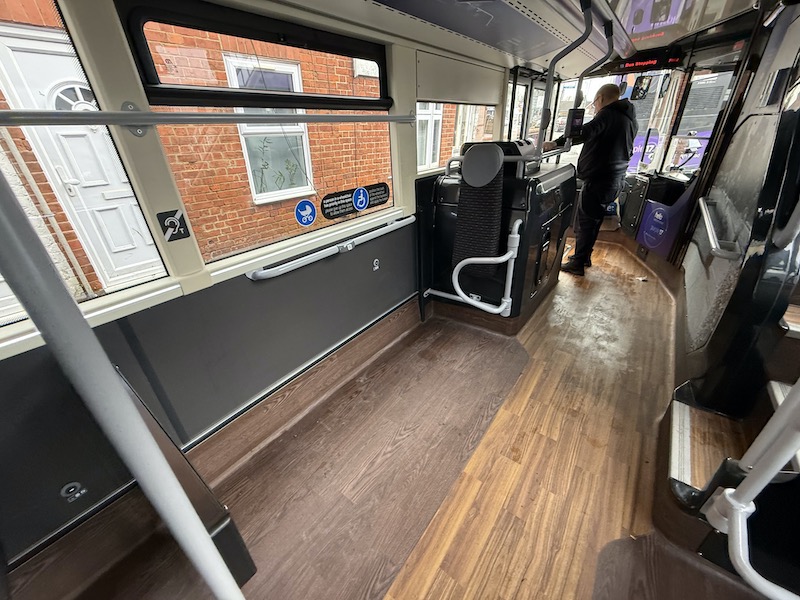
… with an illuminated next stop display facing the nearside space, which looks smart…
Seat backs have the usual charging points (wireless and sockets) and bell pushes.
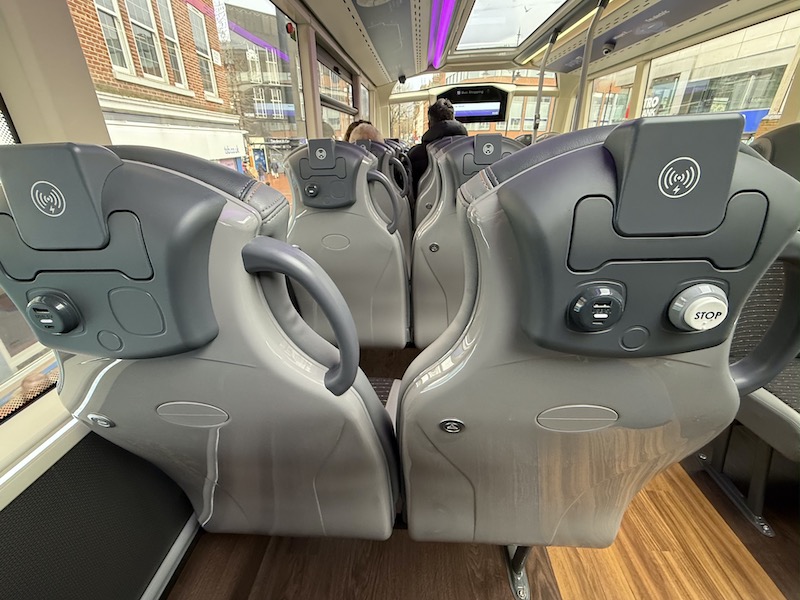
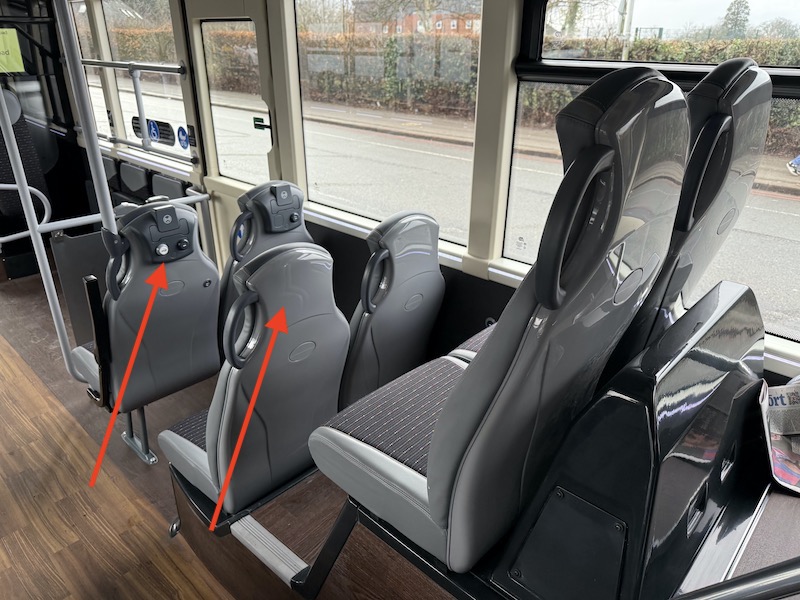
I noticed the penultimate seats don’t have either on the backs of the seats in front of them so a passenger needs to lean over and press the bell on the seat back in front, which could be awkward if it’s occupied.
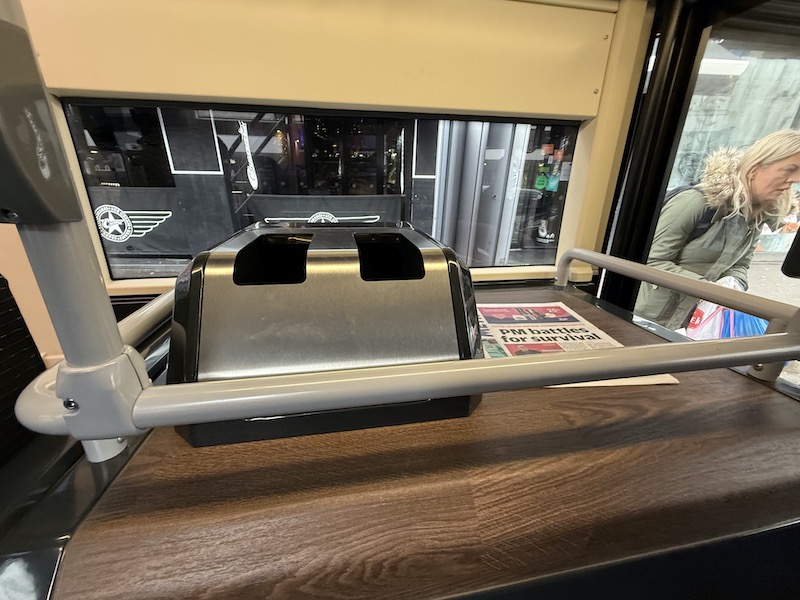
There’s what looks like a giant toaster above the nearside front wheel which I assume is for litter and recycled litter albeit not marked and I didn’t notice any facility to store the supply of Metro newspapers.
On the upper deck there’s a table for four on the offside immediately behind the staircase…
… with four pull out surfaces ‘Chiltern Railways style’…
… and as already mentioned, a rather large, perhaps larger than it needs to be, housing for the next stop display is at the front.
Seats are comfortable and practical for an urban journey of relatively short duration…
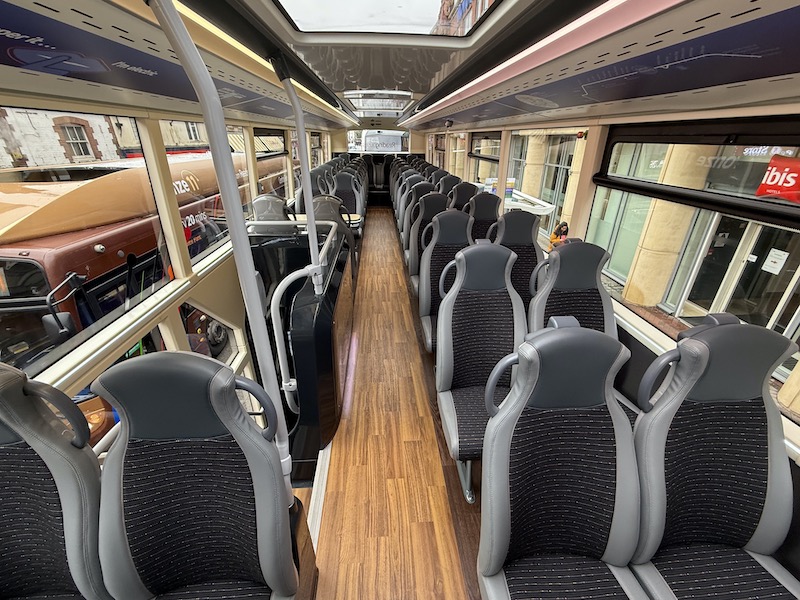
… with a smart grey based moquette and good leg room, both on the upper deck…
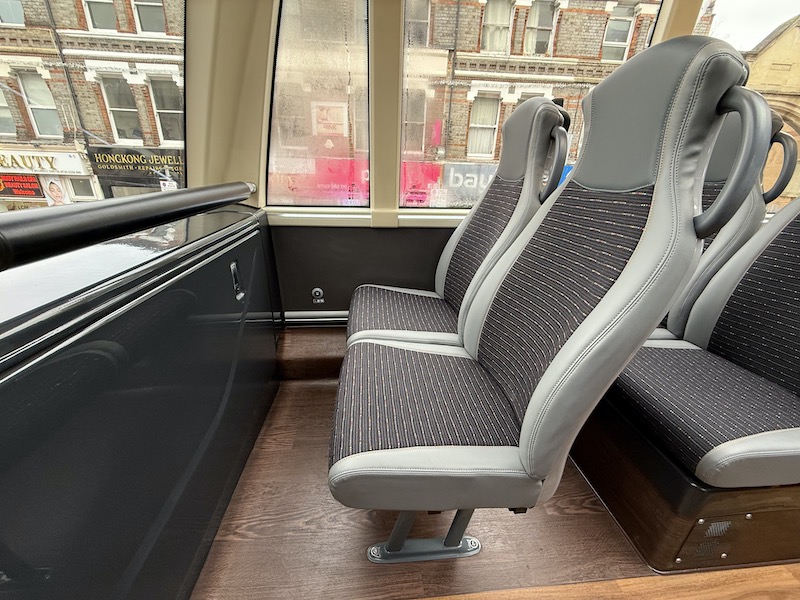
… and lower deck.
Robert Williams, Reading Buses Chief Executive, reminded staff that the company’s owners, Reading Borough Council, “acquired the town’s horse-drawn tramway in 1901 to electrify it, and it is notable that we are reintroducing a different form of electric technology in our 125th anniversary year. The old tramway ran from Oxford Road to Wokingham Road which remains the core of the purple 17 route.”
The company is marking its 125th anniversary this year in a number of ways including new fleet no 4 (RG04ZEB) being painted in a special gold livery.
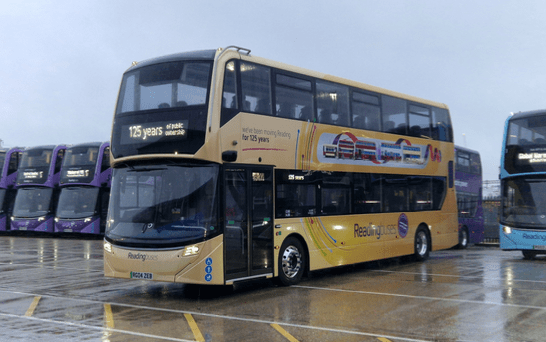
They’re impressive buses and the eight more expected this summer will be for operation on route 26.
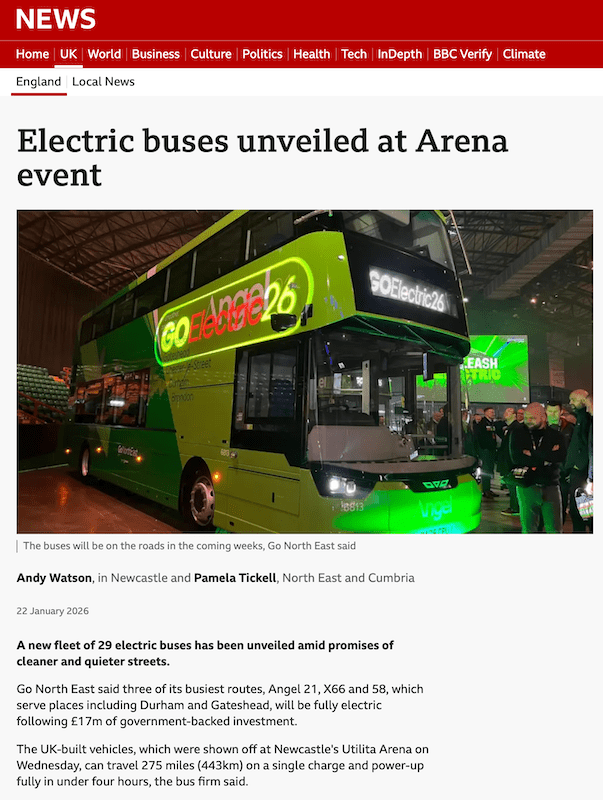
It’s interesting to note how other electric bus fleets are being introduced around the country including a characteristically razzmatazz style launch a couple of weeks ago for 29 Wright buses for Go North East “in an event unlike anything the region has seen” at the Utilita Arena Newcastle.
“Guests were welcomed with lanyards and limited-edition concert-style T-shirts, before the arena erupted into a wristband light show inspired by the likes of Taylor Swift and Coldplay. As the finale hit, the lights lifted to reveal our new fleet of electric double-deckers centre-stage – the first time buses have ever taken the spotlight at the venue.”
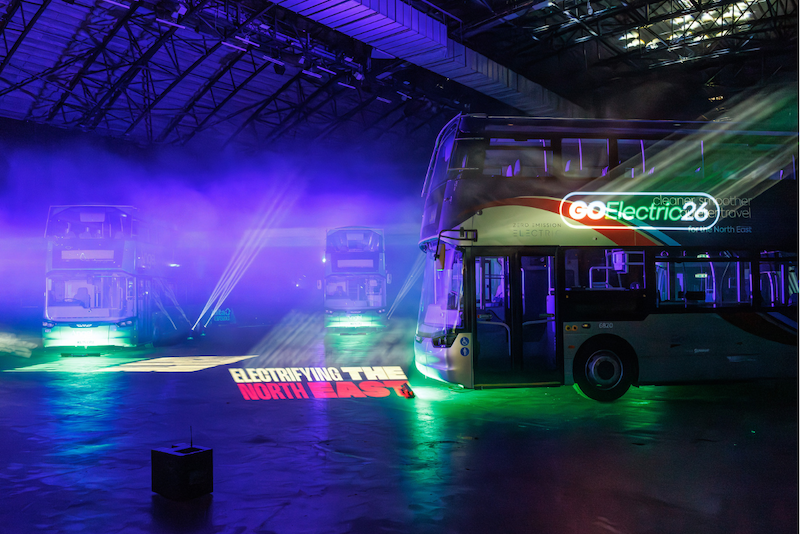
I often wonder how much such extravagant launches cost to put on and whether the resultant coverage in the local media and trade press justifies such a financial outlay, particularly when a more low key launch, as in Reading on Thursday, seems to have achieved the same level of coverage and awareness in the local market.
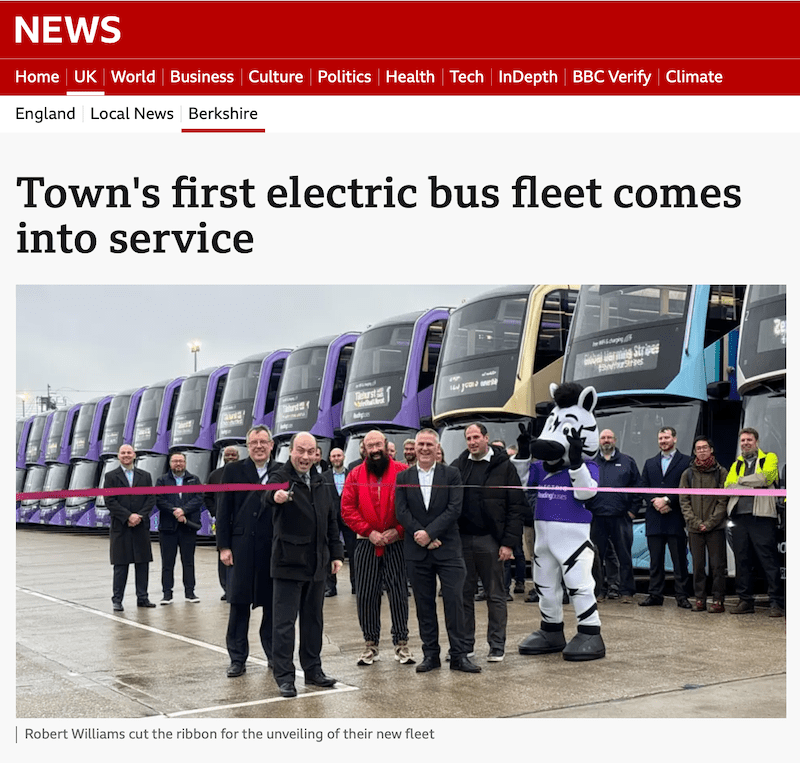
However it did encourage me to take a trip up to Newcastle on Monday to also check out Go North East’s new buses.
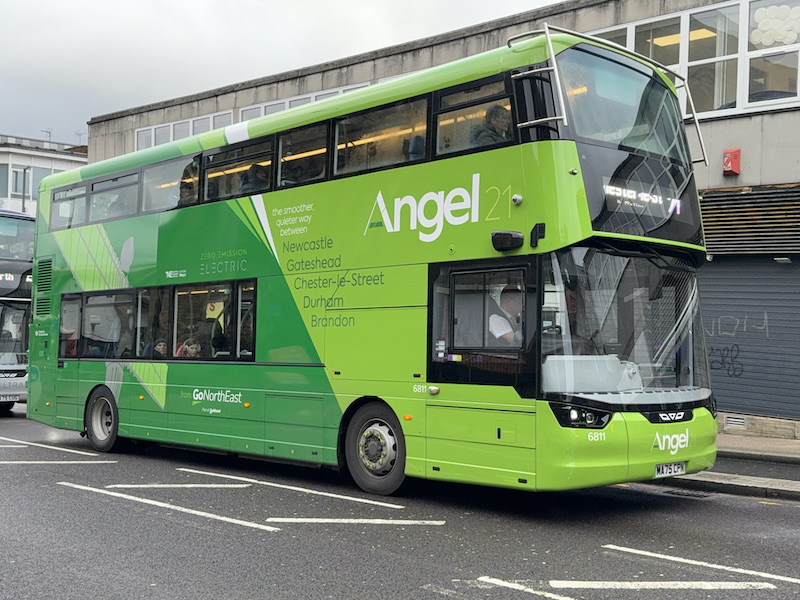
As already shown in the news image above, there are 29 of these new Wright StreetDeck Electroliners for routes 21, 58 and X66 although so far only enough buses have arrived to enable the first two routes to be upgraded and then not enough buses to make for a complete route conversion.
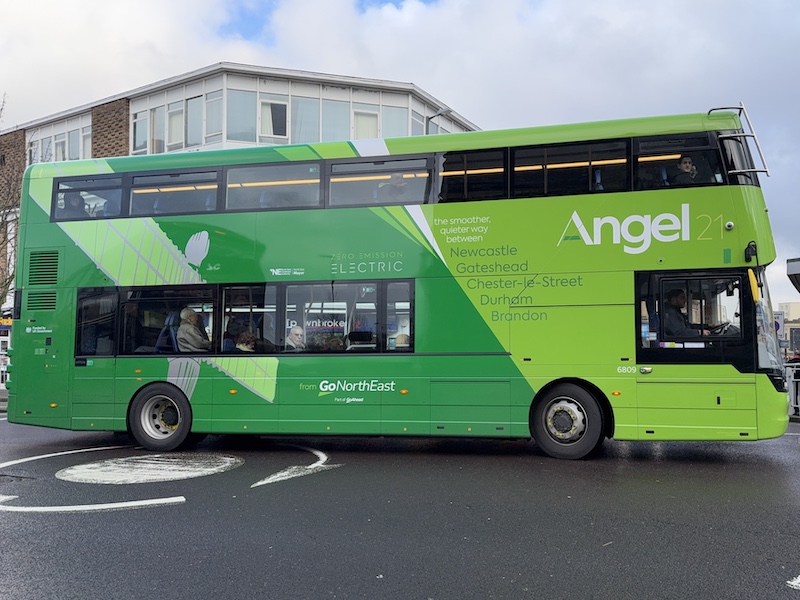
It looks like around 25 of the new buses have seen service so far with those for the X66 yet to break cover.
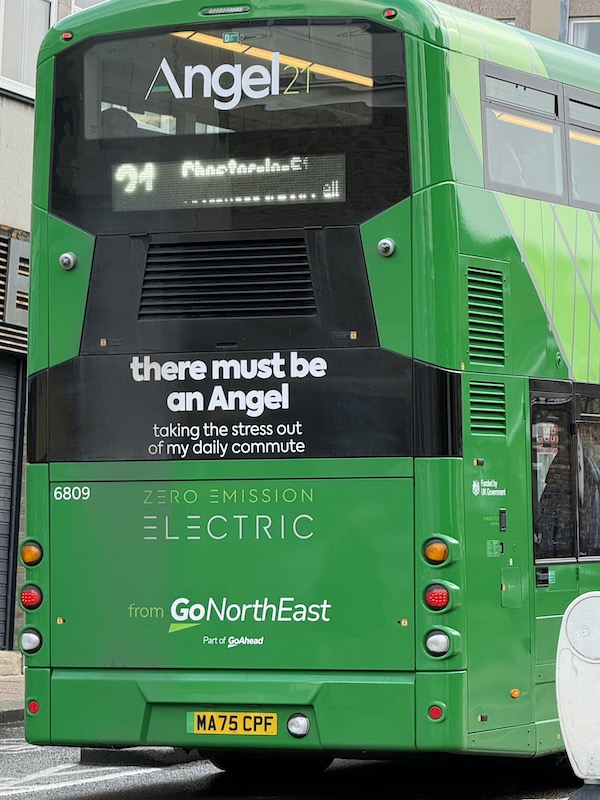
An updated version of the Angel 21 livery has been applied to the buses for that route…
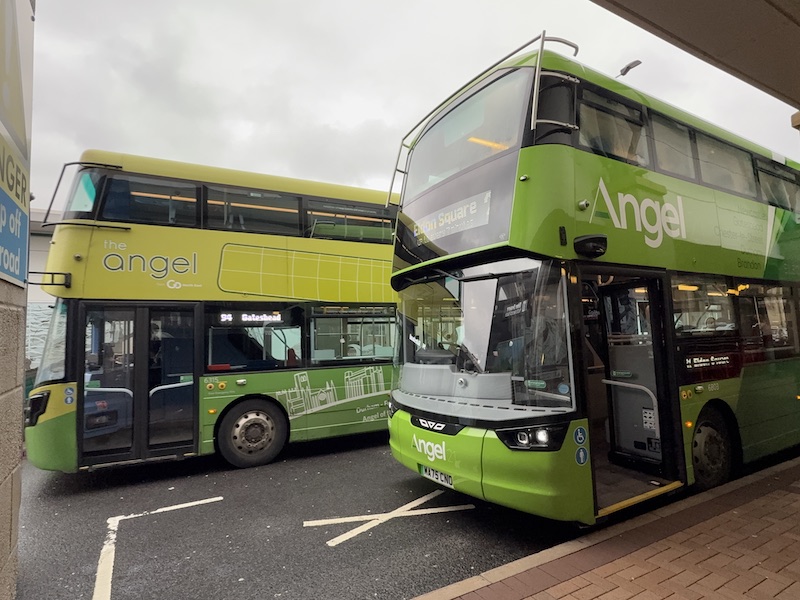
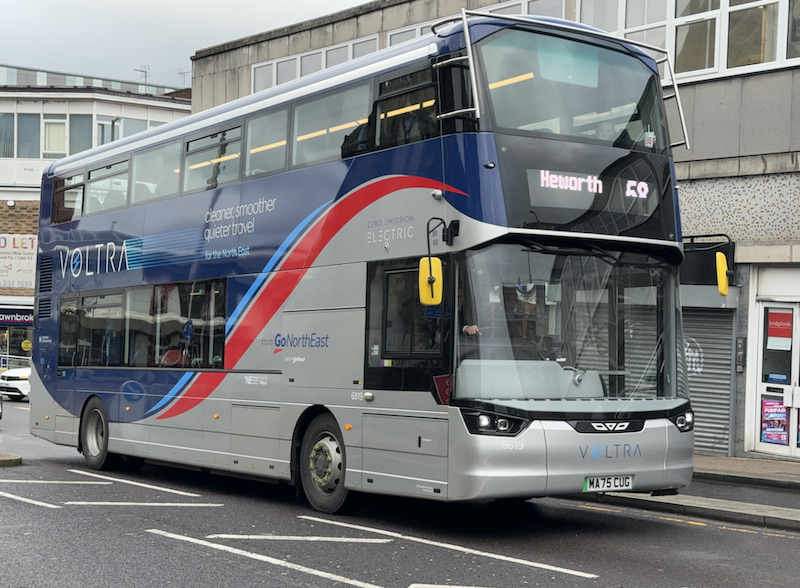
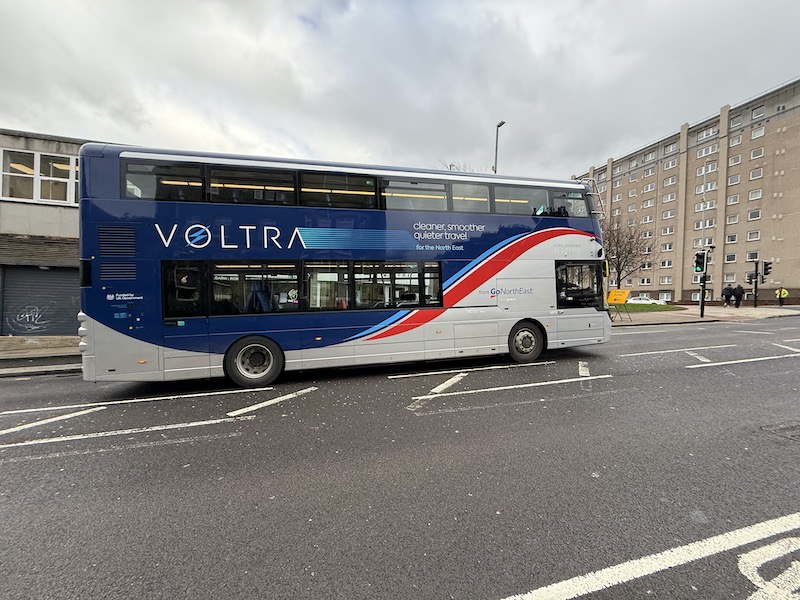
… with route 58 joining the Voltra branding first used for a couple of routes in 2020.
The interiors are smart but don’t come with the same refinements as in Reading. For example, a more traditional seat layout at the rear of the lower deck has a seat pair instead of the bench table over the rear wheel…
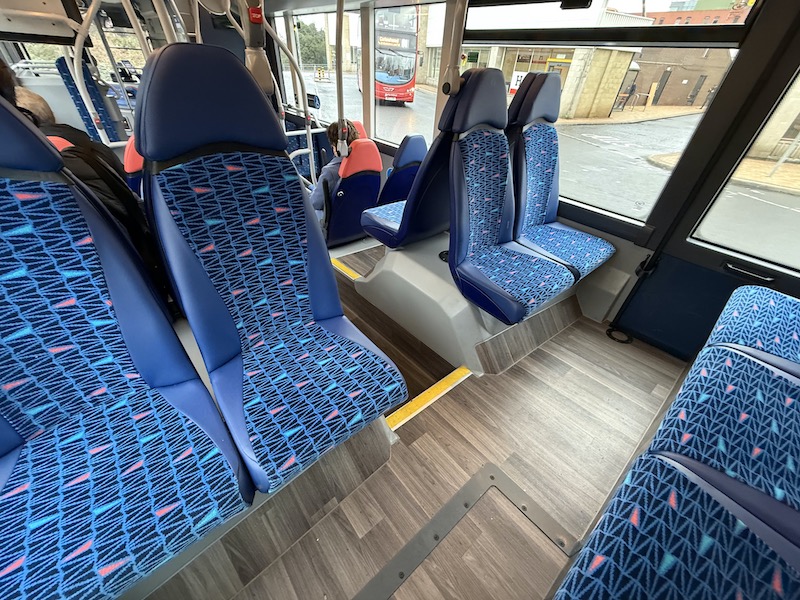
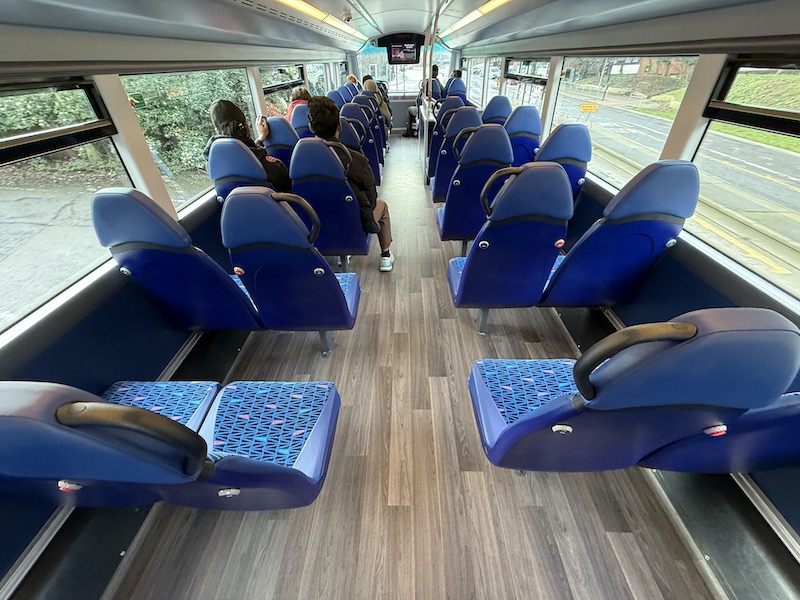
… and there’s no table upstairs, or mood strip lighting around the body panels.
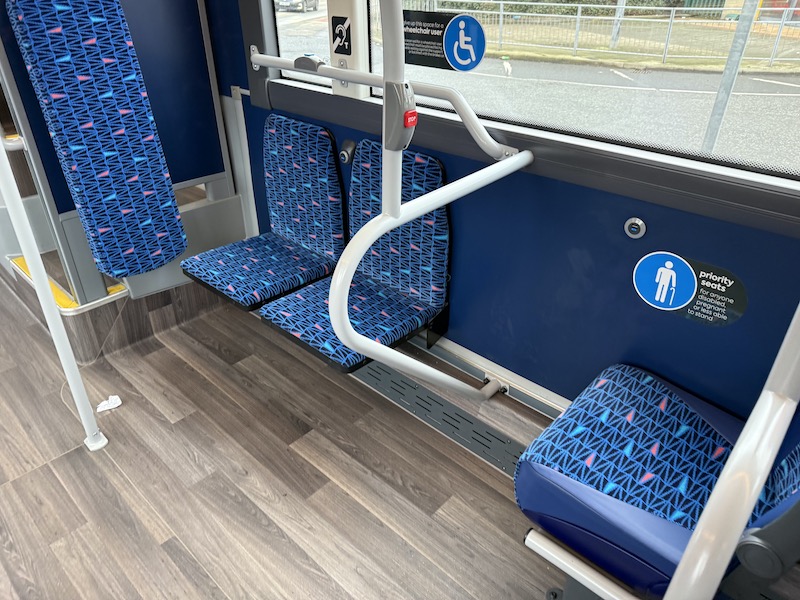
They also have two wheelchair spaces as now seems to be standard…
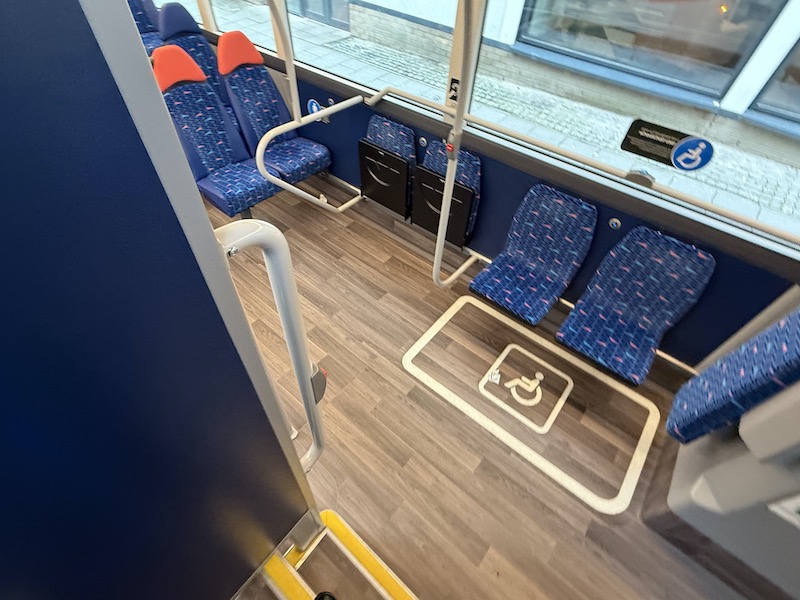
… although the offside space has a grab pole in front of a single ‘priority seat’.
It’s interesting to compare the lower deck layout with seven forward facing seats without a step up…
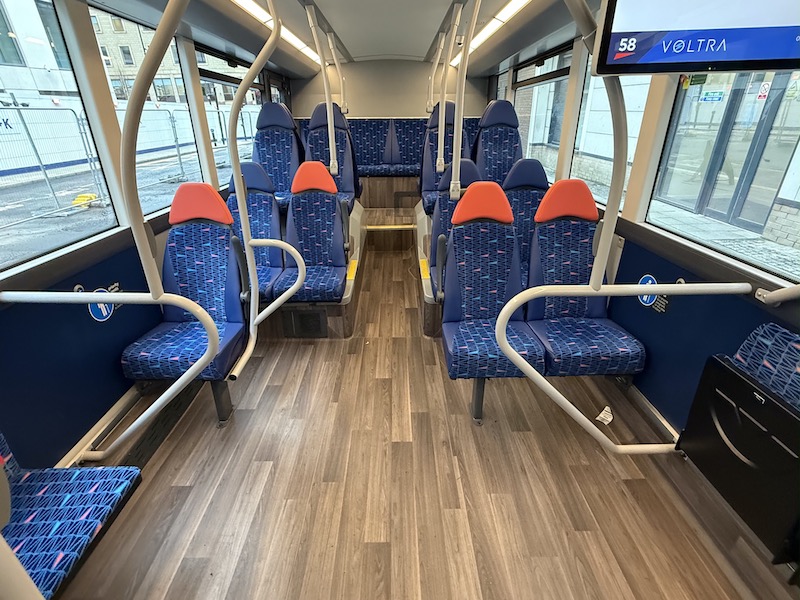
… compared to ten in Reading’s buses, as can be seen in this ‘side by side’ comparison.
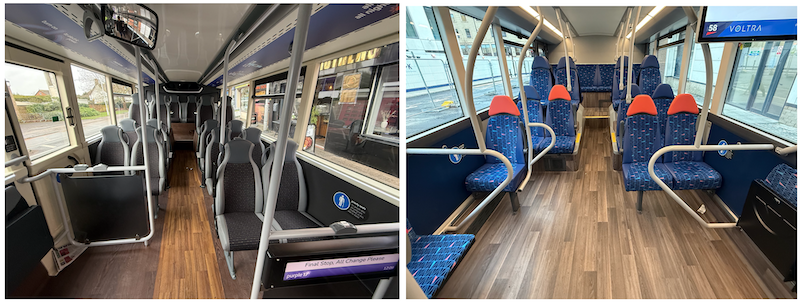
Although Go North East does offer more space on the nearside for a buggy as well as a wheelchair.
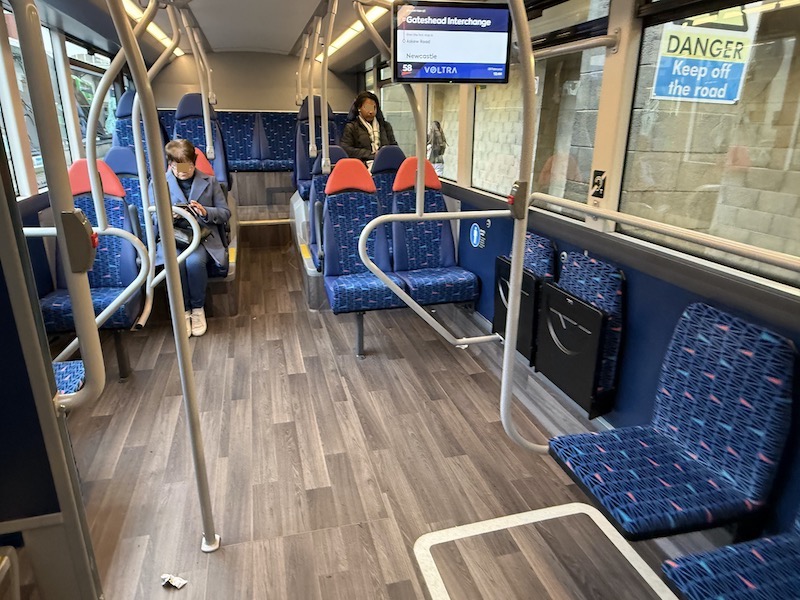
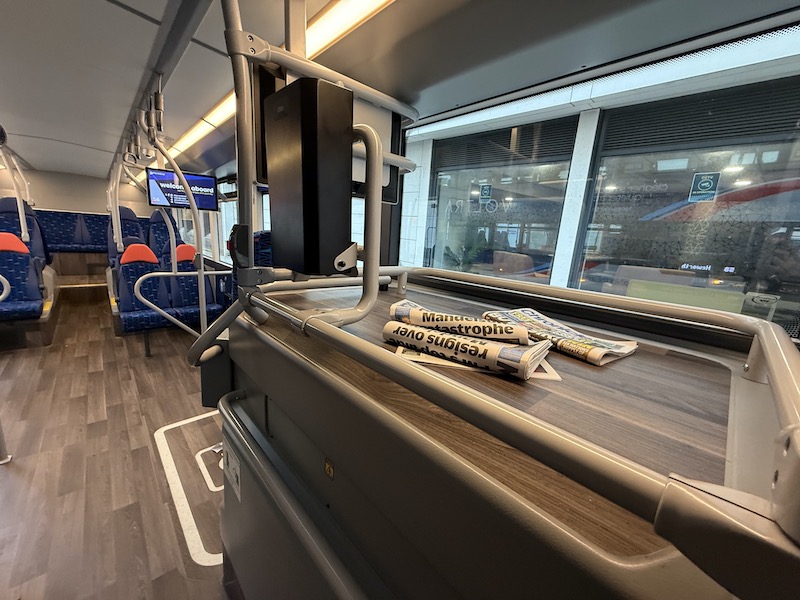
As in Reading’s buses there isn’t yet a holder for the Metro newspapers and there’s a more standard litter bin than the toaster variety.
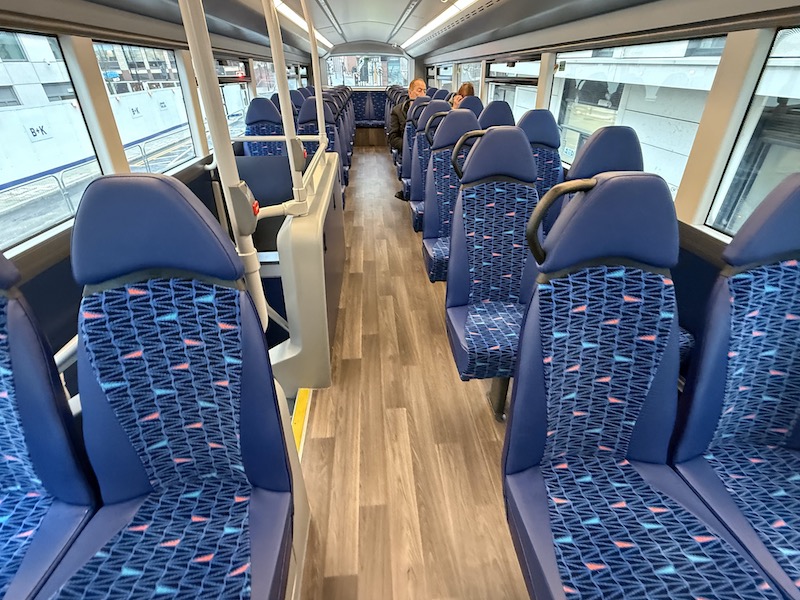
The seats themselves are comfortable, as is the leg room, but I prefer Reading’s more subtle grey based moquette. Also, there are no wireless charging holders on the rears of the seat backs but there are usb and bell pushes.
As in Reading, it’s good to see more new electric buses hitting the streets for passengers in the North East.
Roger French
Blogging timetable: 06:00 TThS
 BusAndTrainUser
March 14 is the 100th birthday of Workington bus station (the first proper bus station in the country). This would be a good feature especially as there will be celebrations, the unveiling of a new clock and some vintage vehicles. It would be a good opportunity for you to see how poor the new design of the layout is, and also to cover operations in West Cumberland. An opportunity to cover the closure of the coastal railway at Whitehaven while the tunnel is sorted (the orange water fiasco with the water colouring the harbour). Worth a trip to a remote part of England! Let me know if you coming up and I can show you round. Peter Fox
LikeLike
Sorry to disappoint but Maidstone claims the first purpose-built bus station, having opened in 1922.
Neville
LikeLike
Workington was the first covered bus station, and remains in use. Maidstone’s at Mill Street is now a car park.
KCC
LikeLike
The Three Tuns is at the Wokingham Road end. The Tilehurst terminal is the Bear Inn.
LikeLike
Thanks; corrected.
LikeLike
The Tilehurst Terminal has been renamed in recent years after the pub changed its name to ‘The Water Tower’ – after the adjacent structure which, along with a covered reservoir, was constructed in the 1930s just before the trolleybuses arrived. Both developments supported the extension of housing developments westwards into Tilehurst, which had been incorporated into the Borough of Reading in 1911.
The terminals were established when trolleybuses took over from trams on the ‘Main Line’ in 1939 and the route was extended to the Borough boundary at both ends. Both have remained consistent ever since, including the U-turn at each end of the route.
Reading Buses introduced route numbers officially in August 1964, starting at 15 upwards to avoid duplicating Thames Valley route numbers. The ‘Main Line’ became the 17 and has been the same ever since. It was the first route to be upgraded under Reading’s then-new ‘Premier Routes’ branding, becoming purple 17 in October 2004.
Julian Walker
LikeLiked by 1 person
Lower Earley is misspelt – the second ‘e’ is missing.
LikeLike
Thanks; corrected.
LikeLike
Looking at the photo of the rear of the red Reading bus (RG22ZEB) it looks as though it has a Beverley Bar roof profile. Showing my age here.
Gareth
LikeLike
Yes! The colour scheme causes an optical illusion.
RW, Cambridge.
LikeLike
I suspect ZEB refers to Zero Emission Bus rather than Zenobe.
LikeLiked by 1 person
That’s a good point. Thanks.
LikeLike
In other electric bus news, National Express West Midlands now have the first 50 of its new Wright Electroliners out in service from their garage in Wolverhampton, with a further 47 due to arrive in April.
LikeLike
Route 17 was, of course, the route number used by Reading’s trolleybuses. The Wokingham Road (Three Tuns) terminal is historic as that is where the Reading Borough boundary remains. A close look at the A-Z Street Atlas of Berkshire (no longer a county in its own right) shows that most of Reading University is located within the Wokingham Borough. A close study of all the unitary authority boundaries within the former Berkshire will leave all utterly bewildered. Traversing the A329 all the way to Bracknell used to be the territory of First bus Route 190. These baffling “Berkshire” borough boundaries, with the unitary authorities now responsible for bus service provision does the public no good at all. Unless I can be enlightened by those with greater local knowledge, we have Maidenhead and Henley on Thames (admittedly in Oxfordshire) not that far apart but no direct bus link. When my home county, Surrey, is rent asunder I shudder to think what damage shall be done to the current bus network.
LikeLike
The 228 connects Maidenhead and Henley, albeit only about every 3 hours. https://www.thamesvalleybuses.com/services/CTNY/228
LikeLike
I moved to Reading in 1970. Reading Bus routes started expanding beyond the borough boundaries at around the same time, and have been spreading further ever since. The Berkshire unitary authority boundaries, as fossilised in 1998, are indeed bewildering but they haven’t inhibited the expansion of bus services centred on Reading. For a while after 1994 I lived in Sonning Common in Oxfordshire and the principle bus service there was provided by Reading Buses.
LikeLike
So the moral of the story is that if you want cheap bog-standard electric buses, buy from BYD, Yutong etc; if you want up-market bespoke electric buses, buy from ADL (or Wright). Presumably it is easier to specify interiors from a local producer.
MotCO
LikeLike
I don’t know if the Stagecoach Yutong buses are “bog-standard”?
LikeLike
Based on my recent experiences in North London, the BYD double deckers (route 31) offer a superior experience vs the Wright EVs on 113. And I don’t think this is because buses on the 31 are newer or different operator choosing a premium fitout.
Not enough experience on a new ADL to offer a comparison, only the more aged BYD/ADL enviro200ev (route 46) which are now showing their age (creaky interior plastics and grumbly bearings).
The Geely Volvo MCV single decker EVs and single decker Wright EVs on local routes (187/268) are middling; locally some complaints about reduced number of “level access” priority seats (seats that don’t need a “step up”) compared to previous diesel buses on route (which I think we’re longer).
I do dislike the current trend for fake wood effect laminate flooring, though, my view is the wood effect always looks dirty, compared to previous use of grey or blue speckled “lino” type flooring which, when mopped clean, looks clean.
milest
LikeLike
Geely owns Volvo Cars, not Volvo Truck & Bus which remains in Swedish ownership https://www.volvogroup.com/en/investors/the-volvo-share/ownership-information.html
LikeLike
In other news, that will doubtless please Roger, Transport for Cornwall have produced a new timetable booklet for the February timetable changes, and made it widely available, unlike the last one.
LikeLiked by 1 person
Nice blast from the past having the fleet number match the reg 👍
LikeLike
All these references to Route 17 provoked a memory of visiting Reading in 1966 with a friend to ride on the Trolleybuses for the day. Apart from the 17, I distinctly remember travelling on a Sunbeam S7 six wheeler on Route 18 up Armour Hill & being fascinated by the turning circle there. Does it still exist? I also recall visiting the original Mill Street depot which I appreciate, disappeared years ago. This blog evokes wonderful memories as well as bringing events completely up to date. Well done Roger.
LikeLiked by 1 person
The turning circle is still there (although now largely used as a car park!). There are also still a couple of trolleybus traction poles left in Kentwood Hill although this is largely because they are too different to remove. There was also one remaining in Northumberland Avenue when I last checked – I do wonder whether this is quasi listed. The others in both Northumberland Avenue and Whitley Wood Lane, which had survived long after most had been removed, were replaced by modern lamp standards a few years ago.
LikeLike
note that the DfT funding reduce the present electric purchase premium back to that of a conventional bus. I would hope the batteries to last 10 years with the buses having a 18 year life.
Nice to see the Angel green yellow livery as green liveries have tended to dissappear with stagecoach first and arriva corporate colours. Transdev Keighley network being a bit of an exception but green coming back in recent years to indicate electric investment. Hopefully readings now spare older diesels can update other national operators fleets that in some places are a little tired though didnt reading corporation historically run their fleet to its maximum useful life?
JBC Prestatyn
LikeLike
The ZEBRA grant pays for 75% of the difference, so operators are spending more of their own cash than they would for an equivalent diesel bus.
KCC
LikeLike
That’s reasonable because it should be cheaper to operate electric buses than diesels.
LikeLike
Nice to see Reading Purple 17 electrified again. I am just old enough to have travelled on the trolleybus as a child to visit relatives. I remember they were silent in operation, no motor noise, just tyre noise and interior rattling.
Peter Brown
LikeLike
Rode some of the Reading Buses last Tuesday, not realising they were as new as they were!
Very nice!
LikeLike
They certainly look impressive pieces of kit. The outstanding vehicles for the X66 at GNE are due to be ADL E200EV, rather than Wrights Electroliners.
LikeLike
I believe the current registration format started in September 2001 with 51, then 02 in March 2002. So do the 24 Reading electrics have plates RG02 – 25 ZEB for buses 2 to 25, with no 1? It sounds like someone’s bright (?) idea, which will fail to continue unless there is only one new bus a year. In other words, a pointless gimmick.
LikeLike
No doubt you also see Google as a “pointless gimmick” – instead of making sarcastic comments you could have just researched it. Bus number 1 has the cherished plate “MRD 1”.
I don’t understand why having custom plates for this batch means every new bus Reading ever buy has to also have a custom plate?
LikeLike
MRD 1 has been used by Reading buses for over 30 years, first appearing on a MCW Metrobus, then Spectra 701, followed by OmniDekka 828 and until very recently was on Hybrid (later converted to diesel) 201.
I have submitted a Freedom of Information request to RTL, to find out how much these “RG–ZEB” plates have cost.
Emma
LikeLike
pprobably250quid each or whatever the going rate from dvla is plus the cost of a licencing bod in Reading Council.
LikeLike
That’s my guess – the RG – – ZEB combination isn’t going to be much in demand (as evidenced by the fact that 02 – 24 were all available) so the fee charged by DVLA was probably the base £250. Reading Buses has used select plates on a number of buses recently – it should be seen as part of the overall branding approach. In the grand scheme of things the cost is very small.
RG25ZEB and RG26ZEB are no longer available which may give a clue as to some of the registrations of the next batch of EVs…
Reading Buses has provided answers to frequently asked questions about EVs on its website –
https://www.reading-buses.co.uk/electric-frequently-asked-questions
This also explains why the buses only have a single door. Reading was an early user of two door buses, in 1957, with a batch of AEC Reliances. It also took delivery of dual door Bristol REs. From 1971 to 1987 almost all double deckers (apart from those for long distance services) had two doors. Since then only the Scania / ADL Enviro 400 City delivered in 2017/8 for Purple 17 have been to this layout.
LikeLike
one assumes the plates will last as long as the bus does and could be transferred in the future
JBC Prestatyn
LikeLike
Similar RBxx ZEB are on the DVLA Personalised Reg website for £250 or £399 each, which might give a rough guide.
LikeLike
Reading bus should have invested in the infrastructure for the gas bus, just wonder is it no longer sustainable on expanding the gas bus fleet, or is the Op cost be lower for e-bus. It was a bit surprised the new 17 buses are single door again. Go Northeast have long awaited for new buses, hope the Wright would work well on the long 21 route.
LikeLike
I don’t know for certain but I think all Reading buses have been single door vehicles for quite a long time now.
LikeLike
The 67-plate Enviro 400s these are replacing on the Purple 17 were double door.
LikeLike
No manufacturer currently provides a UK-spec gas bus, and as they are not zero emission, would not have been eligible for any grant funding. It is effectively yesterday’s technology – a Betamax cassette in a digital era.
LikeLike
The electrics on the 21 Angel have been a disaster. They don’t have the required range and have been constantly breaking down. They’re entirely unsuited to the route.
they can’t do evening runs, they can’t cover the N21 and now GNE are adding runs to Riverside depot from Eldon Sq to charge the vehicles, a challenge when the 21 rarely keeps to time.
lovely having shiny new electrics, though the interior is a downgrade from old Streetdecks, but without infrastructure to charge in Newcastle, Chester le st or Durham, they’re a dud
LikeLike
The Voltra ones are also coming in at night so it’s not to do with range. The vehicles have generally been in service for just three weeks so they’re managing their entry gradually and working on them at night.
BW2
LikeLike
Interesting that GNE are having this big song and dance about new electric buses, when they already had 18 electric buses in the fleet, the first batch are over 5 years old now … great to see the investment, but it feels like the event might have been a little bit over the top for the circumstances!
LikeLike
isn’t the arena sponsored by an electricity supplier?
JBC Prestatyn
LikeLike
I really hate those stop buttons built into the seat back. Unless you’re sitting in the row that has one it just feels like a massive invasion of someone’s personal space to have to reach in and press it.
LikeLike
I also feel they should be more “recessed”, to help prevent accidental use.
LikeLike
Roger. This is a well covered analysis of these two operations. Interesting to see reading upping the anti perhaps they need a better standard as it’s closer to the capital hence a higher spec.
it’s still waiting and see in the “city” salisbury in wiltshire.
currently struggling to get 3 69 plate ones in daily service
new vehicles. NO SIGN. How wcc promote them is anybody guess.
they need to get long term rosd work completed first.
I can’t imagine it will be anything better than a ribbon cut. Using SCISSORS
regards. Stuart
LikeLike
reading has become a hi tech financial centre with accountancy and consultancy practices, prob also more active retired persons
LikeLike
The “Angel Network” brand is proposed to be used for the NECA “franchised” bus network which works in Gateshead (the location of the Angel of the North) and along the current 21 route but has absolutely no relevance to anywhere north of the Tyne, such as Northumberland.
William.
LikeLike
Another really good blog post – I was particularly interested in the interior comparisons having tried the Go North East but not the Reading vehicles. I found the view forward from the seating over the rear wheels on the lower deck really restricted by the back of the large tv monitor for the wheelchair bay, the Reading solution of having it mounted lower so it’s closer to the wheelchair users eyeline and also doesn’t block other passengers forward view seems more more effective. I found the same issue of restricted forward view on the Stagecoach single deck Youtongs too.
Steve
LikeLike
Thinking of the Reading change, this is how to do a launch. A whole route conversion on a single day. I hope there was fanfare inside the bus as well as at the event. The customer experience changes, for the better, for always. It can be a talking point. The compares so much better than when a depot gets a random allocation of newish buses which are scattered around a network meaning that the overall experience on any given route varies day to day and each time a few swaps between depots are made. Done right, it’s a factor in changing the perception of bus travel. Consistency of brand, and I mean in the broadest sense, is something where the bus industry lags decades behind retail and most other industries in all but a few isolated cases.
Interesting that the service has reverted to single door. I have to say also that I might have tweaked the livery just a bit more, so it’s strikingly new different inside and out.
LikeLike
Two brand new buses on the Angel service as pictured side viewed. One has camera mirror and the other standard mirrors – is it not consistent?
LikeLike