Tuesday 3rd February 2026
Two very different ‘nearly new’ trains entered service last week, and ok, one isn’t exactly ‘nearly new’ in that it’s approaching its 50th anniversary, but I bet some passengers won’t realise.
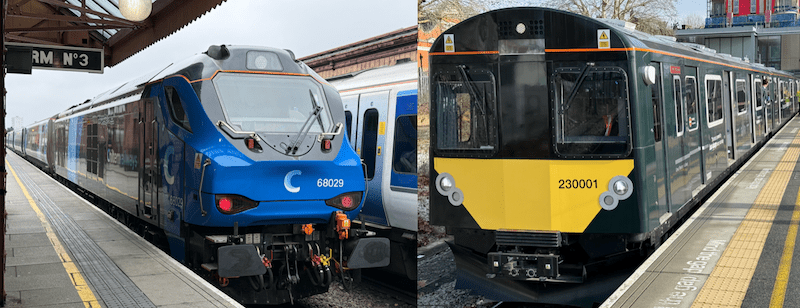
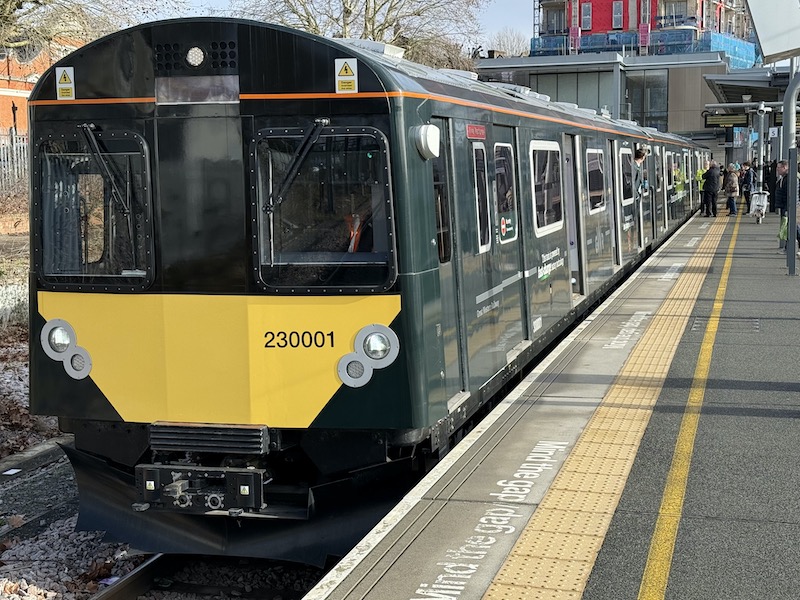
The more modern of the pair is Chiltern Railways’ loco hauled Mark 5A coaches formerly with TransPennine Express where they saw very little service (if any at all, in some cases) since new in 2019, being withdrawn in 2023, while the more ‘mature’ of the pair is GWR’s former London Underground D78 Stock now reclassified and rebuilt as Class 230 and uniquely this example being battery powered with fast charging capability.
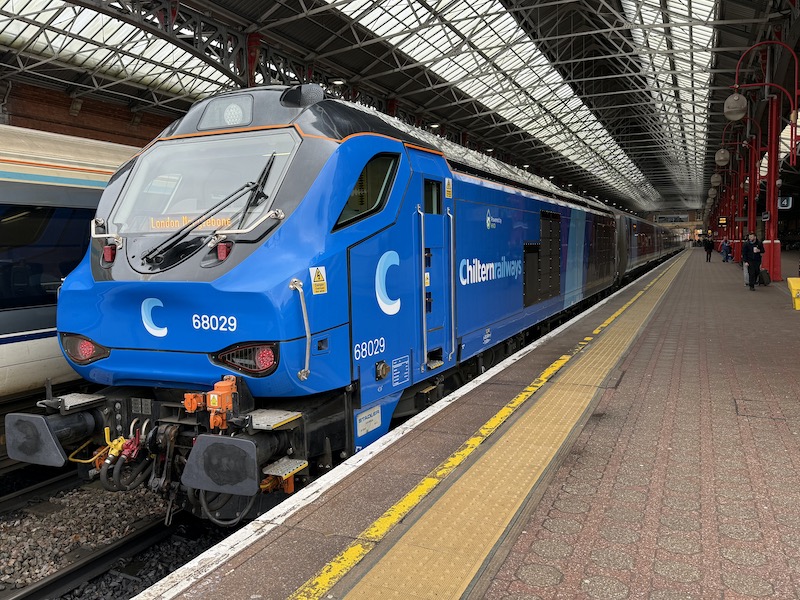
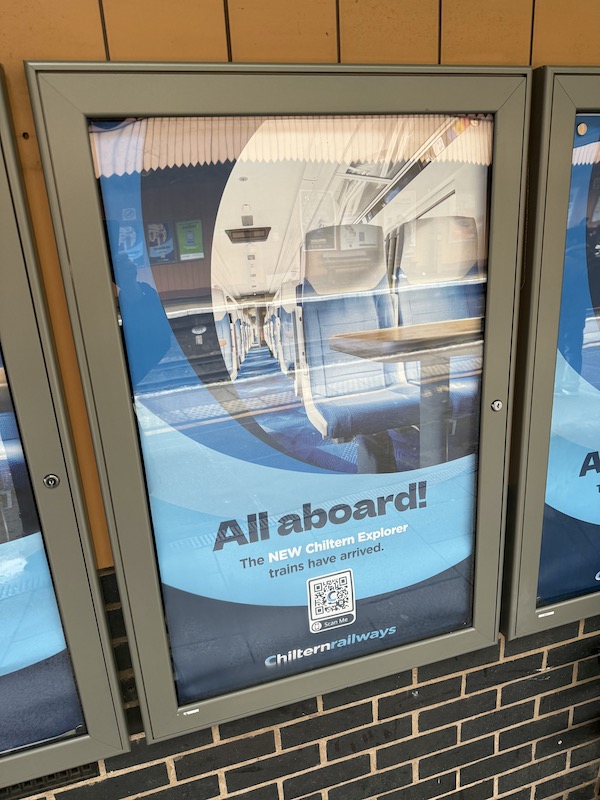
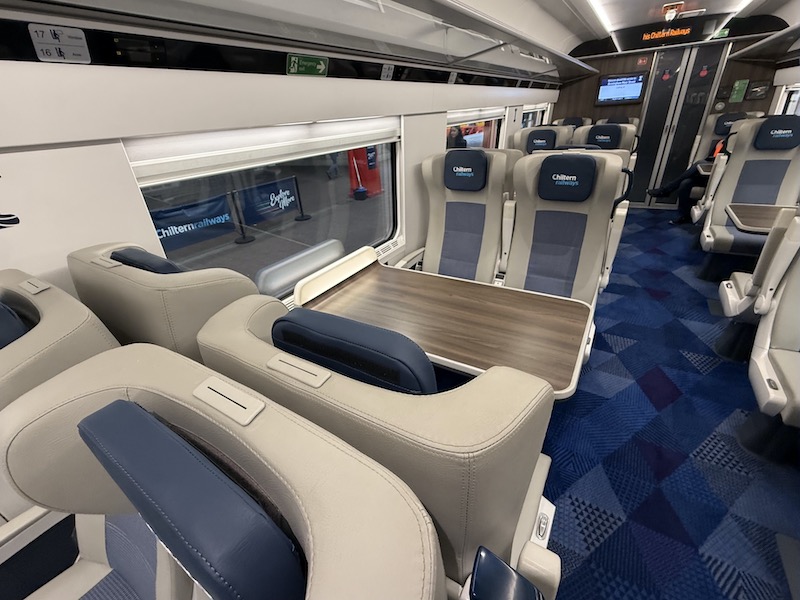
First up of the two was the launch last week of the newly branded ‘Chiltern Explorer’ trains sporting a smart new Chiltern Railways livery for both the (Class 68) locomotive and the five coaches.

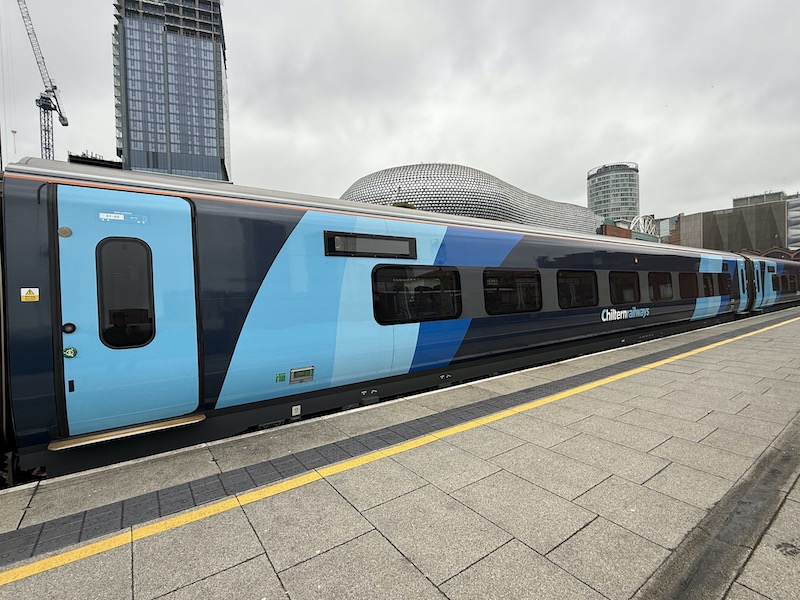
These ‘nearly new’ coaches provide a much welcome step up in comfort and ambiance compared to Chiltern’s almost fifty year-old Mark 3 carriages they’re replacing.
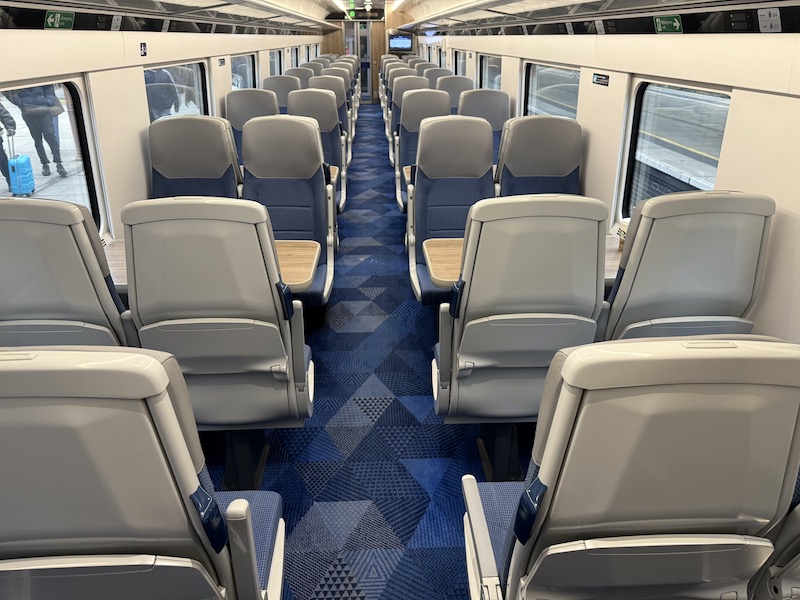
The company has taken new ten year leases on the 13 former TransPennine Express sets and although each five carriage rake has 90 fewer seats than the trains they’re replacing, overall capacity will improve following Chiltern’s intention to increase the number of trains in an expanded timetable between Marylebone and Birmingham Moor Street.

The aim is to get that in place by the end of this year when it’s hoped 10 of the 13 trains will be in daily service making for a consistent half-hourly frequency together with extra journeys to and from Banbury thereby providing an additional 10,000 seats per weekday to Chiltern’s network representing an impressive 10% increase in capacity.
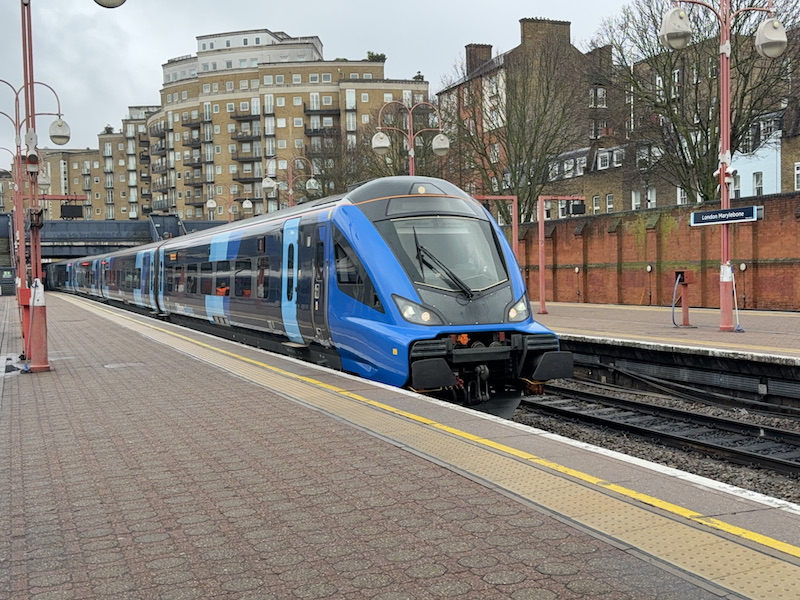
This increase also comes from the ‘new’ trains enabling Chiltern to cascade older Class 165 and 168 trains to other routes with the former to be used on expanded commuter routes between Aylesbury/High Wycombe and London and the latter on more Oxford journeys to and from London. Chiltern reckon overall, the number of journeys will increase from 350 to 380 per day.
It’s one of those ‘just in the nick of time’ changes as Chiltern’s Mark 3 stock is coming off lease at the end of next month making it vital a suitable replacement was made available in time and thankfully the DfT approved the acquisition of the Mark 5As last August giving the company just enough time to get everything in place for a gradual roll out over the coming weeks. It’s hoped to have four in service by the time the Mark 3s are withdrawn but at the moment just one is in passenger service.
I took a ride on it from Marylebone to Birmingham and back yesterday and was very impressed with both the comfort and ambiance recalling my sample journey when the trains were first introduced by TransPennine Express over six years ago, since when they haven’t clocked up many more miles being stored out of use in sidings for the last few years. I believe a few units still had the bubble wrap protecting the interior, never having been in service.
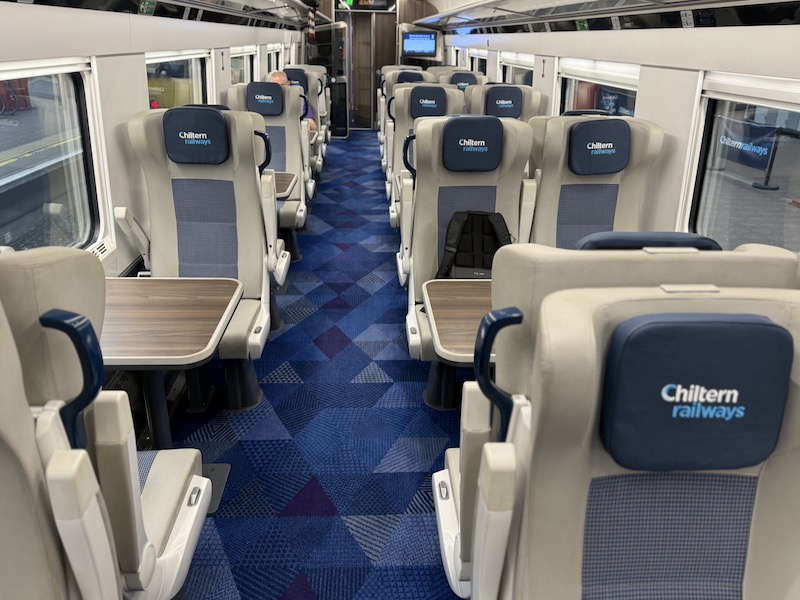
In a change of policy for Chiltern, the company is keeping the First Class coach E in the Mark 5A set. Previously it tried a ‘Business Zone’ in the Mark 3s but this was dispensed with in Covid and never reinstated. Until all the sets are in service, passengers can pay for a £20 upgrade on the train rather like the erstwhile ‘Buisness Zone’ arrangement.
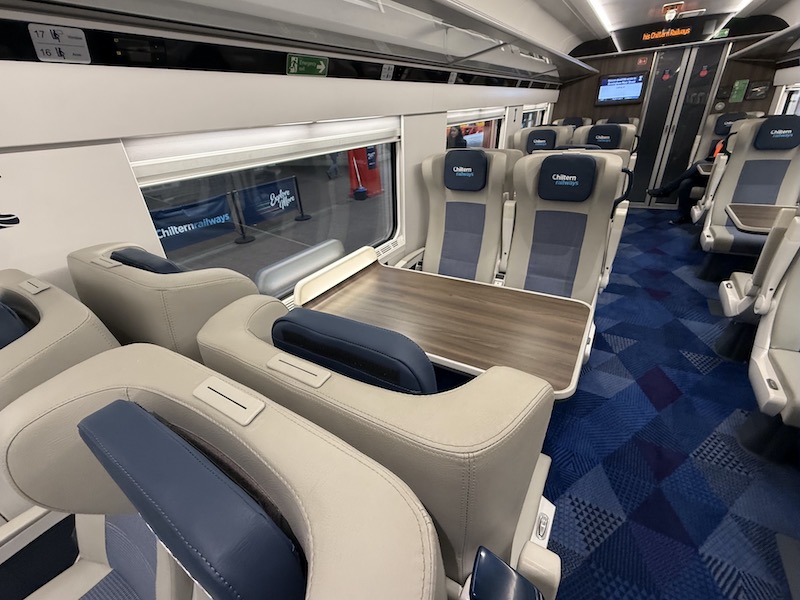
During this period, there’s no refreshment facility and I understand no arrangements are so far in hand to commence one. This will be a shame as all other long distance train companies provide, complimentary refreshments in first class and passengers will expect it.
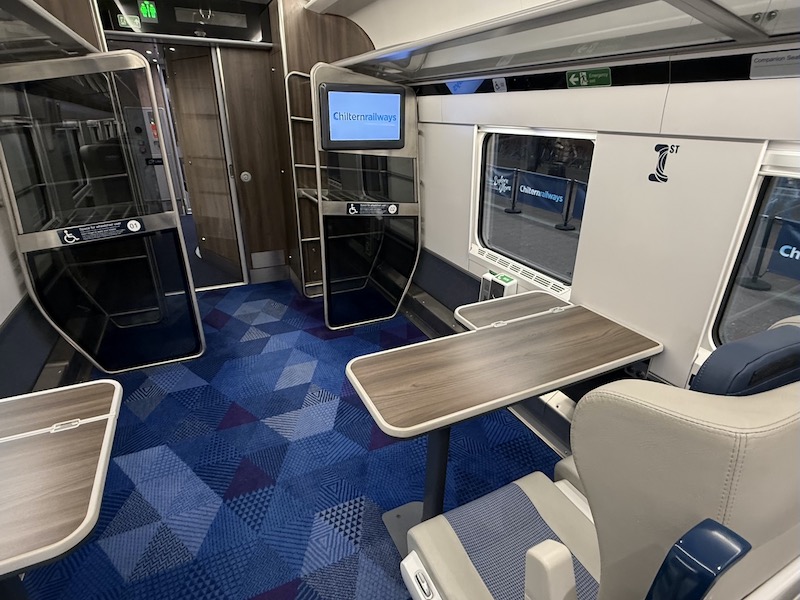
Another oddity is TransPennine Express only specified two spaces for a wheelchair both in the First Class coach E whereas most five coach sets also have spaces in Standard Class Coach A. Chiltern is ensuring passengers using a wheelchair as well as one carer can use the space without paying the First Class £20 upgrade.
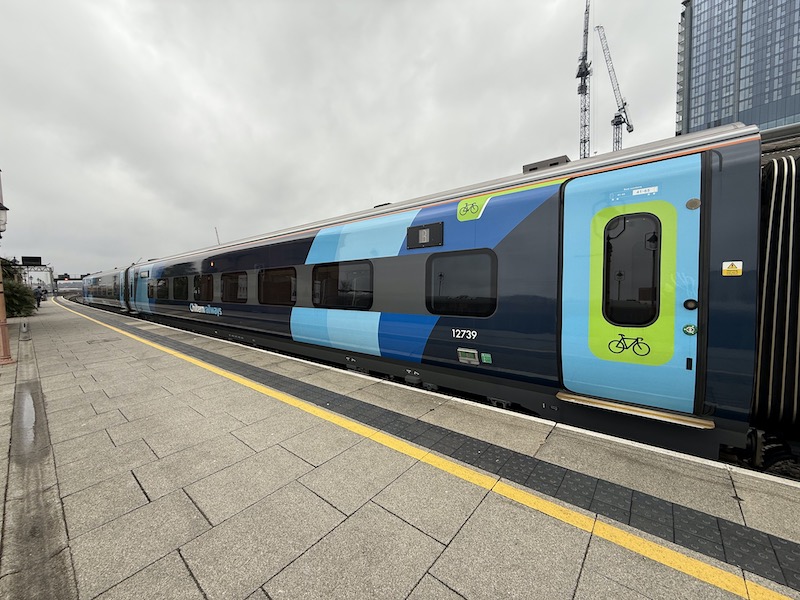
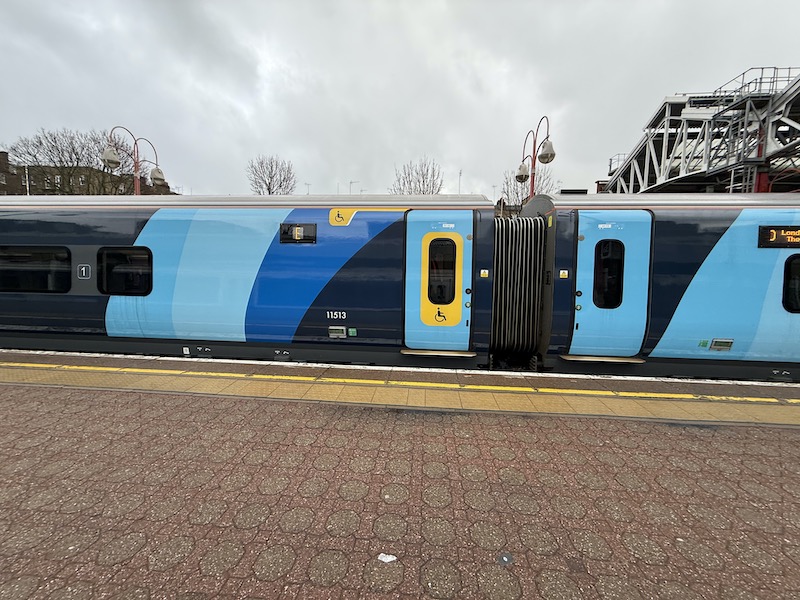
I was expecting to see the new livery incorporate the Chiltern Explorer branding that I understand the trains are being called…
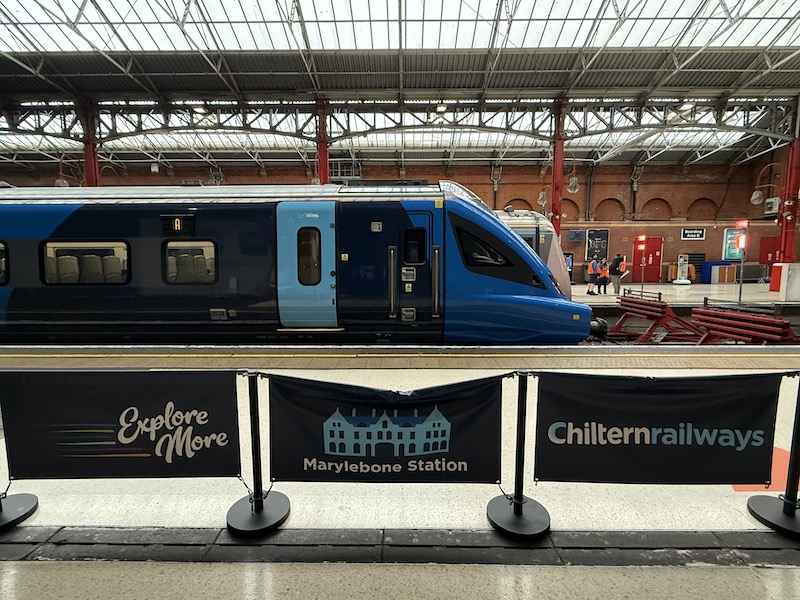
… so was surprised not to see it, but very much like the new colour scheme – so much better than the glimpse we recently got of a proposed GBR livery.
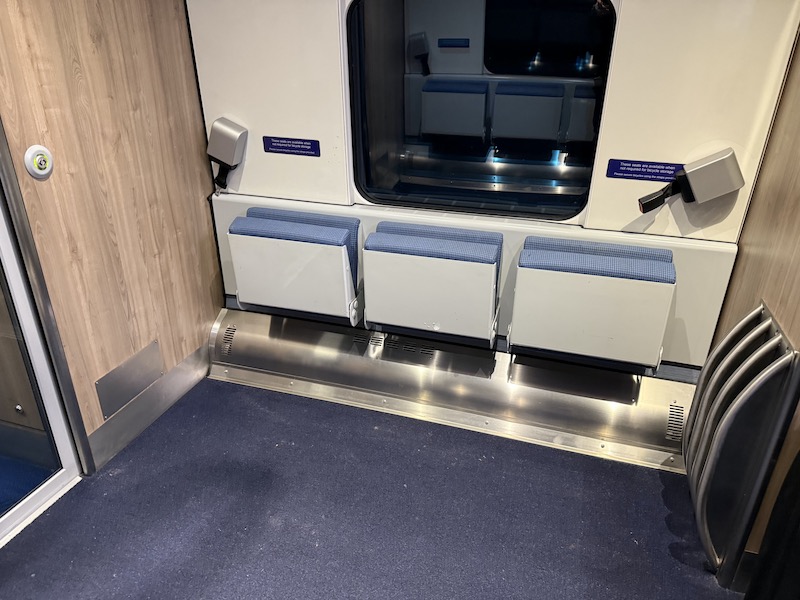
Coach B has dedicated spaces either side of the gangway for cycles with three tip up seats too.
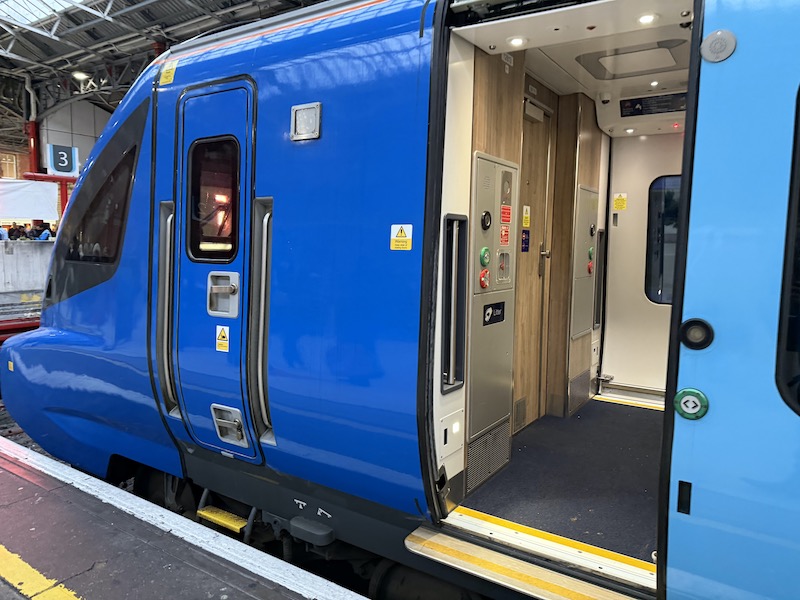
I very much enjoyed my day trip to Birmingham. Both Marylebone and Moor Street are so much more pleasant to use than Euston and New Street and these splendid ‘new’ trains really feel like proper trains with their locomotive hauled coaches, albeit the Class 68 only appears at one end of the train.
It’s nice to see Chiltern back on top offering a quality product. Chiltern’s passengers’ gain is TransPennine Express’s passengers’ loss.
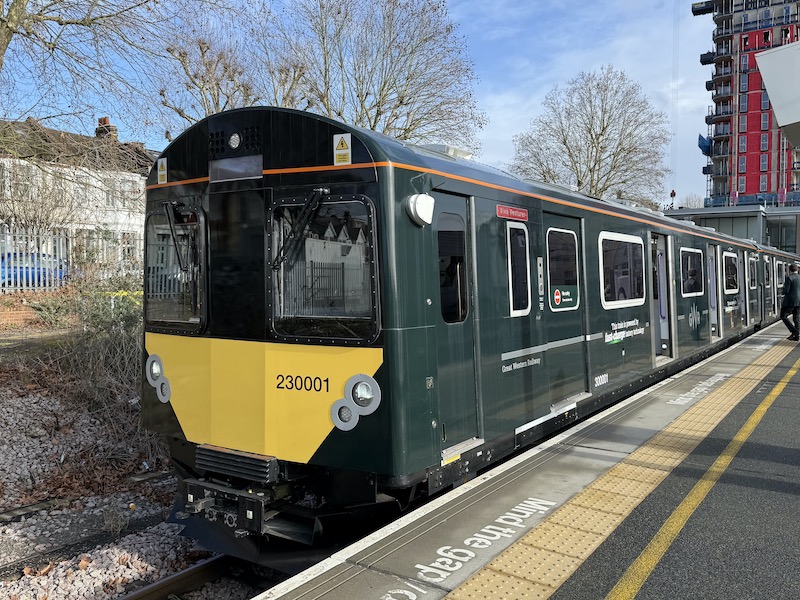
The other ‘nearly new’ train is GWR’s Class 230 train. This truly is an innovative development with GWR setting out to see if battery powered trains can run cost effectively and efficiently on branch lines of which GWR has quite a few, both in the Thames Valley and the West Country which are all currently operated with ageing diesel trains.
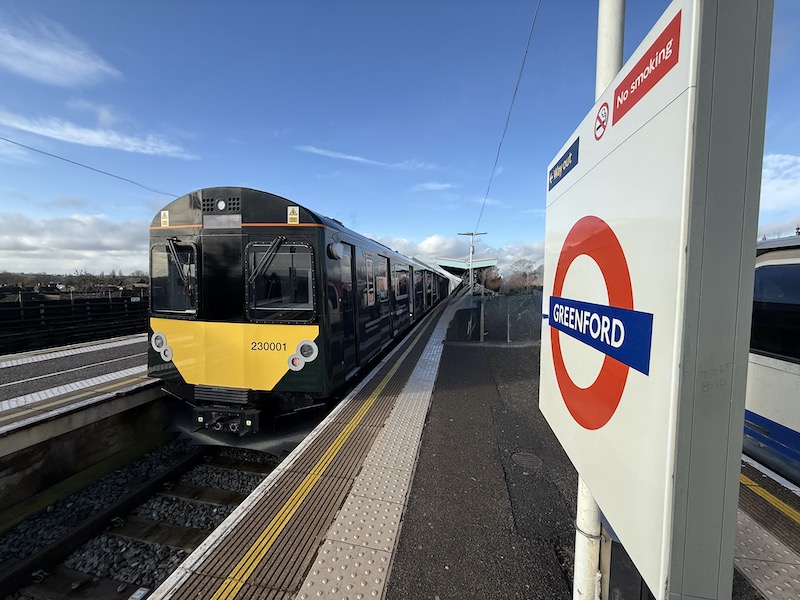
This one train, 230001, has been refitted internally as per the original concept begun by Vivarail before it went into Administration in December 2022 and led to electric versions of the former District line trains in service with South Western Railway on the Isle of Wight and diesel versions running with Transport for Wales and previously with London Northwestern in Bedfordshire.
The seats and facilities in this refurbishment are excellent for the short journey lengths passengers typically make on branch lines not least the West Ealing to Greenford shuttle which is the subject of the current trial. It’s only two and a half miles long and a 12 minute journey from one end to the other.
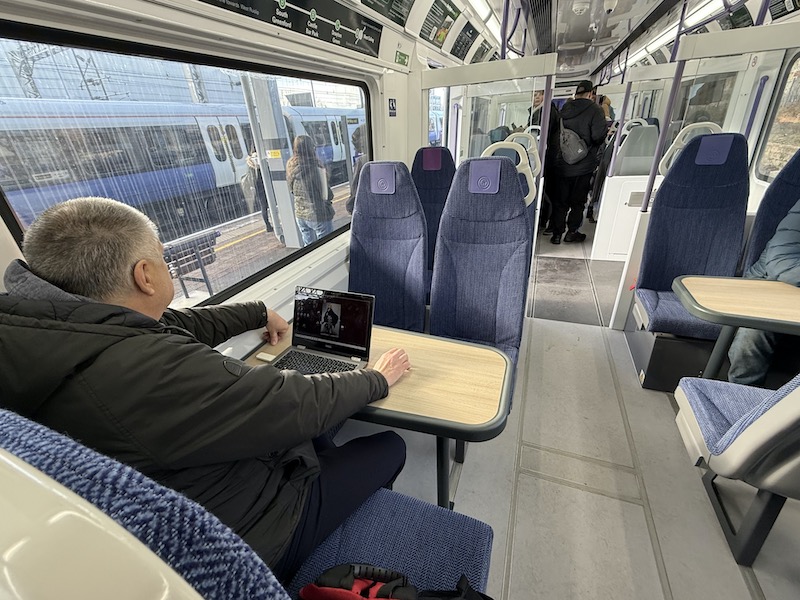
The interior is bright and smart with an accessible toilet in the middle of the three coach train…
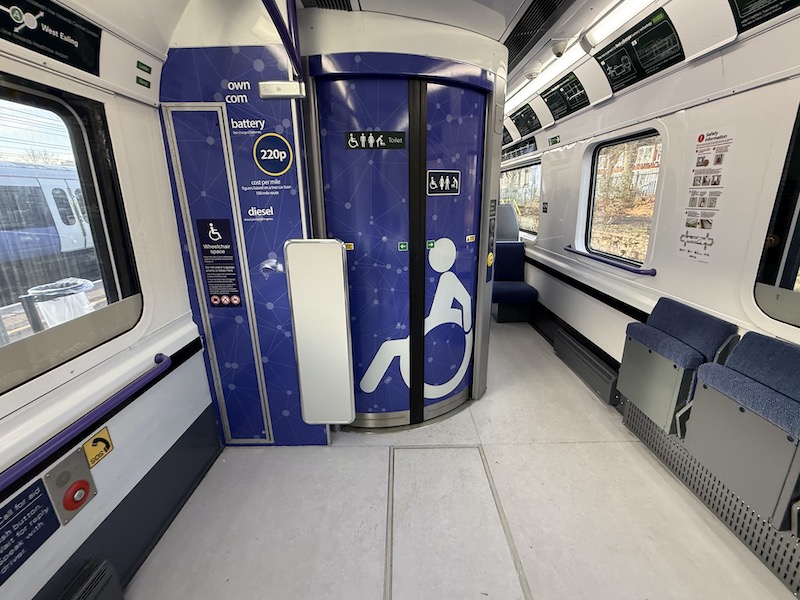
… and an adjacent area for a wheelchair user…

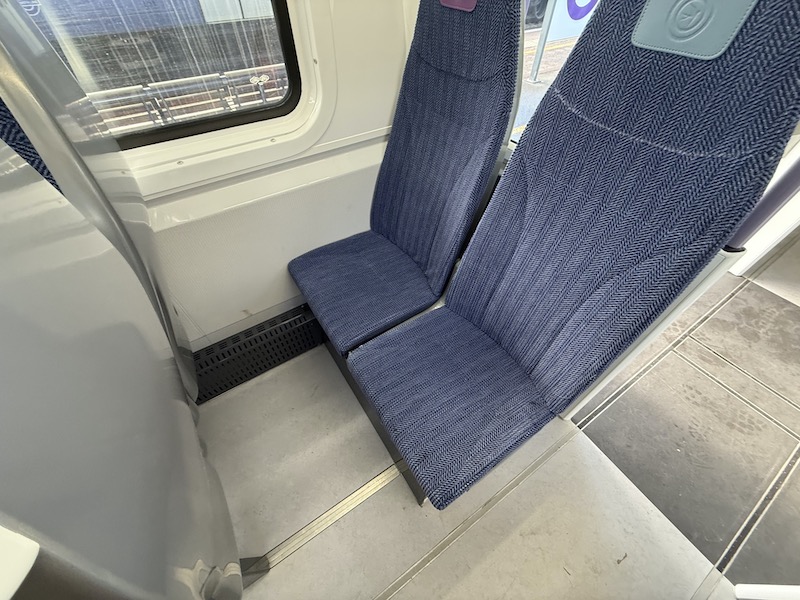
… as well as some tables, airline style seat pairs and some longitudinal seats, all with usb or power sockets…
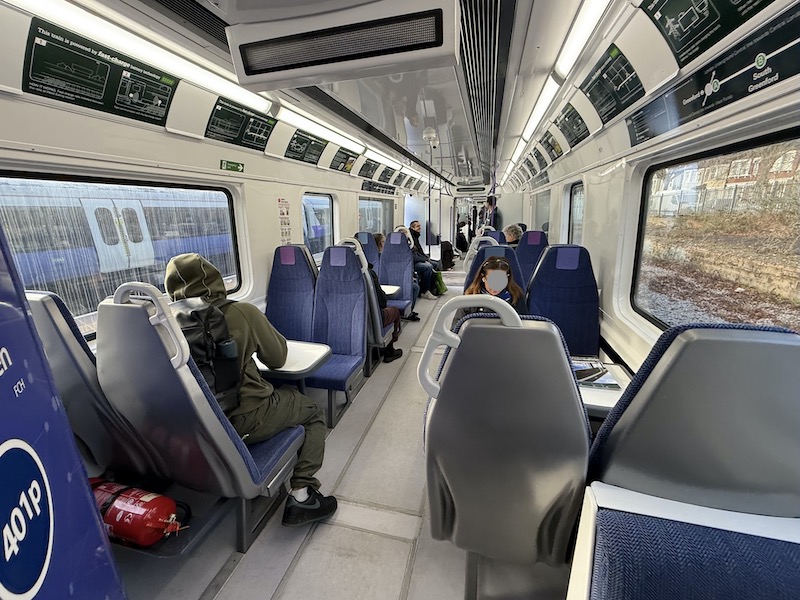
… and with good leg room.
What’s revolutionary about the train is its fast charging batteries which have been placed in two banks under two of the three coaches on the train.
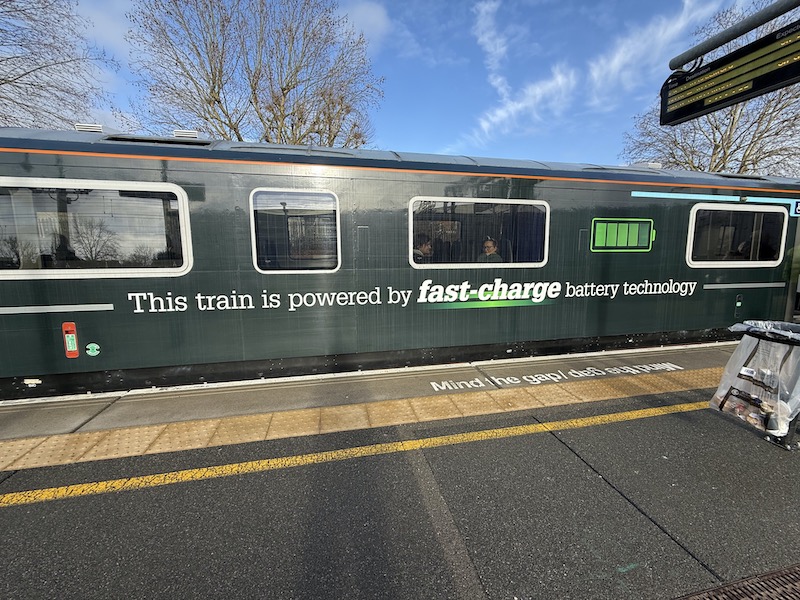
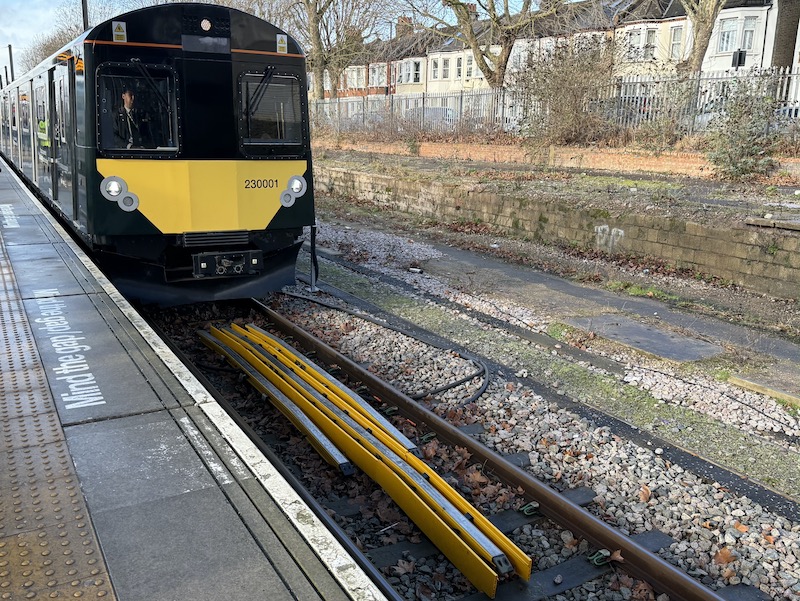
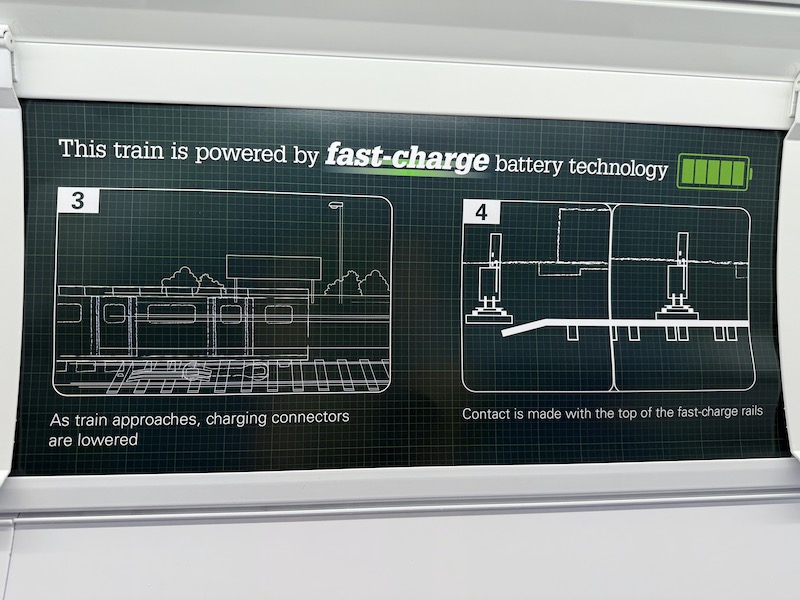
Every time the train arrives at West Ealing the shoes attached to the batteries under the train line up exactly with two strategically positioned fast charging rails in the centre of the track.
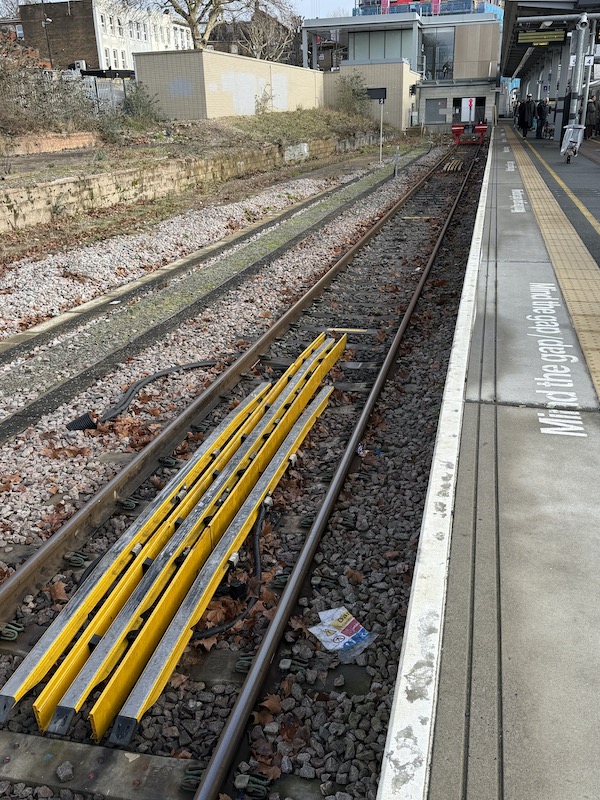
These have three rails in each unit – a positive one in the middle and two negative outer ones – so it doesn’t matter which way the train is pointing when it arrives into the station, the negative shoe will always come into contact with a rail.
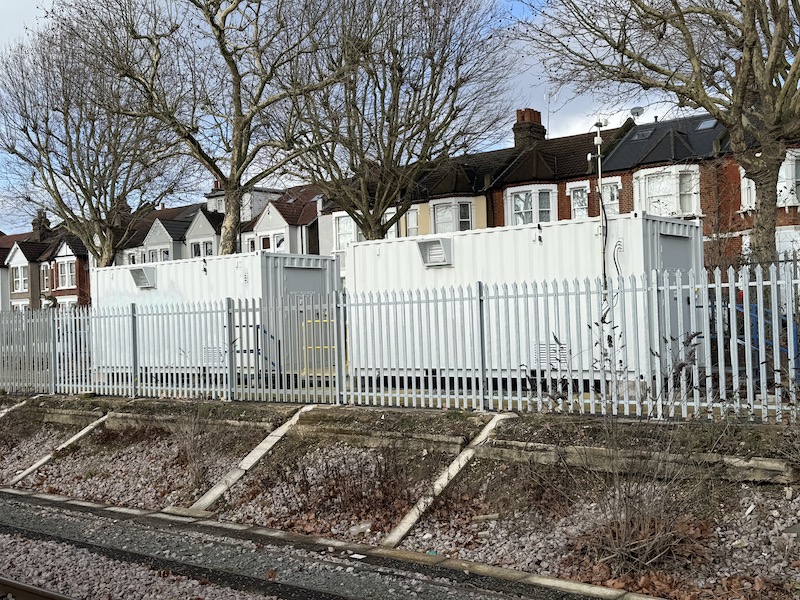
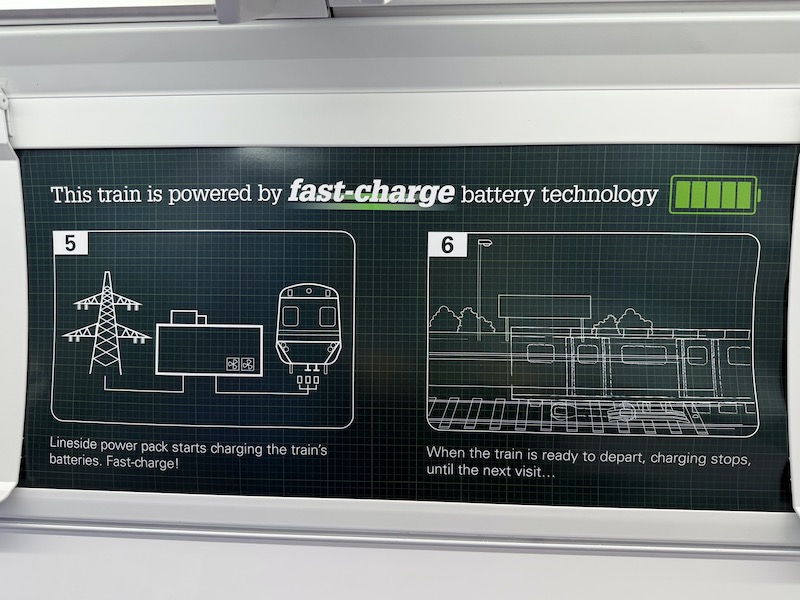
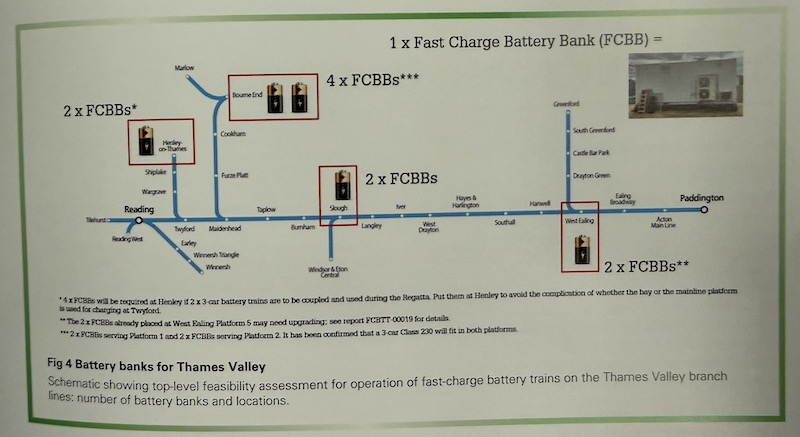
At the side of the track is a bank of batteries linked to the grid and housed securely in two ‘shipping container’ style cabinets similar to back up power arrangements at many hospitals.
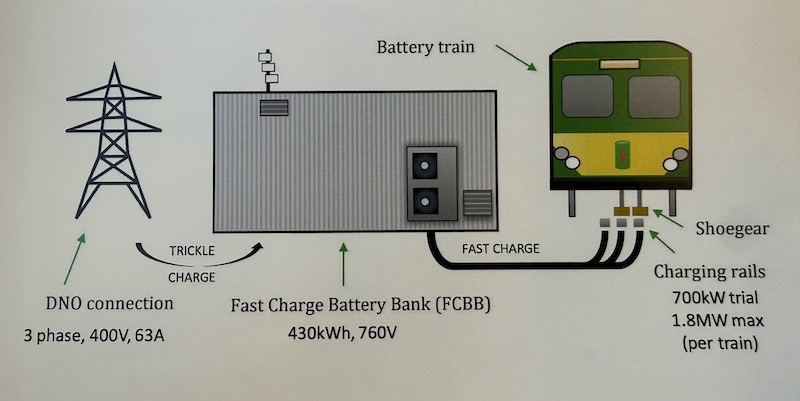
These are connected to the fast charging rails where there are sensors to pick up when a train has arrived so the process of charging can automatically begin, cutting out when the driver puts the power back on in the train to drive away. The train stands in West Ealing for three to four minutes between journeys, but this is long enough to keep the batteries on the train topped up. The track side batteries in the containers replenish from the grid in between times too.
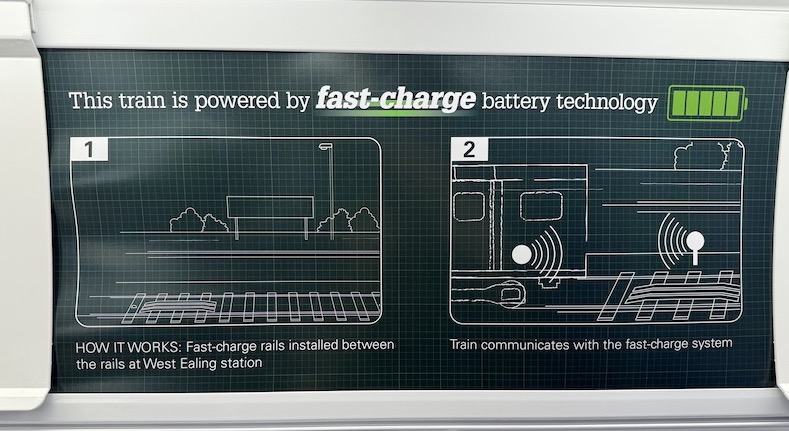
Posters on board the train explain the process in six stages.
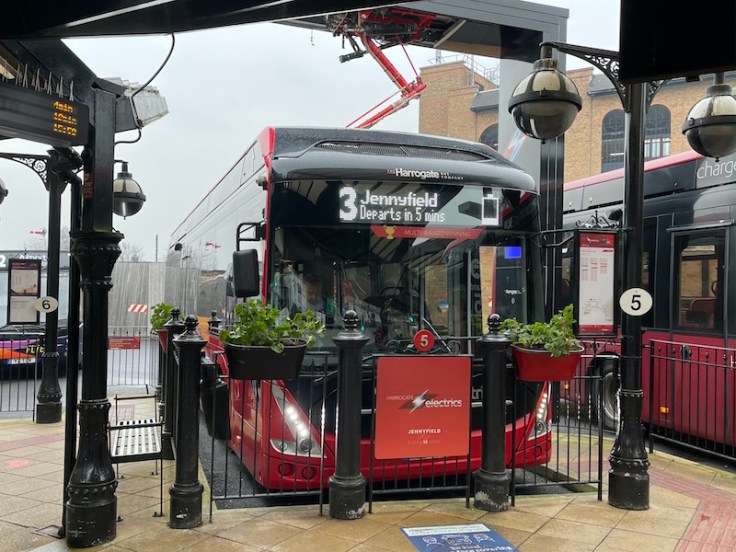
It’s a similar concept to the pantograph charging some bus companies have been using for some years to top up batteries on board buses when the bus is in a bus station.
After Vivarail folded GWR bought out many of that company’s assets including taking on staff who’d been working on the project and it was a pleasure to meet David Horton, now GWR’s Chief Mechanical Engineer for the Battery Train Fast Charge Project on the train on Saturday. David and colleagues have brought the scheme to fruition with last Saturday being the first time the train has been in public service on the Greenford branch following a couple of years of development trials in a whole variety of conditions.
To begin with the train is only in service on a Saturday with the normal diesel train running on Monday to Friday, but it’s hoped in due course to extend the trial to more days of the week.
David and the GWR team are to be congratulated for the extensive work they’ve pioneered during the last three years following Vivarail’s demise and it certainly looks as though it will pave the way for GWR and other train companies, needing to replace diesel powered trains on branch lines (where there’s no hope of ever justifying electrification), to look at battery power with fast charging as a realistic alternative especially when incorporated into new build trains.
Roger French
Blogging timetable: 06:00 TThS
 BusAndTrainUser
“The number of journeys will increase from 350 to 280 per day” … er?
LikeLike
Thanks; corrected to 380.
LikeLike
Why tables and toilets on such a short line
LikeLike
interior carried over from the vivarail concept for a full train unit with the idea of more intermediate coaches in longer formation for other lines. And it did the 200 miles non stop challenge which the staff would need the tables etc for
JBC Prestatyn
LikeLike
In this modern world of poor toilet provision, never turn your nose up at one being provided, you never know when you might need it.
Jan B
LikeLike
It was fitted out by Vivarail as a demonstration of what could be done with train. Unless you think of course that the tables and toilet should be removed just because the train happens to be running on the Greenford shuttle at the moment.
Steve
LikeLiked by 1 person
My understanding is that is was kitted out for the COP26 Conference in Glasgow in 2021 (before Vivarail went into liquidation.) and has retained the interior layout from that time.
Julian Walker
LikeLike
Stourbridge Junction to London Marylebone isn’t exactly a short line is it ?
What a wierd comment for a journey that takes about 2 & half hours at the quickest.
I do wonder sometimes about the mentality of some who comment on Rogers Excellent Blog
Using the line regularly I personally welcome the nearly new stock Chiltern Railways have introduced.
LikeLike
I ppresume the ‘short line’ comment refers to the Greenford shuttle in the second half of the article, which must be one of the shortest end-to-end rail journeys in the country.
LikeLike
GWR ones a trail or a trial?
LikeLike
Corrected; thanks.
LikeLike
Nice one Roger. I can’t wait to try both of them out. I have a long-standing intention to visit Birmingham to check out the history of one of my ancestors there.
The Mk5 coaches appear to have slightly lower seatbacks than some of those imposed on us these days. Is that the case? I hate the claustrophobia that the hyper safety obsessives have imposed on us, especially in open saloons where previously multi-window views were available from any seat. Now reduced to neck-busting sideways looks, if there’s not an over-wide pillar in the way.
On first read of your articles, the typos are still all there. But checking the comments shows they’ve been spotted and corrected. A mystery of the blogaverse?
LikeLike
The seat backs aren’t as claustrophobic as on the Pendolinos.
LikeLike
The seats in the MK 5a are the same dreadful ironing boards as on the IETs and Azumas. Plus, being CAF, the ride quality is absolutely appalling.
LikeLike
I don’t mind the “ironing board” concept so much as the appalling transverse steel girder under the seats on the IETs. The one where the “cushion” gives up any pretence of cushioning after no more than about 1 year.
LikeLike
Very interesting and thanks as always.
Can someone technical explain why a charging connector shoe needs to lower at the termini?
Isn’t that just more to fail? Why not just a pickup rail as per third rail?
LikeLike
have you seen shoes ripped off when obstructions hit , lots of track and train damage.
There might have been a case for taking some branch lines into London Transport years ago including 3rd or4 rail electrification but things like green belt changed the financial rationals
JBC Prestatyn
LikeLike
If you look carefully, a current pick-up shoe on the third rail system is sprung downwards to ensure a good connection. The third rail is raised above the running rails; in this way there is little danger of the shoe hitting the rails. The movement involved is probably less than one inch.
In the case of a battery charging rail, the current collection kit is forced downwards above the charging rails to ensure a good connection. There is other kit between the running rails (what was the AWS ramp, now the grids between the rails as part of the signalling systems) which needs to be cleared to avoid damage. I suspect the clearance needs to be more than an inch here, hence the collection shoe needs to travel further.
With the extensive testing involved prior to entering into service, I would expect that the current collection arrangements have been well thought through before installation.
LikeLike
Always nice to see “new” trains but wasn’t one of the reasons that the Mk5s were withdrawn because of cracking of the underframe. I assume thats all resolved now
LikeLike
I watched a review of these Chiltern trains on Sunday. It wasn’t favourable to CAF.
Peter Brown
LikeLike
It’s good to see FGW exercising their usual consistency, with padded 2+2 seating and tables for the 12-minute journey to Greenford, and 3+2 seating with no flat surfaces at all – not even a coffee perch – for the 90-minute journey from Reading to Gatwick.
LikeLike
see the comments above for an explanation of the seats and tables on the class 230.
LikeLike
which does raise the question of cost of specification of any additional units, clearly reading Gatwick needs something benefitting a near regional service. Would 230s if used on the gwr branches get an effective downgrade or are toilet disabled and bike area modules easy to fit these days?
JBC Prestatyn
LikeLike
with gbr coming is there a case of ignoring the difference between Chiltern and GWR generally now. Running 230s West Drayton to Ruislip and Beyond has some thought in an Elizabeth line era.
JBC Prestatyn
LikeLike
I’m going back a few years now, but there was a period of time when I would travel to London at least a couple of times a year. And I always made a point of travelling with Chiltern. Admittedly it was more convenient for me at the time as I could just take a short bus ride to Solihull railway station, and there used to be some great prices on Advance single tickets, £6 each way I remember paying.
For me, the journey time was acceptable, usually just under two hours, maybe a little longer depending on what stops were called at. Never had any complaints or anything bad to say about Chiltern from my own experience.
LikeLiked by 1 person
Poor Chiltern passengers. I found the TPE Mk 5s to be quieter than a 185, but that’s it. The seats were grim and the ride unpleasant and at times disconcerting. Some sets suffered from a rapid whip from side to side which worsened with age. After one particularly bad one once I really thought that we were going to derail. The 68s seemed to have to be left ticking over between duties, and the noise under Scarborough or York trainshed roofs was horrendous. Basically a freight loco and cut-price carriages being asked to do too much. The return to 185s was a blessed relief.
Eden.
LikeLike
I’m slightly miffed about why everyone is suddenly doing train “rides” rather than journeys. It is particularly prevalent on YouTube, “I ride Lumo to Glasgow”, rather than travelling.
LikeLike
Be miffed no more. Have changed the title for you.
LikeLike
Roger, you have two identical photos of the First Class carriage interior; was one of them meant to be a picture of the Standard Class interior?
Steven Saunders
LikeLike
The first interior photo is of Standard Class and the following two ore First Class, also the one showing the wheelchair spaces is in First Class.
LikeLiked by 1 person
A slightly trivial point but isn’t a 2xx class supposed to denote a DEMU? As this train no longer uses a diesel generator (I assume it’s been removed, but happy to be corrected), shouldn’t it be reclassified to 6xx?
LikeLike
@Roger what time were you on 230?
I was there early-mid morning with my train mad son starting from the Greenwood end at 1030 and exiting down the Lizzie line after one trip (to head onwards to other appointments) so I was wondering if we overlapped (and didn’t quite manage to meet up) or not.
Also whether either of us were in the presence of the mysterious Diamond Geezer (I think not for me based on sun angle of his pictures)
(Regarding our other email chat about route London route 603: appalling timekeeping last 2 weeks for a limited run schools service, badly impacted by poor TfL/Metroline choices on handling emergency and long term roadwork diversions; hopefully will settle down again but not helpful for parent recruitment to a modified timetable.)
MilesT
LikeLike
Ah; just missed you then.
LikeLike
Where is Greenwood?
LikeLike
I think he means Greenford
LikeLike
Apparently these Chiltern Explorer trains can fit in the bay platforms at Oxford. Could be a nice way to get to Milton Keynes. The fine residents of Jericho (the suburb near the station) would have to tolerate locomotive noise, but I’m sure something sensible could be arranged. (CH, Oxford).
LikeLike
A video of the Class 230 came up in my YouTube feed. It’s still got that lovely D Stock sound.
Peter Brown
LikeLike
Wouldn’t it be just amazing if such a “cheap as chips” but very effective train allowed the opening up of a huge range of new branchlines, and that was the background soundtrack.
LikeLike
I travelled to London Marylebone with Chiltern Railways last Monday as always & one of the nearly new trains was in service.
I have to say I was very impressed with the stock..
A very welcome addition to the line from Stourbridge Junction to London Marylebone offering an excellent alternative to West Coast Mainlline.
LikeLike
Class 68s make a hearty throbbing noise – like Deltics. The good people of Scarborough were less appreciative of the noise and forced TPE to withdraw them.
LikeLike
I’ve been using Chiltern on a semi-regular basis over the past few years and never had an issue with the service or the trains. The MK3’s admittedly are past their best and are in need of replacing, that being said they were very comfortable for a run down to Marylebone from Moor Street.
Travelled on a few MK5’s with TPE before they went and wasn’t overly impressed with the comfort. In my opinion the seats are too upright and lack sufficient padding, much like the Hitachi classes 800/1/2’s, after an hour they are uncomfortable. The novelty factor being Britain’s newest loco hauled stock wears off after a while. Controversially, I loved that they idled at Scarborough station purely because it annoyed my ex mother in law who lived nearby.
I’ll give the Chiltern MK5’s a go but probably not the full journey between Birmingham and Marylebone, maybe as far as Warwick or Leamington Spa.
LikeLike