Tuesday 13th January 2026

Franchising may be a thing in many parts of Britain, but down in the Home Counties bus deregulation appears to be alive and well as it approaches its Ruby anniversary later this year.
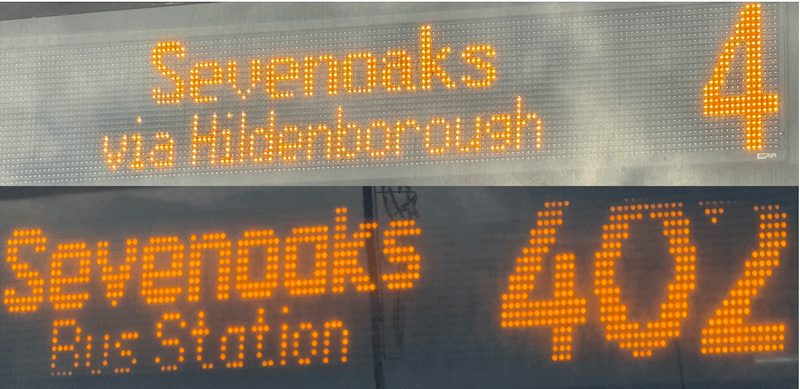
Hot on the heels of Berkshire’s Bus Battle described in last Tuesday’s blog comes another skirmish in Kent following Go-Coach (now known as go-bus) introducing a new off-peak Mondays to Fridays route between Sevenoaks and Tonbridge via Hildenborough, and in so doing blatantly challenging Arriva’s long established route 402 between Sevenoaks, Tonbridge and Tunbridge Wells – once a key trunk route in London Transport’s Country Bus network running from Bromley to Tonbridge with Green Line route 704 also on the corridor continuing south to Tunbridge Wells and not forgetting route 403 (from Wallington, West Croydon and Westerham and then Sevenoaks to Tonbridge).
© Crown copyright 2026 Ordnance Survey Licence No AC0000873681
I mustn’t over egg this one as go-bus is only running five competitive return journeys on Mondays to Fridays clearly fitted around peak school journeys and a driver’s hour’s break mid morning but nevertheless it adds five departures from Sevenoaks at 09:45, 10:45, 12:45, 13:45 and 16:45 with return journeys back to Sevenoaks leaving Tonbridge half an hour later.
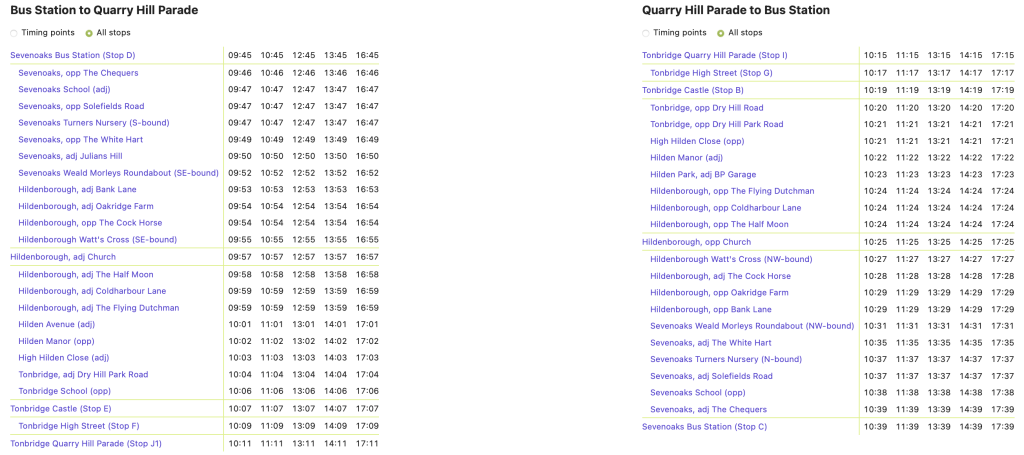
Arriva’s timetable comprises a half hourly frequency in the off-peak generally at 23/53 from Sevenoaks and 22/52 back from Tonbridge. Interestingly, aside from a journey at 07:13 from Sevenoaks the next departure is at 08:51. Similarly from Tonbridge the first northbound journey is at 07:15 then nothing until 08:35 and 09:12. So, not particularly helpful for commuters and school children. The go-bus incursion doesn’t add anything to plug these gaps either.
Go-bus has got form adding off-peak journeys to established routes as the company did the same with Arriva’s 477 between Dartford and Swanley last year. This time I don’t think there’s any question Arriva will walk away, as they did in that case. By offering a half hourly frequency I’m sure passengers will continue to use Arriva’s well established departure times and doubt they’ll become aware go-bus is offering a small number of alliterative options.
I travelled on the go-bus 13:45 departure from Sevenoaks to Tonbridge last Tuesday, the route’s second day, and wasn’t particularly surprised to see only two other passengers board in the bus station who travelled all the way to Tonbridge.
No other passengers were waiting at any of the bus stops on the journey south so it was just the three of us on board.
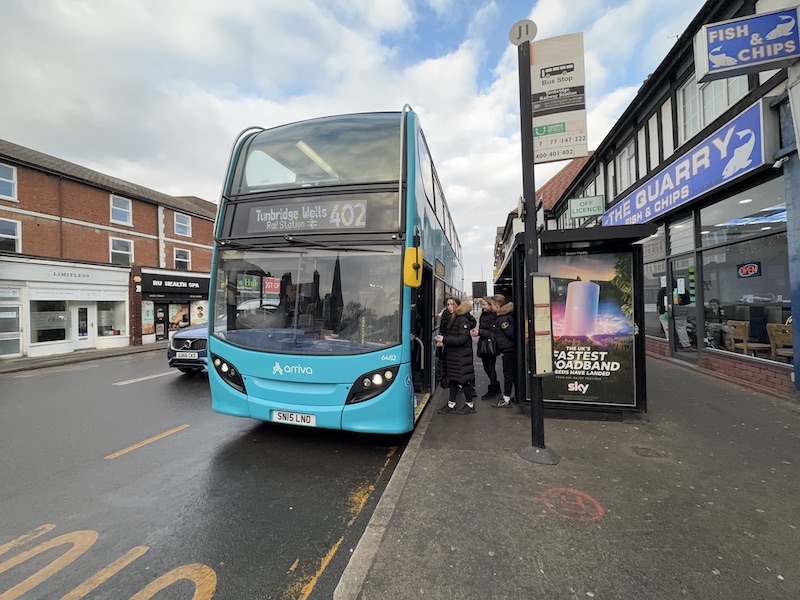
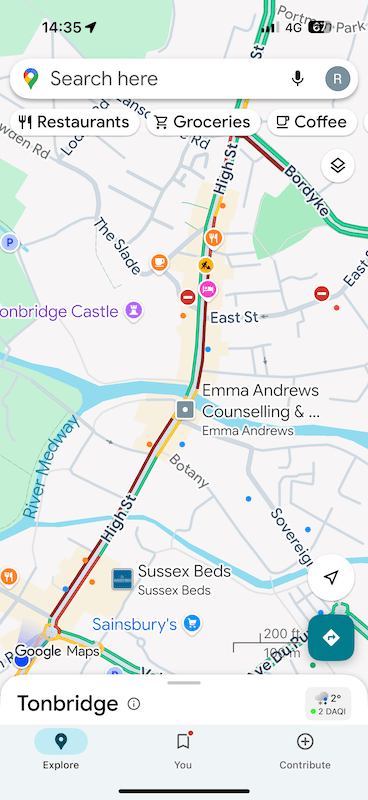
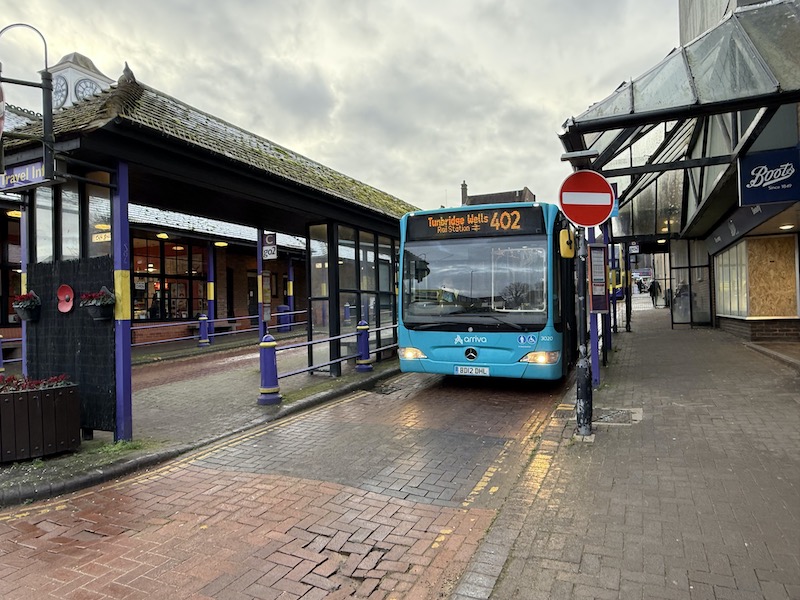
At Tonbridge one passenger boarded at the terminus at Quarry Hill Parade when the bus left at 14:15 but I waited for the Arriva departure on route 402 at 14:22. I noticed this was running about 10 minutes late on its journey coming up from Tunbridge Wells, and sure enough it didn’t arrive until 14:31 and with a driver changeover didn’t leave until 14:34 with one passenger having boarded joining the 10 already on board.
We then spent eight minutes crawling north through Tonbridge High Street due to temporary traffic lights for roadworks with four passengers alighting and three boarding at the next stop at the Castle. Five passengers alighted at four stops between there and Hildenborough which we passed through running 20 minutes late.
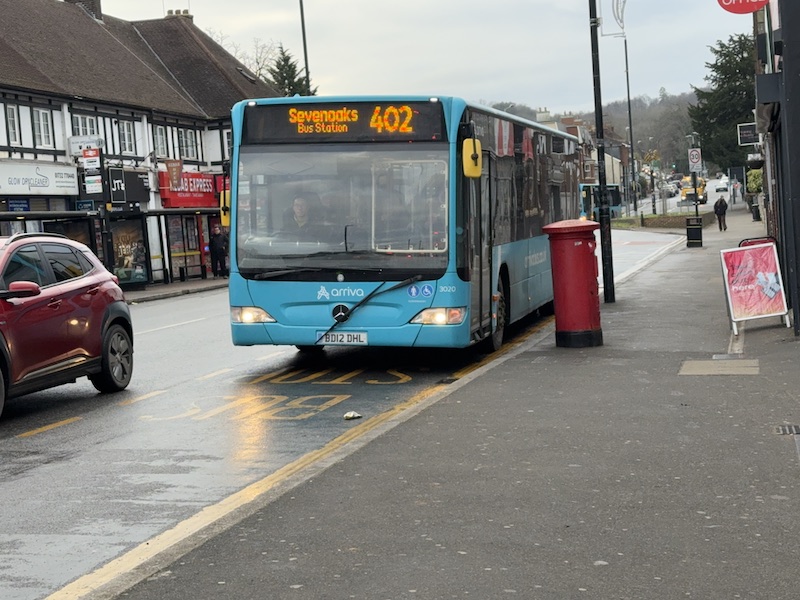
One more alighted on the outskirts of Sevenoaks with three doing so in the town centre and the remaining one on board continuing into the bus station where we arrived at 15:04, 18 minutes late. Luckily the next departure back to Tunbridge Wells was off-frequency at 15:00 so the bus leaving at 15:05 with one on board wasn’t too bad a recovery.
It’s an odd decision to add another five journeys to the established half hourly service provision which looks adequate for the demand, aside from the already mentioned morning peak hour gaps. I doubt the revenue on these interloping journeys will even cover the marginal cost of fuel and wear-and-tear.
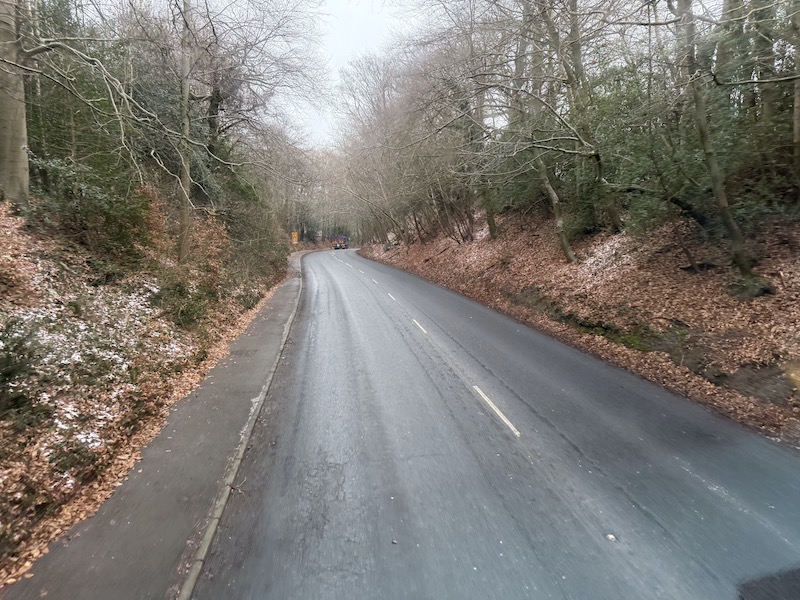
There’s not a lot of places to generate custom along what was in times gone by the main A21 other than in Hildenborough which isn’t that great a metropolis.
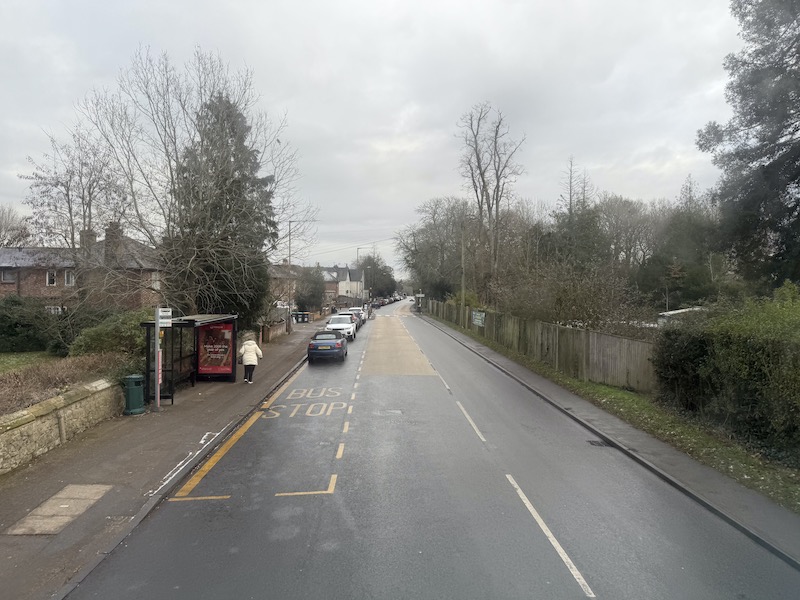
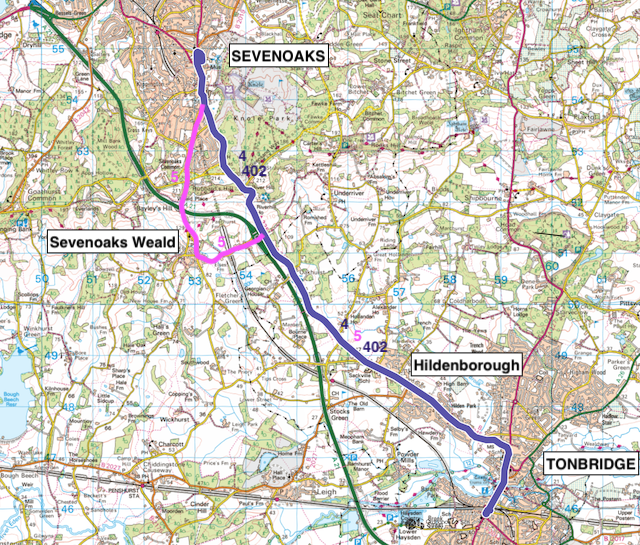
Go-bus also runs a route 5 between Sevenoaks and Tonbridge comprising just three off-peak journeys which deviates to serve Sevenoaks Weald (see above map). Leaving Tonbridge Castle at around 14:40 the third journey of the day was just arriving from Sevenoaks with no-one on board.
It was good to see go-bus had posted timetables along the route…
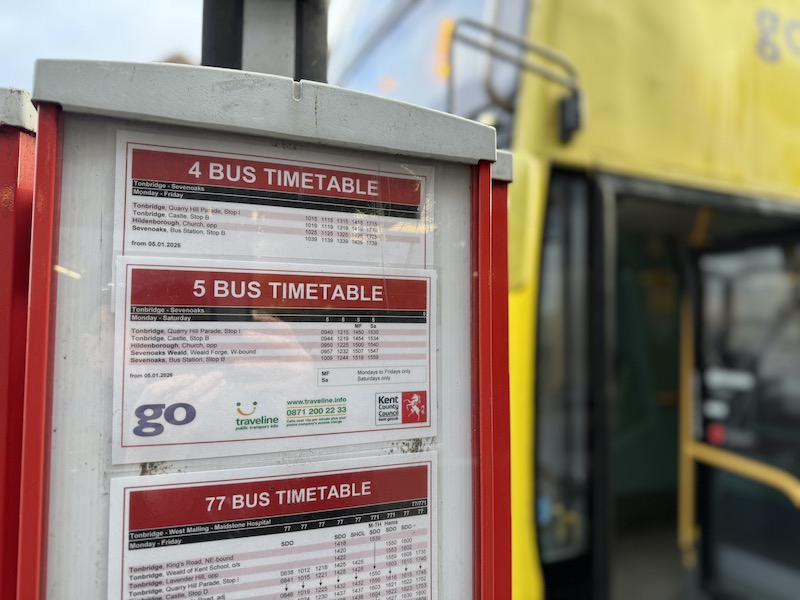
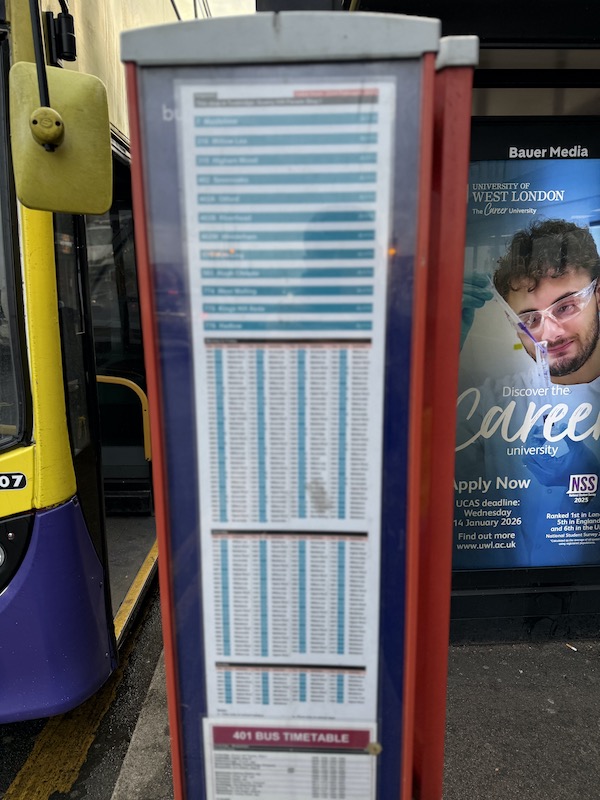
… which perhaps are simpler to read and understand than Arriva’s departure listing for multiple routes in Tonbridge.
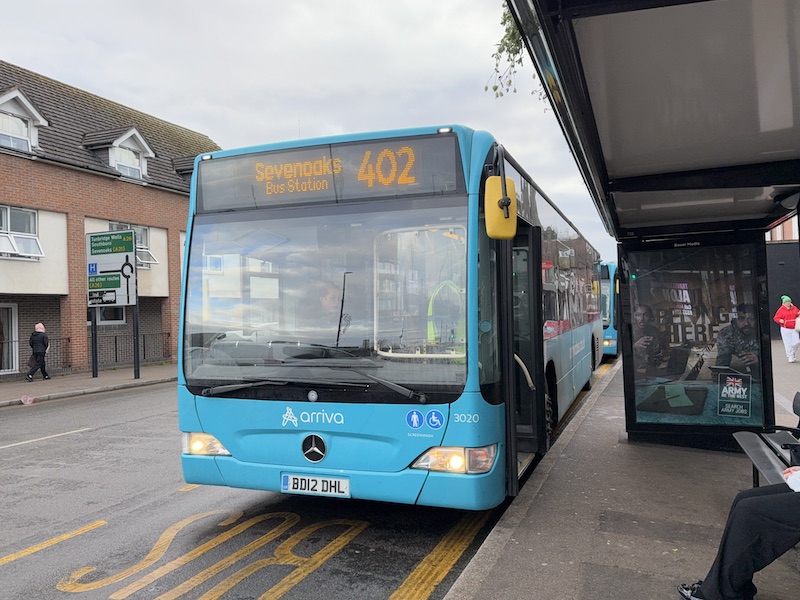
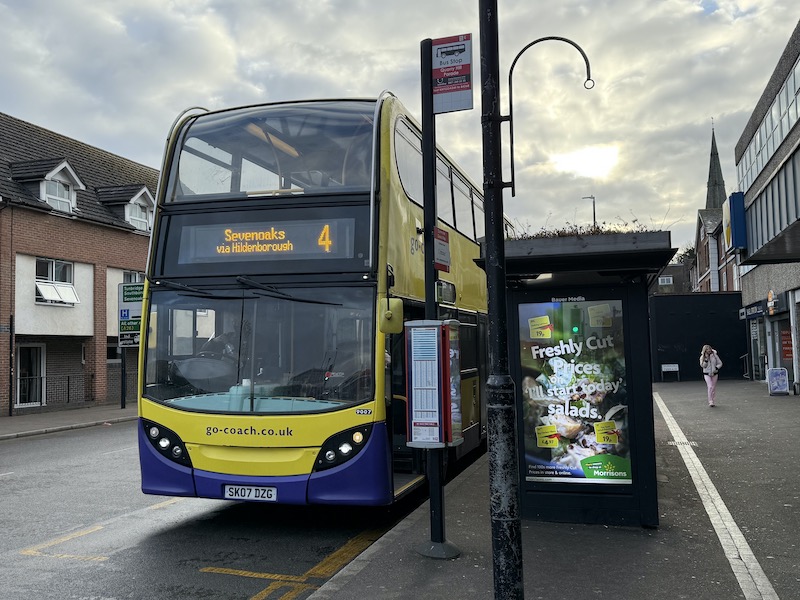
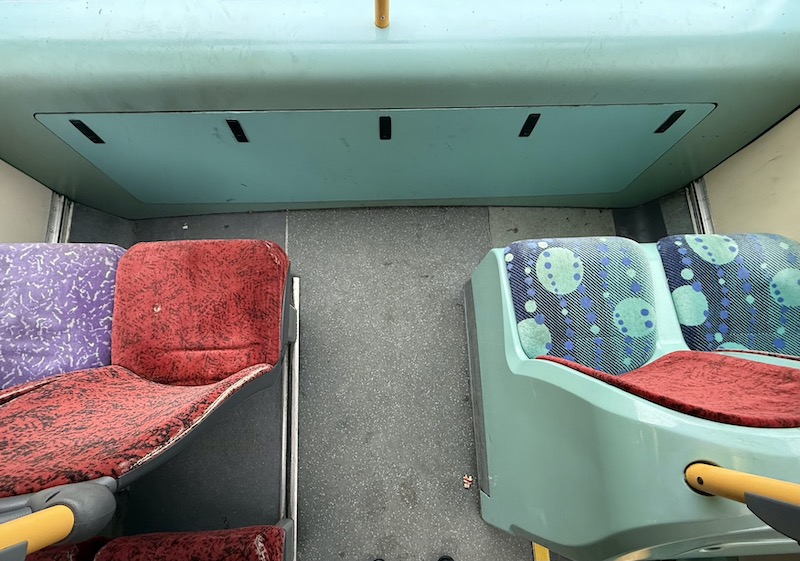
It was nice to have a double deck ride on the 4, and as you can see, although the 402 is normally double deck operated, the journey I travelled on was on one of Arriva’s Mercedes Citaros. Go-bus’s double deck had been given a makeover with some smart red moquette but three of the front seats obviously didn’t make the cut – giving a clue as to the vehicle’s previous (‘first’) owner.
Some might justifiably wonder if go-bus has spare off-peak resources why not use them to supplement the rather sparse timetables it operates on routes to Westerham or Orpington rather than adding to an already adequately served corridor.
Roger French
Blogging timetable: 06:00 TThS
 BusAndTrainUser
Certainly agree with that last sentence. The pitiful loadings during the day twixt Sevenoaks and Tonbridge are bad enough (remember it was only an hourly headway for many years when the 402 route went to Bromley), and with Autocar also providing an hourly Hildenborough-Tonbridge service via the main housing estate, the new 4 is going to struggle. Unless of course Go-Bus know something we don’t and Arriva are already preparing to reduce their Tunbridge Wells “network”, or what is left of it, still further.
I know there are all sorts of complications now with LEZ zones etc, and a pile of paperwork for any Operator who dare enter the over-regulated TfL area, but I think a couple of return trips to Bromley, Croydon and/or Bluewater would be a better use of the otherwise idle vehicle.
It isn’t helped by Sevenoaks becoming a retail desert (even Poundland has closed!), and I recall talking to a Dunton Green Driver way back in the 1970s, and happened to use the words “town centre”. He looked at me in disbelief, saying.. “town centre!, town centre!, two Oxfam shops and a Woolworths more like!”. Things have not improved since.
Terence Uden
LikeLiked by 3 people
Define ‘over-regulated’, Terence, or are you against buses being to the highest environmental standards?
Dan Tancock
LikeLike
Nothing to do with the “highest environmental standards”, as other parts of the UK can boast of running similar vehicles with considerably less subsidy.
The point I was making was recalling talking to an Operator who entered the TfL area on just a couple of school journeys, who said the paperwork required stood “a mile high”. He added that the paperwork required for the other four Counties their services entered was minimal.
That was “my definition”
Terence Uden
LikeLike
Mountain of paperwork? The LSP application is online and I would estimate takes about 10 minutes to complete.
Dan Tancock
LikeLike
I think “greenline727” has expanded my comment more fully. And I am sure the Operator concerned didn’t make it up!
Terence Uden
LikeLike
@Terence Uden – I am curious to know where else in the country the entire bus fleet (all operators) is Euro 6 or zero-emission, and procured without subsidy (which would mean without ZEBRA or any other public funding).
Malc M
LikeLike
My comment said “considerable less subsidy”…..
Terence Uden
LikeLike
@Terence Uden – OK, point taken.
Would you like to name the places (other than London) where the entire fleets of all operators are Euro 6 or zero-emission?
In these places, do the buses provide the same early morning to late evening, seven days a week, service levels as in the capital? At the same fares (for children, adults and over-60s) – including being able to transfer from one bus to another (regardless of operator) on a single fare of less than £2?
Malc M
LikeLike
The timetables are standard KCC format, so likely put up by KCC’s contractor.
LikeLiked by 1 person
for towns that don’t really have that much in them they still manage to have congestion on the roads, more so Tonbridge to Tunbridge Wells.
I would like to see go-bus apply for at least on TfL contract the service to Swanley seeming the obvious one.
JBC Prestatyn
LikeLike
There were all sorts of shenanigans, in the past, over what is now the A225, B245, A227, B2260, A26. Green Rovers not available for travel south of Hildenborough and during the War when Green Line coaches were off the road Route 403D got to Tunbridge Wells instead.
LikeLike
Applying for a London Bus Permit costs £500 … for which the operator gets pretty much nothing back They should at least get roadside publicity … and we’ve all seen how that works!!!
My erstwhile boss (about 15 years ago) suggested we should apply for a TfL tender. When I pointed out that, even for a 4-bus route, TfL would peer into every nook and cranny of his business, that we would need a route controller throughout the traffic day, that they could appear unannounced and inspect ALL his buses and coaches, not just the relevant ones …. he decided not to bother!!!
TfL literally own you body and soul … all OK if you have 1500 buses on contract to them, but not otherwise. The tangle that Sullivan Buses got into is witness to that.
Terence … nicely put indeed.
LikeLike
I thought the fee for an LSP was still £150 (plus VAT, of course).
LikeLike
Still nearly 3 times what you would pay anywhere else I deal with, including a permit for Manchester – and the paperwork for TfGM permits for non-Bee Network services isn’t that much longer than a normal registration (more questions about your service quality but it only takes a few minutes to complete that section).
Dwarfer
LikeLike
why plus VAT. Vat only levied on business and most local authority charges are not in course of business
LikeLike
Not true. The Government decides what is VAT-exempt (or zero-rated) and what isn’t.
Local Authorities pay VAT on goods and services from a VAT-registered supplier. They can claim VAT back from the Government only for statutory activities. For things like transport permits, the transaction is effectively treated like any commercial arrangement.
Dan Tancock
LikeLike
sullivans problems seemed a simply post covid resource issue , not enough drivers
go at present has a good fleet profile KCC experience and keeping to maybe one route initially would work
LikeLike
@GreenLine727, @anon 13/1 17:14 – at the time of Sullivans’ abrupt exit from TfL work, performance reports available on TfL’s website indicated that they were the worst-performing TfL operator by a very wide margin. If they were suffering post-Covid driver shortages, how was every other London operator managing to cope?
Not all TfL contractors have fleets of 1500+ buses. In the same area that Sullivans operated, Uno also operate a small number of buses on TfL contracts, and yet from what I can see, they didn’t seem afflicted by the problems that affected Sullivans’ contracts.
And so, passengers relying on routes where Sullivans were the operator were getting a less reliable service than passengers using other TfL routes.
Malc M
LikeLike
were not some london routes reduced in frequency during after covid , of course larger companies can resource round drivers a little more easily, this was one of the problems with Mitcham Belle and Limeborne . It’s easier to perform if your agreed service level is reduced
JBC Prestatyn
LikeLike
@JBC Prestatyn – in the case of Sullivans, I’m not sure that really adds up.
I mentioned above that Uno, another fairly small operator in the same patch as Sullivans, seemed to be able to operate reliably where Sullivans struggled.
If the post-Covid recovery is an explanation, it is worth noting Sullivans was taking on additional work in 2022, picking up the TfL 549 (admittedly only a one bus operation) and also taking on part of route 84 when Metroline abandoned it. By the time of their exit, after prolonged poor performance, they had already lost several TfL school routes (OK, they are not particularly onerous for the numbers of dirvers required, but the operation – or its commitment to TfL contracts at least – was shrinking nevertheless). But I understand it kept its (commercial) Thorpe Park service going, even whilst it was struggling to maintain its TfL commitments.
Ultimately, if smaller operators are going to find it more difficult to deliver what their contracts require, is it in the passengers’ interests to award contracts to those smaller operators? Would the passengers standing by the roadside, hoping their bus might eventually turn up, have had much sympathy for the operator which was repeatedly letting them down, when passengers on other routes (run by larger operators) were receiving a better, more dependable service?
That said, while there are a number of smaller operators which have struggled to maintain their LRT/TfL work – Sampsons, Cityrama, Limebourne, Harris Bus, Capital Logistics/Driver Express are just some of the examples (as is London Easylink for different reasons) – there have been smaller operators who made a success of their London contracts, examples including Crystals, Metrobus, Ensignbus to name but three.
Malc M
LikeLike
Oops!!! £150 for the initial application, of course.
Where did I get £500 from? Maybe it’s for a 5-year renewal? I’m sure I paid it to TfL sometime …..
LikeLike
£150 for the initial application, a form that takes no more 15 minutes to fill in and £nil for as many variations to the permit as you like.
Steve
LikeLike
Putting buses on between school times suggests to me that either Go-bus have won additional school contracts or they’ve lost off-peak contracts and in either case need to find something for the driver to do.
It’s sad that they’ve chosen to attack a route which sounds barely viable as it is, knowing that the likelihood is the withdrawal of the extant service and a worse outcome for passengers.
Previously Roger seemed to be ‘in love’ with Go-bus and looked at them with rose-tinted glasses, but I notice a change of tone here. Perhaps, like me, he is wondering why Go-bus couldn’t have innovated instead of just attacking 1986-style?
LikeLike
They definitely should’ve bolstered their existing routes or introduced a new service into London, Croydon or Bromley sound like great ideas. Plenty of gaps in the buses in and around Sevenoaks. I rode the 1 from Westerham once, sad how early it ends! Just useless for most people. I roll my eyes when I see companies run against a different operator, just a waste of resources, not good for passengers or staff and in the end, the faux competition has knackered everyone out and the service is worse for everyone. Time to run it for the benefit of passengers again!
Aaron
LikeLike
Combining Go-Bus routes 3 and 4 is possible with slight changes to timings, giving links from Tonbridge to Orpington, and giving a link from Sevenoaks Station (rather than just the Bus Station) to Tonbridge. This will introduce a Unique Selling Point, rather than just duplicating the 402.
MotCO
LikeLike
That is what I mean there are tons of ideas they could’ve tried rather than copy Arriva. Your idea would likely gain ridership from the new connections. I thought Sevenoaks to New Addington via Westerham and Biggin Hill to connect with the trams could work too.
Aaron
LikeLike
@Aaron – looking at that specific idea, I’m not sure it would succeed.
Biggin Hill to New Addington for tram connections is already provided by the 464. As the 464 is a TfL service, it enables passengers to travel through on one fare. So I doubt Go-Bus would get much custom for that flow.
Sevenoaks to Croydon – already possible using train to Bromley South then Superloop to Croydon, although Sevenoaks station is not particularly convenient for the town. Nevertheless, probably not very rich pickings there either.
Westerham to New Addington for tram connections? Possibly, although 246 to Bromley then Superloop is probably not much slower, and is a more comprehensive service.
A double-decker would need to run via Keston and Coney Hall as the lanes used by route 464 between Biggin Hill and New Addington would be unsuitable. If I say “I would like to see a double-decker try it”, in fact I wouldn’t, because the result would not be pretty!
Sevenoaks and Westerham direct to Croydon, on the other hand, restoring a long-lost link via Warlingham once provided by the 403 then 483, might be more useful than just duplicating part of the 402. And there are doubtlessly plenty of other opportunities in that part of Kent where a new service, offering new links, could be developed using a bus and driver in between school duties.
Malc M
LikeLike
I think between what I said and what you said, just shows what kind of routes are missing and these sorts of links are missing in areas all around London, despite traffic being a daily issue. The kind of routes a deregulated environment would never try as it’s risky but in a centrally planned, regulated one like existed until 40 years ago would be seen as important outer parts of a wider network.
Seems lazy what Go-Coach has done and the route probably won’t exist years from now, which is no good for increasing ridership, let alone using transport for wider social, economic and environmental goals.
Aaron
LikeLike
@Aaron – rest assured, I’m not disagreeing with you on that general point at all! I was merely questioning whether the specific idea you suggested would work. If that one is not a “runner”, there are plenty of other opportunities in north west Kent where a bus and driver spare between school duties could be used to open up a couple of new or long-lost links. Would it be as lucrative as skimming some revneue off the 402? Maybe not!
Malc M
LikeLike
Probably worth noting that the 5 via Weald Village is run on behalf of KCC unlike the new 4 which is commercial
LikeLike
Many thanks for covering my ‘home’ route. Yes, I also wonder if Go-bus have chosen the right option for use of a spare bus out of school-bus hours.
The 402 especially seems to suffer from road-works problems, leaving its regular customers unwilling to trust it for journeys like doctor appointments. I’m sure I’ve said this before, but WHEN will the big bus companies get their brains and muscl together and go and sit on the Transport Minister’s desk until s/he agrees to set up a reasonable scheme to enable buses to be more reliable. Roadworks affect buses much worse than car-drivers who will usually divert to avoid them; buses can’t. Car-drivers would be delighted to see Water/Electric/Gas etc. companies pay big fees to provide diversion publicity – not just before the works, but anywhere which would take traffic away from them. Ideally the utility companies would also have to pay to at least double the bus service, so that people waiting at stops after, as well as before the roadworks could stand a chance of getting a bus at the right time.
It’s good the 402 runs half-hourly; for many years it was only hourly. However, probably due to factors at the Tunbridge Wells end, it does not serve Sevenoaks station, where the trains every-15-minutes do a thriving trade – and fill the coffers of the car-park company. Bus managers have, as far as I know, never talked to the rail managers about co-ordinating times, even when the trains were just every half-hour. Nowadays, the idea of a day in London by bus+train would be ridiculous – you’d have to leave by 2.30pm … there are precious few buses from the station to anywhere after the school journeys, and none on the 4 or 402.
LikeLike
I’m not sure coordinating bus-train departures is even allowed in the deregulation climate. Apparently there’s some competition “law” that disallows this?? As if buses and trains did even compete, but this is what I’ve heard.
I’m sure many of the readers here will know more on this bizarre setup
LikeLike
Pretty much nonsense!! It is difficult to co-ordinate because rail operators don’t have bus operators on their “important to consult” list.
Even Intalink, where both sides are members, co-ordination is not perfect.
I’ve known stations where local staff have tried to display bus timetables, only to ve told that the racks are for rail leaflets only … Andover and Lymington Town spring to mind … I’m sure there are others.
LikeLike
When Stagecoach took on the East Midlands Trains franchise, there was an initial burst of cooperation between the rail and bus side at some locations but it rapidly ceased, apparently because Group wanted to keep a strict separation between the two sides of the business.
It became so silly that at one point the Stagecoach ITSO smartcards issued to rail staff as gate passes were – we were told by EMT management – blocked from being loaded with Stagecoach bus tickets!
LikeLike
Nottingham train station is one of those places that’s had a lot of bus timetables
LikeLike
Where there’s a will, there’s a way. Brighton & Hove set up a partnership with GTR, with bus departures down prominently at Brighton station and even I think on trains. There’s absolutely no legal reason why bus and train companies can’t cooperate by coordinating timetables and information – if there was then PlusBus wouldn’t exist!
LikeLike
The front wiper on that Citaro looks a bit squiffy!
LikeLike
The Germans are renowned for their attention to detail. The wiper is clearly cleaning the Mercedes logo & Registration plate simultaneously. Ingenious!
LikeLike
I really struggle to see what benefit this “new” service provides. And to me, it illustrates just one of the shortcomings of deregulation.
An operator has a bus and driver spare in between school runs, and wants to earn some additional revenue. I wouldn’t quibble with that at all. So, what to do with that bus and driver? Develop a new route (or restore a lost one), creating or restoring links which aren’t provided by the current bus network? Boost the service on an existing, low frequency service? (As an example, route 5 serving Sevenoaks Weald only appears to run three journeys a day, at intervals of 2½ hours) Or just run a few opportunistic journeys over an existing corridor already served by another operator, skimming off a bit of revenue but clearing off when you have something more worthwhile to do with that bus and driver? That approach seems to do little to grow the market, instead just taking a bite out of the revenue of the existing service.
This looks to me rather like the latter – route 4 doesn’t provide the same frequency, nor the same hours of coverage, nor does it provide a Saturday service, nor does it fill in any of the holes in the 402 timetable, nor does it do anything the 402 doesn’t (unless I have missed something). And as we saw recently on the Orpington/Swanley/Dartford corridor, this kind of competition can end up destabilising the existing, more extensive service.
As you say, Roger, bus deregulation appears to be alive and well!
Malc M
LikeLiked by 1 person
without knowing how the 5 is resourced at first sight increasing that to something like hourly looks to be better economic usage
JBC Prestatyn
LikeLike
Same Go-Coach tactic they tried with the 477. Look where that got them so they now have to share a route which was a struggle for even one operator!!
Putting in a few off peak between school runs on a route to destabilise the main operator of basically the same route is poor and when the main operator gives up what happens then? If like the 477 originally (before Go-Ahead waded in), it’s the passengers that get left high and dry.
If you have intention to take over a route then do it properly – provide a full timetable AND provide a service *for the passengers*.
Paul D
LikeLike
Sadly, looking at Go Coach’s timetables, they run the bare minimum and somehow offer even less. Even the elderly can’t do much if the last bus back is at 3pm! Also strongly agree with you.
Aaron
LikeLike
Totally different from 477 situation. Arriva had already threatened to pull out of the route but had been persuaded to stay on a while, they had also said the route was not viable. At that point Go-Coach stepped in to cover the better used part of the route. Arriva then immediately pulled out before Go-Coach ran one bus on the route! Arriva had basically crippled the route over several years – no Sunday service, no evening service, frequent cancellations and at times a bizarre frequency of every 40 minutes.
Since both Kent Country and Go-Coach have been operating the route, my own observation would be that loadings have increased markedly on the Swanley to Dartford section.
LikeLike
Forgive me if I am misremembering, but I don’t think Go-Coach “stepped in” at all. Arriva were still running the 477 at the time.
Go-Coach launched their own service over only part of the route, and only once the morning school buses were looking for something to do (on Mon-Fri, Arriva 477 started up before 07:00 while Go-Coach didn’t get going until 09:30). Arriva continued to run until the cancellation of their registration could take effect.
Didn’t Arriva only deregister the 477 once they knew Go-Coach had registered part of the route?
Happy to be corrected if my memory is faulty!
Malc M
LikeLike
I feel sorry for the passengers in all this. Nothing here makes life easier or better for them. It’s all fragmentation, different or no publicity and no extension of the operating day and equally no apparent benefit from either operator for people commuting for work or education. Deregulation was only ever for the benefit of bus companies profit and bus enthusiasts.
LikeLike
Exactly. Well said! As a bus and train enthusiast, would return the lot to British Rail and National Bus Company in a heartbelt if I could and make them integrate properly. Seeing how it works in Ireland (despite a lack of infrastructure) as it was never privatised really opened my eyes. Northern Ireland to an extent too.
Privatisation was a mistake. No wonder traffic is so bad, nothing is coordinated.
Aaron
LikeLike
Personally, I am less bothered about who owns it, and more interested in who specifies and oversees it.
I can recall the days before tendering, when London Transport ran the bus network itself. High costs, yet service quality could be dreadful, lost mileage of 15% and more across the network, long gaps all too common as you waited in hope that a bus might turn up at some point. I can’t comment on how good (or otherwise) the NBC subsidiaries were.
Tendering in London certainly wasn’t always a smooth success but it did place greater incentive on operators (including London Buses) to deliver the service properly or risk losing it to someone else more capable of doing a better job. Service quality improved, costs came down enabling money saved to be reinvested in providing more service (better frequencies, longer operating hours, new links).
In London, and in other areas where franchising is happening, there is a “guiding mind” overseeing the network as a whole. That is not the case under deregulation, where each operator looks after its own interests (and competition law makes co-operation between operators difficult).
Through the 1970s and early ’80s, British Rail didn’t always have the best reputation, but it felt to me that with sectorisation, BR was getting its act together and becoming quite successful. That was then sacrificed on the altar of privatisation and competition. Franchises were let as business opportunities where the TOCs were motivated to go out and maximise fare revenue; Railtrack seemed to behave like a property company which also had some steel rails to look after. Each organisation looked after its own interests, there was a lack of an overall “guiding mind”.
The profit motive unsurprisingly led to TOCs focusssing particularly on the lucrative flows and paying less attention to their other services. The Strategic Rail Authority, for which I worked throughout its brief existence, had little in the way of Strategic powers or much Authority (only the Rail bit of its name really rang true). The repeated failures of the East Coast Main Line franchise are a sad reflection of how financially-risky the franchises could be.
I will be interested to see how things develop as Great British Railways takes shape.
Malc M
LikeLike
Er, there was zero coordination between bus and rail when almost the entire transport sector was nationalised (or in municipal ownership) after 1947, barring a few family run bus companies.
This kind of comment is so depressing. Japanese railways are privatised, so as some of the metros, so are many important railways in Switzerland. The idea that putting something into public ownership is going to miraculously improve coordination is just not the case.
LikeLike
I read somewhere that some locals thought it would serve more parts of Hildenborough to find it just goes along the main road.
LikeLike
Meanwhile areas like Paddock Wood which has the vast majority of new housing in Tunbridge Wells and a growing population have a pretty measly (and non-advertised) bus service from Arriva. Wish Go Bus would think about better connections here!
LikeLike
Anyone who looks at deregulation from a balanced perspective will generally find both positive and negative elements. I can’t imagine anyone will derive anything positive from Go-bus’s actions. At the same time, the morning peak service gap on Arriva’s service let’s down their otherwise comprehensive offering on the route.
LikeLike