
Tuesday 9th December 2025
Recent reports in some of the trade press quoting an eye watering cost of £650-£680 per passenger for a rail replacement bus service that’s been running for almost two years cried out for a BusAndTrainUser Verify investigation.

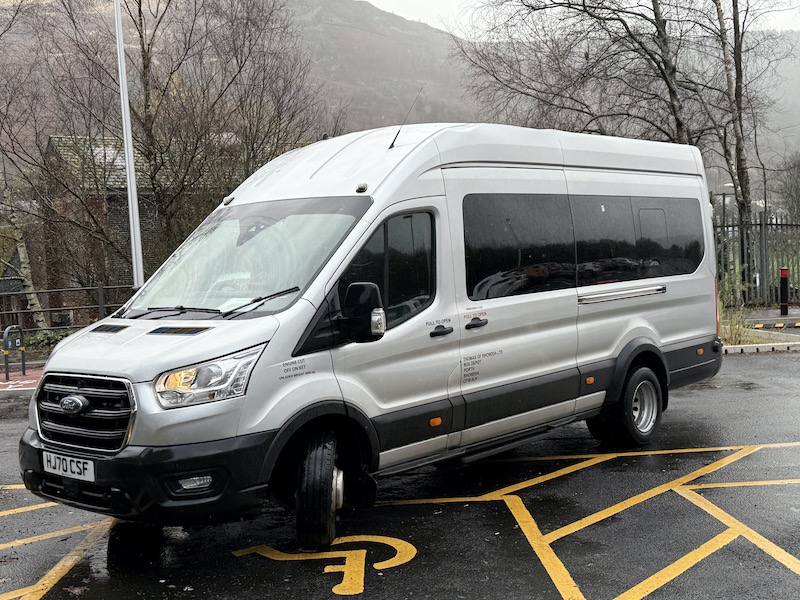
It was reported the 16 seat minibus providing a journey of less than three miles on a short stretch of the Treherbert line in the Cardiff Valleys across a 19 hour operational day was carrying on average less than four passengers a day. A Freedom of Information request to Transport for Wales (TfW) confirmed the cost of the contract for the minibus at £297,988 between April and August with £97,245 also spent on “revenue protection for this service, although in practice staff may occasionally have been redeployed elsewhere”.
It all sounded too bizarre to be true so last Saturday I took a ride on the 10:56 from Cardiff Central to Treherbert to see what all the fuss was about and provide some verification.

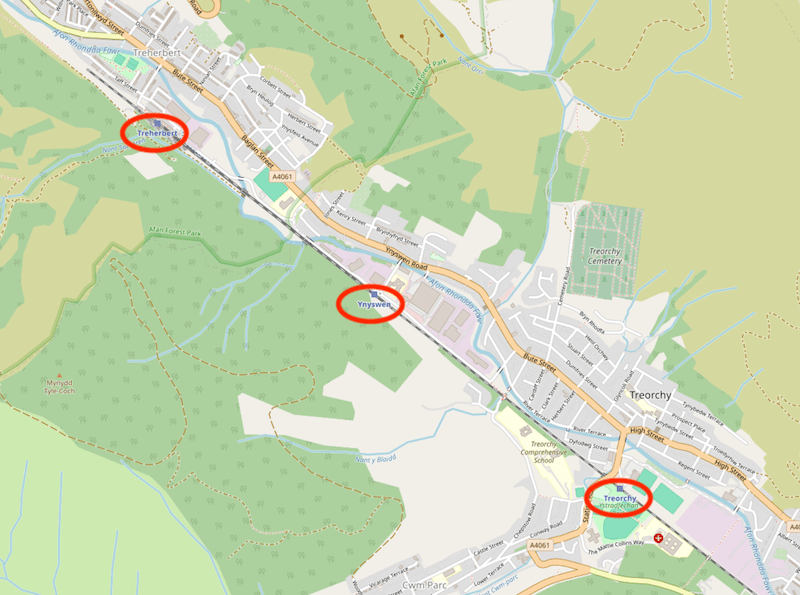
The Treherbert line north of Pontypridd closed back in April 2023 as part of upgrade work to electrify the line. Unfortunately when it reopened 10 months later, in February 2024, not all the work had been completed, in particular building a new second platform along with doubling the track and the installation of a footbridge and lifts at Ynyswen, the penultimate station on the line between Treorchy and the terminus at Treherbert. Ynyswen station remained closed as trains returned to the line from Cardiff Central through to Treherbert.
The distance between these last three stations is quite small (0.8 miles Treorchy to Ynyswen and 1.8 miles from Ynyswen to Treherbert) but it was felt best to lay on a bespoke replacement bus service with any passengers living close to Ynyswen station being ferried less than a mile to Treorchy to connect with trains towards Cardiff, as well as providing a facility from Ynyswen to Treherbert, even though three buses an hour operate between the two locations.
As is the way with these things the improvement works took a lot longer than anticipated due to unforeseen complications and this temporary bus replacement fix which has been in place since February 2024 will only come to an end this weekend when the newly extended Ynyswen station finally reopens having been closed since April 2023.
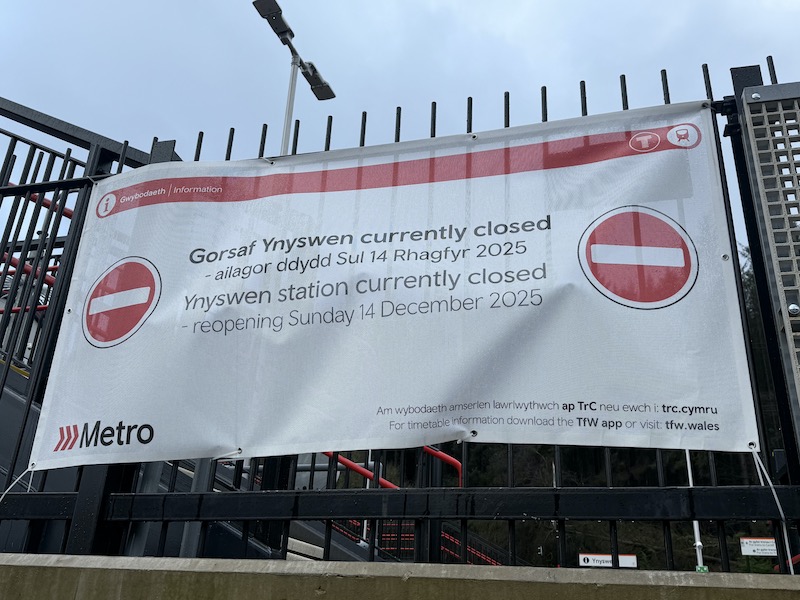
The £650-£680 cost per passenger came from an interpretation of two Freedom of Information enquiries as it turns out no records have been kept of how many passengers actually use the Replacement Bus service, so the headline grabbing cost per passenger has come from dividing the contract cost by the number of ticketed passenger journeys to and from Ynsywen during a sample period, which are naturally minimal since there are no ticket buying facilities at Ynyswen with the station closed off as a construction site behind barriers.
Nevertheless TfW defended the cost, saying due process in seeking tenders for the bus service had been followed by its contracted rail replacement administrator, Transport UK, however one of the trade magazines Passenger Transport “asked three bus operators to estimate their costs for providing the half- hourly minibus service. All three estimates were significantly lower than the cost of the current contract.”
A TfW spokesperson also explained alternatives of negotiating ticket acceptance with Stagecoach on its parallel bus routes running three times an hour along Ynyswen Road were discounted as the services between Treorchy and Treherbert don’t connect with train times whereas a bespoke service would work better for passengers.
They added they considered using taxis as required but again couldn’t get commitments from locally based taxi companies and “would have depended on sending taxis from the Cardiff area, causing delays for customers and increased costs.”

The service is being run by Porth based Thomas of Rhondda using minibuses from its mainly coach fleet used on Private Hire as well as a couple of Enviro200s used on three local bus routes in the Porth area. The Replacement Bus runs from first to last trains, seven days a week giving a half hourly timetable from 05:20 to 22:20 then hourly until 00:20 as well as hourly between 08:00 and 23:20 on Sundays making for quite an intensive commitment for the (officially) four (ticketed) passengers a day who’ve (supposedly) used it.
Southbound journey time from Treherbert to Ynyswen is three minutes and two minutes on to Treorchy with northbound journeys given three minutes back to Ynyswen and eight minutes on to Treorchy.
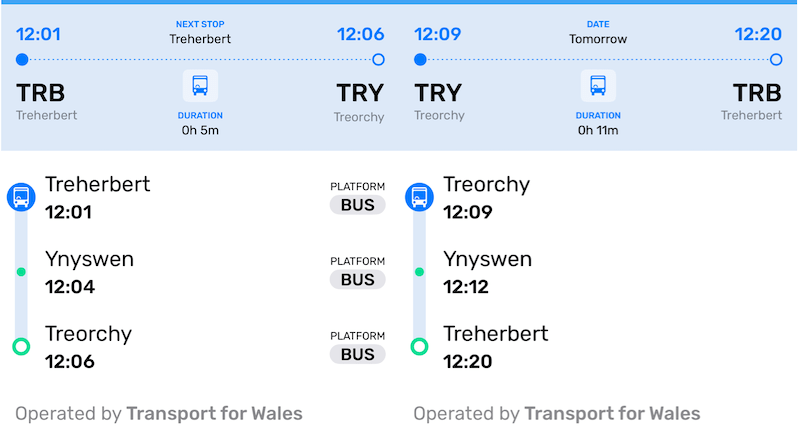
Luckily for my trip on Saturday to check it all out, TfW was running a good service up and down the Valleys and I arrived on time at 11:56 at Treorchy where I alighted to catch the replacement bus for Ynyswen, due at 12:09 for the three minute journey up the road.
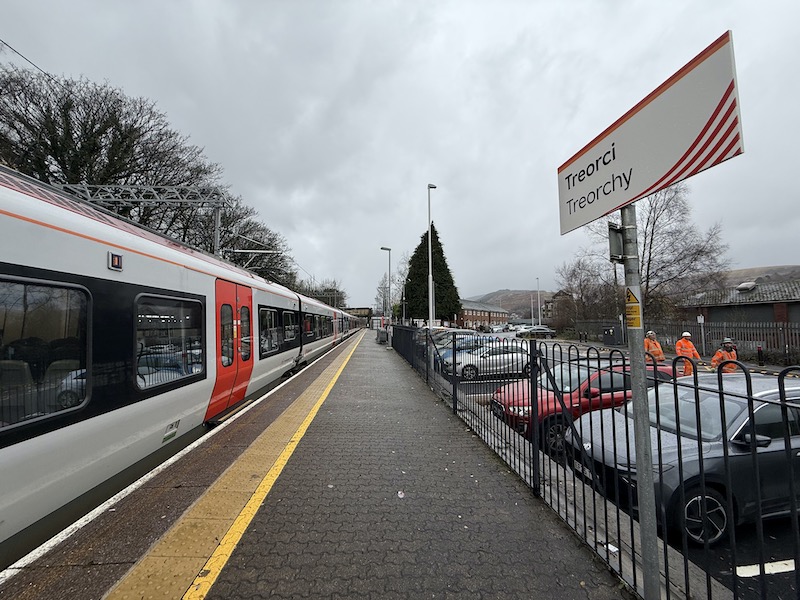
I’d noticed the bus was due from its previous journey from Treherbert at 12:06 so wasn’t unduly concerned when there was a distinct absence of a bus.

What I was concerned about was the distinct absence of any information about the bus.
Zilch.
And looking at the confined space alongside the platform and car park it made me begin to wonder if the bus actually came up to the station rather than stopping in the main road.
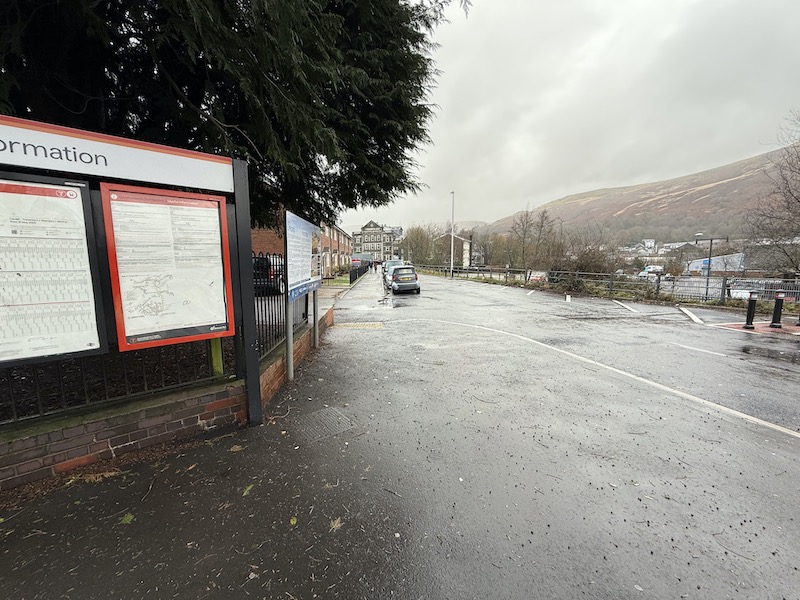
A poster display commendably shows the current timetable in traditional format…

… with a blank line for Ynyswen and a ‘x1’ code alongside which in the small print explained “shuttle bus services in place for Ynyswen station; running between Treherbert station and Treorchy station.”

But there was nothing to indicate where to catch the bus nor about the replacement service even though there was a poster about other engineering works up until mid January.

I decided to chance it and wait at the station.
12:06 came and went and no bus appeared.
As did 12:07 and 12:08.
I started to get anxious.
Still nothing at 12:09; the scheduled departure time.
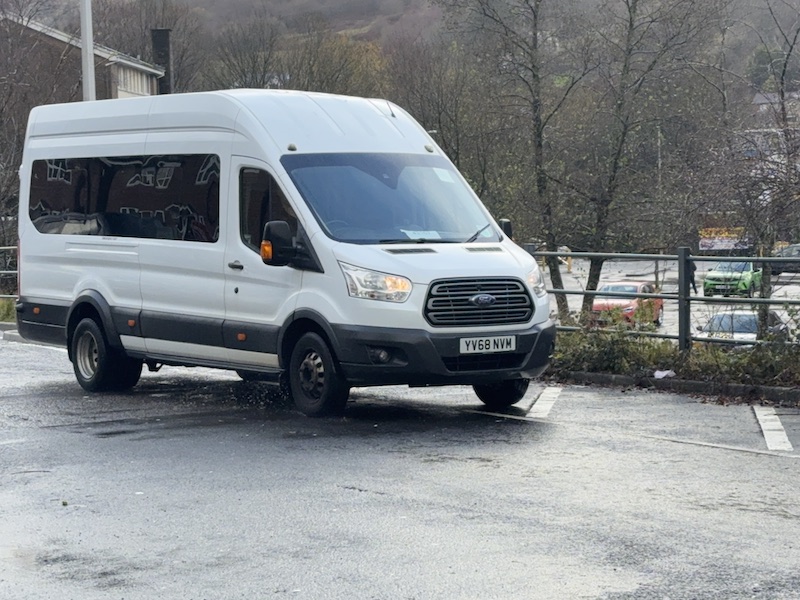
Then at 12:10, to my relief, a minibus came into view and pulled into the empty disabled parking bays…
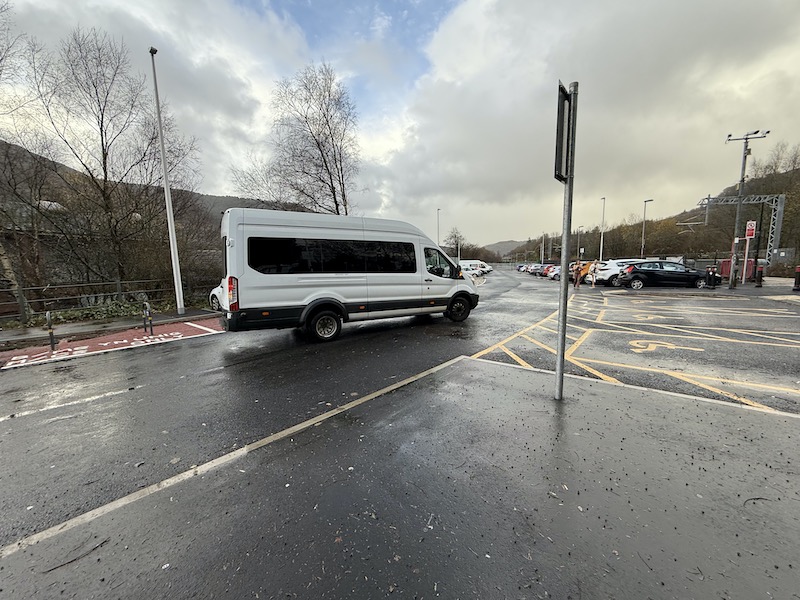
… and I saw a passenger alight, so quickly ran round and reopened the nearside passenger door to board, taking the driver completely by surprise.

Not only did Alex, the driver, explain, he didn’t recognise me, but he doesn’t pick up any passengers there, as the official stop is 450 yards away in the High Street, which, when I got home on Saturday evening I made a thorough search online and eventually did find a map on the TfW website explaining this. But you’d think something would be posted at the station to let passengers know where to wait.

Alex also explained despite officially being required to drop passengers in the High Street, if anyone is on board wanting the station he does drive up there otherwise it’s quite tightly timed to walk and catch the train which leaves at 15 and 45 minutes past the hour towards Cardiff. It was my lucky day that a passenger had been on the bus wanting the station otherwise I wouldn’t have seen Alex or the bus.
Not only is this Rail Replacement Bus costing a small fortune, officially, it doesn’t even serve the railway station. Alex showed me the bus stop I should have been waiting at on High Street as we passed it on the journey, but there was no-one waiting there.

Similarly the bus doesn’t directly serve Ynyswen station (or Treherbert station) either although there’s more logic to the former in that the station is closed so there’s not much point going there which is also around 300 yards down a side road off the main Ynyswen Road.

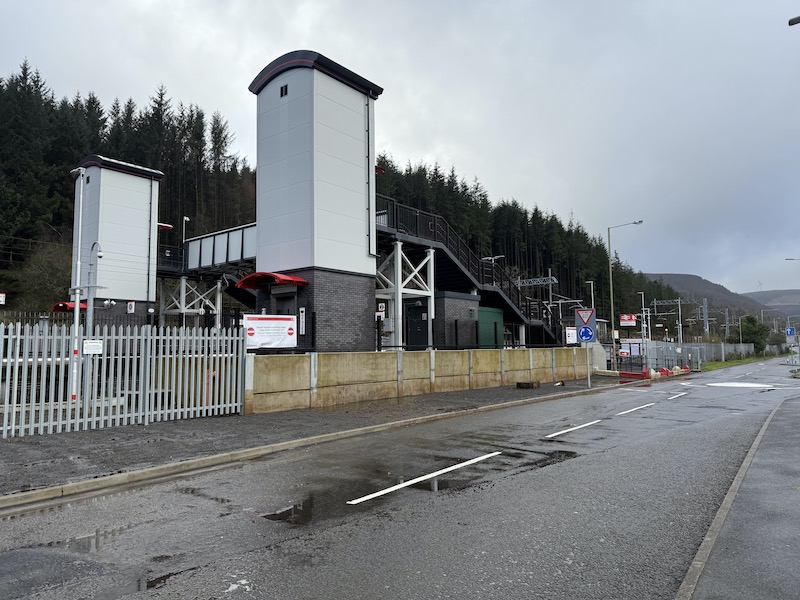
However as Alex was going off on his break he kindly dropped me off by the station so I could take a look at the newly installed footbridge, lifts, platform and doubling of track….
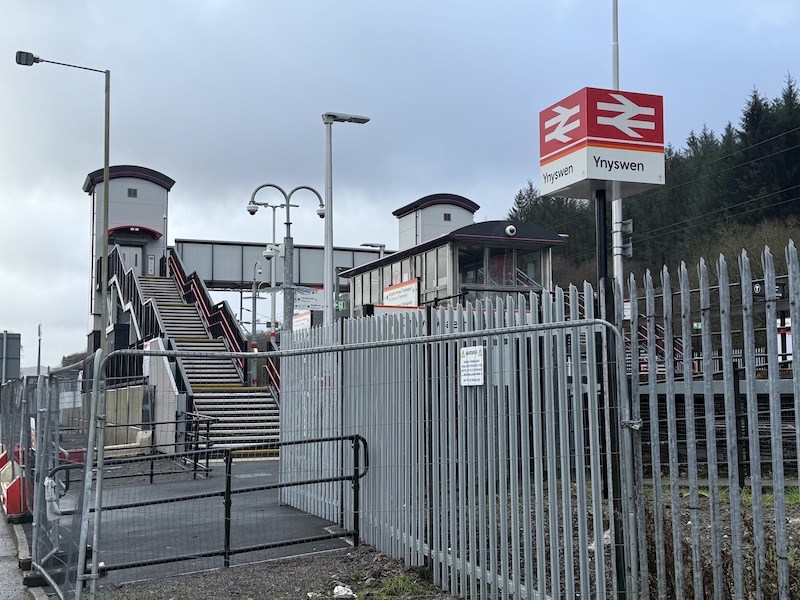
… and it all looked ready for its grand reopening on Sunday with the new December timetable.
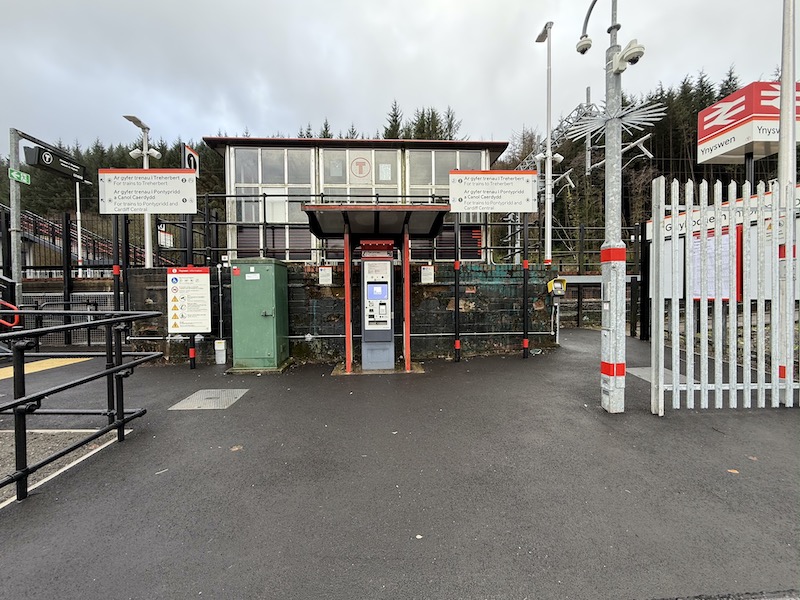
The lift towers looked somewhat over engineered to me, but otherwise it was all very standard stuff for the improved facilities being installed on these Valley lines ready for the “Metro” roll out. The need for a passing loop (and second platform) here is so TfW can introduce a 15 minute frequency timetable with trains (or, actually, new look tram-trains) passing on the otherwise single track at this end of the line.
Which made me wonder why the whole thing has been built in the first place as elsewhere where trams run (eg Croydon, Sheffield, Birmingham etc etc) passengers cross the tracks at surface level, yet here these huge monstrosity of lift towers have been constructed at no doubt huge expense.
Having reflected on that it was back to the main road and wait where Alex had shown me, for his colleague Ian, who would take me back for the two minute ride to Treorchy at 12:34.
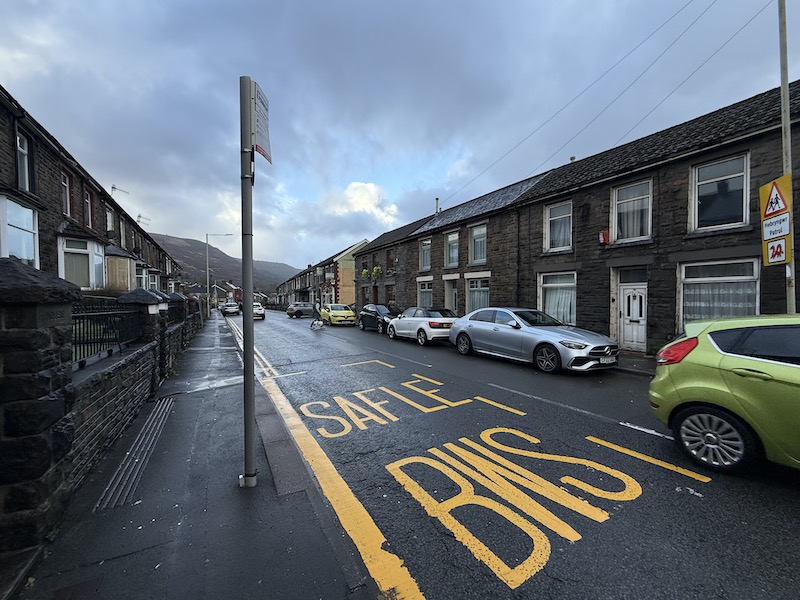
As expected there was no information about the shuttle bus at Ynyswen station nor at the bus stops it uses on either side of the road, although the Treherbert bound stop did have the remnants of a notice…

… which looked as though it was about the Rail Replacement Bus service.

At 12:33 a Stagecoach bus came into view which initially I hailed thinking I’d try that as an alternative…
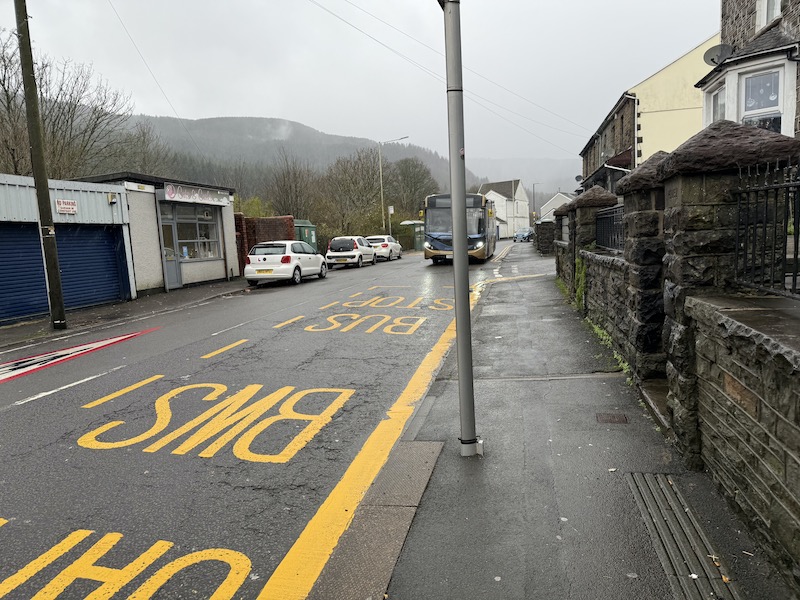
… but then I saw Ian just a short distance behind so waved the former on and met up with Ian.
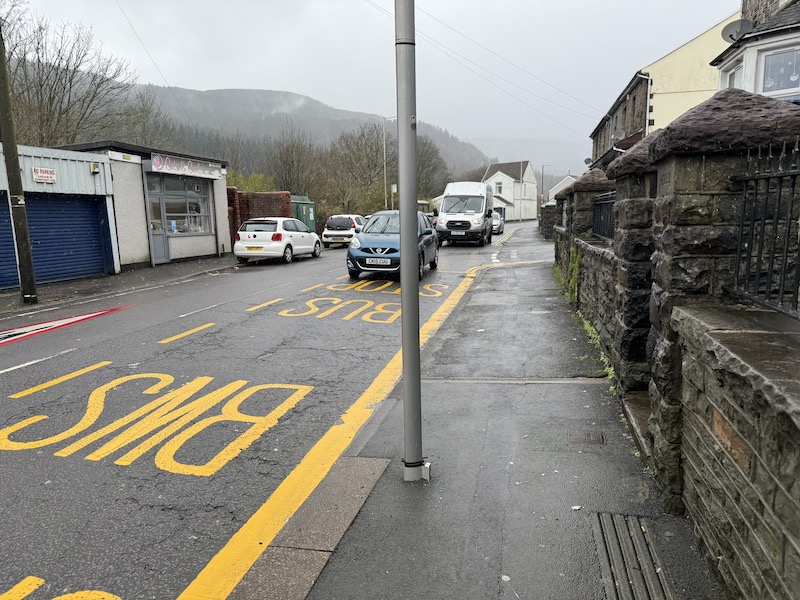
We overtook the Stagecoach bus at the next stop, so it was worth waiting those extra seconds.
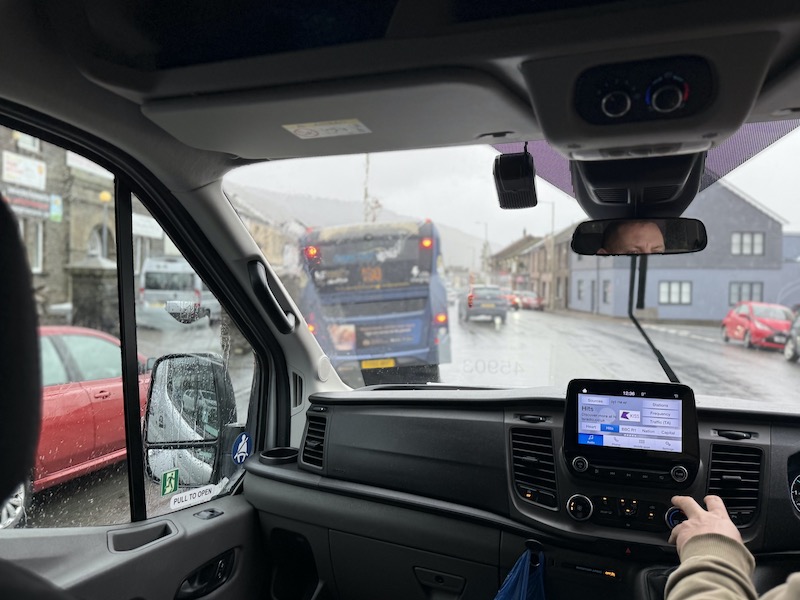
Ian kindly took me right to the station too, which was appreciated especially as it had started raining and also it would have been tight to make it for the 12:45 train if I’d had to walk from the High Street.
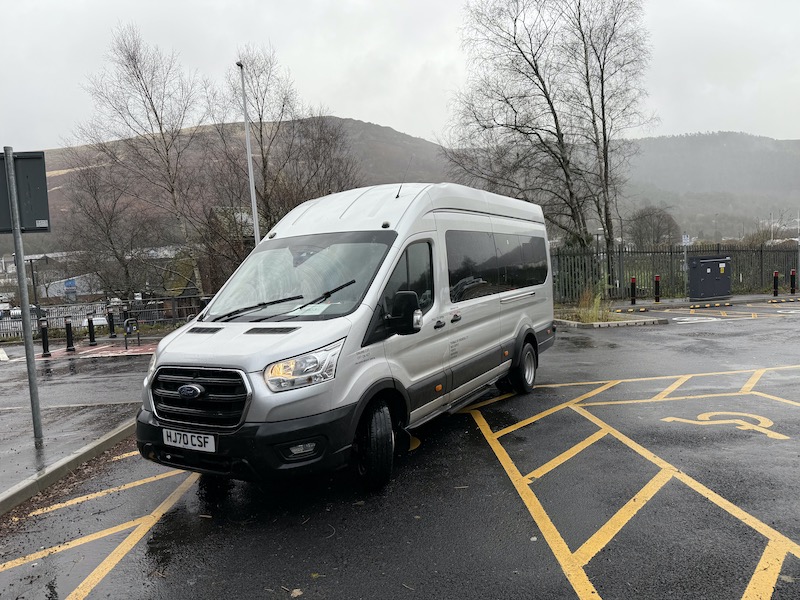
Ian had been driving the Replacement Bus since it started and admitted it had been tedious at times whereas Alex was more of a newbie having only done it for the past year!
In the couple of minutes I enjoyed with both of these very friendly drivers they both confirmed genuine train passengers have been very few and far between and the main use of the service has been people travelling between Treorchy and Treherbert to avoid paying a fare on the parallel Stagecoach routes 120 (half-hourly) 121 (hourly) and 130 (two-hourly).

Ian mentioned one morning journey is particularly busy with school children avoiding the alternative of a walk or catching the Stagecoach bus.

There’s no doubt the quoted £650-£680 figure is so high because it’s the price per ticketed rail passenger and therefore somewhat academic. Despite TfW commenting about the cost of revenue protection, I doubt hardly any passengers have purchased a ticket for their journey on the minibus. It’s almost certain the number of tickets sold to start or end at Ynyswen have been very few and far between especially as there’s no access to a ticket machine there, and other than this intrepid blogger, who else would buy a ticket with Ynyswen as the destination? In fact, I’m surprised as many as four tickets a day have been sold.
I reckon my ticket for Saturday is therefore somewhat unique.

It’s interesting to note TfW are currently advertising for a Road Transport Risk and Route Assessor which involves “developing and implementing a consistent customer focused process for assessing Rail Replacement Services across the TfW network”. TfW’s Ben Clifford said “we’re bringing the planning and management of rail replacement in-house … a big step to enhance our Rail Replacement Services and deliver real impact for customers”.
Perhaps lessons of the bonkers situation that’s applied at Ynyswen for these past almost two years are thankfully being learnt and such a ridiculous arrangement will never be repeated.
Let’s hope so.
And finally for this blog, a special personal message for the person in GWR’s Delay Repay team who’ll be looking into my claim just submitted for the 30-59 minute delay I experienced on my return journey from Cardiff Central to Paddington on Saturday afternoon which, based on previous experiences, I am certain will be deemed “unsuccessful” and I will have to go through the trauma and frustration of appealing and justifying it with no end if emails and phone calls. So, I will be referring them to this blog …..
“Hello there … yes, I know the Delay Repay software will automatically flag up that having bought my return ticket from Hassocks station at 06:51 on Saturday morning, the earliest I could have arrived in Ynyswen was 12:12 (having left Hassocks on the 07:02 to Victoria) and it seems incredible to you that I would travel for five hours and ten minutes only to stay at my destination for 22 minutes before returning on the 12:34. But now you have read this and other blog posts you can see that’s the kind of quirky thing I do, so please authorise the £19.67 I’m entitled to without further hassle and delay”.
Roger French
Blogging timetable: 06:00 TThS
 BusAndTrainUser
Fascinating, and good luck with the delay repay – but I think you mean incredible (which describes something) rather than incredulous (which describes a person).
LikeLike
Thanks; incredible now updated.
LikeLike
Does this not typify everything that is wrong with the railways. A rail replacement service that is there to help elderly and disabled people in particular with no adequate publicity and which leaves people to walk 440 yards which these categories of passenger will be unable to do and means they will probably miss the train anyway.
TFW continues to lead the pack in increased costs and subsidy which are outstripping any increase in revenue. And their ability to plan is called into question by the recent poor publicity and lack of planning of the recent Powys bus network changes.
It will be interesting to see how many people use the station when it’s reopened, and what effect doubling the rail service to every 15 minutes will have on rail patronage and the parallel Stagecoach bus service.
LikeLiked by 1 person
Given the population in the area a 15 minute service looks to be an economic basket case
LikeLike
Thank you for this blog – and the lengths (literally) to which you will go to try and sort out the truth!
Re the arrangements for crossing the track at Ynyswen, I’m wondering if – as in the case of the West Ealing-West Ruislip bus – the cost and hassle of registering a station as infrastructure for ‘trams’ rather than ‘trains’ has been reckoned as more than the cost of constructing the footbridge and lifts. I recently read Thomas Ableman’s ‘Freewheeling’ blog about taking decisions in large organisations, and am wondering if ministers (such as Heidi Alexander) have given instructions to their officials to try and make decision taking quick, simple and inexpensive!
LikeLiked by 2 people
will I be seeing Roger at todays launch ot GBR at London Bridge today or a visit to rail 200 train at PAD . Meanwhile I doubt local trams will bother the bus as such instead tram users will be off to Cardiff as main destination
LikeLike
Another glorious example of “Transport for Wales” at their finest. You really couldn’t make some of this stuff up, but they never disappoint. How comforting to know the future of public transport in such places will be directed by Politicians and no longer by Transport professionals who do actually know how to run bus and rail companies.
They bleat about “co-ordination” and reducing wasteful competition, throw money at Rail in the manner of a drunken Sailor whilst penny-pinching regarding buses, but at least provide us with such rich material to enjoy blogs with!
Terence Uden
LikeLiked by 2 people
Terence, wouldn’t it be TfW OFFICERS doing the actual directing (who should be qualified transport professionals, fully informed about developments overseas and at home), answerable to elected politicians acting as the “shareholders” and democratically accountable to the public?
I think that is an entirely reasonable expectation. Whether the hollowed out neo-liberal UK state is capable enough is debatable though so that could account for your scepticism.
Peter Brown
LikeLike
Peter, in your analogy, the “public” are the shareholders – they pay for it – and the elected politicians are more akin to a board of directors. I agree that the TfW officers should be suitably qualified transport professionals, but it is the board of directors who will be held responsible by the shareholders if the business is not properly run.
Of course, the officers may in certain cases be given delegated responsibilities, and if they fail to exercise those responsibilities wisely, then they may also have to “carry the can”. But the “shareholders” may still determine that the “board of directors” made unwise decisions in delegating such responsibilities.
RC169
LikeLike
Politicians are at least answerable to the public and will make decisions based on the advice from transport professionals, so it’s not an ‘either or’.
In any case Big Bus plc is only accountable to anonymous shareholders, pension funds etc who will want every scrap out of the business, so generally they can’t be trusted to look after the passenger either.
LikeLike
You mention the lifts but not the stairs which remind me A Matter of Life or Death starring David Niven. ‘Slips, trips and falls’ always comes top of the Pareto when looking at safety reports, so why does the industry persist in building stairways to (nearly) heaven? RC-UIC
LikeLike
According to RTT, trains are making “unadvertised service stops” at Ynyswen, anyway!
LikeLiked by 1 person
The curse of the dreaded “procurement” strikes again. What seems like a good idea in terms of unifying many disparate setups for purchasing things turns into an incredibly expensive overheads-loaded milch-cow for canny suppliers.
I suspect complex contract terms and overdone risk-avoidance is mainly to blame.
Contract drafters (well before the start of operations) feel obliged to predict everything that might go wrong several years ahead.
A futile exercise that we end up paying for.
LikeLike
That minibus don’t look like it is PSVAR complaint either. I can’t comment fully but as a wheelchair user I’d be stuck (albeit it is acedmical as Rodgers delay repay PS) that could have further inflated TFWs costs with a discrimation lawsuit.
LikeLike
PSVAR applies to vehicles with 22+ passenger seats, so a 16 seater minibus doesn’t actually have to be accessible, despite being on a scheduled service. Not that that fact is going to be much comfort to a wheelchair user…
LikeLike
Sadly, this is just another example of how TfW are so out of touch and sadly are accounting wholly scrutiny. Don’t believe me – watch the Senedd’s annual scrutiny of them. It’s laughable! Sadly Welsh Government are also culpable in all this as they are waving through all thein year extra revenue top-up for the utter madness that has become rail in Wales. This is damaging public confidence in public transport. Wait util they start playing buses. They have no clue! Or money!
LikeLike
The station closed banner in Welsh then English suggests that “currently closed” has no Welsh translation as it appears in English twice. Which is likelier, this being true or that some twerp made an 8/3 pi r cubed of the job?
LikeLike
According to Google AI
To say “currently closed” in Welsh, you’d typically use phrases like
“Wedi cau“(meaning ‘Closed’ or ‘Has closed’) or “Ar gau”, with “Ar gau” often used for signs indicating a current state, like a shop being shut, while “Wedi cau” is a more general past perfect for something closed. For “currently,” you might add “ar hyn o bryd” (at this time/moment)
LikeLike
No-one speaks Welsh there anyway so I don’t know why they bother.
LikeLike
Madness – Stagecoach run buses every 15 minutes up and down the main road here, so by default that’s going to give a decent connection time to every train, and they run an hourly service that runs past both Ynyswen and Treorchy stations. If the minibus actually ran to Treorchy station then you could understand the benefits of giving passengers an easy connection, but in the absence of that then it is just bureaucracy pissing money away because of pointless rules.
LikeLike
Your dedication to investigating the matter of wasted taxpayer’s money when it comes to transport subsidies, is impressive. To have travelled from Hassocks to this corner of Wales & then find no information concerning the mini bus connection, then to catch said bus by shear luck for a journey of some 3 miles & subsequently suffer a train delay from Cardiff to Paddington to get home the same day – I take my hat off to you! I hope you’re reimbursed by GWR Delay Repay with an appropriate apology in time for Xmas.
LikeLiked by 1 person
In a strange sort of way, this story is also vaguely encouraging. No attempt was made to actually close the station. So it is reminder (again), that trusting a railway will continue to serve is a better bet than for bus routes with the need to only give seven weeks notice of termination (CH, Oxford).
LikeLike
Re Lifts : I am finding a complete lack of lifts in the London Underground – where only one is provided generally at best often serving three or more levels (street/ ticket hall / interchange / final platform) . This made what should have been a decent interchange to Elizabeth Line at Bond Street a pain in the rear with long queues of wheelchairs to access slow, and sometimes difficult to exit, lifts) The EL (is this a national rail – with frozen fare – or a tube – with the + 5.8percent suffered ?) itself should have been positioned between Bond Street and Oxford Circus to have exits each end with better interchanges (though would that have made Oxford Circus too Busy ?)
For the mini-bus replacement cost I wonder if the cost included the earlier longer closure? If not we can note the long hours of operation , including Sundays. Does the timetable mean 3 buses are needed (and hence 6 driving shifts weekdays ?) or two buses and spare ?
Quite why on rail replacement no ticket checks are made is beyond me – though when the stop is not immediately near a ticket machine I can understand why people would have difficulty getting a ticket and then off to find the bus. All routes to the replacement bus stop should be clearly signed as should the stop with timetable on it (I have complained abut TfL ones in this respect before with engineering on the East London Line )
It can be useful if Rail Replacement Buses (Additionally) serve actual passenger objectives – like town centres – for England National Rail (GBR?) this tends NOT to happen – with TfW being an integrated provider this could happen – there could be some station-town revenue loss from bus routes but I think the goodwill generated would outwiegh that.
Can one person (or what team or resource be pulled in) cover every place in Wales with planned line closures up to six months ahead , plus emergency bus cover in cases of landslip/bridge strike / weather etc ? Of course if stations are staffed (even if closed) that can help but I assume Tram is unstaffed halts effectively)
JBC Prestatyn
LikeLike
TfW are a disgrace and it should be investigated by the Wales Audit Office. Those at the top must be held accountable for continually wasting public money.
LikeLike
Looking at the limited TfW data more people are using rail in Wales but passenger numbers per Km are well down. Sop more trains are running but not many people are using them it tends to indicate an over provision of trains
LikeLike
The U.K. went metric in 1970. Typically in terms of implementation, it didn’t apply to everything, hence why to this day we still order a pint when visiting a pub. Another measurement never adopted was Km. All distance measurements are shown in miles to this day, therefore, any official references to distances should be recorded accordingly.
LikeLike
Go-ahead for huge change in how buses in Wales operate
The green light for a major overhaul of bus services in Wales has been given putting Welsh Government ministers in the driving seat to decide routes, timetables and fares.
Senedd members have voted 34-10, with two abstentions, in favour of a bill to replace the current system in which private operators decide most routes on a commercial basis.
An impact assessment put the total costs of the reforms over 30 years at £623m which was outweighed by estimated benefits of £3.6bn, a return of approximately £5 for every £1 spent.
LikeLike
Who on earth works out such figures? And dare to predict costs in 30 years time!!?
Previous “assessments” such as this will show you can probably treble the first figure (costs) and reduce the “benefits” in the same proportion by 66%.
The Senedd members really are kidding themselves, but hey! does it matter as most of them will be on a nice fat pension by then if still alive.
LikeLike
A famous quote comes to mind ‘There are lies, damned lies & statistics’
LikeLike
To be fair, financial consultants KPMG did a report for England’s Economic Heartland (EEH – broadly a group of Eastern region Local Authorities) which came to a very similar conclusion. Here a £1 investment was deemed to have resulted in £4.55 in wider economic benefits.
Dan Tancock
LikeLike
Interesting blog covering the South Wales Metro project, this link specifically to Cardiff Crossrail phase 2.
Peter Brown
LikeLike