Saturday 6th December 2025
Another month’s round up of emails readers have kindly sent me….
ember shakes up the coach hire market

Roy kindly drew my attention to further expansion by ember, the forward looking coach company in Scotland. Not only did the company launch two more inter-city routes between Glasgow and Inverness and Edinburgh and Inverness in October but last month began a new strand to its portfolio of electric coach hire AND something novel, a completely transparent hire rate. Its website explains the cost of each hire is a £300 flat fee plus £60 per hour of driving and £20 per hour waiting. With friendly drivers, live tracking, simple pricing, 100% electric, reliable and comfortable coaches I can see the ember approach will once again prove a winner and shake up the private hire market.
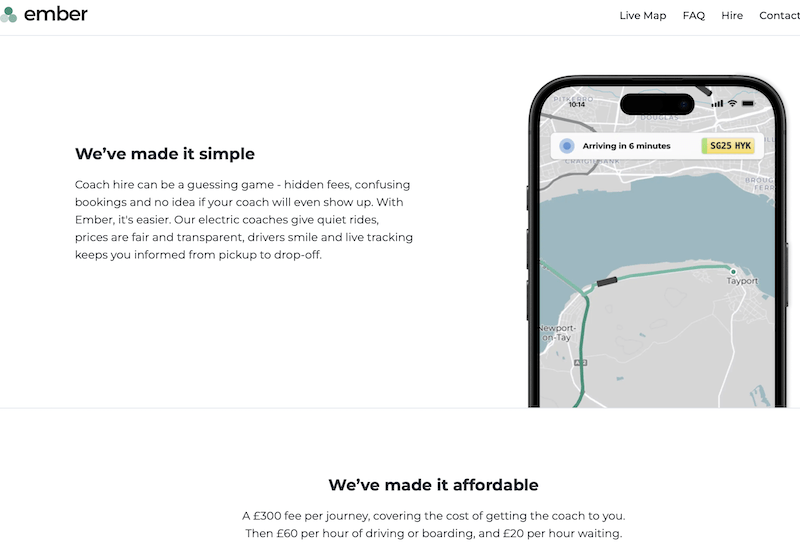
The ember website also includes a very helpful FAQ section too.
Cross words about Cross Country
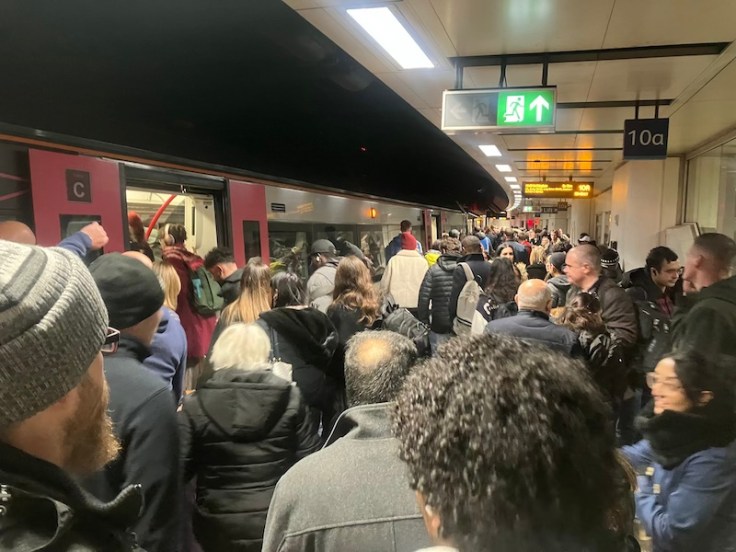
Mel emailed me following my comments about overcrowding on Cross Country trains in last week’s Seen Around blog to add his forthright thoughts: “my most recent experience was the on-time 20:13 from Birmingham International (origin, Manchester) to Bournemouth, which arrived full and standing as a four-car Voyager. When I got off at Leamington Spa, it was still very full, and more people were trying to get on. This is not untypical. As a regular on the Birmingham-Peterborough service, apart from the odd days when you get a longer train, it is generally full and standing as you describe. Given XC’s fares are generally high, I don’t get why they need such a big subsidy. It would be interesting to do a big desktop recast.”
Mel went on to explain the background to the XC franchise reminding me “the last time it was properly re-franchised (when the routes were to change) Virgin decided not to bid when the DfT said it would be a two-car DMU network. Virgin saw the potential (which is obvious and very clearly big) on these routes, but the DfT just saw it as a ’no investment’ railway and couldn’t be persuaded otherwise.” Mel also added his thoughts on the Thameslink graffiti situation and concluded “it is terrible, and makes travelling on Thameslink – upright ironing board seats and no power/USB sockets or tables – even more unpleasant. Quite why people think having the DfT in charge is a ‘good thing’ is beyond me. Remember, it was the DfT that specified the trains (like the IET) and forced them on the operator, because they were ‘cheap’.”
Why bother telling TfL things?
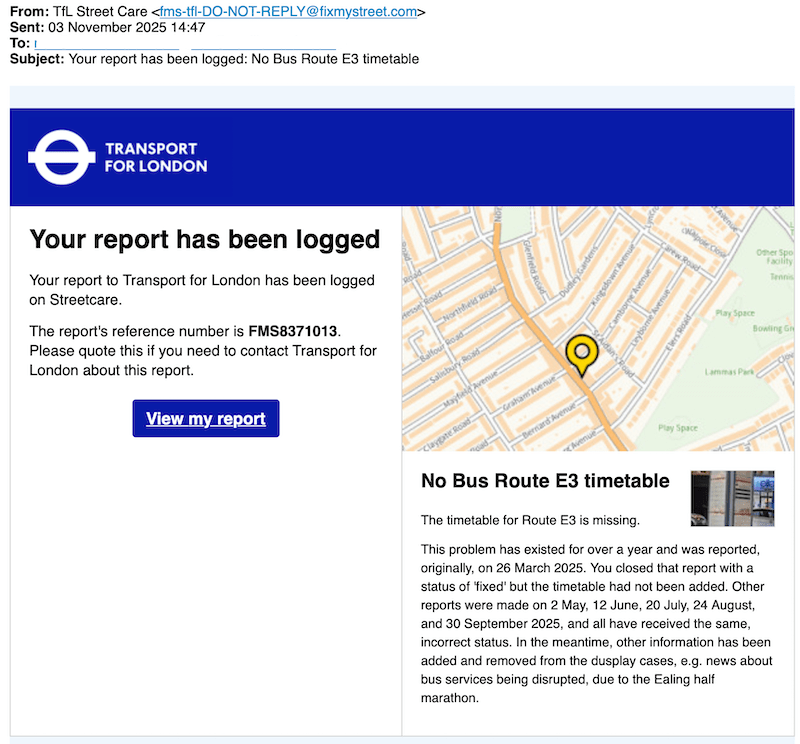
Neville passed on his frustration at TfL’s feedack reporting service for logging details of damaged bus stops or those displaying incorrect information. He rather depressingly explained “I decided to report a problem close to home back in the Spring of this year that had existed for at least a year. However, I wasn’t expecting quite the scale of uselessness in making the effort I have continued to make since then! There’s no hope, which is the conclusion I think you’ve reached on this subject too.”
To illustrate his point, Neville sent me the following acknowledgment received from TfL about his latest report….
And then, on a similar theme, the next day, I received an email from Max providing “a condensed account of TfL’s awful diversion arrangements in Sidcup, where part of the High Street was closed.” It’s difficult to succinctly summarise the chaotic arrangements Max described with two different diversions for two sets of roadworks but he provided me with a few maps to try and explain things…
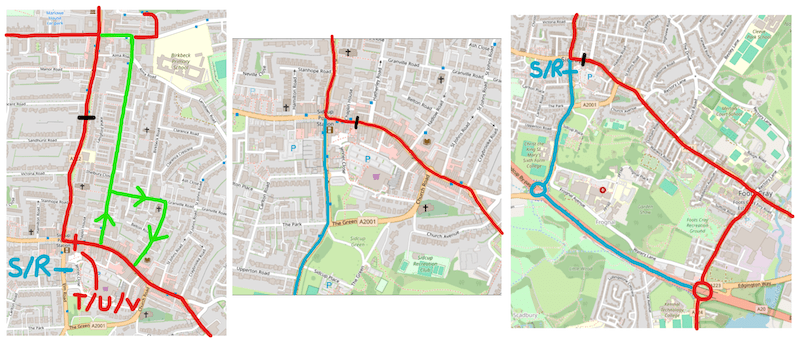
… and the following explanation…. “Diversion A is shown in blue, diversion B in green, the exact location of the roadworks by a black dash and the buses’ normal route shown in red. For simplicity’s sake I have stuck with just the 51, 233 and 492 as these were the only buses affected by both sets of roadworks. I don’t believe the roadworks were supposed to overlap at all, and true enough diversion B’s roadworks only started once A’s had finished, however TfL’s communication did not reflect this. And in the time between roadworks A finishing and B starting, half of drivers continued following diversion A and half went back to the normal route, even with buses arriving literally one behind the other. Signage on High Street throughout instructed passengers to use stops S/R on diversion A (even once B was in place and diversion A was then impossible for the 51/233/492) – this was a problem particularly at stops T/U/V, which were not supposed to be served by these buses during either diversion. A 233 was seen driving the wrong way up the one-way system on diversion B.”
Express routes in the slow lane
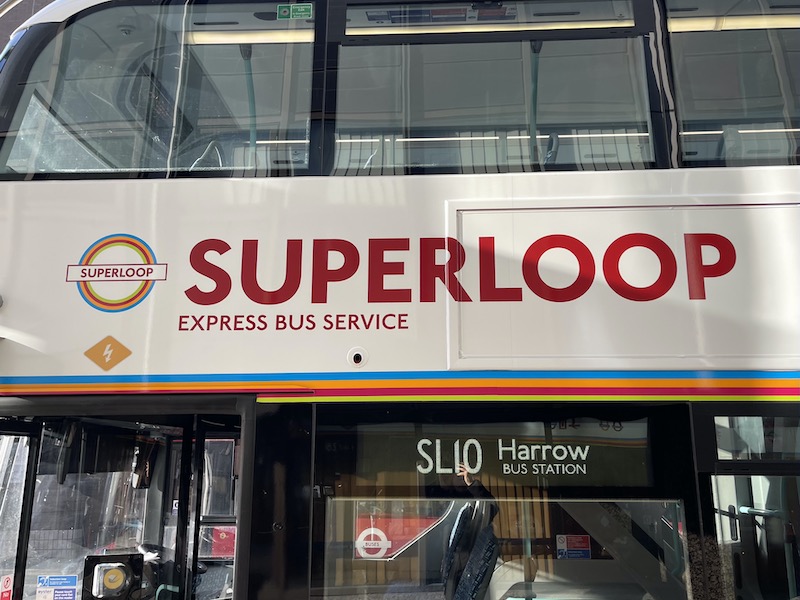
Richard emailed with “a random thought” having reflected on London’s “Superloop and Bakerloop services being marketed as ‘express’ routes, I wonder whether, in view of the fact they cannot travel at more than 20mph and will be subject over certain sections to much slower average speeds, they could take the award for the slowest express services ever?”
He went on to explain “I doubt many, if any, other express services across the UK could claim to be anywhere near that slow, either now or in the past (except maybe those running 100 or so years ago)! It almost seems something that should be referred to the Advertising Standards Agency as ‘express’ implies ‘fast’ and would-be passengers might expect something much quicker than they will actually get. It could be construed as misrepresentation. These routes should have been marketed as limited stop services as that is what they are, although I have always wondered whether Joe Public understands what that term means, as it really is an example of ‘bus speak’ as I call those things that we understand internally and assume passengers will do so similarly without questioning whether they actually do or not.”
Peter gets Arriva to act
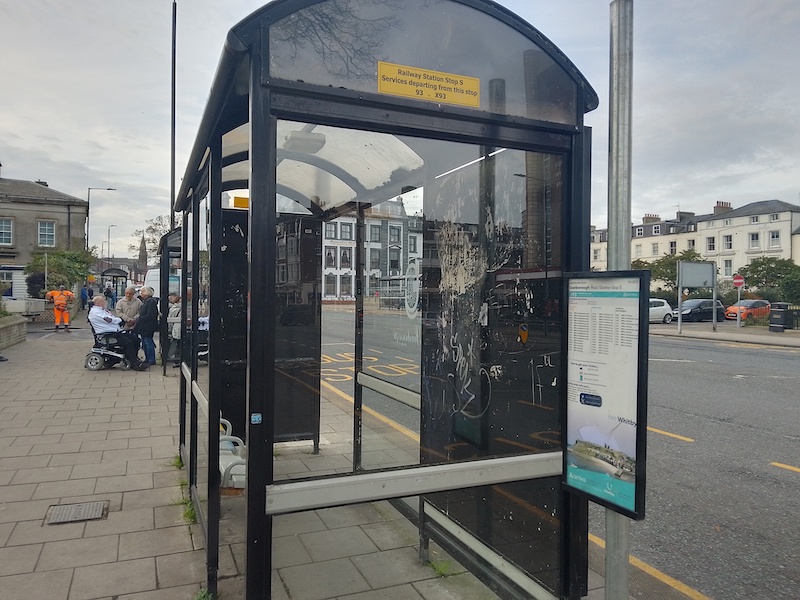
Peter got in touch following my visit to Scarborough to try out the X28 to tell me about the lack of timetables on display at the main bus stop outside the town’s railway station for Arriva’s popular route X93 to Robin Hood’s Bay, Whitby and Middlesbrough.
Peter explained “there is nothing in any of the bus shelters to say where it goes from, or when, or even at all. There are no printed timetables, nor anywhere in the town to get any bus information at all.. This has been the case for over 20 years. I only moved here in March, but I have sent emails to Arriva and to the council but without reply. The other bus shelters, served by Coastliner to Leeds and East Yorkshire services, all have timetables. Once you leave the station area, Arriva stops all have Arriva timetables too, even on the moors in the middle of nowhere, so why not at the terminus where nearly everyone boards? This week I have printed a timetable myself and posted it inside the shelter. I wonder how long it will last, and I wonder how many summer visitors never find out there is a bus to Whitby.”
That sounded like another example of a kind act by a helpful passenger to let fellow travellers know about a bus route only for another email to arrive from Peter the next day saying “after my timetable had been up for two days, it vanished, as I feared it would. But at the same time a brand new timetable case appeared on the adjacent lamppost with an up to date timetable….first time in 20 years. I spoke to a driver and he said that mine had been spotted, and had finally shamed them into action. So hopefully I did some good.”
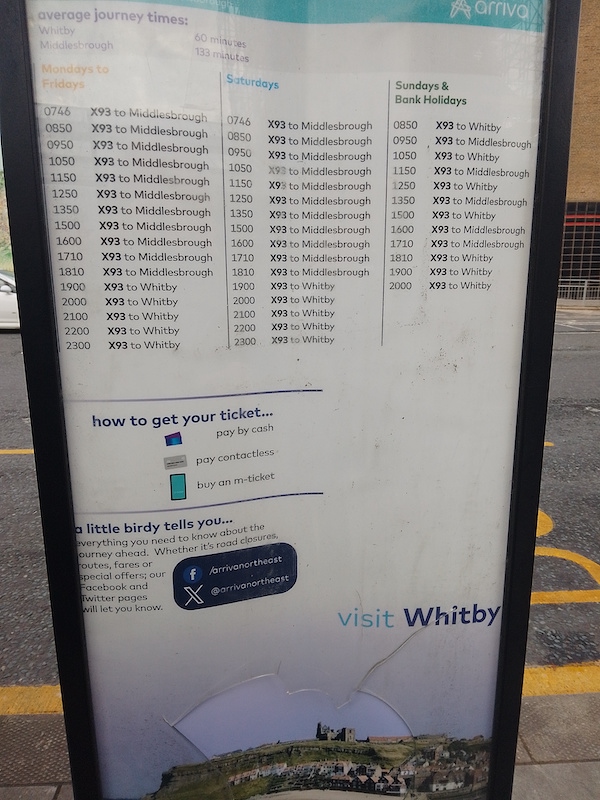
It certainly did Peter, and well done to you although, as he pointed out, it’s a shame the plastic timetable case was damaged within a day and he also pointed out the yellow notice on the bus shelter (in the other photo) proclaiming route 93 stops there is a relic from the old United days – the last time the number 93 was used.
More Medway grief from roadworks
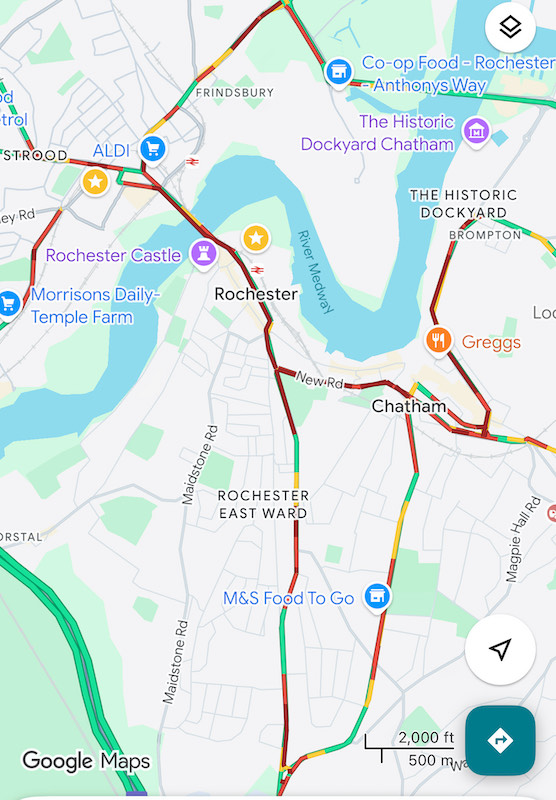
Readers may recall an insider working for a bus company in Medway tipping me off about disruptive roadworks in Strood back in April leading to a blog report. He’s got back in touch last month to say “me again! Strood strikes again! Today has operationally been extremely challenging due to emergency works that are scheduled up until the 18th November. Drivers cover Strood on one portion of a duty, and say Gillingham on another, so this had quite a great affect! It again highlights how one hold up can create gridlock. It went as far as Chatham Rail Station and beyond at one point … with … some 133’s and 191’s, diverted to avoid Strood completely.” He also sent me a Google map image which all too effectively demonstrates the scale of the challenge.
£285 for an upgrade to First
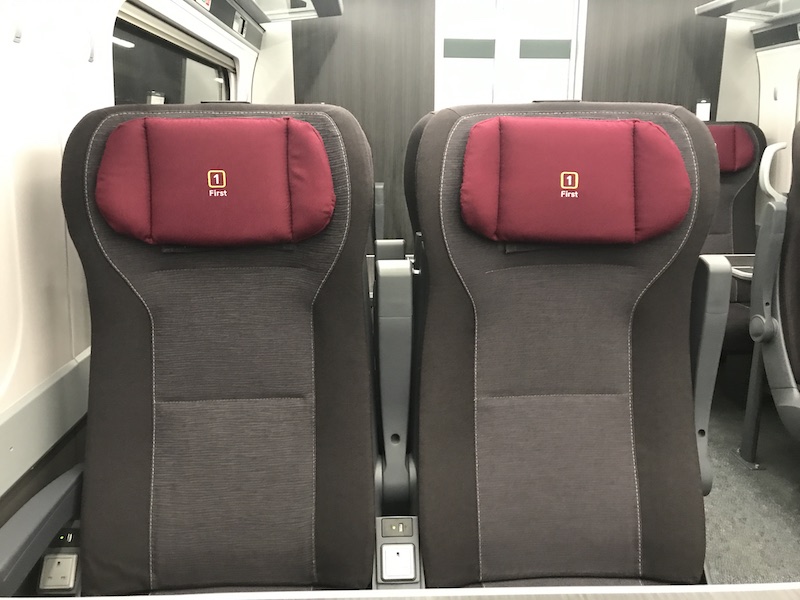
Andrew followed up my blog about rail ticket pricing to let me know “my son yesterday booked a single train ticket from Truro to Wellingborough for next Monday, with a Railcard, for £30.30 but was horrified to be offered a first class option for £315.35. Who in their right mind would go for that option? It is not surprising to see the seats empty!! I suppose somebody either thinks that we are stupid or has a weird sense of humour …..”
Armistice praise for Lothian
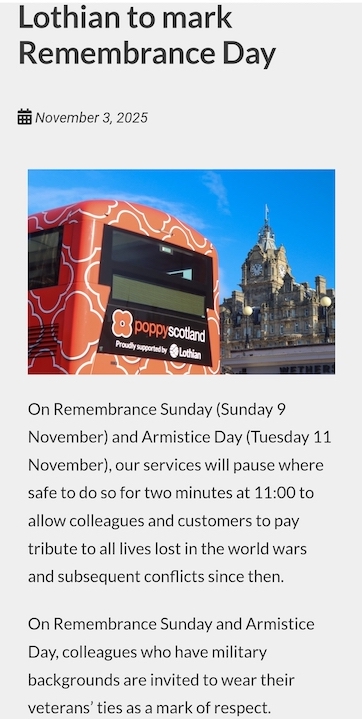
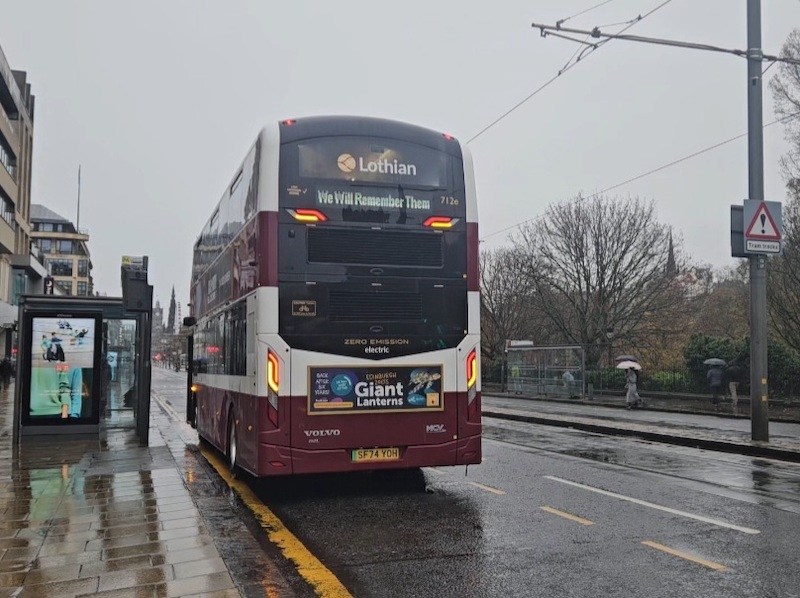
John emailed on 11th November to say “this year Lothian Buses publicised in advance all buses would pull over for two minutes at 11am. It was apparent from overheard radio messages that a prearranged count down was taking place as the 31 I was aboard passed Haymarket. I walked into Princes Street as the cannon fired in Edinburgh Castle at 11am. The new BZL electric bus pictured on route 24 like other buses had pulled to the side of the road with the driver activating the hazard warning lights before resetting the destination to show “Lest we forget” message. After the cannon fired a second time to mark the end of the minutes silence the incoming driver reset the destination and proceeded in service. Full marks to Lothian Buses for their highly professional commemoration of Armistice Day.”
A sign of the times
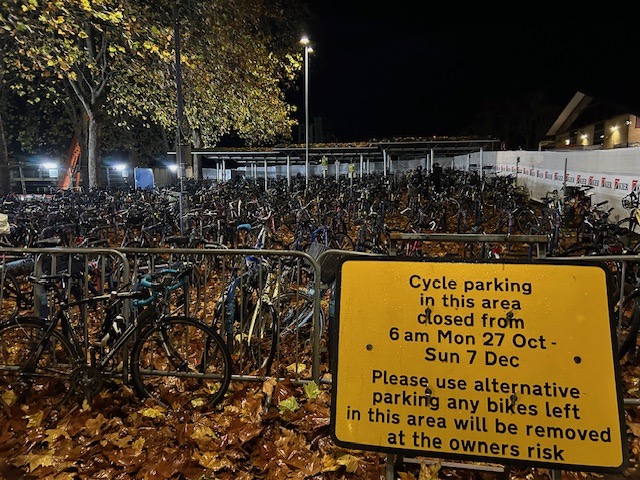
Steve followed up my recent blog about Oxford’s Temporary Congestion Charge by emailing me the above photo he took of a sign by the railway station telling cyclists not to leave the bikes in the area.
Darting about a website
Damon emailed to let me know Go-Ahead owned Dartline are “taking over a number of routes in Devon from Stagecoach in early January. Namely most journeys on the 6A (to be 66), as well as the complete operation of routes 96, 97, 348/349, 360 and 369 (Country Bus taking the 173, and MD Bus the one vehicle 660/855/856/859 school/shopper routes).”

He went on to add “what intrigued me was going onto the rebranded Dartline website https://www.dartline.co.uk/, where the operator seems to want to deny running any buses at the moment and giving any information out. The main menu at the top has no mention of local buses, and scrolling down to where there is a ‘Local Buses’ box just takes you to Traveline. While I know there are some smaller independents out there who run tendered routes with minimal/no presence online and just get by with locals knowing about the service, I found this quite surprising coming from a Go-Ahead owned operation!”
Little Reds hit the road
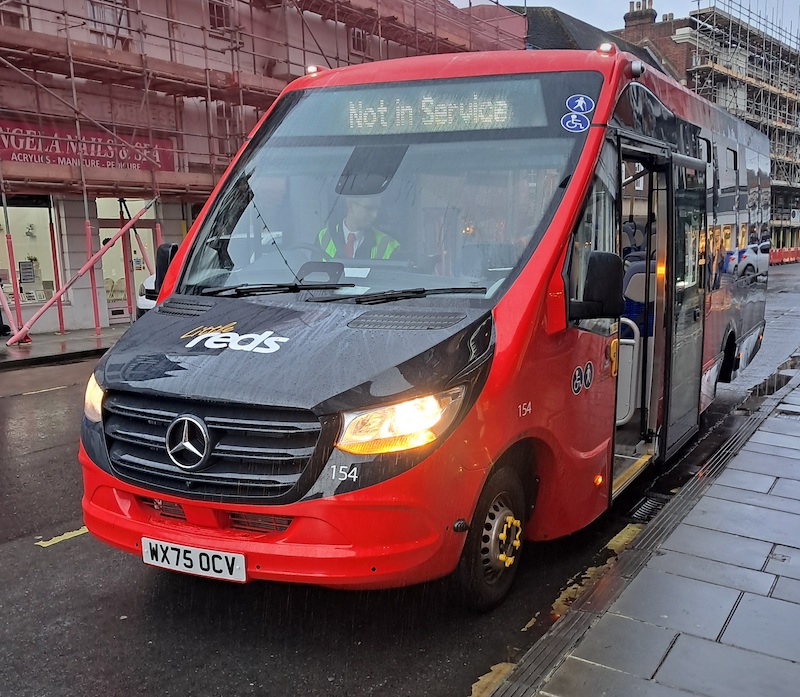
And finally thanks to Stuart who emailed me a photo of one of the nine new Mellor Strata Ultra Mercedes minibuses just delivered and branded as Little Reds for use on routes rural routes in Wiltshire and Dorset including the 25, 26, 27, 29 and 37. They certainly look smart.
Roger French
Blogging timetable: 06:00 TThS
 BusAndTrainUser
Local Government Reorganisation and Public Transport
With the proposed delay to elected mayors we appear to have a potential issue with public transport. At present public transport LTA usually comes under the county council but these will now from May no longer exist. If we take Essex for example the County council will be replaced by 3 unitary authorities. The most sensible temporary situation would be to retain the current LTA which would probably have to be funded by the 3 unitary authorities until they get an elected mayor when they take on responsibility for transport
LikeLike
In Lancashire the Combined County Authority will become the LTA despite not having an elected mayor.
The county council and district councils are not set to be replaced by unitary authorities until 2028.
Jim Davies
LikeLike
Only the Mayrol elections are postponed. The County councils are still Bering replaced by unitarity authorities
LikeLike
Essex is currently subject to a consultation that closes in January and offers four options:
https://www.gov.uk/government/consultations/local-government-reorganisation-in-essex-southend-on-sea-and-thurrock/proposals-for-local-government-reorganisation-in-essex-southend-on-sea-and-thurrock
It certainly won’t be implemented by May!
LikeLike
Currently the elections for the new unitary authorities are still scheduled to take place in May
LikeLike
If we are still talking Essex, no they are not. It was one of the four announced earlier this week as postponed until 2028.
https://www.bbc.co.uk/news/articles/c5yjg2r7z9zo
LikeLike
THis will happen in Surrey and Hampshire too. I have written to the local newspaper about it and also other county wide services like archives and museums.. Noone gives an answer.
Does the Government not know or think about county-wide services?
malcolm chase, Fleet
LikeLike
As per earlier comment I think there is confusion between elections for Combined Authorities (county level or wider) and elections for the new Unitary Authorities (district level – usually combining one or more districts).
Is your understanding that the local elections will go ahead in 2026 (so abolition of Hampshire County, Southampton City and Portsmouth City Councils and replacement with four or five (larger) unitary authorities)? If so, yes there will be a gap in responsibility for public transport
LikeLike
The timetable for Hants is similar to Essex. Unitaries are not planned to takeover until April 2028.
https://www.gov.uk/government/consultations/local-government-reorganisation-in-hampshire-isle-of-wight-portsmouth-and-southampton/proposals-for-local-government-reorganisation-in-hampshire-isle-of-wight-portsmouth-and-southampton#what-happens-next
The gov.uk website does not seem to reveal when any of the proposed Combined Authorities will now come into existence – old documents still state May 2026, which is no longer feasible.
LikeLike
Following up a previous blog, it looks like my comment that Reading Transport has always struggled to find a settled pattern for the minor routes south of the town centre was rather on the money.
The revised route 10 has apparently been unpopular with passengers and will be withdrawn in the next round of service changes, to be replaced with the diversion of roughly half the route 50 buses.
Ironically this more or less takes us back to the position two rounds of service changes ago before the route 10 was created.
LikeLike
I also despair at the state of publicity at bus stops and shelters on the London bus network. Add to that the lack of up to date timetables (even on Night routes) broken timetable frames and now regular blank Countdown screens which never get fixed. Also worth noting that no additional screens have gone up since 2023. So much for a Bus Action Plan. No wonder bus use is continuing to decline in London if no one at TfL actually cares (or even notices). I was in Portsmouth recently and impressed with bespoke bus stops and shelters, functioning real time information and route branding. The results speak for themselves – higher patronage. A lesson to be learnt for London.
Martin W
LikeLike
Let’s compare this to the “good old days” of London Transport – say, 50 years ago.
Many bus stop flags were just a simple flag. It told you it was a bus stop, but no indication of which routes stopped there.
Timetables might be displayed (but not stop-specific) – if you were lucky. But for many routes, you might just see a small yellow slip showing the times of last buses (at key timing points), with a rough indication of frequency. Whilst the times of last buses were shown, no indication of when the first bus was due. And whether it was a timetable or a yellow slip, you had to work out where you were in relation to the timing points shown.
Or, all too often, you might find just an empty timetable case with no glass, no timetables or information.
No such thing as countdown displays. You just stood and waited (and all too often, waited and waited). Just because it said buses ran, say, every 10 minutes didn’t mean you wouldn’t be waiting 45 minutes for one to bother to show up – but nothing to inform you of that.
That’s not to pretend everything in the capital is now perfect. Countdown not being rolled out further, and displays not working long-term, are valid points.
As for higher patronage in Portsmouth, is ridership actually higher in Portsmouth than in London? Or is it rising from a low base?
Malc M
LikeLike
Not correct, Most stops would indicate all the routes served and have full timetables
LikeLike
The improvement in London information was roughly concurrent with the introduction of tendering. Plenty of photos show bus stop flags in the 1980s without route numbers e.g.
https://londonbusesbyadam.zenfolio.com/p667278590/h1ab77351#h1ab77351
https://in.pinterest.com/pin/time–330873903888410399/
LikeLike
@Anon 09:11 – not correct!
Full timetables were either 12″ or 24″ panels. Most stops had either a single or a double 36″ frame. Three routes with 24″ timetables? More than six routes at a stop? How did those get displayed?
Many bus stop flags didn’t display route numbers. Those that did were where stops were clustered (and the route numbers weren’t necessarily shown in any order).
Malc M
LikeLike
In Portsmouth, bus passenger numbers are up 41 per cent in just two years, with over a million journeys now made every month. That’s the best post-covid recovery of any UK city.
LikeLike
Bus journeys are 43 million below the budget and 50 million down on last year
Reoort to TfL Board Dec 3rd
LikeLike
Managed decline
LikeLike
With London accounting for around half of all bus journeys made in England, a 3% drop in trips per head in the capital had a marked effect on the overall picture.
LikeLike
Heavy graffiti in the toilets on Thameslink trains predates DfT micromanagement and the current rolling stock. It’s clearly for the operators to get a grip of it, but none gave as yet.
As for Dartline, this doesn’t surprise me as Go South West seem to be very weak compared to the rest of GoAhead when it comes to marketing and publicity.
Steve
LikeLike
Poor bus stop information seems to be spreading to Brighton & Hove. A new real time display system has been in the process of installation for months, and is still not fully up and running. My local stop has had a new screen installed, helpfully displaying the makers logo for weeks on end, recently going blank, and there are plenty more in the same state. I realise that the real time displays are the council’s responsibility, but surely someone at Brighton and Hove buses could bring a bit of pressure to bear? Yes, you can look up real time info on the app, but the at a glance facility offered by the screens at the stops is something that we have all got used to, and come to expect as a basic level of service. Let’s at least have some up to date information on progress either from the council or the bus company, and as for the company responsible for the new system – get your fingers out.
LikeLike
Registration details suggest the 93 survived as an Arriva Durham County route until spring 2013. The style of shelter suggests it would not have been around in United days anyway.
LikeLike
The Little Reds Mellor Strata looks smart. Here’s hoping for a future report from Roger.
Peter Brown
LikeLike
Sadly the travelling experience on these buses comes no where near the good looking of them. Lets hope Go Ahead have disabled the radios, so passemgers are not bombarded with blaring music like with many other ooerators of these. And tough luck if you want a decent forwaed visoon !
LikeLike
Poor work by LTAs appears to be a National issue which will only get worst with the forthcoming reorganisation.
TravelNotts do a reasonable job with RTI screens and information, but you cannot have those in rural areas now served by DRT. Stop plates are being updated with new logos but mistakes are happening – missed routes and incorrect route numbers. I’ve complained but didn’t even get a reply.
Timetables are added by operators, though I am seeing new generated displays on some stops.
The new major has been consulting on buses recently, but only if you know about it and take an interest.
Richard Warwick
LikeLike
A bit off topic. My wife & I travelled to Braintree yesterday in anticipation of attending the opening of the Zero 2 Bus Museum at Great Yealdham this morning only to discover this had been cancelled & furthermore, that it won’t be opening now until Easter 2026. The frustrating & disappointing element of this notice (posted on their website) is that I personally took the trouble to send the museum (via their website) an enquiry two weeks previous to enquire whether the opening was definitely going ahead. They didn’t respond, so I assumed they must’ve been too busy with all that goes into such an enterprise & went ahead & booked accommodation for the Friday. I only discovered the cancellation this morning, having travelled over 150 miles to be there. My only reason posting this here is to discover whether anyone else was similarly affected.
LikeLike
It’s always a good idea to check such events on the LOTS (London Omnibus Traction Society) news page: the Great Yeldham cancellation was posted there on 12th November.
Ian McNeil
LikeLike
Thank you for that Ian, your reference to LOTS made me smile as It brought back memories of when I was a member back in the 1960s. I recall travelling from my then home in South Ealing, by Piccadilly train to Hammersmith & then changing to a District train to Victoria to attend the monthly LOTS meetings that took place above the Coach Station. We gleaned the latest news from typed up news letters while watching film shows (courtesy of Super 8) & I still remember the camaraderie of all those fellow enthusiasts eager to share their knowledge & experiences. LOTS owned RT1431 in those days & we had many trips out to visit various places at weekends. My family moved to the south coast in 1968 so sadly, I let my membership lapse. As you can tell, it hasn’t dulled my interest in buses though. I’ll check the latest on the museum in the new year, as suggested.
LikeLike
While that’s extremely frustrating, the cancellation was being officially posted by November 20th and possibly earlier. I see that the Facebook page associated with the museum has a note on it to say that it has been hacked and isn’t being updated so that may not have helped.
I’m sure it will be worth the wait, I’m lucky as I’m only ten miles from the museum.
LikeLike
Strangely enough I think DfT almost got it right with the class 700 trains that run on Thameslink. The plan was that the load on the tracks would be as low as possible. That was because the most heavily used section is all in tunnel and access for maintenance is quite tricky as a result.
That weight minimisation strategy accounts for the “ironing board” seats and the lack of tables. Every ounce counts when you are looking to reduce weight. Although, after passenger grumbling, some units have had tables retrofitted now.
Another feature that fits the service well is the automatic operation of the doors in the central section of the route. Not only the automatic operation, but also, in the outer areas, the instant response to a press of the door button. These all go to reducing the unproductive part of station dwell times. Compare and contrast with the sluggish and often delayed door operation on SWR services.
The toilet graffiti is another issue, and it would be perverse to blame DfT for that.
LikeLike
Roger: Please don’t forget that the fare from Chichester (where I live) to Weymouth is DEARER than the fare from Worthing or Brighton to Weymouth (on a train that, (obviously!!) goes through-and stops at Chichester). We are having 2-that’s one each side- of the small ticket machines removed.
LikeLike
Lothian Buses may have their detractors, but compared with some of the dross operating shoddy services with poor, missing or wrong publicity, they are nearly always an exemplar of how to do it. The formalised two-minute silence is totally in keeping.
LikeLiked by 1 person
Yes I remember the drivers and conductors on the buses and trams in the 1950s were always smartly turned out, and every year their peaked caps changed from black to white on 1st May (or was it April?).
Ian McNeil
LikeLike
local protest to prevent replacement of 1950’s bus stop with something modern and objectly worse.
https://www.edp24.co.uk/news/25681761.bailiffs-arrive-4am-sheringham-bus-shelter-protest/
milesT
LikeLike
Certainly in the last decade or so, the Arriva X93-X94 timetable was never posted at the terminal bus stop in Scarborough by official means – bus company or local authority.
I believe this was raised internally, but there was no response, and drivers noted that, when arriving at Scarborough, they inadvertantly became a mobile travel information service.
On & off either side of Covid-19, a list of departures was posted on the shelter glass by a driver, whose wife had typed and printed it at home.
This was vulnerable to disappearance, and ended altogether when said driver took employment elsewhere….
LikeLike
thanks again Roger for putting my ikle reds image in your fab blog. Happy new year. Rgds stu
LikeLike