Tuesday 25th November 2025

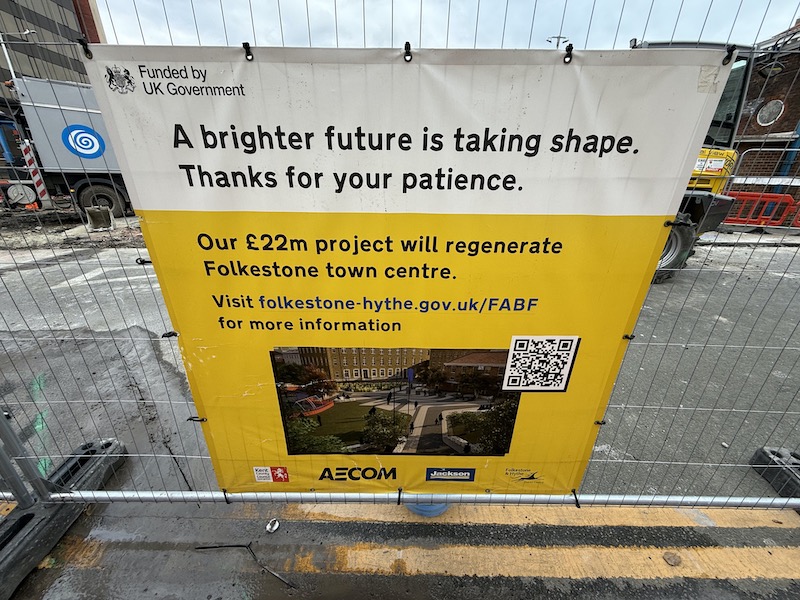
Folkestone’s long standing Bouverie Square bus station is no more. After 50 years public service it closed at the end of September to be converted into a town centre community park (to be also known as a ‘Green Heart’) as part of Folkestone and Hythe District Council’s £20 million Brighter Future project.

I paid a visit last week to see how the transformation was coming along and the alternative arrangements passengers face now buses have been banished from Bouverie.

There’s not much greenery yet but it’s early days and there’s certainly a lot of work going on to transform the former Square which sat alongside Stagecoach’s offices and many years ago even a Travel Centre where you could obtain information about, and copies of, bus timetables.

That building looks rather sorry for itself now although seemed to still be in use for Stagecoach staff as it’s a handy town centre point for drivers to take over duties etc.

The District Council’s vision is to lease the now unused space out as a café to act as an anchor for the park.

The District Council is displaying some lovely idyllic images of how the new park will look on its opening day in glorious sunshine with mature grown trees and foliage…

… which will certainly make quite a contrast with a bustling bus station…
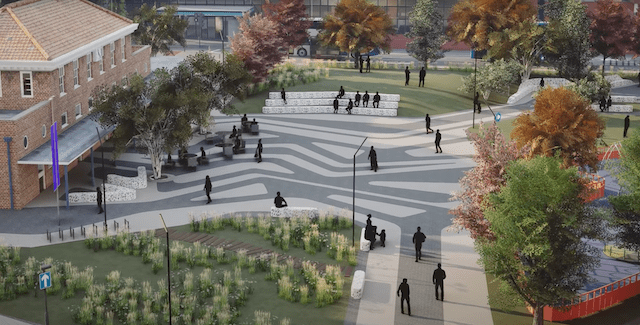
… where buses used to come and go as well as terminate and take stand time.

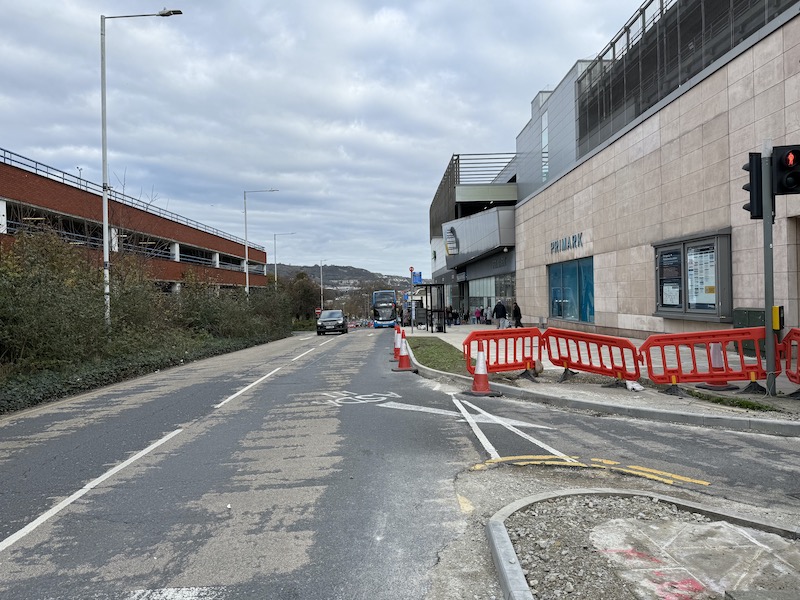
And as you can see from these AI generated images buses will now use new bus stops at the north of Bouverie Square in Middleburg Square.
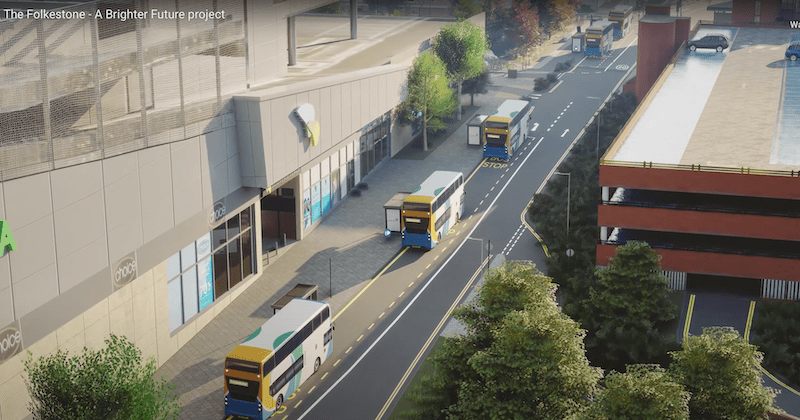
The images show bus shelters lined up along the road which passes between Asda, the Bouverie Place Shopping Mall and a rather down-at-heel looking currently unused multi-story car park.

These new arrangements for buses have been officially welcomed by Stagecoach South East. Managing Director Joel Mitchell has explained “we’re pleased to support Folkestone & Hythe District Council’s regeneration plans by relocating our services in line with the new layout. The linear design will create a safer environment for pedestrians, and this move gives us the opportunity to further improve customer information, including the introduction of real-time updates at the new stops.”
I can understand Joel’s reference to the “linear design” creating “a safer environment” as there’s no doubt the former bus station layout could appear a little chaotic and foreboding at times particularly when trying to access the centrally located bus stops. It wasn’t ideal by any means.

Joel also refers to the introduction of real-time updates at the new stops which of course could have been provided in the old arrangements although I expect the old style shelters there didn’t lend themselves to receiving the necessary power connections.

However my concern is whether the shelters now in place in Middelburg Square are extensive enough and befitting of a new “bus station”.
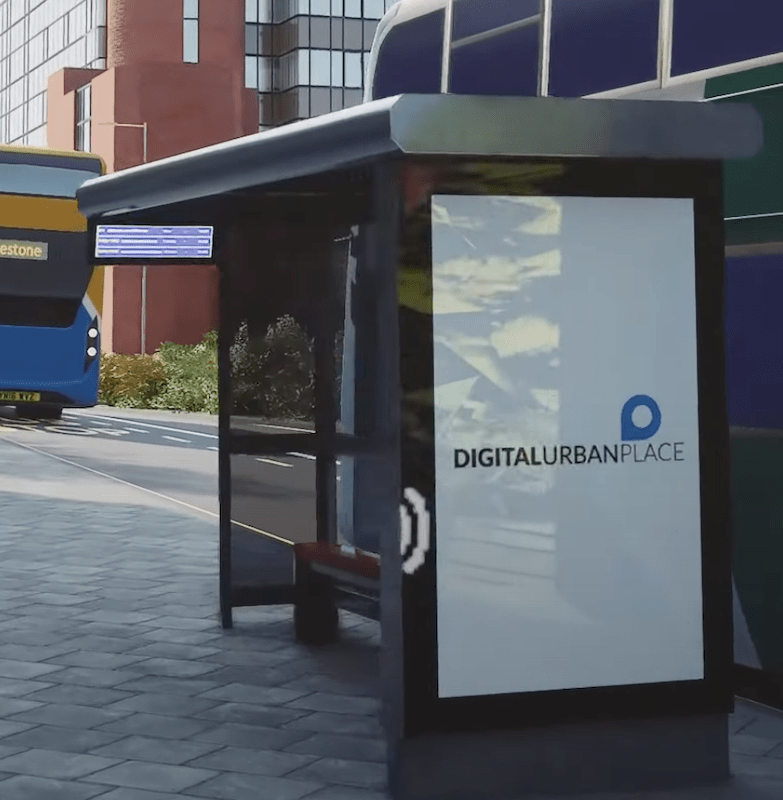
It may be the case what I saw are only temporary arrangements and the shelters will be moved around once the final phase of the ‘Green Heart’ is implemented, but they looked pretty permanent to me and more or less as per the AI generated images shown above.
So, my main criticism is they’re not big enough and custom and practice seems to have dictated they’re the wrong way round.

Passengers are queuing away from the bus shelters rather than waiting in the shelter to form the first part of the queue. This is because it’s a one-way road and people naturally like to face where buses are coming from. Bus drivers are pulling up at the western end of the shelter where a pole and flag has been installed. So it’s all a bit crazy.
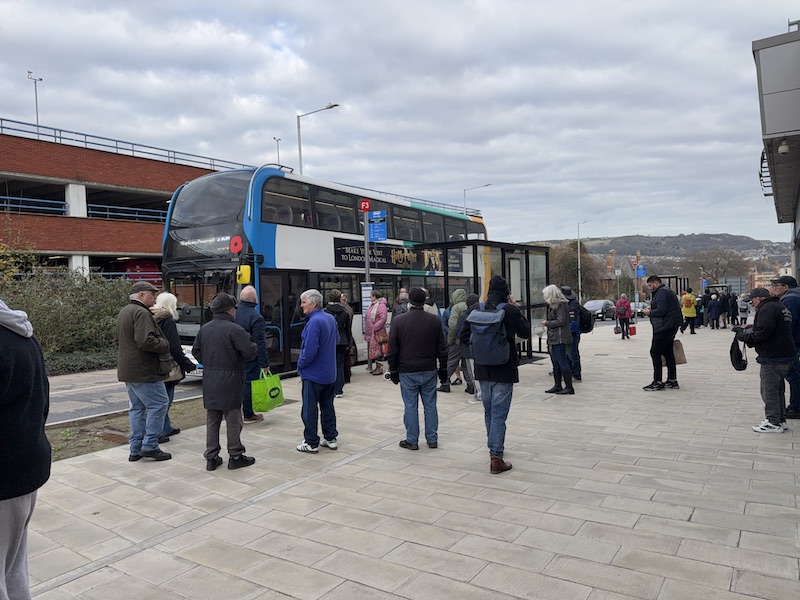
Before habits get too engrained the bus stop poles (and, when installed, the real time departure panels) need to move to the other end of the shelter and passengers encouraged to queue through the shelter facing east.
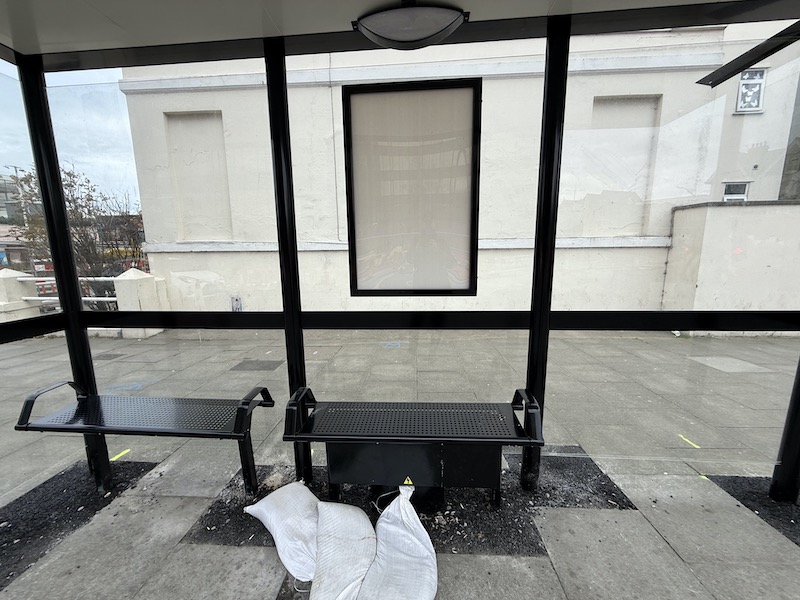
It’s a shame no information is posted in the large cases inside the shelters although departure listings are available in a case on each bus stop pole. As you can see the seating is minimalist too, although at least it’s not of the perch variety.

Stagecoach has produced a helpful map showing where the new departure points are located which is available on line but is very difficult to find out on the street.

I arrived in the town with no knowledge of where the bus routes were now departing and eventually found a copy of the map on a shelter within the now abandoned bus station.

It might be helpful to place a much larger copy in all the empty cases in the new shelters to help visitors and first timers like myself.

The current shelter-less location of bus stop F1 for hourly route 10/10A to Ashford, the six-journey-a-day route 74 and National Express coaches is way to the west outside the back wall of Sainsbury’s on Bouverie Road West. I’m sure this must be a temporary arrangement while the works are taking place and guess it’s permanent location will be closer to Cheriton Place.

I certainly hope so.
Closing the bus station is certainly a bold move by the District Council. Its successful bid to Government for Levelling Up funding for the overall Brighter Future project came after a public consultation exercise and includes extensive public realm improvements to other parts of the town centre including the corridor between Folkestone Central station and the town centre. This includes 20 mph speed limits and other traffic management arrangements with a new footbridge linking Guildhall Street North and Guildhall Street. Beautification of the pedestrianised shopping streets is also in hand.
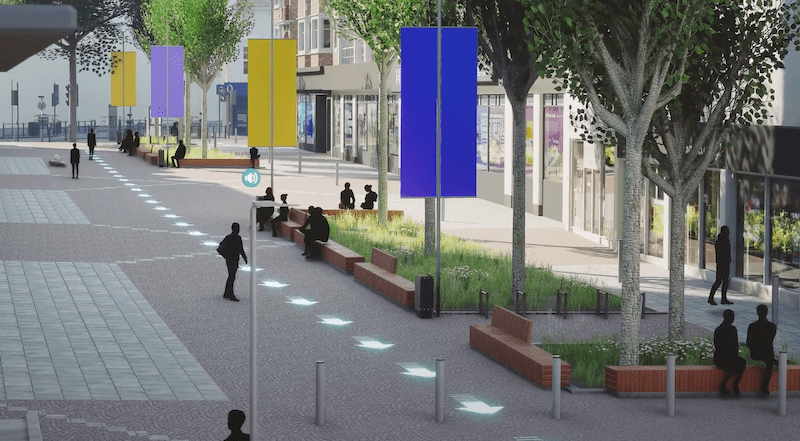
The new location for the bus stops outside an exit from a shopping arcade is quite handy for shoppers and I’m sure the new community park once it’s established will be a welcome focal point for the town.

But, so should a ‘community bus station’ and notwithstanding Joel’s well made point about safety I think it’s a shame we’ve lost a bus station with plenty of room for buses in favour of a few (too small) bus shelters on a one way street.
Roger French
Blogging timetable: 06:00 TThS


Is it a requirement that folks involved in the redesign and layout of a transport interchange actually understand what it’s like waiting in British weather conditions in these minimalist structures which are increasingly common these days? It’s an insult isn’t it to expect people just to hang around in what amounts to a ‘lean to’?
LikeLiked by 1 person
Hardly an improvement more making things worse
LikeLike
The cynic in me wonders that presumably Stagecoach owned the Bus Station as part of their purchase of East Kent many years ago and made a nice profit selling the site?
Hence their enthusiasm, as the current foreign owners continue their asset stripping.
LikeLike
Asset stripping is nothing new, and not confined to foreign ownership.
Not long after buying Hampshire Bus in 1987, Stagecoach sold Southampton bus station. Lewes is another asset to have been sold off, about 20 years ago.
Malc M
LikeLike
I miss the old Marlands bus station in Southampton as it was central & convenient, although probably in need of some TLC towards the end of its life. The present dispersed arrangements for catching buses in the city don’t exactly encourage their use. There also used to be a very good bus garage in Bedford Place, but of course, it was sitting on prime land & like the bus station was seen as a way to realise assets.
LikeLike
I tried out the new arrangements recently. It’s rubbish to be honest.
The bus station wasn’t ideal – the layout was poor. But it needed a redesign not closure!
The alternative is now waiting alongside the road with small cheap bus shelters – these are supposedly temporary until larger decent shelters with real time information come, but I never believe local authorities when they describe anything as temporary.
This has also made me realise that waiting for a bus is much more pleasant away from the roads – the car noise aswell as pollution fumes of idling traffic are annoying.
When I was waiting for the bus, the weather was poor and the shelters were full – I could shelter in the nearby shopping arcade though. It was also very dark, with no street lighting around the shelters , which also don’t have lights themselves.
All in all, I find it to be a retrograde step. Yet again it feels bus passengers have not properly been thought about. Very disappointing.
AMB, Canterbury.
LikeLiked by 3 people
Improving things worse. It’s all about asset stripping, they don’t care that it makes it more difficult for people to find and wait for a bus in the future as long as it looks like the company is making money in the balance sheet today.. then when less use is made of the service they can run that down too.. they’ve already flogged off the depot!
LikeLike
The depot has not yet been sold, more than two years after closure. It was recently used for the storage of some Stagecoach London buses.
LikeLike
As Folkestone, like so many coastal towns in the South, became another “inner-London-by-the-sea”, only a complete Innocent will not realise what the “community space” will become after dark.
I have no idea whether Stagecoach instigated this or not, but Council Tax payers are obviously having to find £20m to provide it.
Just imagine if this was on the railway, and stations and all the facilities that went with them were closed to provide “exciting new spaces”, with passengers having to board a few hundred yards away on exposed platforms with just a couple of shelters provided.
But no matter, it’s only bus passengers who can put up with such things.
Terence Uden
LikeLiked by 1 person
That’s how the North London Line ended up in the 1980s!
LikeLike
The freehold of the site belongs to the Radnor Estate, Stagecoach only having a lease to use it.
So Stagecoach hasn’t made any money from leaving, though it has potentially avoided the costs of refurbishing a 70 year-old property y (it opened in 1955).
The district council has harboured an ambition for more than a quarter of a century to get rid of the bus station, and the ill-judged Levelling Up Grant has finally seen this achieved.
The new “linear facility” is probably on the windiest street in Folkestone. It isn’t a particularly pleasant place to wait, and I doubt that any of the decision makers had sufficient experience to know this.
LikeLiked by 1 person
As Roger & others have already remarked, the shelters & seating are wholly inadequate presently. I trust common sense prevails & longer shelters facing away from the traffic along with decent seating, effective lighting & real time information are eventually installed. All of this is essential to not only accommodate existing bus travellers but hopefully, entice others to use the bus more often.
LikeLike
As others have said, shelters should face away from the road protecting passengers from traffic noise, fumes, and spray on wet days. The pole and stop (where buses pull up) should be positioned upstream of the shelter so the queue can face oncoming buses and walk forward to board.
Peter Brown
LikeLike
Why do councils think it is a good idea to close bus stations ? Taunton had a useful town centre bus station until several years ago, when it was closed for “redevelopment” and buses were distributed to stops around the town centre. Vehicles on layover that had parking spaces at the bus station were consigned to the depot a couple of miles away.
Although I didn’t closely follow the matter I had the impression that the plans seemed to be a bit vague, and nothing happened until the bus station building eventually became a temporary covid inoculation centre during the pandemic.
The inoculation centre closed and the tumbleweed started rolling again, but recently I heard that there are apparently now some plans to turn the building into – wait for it – a bus station.
LikeLike
The closure of Taunton bus station had nothing to do with the council. It was First who didn’t want the expenditure on a site that had had little maintenance in NBC, Cawlett and First ownership, so they closed the site.
The site was expected to be developed but the council bought it and have plans to reopen it as a bus station.
BW2
LikeLike
One less-commonly mentioned but significant issue with closing bus stations is that there is no longer one single named point for bus-bus connections. When buses are distributed to nearby streets, unless all routes serve the same street the timetables will inevitably have different named terminus locations / timing points and even if an effort is made to keep the stops close to each other (that’s not always the case!) immediately the non-local people have no idea that the locations are virtually the same place. In the Southampton example, a non-local wouldn’t know that interchanging between route 7 in Vincent’s Walk and route 2 in Hanover Buildings is very close (about the same as from one end of a bus station to the other) but without the label bus station it might as well be the other side of the city. It’s all about information design, but in physical reality.
LikeLike
Dear Roger,
What about Bus Information?
Its all very well them making a ‘new’ place for Buses to stand at, but how are people supposed to get information?
It is rather like Cambridge….its Central Bus Station, in Drummer Street – which is wrongly placed, in my opinion, it would be much better at the Railway Station – doesn’t have a Bus Information Office any more….so how are people, who are not ‘tech-savvy’, supposed to find out Bus Times?!
Thank you.
Kind regards,
Ben Walsh, Cambridge.
LikeLike
Ben, Drummer Street is surely closer to the shopping centre of Cambridge? Integration of different modes of transport sounds like a good idea, but I do wonder how many bus passengers actually do switch from the bus to a train?
RC169
LikeLike
Not as many as there might be because the buses go to the bus station. In fact in a world of online shopping, out of town retail snd declining high streets the bus to rail market may actually have more growth potential.
Peter Brown
LikeLike
A common fallacy. The town centre is still the pre-eminent destination in many places for shopping, working and tourism reasons, even in a place like Cambridge that has some substantial peripheral traffic objectives.
LikeLike
Even if you are tech savy, the Stagecoach Bus App is always incorrect.
LikeLike
Part of the problem is that the bus operators themselves are not necessarily particularly enthusiastic about bus stations. If the bus operator provides the station from their own resources, then it costs them a significant amount of money, particularly for prime central locations. The passengers actually want to get to offices or shops, etc, and not specifically to a bus station – although for their return journeys, a station can provide a more comfortable location to wait for a bus. If the station is provided by the local authority, then the operators will probably still have to pay for it, via a “per departure” charge or similar.
When I worked in the bus industry, almost 50 years ago, the council in one town on our network wanted to build a bus station, where there had not previously been one. Most of our services that served the town terminated there, as did those of other municipal and independent operators; but the town’s own municipal operator ran cross town services which would stop outside the bus station without actually entering it. This didn’t go down well with the other operators, who would be obliged to pay a departure fee for their services. The station was eventually built, but I don’t know whether the local municipal operator did actually manage to avoid paying any departure fees!
RC169
LikeLiked by 1 person
Its all very sad. What happened to town planners – do councils not employ any? I first saw Folkestone, one of the best, in 1955 I think on a bus from Maidstone. Interchange will be difficult. Look at Aldershot where Stagecoach thinks it is better to have no bus station away from the centre. But how long does it take to change buses in Aldershot, something I do regularly?. Too long for old people and with no signs either.
malcolm chase, Fleet
LikeLike
What happened to town planners – do councils not employ any?
They are probably now contractors charging £££ – kerching!!!
LikeLike
As in Swindon, the new “bus station” along a length of road exposed to the weather is a distinct worsening of what was there before. The only positive thing I can find to say is that the stops are nearly all in the same place, unlike in Birmingham where they are all round the city centre to make most changes an ordeal. “Not as bad as Birmingham” is not really a commendatiin.
I can’t decide whether the Stagecoach mouthpiece, at the time of his apologia, had his arm forced up his back or had a pole up his fundament, puppet-style.
LikeLike
My principal memory of Folkestone as a public transport user was in 1972 after abandoning a motoring holiday with my parents in France. Father had chosen a dull part of France, and I was thoroughly bored with hours in the car. The football season had started so I wanted football fun rather than more hours in the car. At Montauban I “resigned” from the family holiday and bought myself a single rail and ship ticket back to England. It was overnight from Montauban to Paris and then an early morning connection to Calais where a NON CAR FERRY ship took me across the Channel to Folkestone. I think I had a “sleeper” from Montauban to Paris, but it was a day train on to Calais and then there was this BR ship which was divided between the Classes, 1st and 2nd! At Folkestone Harbour there were three 4-COR coupled units waiting to take us all to London. With a 1/30 gradient, the motorman needed to select “weak field” by a simple switch in his cab to get us up to the main line. On DC stock “weak field” enhances the motors’ power tackling a gradient or on level track increases the speed. Mother’s parents were house sitting at my Hersham home so they were astonished to see me on my own, walk across my own front yard that Thursday. Two days later, football fun in London yet my dear Palace lost at Tottenham. Most certainly my longest journey to watch a football match in England. 4-COR is one of my favourite classes: cab ride when 12 from Victoria to Birchington on Sea.
LikeLike
4 CORs were not used on the South Eastern Division. More likely to have been 4 CEPs (though every chance that the boat train included a BEP).
LikeLiked by 1 person
Yes, I did make a mistake. The train from Folkestone Harbour to London was a rake of 4-CEPs, yet as well as a cab ride in a 4-CEP, I also had cab rides on the SW Division in a 4-COR!
LikeLiked by 1 person
There was often a Motor Luggage Van (sometimes two!) attached at the seaward end of the train, which would uncouple and run up the pier on its batteries. I suspect that your vessel was the “Invicta” on which I too travelled a few years earlier.
LikeLike
Or “Maid of Orleans”.
LikeLike
Are those images really AI-generated, and not just good old-fashioned CGI (computer-generated imagery)?
—Josh
LikeLike
Can we ask AI to design the ideal bus shelter
JBC Prestatyn
LikeLike
Hopefully the AI won’t be inspired by the vast majority of British bus shelters. We should definitely use a German AI I think!
AMB
Canterbury
LikeLike