Saturday 25th October 2025
Tomorrow marks the exact day 39 years ago, Sunday 26th October 1986, when Britain’s buses were deregulated outside of London. To mark this anniversary – as by the time we get to the 40th next year, much of the country’s buses in the large conurbations will be under a franchised regime – here’s a weekend blog special looking at examples of what’s happening out on the road in 2025 in today’s blog with a Sunday blog extra tomorrow looking at wider implications and what’s likely for the next 39 years.

The whole point of deregulating Britain’s buses back in 1986 was to reverse the consistent institutionalised year on year decline in passengers and reduce the ever increasing need for public funded subsidy by making it easier for bus companies, including new entrants to the market, to introduce new routes as well as compete and thereby attract more passengers with a better service. I’ll comment more on this tomorrow as it didn’t work out that way in many areas, but for today, let’s take stock, 39 years on, at that vision of competition and the introduction of new services.
In a nutshell, there’s not much head to head competition left in 2025 (as there hasn’t been for a couple of decades) and history shows those areas with what’s generally regarded as a quality bus offering do so as a consequence of bus companies using a monopoly of service provision to introduce improvements to frequencies, vehicle investment, ticket and fare offers and excellent marketing to gain passengers, almost always alongside a pro-active local authority introducing helpful infrastructure. Think Bournemouth, Southampton, Brighton and Hove, Oxford, Nottingham, Reading, Norwich as just a few examples.
But, as recorded in recent blogs, competitive spats do still break out from time to time including most famously in recent weeks in Cornwall as well as earlier in the year between Derby and Burton upon Trent and Lichfield and Tamworth and also, even more recently in Scarborough….

I took a trip up to Scarborough on Tuesday to check out this latest example of head to head competition where Viscount Travel has begun a new route X28 from Scarborough to Pickering including some journeys extended south from there to Malton…

… in so doing treading on the toes of Go-Ahead owned East Yorkshire’s parallel route 128 to Pickering and Transdev’s Coastliner on those journeys onward from Pickering to Malton.

As you can see, the new X28 runs hourly using two buses and has led to East Yorkshire upping its game with a more frequent 128 also now running hourly, rather than two-hourly, between Scarborough and Pickering and a new X3 comprising four off-peak journeys extended on from Hutton Buscel (normally route 3) to Pickering. And in a move typical of such skirmishes, has reduced fares to give “better value” by extending the Scarborough Zone ticket all the way through to include Pickering!

Viscount’s X28 keeps to the A170 and takes just 37 minutes to reach Pickering whereas East Yorkshire’s 128 goes initially via Crossgates, south of Scarborough, taking an hour and the new X3 follows the A170 but also serves the village of Hutton Buscel and takes 50 minutes, so there’s a definite time advantage for Viscount passengers if they want a direct journey.
I sampled Viscount’s 13:20 departure from outside Scarborough railway station through to Malton on Tuesday morning. The bus was on stand in good time with the driver allowing passengers to board from soon after 13:00.
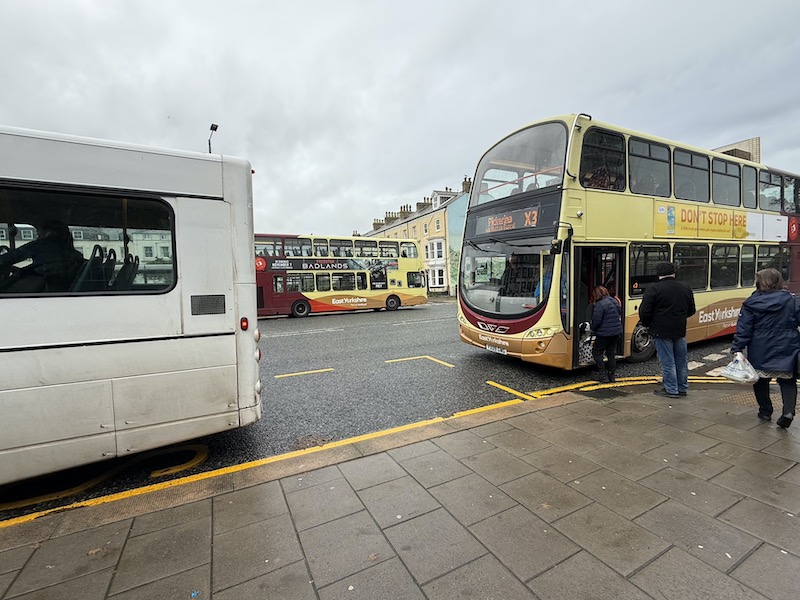
It was preceded by the 13:05 X3 to Pickering which left with five on board – the same number who opted to board Viscount, three of whom travelled to Pickering and two the full route to Malton.

Not huge numbers for the seventh week of the new service, but I see a Viscount Travel journey numbered 126 serves Ryedale School in Nawton which has been incorporated into the timetable thereby adding off-peak in-fill work for this vehicle on the X28 and I guess it’s hoped to stimulate the market for more passengers as well as poach some from East Yorkshire. But as we see, East Yorkshire won’t sit back and watch its passengers drift away and has responded in like kind meaning in the short term, passengers enjoy more and quicker journeys and cheaper fares. But in the long term, evidence from elsewhere shows, competition of this kind isn’t sustainable.
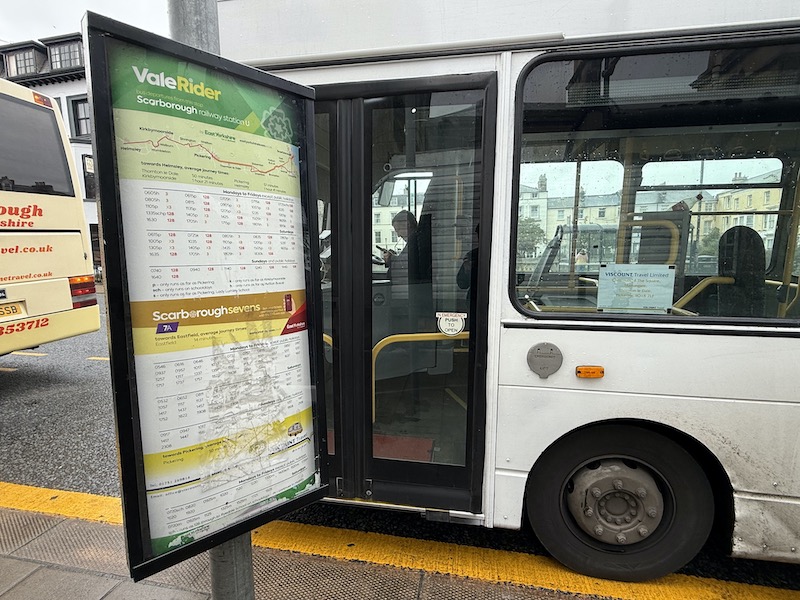
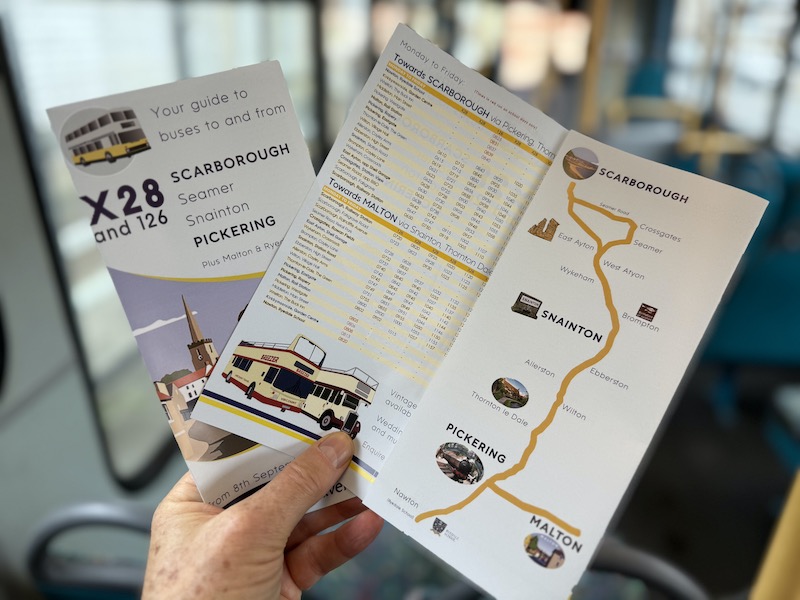
I didn’t spot departure times listed in the bus shelter at Scarborough railway station for the X28, but what is displayed does show what’s being marketed as “Vale Rider” for the 128/X3 by East Yorkshire…
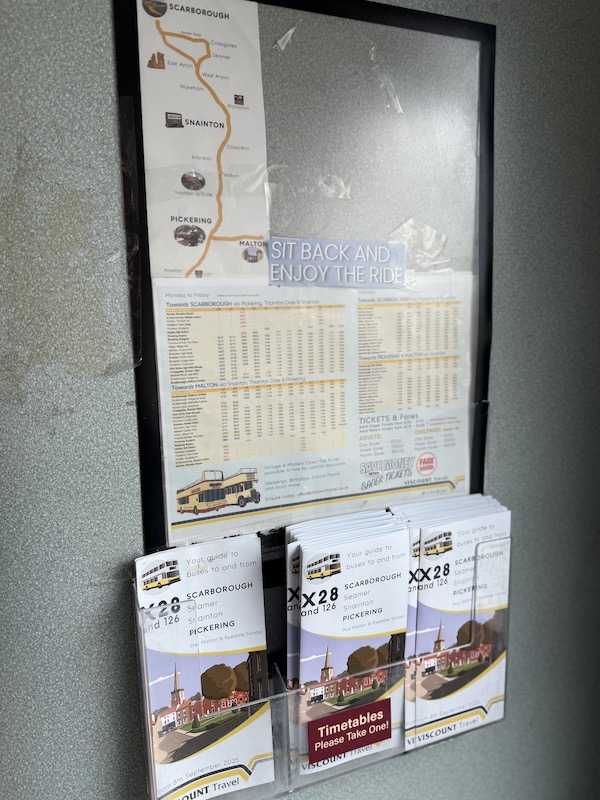
… but I was impressed to see a timetable leaflet available to pick up on board the Viscount bus for the 126/X28…
… and one of the two passengers alighting from the bus at Malton remarked to me how much more convenient it was to have this through bus service as an alternative to the Coastliner bus or train.
Meanwhile, elsewhere on the competitive front, the previously blogged about skirmish between Arriva and go-bus between Dartford and Swanley sees a change from this weekend with Arriva withdrawing after today and Go-Ahead taking over the hourly link using a new Kent Country green coloured branding as an offshoot to the Fastrack operation.

The new timetable, which utilises two buses, begins tomorrow, impressively bringing a new Sunday service to the route…
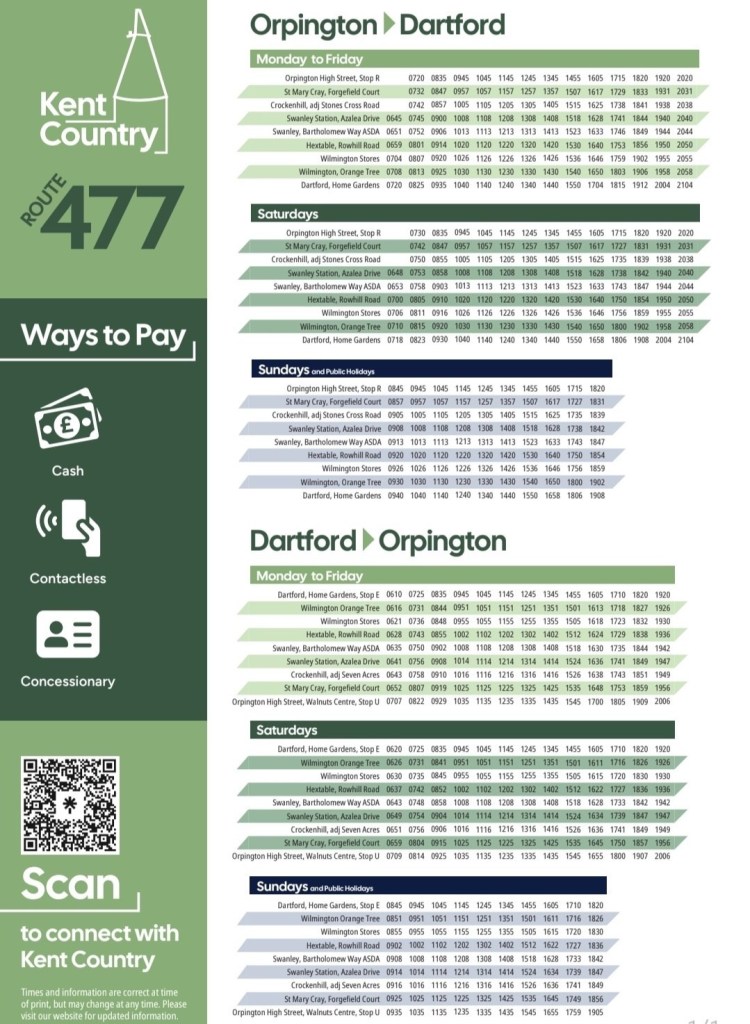
… while go-bus has improved its timetable to include morning peak hour journeys previously shown as separately identified journeys serving Wilmington Academy.

A couple of friends and I took a ride on Arriva’s journey at 12:38 from Orpington to Dartford earlier this month to see what Go-Ahead will be inheriting.

Two passengers made a short local journey within Orpington with one more boarding in the town along with another in St Mary Cray and a third in Crockenhill all travelling through to Dartford.

Once we hit Swanley (one more boarded) on the contested section of route through Hextable (three more boarded) and Wilmington (six more boarded) all travelling through to Dartford making for a reasonable number in the end.
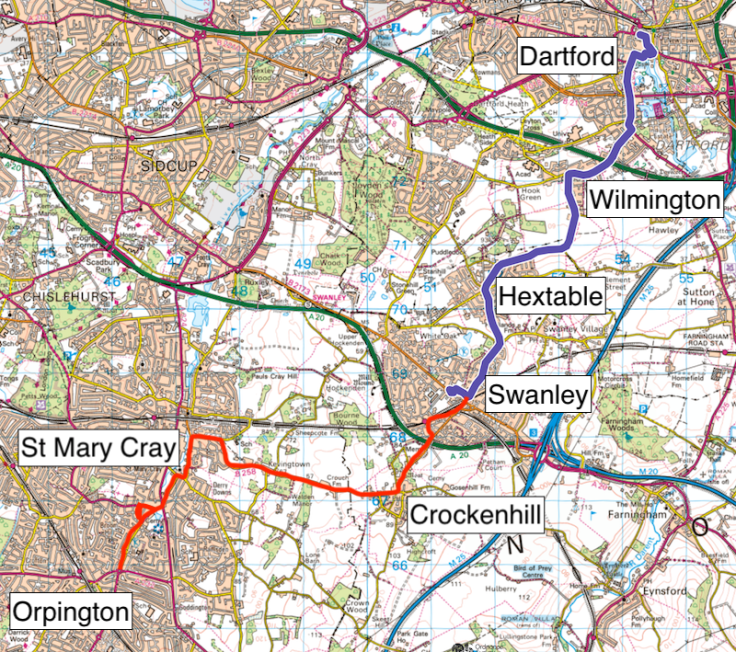
It’ll be interesting to see how the trebling of frequency between Swanley and Dartford along with Go-Ahead’s newly created branding and obvious keen interest in developing the corridor and beyond pans out in the coming months.

And finally for today’s Part 1 of 2 blog, a quick overview of recently introduced new bus routes. There’s been an impressive number over the last 12 months thanks in many cases to Bus Service Improvement Plan (BSIP) funding, but also some notable commercial initiatives I’ve featured in previous blogs including…..
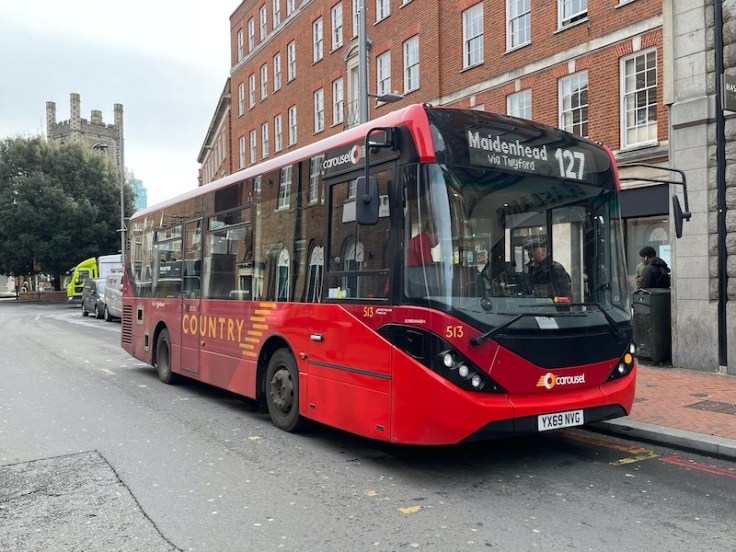
… Carousel’s route 127 between Reading and Maidenhead; Thames Valley’s route 704 between Maidenhead and Heathrow Airport; NorthStar’s routes X22 and X43 to the MetroCentre; Black Cat Travel’s route 2 between Retford and Lincoln; Arriva’s routes X1 and Loop in Milton Keynes; JMB Travel’s route X1 between Hillhouse, Hamilton and Glasgow; uno’s route X10 between Luton and Hatfield are just a few that come to mind with BSIP funded initiatives including Brighton & Hove’s 1X and 3X, Telford & Wrekin’s route 100 (and others) and a welter of new initiatives in Hertfordshire and many other places, including the Cambridgeshire and Peterborough Combined Authority.
Which brings me to Wednesday of this week when I took another ride on one of that Authority’s seven new Tiger branded bus routes introduced in May thanks to funding from the previous Mayor (Nik Johnson)’s £36 public transport precept on council taxpayers.
Readers may recall back in the summer when I sampled these new routes I couldn’t understand the rationale behind route T2 which provides an hourly service utilising two buses linking three of Cambridge’s five Park and Ride sites across the north of the city, notably without serving the city centre.
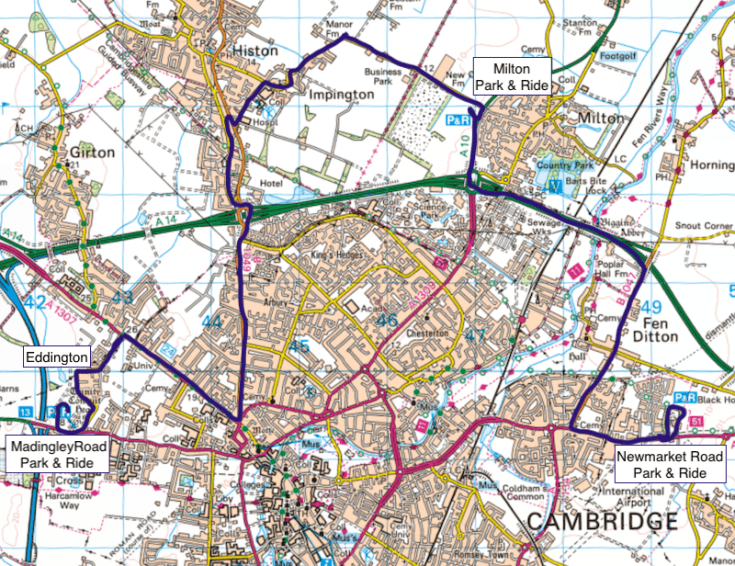
Five months on, I was intrigued to see whether my previous experience of a solitary ride other than one passenger making a short journey at the western end of the route between Arbury and Eddington would be improved upon.

There were a dozen or so passengers waiting at the bus terminal point when I arrived at the Newmarket Road Park and Ride (P&R) site (on the north east edge of the city) for the midday departure on the T2 but unsurprisingly they were all waiting for one of the frequent buses on route PR2 which whisks them into the city centre.
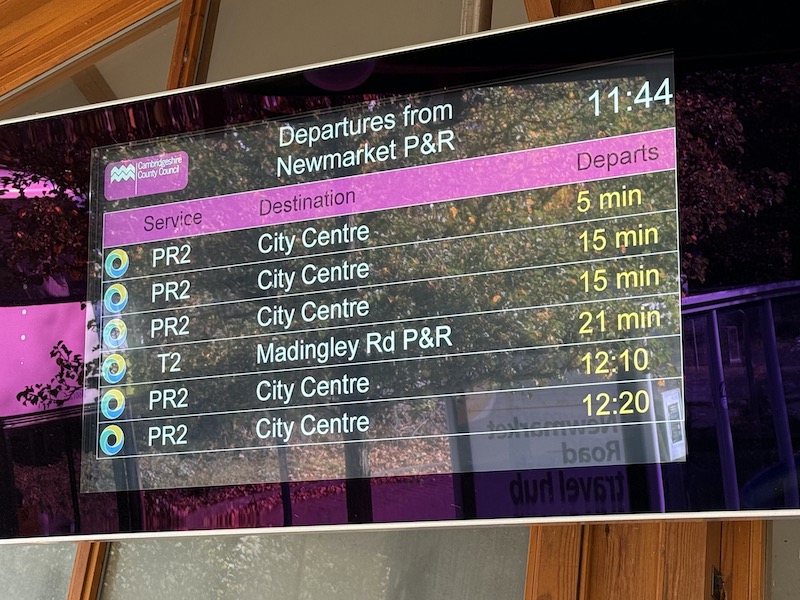
Taking a bus ride around the northern edge of the city to either the Milton P&R site in the north or the Madingley P&R site in the north west isn’t much of a draw – why would it be? It wasn’t long before we arrived at the Milton P&R site having whisked along the A14…

… and then cut across countryside to Impington where the T2 now provides a bus to the west of the village not served by route 8 which otherwise provides a 40 minute frequency between the main part of the village and neighbouring Histon into the city centre (see above map). However, on the new section of route I didn’t spot any bus stops which rather negates the point of having the new bus route.
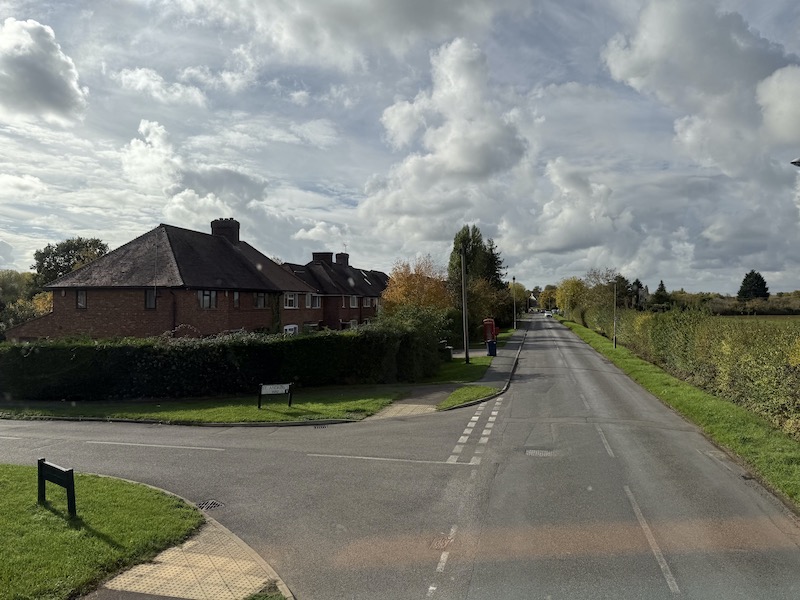
Near Arbury we passed the bus heading the other way which also had no passengers on board…
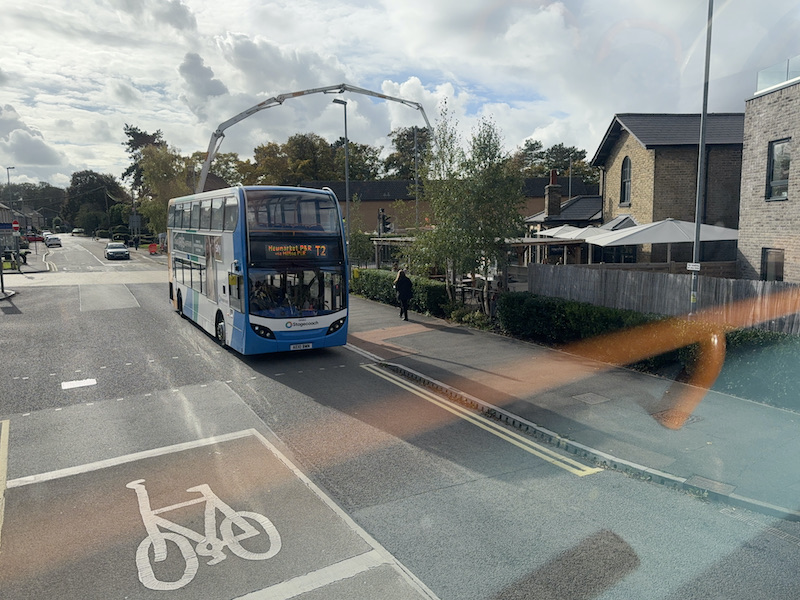
… but, as with my previous journey found a passenger to pick up opposite the Iceland store, having done some shopping, who travelled to the new residential development at Eddington.

She told me she occasionally uses the bus to make this journey so it’s a handy newly provided link for her.
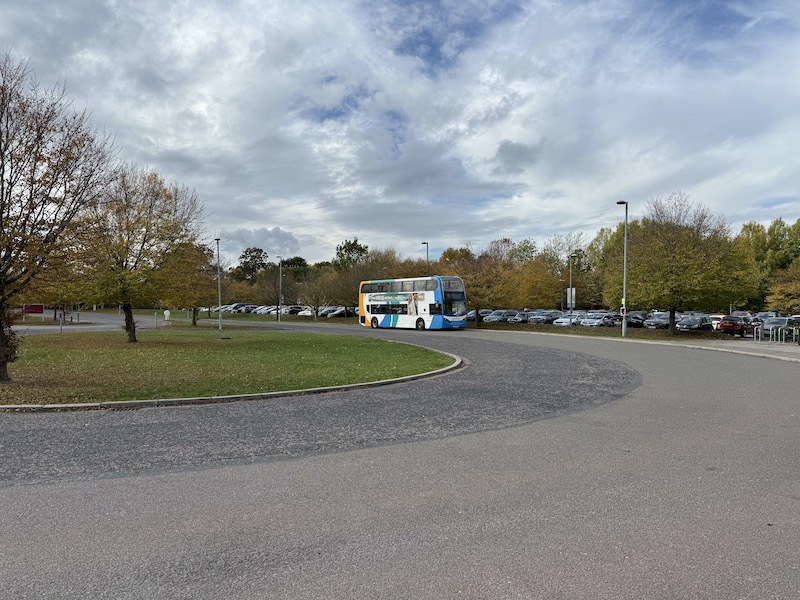
At the terminus at Madingley P&R I had a chat with the driver who admitted it’s very quiet during the day with few passengers travelling but said some students use it at peak times to travel to the college at Impington which is also served by Stagecoach’s route 8 running every 40 minutes.

After a break at the terminus (the schedule has 16-17 minutes layover in every hour) I caught the same bus back as far as Arbury with a couple of passengers making a one bus stop ride in that area who could also catch the more frequent route 8 (which was following us) and another passenger boarding who also looked as though they were making just a short journey home from the shop.

There’s been some new residential development near the Park & Ride site on Newmarket Road but there’s no reason why these residents would want to travel to one of three Park & Ride sites, nor to Impington, Arbury or Eddington the three communities served along the line of route.
Five months on, I’m still struggling to come up with a rationale behind route T2 other than it looks good on a map to have an orbital bus route around the north of the city, even if no-one wants or needs to travel on it.
I’m not sure route T2 being a feature of a deregulated environment would have been something the original architects of the new regime back in 1986 would have envisaged but the last 39 years has been full of surprises of one kind or another with many pluses and many negatives. I’ll touch on more of these in tomorrow’s Part 2 blog.
Finally, those who subscribe as a member to Geoff Marshall’s YouTube channel will know he accompanied me on the T2 on Wednesday as he uploaded on Thursday a “behind the scenes” video of the day – do sign up to become a member if you want to see more.
Roger French
Blogging timetable: TThS with a Su extra tomorrow.
 BusAndTrainUser
There will be competition between Twyford, Charvil and Reading very shortly when Reading Buses start a new route 12 running every half hour off peak. I think this will mean five buses an hour between Reading and Twyford (12 * 2, 850 * 2 and 127 *1) which is clearly massive over busing.
This seems exactly the type of competition which should be avoided, especially if public funds are involved. If Reading Buses captures local traffic the effect will be to undermine the finances of longer distance routes 127 and 850 and potentially Twyford and Charvil end up having reduced connections to the north and east. https://www.reading-buses.co.uk/introducing-our-new-route-12-twyford
LikeLike
On the same day Thames Valley (aka Reading Buses) start route 20 Maidenhead to High Wycombe in competition as well.
Steve
LikeLiked by 1 person
I can’t find any info about Thames Valley route 20 on the Maidenhead to High Wycombe corridor in November. Have they changed their mind?
LikeLike
It’s well hidden which is how I missed it when I wrote my original post. But it appears to be an extension of one of the two 7s each hour.
https://www.thamesvalleybuses.com/network-changes/8ae8abd3-f49f-4e35-9f0e-8927ed5841bc
LikeLike
Still can’t find anything on Route 20 to High Wycombe, just historical bits, but that doesn’t mean it won’t happen! The furthest I’ve got is this: https://www.thamesvalleybuses.com/services/CTNY/20?date=2025-11-06&direction=outbound
But they haven’t loaded any timings or stops for November yet.
I’ll just wait & see.
LikeLike
I’m sure there will be much more to comment on tomorrow but I think Oxford, Southampton, Bournemouth and Nottingham were aided by competition between too well funded operators rather than the small independent versus the big monopolist.
In Nottingham the threat of Trent Barton having a serious try in the City, Oxford Harry Blundred forced City of Oxford to up their game, Southampton Bluestar versus the Corporation and Bournemouth Wilts and Dorset versus the Corporation.
And pre 1986 the threat of competition forced NBC to come out of the dark ages with minibus networks and other innovations.
LikeLike
The competition (following de-regulation) in Southampton was initially between Southern Vectis owned Solent Blue Line & the city’s arm’s length owned Citybus & that in Bournemouth, between Wilts & Dorset & the town’s arm’s length owned Yellow Buses. Southampton’s business was then sold to First Group & Bournemouth sold a share of Yellow Buses to Transdev before RATP took over. Subsequent takeovers led to Wilts & Dorset being sold to the Go Ahead Group in 2003 which eventually re-branded the business MoreBus, who in turn, took over the services of (by then, management owned) Yellow Buses which had sadly, fallen into administration during July 2022. Solent Blue Line was subsequently re-branded Blue Star following its sale to Go Ahead Group in 2008 which followed the acquisition of Southern Vectis in 2005. First Group shut down their Southampton business in 2023 & Blue Star then stepped in to take over their services. All very complicated but both Bournemouth & Southampton (along with the Isle of Wight) are now well served by Go South Coast, largely thanks to the vision & initiative of their late MD, Andrew Wickham.
LikeLike
In the earlier years of deregulation, Bournemouth saw competition not only between the established operators (the municipal and the ex-NBC), but also from Badger Vectis (a consortium of Badgerline and Southern Vectis) and from Charlie’s Cars (were they Shamrock & Rambler?) In the 1990s, Routemaster Bournemouth tried their luck too.
Morebus didn’t so much take over the services of Yellow Buses, as pick up the pieces after Yellow Buses collapsed. Not all services were replaced. Of those that were, it was generally at reduced frequency, and in some cases only part of the route was replaced.
I think the story in Southampton had an added twist – the out-of-town services were operated by Hampshire Bus, until Stagecoach sold the Southampton operations to Solent BlueLine.
Malc M
LikeLike
Go Coach and Kent Country will be co-operating on the 477 Dartford to Swanley by accepting each other’s tickets.
LikeLike
Shame more effort wasn’t made to coordinate the timetable then.
Aaron
LikeLike
The T2 in Cambridge sounds like a “good idea” by people that don’t use buses and don’t have a clue as to what potential passengers want.
It kind of reminds me of when I was in Saudi Arabia the senior Saudi management thought it was a good idea to link all the shopping malls in Madinah. When questioned why they thought it was a good idea, the response was that someone would drive to shopping mall A and then get the bus to shopping mall C. We asked why wouldn’t they drive to shopping mall C, no answer. It went ahead but cancelled after two months of carrying nothing
LikeLiked by 1 person
The Pickering situation was entirely avoidable. The 128 corridor has needed more than one bus every two hours ever since they chopped the hourly one out. But despite lots of conversations, requests, councillors involvement etc, EY didn’t up their game. So Viscount, a local operator from one of the villages, stepped in.
Only then did EY get interested. If I was Go-Ahead, I’d be questioning why such choices were made. When a two hourly bus arrives with over 50 passsengers each trip, that should be enough of a hint to make it hourly again.
The timetables are also a mess. Random minutes past the hour, meaning you have to look when the buses are. This sort of practice drives people away. When are bus companies going to learn this?
LikeLiked by 2 people
Lonsdale Buses (aka Kirkby Lonsdale Coaches) start two new services on Monday after losing tendered work to Stagecoach.
The 83 provides new or restored links to Morecambe from the Lune Valley and the northern suburbs of Lancaster. Suggested to the company by the local Bus Users’ Group it is a genuine addition to the local network.
However it is being interworked with service 85, an early-deregulation style competitive service running 5 minutes in front of Stagecoach’s 5 between Morecambe and Carnforth. Both new services are hourly, early morning to early evening and require two vehicles.
The is no sign yet of any response from Stagecoach.
Jim Davies
Lancaster
LikeLiked by 1 person
Some of these points made offer a too simplified version of an analysis of the bus industry since deregulation. One thought for example some of those places listed above have seen a large increase in university students since 1990 and then from 2010 onwards. Brighton now has nearly 40,000 students, the bulk you could imagine would be bus users. This would have been a benefit to both a regulated and deregulated environment increasing passengers and therefore profit/investments I.e. nothing to do with deregulation.
LikeLiked by 2 people
Cumberland is one of the first to be the pilot area to gain control of bus services in the eay that Manchester does. And here is the link list some of the improvements (long needed). https://www.cumberland.gov.uk/news/2025/cumberland-go-rolls-out-new-bus-services-take
Peter Fox
LikeLike
The point about the pilot schemes is that they are intended to find an alternative to the “Manchester” method of franchising in recognition of the fact that smaller, more rural authorities couldn’t afford the financial risk that entails.
The improvements now being made are funded through BSIP and are completely unrelated to the franchising pilot. As here in Lancashire a lot of them merely reinstate services lost over the years as operators and councils have cut back.
LikeLike
Dear Roger,
That’s interesting, as I live in South Arbury! I think the merits of bus deregulation/privatisation are, as you would expect me to say, very little….and I am being generous by saying that! Under Nationalisation, we had three bus companies, in the Cambridge area – Eastern Counties, Premier Travel and Whippet – now its just two, or one, dependent on who you use. In 1985, the Bus company, was split into two – you had Eastern Counties, operating Norfolk and Suffolk, and a new outfit, ‘Cambus’, operating Cambridgeshire and Peterborough areas. They got deregulated in 1986, to serve their respective areas, and Cambus gobbled up Premier Travel, which ceased in about 1989/90. Whippet was superseeded by some foreign outfitters, a couple of years ago. And Cambus was gobbled up by Stagecoach, when the MD of Cambus, sold up. So, what do we have now – not lots of different companies, but even less, then we started out with! So, forgive my scepticism, but I don’t think it has been successful – as Rail Privatisation wasn’t….but that’s for another day!!!!
Thank you.
Kind regards,
Ben Walsh, Cambridge.
LikeLiked by 1 person
I think for orbital bus services to succeed they need to have strong traffic generators at either end, but also strong connections where they cross radial services. The connections make suburb to suburb journeys possible that would otherwise involve inconvenient journeys into the town centre and back out again. Because of the inconvenience of the detour via town centres these orbital journeys are usually made by car. Think of all the suburban retail, business parks, industrial estates full of cars, whereas buses seem only interested in taking people to town centres (often declining town centres again that).
Peter Brown
LikeLike
Another challenge for orbital routes is geography – in many towns the roads simply don’t exist for them to run along. If I think of the three places I lived before London:
Watford – Cassiobury Park, the farmland south of Holywell and Merry Hill Wood basically make any orbital route except one very close to the town centre impossible to the south and west.
Reading – the river blocks any orbital route north of the centre and to the south there’s no connetion between Green Park and Southcote. That just leaves Tilehurst and Woodly/Earley where several routes to and from the centre have long had orbital legs at their ends (e.g. 15 and 21).
St Albans – the roads exist here, but I don’t see Morrisons in Fleetville, the Abbey Station & the nearby retail park and the Hospital as being big enough traffic generators, especially as they are served by crosstown services.
LikeLike
There are proposals for a Watford, Borehamwood, Barnet to Cheshunt Bus
LikeLike
Exactly! – and quality of interchanges is something the big bus groups have generally failed to appreciate as a revenue generator. Hence the typical medium-sized town’s ‘network’ consisting of a number of routes into the centre – each with its own frequency, so that connections at the centre are haphazard, so that people just don’t use the bus to get anywhere except from home to centre and back; hence the seemingly inescapable figure of 8% travel by public transport.
Perhaps there is some hope, if the DfT follow up the focus on integration promised by the government.
LikeLike
The effects of deregulation have largely been driven by the changes to local economies. As noted above, cities and towns that have seen increasing students and growing economies have seen improved bus services. In areas where the local economy is dying then the bus services die too. Initially the LAs could step in as they had the funds to do so. As that money dried up so withdrawn routes were not replaced until recent extra funds have allowed them to.
A lot of on road completion after deregulation came about because the privatised companies shed staff who then set up new companies to compete against former employers. That happened to me!
Richard Warwick
LikeLike
Thanks Roger – Interesting and readable, as ever.
Just one thought on the existence or non-existence of competition across the country:-
Even the threat of a new entrant can apply competitive pressure. Sensible managers know that falling standards can lead to other companies seeing if they can do better, which will damage the incumbent even if they eventually see off the ‘predator’. So they should try quite hard not to let standards slip very far.
I don’t know if this is a factor in the bus market – many of your reports suggest not ! – but it ought to be.
Martin Stanley Former Chief Exec, Competition Commission
LikeLiked by 1 person
Deregulation has done no favours in Hertfordshire, all that happened here is that one dominant company came about and became complacent doing the minimum. But due to the polycentric nature of the county, several smaller companies could run a handful or two of routes, with a dwindling number of routes being council contracts. There is no competition here. What exists is complex and confusing and does nothing to advertise the bus as useful, not even to just get to the rail station. Some towns like St Albans and Hoddesdon see 5 or more companies each running just 1 or 2 routes, all with no regard or consequence for the others. There’s little sense of a wider network like when London Country existed. It’s a mess, marginal routes and cross-boundary routes into London disappeared and the county feels incredibly disconnected.
Recent changes like the 907 to Stevenage, 242 to Hatfield, 84B/243 – Barnet to Potters Bar, 91 – Letchworth to Royston, new routes 725 and 908, all only happened with BSIP money, public money. Many routes that were cut relied on public money to run at times private companies just won’t, like late evenings and Sundays. If a county council is going to get involved and coordinate connections between its towns, it may as well, run the lot. I was very happy to see Hertfordshire is doing a franchising pilot, I really hope it involves the public in this for suggestions on where to improve and restore routes, there is much to be done to have a decent network again.
It’s also worthy to note that the current places were buses are good are essentially monopolies in their towns or counties, whether private or public.
Aaron
LikeLike
The usual hobby horse, Aaron. At 30, you have no experience of how dire London Country operations were, nor what a financial basket case it was for most of its existence. Starved of investment by its LT parent, or saddled with buses not suitable for one man operation. Frequent crew shortages and cancellations. (There is a very good Ian Allan book on the subject written by John Glover).
Sadly, Arriva has repeated some of this, but others, such as Uno, have shown what can be done in a challenging territory, where the car has been dominant for more than 50 years, and traffic jams are endemic.
Herts won’t be able to afford franchising on either the London or Manchester model, and is about to spend a six figure sum to discover this. At best it would be the same network, but if the Manchester model is a template, at twice what it costs now.
KCC
LikeLike
@KCC – during the 1970s, London Country was indeed in a poor state. However, by the end of its short 16-year existence, it had been transformed from a financial basket case into a profitable enterprise. That said, I don’t know how much of that profit came from Green Line and coaching commitments, and how much was made from “bread-and-butter” local bus operations.
Malc M
LikeLike
To put it briefly, LCBS became profitable by cutting out the dead wood on routes (MAP helped considerably here), and by aggressively reducing costs.
Cost reduction was a by-product of fleet rationalisation; and of course by the end of crew operation.
Cutting out the dead wood of running late evening buses that ran empty or nearly so … and seeking county council support for those rural routes that remained.
It took nearly 15 years, but it was achieved …. if deregulation hadn’t come along with the double whammy of privatisation as well, we may gave seen a quite different LCBS in 1986.
Of course, we’ll never know …..
LikeLike
Watford, St Albans and Hemel all had considerably better town networks under LCBS than they do now (although staff shortages at Garston were a long standing issue). In Stevenage the network survives more or less intact, but frequencies and more recently hours of operation have been drastically reduced. Of the major conurbations only Welwyn-Hatfield arguably has better coverage than it did under LCBS, and that’s down to longer distance services to the University plugging the gaps.
LikeLike
You can say what you like, it won’t change my view that today’s buses in this county are not good enough. Not sorry for saying that. Hertfordshire needs a single company that covers the former country area, it’s that simple. You say yourself Arriva is no good, so why make this personal? I wasn’t around at the time, but I can still have an opinion. From research, I see what was an actual network before 1986, when today it’s really fragmented. Also, Uno have improved, but they don’t fully cover the core of the network.
If franchising means I can look at the buses in St Albans and elsewhere and not get a headache looking at them, then that is already an improvement. There needs to be a strong identity for local buses as well as coordination between routes and trains. Even if it is the same network at first, the county would have an incentive to make it work better and you can do more with less when it’s publicly controlled. HCC has already reformed the ticket system and identified and improved the key corridors, so if they can go further, even if it needs government support, then go for it!
Aaron
LikeLike
A better bus network is something most of us here will aspire to but who will fund this? It’s either through increased ticket prices or more gov funding and there are huge swathes of voters that don’t agree with either.
LikeLike
My argument is that counties are putting in millions of pounds into buses right now, why just give it to private companies who may not have the same priorities or goals as the county does and not have the control over the outcomes? We saw it with Arriva initially wanting the new electric buses and then changing their minds, now Uno has them, how much time and effort could’ve been saved if the electric buses could’ve been strategically placed in an area instead? They could’ve been in place for years by now providing the benefits of that investment. To me its clear if buses are left to the market, companies will not invest on their own, especially where its fragmented, either in new vehicles or better routes. They just stick to where is already profitable at the expense of social goals.
Aaron
LikeLike
Local Transport Authorities (LTA) are in charge of the BSIP funding, and can set their own objectives – the funds are not a free for all controlled by operators.
Further, the majority of electric bus funding still comes from the operator – the ZEBRA grant only covers 75% of the additional cost over a diesel equivalent. So most operators are investing more than they would if they just bought diesels.
The charging infrastructure element of ZEBRA does cover up to 100% of costs, and in both cases, the grant application is made by the LTA, not the operator.
If the LTA wanted to go it alone, it would need to find £200,000-£300,000 from its own funds for every electric bus it purchased.
KCC
LikeLike
Does it make sense to have 4 routes running between Hertford and Welwyn when passenger numbers are quite light wheres other corridors with much higher passenger numbers get fewer buses
There seems to be little logic in how this BSIP money is being spent, A lot looks as if it is being wasted
LikeLike
I think you mean four buses an hour between Hertford and Welwyn Garden City (2×323, 1×324 and 1×724). Of course, all three routes serve different intermediate stops and vary in the time taken to do the end-to-end journey. It’s about providing choice.
You are, of course, entitled to your opinion on Hertfordshire BSIP bus routes, but your view doesn’t reflect reality. Previous articles on this very blog have pointed to the popularity of the 907 and the 725 is doing very nicely. The 908 will be extended to Panshanger in WGC from the beginning of November (renumbered to 400), providing new direct links.
Dan Tancock
LikeLike
Of those routes, the 724 being long established always carries decent numbers. But a while back, I used the 323 from Welwyn to Hertford, was surprisingly busy and this was before it was extended to Ware to replace the 395. The 324 I’ve not used so don’t know how well used it is, but knowing at most daytime hours there is a bus every 15 minutes between the 2 towns makes it much more attractive to use, I could use any bus to Hertford and it would be a short wait to go to Welwyn. To me that coordination on specific corridors has really paid off, credit to them.
Aaron
LikeLike
The comment from the passenger alighting at Malton is interesting. Checking the timetables, the X28 is quicker than Coastliner’s 843 between Scarborough and Malton, but only by 3 minutes, and much less frequent. An 843 would have been due to leave Scarborough station 10 minutes before the X28 that Roger travelled on. So how much more convenient is the X28 really?
I wouldn’t describe the 477 Sunday service as new. Arriva had provided a Sunday service but withdrew it in recent years, so this is a reinstatement.
The T2 might be just the kind of service that deregulation envisaged – a service deemed “socially necessary” and supported with subsidy, bolted onto the network to provide something no operator is prepared to run commercially. Mind you, it does strike me as a curious route, its purpose far from clear.
Malc M
LikeLike
The subtle dig at Viscount in the East Yorkshire announcement (“just the biscuit”), whilst amusing, is only too revealing of a depressing attitude which regards the other operator as an enemy to be belittled and ridiculed without regard to their shared customers, rather than a fellow entity with a common purpose to be encouraged and, where possible, cooperated with to the benefit of those same common customers. Compare and contrast with the Go-Ahead Kent Country / Go Coach situation on the 477.
LikeLike
Update on the Derby-Burton competition.
While the coordinated service was recently torn up, tickets haven’t been inter available for many a moon.
Arriva have dropped back to 2/hour daytime and the buses turn into the new Spondon 20/21 at Derby bus station.
While Arriva are using the bus station, Trent are trouncing them by setting down and picking up at all of the city loop stops – far more convenient. The Arriva men don’t even set down inbound because they don’t know the stops. Trent however have dropped off their evening service around 20:00 – both companies previously ran one bus per hour five minutes apart. Arriva have thrown the towel in on Sundays.
Trent’s new buses have 2+1 seating at the front with spacer cushions making them effectively wider, something railways could learn from!
LikeLike
Franchising leads to financial disaster, the state is rubbish at running anything. But I agree that the time has come for all operators to adopt a standard area livery and ditch their own ticketing schemes. The Bee network had simplified tickets and the single livery across everything simplifies what the Passenger sees. Contrary to what the big groups think in general the passenger couldn’t give a stuff about who runs his or her bus.
In Hertfordshire this would be possible and desirable, with simplification of ticketing a first priority. This has to be the next development of EP’s
In Leicester this has basically been achieved, Green buses across multiple operators and the Flexi ticket being the all operator offering
LikeLike
Local council have not helped with new housing estate built but with them being almost impossible to be served by buses
LikeLiked by 1 person
hello. Th e point about Reading abstracting the profitable end of routes is all too accurate. That is exactly what RT did to the its route 7 Tiger bus to Fleet. Result – there is n ow no bus from Fleet to Reading.
malcolm, Fleet
LikeLike
Interesting comments about the former London Country, while it certainly had it’s problems, especially unreliability both before and after deregulation. It did provide a fairly comprehensive network complete with generally good publicity and timetables, especially in it’s later years.
A journal of the time commented that the worth of London Country was greater as a whole, rather than the subsequent parts it was split into.
It certainly struggled before deregulation, as it was required to be split into 4 Bus companies and 1 engineering less than 8 weeks before deregulation and adjust it’s network.
After deregulation and for a number of years after, in a pre internet age new timetables, service changes etc plus which ticket was valid where, were not always easy to find in parts of what had been it’s operating area.
One example a service withdrawn by London Country North West was covered by a Hertfordshire Council Contract, problem being that there was no roadside publicity, so people viewed a rather unlikely looking bus in the form of a tatty looking coach with just an ultimate destination board in the front coming along the road.
2 parts of the broken up London Country had their long term Garages sold separately and in some cases were required to vacate the premises when the new owners exercised their rights.
This sometimes resulted in new premises being very spartan, one having to have fuel delivered by tanker everyday to fuel the vehicles.
This must have impacted on vehicle maintenance standards, more so as by this time many vehicles were 10 years or more old, so reliability would most likely have again suffered accordingly.
While these events are in region of nearly 40 years ago, the increasing fragmentation of services and constant company changes continued for some years, all of which in an area of fairly high affluence probably discouraged increasing passenger usage.
LikeLike