
Saturday 4th October 2025
Here’s something a little different for this fortnightly series. A place which has two names with each enjoying the presence of two stations.
As you can see from the map below, Epsom and neighbouring Ewell are one continuous urban sprawl in Surrey and famously resisted being included in Greater London on its formation in 1965 with the boundary skirting the town’s eastern edge as shown.

Also shown above, Epsom has two stations called Epsom and an Epsom Downs with Ewell having an Ewell West and Ewell East. Epsom Downs station just creeps over the border into Reigate and Banstead Borough Council’s jurisdiction.
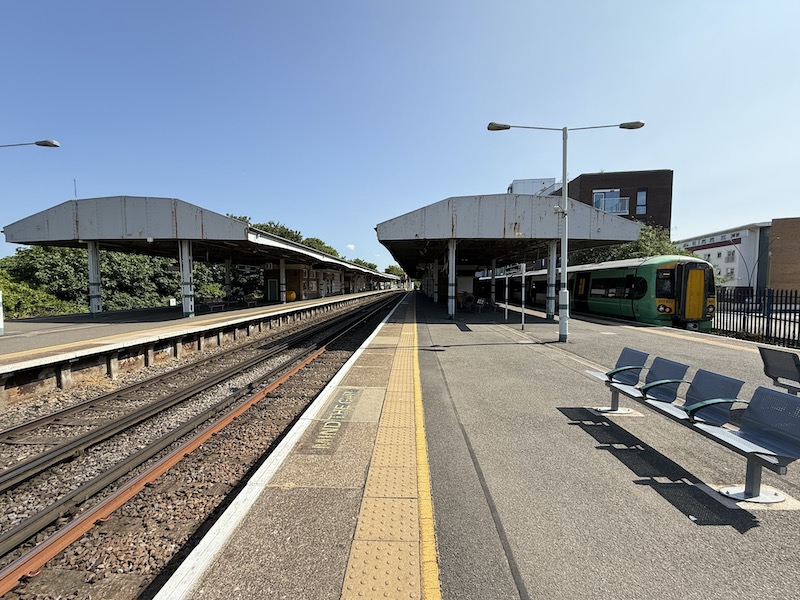
There’s quite a contrast between Epsom’s centrally located four platform station (above) which sees both terminating and through trains operated by two train companies (Southern and South Western Railway) and the one platform unstaffed terminus at the end of a single track branch line over at Epsom Downs.

The former being the town centre located station sees 3,135,000 passenger entrances and exits per year but frustratingly for many, lies just outside the Travelcard Zone 6 boundary while the latter sees just 120,000 passengers passing through, even though it has the benefit of falling within Zone 6 adding an anomalous touch to the town but perhaps proving it’s all about location, location, location. Epsom Downs was once useful for racegoers at the nearby race course….

…although much less so once Tattenham Corner arrived on the scene which is more convenient, but a relatively recent housing development on former railway land offers up custom.
As befits its busyness, Epsom sees four Southern trains each hour – a half hourly terminator to and from London Bridge via Sutton and West Croydon and a half hourly departure originating in Victoria and running via Mitcham Junction and Sutton and continuing south via Leatherhead to Dorking, with one of those continuing further south each hour to Horsham.
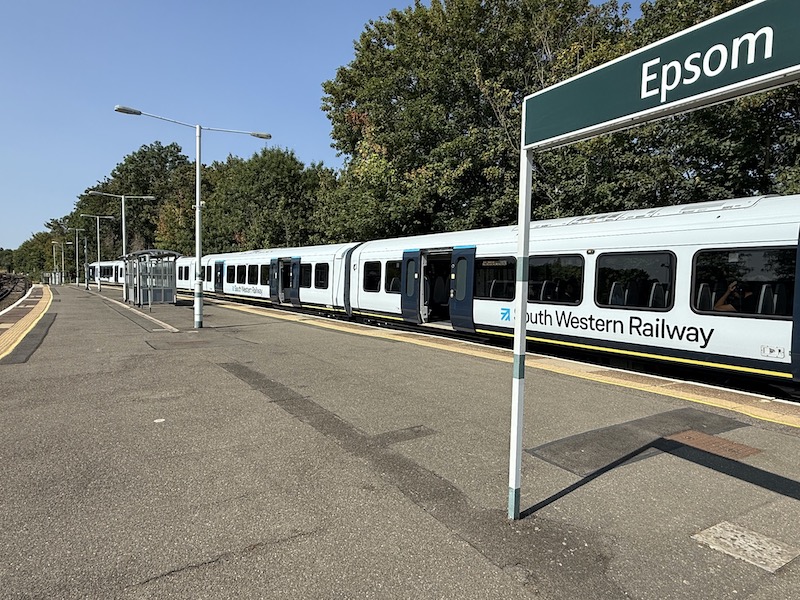
South Western Railway’s involvement sees a half hourly frequency from Waterloo via Wimbledon, continuing after Epsom to Leatherhead then either hourly via Effingham Junction to Guildford or hourly to Dorking. The latter frustratingly running 4-6 minutes after Southern’s Dorking terminator.

Epsom Downs on the other hand has a half hourly Southern service to London Victoria via Sutton, West Croydon and Norbury. And that’s it.
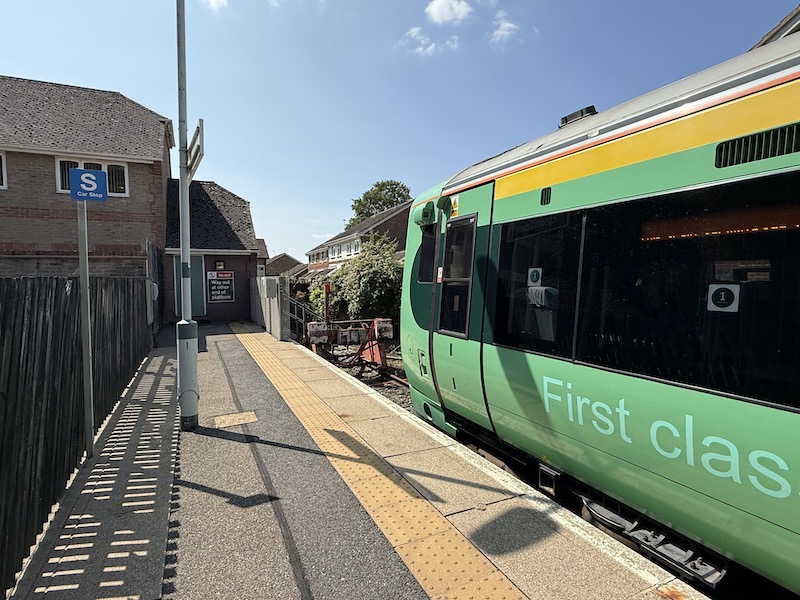
Both stations come under Southern’s jurisdiction.

Walking round the corner from Epsom’s centrally located Clock Tower into the appropriately named Waterloo Road you’ll find Station Approach on your left but if you didn’t know it was there, you might be forgiven for not realising that’s where the entrance to Epsom station can be found.
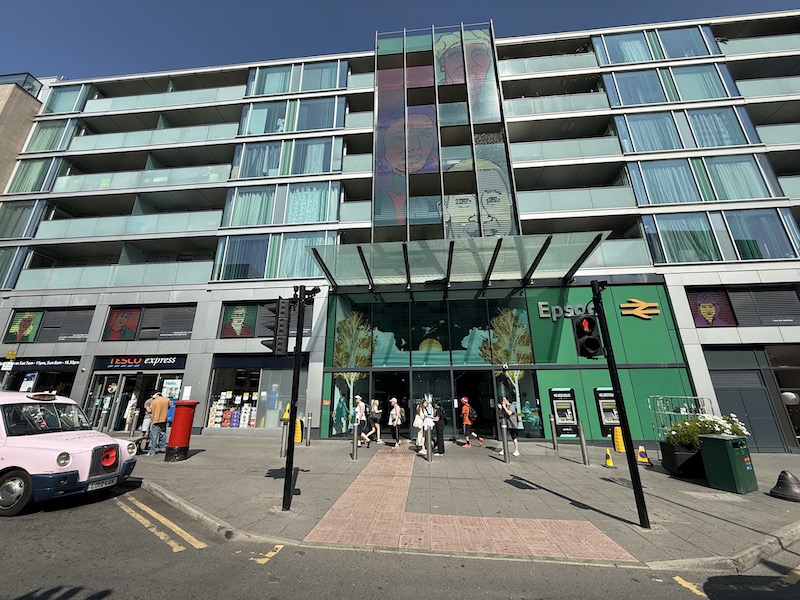
Hidden as it is beneath flats, a budget hotel and a car park and sitting alongside a Tesco Express and Costa. Luckily there’s a prominent sign on a vivid green background to confirm this is indeed the entrance and a rather large ticket hall awaits as you enter.

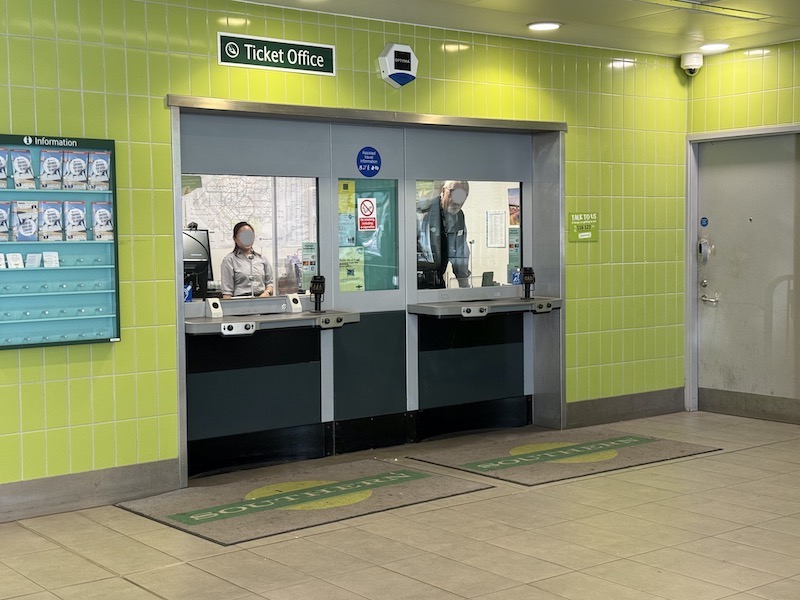
Here you’ll find a two window ticket office (which, impressively, were both staffed the day I visited)…
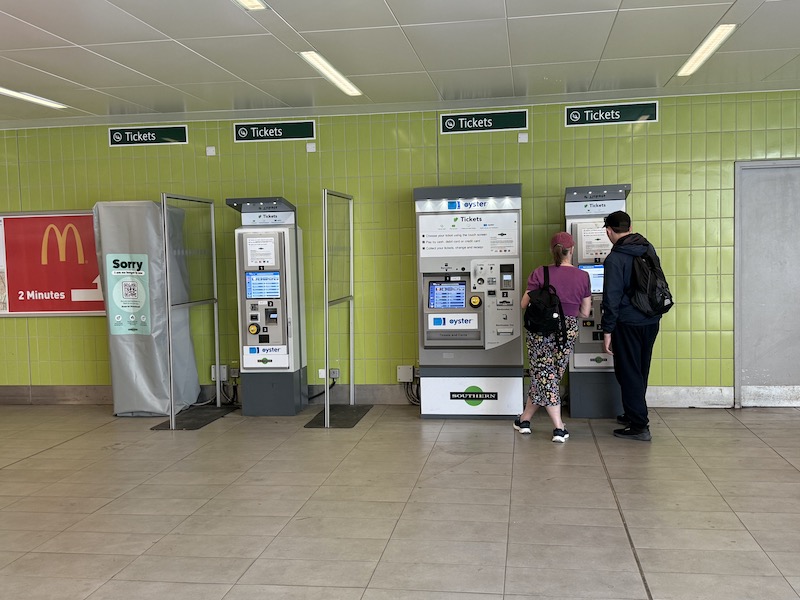
… a selection of ticket machines…
… access to the car park…

… and the ticket barriers and departure boards.

A very wide subway takes you under the tracks with lifts and stairs to the four platforms.
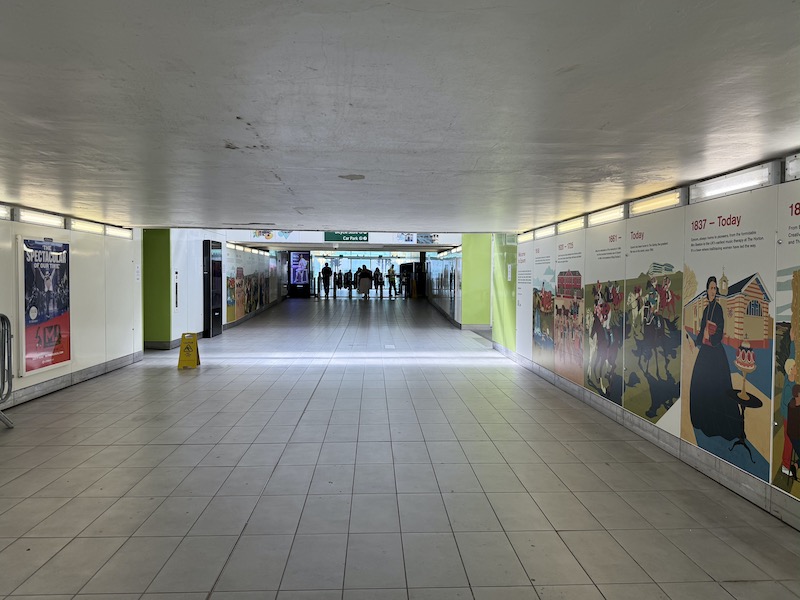
Both the subway and the stairs have interesting artwork and illustrations to brighten up your walk to and from the platforms….
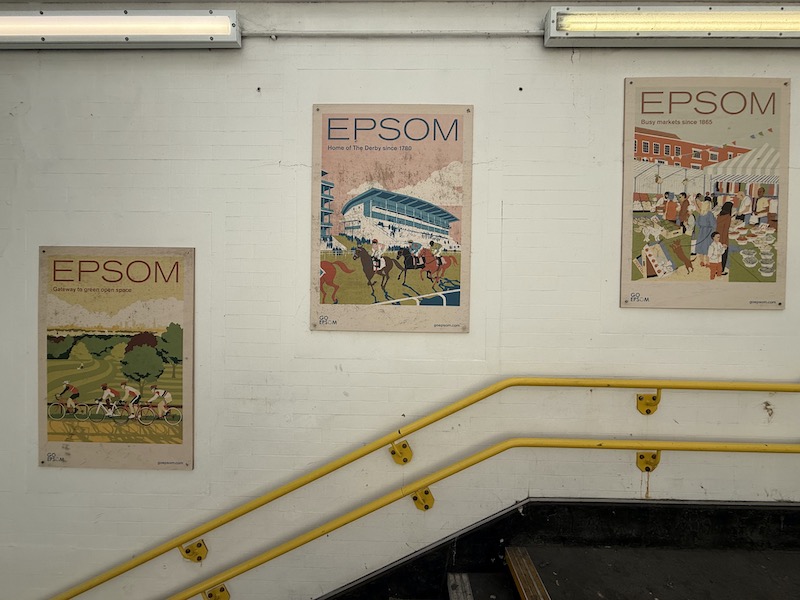
… while the lifts bring you out at the extreme eastern end of the platforms.

There’s a waiting room on platforms 1 and 2…

… and a Puccino’s on platforms 3 and 4.

There’s plenty of seats with brown wooden slated ones under the canopies…

… and metal ones outside where there are also shelters with the usual perch type seats.

One retail unit has obviously closed down on platforms 3 and 4.

A ladies toilet can be found on platforms 3 and 4 and initially I was confused by the sign on platforms 1 and 2 pointing to the gents toilets but indicating they were for both genders and accessible which the sign on the door contradicts.

Then I realised the accessible toilet and the ladies are the other side of that pillar.

But a visit to the gents made me alarmed to note the position of the left hand urinal right next to the second sink. It looked a bit too close if both were in use.

Over at Epsom Downs the original 1865 built station had nine platforms bringing thousands of race goers but once Tattenham Corner opened in 1901 the bulk of that traffic switched to using that station with Epsom Downs reduced to just two working platforms in 1972 and singled to one, along with the line from Sutton, in 1982.
A new station was opened 420 meters north of the original site in 1989 with what looks like the former station building repurposed to a children’s nursery…
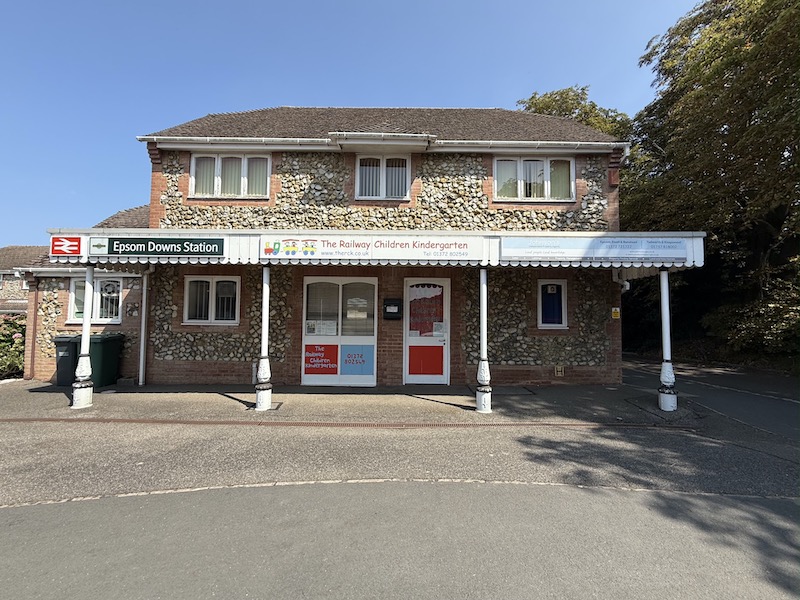
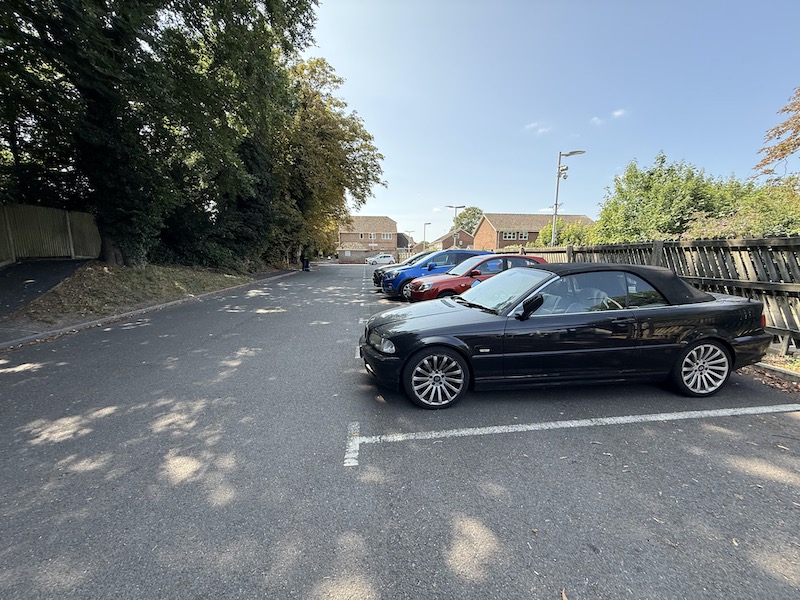
… and the entrance to the platform now a short walk through a small car park…

… which on the weekday lunch time I visited, aside from a couple of vehicles for the nursery, had just four cars parked up.
There’s a ticket machine…
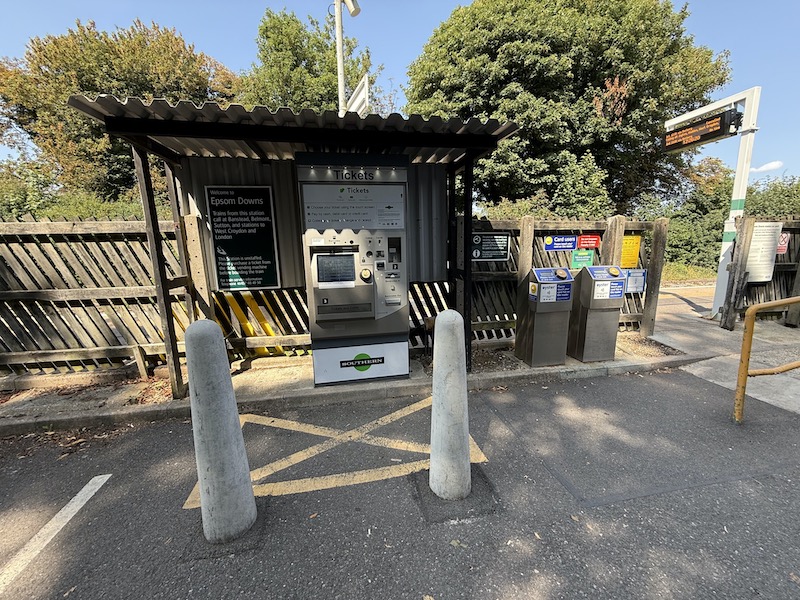
… a couple of cycle racks…

… and a shelter on the platform with eight wooden slatted seats…

… with just three more (metal) seats further up the platform.
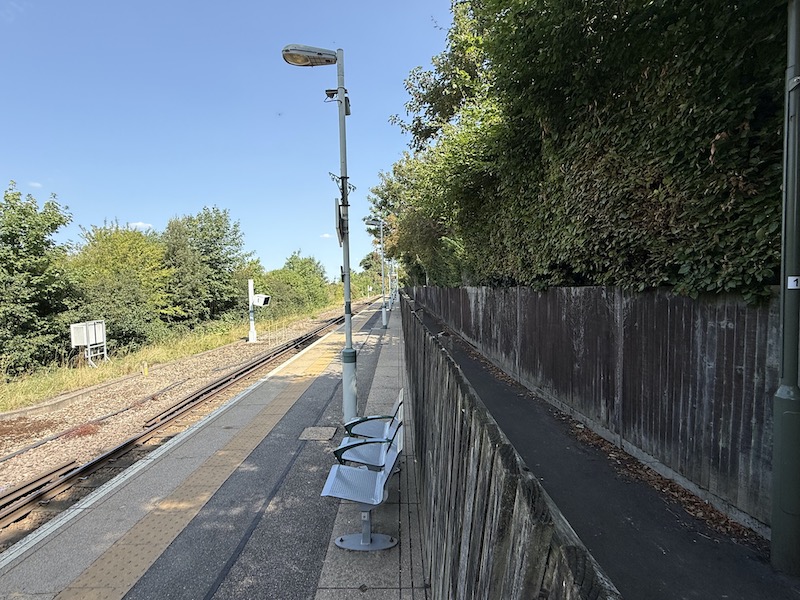
And that’s about it, other than a dot matrix…
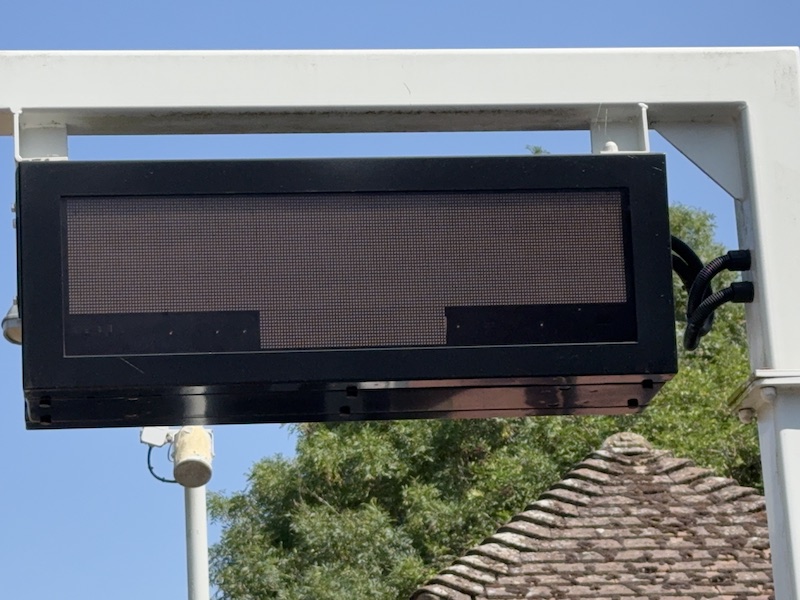
… and a grit bin.

A ten coach train usually fills the platform every half hour but the day I visited saw a cancellation so the three other passengers and I all patiently waited for the next one enjoying the peace and tranquility, but few facilities.
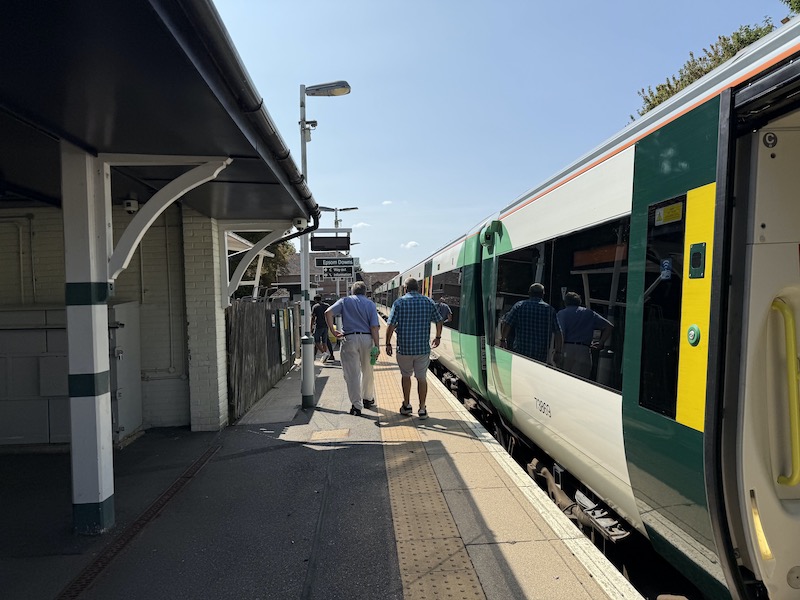
It’s a real shadow of its former glory.

Over in neighbouring Ewell the East and West stations have many more similarities between them than between the two Epsoms.

Ewell East (above) opened in 1847 and can be found on the Southern line from Epsom to Sutton seeing three trains per hour to London, one via Hackbridge to Victoria and two via West Croydon to London Bridge…

… and three per hour south to Epsom with one continuing to Horsham via Dorking.

Ewell West (above), which opened slightly later in 1859, is on the South Western Railway line to Wimbledon and sees two trains per hour to Waterloo with two south to Epsom and Leatherhead with one continuing to Dorking and one to Guildford.
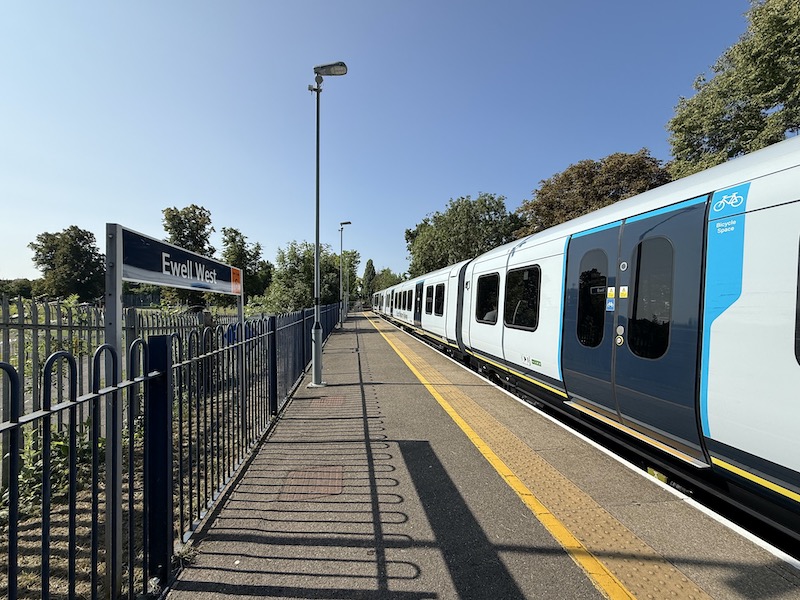
Ewell East is the less busier of the two with 452,000 passenger movements a year while its West counterpart sees just over double that number at 921,000.

Both stations have a staffed one-window ticket office (East photo above, and West photo below).

East’s also incorporates a small seating area… as befits such stations under Southern’s jurisdiction….
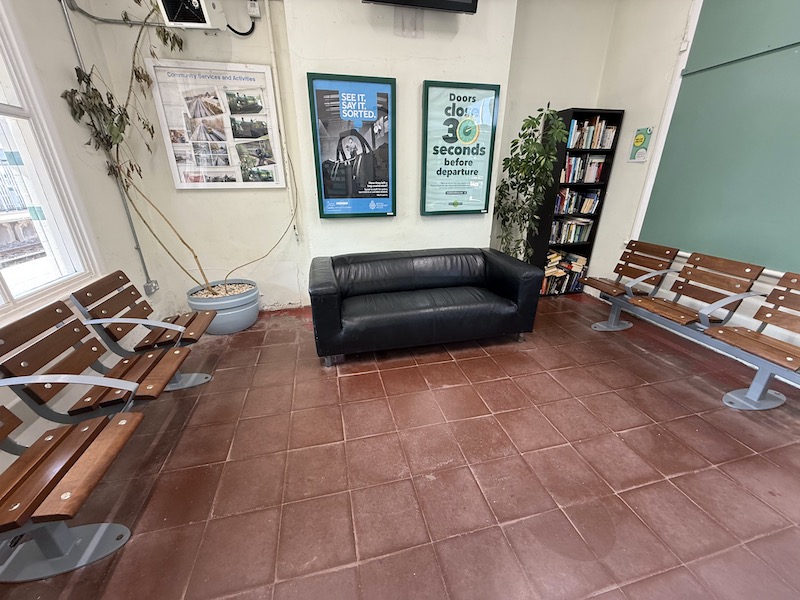
… while West’s waiting area (and toilets) are adjoining.

East’s ticket office is on the London bound, platform 1…
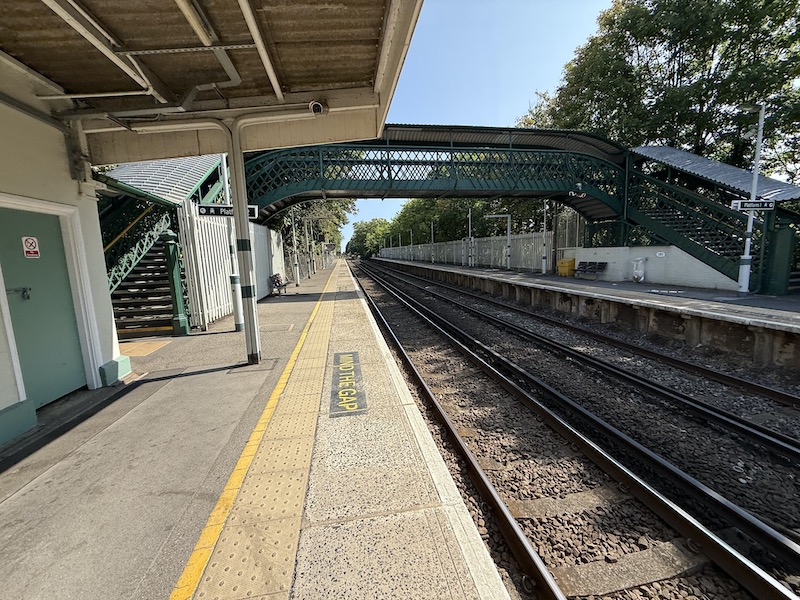
… with West’s on the southbound, platform 2…

with a footbridge connecting the two platforms, albiet in East’s case without a lift. However, Ewell East’s platform 2 is accessible by a long footpath…

… which runs alongside the platform and has ramp access.

Ewell West also has ramp access to platform 1 (the non ticket office side)…

… from the main road which passes over the tracks…

… and brings you to the platform where there’s a ticket machine and help point.

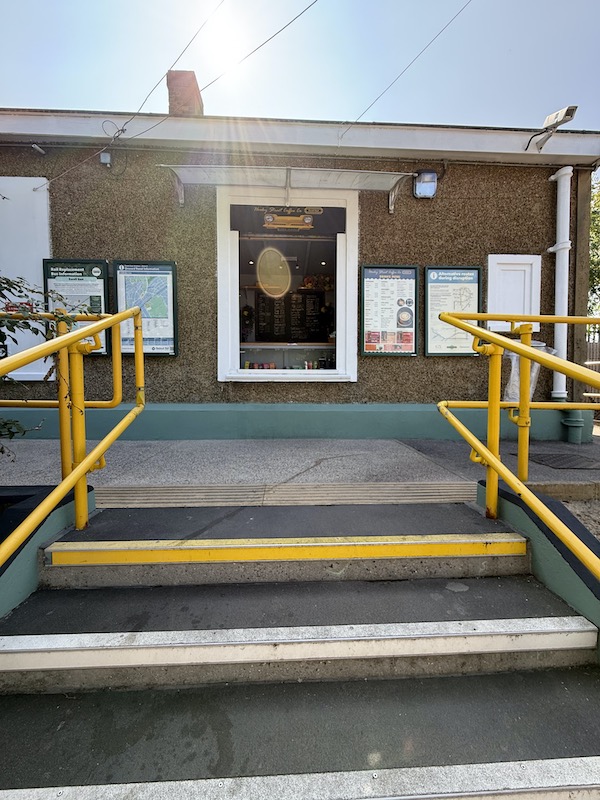
There are steep steps up to the entrance to Ewell East…

… but there’s also a long ramp too…
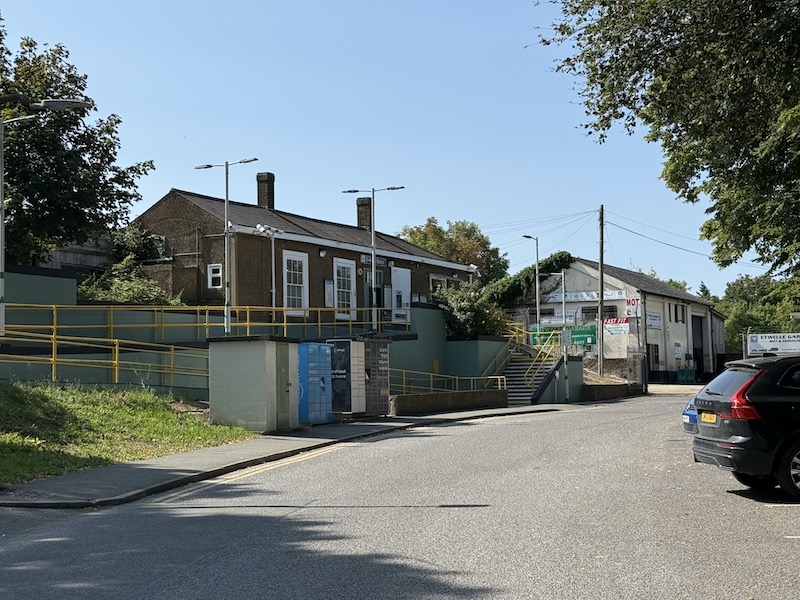
… and at the top of the steps a coffee shop window awaits.
On the platform there are 12 Southern style wooden seats under the canopy on platform 1…

… and a ticket machine for when the ticket office is closed.

Platform 2 doesn’t enjoy such weather protection…
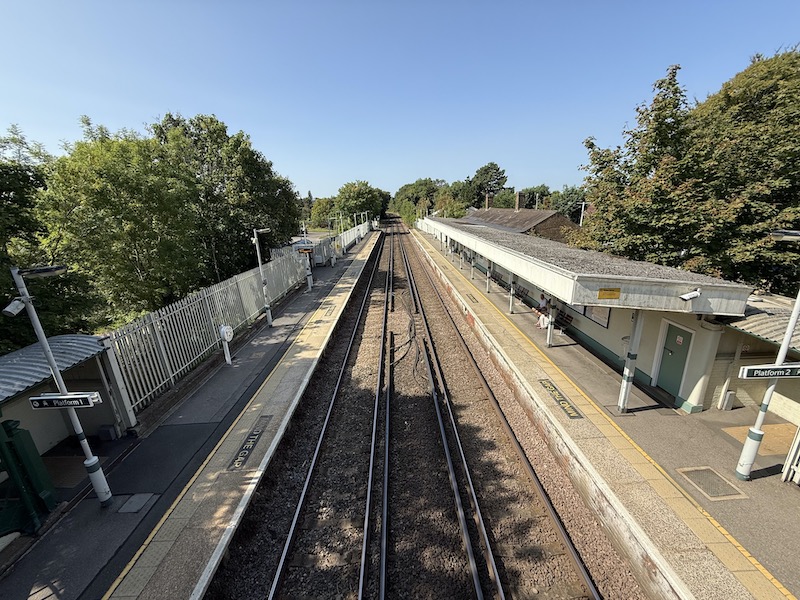
… with only a small old style shelter with three seats and a ticket machine…

… by the gate entrance from the footpath…
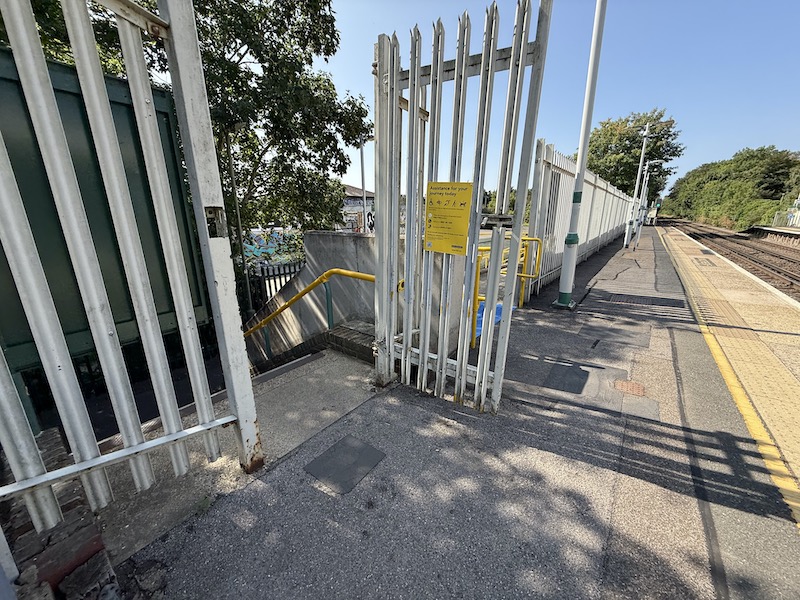
It was noticeable just how few seats there were on the platforms.

Back at Ewell West the London bound platform 1 has three shelters. An old style slimline width with canopy …

… and a couple of contemporary styles with those uncomfortable metal benches.
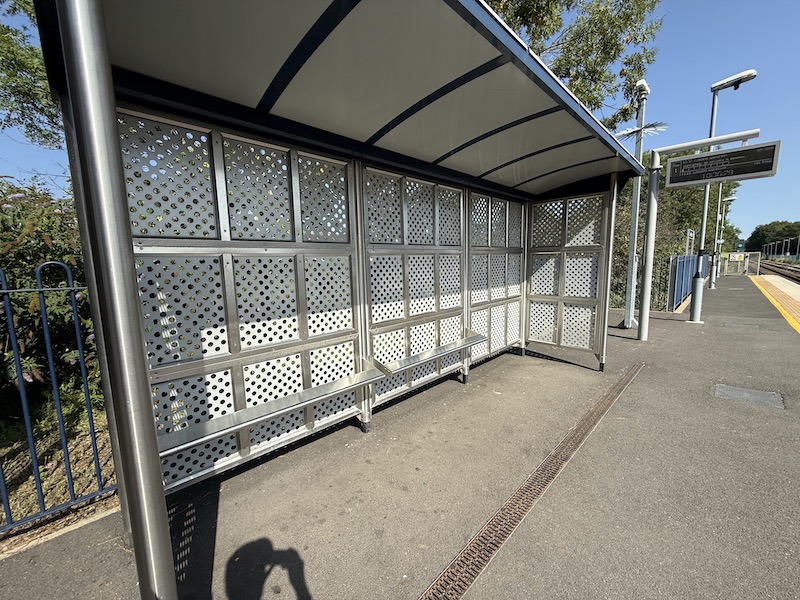
More seats are liberally placed along the platform length…
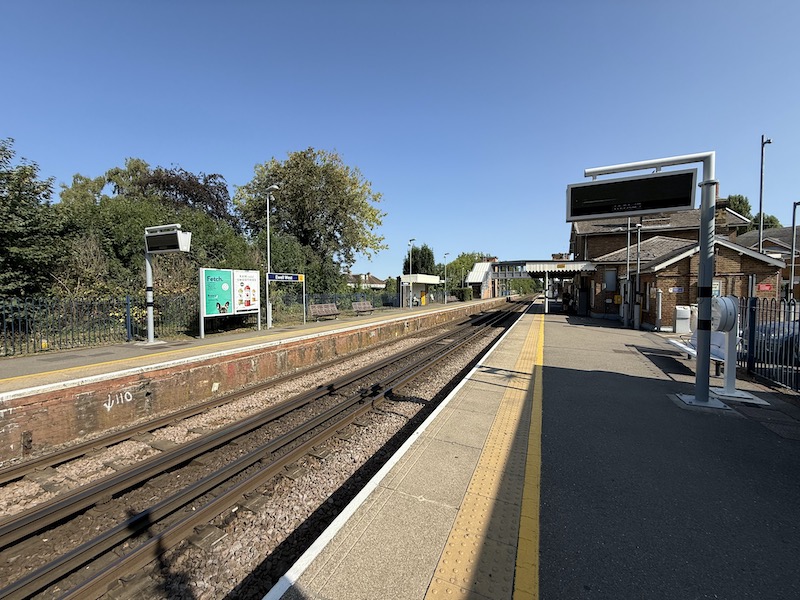
… including those traditional style ones beloved of South Western Railway.
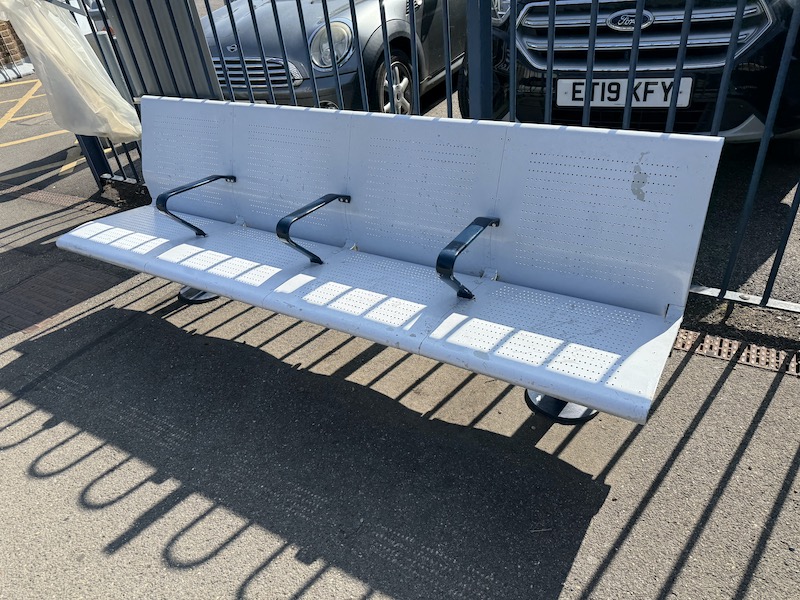
There’s a particularly tight squeeze on the section of platform where the road passes over the tracks…

… and just outside the station…

… there’s been recent residential development…

… but Ewell West’s extensive car park still offers plenty of room for commuters.

On the other hand, Ewell East’s car parking was more constrained but plenty of spaces when I visited.

Of the four stations featured here, Epsom obviously is the best connected to bus routes with Epsom’s substantial route network of TfL and Surrey based routes available just a stones throw away as well as some routes picking up right outside the station.

The other three stations don’t fair so well. Epsom Downs is a short walk through the new residential development to TfL’s hourly route 166 to Banstead, Coulsdon and Croydon; Ewell West has TfL’s hourly route 467 to Chessington and Hook and finally Ewell East has the twenty minute frequency S2 to Sutton and St Helier.
And that’s about it for the ‘read one blog featuring a place with two stations and get another one free’. Normal service resumes next time.
Roger French
Did you catch the 19 previous blogs in this series? 1: Hertford; 2: Canterbury. 3: Wigan, 4 Dorchester, 5 Windsor, 6 Wakefield, 7 Reddish, 8 Yeovil, 9 Newark-on-Trent, 10 New Mills, 11 Tyndrum, 12 St Albans, 13 Falkirk, 14 Catford, 15 Helensburgh, 16 Gainsborough, 17 Edenbridge, 18 Bicester, 19 Worcester
Blogging timetable: 06:00 TThS
 BusAndTrainUser
I have very fond memories of Ewell East Station both as a railway station and a geographical location. On the south side of the tracks, here, is a sports ground and when I first went there for football refereeing appointments was owned by the London Fire Brigade although it is now owned by the North East Surrey College of Technology. Indeed, as a referee there were extraordinary developments at this ground’s pavilion. On one occasion arriving for my match, I noticed what had been a canteen area was stuffed with obsolete scientific instruments obviously discarded by the College Physics Department. There were one or two items I would have loved to take home – but my kit bag was too small. A gate was usually left open between the down platform and the sports ground but on some occasions, I needed to climb over it when it was locked shut. Currently, no longer a referee and with a pension to spend, Ewell East Station is the location of “The Glyn Arms” a ‘Toby Carvery’ and I would have used the, then, bus Route 470. I would also have used Ewell West in respect of refereeing appointments, walking through the village to or from my games. It is indeed a tight squeeze under a bridge to the southern end of the up platform at Ewell West and the gap between the platform and the train on this part of the platform is quite large.
LikeLike
SWR’s service provision at Epson has been subject to their severe service cuts post Covid. It used to be four trains per hour to Waterloo – two each from Guildford and Dorking. Two trains per hour were stripped out without any adjusted to the remaining services to improve connections.
Steve
LikeLike
The SWT timetable is a total mess these days. Services were chopped out without any consideration of what the impact would be to the regular headways for inner suburban stations. Despite passenger numbers collapsing, returning so much stock means morning rush hour trains are frequently crush loaded. And of course we’ve still got the fast Sheppertons which aren’t actually noticably faster, they just mess up the timetable even more as even major stations like Kingston nolonger have a standard service to other inner suburban stations.
LikeLike
Also worth noting that the Waterloo route is slightly quicker and was always our preferred way of getting to central London when we lived in the area. It probably also explains why Ewell West is the busier of the pair.
Does anyone know why one train an hour skips Ewell East?
LikeLike
Efficiency for commuters. Is all I could find online about the station being skipped on some journeys.
LikeLike
The Ewell East stop was taken out of the Dorking – Victoria semi-fast to allow a stop at Carshalton without affecting the overall timing. In those days it still had the Epsom – Victoria stoppers as well as the London Bridge trains, so a cut from six to five tph wasn’t too serious. But when the stoppers were cut during Covid and the former semi-fasts made all the extra stops including Carshalton the Ewell East call wasn’t reinstated. A pointless anomaly which has been pointed out to GTR but ignored.
LikeLike
We learn something new everyday, and I had absolutely no idea that Epsom Downs once boasted nine platforms! Unlike most “reduced” railway locations, there are no clues left!
Terence Uden
LikeLike
Quite why it would have needed 9 platforms who knows, May be the railway company was just over ambitious and it never attracted the traffic it expected
LikeLike
There’s a photo in this article of all the platforms in use on a race day.
https://www.wymann.info/EpsomDowns/1865-1928.html
LikeLike
Very many thanks for that – extremely interesting article! Galling for the LBSC (and irritating to the passengers) to have had to locate Epsom Downs station so far from the grandstand due to the nimbies, and then to have Tat’m Corner station built almost on the spot!
LikeLike
Things change over time, Central London had conduit tram because they would not allow overhead wires
The early underground limes were not allowed to go under building hence some stations on vert sharp curves
LikeLike
What a fascinating article and many thanks for sharing Phil
Terence Uden
LikeLike
During the late 19th Century huge numbers of specials ran for the Derby, with Epson Downs handling 70,000 passengers on each day (and the Royal Train which of course needed a platform).
The traffic declined, initially due to Tattenham Corner opening which was closer to the race track and later due to London Transport offering a very frequent bus service to and from Morden.
Neverthess, even post war World War 2 it large numbers of additional trains were run and the platforms survived a surprisingly long time.
LikeLike
Those Guildford and Dorking services need coming back as it is getting busier on the Waterloo-Wimbledon-suburbs sections and I detect frustration at the lack of trains to from Raynes Park these days.
The 467 only runs M-S so an annoying little walk to near the Centre of Ewell for buses on onward journey to Epsom for those on Z16 cards or London Freedom Passess and similar,
The Bourne Hall at Ewell (Alton and Ewell have same derivation of name from land with rising spring water) has seen the more recent return of the regular transport collectors fairs , sometimes attended by an historic vehicle from Cobham Bus Museum. Quite a few Epsom rail passengers use the passageway from the High Street to arrive opposite the station entrance , but the road outside the station has long lost the bus terminal and stopping points of London Country 406s and similar with special services run on Derby race meeting . although somewhat famous Edward Thomas of Ewell provide a service these days , and I think do less vehicle trading than they did in the past sourcing for other local operators around Cheam and so on in the 60s and 70s
JBC Prestatyn
LikeLike
Epsom Town railway station is a closed railway station that served the town of Epsom in Surrey, England. For many years, Epsom had two railway stations, one built by the LSWR in 1859, and this station, built by the LBSCR twelve years earlier. It was located on Upper High Street and is less than ten minutes’ walk from the town’s other station. It closed in 1929 when the former LSWR station was rebuilt and expanded to four platforms.
LikeLike
The ex-LBSCR station at Epsom Town remained as the principal goods yard after passenger services were concentrated at the LSW facility. The yard closed in the 1960s, but the station building still exists behind the shops in the Upper High Street.
Chris Jackson
LikeLiked by 1 person
The nursery at Epsom Downs was the ‘new’ station building, erected by Network SouthEast when the station was relocated in 1987. Built in the vernacular style to match the housing estate that covers the site of the original platforms. The old buildings more or less fronted onto Longdown Lane, about a quarter of a mile further south. The current entrance is roughly in line with where the signalbox used to be at the old station throat.
LikeLiked by 2 people
The Sutton to Epsom Downs line was singled after an arson attack on the signal box at Epsom Downs and initially used the “up” line and worked as an unsignalled “one train in steam”. It later switched to the down line and the up line was lifted. Through services resumed in 1983 when the signalling was altered.
LikeLike
Lichfield please also would altringcham and hale count?
Fred
LikeLike
I presume Epsom Downs still gets some use on race days, so that passenger numbers just for local travel are probably well under 100,000 pa. Interesting to compare with, say, Ickenham, which is similarly placed on the NW edge of Greater London, and which gets substantially more than a million. The difference, of course, is that the latter gets tube-frequency services rather than the main-line rail standard 2 per hour. It’s a lesson which should not need repeating after the DLR, the Croydon trams etc..
The Railway’s story is that Waterloo is full, and the government has booted Crossrail 2 into the long grass. Perhaps what is needed is a less extensive and less expensive alternative: I suggest a quick-and-easy tunnel link between Waterloo and Liverpool St. Funding could come from the renting out of the ground-level platform spaces no longer needed, as well as the efficiencies (like Thameslink) from connecting the services, and the extra revnue (like the Elizabeth line). It would use the trace of the Waterloo and City line (with one extra station, under Blackfriars). A solution to matching three NE branches with six SW might be splitting/joining trains, something the Southern has been good at in the past. Cut out gold-plating (I for one don’t want to have to use the longest escalator in the world) and aim to have it in service by 2030 so no scope for cancellation by a change of government!
LikeLike
As I understand it Waterloo isn’t full now they have the Eurostar platforms back, it’s the tracks between Waterloo and Raynes Park which are full (or were pre-Pandemic). That’s why every solution to CrossRail 2 involves tunneling out so far in the south west at such huge cost. But given that SWR is still something like a quarter below its pre-pandemic passenger numbers its hard to see the business case stacking up for a while.
LikeLike
Interesting, but if the average tube line can cope with trains every two minutes, why not the lines between Waterloo and Raynes Park? I think perhaps it is not actually those lines, or the platforms at Waterloo which are the problem, it is the points and flat crossings involved in getting a train every two minutes into the platforms – in which case, a tunnel from just-before-Waterloo to just-after-Liverpool St would make a lot of sense. I really do think that there is not much point in pressing for approval of Crossrail 2, maybe getting it approved, but it taking 15 years to build, and being cancelled as soon as the government changes.
LikeLike
Most tube lines are operated by a single type of rolling stock, calling at all stations, which enables uniform timetables. That is not the case on most main lines, including this one, hence lower frequencies (although SWR;s plan was of course for one single class of suburban rolling stock). Not to mention the severe curvature at Clapham Junction, which means station dwell times are longer because passengers need longer to get on and off.
Neither is a tunnel from “just before Waterloo” ever going to work. The main line is elevated, there are numerous other tube lines, the Thames and the Thames Tideway (sewer) tunnel to be avoided, all of which means being considerably deeper than anything at present. At the Liverpool Street end, there’s also the complication of the Elizabeth Line tunnel – a new line would have to be below that.
LikeLiked by 1 person
Liverpool street station and the lines out from it are pretty much at capacity
LikeLike
Even on the current reduced timetable, both the slow and fast Wimbledon lines are operating on a three to four minute headway in the rush hours. The intention was that switching to a ten car innter suburban railway with a uniform fleet, strengthening the long distance services and segregating the Hounslow / Windsor / Reading line services from the mainline would buy a decade’s extra capacity.
If management had the balls to take on the unions and force through DOO that could have squeezed some more capacity onto the inner suburban network since dwell times are way longer than everywhere else as time is lost at every stop while the guard gets out of the train and checks the platform is still there. This is course didn’t happen, along with the promises made that the involvement of MTR in the franchise would introduce some Hong Kong style rigour into operations.
Of course its all a bit moot now as even before the pandemic, closing down much of the inner suburban service for an entire summer to rebuild Platforms 1-6 had already trained passengers that they could work at home. And SWR’s ridership recovery from the pandemic is the about the worst in the country, so whether the Crossrail 2 numbers will ever stack up is doubtful.
LikeLike
Slated seats at Epsom, slatted ones at Epsom Downs.
LikeLike
As to race day traffic: the railhead was Surbiton Station before the stations at Epsom were built. Additionally, the Post Office converted Epsom Telephone Exchange to fully automatic working at the earliest opportunity it could, in order to cater for journalists working at the Epsom Downs Racecourse.
LikeLike
There is another access to Epsom Downs station, although I’m not surprised that you missed it. A footpath heads south-east from the London end of the platform to emerge anonymously between two houses on Ruden Way. The only indication that it’s there is a small and easily-missed sign attached to a lamppost on the opposite side of the road.
Michael Wadman
LikeLike
Epsom Downs race passengers are not that many- there is no facility to increase trains to the station , unlike Tattenham Corner that retains one or two excess platforms – and a spare train is kept there on race days to cover breakdowns along with a van of track engineers , drivers and maintainers.
Phil- its not really the rush hour service – that is generally good, but there are scheduled gaps at Raynes Park of 5 to 8 mins where those other trains used to run. No trains = frustrated passengers all the way from Dorking and its a funny we dont have enough passengers on SWR when they close the long distance platforms pm peaks from 4pm ish at Clapham Junction because wokings are leaving full even with 10 coach trains from Waterloo – whatever happened to 12 coach units when the VEPs went ?
JBC Prestatyn
LikeLike
I live in Earlsfield, trust me I’m well aware of those 5-8 minute gaps! Some of the problem is SWR have taken out of service great chunks of their fleet without replacement. The 442s, 456s and 707s have all gone, the 458s are being changed back to four car trains and the 455s are being withdrawn well ahead of their replacement. The result is the 450s are being used to plug gaps all over the place, meaning that long distance services are short formed as well.
LikeLike
I wonder how many people now are actually put off travelling on SWR ? In summer I did not like taking the tube, preferring to use SWR or TL as it was a bit cooler. Ever since the Northern Line threw in services to Battersea Powerstation Morden line has had bits of reduced services noticable at Stockwell when two victoria lines try to squeeze on a 6 min gapped Northern.
JBC Prestatyn
LikeLike
Cannot see the reason why Shepperton servicea cannot call at Earlsfield all day instead of just during the peak and on Sunday to be honest. That 10-minute gap is rather frustrating.
LikeLike
Dear Roger, I enjoyed reading about the Epsom & Ewell stations.
Mentioning Epsom Downs and the TfL route 166, reminds me that it has two oddities concerning its bus stops. Rosebushes and Epsom Golf Course each have one bus stop for both sides of the road. Notices shown on the “G” plates (I believe they are called). Unique for London Transport/London Buses/TfL.
I hope Mr Gilbert of Go Ahead will take notice of your comment regarding local identities of bus companies. Nothing like an M&D bus in green and cream. And getting rid of that nonsense name Arriva.
I am aware of Go Ahead`s assertion in Cornwall. I have not been a fan of First Buses at all this century and not that great a fan in the last century, and so to read your comments on the situation down there that they may withdraw from the area.
And their take over of the Fast track services in Dartford & Gravesend by Go Ahead using a new brand, “Kent Country” leads me to think that they on an expansionist mood to expand greatly into Kent. What say you?
I`d like to be a route planner at TfL – there is so much duplication of routes that could be streamlined – as well as providing better connections.
And what will happen at Crews Hill if the area becomes one of the “new towns” beloved of this Government ?
As ever thanks for all the blogs you do. Night buses next ? Brian Hawkins.
LikeLike
If you want to se a really strange timetable have a look at the 456 to Crewes Hill
LikeLike
Little-known fact – Epsom station is in Zone 9. This is not shown on TfL’s Rail and Tube map because of the considerable fare differences between inboundary Z1-9 Travelcards and cheaper Epsom-origin outboundary Z1-6 Travelcards, I understand.
LikeLike
Epsom station has been in the Oyster Fare Zone 9 since 2019 (Oyster was previously not accepted), Ewell West is a short <15min walk to more frequent TfL and SCC bus services.
As for TfL bus route 166, it is actually only Mon-Sat to Epsom, and Mon-Sun to Banstead, and is supplemented by SCC route 318 between Epsom-Banstead on Mon-Fri, which is run by Metrobus (at one point was ran by Go-Ahead London) and SCC route 480 but only between Epsom-Tadworth.
LikeLike
Roger
In your Places with two stations series. I assume you will include
Smethwick with its two stations Smethwick Rolfe Street and Smethwick
Galton Bridge.
There was a film, I think a BBC documentary, some years ago, called
Smethwick the Town the Railways Built but I have been unable to find it
online. However, my point would be that it was the canals originally
that built the town. When you look at Smethwick’s railways you cannot
miss the canals as two of them run alongside the railway.
Basic Railway History of Smethwick: There were three railway lines
between Wolverhampton and Birmingham. The original Grand Junction (1838)
runs east of Smethwick and does not concern us here. The LMS line which
runs through Smethwick town centre from Birmingham New Street, and the
GWR line which runs through the east side of Smethwick from Birmingham
Snow Hill and is now the West Midlands Metro. The Stourbridge Line
enters from the west and connects with both lines to Birmingham.
The building of the New Street line was 25% funded by Birmingham Canal
Navigation so followed their right of way all the way from Birmingham to
Wolverhampton. A change from railway companies buying canals in other
parts of the country to close them down to build the railway.
Named Smethwick Stations:
Smethwick Rolf Street. The town centre station opened 1852 by the
Birmingham Wolverhampton and Stour Valley Railway. There used to be a
goods yard now under the By Pass. This is on the New Street Line.
Smethwick Galton Bridge north of the town centre opened 1995 to form an
interchange between the Snow Hill Line (HL) and the New Street Line (LL).
Other Smethwick Station
The Hawthorns at the former junction between the Snow Hill to
Wolverhampton Line (now West Midlands Metro) and the Stourbridge line.
Two platforms for the railway and two platforms for the Metro.
Former Smethwick Stations
Soho on the New Street Line south of the town centre
Handsworth and Smethwick on the former GWR line now Handsworth Booth
Street Metro stop
Hawthorns Halt a four platform halt only used when West Bromwich Albion
were plying at home. Slightly north of the present The Hawthorns station
Smethwick West (previously Smethwick Junction) on the Stourbrdge line at
the junction between the New Street and Snow Hill Lines. Remains of
platforms can still be seen from the carpark on the opposite side of the
road from Smethwick Galton Bridge. Closed 1996 because someone forgot to
go through the procedure for closing a station so for a year a member of
staff had to walk across the road for one train a week stopping at the
former station.
Canals
The original canal (The Birmingham Old Main Line Canal) was built by
James Brindley. John Smeeton later lowered the canal in two stages. This
is the upper level canal still in existence.
The lower level canal (The Birmingham New Main Line Canal) was built by
Thomas Telford in 1829 to avoid the locks on the Brindley/Smeeton canal
This involved major earthwork and in its day was the largest earthworks
in the world. Telford also built the Galton Bridge, again in its day the
longest single span bridge in the world.
The Galton Bridge became unsuitable for modern traffic so in the 1960s a
decision had to be made. The final decision was not to build a new
bridge but to roof over the two canals thus building the two newest
canal tunnels on the canal network and build an embankment on top of the
tunnels.
*_The Galton Valley_ *is a major transport corridor over the Smethwick
Summit yet it is entirely man made. I sugges you walk along the canal
between the two stations. From west to east you will see:
The High Street, a former drovers road, piked in the 1700s. There is
still the old Toll House at the foot of the footbridge over the railway
and By Pass. The road is only one-sided because Smethwick is the tow
where the knoked down the High Street to build the By Pass
The By Pass a dual carriage way road
The railway
Telford’s New Canal
The old Canal
Near Rolf Street there is also a short road called North Western Road,
obviously named after the L & NWR which replaced a level crossing over
the railway,
Hope all this helps. I had fun writing it
David
LikeLike
AI could be very useful for optimizing timetables. There is a vast amount of data that needs analysing humans cannot really do it
LikeLike