Saturday 27th September 2025

The London Transport Museum Friends held another country bus route recreating day on Tuesday and I was lucky enough to get a sought after ticket and take a ride on board.
It follows the wonderful day in June 2024 when route 386 was recreated between Bishops Stortford and Hitchin and another, I couldn’t make earlier this summer, retracing route 350 between New Barnet and Bishops Stortford.
Following requests for an event ‘South of the River’ Tuesday saw us exploring border territory where Surrey meets Kent recreating a trio of routes connecting Oxted and Hurst Green with Westerham and Edenbridge.

And who better to act as our tour guide for the day but my good friend Ray Stenning, who lived and grew up in Oxted and neighbouring Hurst Green and who was joined by veteran busman, John Kateley, who kept us all in check for the day having once driven these routes when he was based at Chelsham bus garage.
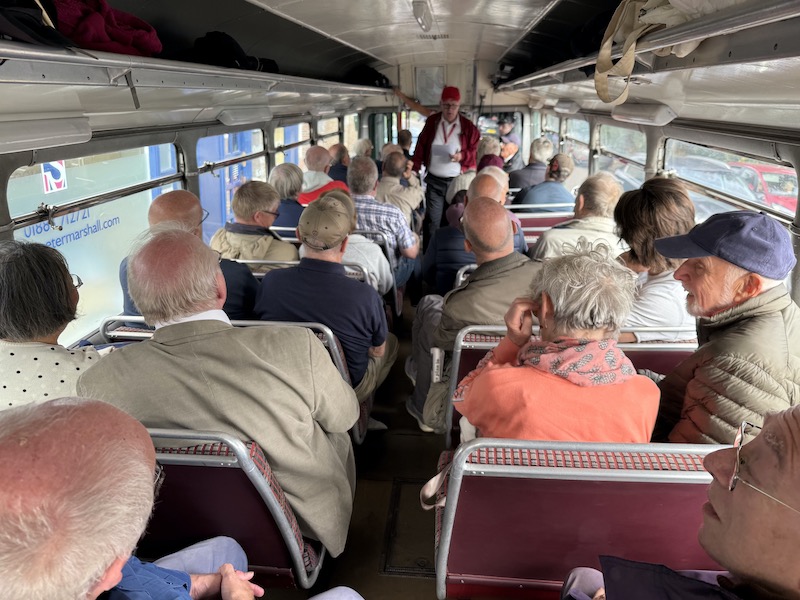
As we toured around, Ray kept us informed and entertained with a welter of anecdotes and fascinating historical facts, including those famous people who lived in the local area, and of course, the history of the bus routes serving this part of Surrey and Kent. As befits his approach to such matters we were all presented with a lovely map at the beginning of the tour…

… and a superbly designed 12 page souvenir brochure as a memento of the day at the end.

This superb brochure explains the origins of the three routes going back to their arrival on the scene in August 1921 when East Surrey began running the S4 from Croydon through Warlingham and close to Botley Hill to Limpsfield and on through The Chart to Crockham Hill and Edenbridge. There were many changes as the route developed, not least after London Transport took over in 1933, but things settled down after the Second World War as many new houses were built in Oxted and Hurst Green in the late 1940s and early 1950s.

For many years through the 1950s and 1960s the area had the three routes we were recreating:
- 464: Holland-Hurst Green-Oxted-Limpsfield-Crockham Hill-Westerham
- 465: Holland-Hurst Green-Oxted-Limpsfield-Crockham Hill-Edenbridge
- 485: Edenbridge-Crookham Hill-Westerham
Generally the route between Holland and Oxted received a 20 minute frequency with GS type single decks, later replaced by RFs, but for a short period in the early 1960s this frequency improved on Saturdays to every fifteen minutes. Alternate journeys continued half hourly to The Chart and from there hourly to Crockham Hill then alternating again two hourly to either Westerham (464) or Edenbridge(465).
Four other routes in the area were:
- 410: Reigate-Redhill-Godstone-Oxted-Limpsfield-Westerham-Bromley
- 705: Windsor-London Airport-Victoria-Bromley-Westerham-Sevenoaks
- 706: Aylesbury-Watford-Victoria-Croydon-Chelsham-Westerham
- 707: Aylesbury-Watford-Victoria-Croydon-Chelsham-Oxted
Our day began outside Oxted railway station with London Bus Company’s RF180 ready and waiting for us alongside a row of shops and what was once a rather nice waiting room and toilets, with the latter still available today, albeit rebuilt since the 1950s when an RF waiting here would have been a common sight.
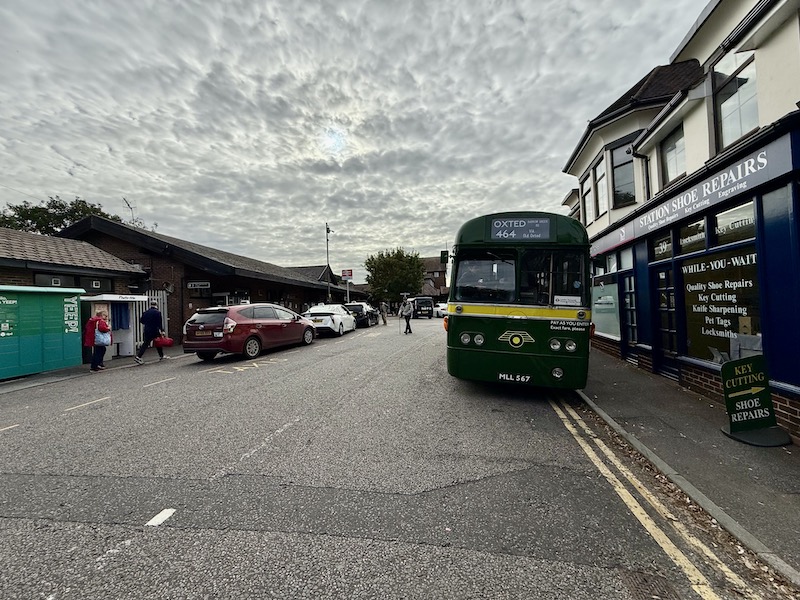
The bus was one of those Green Line buses latterly downgraded to bus work but carries the wonderful moquette synonymous with its days on Green Line routes.

With everyone on board we set off ‘out of service’ to begin the tour proper at the southern most terminal point of route 464 at Staffhurst Wood where three buses which had operated journeys to a nearby school departed at 09:16, 09:20 and 09:27 using a delightful remote triangle at a road junction to turn round ready for a journey back to Oxted.

This was the first of many scenic photo stops we enjoyed on the tour as well as keeping us all fit getting on and off the bus each time.

The tour proper then began recreating a journey on the 464 through to Oxted and a spur just north of the town centre to Barrow Green Road where short journeys known as ‘swingers’ terminated every two hours instead of continuing on to The Chart (hourly) and Westerham (two-hourly).

This took us via the normal southern terminal point in a village called Holland where we recreated the point where the bus would have turned…

… and even spotted the original bus stop post which would have carried the familiar London Transport flag with roundel/bullseye symbol.

It was then on to Hurst Green and a loop round Pollards Oak continuing further north to Old Oxted…

… where it’s hard to believe that as late as 1971, (obviously pre M25) and a diversion of the A25 to a new ‘by-pass’, all traffic used to pass through this very narrow village centre.


As we entered Oxted there was time for another scenic pause by the lovely Master Park for more photos…

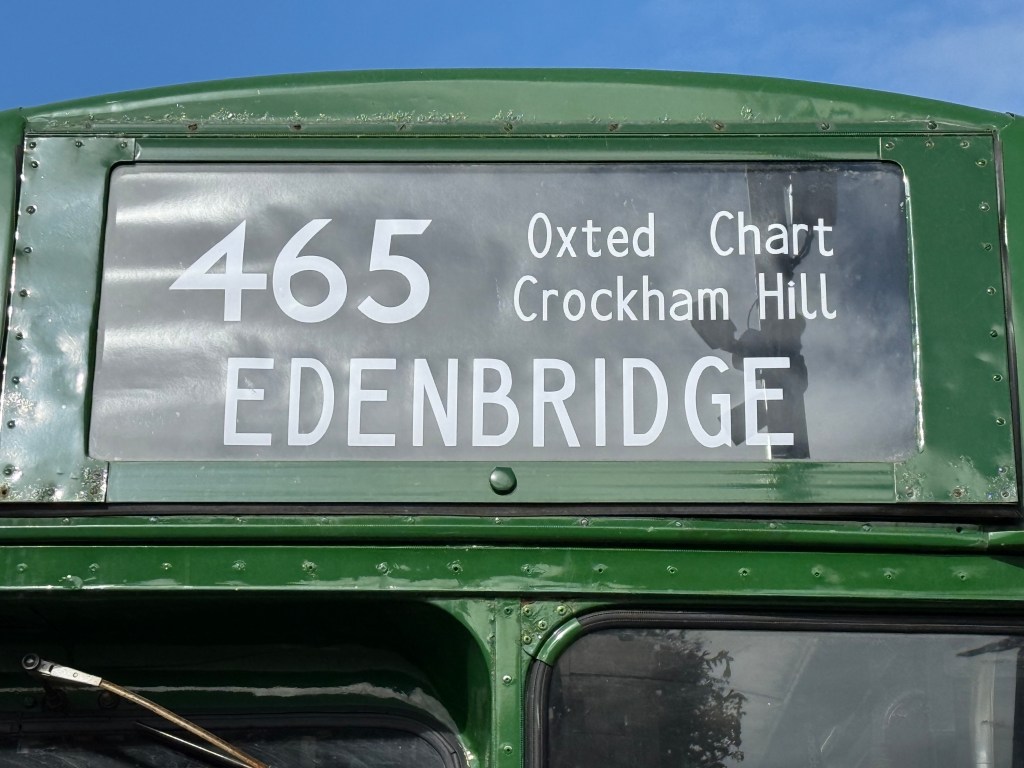
… before continuing to the terminus at Barrow Green Road and then heading back to the bus stop by the station but this time on the east side in Station Road East where we turned into a route 465 to take us down via The Chart and Crockham Hill to Edenbridge.
It was interesting to see shoppers reactions to the bus as it stood for a while at the bus stop in the centre of Oxted with many of the more senior passers by looking nostalgically and fondly at what in years gone by would have been a common sight.

Once we reached Chart, also called The Chart, also called Limpsfield Chart it was time for another pause for photographs at this delightful spot…
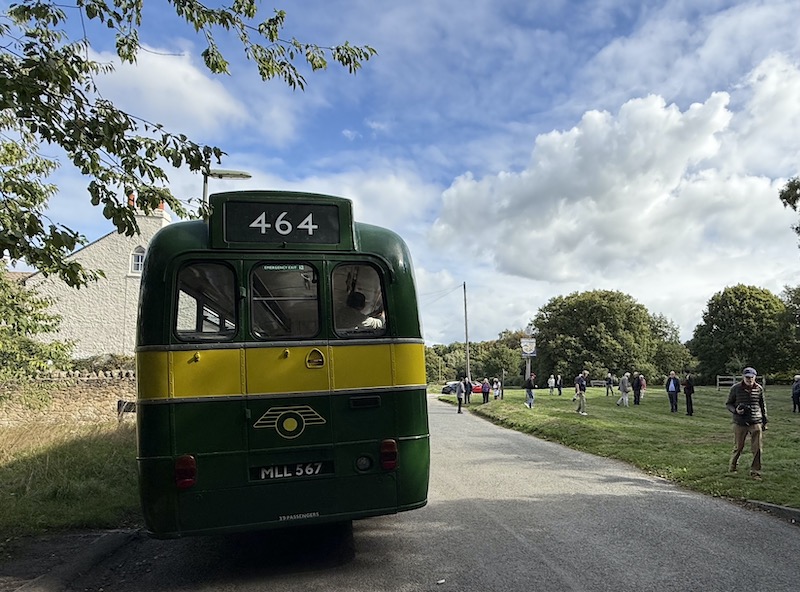
… when a Metrobus bus on today’s equivalent route 594 heading to Westerham appeared…

… making for an interesting contrast spanning around 60 years.
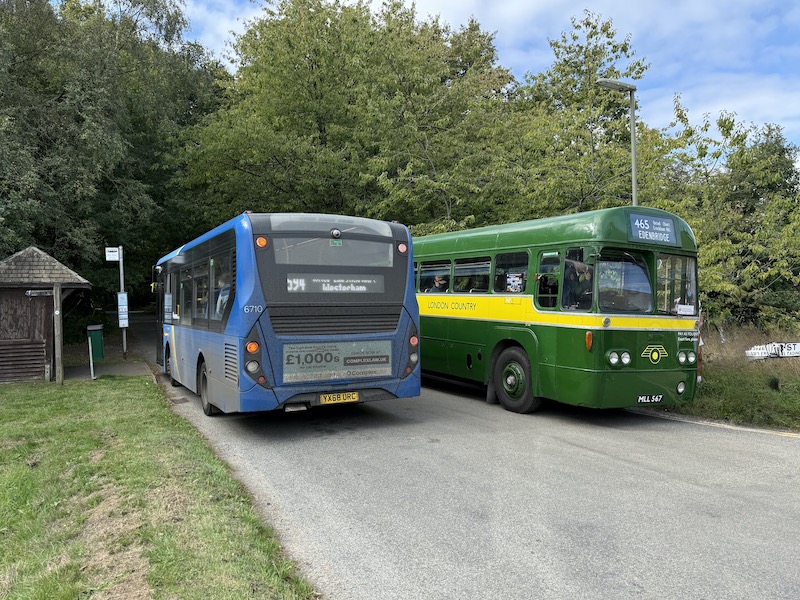
It’s a lovely run down to Edenbridge through the wonderfully wooded Kent Hatch…

… and Crockham Hill (with an emphasis on the words ‘down’ and ‘HIll’ in this part of the route) which sees dramatic changes in levels as we arrived in Edenbridge and headed to the point where buses on route 465 (as well as the 485) turned round and waited time before returning towards Oxted. This was on the forecourt of the small Maidstone & District bus garage situated to the south of the town centre.

Sadly this closed in 1996 (having only opened in 1955) and was subsequently demolished to make way for houses so we gave the residents a taste of how life was like a few decades ago for their enjoyment albeit we avoided turning and standing on their driveways!
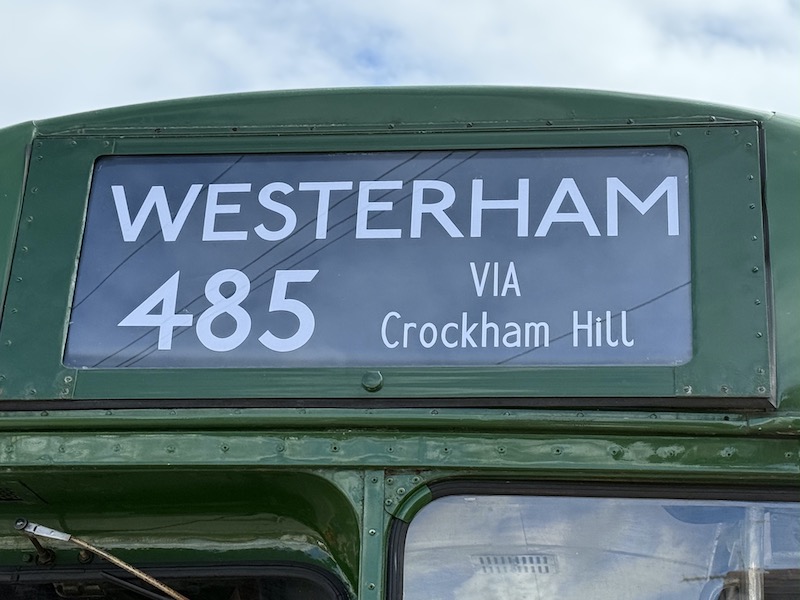
The blind was then changed a third time for our final recreation – route 485 back via Crockham Hill to Westerham and it was all aboard once again with us soon arriving in this busy town on the A25…

… and meeting up with another modern day bus on TfL’s route 246 which connects the town to Bromley as route 410 and Green Line route 705 once did.

After another welcome pause in the glorious afternoon sunshine, although the blind was set for Edenbridge, our final port of call was Chartwell where tour organisers Mike Kay and John Kately had arranged for a scrumptious afternoon tea to be laid on by the staff together with an illustrated talk about Winston Churchill and the history of Chartwell which made for a fascinating listen.
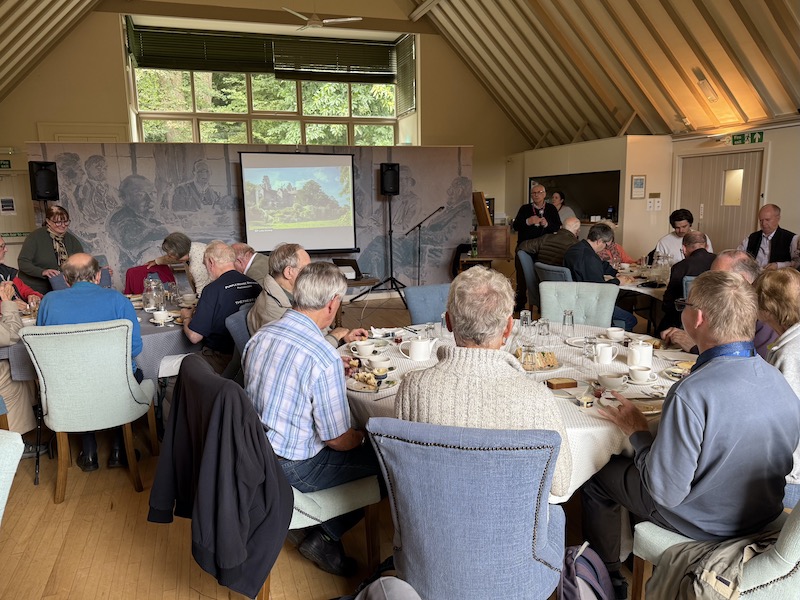
And a great note on which to end the day.

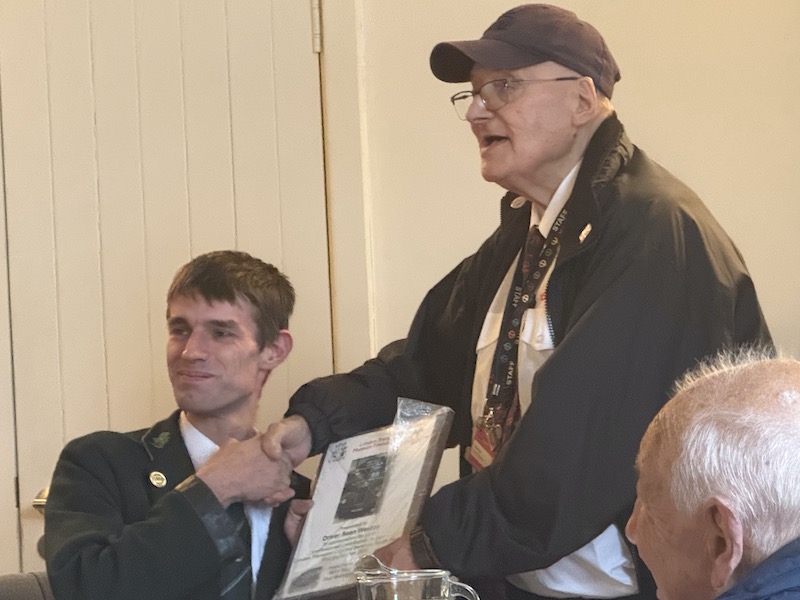
The legendary Mike Kay presented Ray with a well deserved certificate in recognition of his amazing efforts as our guide for the day as well as to John…
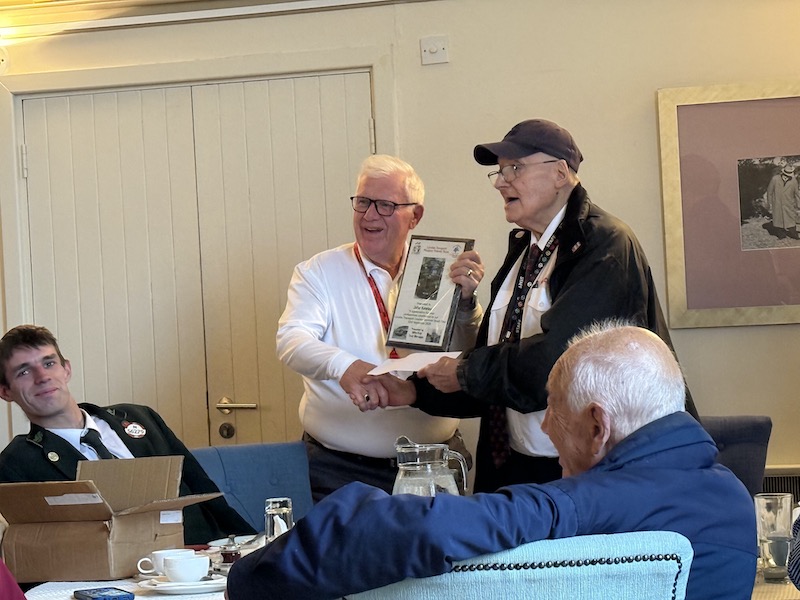
… and also to our superb driver Sean.
Driving an RF doesn’t compare with today’s modern day buses, having rather basic amenities for the driver.

Then it was all back on board for one final time to take us back to Oxted. And naturally we went the pretty route via Kent Hatch again.

It was a great day which was clearly enjoyed by everyone attending and huge thanks to Ray and John for all the organisation that went into making it a success. Looking forward to the next one.

Roger French
Blogging timetable: 06:00 TThS
 BusAndTrainUser
Green Line fare tables were complex things. In addition to single fares, there were returns, cheap-day returns and on different routes either 5-day or 6-day tickets (before the concept of season tickets was contemplated). Furthermore, over several common sections of route where the Country Bus route did not run on Sundays there were sections of GL route which charged either bus fares or a lower coach fare. Indeed, when the Sunday bus service between Oxted and Holland was cut, GL Route 707 was extended to Holland on Sundays. In western Surrey on Sundays, GL Route 716A charged bus fares between Addlestone and Woking.
LikeLiked by 2 people
But they usually had a timetable leaflet complete with fare chart on it
LikeLike
I’d love to have gone on this one… where does one find details of future such excursions??
LikeLike
They’re put on by the Friends of the LT Museum.
LikeLike
https://www.ltmuseumfriends.co.uk
LikeLike
Lovely reconstruction! The one I remember best was the 485, though I remember it terminating in Edenbridge Town station. Another Westerham bus was the 403, a long route from Croydon (sometimes even Wallington) to Tonbridge, and it was better timed, coming from Sevenoaks, to meet the 485 to Edenbridge, rather than use the seemingly more direct 413 to Four Elms, as there was no useful connection there with the Maidstone & District bus from Tunbridge Wells (I forget the then number, but it is now Metrobus 231/233).
Glad you enjoyed visiting my patch … (I always enjoy visiting Brighton)
Rick Townend
LikeLike
It was the circular 93 between Edenbridge and Tunbridge Wells – hourly via Four Elms, Bough Beech and Penshurst, 2-hourly via Hever, Cowden and Ashurst
LikeLike
464: Holland-Hurst Green-Oxted-Limpsfield-Crockham Hill-Westernham (spillling error)
JBC Prestatyn
off to ride the BL1 Waterham route today and check if anyone pays fares on the 436 this week.
LikeLike
Thanks; corrected.
LikeLike
721 (open top) Braintree – Great Yeldham
ZERO2 Bus Museum
Open-top bus operating on Saturdays,
Sundays and Bank Holidays from 20
September 2025 until 26 October 2025.
LikeLike
While the service has been registered as above, the opening of the Museum has been put back to December so I assume that the route will not operate until then.
Nigel Turner
LikeLike
If it is registered, then I guess it will have to run. Maybe using an open top is to try to attract people just for a ride, subject to weather of courss !
LikeLike
The registration is now shown as withdrawn on the Traffic Commissioners web site so I would say that it won’t be running.
LikeLike
Memories indeed! Coming south from Staffordshire as a child, I found myself living in this strange place called “Caterham-on-the-Hill”, with only green buses and not a Midland Red in sight! I soon located Chelsham garage, and used to walk there every Sunday morning to watch the run-out. Was fascinated by the clouds of exhaust smoke made by the “C” class Leyland Cubs as they headed off across Worms Heath towards Oxted and beyond, but even more fascinated by the blinds showing “Holland”….really? that far?
I think it would be more fair to describe the Monday-Friday headway on the Oxted-Holland section as 15-15-30 (in the peak era), and it was this section who suffered the 50% cut when GSs were replaced by RFs. The 707 Sunday extension to Holland after the group were withdrawn on that day introduced Conductors at that point for the first time, although the Edenbridge leg had been covered by Green Line coaches pre-war.
I received a £5 award from the Staff Suggestion scheme in 1960, as nobody had apparently thought before to advertise the “bus fares are available on this section” for the relevant Green line services in the timetable booklets. As my weekly wage was just £6.50 at the time (£324 pa), this was quite a boost!
A much enlarged Hurst Green/Holland area now sees double-deckers on many workings, but the Westerham-Crockham Hill-Edenbridge leg (former 485) only about four buses a day on the 246
Terence Uden
LikeLiked by 2 people
236
LikeLike
Yes indeed! I must have been dreaming of the independent Metrobus era when the commercial 246 went from Bromley North to East Grinstead every hour! Seems a lifetime ago now.
TU
LikeLike
Sounds like a great day out!
Peter Brown
LikeLike
The ‘wonderful moquette’ was of course synonymous with the latter years of Green Line service, dating from the 1960s modernisation of most of the RFs, and was also used on Green Line Routemasters. I always associated with Ribble, who used the same moquette (or a very similar one) on Atlanteans and PD3s in the 1960s.
Was that the same Mike Kay of Grey-Green and British Coachways fame?
LikeLike
Anyone wishing to continue their moquette reveries into the night may wish to consider this product:
https://www.ltmuseumshop.co.uk/routemaster-moquette-pyjamas
LikeLike
I note the various comments about Chelsham bus garage. This was, I believe, actually located in Warlingham where the current Sainsbury’s is. It also happens to be the current-day terminus of London bus route 403 which runs approximately every 10-12 minutes during the day.
According to a late friend who was bus-obsessed, Sanderstead had an amazing number of bus route due to the proximity of Chelsham garage and Chelsham itself had quite a few for the same operational reasons – a bit like the number of buses in Sussex serving Crawley bus garage today. I see from your article that the 706 and 707 served Chelsham.
Being full of nostalgia my friend bemoaned the loss of all these routes but I do wonder if overall the service is actually better now with few routes but much more frequent buses on them. Of course, the loss of links to places like Oxted and Westerham is a great downside as is the ‘two or three buses a day if you are lucky’ feeling that one now has once you enter rural Kent.
Pedantic of Purley
LikeLiked by 1 person
Two spotted typos: Crookham for Crockham, and Ayelesbury. Not bad for a piece of this length, read any non-edited newspaper or magazine article these days and the errors per 1000 words will be much greater (some due to carelessness, some to (non-) journalistic ignorance).
LikeLiked by 1 person
Many thanks – both now corrected.
LikeLike
Love how Midland Red always seems to get a mention.
Interestingly I went to visit a client in Stafford today and used Diamond 4H/ NXWM X51 / Chaserider 74. In the era of Midland Red it would have been 196 direct.
Just a superb article & tour Roger.
You evoked the past superbly and so brilliantly recreated a lost age.
Congratulations to all involved.
LikeLike
An RF still gives a impressive ride for the passenger that is equal to or better than many modern vehicles. I remember reading an article relating to the period towards the end of RF operation, when a Windsor driver who was about to embark on a trip in to London on a Sunday afternoon, upon seeing an RF sitting in the garage, chose to take this in preference to one of the more modern coaches then, generally in use, as it was easier to make up lost time on a late running journey with an RF than with one of the more modern coaches. The refurbished RFs were impressive looking vehicles and appeared to be a worthwhile investment to extend the life of such reliable vehicles!
LikeLiked by 1 person
705Express_As_at_19850629_6143.pdf
705_706_As_at_19790707.pdf
410_As_at_19780700_4380.pdf
LikeLike
Many thanks for these. I just checked the 410 timetable – still showing the 3-minute wait at Westerham to meet the 403; this meant you could get from Sevenoaks to Redhill in an hour and twenty minutes. Today by train it’s about the same, though not serving Westerham, Oxted, Godstone or Bletchingly. I reckon an express bus could do it in under an hour – any takers, today’s innovative, enterprising bus companies? (no, I thought not)
LikeLike
One should always remember the “Red Gentleman” working rare duties on Route 706 – such as “C202DYE”! On 17/01/1987 I rode it from Victoria to Bromley, upstairs – Gershwin’s “Rhapsody in Blue” was playing as we eased through the Saturday evening traffic.
LikeLike
Have they ever thought about running them daily. Surely it be a nice money for the Museum. Just a thought yes maybe they would need to invest in Modern Buses like the Enviro 200 or Optra Versa.
LikeLike