
Thursday 25th September 2025

Welcome to another blog about another bus route numbered 11 and where we head to Nottingham.
Interesting developments at award winning bus company Nottingham City Transport (NCT) this month saw managing director David Astill warn staff of tough times ahead following disappointing financial results for year ended March 2025. “The company has returned a small profit of £0.5m, a break-even position that is not sufficient to sustain the business in the longer term”.
David reports passenger resistance to the increase in the Government funded cap (£2 to £3) with numbers travelling “consistently 3% lower than the same weeks last year” and warns of “a potential reduction in staffing levels”.
So, it was a surprise to see NCT expanding its network last week to serve the small community of Cropwell Bishop, six miles outside the city boundary, with an hourly extension of its Green Line branded route 11 from Adbolton.
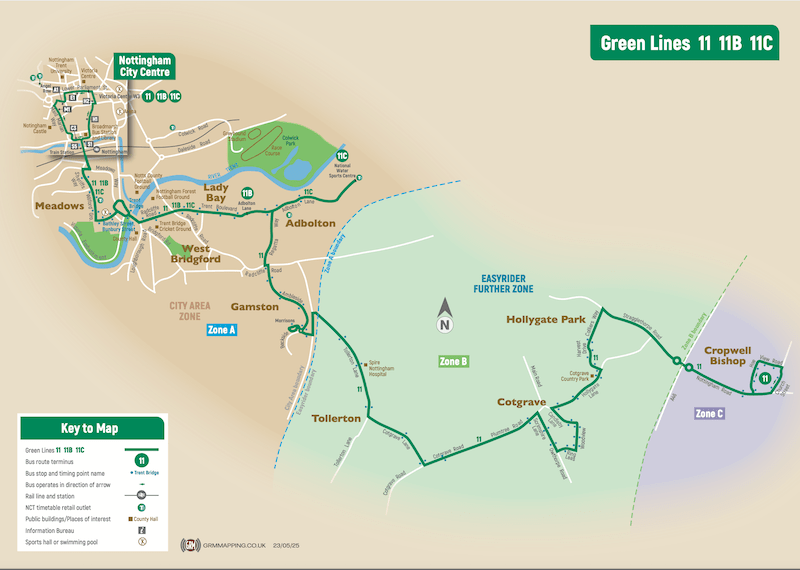
The village had been served by a County Council tendered route 33 latterly operated by the county’s own buses branded as ECOnnect, but prior to that by community bus operator C4TN.

I’m assuming Nottinghamshire County Council is providing some funding for this extension although that’s not entirely clear as it states online “because the 11 is a predominantly a commercial bus route, it offers better value to the council allowing us to make improvements to the 747 and 833.”

But using the word “improvements” to describe what’s happening to the 833 is being rather economic with that term. As can be seen above, previously route 33 provided a bus every 70 minutes (not ideal) offering a through service from Radcliffe on Trent, Upper Saxondale and Cropwell Butler (as well as Cropwell Bishop, parts of Cotgrave and Tollerton – now covered by the newly extended 11) to West Bridgford (not covered by the 11) and Nottingham.

As shown on the map above, the 833 operated by Centrebus for the county council, has been extended to cover Upper Saxondale and Cropwell Butler but passengers have to change on to route 11 at Cropwell Bishop to reach Nottingham. Buses arrive on the 833 from Upper Saxondale and Cropwell Butler at 08 minutes past the hour with the 11 departing for Nottingham at 10 making for a tight 2 minute connection and in the reverse direction the 11 arrives at 59 giving an even tighter one minute connection with the 833 departing at 00. Through tickets are available, but the County Council explain passengers wanting to travel to West Bridgford town centre (not served by the 11) will have to change again in Gamston on to NCT’s route 6 to which through tickets are not available.

It’s not my idea of “an improvement”.
The aforementioned route 747 (operated directly by the County Council) has been extended to serve Gunthorpe, Shelford, Radcliffe on Trent, Upper Saxondale, Cropwell Butler and Cropwell Bishop again covering for some communities no longer served by the withdrawn 33 nor the extended 11.
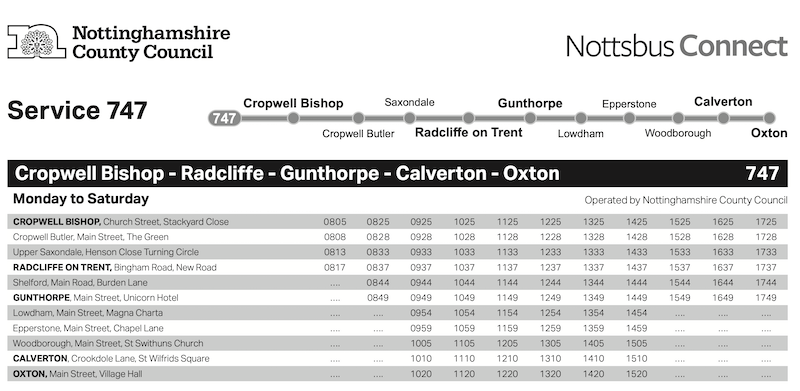
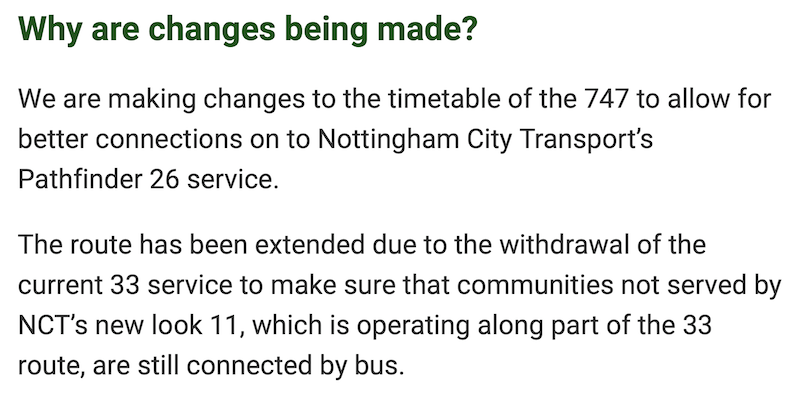
I see the Council say there’ll be “better connections” on to NCT’s route 26. This would be in Lowdham, where the 747 crosses the 26. The 747 is timed hourly at Lowdham Main Street Magna Carta (from Cropwell Bishop/Cropwell Butler/Upper Saxondale and Radcliffe on Trent) at 54 minutes past the hour. NCT’s 26 passes on its way into Nottingham at 26 and 56 minutes past the hour, while it arrives back from the city in Lowdham at 15 and 45 with the 747 departing at 46. Good luck with those connections.
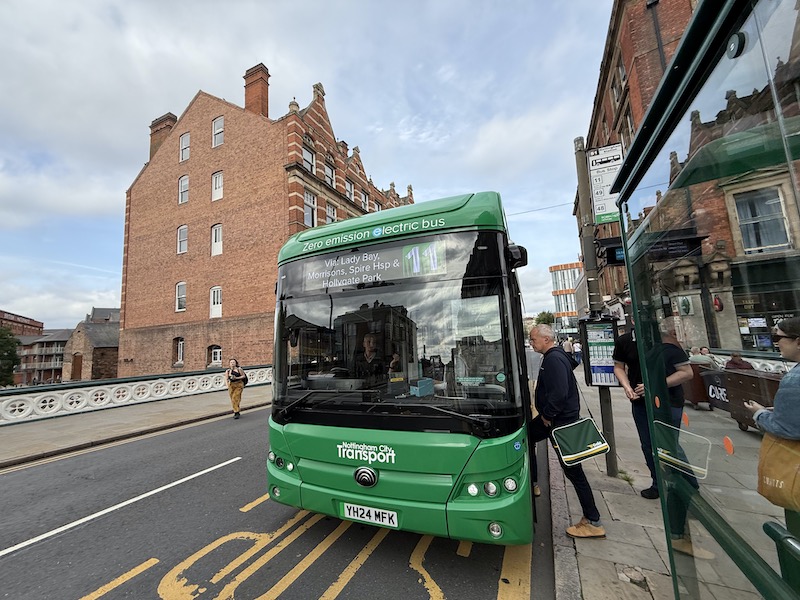
I took a ride on the newly extended route 11 last Friday and as bad luck would have it, for the first week of a new operator, a road closure along the route in Tollerton was adding around 8-10 minutes to each single journey easily using up the 11 minutes layover at Cropwell Bishop with no mitigation at the city centre end of the route which is served in a loop with the timetable showing just one minute layover. There was therefore no hope for connections to the 833 being made.

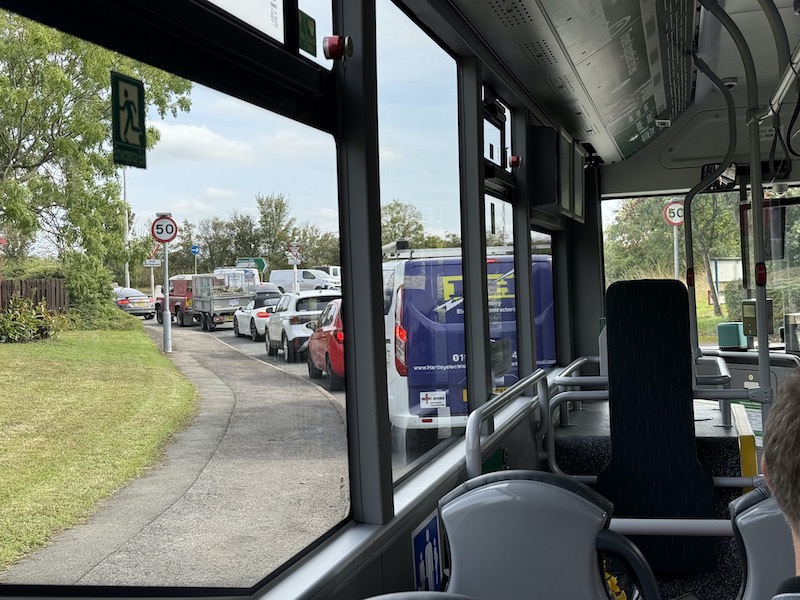
The driver of the journey I travelled on did her best to limit the delay although two sets of temporary traffic lights didn’t help…

… nor waiting for a gap in the traffic to cross the busy A52 at Gamston.
My late morning journey left Nottingham railway station towards Cropwell Bishop eight minutes late (having arrived that late on its inbound journey) with an impressive 22 on board.
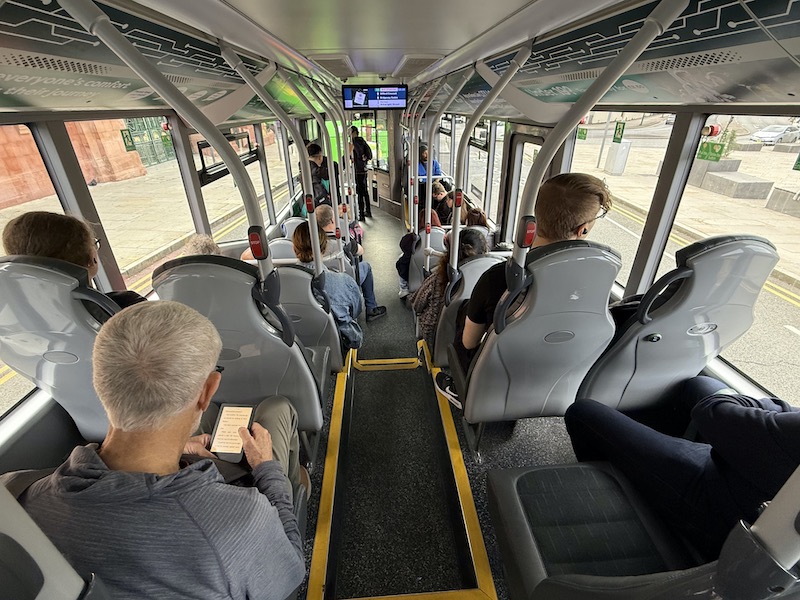
However all but five had alighted by the time we reached Adbolton also served by hourly 11B and 11C journeys making for a 20 minute frequency (as also applied before the extension) although we gained two drivers learning the route as we headed out of the city.
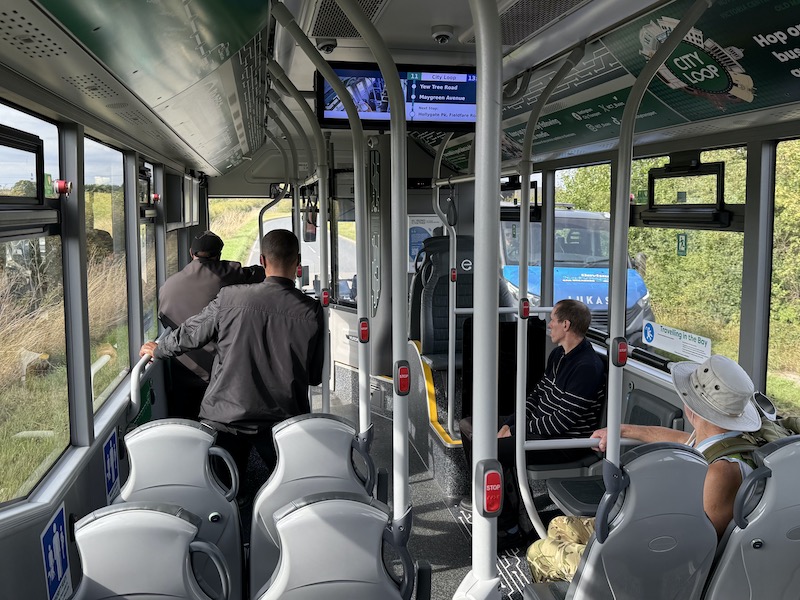
Despite the diversion we were only 12 minutes late when we reached Cotgrave where two alighted and another passenger boarded making four for the final leg over to Cropwell Bishop where skipping the layover meant we headed back to Nottingham just two minutes down.

No takers for us in Cotgrave which trentbarton serves every 20 minutes providing a quicker route into the city centre. Furthermore its buses pick up on the other side of the road to NCT’s route 11 so I don’t think the latter is going to attract much custom from this dormitory suburb of the city with trentbarton retaining its dominance of the Cotgrave market.

The diversion cost us another seven minutes delay so heading back into the city meant we were around nine minutes down and once again picked up around 15 passengers on the familiar 11/11A/11C section of route.
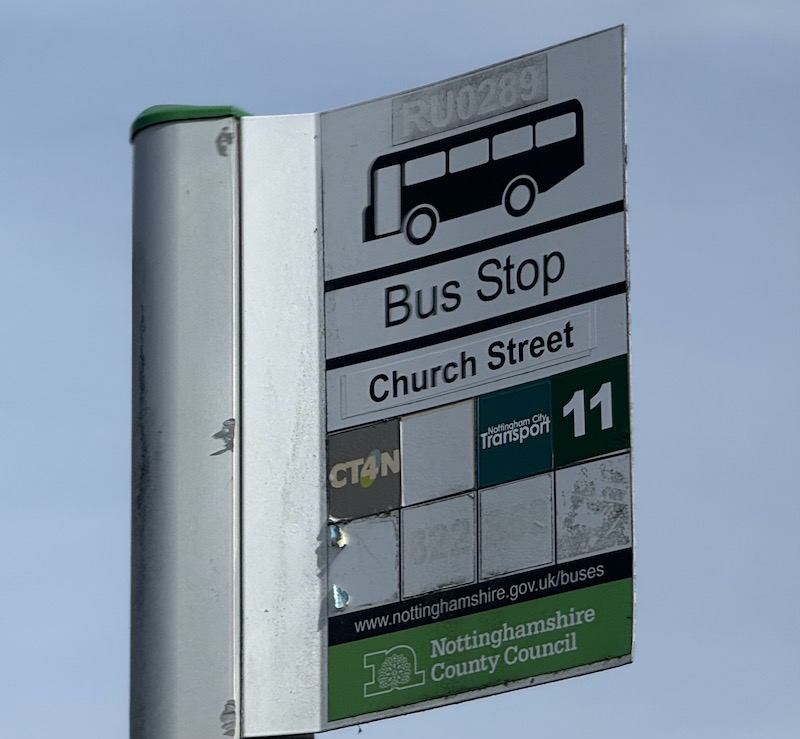
It was good to see bus stop plates along the route had route 11 added as well as timetables on display all being updated, although I noticed a CT4N still appearing on a flag in Cropwell Bishop’s Church Street. Electronic departure signs were also updated…

… and impressively copies of an updated timetable book for all the routes operating under the Green Line branding were available at Nottingham railway station…

… and on board buses.

The only thing I noticed not updated was the internal route maps still showing the former terminus for the 11 at Adbolton along with the 11B and 11C.
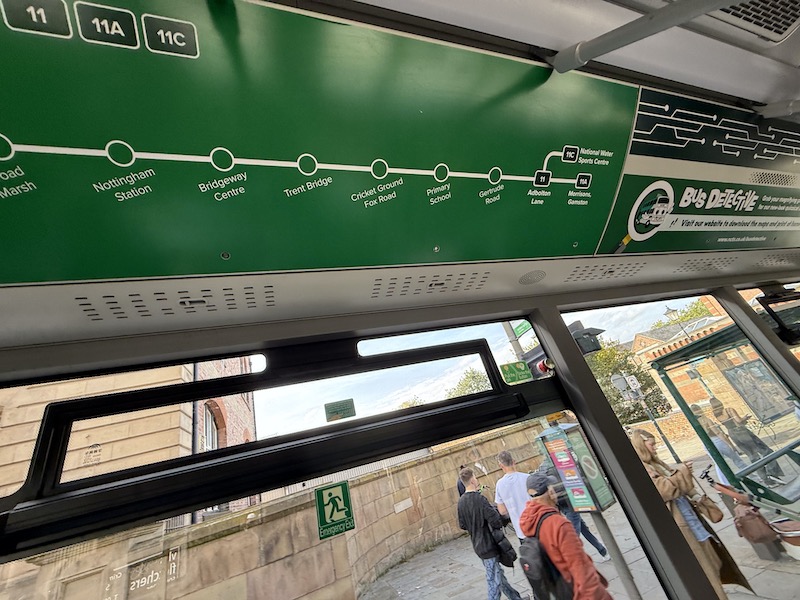
Good luck to NCT with this newly extended route – I think they’ll need it, not least in view of the challenging financial position of the business.
Roger French
Blogging timetable: 06:00 TThS
 BusAndTrainUser
A 3% year on year drop in passenger numbers hardly meets Govt previously stated targets for bus travel. I think too the rising age for pensioner passes has an impact along with the general economic malaise of going nowhere slowly. The financial challenge (though the year end may not have been impacted) with Employer NI contributions rising is more likely to be a cost factor in potential future losses.
Even though many travellers were – depending on operator less financially impacted by a £3 max fare it was bad publicity that put people travelling off , and £6 return is £10+ a week for some travellers so it will eat a bit into thinking, and it is basically the marginal passenger on a route or network per journey that can add £40 to £80 per day to revenue for no significant additional cost,
As to the Nottingham CC funding of routes that has to be their decision – has there been local feedback on the changes – which appear for some to double the £3 per journey to up to £6 ( £12 return with no discounts) ?- are those interchange times being met – without a survey of the revised 833 I dont think you will get a full picture
I dont know if Nottingham plans for more people to walk/use cycles in the city nor the present state of reporting of tram revenues and how they have changed.
Finally following our discussions recently on Arriva/ GoAhead and Konnectbus etc in East Anglia has Go-Ahead’s sale of its operations in that area come as a surprise – given the buyer involved ?
JBC Prestatyn
LikeLike
Fares in general in my view are bot the problem it is more down to poor and infrequent services
LikeLike
Its time you came and had a look at what goes on in West Cumbria. The depot at Lillyhall is known as “the bus graveyard” with older buses sent in from around the Stagecoach empire rather than new vehicles. Consequently we suffer frequent breakdowns! The timetable for West Cumbria does not show all services run by Stagecoach (the 600 Carlisle Cockermouth and the X4/X5 Workington Penrith only have QRcodes and thats only because I have been complaining. The excuses are that the 600 is not run by Lillyhall depot and the X4/X5 are in the Lakes timetable! Unbelievable! The icing on the cake for stupidity is the revamp of Workington bus station. Because of the layout all buses need to reverse off the stand with the traffic flow now one way. Stupidly Stagecoach have full length vehicles using the first two bays by the vehicle entrance and consequently these buses need to reverse outside the bus station across the pavement and possibly into the road with no banksman provided. An accident waiting to happen. Could have easily been avoided with the shorter vehicles using these bays. Drivers are complaining and I have been told that the decision to swap things round has to be taken by Stagecoach head office!!!! Videos on Youtube clearly show the problem. I think you would enjoy West Cumbria with some good scenic bus routes (most now ending for the winter) as well as the scenic Cumbria Coast railway albeit with the problems of Bransty tunnel. I would be happy to spend a day or two showing you round if you visited the area. Peter Fox
LikeLike
it is cool but i think they should but 11B to city loop
LikeLike
833 goes to Bingham. That has enough shops for day to day use.
You can change there for Trentbarton’s “Mainline” bus fast to Nottingham every 10 minutes. There are other buses to Nottingham, Grantham, Newark, etc . There is also the train hourly on the Nottingham, Grantham, Skegness service.
A change from the 833 to the 11 would be unusual.
The old Tollerton airfield site where the Spire Hospital is, is about to start a major house building development. This will benefit the 11 in due course.
LikeLiked by 1 person
Quite apart from its trams, Nottingham lays claim to another form of electric traction – its transient place in London Underground history. The “A” stock for the Metropolitan Line built in Sheffield by Cravens used the former Great Central route through Nottingham Victoria and I have an archive picture of one such train on the up line through East Leake Station north of Loughborough. A cousin who lives in East Leake sent me a couple of pictures of one such train: 73010 a Riddles 4-6-0 is seen heading a rake of “A” stock on its way to Neasden. The loco bears the shed code “2F” (Woodford Halse). So, all “A” stock trains would have entered the system at Amersham to serve that station hundreds and thousands of times before withdrawal. I had a night in West Bridgford on 16/07/1978 during one of my “churches & cathedrals” motorcycle tours. My drive from Norwich that day made me so exhausted that I was able to fall asleep in my room despite it being located over the hotel’s very active dance hall. The following day I had an abortive trip to Crich (the museum was shut). As to Nottingham’s buses – I only ever rode those on London Route 188!
LikeLike
Roger, going back to NCT route 11 and the comments about the £2/£3 fare, did you notice what proportion of passengers on your sample journeys appeared to be farepayers?
Ian McNeil
LikeLike
I didn’t pay close attention but probably around 40%.
LikeLike
Not sure NCT can blame the £3 single fare cap for declining patronage when the capped daily contactless fare outside of the city centre zone is £8?
Seems to me most would benefit from buying two single tickets if multiple journeys are not required.
Dan Tancock
LikeLike
Is the NCT financial performance better than the highly regarded (well on here), Transdev Blazefield who have combined losses of £15M from 2022 to 2024
LikeLike
They were profitable in Year to 31st March 2023 (£2m) and 2024 (£5m). But this doesn’t seem to be enough to cover replacement of the 220 street fleet on a regular basis, unless I’ve misunderstood how new buses are being capitalised and depreciated in the acccounts.
https://find-and-update.company-information.service.gov.uk/company/02004967/filing-history
LikeLike
At operating profit granted yes, but as a business they need to pay for financing. Once this is included they have suffered losses. Loss before tax is getting better in 2024 but substantial losses in 2022 and 2023.
LikeLike
Sorry thought you meant Transdev Blazefield
LikeLike
11 The extension also serves parts of Gamston not covered by the 6, plus the big Morrison’s. From Morrison’s to the City Centre the 11 is 4 mins quicker than the 6, although the 6 is every 15 mins, vers every hour for the 11.
The big Tollerton housing development, now eventually starting, makes the 11 a potential future investment and keeps out competition from Trentbarton.
The route changes may mean for some people they have to pay more for the same journey, but may well mean that they travel somewhere different instead with no fare change. You go where the route now goes.
LikeLike
The NottsBus Day Connect ticket at £10 (an all-day through ticket) covers travel on the NottsBus 747/833 to the NCT 11 and then to the NCT 6 – and including all other NCT city services.
So a visit to West Bridgford town centre using the combination of 833/11, changing to the NCT 6 at Morrisons in Gamston is covered, and includes onward travel across Nottingham city.
LikeLike
My experience of the East Midlands is that a surprising amount of people assume that the only fare available is the £3 single, leading to complaints like “I have to use four buses so it costs me £12 a day” when a day ticket would be much cheaper for them.
If multi-operator tap-and-cap becomes more widely available, I can see those people making noise about “having been ripped off for years” too, which the media will doubtless gleefully report.
LikeLike
Nottingham is somewhat better than the other EM city areas in having the Robin Hood Card. Mainly intended to the city, but does cover some of the wider greater Nottingham area and the entire tram network.
LikeLike
Unfortunately the sort of person I’m referring to, who appear unable to contemplate asking for a day ticket rather than just wordlessly blipping their phone, would also be unable to buy a Robin Hood ticket.
Here in Lincoln I’ve watched people do just that then get off three stops later (which would not have been a capped fare) so they’re paying more than they need to just because they don’t want to speak to the driver. Strange attitude, to my mind, but there’s no accounting for folk.
LikeLike
You’ve come to a route I used to live on!
The service as far as Adbolton Lane was one that was once operated by West Bridgford Urban District Council and was then the 12 to Seymour Road. In 1968 NCT took over after WBUDC failed to get an OPO agreement with the union. There had been a possibility of Barton taking over. From 1978 the route was linked to a former NCT trolley bus route to Bulwell as the 85, this was still the case up until 1995, presumably to save costs and cross subsidise the weaker Adbolton Lane end.
Following a major route change – cross city routes abandoned due to the road layout changes brought on by planning for the new tram – it became the 11 and was very popular. This part of West Bridgford was always popular with students but they now have new accommodation in the city.
The route out to Tollerton, Cotgrave and beyond was Barton route 22 until it was abandoned not long after Trent took over. Very affluent villages (Cotgrave aside) but Trent serve that market. The development of Bingham over the years has made that the focus for the villages rather than West Bridgford and so it now acts as the local hub.
With the forthcoming restructuring of the districts within Nottinghamshire, with Rushcliffe merging with Nottingham, I expect to see more of this type of development. Hoping to subsidise loss making rural routes by incorporating them into city bus services, not an attractive option.
Richard Warwick
LikeLike
If the increase in the cap from £2 to £3 only produced a 3% reduction in passengers it shows what some of us have been saying throughout this debacle which is that fares are pretty inelastic. See also the ScotRail and TfL off peak fare experiments, although hilariously ScotRail having proven that the termporary abolition of off peak fares wasn’t achieving its objectives, have gone ahead and made it permanent.
LikeLike
That’s politics as applied to the ‘Great Britain Passenger Railway’ (as the post-privatisation railway was referred to on the national timetable book), and why GBPR will never be a genuinely commercial business in whatever form it operates; it’s always being interfered with by the politicians.
LikeLike
Ah, yes, but there might be an inertia to some of this. So if you are making a regular journey, and the fare changes, you might for a year or two pay the higher fare. But in the long run, you might also be eyeing up that car you hadn’t initially planned purchasing.
So over a long period, sadly, the statistic could end up being much more than 3%. (CH, Oxford).
LikeLike
Sad to see the dreaded road-works wrecking another infrequent bus service. If he bus industry would get together and tackle this issue, there would be loud cheers from passengers.
Your photo of the bus service shows, as is common, lots of information crammed into a small display-case on the bus stop post, while a large space is unused on the shelter. Is there some law against using bus shelters for timetables etc.? It sems to be possible in some areas to use them for advertisements for car sales. But publicity spread over a wider space could be a real benefit for bus passengers; for a start everything could be in larger print – better for people with sight problems (who, after call, cannot drive), and for all of us on a dark night or when the glass is misted up. And at a crowded stop, there’s a better chance for more people to read the timetable at the same time.
There would also be benefits in a wider range of information – e.g. a large local network map, details of buses at the stop opposite, full timetables so you can work out how to make your return trip, or what buses or trains this route connects with.
LikeLike
Can you hear the calls of “But that’s all online…”?
I agree with you, especially as it’s been instructive dealing with too many younger people who appear incapable of finding their own way from A to B despite holding smartphones with built in maps and navigation.
Mind you, too many of them can’t read a departure list in my experience, let alone a proper timetable. “It’s too complicated!”, they say.
LikeLike
Bus shelters are often provided by advertising companies. They will, obviously, prioritise advertisements over bus information. These shelters are usually the clean, well maintained ones. A grotty bus shelter is often owned by the local authority, who have no incentive, and more importantly, no funds to do anything with them.
It would be great if they could look after them better, but we all know the answer to that one!
I have, in the past, resorted to “fly-posting” on bus shelters to inform my passengers of timetable changes to my services . . . probably illegal, but in desperation it seemed the best thing to do.
The only good example (that I know of) is at Peterborough Bus Station . . . the timetable information for all companies (except Delaine) is provided by the chap that runs Peterborough Bus Times . . . presumably with permission from the local council. Clear and concise timetable and route details . . . but he is only one man!
To answer A Nony Mouse below . . . I once helped a passenger changing trains at Aldershot . . . he wasn’t local, and was relying on his phone to tell him how to find his next train . . . he left the station completely, because his phone implied that was what he needed to do. I showed him the displays on the platform that indicated his next train . . . he simply had no idea!! Unbelieveable, but true!!
LikeLike
A breakthrough new artificial intelligence platform could provide the solution to Britain’s worsening school run crisis, as vehicle trips to school have surged 23 per cent since 2005.
The Step platform, developed by UK startup HomeRun with Department for Transport funding, employs AI technology to chart pupils’ travel patterns and identify optimal locations for walking routes, cycling infrastructure and public transport improvements.
LikeLiked by 1 person
For School travel we could look at Surrey County Council re drawing routes (illegally it seems) for wal to school so they dont have to pay for the over 3 miles free school bus journeys.
The TfL Friday off-peak tube fare experiment was never really going to generate more passengers, there has been a structural change in travel since covid , which is starting to revert but Thursday has long been the new friday , with the long weekend turning into work from holiday home on a Friday for a substantial amount of folk and the theatres can only accommodate as many persons as there are seats so that is a leisure limiting factor along with people going out late if they go out so the evening peak is not a thing as such , but the reduced costs were liked by londoners.
When I studied 4 “typical” ( they werent as such , trying to find a typical bus company is difficult) NBC companies, after dealing with other contributing factors a REAL increase in fares of 10 percent would give a 3percent loss in passenger journeys (Revenue). This excluded car ownership which I showed was a function of rise in real wages , but itself then led to a loss of revenue but I could not work out a direct function of how increase in fares impacted on a decision to buy a car and use that. I suspect that because the running costs of cars are about the same as a bus fare for an individual that lower income people didnt have much choice other than to pay the fares.
Fare discounting on its own rarely increased journeys. Advertising did , a bit, advertising a lower fare really depended on local management for them to see what differences occurred.
Tagging a rural end to a city service can reduce overall costs thus reducing the loss. Can loss be eliminated – depends
JBC Prestatyn
LikeLike
A huge problem in the less urban area is the cost of home to school taxis
LikeLike
JBC . . . ah, the fares resistance conundrum!! If you need an increase in fares income, by how much do you need to increase actual fares to achieve it?
I spent a few years in the late 1980s trying to work that out . . . and never achieved an accurate figure. The best I could come to was that a 5% increase in fares would net a 3%-4% increase in income; although a 10% increase would disproportionately reduce the net increase . . . so 10% might produce an increase of only 5%-6% in revenue.
My MD (an engineer) simply couldn’t get his head around that!! The best way to explain it to his understanding was that small occasional increases was better than a “big bang” increase . . . an increase of 5p twice a year “should” eventually bring in a better yield than a one-off 10p increase .
It was all “estimated”, though . . . too many outside factors to consider (changes in timetables, reliability of operation and so on).
LikeLiked by 1 person
Not specific to this blog page but we were recently looking at Oxford and its buses (or was that on YT with someone else) Anyway I see this week that Oxford council are bringing in a car congestion charge zone around the centre of Oxford. Problem with Oxford from the West is there is only one road to get in to Oxford and if you want East of Oxford by car it is tricky to get around easily , or cheaply , yet bus services up Botley Road were not exactly frequent or had great capacity, does this give a guaranteed cash inflow to Oxford Council ? Will bus services improve (beyond 7pm ?)
JBC Prestatyn
LikeLike