Saturday 20th September 2025
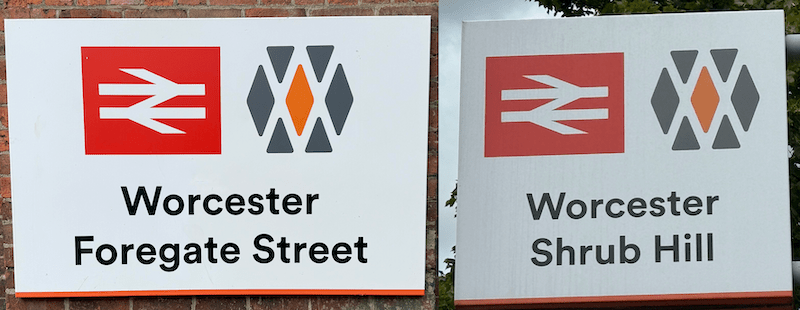
I didn’t originally have Worcester on my list for this series by dint of the 2020 opening of Worcestershire Parkway making it a three station city. However, after lobbying from my Worcester based friend and former bus industry colleague, Iain Macbriar, who quite rightly pointed out Worcestershire Parkway is in Worcestershire (as its name implies) and lies outside the city boundary, I was easily persuaded to change priorities not least as it gives an opportunity to highlight a number of notable oddities about this city’s two stations.
First oddity is although Worcester Foregate Street has two platforms and a seemingly double track running through the station, it is actually two single tracks with trains arriving and departing from different places on each of the tracks.
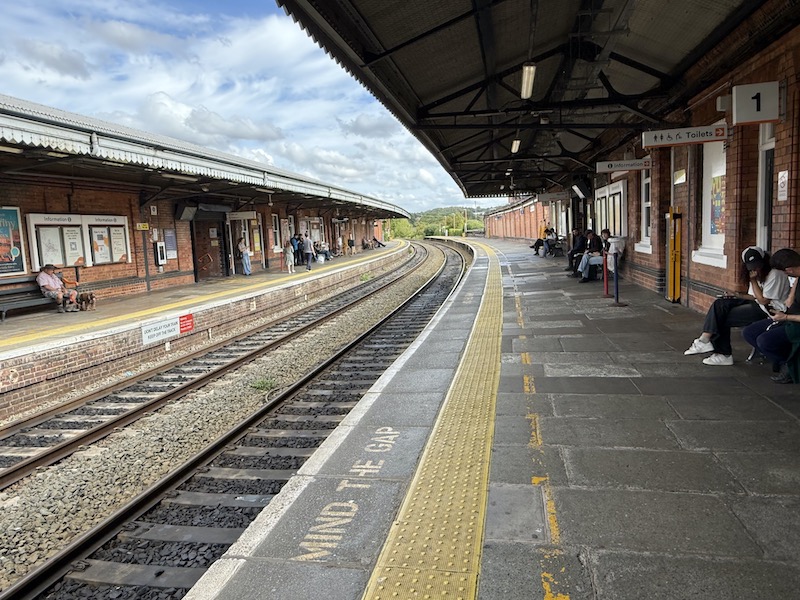
The track for Platform 1 can only be used by trains coming to and from the city’s other station, Worcester Shrub Hill and beyond, while Platform 2’s track only takes trains north to (and from) Droitwich Spa and beyond. South of Worcester Foregate Street’s platforms there’s a crossover at Henwick Junction where trains can swap over to the southbound track from Platform 2 and they become double track again.
Here’s a diagram courtesy of Wikipedia which shows how trains (run by West Midlands Trains) continue north from Droitwich Spa either via Kidderminster or Bromsgrove to Birmingham with the former serving Snow Hill and Moor Street and the latter University and New Street. The former continue to Dorridge and Stratford-upon-Avon while the latter terminate in Birmingham New Street.

South of Foregate Street trains continue to Great Malvern or Hereford operated by both West Midlands Trains and GWR, although the former only uses platform 2 and the latter can only use platform 1 as those trains come from Shrub Hill. So passengers bound for Hereford need to be careful which platform they’re waiting on as trains head there from both.
GWR’s trains from Platform 1 to Shrub Hill continue to either Oxford and London Paddington or Cheltenham and Bristol.
Here’s an adaptation of the OS map to illustrate what I’ve tried to describe as well as showing the locations of both stations in the city, which are around a 12-15 minute walk apart (or a two minute train journey).
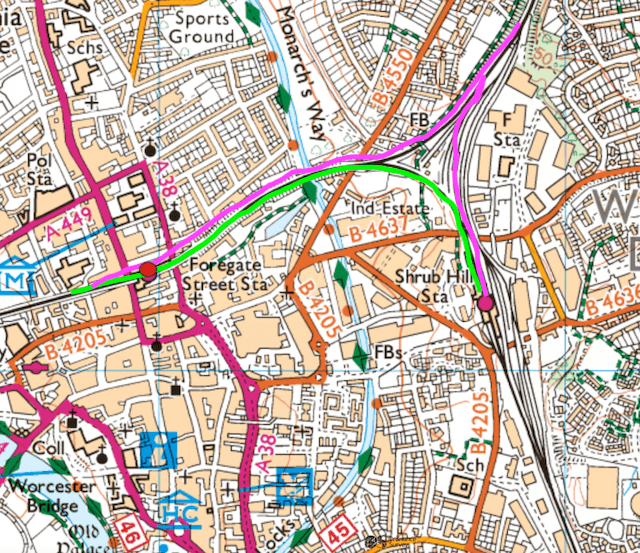
And, perhaps even better, here’s an extract from Traksy which also explains the layout.

From the foregoing readers may appreciate that over at Shrub Hill where the double tracks are more traditionally double tracks, and bi-directional at that, passengers can catch a train to Great Malvern and Hereford, Oxford and Paddington as well as Cheltenham and Bristol and also West Midlands Trains services to Kidderminster, Birmingham and on to Dorridge and Stratford-upon-Avon call in and then change direction back out again.
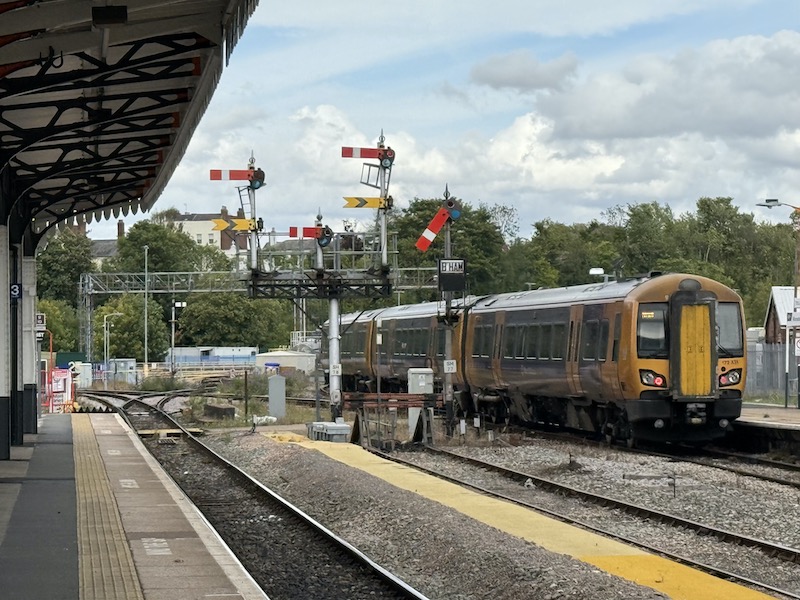
The second oddity is at Shrub Hill where there’s a splendid display of old style semaphore signals still in use at the north end of the platforms. It’s nice to see some old style signaling as it becomes more of a rarity on Britain’s railways these days. These signals control the passage of trains from both platforms 1 (to Foregate Street) and 2 (to Droitwich Spa)
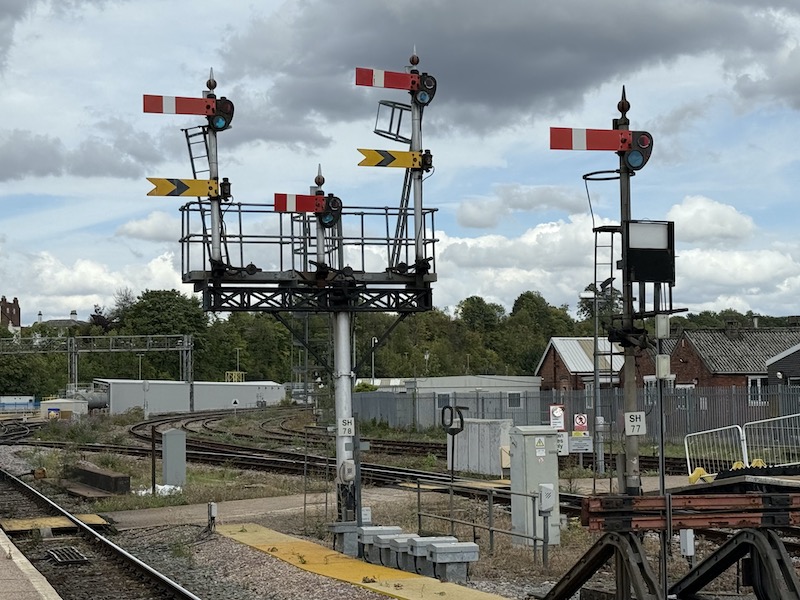
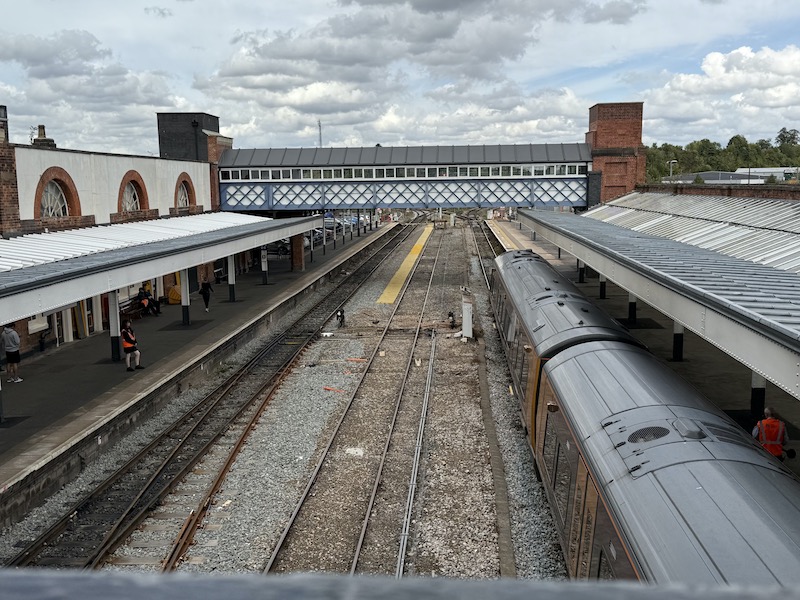
As you can see from the Traksy diagram there’s also a centre track running through Shrub Hill with a buffer stop at the northern end as can just about be seen in the photo below.
The next rather nice oddity is still at Shrub Hill where there’s a magnificently restored Victorian waiting room on Platform 2.

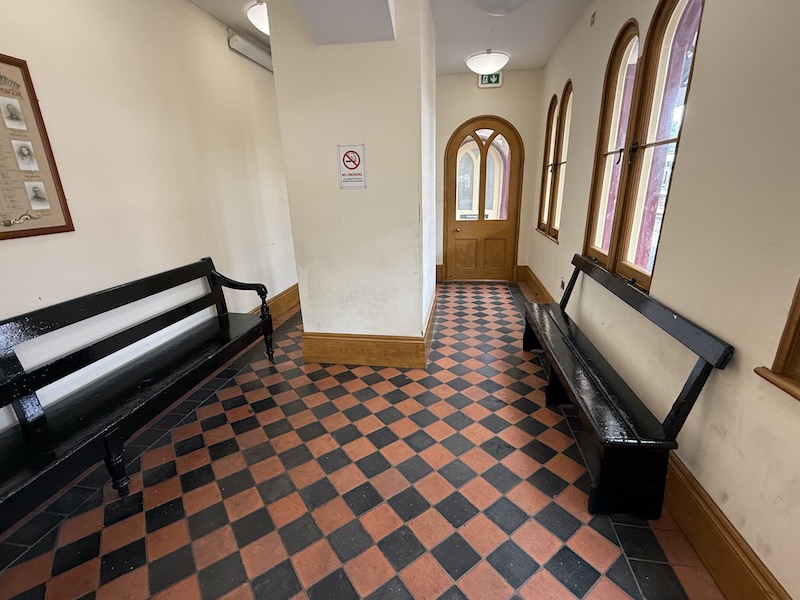
This was originally constructed in 1864 and divided into a Ladies Waiting Room, First Class (and later Third Class) Waiting Rooms.
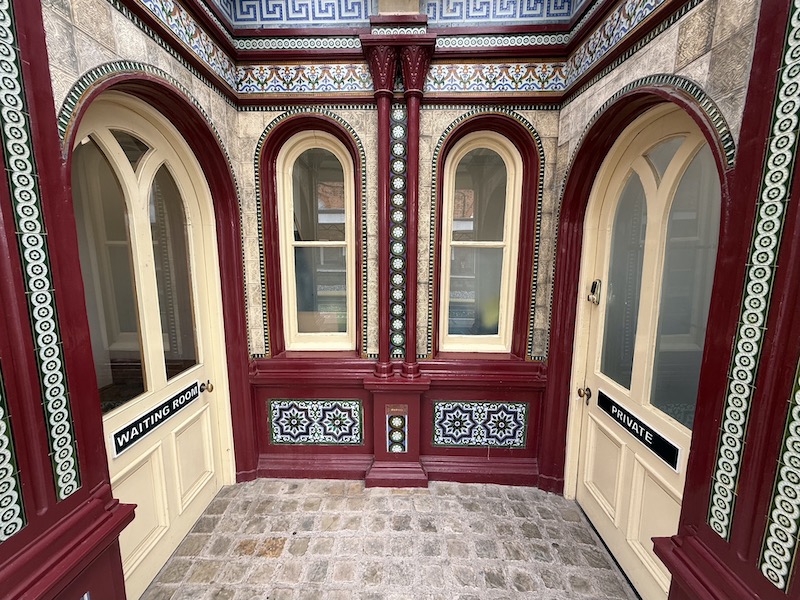
It’s Grade II listed and was restored by Network Rail in 2015 with help from the Railway Heritage Trust being returned to its use as a gender neutral waiting room and, these days, an information point rather than a First Class (or Third Class) waiting room.
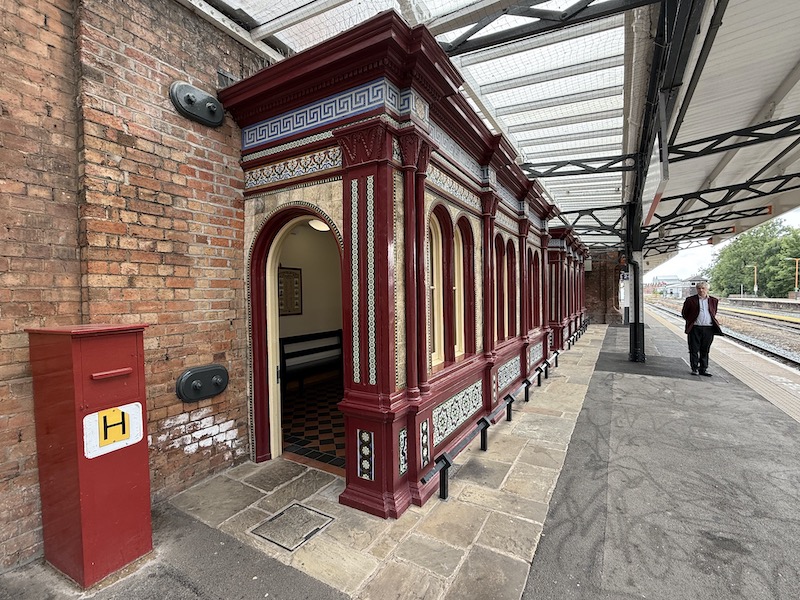
The unusual tile clad structure is believed to have been originally created as a prototype exhibition structure – the building facade is cast iron, with the combination of external tiling and cast iron making it a unique survivor of the Victorian period.

It really is all rather lovely and one of the best waiting rooms on Britain’s rail network.
Another oddity at Shrub Hill is it used to have a claim to fame of leading to Britain’s most dangerous bus stop along side on Tolladine Road, at the bottom of a public footpath away from the station.

Called Station Steps, I paid a visit specifically to see it and catch a bus from there in 2019…

… but I see it’s now been discontinued, as although it’s still shown on Google Maps as a bus stop…
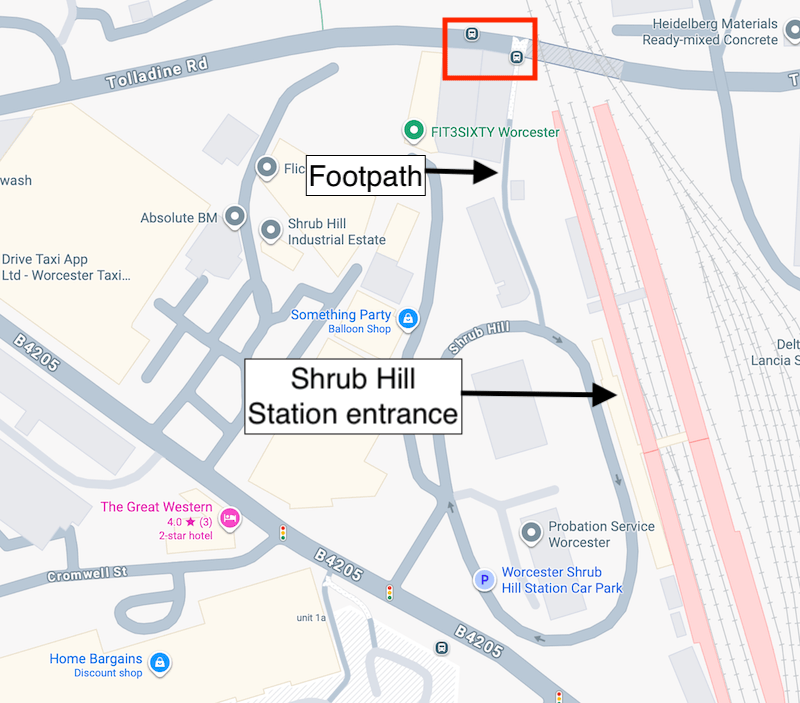
… there’s now no sign of a bus stop flag and I certainly wouldn’t risk waiting there again.
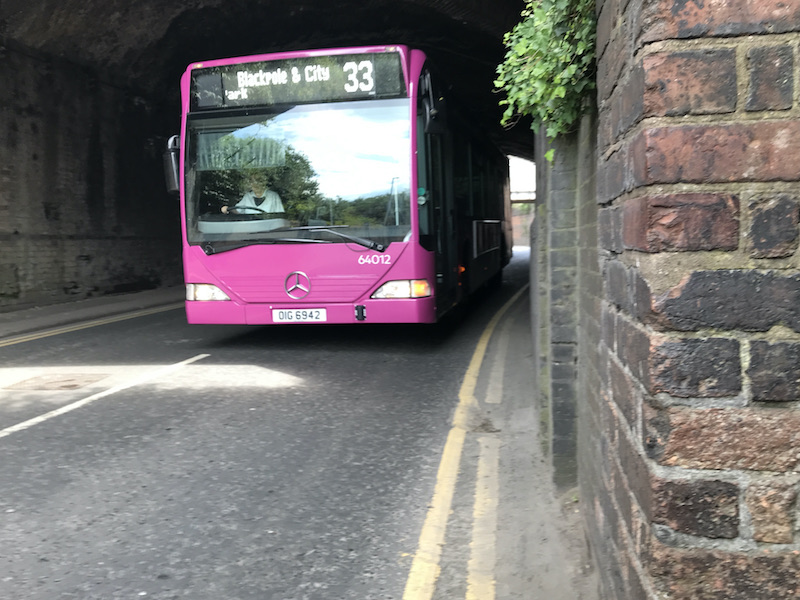
You’re literally waiting in the road on a blind bend…
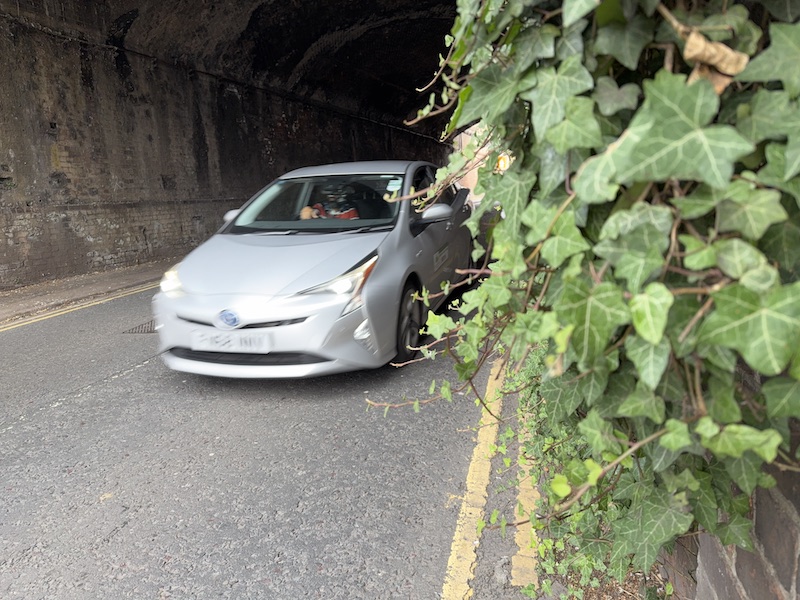
… at the bottom of some steps…
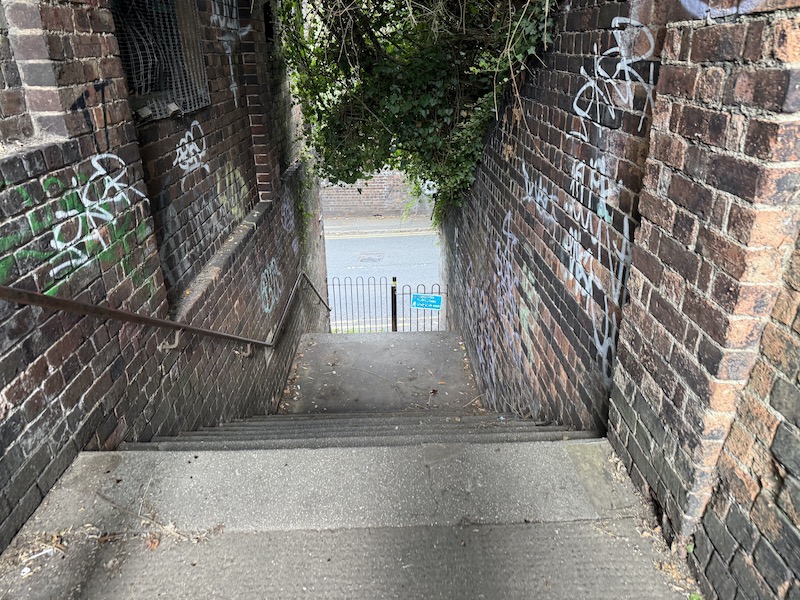
… at the end of the footpath from the station.
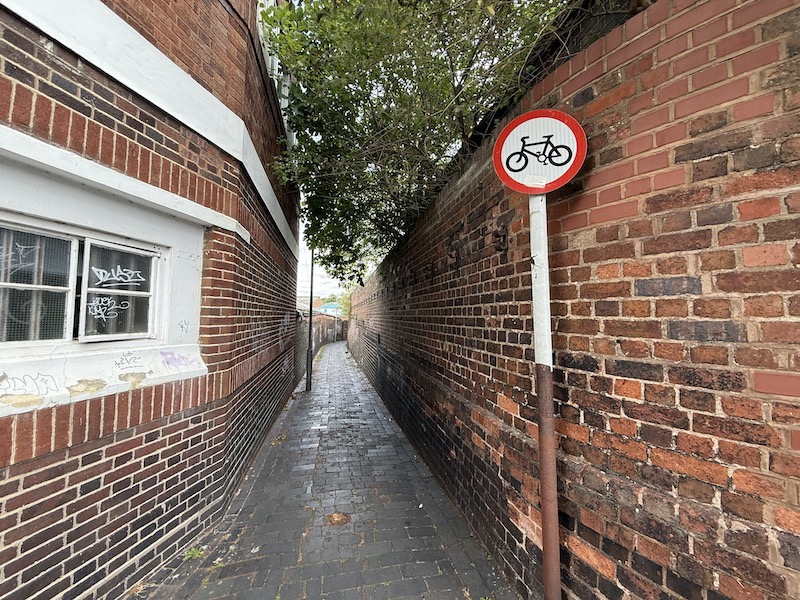
I see the ivy on the wall has grown in the last six years since I was last there, making it even harder for you to see the traffic coming and them to see you.
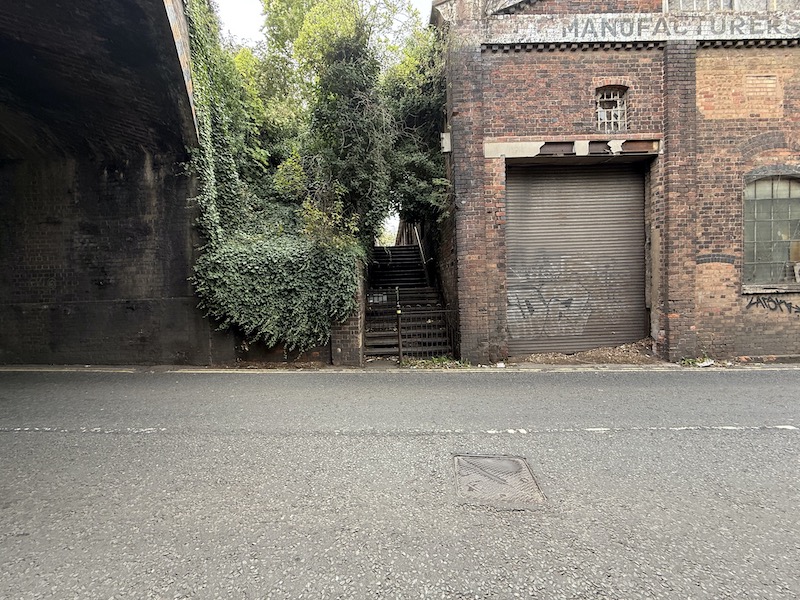
I’m not surprised it’s been discontinued.
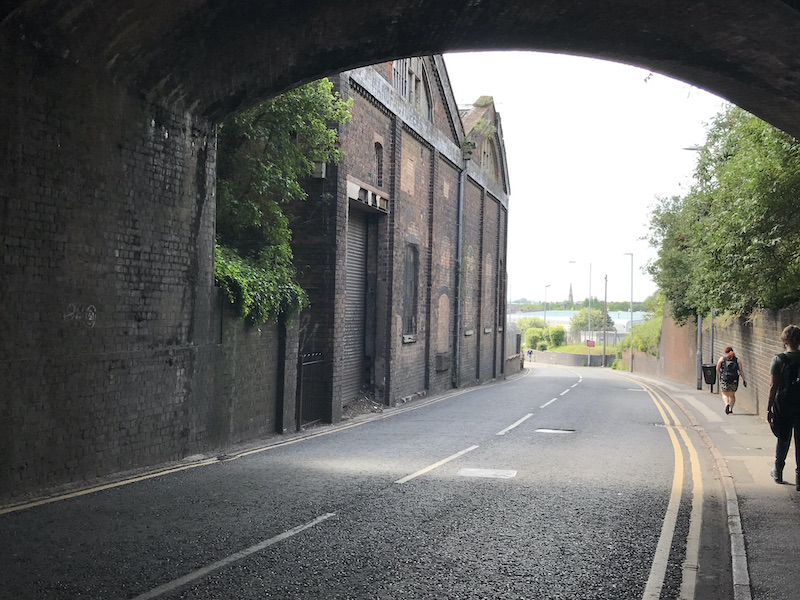
It would never pass a risk assessment these days.
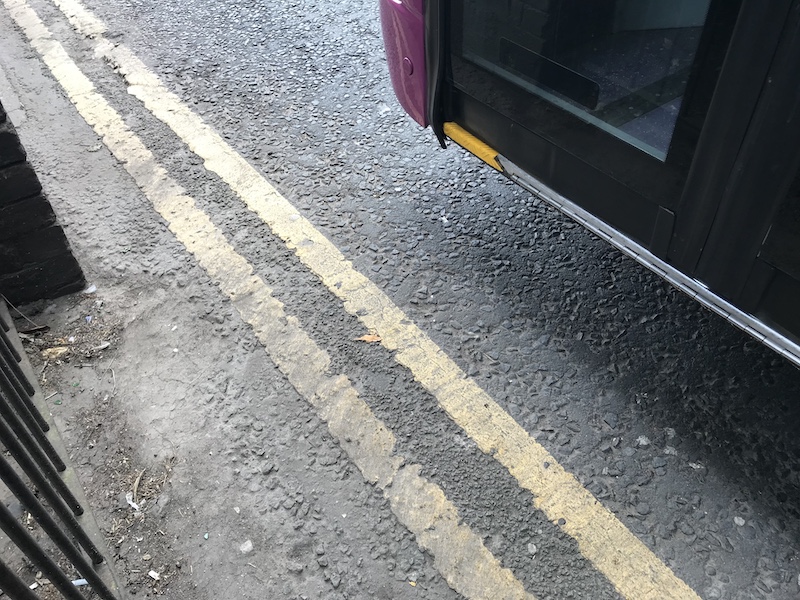
Back at Foregate Street there’s been another bus stop change as Iain tells me the northbound bus stop for the station used to be sited under the railway bridge providing ample shelter for waiting passengers and easy access to the station opposite…
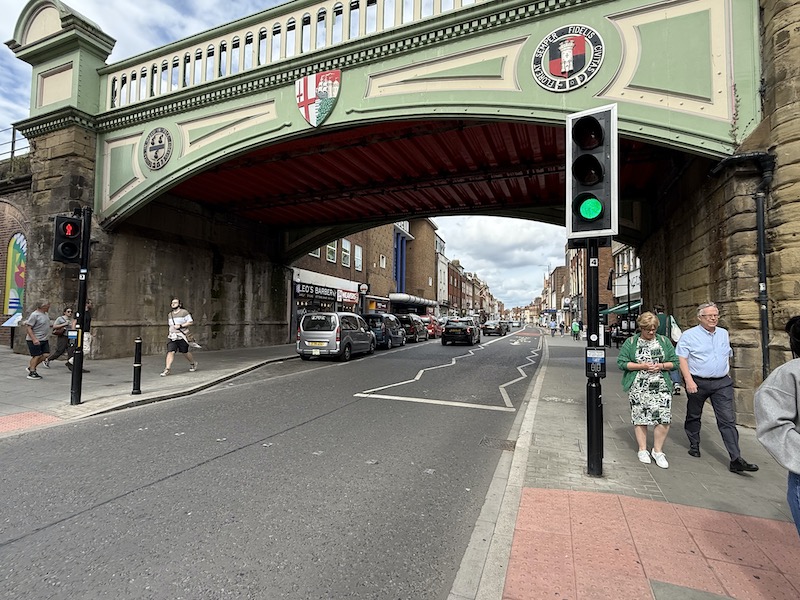
… but it’s now been resited further north beyond a taxi rank, where the old bus stop used to be, so has its own small bus shelter for passengers to wait in and a longer walk to and from the station.
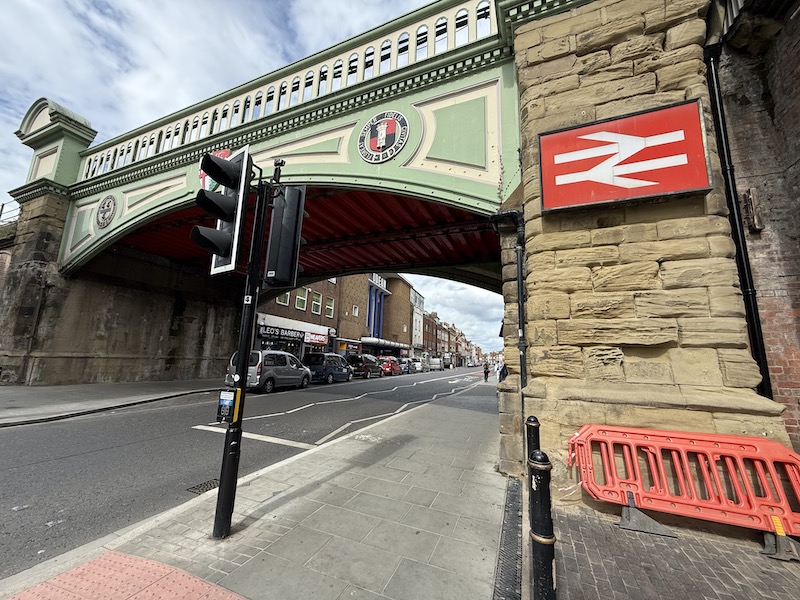
The station entrance/exit to Foregate Street is sited within the railway arches under the viaduct with a West Midlands Trains Travel Centre to greet you…
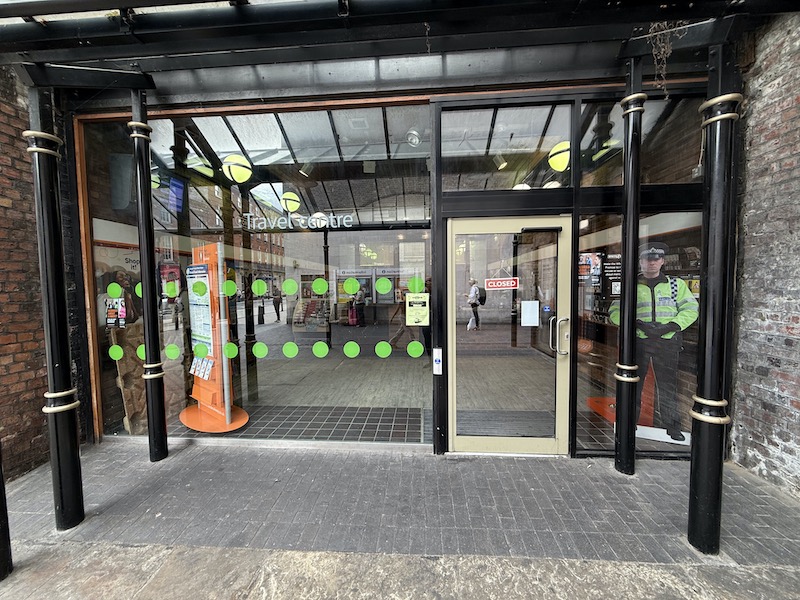
… except it was closed on Saturday when I visited, but good to see one of these rare facilities still available…
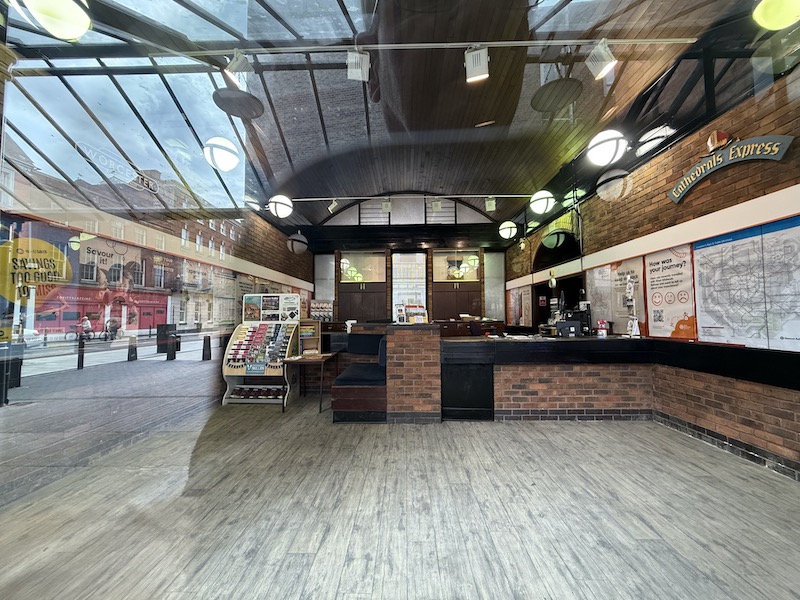
… and just beyond that as you enter the station…
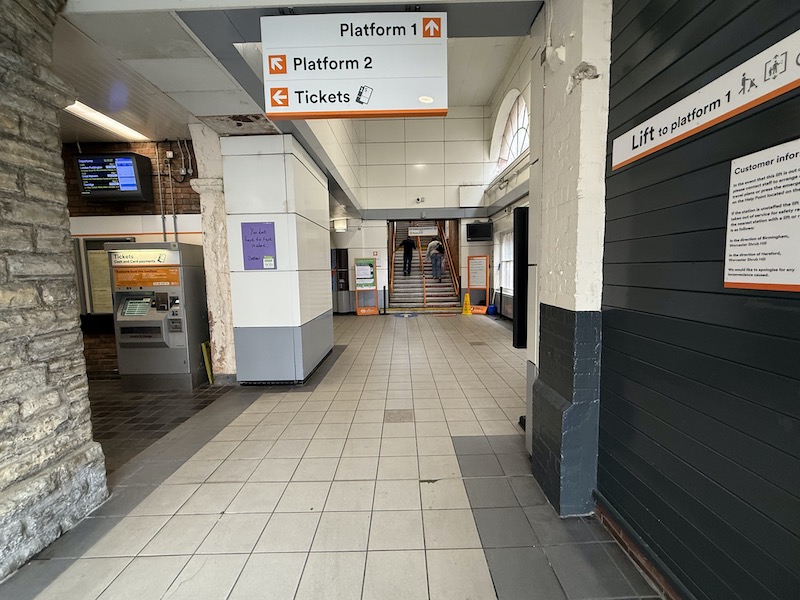
… on your left there are three ticket machines and a departure screen…
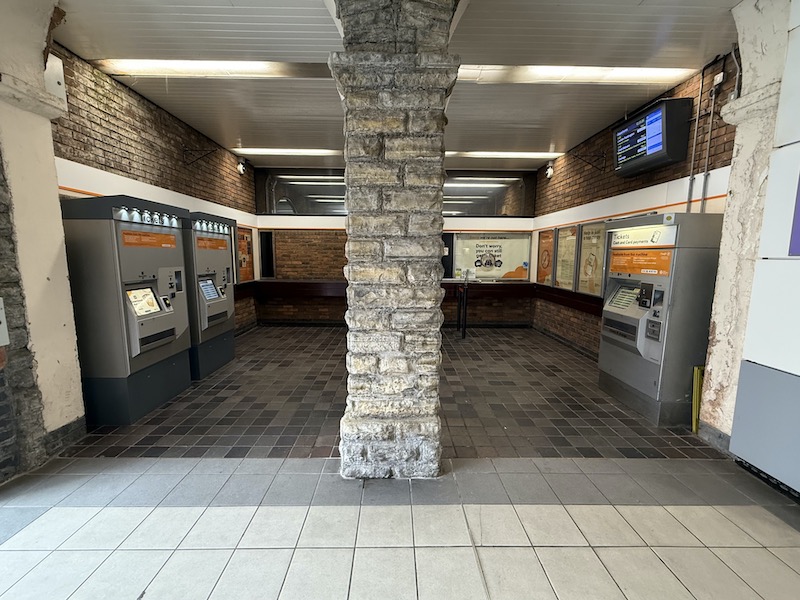
…and hidden behind that central pillar is a ticket office with two windows.
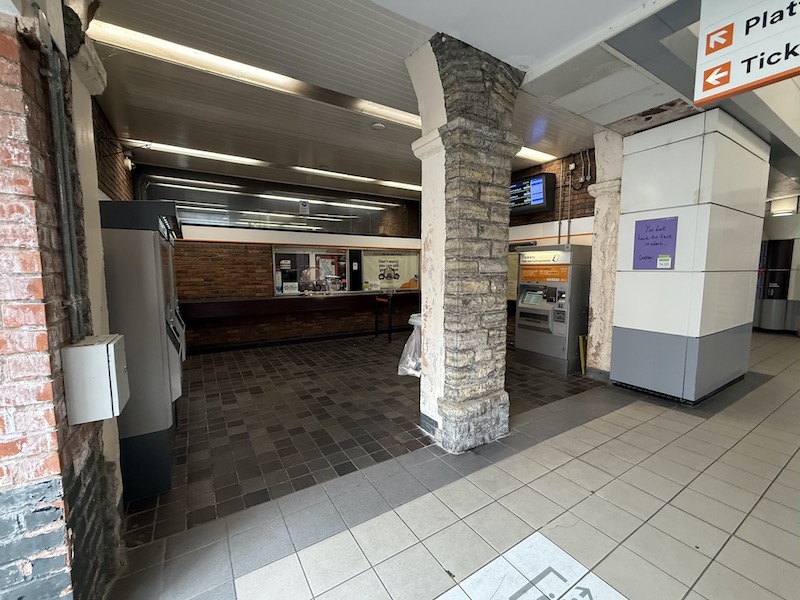
There’s then a subway which takes you under the tracks to access Platform 2…
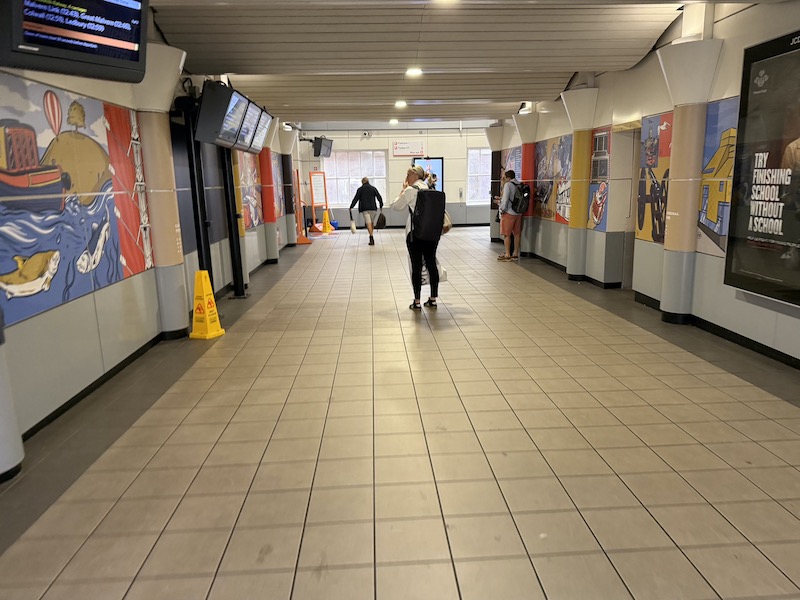
… which also has it’s own entrance/exit to and from Foregate Street outside.
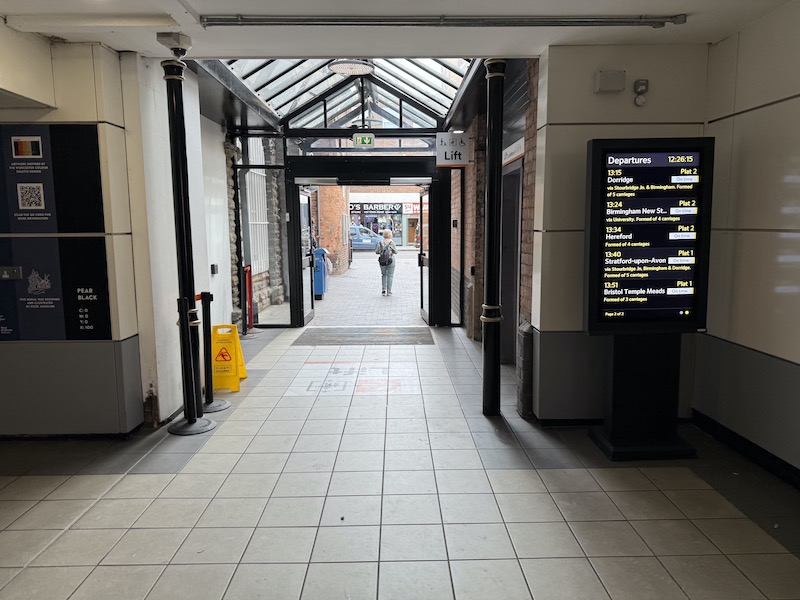
Alongside this entrance/exit one of the arches has been converted into a cycle store.
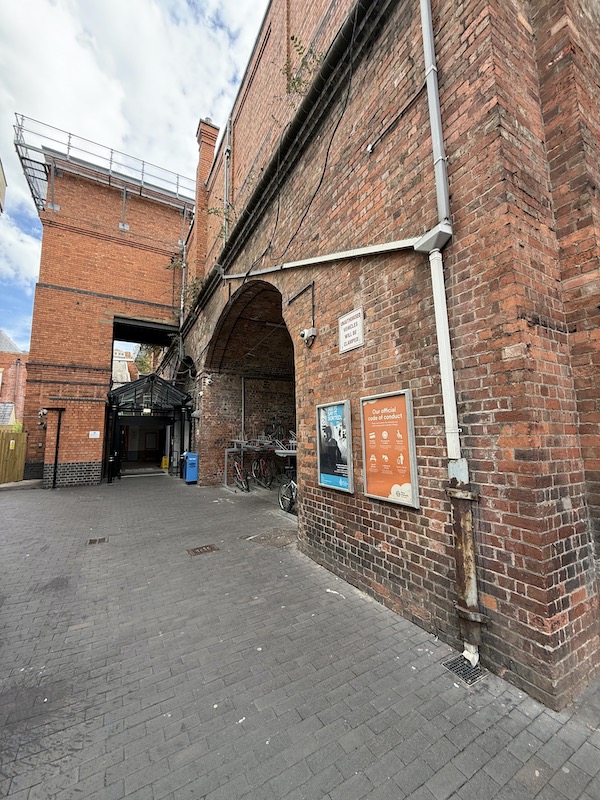
It’s a rather long climb up to platform level…
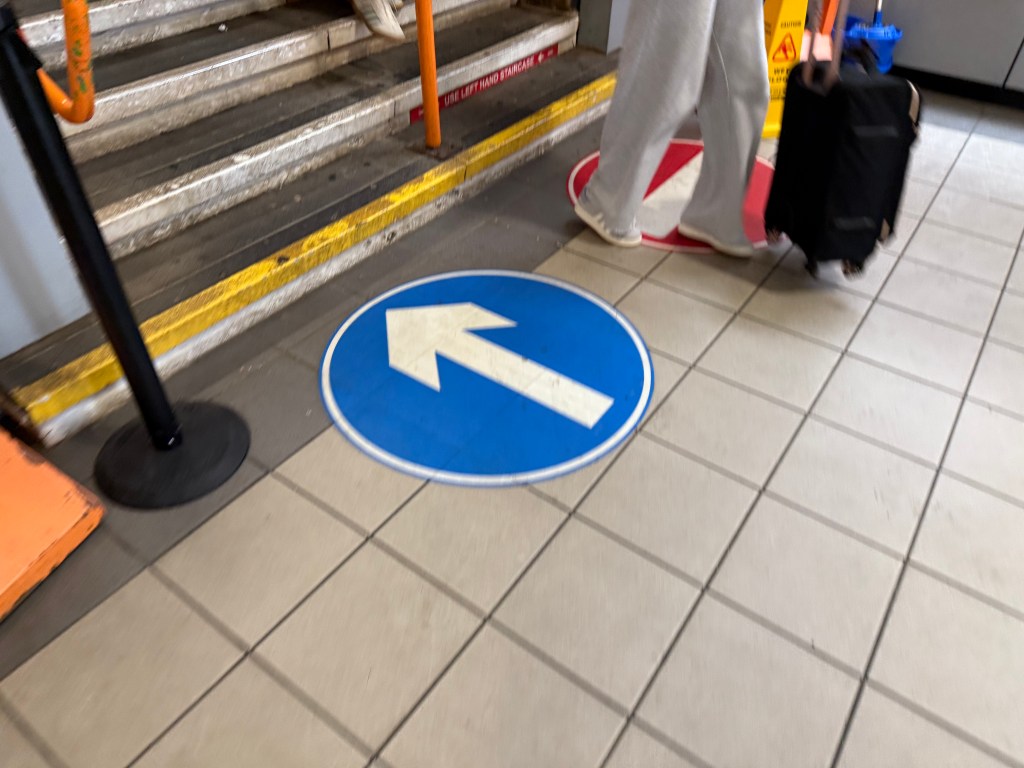
… but there are lifts to each platform…
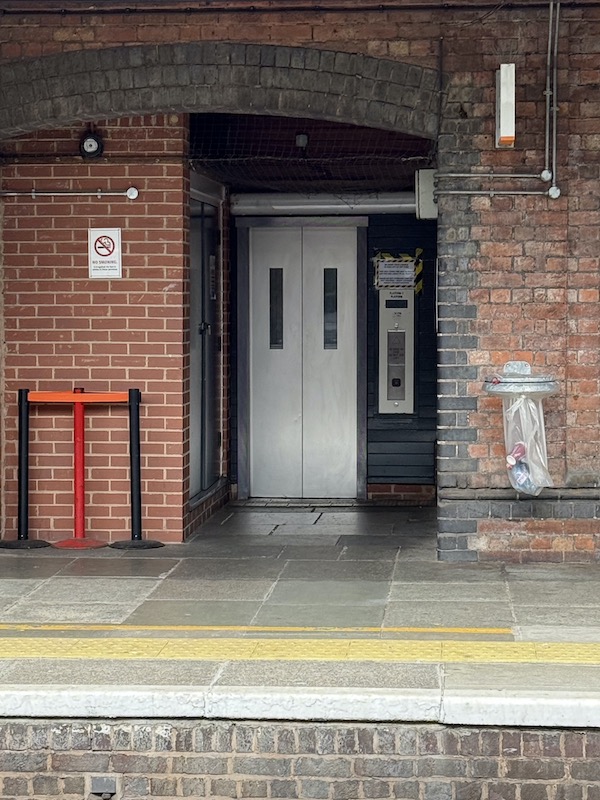
… for those with accessibility needs or just not up to climbing so many steps.
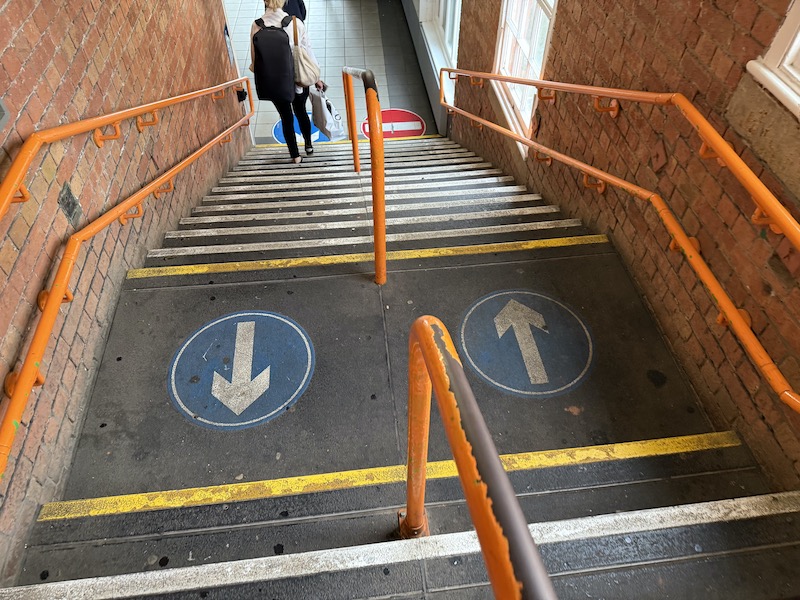
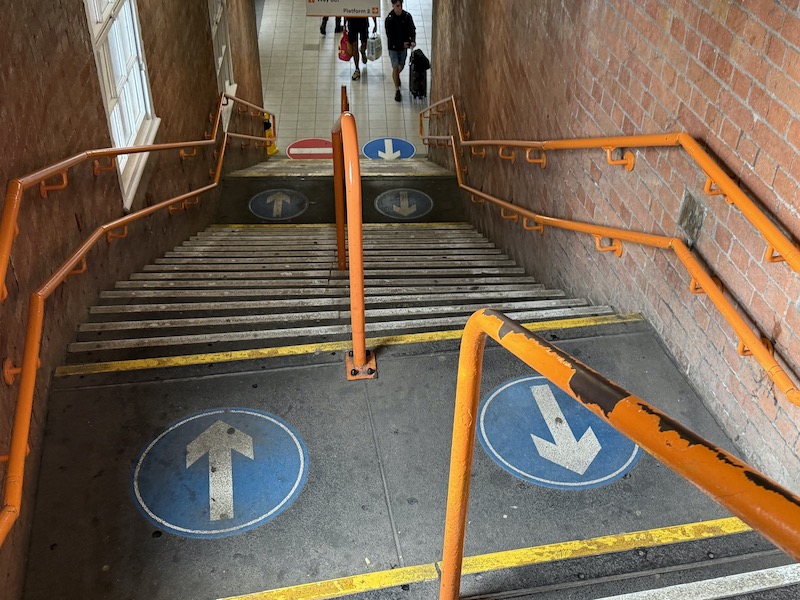
Oddly, the steps to Platform 2 are marked for passengers to use the right hand side to go down, whereas on Platform 1 it’s more the traditional British way of going down on the left hand side.
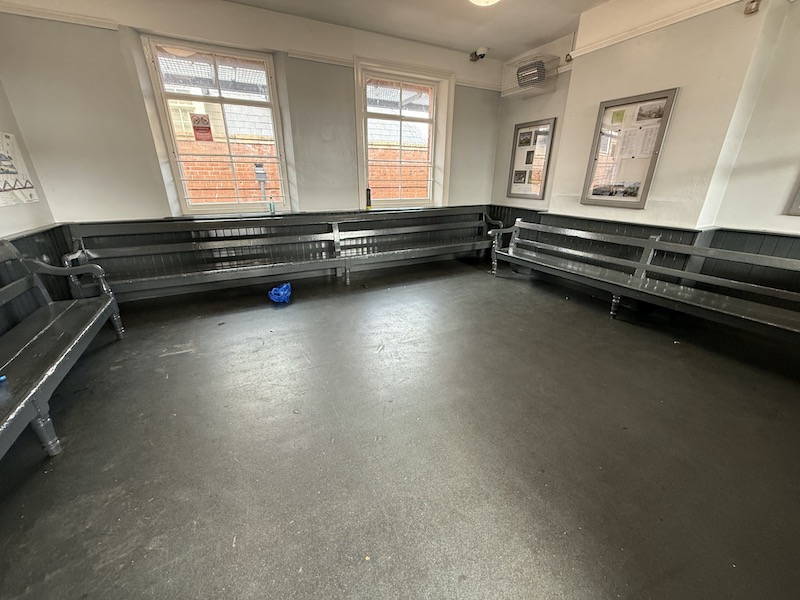
There’s a waiting room on Platform 2, albeit not in the same class as over at Shrub Hill…
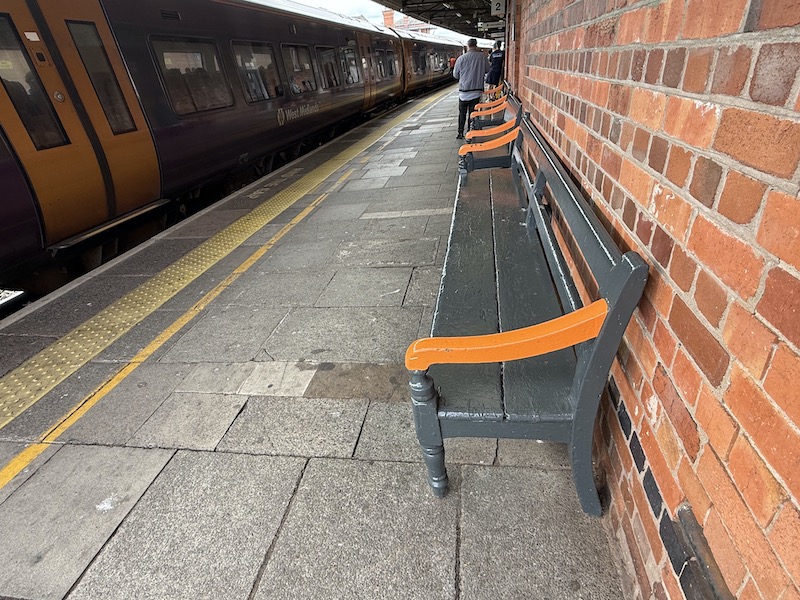
… but I rather liked the West Midlands Trains’ corporate colours as applied to the bench seats on the platform itself.
Platform 1 has a locked information point and toilets…
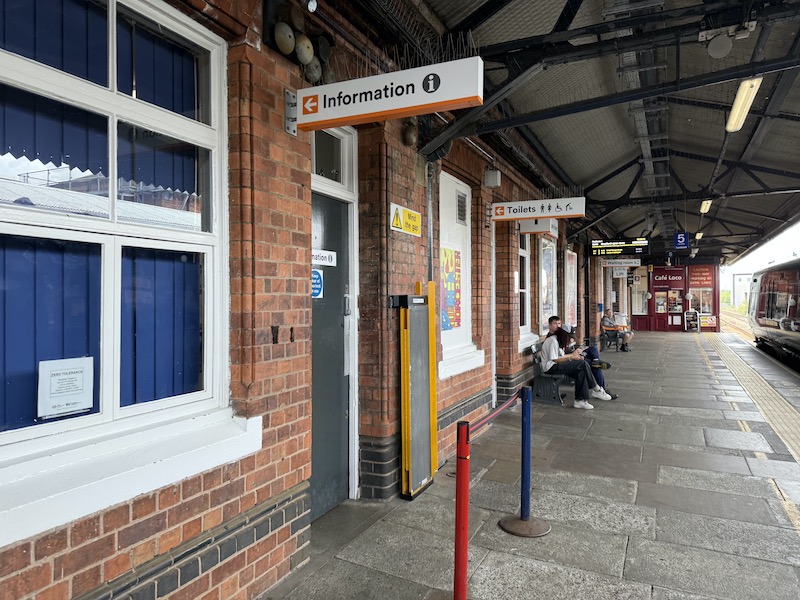
.. and a Café Loco…
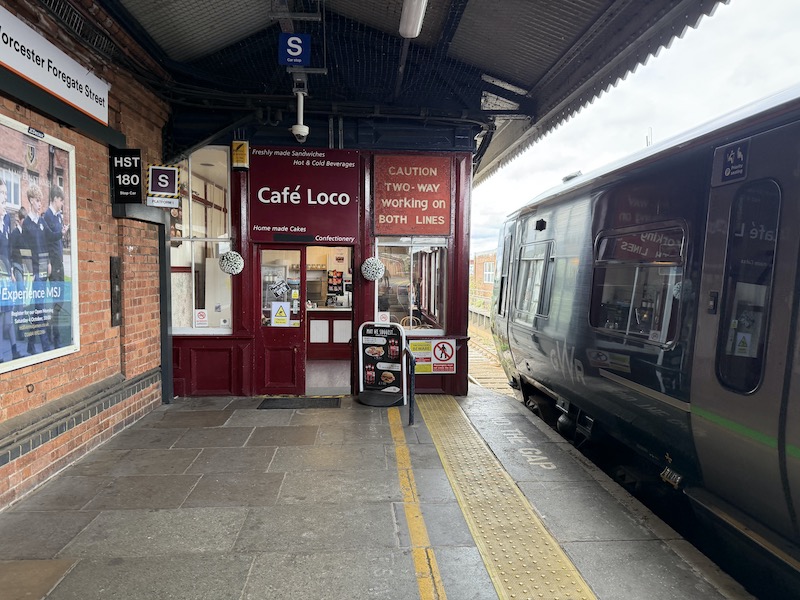
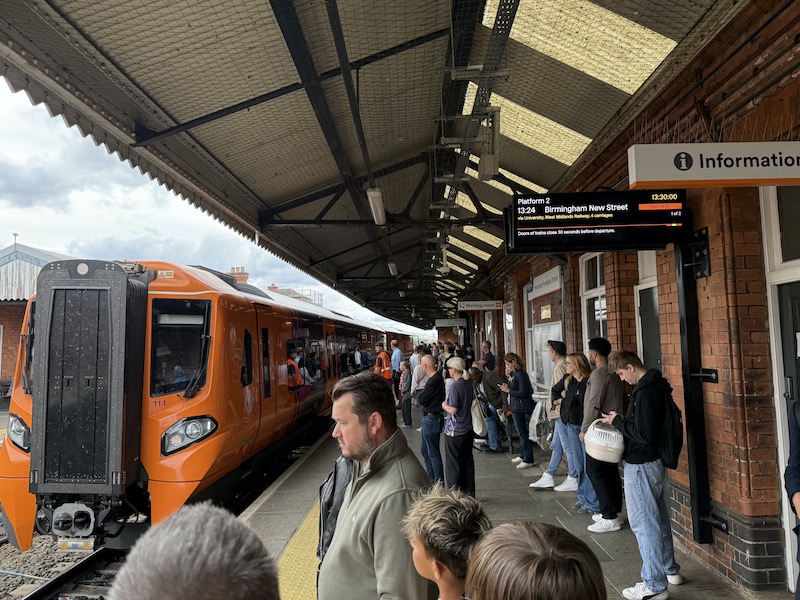
… which I would have thought would have greater footfall on Platform 2 which struck me as the busier of the two with West Midlands Trains’ departures direct to Droitwich Spa and Birmingham
Compared to Foregate Street, Shrub Hill is a much grander affair with a sweeping driveway up to the main entrance where taxis also wait for custom under a porte cochère structure.

The whole effect is lost somewhat by the brutal seventies office block built in front of the station together with a parking area.
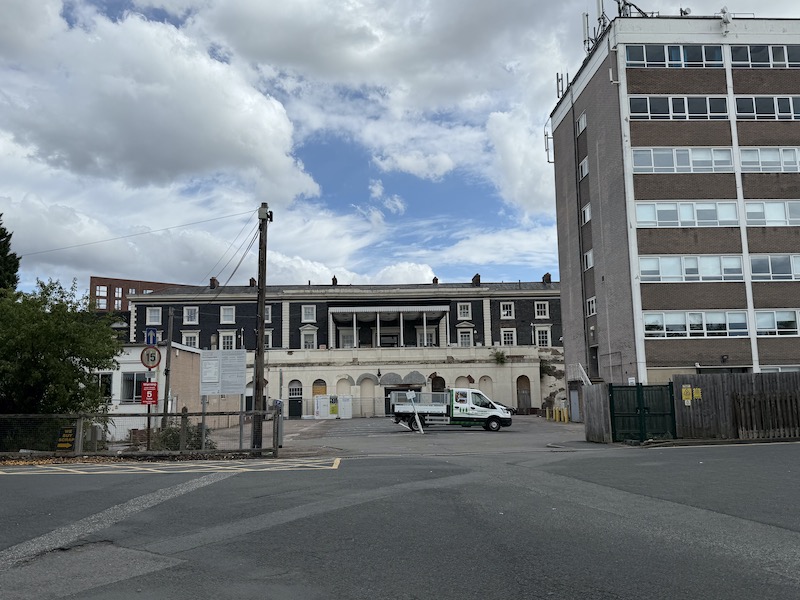
Stepping out from the exit under the porte cochère you get a splendid uninterrupted view of the office block and can imagine the city behind that.
Entering the building brings you to the ticket office with a ticket machine for when the office is closed (as it was when I visited) …
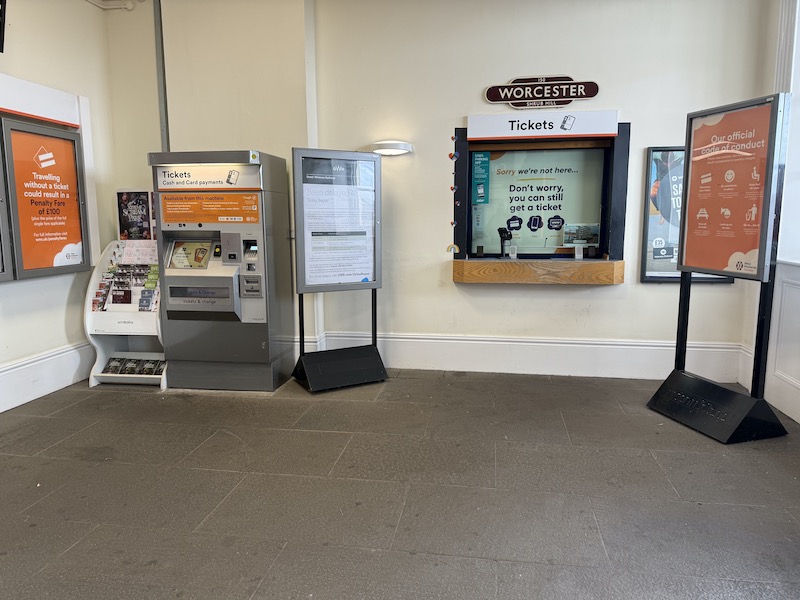
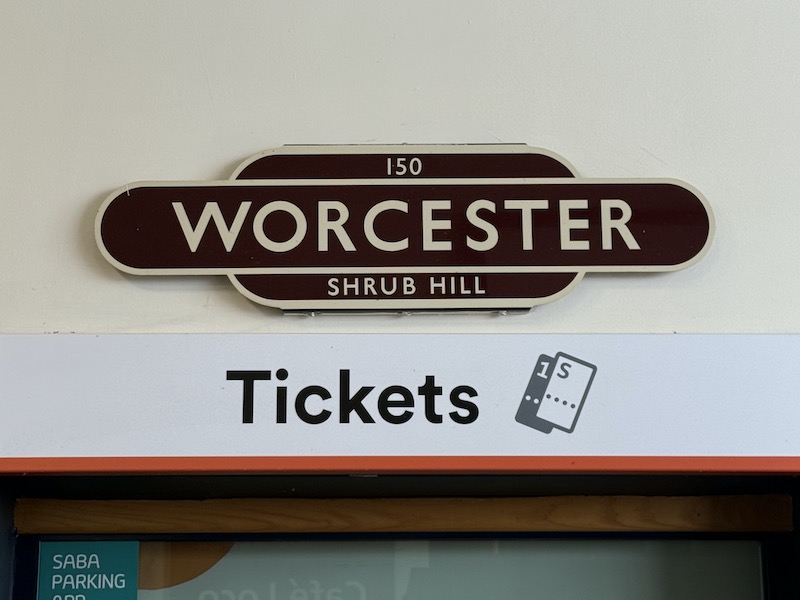
… but note the rather nice original sign above the window.
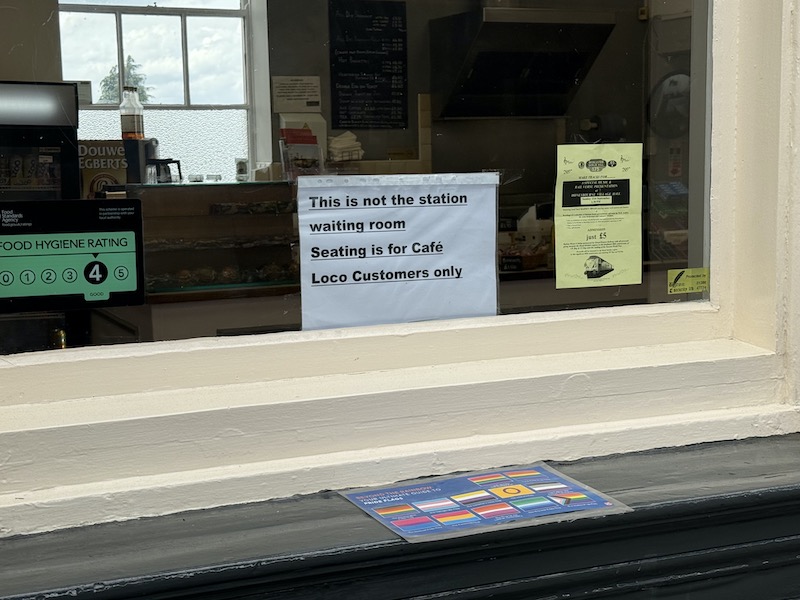
… and a waiting room the other side leading to another Café Loco…

… where you have to buy something if you want to use the seats in that room.
Outside on Platform 1 for fans of telephone boxes there’s a lovely restored K8 in situ…

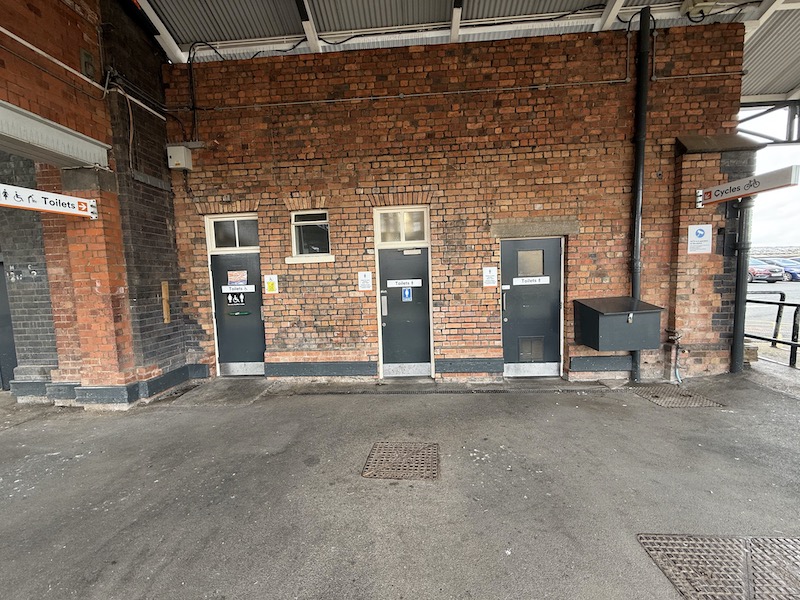
… as well as toilets…
… and a footbridge to take you over to Platform 2, but sadly there are no lifts so that platform, along with Platform 3 remain inaccessible for those unable to use stairs.
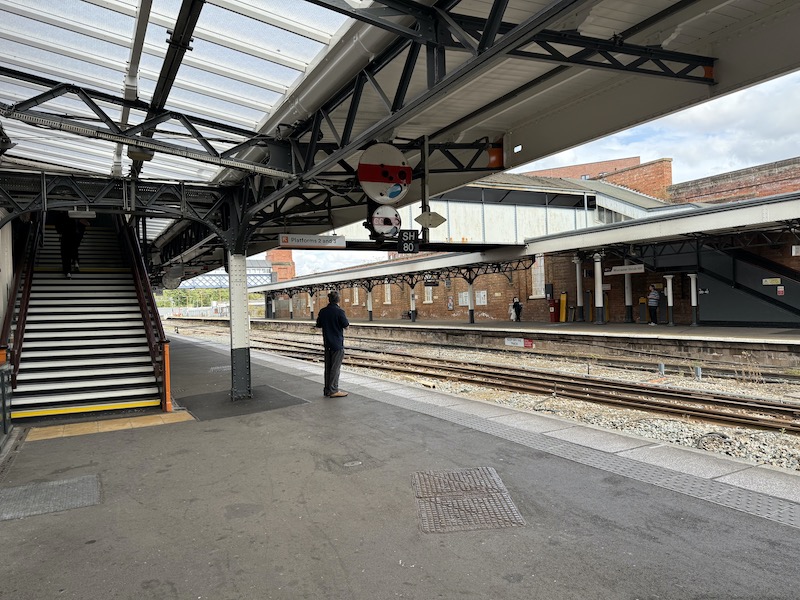
However, there is what looks like an old goods lift to a separate footbridge further north along the platforms.

Platform 3 is rarely, if ever used, and comprises a short stretch of track alongside some sidings at the southern end of Platform 2 – see the earlier Traksy diagram.
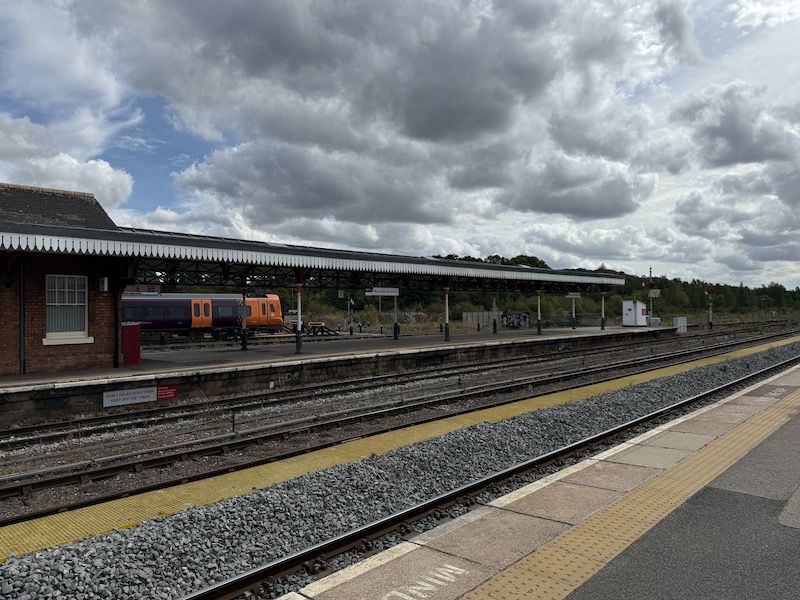
There’s also what looks like a south facing disused bay platform alongside Platform 1…
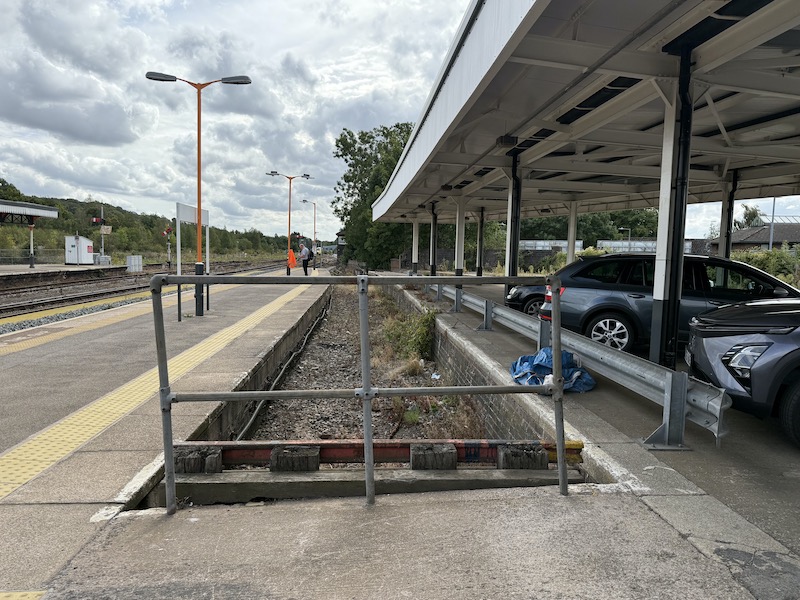
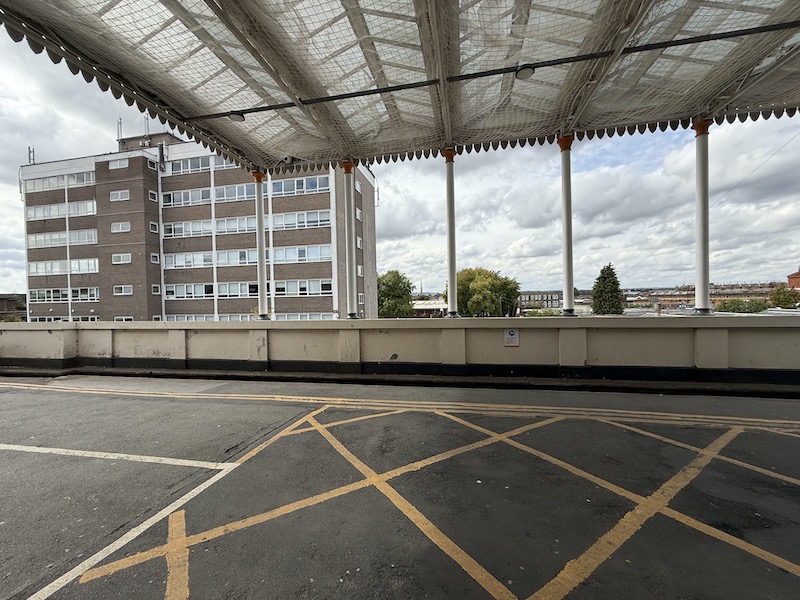
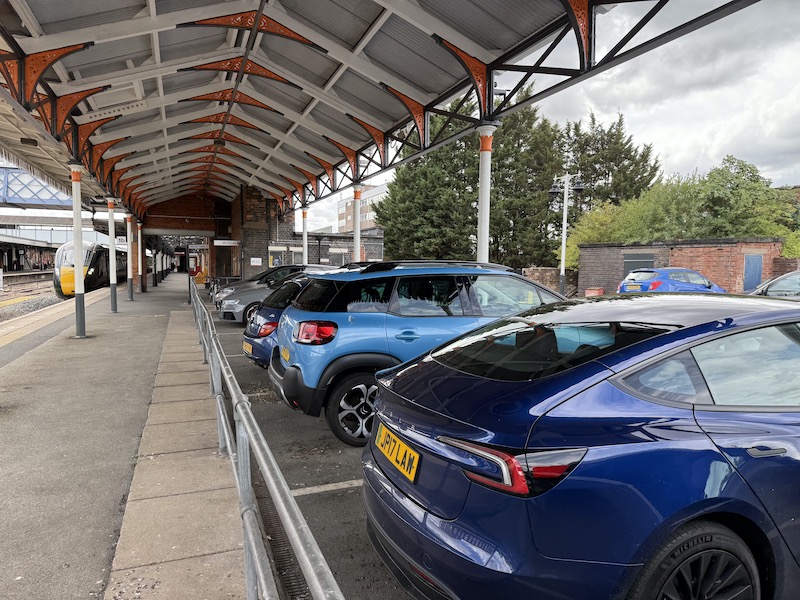
… and you can also see cars park right up to it, as they do at the northern end of Platform 1.
Shrub Hill arrived on the scene first, opening in October 1850 with Foregate Street ten years later in May 1860, but the upstart is by far the busier of the two on today’s railway seeing 1,748,000 passenger entries and exits in 2023/24 compared to Shrub Hill’s 527,000.
But there’s no doubt Shrub Hill wins hands down on character, although fails miserably on accessibility where Foregate Street triumphs with its lifts.
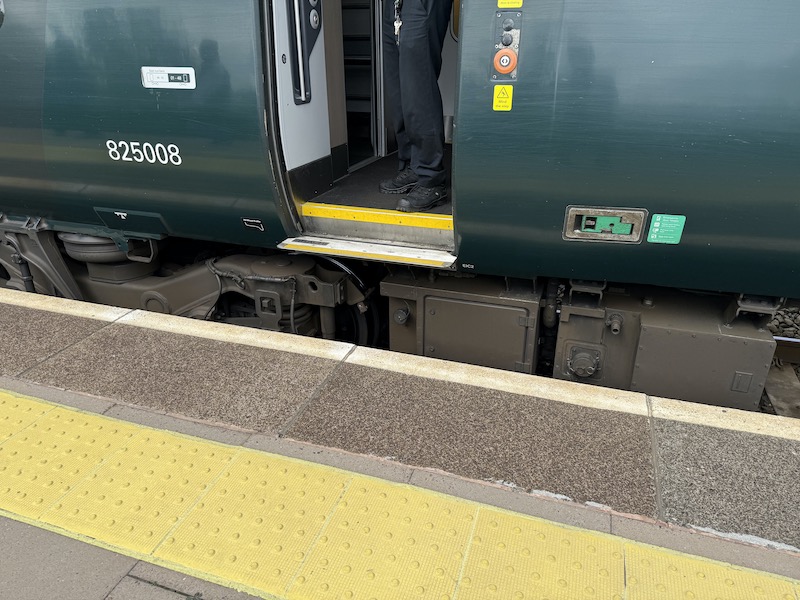
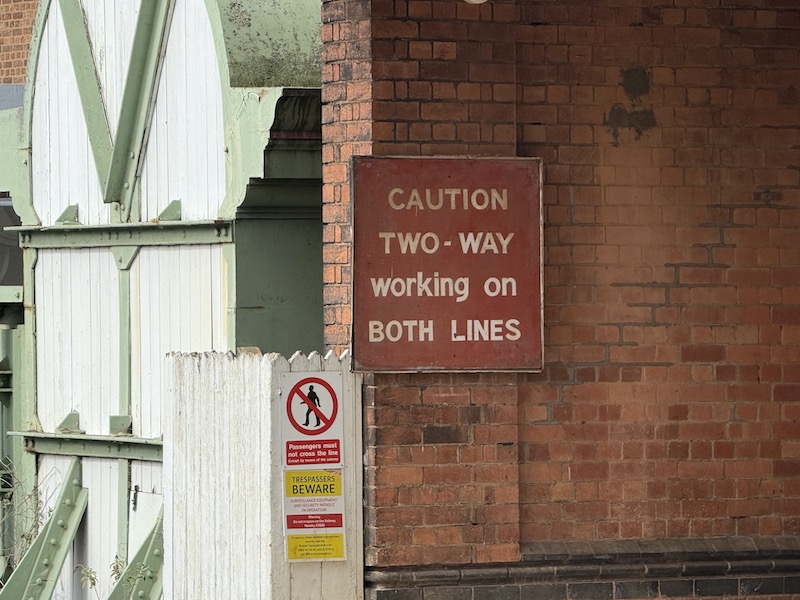
However, those who don’t like alighting or boarding trains with mega gaps between the platform and the train should avoid the eastern end of Platform 1 at Foregate Street where there’s one of the widest gaps I’ve ever seen.

Iain pointed out it could be even wider than the gap I highlighted at Gainsborough’s Lea Road which featured in last month’s blog on that station. Here it is again.
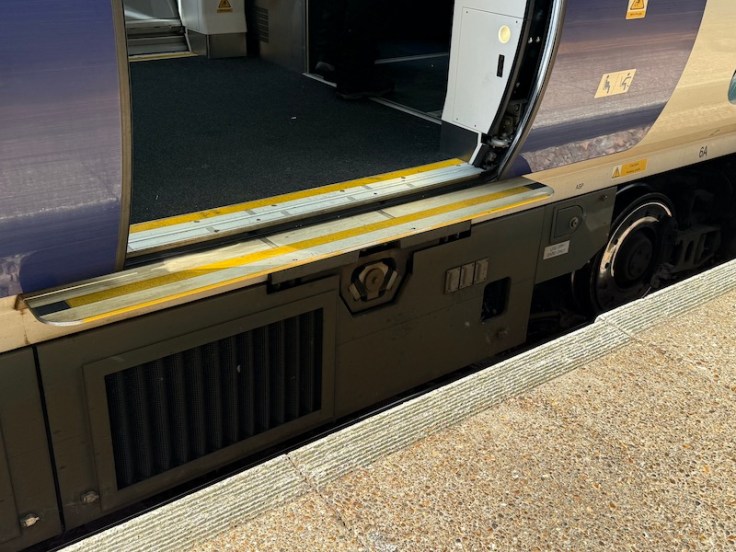
I reckon it’s a tie.
But also, at Foregate Street, make sure you’re in the front four coaches of a nine coach GWR train to be able to alight at all.
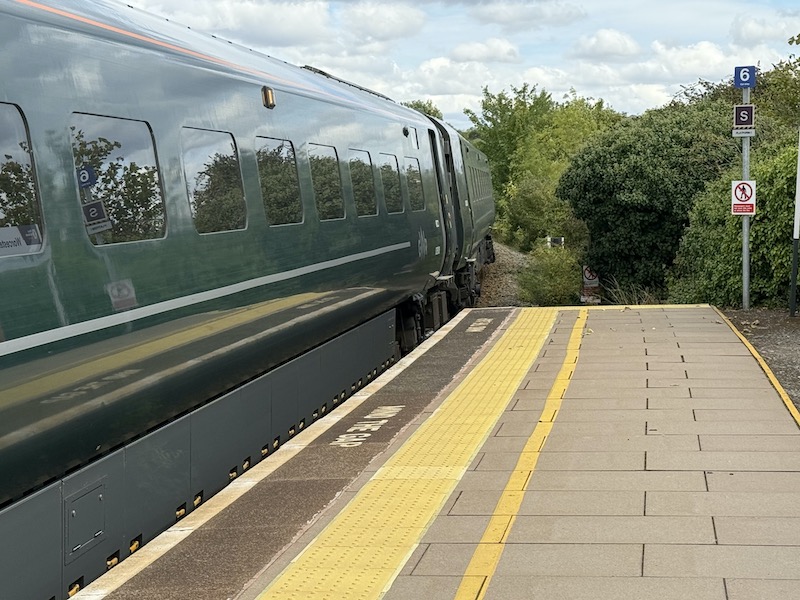
Thanks Iain, it’s been a pleasure to include these two stations and highlight their oddities and contrasts.
Roger French
Did you catch the 18 previous blogs in this series? 1: Hertford; 2: Canterbury. 3: Wigan, 4 Dorchester, 5 Windsor, 6 Wakefield, 7 Reddish, 8 Yeovil, 9 Newark-on-Trent, 10 New Mills, 11 Tyndrum, 12 St Albans, 13 Falkirk, 14 Catford, 15 Helensburgh, 16 Gainsborough, 17 Edenbridge, 18 Bicester.
Blogging timetable: 06:00 TThS
 BusAndTrainUser
Its mad that trains at Foregate Street can only use P1 to Droitwich & beyond, & P2 to Shrub Hill & beyond, as looking on google earth, a crossover can easily be errected by Network Rail, as its a good 500 meters from Foregate Street to where the lines diverge to either Droitwich & Shrub Hill.
SM
LikeLiked by 1 person
A crossover cannot “easily be erected” because it would require the area to be completely resignalled to do so. The Worcester area is still signalled under absolute block principles and Foregate Street is in the unsignalled block section between Henwick signal box to the west and both Shrub Hill and Tunnel Junction boxes to the east.
As another commenter has noted, there used to be such a crossover (and associated signal box) but it was removed by BR during one of its regular periods of removing infrastructure to cut maintenance costs.
It’s possible (although unlikely) that such a crossover could be reinserted when the Worcester area is eventually resignalled but, given that Network Rail is under major pressure to cut costs and the national resignalling programme seems to have almost stalled, who knows when that might be?
LikeLike
As a fairly regular user of Foregate Street for many years, I had never realised before the track layout caused such limitations and now realise why you never see a GWR train on platform 2! It has always crossed my mind that the platform numbering seems the wrong way round and now I know why!
They certainly are very different stations, and Shrub Hill always looks as if straight out of a “Thomas the Tank Engine” book, with vastly more staff than passengers seen moving about the station. The only busy times I have ever seen is during Sunday engineering work with hordes of people getting entangled on those stairs having to switch trains!
Terence Uden
LikeLiked by 2 people
When I started work in Worcester in 1986 I made a special trip to Shrub Hill to photograph those semaphores before their “imminent” removal.
Nice to see they are still there!
Jim Davies
LikeLiked by 1 person
Station Steps stop is very much still in use!
LikeLike
Thanks for that.
LikeLike
First Midland Red Red Buses Limited Service 34 that does a loop around Warndon uses Station Steps bus stop on roughly on a half hourly frequency.
Midland Red & its sucessors were notorious for having bus stops in very dangerous places to board & unload.
Following risk assessments by TfWM all these stops are mainly gone in the Black Country although one remains in the middle of a pelican crossing in Kingswinford.
In Worcestershire many remain including one at the popular garden centre Webbs in Hagley on the 192 where you literally stand on the top of bank in front of a ditch to board towards Kidderminster while opposite your standing directly in the road on A456 towards Halesowen.
LikeLike
I don’t know Worcester very well, but – from the bus network and timetable – I imagine that particular stop is mainly used by passengers from the estates along Tolladine road wanting to get to Shrub Hill station. As almost all trains calling at Shrub Hill also call at Foregate Street, few passengers will need a bus to get to the City centre, and there is the slightly more convenient stop in Shrub Hill Road, also with three buses per hour to the bus station.
LikeLike
I reckon the difference in up and down directions on the steps at Foregate Street is to funnel those from the platform uninterrupted to the nearest exit, leaving the other side for those arriving from the ticket issuing facilities.
A further restraint that used to exist at Foregate Street, but I think they have sorted, was that trains terminating from the East had to leave the station to Henwick, then return again, presumably to clear the section.
LikeLike
That was changed back in the 1990s, although I have a memory that (at least initially) it was only for trains arriving in platform 2 from Tunnel Junction.
LikeLike
Thanks for that. Was brought up in Worcester but haven’t been since my parents left in 2006. Foregate Street is looking much better now and is the better used of the two I see. We used to use station steps as small children late at night as my parents preferred that route home in the dark!
One small issue you have put trakys rather than traksy in your link to the map. On that topic Traksy is created by someone born in Worcester which is why they were the first non train describer maps on the site.
LikeLike
Thanks – Traksy now corrected.
LikeLike
Thanks for this one. We lived in Droitwich for 30-odd years until 2018 so Worcester stations were familiar to us & often used on various travels. Not much seems to have changed since I was last there. Good to see Cafe Loco still going strong! Longed for Worcestershire Parkway to open *before* my retirement in 2015 but alas…
LikeLiked by 1 person
A tip for those from the South-East. The Worcester stations are the at the northwestern extremity of the Network Railcard area. Good for split ticket savings if you are heading for Great Malvern or Hereford. Although I’d done exactly that in my pre Senior Railcard days, I only actually visited the city properly, including both stations, 18 months ago.
Stuart S
LikeLiked by 1 person
That is very true. I have a Network South East card, live in the Oxford area, and definitely the trips I make for leisure are often within the Network Card area, due to the 1/3 reduction. Will Great British Railways offer something like a UK-wide railcard I wonder? (CH, Oxford)
LikeLike
This may be of interest to you, Roger. This is a service I have used to and from Charmouth when
LikeLike
Those platform arrangements at Foregate Street certainly caught me out when I had to change trains there a few years ago! Thinking that “trains keep left”, I was puzzled to see no mention of my ongoing service on the departure indicator. It was only when a train came in one of the platforms in the “wrong” direction that I realised my mistake.
LikeLike
Did What I think is Shrub Hill have another platform originally?
Surely they did not build a canopy to park cars under
LikeLike
Yes, it did. And it also had an overall roof; see this detailed map from 1926:
https://maps.nls.uk/geo/explore/#zoom=17.0&lat=52.19541&lon=-2.20912&layers=168&b=ESRIWorld&o=100
LikeLike
Incidentally, that map also just predates the closing of Worcester’s tram network and replacement by Midland ‘Red’ buses in 1928, so shows the tram network (including single track sections with passing loops) as well as some of Worcester’s extensive railway sidings.
If you look west of Shrub Hill station to Worcester Vinegar Works and Pheasant Street running along its eastern edge, a close look will identify “S.P.” where the railway crosses the road. That’s Worcester’s possibly unique four-sided semaphore signal fitted to stop road traffic for a train to shunt into the vinegar works, which is sadly less famous than the standard sempahores used at the Shrub Hill Road crossing.
(Should be centred in this link if I’ve got it right: https://maps.nls.uk/geo/explore/#zoom=18.0&lat=52.19364&lon=-2.21547&layers=168&b=ESRIWorld&o=100)
LikeLike
Thanks for that link. A reminder of what a great resource the National Library of Scotland is for those who live old maps.
LikeLike
I note that Cafe Loco, in addition to excluding fare-paying passengers, only has a “4” Hygiene Rating…!
LikeLike
A 4 generally just means the paperwork isn’t being kept up properly from what I’ve read elsewhere. It’s not unusual for big chains to have a 4 rather than a 5.
The time to worry is when a long-established business doesn’t display the sign at all, as that usually means they’ve got an embarrassingly low score of 1 or 2 like the dodgiest short-lived kebab shops have!
LikeLike
From a professional point of view if a business isn’t it taking care properly of its paperwork; a vital requirement for HMRC; then what else is it not taking care of ?
LikeLike
From what I’ve read it’s purely the storage records. I doubt that HMRC really care about such things.
4 is not a bad hygiene rating; it’s officially “good”. As in good but not the outstanding of 5, in OFSTED speak. Or the difference between a bus company that does everything right legally (Diamond or NXWM or Arriva) and one that wins national prizes for going beyond that (Nottingham City Transport or Trentbarton, for example).
LikeLike
Diamond Bus West Midlands was voted Employer Of The Year at an awards ceremony held in Worcestershire last week by its peers.
This underlines the premium quality operation Rotala operates with Diamond Bus West Midlands.
LikeLike
I knew you’d bite!
I wasn’t originally going to include Diamond in my comment, but I couldn’t resist temptation.
LikeLike
Are we talking about the Redditch Business Awards judged on information submitted by a nominator and the business themselves, or an industry awards scheme judged and voted for by passengers and/or people from within the bus industry?
LikeLike
https://www.diamondbuses.com/news/redditch-business-awards-winners/
LikeLike
Bearing in mind GO AHEAD cannot do anything wrong in the eyes of many contributors on this excellent blog.
Its an interesting to see after recent vertical integration that GO AHEAD EAST has been offloaded.
Mind you GO AHEAD has form on these u turns bearing in mind they cheated the UK taxpayer out of £25m in its rail franchise & wrote of £8m on its Balance Sheet when they failed to make a success of Diamond Bus West Midlands .
Oddly enough given the hypocritical nature of GO AHEAD I have come home from work on Diamond Bus West Midlands; now a very sucessfull operator under different ownership which wasn’t the case under GO AHEAD…….
LikeLike
f they have 1 or 2 you would think they would have to close until bought up to standard
LikeLike
It’s actually a 3 at both stations according to the food.gov.uk website
Foregate – https://ratings.food.gov.uk/business/1603279/cafe-loco-at-foregate-street-station
Shrub Hill – https://ratings.food.gov.uk/business/1595294/cafe-loco-worcester
LikeLike
Are we talking about the Redditch Business Awards judged on information submitted by a nominator and the business themselves, or an industry awards scheme judged and voted for by passengers and/or people from within the bus industry?
Looks like the former …
LikeLike
Apart from the oddities of the inter-station connectivuty, what is crazy is that the major city of Worcester was bypassed by the main Birmingham- Bristol route. Different railway companies existed, but surely Worcester was at least as important as Cheltenham. It’s akin to Burton or Chesterfield being avoided on the other side of Birmingham, which of course they weren’t.
LikeLike
From my knowledge Worcester was omitted from the main rail line by the Birmingham & Gloucester Railway when built originally because of its River Links on the River Severn down to Gloucester and Bristol & up to Ironbridge & the cut served Brum & The Black Country from Diglis Basin.
In essence the majority of freight was transported on either the river or the cut hence the felling by B&GR that it was already served enough without rail.
LikeLike
Foregate Street used to have a conventional two-track layout for the first 100 years or so. The current arrangements date from the 1970s, I think, when the junction signalbox at the western point of the triangle was removed, along with the points and diamond crossing. The resulting single-track block section(s) were extended through to Henwick, where the mechanical signalbox had to remain because it also controlled a level crossing.
LikeLike
Not quite correct, I’m afraid.
The multi-arm signal on the left reads from platform 1 to (left to right) Foregate Street, sidings and Droitwich; the single signal reading from platform two has a mechanical indicator reading H’FORD towards Foregate Street and B’HAM towards Droitwich.
Trains from Birmingham towards Hereford via Shrub Hill would arrive at and reverse in platform 2, a manoeuvre I made many times when working in that part of the world.
LikeLike
Oh, and…
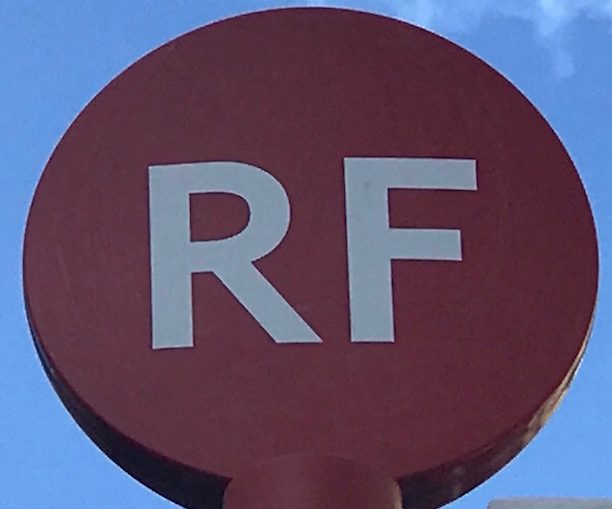
Sorry, Roger, but that’s absolutely not an original totem. The 150 at the top of the sign is because it’s to commemorate the 150th anniversary of the station.
LikeLike
Superb report and pictures. Love the historic railway crests on the pictured bridge. Worcester is a fantastic city I last visited on 20/21 July 1978. This was one of my “cathedrals” motorcycle tours. I was aboard UGF666R, my first Honda CD175 still on L-Plates. Despite living in Hersham in Surrey the 20th of July saw me on route from a friend’s flat in Peterborough seeking out cathedrals to visit so between Peterborough and Worcester I visited the cathedrals at Leicester and Lichfield. Needing to avoid motorways I got through Birmingham so easily as though I lived in the area. I used “The Star” hotel in Worcester yet after getting a room I was denied access to the cathedral late afternoon as a school’s valedictory service was taking place. I went back to my room and fell asleep in a chair with my road atlas on my lap. I was exhausted as I had driven a very long way on a light motorcycle against a weather front. NOT wind but an enormous body of air being driven eastwards as I made my way during 20 July 1978.
LikeLike
Good to see a K8 in such good nick!
LikeLike
There was another station at Henwick that closed in 1965
LikeLike
I hope that Bromborough on the Wirral is covered as it has 2 stations
LikeLike
I doubt it will be, as they are both only served by the same trains.
LikeLike
GoAhead East Sold
LikeLike