
Saturday 5th July 2025
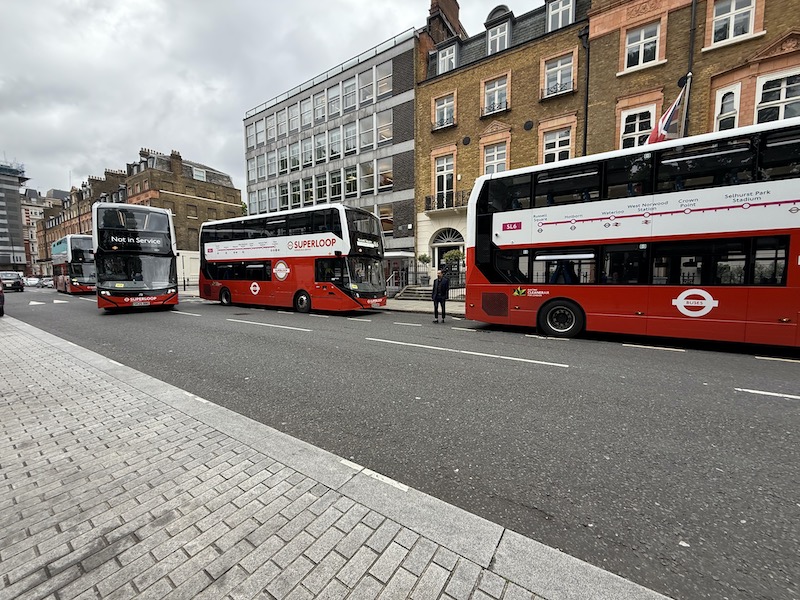
As TfL’s Superloop brand becomes ever more nonsensical with more routes planned that are questionably ‘super’ and are certainly nothing about being part of a ‘loop’, I took a ride on one of the longest standing and original non-loop routes to be added to the brand – the SL6, renumbered from its more user friendly X68 back in July 2023.
Ironically route X68 began on Britain’s Bus Deregulation Day, 26th October 1986, except it was nothing to do with deregulation as that only applied outside London, and in fact being a Monday to Friday peak hours only route, its first day was actually Monday 27th. But, it’s a nice coincidence that while the rest of the country was getting used to a fledgling bus regime featuring crew operated Routemasters, floods of frequent minibuses, whacky brand names and many other initiatives to launch a new commercialised era, in the Capital, London Regional Transport was introducing its own innovative service – a limited stop version of the long standing route 68 aimed at commuters and to run between West Croydon and Russell Square.

Thanks to the wonderful londonbuses.co.uk website we can see the route has very much stayed the same for its almost 40 year life having initially nine journeys running every 20 minutes taking six buses…
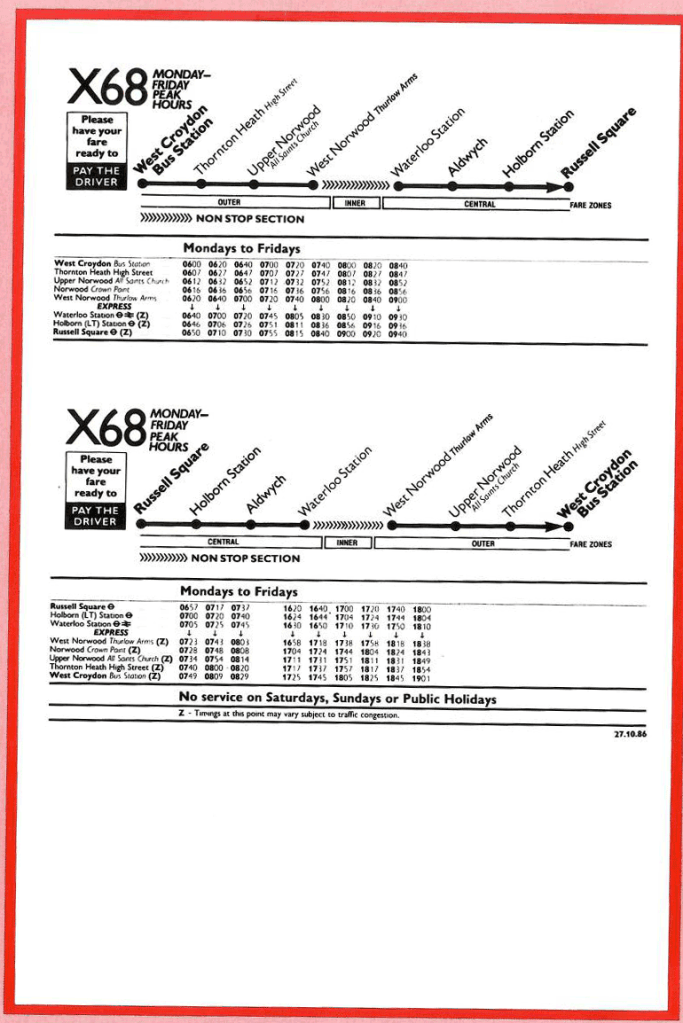
… compared to today’s 12 journey timetable (around every 15 minutes) taking 10 buses. The two buses operating the first two journeys from West Croydon at 05:50 and 06:05 run out of service on arrival at Russell Square and dart back to West Croydon to operate the last two journeys at 08:12 and 08:30. The other eight buses just do the one journey with the reverse arrangement applying in the evening peak.
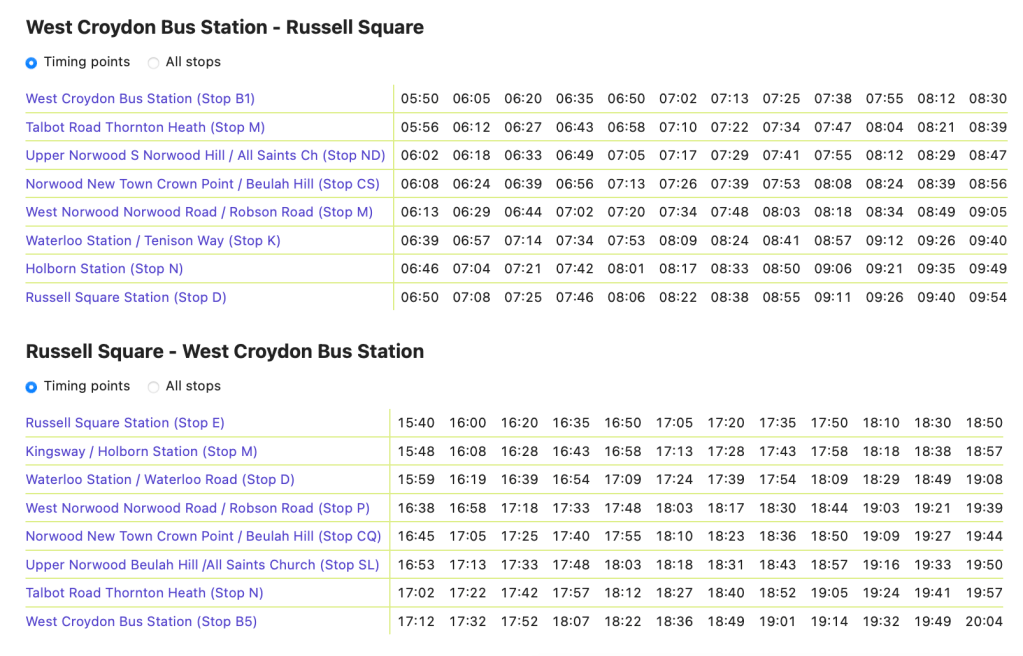
Interestingly whereas in 1986 the 08:10 departure from West Croydon took an hour to reach Russell Square, today’s 08:12 is scheduled to take an hour and 28 minutes, with the 07:38 beating even that at one hour and 33 minutes, such has been the increase in traffic congestion in the intervening decades. And, in fact it’s worse than that, as I found when I travelled on the 08:12 departure on a recent Tuesday morning as I’m about to relate.
For its first 20 years the route was operated from Norwood bus garage but in 2006 the contract was reassigned from Arriva to Go-Ahead London, being operated from that company’s garage in Camberwell where it stayed until the end of March this year when Arriva won the contract back with the route returning to Norwood from where it’s operated with ten new electric EE-class AD40 Enviro400 EV buses.
Go-Ahead used to use some of the buses in between the peaks on route 188 but obviously since the 2023 rebrand as Superloop that’s not desireable so eight of the 10 buses just do the 12 mile single trip in the morning and evening as a day’s work with the other two buses doubling up to do two journeys in each peak.
And indeed my journey, the 08:12 is one of those two, with the driver and bus having also operated the first journey from West Croydon at 05:50, arriving Russell Square at 06:50 and returning back into West Croydon’s bus station as I arrived at 08:08, giving the driver a quick four minutes for a mini break.

At 08:11 he pulled round on to the departure bay and three passengers and I boarded and we set off.

I noticed the destination blind reads “FIRST STOP WATERLOO” but that isn’t strictly true, as I found during the journey, on the first section of route between West Croydon and West Norwood, when every bus stop is observed and some passengers also alighted.
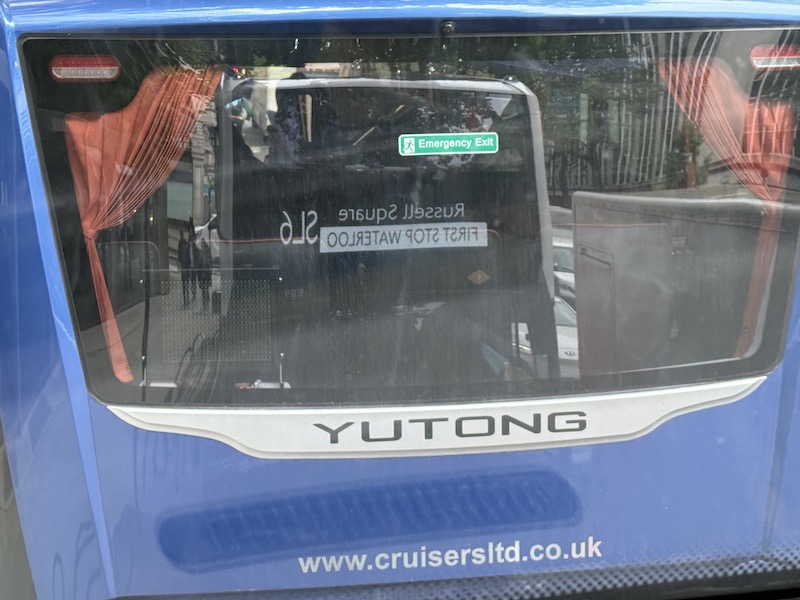
It’s only after West Norwood the bus becomes an “EXPRESS BUS SERVICE” not stopping again until Waterloo – although on the journey I took, the driver let a passenger off at the traffic lights at Lambeth North. I wonder if she tries that on every morning.

We stopped at 17 of the 25 bus stops between West Croydon bus station and Norwood Road picking up 44 passengers in total. Busiest pick up was Beulah Spa in South Norwood where eight boarded with seven getting on at Crown Point in Upper Norwood and five in Howden Road, South Norwood. Otherwise it was ones and twos. One passenger alighted at St Julian’s Farm Road in West Norwood and three at the next stop, West Norwood station.
After the non-stop section, nine passengers alighted at Waterloo station with seven boarding, five more got off at Lancaster Place but the majority, 16, alighted at Aldwych with another 10 leaving at Holborn and two more at Southampton Row leaving just four on board, as well as myself, as we reached the terminus in Russell Square including a woman who’d joined me in the upper deck front seats at West Croydon and travelled all the way.

The most intriguing thing about the journey was the timekeeping. Despite an on time departure and what seemed like a generous running time allowance (certainly compared to 1986) it wasn’t long before we were losing time.

We lost five minutes crawling up Beulah Hill, Upper Norwood in slow moving traffic.

There wasn’t any particular reason for the slow movement other than too many cars for the available roadspace

The slow moving phenomenon continued into Knights Hill…

… as we approached West Norwood station for our penultimate pick up bus stop which we reached at 08:57, ten minutes down on the scheduled time of 08:47.
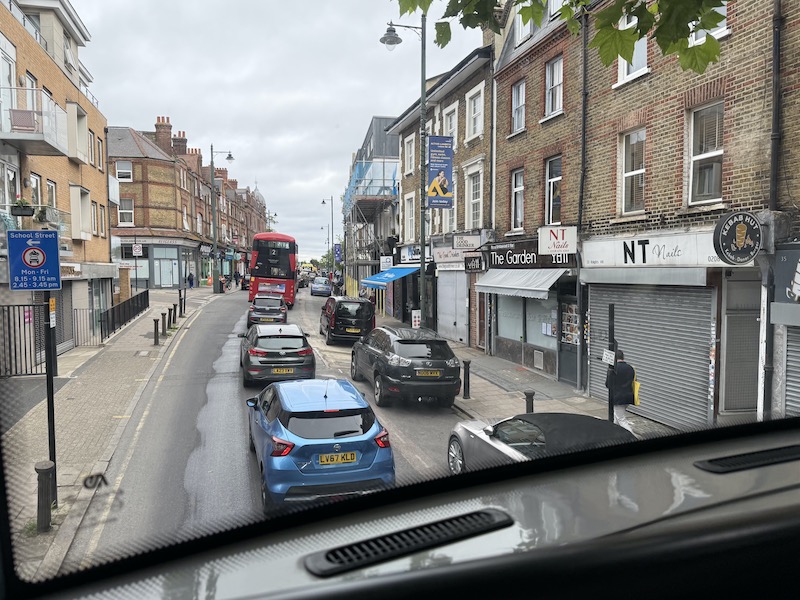
But, never mind, we’re now an “EXPRESS BUS SERVICE” with the next stop Waterloo, Horray.
Except there’s no let up in the queuing traffic as Knights Hill becomes Norwood Road and Tulse Hill station just 900 yards on from West Norwood station.

But it took us eight minutes, and this time there’s a reason.

Our old friend, temporary traffic lights.

But at least they’re only “Two Way” but what’s this they’re guarding?

Can it really just be that? A small drain like cover?
I take a look at progress so far, as we at least start to feel as though we’re an “EXPRESS BUS SERVICE”.
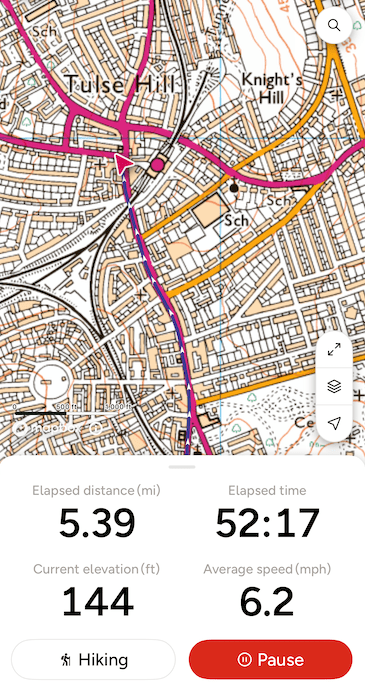
It’s been 52 minutes since we left West Croydon and we’ve covered 5.39 miles. That’s an average of 6.2mph. Not a very “EXPRESS BUS SERVICE“, although not bad for London, I suppose.
As we negotiate the one way system by Tulse Hill station I spy one of the earlier SL6 buses heading back to Norwood bus garage having completed half its day’s work with its earlier northbound journey.

We then continue towards Brixton along Tulse Hill itself, helped by a bus lane…

… although not by this driver of this 415 waiting time on a section of road where there’s just the one northbound lane meaning all traffic had to also wait time behind it or until a break in the southbound traffic appeared.

And, before long we find ourselves reaching Brixton Hill and the traffic queue to pass through busy Brixton…

…and it certainly helped that we didn’t have to negotiate our way into the bus stops, but it still took us 10 minutes to pass through this short section of route.
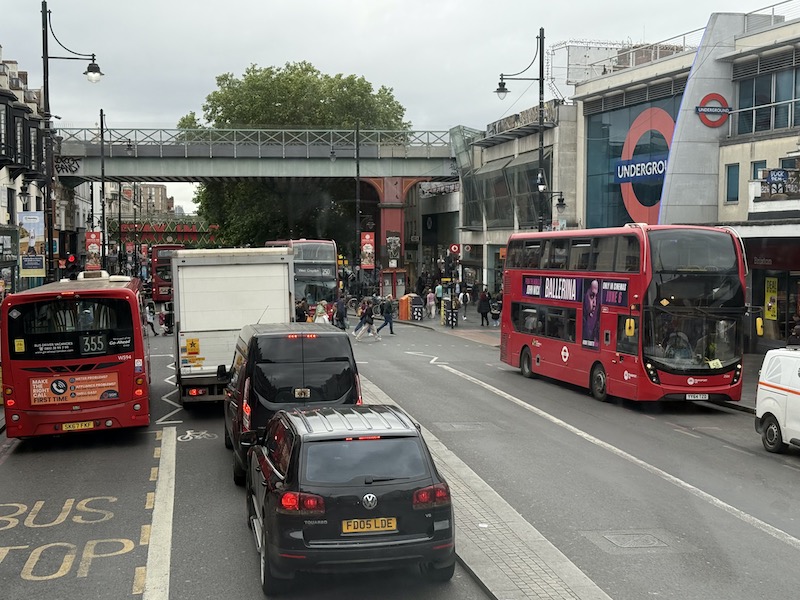
But, having cleared Brixton at 09:25, it was easy going as we glided through Oval and headed on to Lambeth North and soon after that, Waterloo was in sight…

… with another bus heading back to Norwood bus garage.
We pulled up at the bus stop alongside Waterloo station at 09:41, 15 minutes later than scheduled and almost one minute short of an hour and a half from leaving West Croydon.

But there was still work to be done, not least crossing Waterloo Bridge…

… negotiating Aldwych and the notorious Kingsway towards Holborn which was being as unkind to free flowing traffic as usual. Finally we pulled on to the Russell Square terminus bus stand at 09:57, exactly an hour and 45 minutes after leaving West Croydon and 17 minutes late. and a whole 45 minutes later than that 1986 timetable would have predicted.
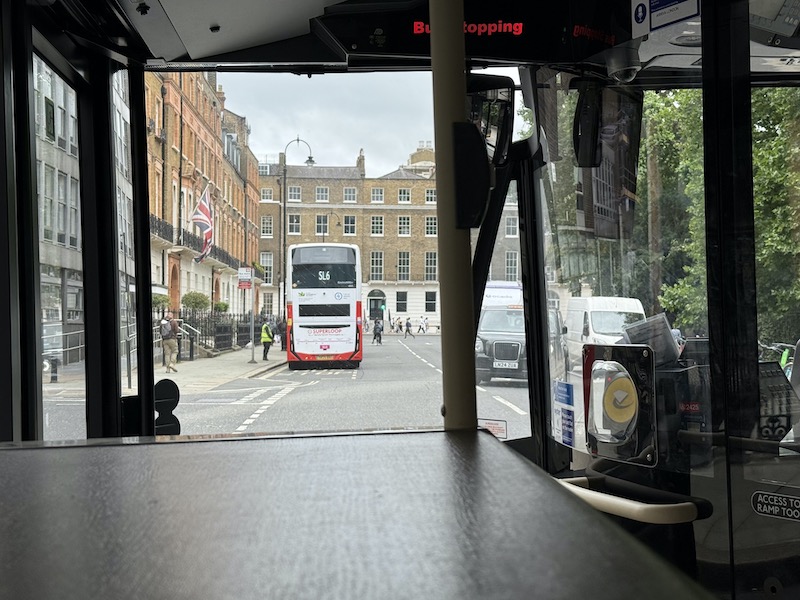
As we pulled in I spotted the bus in front of us still on the stand, only to alight and realise the bus in front of that was still on the stand…

… only to look behind me and see the bus behind us arriving on to the stand…

…making for a quartet of SL6 buses as photographed at the top of this blogpost.

The new Arriva contract for route SL6 costs TfL £2,895,000 per annum. That works out at £473 per journey (24 single journeys, times five days, times 51 weeks comes to 6,120). Ignoring the seven passengers who boarded at Waterloo, and assuming the 44 passengers boarding in South London all paid the single fare of £1.75 rather than having a Travelcard or longer duration pass, that makes for a revenue from fares of £77 per journey – making for a subsidy per passenger journey of £9 (£473 less £77 divided by 44).
At 12 productive miles per single journey, ignoring ‘positioning journeys out of service’ these buses which must cost around £500,000 each (I’m a bit out of touch with the price of new electric double deckers, not having gone shopping for one lately) makes for an average annual productive distance covered for each bus of just 7,344 miles (12 miles, times 24 journeys, times 5 days, times 51 weeks).

Only in London.
Roger French
Summer blogging timetable: 06:00 TThSSu


TfL post time schedules for all
their routes on line nowadays
online that show the duty
numbers for each trip. These
are available for every route via
this link.
https://s3-eu-west-1.amazonaws.com/bus.data.tfl.gov.uk/schedules/Schedule_SL6-MT.pdf
For the casual reader I attach
link to sample SL6 Monday to Thursday.
https://tl.gov.uk/corporate/publications-and-reports/bus-schedules?Query=Sl6
Roger and others this will allow
you to cast your experienced
eyes over the inefficiencies of
running a uni directional
service, with long unproductive garage runs and repositioning journeys
As you say it could only happen
in London.
John Nicholas
LikeLike
Apologies, this the link to all TfL schedules
https://tfl.gov.uk/corporate/publications-and-reports/bus-schedules
JoNi
LikeLike
You’ve probably got the driver on your journey into a lot of trouble referencing the traffic light drop off, it’s not exactly a dangerous move is it so you could have just left that bit out, but nope, you have to be one of those OTT health and safety bods with now’t better to say! As for taking his photo…..
LikeLike
Dear me.
LikeLike
I’m sure half the the people complaining about the former X68/607 being in the Superloop sequence would also be complaining if TfL had express bus routes numbered in three different sequences (6xx, Xxx and SLxx) and that TfL’s Superloop maps didn’t show all the express routes. Sometimes I think folks go looking for something to be unhappy with.
LikeLike
Seems to me like you’re just easily pleased.
LikeLiked by 1 person
It largely duplicates the 68 so is pretty wasteful in both finance and resource and passenger loaders do not appear to be high
LikeLike
The SL6 is not wasteful, i’ve been on ther SL6 [when it was X68] a few times & buses have always been well loaded bordering full by the time it goes past West Norwood, Northbound, & Waterloo, Southbound. its an express commuter service like i’ve said main purpose is is the area around Beulah Hill/South Norwood Hill which is some distance from the nearest station.
SM
LikeLike
There’s no doubt that it serves a purpose, but the question is “at what cost” and whether it is the most effective use of that money.
LikeLike
I regularly see standing loads on the SL6.
LikeLike
The SL6 is a commuter route, the first stop Waterloo, acutally means that’s the first stop passengers can leave the bus is Waterloo, main purpose of the SL6 is the area around Beulah Hill/South Norwood Hill which is some distance from the nearest station.
And another thing, on the morning service, last stop to pick up passengers is West Norwood, no passengers should be allowed on after that.
SM
LikeLike
Well if a commuter route only really needs to run Monday to Fridays peaks
LikeLike
That would be why it only runs in Mon – Peaks then!
Steve
LikeLike
And if you read the post, it says the passengers were alighting before Waterloo 🙂
LikeLike
In LRT days there were several Express or Limited Stop services, some I rode and there were others that slipped through my net. Some were quite local such as the X71 between Ham and Chessington and the X72 between Woolwich and Thamesmead. An X53 ran between Central London and Thamesmead but I recall doing this journey one night as a 177E! Another fond memory is when there was a Route 609 between Central London and Mortlake using “light” trips of London’s Airbus Metrobuses with high back seating. Those Route 609 rides were in my “Young’s” era and one Route 609 driver took me past the official final stop to drop me off outside “The Charlie Butler” PH for my evening refreshments. In 1987 Travelcards were extended to the Green Line network inside Greater London so there were numerous additional limited-stop services to enjoy and the fantastic plethora of coaches to ride on. One’s Travelcard took one onto such delights of COMS coaches working Route 790 between Victoria and Uxbridge as well as Green Line’s own vehicles. ENOC ran a service between Oxford Circus and Southend on Sea and one’s Travelcard was good as far as Romford. At 72 my memories of all this fun I had are starting to fade and burrowing through my Diaries to cite dates would take hours! My thrill of bus diversions in my current era are also starting to wane and do not feature as principally in my Diaries as they used to. However, on two recent era trips an “express” aspect to one route diversion was an absolute thrill. Southall town centre was shut for religious reasons, so Route 120 was diverted between the White Hart Roundabout and North Hyde Lane via the A312 (Hayes Bypass) taking one over the fantastic viaduct crossing the GWR and the GUC! The view from the top deck was worth paying for but I rode free on both occasions – Metroline at its best.
LikeLike
The 177E was the 177 Express. During the time that it was operated with ex-West Midlands Titans, it was fairly common for the buses to show 177E on their four-track displays.
A 53X was introduced in 1988, upon route 53’s conversion to one-person operation. The X53 came later, replacing both the 53X and 177 Express.
Malc M
LikeLike
Thanks for this report. For a long time I’ve thought that the way to get cars off the south London roads is to make the railway system work more like the tube. Has there been any study of traffic conditions in the areas served by the Elizabeth line? Most of south London, including West Croydon, and West Norwood have a complex network of semi-combining half-hourly train services – clever, maybe, but you still need to keep consulting the timetable. A few services – the Overground, Thameslink (to Streatham), and the Victoria-Orpington (just recently) – run every 15 minutes, but it’s not like getting the Piccadilly from Cockfosters!
The obvious solution is more cross-central-London connections. Crossrail-2 is very long-term and really expensive, so is a political no-goer; could there not be a rolling programme of smaller-scale, less gold-plated schemes to connect, say the North/East Dulwich trains with the GN City (Moorgate-Finsbury Park-Enfield)? – run it like a tube line, with trains every few minutes; there would still be a role for Express buses, to complete the S.London interuban network.
LikeLike
The lines from Liverpool Street are pretty congested with little if any spare capacity for new services
LikeLike
My understanding is that there is no viable tunneling route south from Moorgate. The secret world beneath the centre of the City is clogged up with tunnels already.
LikeLike
Doesn’t the Bank of England have underground vaults which would make any potential extension of the Northern City Line south of Moorgate infeasible?
LikeLike
Given that under Mayor Khan London’s bus network actually carried fewer passengers in 2024/25 than the year before and missed the bus lane target of 25kms by 2025 then Superloop is an achievement. Although it represents I think less than 2% of annual bus mileage it did help London’s Transport Commissioner and his cronies to pick up huge salaries and bonuses
Don’t get me wrong though I am a fan of Superloop and do want to see the network expand. It’s a shame that buses have to travel along 20mph zones where there is no traffic (Park Road Teddington for example) and buses get delayed by buses in front ‘making time ‘ in awkward places. The Waterloo to Holborn corridor is also notoriously slow since the bus lanes were temporarily removed about 10years ago. It’s also wasteful for Superloop buses to remain idle when not in service and for running times on parallel routes to be at times faster than Superloop ones. Perhaps a review of the network as well as expansion is now required ?
Martin W
LikeLike
In your summary of the introduction of deregulation you seem to have forgotten to mention clapped out buses, cowboy operators, bus wars, loss of integration and overall general chaos.
Bob
LikeLike
Indeed, I regularly had to ride between Brixton and Upper Norwood on the 196 which was run by Cityrama using ancient DMS buses. Terrible.
LikeLike
“clapped out buses, cowboy operators, bus wars, loss of integration and overall general chaos”
If I could expand on that, I would add routes/timetables that were forever changing, services being abandoned at 42 days’ notice (throwing a problem at the county councils/local transport authorities to conjure up unallocated money in their budgets to fund replacements), not to mention the continued decline in passenger numbers.
Malc M
LikeLike
Bus companies need to give 70 days notice to the local authority now. The first 28 days is to give the LA time to negotiate with the operator concerning any potential subsidy requirements.
After that time, the registration is forwarded to the Traffic Commissioners for consideration and acceptance.
LikeLike
@GreenLine727 – that may be the case now, but not in the earlier days of deregulation.
In those early days, it was 42 days – and then as now, it is left to the local authority to pick up the pieces using whatever money it can find.
Malc M
LikeLike
You forgot astronomical fare increases, complicated fare structures coupled with operator only tickets in metropolitan areas that saw off passengers in their droves!
JoNi
LikeLike
A few fairly random thoughts:
LikeLike
I went out of my way to use it for the first time just days after the renumbering from X68. Unfortunately, the first evening departure from Russell Square did not operate, thus the second became very full probably earlier than was normal. It certainly serves a need, and most certainly underlines why inner-South/South-East London is very much the poor relation to all other parts of the Capital City and Greater London County by lacking the Underground.
The limited stop is the main appeal, “Express” it sure isn’t! But my observations, with reasonably light traffic before the main peak, was that the bus had to keep to 20mph in spite of numerous sections of wide open road along the non-stop section prior to West Norwood. Ridiculous!
Only in London!
Terence Uden
LikeLike
I smile at such a commentray. But you are right. How long do we give Superlooper. Remember when the 68 ran from South Croydon to Chalf Farm. A long time ago I know and traffic conjestion, highways reduced to one lane for cycles etc and a 20mph speed limit. There has been much improvement of London’s bus services???!!!
LikeLike
TfL’s deluded despots exposed:
https://www.standard.co.uk/news/transport/2-200-transport-for-london-staff-wages-ps100-000-bonuses-tfl-b1235230.html
No wonder London’s public transport is the most expensive in the world and also one of the least reliable – these extremely fat cats are stealing all the money.
LikeLike
An hour on buses for £1.87 is far from expensive
LikeLike
Perhaps send Reform’s DOGE the costings – though assume the SL6 runs fully loaded (seated) on all journeys (ignoring intermediate borders and alighters unless it can be shown that the effective load factor is indeed more than 1 for an entire journey.
I think running the SL6 both ways daily would be useful. Perhaps even extending to Purley for a first stop Croydon Fairfield Halls for a commuter etc express M-F peaks both ways (4 journeys ?)
If Russell Square is going to be so full then might as well add a charging point for the buses there.
Responding to others Roads next to Elizabeth Line are still as congested as ever ( dont forget the east and west main legs of the Line are no more than the Shenfield Commuters stopping services and the GWRs locals into Paddington . What the EL did was to facilitate more construction of high rise flats in Ilford and Southall so its more people but others still use cars – or buses – on ever restricted road space and no amount of extra / longer trains (which are needed now) will seriously impact into that from the fairly spaced out rail stations.
South London rail services are impacted with the amount of terminal space at the likes of London Bridge. I would make some enhancements though to try to make services 20mins rather than 30 ( but we note where commuter services an 11 till noon wont really carry more , if any, passengers). If that could be done on the Wimbledon Loop (which covers the Streatham Herne Hill kind of traffics) with the extras to London Bridge re introduced 20mins which really would give a tube level service (which even from Cockfosters dips to 10mins at times) Extend the Overground Crystal Palace Terminators on via Balham to Clapham Junction ever 15mins to give 7.5min or better service on WLL – which is needed for Chelsea etc match days if nothing else.
AND Improve publicity for services
JBC Prestatyn
LikeLike
Could a new off-peak Superloop route be introduced around the South Circular – eg Woolwich to Clapham Junction – to utilise the buses?
MotCO
LikeLike
wasn’t the X68 the child of certain innovative LBL District managers, as opposed to a LRT policy? Why was there a 607, X43, and I77E; but no X25, X29 or say, X18? Seems more like motivated staff ‘playing buses’ with special blinds and liveries rather than any comprehensive transport scheme.
LikeLike
The express routes may well have been local initiatives by the London Buses’ Districts/subsidiaries rather than an overarching policy.
I understand the 177 Express, from Thamesmead to Central London, was suggested by staff at Plumstead garage. Thamesmead was, and still is, remote from rail access – and at the time, there was no Jubilee Line at North Greenwich nor an Elizabeth Line at Abbey Wood. The X43 from North Finchley to London Bridge took advantage of the newly-introduced “Red Route” traffic restrictions on the A1 corridor, after serving areas not well-connected by rail (Friern Barnet and Muswell Hill).
As for an X18, X25 or X29, may depend on what proportion of passengers travel long distance. The 18 is generally parallelled by the Bakerloo and what is now the Lioness Line catering for longer distance journeys. On route 25, the outer reaches are parallelled by the Great Eastern Main Line, on which the service has been frequent for many years. From Stratford inwards, the Underground provides plenty of parallel journeys. The 25 did used to be accompanied by a limited stop Green Line 721, although that ventured no further into Central London than Aldgate. As for the 29, from Wood Green southwards, the Undeground provides alternative connections into Central London.
Artics were deployed on the 18, 25 and 29. I wonder whether this may point to those routes being heavily used by short-distrance riders, with rather fewer longer-distance passengers.
Malc M
LikeLike
The X43 (launched by Transport Minister Steve Norris) did indeed take advantage of the Red Route initiave well before TfL was set up. The comparison with the 18 and 25 is apples and pears as fares are much cheaper in comparison with rail services . Something that Railplan and staff getting free travel tend to forget. Until recently the 25 was one of London’s busiest bus routes but now that it’s western terminus is hardly a traffic objective that is no longer the case. No doubt more bus routes from the east will be curtailed when Oxford Street is pedestrianised causing further decline in the capital’s bus service.
Martin W
LikeLike
@Martin W – while it is true that London’s bus fares are cheaper than rail, passengers on routes such as the 18 and 25 have a choice – a quicker journey by rail, or a slower but cheaper journey by bus.
I am not convinced that spending money to run limited stop buses to parallel rail services, duplicating the rail service, is a wise use of funds. You may disagree.
Malc M
LikeLike
The problem is that rail stations (if it is the main line railway rather than something like the Undergound) are generally a couple of miles apart (at least). In an area where housing extends all of the way along the railway line – as in parts of the London suburbs – then some people will be a mile or more from their nearest station. So for those passengers, a limited stop bus would be useful, even if it is parallel to the railway.
RC169
LikeLike
@RC169 – not the case in this context. The suggestion from Martin W was for limited stop routes parallelling TfL routes 18 and 25. In the suburbs served by those routes, I challenge you to find anywhere which is a mile or more from a rail or Underground station.
Malc M
LikeLike
@MotCO
An off-peak Superloop as you suggest would operate between what time and what time, bearing in mind the buses would need to be in position off and onto their runs on the SL6?
In fact, there are plans for a Superloop along the South Circular between Eltham and Streatham – presumably avoiding the low bridge at Tulse Hill unless the route is single-deck, and presumably planned to run all day rather then just “when it suits us, ‘cos we’ve got a few buses hanging around in between other stuff”.
Malc M
LikeLike
Route X68’s introduction in October 1986 coincided with its “parent” route 68 being converted to one-person operation. Pay-as-you-enter brought longer journey times – even the first and last journeys saw 10 minutes added to their running time between South Croydon and Euston.
As others have commented, the Upper Norwood area is remote from any rail station. Train services from West Norwood, Tulse Hill and Herne Hill were at British Rail suburban frequencies (ranging from 10-15 minutes to half-hourly) rather than the every few minutes “turn up and go” services levels provided by the Underground. Suburban trains terminating at Victoria or London Bridge weren’t particularly convenient if you were travelling into the heart of London, either.
The X68 was doubtlessly introduced to mitigate the effects of pay-as-you-enter, for commuters using the 68 from Upper Norwood to Central London. Half-a-dozen Leyland Olympians were fitted with coach seats for this purpose.
A few years later, the 68 was split in two, the southern half becoming 68A. It was later renumbered 468.
Malc M
LikeLike
Only in London for the moment as I’m sure all Labours empire building city region mayors will soon be running similar services
GT
LikeLike
Perhaps the SL in SL6 means South London.
For the 25 Having Artics flows from observation tended to be Stratford pick up , heave and drop off all the way to Ilford ( but a few not wanting to pay railfares it was all the way to Ilford). Other traffic was Stratford to Central London ( and for both the reverse flows were true) so busy with both potential for semi express services and lots of on and off. Of course at one time this would be solved by RMs running every three mins, though bendys gave disabled spaces which were useful.
I understand bus passengers in London 2024/2025 are lower than 2023/2024 anyone got a reason why there is a decline (shift to rail/cycle and changing work patterns are probably the biggest reasons but the reduction in bus service provision must have an impact.
It seems strange why Thamesmead was / is so ill served by high profile public transport , it really needed to be in place for work education and shopping since before area was developed , and since 2000 obviously places like Greenwich have changed from industry to big leisure along with the rise of Bluewater as shopping destination.
JBC Prestatyn
LikeLike
Seems like an awful waste of money to have a brand new fleet of electric buses and then to just use them for 2 trips a day Monday to Friday only.
Outside of London some vehicles would cross link with some sort of off peak only service, or run on the normal stopping service that the peak express complements, or the afternoon journeys would do some schools first.
I can’t think of another peak hour service that is run with route branded vehicles which as a result stops them from being used on other services
LikeLike
London of course in the past had an ex tensive network of limited stop cross London Greenline services. They failed due to traffic conjection and not being fdully integrated into TfL service
LikeLike
The original Greenline network was transferred along with London Transport’s country area services to the National Bus Company with effect from 1st January 1970 & became London Country Bus Services Ltd. Once LCBS eventually settled down it made efforts to reform the Greenline network but ultimately to no avail. Following de-regulation a couple of companies continued to use the Greenline name but otherwise the original network had long ceased to exist by the time TfL was formed.
LikeLike
Hello Roger, this article has been brought to the attention of one of the Arriva Management teams (we don’t want to say who we are as we have a very important role behind the scenes, basically we are along the lines of quality control management) by a member of the public and we just thought as a senior team we would reach out to thank you Roger for highlighting the issue of the customer alighting at the traffic lights. Sadly we have employed many a driver who thinks they are above the rules so this may act as a wake up call as this is a very important issue that occurs frequently throughout our network. We are clamping down on the serious issue of customers alighting at places other than designated bus stops and we just thought we would thank you for taking the time to record what had happened. To the driver in question as well as all the rest who think rules aren’t for them, you never know who’s on board so don’t do it!
LikeLike
Perhaps the Arriva quality control management team could also do something about the appalling cleaning standards inside their buses (Arriva London North in particular). On some LTs you can’t even see out of the front windows due to the grime and poor washing. You could attend to the etched glass issue too which is now spreading again.
Martin W
LikeLike
It’s worth noting (the supposed Arriva team above in the comments would do well to note too) that the bus driver may not have let the passenger off. Seen this many times where the driver will to a more passive or active degree suggest to the passenger that they may let themself off using the button above the door as they aren’t allowed to open the door for them. I suspect that is what may have happened on your trip too.
LikeLike
Please see next comment for our reply as our comment has posted itself there instead of here.
LikeLike
The old X68 [particularly when it was operated by Go Ahead] did interwork with a few routes, the interworkings stopped when it got renumbered to SL6 & part of Superloop, TFL state, buses allocated to Superloop routes cannot be used on any other routes.
SM
LikeLike
Drivers know the reason behind this important rule, we will not allow any bending of this rule in any way, be it verbally or by gestures. If a passenger let’s themselves off without the driver indicating in any way to press the button, then the driver isn’t at fault, however they must tell the passenger not to press the button. If the driver indicates in any way as to where the button is, then we view that as a breach of the rules, and more importantly so will the authorities should something serious happen.
LikeLike
Why are you hiding behind “Anonymous” given how “important” this rule is?
Are you ashamed of it or something?
LikeLike
There are various reasons why people who are employed in the industry do not disclose their identities on public forums such as this one. You could make your own enquiries to check the accuracy of information given if you wish to.
In any case, you’re not exactly being explicit about your own identity. Or did you just forget to include a signature on your post?
RC169
LikeLike
Quite true, but then I’m not claiming to be something I’m not and lecturing others about “important rules”. Note the time of the post 7.09 pm….
LikeLike
What do you mean “…I’m not claiming to be something I’m not”?
Are you disputing the correctness of the comments at July 6, 2025 at 8:16 am and July 7, 2025 at 7:09 pm?
RC169
LikeLike
“RC169”
An official statement from a company, particularly one admonishing a driver, should be signed, else it looks like it could have been added by anyone just out to cause trouble, as indeed the comment probably has.
LikeLike
As a one-time regular commuter on the X68, and a current very occasional user of the SL6, a few observations.
Stopping arrangements. When I used the X68 regularly in the ‘nineties, the stopping arrangements were: in the morning, all stops to West Norwood *to pick up only*, non-stop to Waterloo, normal bus to Russell Square; in the afternoon, all stops to Waterloo *to pick up only*, non-stop to West Norwood, normal bus to West Croydon. As far as I am aware that is still supposed to be the case. But when I occasionally use the SL6 in the morning nowadays, I note that Sonia religiously announces every stop on the West Croydon – West Norwood section. Not only is this unnecessary – if the pax can’t alight there then what’s the point of announcing the stop – but it’s actually confusing, as the very act of announcing the stop implies that you can alight there. In your report you say that several pax did indeed alight over this section, so either they’ve changed the rules or the drivers have given up trying to enforce them. I suspect the latter.
Routeing. In the ‘90s most drivers followed the normal 68 routeing over the non-stop section, via Herne Hill and Camberwell, but one or two went via Brixton and Kennington. It appears from your report and my own experience that nowadays the latter is the normal routeing.
Vehicles and branding. Back in the ‘90s the X68 had a trio of dedicated Olympians with coach seats (they weren’t all that comfortable though as the seat backs were too upright) but they were painted in normal livery. The procedure then was that when each bus finished its last morning northbound journey it ran back to Norwood Garage in service as a 68; and in the evening before each bus started its first southbound journey it ran up to Russell Square in service as a 68. Of course they can’t do that now that the route is branded as a Superloop even though it really isn’t.
Michael Wadman
LikeLiked by 1 person
South London enjoyed the convenience of a huge tramway system provided by the London County Council, which made up for the lack of Tube lines. Alas this was foolishly ripped out by LT. I can thoroughly recommend the memoirs of an LCC tramway man titled The Wheels Used To Talk To Us.
https://images.app.goo.gl/wFyNpYsLtS1Rp5vt8
Peter Brown
LikeLike
There was indeed an extensive network of tram routes in south London – but not every part of south London. Trams did reach the terminus of todays route SL6 at West Croydon, the last pick up/first set down at West Norwood, and also intermediately at Thornton Heath. All three points were, and are, very close to rail stations. The core “market” for the SL6, the section through Upper Norwood, was never reached by trams.
Whether trams really made up for the lack of Underground is debatable. Trams did not provide comparable quick and direct links into Central London. However the suburban rail network was more extensive south of the Thames.
Tram lines began to close in 1931, two years before the formation of London Transport, with London United Tramways introducing trolleybuses to replace trams in the Twickenham/Kingston area. Although I could be mistaken, I have a feeling that following London Transport’s creation in 1933, there was a plan to replace all of the trams with trolleybuses. Those plans were halted by the Second World War, and following the end of hostilities, the decision was taken to replace trams with diesel buses.
Malc M
LikeLike