Tuesday 24th June 2025

Transport planners love track based solutions for large conurbations, especially trams. Bus based systems just don’t cut it in the same way, they reckon. Look at Leeds, for example; for years city leaders have lamented its lack of trams (“the largest city in Europe without a mass transit system”) looking enviously at Sheffield, Nottingham and Birmingham/Wolverhampton’s networks not least with the latter’s extensions now under construction.
The downside of trams has always been their enormous construction costs as well as all the upheaval during construction eg resiting utilities under road surfaces.
City leaders have to patiently wait for generous Chancellors to come up with billion pound handouts in Comprehensive Spending Reviews as has just happened for Leeds with a £2.1 billion handout.

Now, Coventry City Council reckons it’s found a much cheaper solution with what it’s calling Coventry Very Light Rail (CVLR).

For the last few weeks the public have been given the chance to try out the concept by taking a couple of 45 second rides on a short stretch of track laid in Greyfriars Road in the city.
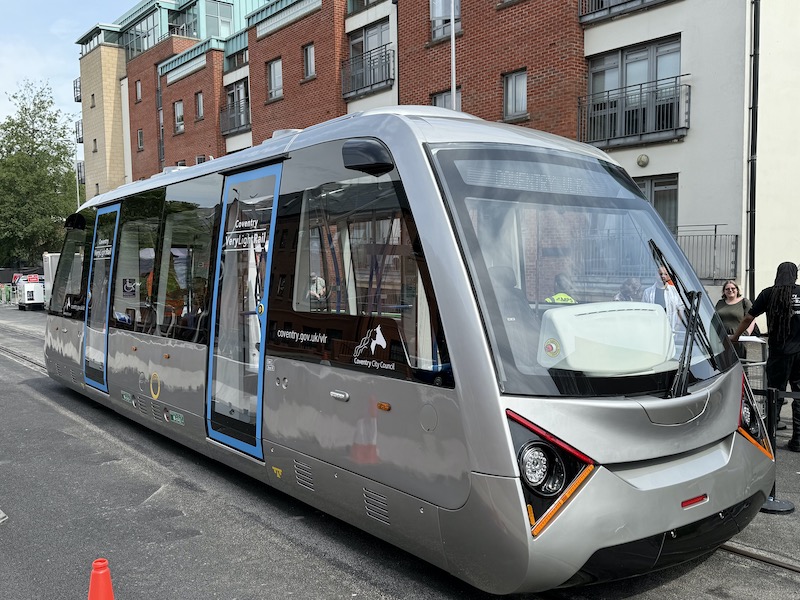
The promoters point to CVLR’s benefits as being “a significantly reduced installation cost” quoting a figure for conventional tram installations of £25 million per kilometre (rising to £100 million per kilometre in city centres) although interestingly I note no comparative figure for VLR is stated in the promotional literature other than “it can be delivered at less than half the cost and in half the time of conventional light rail systems, while providing the same benefits”.
A second benefit is the tram being battery operated, so there’s no need for overhead cables, and thirdly, the track is laid just 30 centimetres into the road surface “minimising the need to relocate pipes and cables” although how utility companies would access their “pipes and cables” without disrupting the tram service isn’t explained either.

A fourth benefit is given as the tram being “able to handle 15 metre radius curves” meaning no need for changes to street corner infrastructure.
The concept reminds me a bit of the Parry People Mover, not least because a prototype was demonstrated in similar circumstances on a short stretch of track in New Road, Brighton in 1994. I recall its inventor, John Parry, saying the vehicle’s flywheel technology was a cheap and effective way to provide ‘mass transit’ along the seafront road and up to the railway station (as well as replacing the Volks Railway).

That demonstration came to nothing but much development time later, two production vehicles became Class 139s and have been running the Stourbridge Shuttle since 2009.

Back to CVLR, and I took a ride on the trial vehicle on Saturday. The tram has 20 seats with a total capacity of 56 including an area set aside for wheelchair users.
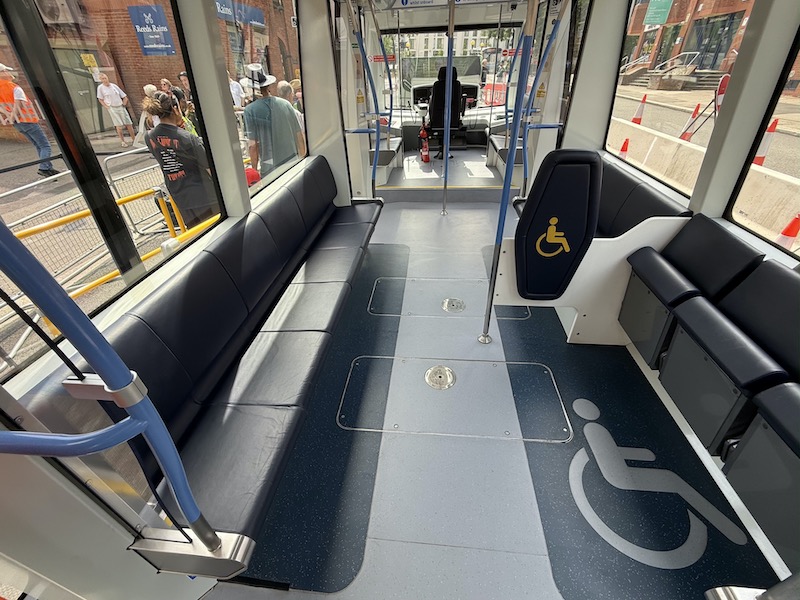
A ramp had been installed by the temporary tram stop at the start/end of the trial track in Greyfriars Road to enable those using wheelchairs and others to enjoy level access boarding and alighting. Presumably similar arrangements would be needed at all tram stops.
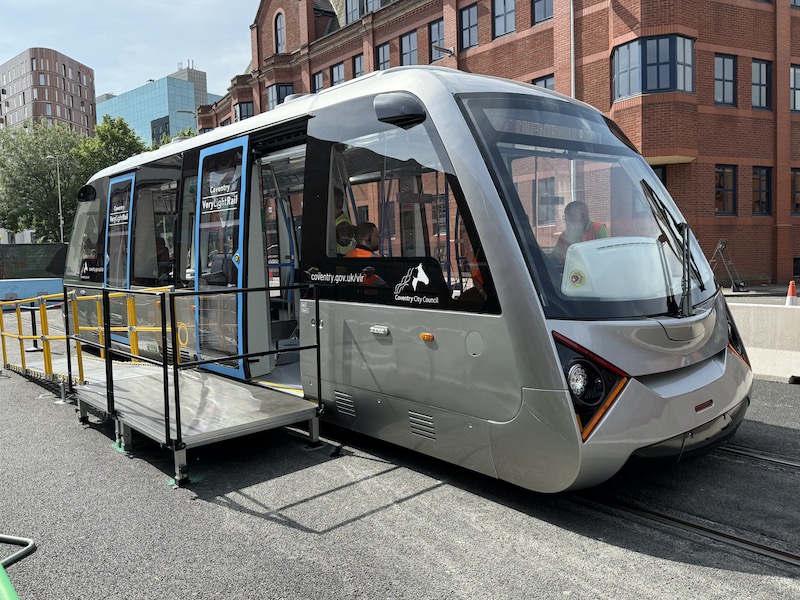
Acceleration was impressive. The tram can travel at road speed limits which in this case was 20 mph. It was also very quiet while in motion.
45 seconds after leaving we reached the end of the track, the driver changed ends and we headed back.

Here’s a 45 second video of the journey for your edification.
CVLR is being funded by a number of partners in this project including the West Midlands Combined Authority, Coventry and Warwickshire Local Enterprise Partnership and Coventry City Council with the project also part of Coventry’s bid to the City Region Sustainable Transport Settlement. Others involved include WMG at the University of Warwick, Dudley Metropolitan Borough Council and the Black Country Innovative Manufacturing Organisation “to drive forward the research, development and testing of the system”.
The project partners have “developed a new vehicle and track which aims to provide a reliable, frequent, environmentally friendly, hop-on, hop-off service in the city”. They go on to explain “CVLR will provide residents with an alternative transport option, help improve air quality, reduce congestion, support housing development, and provide jobs and skills. The system’s installation will secure local investment and put Coventry at the forefront of the green industrial revolution.”

They certainly made a show of the demonstration in Greyfriars Road with professional event staff brought in to make everyone smile and feel welcome for their 45 second rides.

I don’t want to be a party pooper on all that fun but do feel obliged to point out a bus is capable of seating at least 56 (never mind 20) at a fraction of the cost of VLR and if you want it to look like it’s track based you can do what’s been done in Crawley, Leigh, Luton, parts of Leeds and Bradford and Cambridgeshire and install a guideway, or not even that as has been done in Gosport, Dartford, Dover, Runcorn and Bristol.

But I agree, a bus doesn’t quite do it like a tram does.
Roger French
Summer blogging timetable; 06:00 TThSSu
 BusAndTrainUser
I trust fixed infrastructure more – because it’s harder to close down. I might move house on the basis of a rail or tram service but I wouldn’t do that for a bus service that could evaporate at six weeks’ notice.
John Geddes
LikeLike
we used to have huge tram networks which were closed for political reasons in many cases. Why are people so sure this won’t happen again especially with huge budget constraints?
Buse have the huge advantage as they can go off into quieter areas beyond the bus way
Ray Wilkes
LikeLike
@Ray Wilkes – the UK is not alone in tearing up its tram systems. Parts of Europe did so too. And yet, trams are enjoying a renaissance there.
In France, the number of tram systems dwindled to just three. Over the last 40 years, however, new systems have been opened, and the number of tram systems in France now stands at around two dozen. I understand every French city with a population of 160,000 or more has a tram system.
Spain, too, has opened around a dozen tram systems, although a couple of them have floundered (for financial reasons, I understand).
If other countries can invest in tram systems, why are we in the UK so reluctant to do so?
Malc M
LikeLike
The old Tram networks were closed mostly due to the large expantion of Towns & Cities all over the UK in the 1950s & 60s, Tram networks were unable to cope with the expantion, & it would have cost a fortune, Buses were available & more cost effective, & have a huge advantage that routes can divert to serve other areas, as well as can be extended beyond the tram terminus
SM
LikeLike
@SM – and yet, look at how tram networks reach newly-developed suburbs on outskirts of continental cities.
Malc M
LikeLike
@John geddes. I am of the same mind as jarret walker: infrastructure in the street is not evidence of permanence. A long term funding model is.
the write off cost of cheap trackage is also cheap.
BRT / BRTlite (including enhanced bus stops in city centre) with full sized Battery vehicles and opportunity charging would be cheaper.
milesT
LikeLike
I’d like to see them repeat the experiment using an Irizar ie tram and measure the reaction to both. I suspect people may not notice the lack of rails. Then present the comparative costs.
What I’m suggesting is that the rails are a small part of the attraction. The perception of a tram is also modern, frequent, reliable, it delayed by traffic and other things.
LikeLike
The cost of trams is horrendous. Typically as well they t least 3 times over the ordinal budget and require large annual subsidies. The other problem is roadworks and or accidents can bring the service to a halt
Trams/Light Railway only really make sense if you need to transport very large number of passengers and the distance is quite long for anything else proper segregated bus lanes are much lower cost and work just as well . They could as well use laser guidance to keep the lanes as narrow as possible
LikeLike
Yes, the main benefit with VLR would be the significant cost reduction compared to trams, but still despite its undoubted ‘innovation’, it still ends up being a very expensive vanity project.
The money would be far better spent on bus lanes and priority measures, in my opinion.
Stu – West Midlands Bus Users
LikeLiked by 1 person
The other big cost fact is the tears of disruption whilst they build it with shops and businesses loosing revenues as people avoid the area
LikeLike
Looking up the population of Coventry and it is about 400,000. Typically about 10% use buses so that’s a potential market of less than 40,000
LikeLike
The potential market is 400,000. Why assume the market is restricted to existing bus users?
LikeLike
while the total addressable market (TAM) may be circa 400k, it is unlikely to develop a route structure dense enough to capture TAM.
Pick a percentage uplift of current ridership: 100% uplift would mean 40k.
Does that new 40k ridership create a viable business case for VLR? How many years to pay off the capital cost at normal gilt bond rates?
LikeLike
So it seems better than a bus so will attract more passengers, but can’t manage those passengers. High operational costs with more drivers per 1,000 passengers moved than for a conventional high capacity tram, and you still have track maintenance costs.
Most gadgetbahns are solutions looking for a problem, but I think in this case the problem (high infrastructure costs of conventional trams) has been passing solved but the solution is worse than the alternative ie not having the infrastructure at all, and running buses.
If they can transfer some of the lightweight and lower cost tech to a conventional system, then there could be a positive outcome, but otherwise I can’t see the niche that this fits.
LikeLiked by 1 person
This.
It’s worth noting that the Parry People Movers only ended up on the Town Car in Stourbridge because Mr Parry was able to put pressure on the local authority at the time the authority was desperately looking for replacements for the class 153 railcars which the DfT had decided were needed elsewhere. Since there were no alternative single-car units available in this country, the options were either bustitution, which wasn’t politically palatable, or the PPM which at least allowed the politicians to make noises about local innovation and so on. The PPMs being double-crewed aren’t really any cheaper to operate than the preceding 153s were.
I suspect that when the PPMs become life expired, they’ll be replaced by a variant of this VLR vehicle, which will allow the politicians et al to claim that the [VLR] concept is proven, local innovation, etc. just as they did when the PPM arrived on the Town Car
LikeLiked by 1 person
Hi Roger
An important point not mentioned is that the VLR track has to be dedicated ie not shared with normal road traffic
But if a similarly dedicated bus lane were created very similar benefits would accrue
But I do agree with your final comment that ‘a bus doesn’t quite do it like a tram does’
Will Frecknall
Hereford
LikeLiked by 1 person
it was said the tracks were tested outside the council refuse depot with hundreds of heavy lorries passing over so don’t think it does have to be on separate rights of way
LikeLike
If they had protected the track beds of the old railway lines that were closed they would have offered a lo cost solution. Many of the old branch lines could have been converted to a bus lane with the added advantage of being able to take the service into the town centre . The typical rail loading gauge is 9 foot
LikeLike
Meanwhile BBC East yesterday trumpeted “the possible future of public transport in Cambridge” with a report on a driverless suburban minibus route which Whippet has started, with a second route coming shortly.
Ian McNeil
LikeLike
There is currently a great deal of very vocal public criticism of the project and it’s being frequently described as a council vanity project. This hasn’t been helped by the fact that the local councillor who has been promoting it isn’t exactly popular with the local electorate for a number of reasons. Some public opinion has also centred around the fact that Coventry now has a fleet of electric buses (just the handful of single decks left to replace), so why is anything else needed?
Unfortunately, Coventry City Council’s responses to public criticism sound more like prepared statements than actual responses which engage with the public and pick up on the issues being raised.
Silly as it may seem, there was a loud public backlash against the introduction of garden bin charges of £40 per year last year in Coventry. This is despite the fact that every surrounding local authority including mine, introdoluced them years ago. As a result, any project that has needed funding since then is also being criticised by it is seen as being funded by this charge. Totally untrue, but the great Coventry public are not being swayed!
There is speculation about what might happen in Coventry’s local elections in May next year and whether the political landscape will go in the direction that many local authorities did this year……
LikeLike
I forgot to add, as an enthusiast, I’ve also had a journey and got there by using one of Stagecoach Midlands new electric Yutong single decks from home. That by far was the best part of the journey!!!
LikeLike
It feels like VLR is suffering from the same problem as the commercial “on demand” minibus services had – which is that when you have a system with very low capacity, even if you keep costs low you’re still not going to be able to recoup those costs because the vehicles can’t carry enough passengers to do so.
One of the big advantages of trams over buses in urban areas is that they can carry more passengers. Take away that advantage by running tiny trams and you’re taking away the main reason for running trams.
LikeLiked by 1 person
They suggest these minimum trams will have a capacity of 56 to 60 passenger so similar to a modest size single deck bus
They suggest a cost of £7M a Km compared with £30M for normal trams(That £30M is probably optimistic as most schemes go massively over budget, Birmingham worked out at £160M
I am sure this light tram network will cheaper as it is battery powered and the track will be slightly cheaper to instal but the £7M looks to be wildly optimistic I would reckon nearer £20M
LikeLike
As the late Dennis Gill opined years ago the advantage of a tracked (or overhead – trolleybus) system is the fixed equipment that tells the public the service and route will be there tomorrow and months after. Bus routes are too easily changed or abandoned.
In addition the comfort of steel wheel on steel rail cannot be bettered. I can read on rail and tram routes but would be made nauseous trying to read on a bus.
LikeLiked by 1 person
In my regular travels around Europe, trams do it for me. I really like the convenience of single-deck articulated buses too. The fixed track/routes of trams give them a big advantage – new users can see where they’re going, and the stops are normally very obvious. Those mean that proper comprehensible route maps exist too. Both are essential for new users to have the confidence to give public transport a try.
LikeLike
To continue-
the big problem with the VLR is it’s lack of capacity. Not enough to make it at all economic in comparison with a bus. A properly thought out and publicised bus route with electric articulated buses would make VLR look like the expensive overgrown people-mover pod that it is.
LikeLike
Not articulated buses again. Don’t you re-call what happened in London? These vehicles work fine in European cities but not here where our city streets tend to be narrower with lots of tight turns. That’s why double-decker buses reign supreme in our cities & urban areas & long may they continue to do so.
LikeLike
Ironically Coventry had 2 batches of artics, Mercedes 0405s and newer Citaros. They had full length lives and never seemed to cause any issues with congestion. Ironically, the railway station – city centre – hospital route, now a potential VLR line was one of routes almost exclusively operated by them. The Citaros were only withdrawn in 2018, by which time they were 15 years old.
LikeLike
@Anon 10:48 – that tired old claim again.
Have you actually been to Europe and taken a good look at the streets which articulated buses navigate? If you haven’t, there are a few examples here: Random streets: What is a “wide continental boulevard”?
As for what happened in London, their removal was a political decision, and an irrational one at that, pushing up the cost of providing the service (by needing more buses to deliver the same capacity).
Double-deckers aren’t without their problems – they don’t get on too well with overhanging trees or low bridges.
Malc M
LikeLike
Yes, the cycling lobby and certain politicians took against them, and the media followed along with increasing hysteria.
Didn’t seem to be an issue in Brighton, Nottingham, Swansea or York where artics were used at the same time as they were allegedly a problem in London, or back in the 1980s in Sheffield where SYPTE used them and later in Staffordshire where Midland Red North used them out of Cannock on some interesting rural routes along windy country lanes.
But, hey, the Daily Mail and Evening Standard have to be right, eh?
LikeLike
Yes, certain politicians & the cycling lobby assisted in the welcome withdrawal of articulated buses in London but there were other reasons too. A number of cyclists & pedestrians were killed & severely injured by these vehicles. Add in *fare evasion & electrical fires & it’s easy to understand why these vehicles had to be withdrawn. People in this country, in the main, want a seat on a bus, particularly if they’re going to travel a reasonable distance. London Transport tried inflicting ‘cattle trucks’ onto Londoners in the form of AEC Merlin’s & Swifts back in the 1960s & 1970s. That didn’t work out well either.
*The replacement New Routemasters were similarly afflicted by fare evasion but TfL finally woke up & insisted passengers only entered by the front entrance. Oh, and one last thing. If all the other towns & cities you suggest had no issues with articulated vehicles then why have all these been replaced by conventional single deckers & double deckers?
LikeLike
@Anon 23:21 24/6
The killing of cyclists is another myth, used by the politician who used it to justify his decision to get rid of the artics. Subsequent events have shown that politician to have a somewhat intermittent relationship with the truth.
It was later established that in the 9½ years that articulated buses operated in London, the number of cyclists killed in collisions with them was… thankfully, none at all.
Sadly, there were pedestrian fatalities – just as there were pedestrian fatalities involving other types of bus. One of the pedestrian fatalities involving an artic was a person who was dragged for some distance by (I think) the rear axle of an artic on route 25. That tragedy was jumped on by some commentators to brand articulated buses as dangerous. Less than a year later, a similar tragedy occurred involving a bus on route N5. The N5 wasn’t operated by artics, and that tragic incident gained far less attention as a result (despite the consequences being the same).
As for the fires, that was an issue with the Mercedes Citaro, not with artics per se (although all of London’s artics were Citaros). The Citaro wasn’t the only vehicle type which showed itself susceptible to fires. I have lost count of how many Dennis Tridents went up in flames – but where were all the commentators calling for “those fire trap double deckers” to be banished from the streets?
If you believe passengers generally want a seat, take time to observe how people travel, particularly when making short journeys. There may be one or more seats available at the back, or on the upper deck (where there may be plenty of seats available). And yet, in my experience, some people will nevertheless choose to stand rather than making their way to those available seats.
Malc M
LikeLike
Clearly you prefer articulated buses rather than traditional British double deckers. Fair enough, but don’t bend the facts to suit your own agenda.
LikeLike
@anon 16:52 – I have already checked my facts, thank you.
The claim about artics and cycling fatalities was exposed as a myth by a member of the London Assembly submitting a question to the Mayor, which he was obliged to answer. Take a look at Fatal and serious accidents
As for people choosing to stand, and your comment: “You’re referring to short journeys, mainly those undertaken in cities & large towns.” I was indeed referring to the use of artics in a city, where they were used on routes with a high proportion of short-distance riders.
Who’s bending the facts to suit their agenda? Not me!
Malc M
LikeLike
Try practicing what you preach, maybe?
Or are you one of those who only accepts facts as valid when they suit your prejudices and/or your agenda?
LikeLike
Astonishing that Politicians and unfortunately a large number of the general public can happily allow £billions to be spent on tearing up city streets for fixed and inflexible rail, yet are blind and in many cases downright hostile to the introduction of even short stretches of bus lanes which cost virtually nothing!
Sure a Tram can carry more passengers, but most of our towns and cities still have a road system that would be recognised by the Victorians and, unlike Europe, less suited to tramway operation. I recall the problems in the ’50s and even 1960s when trolleybus routes needed to be extended to out-of-town housing estates, and their inflexibility was often used as the excuse at the time to abandon the system. Fixed rail is only credible if used intensively.
The recent government promises, clearly made in blind panic as a result of the recent local Council elections, and in spite of a billowing National Debt, verge on farce. But it will at least keep many “Consultants” happy for a few more years producing costly and nonsensical reports (as with HS2), most of which will never see the light of day.
Terence Uden
LikeLike
We’ve witnessed over the years how all the U.K. cities that have re-introduced trams have inconvenienced their citizens while tracks are laid & other infrastructure is either replaced or introduced to facilitate the new systems. Edinburgh particularly comes to mind. Once these systems are up & running they do tend to get used intensively in most areas, Manchester being a prime example. However, I agree with you regarding bus lanes. Just look at Liverpool, although recent government pledges of funding for franchising seems to have made the council re-think. Surprise, surprise.
When introducing trams the one thing that seems to get over-looked is the long term cost of maintenance of tracks & infrastructure as well as the need to eventually replace the trams them-selves. Sheffield seems to have over come this by securing government funding but as for all the others, future governments are unlikely or unwilling to be so generous with our taxes.
LikeLike
Roger in general I agree with much of what you say but sometimes you do allow your prejudices against fixed transport to get the better of you. Yes such systems are not always appropriate and capital costs far outweigh benefits BUT you will have to accept that bus systems have problems. Basically I am sorry to say HUMAN ones and in particular DRIVERS! As a person with slight mobility issues and a regular bus user it would be nice if drivers respected this. NOW TO BE FAIR YOUR OLD COMPANY HERE IN BRIGHTON IS GENERALLY EXCELLENT. Rarely do drivers think they are F1 and they do respect that one does not get up from the seat until the bus stops . If only the drivers of London-Edinburgh-Paris-Lisbon-Rome would undertake the same training as in Brighton. Point being that PASSENGERS PREFER THE MORE STEADY AND PREDICTABLE RIDE OF THE TRAM.
yours Ken
ps I haven’t seen the Coventry teams but you may be being hasty .
LikeLike
I also am retired and a Brighton bus user. But I do rather wish the drivers would get a move on instead of tootling about at little more than walking speed. It is not necessary. Driving with a view to getting somewhere need not preclude smoothness and comfort! Crawley drivers get on with the job excellently, I have no idea why Brighton are as they are.
LikeLike
This is something I could see the Chinese doing , rather cheaply.
Is the VLR unit articulated or just an overhang on swept curve even on tight radius ?
I could see , presumably keeping axle weights constant , adding an articulated central section and designing to allow units to operated in tandem. that would give say 200 people shifting 4 wheelchairs which seems useful but what about hills – do we have to add a cog drive system ?
What you could do if working vehicles in tandem is to use three vehicles to run a route with one charging its batteries at end of line , two go off in a pair run a rounder then swap a power car out while another charges repeat as needed. ( I suppose hot swap battery packs could be tried – normal swap time for these is about 6 to 10 mins which is enough for a driver break ) What it does do is provide proof of concept and demand.
As to Leeds I do feel at first site that £2.1billion can be spent getting far more travel buck out of it, I can only assume that the spend anticipates even more building of apartment blocks and office blocks along lines of route
LikeLike
As to Trams , in Croydon the Evening Frequency drops so relatively much that anything for the night time economy just becomes so frustrating , service levels have to be far higher on Trams than they actually are in many parts of the country
Dont know why the VLR isnt up and running on Southport’s peir tracks ( or a couple of Parry’s )
JBC Prestatyn
LikeLike
I don’t see the advantage of the VLR. Firstly the vehicle capacity is smaller than a medium length low floor bus, thus cancelling out the driver productivity of trams with their greater capacity. Ability to work coupled in multiple or an articulated design is needed to make the operating cost lower.
I’d rather tackle the issue that the cost per km for tramway construction in the UK is much higher than in Europe. This could be due to the disregard of UK first generation tramway construction techniques held by the LRTA, ignoring modern European methods and using heavy rail engineers who over specified. French tramway construction costs are lower than UK yet they include building facade to facade complete street reconstruction to improve the public realm in all their projects with beautiful results. The lowest cost French system is Besancọn, did we learn? No.
Utility relocation is not always charged to tramway budgets in some countries, and therefore reflected in their construction costs.
It is possible to divert trams around streetworks with temporary track panels and special points that fix on top of the main line ramping up and onto the temporary track.
Peter Brown
LikeLike
There does seems to be a lot of over negative responses to this idea in my mind. Surely it’s a proposal worth looking at.
Unfortunately in this country a bus will never have the same attraction for would be passengers, as something on rails has. With regards to the capacity is it 56 people in total capacity on each service. Surely larger vehicles could be built if a system went into production?
LikeLike
I don’t suppose any of the visitors have got to ridden on a trip with 56 passengers on board? It would look crowded with all 20 seats taken, add 36 standing passengers, and dwell time at stops will go up significantly.
LikeLiked by 1 person
The VLR is only experimental at present. You need to talk to the organisers for more details.
LikeLike
Well done Coventry for proving the concept – LTAs have very little capacity for innovation these days. But it’s not mass transit and a bus carries similar loads. The benefits of a fixed route and visibility to irregular users is strong. It could do a good job in a mid sized city/ town where, for example, the rail station is remote from the centre.
LikeLike
The likely traffic would not justify it and a lot of he rail traffic would just be peaks
LikeLike
This is an interesting development and shows how civil engineering aspects to transport infrastructure can evolve. London Transport employed what I shall call Modified Cut & Cover for the Piccadilly Line when they extended it from Hounslow West to Hatton Cross. There was no where near the disruption compared to when the original alignment of the Metropolitan Railway was dug. Laying tracks for traditional and historic tramway systems in the UK involved massive disruption. London junctions such as “Bakers Arms” or “Thatched House” would have taken several weeks to complete before the road surface could be laid for wheeled transport to resume. I got to Coventry a few times in 2004 when there were free Silverlink tickets printed in the “Evening Standard”. All I needed to pay for was a Travelcard fare between Hersham and Euston.
LikeLike
There are various comments such as “…the fixed equipment that tells the public the service and route will be there tomorrow and months after. “
But is that really true? In Britain, all of the trolleybus systems, and all but one of the tramways, had been closed by 1972. The story is not very different in France, and plenty of small town systems have been closed in Germany. Even in Switzerland, 2 trolleybus systems have closed in the last 40 years.
There may be a perception that fixed infrastructure means permanence of service – but in many cases, it has been a misleading perception.
RC169
LikeLike
I can’t see how a low capacity system like this will ever make sense when compared with a high quality bus alternative including a dedicated route ( guided or not), high quality stops, good vehicles, great staff. It can be done in South America so why not here.
The perception of permanence is an important issue, but moving to a franchise based system (rather than a de-regulated one) could help provide confidence in service permanence
LikeLike
For some reason the government will not invest in buses and they are all run on a shoe string
LikeLike
Until I saw the video of the ride on the device I hadn’t realised that Coventry has GREY buses. Yuk. Puts me in mind of utility vehicles just by the colour. No doubt a raved-about design in certain quarters.
LikeLike
Thank you for taking up my
suggestion to come up and provide an objective view on Very Light Rail in my native city.
Friends rode on the test vehicle
but l just took photos when
walking back from town with
my groceries. I only use buses
locally for leisure or as a
absulute last resort.
Coventry is a city served by
National Express that
destroyed bus ridership by a
culture of greed in the
environment of a monopoly
with ineffectual politicians
unable to represent the travel
needs of their electorate with
the notable exception of Dave
Nellist who got 20,000
signatures to a petition over a
weekend.
Last Monday I spoke to the site
manager as they began taking
the VLR fencing down.
He told me the VLR project will
enter the second phase extending along the footpath over the ring road then serve the station.
The green hoarded areas
outside the station are where
the site office and materials
will be kept. The VLR will then continue down Park Road as double track, then cross the bottom.of my road within 100 yards of my home where bus stops exist before proceding up Mile Lane before turning left to terminate in Puma Way at the technology park.
They have a completion target of early 2027, which the Site Manager is confident of
achieving as it only requires
skimming the road and placing
slab track down as they did swiftly in Greyfriars Lane.
VLR will certainly give
improved access to the City by
public transport for visitors
directly outside the station which is by Friargate
council buildings. I hope to have handy access as well, although the West Midlands
doesn’t have a record of bus
and tram travel for the one
price on one product like my
Edinburgh Ridacard.
While sampling the superb
aesthetically pleasing electric
bus being demonstrated on
route 7 in Brighton last Monday I had a lightbulb moment
realising that very light rail has successfully operated in the city for many years.
The Volks Railway has provided a successful very light rail service that meets the needs of leisure travellers where it is sited in for over a century.
“Send Roger French to Coventry” was a previous suggestion to come to the city in a letter published in Buses
magazine when B&H were at
the zenith of their powers
providing a citywide network, having since succumbed to similar values that resulted in NX being described as a basket case.
Perhaps its time to write another letter to Buses saying “Send Andy Burnham to Brighton” or rather his egalitarian values.
Brighton doesn’t need
Franchising it needs positive promotion as the essential travel for the city with a return to a “Commitment to customer service”.
I still have the leaflet!
John Nicholas
on blustery Southport Beach
LikeLike
this is not true John, there are tickets available from TfWM
LikeLike
Apologies taking time to
reply as I’ve been
attending Regency
Roadshow in East
Sussex and there has
been mayhem on the
West Coast mainline this evening.
I accept that the
sentence mentioned lacks grammatical crispness.
After investigation this is
a better phasing
My Edinburgh Ridacard
gives me a weeks travel
for £24.50 valid on
Lothian subsidiaries
buses and trams 24
hours a day in zones A and B including to
the airport by both
modes.
https://www.lothianbuses.com/ridacard/#cost
The equivalent West
Midlands Swift costs
£20 for weeks travel on
all buses but £34 if you
select the bus and tram
option.
https://ticketsearch.tfwm.org.uk/#/2allowBus&passengerType=Adult&timeBand=Less%20than%20a%20month&limit=6&limitExact=6#sbmBtn
https://ticketsearch.tfWwm.orgLk/#/?allowBus&allowMetro&passengerType=Adult&timeBand-Less%20than%20a%20month&limit=6&limitExact=6#sbmBtn
I envy those with fluent writing skills.
John Nicholas
LikeLike
An impressive batch of comments! You make a good case that buses could provide as good a service. Is there any credible, publicly available research about whether there is really a general preference for trams over buses? – and what factors contribute to this? – and how could bus operators address these? – and why don’t they already? (or Where are they doing it already so that we can all go and see it?).
Here is my list of what buses could do better: (1) restrict the vaunted ‘flexibility’ as far as possible – the Win from having a regular, frequent service is badly spoiled by having (e.g.)’schooldays only’ deviations; (2) reduce loading/unloading time to an absolute minimum; (3) simplify networks/maps, so that visitors can quickly find out how to get around; (4) improve the waiting experience at stops – make it comfortable and worry-free.
Perhaps there should be a clarification of what the aims are for an area’s public transport Be a fall-back for non-drivers? – cater only for popular journeys (shopping etc.)? – Achieve a big modal transfer from cars (+ better air, reduced congestion)? – that would affect how much money/trouble could be spent on bus-lanes etc.. A recent video on the ‘Not Just Bikes’ youtube channel (The Absolute Best Transportation for Cities) made a point which bears consideration: Trams do better in pedestrianised areas than buses, partly because the track they follow is absolutely clear. I don’t know if this would be a factor in Coventry,
LikeLike
I think a pragmatic approach for any city wanting trams is to upgrade bus infrastructure to something approaching tram quality first on the busiest corridors. This means using all the measures available, bus lanes (continuous and short on approach to major junctions), traffic signal pre-emption, bus gates etc. Bristol is about to create a segregated route across the city centre with some junction improvements and additional bus lanes initially for Metrobus but with a longer term aspiration for rapid transit. They key is the separation from general traffic, ie the hard bit. Fancy shelters, real time info and a nice livery aren’t sufficient on their own.
Peter Brown
LikeLike
im really struggling to see the benefits of this system apart from the novelty, given that almost every bus in Coventry is an electric double decker and TfWM will imminently make the buses public. I doubt the CVLR could match that capacity, Coventry rail station alone gets over 20 buses an hour.
It feels like this system will just have the worst from both buses and trams with none of the benefits. Or even worse if it replaced all the buses in the city centre.the CVLR demo has already caused significant disruption to plenty of buses in the city centre, I note that when it was first publicised, one of the proposed benefits of this system was automation. But I note that they have not really mentioned that since.
it really feels like the system is just aiming at reduction of installation costs (and political point scoring).But that ignores the fact that major transport infrastructure investment usually comes from HMGov. , so if HMGov. (ie The treasury) wanted they could easily stump up the cash for a proper tram, as in the recent case of Leeds – from a certain Leeds educated PM and Leeds MP duo calling the shots.
LikeLike
The current CVLR concept is actually shockingly bad with the way they have designed it.
It’s supposed to eventually replace buses, yet their demonstration vehicle has a lower capacity compared to 10.5m DD buses (why didn’t they build a Double-Deck tramcar?), and not having a built-in electric or manual fold out wheelchair ramp will negate any cost savings, as expensive platforms would need to be built.
Their demonstrator doesn’t allow for OMO (One Man Operation) due to the dual door layout, and no space for a cash tray, meaning that costly conductors and/or ticket inspectors+ticket vending machines will be required to stop any fare evasion (unless you make service “free” by charging all tax payers for the service).
And battery power is probably not a good idea, tramcars should last at least 25+ years in regular service, BEV would shorten to only 15, thus a costly investment is needed, which could have been avoided if they installed overhead electrification, or powered the tramcar with a diesel engine.
LikeLike
Doesn’t bode well for the future of the Coventry VLR project:
https://www.expressandstar.com/news/2025/07/06/west-midlands-very-light-rail-innovation-centre-operators-enter-administration-with-poignant-announcement/
Peter Brown
LikeLike
I am sometimes shocked how Britain love railways so much that they are unable to see that there are many examples over the world of buses serving passenger flows that overlap the technical capacity of tram lines and light metro lines (such as the Toulouse metro).
A Very Light Tram brings all the problems of a railway system, such as the natural inflexibility (a vehicle that requires tracks will always require a bus to replace it during longer engineering works), the more expensive infrastructure and the requirement for more specialised workforce. Overall, it will tend to require subsidies, no matter what speech and what financial malabarism they are doing to justify the economical feasibility.
A lot of people hate me for saying this, but look at Bogotá, Colombia and their Transmilenio BRT which is holding the demand of an 8 million population capital while the metro system is still under construction.
Look at Curitiba, Brazil, where the concept of BRT evolved since 1974 from something like the Runcorn Busway to a high capacity bus network with double-bendy buses, elevated stations that allow each corridor to carry as many people as some European metro lines.
Look at New York City, where double bus lanes (with one lane for stopping services and another one for expresses) allowed the creation of the Select Bus Service (which inspired Superloop): the M15-SBS (a faster variant of the M15) is often quicker than the subway alternatives, without the hassle of going up and down stairs and changing trains.
I am pretty sure there are brilliant professionals in the bus industry in this country: local and central governments should support and enable them to be creative, shine and use the full potential of the bus.
LikeLike