
Tuesday 10th June 2025

My friend Ray and I enjoyed our third walking tour of London’s termini on Friday as part of ‘Railway 200′ celebrations this year.
Like Victoria and London Bridge, this tour, organised by Network Rail, was led by the wonderful Rachel Kolsky exuding her enthusiasm and passion for the social history surrounding the development of the railway and in particular its stations.

It was another two hours packed full of fascinating historical facts and reminders of how this wonderful station has developed over the decades.
The current station as we know it today opened in 1922, the year prior to the ‘Railway Grouping’ in 1923 when the London and South Western Railway (LSWR) was absorbed into the newly formed Southern.

There’s a beautiful stained glass window featuring the LSWR crest on the balcony which commemorates that year’s opening along with stone engraving of the destinations served from the station =but sadly it’s currently covered up with scaffolding as part of Network Rail’s major project to replace the station roof, as can be seen in the photo below.

Waterloo’s story begins much further back in 1838 when the LSWR started running between Southampton and London with a terminus at Nine Elms but it was soon realised a station closer to what we now know as the South Bank would be better for passengers so the first station on the current site, known as Waterloo Bridge station, was built and opened in 1848.
Over the ensuing decades it expanded with more facilities added in a piecemeal fashion making for a rather muddled layout which some likened to seven separate stations in one (including what we now know as Waterloo East, the Underground lines and the Waterloo and City line).

At one time a spur line connected Waterloo with Waterloo East (including running across the concourse) but this fell into disuse by 1907 and the track was lifted as part of the redevelopment of the station between 1909 and 1922. It was turned into a pedestrian link and is still in place today (coloured pink in the above photo), albeit out of use behind a locked grill.
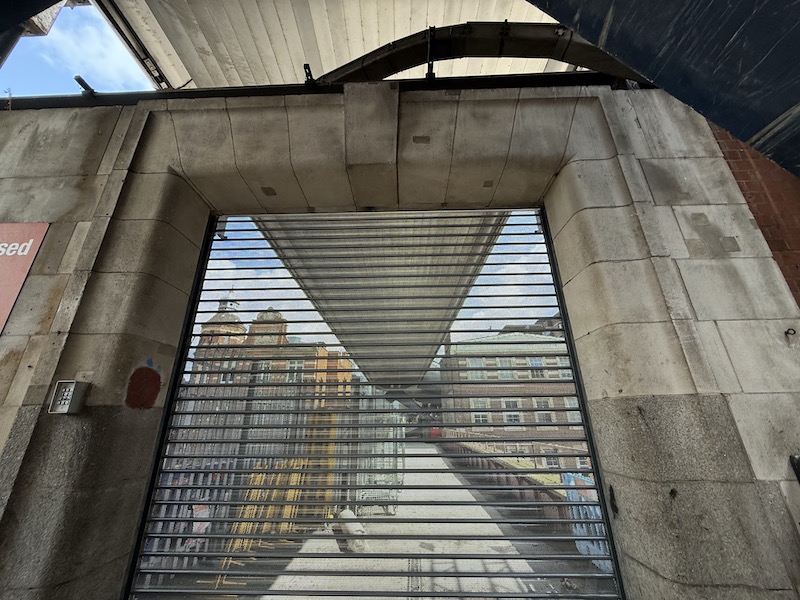
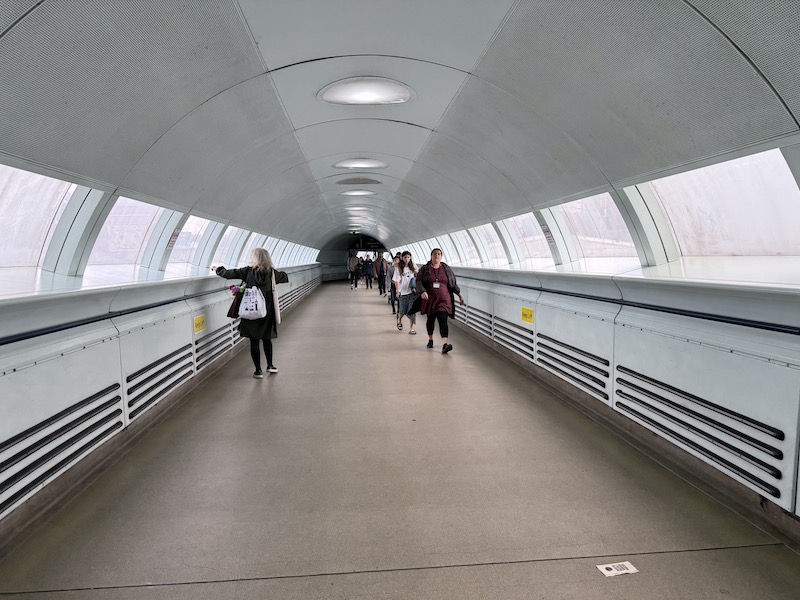
It was replaced with a tube style structure at a higher level which can be seen above the old link in the photos above (and from inside it, below).
Rachel also reminded us of the cab road which was located where Boots is now…

…between platforms 11 and 12 which also crossed the concourse….
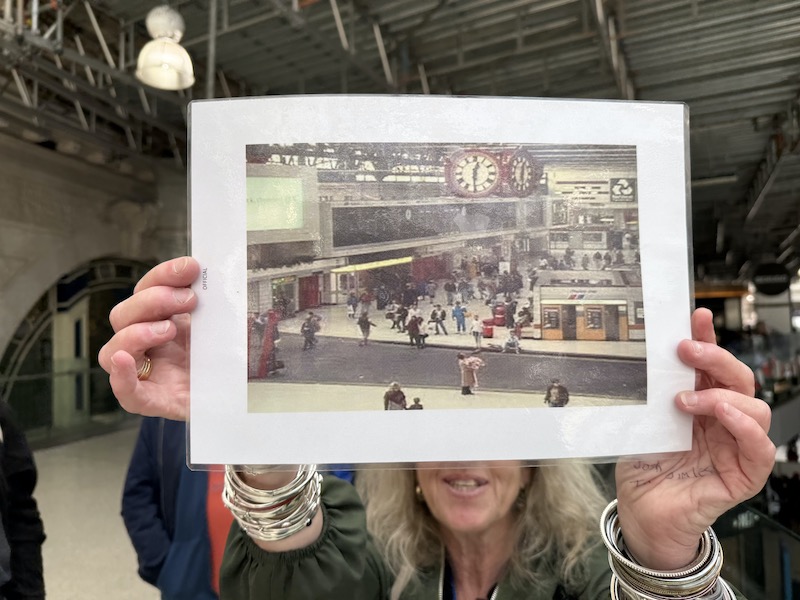
…and is hard to imagine now.
Just like at London Bridge, another footbridge taking passengers directly from the station to neighbouring streets was demolished as recently as the Covid lockdown. This one conveniently crossed York Road at a high level…

… providing a handy link from the northern end of the station concourse…

… over to South Bank without having to cross the busy road at ground level.

You can still see where the footbridge crossed York Road penetrating the huge abandoned Elizabeth House office block with its retail units on the ground floor all now empty…
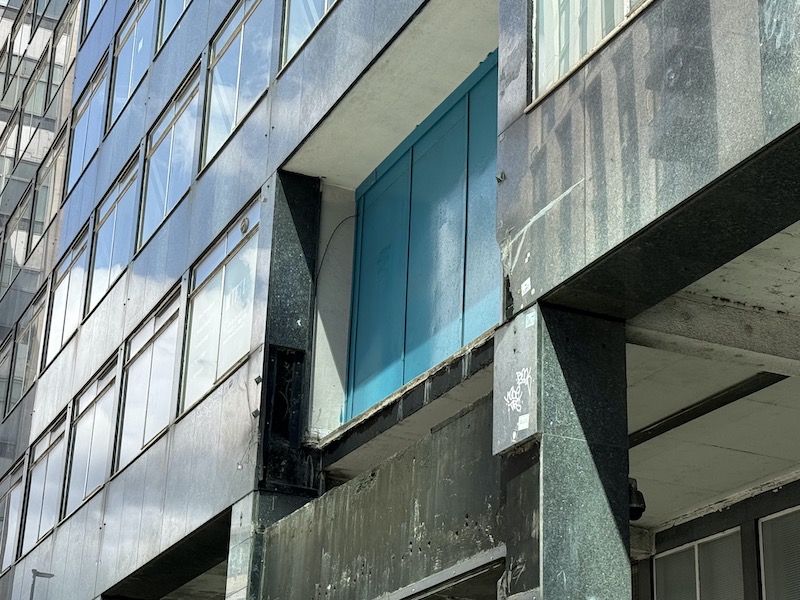
… as the building awaits demolition to be replaced with something more modern to regenerate the area and improve the ‘public realm’ outside the main entrance to Waterloo station itself.


Another surprise was being reminded the balcony inside the station was only opened as recently as 2012.
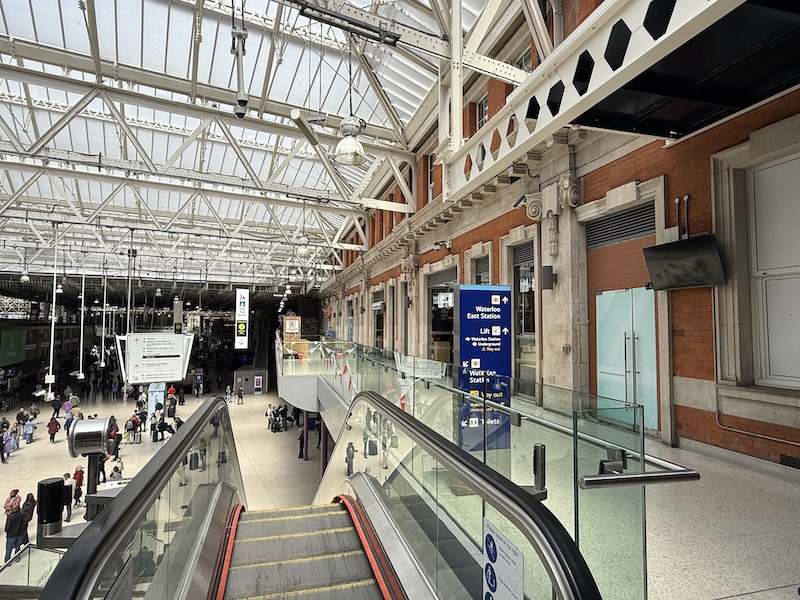
This provides some great views of the concourse and additional seating alongside the retail units. A fascinating sculpture has recently been added in this area with an interesting back story.
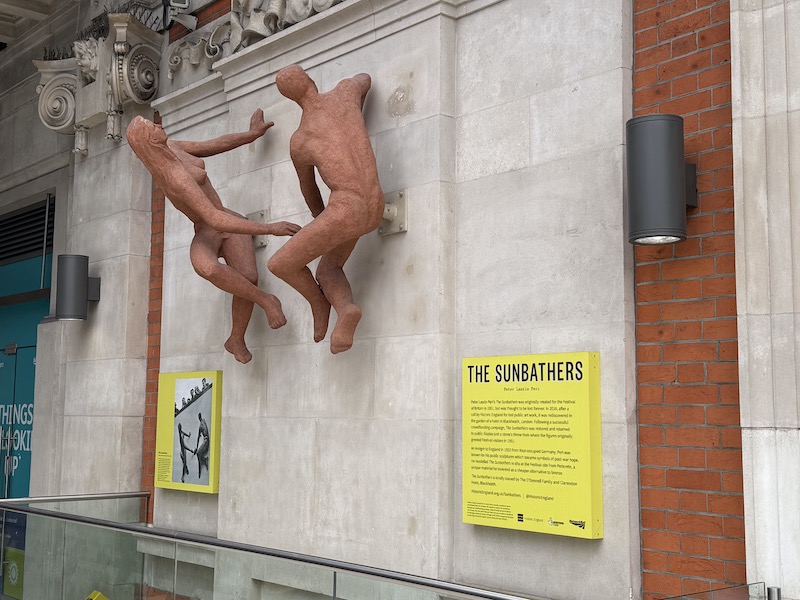
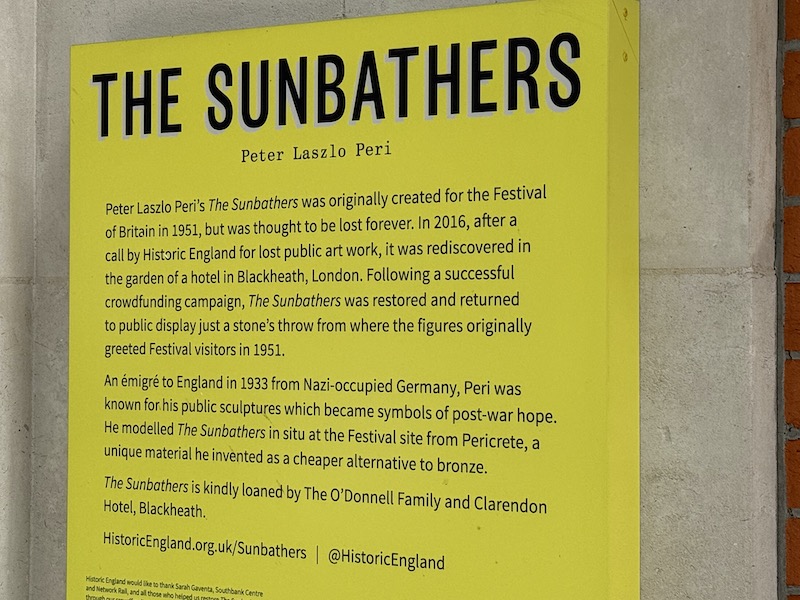
Called The Sunbathers, it was originally created by Peter Laszlo Peri for the Festival of Britain in 1951 and was thought to be lost forever, only to be rediscovered in the garden of a hotel in Blackheath in 2016.
Another iconic sculpture at the northern end of the concourse is one unveiled in 2022 to recognise the National Windrush Movement which has strong connections to Waterloo.

Opposite this one can see where a branch of the National Provincial Bank was once located on the concourse now the stonework bearing the name has been uncovered.

Close to this location, which is now occupied by Pure, there’s a branch of Foyles bookshop which was once a top class restaurant which had two lovely pay booths for diners to pay their bills as they left the premises…

… and which have been restored and can still be seen in the shop today.
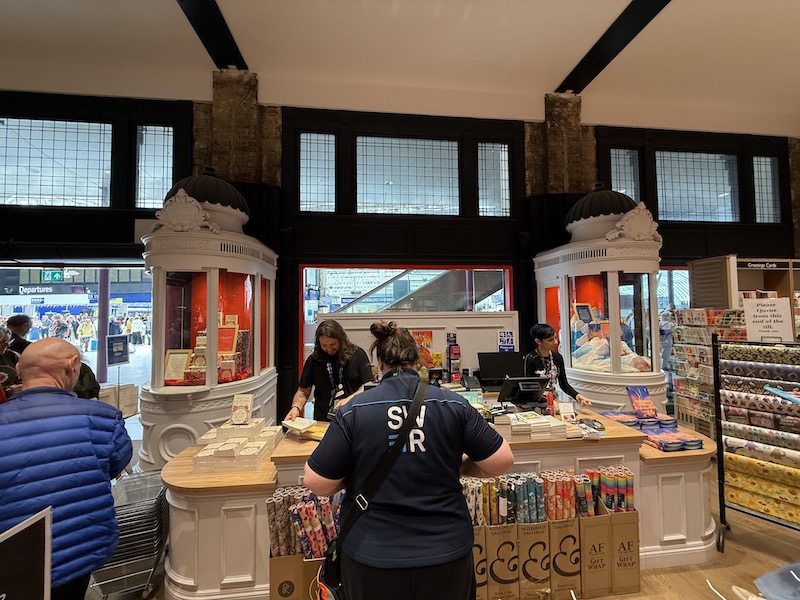
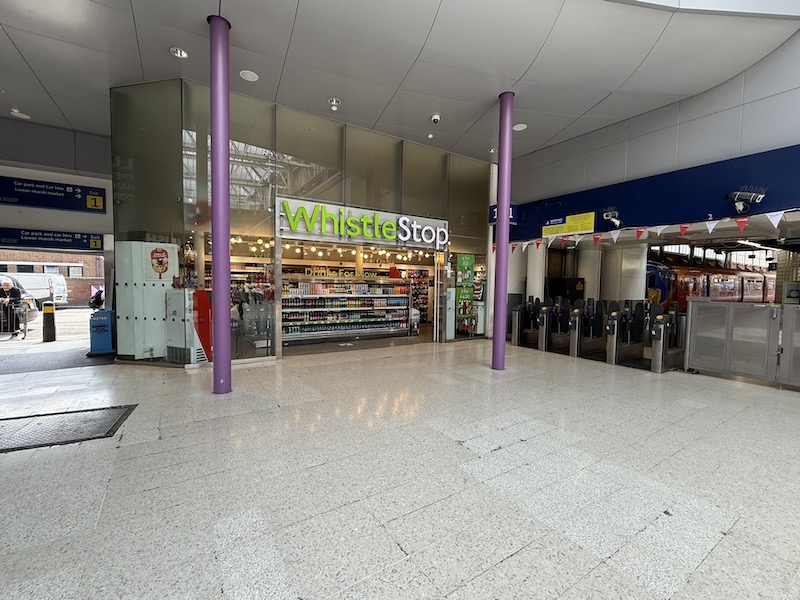
Down at the southern end of the concourse we were reminded there was once a cinema…

… which was located where WhistleStop is now.
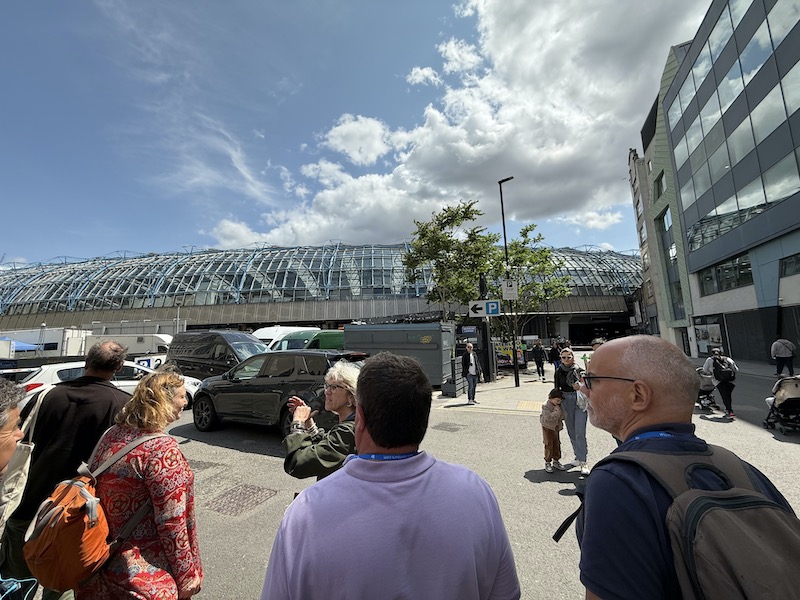
No tour of Waterloo would be complete without reference to Eurostar which had its terminal located in the newly built ‘blue caterpillar’ (as Rachel calls it) between 1994 and 2007…

… which we admired as we took a walk around the outside of the station…
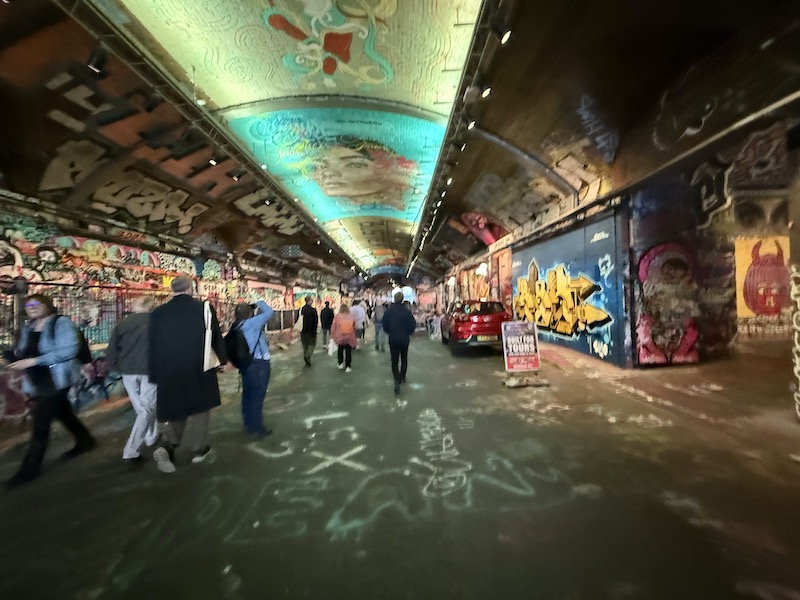
…continuing through Leake Street arches taking us under the station. Leake Street is now home to an amazing collection of official graffiti including parts of the street where lessons are given how to use spray cans…
… then continuing on to see where the terminus of the London Necropolis railway once stood in Westminster Bridge Road…

… now occupied by Westminster Bridge House.

Rachel explained the background to this unique railway which began in 1854 in response to severe overcrowding in London’s graveyards and cemeteries. It took coffins and mourners to the newly built Brookwood Cemetery in Brookwood, Surrey. The London terminus moved to the above location in 1902 and was used until destroyed during World War II.

Continuing our walk we passed through Lower Marsh Street Market…

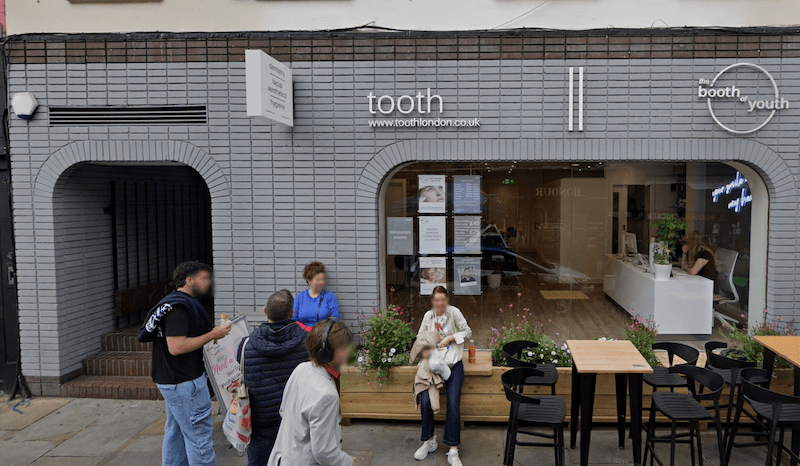
… noting the retail unit once occupied by the wonderful Ian Allan Bookshop (now home to a private dental emporium)…
… and concluded our tour taking a look at what many people think is the crane used to lift trains from the Waterloo and City line out of the depot located directly beneath this point. The line has no access to the wider Underground or National Rail network hence the need to crane trains in and out as required.

However, as Rachel points out, the working limit of this crane shown as 1.5 tons is nowhere near enough to lift an Underground train carriage and a massive mobile crane is now brought in when needed to fulfill the task.
It’s another fascinating tour and Rachel does a great job in bringing the station’s history to life describing so many interesting features you’d otherwise never know. One last one is hidden behind the scaffolding currently adorning the taxi road. It’s a recently installed mural showing the name Waterloo but as Rachel points out, the second ‘O’ of ‘WaterloO’ is depicted as a clock – showing the time of 18:48…

…. the year it all began at Waterloo.
Roger French
Blogging Summer timetable: 06:00 TThSSu


What has happened to the sculpture of railway artist Terence Cuneo, which at one time overlooked the International Concourse?
LikeLike
Terence Cuneo statue now at Brompton Barracks, Gillingham, Kent
LikeLike
Eurostar services started in 1994, not 1984.
LikeLike
Thanks; typo corrected.
LikeLike
Eurostar started in 1994, I think.
LikeLike
Thanks; typo corrected.
LikeLike
Elizabeth House had a 1960s charm and the shop units were affordable. No mention of the missed Red Arrow bus services from Waterloo
LikeLike
Fascinating!
LikeLike
Ray Davies (of Kinks fame) did a little film in the 80s called “Return to Waterloo”. In it you ca not only see the old cab road, but also the old station at Guildford. The film is set against an imaginary trip on the NewLines from Guildford to Waterloo via Oxshot.
Mike Jones
LikeLike
I live in the New Forest & Waterloo has always been my destination when visiting London over the years. I’ve spotted many famous faces getting off the train including Ray Davies of The Kinks accompanied by Tony Booth (Till Death Do Us Part) on one occasion. The Kinks were one of my favourite bands with the lyrics of Waterloo Sunset evoking so much about this part of London. Although I’ve stopped to look at various historical aspects around the station over the years, this blog certainly enhanced my knowledge. The reference to Lower Marsh Street also brought back memories of visiting the Ian Allan bookshop where, time permitting, I would spend time & money while waiting for my return train home.
LikeLike
Gosh, I remember the News Cinema – and I once ate at the “posh restaurant” with my mother, which featured a wonderful variety of railway cutlery!
By the way, I wouldn’t try cooking on the footbridge’s locked “grill” …
LikeLike
n the late-1950’s the News Theatre went over to screening one hour long continuous programmes of cartoons but later in the 1960’s went over to screening double bills of old Hollywood ‘classics’, and it was re-named Classic Cinema Waterloo. It closed on 14th March 1970 screening a double bill programme of Hitchcock’s “Torn Curtain” and “An Inspector Calls” and lay empty for 14 years until it demolished in 1988.
LikeLike
The cab road was a handy way to get to the platform ends.
LikeLike
I have used Waterloo station since the 70s. I remember handing in a petition to the Southern Regional offices when they cut back the last train to Shepperton ! I’ve seen it improve and decline over the years. Certainly improvements in ambience and retail and even cleanliness. The new toilets are pleasant but already falling apart with broken doors that don’t seem to get fixed. What the station lacks is s a decent restaurant. Plenty of fast food places but only one eatery on the balcony. Ok as long as you dodge the pigeons ! As far as connectivity is concerned that footbridge is a real loss. I remember when you could directly access the South Bank and the Festival Hall. As a pedestrian arriving and leaving the station is not brilliant and I’m not sure if Lambeth’s plans will do much maintain direct access through the Waterloo arch. Something should also be done to restore discipline with taxi drivers. Too often they drop off passengers blocking the buses from getting on the stand by Mepham Street.
LikeLike
I’m not sure a restuarant (as in full-service, sit-down type) is needed at the Station itself. This is largely a commuter station (at least these days); few passengers will be waiting more than an half-an-hour for a train and if they are getting food, will want something quick. There are plenty of restaurants in the surrounding area.
Julian Walker
LikeLike
Early French Eurostar passengers weren’t unduly amused about arriving at a station called ‘Waterloo’. As the Abba song rang in their ears, perhaps.
LikeLike
My wife & I travelled to Paris back in 2000 from the Eurostar terminal at Waterloo. We were both impressed by the facilities & helpful staff prior to our departure. The French may’ve been ‘amused’ by their arrival at a station called Waterloo but we met plenty of other English people, who like our-selves, were ‘not amused’ on arrival at Gare Du Nord. At that time, an old tired station lacking many of the facilities & assistance we enjoyed at Waterloo. C’est La Vie!
LikeLike
Lavvie! There, I said it (as requested)…
LikeLike
And once the kids have learnt to use the aerosol paint cans they can venture out onto the big railway and apply their knowledge to infrastructure and rolling stock….
LikeLike
Great look around but your tour omitted the vast labyrinth beneath the concourse and platforms! As anyone who ever uses the platform subway will tell you, there are several subsurface levels and slightly bewildering routes to the various Tube lines. From that we glimpse a tiny bit of what is nearly all a hidden world. Also, you could personally indulge us in a grand tour of all the various bus stops and routes that serve Waterloo, some of which are served by the escalator equipped-subway from the concourse to Tenison Way.
I personally think the interior view of the roof of the old Eurostar terminal is up there with the best of the Victorian station architecture that we rightly celebrate. That view was opened out by the conversion of the international platforms for domestic use and I recommend people to stop at the Windrush monument and stare for a while.
Lambeth Borough and Network Rail do have plans to improve the “public realm” between the Victory Arch and the South Bank. My goodness, it’s a right mess at the moment. Huge numbers of people walk through there, and they deserve something equalling the area around Kings Cross and St. Pancras in quality.
LikeLike
The Headquarters offices were my “home station” for three separate spells during my railway career. As others have alluded, even this two hour long tour has only scratched the surface of the secrets of Waterloo station and its surroundings. And can I be the first to mention the excellent documentary “Terminus” produced by the British Transport Films Unit in 1961.
Steven Saunders
LikeLiked by 1 person
Which Buckinghamshire station used to be served from Waterloo?
Brian
LikeLike
Wraysbury, on the Staines to Windsor branch, used to be in Buckinghamshire before boundaries were redrawn.
LikeLike
The restaurants on the balcony were very popular. I used to meet a daughter there until their closure. All the great stations in Europe used to have restaurants, which I miss.
Waterloo was a friendlier place before the installation of the barriers, which my wife and I find a real nuisance – often they do not work anyway.
A very odd and retrogade decision to close the walkway across York Road. As for the buses, apart from cutting all the well-used routes to the City except for the 76- why? – the stops are pushed further and further away- so is the taxi rank- making life more difficult for slow walkers.
Malcolm Chase – commuter for 30 years and irregular user since 1950s
LikeLike
I miss Ian Allen. Always went in there when I was in London. Together with the old Transport Museum shop (turned left, obviously) and the big Virgins, HMVs and Tower Records. Those were the days.
LikeLiked by 1 person
I hope that Rachel Kolsky was aware of Helen McKies two evocative paintings of Waterloo Station at war and in peace.
I don’t have time to acknowledge copyright so I will just dump the links here –
https://collection.sciencemuseumgroup.org.uk/objects/co8021757/waterloo-station-war
LikeLike
How do I make my poor contribution not anonymous?
Steve Wedd
Brighton
LikeLike
My dodge to avoid the horrible walk between the station and the South Bank is to use the escalators down to the tube level and then up the escalators to the exit on York Road. OK of course if you’ve got a travel card or a staff pass,
Lawrie
LikeLike
just a reminder that next week is Better Transport Week with lots of events planned.
https://bettertransport.org.uk/better-transport-week/
Peter Brown
LikeLike
Whatever the presumed quality of the coloured wallsprays in Leake Street, the crude white scribblings on the ground are just scruffy. If they are the result of tuition, the tutors need replacing PDQ.
LikeLike
All change at Waterloo
Waterloo station to emerge from under arches with new masterplan | The Standard
LikeLike